Dust on snow

A picture named dirtycareinstein.jpg

Here’s Part 1 of Mike Horn’s in-depth look at the problem of dust on snow events and their effects on the snowpack and runoff. His series will include a close look at the Gunnison Basin. From the article:

The new study shows this is due to increased dust caused by human activities in the region during the past 150 years. In addition, peak spring runoff now comes three weeks earlier than before the region was settled and soils were disturbed. Annual runoff is lower by more than 5 percent on average compared to pre-settlement levels…

Tom Painter, a snow hydrologist at both NASA’s Jet Propulsion Laboratory in Pasadena, Calif., and the University of California at Los Angeles, led the research team. His team examined the impact of human-produced dust deposits on mountain snowpacks over the Upper Colorado River basin between 1915 and 2003. Studies of lake sediment cores showed the amount of dust falling in the Rocky Mountains increased by 500 percent to 600 percent since the mid-to-late 1800s, when grazing and agriculture began to disturb fragile but stable desert soils…

The NASA press release explains why dust on snow is such a downer for water supplies. “More than 80 percent of sunlight falling on fresh snow is typically reflected back into space. In the semi-arid regions of the Colorado Plateau and Great Basin, winds blow desert dust east, triggering dust-on-snow events. When dark dust particles fall on snow, they reduce its ability to reflect sunlight. The snow also absorbs more of the sun’s energy. This darker snow cover melts earlier, with some water evaporating into the atmosphere. Earlier melt seasons expose vegetation sooner, and plants lose water to the atmosphere through the exhalation of vapor. The study shows an annual average of approximately 35 billion cubic-feet of water is lost from this exhalation and the overall evaporation that would otherwise feed the Colorado River.

More Gunnison River Basin coverage here.
Precipitation news

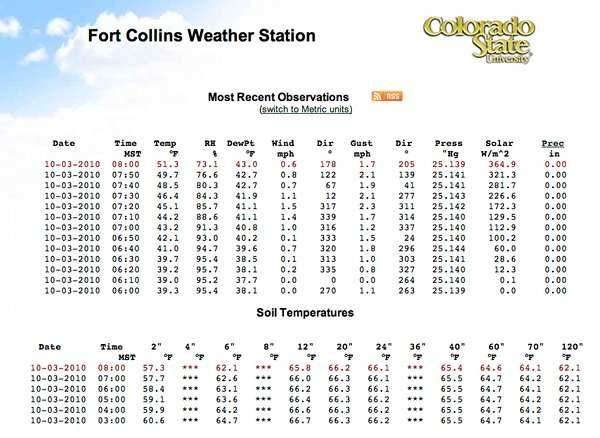
A picture named csufortcollinsweatherstation.jpg

From the Fort Collins Coloradoan (Bobby Magill):

Total monthly rainfall in Fort Collins was .06 inches – 4.3 percent of normal – making last month the seventh-driest September on record. The last year it was so dry in September was in 1992, when only .02 inches of rain fell that month. The culprit for all the dry weather was a giant high pressure over the Rockies, shunting storms well to the north, said Colorado State Climatologist Nolan Doesken.

Particularly unusual, he said, were wide temperature swings between day and night. Some mornings, he said, the temperature here dipped to below 40 degrees, but the daytime temperatures were in the 80s…

The region’s reservoirs are well above normal for this time of year, he said, with Horsetooth Reservoir at two-thirds capacity and Lake Granby nearly full. Lake Granby filled completely this year, something that hasn’t occurred since 1999, [Brian Werner from the Northern Colorado Water Conservancy District] said. There’s so much water in the region’s water supply system that “even with a below-average runoff and snowpack next year, we’re still going to be in good shape,” Werner said.

2010 Colorado elections: Proposition 101

A picture named saguachecreek.jpg

From The Pueblo Chieftain (Patrick Malone):

The Bell Policy Center quantified the impact to Colorado communities if Proposition 101 passes in November, cutting property taxes and vehicle and telecommunication fees.

When fully implemented, Proposition 101 would eliminate $1.7 billion a year in state revenue for road maintenance, emergency medical services, colleges and services to low-income and disabled citizens. Local governments would be deprived of funds for schools, road and bridge maintenance and libraries, it said…

Together with Amendments 60 and 61, Proposition 101 would place stringent limits on governments’ collection of taxes and ability to borrow and spend. Bell’s analysis of the impact showed that $3.84 million a year that goes to Pueblo County’s budget evenutally would shrink to $65,816, and the city of Pueblo’s funding would be cut from $1.06 million to $18,143. Funding to libraries in Pueblo County would dip from $652,513 today to $11,195. The local contribution to Pueblo City Schools would fall from the current $161 per student to $2.76 per student in 15 years or so. At School District 70, the contribution from local fees and property taxes would dip from today’s $240 per student to $4.11. School districts in surrounding counties would see per-pupil annual revenue streams strangled similarly: Canon City from $304 to $6.08, Florence from $422 to $8.44, Cotopaxi from $764 to $15.27; East Otero $298 to $6.94; Rocky Ford from $203 to $4.73, Manzanola from $127 to $2.96; Fowler from $277 to $6.45; Cheraw from $125 to $2.91; Swink from $315 to $7.34; Trinidad from $224 to $3; Primero from $1,650 to $21; Hoehne from $532 to $7; Aguilar from $555 to $7; Branson from $57 to $1 and Kim from $623 to $8.

Pueblo County’s two school districts currently receive $4.73 million annually from the fees that the proposition would impact. That amound would be cut to $81,063. The $1 million that Canon City School District receives now from local property taxes and fees would shrink to $20,709. And Florence School District’s $591,924 would shrivel to $11,834; Cotopaxi’s $164,423 would wane to $3,287. Funding for Las Animas County’s general fund would fall from $727,999 to $9,240. That county’s ambulance district funding would fall from $186,136 to $2,363, and its fire district’s current $163,386 would plummet to $2,074.

More 2010 Colorado elections coverage here.

It was a good week around Coyote Gulch

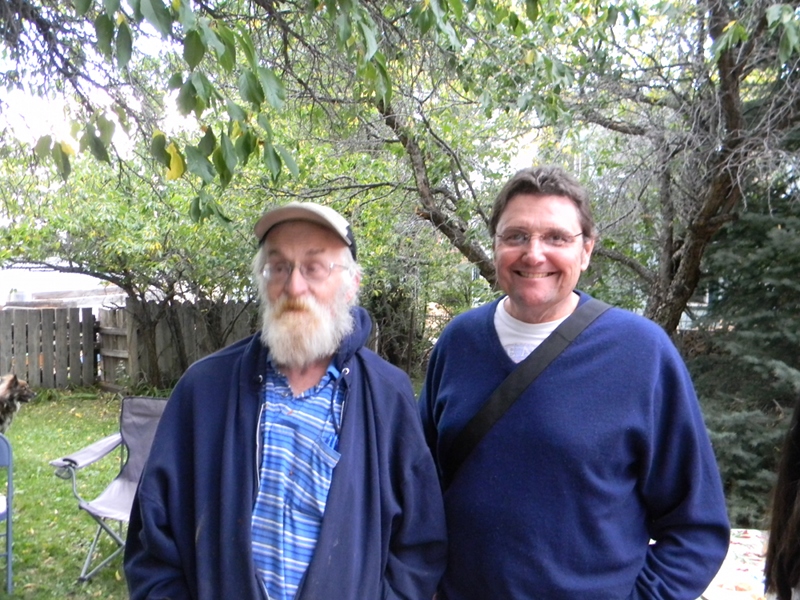
A picture named coyotegulchandedqullen10022010

Yesterday’s shindig at the Quillen’s in Salida was a hoot. The conversation ranged from George E. Ohr (1857-1918), of Biloxi , Mississippi whose break with traditions in potting earned him the moniker, The Mad Potter of Biloxi, to the legitimacy of unelected quasi-governmental water conservancy district boards.

Ed told me that Mike Rosso’s job — Rosso is the owner and publisher of Colorado Central Magazine — was to get the writers to the party. Ed’s role was to invite, “all the old Salida hippies.” The San Luis Valley was well represented as well.

Earlier in the week I was the guest of the Water Supply and Storage Company on a tour of their transmountain facilities. They operate both the Grand River Ditch and the Laramie-Poudre Tunnel. Those projects bring water into the South Platte Basin via the Poudre River. The WSSC representative said that it takes 1100 acre-feet a day to run the system.