World Water Monitoring Day: Littleton recap

A picture named studentslesherjhsamples.jpg

From the Littleton Independent (Tom Munds):

The Littleton Preparatory Academy class was among several schools that made Sept. 28 field trips to take part in the World Water Monitoring Day program hosted by the Littleton/Englewood Waste Water Treatment Plant. When schools arrived, classes were usually split into two groups. One group went to the plant building to look at displays and watch a slide show about the river, while the other group went to the river, where they ran a series of tests on the water. The groups then changed places.

At the river, students were divided into three- or four-member teams and each team ran the same series of tests on the river water. Advisers from the plant were on hand to guide them step-by-step through the testing process…

Tests include determining how much oxygen is in the water and performing a pH test to measure the level of acidity in the river. The students also run a test to determine turbidity or a measure of the clarity of the water. When the tests were completed, students got to wade out into the river with nets to see what creatures and critters they could find living in the water.

More education coverage here.

Energy policy — geothermal: Great Pagosa Aquifer has big potential to drive economic growth in the Upper San Juan Basin

A picture named pagosahotsprings.jpg

From the Pagosa Sun (Jim McQuggin):

Meeting with town and county officials last week, representatives from the National Renewable Energy Laboratory (NREL) — part of the U.S. Department of Energy’s (DOE) Office of Energy Efficiency and Renewable Energy — concluded a two-day visit to Pagosa Springs by telling local officials that, while future research is warranted, initial indications suggest a vast resource with almost unlimited potential. “There are a huge amount of resources,” said Gerald Huttrer, president of the Geothermal Management Company, Inc. and consultant for NREL. “The resource is way, way bigger than anybody had anticipated.”

That knowledge, said Elaine Wood, former Pagosa Springs resident and a consultant on clean energy projects with NREL, “Takes away the fear of scarcity.”[…]

The result of the visit and subsequent analysis of the Great Pagosa Aquifer, all three agreed, was a surprising view of a resource that had been previously viewed by many as a limited pool at risk of depletion. Not only did all three concur that ample resources existed for further possible use, but that processes could be employed to replenish geothermal water taken out of the aquifer. Calling Pagosa Springs a “pump and dump” community (meaning that geothermal water is currently dumped into the river after using it for heating), Lund proposed that future production wells be accompanied by injection wells — the means to put water back into the aquifer after drawing it up for heating or other purposes. While Lund stated that the aquifer contains ample amounts of water, injection wells would ensure adequate levels — as well as provide a psychological assurance that little danger exists of depleting the geothermal water. Huttrer added that reinjection would not alter the aggregate temperature of the aquifer. Comparing the reinjection process to trying to cool a hot bath with a drop of cold water, Hettrer said, “A 10 to 20 degree change (in reinjected water) relative to the amount of water (in the aquifer) would be immeasurable.”

From the San Juan Silver Stage Online:

The magma-heated Great Pagosa Hot Springs draws its name from the Utes who, after frequent skirmishes with other tribes and (legend has it) a decisive knife fight, eventually claimed the springs as their own. They called it “Pah gosah,” The term is open to loose interpretation. According to local lore, the name has been variously translated in recent years as meaning “boiling water” or “healing water.” However, a Ute elder once suggested that a more accurate translation would be “water that has a strong smell.” The sulphur-like odor comes from the water’s high concentration of hydrogen sulfide. For centuries, long before the white man came, the Utes and other Native Americans availed themselves of the mineral-rich water’s curative powers for multiple ailments. Some uses were rather imaginative. For instance, young warriors suffering from adolescent skin eruptions treated them by coating the offensive spots with the mineral rich mud.

The practice was later repeated by cowboys sparking a lady when the white man first came to the area and cattle ranching, and along with lumbering, was the economic backbone of Pagosa Springs. The cowboys often brought their horses to heal sore hooves in the warm, soothing mud after a long cattle drive. (The Indians did that too, supposedly bathing first the men, then the horses and last, the women!) But mostly, it was people who sought healing from the springs. Following the Civil War, and in conjunction with a world view that considered mineral baths a curative for all sorts of ailments, the Pagosa Springs became a popular spot for those suffering from arthritis, rheumatism, intestinal problems and more. It still is.

The Mother Spring dates back to as much as ten million years ago, when it was formed by volcanic activity that helped form what is now the San Juan Mountains. Nobody knows how deep it is, although several have tried to find out over the last century or two—none with much success. According to The Springs Resort, The Springs’ retained hydrologist coated an aluminum boat in foam, paddled out to the center of the pool and tested its depths with a sounding device. At 1500 feet, the device floated back up, buoyed by the hot water and hotter gasses streaming up from the Pagosa Aquifer below. So, it may very well be the deepest hot springs in the world. The water contains heavy concentrations of sulfate, sodium (no wonder we floated), chloride, potassium, silica and magnesium.

More geothermal coverage here and here.

South Platte River basin: Denver’s Overland pond

A picture named overlandponddenver.jpg

From the Washington Park Profile (Paul Kashmann):

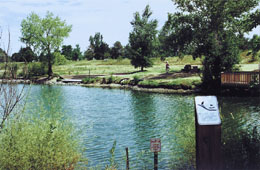
Born as remains of a once-active gravel pit that provided material for local road beds as well as fill for the Valley Highway (I-25), the pond and surrounding habitat that exists today was the 1980s brainchild of the late Merle Grimes. As a UCD graduate student in landscape design, Grimes had the idea for an ecological education park that would bring together a broad range of Colorado’s eco-zones in one location.

In 1986, having taken a position with the Greenway Foundation, Grimes put his ideas into action, spearheading creation of the Overland Pond habitat that would become the first natural area reclamation project along the Platte River Greenway.

Today, locals of all ages relax around the pond, fishing, listening to the birds and hoping to get a glimpse of the variety of other wildlife – fox, beaver, skunk, snakes, raccoons and turtles – that call the area home.

Fulfilling Grimes’ original mission, thousands of local students visit the pond each year. SPREE, the educational arm of the Platte River Greenway Foundation, brings all Denver Public Schools 5th graders either to nearby Grant Frontier Park or Overland Pond Park each year, and other school districts in the area make use of the pond for a variety of environmental programs.

More South Platte River basin coverage here.

2010 Colorado elections: Proposition 101, Amendment 60 and Amendment 61

A picture named norwood.png

From The Denver Post (Tim Hoover):

SurveyUSA conducted the recorded-voice poll of likely voters Tuesday through Thursday…

Amendments 60 and 61 and Proposition 101, which opponents have dubbed “the ugly three” as part of an expensive ad campaign, were polling abysmally. The three measures on the November ballot would cut billions in state and local taxes, prohibit all state borrowing and severely limit local debt. A coalition of businesses, labor groups and nonprofit organizations opposes the measures, which also are roundly opposed by most elected officials regardless of party. The poll showed 10 percent of likely voters supported Amendment 60, which would cut property taxes, while 48 percent opposed the measure and 42 percent said they were not certain. Similarly, 10 percent supported Amendment 61, which would bar state borrowing and limit local debt, while 49 percent opposed the initiative and 40 percent said they were unsure. Meanwhile, 12 percent of poll respondents said they were supporting Proposition 101, which would cut income taxes and vehicle and phone fees, while 44 percent opposed it and 44 percent were unsure.

The three measures are dead, said Denver political analyst Eric Sondermann. “I think these three initiatives have been successfully branded as way, way outside the pale,” Sondermann said. “Voters are in an angry mood. They’re in a disenfranchised mood. They’re in an alienated mood. “But they’re not in a crazy mood.”

More coverage from The Colorado Statesman (Marianne Goodland). From the article:

Former state budget director Henry Sobanet of Colorado Strategies did one of the estimates on the job losses that could result from passage of the three measures. He wrote in a July white paper that K-12 education could be the biggest loser, with 21,448 jobs lost; general construction could lose 20,744 jobs; general government, which includes local and state government, could lose 13,359 jobs; health care could drop 11,761 jobs; and transportation could lose 5,814 jobs.

In terms of revenue impacts, according to Sobanet’s report, Amendment 60 would require the state to cover $1.2 billion in lost mill levy revenues that would support K-12 education; Amendment 61 would cost the state more than $2 billion in lost public finance, and Amendment 101 would cost state and local governments about $2.3 billion in lost sales and income tax revenue. Amendment 60 amends the Taxpayers’ Bill of Rights in Colorado’s Constitution. It would reduce local property taxes for public schools’ operating expenses by 50 percent over 10 years and require the state to cover that lost funding. It also would require publicly-owned enterprises to pay property taxes. The largest of those enterprises is Colorado’s public colleges and universities that collectively hold more than $6 billion in property assets.

Amendment 61, which also amends TABOR, prohibits the state from issuing bonds for long-term needs, such as road and building construction; borrowing for short-term needs, such as day-to-day operations; and borrowing for lease-to-own purposes, primarily for new buildings or equipment. It also would prevent enterprises, such as public colleges and universities, from issuing bonds to finance new buildings. Proposition 101 is a statutory change that has constitutional implications. It would reduce or eliminate taxes and fees on vehicle registration, leases, rentals and purchases; eliminate taxes and fees for telecommunication services. It also would reduce the state income tax rate from 4.63 percent to 4.5 percent beginning in 2011, and eventually to 3.5 percent.

While Proposition 101 is a statutory change, its reduction of the state income tax could not be overturned without voter approval, due to TABOR. In addition, Proposition 101 requires voter approval for any increase in taxes or fees for vehicle or telecommunication services…

Amendment 61 is especially dangerous, perhaps even insidious, said John Beeble, president of Saunders Construction. Because the amendment uses “borrowing” instead of “bonding, people think it has something to do with overspending in Washington,” Beeble said, but what it really does is end publicly-financed construction projects. “Colorado will be the only state that prohibits the use of bonding and revenue notes,” Beeble said. “I don’t want to be in that state.” Beeble also noted that had Amendment 61 been in place in the past, the TRANS project that funded T-Rex and other transportation projects could not have happened, nor could the building of the University of Colorado Anschutz Medical Campus. “Bonding is a responsible way to fund public infrastructure such as roads, dams, airport, light rail, school, college buildings and water treatment facilities,” Beeble told reporters. “The people behind 61 want to take bonding off the table and [that will cost] 21,000 jobs in small businesses — painters, pavers, plumbers, architects and electricians — who make large projects happen in Colorado.”

More coverage from Joe Hanel writing for The Durango Herald. From the article:

There’s a difference between financing and deficit spending, [Dan Hopkins, spokesman for Coloradans for Responsible Reform] said. The state and local governments already have to have balanced budgets.

More coverage from the Sky-Hi Daily News (Reid Armstrong and Tonya Bina). From the article:

But, if 101 passes, the hurt would be felt across the county, according to Grand County Director of Accounting Scott Berger, who said Proposition 101 could reduce county revenues by $500,000, cutting support primarily to Grand County’s road and bridge department. The full combined effects of 101 impact Grand Lake by an estimated $46,455 in the first year while the Town of Winter Park predicts that it will lose almost $198,000 in the first year alone from Prop 101, according to a report complied by Finance Director Bill Wengert. Winter Park might not have to shut the doors, but putting that first-year total in perspective, Grand Lake’s total road maintenance budget in 2010 is $45,000, according to Grand Lake Town Manager Shane Hale. And for towns like Granby, income from franchise fees alone, which amount to $35,000, are the equivalent to the wages of one town employee, pointed out Granby Town Manager Wally Baird.

Hale calls the measures a “race to the bottom.” “Let’s see how quickly this state can get under states like Arkansas for the least favorable public perception,” he said.

More 2010 Colorado Elections coverage here.

Energy policy — coalbed methane: State Engineer’s Office forum recap

A picture named nontributarycoalbedmethane.jpg

From The Pueblo Chieftain (Chris Woodka):

Before last year, the state did not administer water produced by coal-bed methane wells. The water in question is groundwater commonly found along the seams of coal from which methane gas is extracted. In the Arkansas River basin, there are hundreds of wells located in Las Animas and Huerfano counties. There are also large coal-bed methane fields in the San Juan and Picance basins in Western Colorado, as well as at smaller sites around the state…

The state Legislature subsequently passed a law, 09-HB1303, that affirmed the Supreme Court decision that removal of water for coal-bed methane is a beneficial use. The law also directed State Engineer Dick Wolfe to develop rules for oil and gas wells. “So, what does it mean? It means the state could issue permits, and it could mean a big curtailment,” [Kevin Rein, assistant state engineer] said. Nontributary groundwater is not affected by the decision or the law, however. The state does not administer nontributary groundwater — that which is pumped from wells that would not have a 1 percent depletion on surface flows over 100 years. Earlier state laws, 73-SB213 and 85-SB5, give certain rights to landowners or oil and gas drillers to nontributary water. Because gas wells often are thousands of feet deep, as opposed to hundreds of feet for most domestic or irrigation wells, many could be nontributary, Rein explained…

In coal-bed methane production, the removal of water itself is considered a beneficial use, so all require a permit if the groundwater is deemed tributary. In other oil and gas production, the state still regards only water used for purposes such as dust suppression or fracturing geologic formations as beneficial. So far, about 5,000 coal-bed methane wells have obtained permits, and some companies have begun filing for water rights in Water Court or substitute water supply plans from the Division of Water Resources.

More coalbed methane coverage here and here.