Update: Here’s a release about the oil shale NEPA review from Governor Ritter’s office (Evan Dreyer):
GOV. RITTER STATEMENT ON BLM STEPS TOWARD OIL SHALE RD&D LEASING
Gov. Bill Ritter issued the following statement today regarding the U.S. Bureau of Land Management’s steps toward additional oil shale research activities:
“BLM Director Bob Abbey’s announcement that it will continue to analyze three oil shale research proposals follows Interior Secretary Salazar’s important reforms in Research, Development & Demonstration leasing. The RD&D program that this Administration is implementing has elements that I have long supported, including constraints on the size of leases and substantial due diligence and reporting requirements.
“Colorado has always supported a robust RD&D process to research and evaluate the technologies that could be used to develop oil shale and to better understand the environmental impacts.
“The potential for oil shale development in Colorado, and the economic opportunity that it represents, is huge. But the prospect of commercial-scale activities raises significant questions about how oil shale can be successfully integrated into our state’s economy and how we can protect the state’s environment, water, wildlife and communities.
“The RD&D program is wisely designed to answer fundamental questions about the feasibility of the technologies, their likely impacts on the environment and communities of Western Colorado, and their use of our scarce and valuable water supplies. As I have always maintained, these questions must be answered before oil shale research can transition to commercial development.
“I’m therefore pleased that Director Abbey is taking such a thoughtful approach.”
Here’s the release from the Bureau of Land Management (Matt Spangler/Vince Vogt):
The Bureau of Land Management today announced that it has taken a key step to advance research on an important potential source of domestic energy.
The BLM’s Washington, D.C., Office has completed its review of three nominations for oil shale Research, Development, and Demonstration (RD&D) leases in Colorado and Utah. These second-round leases would allow the proponents to test the feasibility of various oil shale recovery technologies on public lands in the two states. The nominations will now be forwarded to the agency’s Colorado and Utah State Offices for the next phase in the review process.
BLM Director Bob Abbey said, “To determine whether oil shale will be a viable energy source on a commercial scale, we need to support critical research to answer fundamental questions about the feasibility of the technologies, their impacts on the environment and local communities, and their use of water. This second round of leases will help us answer those critical questions so that we can chart a safe, orderly, and responsible path for our energy future.”
Abbey added, “The BLM is committed to careful consultation with all affected stakeholders in the oil shale process, including states, counties and tribes. The analysis that our states will now conduct will help us chart a wise path for western shale oil resources.”
In November 2009, the BLM published a notice in the Federal Register calling for nominations for a potential second round of oil shale RD&D leases, following the awarding of six leases in an initial round in 2007.
The BLM solicited nominations of parcels, not to exceed 160 acres, for the conduct of oil shale research, development, and demonstration under a 10-year lease term. Applicants could also identify up to an additional 480 acres to be reserved for a potential commercial lease, for a total of 640 acres. The lease size available for commercial development was reduced from the 5,120 acres in the first round of leasing because the substantial reserves represented by 640 acres are more than adequate for a major oil shale production operation. The second- round leases would contain substantial diligence requirements, including specific timeframes for submitting plans of development, obtaining state and local permits, developing infrastructure, and submitting quarterly reports.
The BLM received three nominations in early 2010: two in Colorado, from ExxonMobil Exploration, Co., and Natural Soda Holdings, Inc.; and one in Utah, from AuraSource, Inc.
Earlier this year, the BLM formed an Interdisciplinary Review Team (IDRT) with representatives of the Governors of Colorado, Utah, and Wyoming; the Department of Energy; and the Colorado School of Mines. The team recommended that all three nominations be advanced.
The Colorado and Utah offices will now conduct National Environmental Policy Act (NEPA) reviews of the nominations. The analyses may take from four to 18 months to complete, depending upon the complexity of the resource issues to be analyzed.
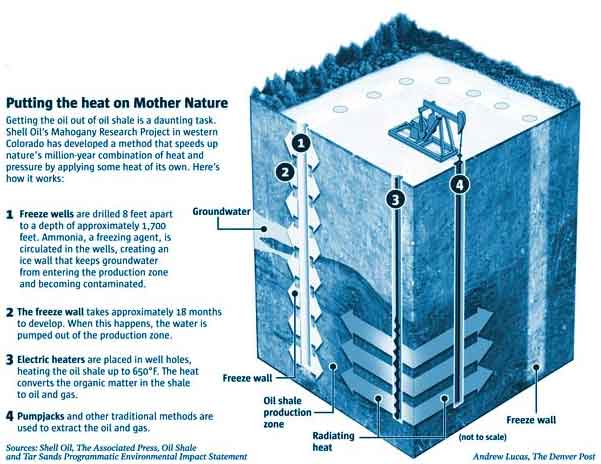
Oil shale is a fine-grained sedimentary rock containing organic matter from which shale oil may be produced. The organic matter, derived mainly from aquatic organisms, is called kerogen.
According to the United States Geological Survey, the U.S. holds more than half of the world’s oil shale resources. More than 70 percent of the U.S. supply lies on Federal lands in Colorado, Utah, and Wyoming.
From the Deseret News (Amy Joi O’Donoghue):
Colorado and Utah offices of the BLM will now complete a federally mandated environmental review. That could take up to 14 months. One lease is held by AuraSource in Utah, while the other two are in Colorado with Exxon?Mobil Exploration Co., and Natural Soda Holdings Inc.
AuraSource Chief Financial Officer Eric Stoppenhagen said the two-year-old company uses a low-temperature catalytic process to recover oil from oil shale, relying on less than one barrel of water per barrel of shale oil that is produced. Water consumption is driven more by mining and road dust control, as well as reclamation efforts. In China, AuraSource’s plant in Qinzhou has the processing capacity of 1 million tons of oil shale.
BLM’s director Bob Abbey said the projects will serve as a good blueprint to answer fundamental questions about the technology of oil shale extraction. “To determine whether oil shale will be a viable energy source on a commercial scale, we need to support critical research to answer fundamental questions about the feasibility of the technologies, their impacts on the environment and local communities, and their use of water,” Abbey said. “This second round of leases will help us answer those critical questions so that we can chart a safe, orderly and responsible path for our energy future.”[…]
Environmental groups, however, blasted the announcement. “Oil shale is nothing more than a dirty, expensive pipe dream,” said Bobby McEnaney, lands advocate for the Natural Resources Defense Council. “This administration is making smart decisions by investing in clean energy that will create jobs and reduce our dependence on oil. Oil shale undermines that effort,” McEnaney said.
More coverage from the Colorado Independent (David O. Williams):
BLM director Bob Abbey today announced the federal agency has reviewed nominations for three potential lease-holders — ExxonMobil and Natural Soda in Colorado and AuraSource in Utah – and will now forward them on to state regulatory agencies for the next phase of consideration. “The potential for oil shale development in Colorado, and the economic opportunity that it represents, is huge,” [Governor Ritter] said in a release. “But the prospect of commercial-scale activities raises significant questions about how oil shale can be successfully integrated into our state’s economy and how we can protect the state’s environment, water, wildlife and communities.”
“People have been trying to figure out how to suck the hydrocarbons out of these rocks for over a century,” former oil shale worker Craig Thompson said in a release. Thompson is now a professor of engineering at Western Wyoming Community College and on the board of the National Wildlife Federation. “No one has found an economic solution. When Exxon pulled the plug on their $5 billion gamble and laid off 2,200 workers, the West learned a bitter lesson. The last thing we need is another pipe dream and another economic ‘bust.’”
More coverage from the Denver Business Journal (Cathy Proctor):
The leases — the second round of federal oil shale leases offered in recent years — underwent review at federal agency’s headquarters in Washington and now will undergo additional review by BLM personnel in Colorado and Utah, the agency said. The department-level review team included representatives of the governors of Colorado, Utah and Wyoming, the U.S. Department of Energy and the Colorado School of Mines. The team recommended that all three nominations be moved to state-level reviews. The BLM’s Colorado and Utah offices will now conduct National Environmental Policy Act (NEPA) reviews of the proposals, a process that could take four to 18 months to complete, according to the BLM.
More oil shale coverage here.