Here’s the release from Southeastern Water (Chris Woodka), USBR (Elizabeth Smith), and Pueblo Water (Joe Cervi):
A three-party contract allowing for the Arkansas Valley Conduit to deliver clean drinking water to 50,000 people in 39 communities east of Pueblo was signed by the Bureau of Reclamation on March 18, 2022, following approval by the Southeastern Colorado Water Conservancy District Board and the Pueblo Board of Water Works (Pueblo Water). The contract was drafted after negotiations that began in November 2021.
“This contract signing marks one of the most significant milestones to date towards making the AVC a reality and bringing clean water to communities that desperately need it. It advances the project over 14 miles east from Pueblo Reservoir which puts us much closer to our first participants in Avondale and Boone,” said Brent Esplin, Regional Director of the Missouri-Basin and Arkansas-Rio Grande-Texas Gulf regions for Reclamation. “It is also the culmination of years of collaboration between Reclamation, Southeastern, and Pueblo Water to deliver a more cost-effective project to people of the lower Arkansas Valley.”
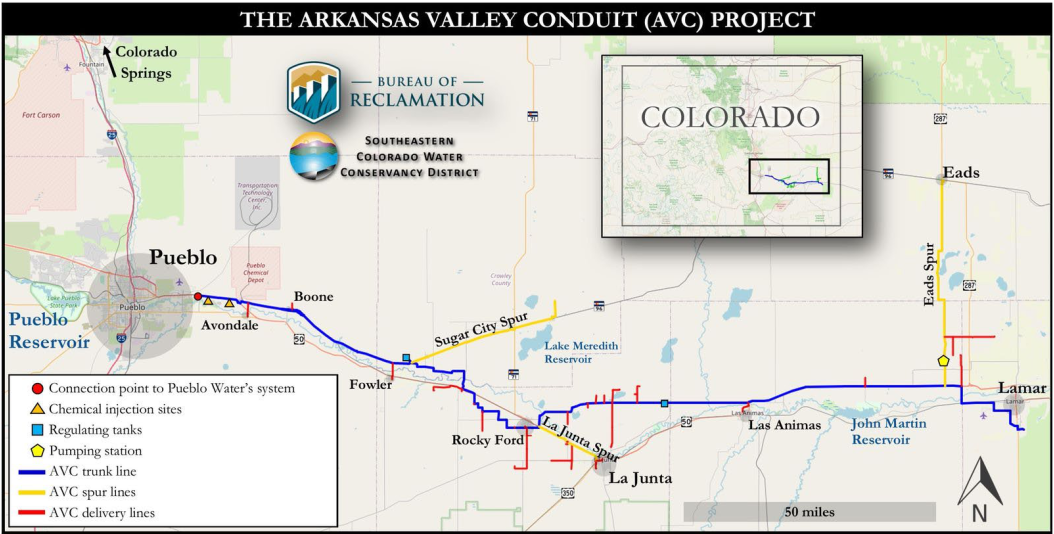
The contract will allow the Southeastern District to use capacity in Pueblo Water’s system to treat and deliver AVC water to a pipeline being constructed by Reclamation. The connection point for AVC is at the east end of Pueblo Water’s system, at 36th Lane and U.S. Highway 50.
Arkansas Valley Conduit map via the Southeastern Colorado Water Conservancy District (Chris Woodka) June 2021.
The water will be either Fryingpan-Arkansas Project water or from participants’ water portfolios, not from Pueblo Water’s resources. The route of the AVC follows the Arkansas River corridor from Pueblo to Lamar, with spurs to Eads and Crowley County. Reclamation is building the trunk line, while the Southeastern District will build the spur and delivery lines. Estimated total cost is about $600 million.
The Southeastern and Pueblo Water boards both unanimously approved the contract on March 15 and 17, 2022, respectively.
“This project is vitally important to the people of the Lower Arkansas Valley,” said Bill Long, President of the Southeastern District board. “It would not be viable, and certainly not affordable without the partnership with Pueblo Water, and I would like to express my appreciation to the board.”
“This is a truly monumental achievement and marks the culmination of decades of hard work, dedication, and collaboration by those who have devoted their lives to the business of water,” said Seth Clayton, executive director of Pueblo Water. “Pueblo Water is proud to be an integral participant in this important time in history.”
Many of the Lower Arkansas Valley water systems face water-quality enforcement actions for radionuclides or surface contaminants in groundwater sources. They face ever increasing costs to cope with these problems. The AVC will eliminate or reduce the effects of those contaminants by delivering filtered water from Pueblo Reservoir.
To deliver the full volume of water through the system, Pueblo Water must make some upgrades, and will receive a $20 million construction recovery fee. In addition, Pueblo Water will receive a $2 million investment payment. As the needs of AVC grow, Pueblo will receive funding for necessary improvements.
This is seen as a win-win opportunity by both Pueblo Water and the Southeastern District because it reduces the cost of an earlier plan to build a new pipeline south of Pueblo.
“Not only does the agreement save the AVC project hundreds of millions of dollars and years of construction time, but it also benefits Pueblo Water customers by providing an opportunity to use the excess capacity we have in our system and deliver water to our neighbors in the Lower Arkansas Valley,” Clayton said.
Pueblo Water will charge an initial rate of $2.19 per 1,000 gallons delivered, which reflects the operation and maintenance costs of those parts of the system needed by AVC. The rate will increase annually at the same rate as Pueblo Water’s other customers.
Pueblo Water will also renew its contract to store excess capacity water in Pueblo Reservoir for a 50- year period under the contract.
Finally, the contract spells out environmental commitments and operating conditions related to AVC.
“The significance of this action is that everybody will have the opportunity to have a clean source of drinking water after more than 20 years of work,” said Jim Broderick, executive director of the Southeastern District.
Alan Hamel, a Southeastern Board member, and former Pueblo Water executive director, said the idea for the AVC actually goes back 60 years, to the 1962 signing of the Fryingpan-Arkansas Project into law.
In 1968, there was a plan to jointly build a federal treatment plant for Pueblo Water and the water line for AVC.
The AVC was put on hold because of the inability of communities to pay for it. The AVC concept was revived in 2000, and a 2009 federal law provided for 65 percent federal funding, to be matched by 35 percent in other funding.
Reclamation issued a Record of Decision in 2014 which endorsed construction of the AVC to proceed via the “Comanche North” alignment. The alignment was modified in 2019 through a collaborative effort between Reclamation, Southeastern, and Pueblo Water which replaced the pipeline around Pueblo with this contract.
Federal funding so far has totaled $40 million, while $100 million in loans or grants is available to AVC through the Colorado Water Conservation Board. The District has contributed $4.8 million through its Enterprise, while participants have paid $1.5 million since 2011.
Pueblo County recently contributed $1.2 million to build delivery lines to Boone and Avondale through local American Rescue Plan Act funds, and other counties or cities in the Arkansas Valley are expected to contribute as well.
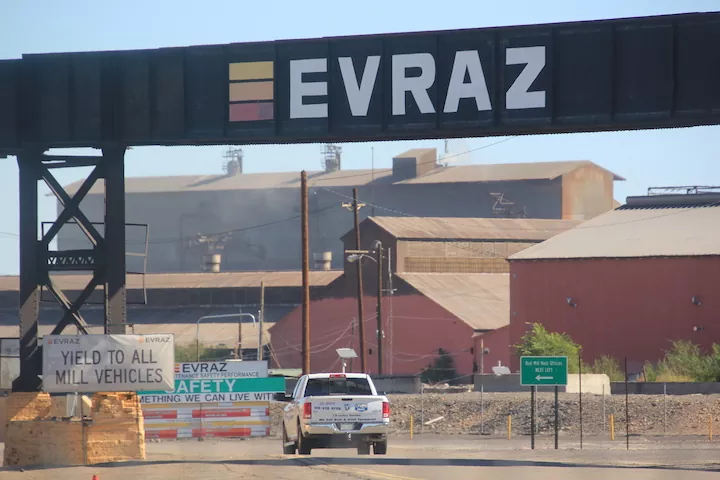
Putin crony Roman Abramovich’s ownership of London’s Chelsea soccer club has been crimped by sanctions levied by the U.K. The Colorado steel mill of which he is a major owner is operating as usual—for now. Photo credit: Allen Best/Big Pivots
Click the link to read the article on the Big Pivots Website (Allen Best):
In the early 20th century Pueblo’s steel mill was owned by American oligarchs, John Rockefeller Jr., the descendants of Jay Gould, and others. Might ownership of that steel mill—and Colorado’s largest solar array—revert to American ownership as a result of the Russian war against Ukraine?
Now called Evraz, the steel mill is owned primarily by Russian oligarchs, with Roman Abramovich having the largest stake.
The United States has not yet imposed sanctions on Abramovich, unlike the United Kingdom and Canada. That leaves his ownership stake in the Pueblo steel mill intact as well as his ownership of two houses in Snowmass Village.
In Pueblo, there are doubts that the mill could end up being cut off from its Russian owners because the product is for the domestic consumption, not for export.
But then Chelsea, the soccer club in London that Abramovich owns, is no longer selling tickets, the result of sanctions applied last Thursday by the United Kingdom. As long as Russia’s war against Ukraine continues, ownership of the plant in Pueblo will remain an active question.
Evraz North America, which operates the steel mill, is a wholly owned subsidiary of Evraz, a company incorporated under laws of the United Kingdom, with shares traded on the London Stock Exchange—until last Thursday.
In sanctioning Evraz, the British government accused Roman Abramovich, the largest shareholder, of being a “pro-Kremlin oligarch” who has received preferential treatment and concessions from Putin and the Russian government and “is or has been involved in destabilizing Ukraine and undermining and threatening the territorial integrity, sovereignty and independence of Ukraine.”
The statement also accused Evraz of “potentially supplying steel to the Russian military, which may have been used in the production of tanks.” In response to a Financial Times inquiry, the company insisted it only made steel for the “infrastructure and construction” sectors, the Financial Times reported.
The Financial Times last Friday also reported that 10 members of Evraz had resigned after the United Kingdom’s action.
Canada last Friday also imposed sanctions on Abramovich, and on Tuesday so did the European Union.
Within hours of the Russian invasion of Ukraine, the United States imposed actions against several Russian oligarchs and institutions, but not Abramovich nor Evraz.
Five Russians own two-thirds of Evraz’s shares. Second to Abramovich in holdings is Alexander Abramov, a former scientist who founded Evraz in 1992. The other three are also Russian oligarchs, reported the Pueblo Chieftain in a March 5 story.
An oligarch is defined as a very rich business leader with a great deal of political influence. An oligarchy is a country ruled by oligarchs. Forbes in 2021 ranked Abramovich as 12th wealthiest among Russia’s billionaires, with a net worth of $14.5 billion.
Evraz also has steel, mining, and vanadium operations in Russia, the Czech Republic, and Kazakhstan.
In the United States, Evraz has mills in Pueblo, which has 1,100 employees, and in Portland, Ore. It also has five mills in Canada, three in Alberta and one in Saskatchewan, according to its website.
Evraz also has scrap operations, including one along the South Platte River north of downtown Denver.
Nowhere has there been even a suggestion that the Pueblo steel mill or other operations in North America have directly supported the Russian war effort.
The Pueblo mill primarily uses recycled steel to make its products, which requires a lower temperature than is necessary when using iron ore and other raw resources. Foundry operations became electrified in the early 1970s, the result of construction of the nearby Comanche 1 and 2 coal-burning units.
Early last November, a 298-megawatt solar farm was completed on land owned by Evraz between the steel mill and beyond the Comanche units. This allowed the steel company to proclaim that it had become the first solar-powered steel mill in the world, as Big Pivots explained. Financial and other details of that claim have never been made public.
The investment in the solar farm hinged upon plans to go forward with construction of a $500 million mill that will make quarter-mile rail segments that Union Pacific, Burlington Northern-Santa Fe, and other railroads want. The construction project employs 400 to 500 people.
Jeffrey Shaw, chief executive of the Pueblo Economic Development Corporation, says the impact to Pueblo and the steel mill there appears to be nil.
“We have asked what the impact of the global geopolitical front will be to the facility, and the answer we have gotten back (from Evraz) is—consistent with what has been reported—that they are moving forward with the facility,” he says. He also points that the market for the products of the steel mill is domestic, not foreign.
Driving by the mill, construction work continues with no evidence of slowdown. “We’re very optimistic that it will carry on” as planned, he added.
The Pueblo Chieftain story by editor Karin Zeitvogel reported no changes evident at the steel mill in early March. “We haven’t seen anything yet, and everything is just like it was a week ago,” said Eric Ludwig, president of the United Steelworkers 2102 Union, a week after the invasion.
The Evraz annual report for 2021 noted the cloudy global horizon, referring to Ukraine five times and potential for sanctions nine times. The report mentions the “worsening situation relating to Ukraine and heightened risk of the economic sanctions.”
In modeling, the company also described a “severe downside scenario” that could cause it to reduce capital spending by $500 million a year.
Might that include the work on the new Pueblo mill? No mention there.
Abramovich was the focus of a lengthy New York Times article on Sunday that explored his ties with the United States and other western countries. An orphan who grew up in a town along the Volga River, he dropped out of college and then emerged from the Red Army in the late 1980s just as the Soviet leader Mikhail Gorbachev was opening new opportunities for private enterprise. Abramovich, says the Times, thrived as a trader—of almost anything and everything, it would seem.
The big break for Abramovich came in the mid-1990s, when he and a partner persuaded the Russian government to sell them a state-run oil company for $200 million. In 2005, he sold his stake back to that government for $11.9 billion.
His holdings include the Chelsea soccer team in London, which he bought in 2003 and which he was frantically trying to sell last week before the UK sanctions. The sanctions prohibit the club from selling tickets to matches.
The Times said leaders of cultural, educational and medical institutions, along with a chief rabbi, had sent a letter urging the United States not to impose sanctions on Abramovich, a major donor to Jewish and other causes.
A request to the American ambassador to Israel “reflects the extraordinary effort Mr. Abramovich, 55, has made over the last two decades to parlay his Russian fortune into elite standing in the West,” said the Times, going on to describe his houses, his art works, his yachts, his private 787 jet, and more.
That includes real estate in Colorado’s most elite resort community. The Aspen Times on March 1 explained that Abramovich has owned two houses in Snowmass Village since 2008. One 12,859-square-foot house has 11 bedrooms and 13 bathrooms and sits on 200 acres of land. The smaller 5,492-square-foot house sits on 1.8 acres of land.
Abramovich’s name is also prominent in Aspen, reported Rick Carroll of the Aspen Times. Lettering on the outside of a synagogue on Main Street in Aspen suggests Abramovich and his now ex-wife Dasha were major donors.
Russia’s oligarchs have “used their ill-gotten gains to try to launder their reputations in the West,” Thomas Graham, a Russian scholar from the Council on Foreign Relations, told the New York Times. “But the message of these sanctions is, that is not going to protect you.”
Michael McFaul, an American ambassador to Moscow during the Obama administration, described disingenuous behavior on several sides. He told the Times that while Putin’s government claimed to despise the United States and its allies, his foreign ministry was constantly trying to help the oligarchs around him, including Abramovich, obtain visas so they could ingratiate themselves with the Western elite.
“On our side, we have been playing right along,” he said, overlooking ties of the oligarchs to Putin and welcoming them and their money.
Sources also told the Times that the relationship that Abramovich and other oligarchs enjoyed with Putin cut both ways. After Putin was inaugurated president in 2000, he quickly moved to dominate the billionaires who had profited from privatization, sending a message by jailing the richest and most powerful oligarch. Abramovich is one of the few early elites who remained in Putin’s circle.
Putin’s display of force, however, also gave oligarchs freedom to establish ties in the West—as potential places to land.
As for Pueblo, it’s had ups and downs in the last 141 years it has been making steel. The mill was a consequence of Pueblo having rail connections, water, and proximity to coal, iron ore, and limestone. Coal mines at Crested Butte, Redstone, and elsewhere supplied the smoke-belching mill that was then called Colorado Fuel & Iron.
Much of the old CF&I plant at Pueblo remains standing even as a new long-rail mill goes up. Photos/Allen Best
CF&I was owned by American-born oligarchs of their day. A smaller figure was John Cleveland Osgood and the larger names were John Rockefeller Jr. and Jay Gould.
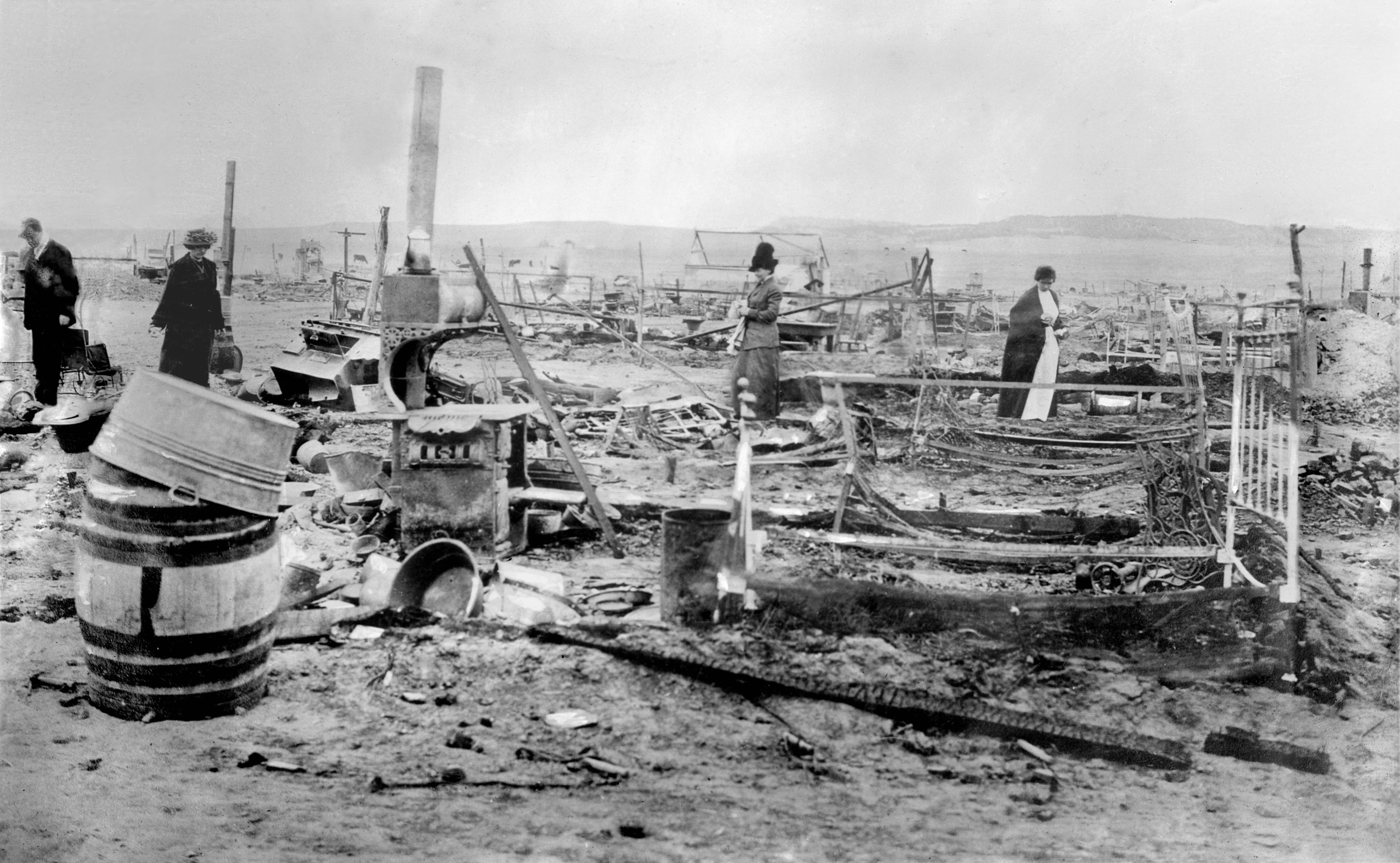
Ruins of the Ludlow Colony near Trinidad, Colorado, following an attack by the Colorado National Guard. Forms part of the George Grantham Bain Collection at the Library of Congress. By Bain News Service – This image is available from the United States Library of Congress’s Prints and Photographs divisionunder the digital ID ggbain.15859.This tag does not indicate the copyright status of the attached work. A normal copyright tag is still required. See Commons:Licensing for more information., Public Domain, https://commons.wikimedia.org/w/index.php?curid=10277066
There have been downsides for Pueblo, too, including a bloody strike in the coalfields south of Pueblo in 1913-1914. The strike culminated in the deaths of 21 miners and their families, including 2 women and 11 children in what is remembered as the Ludlow Massacre. In 1921, a flood killed at least 78 and likely many more while swamping the downtown district and other low-lying areas.
The steel mill at one time employed 12,000 people and, by the 1970s, paid handsomely and gave months-long vacations to employees with greater seniority. Going into 1990, CF&I teetered into bankruptcy. It was acquired by Oregon Steel in 1993 and the name was changed to Rocky Mountain Steel Mills. In 2007, it and other Oregon Steel holdings were acquired by Evraz for $2.3 billion.
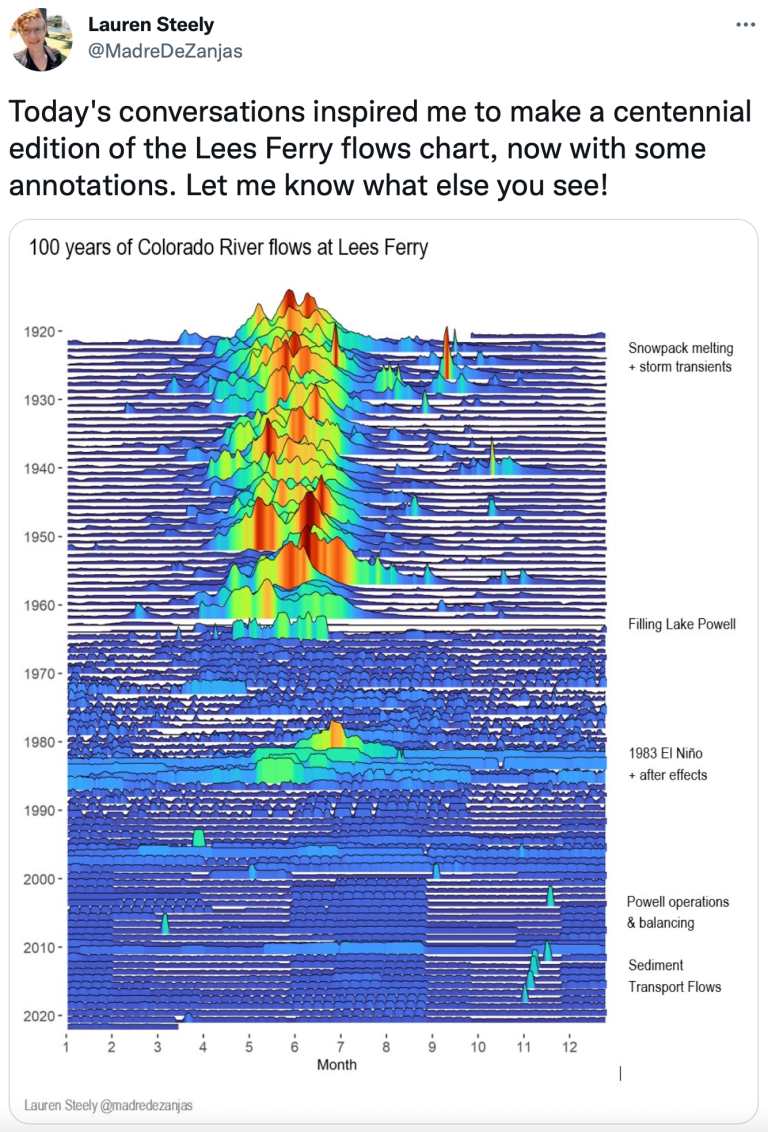
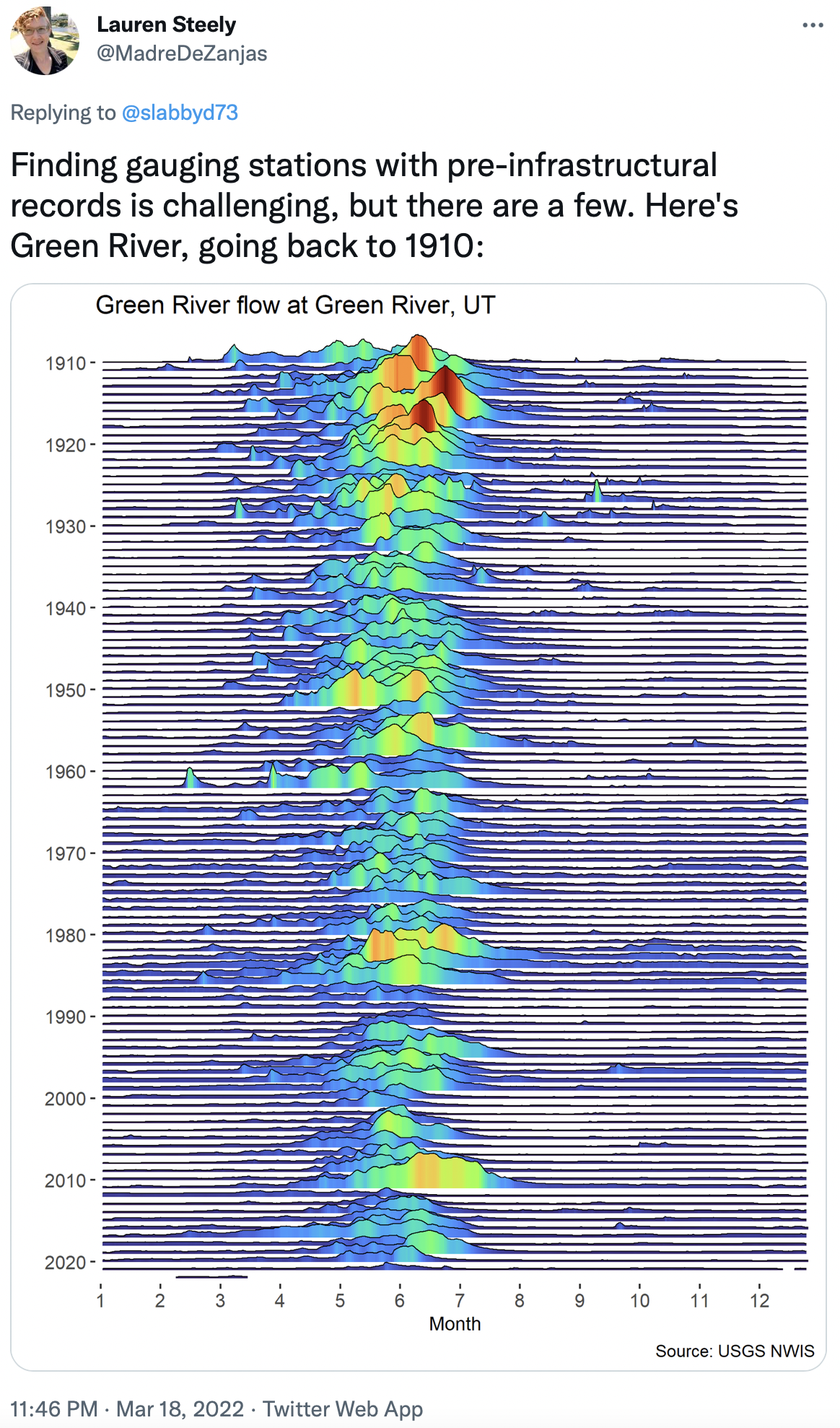
Two photos associated with Lauren’s tag “1883 El Niño after effects”.
Cavitation at the Glen Canyon Dam, the cause of the emergency in 1983 via Flow Science.
During the 1983 Colorado River flood, described by some as an example of a “black swan” event, sheets of plywood (visible just above the steel barrier) were installed to prevent Glen Canyon Dam from overflowing. Source: Bureau of Reclamation
The Lees Ferry streamgage then and now.
September 21, 1923, 9:00 a.m. — Colorado River at Lees Ferry. From right bank on line with Klohr’s house and gage house. Old “Dugway” or inclined gage shows to left of gage house. Gage height 11.05′, discharge 27,000 cfs. Lens 16, time =1/25, camera supported. Photo by G.C. Stevens of the USGS. Source: 1921-1937 Surface Water Records File, Colorado R. @ Lees Ferry, Laguna Niguel Federal Records Center, Accession No. 57-78-0006, Box 2 of 2 , Location No. MB053635.
Lees Ferry streamgage and cableway downstream on the Colorado River, Arizona. (Public domain.)