
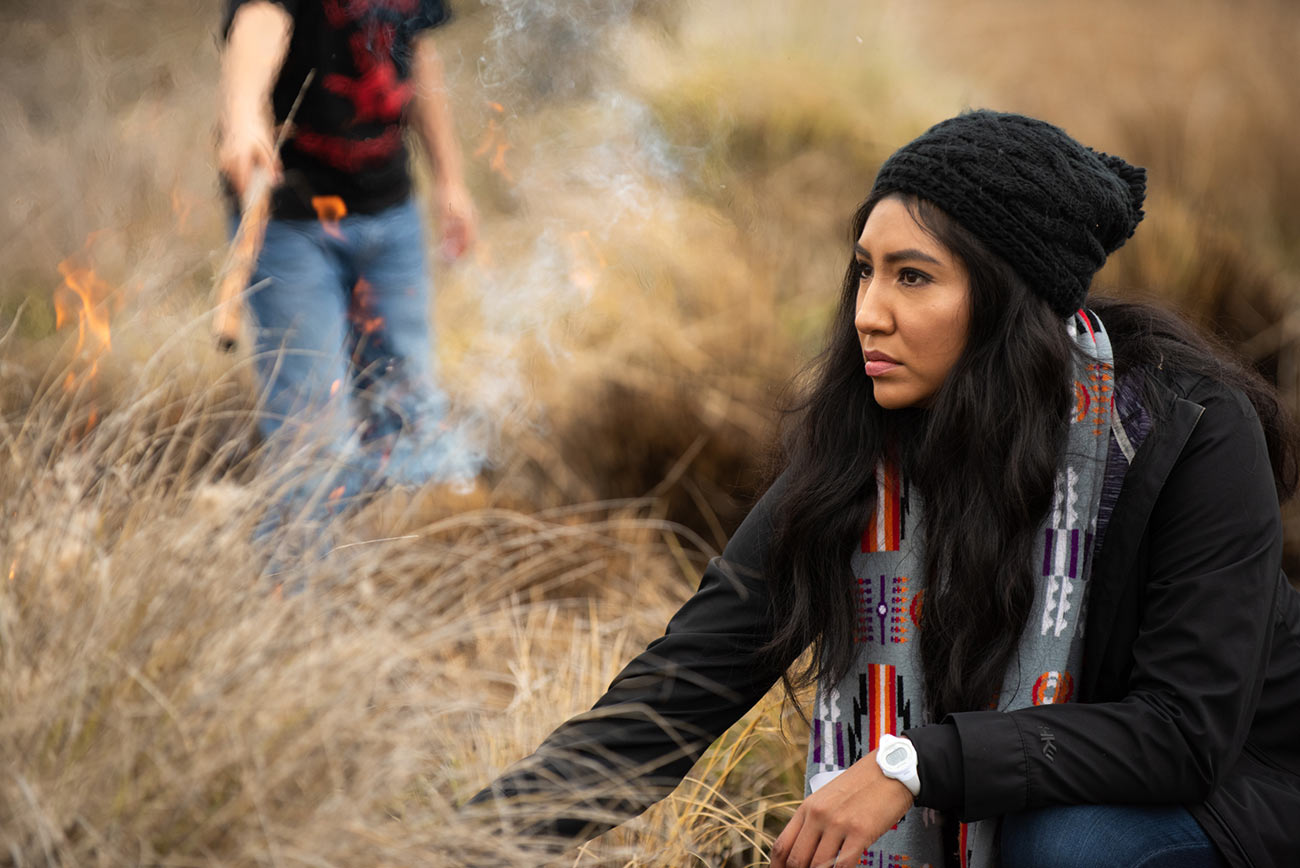
Click the link to read the article on the AZCentral.com website (Debra Utacia Krol). Here’s an excerpt:
About 50 women came to Karuk country to train and learn about bringing fire back to the land, as their ancestors had for generations.
About 50 women from Indigenous communities across the United States, Canada and Australia had converged on Karuk country [During October 2022] to train and learn more about bringing fire back to the land at the first-ever all-Indigenous, all-female training and exchange camp…The program, known as TREX, was developed to provide hands-on training for local fire crews by running cooperative prescribed burns. The two-week fall TREX was renamed WTREX, reflecting its emphasis on training, or in some cases retraining, Indigenous women to reclaim their role in protecting their homes, their cultural assets, their foods and their ecologies by “laying down the fire.”
“This is where my ancestors come from,” said Sammi Jerry, a Karuk tribal member who talked about her small son, Sáak Asaxêevar, at the event. Looking at the women gathered in a circle and the men supporting their efforts, she said, “You guys are a part of making our world better, of completing the circle. And I will eternally be grateful.”
[…]
The Karuk understand well what can happen when Indigenous peoples are barred from their traditional practices. The tribe lost 150 homes, including its elder housing complex, and two people lost their lives during the Slater Fire in 2020. It wasn’t just preventing wildfires from consuming their families’ homes, making hazel grow straight and strong for baskets or nurturing plants for food or medicine that brought these women, and the men who provided support and training, to one of California’s most remote river valleys for two weeks of rough, oftentimes backbreaking labor. They were there to preserve their cultures and prevent ecological disaster, both along the Klamath and in their own homelands. The Karuk Tribe and other tribes whose ancestral lands lie along the Klamath River also must overcome obstacles as they work toward that goal and exercise their cultural sovereignty…
Tribes such as the Karuk, whose 1.04-million acre ancestral land base was nearly all appropriated by the U.S. Forest Service in the late 19th century, have been fighting for their rights to steward their ancestral lands and waters according to time-honored cultural methods since California became a U.S. state more than 170 years ago. Before European settlers came to California, Indigenous peoples used fire as a tool to protect their homes. Women typically burned the land surrounding villages, while the men would burn farther out along important trails or wildlife corridors. People carefully nurtured important plants and trees like hazel, huckleberry, wild mint, oaks and tanoaks.
