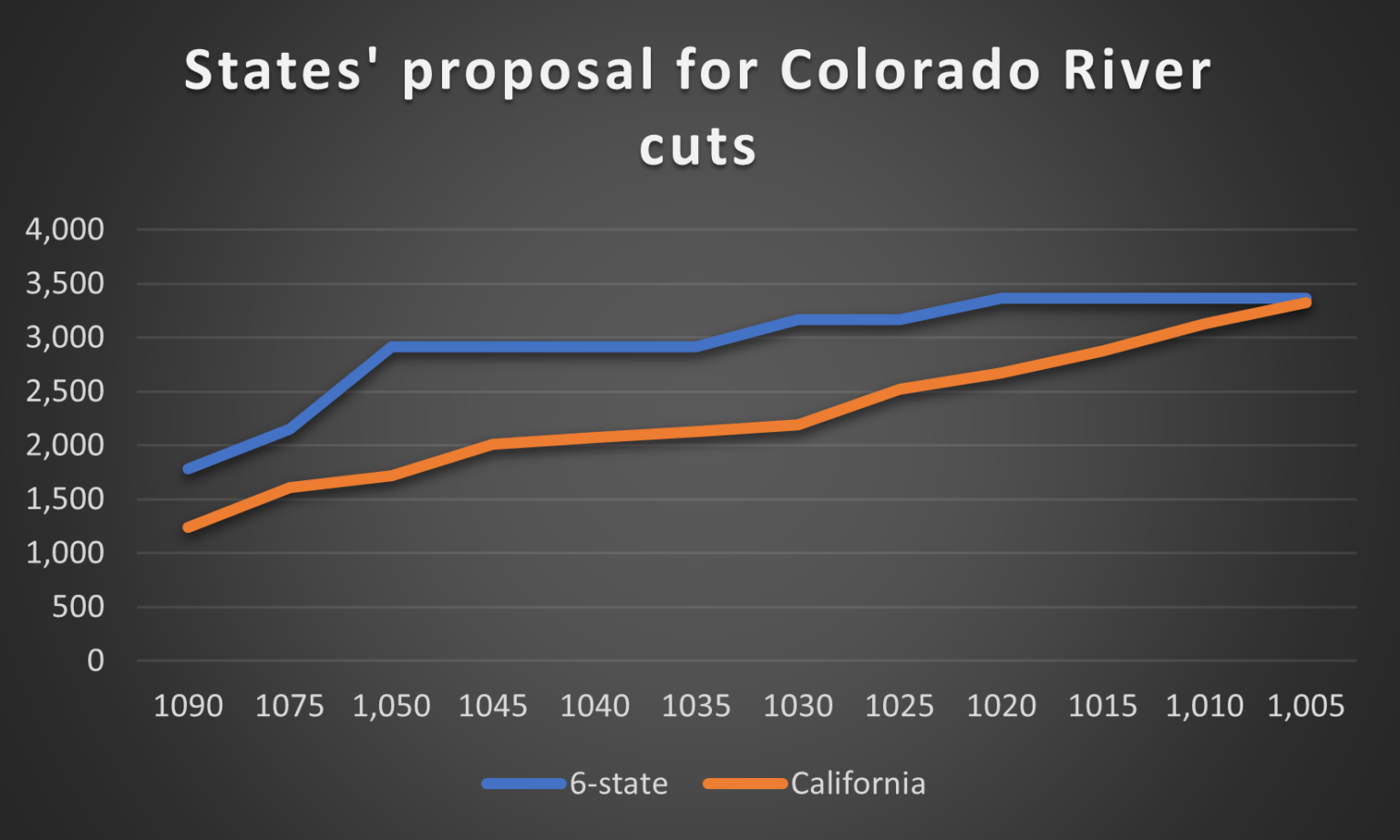
States’ proposal for Colorado River cuts. Lake Mead elevation along the x axis, millions of acre feet of cuts along the y axis. Credit: John Fleck
Click the link to read the article on the InkStain website (John Fleck):
Getting ready for an interview this morning with Mark Brodie at KJZZ (waving at my Phoenix friends!) I put together a table to make it easier to compare the six-state proposal submitted Monday to reduce Lower Colorado River Basin water use, and the California proposal submitted yesterday (Tues. 1/31/23).
Perhaps worth sharing here? “Elevation” is Lake Mead elevation, the numbers are million acre feet of total cuts.
Two keys to note.
First, despite big disagreements about how to approach this, we have unanimity among all seven states that very deep cuts in Lower Basin water use are needed. At the lowest Lake Mead elevations, the numbers are similar.
The difference is in timing. California’s cuts don’t kick in until later – essentially a gamble on good hydrology once again helping us avoid conflict by letting us use more water in the short term.
The six-state proposal says “go big” any time Mead drops below 1,050. The California proposal doesn’t start “going big” until 1,025.
The six-state proposal yanks the bandaid off now.
Under the current “most probable forecast” for the coming year, we’d end up in 2024 with:
Six state proposal: 3,168 million acre feet in cuts
California proposal: 2,188 million acre feet in cuts
Tier
Elevation
6-state
California
Tier 0
1090
1,784
1,241
Tier 1
1075
2,156
1,613
Tier 2a
1,050
2,918
1,721
Tier 2b
1045
2,918
2,013
Tier 2c
1040
2,918
2,071
Tier 2d
1035
2,918
2,129
Tier 2e
1030
3,168
2,188
Tier 3a
1025
3,168
2,525
Tier 3b
1020
3,368
2,675
Tier 3c
1015
3,368
2,875
1,010
3,368
3,125
1,005
3,368
3,325
There are other differences too – huge disagreements on how to approach the allocation of the cuts! No time for that this morning, I’ve a book to write, but I hope to get back to that in the next few days, stay tuned.
Colorado River February 2020. Photo: Abby Burk via Audubon Rockies.
“Water is the conversation. It will be the centerpiece of our agenda this year,” said newly elected Speaker of the House Julie McCluskie, setting the tone and elevating water issues for Colorado’s 2023 General Assembly.
It’s no secret Colorado’s rivers and streams are suffering and our state’s challenges are a good example of water crises gripping the American West. Parched rivers; stressed farms, livestock and fish; and more frequent floods and wildfires are all symptoms of the disruption wrought as climate change impacts our region and already strained water supply.
Abby Burk brings a lifetime love of rivers, particularly of the Colorado River and its tributaries. As the western rivers regional program manager for Audubon Rockies. Photo credit: Audubon Rockies
Colorado’s lawmakers and other leaders have a responsibility to ensure Coloradans have the tools we need to proactively respond to drought and its impacts — on the legislature’s opening day, Senate President Steve Fenberg made it clear water will be among the high priority items the General Assembly takes on. And Speaker McCluskie concurred, saying: “Colorado has to be seen as a leader in this space.” Gov. Jared Polis’s proposed 2023 budget has already highlighted support for addressing our state’s water challenges. Last year the federal government injected a once-in-a- generation allocation of public funds to support water needs in the West. Now action is needed within the Colorado legislature to increase funding and capacity to establish both immediate and long-term drought security and to protect clean drinking water alongside river and watershed health.
We’re excited to see the Governor’s budget request for a historic $25.2 million to advance implementation of the state’s water plan, providing capacity to meet increasing demands, to combat the effects of climate change, and to support the health of our rivers. It’s important to note: these state funds are vital for unlocking matching federal dollars, dollars that are expected to be leveraged for approximately $100 million worth of water project grants across the state — a 4-to-1 return on investment. By engaging local communities, investing federal funds in needed infrastructure projects, and empowering millions of people to take action to conserve water, Colorado will make significant progress toward responding to long-term climate trends.
Flows in the Colorado River have decreased by more than 20% in just the past 20 years, which is why improving the struggling Colorado River system has been, and remains, the top priority for Water for Colorado. A healthy and vibrant river system serves as habitat for wildlife, increases resilience to floods and wildfires, enhances the quality and availability of water and forage for livestock, bolsters critical rural recreation economies and provides numerous ecological services that protect our sources of clean drinking water. With increasing threats of extreme weather events, healthy and functioning streams are critical to ensuring resilient communities, and a thriving state. This is why we are supporting efforts by the state’s Department of Natural Resources to pass legislation clarifying stream restoration projects can proceed without unnecessary red tape; and also why we support Governor Polis’s budget request to increase Colorado’s ability to leverage federal funds and assist with the crisis we are facing on the Colorado River.
Water policy is no longer a niche issue. Water conversations are happening at every level of state leadership — from the Governor’s office, to the General Assembly, to the Attorney General’s office — and across issue areas this session, making national headlines week after week. For example, as Governor Polis and the General Assembly seek to address land-use patterns and the affordable housing crisis, they are inserting water use into the conversation as a vital element. Integrating land use, development planning and more flexible water management can be another area on which our state leads.
Jessica Gelay Colorado Government Affairs Manager. Photo credit: Western Resource Advocates
The focus on water needs to be wide-ranging, but it also must be consistent. The time is now for Colorado to implement innovative policies that keep rivers flowing and proactively respond to drought conditions. In doing so, we will be a leader, showing other states how to do more with less, supporting the health of our river systems, and securing our state’s long-term vitality in the face of a hotter, drier future.
As Speaker McCluskie told us, the work ahead on water may be “the most challenging work the state has ever done.” While this is likely true, it may also be the most
rewarding — we can tell our children and grandchildren they live in a more resilient state because of the work conducted this session.
In his 2023 State of the State, Governor Polis reminded us “water is life in Colorado and the (W)est, it’s as simple as that.” The consequences of inaction this session are too great to consider. Failing to protect our water resources is not an option. Luckily, Colorado has the opportunity to not only protect our water resources in the near-term, but lead the charge toward longer-term drought resilience and climate resilience. It’s incumbent upon our lawmakers to secure Colorado’s water future. We look forward to working together to do so.
Abby Burk is Western Rivers Regional Program Manager for Audubon Rockies. Jessica Gelay is the Colorado Government Affairs Manager for Western Resource Advocates. Audubon Rockies and Western Resource Advocates are both members of the Water for Colorado Coalition.
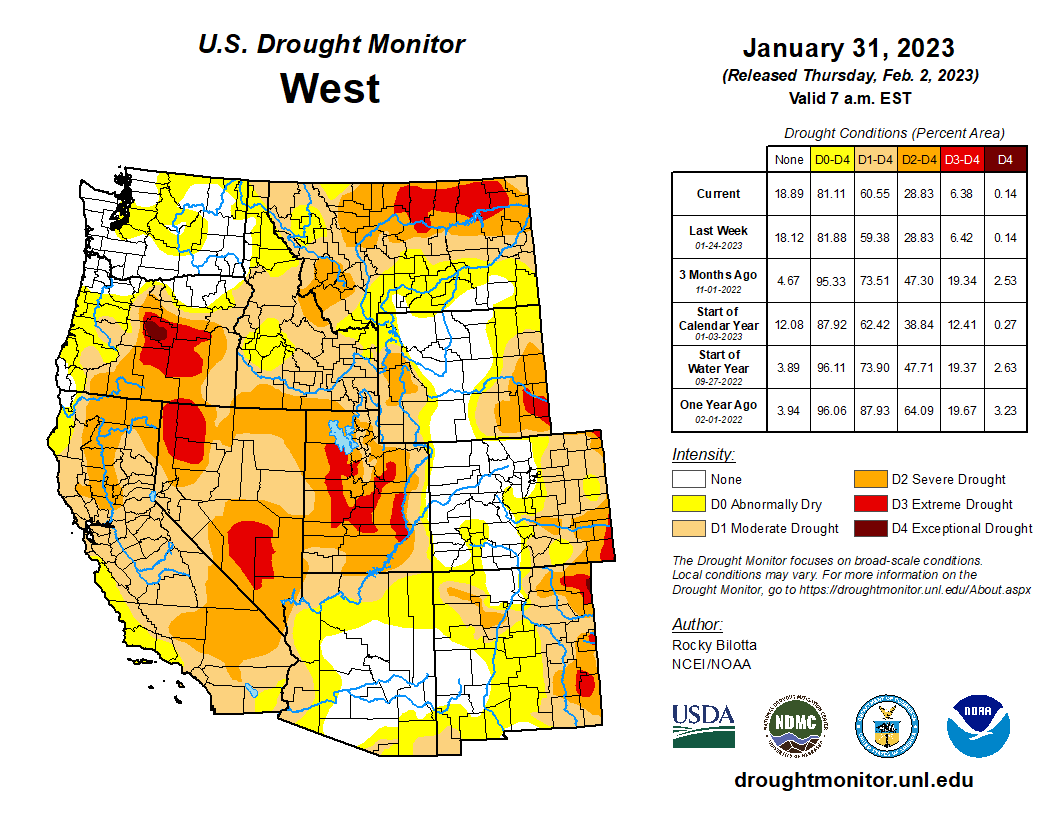
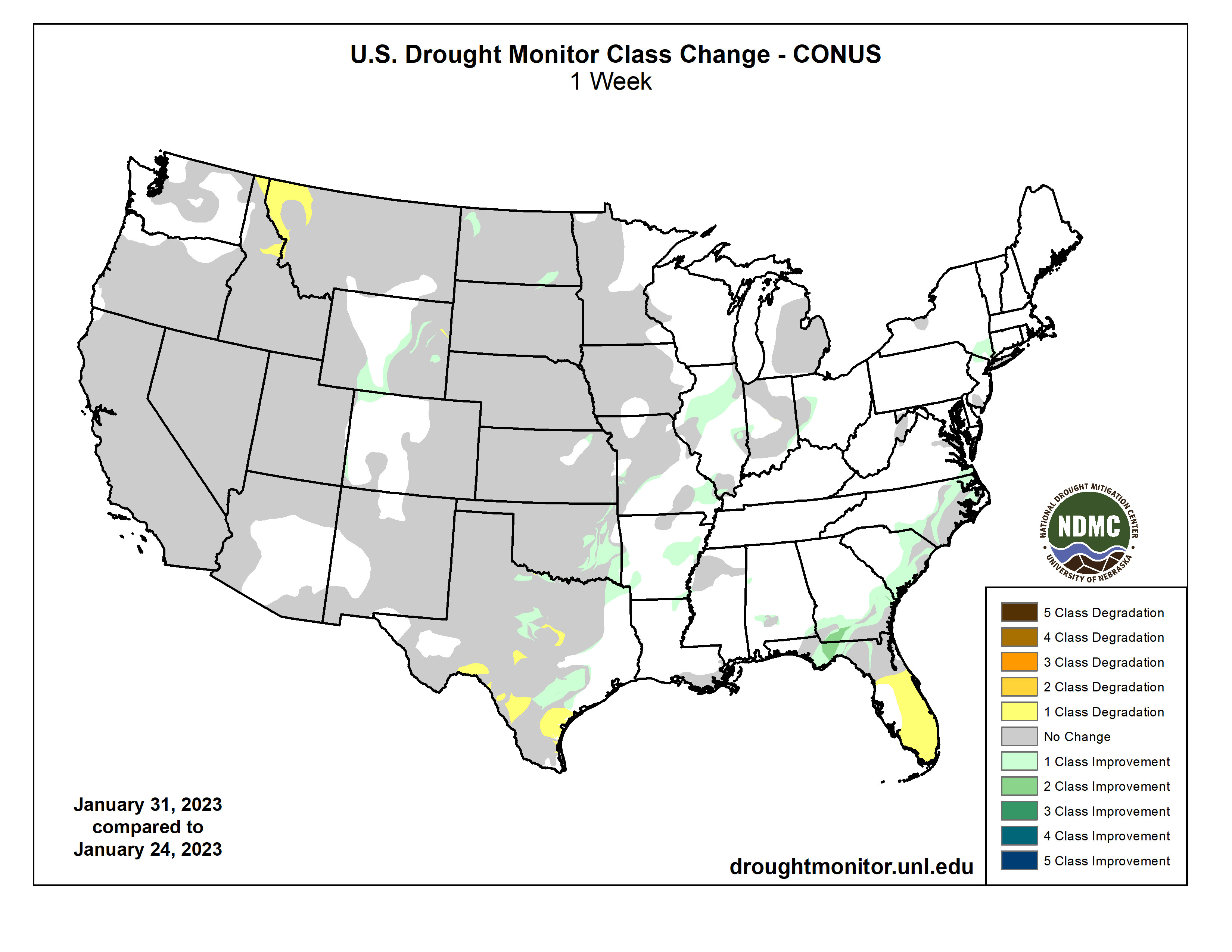
Winter storms brought heavy rain and snow much of the eastern U.S. and from the Pacific Northwest to the central Rockies this week with above-normal precipitation observed from the southern Plains to the Southeast and along the East Coast. Precipitation led to abnormal dryness and drought improvements in the central Plains, Midwest, Southeast and Northeast. Conversely, conditions worsened over dryer areas including Idaho/Montana, southern Texas and the Florida Panhandle. In the eastern United States, temperatures have been above-normal resulting in rain falling over many areas instead of snow. Many cities including New York, Baltimore, Philadelphia and Washington D.C. remain snowless for the season. New York City recently set a new latest first measurable snowfall previously set on Jan 29, 1973. In California, a series of atmospheric rivers brought significant amounts of rain which gave reservoirs a much-needed boost, but California lacks infrastructure to make use of such a massive rainfall. Despite the deluge, the winter storms may not have eased the state’s drought. In Hawaii, a strong low pressure system aloft combined with a low pressure trough at the surface to produce conditions favorable for heavy rainfall and flash flooding over portions of the main islands…
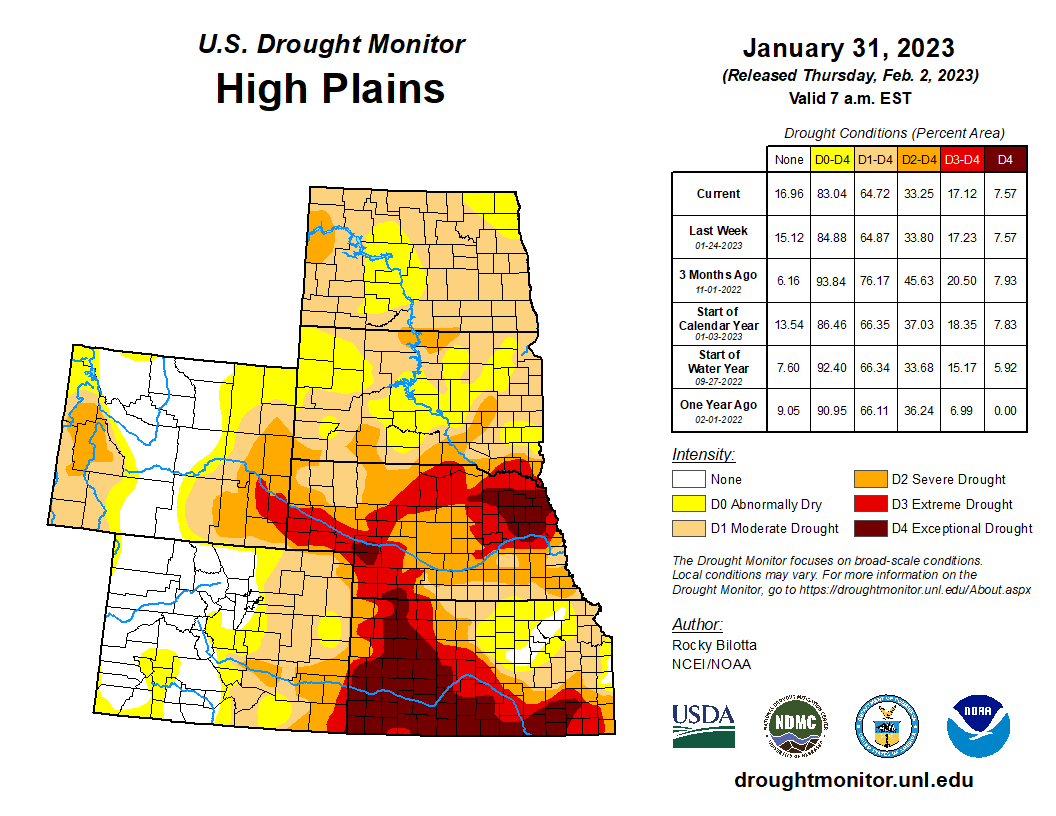
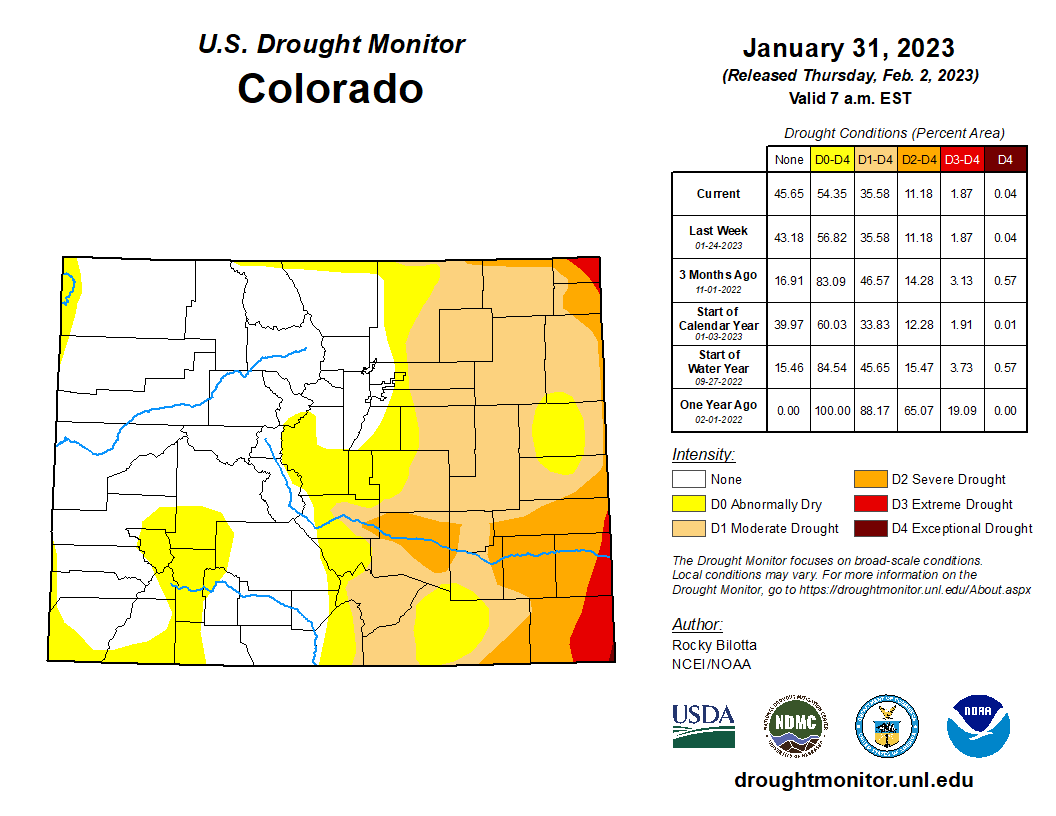
A half an inch or more of precipitation fell across parts of Colorado and Wyoming, mainly in the higher elevations, resulting in improvements to moderate to severe (D1-D3) drought and abnormal dryness (D0) in eastern Wyoming and improvements to abnormal dryness western Colorado. Much of the High Plains remains in a holding pattern as areas that received abundant snowfall over the Water Year are slow to make improvements due to the long-term nature of drought in the region…
Colorado Drought Monitor one week change map ending January 31, 2023.
Precipitation was below-normal across the region, especially along the West Coast. Due to weeks of heavy precipitation, from a series of atmospheric rivers, halted most degradations or improvements this week despite the deluge, placing much of the region on a holding pattern. The rain did give reservoirs a much-needed boost, but California’s infrastructure is not set up to make use of such a massive rainfall. Because of California’s system of dams and levees, which try to control surface water flow, underground aquifers are not always able to recharge their overpumped supplies during heavy rain events. When rivers are restricted, less water comes into contact with soil surfaces and less water is therefore able to seep down into aquifers. In the drier areas of the West, moderate (D1) drought expanded into parts of northern Idaho and northwestern Montana due to continued degrading conditions that can be observed in soil moisture, streamflow, and precipitation deficits (up to five inches) for this area. In Utah, much of the state has above normal snowpack but no improvements were made this week based on the current issues with groundwater and depleted reservoirs…
A half an inch or more of precipitation fell across much of the South with the heaviest amounts falling across the eastern part of the region. Two inches of more of rainfall fell across parts of eastern Texas, Arkansas, Louisiana and Mississippi, which resulted in moderate to exceptional (D1-D4) drought and abnormal dryness (D0) improvements in Oklahoma; moderate to extreme (D1-D3) and abnormal dryness improvements in eastern Texas; and abnormal dryness improvements in Arkansas, Louisiana and Mississippi. Conversely, drought and abnormal dryness was expanded in western Texas due to lack of rain, precipitation deficits, drying soils and degrading streamflow in the area…
Looking Ahead
The National Weather Service Weather Prediction Center has forecasted a significant ice storm (valid January 30 – February 2) is forecasted to bring freezing rain, sleet, and ice accumulations over portions of the Southern Plains and Mid-South. The storm is expected to bring prolonged power outages and cause treacherous travel conditions. Moving into next week (valid February 4 – February 8), very chilly conditions are expected across the Northeast as cold air and gusty winds settle in under upper-level troughing. Dangerous wind chills and possibly new daily temperature records are in store for much of the Northeast region. Temperatures could stay below zero all day in parts of Maine and in the single digits in much of northern New England. This cold airmass is expected to sink further south along the Eastern Seaboard leading to temperatures 10-20F below normal. Temperatures are expected to rebound across the East as warmer temperatures over the central U.S. migrate eastward after the weekend. The West however could stay around 5-10F below average especially in terms of highs underneath upper troughing. A frontal system could spread some light snow to the Midwest/Great Lakes regions and Northeast this weekend, and amounts could be enhanced downwind of the Great Lakes. Light precipitation is possible along the Eastern Seaboard while the West could expect generally light to moderate precipitation in the form of lower elevation rain and higher elevation snow. At 8 – 14 days, the Climate Prediction Center Outlook (valid February 9 – February 15) calls for below-normal temperatures across much of the West, from the Pacific Northwest to the Southwest, and much of Alaska. Near-normal temperatures are expected in parts of the Northwest, northern and central Rockies and southern Plains, including southwest and eastern Alaska, while the eastern half of the contiguous U.S. and the Alaska Panhandle have the greatest probability of warmer-than-normal temperatures. Most of the U.S. can expect above-normal precipitation with the probability of near-normal precipitation occurring in much of the Northwest, the Florida Peninsula and northern Alaska and in parts of southern Texas.
US Drought Monitor one week change map ending January 31, 2023.
Click the link to read the article on the Sky-Hi News website (Kyle McCabe). Here’s an excerpt:
Six of the seven Colorado River Basin states agreed to a plan Monday, Jan. 30, to conserve water in the river and manage lakes Powell and Mead, a day before a federal deadline for the states to agree on voluntary water cuts passed. Politicians including Sen. Michael Bennet and Gove. Jared Polis applauded the six states’ collaboration…The six-state plan would not reach the 2 million acre-feet threshold, focusing many of its cuts on lower basin states, despite not having the approval of California, a lower basin state and the river’s largest consumer.
A news release from Bennet’s office quoted him as saying the plan “did exactly what was needed” and expressing his disappointment in California not agreeing to the plan. California instead submitted its own plan to the U.S. Bureau of Reclamation on Tuesday. Polis said in a news release that Colorado will also continue to follow the Upper Colorado River Commission’s 5-Point Plan from July 2022, which was the upper basin’s original response to the Bureau of Reclamation’s calls for conservation in June 2022.
Click the link to read the article on The Deseret News website (Amy Joi O’Donoghue). Here’s an excerpt:
Politics and threatened litigation are replacing what is left of the water in the Colorado River as the seven basin states that rely on the West’s largest river try to reach an agreement to cut flows so power generation can continue at Glen Canyon and Hoover dams. The directive to find some sort of definitive plan for dam operations by reducing flows was issued by the U.S. Bureau of Reclamation, which is tasked with making decisions to prop up the river that has been decimated by drought and over diversion through the years. The proposals do not change any of the states’ water allocations, for now, or affect any existing water rights. The plans will ultimately become part of a more comprehensive effort being worked on by the federal agency.
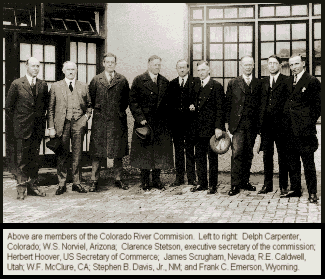
The Compact’s Signers. Photo via InkStain
It is more than a heavy lift for a river that was divided up under a compact forged more than 100 years ago in a remote location in New Mexico and subsequently shaped by regulations, court decisions and compacts that all coalesced into what is now known as the “Law of the River.”
[…]
“Instead of bending over backwards to prop up Lake Powell, officials should be making plans to save Lake Mead and utilize Glen Canyon as a backup facility,” said Eric Balken, executive director of Glen Canyon Institute. “There’s just not enough water to save both reservoirs, and Mead is more vital to the basin.”
The institute has long advocated for the draining of Lake Powell, the nation’s second largest reservoir behind Lake Mead.
On Monday, six of the states sharing the Colorado River — California later detailed its own plan — submitted what they described as a Consensus Based Modeling Alternative to the reclamation bureau. While not a formal agreement, they say it provides a step toward helping the federal agency as it crafts an environmental review going forward.
Among other things, the alternative details:
Additional combined reductions of 250,000 acre-feet to Arizona, California and Nevada at Lake Mead elevation 1,030 feet and below.
Additional combined reductions of 200,000 acre-feet to Arizona, California and Nevada at Lake Mead elevation 1,020 feet and below, as well as additional reductions necessary to protect Lake Mead elevation of 1,000 feet.
Those potential reductions are designed to keep Lake Mead’s Hoover Dam in operation.
Proposal Outlines Constructive Approach to Achieve Necessary Water Use Reductions through 2026 to Protect Critical Infrastructure, Prioritize Public Health and Safety
California water agencies that rely on the Colorado River today proposed a modeling framework for the U.S. Bureau of Reclamation to evaluate as it considers actions to help stabilize reservoir elevations and protect critical infrastructure to ensure the Colorado River system can continue to support 40 million people, nearly 6 million acres of agriculture, and Tribes across seven states and portions of Mexico.
The modeling framework outlines a constructive approach to achieve additional water use reductions while protecting infrastructure, prioritizing public health and safety, and upholding the existing body of laws, compacts, decrees, and agreements that govern Colorado River operations (known collectively as the Law of the River). The approach builds on the California agencies’ commitments announced last fall to voluntarily conserve an additional 400,000 acre-feet of water each year through 2026 to protect storage in Lake Mead and help stabilize the Colorado River reservoir system.
California’s proposed framework seeks to protect Lake Mead elevation of 1,000 feet and Lake Powell elevation of 3,500 feet by modifying some parameters governing reservoir operations, maximizing the impact of existing plans and voluntary conservation actions, and increasing cutbacks if Lake Mead elevations decline. It also protects baseline water needs of communities across the West by prioritizing water supplies for human health and safety. The proposal was carefully developed to enable workable phased water use reductions and ensures protection of adequate water volumes in Lake Mead and Lake Powell.
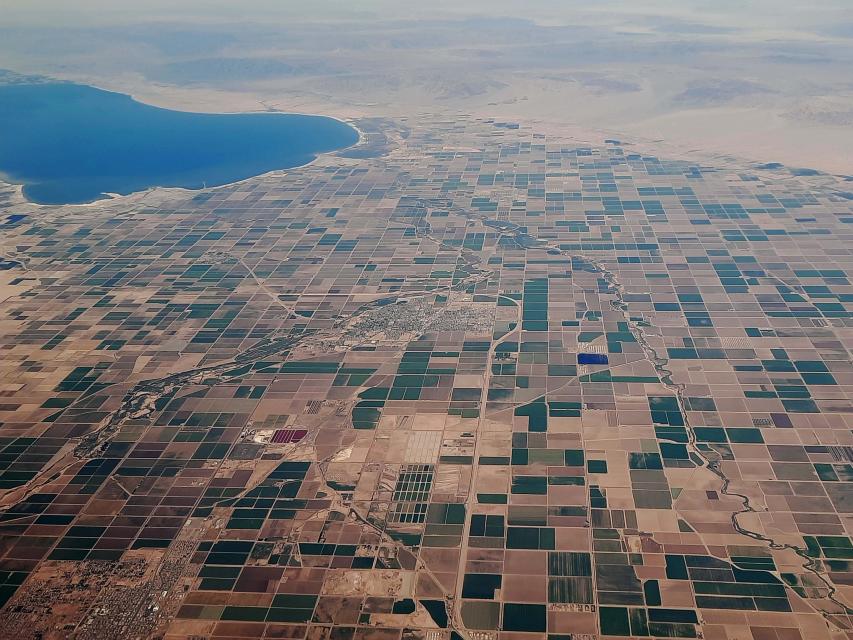
The Salton Sea (pictured above ) straddles the Imperial and Coachella valleys and has long been a sticking point in Colorado River deals. But the federal government recently committed up to $250 million for restoration efforts at the sea. (Source: Water Education Foundation)
“The alternative provides a realistic and implementable framework to address reduced inflows and declining reservoir elevations by building on voluntary agreements and past collaborative efforts in order to minimize implementation delays. California’s alternative protects critical elevations and uses adaptive management to protect critical reservoir elevations through the interim period,” — JB Hamby, chair of Colorado River Board of California and California’s Colorado River Commissioner, wrote in a transmittal letter to Reclamation.
The approach differs from a modeling proposal submitted to Reclamation on January 30 by the six other basin states. The six-state proposal would direct the majority of water use reductions needed in the Lower Basin to California water users through a new apportionment method based on “system and evaporative losses.” The proposal directly conflicts with the existing Law of the River and the current water rights system and mandates cutback without providing tools to manage reductions.
For the past several months, California water users have sought a timely, practical and implementable solution with other Lower Basin users that can be implemented over the next three years to protect critical elevations in Lake Mead while longer-term changes are negotiated to update 2007 Interim Guidelines that will expire at the end of 2026. Suggestions to fundamentally change the Law of River are appropriately addressed through this shared process to update the guidelines.
California’s water agencies remain committed to working with all Colorado River basin states to take urgent, fair, and achievable action now to avoid unacceptable risks to communities, farms and economies in California and the rest of the basin.
For decades, California has been a leader in managing its Colorado River water resources and collaborating in basin-wide efforts to more effectively operate and manage the reservoir system and to incentivize water conservation as demands have increased in the face of shrinking supplies due to climate change.
In 2003, California permanently reduced its use of Colorado River water from about 5.2 million acre-feet annually to its basic apportionment of 4.4 million acre-feet, a permanent annual reduction in water use of about 800,000 acre-feet. The reduction in use resulted from implementing a combination of agricultural and urban conservation activities. Since 2003, water users in California have taken significant actions to conserve Colorado River water, adding over 1.5 million acre-feet and 20 feet of elevation of conserved water to Lake Mead since 2007. California water users committed to further conservation to bolster storage in Lake Mead through the 2019 Drought Contingency Plan. California has invested billions of dollars in urban and agricultural conservation across Southern California, through programs that reach virtually every Colorado River water user in the state.
“Twenty years ago, California adopted the largest water conservation-and-transfer agreement in U.S. history that not only supports the bulk of our nation’s food system but also sustains the environment. This multi-billion-dollar conservation-focused framework – the Quantification Settlement Agreement – is the blueprint for other states to follow. California has done its part and is willing to do more, but it’s time for the other states to step up and create their own conservation programs that sustain the quality of life in their communities,” said Jim Madaffer, vice chair of the Colorado River Board of California, representing the San Diego County Water Authority.
“For over 20 years, Metropolitan has met the challenge of reducing our use of Colorado River water, and we are committed to doing more now. But we must do it in a way that does not harm half of the people who rely on the river – the 19 million people of Southern California. We must do it in a way that does not devastate our $1.6 trillion economy, an economic engine for the entire United States. We must do it in a way that can be quickly implemented, adding water to lakes Mead and Powell without getting mired in lengthy legal battles. We must do it in a way that maintains and strengthens partnerships on the river, allowing us to work together to build longer term solutions. The proposal presented today by California does all of this by equitably sharing the risk among Basin states without adversely affecting any one agency or state. The plan presented yesterday, which shut out California, does not. California knows how to permanently reduce use of the river – we have done it over the past 20 years, through billions of dollars in investments and hard-earned partnerships. We can help the entire Southwest do it again as we move forward,” said Adel Hagekhalil, general manager, Metropolitan Water District of Southern California.
“The Colorado River – Imperial Valley’s only source of water – supports far more than our rural disadvantaged community as it provides for a robust agricultural industry that feeds millions of people and provides food security for this nation. California, and particularly the Imperial Irrigation District, is working to be part of the solution, however we also believe in upholding the Law of the River and not shouldering the burden of supply limitations for states and agencies that have outgrown their water rights. California has spent the past two decades successfully working together to resolve intra-state supply and demand imbalances to sustain the Colorado River. Since the signing of the Quantification Settlement Agreement, the largest ag-to-urban water conservation and transfer agreement in U.S. history, IID’s water management programs have generated over 7.2 million acre-feet in support of the Colorado River system. Today, IID and its California partners have proposed a balanced and implementable plan that begins to address the monumental challenges we face with the ongoing Colorado River drought,” said Henry Martinez, general manager, Imperial Irrigation District.
A water recharge basin in Southern California’s Coachella Valley. Source: California Department of Water Resources
“Historically, CVWD and our agricultural community have invested heavily in its irrigation delivery system to minimize water loss, including canal lining projects, a closed pipe irrigation distribution system and installing drip irrigation. We have prioritized the efficient use of Colorado River water over the long term. We also took action last year with other California agencies to voluntarily identify a collection of Colorado River water conservation and reduction actions to save 400,000 acre-feet annually through 2026. We support our California partners and are committed to reaching a 7-basin state consensus on a framework for additional water use reductions through 2026,” said Jim Barrett, general manager, Coachella Valley Water District.
The farms of the Palo Verde Valley draw water from the Colorado River. Visual: Dicklyon / Wikimedia Commons
“One-hundred and forty-six years ago, the original developers of our Palo Verde Valley filed and were granted the very first water rights to Colorado River water. Secured by those rights, farmers and farm workers have invested multiple generations of farm loans and hard work to produce food and fiber for consumers. Surrounding our agriculture are small rural cities that depend exclusively upon Colorado River water for their domestic supply. Farmers and landowners in Palo Verde Irrigation District want to be part of a solution to the current mismatch of supply and demand on the River in a manner that honors existing Public Law, and Administrative Law,” said Bart Fisher, president, Palo Verde Irrigation District Board of Trustees.
“The Colorado River has been the lifeblood of the Quechan people since time immemorial, and we have a deep and abiding responsibility to be good stewards of the River – for the Tribe and its members, for the species and ecosystems that it sustains, and for the benefit of our fellow tribes and non-Indian neighbors throughout the Basin. It is why we have always fought for and will continue to defend our water. The modeling proposal submitted by the State of California to the Bureau of Reclamation for inclusion as part of its development of the SEIS reflects a meaningful effort to address the hydrologic challenges facing the Basin while respecting the senior water rights of the Tribe and others and ensuring that the Colorado can continue to exist as a living river,” said Quechan Tribal Council President Jordan Joaquin.
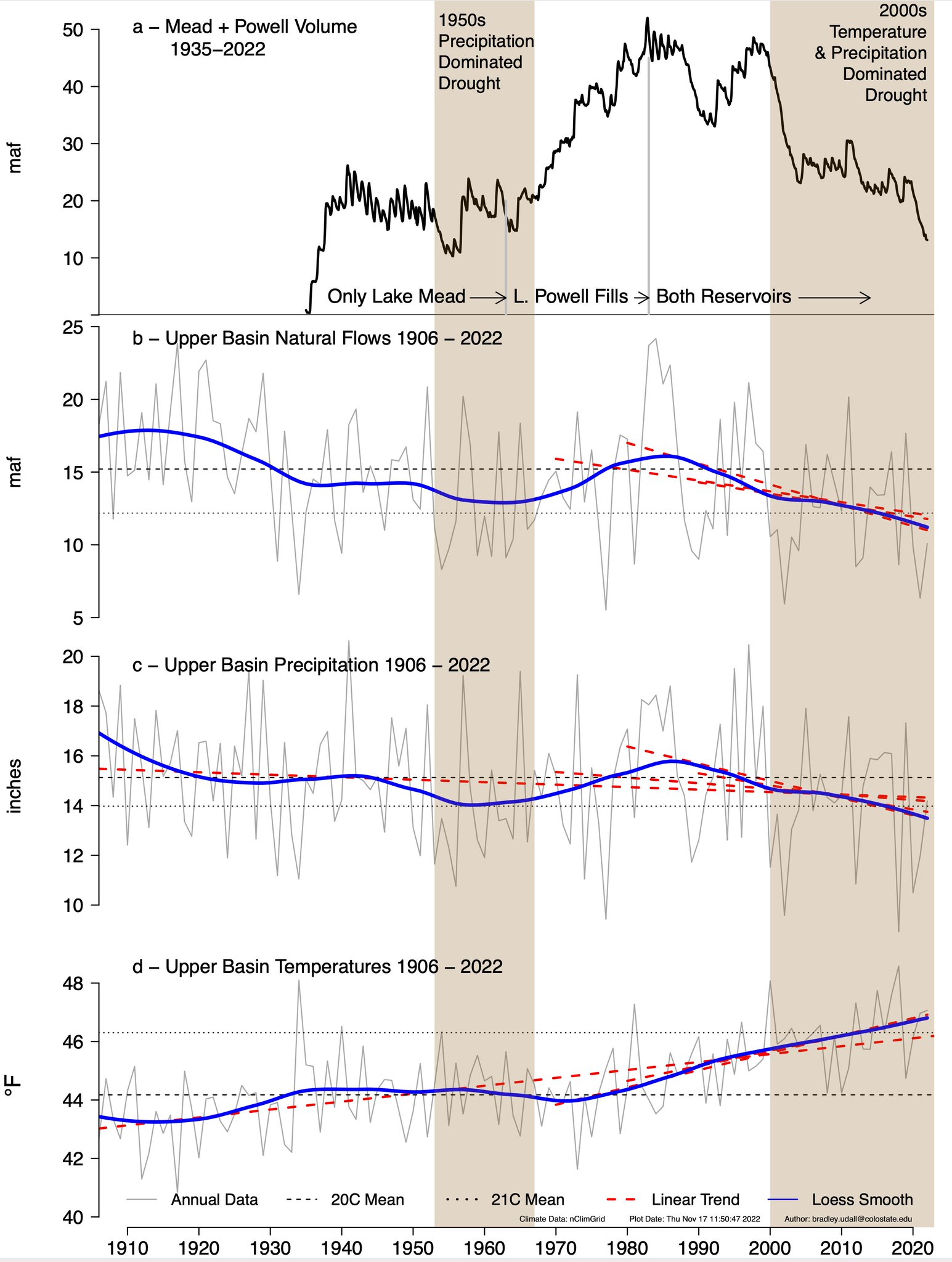
Updated Colorado River 4-Panel plot thru Water Year 2022 showing reservoirs, flows, temperatures and precipitation. All trends are in the wrong direction. Since original 2017 plot, conditions have deteriorated significantly. Brad Udall via Twitter: https://twitter.com/bradudall/status/1593316262041436160
Colorado River “Beginnings”. Photo: Brent Gardner-Smith/Aspen Journalism
Click the link to read the article on the AZCentral.com website (Brandon Loomis). Click through for the photo gallery, here’s an excerpt:
Late last year, the federal government asked the seven states that share the Colorado River’s water to submit a plan by the end of January to rapidly cut their use of water or face mandatory cuts. Six of them found a consensus proposal andsubmitted their idea on Tuesday. The seventh — California — is an ominous exclusion, given that it is the largest water user on the river and could thwart efforts to preserve the system if it presses its rights in court. Even so, water policy experts found it encouraging that six states could come together to present the U.S. Bureau of Reclamation with a state-driven option, one that fast-forwards through a plan devised 15 years ago…One of the proposal’s authors, Southern Nevada Water Authority General Manager John Entsminger, said talks with California would continue.
“We absolutely intend to continue to work in good faith with California,” he told The Arizona Republic. “I don’t see the fact that that six states submitted a letter as any sort of declaration of failure.”
[…]
Reclamation officials have said river users must cut between 2 million and 4 million acre-feet to stabilize the system. Officials from the six states — Arizona, Colorado, Nevada, New Mexico, Utah and Wyoming — believe their plan will save 3.3 million. Each acre-foot contains about 326,000 gallons and is enough to supply two or three households, though roughly 80% of the river’s water is applied on farms…
“You’re just rolling the dice on an extremely high-percentage chance that these reservoirs are going to continue to decline and you could go below minimum-power pool at Lake Powell and dead pool at Lake Mead,” he said.
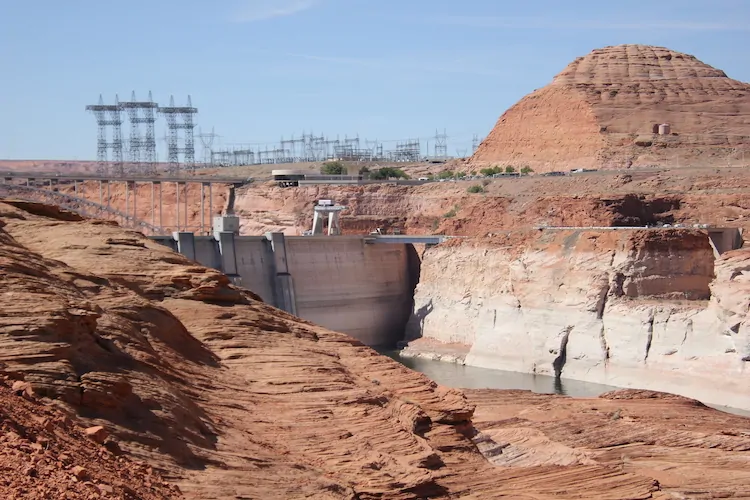
Glen Canyon Dam, seen here in May 2022, was a major electrical generation but has produced less as volumes in Lake Powell have declined. Photo credit: Allen Best/Big Pivots
“This is what climate change + an out-dated law of the river looks like: ‘There’s a problem of aridification. But on top of that, there’s a problem with the rules…The rules governing the system are not sustainable.’ — Jonathan Overpack via Twitter
The river’s biggest water user, California, didn’t join six states in a proposal to cut some 2 million acre feet of usage
For the second time in six months, states that depend on the Colorado River to sustain their farms and cities appear to have failed to reach an agreement on restricting water usage, setting up the prospect that the federal government will make unilateral cuts this year…
“Obviously, it’s not going swimmingly,” said Jeffrey Kightlinger, the former general manager of the Metropolitan Water District of Southern California, a water provider that is a major player in the talks. “It’s pretty tough right now.”
[…]
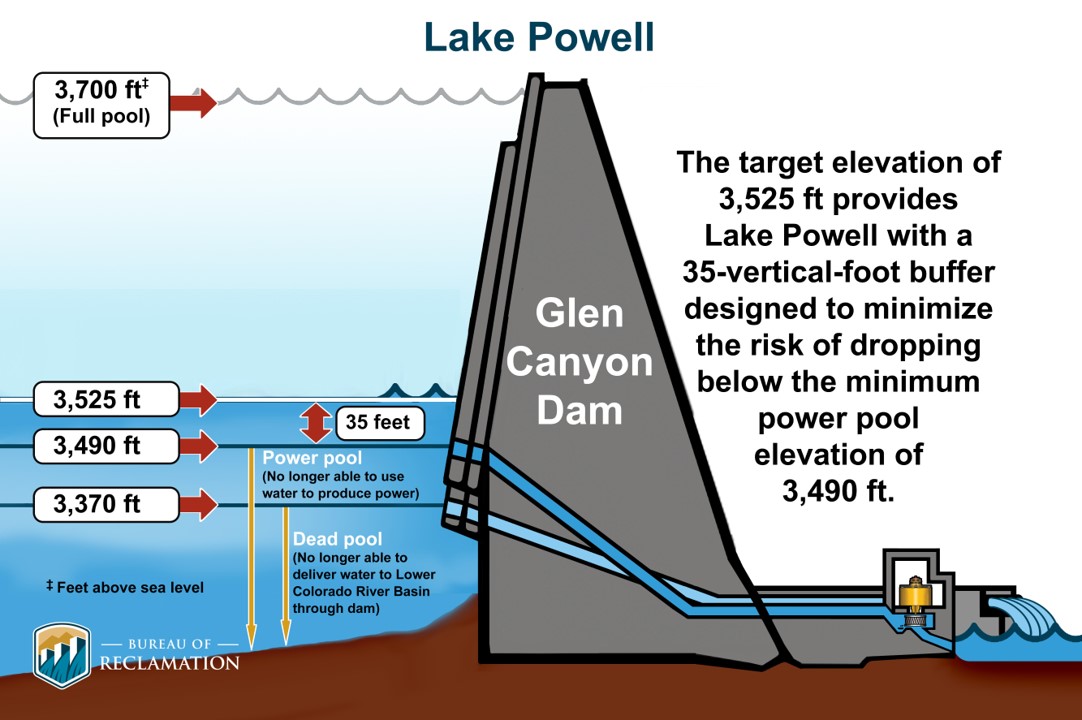
The proposal by the six states — Arizona, Colorado, Nevada, New Mexico, Utah and Wyoming — seeks to protect the major reservoirs in Lake Powell and Lake Mead from falling below critical levels, such as when the dams would no longer be able to generate electricity or at “dead pool,” when water would effectively be blocked from flowing out of these lakes. Before above-average snows in recent weeks, the Bureau of Reclamation was projecting that Lake Powell could start to reach such thresholds by this summer.
One of the central tensions of these complicated negotiations is how to balance cuts between farming regions against those in cities, including major population centers. Agriculture uses some 80 percent of the river’s water and also tends to have the most senior rights, some dating back to the 19th century. The way this “priority system” works, residents of Phoenix would lose water before vegetable farmers in Yuma. Those who grow alfalfa in Southern California’s Imperial and Coachella valleys would keep their water before people in parts of Los Angeles.
Kightlinger, along with many other water experts and officials, says cuts of this magnitude and severity have to be shared, rather than doled out according to seniority.
“They can’t follow the priority system. That would be a disaster. That would be: We’re basically going to put all the cuts on the major share of the economy. That just simply can’t be reality,” he said.
Horseshoe Bend, Arizona. Photo credit: Getches-Wilkinson Center
Click the link to read the article on the KUNC website (Alex Hager). Here’s an excerpt:
Six of the seven states that use water from the Colorado River have agreed on a proposal to leave more water in Lake Mead, the nation’s largest reservoir. California, which has the largest and oldest water rights in the region, was the lone holdout. The proposal was sent to the Bureau of Reclamation as the federal agency considers adjusting the amount of water released from Lake Mead and Lake Powell each year…
“I think the fact that six states are willing to issue this letter without California being on board shows the gravity of the situation for them,” said Sarah Porter, director of the Kyl Center for Water Policy at Arizona State University. “I’m sure they all would have preferred to have California be a cosigner of this, and it just shows how seriously they’re all taking this.”
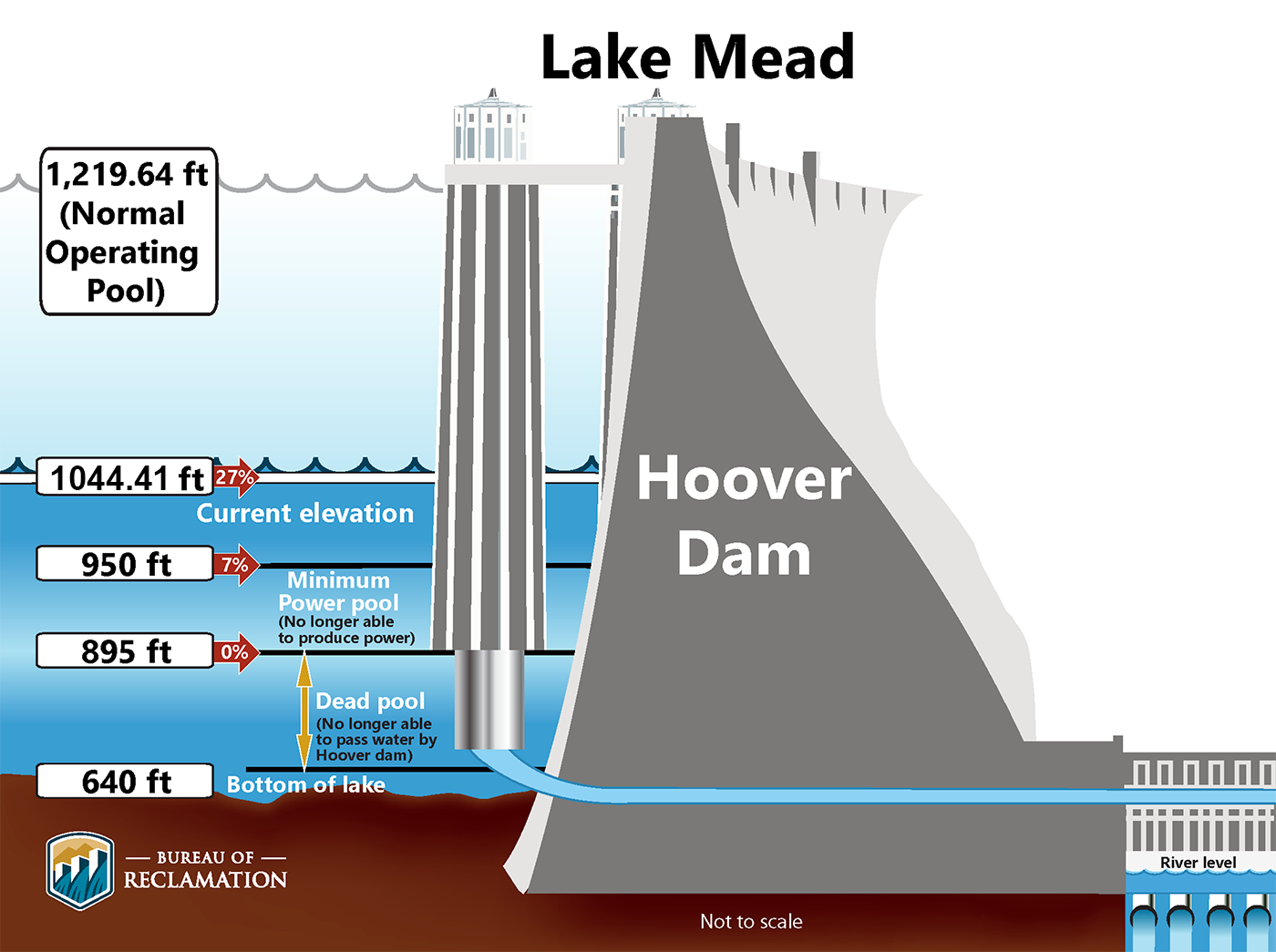
The six-state proposal, branded as the “Consensus-Based Modeling Alternative” would add about 1.5 million acre-feet to Lake Mead in each of the next two years. That’s roughly the same amount of water that is lost each year due to evaporation and inefficient infrastructure. The plan attempts to correct an accounting problem. Each year, some water users in Nevada, Arizona and California are legally entitled to water in Lake Mead that does not physically exist, because it evaporates off of the reservoir’s surface before it ever has a chance to flow downstream. The total amount of evaporated water varies each year depending on reservoir levels and weather. Accounting for that quantity of lost water could get the basin’s users closer to the needed conservation to slow the decline of water levels at Lake Mead. Without changes, federal scientists say the reservoir will continue dropping towards “minimum power pool,” the level at which hydropower generation within the Hoover Dam becomes impossible, and “deadpool,” the level at which water is too low to flow through the dam at all…
California released details of its own proposal to Reclamation late Tuesday. The state suggested the adoption of a water-saving plan it first outlined last October. Under that plan, the state would voluntarily cut back on its water use from the Colorado River use by 400,000 acre-feet – about 9% of its total annual use – each year until 2026. In a press release, the state’s Colorado River board wrote that its proposal would reduce water use while “protecting infrastructure, prioritizing public health and safety, and upholding the existing body of laws, compacts, decrees, and agreements that govern Colorado River operations.” California’s proposal emphasizes the state’s desire to follow existing legal structures for river management, and says further steps could be taken if water levels at Lake Mead dip below 1,000 feet above sea level.
Colorado River Basin Plumbing. Credit: Lester Doré/Mary Moran via Dustin Mulvaney and Twitter