
Where did all the water go? New study explores water use in the #ColoradoRiver basin — Source #NewMexico #COriver #aridification

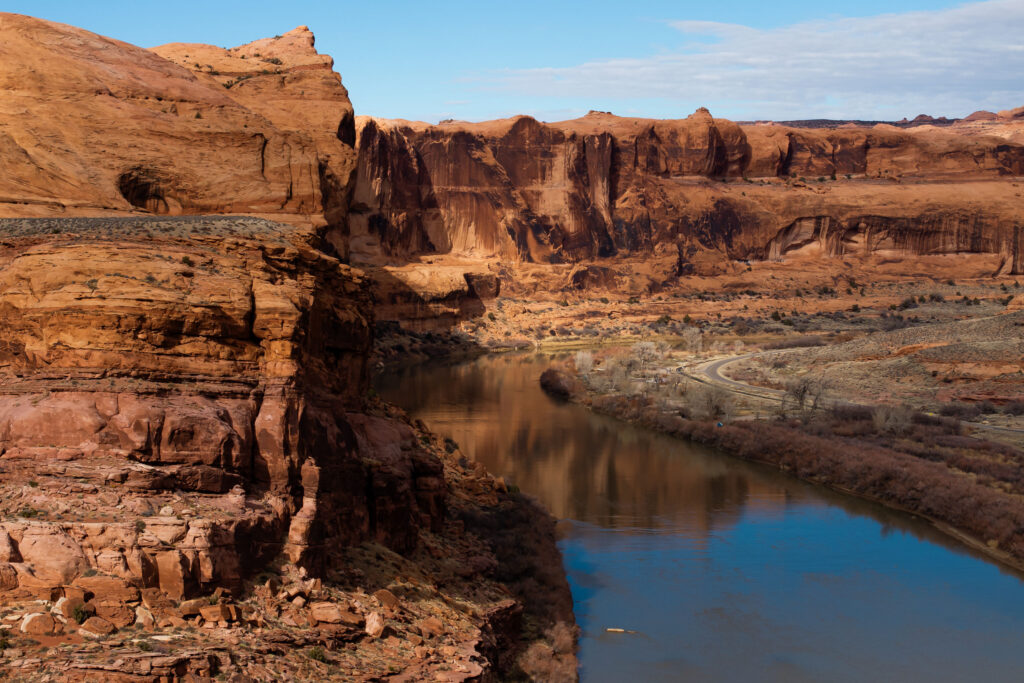
The Colorado River is pictured near Moab on Sunday, Feb. 18, 2024. (Photo by Spenser Heaps for Utah News Dispatch)

Click the link to read the article on the Source New Mexico website (Kyle Dunphey, Utah News Dispatch):

April 2, 2024

The final 100 miles of the Colorado River is a shell of its former self — nearly 10 miles wide at the turn of the century, steamboats would transport carriages and early-model cars from Mexicali to San Luis in Mexico’s Baja California state. Jaguars, beavers, deer and coyotes roamed the fertile riparian ecosystem and farmers had more water than they knew what to do with.

Now, a weave of concrete canals brings water to sprawling industrial farms situated in the Mexicali Valley, with much of the natural riverbed dry and the wildlife sparse. Tides still drive water from the Gulf of California into the valley a few times a year, but the days of a lush river delta in northern Mexico are long gone.
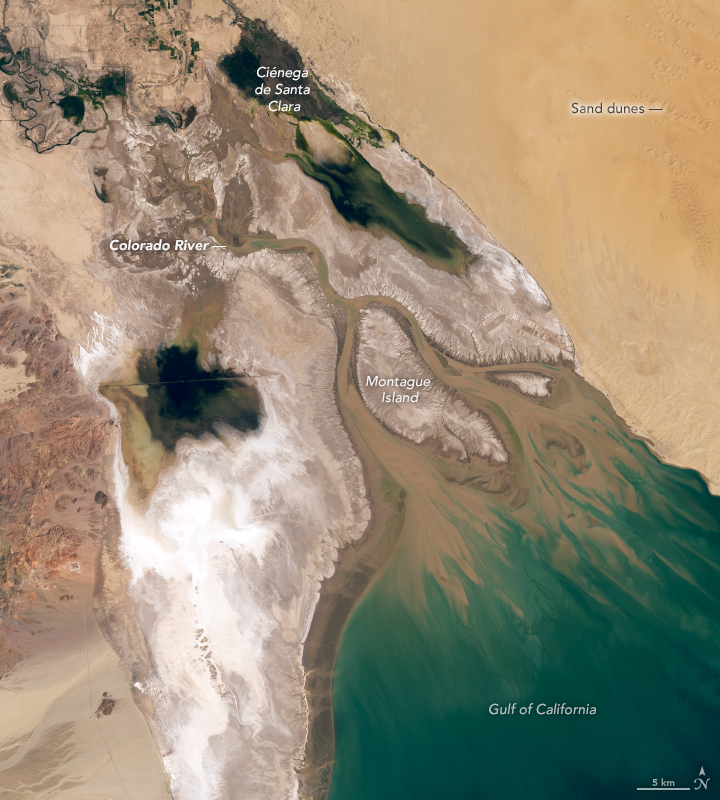
Satellite view of the Colorado River Delta featuring Isla Montague and the Ciénaga de Santa Clara wetland April 25, 2020. By NASA Earth Observatory images by Lauren Dauphin, using Landsat data from the U.S. Geological Survey – https://earthobservatory.nasa.gov/images/146839/green-lagoons-no-more?src=eoa-iotd, Public Domain, https://commons.wikimedia.org/w/index.php?curid=91675468

So, where did all the water go? Researchers on Thursday published one of the more comprehensive analyses of the Colorado River basin attempting to answer the question.

“What we’ve never had is a complete, holistic picture of where all of the Colorado River water goes,” said Brian Richter, president of Sustainable Waters and a lead author of the study.

Richter said that includes an accounting of how all the water in Mexico is used, water that’s exported out of the basin and water from the Gila River, a major tributary of the Colorado River that flows through parts of New Mexico and Arizona.

The answer will likely come as no surprise. According to the study, published in Communications Earth & Environment, irrigated agriculture is responsible for 52% of overall consumption in the basin, and 74% of direct human consumption.

 Of that 52%, crops grown to feed cattle, like alfalfa, account for 32% of all water consumed from the Colorado River.

In the upper basin, which consists of Colorado, Wyoming, Utah and New Mexico, the study found crops grown to feed cattle use 90% of all water diverted toward irrigation — that’s three times the amount of water used for municipal, commercial or industrial use combined.

Richter’s team of researchers calculated the water budget for specific crops by using satellite imagery of agricultural land, then factoring in things like climate and length of growing season to determine consumption.

“If somebody is going to make a statement about how much of the Colorado River goes to irrigated farms, we wanted to make sure they have the right statistics,” Richter said.

The remaining 48% is broken down into three categories in the study — about 18% goes to municipal, commercial or industrial uses, while 11% is lost to evaporation in reservoirs.

Evapotranspiration accounts for the last 19%, which Richter essentially defines as water for the river ecosystem, consumed by riparian and wetland vegetation. It’s a novel approach to a study of this nature, Richter said.

“Usually when people do a water budget for a river system, they’re only paying attention to the human uses. We wanted to change that conversation,” he said.

Consider these other key findings from the study:

In Mexico, 80% of Colorado River water is used for agriculture, while just 7% is left for the river’s ecosystem and 13% for municipal, industrial or commercial use. The river was overconsumed, meaning more water was taken from the river than was supplied during spring runoff, in 16 of 21 years from 2000 to 2020. Users are overconsuming about 20% of the river’s water, the study found. The lower basin uses more water for agriculture than the upper basin — 54% of Colorado River water in the lower basin (Arizona, Nevada, California and Mexico) is used for crops and livestock, compared to 48% in the upper basin. In the upper basin, 24% of Colorado River water is consumed by the ecosystem compared to 14% in the lower basin. About 15% of the water in the upper basin is lost to evaporation in reservoirs — in the lower basin, that figure is at about 10%.

The study comes as water managers from Colorado River basin states are working on new management plans ahead of 2026, when current guidelines are set to expire. Negotiations are tense, and the states so far have yet to reach an agreement. Meanwhile, scientists estimate flows in the river have decreased by roughly 20% over the last century, with warming temperatures resulting in a 10% decrease in runoff.

Richter said he hopes the study can be of use as negotiations continue.

“We wanted to make sure those negotiators have the most accurate and the most complete estimates of where the water is going as a foundation,” he said.

“New plot using the nClimGrid data, which is a better source than PRISM for long-term trends. Of course, the combined reservoir contents increase from last year, but the increase is less than 2011 and looks puny compared to the ‘hole’ in the reservoirs. The blue Loess lines subtly change. Last year those lines ended pointing downwards. This year they end flat-ish. 2023 temps were still above the 20th century average, although close. Another interesting aspect is that the 20C Mean and 21C Mean lines on the individual plots really don’t change much. Finally, the 2023 Natural Flows are almost exactly equal to 2019. (17.678 maf vs 17.672 maf). For all the hoopla about how this was record-setting year, the fact is that this year was significantly less than 2011 (20.159 maf) and no different than 2019” — Brad Udall

Biden-Harris Administration Announces $320 Million for Tribal Domestic Water Infrastructure — U.S. Department of Interior

Photo credit: Department of Interior

Click the link to read the release on the Department of Interior website:

April 2, 2024

WASHINGTON — The Department of the Interior today announced that up to $320 million is available under President Biden’s Investing in America agenda through the Bureau of Reclamation to assist federally recognized Tribes and Tribal organizations as they plan and construct domestic water infrastructure. 

“Investing in water infrastructure projects is crucial to ensuring the health, safety and prosperity of Indigenous communities,” said Secretary Deb Haaland. “Through President Biden’s Investing in America agenda, we are making targeted investments throughout Indian Country to repair and revitalize key infrastructure facilities, which will help support our trust responsibilities, advance economic opportunities and expand access to clean, reliable drinking water for Indigenous communities.”  

“Reclamation is working hard on projects that support water conservation and infrastructure improvements across Indigenous communities,” said Reclamation Commissioner Camille Calimlim Touton. “These efforts funded by the Investing in America agenda are integral to helping ensure Tribes have clean, reliable drinking water and upgraded infrastructure to support their communities.”  

The Inflation Reduction Act invests an overall $550 million to expand domestic water supplies in historically disadvantaged communities. Projects may be funded for up to 100 percent of the cost of planning, design or construction. There is a maximum funding limit of up to $3 million for planning studies, including environmental compliance; up to $5 million for design projects, including environmental compliance; and up to $50 million for construction projects. 

This funding is also advancing President Biden’s Justice40 Initiative, which aims to ensure that 40 percent of the overall benefits of certain climate, clean energy, and other federal investments flow to disadvantaged communities marginalized by underinvestment and overburdened by pollution. 

This funding opportunity is open to Tribes in the 17 western U.S. states served by Reclamation, which will implement the program in two phases: phase one funding will be for planning, design or construction in fiscal year 2024; and phase two funding will be for construction in fiscal years 2027 and 2028. Receiving phase one funding is not a prerequisite for receiving phase two construction funding. However, all project proposals for construction must show that the planning and design have been successfully completed, and priority will be given to those funded under phase one. To be eligible, at least 80 percent of a project’s annual average deliveries must be for domestic water purposes. 

Tribes interested in obtaining assistance under this program must submit a proposal to Reclamation’s Native American Affairs Office. Proposals will be accepted until August 4, 2024.

For more details on the application and award process, visit Reclamation’s Tribal Domestic Water Supply Projects Funding Announcement webpage.