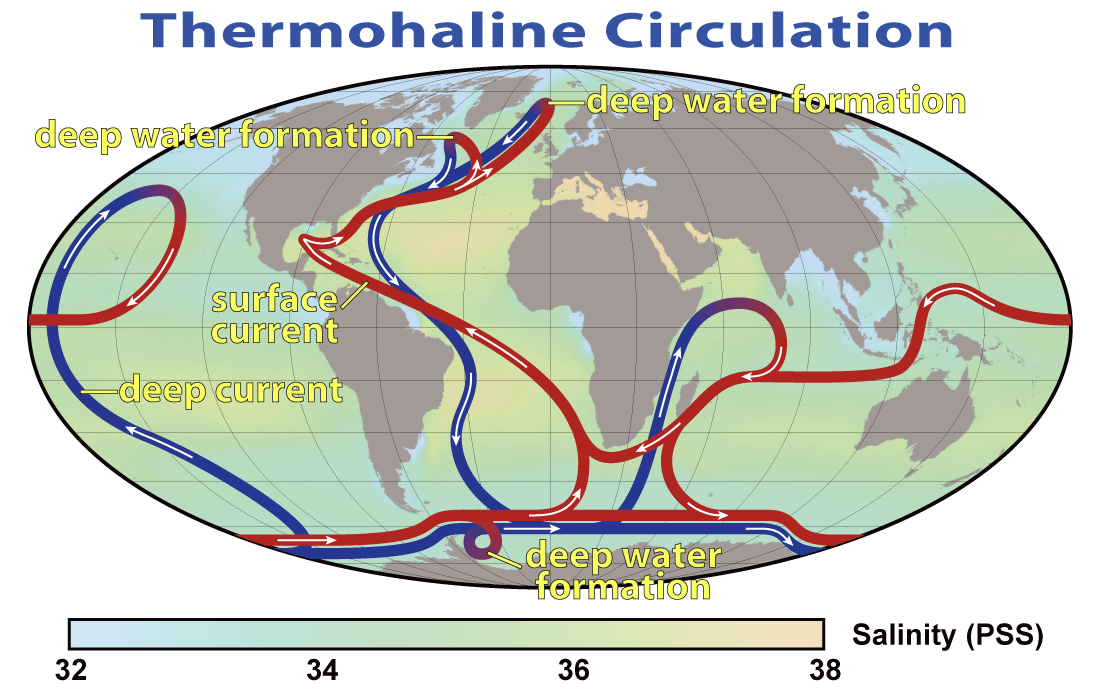
Click the link to read the article on the Oceanography website (Stefan Rahmstorf). Here’s an excerpt:
DRASTIC PAST AMOC CHANGES
Based on this understanding of AMOC instability mechanisms, we can examine some dramatic climate changes that have happened in the recent past—“recent,” that is, from a paleoclimate perspective, namely in the last 100,000 years.
In 1987, Wally Broecker published a now famous article in the journal Nature titled “Unpleasant surprises in the green- house?” (Broecker, 1987). In it, he dis- cusses data from deep-sea sediment cores and holes drilled into the Greenland ice cap, noting that these data reveal that “climate changed frequently and in great leaps” rather than smoothly and gradu- ally. Given the regional patterns of these changes, he identified the AMOC (at the time referred to as the “Atlantic conveyor belt”) as the culprit. He warned that by releasing greenhouse gases, “we play Russian roulette with climate [and] no one knows what lies in the active cham- ber of the gun.”
In the decades since then, we have come to distinguish two types of abrupt climate events that repeatedly occurred during the last Ice Age, centered around the northern Atlantic but with global repercussions (Rahmstorf, 2002).
The first type is Dansgaard-Oeschger (DO) events, named for Danish ice core researcher Willy Dansgaard and his Swiss colleague Hans Oeschger. More than 20 events prominently show as abrupt warming spikes of 10°–15°C within a decade or two in Greenland ice core data (Dansgaard et al., 1982). They can be explained as sudden start-ups of ocean convection in the Nordic Seas when Ice Age convection was mostly only occur- ring in the open Atlantic to the south of Iceland (Figure 5). The warm ocean cir- culation configuration that reached far north was apparently not stable under Ice Age conditions: it gradually weakened, until after some hundreds of years, the convection and warm event ended again. It is thus an example of a convective flip- flop as discussed above, with the Nordic Seas convection turning on and off.
The second type is Heinrich events, named for the German scientist Hartmut Heinrich (Heinrich, 1988). It involves huge masses of ice that episodically slid into the sea from the thousands of meters thick Laurentide Ice Sheet that covered northern America at that time. These iceberg armadas drifted out across the Atlantic, leaving behind telltale layers of ice-rafted debris on the ocean floor and adding fresh meltwater to the ocean sur- face. This led to even more dramatic cli- mate changes, linked to a complete break- down of the AMOC. So much ice entered the ocean that sea levels rose by several meters (Hemming, 2004). Evidence that this amount of freshwater entering the northern Atlantic shut down the AMOC is found in the fact that Antarctica warmed while the Northern Hemisphere cooled (Blunier et al., 1998), indicating that the AMOC’s huge heat transport from the far south across the equator to the high north had essentially stopped.
Both the Dansgaard-Oeschger events and the Heinrich events, although strongest around the northern Atlantic, had major global climate repercussions even far from the Atlantic as they affected the tropical rainfall belts that result from the rising motion of warm air above the “thermal equator.” During the warm Dansgaard-Oeschger events, these rain- fall belts shifted north, leading to warm and humid conditions in the north- ern tropics as far as Asia. But during Heinrich events, the rainfall belts shifted south, leading to catastrophic drought in the Afro-Asian monsoon region (Stager, 2011). Could similar shifts in tropical rainfall belts be in store for us in future?
THE “COLD BLOB”: AN OMINOUS SIGN OF A SLOWING AMOC?
Let us look how the AMOC is already responding to ongoing global warm- ing, which has already pushed Earth’s cli- mate outside the envelope of the stable Holocene (Osman et al., 2021) in which Homo sapiens developed agriculture and started to build cities.
Unfortunately, AMOC data only go back a few decades, drawn from just a handful of cross-Atlantic cruises since the 1950s and the RAPID-AMOC array of stations that has collected continuous measurements of salinity and current velocities from the near surface to the seafloor across the Atlantic at 26°N since 2004 (Smeed et al., 2020). Therefore, we must turn to indirect evidence. Exhibit No. 1 is the “warming hole” or “cold blob” found on maps of observed global tem- perature change (Figure 6). While the entire globe has warmed, the subpolar North Atlantic has resisted and even cooled. This is exactly the region where the AMOC delivers much of its heat, and exactly the region where climate models have long predicted cooling as a result of the AMOC slowing down.
A seminal study by Dima and Lohmann (2010) analyzed global pat- terns of sea surface temperature changes since the nineteenth century and con- cluded “that the global conveyor has been weakening since the late 1930s and that change (Caesar et al., 2018). This result confirms that on longer timescales, the AMOC is the dominant factor, allowing the conclusion that the cold blob so far corresponds to about 15% weakening of the AMOC.

The cold blob is not just a surface phenomenon; it is also clearly vis- ible (Figure 8) in the trend of ocean heat content of the upper 2,000 m (Cheng et al., 2022).
But apart from the cold blob, AMOC slowing has another telltale effect.
A SHIFTING GULF STREAM
Fluid dynamics on a rotating globe like Earth has some peculiar effects that are not intuitive. They result from the fact that the Coriolis force changes with latitude. In 2007 and 2008, two studies conducted by AMOC researcher Rong Zhang demonstrated how a basic law of physics, angu- lar momentum conservation, acting at the point where the deep south- ward AMOC flow crosses under the Gulf Stream, makes the Stream shift closer to shore when the AMOC weakens (Zhang and Vallis, 2007; Zhang, 2008). Her studies describe a “fingerprint” of a weakening AMOC that not only includes the cold blob but also a sea surface temperature anomaly of opposite sign off the American Atlantic coast north of Cape Hatteras.
Caesar et al. (2018) compared this fingerprint to observed sea surface temperature changes since the late nineteenth century and found strong agreement (see Figure 9). The observational data are much less detailed because they rely on relatively sparse ship measurements, but more detail is in the satellite data. Although the time periods for the observed and the satellite data are different, the trends are divided by the global
mean temperature change to make them roughly comparable in magnitude. Thus, for the relatively short satellite period there is much stronger random variabil- ity relative to the signal (“noise”), and the signal-to-noise ratio declines from top to bottom in the three images. Despite the differences in other variability, the finger- print of AMOC decline is very clear in all three Figure 9 plots.
As a side note, all three diagrams show a warming patch in the Arctic off Norway; in the model, this is due to increasing ocean heat transport from the Atlantic into the Arctic Ocean (Fiedler, 2020). This flow may be unrelated to the AMOC, or possibly anti-correlated to the AMOC and thus a third part of its fingerprint.
The strong warming off the North American Atlantic coast is again not caused by surface heat fluxes, as the reanalysis data show the surface heat flux has changed in the opposite direction, toward increasing heat loss (Figure 7). Also, the current generation of climate models (CMIP6) indicate a clear correla- tion of AMOC strength with this finger- print pattern of sea surface temperatures, including both the cold blob and the warming part (Latif et al., 2022).
Furthermore, a recent study using the three-dimensional observational ocean data collected by Argo profil- ing floats (https://argo.ucsd.edu/) shows that the Gulf Stream has shifted about 10 km closer to shore since the beginning of this century (Todd and Ren, 2023). From the RAPID array we know that the AMOC has indeed weakened during this time span. In addition, there has been a “robust weakening of the Gulf Stream during the past four decades observed in the Florida Straits” (Piecuch and Beal, 2023), which, although not necessarily linked to an AMOC weakening, is at least consistent with it.
Additional evidence consistent with AMOC slowing also comes from salin- ity changes. The northeastern subpolar Atlantic is freshening (Figure 10), likely through a combination of increased as well as the melting of sea ice and the Greenland ice sheet, plus the effect of ocean circulation changes bringing less salty subtropical waters to the north. The Iceland Basin registers the lowest salinity in 120 years of measurements (Holliday et al., 2020).
At the same time, salinity is increasing in the subtropical South Atlantic, which is considered an AMOC fingerprint less affected by short-term variations than the northern Atlantic temperature fingerprint; this suggests an accelera- tion of AMOC slowdown since the 1980s (Zhu et al., 2023).
Yet more evidence comes from analysis of seawater density in the upper 1,000 m in the subpolar gyre region, which cor- relates closely with the AMOC and shows a decline over the past 70 years. This decline implies an AMOC weakening of ~13% over this period (Chafik et al., 2022), consistent with the 15% weaken- ing suggested by the cold blob data.