Water conflict: #ColoradoSprings Utilities, others say #Aurora in violation of 2003 pact — #Colorado Politics #ArkansasRiver

Straight line diagram of the Lower Arkansas Valley ditches via Headwaters Magazine

Click the link to read the article on the Colorado Politics website (Mary Shinn). Here’s an excerpt:

April 22, 2023

Aurora Water is spending $80 million on a ranch of about 5,000 acres near Rocky Ford and its associated water rights. An Aurora presentation showed it estimates it is paying about $9,600 per acre-foot of water. The purchase could yield 18,000 to 22,500 acre-feet every 10 years, Aurora city documentation states…Aurora Water expects to use the water three out of every 10 years to help support its growth and allow the water to irrigate crops during the remaining seven years…

Southeastern Colorado Water Conservancy District President Bill Long said the purchase breaks an agreement Aurora Water signed with the district. Residents in the district have paid property taxes to support bringing water from the Western Slope to the Arkansas Basin.  

“They have purchased water when they agreed not to,” he said.

Colorado Springs Utilities said in an official statement they agree with the Southeastern Colorado Water Conservancy District’s interpretation that the purchase is a violation of the 2003 agreement.

Polluters must pay to clean up areas contaminated with PFOA, PFOS — SourceNM.com #PFAS

EPA Administrator Michael Regan (Photo by Lisa Sorg / NC Policy Watch)

Click the link to read the article on the SourceNM.com website (Lisa Sorg):

April 22, 2024

Industries that discharge toxic PFOA and PFOS compounds into the environment will now be held legally and financially responsible for the contamination, according to a final rule issued by the EPA last week.

The Department of Defense is also subject to the new requirements.

PFOA and PFOS are now classified as hazardous substances under Superfund law, which authorizes the EPA to use its enforcement powers to require polluters pay for and clean up the contamination. The designation also mandates new reporting requirements for facilities that release the compounds into the environment.

These facilities include 3M, DuPont and its spinoff company, Chemours.

ā€œDesignating these chemicals under our Superfund authority will allow EPA to address more contaminated sites, take earlier action, and expedite cleanups, all while ensuring polluters pay for the costs to clean up pollution threatening the health of communities,ā€ EPA Administrator Michael Regan said.

The EPA announced the new rule a week after setting legally enforceable drinking water standards for five types of the toxic compounds, as well as a mixture. PFOA and PFOS are among those compounds with maximum contamination limits of 4 parts per trillion.

Exposure to PFOA, PFOS and other similar compounds has been linked to multiple health problems, including thyroid and liver disorders, reproductive and fetal development problems, immune system deficiencies, high cholesterol, and kidney, testicular and other cancers.

There are several exemptions to the rule — entities that receive, often unknowingly, these compounds from industrial sources: community water systems and publicly owned treatment works, municipal storm sewer systems, publicly owned/operated municipal solid waste landfills, publicly owned airports and local fire departments, and farms where biosolids are applied to the land.

When Regan announced the new drinking water standards, public utilities clamored for ways to pass the treatment costs to polluters. PFOA and PFOS, as well as other types of the toxic compounds, can’t be removed through traditional treatment methods. The upgrades can run in the tens of millions of dollars. The $1 billion in federal funding to help utilities meet the drinking water standards is not enough, given the widespread contamination.

ā€œCommunities across the Southeast and the country have been shouldering the costs of PFAS contamination for far too long,ā€ said Kelly Moser, senior attorney and leader of the Water Program at the Southern Environmental Law Center. ā€œToday’s designations will help put the burden of addressing PFAS pollution back on the polluter. Now states and municipalities must use the tools they have to stop ongoing toxic PFAS pollution before more contaminated Superfund sites are created.ā€

Under the new rule, entities are required to immediately report releases of PFOA and PFOS that meet or exceed the reportable quantity of one pound within a 24-hour period to the National Response Center, as well as state, tribal and local emergency responders.

ā€œAfter decades of industry using and disposing PFOA and PFOS, EPA can now accelerate cleanups of the most contaminated sites,ā€ said Earthjustice Legislative Counsel Christine Santillana, in a prepared statement. ā€œIt’s highly encouraging to see EPA initiate this designation and gives hope to impacted communities that their health will be better protected.ā€

The final rule also means that federal entities that transfer or sell their property must provide notice about the storage, release, or disposal of PFOA or PFOS on the property and guarantee that contamination has been cleaned up or, if needed, that additional cleanup will occur in the future. It will also lead the Department of Transportation to list and regulate these substances as hazardous materials, according to the EPA.

Under federal law, hazardous materials can be transported only with a special permit, accompanied by a shipping manifest. Transportation documents for most hazardous substances are public through the EPA’s e-Manifest database; it will now be easier to track the transport of PFOA and PFOS.

This designation of the two chemicals will also ensure that hundreds of Department of Defense installations with PFOA and PFOS contamination are finally cleaned up.

This could affect the Tarheel Army Missile Plant in Burlington, where PFOA and PFOS were found in the groundwater and soil last year. Although the military has already transferred that property to private owners, the Department of Defense is responsible for cleaning up contamination below the ground — now including PFOA and PFOS.

ā€œNearly 500 military installations are contaminated with PFAS, but the DOD has failed to make PFAS cleanup a priority – and our service members and defense communities are paying the price,ā€ said Jared Hayes, a senior policy analyst at the Environmental Working Group.

The national Sierra Club had submitted public comments last year, asking the EPA to crack down on industrial dischargers.

ā€œWe’re grateful that the EPA continues to find ways to fight what can only be described as an uphill battle against PFAS contamination,ā€ said Erin Carey, acting director of the North Carolina chapter of the Sierra Club. ā€œRight now, the regulation of these dangerous chemicals is far too narrow to be fully protective. With more than ten thousand of these compounds in production, we must move toward regulation of PFAS as a class, rather than this ā€˜whack-a-mole’ method of regulating individual compounds. Broader and more ambitious action will be required of this agency, of industry and of our elected leaders to meaningfully tackle the terrifying and widespread threat of ā€˜forever chemicals’ in our bodies and our environment.ā€

NC Newsline is part of States Newsroom, a nonprofit news network supported by grants and a coalition of donors as a 501c(3) public charity. NC Newsline maintains editorial independence. Contact Editor Rob Schofield for questions: info@ncnewsline.com. Follow NC Newsline on Facebook and Twitter.

Court sides with Forest Service in Purgatory Resort water rights dispute — The #Durango Herald #Hermosa Creek

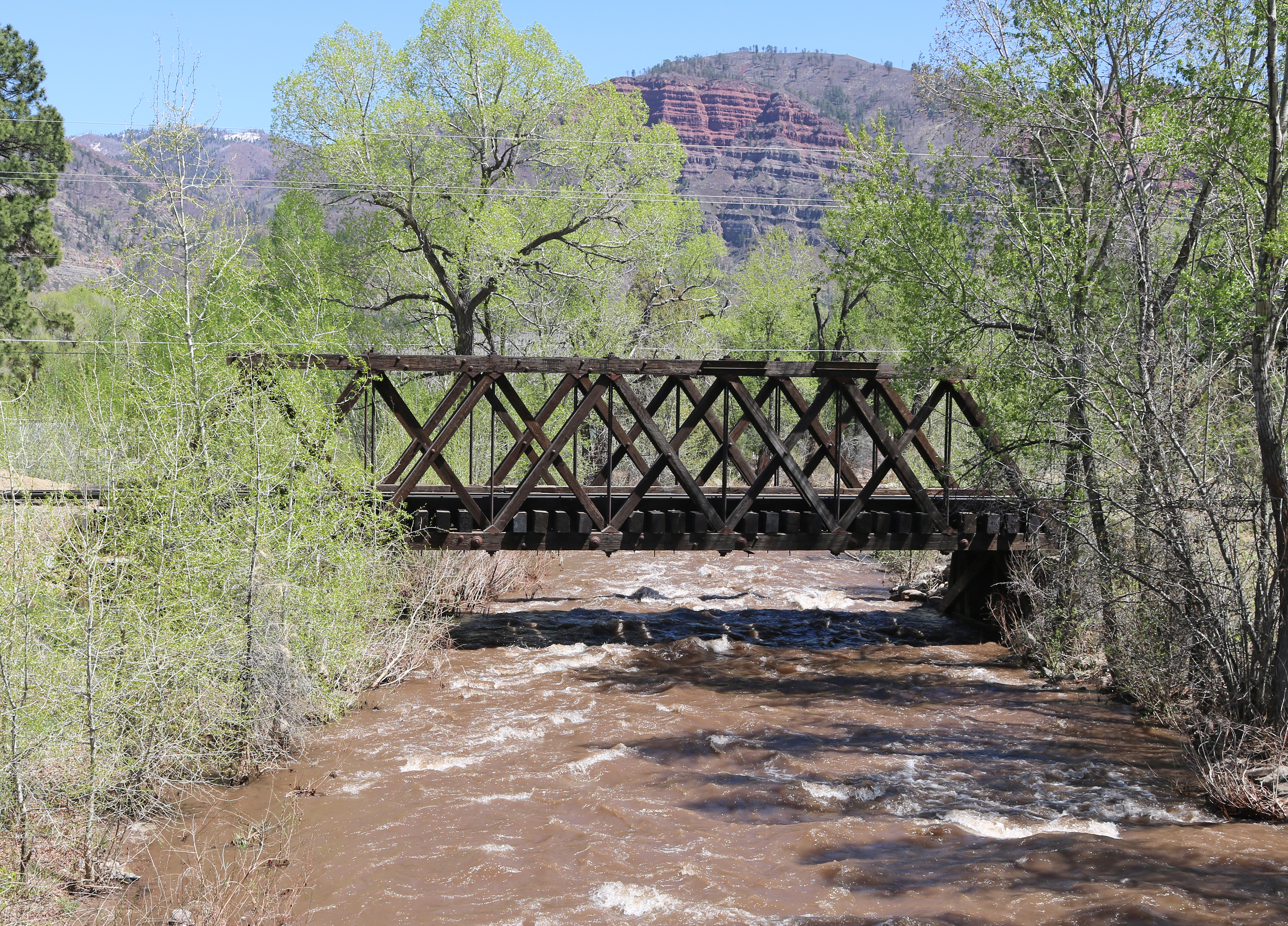
A view of Hermosa Creek in Hermosa, Colorado. The view is from a bridge on U.S. Highway 550 and shows a Durango and Silverton Narrow Gauge Railroad trestle. By Jeffrey Beall – Own work, CC BY 4.0, https://commons.wikimedia.org/w/index.php?curid=89863900

Click the link to read the article on The Durango Herald website (Reuben M. Schafir). Here’s an excerpt:

April 21, 2024

Purgatory is seeking to access federal land so that it may capture water from Hermosa Creek for snowmaking and other municipal purposes. San Juan Nation Forest has objected to the access on the basis that the diversion could detrimentally impact the native cutthroat trout population. The ruling, issued Monday by Senior Judge William Martinez in the U.S. District Court for the District of Colorado, passed judgment on the application of the Quiet Title Act and found that the statue of limitations had expired years before the lawsuit was filed on Oct. 27, 2022. The decision did not address the substantive questions around the resort’s access to Hermosa Creek water, and it does not put the entire issue to bed, San Juan National Forest Supervisor Dave Neely said.

For over two decades, SJNF officials have expressed concern about Purgatory’s attempts to divert 4.54 cubic feet per second of water from Hermosa Creek via an in-stream diversion and ground wells. A water court decreed two water rights in 1972 and 1982, respectively. The water is to be diverted from the East Fork of Hermosa Creek and its alluvial groundwater on land on the back side of the resort area. In a 1991 agreement, the SJNF made a trade with Purgatory’s corporate predecessors and acquired that land. In exchange, the resort acquired land on the front of the mountain.

The core of the case is whether Purgatory retained a right to an easement on the backside on National Forest land – a necessity to access and divert the water in question – when it conveyed the land in an agreement stating it was ā€œfree from all encumbrances.ā€ Purgatory sought a quiet claims action that would have definitively affirmed its rights to the water and an easement or right of way necessary to access it under the federal Quiet Title Act.

Drinking water for 268,000 Coloradans exceeds new limits on ā€œforever chemicals.ā€ How will providers find millions to fix the water? — The #Denver Post #PFAS

This USGS map shows the number of PFAS detected in tap water samples from select sites across the nation. The findings are based on a USGS study of samples taken between 2016 and 2021 from private and public supplies at 716 locations. The map does not represent the only locations in the U.S. with PFAS. Sources/Usage: Public Domain. Visit Media to see details.

Click the link to read the article on The Denver Post website (Noelle Phillips and Elise Schmelzer). Here’s an excerpt:

April 21, 2024

TheĀ 27 water systemsĀ identified by the Colorado Department of Public Health and Environment as exceeding the new standards range in size from Thornton, which serves about 155,000 customers, to Dawn of Hope Ranch, a religious retreat in Teller County that serves 55 people. Some of the larger utilities on the state’s list already are planning to build multimillion-dollar filtration systems, but experts say the smaller water providers will be among the last to fall into compliance. While grant money is available, experts note it’s likely water customers will pay some of the costs via higher rates.

The federal regulations announced 10 days ago require drinking water providers to lower the concentration of forever chemicals below the new limit by 2029. The chemicals — perfluoroalkyl and polyfluoroalkyl substances, collectively known as PFAS — have been used for decades to make waterproof, nonstick or stain-resistant products and are linked to a wide range of health problems, including cancer and reduced fertility…

In Colorado, state water regulators have a good idea which water systems have PFAS in their drinking water supplies, said Christopher Higgins, a professor of civil and environmental engineering at the Colorado School of Mines, who is an expert in PFAS contamination. Fifty-six other water providers in the state have found PFAS in their water but in concentrations below the EPA’s limit, including Aurora, Frisco and Gunnison…

The federal government set aside more than $10 billion to help communities test and treat drinking water for PFAS. That money is intended for rural or disproportionately impacted communities. That’s not nearly enough, Zobell said…Unless there is a leap in PFAS-removal technology in the next three years, many providers will have to raise rates or find money elsewhere, Zobell said. Moody, with the American Water Works Association, said the financial burden has been a primary concern among water providers…There are just a handful of companies in the United States that build and install the filtration systems, Moody said. They will go after the larger contracts, leaving the smallest, more rural water companies in the back of the line because those contracts will be less profitable.

Airborne survey indicates short runoff season — The #Aspen Daily News #RoaringForkRiver #FryingpanRiver #ColoradoRiver #COriver #aridification

Click the link to read the article on The Aspen Daily News website (Austin Corona). Here’s an excerpt:

April 18, 2024

A report from an airborne survey conducted on April 9 shows that snowpack in the upper reaches of both rivers is warmer and smaller than last year. The survey was conducted by Boulder-based Airborne Snow Observatories, a private company operating through contracts with local governments. The survey area includes the headwaters of the Roaring Fork from the Continental Divide to just above Aspen, as well as the Fryingpan River above Ruedi Reservoir, and the headwaters of Snowmass Creek, Maroon Creek, Castle Creek, Hunter Creek and Woody Creek…

Jeff Deems, a Carbondale resident and chief technical officer for hardware at ASO, said the ā€œcold contentā€ of the snow — a measurement of how much energy is required to melt snow — measured on the day of the survey indicates that much of the watershed’s snowpack is already melting or on the verge of melting. According to a report from ASO’s survey, the amount of snow in the basin below freezing, or ā€œunripe,ā€ is roughly 10 percentage points lower than last year around the same time. It currently stands at about 26% of the overall snowpack. The rest of that snow is right at, or approaching, its melting point.  

ā€œI think we’re seeing a fairly warm snowpack this year,ā€ Deems said. ā€œI dug a snow pit on April 9, when the plane was in the air, at 11,000 feet on Richmond Ridge. And most of the snowpack was isothermal — so that is at zero degrees Celsius, at the melting point. There was a very minimal layer in the middle that was a few degrees below freezing.ā€

The total amount of water in this year’s snowpack is smaller than last year. The snow water equivalent, or SWE, in the survey area this year was about 520,000 acre-feet on April 9, a roughly 12% drop from the same number taken at the same time last year (the 2023 survey occurred April 11-12). Deems said the SWE observed in the April 9 flight indicates that this year’s snowpack is smaller than previously thought. Snow telemetry (SNOTEL) sites around the basin show similar snowpack conditions from last year, while the ASO survey shows a clear drop in SWE.  Deems said he thinks the disparity is a result of changing snow distribution patterns, which the SNOTEL sites cannot measure with detail because they are tied to a fixed location.

This map shows the snowpack depth of the Maroon Bells in spring 2019. The map was created with information from NASA’s Airborne Snow Observatory, which will help water managers make more accurate streamflow predictions. Jeffrey Deems/ASO, National Snow and Ice Data Center