R.I.P. Dickey Betts: “And when it’s time for leavin’, I hope you’ll understand, that I was born a ramblin’ man”

Betts at the Pistoia Blues Festival, Pistoia, Italy, July 2008. By SImone berna – https://www.flickr.com/photos/simone13/2667705298/, CC BY 2.0, https://commons.wikimedia.org/w/index.php?curid=8733539

Click the link to read the obit from The New York Times (Alex Williams). Here’s an excerpt:

Dickey Betts, a honky-tonk hell raiser who, as a guitarist for the Allman Brothers Band, traded fiery licks with Duane Allman in the band’s early-1970s heyday, and who went on to write some of the band’s most indelible songs, including its biggest hit, ā€œRamblin’ Man,ā€ died on Thursday morning at his home in Osprey, Fla. He was 80…

Despite not being an actual Allman brother…Mr. Betts was a guiding force in the group for decades and central to a sound that, along with the music of Lynyrd Skynyrd, came to define Southern rock. Although pigeonholed by some fans in the band’s early days as its ā€œotherā€ guitarist, Mr. Betts, whose solos on his Gibson Les Paul guitar seemed at times to scorch the fret board, proved a worthy sparring partner to Duane Allman, serving as a co-lead guitarist more than a sidekick…

With his chiseled facial features, Wild West mustache and gunfighter demeanor, Mr. Betts certainly looked the part of the star. And he played like one.

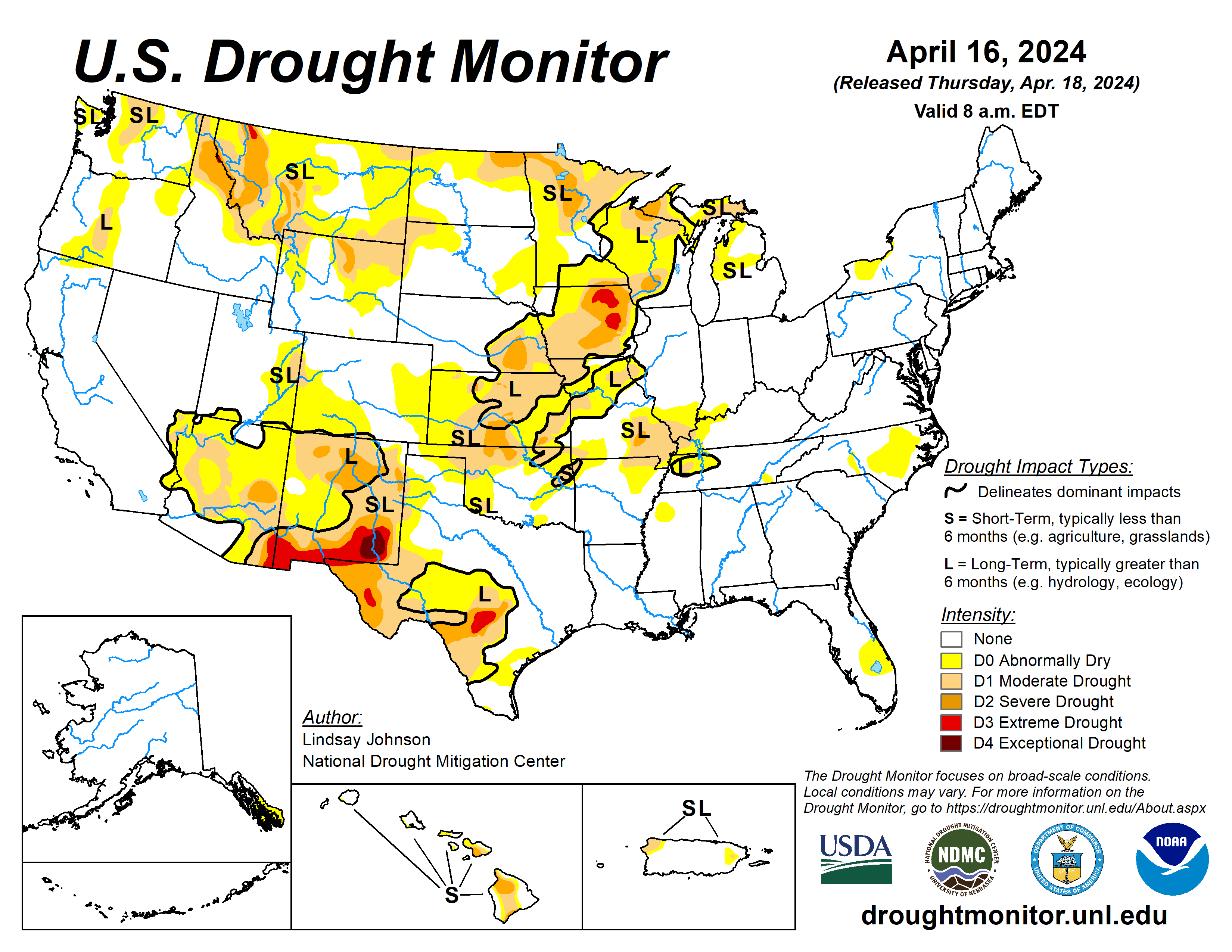
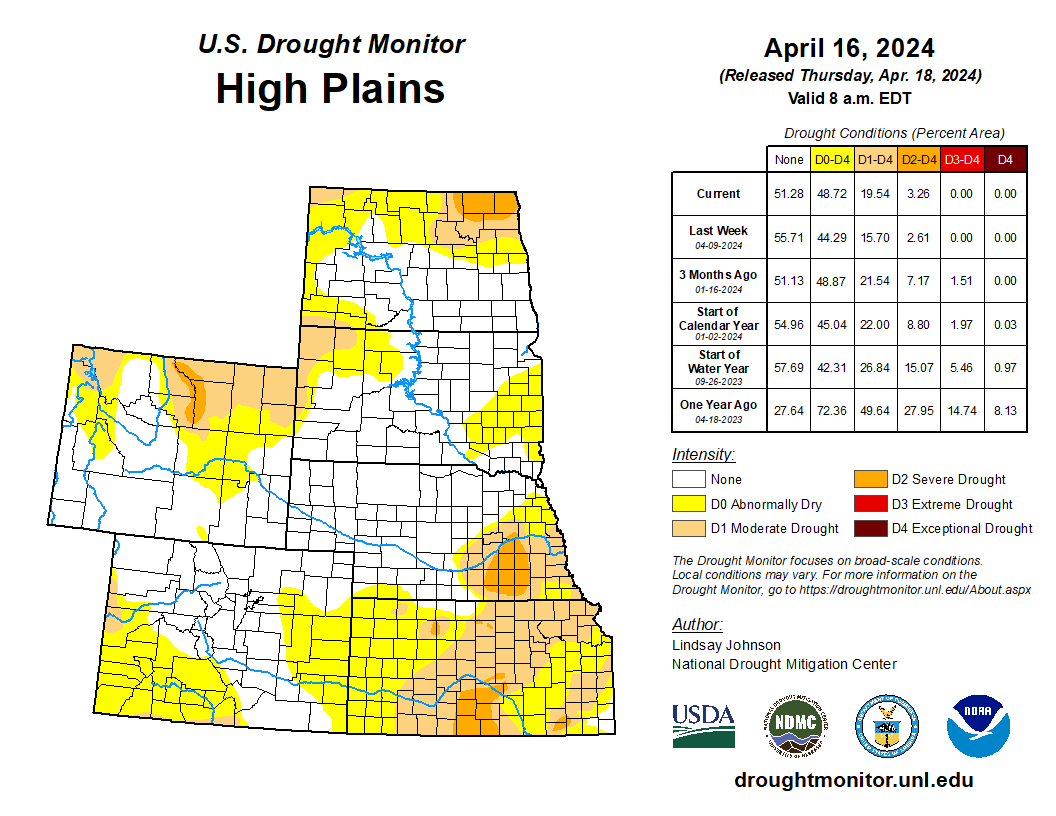
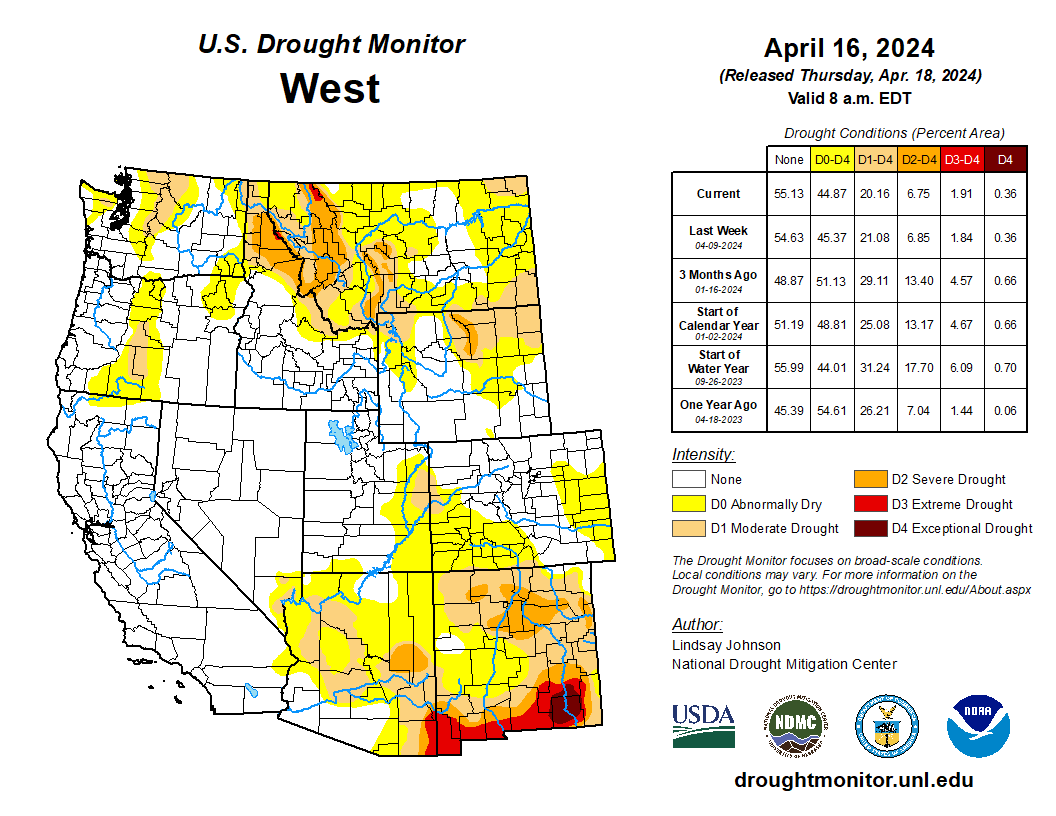
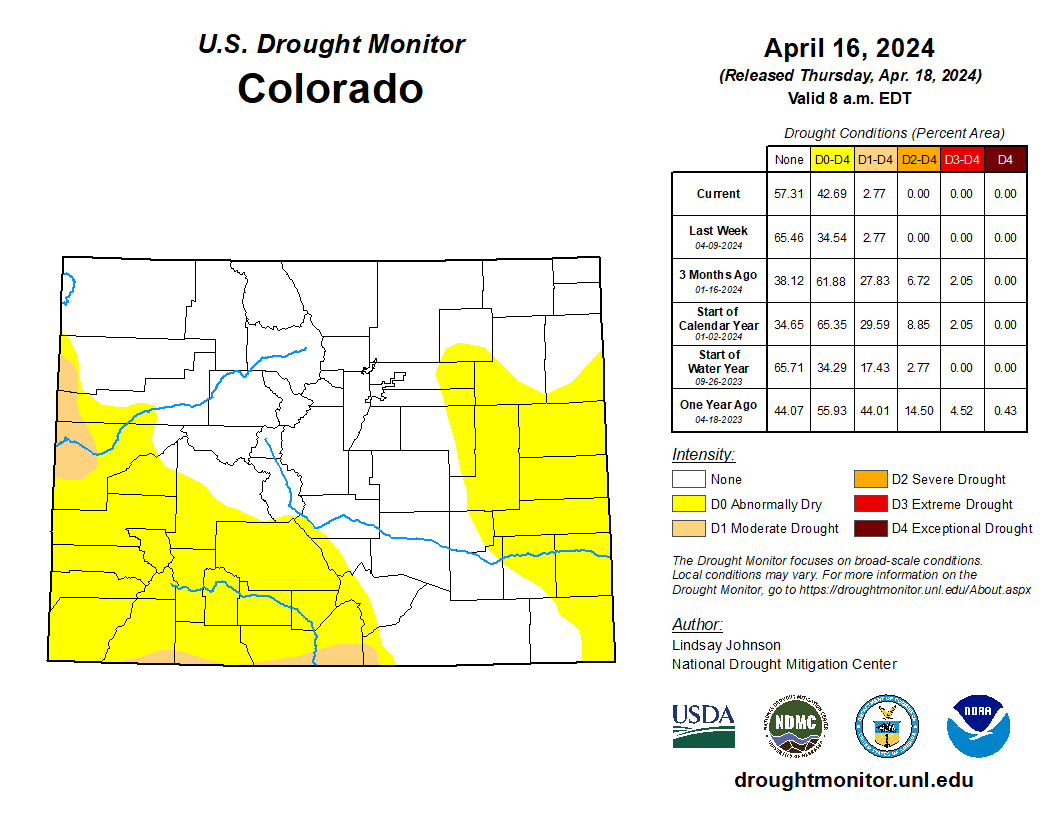
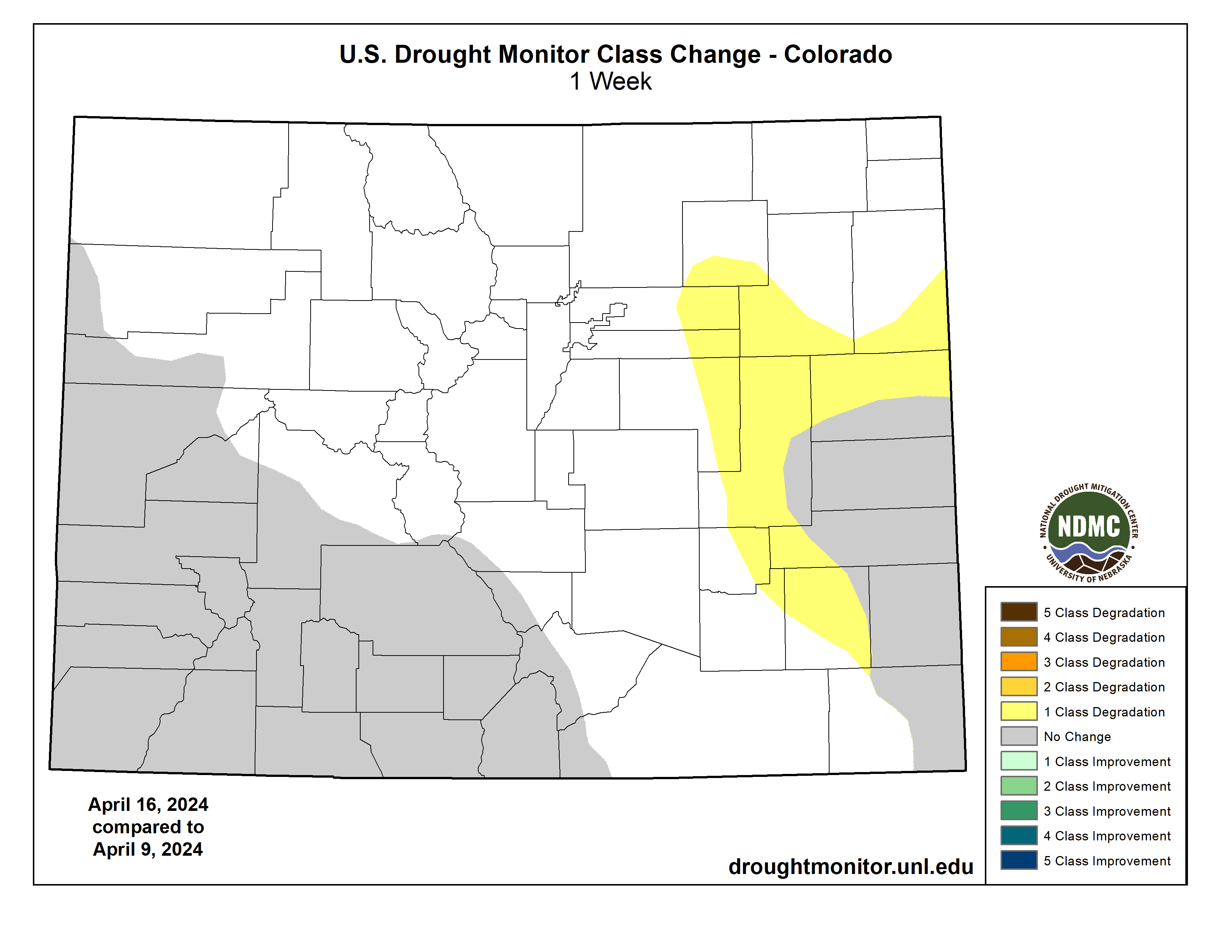
#Drought news April 18, 2024: The southern High Plains are in the grips of rapidly drying conditions, leading to degradations across #KS, with conditions bleeding into E. #Colorado and S. #NE. W. #Kansas has not seen precipitation in over two weeks

Click on a thumbnail graphic to view a gallery of drought data from the US Drought Monitor website.

Click the link to go to the US Drought Monitor website. Here’s an excerpt:

This Week’s Drought Summary

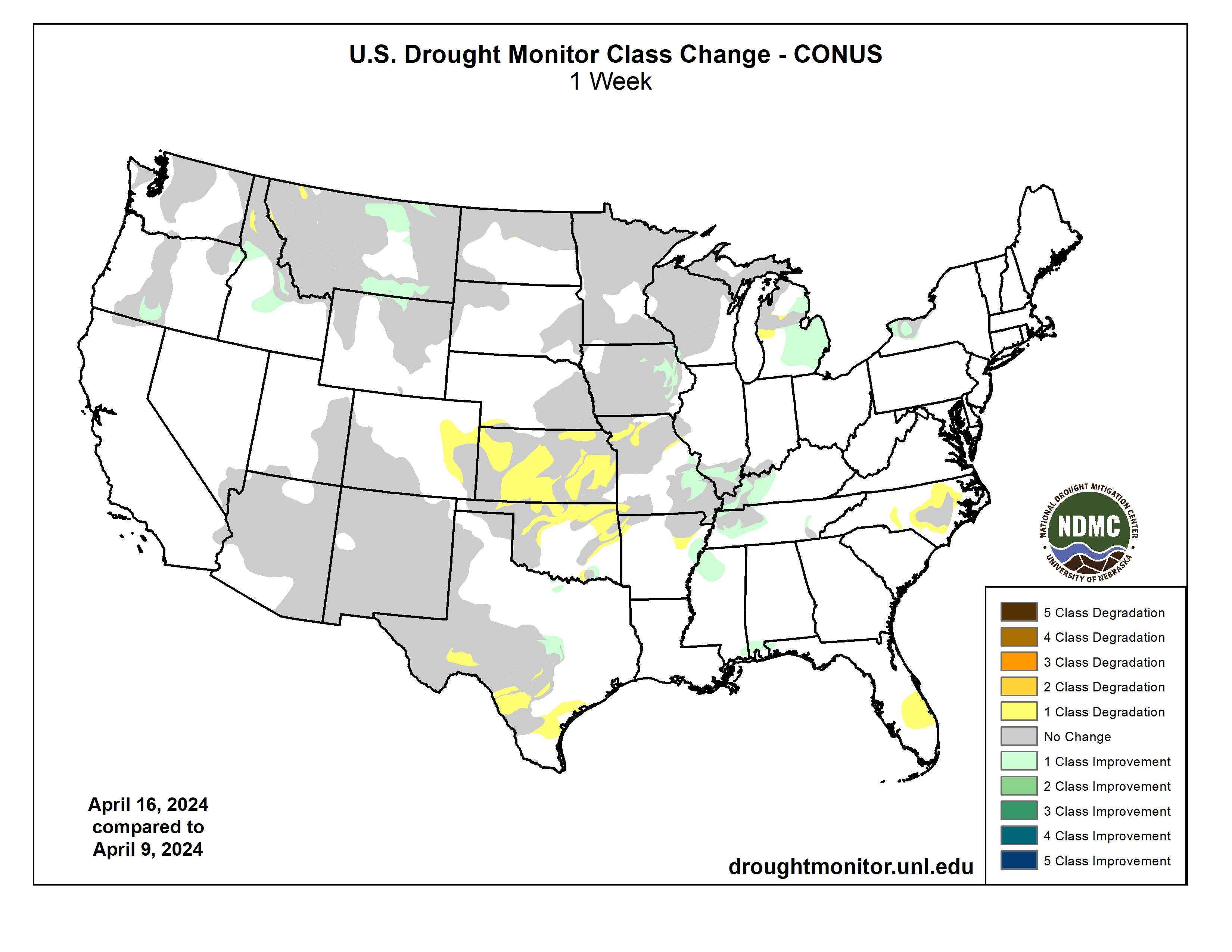
Heavy precipitation fell across much of the central and eastern parts of the country, bringing improvements along the Mississippi River and Great Lakes regions. There were also isolated areas of improvement in Oregon, Idaho and Montana. Extreme drought conditions were introduced in the mountainous region along the Idaho and Montana border due to concerns about low snow amounts and possible early snowmelt. Across the country in the Southeast, areas in North Carolina and southern Florida are seeing drying conditions due to low precipitation over the past few weeks. Western and southern Texas, which largely missed this week’s precipitation, saw an expansion of abnormal dryness, moderate and severe drought conditions. Flash drought conditions are appearing in Oklahoma, and Kansas, with some spillovers in eastern Colorado and western Missouri. Weeks with little precipitation, warming temperatures, dry soils and low streamflow levels are leading to rapid degradations. degradation…

High Plains

The southern High Plains are in the grips of rapidly drying conditions, leading to degradations across Kansas, with conditions bleeding into eastern Colorado and southern Nebraska. Western Kansas has not seen precipitation in over two weeks, providing no relief to the rapidly drying soils and low streamflows. Conditions in Kansas into Oklahoma are seeing rapid deterioration and short-term dryness indicating flash drought conditions…

Colorado Drought Monitor one week change map ending April 16, 2024.

West

The West saw conditions remain mostly the same, with areas in the Northwest seeing some improvements. Regions along the Pacific coast received some precipitation but not in areas needing moisture. There was some improvement in southern Oregon where precipitation did fall. Southern Idaho also saw improvement with the precipitation and decent snowpack. Northern Idaho into Montana did see some degradation, with mountainous areas seeing snow at extremely low levels. Western Montana experienced improvements in the east-central part of the state…

South

Heavy precipitation fell across eastern Texas, Louisiana, southern Arkansas and west-central Mississippi. This brought improvements in northeast Mississippi, leaving the state drought-free with only some lingering abnormally dry conditions. While less precipitation fell in Tennessee, the western part of the state also saw improvements. Conversely, southern Texas and Oklahoma are seeing conditions worsen as conditions continue to quickly deteriorate. Conditions in Oklahoma into Kansas are seeing rapid degradation and short-term dryness indicating flash drought conditions…

Looking Ahead

Over the next 5 days (April 19-23), more heavy precipitation is expected in the Plains and Midwest. Iowa, Nebraska and South Dakota could see upwards of 2.5 inches of precipitation. Northeast Texas, southeastern Oklahoma, and western Arkansas could see 1.5 to 2 inches of precipitation. Areas of higher elevation in the Rockies of Colorado and Wyoming are also expected to see between 1-2 inches.

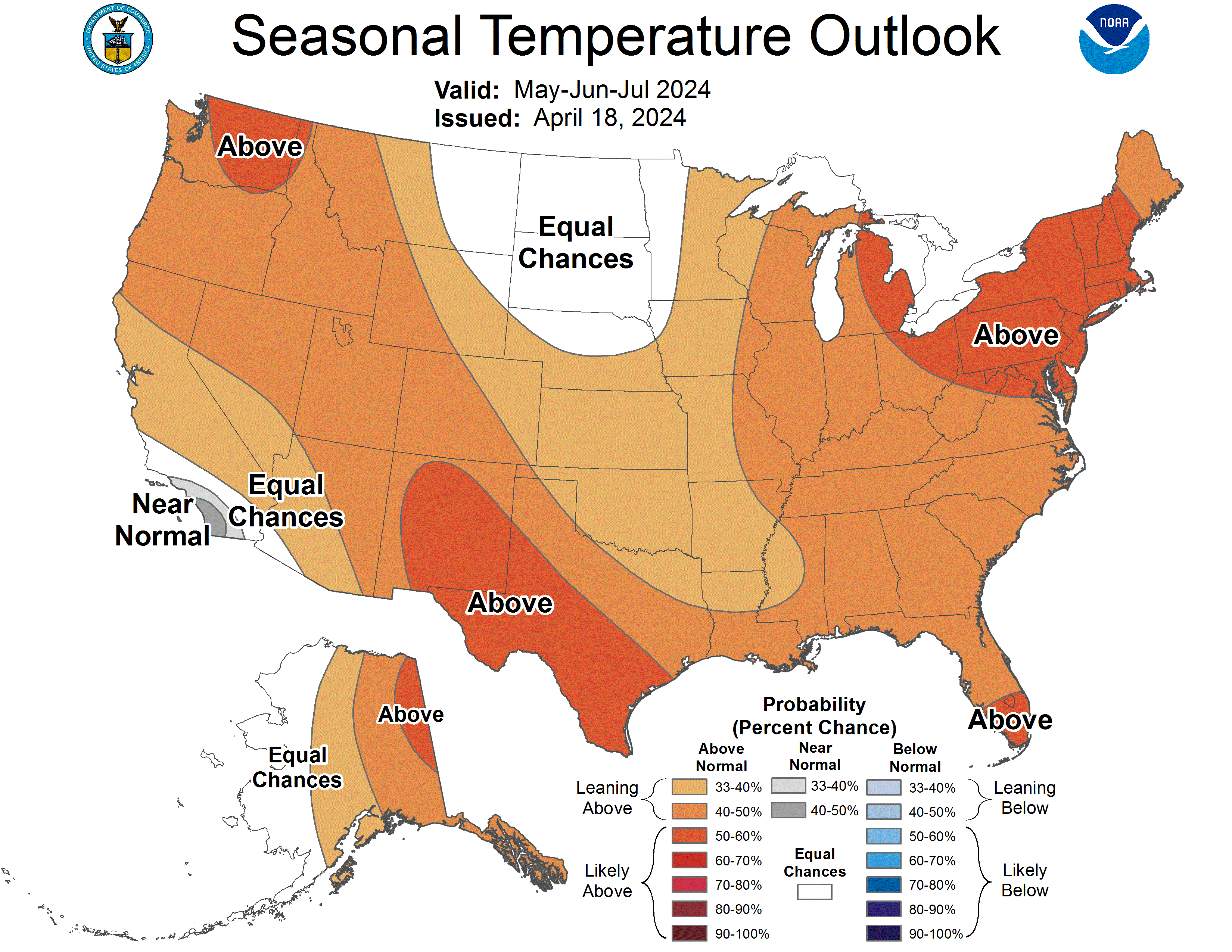
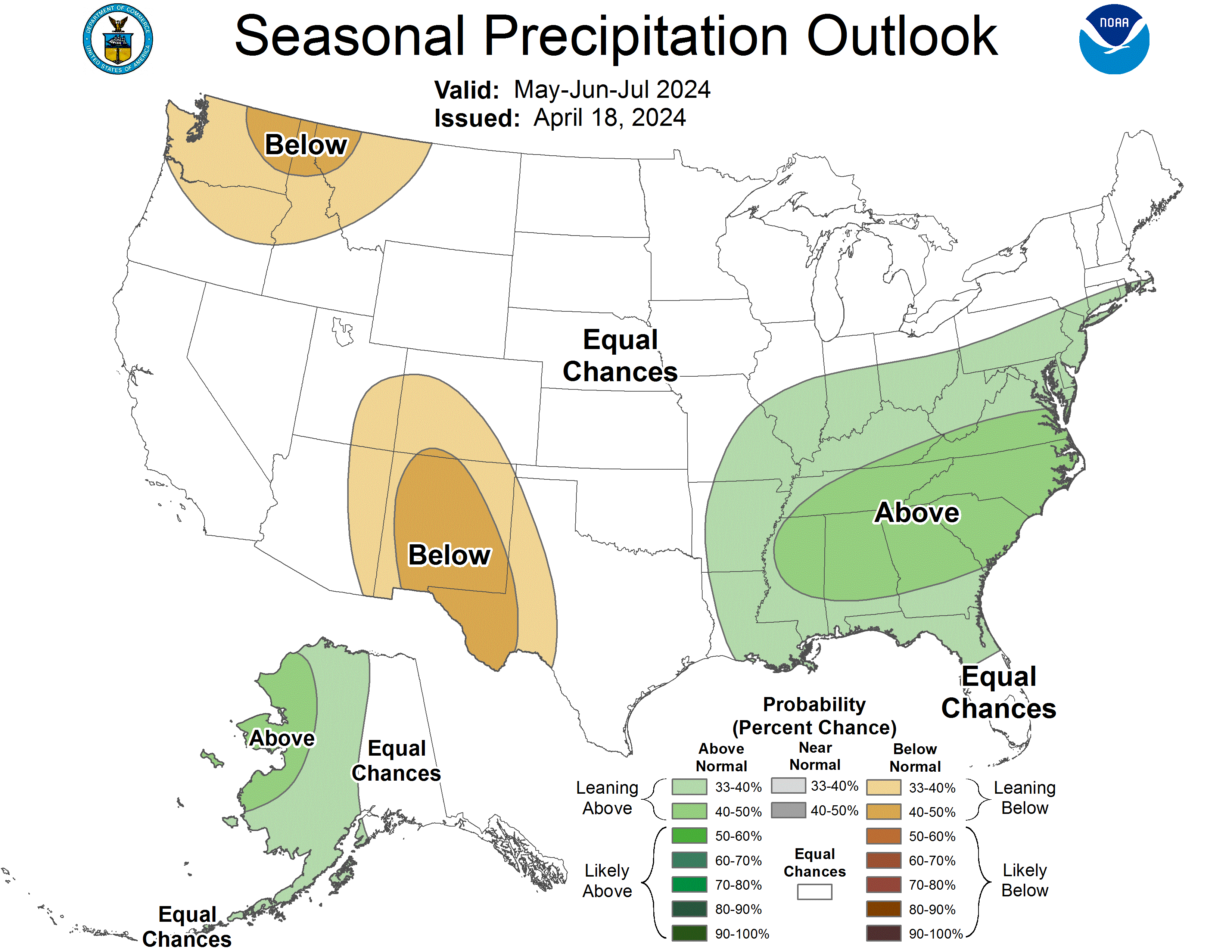
The National Weather Service Climate Prediction Center’s 6 to10-day outlook (Valid April 22) favors above-normal precipitation for southern parts of the U.S., particularly along the eastern Gulf Coast from Texas and Louisiana into parts of Arkansas and Oklahoma. Florida is also favoring above-normal precipitation. The Northwest and Northeast are leaning towards below-normal precipitation. From the middle of Pennsylvania northward, below-normal precipitation is likely to occur. Hawaii is also leaning towards below-normal precipitation and Alaska is leaning towards above-normal precipitation. In terms of the temperature outlook, above-normal temperatures are expected from the West into the High Plains, as well as along the Gulf Coast and Florida. Utah, Nevada, northern Arizona, northern New Mexico and western Colorado are showing a 70-80% likelihood of above-normal temperatures. Eastern Alaska is also leaning towards above-normal temperatures. The Mid-Atlantic region and the eastern Midwest are leaning toward below-normal temperatures. Hawaii and western Alaska are favoring below-normal temperatures.

US Drought Monitor one week change map ending April 16, 2024.

#Wyoming Lawmakers OK $2 million for cloud seeding program — Wyoming Public Radio

Cloud-seeding graphic via Science Matters

Click the link to read the article on the Wyoming Public Radio website (David Dudley). Here’s an excerpt:

April 15, 2024

During the final days of the budget session, lawmakersĀ gave $2 millionĀ to the Wyoming Water Development Office to fund its cloud seeding program. They hope it will help mitigate the impacts of ongoing drought in the Western U.S. Rep. Jon Conrad (R-Mountain View) advocated for the program during the budget session. He urged his peers to do whatever they can to ensure that the state has enough water asĀ upper and lower basin states clashĀ over their use of the Colorado River. As the conflict intensifies, he said, the program is an asset.

We know that cloud seeding has a positive impact upon snowpack, precipitation and streamflow,” said Conrad. “With the challenges that exist with our current climate, meteorological conditions and the loss of needed precipitation to sustain agriculture, etc., cloud seeding is a viable tool that continues to improve.”

[…]

Dr. Bryan Shuman is a professor with the Department of Geology and Geophysics at the University of Wyoming. His research expertise is in how climate change has impacted drought and water resources, and ecological processes throughout Wyoming. He said since the 1950s, Wyoming has seen a significant drop in snowfall and snowpack…

he funds will support the program through 2026.

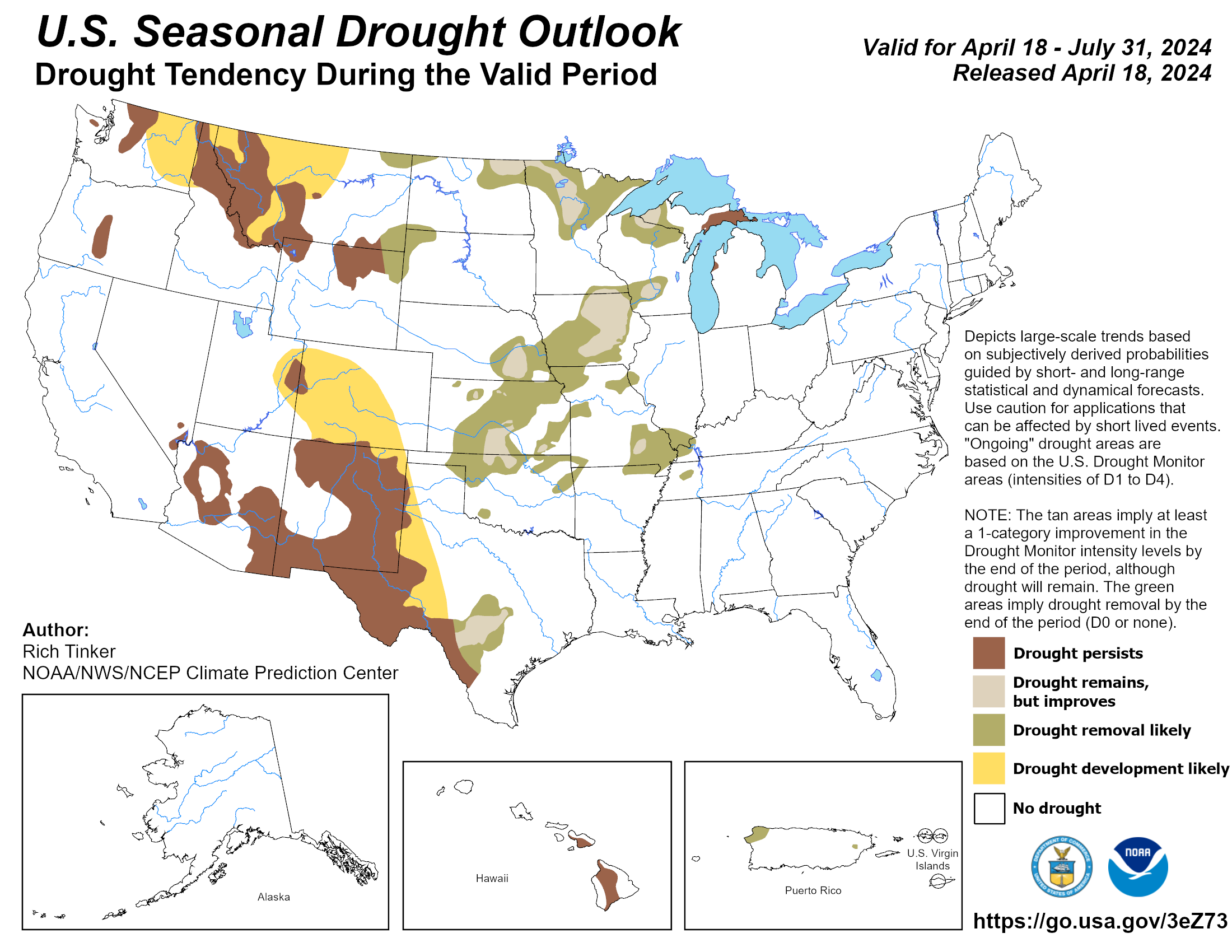
The latest seasonal outlooks through July 31, 2024 are hot off the presses from the #Climate Prediction Center

New #ColoradoRiver proposals put environmental needs front and center in deciding river’s future — Fresh Water News #COriver #aridification

Colorado River. Photo credit: Abby Burk via Audubon Rockies

Click the link to read the article on the Water Education Colorado website (Shannon Mullane):

April 17, 2024

Environmental groups and water experts say the U.S. Bureau of Reclamation should give nature a say in how it manages the Colorado River for years to come.

In March, seven states, including Colorado, released two competing proposals for how to manage two enormous reservoirs in the Colorado River Basin and make painful decisions about cutting back on water use once current operating rules expire in 2026.

But they’re not the only ones throwing out ideas: Water experts and environmental advocates have submitted two proposals of their own. They want to make sure endangered fish, Grand Canyon ecosystems, and more aren’t left out of the conversation. Ā 

The experts hope their proposals, which highlight changing climate data and environmentally focused reservoir releases, help inform the Bureau of Reclamation’s final report for how the river should be managed after 2026. A draft of that report is expected in December.

ā€œIf you don’t care about the environment, then the whole system crashes,ā€ said John Berggren, a regional policy manager with Western Resource Advocates. ā€œThat’s not to say the environment takes priority over water supply and other issues, but rather they can be integrated.ā€

The current operating rules, established in 2007, focus on how water is stored in Lake Powell on the Utah-Arizona border, released to Lake Mead on the Nevada-Arizona border, and then released to millions of water users in the Lower Basin states of Arizona, California and Nevada.

Together, lakes Powell and Mead make up about 92% of storage capacity, about 58.48 million acre-feet, in the Colorado River Basin. Both are about one-third full.

One acre-foot roughly equals the annual water use of two to three households.

High-stakes negotiations stalled early this year with states at loggerheads over how to share water cuts. The four Upper Basin states — Colorado, New Mexico, Utah and Wyoming — only included cuts to the Lower Basin’s water use, although the states promised to pursue voluntary conservation programs. The three Lower Basin states called on all seven states to make cuts when the amount of available water falls below 38% of the total capacity in seven federal reservoirs.

Several tribal nations submitted their own proposal to advocate for tribal water rights in the federal process.

These proposals have the potential to impact water users across the basin, which provides water to 40 million people, more than 5 million acres of farmland, two states in Mexico, and cities including Los Angeles, Las Vegas, Phoenix and Denver.

One perspective all of the proposals have in common: The status quo operations aren’t going to work in the future.

ā€œWe need to use less water, and there’s going to be shortages for the Colorado River going forward,ā€ Berggren said. ā€œWe wanted ours to focus more on how to integrate environmental considerations regardless of who’s taking shortages.ā€

Giving nature a seat at the table

Neither proposal from the basin states places a heavy emphasis on incorporating environmental concerns into how lakes Powell and Mead are managed, and there are plenty of environmental hotspots in the basin.

The Grand Canyon sits below Lake Powell, and its ecosystems and landscape can be helped or hurt by the reservoir’s releases. In 2011, water officials released an 11 million-acre-foot surge of water into the canyon — the right amount of water according to the current rules — that was too big and ended up eroding sandbars where people camp and view the national park. That sand is hard to replace since most of the Colorado River’s sediment is trapped in Lake Powell.

The Upper Colorado River Endangered Fish Recovery Program is trying to boost endangered fish populations in the face of growing numbers of predatory, invasive fish. The Salton Sea in California is shrinking, exposing dry shorelines with toxic dust particles to the wind. The once-vibrant ecosystem in the Colorado River Delta, where the river meets the Gulf of California, is now diminished.

With these areas in mind, one environmental proposal advocates for linking environmental priorities to how the reservoirs operate. It also suggests using updated climate data, in addition to reservoir storage, to determine releases from lakes Mead and Powell.

This proposal was put forward by Western Resource Advocates, Audubon, American Rivers, Environmental Defense Fund, The Nature Conservancy, Trout Unlimited and the Theodore Roosevelt Conservation Partnership.

Since 2007 under the current guidelines, when the water in lakes Mead and Powell dropped to pre-decided water levels, officials knew to release a predetermined amount of water.

Another environmental proposalĀ suggests a more flexible approach: On an annual basis, the secretary of the Interior would decide how much water to release from Lake Powell based on the environmental, recreational, water supply and hydropower goals for that year — rather than using a fixed rule for years to come.

This adaptive-management proposal was submitted by well-recognized Colorado River experts Jack Schmidt, former chief of the federal Grand Canyon Monitoring and Research Center; Eric Kuhn, former Colorado River District general manager and author of ā€œScience be Dammedā€; and Kuhn’s co-author John Fleck, a journalist-turned academic at the Utton Transboundary Resources Center at the University of New Mexico School of Law.

ā€œWhat I have learned in a 40-year career in the Grand Canyon is that scientific understanding evolves, changes and improves,ā€ said Schmidt, currently the director of the Center for Colorado River Studies at Utah State University. ā€œGoing forward, we’re making a mistake to define hard and fast rules for what the releases from Lake Powell to Lake Mead would be.ā€

Big ideas and key questions

Environment and water experts say they are mainly trying to elevate their concerns and the role of nature in the federal process. When it comes to the nitty-gritty, however, each of the proposals raises some key questions for other Colorado water experts.

The joint environmental proposal, which Berggren helped with, identifies several environmental hotspots, like the Grand Canyon, Salton Sea and endangered fish programs, and proposes incorporating them into how lakes Mead and Powell are managed in the future.

For example, the post-2026 operating rules could include minimum flows from Powell into the Grand Canyon of 4.34 million acre-feet per year to ensure that ecosystems, from the lower canyon’s Sonoran Desert to the North Rim’s coniferous forest, stay healthy.

ā€œYou incorporate environmental considerations, and suddenly you have a more healthy, flowing Colorado River, which allows the basin states to have a more reliable water supply,ā€ Berggren said.

But incorporating so many different environmental concerns in one document was a big ā€œred flagā€ for Jennifer Gimbel, a senior water policy scholar at theĀ Colorado Water CenterĀ and former deputy commissioner for the Bureau of Reclamation.

How officials manage each of these environments is tied to years of work by programs, rulemaking documents, legislation and more. Reservoir releases that aim to help the environment are often wrapped into established rules that govern how each reservoir operates.

ā€œThat is one scary document if we’re looking at how to manage everything on the river,ā€ Gimbel said. ā€œI’m not sure how practical they are with trying to move that forward.ā€

The environmental groups’ joint proposal also suggested that officials look at both total reservoir storage and updated climate data to guide operations at lakes Mead and Powell.

The climate data would come from a federal three-year climate model that factors in temperature, precipitation, snow and more to guide operations at lakes Mead and Powell. The total reservoir storage would be based on the amount of water stored in seven reservoirs, including federal reservoirs in the Upper Basin such as Flaming Gorge, Blue Mesa and Navajo reservoirs. That’s similar to the Lower Basin states’ proposal.

Considering both factors together would help avoid unreliable forecasting and adjust to changing conditions, according to the proposal. Upper Basin reservoirs would help with calculations but would not be used to move water from one reservoir to another, Berggren emphasized.

But including Upper Basin reservoirs in how lakes Mead and Powell operate is a flashpoint in the Colorado River negotiations.

Officials like Becky Mitchell, Colorado’s top Colorado River negotiator, have been fighting attempts to include these reservoirs in the operations for Lake Powell and Lake Mead. Flaming Gorge and Blue Mesa, Colorado’s largest reservoir, had to release water to boost Lake Powell’s historically low water levels in 2021, and then Flaming Gorge released more in 2022.

ā€œThese reservoirs are not intended to protect Lake Mead or provide for additional Lower Basin supply, but are for Upper Basin uses and environmental flows, among other purposes,ā€ Mitchell said in a written statement, adding that her team was still analyzing the proposal. ā€œThey are also essential to the success of the recreational and tourist economies in the region.ā€

Considering both factors together would help avoid unreliable forecasting and adjust to changing conditions, according to the proposal. Upper Basin reservoirs would help with calculations but would not be used to move water from one reservoir to another, Berggren emphasized.

But including Upper Basin reservoirs in how lakes Mead and Powell operate is a flashpoint in the Colorado River negotiations.

Officials like Becky Mitchell, Colorado’s top Colorado River negotiator, have been fighting attempts to include these reservoirs in the operations for Lake Powell and Lake Mead. Flaming Gorge and Blue Mesa, Colorado’s largest reservoir, had to release water to boost Lake Powell’s historically low water levels in 2021, and then Flaming Gorge released more in 2022.

ā€œThese reservoirs are not intended to protect Lake Mead or provide for additional Lower Basin supply, but are for Upper Basin uses and environmental flows, among other purposes,ā€ Mitchell said in a written statement, adding that her team was still analyzing the proposal. ā€œThey are also essential to the success of the recreational and tourist economies in the region.ā€

The three water experts’ proposal says the post-2026 rules should include instructions on how to reduce water use when available water is unusually low. But the rules should not include prescriptive annual releases from Lake Powell.

ā€œBecause the science on which those rules were developed is going to change in the next 20 years, and then you’re going to have to renegotiate the whole damn thing again,ā€ Schmidt said.

Instead, the annual releases from Powell can fluctuate, as long as they comply with water law. For example, instead of releasing too much water from Powell because the rules say so — and harming the Grand Canyon’s landscape in the process — the Secretary of the Interior could have more flexibility to decide how much water to release.

Deciding releases annually, instead of setting up fixed rules, has caused other water officials to balk, according to Schmidt.

ā€œI have already had behind-the-scenes, off-the-record conversations with some state people, and they basically said, ā€˜you’re out of your mind. We need certainty,ā€™ā€ he said.

But if water managers do not create rules that are flexible enough to adapt to changing conditions in the river basin, they will continue to run into problems, Schmidt said.

ā€œHow do you incorporate flexibility in a water supply negotiation that seeks certainty?ā€ he said. ā€œThat is the fundamental problem.ā€

Map credit: AGU

Removing PFAS from public water will cost billions and take time – here are ways to filter out some harmful ā€˜forever chemicals’ atĀ home

PFAS are showing up in water systems across the U.S. Jacek Dylag/Unsplash, CC BY

Kyle Doudrick, University of Notre Dame

Chemists invented PFAS in the 1930s to make life easier: Nonstick pans, waterproof clothing, grease-resistant food packaging and stain-resistant carpet were all made possible by PFAS. But in recent years, the growing number of health risks found to be connected to these chemicals has become increasingly alarming.

PFAS – perfluoroalkyl and polyfluoroalkyl substances – are now either suspected or known to contribute to thyroid disease, elevated cholesterol, liver damage and cancer, among other health issues.

They can be found in the blood of most Americans and in many drinking water systems, which is why the Environmental Protection Agency in April 2024 finalized the first enforceable federal limits for six types of PFAS in drinking water systems. The limits – between 4 and 10 parts per trillion for PFOS, PFOA, PFHxS, PFNA and GenX – are less than a drop of water in a thousand Olympic-sized swimming pools, which speaks to the chemicals’ toxicity. The sixth type, PFBS, is regulated as a mixture using what’s known as a hazard index.

Meeting these new limits won’t be easy or cheap. And there’s another problem: While PFAS can be filtered out of water, these ā€œforever chemicalsā€ are hard to destroy.

My team at the University of Notre Dame works on solving problems involving contaminants in water systems, including PFAS. We explore new technologies to remove PFAS from drinking water and to handle the PFAS waste. Here’s a glimpse of the magnitude of the challenge and ways you can reduce PFAS in your own drinking water:

Removing PFAS will cost billions per year

Every five years, the EPA is required to choose 30 unregulated contaminants to monitor in public drinking water systems. Right now, 29 of those 30 contaminants are PFAS. The tests provide a sense of just how widespread PFAS are in water systems and where.

The EPA has taken over 22,500 samples from about 3,800 of the 154,000 public drinking water systems in the U.S. In 22% of those water systems, its testing found at least one of the six newly regulated PFAS, and about 16% of the systems exceeded the new standards. East Coast states had the largest percentage of systems with PFAS levels exceeding the new standards in EPA tests conducted so far.

Is it cheaper to refuel your EV battery or gas tank? We did the math in all 50 states — The Washington Post #ActOnClimate

First road charge for Coyote Gulch’s Leaf in Kremmling May 19, 2023. Note the Colorado Energy Office’s logo below the connectors on the unused charger.

Click the link to read the article (and peruse the graphics) on The Washington Post website (Michael J. Coren). Here’s an excerpt:

August 14, 2023

…I asked researchers at the nonpartisan Energy Innovation, a policy think tank aimed at decarbonizing the energy sector, to help me nail down the true cost of refueling in all 50 states by drawing on data sets from federal agencies, AAA and others. You can dive into their helpful toolĀ here. I used the data to embark on two hypothetical road trips across America, delivering a verdict on whether it costs more to refill or recharge during the summer of 2023. The results surprised me (and they might really surprise my neighbor)…The bottom line? In all 50 states, it’s cheaper for the everyday American to fill up with electrons — and much cheaper in some regions such as the Pacific Northwest, with low electricity rates and high gas prices…In Washington state, with prices around $4.98 per gallon of gas, it costs about $115 to fill up an F-150 which delivers 483 miles of range. By contrast, recharging the electric F-150 Lightning (or Rivian R1T) to cover an equivalent distance costs about $34 — an $80 savings. This assumes, as the Energy Department estimates,Ā drivers recharge at home 80 percent ofĀ the time, along with other methodological assumptions at the end of this article. But what about the other extreme? In the Southeast, which has low gas prices and electricity rates, savings are lower but still significant. In Mississippi, for example, a conventional pickup costs about $30 more to refuel than its electric counterpart. For smaller, more efficient SUVs and sedans, EVs save roughly $20 to $25 per fill-up to cover the same number of miles…

An American driving the average 14,000 miles per year would see annual savings of roughly $700 for an electric SUV or sedan up to $1,000 for a pickup, according to Energy Innovation…

On the emissions front, EVs pulled well ahead. EVs emit less than a third of the emissions per mile than their gasoline counterparts — and they’re getting cleaner every year. America’s electricity mix emits justunder a pound of carbon emissions for every kWh generated, according to the Energy Information Administration. By 2035, the White House hopes to drive that closer to zero. This meant the conventional F-150 spewed five times more greenhouse gas emissions into the atmosphere than the Lightning. The Tesla Model Y represented 63 pounds of greenhouse gas emissions on the trip compared to more than 300 pounds from all the conventional vehicles…Ultimately, we may never agree on what it costs to refuel an electric vehicle. That may not matter. For the everyday driver in the United States, it’s already cheaper to refuel an EV most of the time, and it’s expected to get cheaper as renewable capacity expands and vehicle efficiency improves.