Click the link to read the article on the Alamosa Citizen website:
May 14, 2025
OUTDOOR CONDITIONS
The early May rain delivered a recharge to the Upper Rio Grande Basin, and perhaps there’s more snowmelt coming from the higher elevations that forecasters haven’t yet figured out?
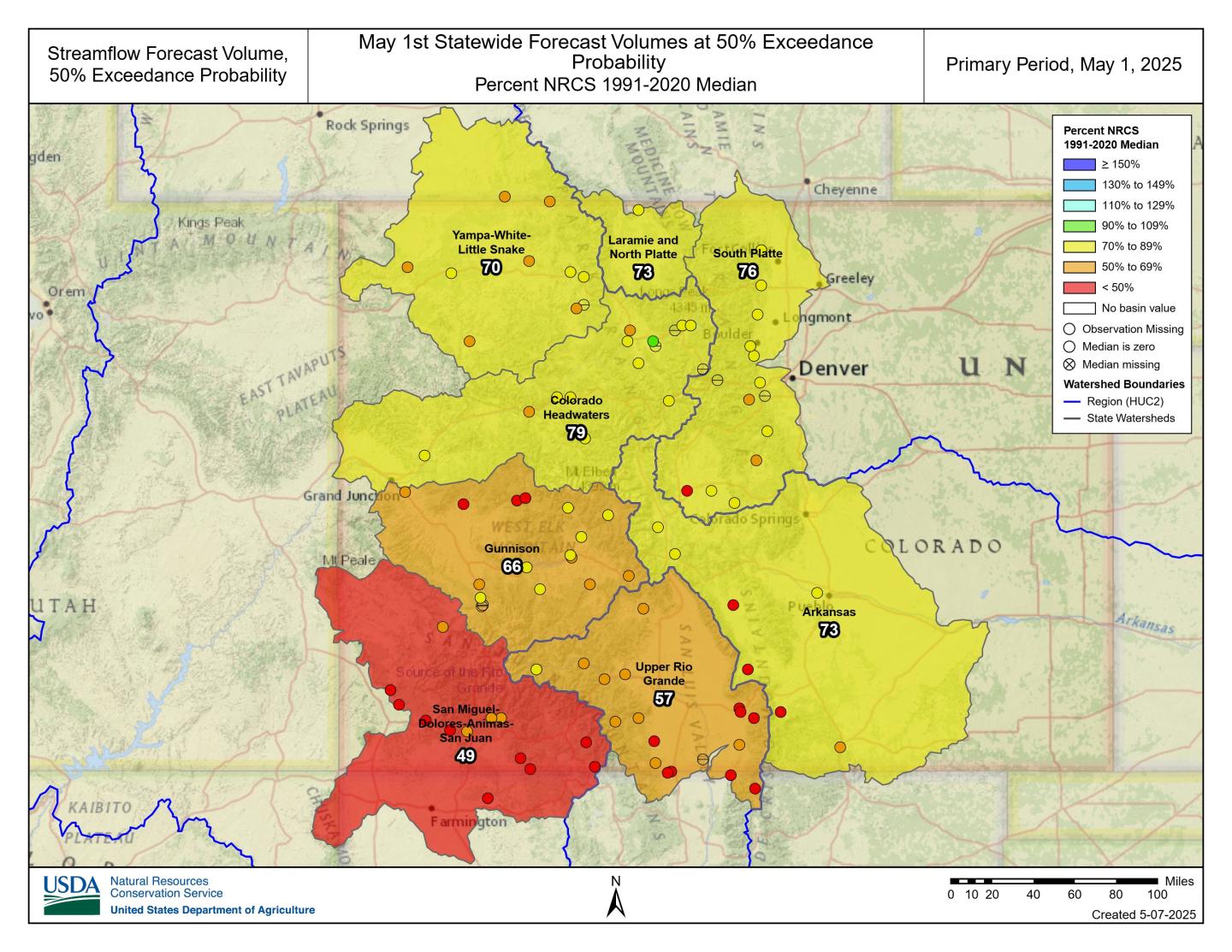
Craig Cotten of the Colorado Division of Water Resources, in speaking at this week’s May 13 meeting of the Rio Grande Basin Roundtable, said airborne snow forecasts are predicting “much higher” streamflows on the Rio Grande and Conejos than the other two sources the state relies on to make its predictions – U.S. Natural Resources Conservation Service (NRCS) and National Weather Service.
Cotten explained the state division of water resources uses all three sources to help it forecast the depths and the amount of water in the rivers. Colorado is forecasting 390,000 acre-feet this water year on the Rio Grande and 180,000 acre-feet on the Conejos – both measurements at around 60 percent of the long-term averages for the river system.
While NRCS and National Weather Service have been predicting low river flows from a light snow year, the Colorado Airborne Snow Measurement Program and its ASO Snow Survey has data that suggests “much higher” streamflows and is a source of information that the state is “trying to figure out what’s going on,” Cotten said.
“We still think it’s not going to be a great year on any of our stream systems,” he said.
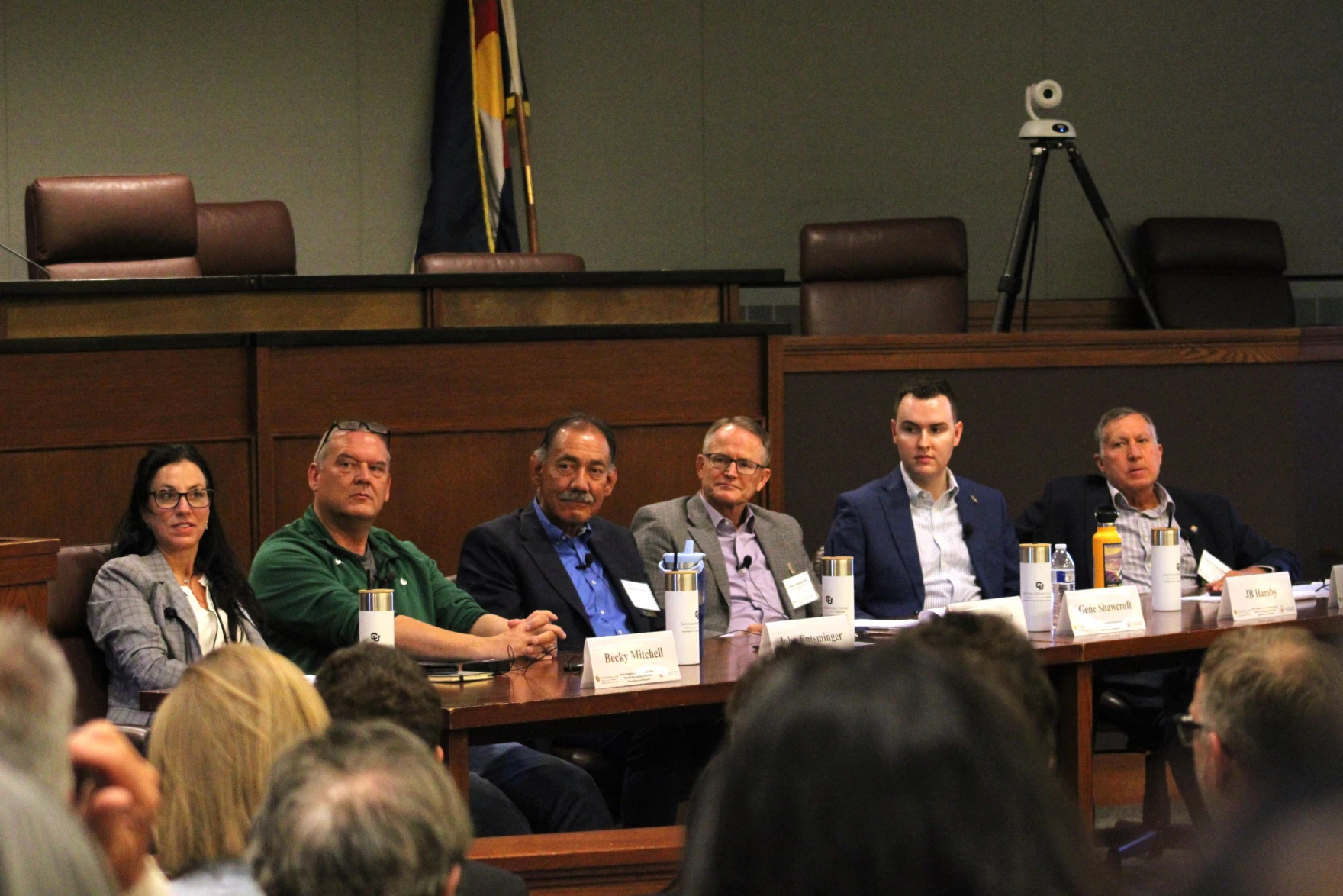
Six of the seven state representatives who will shape the next chapter of Colorado River rules speak on a panel at the University of Colorado, Boulder on Jun. 6, 2024. The same group is opting not to speak at this year’s conference. Alex Hager/KUNC
Click the link to read the article on the KUNC website (Alex Hager):
May 11, 2025
This story is part of ongoing coverage of the Colorado River, produced by KUNC in Colorado and supported by the Walton Family Foundation. KUNC is solely responsible for its editorial coverage.
As tense negotiations about the future of the Colorado River are stuck at a standstill, the people in charge are retreating further into the shadows.
A group of negotiators – one from each of the seven states that use Colorado River water – will not be speaking at a major water law conference in June. Those representatives have appeared together on a panel at the conference for the last few years, and rarely appear together in public otherwise.
“The unwillingness to answer the public’s questions suggests that negotiations aren’t going well,” said John Fleck, who teaches water policy at the University of New Mexico. “I think it misses an important obligation in democratic governance of a river that serves 40 million people.”
The event, the Getches-Wilkinson Conference at the University of Colorado, Boulder, is typically one of two times each year that the negotiators appear together in public. In recent iterations of the same conference, they all spoke on one panel. Occasionally, a state representative has fallen ill or sent a deputy in their stead.
They seemed starkly divided at the other annual appearance, too. In December, they opted to split into two separate panels at the Colorado River Water Users Association conference in Las Vegas.
Water policymakers from (left to right) Utah, New Mexico, Colorado and Wyoming speak on a panel at the Colorado River Water Users Association conference in Las Vegas on December 5, 2024. The two rival factions of states chose to appear on two separate panels then, and have opted to avoid speaking entirely in June. Alex Hager/KUNC
People with knowledge of the situation confirmed to KUNC that state leaders told conference organizers they did not want to speak publicly. There is currently no seven-state panel on the published conference agenda.
JB Hamby, California’s top water negotiator, said he would attend the conference but not speak, and he was “100%” sure the other top officials wouldn’t be speaking. Representatives from Arizona, Colorado and New Mexico confirmed their states’ Colorado River negotiators would not be speaking.
Unlike many government processes, Colorado River policymakers work in a space that does not involve a mandate for public access. Their meetings are often held behind closed doors, are not listed publicly and do not yield minutes or records that can be viewed by the public.
“You need to listen to and have spaces to discuss with the people who are going to be impacted by your decisions,” Fleck said. “That’s not happening now, and that’s really disturbing.”
Those water policymakers are stuck in a standoff about how to use less water from the shrinking Colorado River. Negotiators seem to agree with the broad concept that the farms, businesses and 40 million people of the Colorado River basin need to cut back on water use as the river gets smaller due to climate change. They don’t, however, agree on who should cut back.
Talks so far have largely stayed divided along a decades-old fault line. On one side is the Upper Basin – which consists of Colorado, Utah, Wyoming and New Mexico. The other side, the Lower Basin, is made up of California, Arizona and Nevada.
The Lower Basin has volunteered relatively modest cuts in proposals for how to manage the river after the current rules expire in 2026. The Upper Basin has not volunteered any cuts, insisting that its states are already forced to use less water due to climate change and a longstanding legal requirement to send a fixed amount of water to those Lower Basin states.
“I am fully focused on the negotiations for post-2026 operations of Lake Powell and Lake Mead,” Becky Mitchell, Colorado’s top negotiator, wrote in an email to KUNC. “As the Getches-Wilkinson conference drew nearer, it was unclear where we would be in that process, and I wanted to be cognizant of the sensitivity of the work. Time is of the essence, and these critical negotiations have my full attention at this time.”
The states have dug their heels in on those positions for months now, and their willingness to talk about the status of their closed-door attempts to break the deadlock has only gone down over time.
Reporters’ requests to state water authorities that once yielded interviews with top policymakers are now often met with written statements that tend to be short on detail.
Glen Canyon Dam holds back the waters of Lake Powell near Page, Arizona on Sunday, Feb. 2, 2025. Lake Powell, has approached dangerously low levels in recent years as policymakers have struggled to come up with a long-term management plan for the water it stores. Photo credit: Spenser Heaps/Utah News Dispatch
“I have a lot of respect for the people who are doing these negotiations,” Fleck said. “They’re trying to solve really hard problems, and I respect the idea that they need some space to do that, but not showing up in public at all is granting them more space than I’m willing to grant them.”
Joanna Allhands, an opinion writer at the Arizona Republic who has written about the Colorado River’s “bankruptcy of leadership,” said more transparency from water policymakers “would be smart as a matter of self preservation.”
“Whatever the decision is made,” she said, “Whatever alternative gets chosen, if people feel like they’ve been left out, guess where we’re headed? We’re going to the Supreme Court.”
Colorado River negotiators have said that they want to avoid taking this issue to the Supreme Court, but have made little recent progress to steer talks away from that outcome.
Colorado River “Beginnings”. Photo: Brent Gardner-Smith/Aspen Journalism
This year’s predicted spring runoff into Lake Powell has decreased yet again as the impacts of a dry winter begin to show. Hydrologists at the Colorado Basin River Forecast Center said Wednesday that the amount of water flowing into Lake Powell between April and July this year is expected to be 55% of average. “Average,” in forecasting, refers to the average runoff between 1991 and 2020. That prediction follows a decline in forecasted flows since the start of winter…In terms of actual water, 55% of the average runoff translates to about 3.5 million acre-feet of water making it into Lake Powell…That’s lower than the runoff in 2022, which was a little over 3.7 million acre-feet, but better than 2021’s 1.85 million acre-feet. Spring runoff in 2023 and 2024 were well above what is forecasted this year. The snowpack above Lake Powell, which is the second-largest reservoir in the U.S., has already begun to melt. At the start of April, the snowpack was 89% of the 1991-2020 median. As of May 1, it has shrunk to 71% of the median.
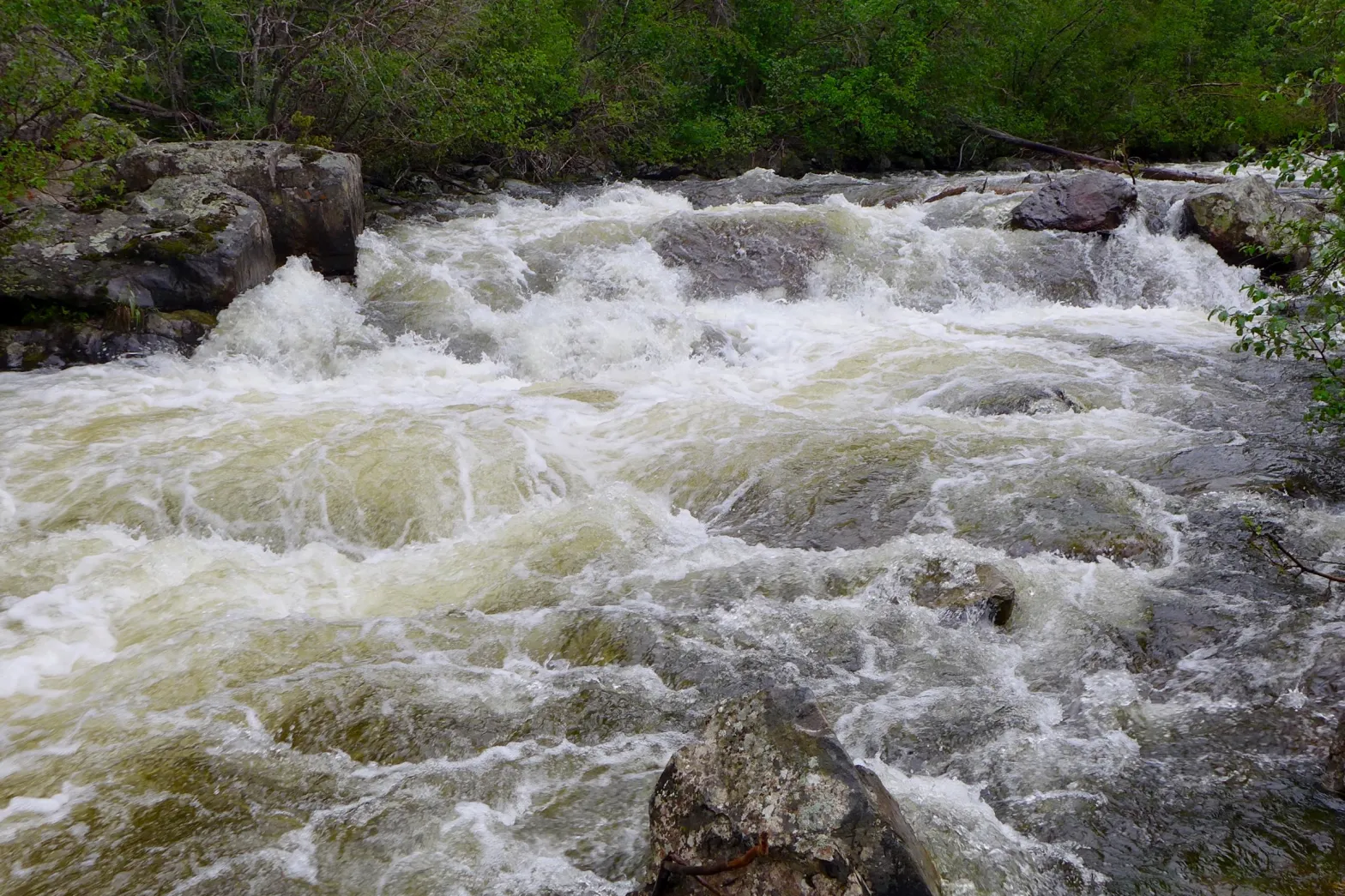
Homestake Creek is a tributary of the Eagle River. CREDIT: BRENT GARDNER-SMITH/ASPEN JOURNALISM
Click the link to read the article on the Vail Daily website (Zoe Goldstein). Here’s an excerpt:
May 8, 2025
Every year brings different water conditions in Eagle County. With climate change, the promise of full rivers in the summer may become even less certain. To prepare for future drought years, the Eagle River Water and Sanitation District and Upper Eagle Regional Water Authority have a new water shortage response plan.
“The goal of this plan is to provide water security, to ensure that we can provide our core services,” said Justin Hildreth, the district’s water resources engineer, when presenting the plan to the district board for approval on April 10. Among the core services included in the list are safe drinking water and water for structure fire suppression…According to the plan, “a water shortage occurs when the (district/authority) lacks the physical or legal water supplies needed” to provide their services and maintain required streamflow levels. This can happen when there are extended calls from older water rights, (like the Shoshone water rights on the Colorado River), when stream flows are low for long periods and when local reservoirs (Eagle Park Reservoir and the Black Lakes) have low supply. The district and authority boards approved the plan during their April 10 meetings after learning about the plan during Feb. 27 work sessions…
One of the best early predictors of a drought scenario is if the snow water equivalent measure has not reached an average of 15 inches across the Vail, Fremont Pass and Copper SNOTEL stations by April 1. “That directly relates to Eagle Park Reservoir, that relates to the flows in Gore Creek and the flows in the Eagle River,” Hildreth said. This year, the average was just shy of 16 inches across the three stations on April 1.
Click the link to read the article on the Aspen Times website (Robert Tann). Here’s an excerpt:
Perched above the Dillon Reservoir on the side of a mountain road in Summit County, Gov. Jared Polis on Thursday signed into law three bills aimed at bolstering the state’s water infrastructure. The measures come amid the backdrop of chronic drought and increased water demand in the West which have made finding a path towards water sustainability more urgent. Speaking amid on-and-off snow flurries and bouts of sunshine, Polis said the bills signed on Thursday will help “build a sustainable, livable future” by “securing our water for the state of Colorado.”
State voters’ decision to approve a tax on sports betting in 2019 has provided a critical funding source for water projects, delivering as much as $30 million a year for infrastructure and conservation efforts. House Bill 1311 takes that a step further by eliminating a tax exemption for revenue generated from free sports bets…
A view of the popular Pumphouse campground, boat put-in and the upper Colorado River. Photo credit: Brent Gardner-Smith/Aspen Journalism
Finding solutions to funding woes
While taxes on sports betting have helped shore up state spending on water projects, its other key funding stream risks running dry…Under Senate Bill 40, the state will commission a nine-member task force within the Department of Natural Resources to study the future of severance tax revenue and come up with solutions to better fund the state’s water needs. The task force will be required to submit a final report to the legislature in July 2026, with lawmakers hoping to turn those ideas into policy.
Grays and Torreys, Dillon Reservoir May 2017. Photo credit Greg Hobbs.
Click the link to read the article on the Big Pivots website (Allen Best):
May 13, 2025
By a Colorado Supreme Court vote of 5 to 2, Boulder and Boulder County won the right to move forward with their lawsuit against two fossil fuel companies. their climate change lawsuit on Monday in the Colorado Supreme Court.
But if the vigor of the writing were the deciding factor, the dissent authored by Justice Carlos Samour Jr. with concurrence of Justice Boatright would carry the day.
That’s not how the law works, of course. The written opinion – echoing what was verbally decided several weeks ago – found that federal law did not preempt Boulder’s claims under state law in this case. In other words, the argument by the city and county against Exxon Mobil and Colorado Suncor can be heard in a Colorado district court.
“We express no opinion on the ultimate viability of the merits of Boulder’s claims,” said the majority in an opinion written by Justice Richard J. Gabriel.
Many similar lawsuits have been filed in the United States by local jurisdictions, and this is only the second one, after a Hawaii Supreme Court decision in 2023 – that has been deemed to move forward. In New York, justices ruled against a similar climate change lawsuit.
Boulder and Boulder County along with San Miguel County originally sued Suncor and Exxon in April 2018. They allege they have and will continue to incur costs and losses as a result of climate harms, such as increased costs for wildfire abatement, and for decades of misinformation.
A state district court rejected the attempt by the two companies to have the lawsuit dismissed. Exxon then directly petitioned the Colorado Supreme Court to overturn the result.
San Miguel County’s case in Denver District Court has been on hold, although this decision sets a precedent for it.
The lawsuit pivots upon several arguments, most notably the federal Clean Air Act, the law passed by Congress in 1970. In dispute was whether this law precludes efforts in Colorado to seek claims from the fossil fuel companies.
Boulder alleges that it has incurred and will continue to incur millions of dollars in costs to protect its property and residents from the impacts of climate change.
Along with the county, it asserts that the fossil fuel companies, “because they knowingly caused and contributed to the alteration of the climate by producing, promoting, refining, marketing and selling fossil fuels at levels that have caused and continue to cause climate change,” should be forced to share the costs.
They also accuse the two companies of “concealing and/or misrepresenting the dangers associated with fossil fuels’ intended use.”
The local jurisdictions also have various public nuisance, private nuisance and trespass claims. Under the latter heading is the “invasions of its property in the form of floodwaters, fires, hail, rain, snow, wind and invasive species.”
But again, this case did not decide the merits of those complaints. It was to decide whether a district court in Colorado had standing to hear the case. The oil companies argued that the Clean Air Act preempted state authority in the matter.
As in other cases heard in other states, the district court judge in Colorado found no language in the Clean Air Act that expressly pre-empted state common law tort claims. Nor, said the justice, did that federal law completely occupy the field of greenhouse gas emissions.
The Suncor refinery lies northeast of downtown Denver. Photo/Allen Best
Congress has the power to preempt state law — on that the two factions of the Colorado Supreme Court agree. Their disagreement come down to whether the Clean Air Act expressly allowed for state authority in this area of pollution — or even whether it needed to offer a green light. Indeed, according to the majority opinion, the federal law itself makes clear that “air pollution prevention … and air pollution control at its source is (sic) the primary responsibility of states and local governments.”
The majority opinion goes on for nearly three-dozen pages, so you might want to read it yourself. Here’s a key passage:
“At root, defendants appear to be arguing that a vague federal interest over interstate pollution, climate change, and energy policy must preempt Boulder’s claims,” it said. But a 2019 U.S. Supreme Court opinion had held that “invoking some brooding federal interest or appealing to a judicial policy preference should never be enough to win preemption of a state law; a litigant must point specifically to ‘a constitutional text or federal statute’ that does the displacing or conflicts with state law.”
Did the oil companies point to a federal state or constitutional text that preempts Boulder’s claims? No, said the state justices.
True, in New York’s Second Circuit ruled otherwise. But that court had engaged in backwards reasoning, said the Colorado state justices.
The arguments also involved whether Boulder and Boulder County are trying to set foreign policy, which is a no-no. Again, the majority of the justices found that the arguments of the oil companies fell short.
In his dissent, Justice Samour, who was joined by Justice Boatright, came to different conclusions in almost every point.
“We are but one individual nation. Yet, the majority in this case gives Boulder, Colorado, the green light to act as its own republic,” he wrote in a nod to a colloquial reference to Boulder. “More specifically, the majority concludes that Boulder may prosecute state-law claims that both effectively regulate interstate air pollution and have more than an incidental effect on foreign affairs. And, alarmingly, the majority’s decision isn’t cabined to Boulder – all other Colorado municipalities may bring such claims. Indeed, at least one (San Miguel County) already has.”
Added Samour in a later section. “I am concerned that permitting Boulder to proceed with its claims will interfere with both our federal government’s regulation of interstate air pollution and our federal government’s foreign policies regarding air pollution.” This has produced a worry that “we are headed for regulatory chaos.”
Samour’s dissent is fun to read as he talks about Bolder whistling past the federal-common-law graveyard, or the attempt by the Boulder jurisdictions to “treat federal common law as chopped liver.”
His bottom line is that the question is not whether the Clean Air Act expressly allowed states to have authority in this area. It did not, he says. It’s a flip side of the coin of the majority opinion.
In a footnote, he says that he would not rule out the possibility that Boulder could bring suit under Colorado law to recover damages allegedly caused by emissions resulting from the energy companies’ activities within Colorado. “But that’s a far, far cry from what Boulder is seeking to do here – with the majority’s blessing, no less.”
Again, it comes back to the Clean Air Act. It does not, he says, gives states authority to independently regulate or otherwise control out-of-state sources of pollution.”