
Click the link to access the article on the AGU website (Mahbod Taherian, Ali A. Ameli). Here’s the abstract:
January 9, 2026
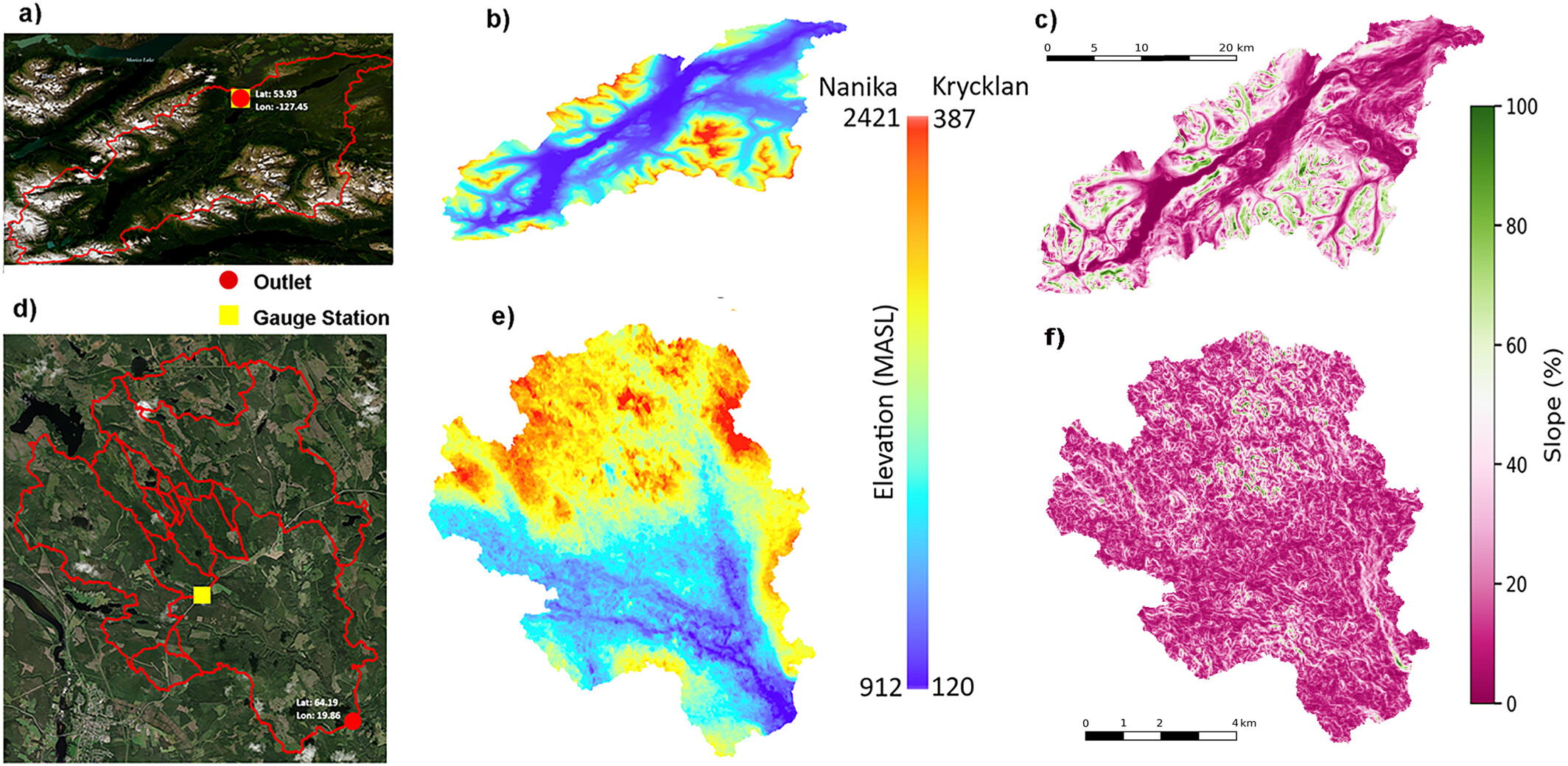
Understanding how snowmelt is partitioned into different hydrologic flowpaths/storages—and how this partitioning varies over time—is essential for predicting water availability and quality under climate variability. In this study, we examine the time-variance of snowmelt partitioning patterns (SPP) in response to interannual variations in antecedent (Fall) rainfall before snowmelt seasons, across two snow-dominated catchments in Canada and Sweden with contrasting geologic and topographic features. Using integrated subsurface–surface flow and transport modeling, combined with observational data, we simulate the partitioning of snowmelt into shallow flowpath, deep flowpath, evapotranspiration, and long-term storage. To generalize our findings beyond the two case studies, we design a suite of virtual experiments that systematically vary catchment slope and the extent of the hydraulic conductivity’s vertical and lateral heterogeneity. Results show that lateral heterogeneity in conductivity mediates the sensitivity of snowmelt partitioning to interannual variations in antecedent rainfall. While laterally homogeneous catchments display minimal sensitivity of snowmelt partitioning pattern to wet or dry Fall rainfall conditions, catchments with heterogeneous lateral structure store a significantly larger portion of snowmelt and reduce snow-sourced shallow flow contributions in years with high pre-snow rainfall than years with low pre-snow rainfall. In contrast, while slope and vertical conductivity architecture govern SPP, they play a limited role in mediating SPP’s temporal sensitivity to antecedent rainfall variability. These findings reveal that subsurface structure—including the extent of lateral subsurface heterogeneity—modulates the influence of climate variability on snowmelt partitioning and catchment hydrologic function. This has implications for predicting streamflow responses, groundwater recharge, and solute transport under changing climate regimes, and highlights the importance of representing time-variable hydrologic behavior in hydrologic models.
Plain Language Summary
Knowledge of how snowmelt moves through a watershed is essential for managing water supplies and ecosystems in snow-dominated regions. Snowmelt can either run quickly to streams or infiltrate to recharge groundwater, and this balance shifts from year to year with climate and watershed structure. We studied two snowy watersheds that differ in slope and subsurface properties to test how late-summer/fall rainfall (which sets pre-snowmelt wetness) shapes winter snowmelt pathways. In steep terrain with horizontally variable (patchy) subsurface hydraulic conductivity, dry pre-snowmelt conditions direct meltwater horizontally to streams, whereas wetter pre-snowmelt conditions favored deeper infiltration and storage. To generalize, we ran virtual experiments that systematically altered the extent of horizontal variability of hydraulic conductivity. A consistent signal emerged: patchy subsurface hydraulic conductivity produced stronger year-to-year swings in how snowmelt is partitioned between runoff and storage, while horizontally uniform subsurface hydraulic conductivity led to more predictable, stable watershed responses. These results show that antecedent wetness and the horizontal structure of subsurface permeability jointly control the time-variability of snowmelt partitioning. Incorporating these controls can improve forecasts of streamflow and groundwater recharge, and guide planning for flood and drought risks in snow-dependent watersheds under increasing climate variability.
Key Points
- Pre-snow rainfall variability alters snowmelt partitioning pattern (SPP) into storage versus runoff, with the magnitude of impact mediated by the extent of hydraulic conductivity’s lateral heterogeneity
- Catchments with greater lateral heterogeneity in hydraulic conductivity store (release) a larger (lesser) portion of snowmelt in years with large pre-snow rainfall
- Slope and vertical conductivity architecture influence SPP but exhibit limited modulation of SPP temporal sensitivity to pre-snow rainfall variability