
By Robert Marcos
For decades people believed that the Anasazi, (later renamed the Ancestral Puebloans), had vanished suddenly and under mysterious circumstances. But over the years a host of scientific disciplines has produced evidence that has largely resolved that mystery. Scientists shifted from viewing the Ancestral Puebloans’ departure as a “mysterious disappearance” to a deliberate migration triggered by a combination of environmental and social factors.
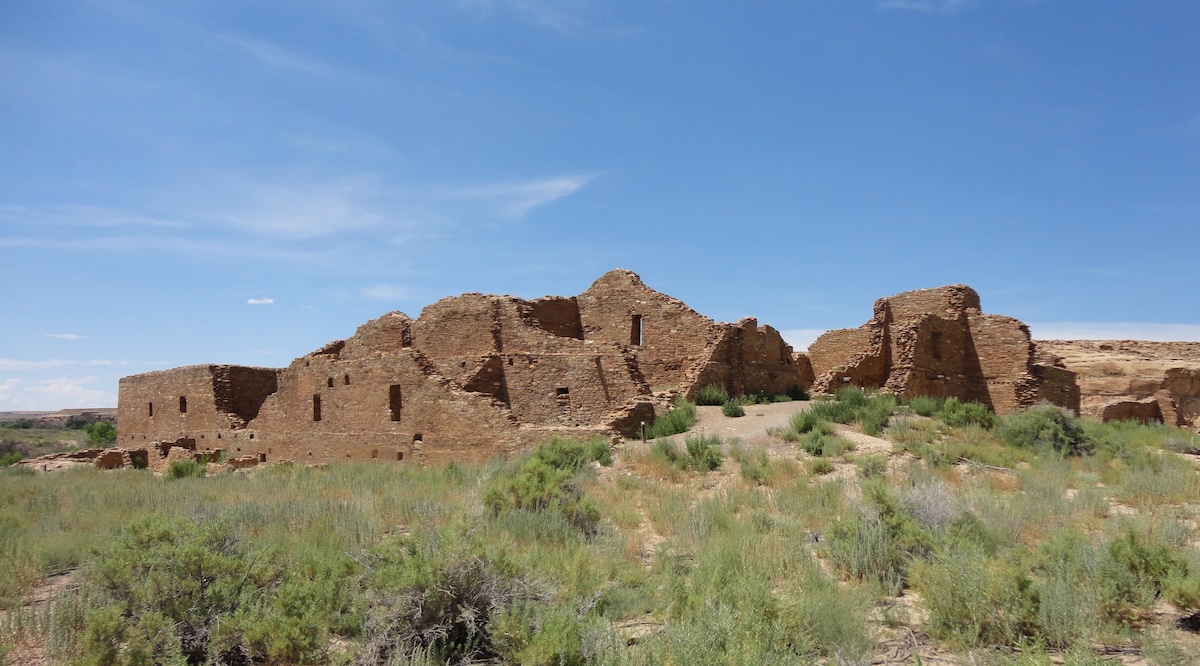
The Ancestral Puebloan great house, Pueblo del Arroyo, in Chaco Culture National Historical Park, New Mexico. Photo by Rationalobserver.
Types of evidence produced by recent studies
Prolonged megadroughts like the “Great Drought” (1276–1299) coincide with widespread abandonment of large Four Corners settlements and severe maize shortfalls.1
Tree rings and other proxies show multi‑year to multi‑decadal droughts during the broader Medieval Climate Anomaly (roughly AD 800–1300).2
Environmental degradation including deforestation and topsoil erosion around major centers like Chaco and Mesa Verde, reducing fuel and soil productivity.3
Deer bones decline and turkey bones increase after about AD 1150, suggesting overhunting of wild game and heavier reliance on domestic turkeys that competed with people for maize.4
Hydrologic stress and extreme variability: Ancestral Puebloan societies were highly dependent on winter snowpack and limited runoff; summer rains were unreliable and often arrived as intense, erosive storms.In earlier droughts (AD 150–950), people were already resorting to melting cave ice for drinking water, indicating that marginal sources became critical during dry spells.5
Climate stress resulted in conflict, and the migration of Numic‑speaking groups onto the Colorado Plateau, and rapid changes in religious and political systems.6
Crop failures undermined rain‑making rituals and institutions, social cohesion and the legitimacy of leadership likely eroded, encouraging relocation.7
In short, highly climate‑sensitive dry land agriculture, local deforestation and soil loss, and repeated multi‑year droughts combined with social pressures, all combined to make life untenable in the Mesa Verde and Chaco Canyon regions.8
Conditions in today’s American Southwest are strikingly similar.
The environmental conditions in today’s American Southwest continue to be characterized by a high-desert environment, which is defined by extreme aridity, and unpredictable precipitation patterns. In many ways this mirrors the volatile climate that challenged the Ancestral Puebloans. Much like the late 13th century—a period marked by the infamous “Great Drought”—the modern region experiences significant moisture deficits and high evaporation rates.
Farmers today contend with a bimodal precipitation cycle: winter snowpack provides the primary source of groundwater and spring runoff, while intense, localized monsoon storms in late summer offer brief but erosive bursts of rain. These erratic shifts between prolonged dry spells and sudden deluges force a reliance on micro-climates and elevation-specific planting, as the short growing season is often bracketed by late spring frosts and early autumn freezes.
Soil conditions that consist largely of alkaline, nutrient-poor substrates, are highly susceptible to erosion. In areas like the Colorado Plateau, the soil is often a mixture of sandy loams and heavy clays that lack the organic matter found in more temperate zones. These soils are prone to crusting and salinity buildup, which can inhibit seedling emergence and water infiltration.
Just as the Ancestral Puebloans utilized check dams and lithic mulching (using stones to preserve soil moisture), modern land managers must navigate these “thin” soils that offer little buffer against environmental stress. The persistence of lithic soils and wind-blown loess ensures that any successful cultivation requires sophisticated water-harvesting techniques to prevent the precious topsoil from being stripped away by the elements.
This is such a thought provoking piece. The parallels you draw between the Ancestral Puebloans’ climate crisis and what we see today in the Southwest are striking and honestly a bit unsettling. The detail about deer bones declining and turkey reliance increasing is the kind of nuanced evidence that really brings the human story to life. It makes you wonder how much we actually learn from the past when our water systems are under the same pressures. The section on lithic soils and water harvesting was genuinely eye opening. Great work by Robert Marcos on tying all these disciplines together so coherently.
Thank you. I appreciate you recognizing the similarities between then, and now.