Climate Change is altering rainfall’s chemistry

by Robert Marcos, photojournalist

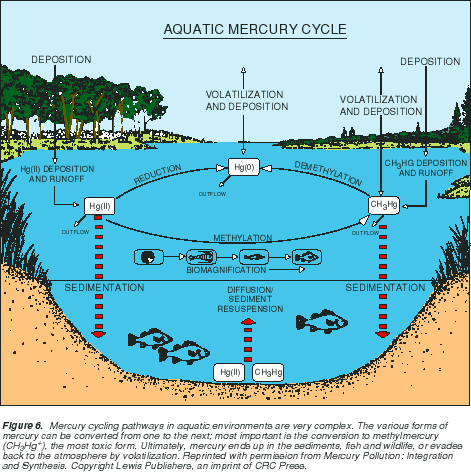
Climate change is altering the chemical makeup of rainfall. It’s increased the concentration of dissolved carbon dioxide which makes rainfall more acidic1. At the same time it has shifted the levels of atmospheric pollutants that wash out when it rains. This changing chemistry is a problem because it alters how water interacts with soils, plants, aquatic systems, infrastructure, and even the atmosphere itself. Increased acidity in rainfall acts as a chemical catalyst that destabilizes both terrestrial and aquatic environments through the following mechanisms2

  • Nutrient Leaching: Acidic rain strips the soil of essential buffering minerals and nutrients—such as calcium, magnesium, and potassium—which are vital for plant cell structure and growth.
  • Heavy Metal Mobilization: As soil pH drops, naturally occurring but normally stable metals like aluminum become soluble. This “mobile” aluminum is toxic to plants, damaging root systems and preventing them from absorbing water.
  • Microbial Disruption: Many beneficial soil bacteria and fungi are sensitive to pH changes. Increased acidity can suppress the microbial activity responsible for decomposition and nitrogen fixation, ultimately reducing soil fertility.
  • Biological Stress and Mortality: Many aquatic species have narrow tolerance ranges. At a pH of 5.0, most fish eggs cannot hatch, and lower levels can lead to the death of adult fish, amphibians, and insects like mayflies.
  • Gill Damage: Soluble aluminum leached from nearby soil enters waterways and clogs the gills of fish. This impairs their osmoregulation and ability to breathe, often serving as the primary cause of fish kills in acidified lakes.
  • Food Web Collapse: The loss of acid-sensitive “base” species, such as certain plankton and invertebrates, triggers a cascade effect that starves larger predators and simplifies the entire ecosystem.

Effects on Agricultural Production

The chemical and physical shifts in rainfall are fundamentally destabilizing the economic foundations of global food systems3.

  • Declining Crop Productivity: For every 1°C of warming, global yields of major staples are projected to decline significantly: maize by 7.4%, wheat by 6.0%, and rice by 3.2%.
  • Nutritional Degradation: Increased atmospheric and altered soil chemistry reduce the concentrations of protein and essential minerals like zinc and iron in crops like wheat and soybeans.
  • Increased Costs: Farmers must spend more on lime to neutralize soil acidity and additional fertilizers to replace leached nutrients like calcium and magnesium.
  • Direct Foliar Damage: Acidic rain erodes the waxy cuticle of leaves, making plants more vulnerable to dehydration, pests, and diseases.

Impacts on Commercial Fishing

Marine fisheries and seafood industries, which supported $319 billion in sales in 2023, face major disruptions as fish stocks move toward cooler poles or become less productive4.

  • Catch Potential Losses: Tropical regions are predicted to see declines of up to 40% in potential seafood catch by 2050 due to warming and acidification.
  • Shellfish Vulnerability: Ocean and coastal acidification (exacerbated by acidic runoff) hinder calcification, weakening the shells of oysters, clams, and scallops. This is estimated to cause consumer losses of $480 million per year by the end of the century.
  • Ecosystem Collapse: Acidified freshwater and marine environments disrupt reproductive cycles; for instance, at a pH of 5, most fish eggs cannot hatch, leading to the collapse of local populations and the industries that rely on them.

Impacts on Water Infrastructure

More acidic rainfall significantly deteriorates water infrastructure by accelerating the chemical breakdown of both metallic and cement-based materials. When rainwater’s pH drops—oftenhttps://www.gov.nl.ca/eccc/files/waterres-reports-drinking-water-study-on-ph-adjustment-systems-task-7-study-report.pdf due to sulfuric and nitric acids—it becomes highly corrosive, leading to structural damage and water quality issues. Acidic water targets the internal and external surfaces of the pipes that transport water.5

  • Chemical Dissolution: Acidic rain reacts with the calcium carbonate and calcium hydroxide in concrete, dissolving these components and leaving the structure porous and weak.
  • Structural Failure: As the concrete matrix dissolves, the protective layer around steel reinforcements (rebar) can fail. Corroding steel expands up to six times its size, creating internal pressure that cracks the surrounding concrete.
  • Surface Erosion: Prolonged exposure causes surface “spalling” or peeling, exposing coarse aggregates and increasing maintenance costs for bridges, dams, and treatment basins.

Challenges for Water Treatment

  • Water treatment facilities must expend more resources to manage increasingly acidic sources of water.
  • Increased Neutralization Costs: Facilities must add more alkaline substances, such as caustic soda or soda ash, to raise the pH to a non-corrosive range (typically 6.5 to 8.5).
  • Disinfection Interference: Efficient chlorination is more difficult in water that is too acidic or too basic, potentially requiring higher chemical doses to ensure safety.
  • Contaminant Mobilization: Acid rain leaches aluminum and other minerals from the surrounding soil into reservoirs, requiring more complex filtration to remove these additional contaminants.6
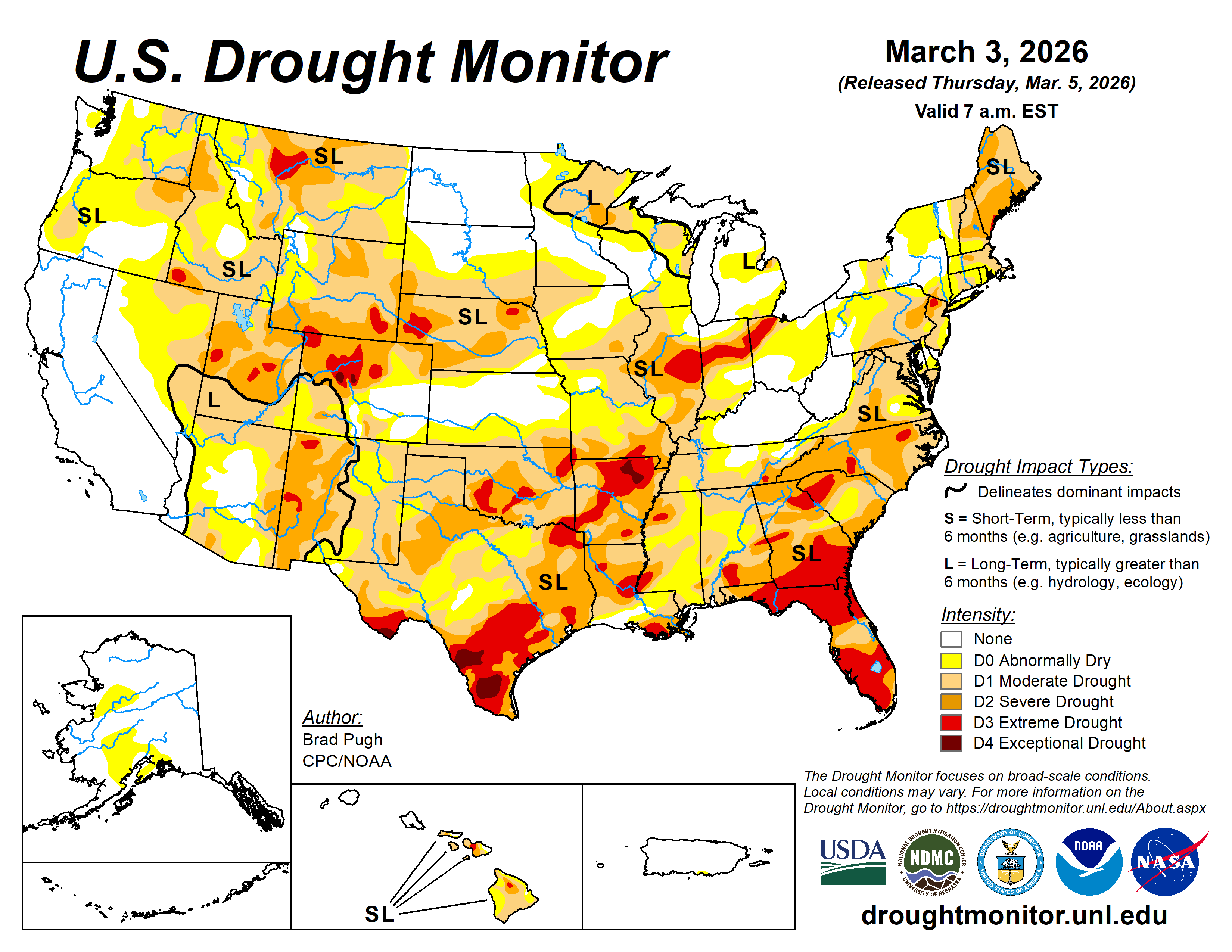
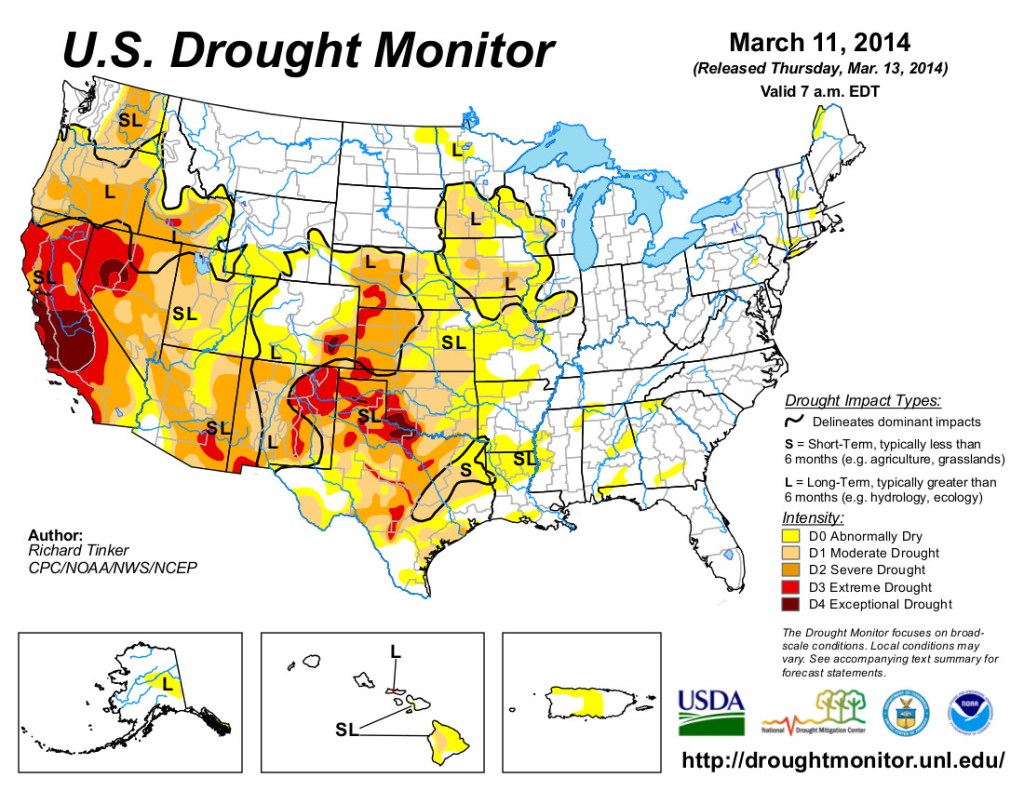
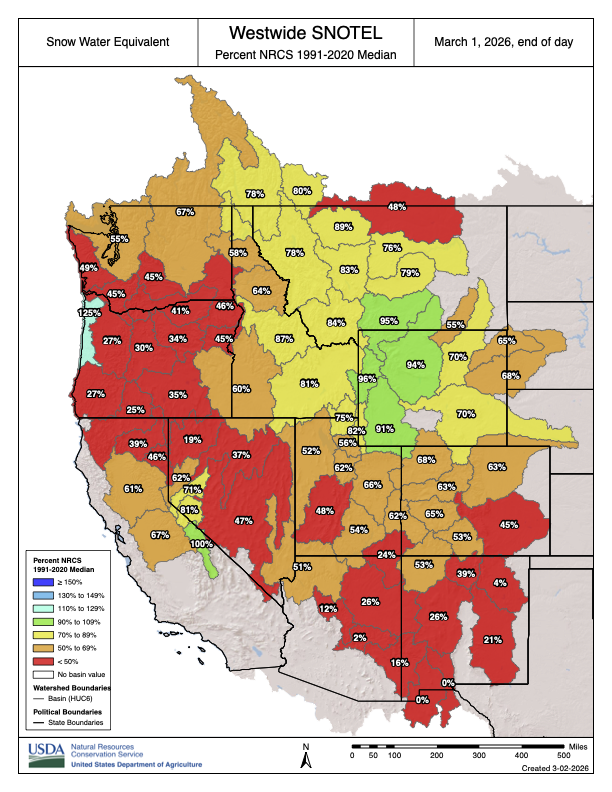
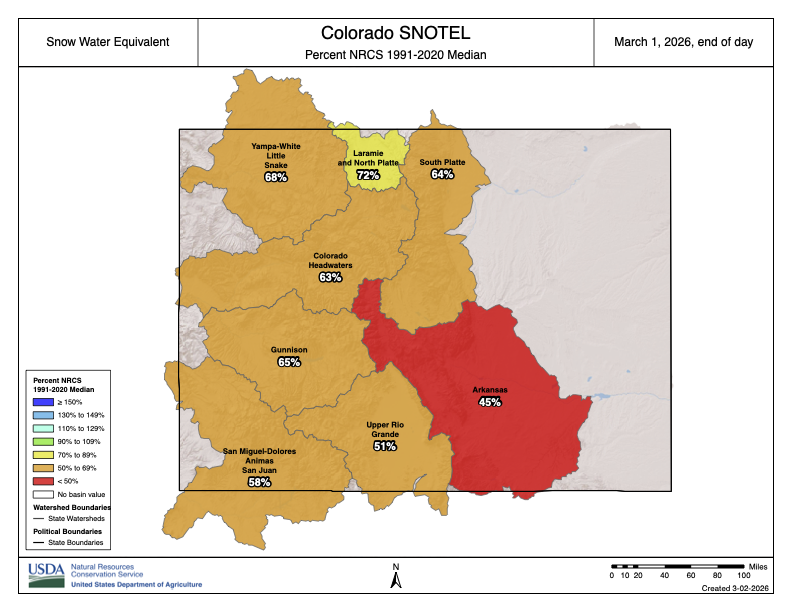
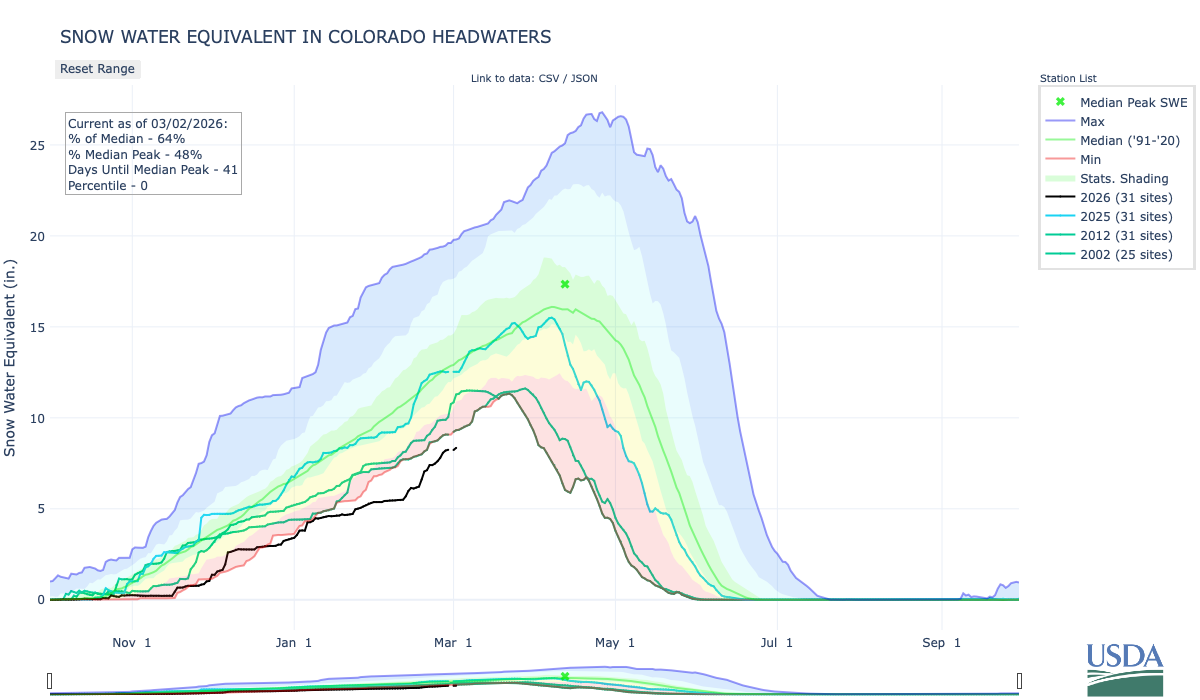
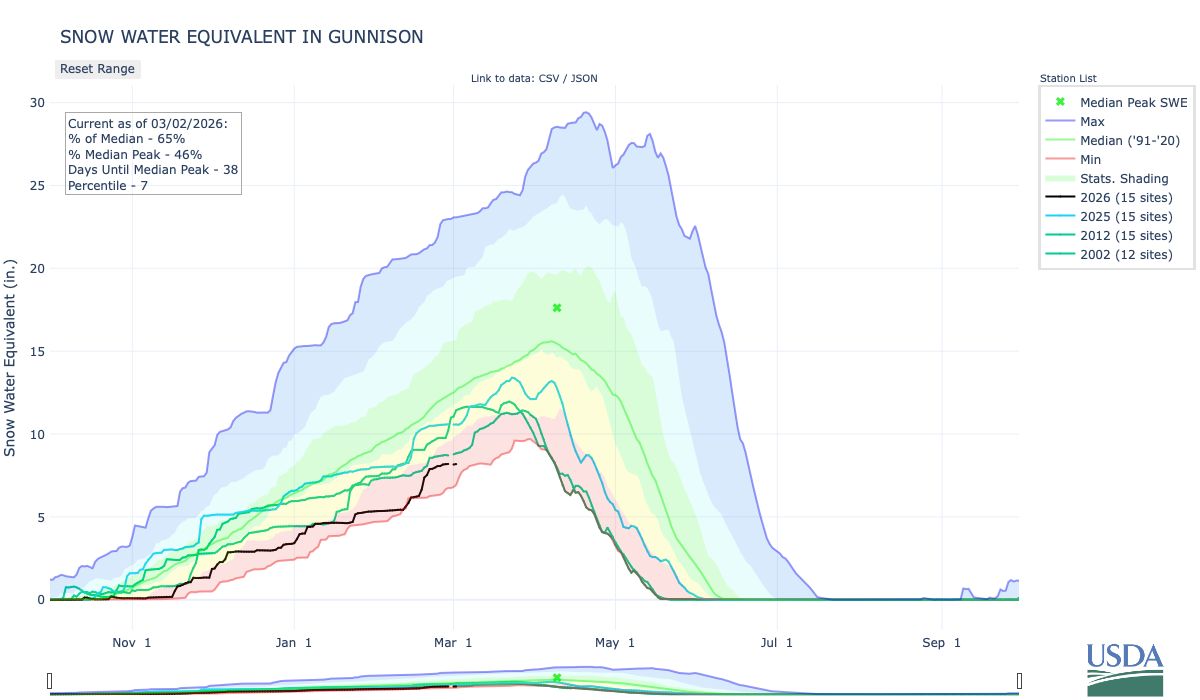
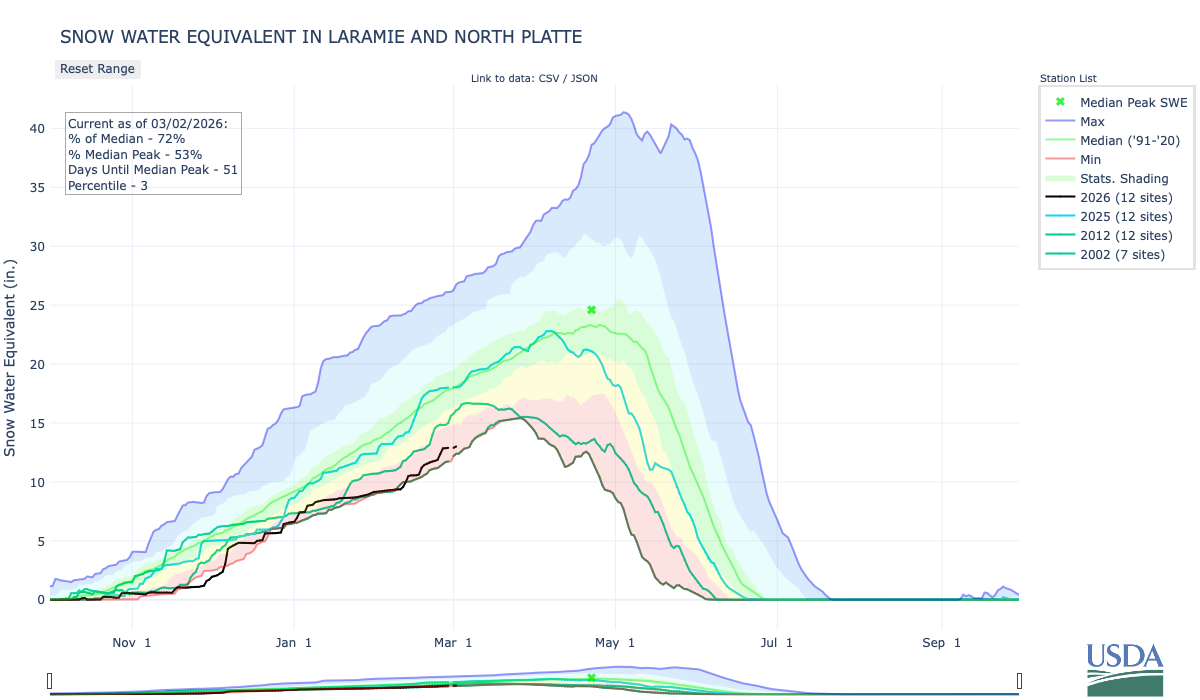
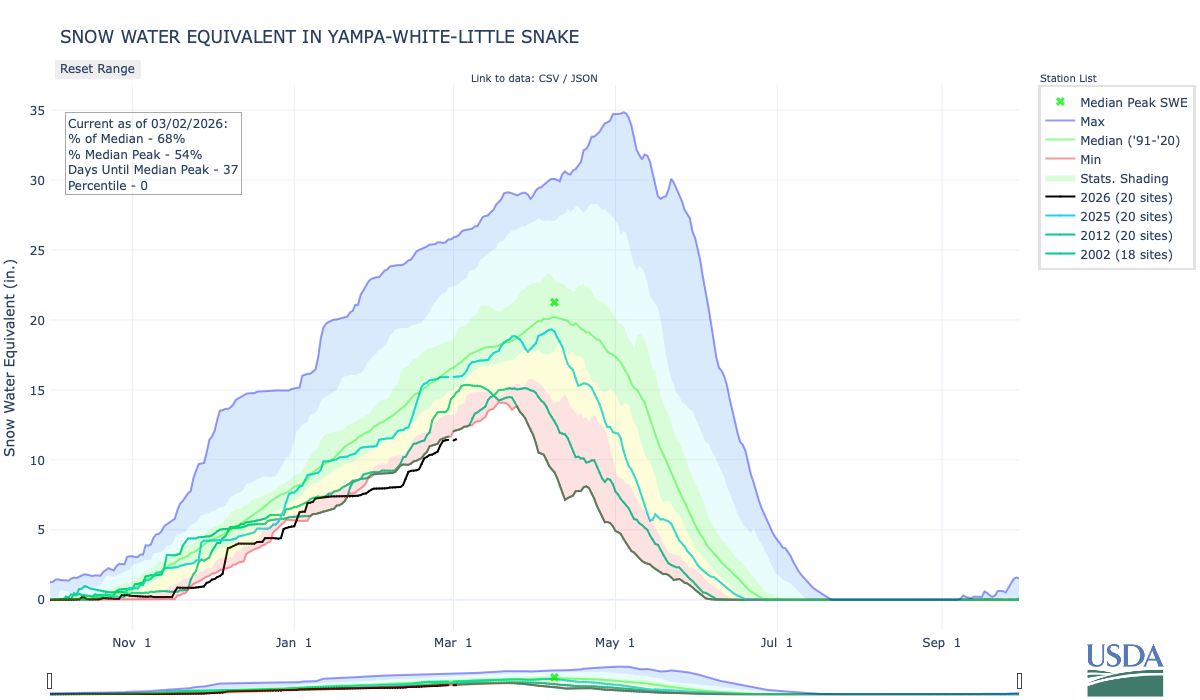
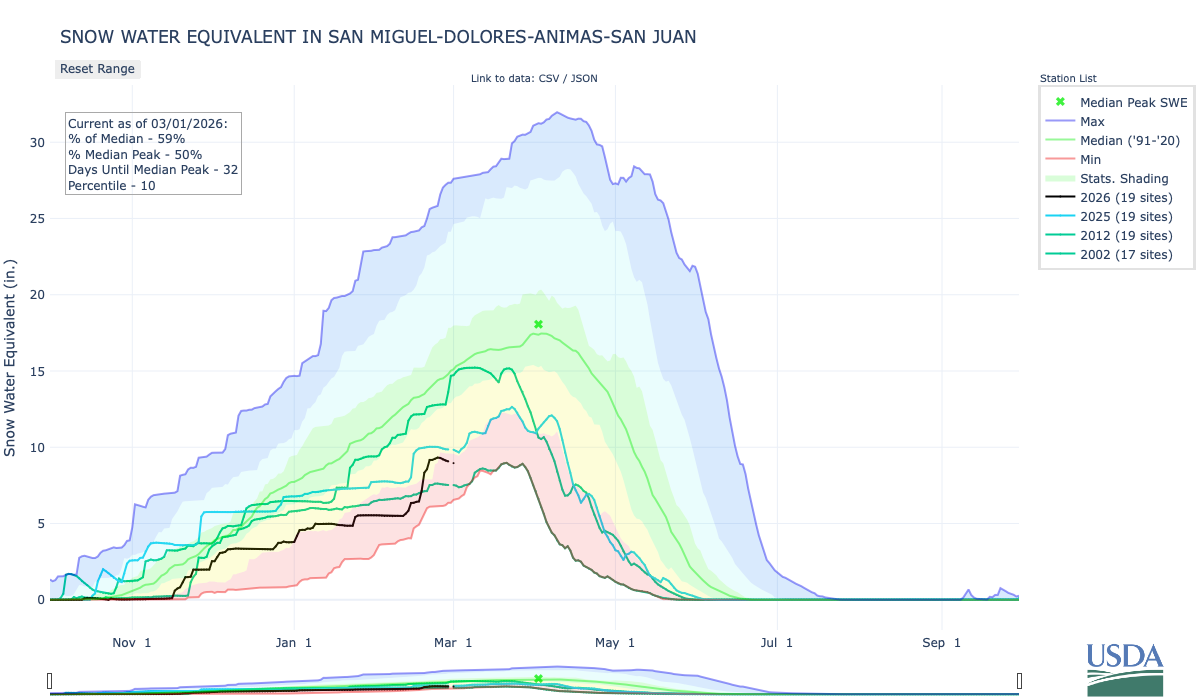
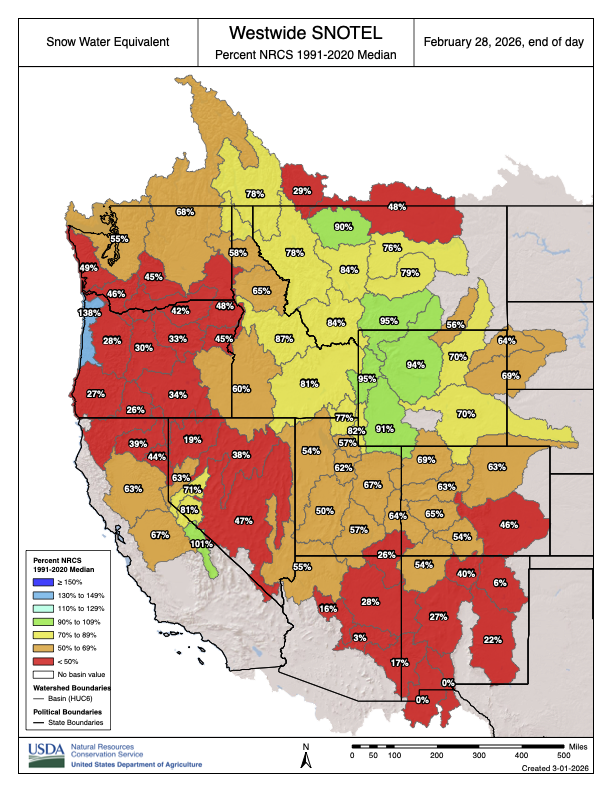
#Drought news February 5, 2026: As of March 3, snow water equivalent is less than 70 percent of normal across the Central Rockies, less than 50% in the Four Corners region #snowpack

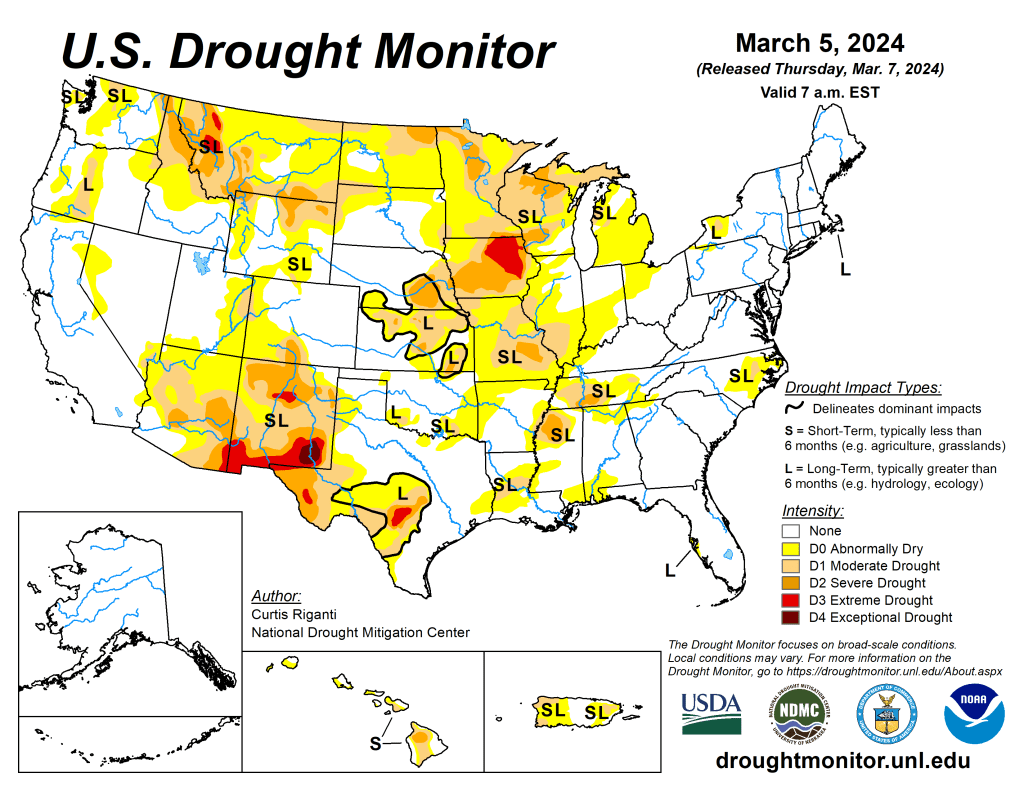
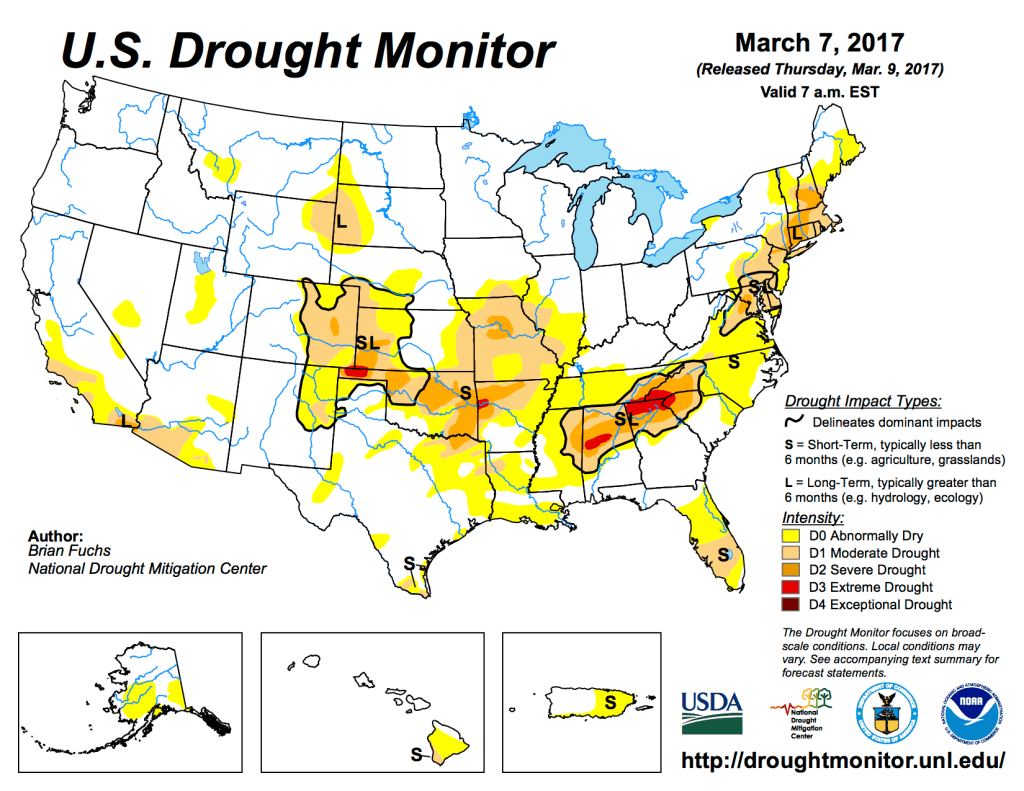
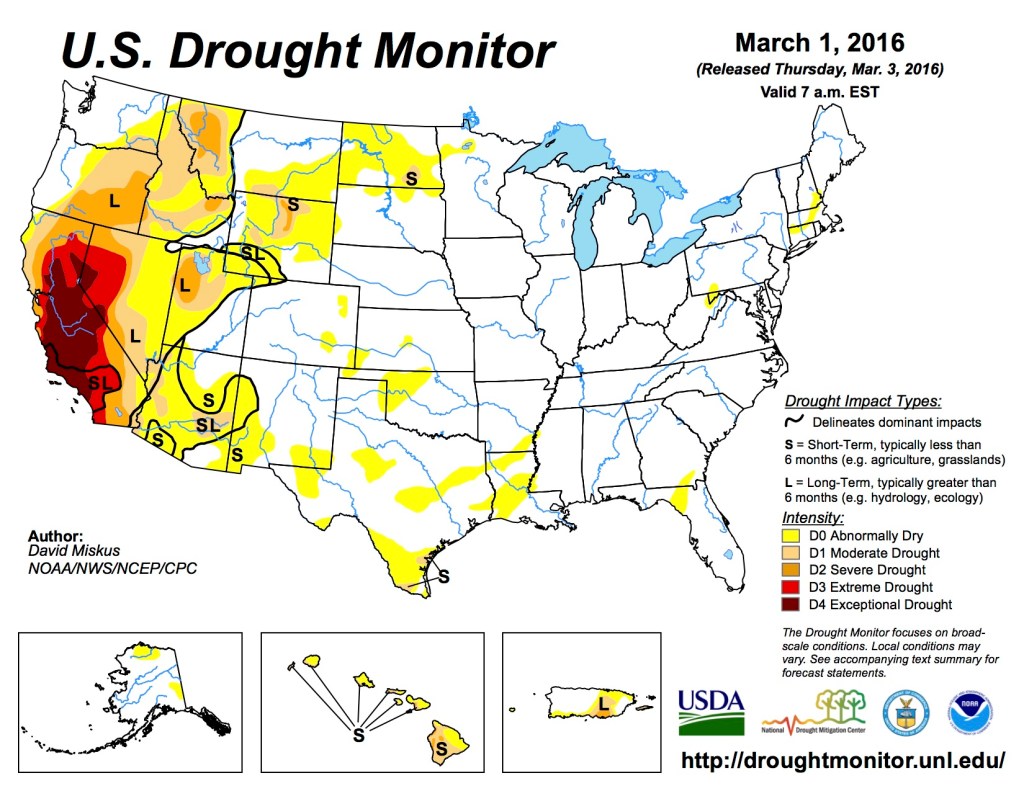
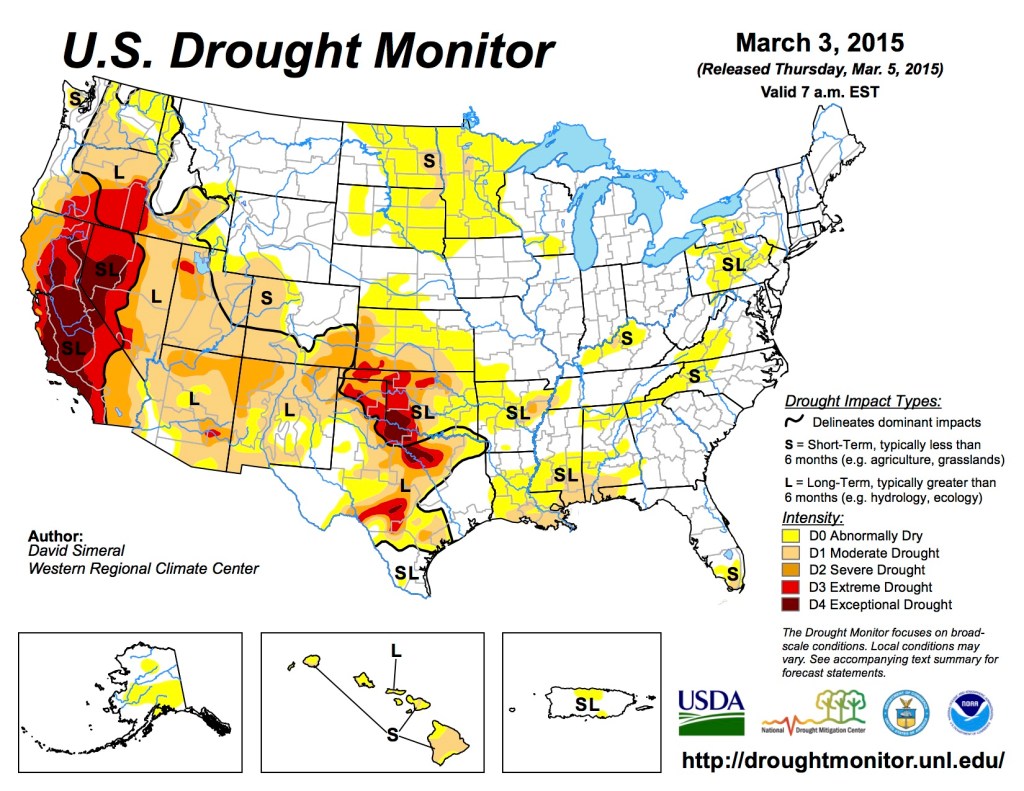
Click on a thumbnail graphic to view a gallery of drought data from the US Drought Monitor website.

Click the link to go to the US Drought Monitor website. Here’s an excerpt:

This Week’s Drought Summary

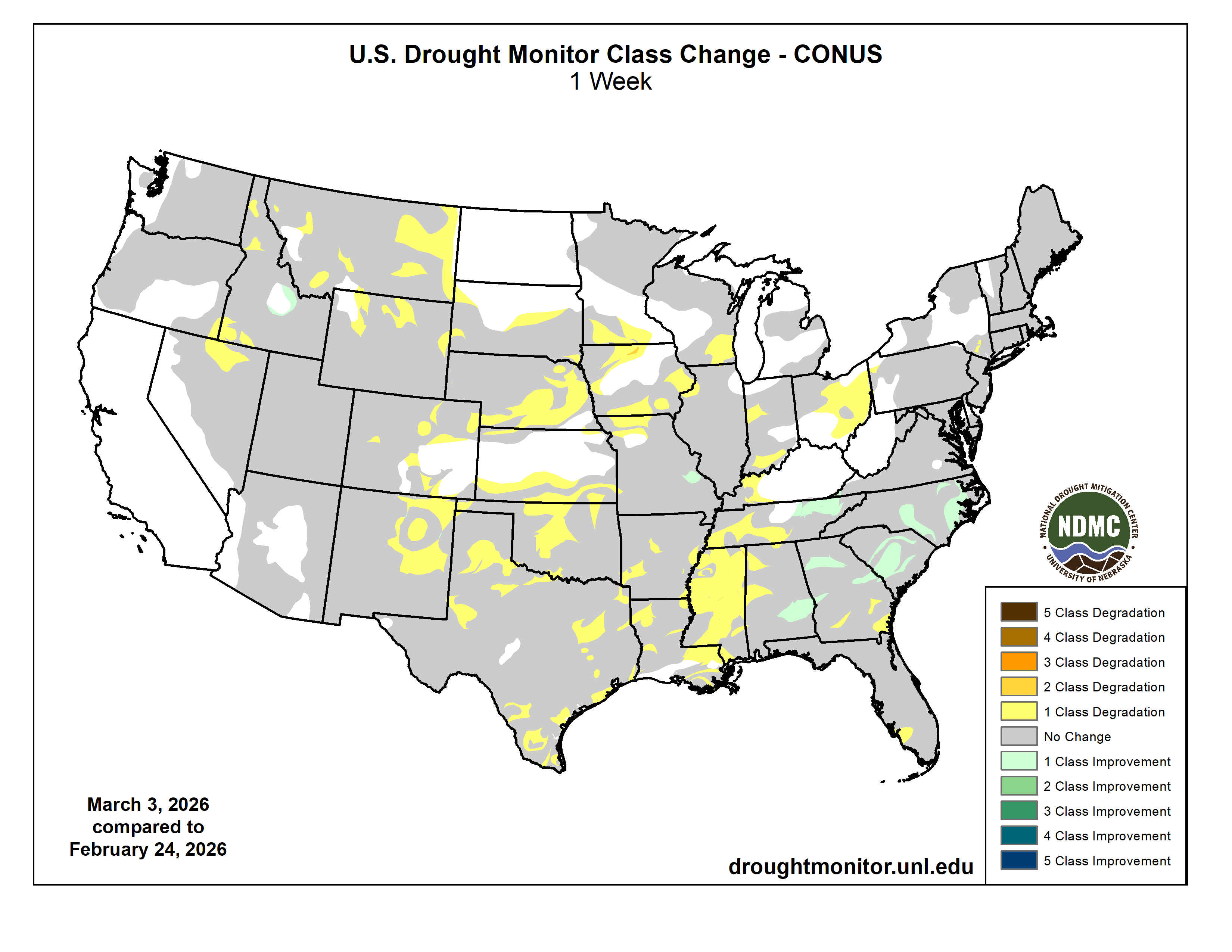
Since the beginning of December 2025, drought expanded and intensified across the Lower Mississippi Valley and Southern Great Plains which is typical during a La Nina winter. Much needed precipitation at the end of February led to small improvements across parts of the Southeast and also at least briefly stabilized the drought status for this region. Widespread severe to extreme drought is designated for much of the Carolinas, Georgia, southeastern Alabama, and Florida. A longer-term drought continues to affect the Mid-Atlantic and portions of the Northeast. The unusually dry winter persisted across the Midwest through the end of February with additional degradations made this past week. These worsening drought conditions extend west to the Central Great Plains along with the Central to Northern Rockies. Below-normal snowpack remains a major concern for the West heading into the spring. Drought coverage decreased in Hawaii during the past few weeks, while Alaska and Puerto Rico remained drought-free…

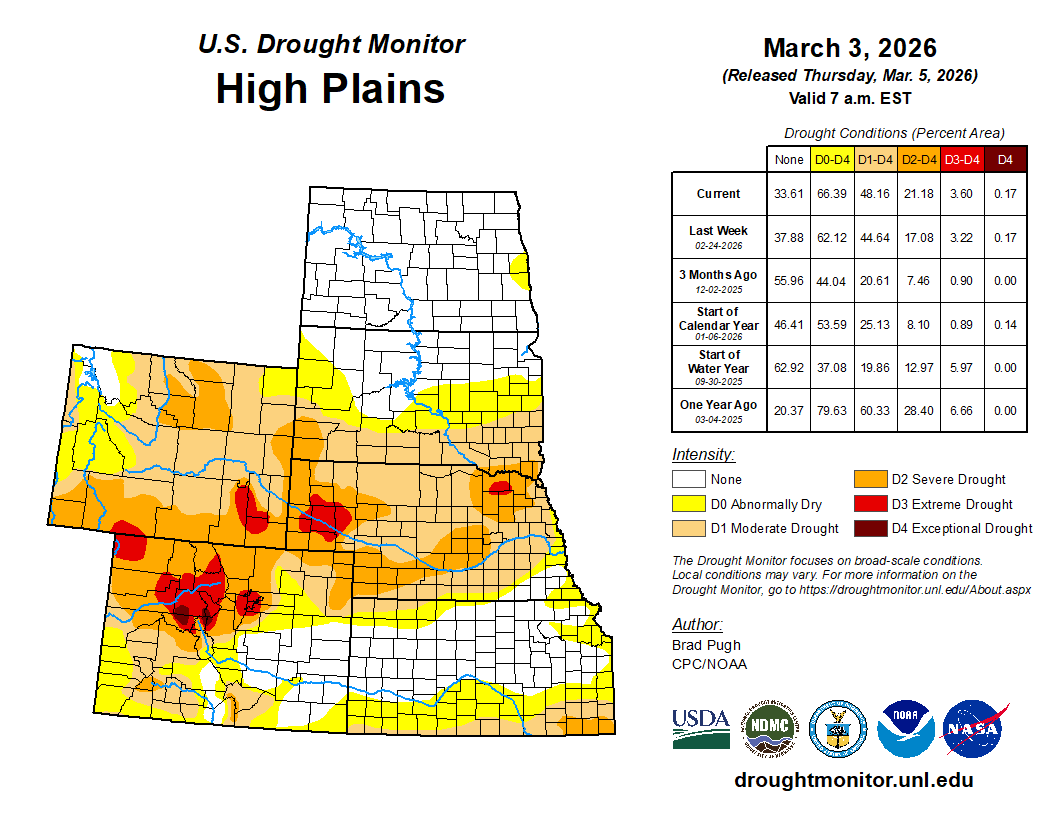
High Plains

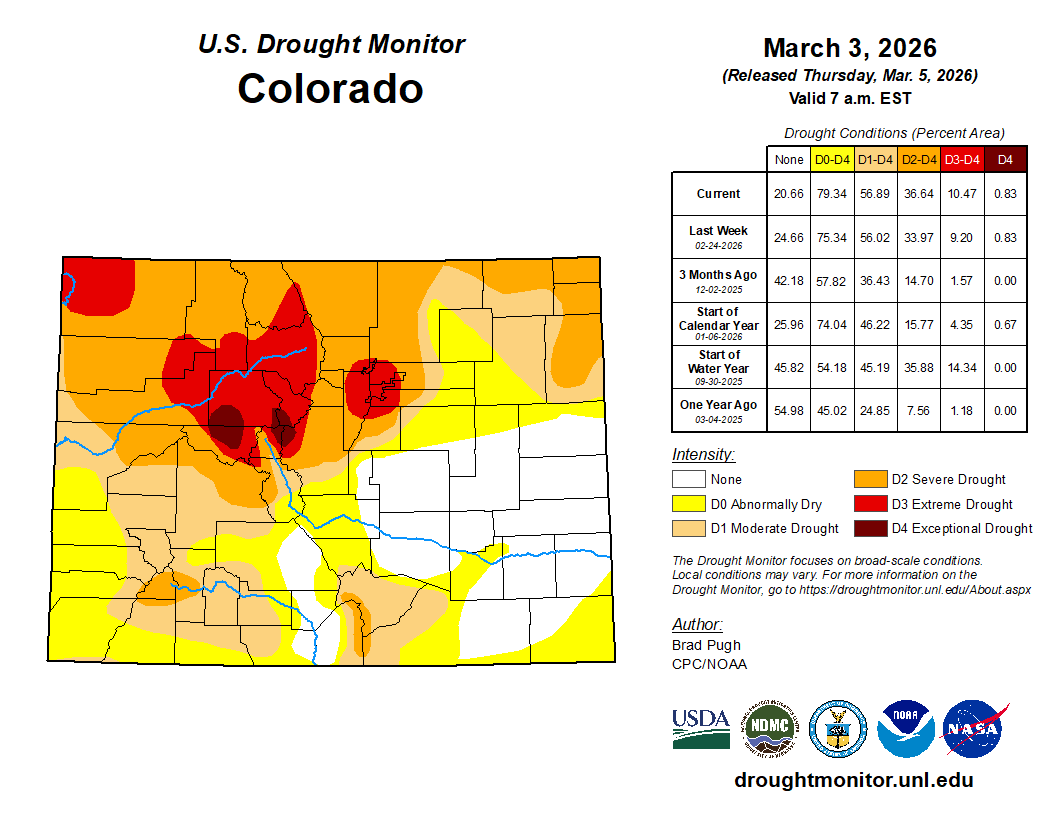
Although late winter is a relatively dry time of year across the Central Great Plains, periods of unseasonably warm temperatures and enhanced winds this past month led to intensifying drought across northeastern Colorado and Nebraska. 30-day temperatures averaged 6 to 10 degrees F above normal throughout the Great Plains. A 1-category degradation was made this past week to parts of Kansas and South Dakota. Widespread drought of varying intensity remains designated for much of Colorado and Wyoming. As of March 3, snow water equivalent is less than 70 percent of normal across the Central Rockies…

Colorado Drought Monitor one week change map ending March 3, 2026.

West

Water-year-to-date precipitation (October 1, 2025 to March 2, 2026) averaged below-normal for the Great Basin which led to a slight increase in moderate (D1) coverage across northeastern Nevada this past week. Following a drier- and warmer-than-normal February, a 1-category degradation was also made to parts of Montana. A 1-category degradation was also warranted for parts of Idaho, reflecting the below-normal precipitation and low snowpack this past winter. Even for areas of the West that have received above-normal precipitation since the beginning of October 1 such as the Northern Intermountain West and Northern Cascades of Washington, snow water equivalent (SWE) is running below normal. The low snowpack throughout much of the West is a major concern heading into the spring. As of March 3, SWE is less than 50 percent of normal from the Cascades of the Pacific Northwest southward through the Great Basin and Four Corners region. Although California remains drought-free, SWE is 59 percent of normal statewide according to the California Department of Water Resources…

South

Heavy rainfall (1 to 3 inches, locally more) resulted in a small 1-category improvement to parts of northeastern Tennessee. For the Lower Mississippi Valley and Southern Great Plains, drought continued to expand and intensify through the end of February and beginning of March. The major change this past week was a widespread 1-category degradation to Mississippi and also north-central Oklahoma. Since the beginning of December, precipitation has averaged less than 50 percent of normal across much of the Lower Mississippi Valley and Southern Great Plains. Impact reports from north-central Oklahoma include poor wheat conditions and surface water supply shortages. An expansion of moderate drought (D1) was also warranted for northeastern New Mexico. In addition to the drier-than-normal winter, 90-day temperatures have averaged 2 to 6 degrees F above normal. The lack of winter precipitation combined with periods of unseasonably warm temperatures and enhanced winds led to an increasing coverage of severe (D2) to extreme (D3) drought from the Mississippi River west through Oklahoma and Texas…

Looking Ahead

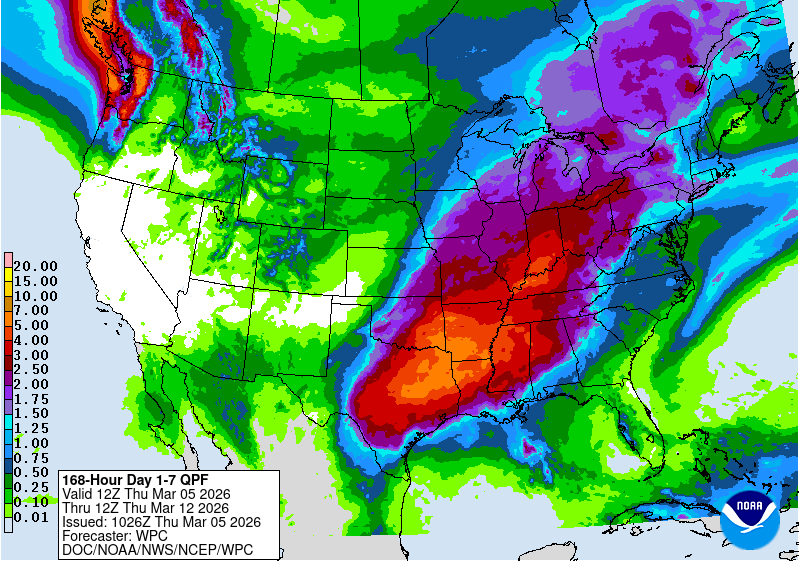
A major pattern change is underway which will promote multiple low pressure systems tracking across the Great Plains and Midwest during early to mid-March. The Weather Prediction Center (valid March 5-9) depicts a swath of heavy precipitation (1 to 3 inches, locally more) from eastern Texas and southeastern Oklahoma northeast through the Lower to Middle Mississippi and Ohio Valleys. This heavier precipitation is forecast to extend into parts of the Northeast, but little to no precipitation is expected from Virginia south to Florida. Much-needed snowfall is expected across the Northern to Central Rockies, while dry weather prevails across California and the Southwest. Much above-normal temperatures are forecast across the southeastern and central U.S. where daily record highs may be broken from March 5 to 9.

The NWS 6-10 day outlook (valid March 10-14) calls for an increased chance of above-normal temperatures for the East, Middle to Lower Mississippi Valley, Southern Great Plains, Southwest, and California. Below-normal temperatures are more likely from the Pacific Northwest east to the Northern Great Plains. Below-normal temperatures are strongly favored for Alaska. The 6-10 day outlook favors above-normal precipitation from the Mississippi Valley to the East Coast. Above-normal precipitation probabilities decrease west across the Great Plains. Above-normal precipitation is also favored for the Pacific Northwest and Northern Rockies. Near to below-normal precipitation is favored across Alaska, while large above-normal precipitation probabilities are forecast throughout Hawaii.

US Drought Monitor one week change map ending March 3, 2026.

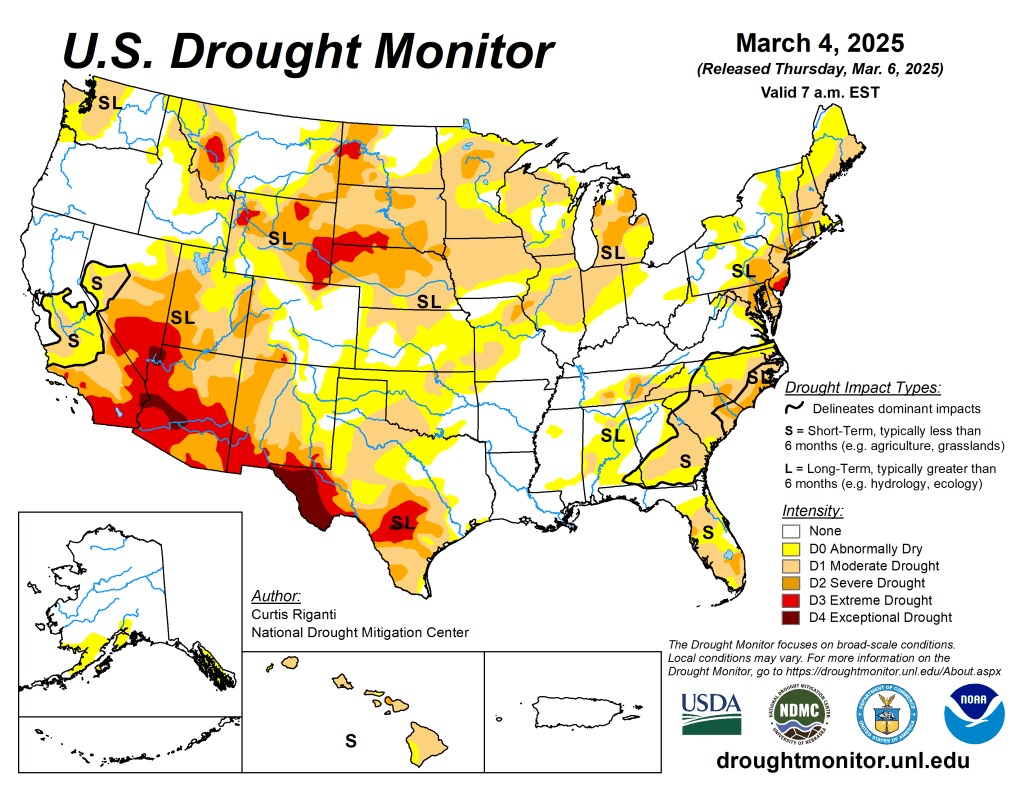
Just for grins here’s a slideshow of US Drought Monitor maps for the past few years.

Snowpack finally saw some above average gains last week — Northern Water #SouthPlatteRiver #ColoradoRiver

Mining Monitor: Trump uranium mine? Or trolling? Also: A guest post on Glen Canyon Dam — Jonathan P. Thompson #ColoradoRiver #COriver #aridification

The Henry Mountains, which are surrounded by and covered with mining claims, including the Trump 1-4 properties. Jonathan P. Thompson photo.

Click the link to read the article on The Land Desk website (Jonathan P. Thompson):

March 3, 2026

The Bureau of Land Management’s Mineral & Land Records System seems like a strange place to get trolled. But I think it just happened. I was looking through the MLRS to try to get an idea of whether insanely high gold and silver prices, and relatively strong uranium prices, had inspired companies or speculators to stake new mining claims n southwestern Colorado and southeastern Utah, when I came across something that seemed almost satirical.

Late last year, Kimmerle Mining Company staked four 20.66-acre lode claims in Garfield County, Utah, on the east slope of the Henry Mountains (just east of Mt. Pennell). The claim’s names? Trump I, Trump 2, Trump 3, and Trump 4.

The Kimmerle family, of Moab, control hundreds of mining claims across southeastern Utah. But they generally don’t mine them, except, it seems, to make a point.

The Kimmerles are the ones who staked mining claims on a mesa just east of Hideout Canyon inside Bears Ears National Monument just months just before the Obama administration withdrew the area from new mining claims. After Trump shrunk the monument to exclude the White Canyon area in 2017, and just before Biden restored the boundaries in 2021, Kimmerle Mining staked five new claims in the area and acquired additional claims from another mining company. Kimmerle Mining promptly filed for a permit to do exploration work there, but the BLM said they had to demonstrate the claims “validity,” or show that they contained “valuable minerals.” The process for doing so would cost up to $100,000.

Shortly thereafter, Kimmerle joined the state of Utah’s lawsuit seeking to eviscerate the national monument, claiming that its establishment had caused him to lose out on mining profits.

No word on whether the firm plans on drilling or mining its Trump claims, but at least we know these folks’ political leaning. 

There have been a handful of other notable mining claim locations in the area in the past six months, including:

  • Platoro West Inc., located in Durango, staked twelve 20.66-acre lode claims southeast of Ouray, Colorado, in the Bear Creek drainage near Darley and Engineer Mountains. The company is registered under the name of William Sheriff, who was recently named executive chairman of Verdera Energy, which has interests in in-situ uranium mining in New Mexico.
  • CCKC Inc., of Philadelphia, located three 20-acre placer claims in Dolores County along the Dolores River upstream of Rico.
  • Roughead Resources of Moab (but which has also been associated with a Houston address) staked fifteen 20.66-acre lode claims in the Lisbon Valley of southeastern Utah near the Mi Vida Mine and the Lisbon Valley Copper Mine. At the same time, the company also staked dozens of claims in Beaver County, Utah.
  • Fermi Metals of Cocolalla, Idaho, staked twenty-three 20.66-acre claims on the southern slope of the La Sal Mountains, just north of the settlement of La Sal. This is near Energy Fuels’ La Sal Complex uranium mines.
  • Geobrines International, of Littleton, Colorado, staked twenty-five 20-acre placer claims in Grand County, Utah, along I-70 between Green River and Cisco. This adds to a cluster of previously filed claims in the same area. They are probably looking to do lithium extraction.
  • Utah Brine Corporation, of Omaha, Nebraska, staked seventy 20-acre claims southwest of the community of La Sal in the Lisbon Valley. UBC appears to be a subsidiary of Omaha Value Inc., which has partnered with an Australian critical materials firm Neometals on its Utah Brine Project, which aims to extract lithium and potash.
  • Antimony Canyon Sovereign Reserve Inc, a division of Australia firm American Tungsten & Antimony, staked nineteen 20.66-acre lode claims near Antimony, Utah, in Garfield County. The plan is to develop an antimony mine here.

In other mining news:

  • Metallic Minerals has been eyeing and drilling into a copper deposit in the La Plata Mountains of southwestern Colorado. While actual mining may be a long ways off, concerned locals are already coming together to keep an eye on the project and push back, if necessary. The La Plata Mountains and Public Lands Coalition now has about 225 members from the region, according to Dan King, the coalition’s administrator. Metallic Minerals’ proposal was just one of the catalysts for the coalition, and its mission is much broader and more regional in scope.

Gold and silver prices have shot up tremendously over the last year, probably due to the Trump-effect on the economy and the U.S. dollar, which is stuck at a ridiculously low exchange rate. Gold is now around $5,000/oz, while silver is hovering around $100/oz., compared to just $30 when Trump took office. Uranium’s doing well, too, sitting consistently in the $80/lb to $90/lb range. 

Which is to say, mining companies suddenly have a lot more incentive to invest in reopening existing, idle mines or even building new ones (assuming they have faith that the high prices will endure). So far, however, it doesn’t seem to have sparked a surge in new mining activity. Even the Revenue-Virginius silver mine near Ouray, which is purportedly ready to produce ore, remains idle. 

The uranium sector does appear to be emerging from its long slumber, but mostly in the form of exploratory drilling, smaller companies selling claims to bigger ones, and staking mining claims on the increasingly sparse sections of public land that aren’t already claimed. Anfield continues work on constructing its Velvet-Wood mine in the Lisbon Valley, but it’s still a ways away from production (and its Shootaring mill is still mothballed and unlicensed). 

Energy Fuels is about the only firm actually producing conventional ore. According to their SEC filings, they pulled about 1.5 million pounds of uranium from the Pinyon Plain mine near the Grand Canyon and 155,000 pounds from their La Sal Complex in 2025. Their White Mesa Mill recovered 1 million pounds of uranium, which is a heck of a lot more than in the past, but still is far short of the facility’s 8-million-pound annual capacity. Despite all of this, the company still lost $86 million in 2025.

Meanwhile, the silver and gold mining corporations raked in massive profits, including:

  • Canadian corporation Barrick, which owns major gold mines in Nevada (Fourmile and Nevada Gold Mines) reported an attributable EBITDA of $8.16 billion last year, the “highest shareholder returns” in the company’s history.
  • Newmont (which jointly owns Nevada Gold Mines with Barrick) reported an adjusted EBITDA of $13.5 billion.
  • Kinross, owner of Bald Mountain and Round Mountain in Nevada, Fort Knox and Manh Choh in Alaska, and Kettle River-Curew Project in Washington, reported adjusted net earnings of $2.2 billion
  • Rio Tinto’s “profit after tax attributable to owners of Rio Tinto (net earnings)” $10 billion. 
  • SSR Mining, which owns a big mine in Nevada, only had a net income of $362 million; but that compares to 2024’s loss of $350 million.

Speaking of commodity prices and profits: American oil and gas companies are poised to make out like bandits thanks to the Trump-Netanyahu war on Iran. 

Iran produces some oil and gas. But more importantly, it borders the Strait of Hormuz and has threatened any oil and gas tankers that try to pass through it, effectively closing the passage. That could stanch the flow of oil and gas to the global market, causing prices to rise. The West Texas Intermediate, or WTI, crude oil price has shot up to about $76, the highest it’s been since before Trump took office. This will cause gasoline prices to climb, but also make drilling in the U.S. more profitable, and could spur companies to start using the stockpile of public land drilling permits they’ve amassed over the last year or so. 

Liquefied natural gas tankers also are unable to get through the Strait to European markets, which will cause prices of the fuel to skyrocket. It could also force European countries to turn to U.S. LNG exporters, which could echo back to natural gas producing states like New Mexico and Wyoming (and also may increase U.S. natural gas prices if the conflict drags on).


Glen Canyon Dam Must Be Modified to Avoid Draconian Water Supply Disruptions

A guest post by Ron Rudolph

Glen Canyon Dam with the river outlets in use as part of the high-flow experimental release. The outlets are only used occasionally and are not engineered for sustained use. Usually, all of the releases go through the penstocks and the hydroelectric turbines. But that won’t be possible if the lake drops below the level known as minimum power pool. Jonathan P. Thompson photo.

Glen Canyon Dam, which impounds the Colorado River to form Lake Powell, is a single point of failure that poses an unacceptable risk to the functioning of the entire river system. Modifying the dam to allow more water to pass through or around it is an essential component of any plan for allocating the river’s dwindling supply. 

The dam’s structural flaw limits the amount of water that can pass from Lake Powell downstream to Lake Mead. Lake Mead, the nation’s largest reservoir, is the primary repository of water for the Colorado River’s so-called Lower Basin states: California, Arizona, and Nevada. A paucity of water released from Lake Powell would eventually force reductions in the amount of water extracted from Lake Mead, diminish drinking water supplies for millions, harm agricultural productivity throughout the southwest, and embroil the federal government, seven states, more than two dozen Tribal Nations, Mexico, and others that share the river’s water in a cascade of costly court cases. 

The back of Glen Canyon Dam circa 1964, not long after the reservoir had begun filling up. Here the water level is above dead pool, meaning water can be released via the river outlets, but it is below minimum power pool, so water cannot yet enter the penstocks to generate electricity. Bureau of Reclamation photo. Annotations: Jonathan P. Thompson

Due to Glen Canyon Dam’s physical limitations, when the elevation of Lake Powell reaches “minimum power pool” or lower, the only way to release water from the dam is through its river outlet works.1 The persistent drought in the southwest, and continued demand for the river’s reduced water supply, makes it highly likely Lake Powell will fall to minimum power pool this year. The U.S. Bureau of Reclamation estimated this month that Lake Powell could fall to minimum power pool by late July, and remain there or lower through 2027.2

The Bureau of Reclamation’s latest forecast for the Colorado River predicts Lake Powell will “most probably” drop below the critical minimum power pool level before the end of this year, jeopardizing Glen Canyon Dam’s structural integrity. In the worst-case scenario, it would do so before summer’s end. This could force the feds to operate the dam as a “run-of-the-river” operation to preserve the dam’s infrastructure and hydropower output, which would significantly diminish downstream flows and threaten Lower Basin water supplies.

In addition, the agency’s February forecast estimates that under “most probable inflow” conditions, Lake Mead would drop below elevation 1,040 in June. If conditions do not improve by the agency’s August forecast, mandatory reductions in water use would be required in Arizona, California, Nevada, and Mexico.3 If the annual amount of water let out from Lake Powell is restricted to the dam’s outlet works, it would result in less water reaching Lake Mead than any year this century, and could trigger even larger reductions in Lower Basin water consumption.4 Releasing water from reservoirs upstream from Lake Powell could forestall the reservoir reaching minimum power pool, however, that is a non-sustainable solution, that fails to address Glen Canyon Dam’s fundamental plumbing problem. 

In January, the Bureau of Reclamation’s draft environmental impact statement — Post-2026 Operational Guidelines and Strategies for Lake Powell and Lake Mead —proposed several options for managing the Colorado River for the next 20 years. None of the alternatives includes remedying Glen Canyon Dam’s structural flaws. 

The Bureau’s proposals have been criticized by some of the largest consumers of Colorado River water who have signaled a willingness to challenge the agency in court. For example, the Metropolitan Water District of Southern California, which serves nearly 19 million people, noted the Bureau’s proposed alternatives “would likely lead to lengthy litigation.”5 The Central Arizona Project, the second largest consumer of Colorado River water, has identified several “legal deficiencies,” including non-compliance with the Colorado River Compact, and failure to adequately disclose and analyze the environmental, economic and socioeconomic impacts.6
Depending exclusively on the river outlet works to release sufficient water through Glen Canyon Dam is bound to fail, like relying on rainfall to grow crops in Arizona or southern California. The Bureau has warned relying on the outlet works would risk water supply disruptions to those who depend on Lake Powell and Lake Mead.7 The Director of the Bureau’s Technical Service Center has advised against using the outlet works as the sole means for releasing water from the dam,8 as previous high-capacity use of them for only 72 hours caused structural damage, which required nine months to repair. Despite the remedial effort, the Bureau concluded the repairs will not prevent future damage.9 The dam’s design flaw led the Arizona Department of Water Resources to conclude the structural limitations of Glen Canyon Dam must be alleviated.10

The calculus for equitably apportioning the diminishing water in the Colorado River is extremely complicated. But one variable in the equation is as obvious as the bathtub ring surrounding Lake Powell: a new system for conveying water sustainably through or around Glen Canyon Dam must be built. Without it, risks to the Colorado River system, and the communities, agriculture and ecosystems reliant on it, will escalate, as will pressure to impose compulsory reductions in consumptive uses throughout the basin. 

Ron Rudolph, a former assistant executive director of Friends of the Earth, spent 35 years in various engineering companies, including MWH Global, CH2M Hill, Jacobs Engineering, and Cardno with a career focused on infrastructure development and environmental remediation.


1 U.S.Bureau of Reclamation, Technical Decision Memorandum, Establishment of Interim Operating Guidance for Glen Canyon Dam During Low Reservoir Levels at Lake Powell, March 26, 2024, page 9

2 https://www.usbr.gov/lc/region/g4000/riverops/24ms-projections.html

3 When Lake Mead drops below elevation 1,040, a “Level 2 Shortage Condition,” mandatory reductions in water use by Arizona, California, Nevada, and Mexico are required by the 2007 Interim Guidelines for managing Lake Powell and Lake Mead, and the 2019 Lower Basin Drought Contingency Plan

4 The Bureau’s guidance for maximum release of water from each river outlet work (ROW) at minimum power pool elevation is 3,185 cubic feet/second (cfs). The agency has determined only three ROWs would be available simultaneously. If three ROWs operate at full capacity, they would release 9,555 cfs. 1 cfs sustained for a year = 724.acre-feet/year. 9,555 x 724.45 = 6,922,000 acre-feet/year. The maximum releases are specified in USBR, Technical Decision Memorandum, Establishment of Interim Operating Guidance for Glen Canyon Dam During Low Reservoir Levels at Lake Powell, March 26, 2024, page 2. The determination that only three ROWs would be available simultaneously in based on USBR, Near-term Colorado River Operations, Final Supplemental Impact Statement, March 2024, page 2-3. The least amount of water released this century was 7 million acre-feet in 2022, based on data from U.S. Bureau of Reclamation, Colorado River Accounting and Water Use Report: Arizona, California and Nevada, 2000-2024

5 Statement of Metropolitan Water District’s General Manager, Shivaji Deshmukh, January 9, 2026

6 Patrick Dent, Assistant General Manager, Water Policy, Central Arizona Project, Report on Post-2026 Draft Environmental Impact Statement, February 5, 2026 

7 U.S. Bureau of Reclamation, Near-term Colorado River Operations, Final Supplemental Impact Statement, March 2024, page 1-9, footnote 10

8 USBR, Technical Decision Memorandum, Establishment of Interim Operating Guidance for Glen Canyon Dam During Low Reservoir Levels at Lake Powell, March 26, 2024, page 9

9 USBR, Reclamation completes recoating of outlet tubes at Glen Canyon Dam ahead of schedule, June 18, 2025; https://www.usbr.gov/newsroom/news-release/5184 

10 Email from Trent Blomberg on behalf of Tom Buschatzke, Director, Arizona Department of Water Resources, February 4, 2026

Central Arizona Project: Letter to Secretary Burgum about the Draft Environmental Impact Statement for Post-2026 Operational Guidelines and Strategies for #LakePowell and #LakeMead — Terry Goddard and Brenda Burman #ColoradoRiver #COriver #aridification

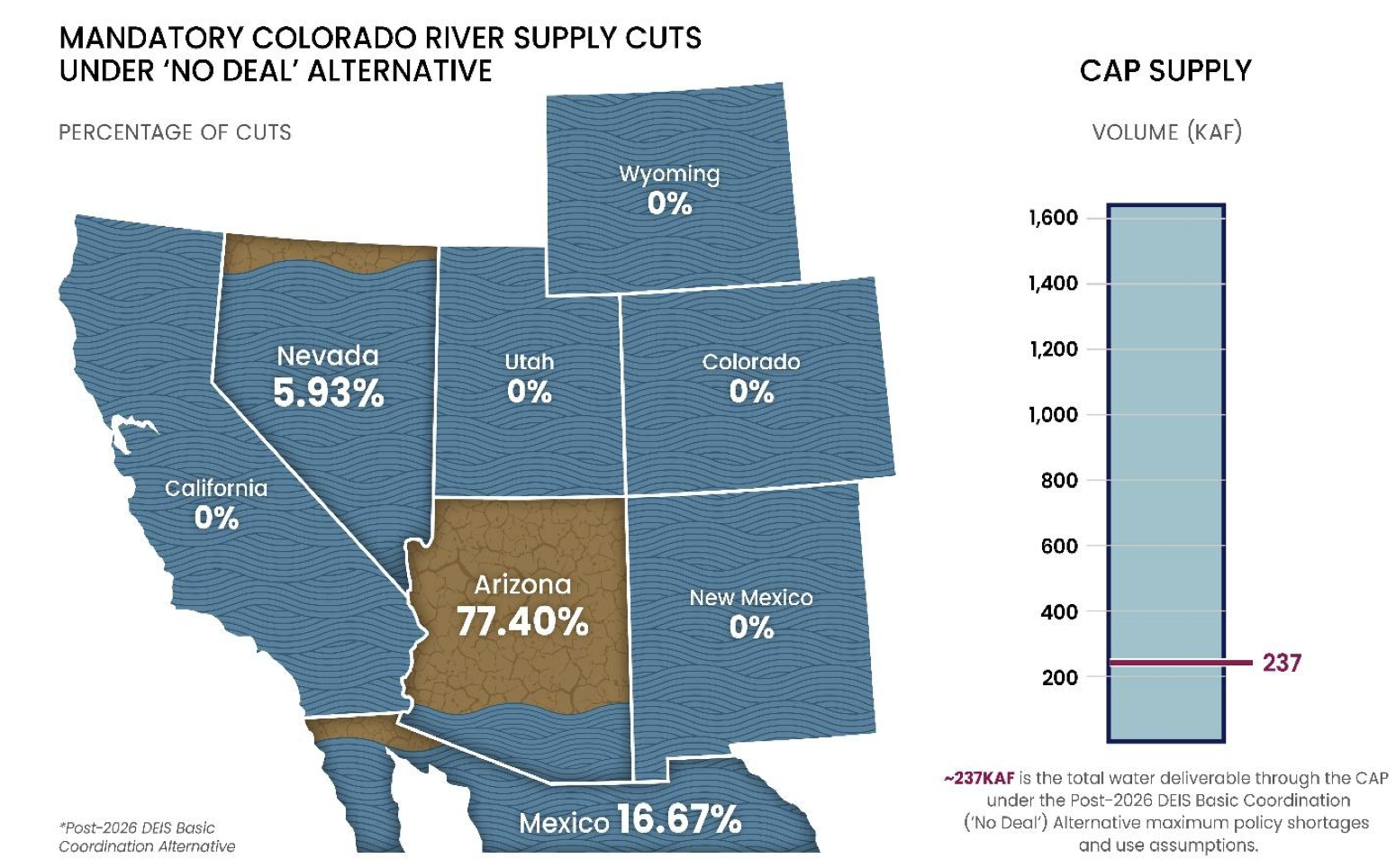
Central Arizona Project map via Mountain Town News

Click the link to go to the Central Arizona Project website Colorado River Operations where you can find links to the relevant documents with respect to the DEIS.

Click the link to read the letter on the Central Arizona Project website (Terry Goddard and Brenda Burman):

Secretary Burgum:

On behalf of the Central Arizona Project and twenty-two Arizona Participating Entities that rely on the Colorado River, I am submitting the attached comments that express our deep concerns regarding the Draft Environmental Impact Statement (DEIS) for the Post-2026 Operational Guidelines and Strategies for Lake Powell and Lake Mead and the devastating impacts the alternatives therein would impose on Arizona.

All the alternatives proposed in the DEIS disproportionately harm Arizona and are unacceptable. Specifically, the Basic Coordination alternative proposed in the DEIS that Reclamation claims could be imposed without Arizona’s consent all but severs much of Central and Southern Arizona from Colorado River supplies that have been relied upon on for four decades, betraying the promise of sustainable water supplies that underly Arizona’s economy and potentially causing “widespread impacts on social and economic conditions. . . . that may force cities and towns to haul water . . . as an alternative to support continued services.”1 Arizona will not tolerate devastation and destabilization, particularly when the DEIS allows other Basin States to increase their water use.

The waters of the Colorado River are foundational to the economy and people of Central and Southern Arizona, supporting 6 million Arizonans, many tribal communities, a thriving advanced microchip manufacturing industry, and critical mineral and agricultural production. Arizona has cultivated a flourishing desert society over the past 40 years through careful and prudent use of Colorado River water supplied by the Central Arizona Project—more than doubling the State’s population while managing at the same time to use less water. The DEIS alternatives threaten to tear apart a generation of careful water management and topple the architecture supporting Arizona’s economy which is home to the heart of the American semi-conductor manufacturing and AI infrastructure industries.

The DEIS alternatives are not just a failure of policy but also include fatal legal deficiencies, and we respectfully request that the Department of the Interior withdraw the document. The United States must implement a decision that is consistent with the Colorado River Compact of 1922 (Compact), the Law of the River, and wise water policy—the DEIS fails on all counts. The enclosed comments highlight several critical flaws in the DEIS, including but not limited to:

  • Inconsistency with the Compact and the Law of the River: Absent agreement by the Basin States, the operating criteria for the Colorado River must comply with the foundational authority on the Colorado River: the Compact. All subsequent statutes, regulations, contracts, and other agreements are subject to compliance with the Compact and the DEIS ignores this foundational issue by proposing alternatives that would result in a breach thereof.
  • Failure to Analyze Upper Basin Delivery Obligations: The DEIS fails to consider or model the impacts of Upper Basin delivery obligations due to a Compact deficiency, including required releases from Colorado River Storage Project Act Upper Initial Units and curtailment in the Upper Basin necessary to prevent a breach of the Compact. This analysis is particularly important at this time, as a breach of the Upper Basin’s Compact delivery obligations could occur within the next 12 months.
  • Failure to Analyze the Devastating Socioeconomic Impacts to Arizona: The DEIS fails to analyze the widespread destabilizing social and economic impacts on Arizona that would be caused by the deep cuts to Arizona’s Colorado River supplies proposed in the document and could cause Arizona’s economy to lose over $2.7 trillion.
  • Failure to Evaluate Reasonable Alternatives: The range of alternatives is too narrow and neglects to evaluate the reasonable and feasible Lower Basin Alternative which would equitably share cuts needed to stabilize the Colorado River System among all seven Basin States and Mexico.
  • Illegal Implementation of the so-called “Junior Priority” on the Central Arizona Project: Arizona never agreed and the law does not make the Central Arizona Project a junior user to the Upper Basin. The DEIS fails by proposing deep cuts to Arizona’s water supplies without Compact compliance or required reductions to the Upper Basin. Further, the “junior priority” described in the Colorado River Basin Project Act and used to distribute the DEIS cuts to the Lower Basin is a facially unconstitutional imposition on Arizona’s sovereignty and illegally attempts to make Arizona a second-class citizen among the other Lower Basin States.

For these reasons and others described in the attached comments, the current DEIS does not provide the “hard look” at environmental consequences required by law. Proceeding with this document is highly likely to lead to legal challenges and long-term environmental damage that has not been analyzed.

We welcome the opportunity to work with the Department of the Interior to ensure the revised DEIS is robust and legally durable. Arizona has been a willing partner in attempting to negotiate a consensus solution to the management challenges facing Colorado River operations and continues to stand ready to find a compromise with the Secretary, the other Basin States, and additional Colorado River stakeholders based on shared sacrifice and a recognition that everyone must reduce their uses to stabilize the system. A revised DEIS is essential to comply with NEPA and properly inform the public and decision-makers and to avoid protracted litigation.

Map of the Colorado River drainage basin, created using USGS data. By Shannon1 Creative Commons Attribution-Share Alike 4.0

Federal Water Tap, March 2, 2026: Reclamation Outlines Options to Prop Up Shrinking #LakePowell — Brett Walton (circleofblue.org) #ColoradoRiver #COriver #aridification

Click the link to read the article on the Circle of Blue website (Brett Walton):

The Rundown

  • Interior Department overhauls its environmental review procedures.
  • GAO says NOAA, which has oversight authority, should do a better job of tracking cloud seeding and other weather modification.
  • Senate passes a bill to allow southern Nevada’s water authority to build a water-supply pipeline beneath a national conservation area.
  • EPA staff decreased 7 percent in the nine months through June 2025, GAO found.
  • Army Corps directive aims to speed up infrastructure work, prioritize projects.
  • House Democrats from the D.C. region ask Congress to fund the repair of a major sewer pipe break.

And lastly, Bureau of Reclamation officials outline options for propping up a shrinking Lake Powell.

“I think it’s safe for us to assume that unless Mother Nature is uncharacteristically generous, that Lake Powell elevations are going to fluctuate at elevations that we’re not comfortable with.” – Wayne Pullan, Bureau of Reclamation Upper Colorado regional director, speaking about the possibility that Lake Powell drops low enough later this year that Glen Canyon Dam cannot generate hydropower.

In context: Two-Decade Hydropower Plunge at Big Colorado River Dams

By the Numbers

7 Percent: Decrease in EPA staff between September 2024 and June 2025, according to a Government Accountability Office audit.

10: States that have weather modification programs, typically cloud seeding to induce rainfall, according to a GAO report.

News Briefs

Interior NEPA Changes
The Interior Department overhauled its environmental review procedures, aligning them with recent court decisions, congressional action, and Trump administration priorities.

The final rule sets page limits (150 pages in most cases, up to 300 for actions of “extraordinary complexity”) and time limits (generally two years) on environmental impact statements.

The new rules do not require public comment on draft environmental impact statements. The only mandatory opportunity for public comment is after the department issues a notice that it intends to prepare an EIS.

Reviews already in progress, those with “applications that are sufficiently advanced,” will be held to the previous standard.

Illustration from the report, “Antique Plumbing & Leadership Postponed” from the Utah Rivers Council,
Glen Canyon Institute and the Great Basin Water Network. Courtesy of Utah Rivers Council

Lake Powell Options
Officials at the Bureau of Reclamation, the federal agency that manages Colorado River dams, outlined several actions they are considering in the coming months to boost water levels in a rapidly shrinking Lake Powell, which could drop to a record low later this year that would halt hydropower production from Glen Canyon Dam for the first time.

The Colorado River’s second-largest reservoir behind Lake Mead is entering one of the most difficult periods in its six-decade history. The basin is drying due to a warming climate. Powell is just a quarter full, and projected to drop lower this year. Winter has been a dud, with warm temperatures and a historically bad snowpack in the Colorado mountains that feed into the reservoir.

Reclamation officials discussed their options during a meeting last week of the Glen Canyon Dam Adaptive Management Work Group, an expert committee that advises on the dam’s ecological impacts.

2024 decision allows Reclamation to “consider all tools that are available” to keep Powell from dropping below 3,500 feet, an elevation that provides a little wiggle room for maintaining hydropower production. Powell today sits at 3,531 feet.

The tool from the 2024 decision is Section 6(E), which grants Reclamation the authority to restrict water releases from Powell to as low as 6 million acre-feet. The planned release this year is 7.48 million acre-feet, so the Section 6(E) authority represents a potential 20 percent reduction.

A cut of that magnitude might not be necessary because Reclamation has another tool it can use in tandem.

That option is releasing more water from Flaming Gorge and other smaller reservoirs located higher in the watershed. This is called a DROA release after its authorizing document. Pullan said this action, which states in the lower basin are advocating for, is being discussed and the volume of those releases would be determined in the spring, around April or May.

In context: Big Decisions Loom for a Rapidly Shrinking Lake Powell

Southern Nevada Water Pipeline
The Senate passed a bill that allows southern Nevada’s water provider to tunnel beneath Sloan Canyon National Conservation Area in order to build a pipeline to increase the water-supply system’s reliability. The bill now goes to the president’s desk.

Studies and Reports

‘Army Mode’ for the Army Corps
Adam Telle, head of the Army Corps of Engineers, issued a collection of directives aimed at reducing paperwork and speeding up water infrastructure construction.

In one memo, Telle called for an “Army Mode” mobilization. He ordered a bottom-up approach whereby officials will select at least 20 projects nationally to prioritize. The list is due March 20.

A separate memo lists seven focus areas for infrastructure work. In descending order of importance: human life and safety, economically or strategically important infrastructure, efficient navigation and supply chains, human property, aquatic ecosystems, state-level infrastructure, and municipal infrastructure.

In yet another memo, he said that project investigations – part of the planning phase – should take no more than three years and $3 million.

Cost of Natural Hazards for the Defense Department
The Defense Department lacks data to understand fully the costs of natural hazards to its installations, according to a Government Accountability Office report.

The GAO made five recommendations, including resilience planning, data collection standards, guidance, and procedures. The Defense Department agreed with all of them.

Weather Modification
The GAO also looked into NOAA’s tracking of activities to induce rainfall or otherwise change the weather.

Thanks to a 1972 law, NOAA has oversight authority over weather modification and any entity that shoots silver iodide into clouds to make it rain is required to file a report with the agency. Solar geoengineering, which attempts to reduce air temperatures, is far less common but also covered under this authority.

The GAO found that NOAA’s database is incomplete, inconsistent, and unreliable. One fifth of interim and final reports had at least one error, the GAO estimates.

“Consequently, NOAA is not fully aware of the extent of weather modification activities that have occurred and are occurring within the U.S., how they are being conducted, or potential effects,” the GAO concluded.

On the Radar

How to Sue the EPA
The EPA is proposing to change the process for filing citizen lawsuits, moving from mail delivery to electronic submissions.

Public comments are due March 26. Submit them via http://www.regulations.gov using docket number EPA-HQ-OGC-2024-0557.

Water Infrastructure Funding
In the wake of a large-diameter sewer line rupture along the Potomac River, House Democrats from Maryland, Virginia, and the District of Columbia wrote to leaders of the House Transportation and Infrastructure Committee asking for funding for repairs.

The letter also asked for the Army Corps of Engineers to prioritize a study of a backup drinking water source for the capital region, which relies on the Potomac.

“Unlike other major metropolitan areas, the region lacks a secondary water supply, which would provide critical redundancy in the event of a future crisis.”

Federal Water Tap is a weekly digest spotting trends in U.S. government water policy. To get more water news, follow Circle of Blue on Twitter and sign up for our newsletter.

Map of the Colorado River drainage basin, created using USGS data. By Shannon1 Creative Commons Attribution-Share Alike 4.0

How much water remains in aquifers of SE #Colorado? — Allen Best (BigPivots.com)

Corn in Baca County. Photo credit: Allen Best/Big Pivots

Click the link to read the article on the Big Pivots website (Allen Best):

February 28, 2026

Study being completed will help guide decisions about continued mining of groundwater in the Springfield area. Ogallala will be gone within 20 years, but deepest formation could last a century.

Before center-pivot sprinklers powered by rural electrification in the mid-20th century, farmers in Colorado’s southeastern corner necessarily relied upon what came from the sky for water. HIgh-capacity pumps, first used in the Springfield area during the late 1940s allowed the farmers to go underground, to more lucratively plumb a series of aquifers and deliver far-higher crop yields.

The Ogallala — also called the High Plains — is the water-bearing geologic formation nearest the surface, followed by the more water-rich Dakota and Cheyenne formations. Underlying both is a far larger reservoir yet called the Dockum Group.

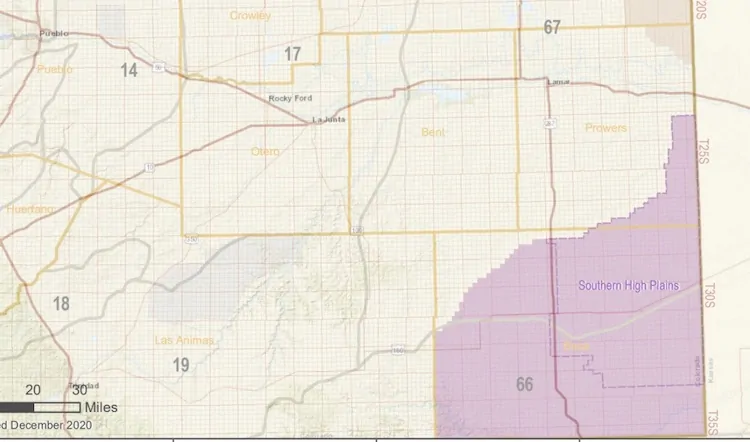
How long will that water last? A new report commissioned by Colorado, still in rough draft stage, finds that a little more than 2,000 wells mine these formations in Baca County and a portion of adjoining Prowers County. The vast majority of the water, 97%, irrigates alfalfa, corn and other crops. Remaining water goes to hog farms, stock ponds, and domestic wells for farmhouses as well as municipal supplies in Springfield and several even smaller towns.

An average 157,000 acre-feet were mined annually from these subterranean deposits from 2020 through 2024. To put that into perspective Denver Water delivers an average 232,000 acre-feet to the 1.5 million residents in Denver and adjoining jurisdictions.

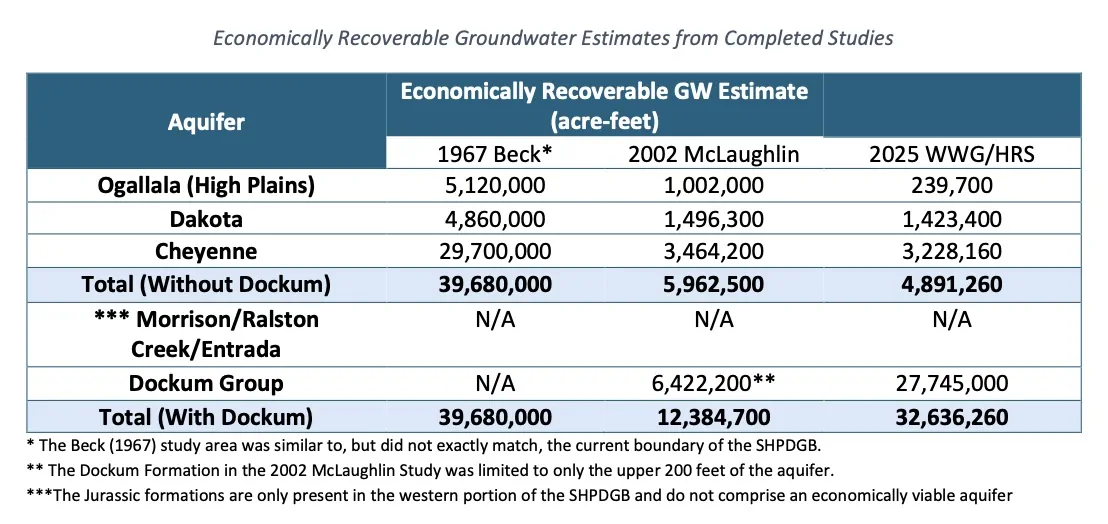
The answer to the question about how long the water will last has not been fully answered. At current rates of pumping, the Ogallala will be gone by 2045, according to this draft study. The next two deeper formations, Dakota and Cheyenne, have been depleted more rapidly but have more water.

The deepest water, in the Dockum, could last a century or more. It depends partly on the quality of water extracted at greater depths. There seem to be some unknowns about this. Cost of extraction is also a factor. Deeper wells cost more money to drill. It also takes more electricity to pump water to the surface. Would crop prices justify the added expenses?

Pueblo can be seen in the upper left-hand corner of this map, and the southern high plains district is designated by lavender.

With those asterisks in mind, the study estimates nearly 33 million acre-feet of water can be economically recovered from the four water-bearing geologic formations in that southern high plains groundwater district.

On average, Colorado consumes 5.3 million acre-feet of water per year, although some of that water gets reused. Think of runoff from farm fields or treated sewage that reenters streams and rivers. When that is added up, Colorado’s total diversions hit 15.3 million acre-feet. This southern plains basin bordering Kansas and Oklahoma is just a small part of Colorado.

Unlike Colorado’s rivers, which are mostly derived from snowmelt and rainfall, the groundwater recharges but much more slowly than the extraction. This study estimates an annual recharge of 32,000 acre-feet compared to the 157,000 acre-feet withdrawn.

Apart from the river valleys, dryland areas of southeastern Colorado were among the last places homesteaded in Colorado. First came the settlements of Denver, Colorado Springs, and Boulder with their access to water from the mountain streams and rivers and proximity to the mountain mining camps. Very quickly, water was diverted to create farms.

Homesteading of the high plains began about 30 years later. By then, the buffalo were gone, and the last battle with Native Americas had occurred in 1869 at Summit Springs. Settlement near Springfield, Walsh and other Baca County towns continued through the 1920s. Peak settlement occurred in about 1930, before the weather turned hotter and drier and the skies filled with dust. Baca County during the decade of the Dust Bowl and the Great Depression lost more than a third of its population.

Baca County since then has continued to lose population as farm sizes have grown. While groundwater extraction has provided a modicum of prosperity, the county ranked 57th among Colorado’s 64 counties in per-capita income as of 2022.

The hydrogeology that is believed to exist in this basin can be seen in this west-east profile. Some formations, including the Graneros and Kiowa shales, contain no water and act as barriers.

The Colorado Ground Water Commission — created in 1965, before groundwater became a common word — has legal purview over extraction. The commission can set limits on the allowable rate of depletion.

The southern high plains district limits new wells within a half-mile of existing high-capacity wells. But it is still possible to get a permit for a new well. That is in dispute. Some think the basin needs to be “closed,” to bar future wells and hence prolong the life of the aquifers.

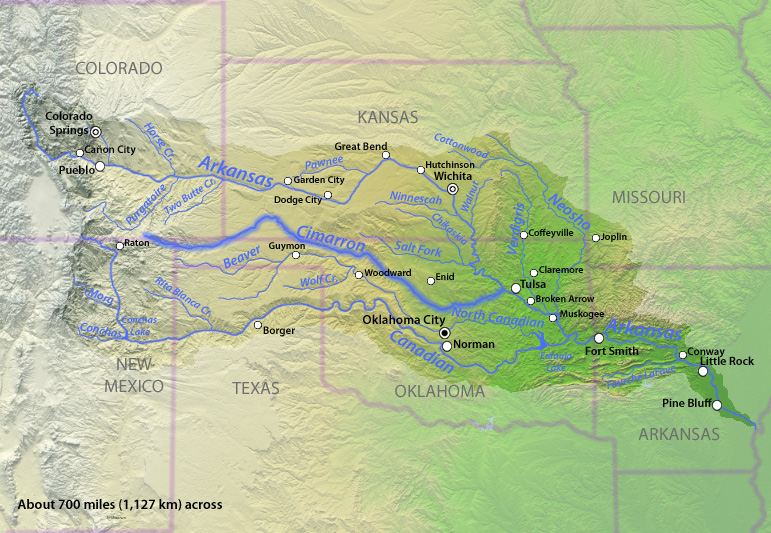
Cimarron River Basin. By Shannon1 – Drawn by myself; shaded relief data from NASA SRTM North America imagery here, CC BY-SA 4.0, https://commons.wikimedia.org/w/index.php?curid=12115861

This groundwater basin in southeastern Colorado is very different from the Republican River Basin of northeastern Colorado in one crucial way. The aquifers do not deliver water to a river subject to a multi-state compact. The Cimarron River nicks the extreme corner of Colorado, but testimony to the poverty of water in this “river” is provided by those traveling to Santa Fe in the 19th century. Nearly all followed the Arkansas River, not the Cimarron, despite the latter route being much shorter.

In contrast, a compact struck in 1943 governs flows in the Republican River. It arises far from Colorado’s mountains and is instead nourished by water seeping out of the Ogallala in places like Holyoke and Yuma and Burlington. Mining of groundwater in the basin to grow crops reduced flows to the extent that Kansas sued Nebraska, which in turn sued Colorado. Now, farmers in the basin are trying to reduce their withdrawals by voluntary retirement of 25,000 acres from active irrigation. The 19,000-plus acres retired so far have been induced by financial incentives that tap federal but also state funds.

Without a compact to force reduced pumping in southeastern Colorado, the state can adopt its own rules.

Residents of southeastern Colorado appear to be somewhat conflicted about whether new rules governing withdrawal are needed and what they should look like. Baca County’s Herald Plainsman in March 2023 reported on a “highly charged” meeting in Springfield called by the state’s Division of Water Resources. Tracy Kosloff, the deputy state engineer, explained that a group from the community had requested a rule change in the previous year.

Their intent was to block the issuance of new permits for high-capacity wells. Kosloff asked for the community to come to a consensus, if possible.

No consensus was evident at that meeting. at least according to the Plainsman Herald report. One speaker said that “without high-capacity wells, there will be no people left in the county.” Tim Hume, who is the region’s representative on the Colorado Ground Water Commission, said that without irrigation, two thirds of the people in the room would not be there. He also noted that one of the 67 monitoring wells had actually shown higher levels in the previous 20 years. But another speaker, Jack Dawson, said to keep irrigation going for quite some time, there was a real need to start conserving water.

With aid of a special $250,000 appropriation by state legislators, the Division of Water Resources commissioned a study by Wilson Water Group and HRS Water Consultants to provide new estimates of how much water remains that can be recovered economically. These consultants are also creating a planning tool to allow groundwater basin users to evaluate future groundwater use scenarios.

At a meeting scheduled for March 16 in Springfield, the consultants hope to glean insight from farmers about what constitutes economically viable extraction. How deep into the Dockum can they go and hope to be able to make money? How much water treatment is required and feasible? The big question is whether new rules will be needed to limit extraction.

Also to be determined are the goals under future conditions. How fast should the groundwater be mined? Or should there be limits beyond those few already in place?  The consultants are to submit a final report before the end of 2026.

What comes of this new knowledge? It’s possible — maybe even likely — that some residents of southeastern Colorado will then file a petition with the Colorado Ground Water Commission to adopt new rules restricting extraction. This study sets up the facts for helping make that decision of whether to do so, and if so, how.

The draft study says a range of viewpoints can be expected. Some stakeholders will favor the status quo. Others might favor restricted pumping from specific aquifers or even from new wells, conceivably all wells. Expansion of irrigated acreage cold be curbed — although in some cases land has been taken out of irrigated production already.

Also relevant is the shifting climate. The study mentions climate change just once, noting that hotter or drier conditions may occur in 50 years, affecting crop irrigation requirements. Already, however, the hotter temperatures of southeastern Colorado cause crops to need a third more water than those grown 200 miles north.

The most direct parallel to a ban on new wells in southeastern Colorado would be a similar ban on new wells in the upper Crow Creek drainage northeast of Greeley near the Wyoming border. The alluvial, Fan and White River aquifers within the designated basin were declared over-appropriated effective April 14, 2017.

Hydrogeology of Colorado’s southeastern corner has been studied several times. First was a studyby the U.S. Geological Survey in conjunction with the Colorado Water Conservation Board completed in 1954. It recorded springs and creeks and pumping from wells for house and towns and stock ponds, with some of the records gleaned by New Deal workers in the 1930s. It made no attempt to quantify groundwater storage volume. Aquifer mining was non-existent in that area as high-capacity pumps had been created less than a decade before.

1967 study by R.W. Beck and Associates did attempt to quantify the groundwater resources. It estimated that groundwater extraction of 13,200 acre-feet in 1950 had grown by 1964 to 118,700 acre-feet.

The study projected that groundwater extraction in the basin would grow to 276,000 acre-feet by 2017. It is somewhat less. That study also projected that population of Baca County would grow to 4,700 by 2017. Actually, it declined to 3,500.

That study made no mention of the Dockum, the formation now believed to have the most water, based on well logs and other lines of evidence.

That study also recommended creation of a groundwater management district to assist in “development” of the extraction. That district was created.

Southeastern Colorado’s groundwater was also part of a six-state study of the Ogallala Aquifer in 1983.

Most recent were two related reports in 2002 by McLaughlin Water Engineers. This new study differs in a substantial way in that it uses data deeper than the 200 feet of the Dockum and hence increases the volume of water that may potentially be extracted. It also employs newer tools to figure out what exactly is going on down there in the dark, although exactly how much sharper insight this report delivers is not yet clear.

The Division of Water Resources also has conducted three studies in this century that define a steady but not dramatic decline of the aquifers in southeastern Colorado.

See Updated Southern High Plains Groundwater Study Draft Report and Planning Tool at the High Plains Study website.

Colorado River District Responds to the Bureau of Reclamation’s Proposals for Post-2026 #LakePowell and #LakeMead Operations #ColoradoRiver #COriver #aridification

Colorado River District land area.

Click the link to read the release on the Colorado River District website (Lindsay DeFrates):

March 2, 2026

Last week, the Colorado River District submitted comments and specific recommendations to the Bureau of Reclamation on the recently released Post-2026 Operational Guidelines and Strategies for Lake Powell and Lake Mead Draft Environmental Impact Statement (DEIS). In its comments, the River District calls for future operational decisions that reflect hydrologic realities, address Lower Basin overuse, and move the Colorado River System beyond constant crisis management.

“A core part of our mission is safeguarding, for all Coloradans, the waters of the Colorado River to which our state is entitled under the various laws, agreements and compacts that govern the river,” said Raquel Flinker, Director of Interstate and Regional Water Resources at the Colorado River District. “Our water users have adapted to the reality of variable hydrology. We are living with a river that has 20% less water and this trend is expected to continue. It is past time that our neighbors in the Lower Basin learn how to live within the means provided by the river.”

“What is very clear in these proposals is that we still have a basic math problem,” said Colorado River District General Manager Andy Mueller. “Every year, around 1.5 million acre feet of Colorado River water disappears due to evaporation and transit loss in the Lower Basin, yet this amount is unaccounted for in the Bureau’s water deliveries. If we want to move out of crisis response mode, every proposal must begin by reducing consumptive use in the Lower Basin by this amount every single year before discussing shortages. If we had fixed the math to align with the laws of nature twenty-five years ago, we would have almost 30-million-acre feet of storage still available in the system today.”

The River District’s letter includes 13 specific recommendations organized around several key themes. First, it calls for post-2026 operations that align demand with available supply and put hydrologic reality, not predictability for the Lower Basin, at the center of decision-making. The River District urges Reclamation to evaluate alternatives that perform under critically dry hydrology, provide a fair, transparent analysis of actions and impacts, and clearly disclose Upper Basin shortage risks in the main body of the analysis.

The letter also stresses that Lower Basin use must be reduced by roughly 1.5 million acre-feet at all times, defined as system losses rather than “shortage,” and that Upper Basin conservation assumptions and scale must be re-evaluated. In addition, the River District calls for clear, durable guidelines and definitions, including fully defining and analyzing “gap water” and “additional Upper Basin actions,” and for CRSP initial unit water to remain in Lake Powell. Finally, it raises Law of the River concerns, including that inter-basin transactions must not be allowed.

The River District’s full comment letter is available here:

Reclamation formally published the DEIS on January 16, 2026, opening a 45-day public comment period. The Bureau of Reclamation must consider public feedback when developing a preferred alternative for management of the system, and the basin states will continue their negotiations alongside this process with the hope of reaching a seven-state consensus. The current guidelines expire at the end of September 2026.

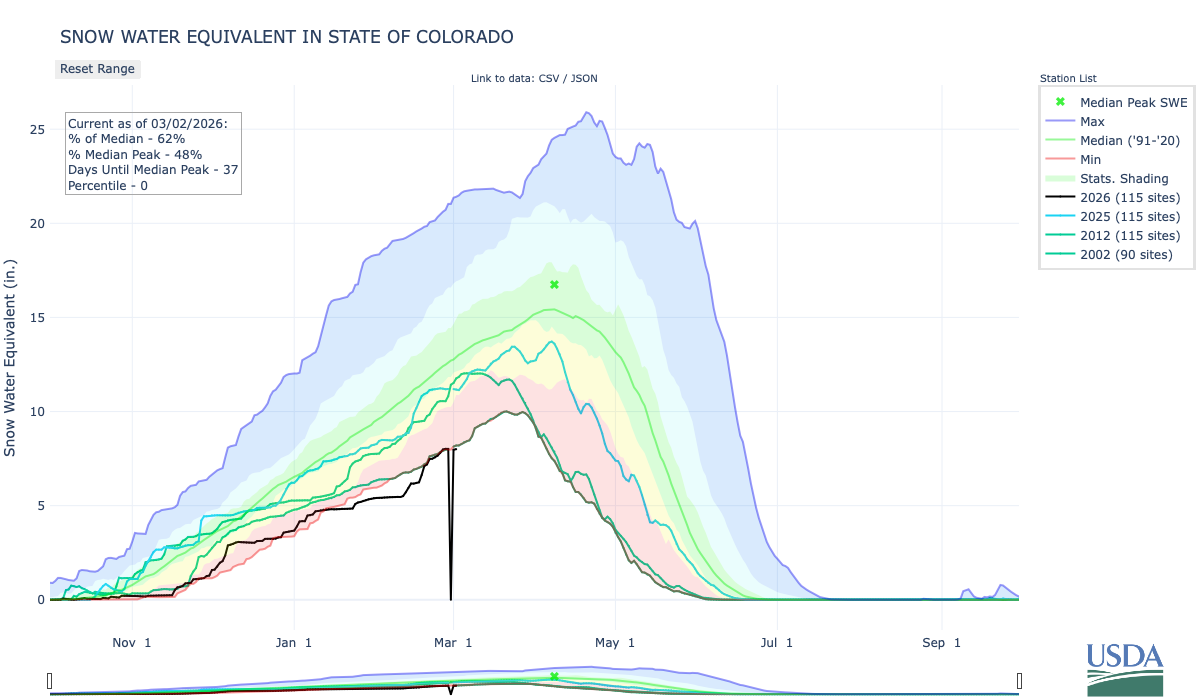
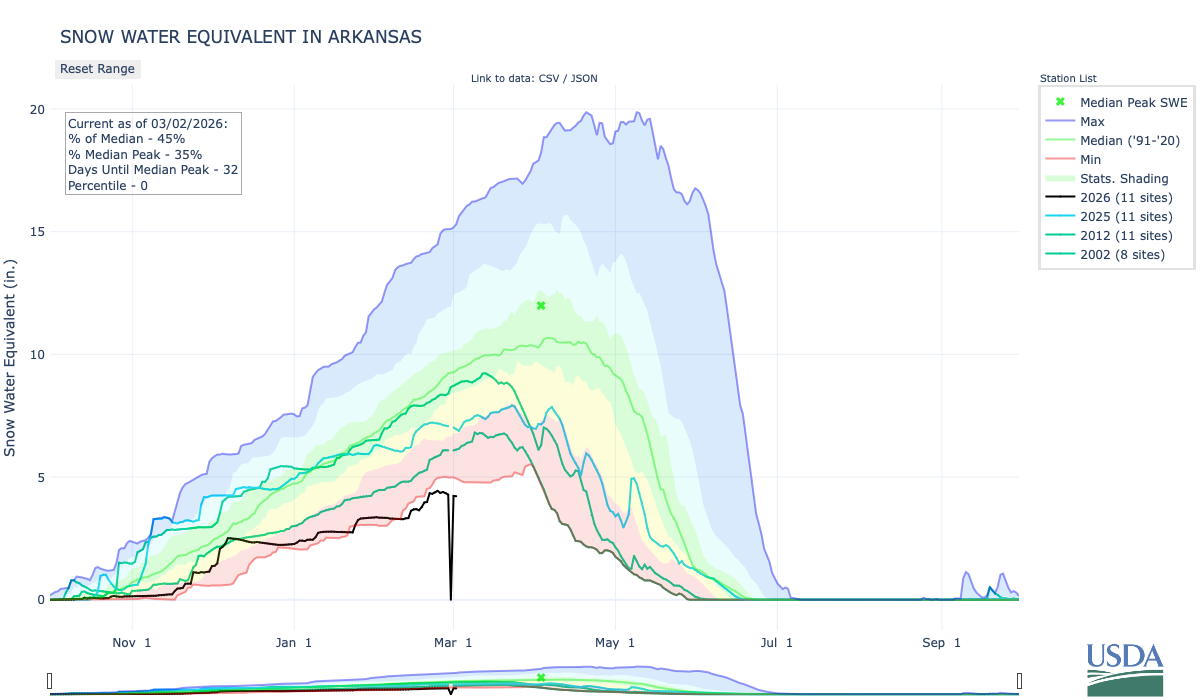
#Snowpack news March 2, 2026

Westwide SNOTEL basin-filled map March 1, 2026.
Colorado snowpack basin-filled map March 1, 2026.

The graphs below show missing data over the weekend.

Balmy winters heighten water worries — AlamosaCitizen.com #RioGrande #SanLuisValley

Man shining a red motorcycle on the left and a woman sunbathing on the right
Tomas Miera shining his Harley left and a woman sunbathing. Credit: The Citizen and Dennis Schoenfelder

Click the link to read the article on the Alamosa Citizen website:

February 28, 2026

Rancher Greg Higel usually opens a barn door for his cows to enter during the cold winter nights. Lately he’s been leaving the cows out at night because “the less you mess with them, the better off they are.”

The February weather has been warm enough not to mess with the cows.

The last two Februarys – 2025 and 2026 – have seen the daily maximum temperature average 50 degrees-plus in Alamosa, according to National Weather Service data. That has never happened before in the Valley’s climate history. 

National Weather Service records as far back as 1948 show only the past two Februarys so warm that ranchers like Higel, who are in the midst of their calving season, worry less about their cows at night and more about their grassfields and what the warm winter means for the ground itself. Included in that are overnight temps averaging in the double digits and frequently in the 20s.

“I don’t think it’s good for the farm ground,” Higel says. He was hopeful the heavy October rains that had flooded his meadows would leave water frozen in the fields through the winter months. But the water hardly froze and the worry now is the anticipated light spring runoff and available water for the grass growing season ahead.

Of the 28 days in February this year, 20 have seen the daily maximum temperature exceed 50 degrees. The highest temperature for the month was 65 degrees on Feb. 25, following 64 degrees on Feb. 24, which established a new high for the date.

February 2025 was just as warm and warmer, with an average daily high temperature of 52.8 degrees. It was a year ago when the phenomenon of average 50-degree weather days was first noted after the mercury hit 60 degrees on 5 of the first 7 days of last February.

Suffice it to say, if it is this warm in February in the high mountain desert, the snowpack is going to suffer. The Upper Rio Grande Basin enters March measuring 55 percent of median on a snowwater equivalent index, which is what worries irrigators. 

And it’s not just ranchers and farmers who should be paying attention.

Adam Moore, supervisory forester with Colorado State Forest Service, says trees around the home need watering when the winter months are this warm. The constant threat of wildfire is another reason to pay attention.

“The SLV and the plains are still facing red flag warnings. There have been large grass fires in Oklahoma and Kansas. The conditions for those fires are not much different than what we have in the SLV. Just like the red flag warnings all year long, wildfire preparedness should occur all year,” he says.

Just don’t get too far ahead. Gardeners should stick to the normal planting times, with mid-April being the earliest for any tree planting.

“Don’t let the warm weather fool you and plant early,” Moore says. “We still stand the chance of late frosts.”

Tell that to Tomas Miera.

“I’ve been riding all winter. My goodness, today is going to be like 64,” he says, standing in his front yard in a short sleeve shirt, shorts and shining his Harley Davidson. “I’m going for a ride later on.”

February allows for it. It’s never been this way.

It’s getting hot in here … and it ain’t just the January Thaw: Plus: #ColoradoRiver Chronicles; Big Bend Border Wall boondoggle — Jonathan P. Thompson (LandDesk.org) #COriver #aridification

Click the link to read the article on The Land Desk website (Jonathan P. Thompson):

February 27, 2026

🥵 Aridification Watch 🐫

Back in the late 1990s and early 2000s, when I lived in Silverton, Colorado, elevation 9,318 feet, we often experienced a “January thaw.” It was a period of a few sunny, warm days between storms that usually fell in January but could also occur in February. If you could find a south-facing deck that was protected from the wind and free of dangling, skull-piercing icicles, you could sit out in shirtsleeves, soak up some vitamin D, and maybe even get a little bit of a suntan. Then winter, below zero temperatures, and super snowy San Juaners would return, finally and grudgingly departing sometime in late May.

A pretty big swath of the Southwest is about to experience a February thaw of its own, according to National Weather Service forecasts, including in these hot spots:

  • Phoenix’s mercury could climb into the low- to mid-90s this weekend [February 28 – March 1, 2026], with overnight lows in the 60s.
  • Durango, Colorado, is expecting to hit 66° F on Sunday (with lows staying above freezing).
  • It will be prime bike-riding weather in Moab, where the highs could climb into the low 70s.
  • And even Silverton will get up into the 50s, with the overnight lows dipping only a few degrees below freezing — bad news for the snow.
  • Denver is under a red flag warning for fire danger today, and will see temperatures in the high 60s.

During a “normal” winter, this wouldn’t be alarming in the slightest. In fact, it would be a welcome respite from winter. Now it threatens to wipe out any indication that it even is winter by potentially erasing the snowpack gained during last week’s storms. The Upper Colorado River Basin’s snowpack is exactly at the same level as it was on this date in 2002. Ohhh boy, if those March storms don’t arrive it’s going to be a long, dry summer.


The trouble with normal … — Jonathan P. Thompson


💧 Colorado River Chronicles 🐟

As a deal between the seven Colorado states for how to divvy up massive consumption cuts seems less and less likely, Arizona is getting a bit more aggressive.This week the Protecting Arizona’s Lifeline Coalition launched a PR campaign, complete with videos, attempting to pressure the Upper Basin states to let more water flow downstream to its Lower Basin neighbors. 

Arizona is understandably worried: The Central Arizona Project’s water rights are junior to most of the other large users in the Lower Basin, meaning they would be among the first to take cuts if there were a shortage. The window for a dramatic improvement in Upper Basin snowpack is rapidly closing, thereby increasing the likelihood of a shortage later this year. 

The campaign includes a series of videos with various officials making their case. There are also a few educational ones that do a nice job of explaining the Colorado River Compact, and are really worth a watch. However, I should warn you that they are coming from a Lower Basin perspective, meaning they interpret one clause of the Compact, Article III(d), significantly differently than the Upper Basin states. And yet, that’s what their entire argument relies on. 

That clause states that the Upper Basin must “not cause the flow of the river at Lee Ferry to be depleted below an aggregate of 75 million acre-feet” for any 10-year period. 

The Upper Basin sees this as a “non-depletion obligation,” meaning it blocks them from exceeding their 7.5 MAF/year allocation if it causes the Lee Ferry flow to fall below a 7.5 MAF/year average. The Lower Basin sees it as a “minimum delivery obligation,” meaning that the Upper Basin is obliged to send an average of 7.5 MAF past Lee Ferry no matter what, even if that means draining all of its reservoirs and drying out its fields and cities.

Keeping that in mind, check out the video:


A Colorado River glossary and primer — Jonathan P. Thompson

The Colorado River Crisis is Here — Jonathan P. Thompson


🤯 Oh, the Humans! 😱

In a comment on Tuesday’s dispatch, reader Steve Harris suggested a story on the U.S. Customs and Border Protection fast-tracking a 200-mile segment of border wall through Big Bend National Park.

This is a super important issue. And it’s not only in Big Bend: The entire border wall is an environmental disaster, slashing through biologically diverse, beautiful country and cutting off migratory routes and movement for mountain lions, javelina, coyotes, ocelot, deer, desert bighorns, and even jaguars. Keep in mind that it’s not just a fence, it’s a giant piece of infrastructure that requires bulldozing all the vegetation and even blasting through the landscape. Besides that, we taxpayers are forking out billions of dollars for something that isn’t all that great at doing what it’s supposed to do.

For me it’s especially heartbreaking to see the wall cut through the borderlands south of Tucson, down in the Patagonia Mountains. Many years ago my dad took my brother and I along some little road through there right up against the border, which at the time was just a barbed wire fence. It was incredible country, so quiet and mostly humanity-free.

The stakes are equally as high in the Big Bend area, where both ecological and cultural treasures are at risk. Unfortunately I’ve never been to Big Bend, and it’s a little ways outside the region I normally cover, so I’m not going to try to pretend to know what’s going on there. But a lot of other smart folks have written about it and are trying to block the new stretch of wall, so I’ll share some of that here:

🌵 Public Lands 🌲

Environmental groups and environmentally-oriented media outlets are making a pretty big stink over the confirmation hearings for Steve Pearce, Trump’s pick to lead the Bureau of Land Management. There’s a good reason for this: Pearce is well known for his hostility toward the BLM and the public lands it oversees, and he has also indicated a desire to sell off public land — a stance he failed to renounce during this week’s hearings.

Pearce is a bad choice for this job. But is it worth spending a lot of resources to get him ousted? Probably not.

If the Senate does not confirm Pearce, then the administration will just find some other bozo to do the job, which in this case is basically a middle manager tasked with carrying out the agenda of Interior Secretary Doug Burgum. Burgum, in turn, is merely executing the Trump administration’s, i.e. Project 2025, policies.

Which I have to say is disappointing and sad. Before he was a cabinet member, Burgum seemed like a reasonable enough guy. Sure he has ties to oil and gas interests, but he also appeared to be a Teddy Roosevelt Republican — an old school conservative and conservationist who valued public lands. He even managed to garner the endorsement of outdoor retailer REI’s board along with that of the hook and bullet crowd.

Instead, he has prostrated himself to the extractive industries, embraced coal mining and oil and gas drilling, and shattered environmental protections for public lands left and right. His distinguishing features as a cabinet member have been his unwavering sneer-like grin and his tendency to fawn over Trump — and coal.

***

Your energy and outrage might be better spent on convincing Congress to shoot down Sen. Mike Lee’s, R-Utah, attempt to use the Congressional Review Act to revoke the Grand Staircase-Escalante National Monument management plan. If the “resolution of disapproval” passes both chambers of Congress with a simple majority vote, it would erase the plan and bar the Bureau of Land Management from issuing another plan that is “substantially the same” in the future.

Republicans in the current Congress used the CRA — which allows Congress to revoke recently implemented administrative rules — to do away with resource management plans in Alaska, Montana, and North Dakota. That’s in spite of the fact that RMPs are not considered “rules,” according to a January 2025 opinion by the Interior Department’s Solicitor. National monument management plans aren’t rules, either, but that’s not a hindrance for Lee.

This wouldn’t change the boundaries of the monument, but would likely cause management of the area to revert back to the 2020, Trump I-era plan. That plan was not only less protective than the newer one, but only applied to a much smaller area, since in 2017 Trump had significantly shrunk the national monument. Revoking the current management plan, then, would leave vast areas of the monument in a sort of management limbo.

It would also open the door to revoking other national monument management plans (e.g. Bears Ears), allowing the GOP to carry out Project 2025’s goal of shrinking or eliminating national monuments in a less visible, more underhanded manner.


Just a couple reminders from a few years ago that it does snow, and it will snow again — just maybe not this spring. Jonathan P. Thompson photos.

Making sense of a chaotic planet: How understanding weather and climate risks depends on supercomputers like NCAR’s

Antonios Mamalakis, University of Virginia

Have you ever stopped to wonder how forecasters can predict the weather days in advance, or how scientists figure out how the climate might evolve under different policies?

The Earth system is a vast web of intertwined processes, from microscopic chemical reactions to towering storms. Ocean currents circulating deep in the Atlantic, forests exchanging carbon with the atmosphere, and humans altering the composition of the air all have effects that ripple through the system. These processes are governed by physical laws, such as conservation of mass, energy and momentum.

All of this plays out on such a large scale that no single human mind can truly grasp it in full. And yet, the system is so sensitive that a small perturbation, given enough time, can steer its trajectory in a dramatically different direction. This sensitivity is called “chaos,” also known as the “butterfly effect.” The planet is, at once, immense and delicate.

Despite this complexity and scale, scientists are able to simulate and anticipate how the climate will change.

How is this even possible? Behind the long-term climate projections that affect our lives sits one of the most remarkable scientific achievements of the modern era: climate models that run on supercomputers.

I am a climate data scientist. My colleagues and I try to understand extreme weather and long-term climate risks by using virtual versions of Earth inside these machines.

What a climate model really is

Here is the simplest way to picture a climate model:

Imagine dividing the entire planet into 3D boxes. At the surface, each box might represent an area 50 to 100 kilometers across. Then we stack boxes upward into the atmosphere and downward into the oceans to create a 3D grid wrapping around the globe.

Each box contains numbers: temperature, wind speed, humidity, sea ice thickness, soil moisture and hundreds of other variables. The model contains mathematical expressions that describe how these variables influence one another: how heat moves, how air rises and sinks, how moisture condenses into clouds, how the ocean absorbs and redistributes energy.

A globe with boxes around it and a close-up of some calculations taking place in one of those boxes.
Climate models are systems of differential equations based on the basic laws of physics, fluid motion and chemistry. They divide the planet into a 3D grid, apply the equations and evaluate the results. Within these models, the atmosphere component, for example, calculates winds, heat transfer, radiation, relative humidity and surface hydrology. NOAA

We then let the model march forward in time, solving the math and updating every variable in every box. Then again. And again.

Now scale that up. Millions of grid boxes. Hundreds of variables per box. Calculations carried out millions of times to simulate decades or even centuries.

And because the system is chaotic, we do not run the model just once. We run it many times with slightly different initial conditions – what scientists call an ensemble – to make sure the result is in fact a true system response to the considered scenario, such as warming temperatures due to increased emissions, and not an effect of chaos.

The result is an astronomical number of calculations. Performing them requires computers capable of executing quadrillions of operations per second – what are known as petaflop-scale supercomputers. A petaflop equals 1 quadrillion – 1,000,000,000,000,000 – calculations per second!

From simulation to real-world decisions

These simulations inform decisions that affect everyday life: how high to elevate homes in flood-prone areas, how to design power grids resilient to prolonged heat waves, how to manage water resources during drought.

Urban planners, engineers, emergency managers and policymakers all rely on information derived from these models.

Dozens of major climate models have been developed around the world by universities, national laboratories and government agencies. Each modeling center builds its own code, makes its own physical assumptions, chooses its own grid resolution and operates its own supercomputing systems. Through international efforts such as the Coupled Model Intercomparison Project, modeling centers agree on common experiments: the same greenhouse gas scenarios and the same volcanic eruptions, for example.

When you hear that extreme rainfall is projected to intensify in a warmer world, or that the Arctic Ocean could become seasonally ice-free within decades, those conclusions are not the result of calculations carried out by a single scientist, a single team of scientists, or even a single model run. They emerge from dozens of independently developed models, run on room-sized supercomputers, under pre-agreed and carefully coordinated experiments.

A map created by an ensemble with multiple computer models shows areas of agreement.
In this example of the use of multiple models, areas in color and without hashmarks indicate regions with high agreement among models, where more than 80% of the models agree on the signs of change. The projections for annual maximum daily precipitation change were made using the Multi-model Coupled Model Intercomparison Project Phase 5 (CMIP5). IPCC

This global collaboration is one of the reasons scientists know so much about climate change. These shared simulations allow scientists around the world to test hypotheses and explore future risks based on models’ consensus.

It is no surprise that the 2021 Nobel Prize in physics recognized pioneers of climate modeling. These models fundamentally transformed humanity’s ability to understand a complex planet.

There is no alternative way to answer “what if” questions about the future climate system. What happens if carbon dioxide doubles? What if emissions decline rapidly? What if a major volcanic eruption injects aerosols into the stratosphere? Because the climate system is so complex, and forces can push it outside the range of historical experience, the past is no longer a reliable guide to the future. So statistical models aren’t enough.

Artificial intelligence cannot replace this foundation either. AI has made impressive progress in short-term weather prediction, learning patterns from vast historical datasets, and producing forecasts with remarkable speed.

But climate projections require extrapolating to conditions the planet has not experienced in modern history – such as higher greenhouse gas concentrations. AI can accelerate simulations and analyze massive amounts of data today, but it cannot replace solving the physical equations that govern the system.

National supercomputing centers are essential

In the United States, major climate modeling efforts have been supported by national laboratories and federal centers, including NASA and the National Center for Atmospheric Research, or NCAR, along with a few research universities.

At NCAR, scientists developed the Community Earth System Model, a comprehensive climate model that’s arguably one of the best models to date and is used by researchers across the country and around the world to study climate change, severe weather, climate effects on wildfires, and atmospheric patterns. It has helped position the United States at the forefront of climate science and enabled the global research community to tackle some of the most pressing challenges of our time.

Running large ensembles with this model requires powerful hardware, data storage systems capable of handling petabytes of output, and engineers who keep these systems operational. This is not a matter of downloading and running a program on a laptop. It is a national-scale scientific enterprise that makes NCAR and its supercomputer essential.

In a warming climate, the stakes are high. The ability to simulate the Earth system at scale is one of the most powerful tools humanity has to prepare for the risks ahead.

Antonios Mamalakis, Assistant Professor of Data Science and Environmental Science, University of Virginia

This article is republished from The Conversation under a Creative Commons license. Read the original article.

Utility-scale battery energy storage facility planned in Hayden — Steamboat Pilot & Today

The estimated 30- to 40-acre utility-scale battery energy storage facility planned by Jupiter Power to be built in 2027 southwest of the Hayden Power Station would look similar to this facility completed in 2024 in Houston. Jupiter Power/Courtesy photo

Click the link to read the article on the Steamboat Pilot & Today website (Suzie Romig). Here’s an excerpt:

February 26, 2026

A utility-scale battery energy storage facility was approved last week by the Colorado Public Utilities Commission with the project planned for construction southwest of the Hayden Power Station within the town limits of Hayden. Megan Castle, communications director for the Public Utilities Commission, said the 400 MW project was approved as part of 10 total bid projects accepted by the state commission. The project in Hayden will be led by Jupiter Power, a developer and operator of utility-scale battery energy storage systems with corporate offices in Austin, Houston and Chicago. The proposed energy storage facility would be located on a 72-acre site on Routt County Road 51 near the Hayden power plant and Yampa Valley Regional Airport and would connect by a new transmission line to the Mount Harris substation southeast of the main Hayden station. The stored energy would be sold to Xcel Energy through a Power Purchase Agreement, said Michelle Aguayo, senior media relations representative at Xcel.

“This project is a Power Purchase Agreement, where another company builds and maintains the project, and we purchase the power produced,” Aguayo said Tuesday.

Hayden Town Manager Mathew Mendisco said municipal leaders are excited about the forthcoming facility, and that Jupiter Power staff already has worked through the preliminary application process with the town and is expected to submit a formal application later this year. Mendisco said the town leadership is happy to have more light industrial development to continue to boost the local tax base.

“Development like this is always good,” Mendisco said. “The energy sector has been part of our economy for many years, and this fits right in. We are excited to have land near the airport developed, and we think this seems to be a good fit.”

Winter plagued by ‘freakishly bad’ atmospheric pattern, meteorologists say — The #Durango Herald #snowpack #drought

Click the link to read the article on The Durango Herald website (Scout Edmondson). Here’s an excerpt:

February 26, 2026

Last week, Southwest Colorado saw enough snow to cancel school and snarl travel. A week later, winter appears to have vaporized – replaced by clear skies, dry roads and temperatures warm enough for sandals and T-shirts. According to the National Weather Service, high temperatures in Durango reached 63 degrees Thursday. It is the latest episode of weird winter weather this year. Jonathan Harvey, an associate professor of geosciences at Fort Lewis College, said in an email to The Durango Herald that winter’s absence is because of stubborn high-pressure ridges steering the jet stream – a belt of fast-moving winds that separates warm tropical air to the south from cold arctic air to the north – toward the northern United States.

“We have spent most of the winter under a ‘ridge’ in the jet stream, which has prevented cold air and storms from hitting our region,” he said.

That, according to National Weather Service forecaster Lucas Boyer, is because of warm seawater temperatures in the Eastern Pacific Ocean.

“We’ve had ample warm water in the in the Eastern Pacific for a lot of the winter,” he said. “We’ve really seen the jet stream get pushed north, which means warm air to the south. It’s been really devastating for any kind of snowfall production.”

Boyer said any storms that have managed to break through that high-pressure ridge were followed by periods of temperatures 10 to 15 degrees above the historical average…The warm, dry winter has hurt snowpack in the San Juan Mountains. Boyer said the water equivalent in the San Juan River Basin is at 17% of the historical median, while the snowpack in the San Juan Mountains is 40% to 50% of average. Unfortunately, Harvey said there is not much time left for mid-elevation snowpack. But, there is still time for high-elevation snowpack.

Colorado Drought Monitor map February 24, 2026.

Wolf Creek Ski Area receives nearly 5 feet of snow, #snowpack jumps — The #PagosaSprings Sun

Westwide SNOTEL basin-filled map February 28, 2026.

Click the link to read the article on the Pagosa Springs Sun website (Clayton Chaney):

February 26, 2026

A “real” winter storm rolled through Pagosa Country last week, leaving behind 1-2 feet, or more, of fresh snow in spots around the county. Meanwhile, Wolf Creek Ski Area reported nearly 5 feet of new snow, with a total of 59 inches falling from Feb. 17 through Feb. 21. According to reports entered into the Community Collaborative Rain, Hail and Snow (CoCoRaHS) network five-day period ranged from 15.8 inches downtown up to 18.6 inches uptown. The highest totals were seen in the northern part of the county, ranging from 24 inches near Lake Hatcher up to 31.5 inches along the Mineral County border. As of Feb. 25, the ski area reported a year-to-date snowfall of 164 inches with a midway depth of 82 inches and a summit depth of 89 inches…
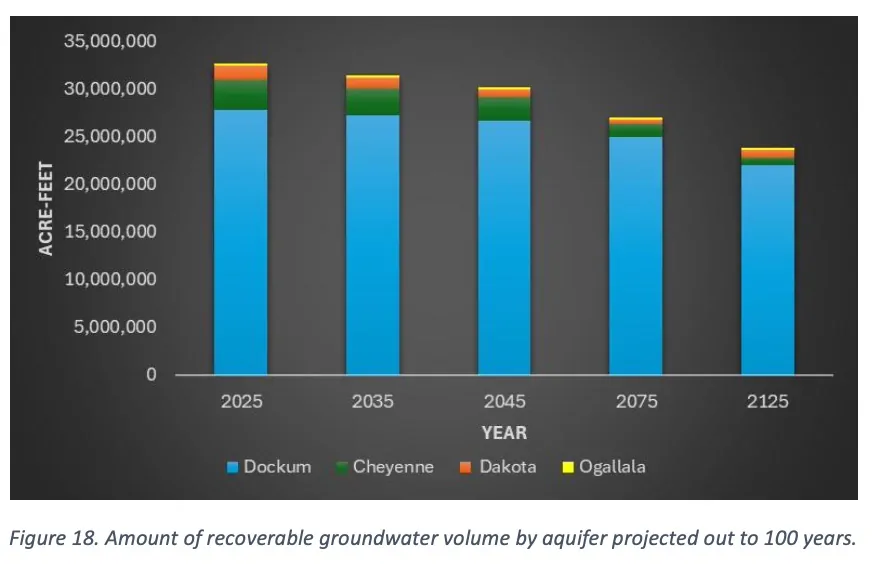
According to the Natural Resources Conservation Services (NRCS), as of Feb. 24, the San Miguel, Dolores, Animas and San Juan River basins were measured to be at 64 percent of its 30-year median snowpack. The statewide snowpack as of Feb. 25 was at 63 percent. A post by Shawn Prochazka from Pagosa Weather notes that the snowpack in the basins jumped from 42 percent to 60 percent during last week’s storm. “That’s an impressive jump this late in the season,” Prochazka writes. As of 11 a.m. on Wednesday, Feb. 25, Wolf Creek Pass, at 10,930 feet, had a snow water equivalent of 14.7 inches. The current amount is 64 percent of that date’s median snow water equivalent…

Colorado Drought Monitor map February 24, 2026.

According to the U.S. Drought Monitor’s most recent map released on Feb. 19, which was valid as of Feb. 17, 100 percent of Archuleta County is in an “abnormally dry” drought stage, with 47.89 percent of the county (the northern half) in a “moderate drought” stage. The far northwestern portion of Archuleta County — 2.17 percent of the county — is in a “severe drought” stage.

Bringing the crowds back to Arches National Park, other national parks: And other public lands briefs — Jonathan P. Thompson (LandDesk.org)

Click the link to read the article on The Land Desk website (Jonathan P. Thompson):

February 24, 2026
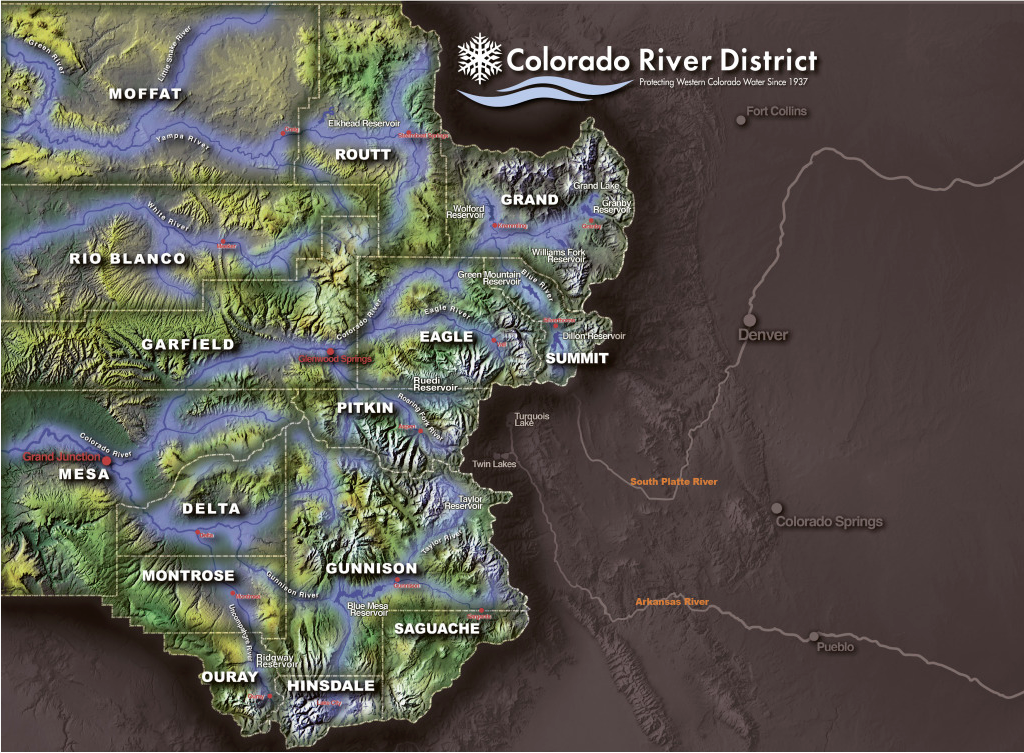
🌵 Public Lands 🌲

Just when you thought the GOP’s assaults on public lands couldn’t get any worse, the Trump administration launched a new blitzkrieg on environmental protections.That includes eviscerating the National Environmental Policy Act, the federal law requiring agencies to analyze, mitigate, and avoid impacts of major federal projects and projects on public land.

Interior Secretary Doug Burgum this week announced the “rescission of more than 80% of Interior’s prior NEPA regulations.” The changes, which includes limiting public comment, are aimed at streamlining permitting across the board, much as the department did with its “emergency permitting procedures” for oil and gas, uranium, coal, and critical minerals projects on public lands.

Associate Deputy Secretary Karen Budd-Falen, who is in hot water over potential ethics violations, lauded the changes, saying in a statement: “These reforms will help unleash American energy, strengthen rural communities ,and deliver real results faster for the American people.” As long as they are fossil fuels, that is, since Interior has put a de facto blockade on solar and wind developments on public lands.

Burgum finalized the NEPA rules a few days after opening 2.1 million acres of previously protected public lands in Alaska’s Dalton Corridor to new mining claims and oil and gas drilling.

***

An oil and gas drilling and hydraulic fracturing operation in the Greater Chaco Region near where the BLM plans to sell more leases this August. Jonathan P. Thompson photo.

The Bureau of Land Management is, thankfully, still taking comments on proposed oil and gas leases, though it’s not clear that they will pay them any heed. You have until March 23 to give your two cents on the Farmington Field Office’s plan to auction 12 parcels covering about 16,856 acres this August. The parcels are on the checkerboard, with the biggest block of them about 20 miles east of Chaco Culture National Historical Park.

Find more information and comment at the agency’s project page.

***

This week confirmation hearings begin for Steve Pearce, Trump’s pick to lead the BLM and oversee some 245 million acres of public land.

Pearce is a hard-right Republican, former congressman from New Mexico, and no friend of public lands or environmental protectionsPearce’s political career was infused with hostility toward the agency he has been nominated to oversee. Pearce has opposed new national monument designations, is a fan of drilling public lands, has tried to weaken or eliminate the Endangered Species Act, lied about wolves in an effort to defund the Mexican wolf recovery program, received a 4% score from the League of Conservation Voters.

A few months ago we would have considered his confirmation a slam-dunk, since at the time most Republicans were still willing to debase themselves to any degree to curry favor with Trump. But with Trump’s approval rating plummeting as he suffers from more frequent cognitive mishaps and more revelations of his involvement with Jeffrey Epstein, the Senate may not be so friendly to Pearce.

***

The News: The National Park Service “expands access,” a.k.a. limits or eliminates timed-entry reservation systems, at Arches, Yosemite, Glacier, and Rocky Mountain National Parks, sparking fears that unmanageable crowds will once again overwhelm the popular parks.

The Context: In the wake of the first wave of the COVID-19 pandemic, when Zoom boomers flooded Western communities and the masses descended on the surrounding public lands, people became increasingly concerned about the resulting crowds at national parks and at popular non-park trails and sites. Not only did the crowds risk damaging the parks’ resources, but they also potentially screwed up the visitors’ experiences.

In Arches National Park, for example, cars backed up at the entry gate for close to a mile, parking lots were crammed with vehicles and trail-jams weren’t uncommon, and on especially busy days park officials had to actually shut the gates and turn folks away — even those who may have traveled from abroad to see Delicate Arch.

To ease the pressure, the National Park Service in 2022 instituted a timed-entry reservation system during the busiest months of the year. This limited the number of people entering the park, but it also ensured the ones that made a reservation that they wouldn’t be turned away. The system led to a sharp drop in visitation during its first year, though the number of people entering the park averaged around 4,000 per day. But it has climbed every year since, including in 2025 when other Canyon Country parks saw visitation decline.

Still, some locals, presumably those of the quantity over quality variety, pushed back, saying the new system was diminishing visitation and hurting the local tourism industry. Last fall, Grand County Commissioner Brian Martinez asked the park service to revoke the timed-entry system and to build up the park’s infrastructure to enable it to maximize visitor numbers. The Trump administration’s park service apparently listened, and now timed-entry is no more.


Neither fire, smoke, nor searing heat can stop the public land swarms — Jonathan P. Thompson

You wanna know how old I am? I’m old enough to remember, way, way back to the days of yore, when federal officials and gateway-town chambers of commerce were wringing their hands in concern over a nationwide decline in visitation to national parks. Over a 13-year period, visitor numbers to 58 “nature-based” national parks—Arches, Yosemite, Yellowstone, …

🐓 Regulatory Capture Chronicles 🦊

Trump’s apparent disdain for clean air (and a healthy public) was manifested in recent weeks as the administration not only rolled back the EPA’s “endangerment finding,” which authorizes it to regulate greenhouse gas emissions, but also the Biden-era mercury toxic air standards

Mercury emissions are an environmental and public health hazard. The Four Corners-area coal plants once kicked out more than four thousand pounds of mercury each year, along with thousands of pounds of selenium and copper and hundreds more pounds of lead, arsenic, and cadmium, not to mention sulfur dioxide, nitrogen oxide, and other pollutants. 

Aquatic Mercury Cycle. Graphic credit: USGS

Those emissions have decreased considerably over the years as federal regulations kicked in and as coal plants were shuttered altogether. Still, the Four Corners plant puts out about 150 pounds of mercury each year, along with varying quantities of other toxic metals. Most of these pollutants are then deposited in the surrounding water, on the land, and on homes. For years, rain and snow falling on Mesa Verde National Park have contained some of the highest levels of mercury in the nation, and elevated levels have even been found on Molas Pass, just south of Silverton. The mercury is then taken up by bacteria in lakes and rivers, which convert it to highly toxic methylmercury, which then enters the food chain. Mercury messes with fishes’ brains, and even at relatively low concentrations can impair bird and fish reproduction and health. It’s not so good for the people who live near the plant, drink the water, or eat those fish, either.

Because most existing coal plants in the West already complied with the Biden regulations, Trump’s rollback isn’t expected to have a significant effect in most cases (unless power plants dismantle existing pollution-control equipment). However, it is expected to allow the Colstrip coal plant in Montana — one of the nation’s worst polluters — to continue to operate (the operators complained that compliance with the Biden rule would have forced it out of business).

The San Juan Generating Station back when all four units were still operating, and spewing mercury and other nastiness on the area and its residents. The plant was shuttered in 2022 and has mostly been demolished. Jonathan P. Thompson photo.

🐐 Things that get my Goat 🐐

I probably shouldn’t put this here, but geez, really? Aren’t we over the whole “The West is a big empty space that we can clutter up with our myths and technology and nuclear waste” complex? I guess not. I’m sure this guy, who is clearly from somewhere that is not the Western U.S., means well. But he needs to figure out that the West’s “empty” spaces are actually full of life and beauty and, well, space, which most of us value quite highly.

Granted, the spaces shown in this guy’s pictures do look like they may have been extensively grazed, but that does not mean they are appropriate places for a bunch of damned power- and water-guzzling data centers and their associated energy facilities.


Data Centers: The Big Buildup of the Digital Age — Jonathan P. Thompson


🤖 Data Center Watch 👾

🌞 Good News! 😎

A new study has shown that it is possible, in some cases, to build large-scale solar systems without destroying the desert on which they sit.

The Gemini Solar Project in southern Nevada is one of the nation’s largest such facilities, covering about 5,000 acres of desert land. During its construction in 2022, the developers refrained from the full “blade-and-grade” site preparation that is typical, and instead worked to minimize disturbance and leave some areas of vegetation and soils completely intact.

A group of researchers from the Desert Research Institute and the U.S. Geological Survey surveyed the plant population — with a focus on the rare and sensitive threecorner milkvetch — before and two years after construction. Their hypothesis was that the facility would detrimentally affect the plant, and that the areas nearer the panels would see the biggest impacts.

What they found is that not only did the milkvetch survive, but it actually thrived “within the novel environment created at Gemini.” The plants found after construction were larger and more fecund than those found off-site. “Our results suggest that the altered environment created by panel arrays did not alter threecorner milkvetch survivorship at Gemini.”

It’s just one study focused on one solar installation and one plant. But it does suggest that, if done correctly, utility-scale solar development does not have to be a desert’s death knell.


In related, but less sunny news: Lawmakers from a handful of states have proposed bills that would make it easier for residents and businesses to install plug-in or balcony solar panels. While these panels don’t generate a ton of electricity, they are relatively inexpensive and, as the name indicates, are pretty simple to hook up. They are common in parts of Europe, especially Germany, and are gaining popularity in the U.S. since the Trump administration has killed most federal rooftop solar subsidies. The legislation is mostly aimed at allowing folks to plug these things in without a permit or go-ahead from the utility. 

Last year, Utah, of all places, actually passed one of these bills. But so far this year plug-in solar legislation has died in Wyoming and in Arizona, after utilities expressed concerns. Come on! The California bill seems to still be alive. 

Parting Note

I’ll be leading a couple of workshops and giving a talk at this year’s Entrada Institute “Writing from the Land” on May 14-16 in Torrey, Utah. Check it out:

#Durango City Council approves feasibility study for #AnimasRiver surf wave — The Durango Herald

Animas River

Click the link to read the article on The Durango Herald website (Christian Burney). Here’s an excerpt:

February 28, 2026

City Council approved a $44,000 feasibility study last week that will explore where a new surf wave could be optimally built along the Animas River in Durango. The nonprofit Animas River Surfers proposed the feasibility study and a partnership with the city to get it done. It raised $13,000 to contribute to the study. The city budgeted $40,000 plus a 10% contingency from the 2015 sales tax fund for the study, which City Council approved last week along with budget appropriations for a wide scope of other projects. Parks and Recreation Director Scott McClain said it has received proposals for the study, and the chosen consultant will identify possible locations for a surf wave and narrow them down to one. The consultant will engage with commercial organizations and Animas River users during the study…City spokesman Tom Sluis told The Durango Herald the city hasn’t yet hired a consultant to conduct the feasibility study and it will be another week or so before a consultant is selected.