This link should open in any smartphone, tablet, or computer browser, and does not require a Microsoft account. You will be able to view and hear the presentation as it is presented.
A copy of the presentation and meeting summary will be distributed to this email list and posted to our website following the meeting. If you are unable to connect to the video meeting, feel free to contact me (information below) following the meeting for any comments or questions.
The meeting agenda will include a review of operations and hydrology since August, current soil and snowpack conditions, a discussion of hydrologic forecasts and planned operations for remainder of this water year, updates on maintenance activities, drought operations, and the Recovery Program on the San Juan River. If you have any suggestions for the agenda or have questions about the meeting, please call Susan Behery at 970-385-6560, or email sbehery@usbr.gov. Visit the Navajo Dam website at https://www.usbr.gov/uc/water/crsp/cs/nvd.html for operational updates.
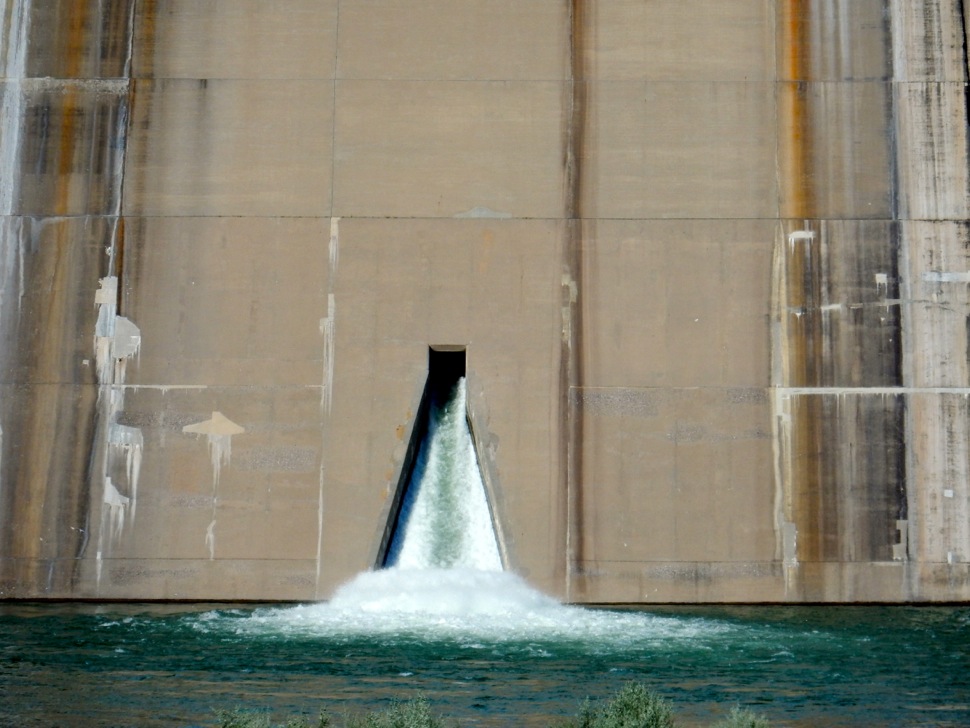
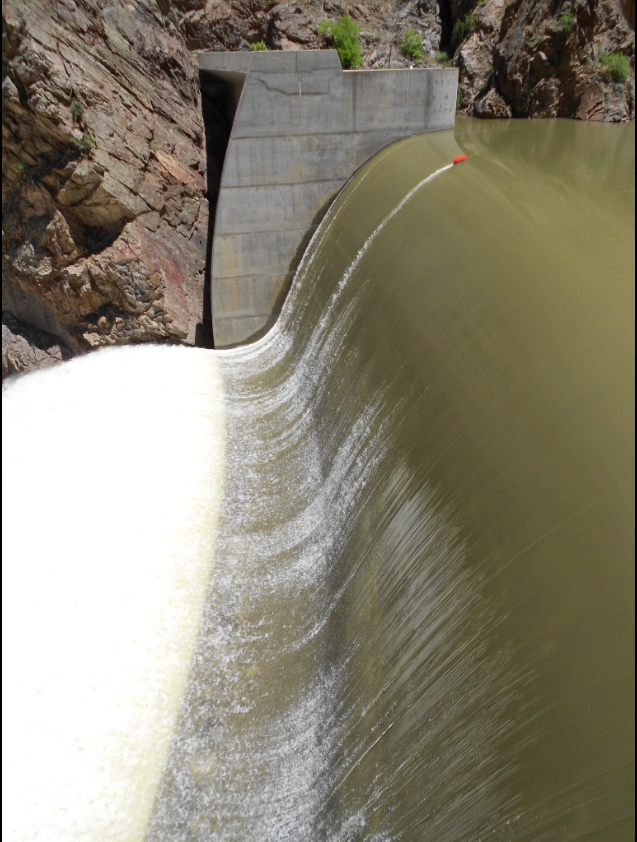
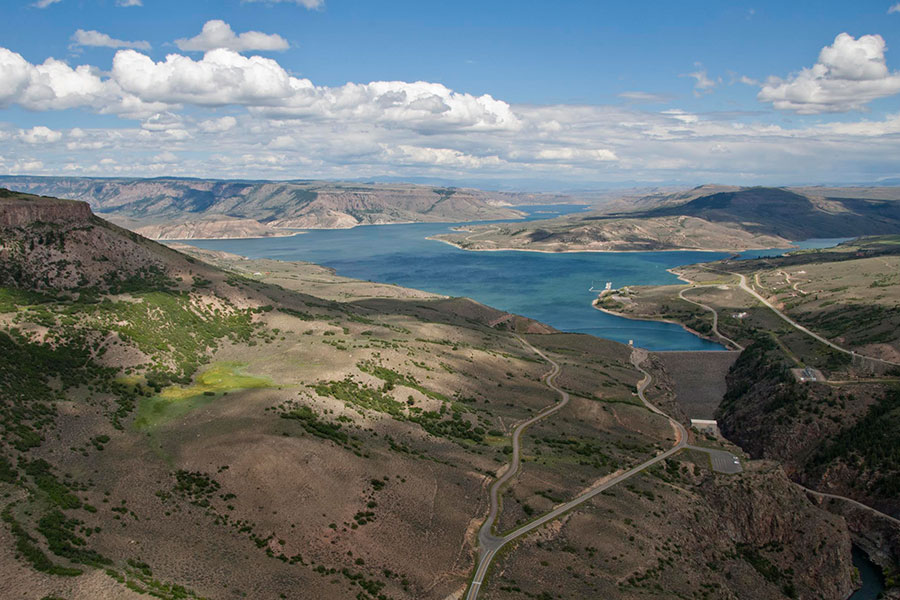
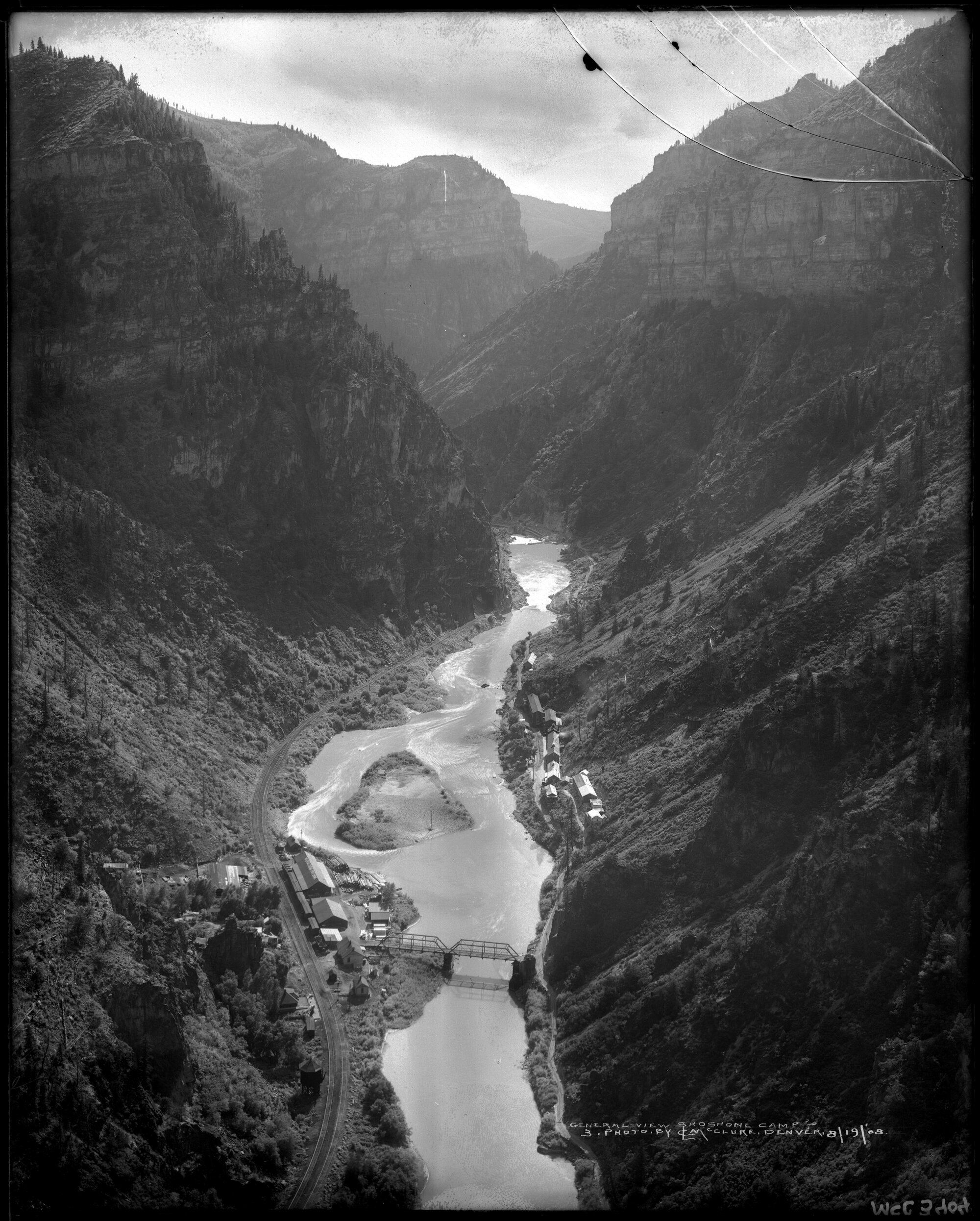
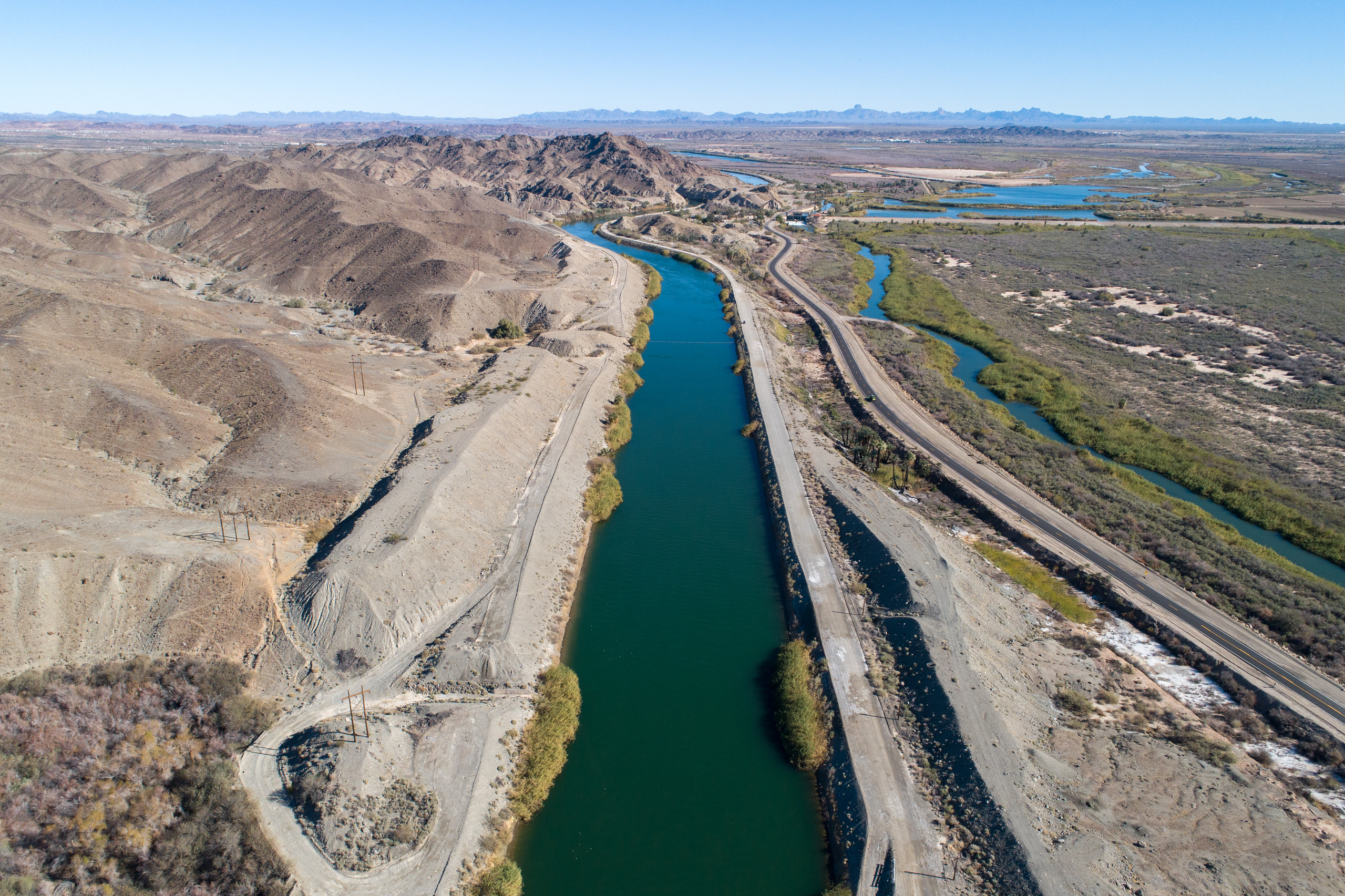
Crystal Dam, part of the Colorado River Storage Project, Aspinall Unit. Credit Reclamation.
From email from Reclamtion (Erik Knight):
This meeting will be held at the Western Colorado Area Office in Grand Junction, CO. There will also be an option for virtual attendance via Microsoft Teams. A link to the Teams meeting is below.
The meeting agenda will include updates on current snowpack, forecasts for spring runoff conditions and spring peak operations, the weather outlook, and planned operations for the remainder of the year.
Handouts of the presentations will be emailed prior to the meeting.
Click the link to read the article on the Pagosa Springs Sun website (Garrett Fevinger). Here’s an excerpt:
January 9, 2025
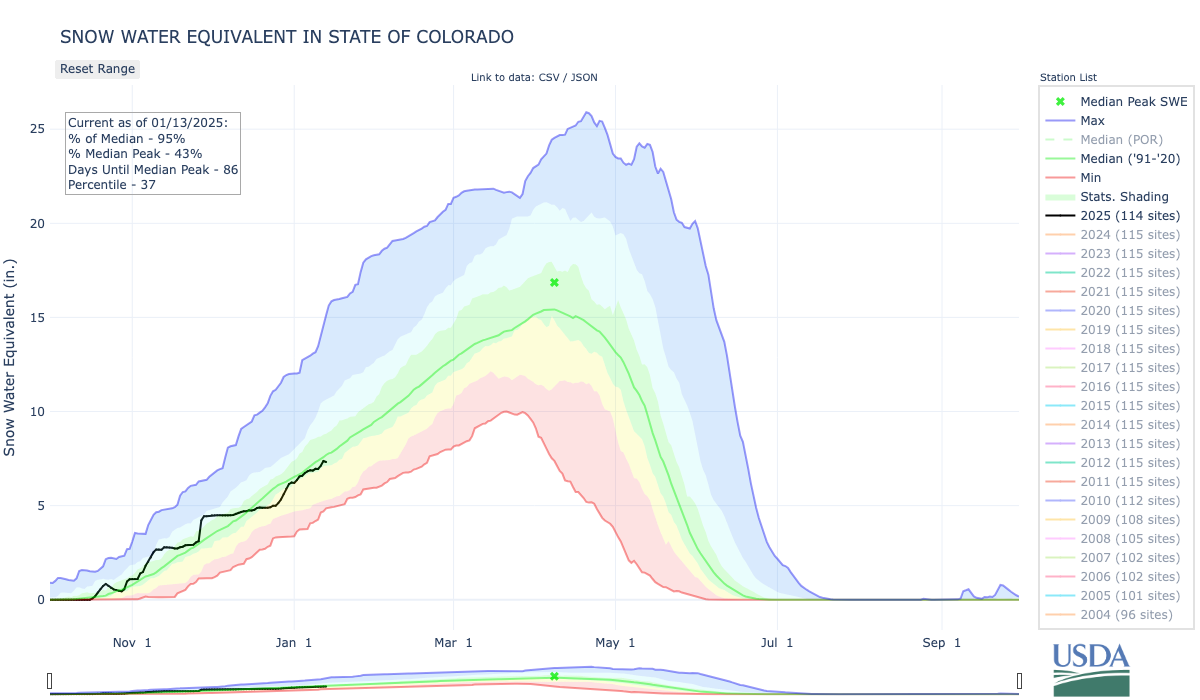
As of Jan. 8, the statewide snowpack pack stood at 95 percent of the 30-year median, according to data from the Natural Resources Conservation Service (NRCS) — an improvement from weeks earlier when those levels tracked significant lower.
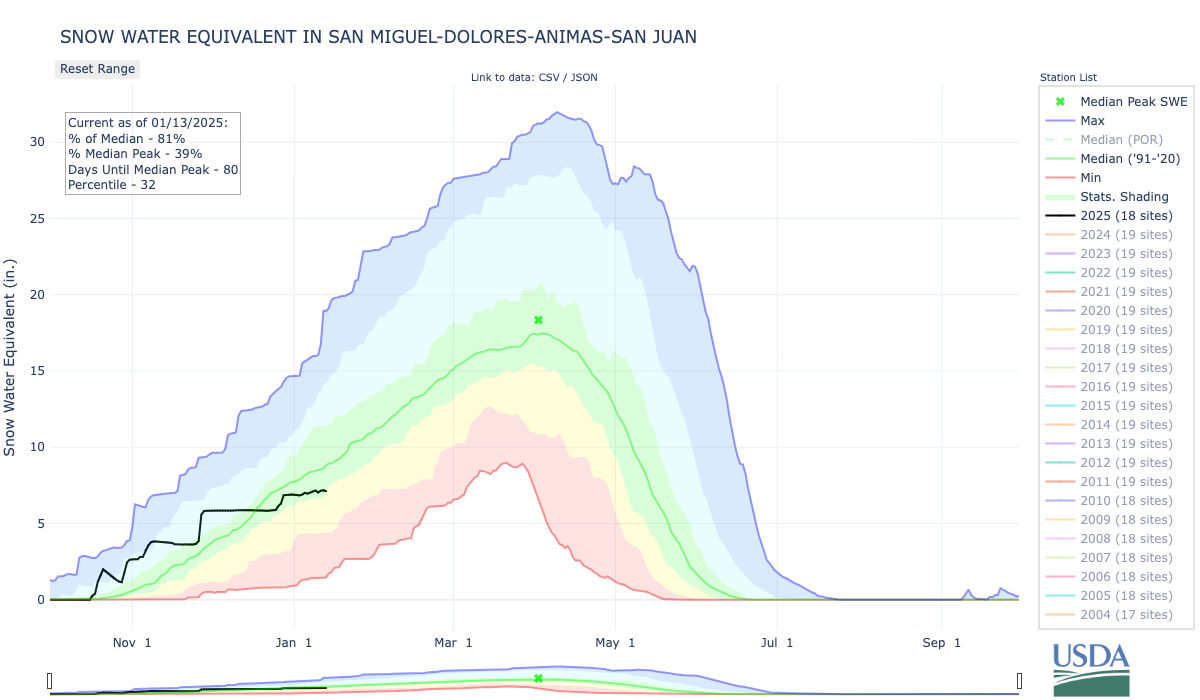
The San Miguel, Dolores, Animas, and San Juan basins measured to be at 84 percent of its 30-year median snowpack as Individual local levels were slightly lower, with the Upper San Juan area at 73 percent of its median snowpack, the Piedra area at 79 percent, and the Conejos area at 60 percent of its median. As of Jan. 8, 45 inches of snow were measured atop the Wolf Creek summit, which sits at 68 percent of its median snowpack, according to the NRCS.
River flows
The San Juan River was flowing at a rate of 42.9 cubic feet per second (cfs) through Pagosa Springs as of 9 a.m. Wednesday, according to the U.S. Geological Survey. Based on 89 years of water records, the median flow for the same date is 54 cfs, with a record high flow of 112 cfs in 1987. The lowest recorded flow for the date is 28 cfs in 1990.
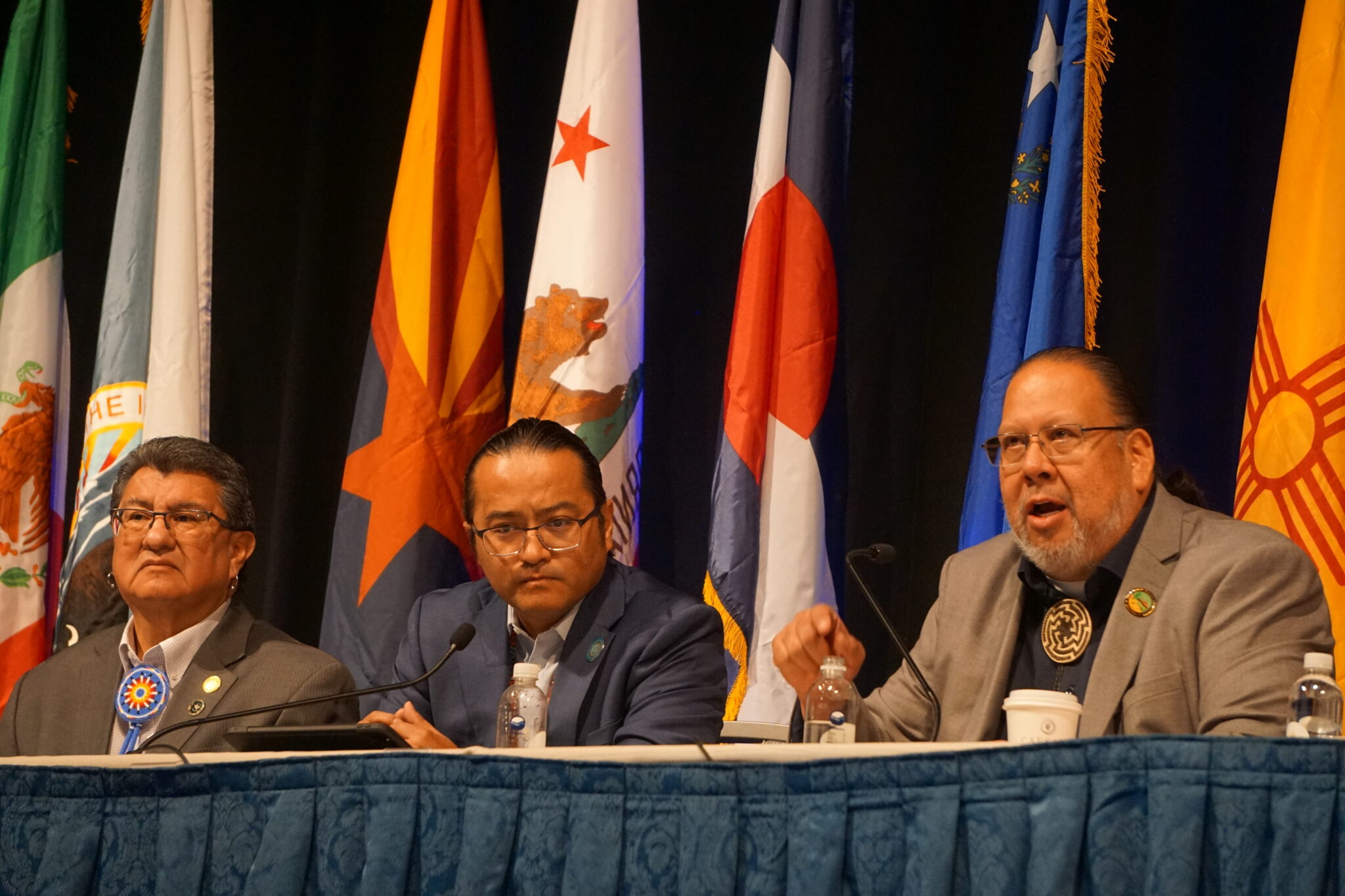
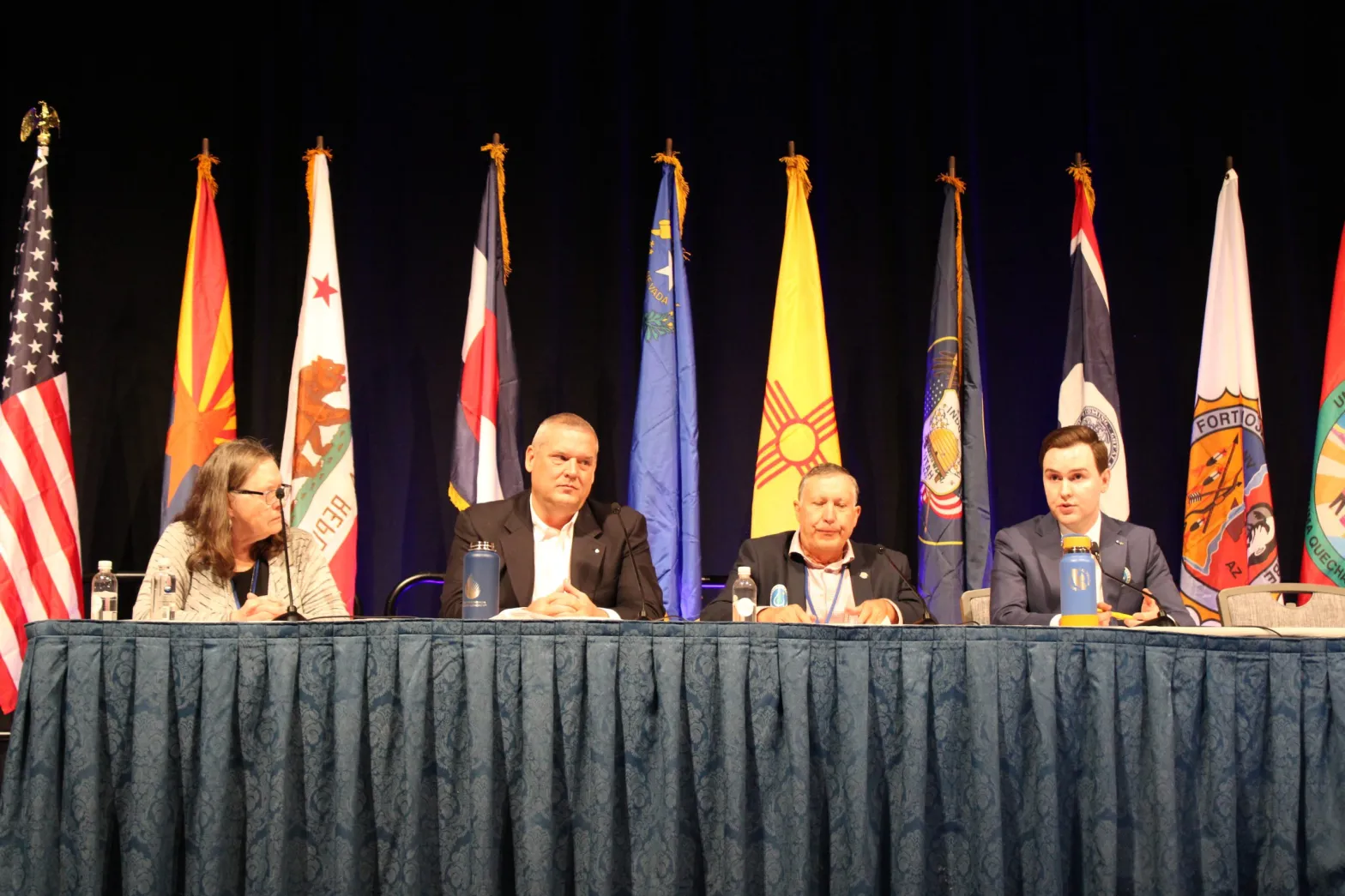
Attendees of the Colorado River Water Users Association watch negotiators Estevan López of New Mexico and Becky Mitchell of Colorado speak on a panel Thursday, December 5, 2024, at the Paris Hotel and Casino. The Upper and Lower basin states are at an impasse about how cuts will be shared and reservoirs operated after 2026. CREDIT: LUKE RUNYON/THE WATER DESK
Click the link to read the article on the InkStain.net website (Jack Schmidt and Eric Kuhn):
January 9, 2024
The press coverage of the December 2024 Colorado River Water Users Association (CRWUA) meeting mostly focused on the ongoing stalemate between representatives of the Upper and Lower Division States over their competing proposals for how the Colorado River Systems’ big reservoirs will be operated after the 2007 Interim Guidelines terminate in 2026. The headlines included words such as “turbulent”, “bitter”, “bluster”, and “spar”. Indeed, there was tension in the air, and the potential for interstate litigation was a topic of much discussion both on the formal agenda and in the hallways where, traditionally, progress is often made between competing interests.
While the press focus on the tension and divisiveness was unavoidable, I believe that there were good reasons for some guarded optimism.
For the ongoing effort to renegotiate the post-2026 operating guidelines, a consortium of seven environmental NGOs has also made a detailed proposal. Their proposal is referred to as the “Cooperative Conservation” proposal. One of the four action alternatives that Reclamation will analyze, Alternative #3, is patterned after the NGO submittal. At CRWUA, John Berggren of Western Resource Advocates, who along with Jennifer Pitt and others prepared the proposal, made a presentation on the proposal. Like the other submitted proposals, the cooperative conservation alternative proposes sophisticated operational rules for Lakes Mead and Powell based on combined system storage and actual hydrology. Where the Cooperative Conservation proposal breaks new ground is the concept of a Conservation Reserve Pool, and this idea could lead the basin toward a practical on-the-ground solution. Indeed, the Gila River Indian Community introduced at CRWUA a similar concept in the form of a Federal Protection Pool made up of stored water in both Lake Powell and Lake Mead. These proposals, taken separately, together, or in some combined and moderated form, might serve as a catalyst for compromise.
As proposed, both the Conservation Reserve Pool and the Federal Protection Pool would be filled with water conserved by reductions in consumptive use and perhaps augmentation from programs in both basins and this water could be stored anywhere in the system. This water would be “operationally neutral” and thus invisible to the underlying system management operating rules. From an accounting perspective, this Pool would “float” above other water in the reservoirs. Floating Pools operate separately from and above the prior appropriation system of water allocation on the Lower River and are invisible to the rules that dictate annual releases from Glen Canyon Dam. Thus, these proposals impart important operational flexibility. In many ways, Floating Pools split the baby—they incentivize innovative conservation measures that allow participants to find value they would not have been able to realize under the prior appropriation system—yet they insulate the prior appropriation system and thus are more protective of higher-priority water users than operationally non-neutral ICS. It’s a stretch to say there is something here for everyone, but there may be enough to kick-start otherwise stalled conversations.
In their proposal, the Lower Division States have offered to take up to 1.5 maf/year of mainstem shortages. Where the two basins remain deadlocked is what happens in those years when shortages exceed the amount the Lower Division States are willing to accept. The Lower Division States have proposed that the two basins share the additional required shortages up to a maximum shortage of 3.9 maf/year. The Upper Division States have said, “No, because we already suffer large hydrologic shortages in dry years, and we have not used our full compact entitlement; the Lower Division should cover all of the shortages.” In their presentation, however, the Upper Division Commissioners (UCRC members) left the door open for continuing discussions between the two divisions. In his remarks, New Mexico Commissioner Estevan Lopez stated that under what he referred to as “parallel activities”, the Upper Division States might be willing to discuss conserving “100,000, maybe 200,000 acre-feet per year.”
Water in Floating Pools could be used for a variety of purposes including environmental management, fostering binational programs, and supplementing scheduled water deliveries. During his CRWUA presentation, John Berggren mentioned an obvious use for this pool. Water stored in the Pool by conserved consumptive use programs in the Upper Division States could be used as an Upper Division contribution during years when mainstem shortages to the Lower Division States exceed a negotiated amount. Of course, the Lower Basin is unlikely to accept Upper Basin creation of Floating Pools made up of water for which there is no current consumptive use. This water is already “system water” and is now being used by existing Lower Basin water agency. Thus, it would be necessary to develop a program to account for and certify savings in the Upper Basin. Further, the thorny problem of shepherding (legally protecting the conserved water so that it ends up in system storage) needs to be overcome. For a perspective on this issue, see Heather Sacket. Undeveloped Tribal water is a controversial sticking-point in this regard, with strong feelings and strong arguments on all sides.
If the Upper Division States were to conserve 200,000 acre-feet per year for five years and deposit that saved water in a conservation reserve “Floating Pool”, something like 900,000 acre-feet could be available for shortage sharing (after accounting for reservoir evaporation). (We use 900,000 af as an example only, how much water the Upper Division States would have to contribute and maintain in a Floating Pool would have to be negotiated between the two divisions.) In their presentation, the Lower Division principals pointed out that had their proposal been in place beginning in 2007, there has yet to be a year when shortage sharing would have been required. Note, this conclusion is very sensitive to “initial conditions.” In 2007, total storage in Lake Mead and Lake Powell was about 8 maf more than it is today. If the 21st century hydrology continues, shortages greater than 1.5 maf/year are likely to occur.
Carefully crafted with appropriate guardrails, Floating Pool concepts can be a catalyst for compromise between the two divisions that give both parties something they need.
How do Floating Pool alternatives fit with the Schmidt, Kuhn, Fleck management approach? Based on our conversations with the authors of the cooperative conservation proposal, we believe the two approaches agree — that our management proposal fits on top of and complements their proposal quite well. In my presentation at CRWUA, I emphasized that, like future hydrology, there is great uncertainty in the future needs of the river’s ecosystem and society’s values. It’s almost a certainty that in the future, prescribed annual releases from Glen Canyon Dam will cause an unacceptable and unanticipated outcome to some river or reservoir resource. When that happens, our flexible management approach and accounting system keeps the basins “whole.”
Is using the concept of Floating Pools as a catalyst to break the stalemate between the two basins without warts? – of course not. There are important considerations regarding the use of undeveloped water—Tribal or otherwise, and the devil is in the details when it comes to developing appropriate guardrails for annual and total accumulation in such a Pool, the number and type of participants, annual debits, and other important qualifications. Even conserving 100,000 acre-feet per year in the Upper Division States, with acceptable verification, could be a stretch, especially if there is less federal money in the future, as there almost certainly will be. Finally, it might put off addressing fundamental problems with the law of the river until the new post-2026 operating rules again expire. When they do, the 1922 Compact and 1944 Treaty with Mexico will still be in place, and these agreements collectively allocate 17.5 maf/year of consumptive use on a river that is only producing 13-13.5 maf/year of water at the international boundary (and runoff continues to decline). What the Floating Pool concept might accomplish is to significantly reduce the temptation and threat of unpredictable interstate litigation, keep the basin’s stakeholders talking to each other, and give us time to move toward more foundational change in how the river is managed.
Map of the Colorado River drainage basin, created using USGS data. By Shannon1 Creative Commons Attribution-Share Alike 4.0
Although Telluride is in the depths of winter, states are still negotiating a new agreement for the Colorado River basin. About 85% of the Colorado River begins as snow in Colorado and Wyoming’s mountains. The 1,450-mile river provides water to about 40 million people in the U.S. and Mexico and is key to the $5 billion annual agriculture economy. Across the state, snowpack is at 97% of the median. Locally, in the San Miguel-Dolores-Animas-San Juan River Basin, snow water equivalent is at 75% of median.
Map of the Colorado River drainage basin, created using USGS data. By Shannon1 Creative Commons Attribution-Share Alike 4.0
Colorado’s Western Slope river basins are essential to the health of the whole basin as well the economy and natural environment. Regional water managers often compete for water demands for agriculture, environmental flows and downstream deliveries to Lake Powell and Lake Mead, which store much of the region’s water. The current operational guidelines for the Colorado River will expire at the end of 2026. Drought in the Western Slope can significantly impact both local water use and deliveries to Lake Powell, and drought is likely to become more prevalent with climate change…A recent study, published in Nov. 2024, analyzed local drought vulnerability in Western Slope and the consequences for the region, going into the Colorado River basin. “Streamflow declines driven by an optimistic climate change scenario can transition the system to a drier regime and increase drought impacts,” the study’s authors write. The study developed a model to create streamflow scenarios and the potential impacts of drought in the region. The model showed elevated drought risks to downstream water users, agriculture and the environment…
The San Miguel Watershed Coalition recently released a new planning document for the whole watershed, including floodplain reconnection and beaver-based restoration projects. Much of this work involves federal land managers because more than 50% of the watershed is federally owned…Other important research includes how to better predict how snowpack is transformed into snowmelt and runoff into watersheds, collaborating with Airborne Snow Observatories (ASO), which provides basin-wide measurements of snow water equivalent and forecasts of snowmelt runoff.
The view from an Airborne Snow Observatory plane as it flies over a mountainous region to capture data on the snowpack. Photo credit: Airborne Snow Observatories Inc.
After years of demanding the cleanup of uranium waste at the Kerr-McGee Quivira Mines on the Navajo Nation community advocates got the news this week that the Environmental Protection Agency will remove waste rock from three areas of the site and move it to a new off-site repository. The removal of over 1 million cubic yards of radioactive waste from the sites about 20 miles northeast of Gallup will begin in early 2025, the EPA said. The waste will be taken to a new off-site repository at Red Rocks Landfill east of Thoreau, N.M. The process, including permitting, construction, operation and closure of the repository, is expected to take 6-8 years.
“I feel as though our community finally has something of a win,” said Teracita Keyanna, a member of the executive committee for Red Water Pond Road Community Association. “Removing the mine waste from our community will protect our health and finally put us back on a positive track to Hózhǫ.”
Commercial exploration, development, and mining of uranium at Quivira Mines began in the late 1960s by the Kerr-McGee Corporation and later its subsidiary. The mine sites are the former Church Rock 1 (CR-1) mining area; the former Church Rock 1 East (CR-1E) mining area; and the Kerr-McGee Ponds area. The mines were in operation from 1974 to the mid-1980s and had produced about 1.2 million tons of ore, making them among the 10 highest producing mines on the Navajo Nation…From World War II until 1971, the U.S. government was the sole purchaser of uranium ore, driving extensive mining operations primarily in the southwestern United States. These efforts employed many Native Americans and others in mines and mills. Between 1944 and 1986, nearly 30 million tons of uranium ore were extracted from Navajo lands under leases with the Navajo Nation. With over 500 abandoned uranium mines — many say the total could be in the thousands — clean up of mines has always been a battle.
Reclamation Commissioner Camille Calimlim Touton greets several members of the Southeastern
District Board, from left, Bill Long, Kevin Karney, Howard “Bub” Miller, Andy Colosimo and Justin
DiSanti. Photo credit: Southeastern Colorado Water Conservancy District
January 8, 2025
Camille Calimlim Touton, Commissioner of the U.S. Bureau of Reclamation, traveled to Pueblo on Wednesday, January 8, to announce an additional $250 million for construction of the Arkansas Valley Conduit.
“We are proud to see the work underway because of President Biden’s Investing in America agenda,” Commissioner Touton said. “But there’s much more work to be done and we are again investing in this important project to bring safe drinking water to an estimated 50,000 people in 39 rural communities along the Arkansas River.”
The $250 million is funded through the Bipartisan Infrastructure Law and is part of a $514 package of water infrastructure investments throughout the western United States under the BIL.
The additional funding brings the total federal investment in the AVC to almost $590 million since 2020, along with state funding guarantees of $90 million in loans and $30 million in grants.
“After 25 years, I still almost can’t believe it’s happening, but I drive by and can see it with my own eyes,” Southeastern Water Conservancy District President Bill Long told Commissioner Touton. “There are so many people who have worked so hard who would be so proud to see it being built. This money will get us to the area that has seen the most problems.”
The Southeastern District is the sponsor for the AVC, which is part of the 1962 Fryingpan-Arkansas Project Act. The 130-mile pipeline to Lamar will bring water to 50,000 people being served by 39 water systems when complete.
Several Southeastern Board members attended Wednesday’s announcement.
“You and your team are the ones who have gotten this off the ground,” said Kevin Karney, a La Junta rancher, and at-large Board member.
“People said it would never get built, but now we’re getting it done,” said Howard “Bub” Miller, who represents Otero County on the Board.
The AVC will help 18 water systems that face enforcement action for naturally occurring radionuclides in their groundwater supplies, as well as communities struggling to meet drinking water and wastewater discharge standards.
Construction of the AVC began in 2023, and three major construction contracts have been awarded.
“This money really gets us further down the valley. It is very much appreciated,” Long said.
Hickenlooper, Bennet Welcome Additional $250 Million for Ark Valley Conduit
Funding awarded from the senators’ Bipartisan Infrastructure Law
In total, Hickenlooper and Bennet have helped secure $500 million in funding for the project
WASHINGTON – Today, Colorado U.S. Senators John Hickenlooper and Michael Bennet welcomed the Bureau of Reclamation (BOR)’s announcement of $250 million in new funding from the Bipartisan Infrastructure Law for continued construction of the Arkansas Valley Conduit (AVC).
“We passed the Bipartisan Infrastructure Law to finally deliver on promises to rural communities,” said Hickenlooper. “In Colorado that means finishing the long-awaited Ark Valley Conduit and bringing clean, reliable drinking water to 50,000 people.”
“For decades, I’ve worked to secure investments and pass legislation to ensure the federal government keeps its word and finishes the Arkansas Valley Conduit,” said Bennet. “This major Bipartisan Infrastructure Law investment will be critical to get this project across the finish line to provide safe, clean water to tens of thousands of Coloradans along the Arkansas River.”
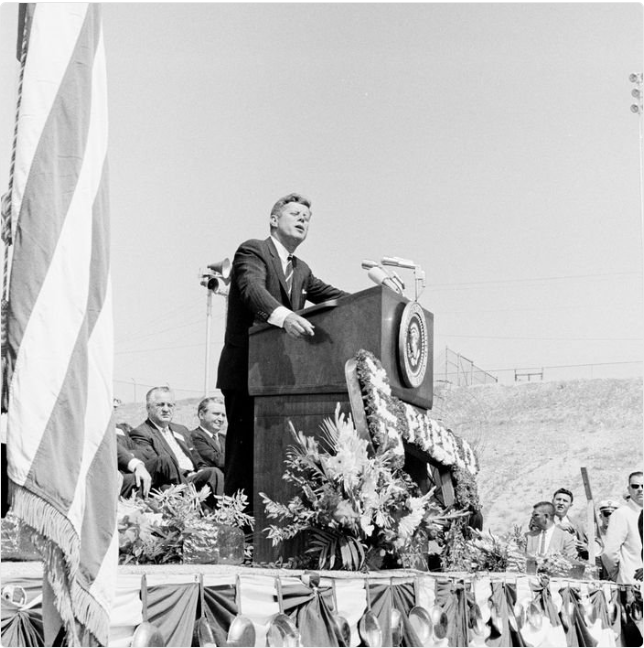
John F. Kennedy at Commemoration of Fryingpan Arkansas Project in Pueblo, circa 1962.
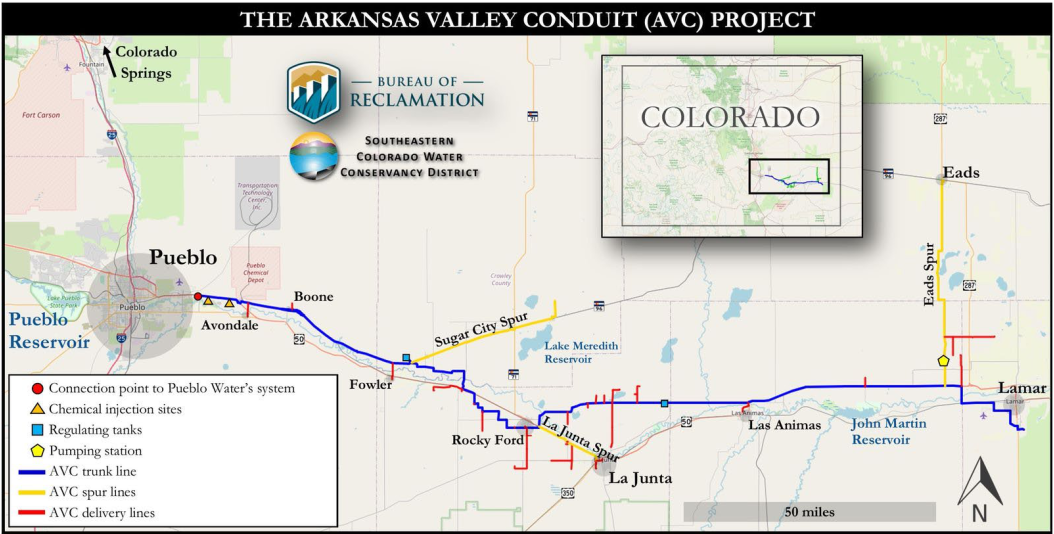
The AVC is a planned 130-mile water-delivery system from the Pueblo Reservoir to communities throughout the Arkansas River Valley in Southeast Colorado. This funding will continue ongoing construction. The AVC is the final phase of the Fryingpan-Arkansas Project, which Congress authorized in 1962.
Hickenlooper and Bennet have consistently and successfully advocated for increased funding for the AVC. Last year, Hickenlooper and Bennet wrote to President Biden to urge him to prioritize funding for the AVC in his fiscal year 2025 budget. The senators also called on Senate Appropriations leaders to provide more funding for the project. In January 2023, Hickenlooper and Bennet urged BOR to allocate additional resources through annual appropriations and Bipartisan Infrastructure Law funding.
As a result of their efforts, the senators have helped deliver $500 million from the Bipartisan Infrastructure Law for the AVC, including $90 million in 2024, $100 million in 2023, and $60 million in 2022. They also secured an additional $10.1 million in fiscal year 2024 and $10.1 million in fiscal year 2023 through the annual government funding bills.
More information on the funding is available HERE.
Arkansas Valley Conduit map via the Southeastern Colorado Water Conservancy District (Chris Woodka) June 2021.
Graphic credit: The Colorado River water crisis its origin and future Jock Schmidt, Eric Kuhn, Charles Yackulic.
January 7, 2025
Belated season’s greetings, dear readers! The season being the long dark days as our turning planet slowly tilts our part of the planet again toward the star we circle – moving us into a new year-cycle that will probably again be ‘one of the ten warmest years in recorded climate history’ – if not ‘the warmest’ again.
But we are officially no longer going to be concerned about that, right? The voters have spoken, with the usual one-percent victory taken by the winner to be a landslide mandate. And what the voters decided, by that one-percent margin, is that we, as a nation, the Untied States of America, shall officially cease to believe that we are changing the climate; we’ve given ourselves license to linger in the denial and anger stages – denial that it is happening, and anger at anyone who wants to blame us for that which we can now officially refuse to believe is happening.
And we will not just lie back leisurely, relaxing in our denial, doing nothing about what we believe is not happening. No, we are going to try to break all previous production records of those fossil fuels that we can now officially refuse to believe are changing the climate – yes, even coal too, to shovel into the industrial juggernaut, which will grow as all those factories that moved overseas will sheepishly return home, once the tariffs are working their magic in bending the rest of the world to our will…. We are promised this will be the official national Reality According To Trump (RATT).
Meanwhile, however, back along the Colorado River, it is a little harder to make the RATT logic compute. The sequence of successively warmer years has had an undeniable, measurable, negative impact on our usable water supply: something like a 5-7 percent loss of surface water for every degree of rise in the annual average temperatures. It’s not necessarily that there’s less water; it’s just that more of the water is shifting into the uncontrollable vapor state rather than the manageable liquid state we earthlings need. The bottom line is a measurably diminishing supply, over the past several decades, of the surface water on which 35 million city dwellers and the irrigators of five million acres of desert land depend to some degree.
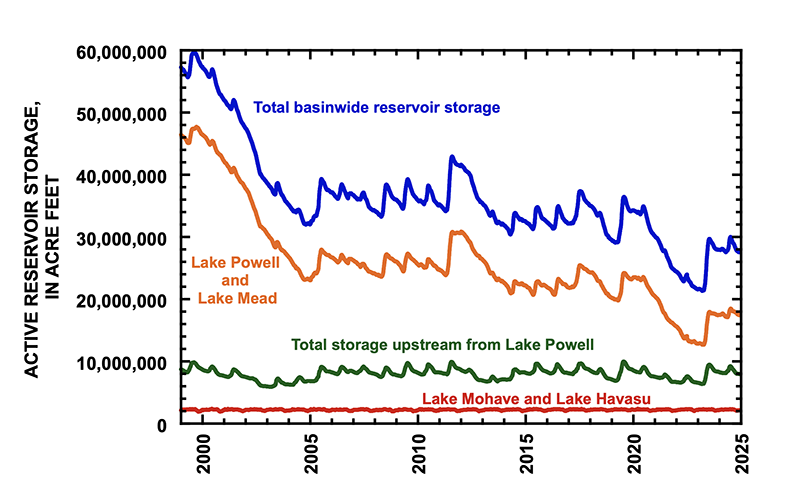
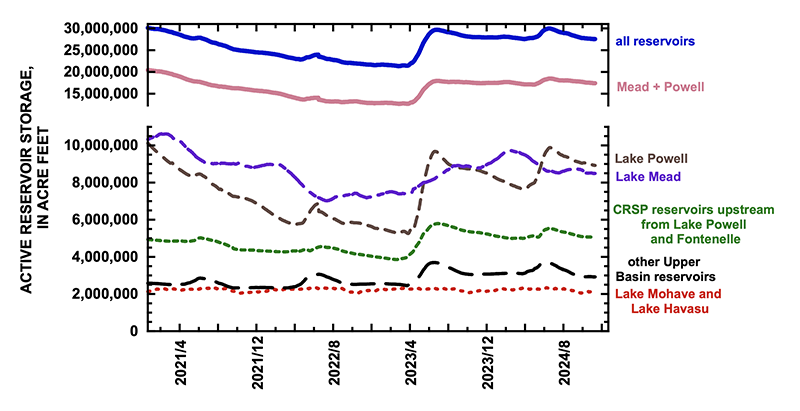
Udall/Overpeck 4-panel Figure Colorado River temperature/precipitation/natural flows with trend. Lake Mead and Lake Powell storage. Updated through Water Year 2024. Credit: Brad Udall
Where are we right now with the management planning process for the river? In mid-November 2024, the Bureau of Reclamation issued five mix-and-match alternatives for managing the Colorado River in the future – meaning the decade or so beyond the 2026 expiration of the 2007 Interim Guidelines (and the 2019 Interim Interim Guidelines, and the 2023 Interim Interim Interim Guidelines).
These alternatives are the Bureau’s effort to break the stalemate in the stalled negotiations between the four states of the Upper Colorado River Basin and the three states of the Lower Colorado River Basin. Large cuts in use will be necessary to keep the storage and distribution systems operational, and each Basin wants the other Basin to take a larger share of those cuts proscribed by ‘the river we have, not the river we dream for,’ as Colorado’s chief negotiator Becky Mitchell put it. (See the graphic at the beginning.)
The Bureau’s five alternatives, for which they plan to do the required Environmental Impact analysis this year, all focus primarily on managing the two main reservoirs, Mead and Powell, although other reservoirs in the system may by used to bolster storage in the two big ones. The five alternatives run a gamut from the NEPA mandatory ‘No Action’ alternative (continue business as usual), through two varying levels of federal management if the states are unable to reach a working agreement, to an alternative based primarily on a plan submitted by conservation groups, to a final alternative that is mostly pieced together from the conflicting plans proposed by the two basins, assuming the two basins can find the necessary compromises to make the two plans into one plan that might work.
Native America in the Colorado River Basin. Credit: USBR
All alternatives except the one by conservationists (#4) include notice that ‘there would be explicit accounting of unused/undeveloped quantified Tribal water.’ This means that the settled or decreed water rights of the First Peoples would finally be acknowledged in the river accounting, noting where and by whom their undeveloped water was being used – the first step, as one tribal member observed, in eventually either getting the water back for their own use, or getting paid by others for the continued use of their water. The First People are getting closer to being at the table. (It is worth noting that the Gila River Indian Community, south of Phoenix, is the first user organization to sign a post-2026 contract with the Bureau to leave some of its water in Mead Reservoir, water that will be conserved through projects to be funded with infrastructure money, if that survives the RATT.)
That is the broad overview; if you wish for more specifics, you can find more detailed descriptions of all five alternatives here, but there is probably no real need for us citizens to get down in the weeds of detail just yet, since we are just passive participants at that level anyway.
Instead, I want to encourage us to think on the larger level of considering alternatives not part of the Bureau’s five choices. Why not? There is, after all, a large minority of us who do not drink the small majority’s RATT kool-aid. For those of you who fit that description, my season’s greeting to you are two quotations I encountered recently that kind of rang my bell:
The first is a poet calling for poets to ‘give us imagination of peace, to oust the intense, familiar imagination of disaster.’ ‘Peace’ is given the negative-space definition of ‘not only the absence of war’: something more, or other, than mere truce. The ‘familiar imagination of disaster,’ on the other hand, is a major element of the RATT: a nation overrun by immigrant murderers, inflation out of control, an economy gone to hell, cities awash in crime, et cetera – that’s the virulent and violent imaginings that became the principal election strategy of the Repugnicans (as distinguished from the real but very timid Republicans). They call it ‘flooding the zone with shit,’ so much imagining of fictitious disaster that one wave of lies cannot be seriously addressed and challenged before the next wave rolls over us. This was a successful campaign strategy, with the naive cooperation of the national media serving as their trumpet: when the fact meets the RATT, print the RATT – reserving the last couple paragraphs for quotes citing the facts that contradict the RATT, thus it’s fair and balanced!
But when we come to our river – how are the poets to ‘imagine the peace’? And the call for poets does not necessarily preclude the hydrologists, politicians, water managers and others who manage ‘the river we have.’ Just to say, for example, as Becky Mitchell said, ‘We need to plan for the river we have, not the river we dream for,’ moves the discourse into the poet’s realm of analogy and metaphor, not denying but augmenting the scientist’s world of evidential causation and consequence, en route to testable hypotheses.
The second quote, however, by the author of 1984 – the book describing the fully devolved RATT worldview that we are flirting with now – cautions us that ‘the imagination, like certain wild animals, will not breed in captivity.’ Is that same as saying the realm of the imagination lies in ‘thinking outside the box’? Like we keep saying we need to be doing?
Well, moving forward with that assumption – Orwell seems to be suggesting that the imagination can’t kick into gear if we are, consciously or unconsciously, holding it ‘in captivity’ inside some box of dominant conventional weltanschauung – ‘world view’ in translation, ideology, or just ‘our way of doing things.’ But the word is so much more heavily evocative in German of the mass and weight of the box, the height of the sidewalls that discouraging climbing up to look over and beyond…. Orwell was aware of the flywheel power of the boxes a society builds around itself – and the extent to which that power depends on the unquestioning, often only semi-conscious, acceptance of those who dwell within the box as ‘the way it is and that’s it.’ Even if ‘the way it is’ is not that great.
That would suggest that unleashing our imagination to such tasks as the ‘imagination of peace,’ even just regional peace along a modest and shrinking desert river, has to begin by becoming aware of the box that we need to be trying to think outside of.
What I think we have in the Colorado River region are at least two nested boxes. Whenever we hear someone intone, ‘The foundation of the Law of the River is the Colorado River Compact,’ or, ‘The Colorado River Compact cannot be (tinkered with, changed to fit reality, or discarded as irrelevant),’ we can assume that their imagination is held captive in the Colorado River Compact Box. When Becky Mitchell says, ‘We have to plan for the river we have, not the river we dream for,’ she has at least hiked herself up onto the edge of the Compact Box – a Compact that was written for a mythic river half-again larger than the river we have now. She might even be looking beyond the Compact for resolution (although she can probably not say that out loud yet).
Prior appropriation example via Oregon.gov
If we hike ourselves up onto the edge of Compact Box, we will find ourselves looking at a larger and more intimidating box: the Prior Appropriation Box. This, not the Compact, is clearly the ‘foundation’ of all law regarding the use of the river: first come, first served, and seniority rules. All seven of the Colorado River states had embraced the Appropriation Doctrine as the foundation of their water law by the early 20th century. (New Mexico and Arizona did not become states until 1912.)
But those of us captive in the Compact Box tend to forget that the Compact Commission came together in 1922 to try to override the appropriation doctrine at the interstate level, among the seven states. California was growing so fast, with Arizona not far behind, that the high desert and mountain states above the river’s canyon region – growing much more slowly due to the erratic ebb and flow of the mining industry – feared there would be no unappropriated water left when they hit their stride. And none of the states really wanted a seven-state horserace of helter-skelter ‘defensive appropriation’ to avoid being left high and dry.
The water managers in the states also knew that the only way to ‘civilize’ the Colorado River was to control and store the annual spring flood of mountain snowmelt, for release as needed throughout the rest of the year. And because it was an interstate river, and because the cost of big mainstream structures was beyond their means, they knew the federal government, through its Bureau of Reclamation, would have to take a lead role in that regional development. But what they did not want was for the feds to take over all the development and operation of ‘their’ river’s water.
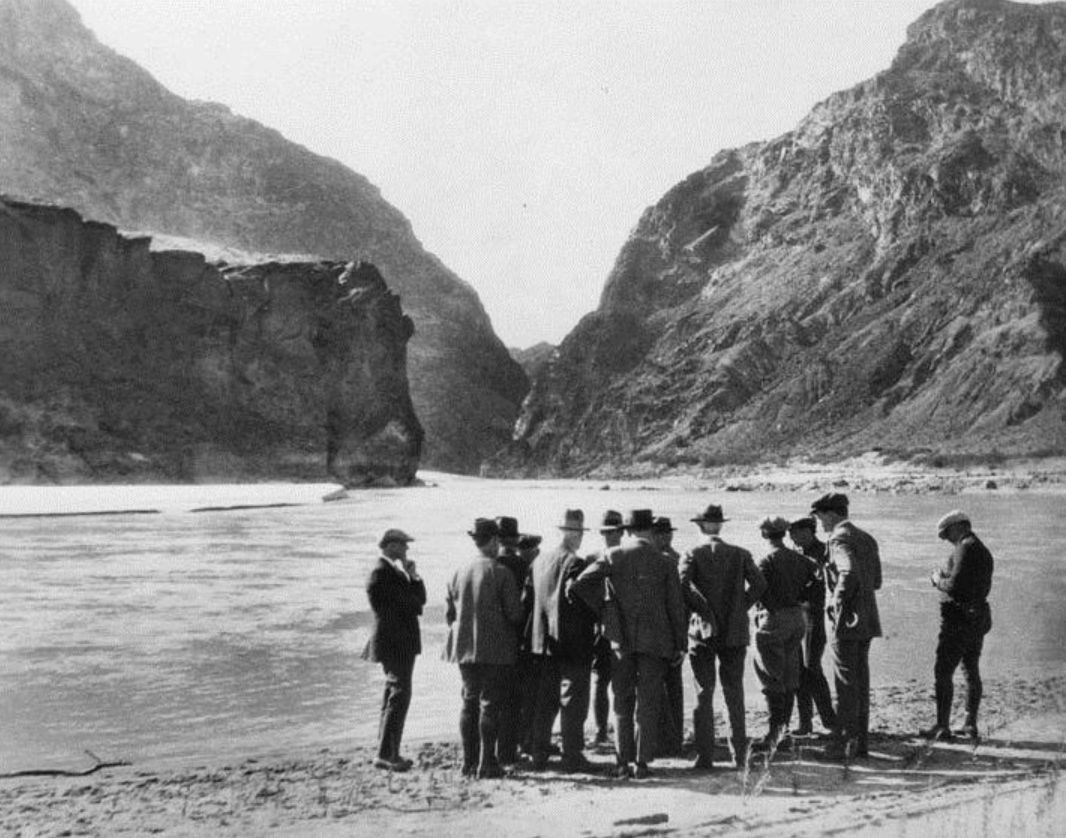
Members of the Colorado River Commission, in Santa Fe in 1922, after signing the Colorado River Compact. From left, W. S. Norviel (Arizona), Delph E. Carpenter (Colorado), Herbert Hoover (Secretary of Commerce and Chairman of Commission), R. E. Caldwell (Utah), Clarence C. Stetson (Executive Secretary of Commission), Stephen B. Davis, Jr. (New Mexico), Frank C. Emerson (Wyoming), W. F. McClure (California), and James G. Scrugham (Nevada)
CREDIT: COLORADO STATE UNIVERSITY WATER RESOURCES ARCHIVE via Aspen Journalism
So the Compact Commission assembled in January of 1922 to develop an interstate compact that would ‘provide for the equitable division and apportionment of the use of the waters of the Colorado River System’ – a seven-way division of the waters to give each state the right to use, in its own good time, the water needed to develop its land and resources. When a state was ready to use it, their share of the river’s water would be there for them, protected from prior appropriation by other faster-growing states.
That was the vision anyway: the ‘Compact Box’ nested in the ‘Prior Appropriation Box’ was to be an interstate refuge from the prior appropriation doctrine. ‘First come, first served’ could by the law within the states – but only up to the quantity allotted for each state.
They failed to realize that vision, however, after several days of trying – mostly for reasons of vagueness about, first, the flow of the river itself, and second, their own over-optimistic estimates of their own futures. Only the persuasive power of the federal representative on the Commission, Herbert Hoover – an engineer by training who really wanted to see the big mainstream structures built – kept them on task until they patched together, ten months later, the two-basin division for the use of the river’s water.
That substitute division was immediately rejected by the State of Arizona, and is now clearly failing at its original intent to transcend the appropriation doctrine between states: California is applying the prior appropriation doctrine against the other states in the Lower River Basin (as Arizona knew they would eventually). And the Lower Basin is threatening ‘Compact calls’ against the Upper Basin states if they do not get their 75 million acre-feet over any ten-year period as defined in Article III(d) of the Compact, as though the division into two basins had given them a big ‘prior appropriation.’
The ‘Compact Box’ is basically just a ‘shadow box,’ a failed effort to do what was really a pretty good idea – an imagination of peace among the states. The question now is: would it be possible to revive that idea of an ‘equitable division’ among the seven states – as something that is already somewhat accomplished? That’s a thread we’ll pluck at next post.
Map of the Colorado River drainage basin, created using USGS data. By Shannon1 Creative Commons Attribution-Share Alike 4.0
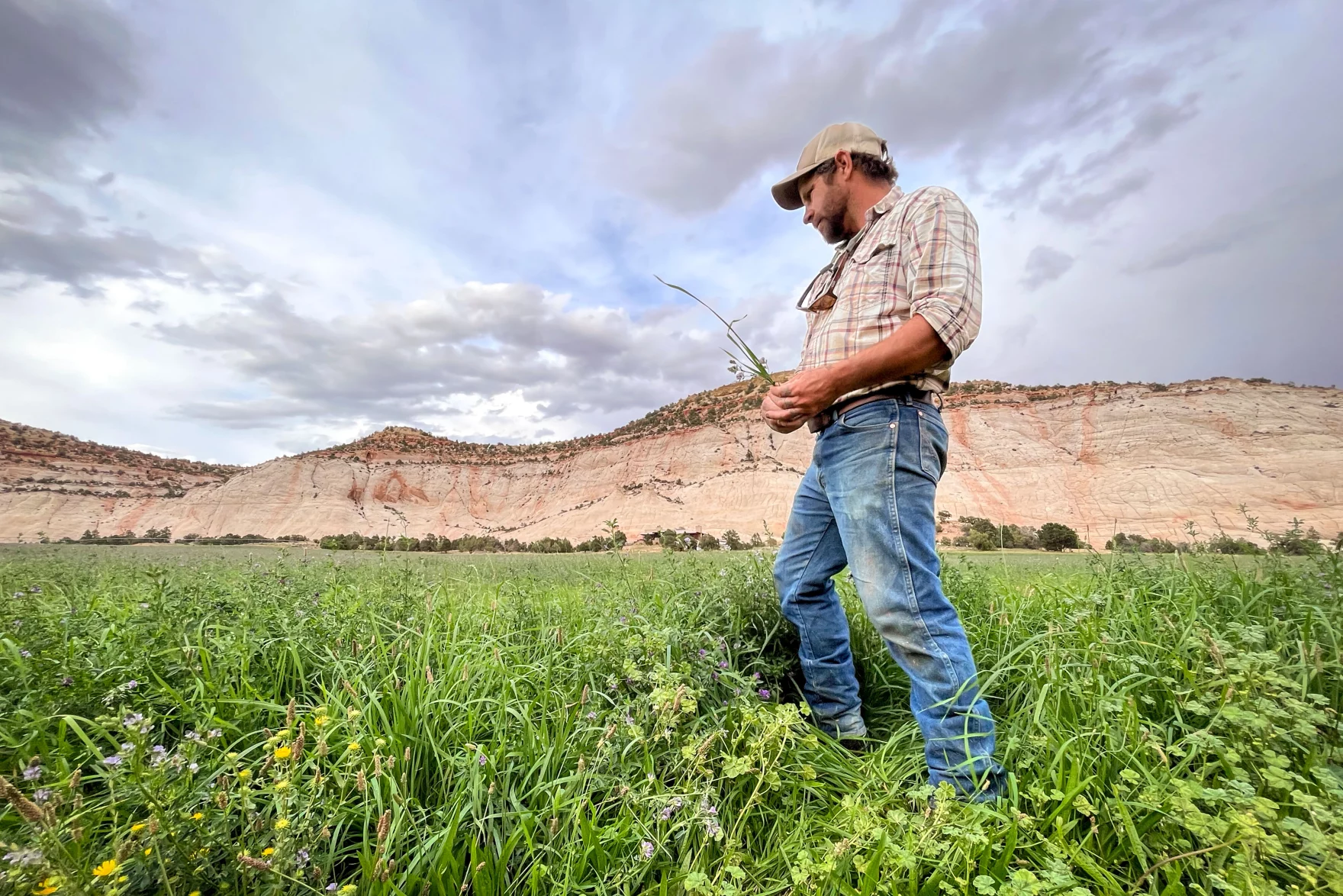
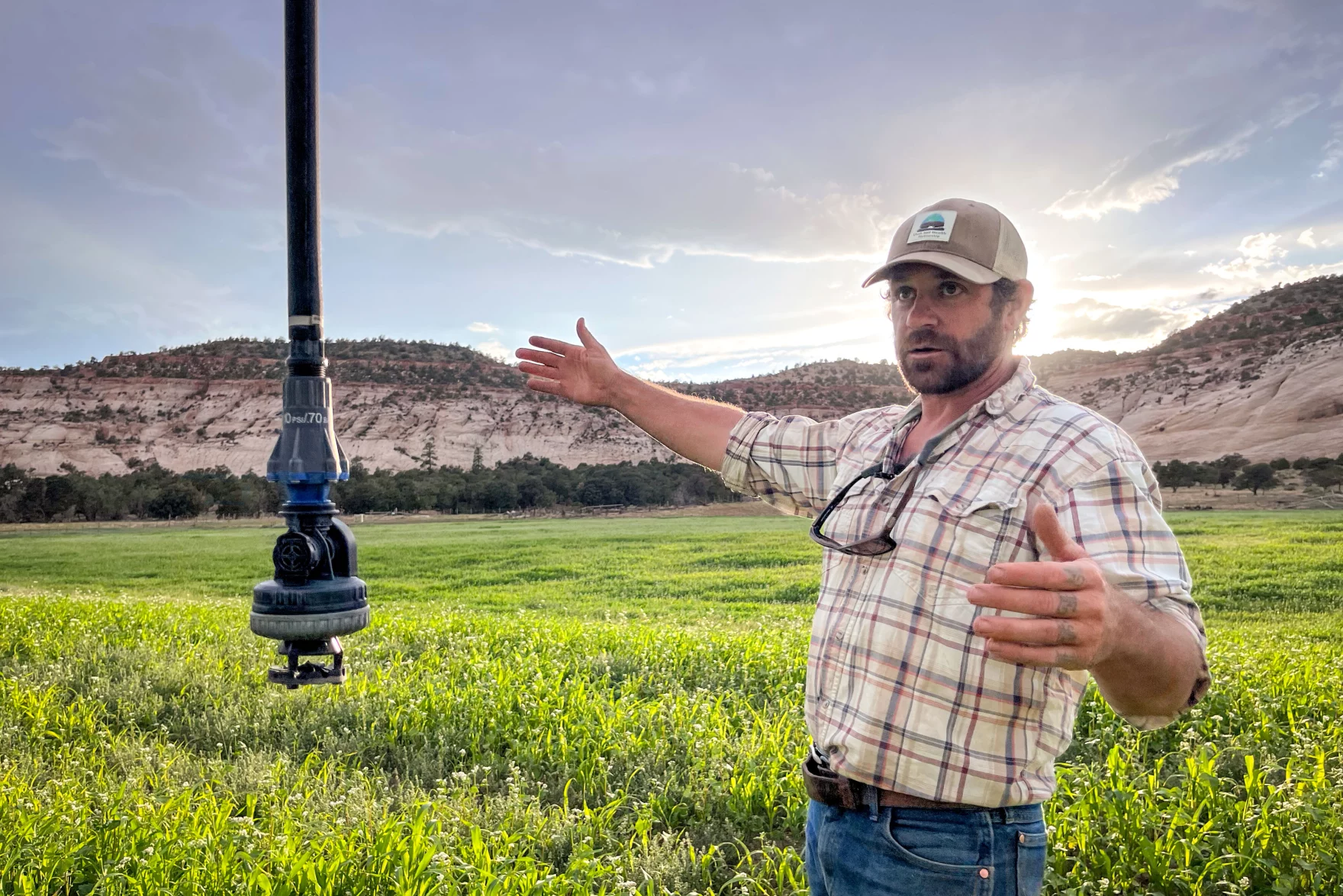
Rancher Andy Rice picks a handful of plants from one of his pastures in southern Utah on Aug. 21, 2024. His ranch is part of a state program aimed at conserving water that helps cover the cost of modernizing irrigation equipment. David Condos/KUER
Click the link to read the article on the KUNC website (Dave Condos):
January 3, 2025
This story is part of ongoing coverage of the Colorado River, produced by KUER in Utah, distributed by KUNC in Colorado, and supported by the Walton Family Foundation. It was also produced as part of the Colorado River Collaborative. KSL TV photographer Mark Wetzel contributed to this story.
Southern Utah is not your typical farm country. At a glance, there appears to be more red rock than green fields.
To make a go of it, farms often huddle around the precious few rivers that snake across the sun-baked landscape. That’s the case for rancher Andy Rice, who raises hundreds of hungry goats and sheep in the town of Boulder — population 227 — just outside Grand Staircase-Escalante National Monument.
In a bright green meadow packed with more than a dozen types of grasses, clovers and flowers, Rice reached down to pluck a makeshift bouquet. He has intentionally planted diverse species here over the years to improve the ranch’s sustainability.
“Isn’t that beautiful?,” he said, holding up a handful of flora. “On top of everything else that’s cool about it, it’s just really pretty.”
But this is still the dry Southwest. The edges of his lush pasture give way to a rugged sandstone ridge. So this grazing smorgasbord is dependent upon irrigation.
The ranch draws water from Boulder Creek, which flows to nearby Lake Powell, the nation’s second-largest reservoir and a pivotal piece of the Colorado River system. Between drought, climate change and competition for that river, however, Rice knows the West faces a precarious future.
“We will have less water. Forever,” Rice said. “We have to accept that and … it’s up to us to be more efficient.”
That’s why he applied for funding from Utah’s Agricultural Water Optimization Program, a $276 million push to help farmers and ranchers modernize their irrigation systems.
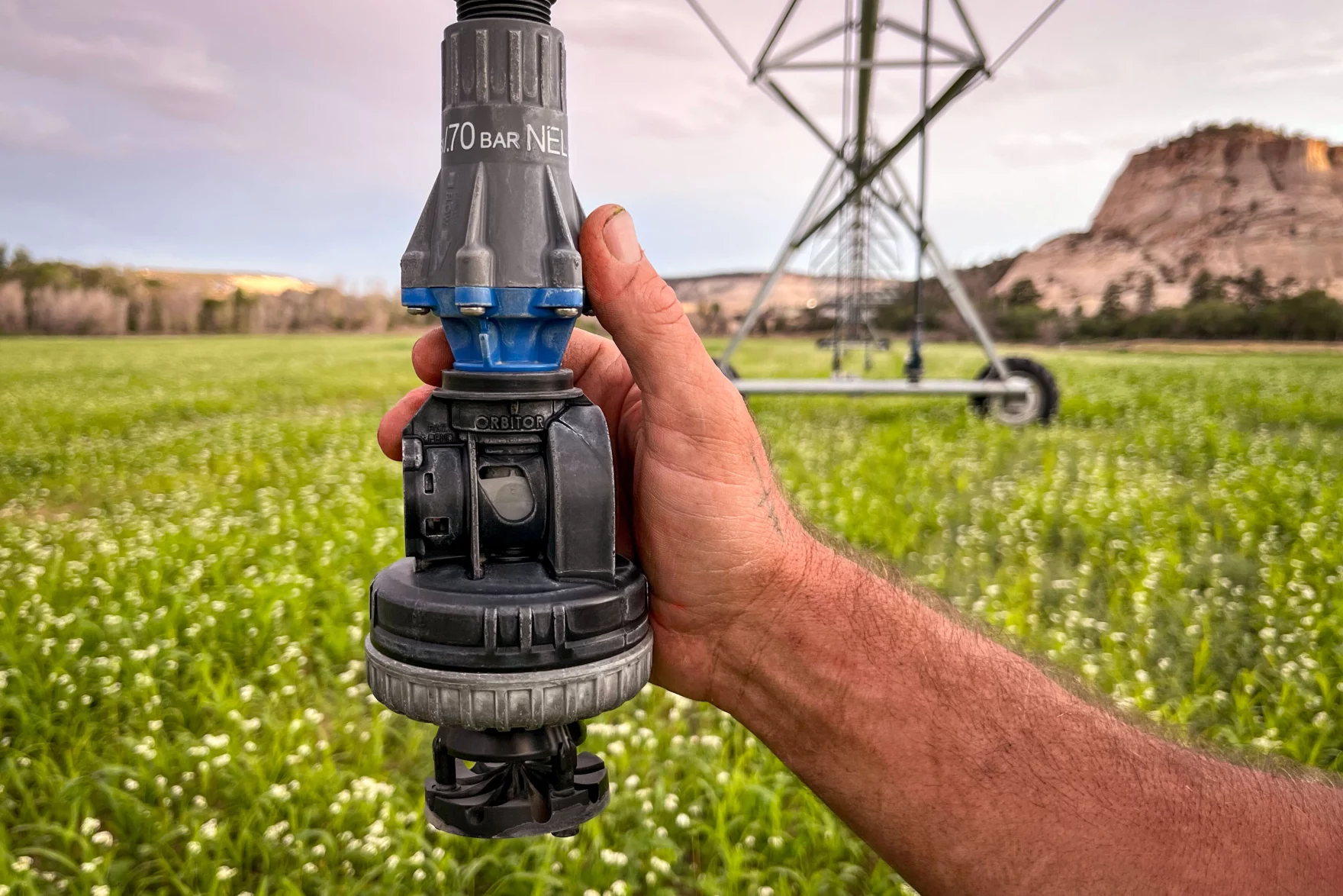
Andy Rice holds one of the nozzles on a center pivot sprinkler system his ranch was able to install thanks to state money, on Aug. 21, 2024. Utah’s Agricultural Water Optimization Program has put millions of dollars into helping farmers and ranchers modernize their irrigation systems since 2019. David Condos/KUER
Agriculture uses between 70-80% of the Colorado River’s water, so a lot of ideas about saving the shrinking river rely on getting farmers and ranchers to cut back. The Utah program — which covers half the cost of buying new, more efficient gear — provides a case study that other Western states might look to as they search for solutions. However, it’s not yet clear how big of a dent these types of efforts can make when it comes to saving water on a basin-wide scale.
Rice stood next to the automated center pivot sprinkler system the program helped buy and grabbed one of the dozens of spray nozzles that dangle a few feet above the ground. Compared to the efficiency of the equipment it replaced, he said, the difference is night and day.
“This farm alone has saved millions of gallons of water. We’re using millions less. And we are one tiny farm in one tiny region,” Rice said.
That’s the idea behind the Utah program. If state money lowers the financial barrier for producers to modernize, the water savings might add up to help Utah get more out of the little moisture it has.
Rice is just one example of the state’s approved projects — 551 of them since the initiative began in 2019, said Program Manager Hannah Freeze. The Utah Legislature has set aside $276 million for the effort. As of late 2024, $108 million of that has been assigned to projects. A majority of the money is benefitting the Great Salt Lake, however. Only $23 million has been approved for 112 projects in Utah’s portion of the Colorado River Basin so far.
It’s a good start, Freeze said, but a drop in the bucket compared to what it might take.
“If we were going to make a real dent or reach the majority of the farmers that we have, it’s more like a $2 billion number,” she said.
That would require more time, too — probably around three decades, Freeze said.
Growing the program that much wouldn’t be easy. Some producers are hesitant to change farming practices. For others, equipment cost remains a barrier even with the subsidy.
Many also don’t know that government incentives like the optimization program exist. A 2023 survey of irrigators across the Colorado River Basin by the Western Landowners Alliance and the University of Wyoming found a “stark lack of awareness” about state and federal funding meant to help them conserve water.
Eventually, farmers won’t have much of a choice, noted Freeze.
“There’s going to be water reductions that have to take place,” she said. “So if we can come in first and say, ‘Let us help you get this improved irrigation system,’ then our farmers can stay in business.”
Sprinklers spray water across farm fields in southern Utah on Aug. 22, 2024. Some research has suggested that improving irrigation efficiency ultimately depletes more water from local watersheds. David Condos/KUER
The Utah program offers a glimpse of what a state-funded program to help producers make that transition can look like.
Some science, however, contradicts the idea that installing new, more efficient irrigation systems automatically means saving water in the Colorado River.
New Mexico State University professor Frank Ward and his colleagues found in their research that applying less water is not the same thing as consuming less water.
Higher irrigation efficiency means a larger percentage of the applied water makes it to the roots of the plants, which is good for crop yields. But even if that lets a farmer decrease the total amount of water they apply to a field, it often increases the amount of water depleted from the local watershed.
Ultimately, he said upgrading sprinkler systems typically means less of the water applied as irrigation soaks into groundwater and returns to nearby rivers as run-off, disrupting the local water cycle.
“Drip irrigation and center pivot are good things to do.They promote the goal of lower food prices, higher food production and farm income,” Ward said. “Just don’t call it investments in water conservation.”
To truly assess if a program like Utah’s is saving water for the Colorado River Basin, he said, you’d need to also calculate how much of the water applied to crops is lost to evapotranspiration, a measurement of the water that evaporates and is released into the air from plants.
In Ward’s view, there are more effective ways a state could spend its money to conserve water in agriculture. Government funds could pay farmers to switch to less thirsty crops or water their fields less than what the crops need for optimal growth. Another option would be to pay growers to temporarily leave some land empty or switch sprinkler-fed farmland to a rain-fed ranching pasture.
A lot of these alternatives might not improve the agricultural economy, Ward said, but that’s a trade-off states need to consider if their ultimate goal is to save water.
Andy Rice explains how the irrigation system updates at his southern Utah ranch have changed the way he uses water on Aug. 21, 2024. David Condos/KUER
When it comes to the Utah optimization program, the results remain a bit hazy.
The state is just beginning to quantify how much water it saves, so comprehensive data isn’t available yet. A legislative audit in 2023 criticized the program for not collecting detailed reports on the impact of its projects.
Early examples like Andy Rice’s ranch, however, point to the potential role that irrigation modernization efforts could play across the West.
All told, Rice said the upgrades to the field with a new sprinkler represent a quarter of a million dollars. For family farms that buy irrigation equipment with the same money they use to keep the business afloat or buy their kids’ shoes, he said it can be hard to justify those costs.
If states across the Colorado River Basin help make it easier for farmers to take that leap, however, he believes that could have far-reaching impacts.
“If hundreds of farms can save millions of gallons of water, I mean, we can fix it,” Rice said. “And do I feel like we have a responsibility to do that? Yeah, hell yeah.”
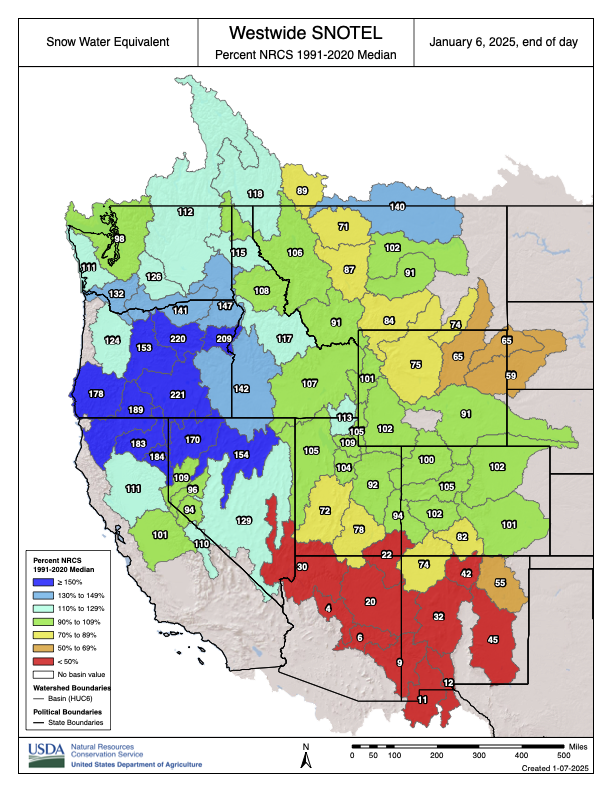
Westwide SNOTEL basin-filled map January 6, 2024 via the NRCS.
Click the link to read the article on the Summit Daily website (Kit Geary). Here’s an excerpt:
January 5, 2025
Summit and Eagle counties are poised to get a consistent dusting of powder nearly everyday this week heading into next weekend, according to National Weather Service meteorologists. Meteorologist Zach Hiris said there will be a “fairly active pattern across the mountains” on Monday, Jan. 6, and Tuesday, Jan. 7, which is likely bring a few inches of snow to the slopes. He said “a bunch of weak systems” could follow from Wednesday through Saturday and these are slated to bring a couple more inches. Summit’s mountains are anticipated see anywhere from 3-6 inches and its valley areas could see 1-3 inches of snow by Wednesday morning, Hiris said. Wednesday, Thursday and Friday could bring an inch or two each, but it will be more sporadic than the snowfall delivered by Monday and Tuesday’s storms, he said.
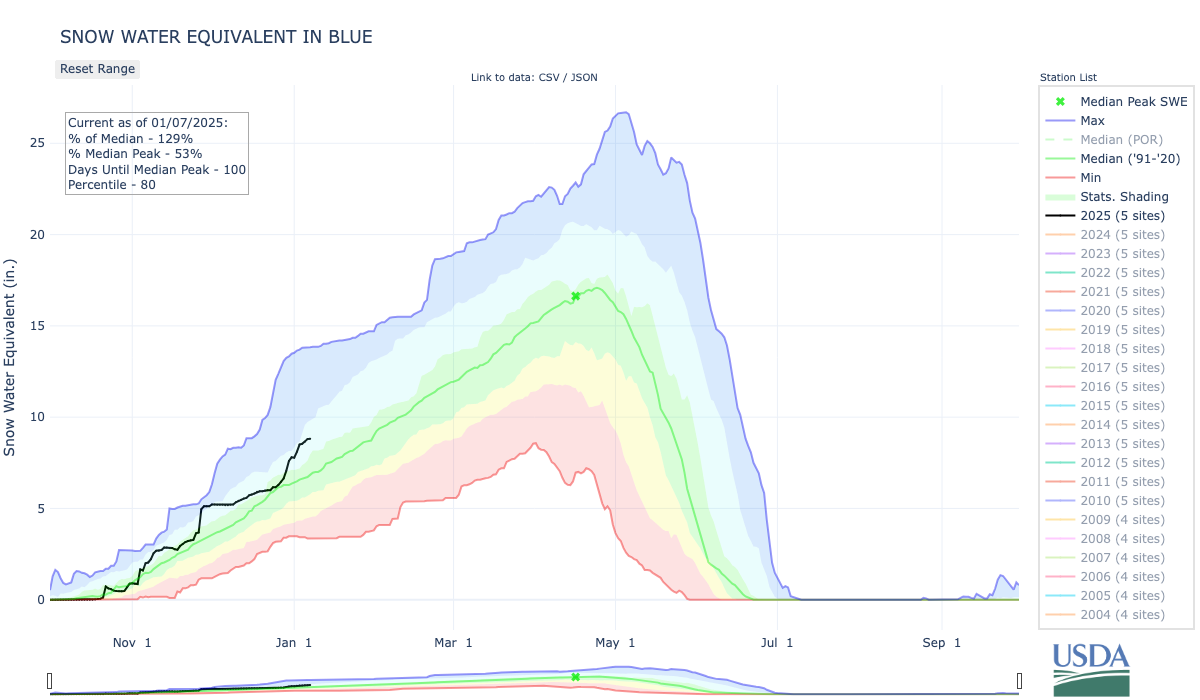
Hiris said the Blue River Basin is currently at 129% of its snowpack median.
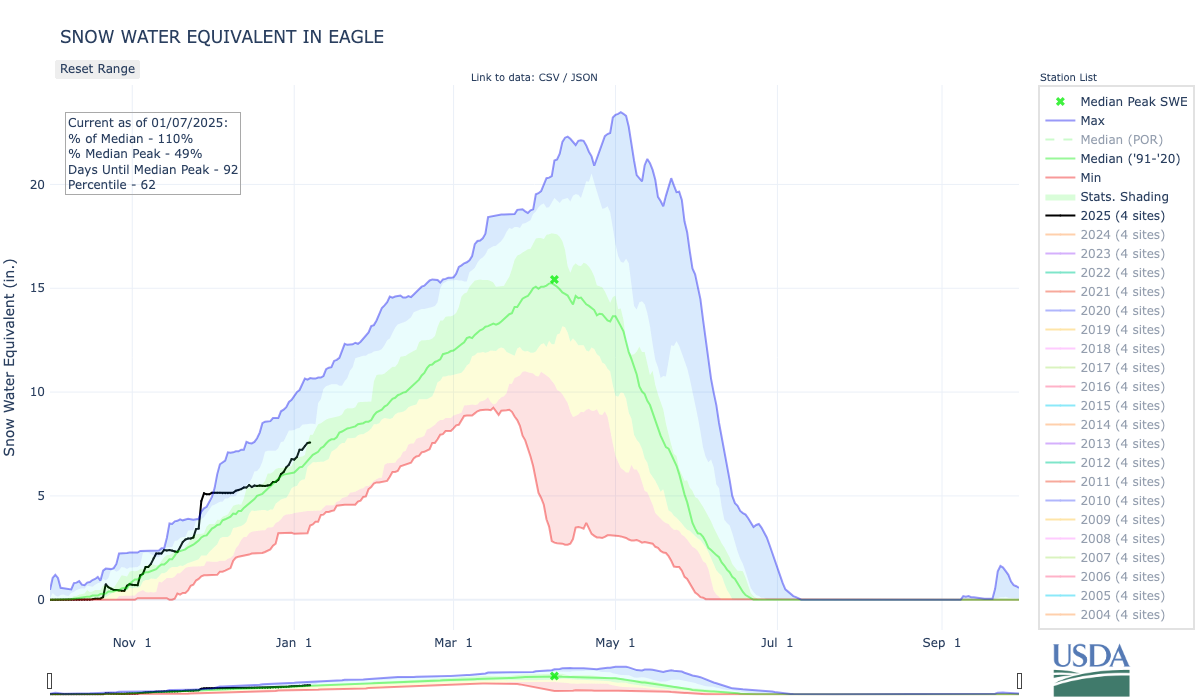
According to the United States Department of Agriculture, the Colorado Headwaters river basin is currently at 104% of its median snowpack, the Eagle area is at 113% of its median snowpack and the Roaring Fork area is at 109% of its median snowpack.
Federal water officials are expected to provide further details in the coming weeks on four proposals for managing the dwindling Colorado River water supply. The current agreement among states expires next year…A pending analysis will detail the benefits and drawbacks of four different plans, said Carly Jerla, the senior program manager at the U.S. Bureau of Reclamation. The analysis will not include any recommendations. The states must reach an agreement on how to allocate the available water by August 2026…
The proposed alternatives include: protecting infrastructure by monitoring how much river water is delivered and using existing agreements when demand overwhelms the supply; adding delivery and storage for Lake Powell and Lake Mead, along with “federal and non-federal storage” to boost system sustainability and flexibility; and a cooperative conservation approach aimed at managing and gauging water releases from Lake Powell amid “shared contributions to sustain system integrity. The fourth proposal would add delivery and storage for lakes Powell and Mead, encourage conservation and agreements for water use among customers and “afford the tribal and non-tribal entities the same ability to use these mechanisms.”
“The preferred alternative isn’t any single one of these alternatives,” Jerla said. “They were constructed to ensure that these concepts were grouped together to allow for the possibility to mix and match.”
[…]
Whatever management path the states agree on, a team of water officials has one concern: the annual set water releases at Glen Canyon Dam. Eric Kuhn, the retired general manager of the Colorado River Water Conservation District, partnered with other water leaders to author a letter to the Bureau of Reclamation asking it to stop the practice of determining water release quantities annually for Glen Canyon Dam in northern Arizona. They agree that water releases must continue. However, they don’t want a set release amount, stressing the flexibility helps with maintaining the ecosystem around the river, specifically the ecosystem around the Grand Canyon…The management approach Kuhn’s team prefers would create two pools: a Lower Basin pool in Lake Powell, the reservoir connected to Glen Canyon Dam; and an Upper Basin pool in Lake Mead, the reservoir connected to Hoover Dam. That would allow for changes in annual releases, if necessary, and offer flexibility, he said.
Map of the Colorado River drainage basin, created using USGS data. By Shannon1 Creative Commons Attribution-Share Alike 4.0
The Upper Colorado and San Juan River Basins Endangered Fish Recovery Programs Reauthorization Act was included in the fiscal year 2025 National Defense Authorization Act. The fish legislation extends programs that protect four threatened and endangered native fish species in the Upper Colorado and San Juan river basins. The defense bill now heads to the president’s desk. The Senate version of the fish bill was sponsored by U.S. Sens. John Hickenlooper and Michael Bennet, both D-Colo., and Sen. Mitt Romney, R-Utah, among others. U.S. Rep. Lauren Boebert, R-Colo., carried a House version of the fish bill. A negotiated version of her bill and the Senate bill ended up being included in the defense bill. The Senate passed the defense bill Monday after passage by the House, despite controversy over a provision banning some gender-affirming care for transgender children of service members, according to a Reuters story.
The fish programs provide for studying, monitoring and stocking the four fish species, managing habitat and river flows, and combating invasive species through 2031. That provides certainty for Upper Basin water use and fulfills the federal government’s trust responsibility to tribes, according to a news release from Hickenlooper’s office…The fish bill language authorizes up to $92 million for the Bureau of Reclamation to contribute annual cost-shared funding for program implementation. It also adds up to $50 million to the authorization ceiling for capital projects, which will fund infrastructure improvements to benefit the fish.
Northern Water Board Director Jennifer Gimbel, left, leads a panel at the Colorado River Water Users Association this month in Las Vegas. L to R: Jennifer Gimbel, Gene Shawcroft, Estevan López, and Brandon Gebhart. Photo credit: Northern Water
A member of the Northern Water Board of Directors played a large role at the annual gathering of Colorado River water officials this month in Las Vegas.
Jennifer Gimbel, who represents Larimer County on the Northern Water Board of Directors and is a senior water policy scholar at Colorado State University, moderated a pair of panel discussions at the Colorado River Water Users Association (CRWUA) annual conference about the current state of negotiations on new guidelines for the operations of Lake Powell and Lake Mead.
Gimbel helped negotiators from the Upper Basin states of Colorado, New Mexico, Utah and Wyoming outline their concerns, and in a second panel, did the same for negotiators for the Lower Basin states of Arizona, California and Nevada.
For the 1,000-plus attendees of the conference, it was an opportunity to learn more about what will guide future discussions about use of Colorado River water throughout the Southwestern United States.
Northern Water is a member of CRWUA and engages with other Colorado River users throughout the year.
In photo from second left: Gene Shawcroft of Utah, Estevan Lopez of New Mexico, Becky Mitchell of Colorado and Brandon Gebhart of Wyoming.
An area chapter of Trout Unlimited recently partnered with a landowner to restore a portion of the West Fork of the Dolores River their property borders…Besides the West Fork’s beauty, it’s the largest tributary of the Lower Dolores. It’s also home to all four kinds of trout, including the only one native to Colorado, the cutthroat…
Over time, modern practices and a change of land use along the riverbanks – such as ranching, grazing, or simply cutting out big fields – has resulted in less and less “large woody debris” falling into the river, Rose said. That debris is not only a source of food, it also can be something of an anchor to slow down the water flow, and to offer fish and other critters a refuge.
In effect, the restoration project was in the name of something Rose called “structural complexity.”
“That’s the most important term you’ll pick up in this whole project,” Rose said. “If you don’t have complexity and have homogeneity, you don’t have the richness you need to accommodate all of the aquatic co-evolutions.”
To create this structural complexity – and put simply – the project involved strategically arranging big boulders in different ways and places along the stretch of river.
October snows above Ouray, Colorado. The Red Mountain Pass SNOTEL showed the snowpack to be 103% of normal as of Jan. 2, 2025. Jonathan P. Thompson photo.
Click the link to read the article on the Land Desk website (Jonatan P. Thompson):
January 3, 2025
🥵 Aridification Watch 🐫
Happy New Year! The Land Desk had a very mellow and relaxing couple of weeks off, and I must admit that I’m struggling to get back into the old routine. And I sure as heck haven’t gotten used to writing “2025” yet. Oy.
But no matter what the calendar may say, we’re one-fourth of the way through the 2025 water year, and one-third of the way through meteorological winter. That means it’s time for a little snowpack update.
Snowpack levels in the watersheds that feed Lake Powell are just about normal for this time of year, thanks to some late-December storms across the region. But as you can see from 2023 (the purple line), there’s plenty of time left for it to be a huge snow year — or a downright crappy one if the precipitation suddenly stops. Source: NRCS.
This snow season got off to a rip-roaring start in much of the West, with some substantial high-country snowfall back in October and November. Then, as is often the case, someone turned off the big sky spigot, the clouds cleared, temperatures warmed, and the early season bounty became mid-winter middling to meager. Meanwhile, the high-mountain snow, while not necessarily melting, began “rotting.” That is, it embarked on the metamorphosis from strong, well-bonded snow, to weak, faceted, depth hoar1.
That’s a problem, because when another layer of snow falls on top of it, the weak layer is prone to failure, resulting in an avalanche. Sadly, avalanches have taken the lives of four people so far this season, all during the last couple of weeks in December. Two of the fatalities occurred in Utah and one in Nevada, all following a late December storm atop a deep, weak layer. The other one was in Idaho on Dec. 15. Two of the victims were on motorized snowbikes, one was a solo split-boarder, and another was on foot or snowshoes. Last season there were 16 avalanche-related fatalities across the West, all occurring after the first of the year.
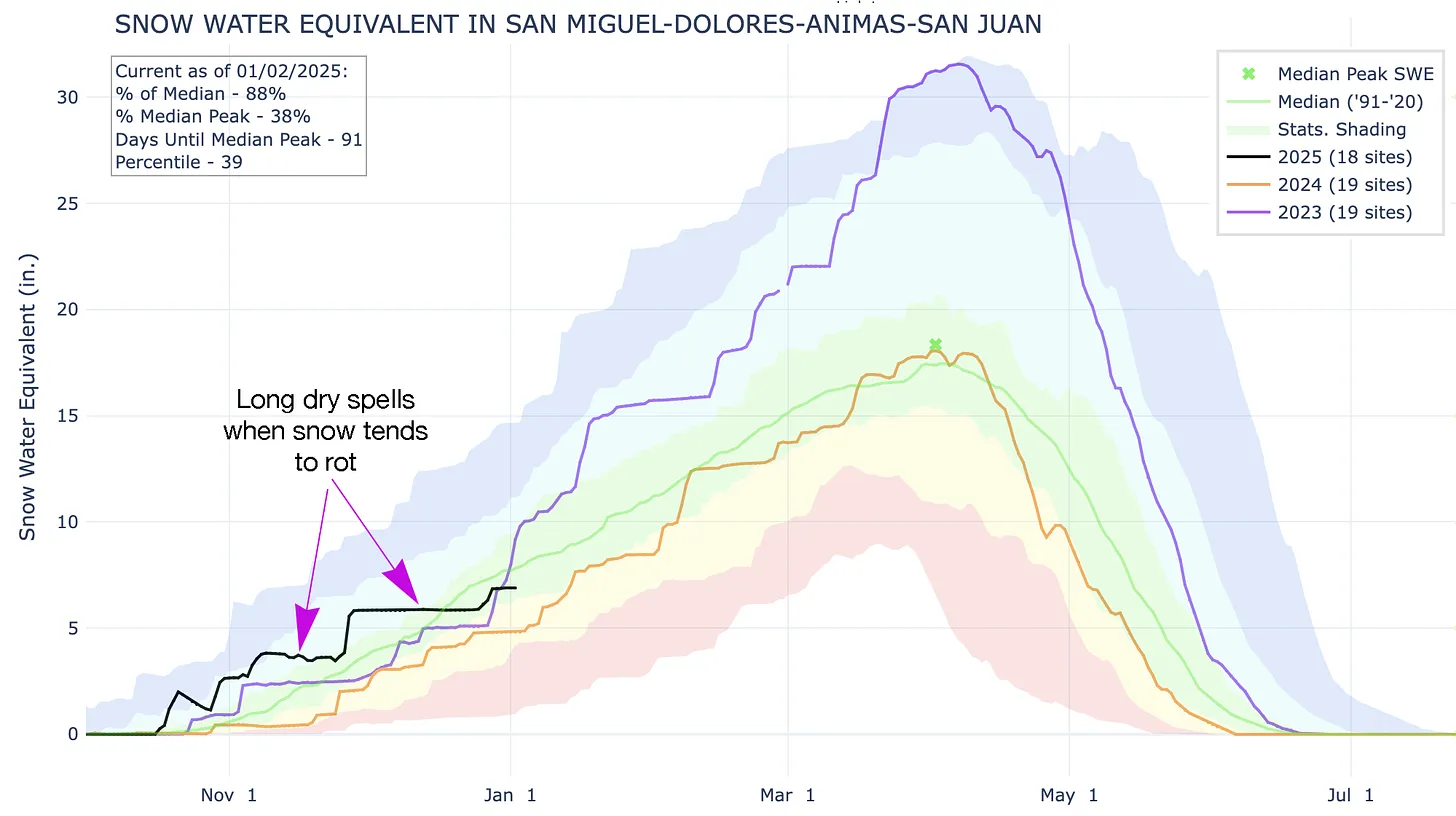
Southwestern Colorado got some good dumps in October and November, pushing the snowpack far above average and into the 90th percentile. But a dry December brought snowpack levels down below “normal” for the 1991-2020 period. Still, this year’s levels almost mirror 2023’s, when snow season didn’t get going until January. Source: NRCS.
Meanwhile, further south, the Sonoran Avalanche Center hasn’t had much action this season, at least not of the snowy kind. Most of the Southwest has been plagued by a dearth of snowfall — and precipitation in general — following a couple good storms in October and November. Temperatures have also been well above average in the southern lowlands. Phoenix set four daily high-temperature records in December, and the average for the month was a whopping seven degrees above normal; Flagstaff was also far warmer than normal and received nary a drop of rain or snow during all of December. And Las Vegas hasn’t received measurable rainfall since it got a bit damp (.08 inches) in mid-July.
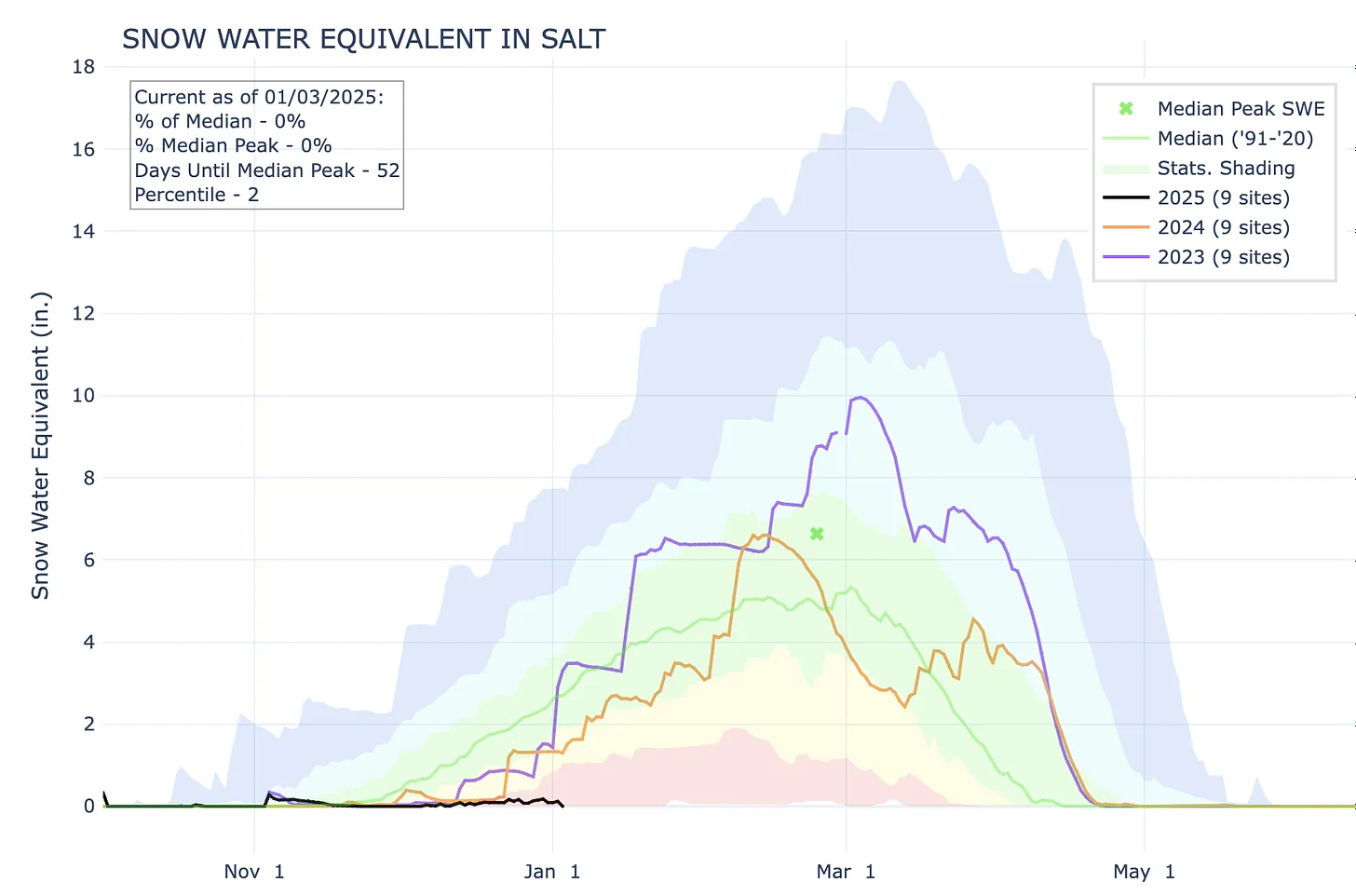
The Salt River watershed in central Arizona has received hardly any snow so far this year and continues to lag far behind the 2023 and 2024 water years. The lack of moisture and unusually high temperatures in December don’t bode well for the region’s runoff. Source: NRCS.
The Rio Grande’s headwaters also started out strong, but have dropped below normal.
Things were looking pretty grim in western Wyoming’s Upper Green River watershed until December snows pushed the snowpack almost up to normal for this time of year. The entire state was quite dry last year and it’s looking like the drought will persist there.
This does not bode well for spring streamflows, particularly in the Salt and Gila Rivers. The mountains feeding the Rio Grande also are in need of some good storms to keep that river from going dry this summer.
We can take comfort in the fact that in many places in the West, snow-season doesn’t really arrive until February or March. So this could turn out to be a whopper of a winter yet.
The drought situation a year ago (left) and now (right). While drought has subsided in New Mexico and the Four Corners area, it has intensified dramatically in Wyoming, Montana, parts of Idaho and a swath that follows the lower Colorado River and includes Las Vegas, which has only received .08” of precipitation since April of last year. Source: U.S. Drought Monitor.
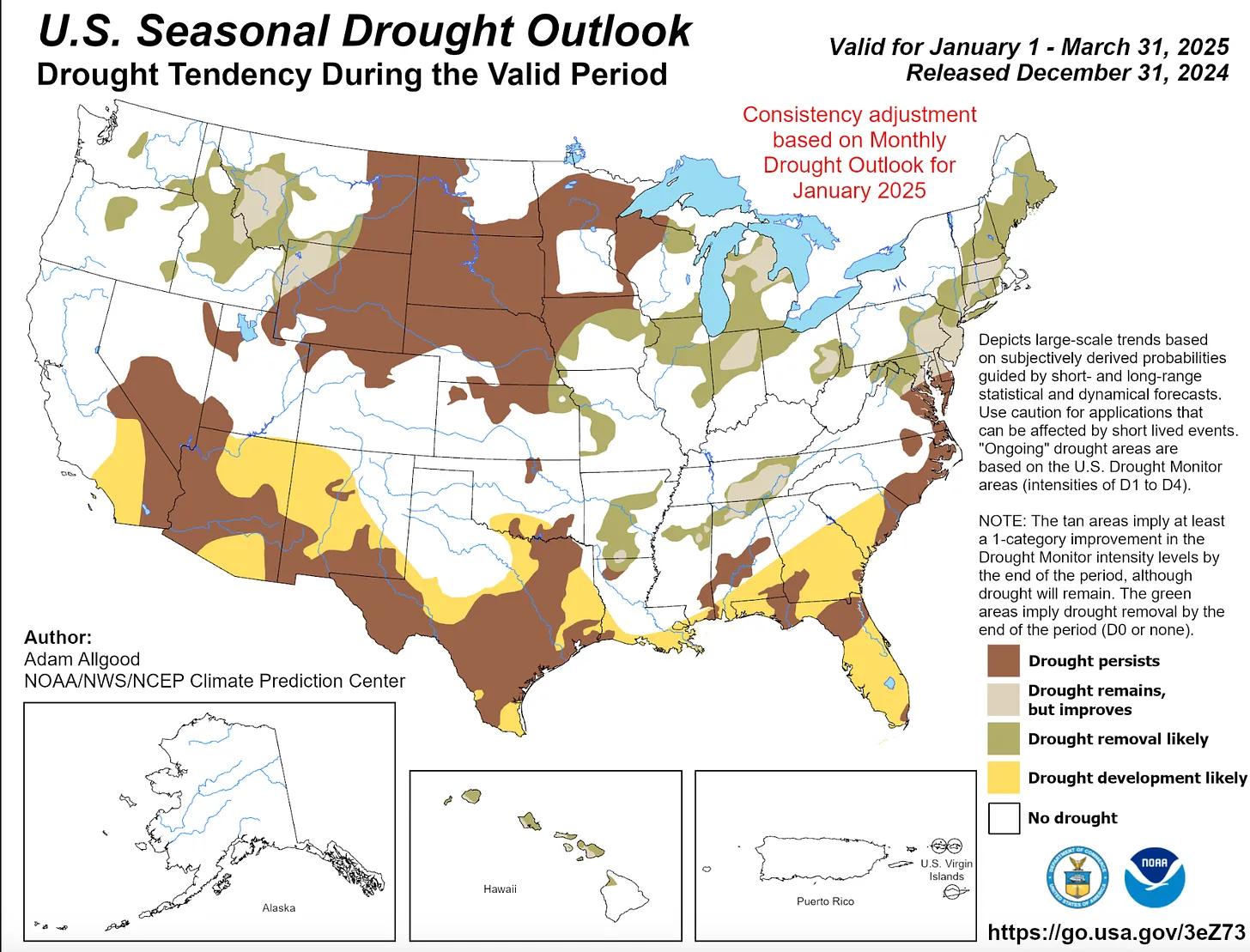
For now it looks like there’s no relief in sight for the Southwest or the Northern Rockies.
🌵 Public Lands 🌲
Biden’s getting busy as he prepares to vacate the White House. The Los Angeles Times reports that he plans to designate the Chuckwalla National Monument on 644,000 acres of federal land in southern California, and the Sáttítla National Monument on 200,000 acres in the northern part of the state near the Oregon border. That’s what I’m talkin’ about, Joe! Now do the lower Dolores!
🦫 Wildlife Watch 🦅
The soon-to-be Chuckwalla National Monument lies south of and adjacent to Joshua Tree National Park, an area often targeted by utility-scale solar developers. That’s the sort of development that will now be banned there. Not only will cultural sites be protected, but also wildlife. A new study found that some of the Southwest’s best sites for solar overlap critical habitat for vulnerable species, including in most of southern California.
***
The U.S. Fish and Wildlife Service is seeking any information on the killing of a gray wolf in Grand County, Colorado, in summer of 2024. The wolf, 2309-OR, was part of the Copper Creek pack that was captured by wildlife officials in August, after members of the pack had made a meal out of local ranchers’ livestock. 2309-OR was in bad condition and perished in captivity; a subsequent investigation found that he died of a gunshot wound. It’s illegal to kill wolves in Colorado, not to mention immoral and just a horrible thing to do. The Center for Biological Diversity and other conservation organizations are offering a $65,000 reward for information leading to the arrest and conviction of the shooter.
📸 Parting Shot 🎞️
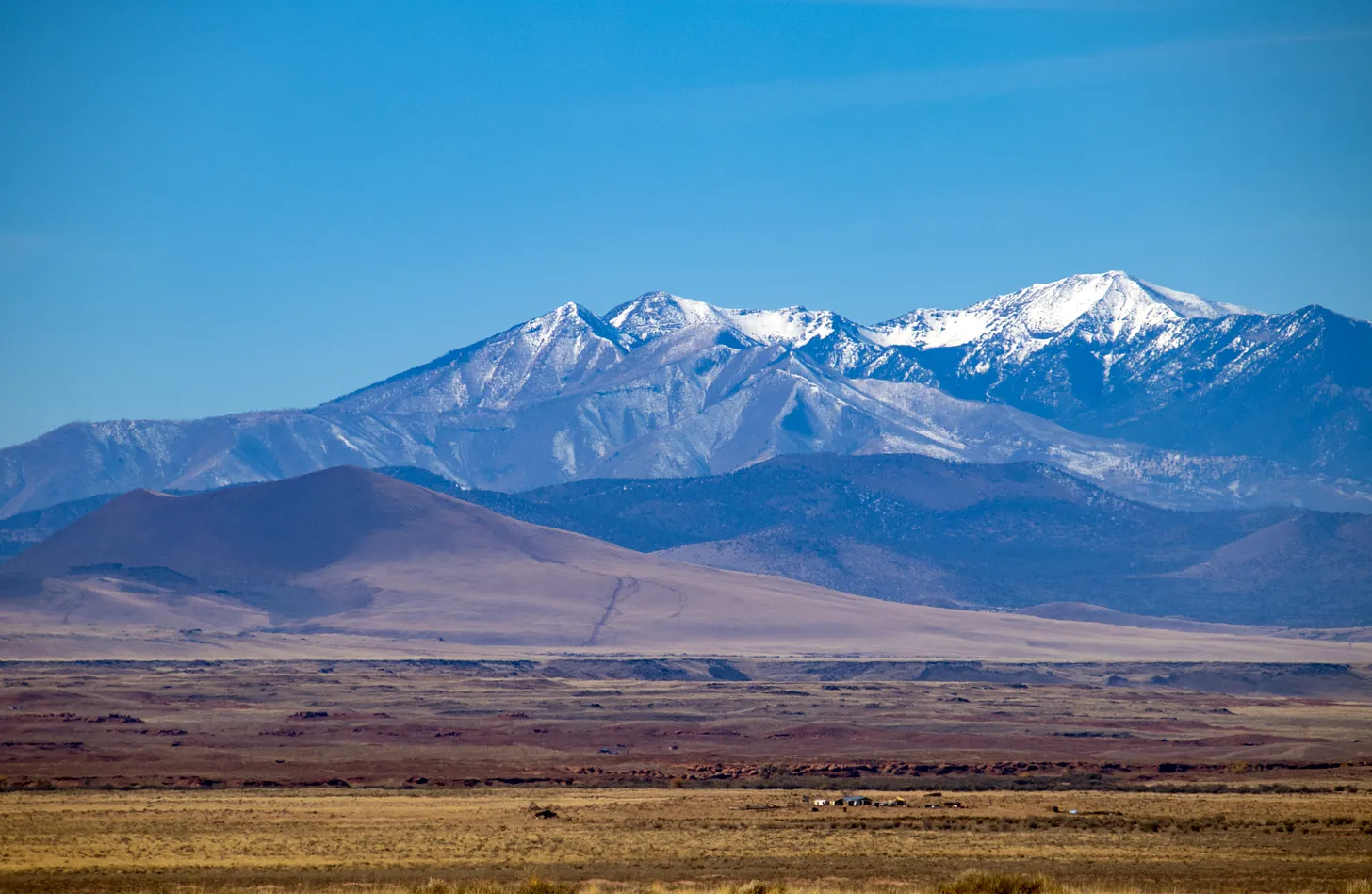
San Francisco Peaks near Flagstaff, Arizona, in mid-November. They had a bit of snow from earlier storms, but haven’t received much since. The Snowslide Canyon SNOTEL site at 9,744 feet in elevation is recording 65% of normal snow water equivalent. Jonathan P. Thompson photo.
1 Andy Gleason, snow nerd extraordinaire, explained it like this after record-high avalanche fatalities during the relatively scant 2021 snow year :
Some people say that the movement toward renewable energy cannot be stopped by a single regressive administration. But Colorado could be badly harmed if its efforts to transition to clean energy are put on hold. Millions of dollars in investments for rural co-ops, community-based solar, and grid hardening could be in jeopardy, striking a heavy blow to our more resilient future. Worse still, that’s only one piece of what could be coming under a new federal regime.
Colorado’s public lands and water supplies are also in grave peril under the incoming Congress and president. This is despite decades of hard, locally-driven work to secure protections for vital headwaters, hunting lands, forests and habitat, many from a century-long history of extraction. And it’s regardless of rapid warming, persistent drought and an imperiled Colorado River system with no good solutions in sight.
Healthy natural systems guard against ecological collapse. But now various environmental tipping points, that moment in a system where it moves into a new norm and change becomes irreversible, appear at their most precarious moments. During 2024 humans pumped out more climate-choking pollution than ever before. That’s almost 10 years after the acclaimed Paris Agreement, which our president-elect and his cabinet have vowed to abandon.
Global warming presents a clear and present danger to all our livelihoods and well-being. And the United States is already the No. 1 oil and gas producer in the world and a top polluter behind only China. 2024 is likely to be the hottest year ever recorded. Without the sufficient response we careen toward calamity. To meet this moment, the incoming administration and Congress have pledged to pollute more and care less.
That is bad news not only for our lands and water supplies, but for the economic future, too. Our ledgers will already never be free of climate risk. Which is why the debate at the global climate summits is now about who ends up with the bill for loss and damages done and coming. That matters here, too: A recent study correlates rising insurance costs with climate vulnerability and puts much of Colorado in the dark red hazard zone.
In a state where housing is increasingly unaffordable, putting science deniers in charge of our future is just a bad idea. Moving federal agency offices or installing Colorado-based cabinet-members won’t matter if the new administration is just rearranging deck chairs to ensure its patrons have the best seats to watch this escalating disaster.
In fact, fossil fuel “dominance” could make a mess of Colorado, as it does most places it asserts itself. This puts at risk our lands and communities with oil trains, backdoor schemes to subsidize legacy polluters, policies that favor extraction over conservation, and more pipelines for more fracked gas exports. The alternative to slamming head on into a worst future is to stop the harm now and to make systems more resilient to coming disruptions. That means less fossil energy and more conservation of natural places. [ed. emphasis mine]
Milkweed, sweet peas, and a plethora of other flora billow from Farmer’s Ditch in the North Fork Valley of western Colorado. Jonathan P. Thompson photo.
Standing up for Colorado’s liveable future means fighting the expansion of fossil fuel infrastructure and defending places Coloradans have fought for decades to protect – such as Thompson Divide, the Dolores River canyons, or the forests and public lands surrounding critical watersheds and farmlands in places like the North Fork Valley.
That will best limit the extent of further harm and will better secure our natural capital as a hedge against future disruption. By investing in ecological systems through resilient watersheds and healthy lands we guard against uncertainty. By defending these cherished places, we will keep intact critical sources of sustenance and enjoyment for the future and return dividends to those who live, work, and visit here today.
The Dolores River, below Slickrock, and above Bedrock. The Dolores River Canyon is included in a proposed National Conservation Area. Photo: Brent Gardner-Smith/Aspen Journalism.
Green River Lakes and the Bridger Wilderness. Forest Service, USDA, Public domain, via Wikimedia Commons
Click the link to read the article on the KUER website (David Condos). Here’s an excerpt:
December 18, 2024
Across Utah, farmers are experimenting with ways to tighten their water use as agriculture, drought and population growth collide to put pressure on the state’s limited water resources. Some are installing more efficient irrigation technology. Others are testing unconventional crops. In Hunt’s case, he’s taking some of his farmland out of commission entirely — for a time and for a price…For the past two years, [Coby] Hunt has taken part in a federal program that pays farmers to temporarily leave their fields empty and lease the conserved water to the government. It’s something that has been going on for years across the Colorado River Basin. Now, Utah is launching its version of that effort. The new multimillion-dollar plan incentivizes conservation and aims to do a better job of tracking that saved water in hopes of getting credit for it in future Colorado River dealings. The practice of leaving a field idle for a season is called fallowing, and Hunt conceded it’s not for everyone.
“Some of the farmers don’t like it. In fact, they don’t like me for leasing my water.”
[…]
Many don’t want the feds involved in their business, he said, or worry the government might take their water permanently if they show they can get by without it. For farmers who grow other crops, like Green River’s famed melons, he said it might not make financial sense to sit out a year and lose your customer base…Hunt usually grows feed for the cattle he raises, so he’s still had plenty to do while this 30-acre field sits empty. Fallowing has just meant he needs to buy hay from elsewhere. He feels good about the amount of water it saves, too. His water right would typically allow him to use six acre-feet of water a year, he said — enough to cover Hunt and the acre he’s standing on over his head. Because his fields are some of the last ones upstream from Lake Powell, it’s easy to imagine the water he conserves making it to the reservoir. That’s why farmers like Hunt are vital to Utah’s new effort to conserve more Colorado River water, called the Demand Management Pilot Program. What’s novel about it is how it will track and document the water savings.
Dusk falls on Lake Powell near Bullfrog Marina on July 15, 2024. The fate of the nation’s two largest reservoirs is still undetermined after a year full of disagreement and uncertainty among the Colorado River’s top policymakers. Photo credit: Alex Hager/KUNC
Click the link to read the article on the KUNC website (Alex Hager):
December 26, 2024
This story is part of ongoing coverage of the Colorado River, produced by KUNC in Colorado and supported by the Walton Family Foundation. KUNC is solely responsible for its editorial coverage.
This year was a bumpy ride for the Colorado River.As 2024 comes to a close, we’re looking at the stories that defined the water supply for 40 million people. Deep divisions between policymakers set the stage for deep uncertainty from Wyoming to Mexico, and those who use Colorado River water are hoping for some more clarity in the years to come. But with an unpredictable new president heading to the White House, they may end up with more questions than answers.
Visit the linked stories below to learn how the year unfolded.
Early disagreement
The biggest headlines of the year came early on the calendar. In March, seven states that use the Colorado River laid bare the deep divisions between them. The rules for sharing its water expire in 2026, and state leaders are under pressure to agree on new guidelines.
Instead of agreeing, they split into two camps and released competing proposals for managing water. The river is shrinking due to climate change, and states need to rein in their demand. Who exactly should cut back on their water use, though, is at the heart of their disagreement.
Shortly after the two state proposals, a group of native tribes released their ownsuggestions for managing the river. A coalition of conservation groups did the same.
Paying for conservation
Discord between the negotiators shaping the river’s future highlighted the need for farm districts and cities to get their own houses in order. Agriculture uses between 70-80% of the river’s water, and much of the pressure to conserve the river falls on farms and ranches.
From the river’s single largest water user in Southern California to tiny family farms in rural Wyoming, the federal government experimented with programs that paid farmers to use less water.
In the Imperial Valley, about two hours inland from San Diego, the farm district inked a deal to take more than $500 million from the Inflation Reduction Act. In exchange, the area’s farmers would leave some water in the nation’s largest reservoir, Lake Mead.
A ditch runs dry through Leslie Hagenstein’s fields near Pinedale, Wyo. on Mar. 27, 2024. Through the federally-funded System Conservation Pilot Program, she was able to make 13 times more than she would have by leasing her fields out to grow hay. CREDIT: ALEX HAGER/KUNC
Meanwhile, a smaller program in the Colorado River’s Upper Basin states – Colorado, Utah, Wyoming and New Mexico did something similar. It paid farmers and ranchers to cut back on water use, but some policy analysts say the program lacks a clear plan for the future.
Cities prepare for a drier future
Cities and suburbs, especially in the driest parts of the Colorado River Basin, are taking matters into their own hands. In an effort to buy some certainty against a future that might see their water allocations get smaller, municipal leaders in Arizona chipped away at multibillion-dollar engineering projects to stretch out their existing water supplies.
In the Phoenix area, cities large and small worked towards a dam expansion that would help them capture more snowmelt from mountains to the north. Some made progress on “water recycling” facilities that can clean up sewage and turn it back into drinking water. Similar efforts are underway in other states, too.
Canyons come back
The past few years have seen dramatically low water levels at the nation’s two largest reservoirs – Lake Mead and Lake Powell – which are both filled by the Colorado River. While that has caused concern for the water managers who want to keep taps and crop sprinklers flowing across the region, some environmental advocates are celebrating the return of habitats that had been submerged for decades.
Now that some portions of Lake Powell have been above water for more than 20 years, scientists are able to study the kind of plants and animals that are repopulating the once-underwater canyons. One study found that it’s mostly native vegetation coming back.
Mexico waits for more water
Uncertainty over the river’s future doesn’t stop at America’s border. In the Colorado River Delta, where the river once reached the sea, environmental groups have created islands of green in the middle of an otherwise barren, dusty landscape.
The Colorado River flows through El Chausse, a restoration site in northeastern Mexico, on October 26, 2024. Photo credit: Alex Hager/KUNC/Lighthawk
The future of those oases depends on negotiations between the U.S. and Mexico. In the past, they’ve designated water specifically for ecological restoration. Conservationists hope they’ll do the same again.
Looking into the past and the future
While this year’s tense negotiations generated frequent headlines about the river’s present, 2024 also provided an opportunity to see how today’s talks are influenced by the past.
A major point of contention between the rival groups of states hinged on the language of a 1922 legal agreement about sharing water. Three words written over a century ago are still shaping the nature of discussions over the river’s future.
Meanwhile, some people watching the negotiations are keeping up a steady drumbeat of calls for ambitious new engineering projects that would secure more water for the Colorado River’s future. The tantalizingly simple solution of piping water from the eastern U.S. to the West just won’t seem to go away, but water experts broadly agree that it’s impractical.
Frustration in the basin
In December, after state leaders had been entrenched in disagreement for months, many involved in Colorado River management grew frustrated. Some commentators voiced those feelings to KUNC ahead of the biggest annual occasion on the Colorado River calendar – a series of meetings in Las Vegas where the public can hear directly from top negotiators.
Water policymakers from (left to right) Utah, New Mexico, Colorado and Wyoming speak on a panel at the Colorado River Water Users Association conference in Las Vegas on December 5, 2024. State leaders are deeply divided on how to share the shrinking water supply, and made little progress to bridge that divide at the annual meetings. Photo credit: Alex Hager/KUNC
“I find it really frustrating to watch them just continue to bicker back and forth rather than coming up with any realistic solutions for the problems that we’re facing,” said Teal Lehto, an environmental activist who goes by WesternWaterGirl on social media.
A Las Vegas showdown
At those meetings in Las Vegas, states made little progress in their negotiations, still mostly sticking to the same points they unveiled in their march proposals. States shared stern words and talked of compromise, but struggled to find common ground.
Awaiting change in the White House
As the year comes to a close, Donald Trump’s return to the White House poses a big question mark for those with a stake in the Colorado River. State negotiators say they do not expect the administration change to shake up their talks, pointing to a pattern of previous presidents leaving water management work mostly to technical experts.
At the same time, some water users worry that Trump may cut spending for water-saving programs that have helped boost the nation’s largest reservoirs during the past few years. Without the federal spending that was set aside by the Inflation Reduction Act, water managers may be forced to come up with new water conservation strategies in 2025.
Drops wastewater rate increase from 30 percent to 10 percent
At a Dec. 20 special meeting, the Pagosa Area Water and Sanitation District (PAWSD) Board of Directors approved the district’s 2025 budget…The 2025 budget includes $1,345,822 in revenues for the PAWSD general fund, primarily from property taxes, and $1,647,189 in expenditures, a 20 percent increase from 2024…The budget indicates that legal and professional spending, as well as spending on maintenance and computer support and upgrades, are anticipated to increase in 2025…
The general fund balance at the end of 2025 is projected to be $1,448,928, down 17 percent from the end of 2024…The PAWSD water enterprise fund is projected to receive $33,450,308 in revenues, including $5,609,336 in service charge revenue, $1 million in capital investment fee (CIF) and raw water acquisition fee revenue, and $25.2 million in loan proceeds, which will be used for the continued construction of the Snowball Water Treatment Plant expansion. Overall, revenues for the fund are projected to rise 5 percent from 2024. Expenditures for the fund are budgeted at $35,934,411, an 18 per-cent increase from 2024
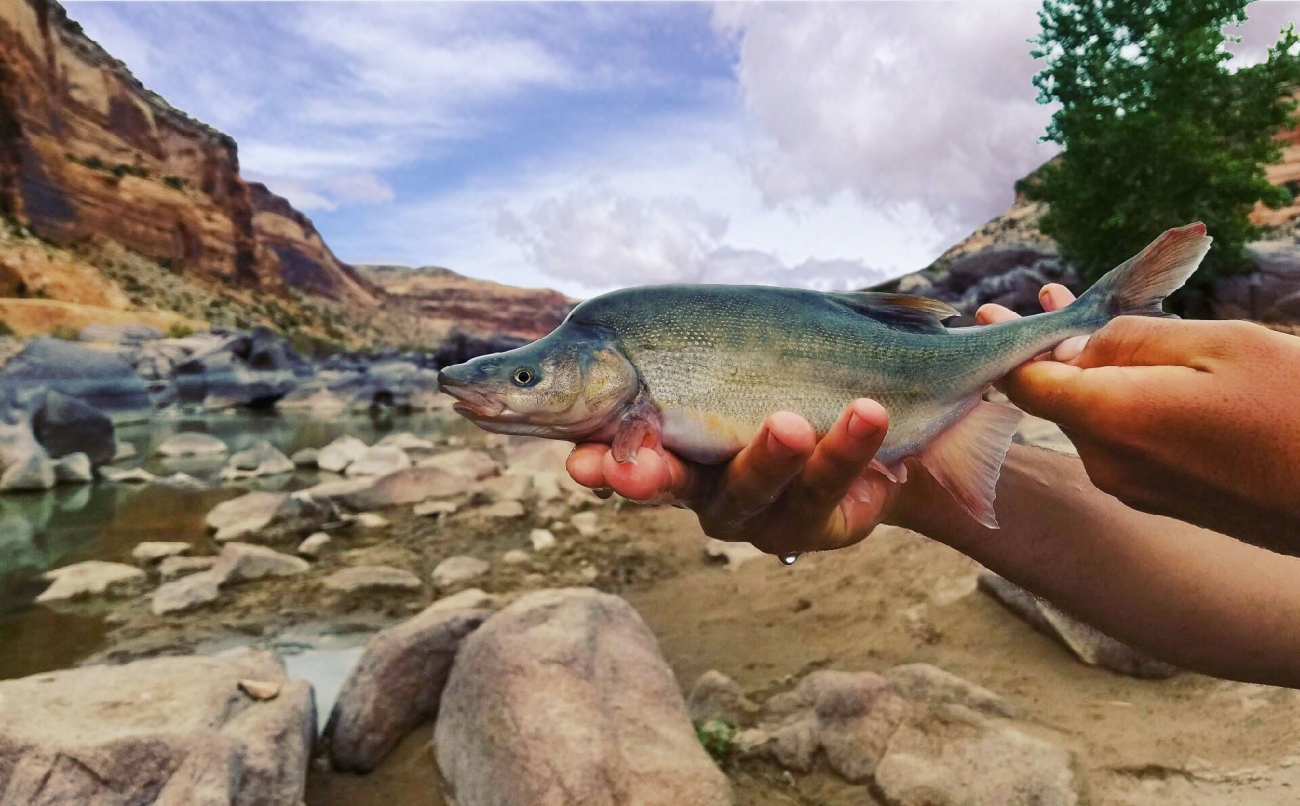
The threatened Humpback Chub is one of four fish species that programs in Colorado and other Western states have been working to recover for nearly three decades. U.S. Fish and Wildlife Service/ Courtesy Photo
For nearly three decades, Colorado and other Western states have been working to recover several species of endangered fish in the Colorado and San Juan river basins. Congress last week approved a bill that will renew the program’s federal funding for seven more years. The bill was included in the 2025 National Defense Authorization Act, which is heading to President Joe Biden’s desk. Sens. John Hickenlooper, D-Colo., and Mitt Romney, R-Utah, sponsored the fish recovery program’s reauthorization act. Rep. Lauren Boebert, R-Colo., sponsored the bill in the House.
“Local communities, Tribes, water users, and Congress — we’re all in to protect our native fish and rivers,” Hickenlooper stated in a news release. “These programs are tried and true. Our extension will help continue them to save our fish and make our rivers healthier.”
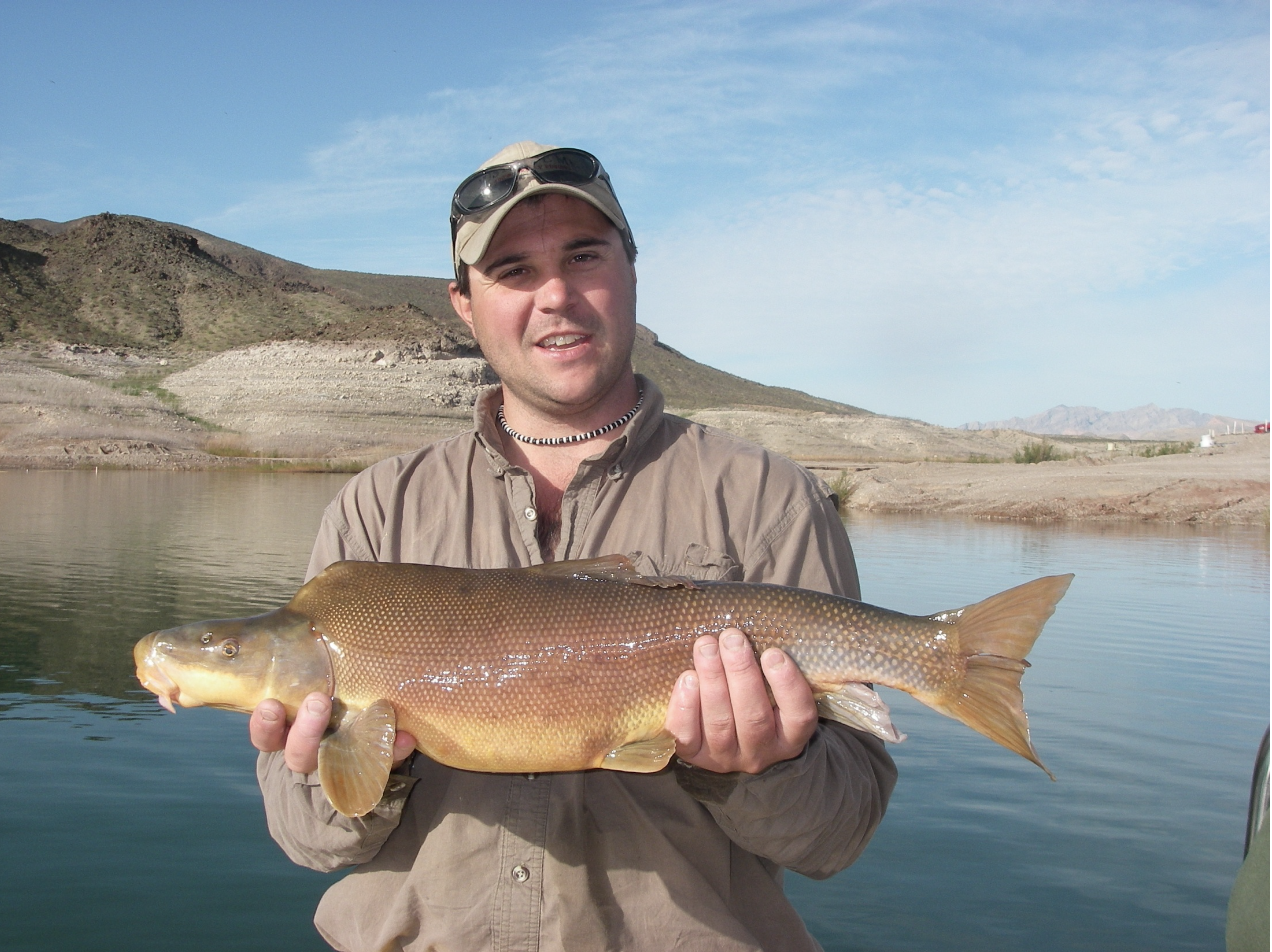
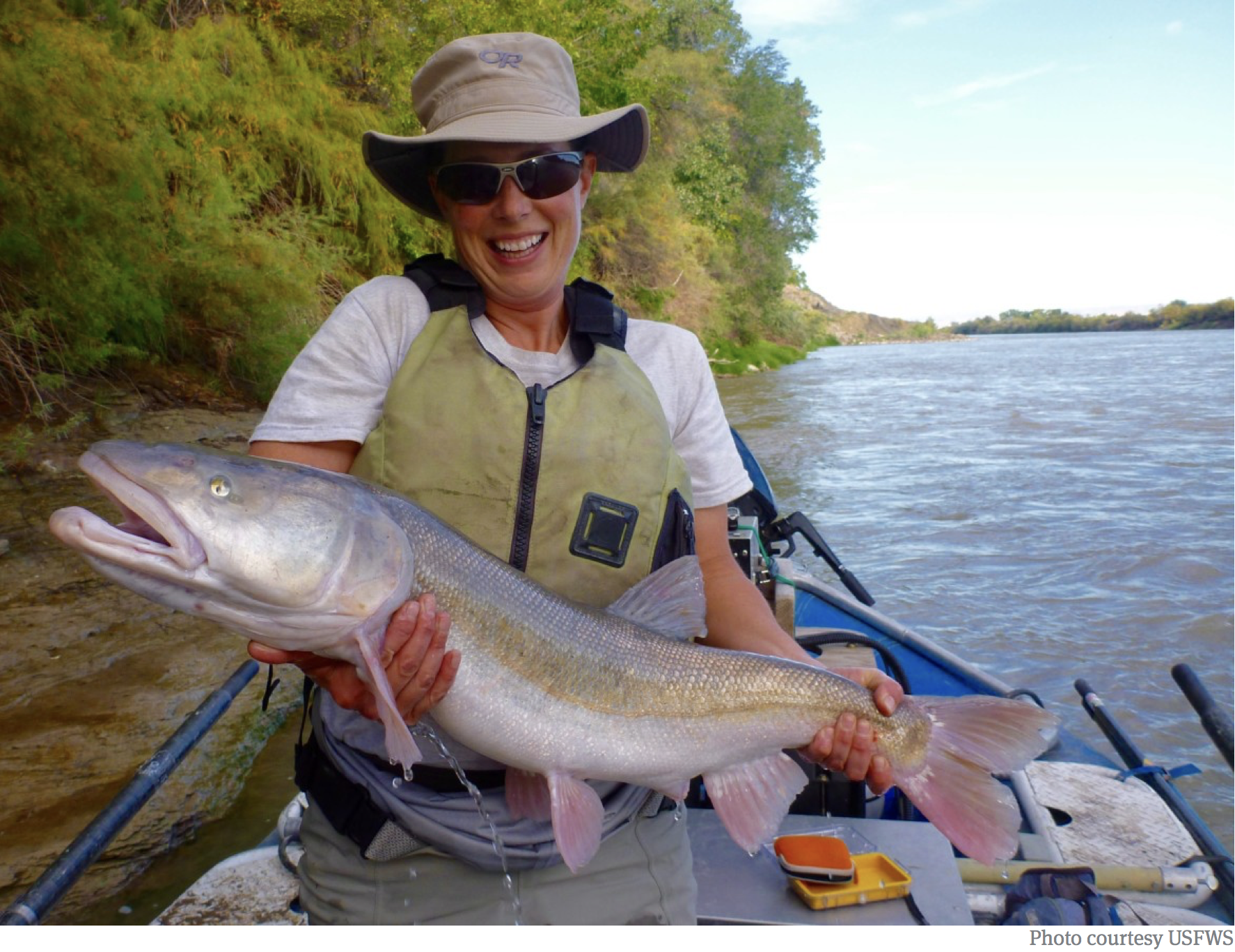
Federal authorization for the two fish recovery programs — the Upper Colorado River Endangered Fish Recovery in Colorado, Utah and Wyoming as well as the San Juan Recovery Implementation Program in Colorado and New Mexico — expired this September. The reauthorization act, however, will extend the programs through 2031, authorizing the U.S. Bureau of Reclamation to contribute up to $92 million in the next seven years. The bill also adds up to $50 million for capital projects that support infrastructure improvements to recover the threatened and endangered species…The annual operating costs for the programs were historically funded by Colorado River Storage Project hydropower revenues, which have diminished over time due to drought, declining reservoir storage, increased costs and more, according to a September Colorado Water Conservation board memo. This has required the federal and state appropriations and contributions to increase to cover costs, it adds. The fish recovery programs also rely on in-kind contributions and funding from other partners. Both programs have sought to recover populations of four species — the humpback chub, razorback sucker, Colorado pikeminnow and bonytail fish — in these basins. When the Upper Colorado and San Juan programs were established in 1988 and 1992, all four species faced extinction, but they have seen some success.
The Gold King Mine’s level 7 adit and waste rock dump, boarding house, and other associated structures, circa 1906. Via the Land Desk
Click the link to read the article on the Land Desk website (Jonathan P. Thompson):
December 13, 2024
⛏️Mining Monitor ⛏️
The News: After decades of trying, Congress finally passed a “good samaritan” mine remediation bill that could help nonprofits and other non-governmental organizations clean up abandoned mining sites.
The Context: In 1994, the state of Colorado, with the help of Bill Simon and other volunteers, launched the Animas River Stakeholders Group to study and address abandoned mines in the upper Animas River watershed. It would be a collaborative approach — without heavy-handed regulations or the dreaded Superfund designation. “We figured we could empower the people in the community to do the job without top-down management,” Simon told me back in 2016. “Giving the power to the people develops stewardship for the resource, and that’s particularly useful in this day and age.”
Their task was a monumental one: The US Geological Survey has catalogued some 5,400 mine shafts, adits, tunnels, and prospects in the upper Animas watershed. Nearly 400 of them were found to have some impact on water quality, about 60 of which were major polluters, contributing about 90% of the mining-related heavy metal loading in streams. Dozens of abandoned mine adits collectively oozed more than 436,000 pounds of aluminum, cadmium, copper, iron, and zinc into the watershed each year, with waste rock and tailings piles contributing another 80,000 pounds annually.1
The upper Animas isn’t unusual in this respect. A 2020 Government Accountability Office report estimated that there are more than 500,000 abandoned mining-related sites and features across the Western United States. While most of those are hardly noticeable and have little effect on the environment, at least 100,000 of them were found to pose physical or environmental hazards.
Those hazards range from open mine shafts (that can swallow up an unsuspecting human or animal), to contaminated tailings or waste rock piles, to the big one: mine adits discharging heavy metal-laden acid mine drainage into streams. Federal and state programs exist to address some of these hazards. But the sheer number of problematic sites, and the fact that many are on private lands, makes it impossible for these agencies to remediate every abandoned mining site.
So, for the last few decades, nonprofits and collaborative working groups like the Animas River Stakeholders have taken up some of the slack. With funding from federal and state grants and mining companies, the Stakeholders removed and capped mine waste dumps, diverted runoff around dumps (and in some cases around mines), used passive water treatment methods on acidic streams, and revegetated mining-impacted areas.
This image was taken during the peak outflow from the Gold King Mine spill at 10:57 a.m. Aug. 5, 2015. The waste-rock dump can be seen eroding on the right. Federal investigators placed blame for the blowout squarely on engineering errors made by the Environmental Protection Agency’s-contracted company in a 132-page report released Thursday [October 22, 2015]
But the most pernicious polluters — the draining adits — were off limits. The volunteer groups couldn’t touch them, because to do so would require a water discharge permit under the Clean Water Act, and that would make the Stakeholders liable for any water that continues to drain from the mine, and if anything went wrong. In other words, if some volunteers were trying to remediate the drainage from a mine, and it blew out Gold King-style, the volunteers would be responsible for the damage it inflicted — which could run into the hundreds of millions of dollars.
For the last 25 years, the Animas River Stakeholders2, Trout Unlimited, other advocacy groups, and Western lawmakers have pushed for “good samaritan” legislation that would allow third parties to address draining mines without taking on all of the liability. Despite bipartisan support, however, the bills struggled and ultimately perished.
That’s in part due to concerns that bad actors might use the exemptions to shirk liability for mining a historic site. Or that industry-friendly EPA administrators might consider mining companies to be good samaritans. And back in 2015 Earthworks pointed out that good samaritan legislation wouldn’t address the big problem: A lack of funding to pay the estimated $50 billion cleanup bill. So if a volunteer group did trigger a Gold King-like disaster, the taxpayers would likely end up footing the bill.
But last year, Sen. Martin Heinrich, a New Mexico Democrat, and 39 co-sponsors from both parties introduced the Good Samaritan Remediation of Abandoned Hardrock Mines Act, tightened up to alleviate most concerns. It passed the Senate in July of this year, and was sent to the House, where it also received support from Republicans and Democrats alike.
Assuming President Biden signs it into law, the new act will open the door to more cleanups — but in a limited way. To begin with, the bill only authorizes 15 pilot projects nationwide, which will be determined via an application process. The proponents will receive special good samaritan cleanup permits and must follow a rigorous set of criteria. No mining activities will be allowed to occur in concert with a good samaritan cleanup. However, reprocessing of historic waste rock or tailings may be allowed, but only in sites on federal land, and only if all of the proceeds are used to defray remediation costs or are added to a good samaritan fund established by the act.
Rep. Frank Pallone, a New Jersey Democrat, opposed the bill nonetheless, saying it compromises federal environmental law and “opens the floodgates for bad actors to take advantage of Superfund liability shields and loopholes.” He added that it would give the incoming Trump administration “unilateral power to decide which entities are good samaritans and which are not.”
This isn’t, however, a blanket loophole, it only applies to 15 projects — at least for now. While that limits the damage that could be done by bad actors abusing the liability shields, it also limits the benefits: Fifteen projects isn’t going to go very far in addressing the 100,000 or so hazardous mine sites. The Animas River watershed may not benefit at all, since the 48 sites in the Bonita Peak Mining District Superfund site are not eligible for good samaritan remediation.
Still, the law will open the door for a handful of projects that could improve water quality in some watersheds. The challenge now is figuring out how to address draining mines in an economically feasible fashion. Simply plugging, or bulkheading, the mine adits often isn’t effective, because the contaminated water ends up coming out somewhere else. And treating the draining water is an expensive, and never-ending, process.
The good news is that some funding was made available via the Infrastructure and Inflation Reduction laws passed during the last four years, and just this week the Biden administration gave mining cleanup a boost this week by offering states $3.7 million in grants to inventory, assess, and remediate abandoned hardrock mines.
The bad news is that the legislation that’s really needed — genuine and substantial mining law reform — probably is on hold for at least the next four years.
Prior to mining, snowmelt and rain seep into natural cracks and fractures, eventually emerging as a freshwater spring (usually). Graphic credit: Jonathan Thompson
***
In other mining news, the Biden administration this week halted new mining claims and mineral leasing for the next two years on 165,000 acres in the upper Pecos River watershed west of Santa Fe, New Mexico. The “segregation,” as the action is called, is designed to allow the Interior Department to determine whether to ban mining and drilling in the area for the next 20 years.
Included within the acreage are more than 200 active mining claims held by Comexico LLC, a subsidiary of Australia-based New World Resources. For the past several years, Comexico has been working its way through the permitting process to do exploratory drilling at what it calls its Tererro mining project. It has met with stiff resistance from locals and regional advocacy groups, partly because mining has a dark history in the Pecos River watershed. In 1991, a big spring runoff washed contaminated mine and mill waste from a long-defunct mine into the upper Pecos River, killing as many as 100,000 trout. That prompted a multi-year cleanup of various mining sites.
But the withdrawal won’t stop the project outright, because it doesn’t affect existing, active, valid claims. Yet it can keep the company from staking more claims and may make it harder to develop the existing ones (especially if they haven’t established validity).
What was a bit more of a surprise to me is how it broke down into categories.
📸 (Not Quite) Parting Shot 🎞️
The old Buick at Cow Canyon Trading Post and Cafe in Bluff, Utah, my favorite place to stop and get caffeinated and breakfast burrito’d in Canyon Country. Jonathan P. Thompson photo.
1 These figures did not include the recently closed Sunnyside Mine/American Tunnel or the Gold King, since both were permitted mines at the time, meaning they weren’t abandoned.
2 The ARSG disbanded after much of the watershed was designated a Superfund site.
Click the link to read the article on The Montrose Press website (Katharynn Heidelberg). Here’s an excerpt:
December 7, 2024
Hydropower infrastructure at Blue Mesa Reservoir will see some urgent updates, with the help of money coming through the Interior Department’s Aging Infrastructure Account. The account received more than $3 billion through the Bipartisan Infrastructure Law. As part of an $849 million disbursement announced by the Interior on Dec. 3, more than $32.03 million will go to replace butterfly valves at the Blue Mesa power plant and to refurbish two ring follower gates at the dam there. This funding will pay for planning, final design and implementation.
“The infrastructure at Blue Mesa dates to the facility’s original construction, with most installations made in 1963,” a Bureau of Reclamation official said via email, in response to questions. “Given a typical service life of 50 years, much of the equipment has exceeded this threshold and requires either refurbishment or replacement. Currently, funding is allocated to priority projects that address these urgent needs.”
The government further is providing $1.3 million to pave the public access road to the power plant and $650,000 to replace the electrical “bus” that transmits power from generator to transformer at the plant…According to Bureau of Reclamation information, Blue Mesa’s power plant is composed of two 30,000-kilowatt generators, driven by 41.55-horsepower turbines; each turbine operates at a maximum head of 360 feet. The plant’s generating capacity is 86,000 kilowatts…The Department of the Interior in its announcement said the money is an investment through President Joe Biden’s Investing in America agenda, and aimed at revitalizing aging water delivery systems. The funding is gong to 77 projects overall, in several Western states, including 14 in the Colorado River Basin, totaling $118.3 million.
Across Colorado, this December has been much warmer than average, a bookend to what will end up as one of the warmest years on record statewide. Except there’s one spot where December hasn’t been warm at all — very much the opposite.
On any climate map of Colorado for December 2024, Gunnison sticks out like a sore thumb. For example, here are the high temperatures from CoAgMET on Friday, December 20. Really warm for late December, including some record highs along the Front Range. But then there’s Gunnison with a high of just 22°F.
And here’s the departure from the average temperature for December through the 21st. Most of the state is 3-9°F warmer than average…and then there’s the bulls-eye of purple around Gunnison. For the week of December 15-21 it’s even more stark: almost the entire state in a deep red of warmth, with Gunnison again in a cold purple. Typically when we see maps like these, we get suspicious about problems with the data or a faulty thermometer, but this isn’t an error. Gunnison has truly been an anomaly in the state’s weather and climate this month.
Departure from normal temperature: December 1-21. Credit: High Plains Regional Climate Center
Departure from normal temperature December 15-21. Credit: High Plains Regional Climate Center
Here are a few more remarkable stats. From December 1-20, the climate station outside Gunnison has been 13 degrees colder than average. The highest temperature reported so far in December has been 26°F; there’s never before been a December without a high above freezing. (The average high at Gunnison this time of year is in the upper 20s.) And there were 15 straight nights with low temperatures below -10°F, including record lows of -26 on November 30 and -23 on December 1.
Two key factors are causing the remarkable cold, compared to the warmth the rest of the state has seen in December. The first is geography. Gunnison sits in a valley, surrounded by mountains on all sides. Northeast of town, the Taylor and East Rivers come together to form the Gunnison River, and the confluence with Tomichi Creek is just to the west. Cold air is known to pool in high mountain valleys like this, and the cold can be very persistent.
MODIS satellite image on December 20, 2024, showing the snow cover in the Gunnison Valley. From MODIS Today at the University of Wisconsin
If there’s a bunch of snow on the ground, these valley cold pools can become especially stubborn, and that’s exactly what’s happened this month. The storm just before Thanksgiving dropped over a foot of snow in the valley, and over 2 feet in the nearby mountains, among the highest totals from this storm. And even though the larger-scale air masses have been warm through December, the snow has remained in the valley (clearly visible in the satellite image above) and the air hasn’t warmed up. When there’s deep snow cover, it reflects sunlight and keeps the days cool, and also favors cold nights by insulating the air from the warmer land underneath. This creates a feedback loop where it stays cold, which means the snow doesn’t melt, which means it stays cold.
What’s especially unusual is that this has all happened without getting additional snowfall: Gunnison has reported only 0.5″ of snow in December. The mountain snowpack has flatlined through December, and up the hill at Crested Butte they’ve even had several days above freezing. But it’s still snowy and cold in the Gunnison Valley, and will stay that way for the foreseeable future. What looks more likely is that the rest of the state will start to cool down to something resembling winter in early January, so Gunnison won’t look like such an outlier.
Students from Palisade High School kissed good-bye to hatchery-raised juvenile razorback suckers before releasing them into the Colorado River May 2023. The fish are listed as endangered under the Endangered Species Act, but populations have recovered enough that U.S. Fish and Wildlife Service has proposed to downlist them to threatened. CREDIT: HEATHER SACKETT/ASPEN JOURNALISM
Endangered fish recovery programs in Colorado and three other Western states were given renewed access to federal funds thanks to a bill passed Wednesday by Congress.
Lawmakers gave the go-ahead to the U.S. Bureau of Reclamation to spend tax dollars on the programs with just days left in a lame-duck session, which adjourns Friday. The news was welcomed in Colorado, where the programs help protect four threatened and endangered species in the Colorado River and San Juan River basins.
“Local communities, Tribes, water users, and Congress — we’re all in to protect our native fish and rivers,” U.S. Sen. John Hickenlooper, a Colorado Democrat who sponsored the Senate bill, said in a news release. “These programs are tried and true. Our extension will help continue them to save our fish and make our rivers healthier.”
Lawmakers voted to reauthorize the federal funding for seven years for two programs: the Upper Colorado River Endangered Fish Recovery Program — which operates in Colorado, Utah and Wyoming — and the San Juan River Basin Recovery Implementation Program — which spans Colorado and New Mexico. The total funding amount is yet to be determined. The federal government allocated about $16.6 million, total, for the two programs between October 2023 and September 2024.
The recovery program bill was included in the annual National Defense Authorization Act, which sets national security policy and recommended spending levels for the Department of Defense. The act still awaited President Joe Biden’s signature as of Wednesday.
Rep. Lauren Boebert, a Republican who currently represents the 3rd Congressional District in western Colorado, sponsored the bill in the House of Representatives to reauthorize funding for the programs.
Through the programs, a wide network of federal, local and state agencies work together to try to stabilize and rebuild the populations of certain endangered species, including the razorback suckers, Colorado pikeminnow and bonytail. A fourth species, the humpback chub, has recovered enough that it was downgraded to threatened from endangered.
The fish species have lost vital habitat along the Colorado River and its tributaries, in part because of human uses, like developing former wetland areas, damming rivers, or diverting the flow of water to farms and cities. Dry years, lower flows and higher temperatures have led to warmer water, offering prime habitat for nonnative predator fish, which eat and compete with the threatened and endangered species.
Farmers, reservoir operators, city water managers, and conservationists across Colorado coordinate their water management plans to try to improve conditions for the species.
These plans also help ensure that Colorado River water continues to flow through western Colorado — instead of being used elsewhere — supporting agriculture and communities along the way.
Even students are involved in the effort. Every year, Palisade High School students help the Upper Colorado River program raise razorback suckers until they are old and large enough to be released into the river upstream from Grand Junction. The school released its thousandth sucker in May.
Students from Palisade High School transfer baby razorback suckers from a tank into the Colorado River. The students raised the endangered fish in a hatchery as part of the Upper Colorado River Endangered Fish Recovery Program. CREDIT: HEATHER SACKETT/ASPEN JOURNALISM
Pat Steele, a science teacher at the high school who helped found the program, said it is awesome to see lawmakers from both parties work together.
“That’s exactly what our lawmakers should be doing,” he said. “Working together and showing that example of bipartisanship, and showing our young people that this is how you get things done.”
For program managers, the move offers greater clarity going forward.
There was never a question that the programs would fold, but Reclamation is a major source of funding, said Michelle Garrison, a water resources specialist for the Colorado Water Conservation Board, one of the top water agencies in Colorado, and a representative of Colorado water users in the recovery efforts.
Without the legislation, the flow of funding could have been disrupted, potentially requiring cutbacks or making it harder to hire seasonal staff and order equipment, she said.
“Knowing it’s good to go really helps the planning process,” she said. It allows the network of partners to identify and prioritize what they need to focus on in coming years. “When you’re comfortable that you’re doing the best you can for the species, that gives you more certainty that you’re going to make sufficient progress.”
Ron Rogers biologist with Bio-West Inc., holds a large razorback sucker captured in Lake Mead near the Colorado River inflow area
A Colorado pikeminnow taken from the Colorado River near Grand Junction, and in the arms of Danielle Tremblay, a Colorado Parks and Wildlife employee. Pikeminnows have been tracked swimming upstream for great distances to spawn in the 15-mile stretch of river between Palisade and Grand Junction. An apex predator in the Colorado, pikeminnows used to be found up to six feet long and weighing 100 pounds. Photo credit: Lori Martin, Colorado Parks and Wildlife via Aspen JournalismWild bonytail chub
he site where Ute Water plans to build Owens Creek Reservoir at 8,200 feet on the Grand Mesa was snow covered by mid-November. The Western Slope’s largest domestic water supplier has conditional water rights for the 7,000-acre-foot reservoir. Credit: William Woody
Click the link to read the article on the Aspen Journalism website (Heather Sackett) Be sure to click through for the great graphic showing conditional water rights volumes and locations:
Updated December 18, 2024 to include William Woody’s photographs (Used with permission).
December 12, 2024
Cities, conservancy districts, energy companies own rights for 2.6 million acre-feet of additional water storage on the Western Slope.
Nearly two hours east of Grand Junction on a remote dirt road on the Grand Mesa is a nondescript, shallow, sage-brush-covered valley where two creeks meet.
The site, at 8,200 feet in elevation, is home to a wooden corral where ranchers with grazing permits gather their livestock and to the Owens Creek Trailhead where hikers set out for nearby Porter Mountain.
It’s also the spot where the largest domestic water provider on Colorado’s Western Slope plans to someday build a reservoir. The proposed Owens Creek Reservoir is modest in size, at about 7,000 acre-feet. It would help Ute Water Conservancy District satisfy the needs of its 90,000 customers into the future.
“Our job as a water provider is never done,” said Greg Williams, assistant manager at Ute Water. “You can develop one and you move onto your next project and go through that same process.”
Ute Water Assistant Manager Greg Williams, left, stands at the site of the proposed Owens Creek Reservoir on the Grand Mesa. Cities across the state have conditional water rights that save their place in line while they work to develop projects. Photo credit: William Woody
In most cases, water in Colorado must be put to beneficial use to keep a right to use it on the books. The cornerstone of Colorado water law is the system of prior appropriation, where the oldest water rights get first use of rivers. And hoarding water rights without using them amounts to speculation, which is illegal. But a Colorado water law feature known as a conditional water right allows water-rights holders to skirt this requirement and hold their place in line. The conditional water rights for the proposed Owens Reservoir date to 1972, although work to build this particular reservoir appears limited to preliminary studies and work on other related components of Ute Water’s system.
Ute Water, along with many other cities, conservancy districts and oil and gas companies across the Western Slope, are hanging on to water rights that are in some cases a half-century old without using them. Conditional water rights allow a would-be water user to reserve their priority date based on when they applied for the right, while they work toward eventually using the water. The result is millions of acre-feet worth of conditional water rights on paper that have been languishing for decades without being developed. Some of these rights are tied to large reservoir projects.
An analysis by Aspen Journalism found that across Colorado’s Western Slope, cities, conservancy districts, fossil fuel companies and private entities hold conditional water rights that would store about 2.6 million additional acre-feet from the Colorado River and its tributaries in not-yet-built reservoirs each bigger than 5,000 acre-feet. This is a staggering amount of water storage and more than the entire state of Colorado currently uses from the Colorado River basin, which is about 2.1 million acre-feet a year.
Most of this water would be stored in not-yet-built reservoirs, each bigger than 5,000 acre-feet. In some cases, the water would be stored in already-existing reservoirs, using conditional rights that would allow the reservoir to be refilled or enlarged.
Ute Water has plenty of company among the state’s conditional water rights holders. The Glenwood Springs-based Colorado River Water Conservancy District has rights from 1972 for the 66,000-acre-foot Wolcott Reservoir on Ute Creek in Eagle County; Mountain Coal Company says it wants to build the 75,000-acre-foot Snowshoe Reservoir on Anthracite Creek near Kebler Pass with rights from 1969; and Denver Water has plans for the 350,000-acre-foot Eagle-Colorado Reservoir on Alkali Creek in Eagle County using water rights from 2007. These are just a few examples of the 94 conditional water rights for new and existing reservoirs of 5,000 acre-feet or more planned for western Colorado identified by Aspen Journalism.
In a way, this planned water development represents the hopes and dreams for the future growth of the Colorado River’s Upper Basin states — Colorado, Wyoming, Utah and New Mexico. The 1922 Colorado River Compact promised 7.5 million acre-feet to the Upper Basin, which so far has never come close to using its half. The state of Colorado has the right to use 51.75% of the Upper Basin’s allocation.
But some experts say these proposed reservoirs are unrealistic wishes of the past, a vestige of the mid-20thcentury frenzy of dam building across the West that is mismatched for 21st century conditions. They say if this scale of future development comes to pass, it would upend the system of water rights, as well as harm the environment. They say the water court system that keeps these phantom reservoirs alive is being abused and should be reformed. In the era of historic drought, climate change and crashing reservoir levels, where users already see shortages in dry years, some say this amount of water for new development simply does not exist.
The Colorado River flows past a golf course near Parachute. Cities, conservancy districts, energy companies and private entities have conditional water rights for 2.6 million acre-feet of water to be stored across the Western Slope. Photo credit: William Woody
The Upper Basin’s dreams of water development also highlight a central tension at the heart of the current disagreement between the Upper Basin and the Lower Basin states of California, Arizona and Nevada. The two sides have not been able to reach an agreement about how the river’s two largest storage buckets, Lake Powell and Lake Mead, should be operated in the future and how cuts should be shared in drought years. Negotiations are currently at an impasse.
Over the past 100 years, the Lower Basin has fully developed its share of the river and then some. The Upper Basin has not, but it believes it is still entitled to, despite the contradictory nature of both committing to conservation while holding on to plans for new future uses.
“It’s especially a problem when we’re trying to find more water to reduce the amount of depletion on the Colorado River,” said Mark Squillace, a natural resources law professor at the University of Colorado Boulder. “If all these water rights were developed, it would be a disaster. I think everybody understands that.”
Holding on to conditional rights
The Colorado River meanders through the Grand Valley, where it turns peach orchards and alfalfa fields green. Ute Water, the largest domestic water provider on the Western Slope, plans to build additional reservoirs to serve its Grand Valley customers.
Photo credit: William Woody
Entities can’t just hang on to conditional water rights in perpetuity. To maintain a conditional right, an applicant must every six years file what’s known as a diligence application with the state’s water court, proving that they still have a need for the water, that they have taken substantial steps toward putting the water to use and that they “can and will” eventually use the water. They must essentially prove they are not speculating and hoarding water rights they won’t soon use.
A cottage industry has sprung up around these diligence filings. Engineering firms produce studies that show a conditional water rights holder has worked to develop the water right. Attorneys file diligence applications with the water court and then see them through the sometimes yearslong process to get it renewed for another six years.
Aspen Journalism’s analysis looked at only the biggest proposed reservoirs on the Western Slope, but every year, hundreds of diligence applications are filed statewide for smaller amounts of water.
And the bar for proving diligence is low.
“It’s only limited by the imagination of the lawyer who’s filing the application about what you can claim for diligence,” said Aaron Clay, a longtime water attorney and water court referee in the Gunnison River basin, who teaches community courses about the basics of water law across the Western Slope.
The standard for reasonable diligence is much lower now than it was decades ago, Clay said, because state officials want at least some of these reservoirs to be built. The thinking is practical and political: Building more reservoirs makes it easier to control the timing and amount of water Colorado lets flow downstream.
Water court judges are hesitant to abandon these conditional water rights, even if they have been languishing without being used for decades partly because in Colorado water is treated as a fully vested property right, where the state may have to compensate water rights holders if they take it away from them. And owners of these rights believe they are valuable and are reluctant to let them go. The status quo is maintained because there’s no incentive for anyone to scrub these unused water rights from the books. [ed. emphasis mine]
Some entities, such as Ute Water, have conditional water rights for several reservoirs, pipelines, pumping stations and other components of an integrated system. Applicants are not usually required to file separate diligence applications for each of the system’s components. For example, in Ute Water’s most recent diligence filing for Owens Reservoir, the conservancy district filed a combined application for 14 different components of an integrated system. The application, filed in August and still pending in Division 5 of water court, claims that work on one feature of the system constitutes reasonable diligence on all the features of the system.
Municipal water providers such as Ute Water are given special deference under Colorado water law through something called the Great and Growing Cities Doctrine. [ed. emphasis mine]
Ute Water Assistant Manager Greg Williams shows a map where the domestic water provider plans to build Buzzard Creek Reservoir and Owens Creek Reservoir. Cities, conservancy districts, energy companies and private citizens have 94 conditional water rights for use in new and existing reservoirs on the Western Slope.
Photo credit: William Woody
“The standard for diligence for a municipality is even lower,” Clay said. “We’re going to give them a little leniency with diligence by saying if you can still show us you’re going to need that water 30, 40, 50 years from now and you’re doing something toward it — studying it, working on the environmental issues or whatever — that’s going to be enough diligence to get you by for another six years.”
Owens Reservoir is just one of several Ute Water plans to develop. Williams said they are currently working to enlarge Monument Reservoir No. 1 and will then explore building Buzzard Creek Reservoir, Willow Creek Reservoir and Big Park Reservoir, all on the Grand Mesa.
“It remains to be seen the timing of when those reservoirs would be developed,” Williams said. “But our intent would be to continue developing each one of those sources.”
Squillace said that although he understands cities may need more leeway when it comes to long-term water planning, there is a lot of abuse of the conditional water rights system. The state water courts should be tougher on denying claims of diligence and stop granting extensions to water rights that haven’t been developed despite having had decades to do so, he said.
“You’re not supposed to sit on them for 20, 30, 40 years before you develop them,” he said. “It’s the failure of the state water courts to take diligence requirements seriously. They just apparently seem to give out these extensions of water rights without a whole lot of showing that there’s actually any kind of diligent work toward developing the water. I think it’s a huge problem.”
Uncertainty hangs over decades-old proposed reservoirs
Smaller proposed reservoir sites are scattered across Grand Mesa in western Colorado, and are underpinned by decades-old conditional water rights.
Photo credit: William Woody
One way in which these conditional water rights could present a problem is the uncertainty they create for the state’s other water users, especially those who have put their water to use in the past 60 or so years.
Andrew Teegarden is a fellow at the Getches-Wilkinson Center for Natural Resources, Energy and the Environment at the University of Colorado School of Law. The University of Denver Water Law Review plans next fall to publish his paper “Uncertain Future: How Conditional Water Rights Have Created Unintended Consequences in Colorado.” When the owners of conditional water rights with older priority dates finally begin diverting water that they have not used for decades, they may cut off junior water users who began using water between the conditional right’s older date and the present day. Teegarden calls this “line-jumping,” and if all these proposed reservoirs were developed, it could upend the entire priority system. [ed. emphasis mine]
The solution, he said, is for Colorado to stop treating conditional rights as property rights. Lawmakers could also reform diligence standards and impose a strict time limit, such as 50 years, for applicants to put their water to beneficial use. Otherwise, these conditional rights should be abandoned.
“Clearly, the history and precedent surrounding conditional rights were well-intentioned on giving users within the system flexibility to implement large-scale projects and the security to hold their place in priority,” the paper reads. “These rights, though, come with unintended consequences and it is vital that reforms be implemented before people begin seeing their water rights curtailed or diminished.”
If these proposed dams are built, they could also have a negative impact on the environment. Western Resource Advocates and several other nonprofit and government organizations within Colorado work to improve riparian habitats and keep water flowing in rivers for the benefit of fish and ecosystems. Many of the groups’ projects try to mitigate the effects of cities and agriculture taking too much water out of rivers.
John Cyran, senior attorney with WRA’s Healthy Rivers Program, said this 2.6 million acre-feet of proposed reservoirs is a time bomb.
“Given that so many streams are already in stressed positions, it’s a big problem for the environment,” Cyran said. “We’re trying to look at the river as it is now and figure out how we can make it healthier. If a bunch of new claims come on the river, that work will be for nothing.”
Cyran brings up another potential issue with conditional water rights: They are able to be bought, sold, changed and transferred to another owner, another location or another type of use. In October, the Middle Park Water Conservancy District transferred conditional rights for a 20,000 acre-foot reservoir on Troublesome Creek near Kremmling to a private ranch for just $10. Some worry that this Western Slope water could be sold to the Front Range. And WRA is opposing another instance in the White River basin where an oil and gas company wants to transfer its storage rights to a new location.
“The idea is supposed to be a conditional right saves your place in line,” Cyran said. “There should be restrictions on water users trying to change those rights to some new purpose while retaining their senior priority. If you can’t use it for what you intended, it goes back to the river. You don’t get to use it for something else, and you don’t get to sell it to somebody to use for something else.”
Future water development tensions persist on Colorado River
But perhaps the biggest issue with 2.6 million acre-feet worth of new water storage may be the effect on, and implications for, the Colorado River basin as a whole. Water managers from each of the seven basin states are in the midst of hammering out a deal that would decide how Lake Powell and Lake Mead are operated and how cuts are shared among the seven states beyond 2026.
The Colorado River flows along I-70 in De Beque Canyon just east of the Grand Valley. Water users hold rights to store an additional 2.6 million acre-feet from the Colorado River and its tributaries in proposed reservoirs on the Western Slope.
Photo credit: William Woody
Colorado officials have been rolling out new talking points, which include that the Upper Basin already uses about 30% less water in dry years because the water simply isn’t there, so the Lower Basin should take a corresponding proportionate cut of 30%.
At a time when water managers are debating how to share cuts in a hotter, drier future and where some water users are already suffering shortages, why is this large scope of water development in western Colorado still planned?
JB Hamby, chair of the Colorado River Board of California and the state’s lead negotiator in Colorado River talks, who also serves on the board of the Imperial Irrigation District, which is the biggest water user on the Colorado River, laughed when Aspen Journalism told him that Colorado has plans to develop 2.6 million acre-feet worth of new reservoirs on the Western Slope.
“That’s crazy,” he said.
Hamby said building 20th century-style infrastructure to develop more water in the Upper Basin does not make sense. He said all water users in the basin should be working together to find ways to collectively reduce their use. That includes navigating differing interpretations of the Colorado River Compact without involving the U.S. Supreme Court.
“That’s our best step forward, not pretending like it’s 1965, which it is not,” Hamby said.
Hamby was getting at something that is a major sticking point between the Upper and Lower basins: two different interpretations of an aspect of the 1922 Colorado River Compact.
The agreement assumed there was 16 million acre-feet of available water each year, with 7.5 million acre-feet each allocated to the Upper and Lower basins. The goal was to reserve an equal portion of the river’s flows for the Upper Basin to prevent rapidly growing California from taking all the water. Giving half to the Upper Basin ensured that the states could slowly grow into their full allocation.
A century later, the Upper Basin still has not done that and currently uses about 4.3 million acre-feet a year. Experts have pointed out that 16 million acre-feet was an overestimate of how much water was available to begin with, and after two decades of being wracked by drought and climate change, that amount of water surely no longer exists in the Colorado River basin system. The foundation of the Colorado River Compact was flawed.
Upper Basin water managers cling not only to what was promised to them 100 years ago but to the belief that as long as they don’t use more than the 7.5 million acre-feet allocated to them, they will not be in violation of the compact. However, some Lower Basin advocates believe that regardless of the Upper Basin’s use, the upstream states could be subject to a compact call if they don’t deliver 7.5 million acre-feet a year. Because river flows have diminished over the past 20-plus years, additional use in the Upper Basin could exacerbate shortages and trigger litigation from the Lower Basin in the form of a compact call, which could force cuts on the Upper Basin. Legal uncertainties about how a compact call could unfold complicates the dynamic and heightens animosity between the two basins.
Amy Ostdiek, chief of the interstate, federal and water information section of the Colorado Water Conservation Board, said an additional 2.6 million acre-feet of reservoir storage won’t increase the risk of a compact call.
“We have the right to the beneficial use of 7.5 million acre-feet a year and in the Upper Basin, Colorado gets 51.75% of the available supply,” she said. “I do not see these projects as putting us in danger of going over that number.”
According to Jason Ullmann, Colorado’s head engineer at the Department of Water Resources, 2.6 million additional acre-feet of water exists in some years and could be developed, especially since most of that would be captured as spring runoff. The way reservoirs typically work is by storing snowmelt in the spring and releasing it as needed later in the year. But any new reservoir would be at the mercy of the particular and variable hydrologic conditions of any given year and may not always fill.
“Typically, storage buckets, the larger ones in particular, they may not accomplish a full fill every year,” Ullmann said. “It may not be a [2.6 million acre-foot] draw on the river every year. It’s just a water right for that amount of storage.”
Hamby said the Upper Basin point of view is one of the past and out of alignment with the hydrology of the river, which has been declining over the past two decades and is expected to continue to decline.
“The idea of developing new infrastructure to put more water to use does not make sense in this century,” he said. “And while there may be feelings of promises from 1922, this is 2024.”
What if it was all a dream?
One reason these proposed reservoirs don’t seem to worry many water managers is because nobody believes they will ever all be built. Although these projects represent the desires of the Upper Basin, this scale of development may be just a pipe dream.
Eric Kuhn, a Colorado River expert, author and former general manager of the Colorado River District, doubts that many of these reservoirs will be built, but not because the water isn’t there or because of the permitting hurdles, environmental impacts or expense of construction. Rather, Kuhn says there’s no longer a need for many of these storage buckets.
Oil and gas wells line the Colorado River along a rural stretch of western Colorado. Energy companies hold conditional water rights across the region, many linked to the potential future development of oil shale.
Photo credit: William Woody
Some of these conditional rights, especially in the Yampa-White-Green River basin, are associated with oil shale development, which has become less economically feasible in recent years. There are no new large-scale federally subsidized irrigation projects on the horizon. And as more agricultural land is converted to residential developments across the West, water use goes down.
Cities such as Aurora and Las Vegas have implemented aggressive conservation programs and have proved they can grow without using a lot more water. As the Upper Basin continues to urbanize, it may never grow into its 7.5 million-acre-foot allocation. The only reservoirs that will realistically be built, Kuhn said, will be small (1,000 acre-feet or less) and on a creek where there’s municipal demand.
“Maybe you need additional storage for streams that don’t have enough storage today, but that’s a tiny, minute amount,” he said. “Conditional water rights are a product of 50, 60, 70, 80 years ago, when they had a purpose. I don’t even see that they have a purpose anymore. They also represent a whole bunch of projects that, if they had been economically feasible, would have been built a long time ago.”
Although many entities continue to hang on to conditional water rights that they are unlikely to develop, some are starting to take a more clear-eyed approach, recognizing that some of these phantom reservoirs are dreams of the past and letting them go.
The River District has abandoned conditional reservoir rights on the Crystal River and other places; in January, a company with ties to oil shale development abandoned rights for a reservoir on Thompson Creek south of Carbondale; Colorado Springs recently gave up water rights for reservoirs in Summit County; and in October, the town of Breckenridge let go of water rights for two reservoirs on the Swan River but kept rights for a third: Swan River Reservoir No. 4.
James Phelps, director of public works for the town of Breckenridge, said they didn’t file the diligence claims this time for Swan River Reservoirs Nos. 1 and 2, which had water rights dating to 1981, because the town doesn’t need to develop that much reservoir capacity. Other factors in the town’s decision to not keep the reservoirs alive were the huge financial costs; the fact that housing developments encroached on the reservoir sites; and disturbance to the ecosystem in a place where residents place a high value on the environment.
“It was determined that if there was a need for the water in the future, whatever that need may be, we wouldn’t need to develop all three of those,” Phelps said. “We know that developing reservoirs is not an easy thing to do.”
Despite Colorado water courts’ tendency to rubber-stamp most diligence applications to keep alive decades-old unused water rights, there is at least one recent example of legal pushback on a reservoir enlargement project.
In October, a federal judge ruled that Denver Water’s Gross Reservoir expansion violated the Clean Water Act because it didn’t take into consideration the potential for a Colorado River Compact call and the declining hydrology of the basin. Although it’s unclear if this ruling would set a precedent for any other dam and reservoir project in Colorado, it signals a growing understanding of the risks that new water development could pose to the entire Colorado River system.
“The Colorado River Compact rests on a politically unpalatable truth — the Compact promised the basin states water that simply does not exist,” a footnote in the ruling reads. “The Court emphasizes this context for good reason: The cracked foundation of the Colorado River’s management system all but demands skepticism over any proposal that will affect the hydrology of the Colorado River basin.”
This story was produced by Aspen Journalism, in partnership with The Water Desk at the University of Colorado Center for Environmental Journalism.
Ute Mountain Ute Chairman Manuel Heart, Navajo Nation President Buu Nygren, and Gov. Stephen Roe Lewis of the Gila River Indian Community during a “Soverign-to-Soverign Nation” panel at the Colorado River Water Users Association conference. (Photo: Jeniffer Solis/Nevada Current)
Since 2021, a handful of Colorado River Basin tribes have significantly boosted water supply in Lake Mead through voluntary contributions, helping stabilize a crucial reservoir that 25 million people rely on.
The consequences of a two-decade drought in the west and a shrinking river have given tribes leverage in negotiations over how the river’s water is managed, and persuaded the federal government to pay tribes to conserve water while funding millions in additional infrastructure.
More conservation arrangements with tribes were reached last week, after tribes met with the Bureau of Reclamation during the annual Colorado River Water Users Association conference to extend water-saving agreements that will conserve another 43,000 acre feet of water in Lake Mead, or enough water to serve about 14,000 households for a year.
The San Carlos Apache Tribe in southeastern Arizona agreed to leave 30,000 acre feet in Lake Mead in exchange for $12 million from the federal government. The Fort Yuma Quechan Indian Tribe along the Arizona-California border also signed an agreement to conserve 13,000 acre feet of Lake Mead water for $5.2 million.
Those investments build on other historic water-saving agreements with Colorado River Basin tribes in recent years designed to boost water levels in Lake Mead.
Last year, the Gila River Indian Community in Arizona received $50 million from the Inflation Reduction Act in exchange for agreeing to leave 125,000 acre feet of water in Lake Mead, adding about two feet of water to the reservoir. The Gila River Indian Community committed to similar water savings this year and in 2025 for an additional $100 million in funding, conserving enough water to supply half a million homes.
In September, the Gila River Indian Community also received $107 million from the Inflation Reduction Act for three separate water conservation infrastructure projects, after agreeing to leave an additional 73,000 acre-feet of water in Lake Mead over the next decade.
During the annual Colorado River Water Users Association conference last week, the Bureau of Reclamation also announced an agreement with the Colorado River Indian Tribes to fund a $5 million study on constructing a new reservoir that could save up to 35,000 acre feet for the tribe, and help them develop their water rights.
Additionally, the Bureau of Reclamation announced $21.5 million in funding from the Inflation Reduction Act last week to help the White Mountain Apache Tribe in Arizona plan and design a rural water delivery system.
The Biden administration committed more than $6 billion to support water infrastructure in Tribal communities between the Bipartisan Infrastructure Law and Inflation Reduction Act, but any future funding will likely depend on what President-elect Donald Trump chooses to do with unspent funds.
During the campaign Trump said he would claw back unspent IRA funding.
Looking to the lame duck
Tribal communities also hope Congress passes and the president signs into law substantial federal water project legislation before the new Congress is sworn in and Trump is inaugurated.
The $5 billion Northeastern Arizona Indian Water Rights Settlement Act that would secure water rights for the Navajo Nation, Hopi Tribe and San Juan Southern Paiute Tribe.
The federal legislation authorizes $5 billion to acquire, build, and maintain essential water development and delivery projects, including a $1.75 billion distribution pipeline. The three tribes would also be guaranteed access to over 56,000 acre-feet of Colorado River water and specific groundwater rights protections.
Navajo Nation President Buu Nygren emphasized the urgency of the Northeastern Arizona Indian Water Rights Settlement. Nygren said he hopes basin states will support and advocate for the settlement, which could boost its chances of passing before a new administration takes the White House next month.
However, some Colorado River Basin states have expressed concerns about the settlement and its impact on water use and future management, a fact Nygren acknowledged.
“I was hoping to come in today that we have some consensus, but there’s one underlying issue that we’re trying to resolve,” Nygren said.
Confluence of the Little Colorado River and Colorado River; Credit: EcoFlight
During a press event last week, New Mexico’s representative on Colorado River matters, Estevan Lopez, said the Upper Basin states are concerned the settlement would allow tribes to lease water from the Upper Basin to the Lower Basin.
“When you move water across the basin boundary, that has always required a seven state consensus,” Lopez said.
“We feel it’s imperative that we need to have an actual consensus among the states if that’s going to move forward,” Lopez said.
Lower Basin states — Nevada, Arizona, and California — and Upper Basin states — Colorado, New Mexico, Utah, and Wyoming — have been at odds for months over how to manage the river after current management rules expire in 2026.
Tribal leaders noted that water settlement bills have historically been passed during lame duck congressional sessions, meaning that if it does not pass now, the legislation will have to effectively restart the process anew in the next Congress.
Nygren said he is still hopeful Congress can pass the water settlement bill during the lame duck session, as either a stand-alone bill or as part of a larger package, and urged the seven basin states to support the settlement.
“We’ve got a Congress that’s willing, that’s excited. All we gotta do is come to consensus, and then we put it in Congress’s hands. It would be a great celebration to see President Biden sign off on that within the next couple of weeks,” Nygren said.
Gov. Stephen Roe Lewis of the Gila River Indian Community echoed Nygren’s optimism.
“I remain ever hopeful that we will be celebrating the first anniversary of the Northern Arizona settlement next year,” he said
Lewis added he is not pessimistic about the Trump administration if the settlement fails to come together before Biden steps down, noting that the Drought Contingency Plan in 2019, which stabilized the Colorado River through voluntary reductions and increased conservation, was authorized when Trump was president in 2019.
“I remain hopeful that [the Trump administration] will help us finish this journey that we’re on for those new guidelines. I’m also not worried about Congress stepping up and providing the new authority and funding that we may need to implement the kinds of ideas that we see are necessary,” Lewis said.
At the Colorado River Water Users Association conference last week in Las Vegas, Nevada, representatives from the 25th Navajo Nation Council, the Navajo Nation Department of Justice, the Office of the President and Vice President, and the speaker’s office outlined the significant water challenges facing Navajo communities and the opportunities presented by ongoing water rights settlement agreements. Crystal Tulley-Cordova, a hydrologist with the Navajo Nation Department of Water Resources, stated at the conference that the tribe is committed to safeguarding water resources across its 27,000-square-mile Navajo Nation, which spans Arizona, Utah, and New Mexico…Tulley-Cordova explained that the Navajo Nation has historically relied on groundwater, which can take thousands of years to recharge…
Three key water rights settlement acts are critical to the Navajo Nation’s water future, Tulley-Cordova stated. The Northeastern Arizona Indian Water Rights Settlement Act of 2024, the Navajo Gallup Water Supply Act of 2023, and the Navajo Nation Rio San José Stream System Water Rights Settlement Act of 2024 provide opportunities to secure water rights and avoid costly litigation…
The CRWUA’s 2024 report highlighted significant developments and challenges in water management, particularly emphasizing the efforts of the Ten Tribes Partnership. The partnership, established in 1992, includes tribes with federally recognized water rights in the Colorado River Basin, such as the Navajo Nation, the Ute Indian Tribe, and the Southern Ute Indian Tribe, which collectively hold rights to approximately 20% of the river’s mainstream flow…The Navajo Nation was a focal point of the report, with updates on key infrastructure projects such as the Navajo-Gallup Water Supply Project. The initiative, supported by federal legislation, will deliver reliable drinking water to underserved Navajo communities by 2029. Recent advancements include the awarding of a $267 million contract for the San Juan Lateral Water Treatment Plant, one of the project’s cornerstone facilities. The report also highlighted innovative collaborations, such as the Jicarilla Apache Nation’s efforts to use its settlement water rights creatively. By leasing water to the state of New Mexico, the tribe supported endangered species preservation while funding essential water delivery projects. These collaborative approaches demonstrate how tribal water rights can address both ecological and human needs.
Colorado River “Beginnings”. Photo: Brent Gardner-Smith/Aspen Journalism
Click the link to read the article on The Salt Lake Tribune website (Brandon Gebhart, Estevan López, Becky Mitchell and Gene Shawcroft). Here’s an excerpt:
December 6, 2024
As representatives of the Upper Basin states of Colorado, New Mexico, Utah and Wyoming, we are committed to a fair, common sense, data-driven approach that balances the needs of all stakeholders. Our approach is to adapt Colorado River operations and uses to the annual available water supply using the best available science and tools while we continue to meet our responsibilities and commitments to our communities, our states and the Basin. We are planning for and will manage the river we have, not the river we want…More than 90% of the river comes from the annual snowpack, which occurs almost entirely in the Upper Basin. Warming temperatures are making river flows increasingly volatile and uncertain and have intensified since the Colorado River Compact was signed in 1922. Getting the next set of Colorado River operating rules right demands that we manage uses within the river we have.
Udall/Overpeck 4-panel Figure Colorado River temperature/precipitation/natural flows with trend. Lake Mead and Lake Powell storage. Updated through Water Year 2024. Credit: Brad Udall
Annual hydrologic variability forces the Upper Basin states to manage uses within the means of the river, which hinders our ability to develop our full compact apportionment. Each year, water managers across the Upper Basin shut off water users when flows are low, adapting uses to the available supply. This is painful to individual Upper Basin water users but is necessary to continue to manage our uses consistent with actual hydrology and the rights and obligations under the 1922 Compact.
As part of the negotiations to establish post-2026 operating rules, we have offered an Upper Division States Alternative, a common-sense, data-driven solution to the Colorado River’s challenges. Our proposal benefits the entire basin by aligning uses and operations with actual water supply and includes voluntary conservation in the Upper Basin. Reclamation has released a description of potential Colorado River water management alternatives to guide development of the post-2026 Colorado River operating rules. We believe the Upper Basin Alternative is within the range of options outlined by Reclamation…Climate change is already here in the Colorado River Basin. Adapting to actual hydrologic conditions, which the Upper Basin does every year out of necessity, can provide a model for equitable and sustainable river use across the entire system. With the current guidelines expiring in 2026, our shared responsibility must be to prioritize the Colorado River’s future by aligning water use with the available supply. It’s time to live within the means of the river we have.
Sessions at this year’s conference, themed “Piecing the Puzzles Together,” were designed to help fit together the various competing interests among Colorado River water users, including tribal, municipal, agricultural, conservation and environmental concerns, said Gene Shawcroft, president of the Colorado River Water Users Association. Climate change and explosive growth in the region have introduced new variability and instability that was not affecting the river when the 1922 Colorado River Compact was signed and require discussions to craft a solution…Water stakeholders across the basin have a responsibility to solve the puzzle for the people of the American West, Shawcroft said. There is also a responsibility to manage the river in an efficient way to ensure its future…
The 1922 Colorado River Compact is still enforced, but the operating guidelines are being negotiated, said Jennifer Pitt, the Colorado River program director at the National Audubon Society. The long-term guidelines, referred to as Post-2026 Operations, will revisit the 2007 Interim Guidelines and other operating agreements that expire in 2026, including drought contingency plans and Minute 323, which allows Mexico to continue to store water in Lake Mead, according to the association’s 2023 report.
Udall/Overpeck 4-panel Figure Colorado River temperature/precipitation/natural flows with trend. Lake Mead and Lake Powell storage. Updated through Water Year 2024. Credit: Brad Udall
Click the link to read the article on the AZCentral website (Brandon Loomis). Here’s an excerpt:
December 6, 2024
State water officials lobbed pointed criticisms at each other on Thursday during successive programs at the Colorado River Water Users Association conference. J.B. Hamby, California’s lead river negotiator, said his state and Arizona won’t keep reducing what they take from the river simply to watch upstream states increase their diversions “and building pipelines to more golf courses.” Brandon Gebhart of Wyoming responded by calling such positions “saber-rattling,” “distractions” and “bullshit.”
[…]
After listening to the back-and-forth on Thursday, a former Interior secretary and Arizona governor said the talks may require a high-level mediator appointed by the White House. That’s what it took to get the states to agree to their initial water-sharing compact in 1922, Bruce Babbitt told The Arizona Republic, and it would help now…Officials from Arizona have begun discussing the option of triggering a “compact call” if that happens, referring to language in the compact that they believe should cause the Interior Department’s Bureau of Reclamation to enforce the compact on behalf of the Lower Basin. Central Arizona Project board members began the week by passing a resolution calling on federal officials to analyze the option of such a compact call…The Rocky Mountain states upstream from Lees Ferry say they already take their share of cuts in low-snow years. Instead of reducing releases from the big reservoirs that the Lower Basin uses, the Upper Basin has to cut back according to what’s flowing down headwater streams. Those reductions average more than a million acre-feet a year, according the New Mexico’s [Estevan Lopez]. The upper states have never approached using their full half, New Mexico compact Commissioner Estevan Lopez said, and aridification has force reductions from a high point of 5.1 million acre-feet.
“It’s highly likely that we in total won’t be able to develop much more than that based on hydrology,” he said.
The future of managing water in the West remains uncertain following the presidential election. But a handful of Colorado River Basin tribes are celebrating a series of new water infrastructure investments from the outgoing Biden administration. Inside a cramped room at a Las Vegas resort, leaders from five federally recognized Southwestern tribes came together during the annual Colorado River Water Users Association conference…
The San Carlos Apache Tribe and Fort Yuma Quechan Indian Tribe, which straddles the Arizona-California border, met with the Bureau of Reclamation to extend water-saving agreements during a signing ceremony on Wednesday. San Carlos has agreed to not withdraw 30,000 acre feet from Lake Mead in exchange for $12 million from the federal government, while Fort Yuma Quechan will collect $5.2 million to leave 13,000 acre feet alone. Colorado River Indian Tribes Chairwoman Amelia Flores signed a letter of intent to fund a $5 million planning study to construct a new reservoir for its main canal through Reclamation’s Native American Affairs Technical Assistance Program, which provides support to develop, manage and protect their water resources…Additionally, the Ute Mountain Ute Tribe, which spans the Four Corners states of Utah, Colorado and New Mexico, signed a repayment contract for the Animas-La Plata Project that has been ongoing for 14 years. It’ll also allocate the tribe 38,000 acre feet of storage in Lake Nighthorse, a reservoir near Durango, Colorado…Lastly, the White Mountain Apache Tribe has been awarded $21.5 million from the Inflation Reduction Act to help plan and design a rural water system to divert, store and distribute water from the White River for some 15,000 residents across the Fort Apache Reservation in eastern Arizona.
Bureau of Reclamation commissioner Camille Calimlim Touton (left) smiles at JB Hamby of the Imperial Irrigation District at a conference in Las Vegas on December 4, 2024. The federal government has sent hundreds of millions of dollars to the Southern California farming district to incentivize farmers to use less water. Photo credit: Alex Hager/KUNC
Click the link to read the article on the KUNC website (Alex Hager):
December 14, 2024
Where the farm fields meet the desert in Southern California’s Imperial Valley, farmer John Hawk looks out over a sea of green.
“It really is an emerald gem that we have,” he said. “With the water, we can do miracles.”
The Imperial Irrigation District uses more water from the Colorado River than any other single entity – farm district, city, or otherwise – from Wyoming to Mexico. As climate change shrinks the river’s supplies, its biggest users are facing increasing pressure to cut back on their demand.
“Do we need to conserve? Absolutely,” Hawk told KUNC in 2023. “We need to conserve, but we need to be paid for the conservation.”
Last year, the federal government took Imperial’s farmers up on that suggestion. Over the course of three years, it agreed to send more than $500 million to the district to use less water and leave it in Lake Mead, the nation’s largest reservoir. That money comes from the Biden Administration’s Inflation Reduction Act.
Water leaders in the West and Washington D.C. alike have lauded the effort as a pivotal way to boost the reservoir, which has dropped to all-time low levels in recent years. Similar spending has saved water on farms and tribal land across the region. It has also made city utilities more efficient. But now, on the cusp of Donald Trump’s return to the White House, those who use the river’s water are worried that funding could disappear.
“All these programs cost money,” said Gina Dockstader, a fourth-generation farmer who sits on the Imperial Irrigation District board of directors. “All this investment, all this infrastructure costs money, and without these additional funds, these farmers can’t afford to put it in by themselves.”
John Hawk, a farmer in California’s Imperial Valley, walks across an irrigation canal on June 20, 2023. “We need to conserve, but we need to be paid for the conservation,” he said. Photo credit: Alex Hager/KUNC
The federal government needs to keep water in Lake Mead and the nation’s second-largest reservoir, Lake Powell. Without conservation, water levels could drop low enough to cause the shutoff of massive hydropower generators. Even lower water levels could make it impossible to send water from big reservoirs to the Colorado River on the other side of the dams that hold them back.
When the Biden Administration set aside $4 billion of the Inflation Reduction Act for Colorado River work, it lifted some weight off the shoulders of anxious water managers, who could use it to incentivize water conservation and stave off catastrophe at those reservoirs.
Those measures also bought time for negotiators working on new, long-term rules for sharing the river’s water. Nevada’s top water negotiator, John Entsminger, called the federal spending a “once-in-a-generation windfall.”
On the campaign trail, then-candidate Donald Trump said he would claw back unspent funds from the Inflation Reduction Act. That could jeopardize the expensive programs that have brought a wave of temporary peace and certainty for the Colorado River basin.
“It would be really disappointing if that went away,” said Hannah Holm with the conservation group American Rivers. “People are pretty pessimistic.”
American Rivers receives funding from the Walton Family Foundation, which also supports KUNC’s Colorado River coverage.
Holm said the need for water conservation, and funding to make it possible, will only get more important in the future. Climate change is expected to keep shrinking the amount of water in the river and necessitate more cutbacks to the region’s water use.
“If that funding doesn’t materialize,” she said, “We just won’t be as able to adapt as well to the conditions we already have, let alone the conditions that are coming our way.”
The Biden Administration’s infrastructure funding reached a wide variety of water-related projects. Holm cited forest restoration work that helps decrease the likelihood of forest fires, which can add dirt, ash, and harmful debris to rivers that supply drinking water.
A pipe carries treated wastewater out of a water recycling demonstration facility in Carson, California on May 26, 2022. Cities are modernizing their water treatment systems to make them more efficient, often with the help of federal funding. Alex Hager: KUNC
City facilities that treat water for drinking were also on the long list of entities that received federal funding under the Biden Administration.
In the Los Angeles area, for example, the Metropolitan Water District of Southern California is spending massive amounts of money on equipment that will help steel its network against future water shortages. That agency is spending more than $3 billion on a water recycling facility, where it will safely turn sewage back into drinking water instead of cleaning it to a lower standard and releasing it into the ocean.
“In the long run, it’s going to be vital for us,” said Deven Upadhyay, Metropolitan’s interim general manager. “In the short run, it looks to be pretty expensive compared to the other resources we have. So the federal dollars really do help.”
Meanwhile, as farms and cities tighten the screws on their water use, the negotiators shaping the big-picture future of the Colorado River are stuck at an impasse. The seven states that use its water are split into two camps, divided by deep ideological differences about who should cut back on their water use going forward.
State water officials are projecting optimism that Trump’s second term will not shake up their talks, citing a historical precedent of stability within federal water agencies that is mostly unaffected by turnover in the White House.
Holm said the future they are negotiating, though, will look different if there is less federal money to ease the pain of water reductions.
“In order to be able to make less water do more,” she said, “We need to be able to manage it a lot more precisely. That takes investment in science, in infrastructure, in monitoring, in figuring out different ways of moving water around. And none of that happens by itself.”
City facilities that treat water for drinking were also on the long list of entities that received federal funding under the Biden Administration.
In the Los Angeles area, for example, the Metropolitan Water District of Southern California is spending massive amounts of money on equipment that will help steel its network against future water shortages. That agency is spending more than $3 billion on a water recycling facility, where it will safely turn sewage back into drinking water instead of cleaning it to a lower standard and releasing it into the ocean.
“In the long run, it’s going to be vital for us,” said Deven Upadhyay, Metropolitan’s interim general manager. “In the short run, it looks to be pretty expensive compared to the other resources we have. So the federal dollars really do help.”
Meanwhile, as farms and cities tighten the screws on their water use, the negotiators shaping the big-picture future of the Colorado River are stuck at an impasse. The seven states that use its water are split into two camps, divided by deep ideological differences about who should cut back on their water use going forward.
State water officials are projecting optimism that Trump’s second term will not shake up their talks, citing a historical precedent of stability within federal water agencies that is mostly unaffected by turnover in the White House.
Holm said the future they are negotiating, though, will look different if there is less federal money to ease the pain of water reductions.
“In order to be able to make less water do more,” she said, “We need to be able to manage it a lot more precisely. That takes investment in science, in infrastructure, in monitoring, in figuring out different ways of moving water around. And none of that happens by itself.”
This story is part of ongoing coverage of the Colorado River, produced by KUNC in Colorado and supported by the Walton Family Foundation. KUNC is solely responsible for its editorial coverage.
Map of the Colorado River drainage basin, created using USGS data. By Shannon1 Creative Commons Attribution-Share Alike 4.0
One of the hopeful notes coming out of the recent Colorado River discussions is the way the operation of Glen Canyon Dam in a more flexible way, to accommodate a broader range of values, is back on the table. The USBR alternatives released ahead of this week’s Colorado River Water Users Association, while requiring some tea leaf divination because of their brevity, seem to leave the door open for this discussion.
Jack Schmidt and I have a new white paper offering some assistance, based on our understanding of the legal and regulatory structure around Grand Canyon National Park and Glen Canyon National Recreation Area. The idea behind what we’re arguing isn’t to wag a regulatory finger and say, “The law requires us to do X.” Rather, we’re saying, “The law enables us to do X,” where for “X” we argue for the consideration of a wider range of social, cultural, and environmental values as we make decisions about how to divide the water up between Lake Mead and Lake Powell.
Congress can pass historic legislation to ensure three Tribes have the water they need to sustain their homelands
The Navajo Nation, the Hopi Tribe, the San Juan Southern Paiute Tribe, and other parties in Arizona have come to an historic agreement with the settlement now before Congress. The Northeastern Arizona Indian Water Rights Settlement Act of 2024—when passed by Congress and signed by the President—will ensure a reliable water supply for these Tribes in northeastern Arizona and the region.
The agreement will do this in part by managing groundwater in the region, by settling long-running claims among in-state parties and the Tribes to the Little Colorado River, and by settling Tribal claims to water from the Colorado River.
The settlement is the result of innovative and creative thinking among the Navajo Nation, the Hopi Tribe, the San Juan Southern Paiute, and other non-Tribal parties. The settlement provides flexibility for the Tribes to distribute water to their people. We note concerns raised by representatives of the states of Utah and Wyoming regarding the potential for this settlement to allow, within the state of Arizona, delivery of Colorado River water across the Upper Basin – Lower Basin divide. The Navajo Nation’s water management challenges are many; this geographic feature should not be one of them. Approving the settlement with this provision is crucially important to the Navajo Nation and should not be considered to set a precedent for other parties.
The settlement not only replaces conflict over scarce water resources with cooperation, but it will also provide five billion dollars in funding to the Tribes so that they will be able to deliver safe and reliable drinking water to tens of thousands of people. This settlement is vital to the Navajo people because:
Roughly a third of the Navajo Nation households lack running water.
The average cost for Navajos to haul water to their homes, ranches, and sheep camps is $133 per thousand gallons, about 70 times more than the cost paid by other water users in Arizona. Without the settlement, thousands of Navajos will continue to haul water an average of more than 30 miles round trip to meet their daily water demands.
The settlement provides certainty on the Colorado River to the benefit of all the 39 settling parties.
It is long past due for these three Tribes to have the water they need to sustain their permanent homelands. Arizona, and the entire Colorado River Basin, will benefit from the certainty provided from this water settlement.
Audubon’s focus on birds means we also prioritize the protection of the habitat they need. Riparian and riverside habitat is of outsized importance for birds and other wildlife. This habitat relies on healthy groundwater levels to sustain flowing rivers and streams and the rich plant life and wildlife they support. Groundwater sustains seeps and springs that provide not only water supplies to people, but also valuable habitat to birds and other wildlife. Likewise, the Colorado River and the Little Colorado River are lifelines in an arid environment. This settlement will help protect these precious water resources.
In Navajo “Tó éí iiná até” means “with water, there is life.” At Audubon, we are guided by what birds tell us; and this is why much of our conservation work is targeted at finding win-win solutions for water for people and birds. We urge Congress to support the advancement of S. 4633/H.R. 8940 this session. This water rights settlement is crucial to ensuring the continued and the increased vitality of the Navajo Nation, the Navajo people, and all the Tribes and people in the Colorado River Basin who will benefit from this historic settlement.
The Powell-Ingalls Special Commission meeting with Southern Paiutes. Photo credit: USGS
NASA satellite images show water decline in Lake Mead from 2000, at left, to 2022, the largest reservoir in the United States. Credit: Colorado State University
Click the link to read the article on the InkStain website (John Fleck):
My colleagues with the Colorado River Research Group have a new policy brief out today taking another whack at the question of “assigned water” – water kinda sorta conserved, but left in storage so water agencies can pull it out again at some future date. Think “Intentionally Created Surplus” (ICS). At this point, nearly 40 percent of the water in Lake Mead is tagged as some agency’s private storage account, rather than being available for general system use.
This is the issue Arizona State’s Kathryn Sorensen (one of my CRRG colleagues) has been raising, and that Kathryn (with help from Sarah Porter and I) wrote about in October. The new CRRG paper argues that, as we move toward expanding the assigned water programs available to basin water users, we need to be mindful of the risks.
Map of the Colorado River drainage basin, created using USGS data. By Shannon1 Creative Commons Attribution-Share Alike 4.0
Drawdown of the Colorado River’s reservoirs now slightly exceeds the amount of gain that occurred during the 2024 snowmelt season. For the next four months until snowmelt begins again, the basin’s reservoirs will be drawing from the excess accumulated in 2023, demonstrating the immense challenge in balancing water consumption with supply.
In Detail…
On 30 November 2024, total basin reservoir storage was 27.5 million af (acre feet)1, approximately two years’ supply at today’s rate of consumptive use and loss (Fig. 1). That amount is 43% of the maximum system contents of July 19832 and is the same amount as at the beginning of July 2021 when the basin’s water managers were beginning to get worried. Conditions are not quite as bleak as in summer 2021, because that year’s snowmelt season had already passed. Now, we can hope that the 2025 snowmelt season might be a good one. Nevertheless, reservoir storage is the bank account from which we draw to maintain the economy of the American Southwest and parts of northwestern Mexico. It would be preferable for there to be more water in that account.
Figure 1. Graph showing total storage in 46 reservoirs (blue line) in the Colorado River basin since 1 January 1999. Also shown are the total contents of Lake Mead and Lake Powell (orange line), total contents of Lake Mohave and Lake Havasu (red line), and 42 reservoirs upstream from Lake Powell (green line) which includes reservoirs managed by the federal and state governments, municipalities, and water districts. Credit: Jack Schmidt/Center for Colorado River Studies.
Approximately 63% of current total reservoir storage is in Lake Mead and Lake Powell. Presently, there is approximately 400,000 af more water in Lake Powell than in Lake Mead, but the contents of Lake Powell are slowly being depleted. The contents of Lake Mead held fairly constant during the past month. The contents of Lake Powell decreased by approximately 4300 af/day during November, but the contents of Lake Mead decreased by only 800 af/day (Fig. 2). Upstream from Lake Powell, Colorado River Storage Project (CRSP) initial unit reservoirs, as well as Fontenelle Reservoir, decreased by only 600 af/day in November, and other Upper Basin reservoirs lost even less (400 af/day).
Figure 2. Graph showing total basin reservoir storage (blue line), and storage in different parts of the Colorado River watershed between 1 January 2021 and 30 November 2024. Credit: Jack Schmidt/Center for Colorado River Studies
Basin reservoir storage must be increased to improve the security of our water supply. We need to increase the balance in our “bank account,” and the only way to do that is to spend less than the amount of our actual water “income.” Most of our income arrives during the snowmelt season of late spring and early summer. Mid- and late-summer, fall, winter, and early spring is the period when we spend the snowmelt-season income, although summer rains and groundwater inflow offset some of our uses.
Occasionally, we have an unusually snowy winter, and the basin’s reservoirs significantly refill. 2023 was one of those years. Reclamation estimates that the natural flow of the Upper Basin3 was 17.4 million af in 2023, the third largest of the 21st century (after 2011 and 2019), and total basin storage increased by 8.38 million af, only exceeded by the increase in storage in 20114. 2024 was a moderately snowy winter.
2024 was a different story, however. The NRCS estimated that the peak snow water content in 2024 was 14% greater than the 30-year average, but dry soils and other effects of a warming climate limited natural flows to between 11.9 and 12.1 million af, which is less than the average for the 21st century5. In 2024, the basin’s reservoirs increased in storage by 2.45 million af. The drawdown of the basin’s reservoirs as of 30 November was 2.46 million af, slightly more than the gain from snowmelt (Fig. 3). The contents of Lake Mead and Lake Powell increased by 1.39 million af in 2024, and the drawdown in those two reservoirs has been 1.07 million af this year. During the next four months, the basin will begin drawing from storage that accumulated in 2023.
Figure 3. Graph showing reservoir storage between 1 January 2023 and 30 November 2024, highlighting the amount of reservoir recovery during the past two snowmelt seasons and the amount of intervening reservoir drawdown. The drawdown of the basin’s reservoirs since July 2024 slightly exceeds the recovery that occurred due to snowmelt in 2024. Credit: Jack Schmidt/Center for Colorado River Studies
Drawdown of the basin’s reservoirs has been much greater in 2024 than in 2023. The amount of drawdown between early summer and today is slightly more than the median drawdown for the past 15 years6 and is 43% greater than the drawdown at this time last year (Table 1). The drawdown of Lake Mead and Lake Powell in 2024 is slightly less than the median for the past 15 years7 but is 98% greater than it was at this time last year.
The total reservoir drawdown between early summer and 30 November is now 14% greater than in all of last year, and drawdown in Mead and Powell also exceeds the total drawdown in those reservoirs last year (Table 2). We did well last year, but not so well this year. Credit: Jack Schmidt/Center for Colorado River Studies
Credit: Jack Schmidt/Center for Colorado River Studies
There are many details ignored in this overview. Reservoir drawdown in the Upper Basin is not only determined by consumptive use, but also by reservoir operating rules that require winter drawdown and by requirements to provide environmental flows. Water use in southern California is significantly affected by water supply available from northern California, the Owens River, and locally. Nevertheless, every drop of water released from upstream is used, lost, or stored in a downstream reservoir, and total basin storage is the only available supply to make up the shortfall between annual precipitation and annual use.
Conservation in the Lower Basin and in Mexico is reducing drawdown in Lake Mead, and the storage contents of Lake Mead are likely to increase during the next few months as water is delivered from upstream. Drawdown of the total contents of Lake Mead and Lake Powell is still 0.32 million af less than what accumulated there from the 2024 inflow season and a 2024 deficit might not occur is Lower Basin water use is drastically reduced or if Upper Basin reservoirs are emptied.
Efforts to date to reduce water consumption in the basin have been significant, and required a significant investment by the federal government. Despite those efforts, we have four months ahead of us before snowmelt in 2025 begins, and we are likely to begin deficit spending unless radical changes in use are immediately implemented. The challenge faced by the federal government, Mexico, the seven basin states, every tribe, and every water user is immense and is not solely restricted to negotiating the post-2026 agreements. We remain in a water crisis today, and the time to greatly reduce water consumption is right now in the present moment. [ed. emphasis mine]
[2] There was 63.6 million af of storage in the basin on 15 July 1983. Some of this storage exceeded the generally accepted capacity of some reservoirs, notably Lake Powell.
[3] at Lees Ferry
[4] Basin reservoir storage increased by 8.78 million af in 2011.
[5] Natural flows for calendar year and water year 2024 were 12.1 and 11.9 million af, respectively, based on Reclamation’s 12 September 2024 estimate. The average natural flow at Lees Ferry between 2000 and 2024 was 12.4 million af/yr, based on Reclamation’s estimates.
[6] The median drawdown between the summer peak and 30 November during the past 15 years was 2.26 million af for the 46 reservoirs of the watershed.
[7] The median drawdown between the summer peak and 30 November during the past 15 years was 1.16 million af for the total contents of Lake Mead and Lake Powell.
[8] Includes drawdown of Lake Mohave and Lake Havasu.
Western states that rely on the Colorado River are in a heated deadlock over how to manage the troubled river, and are doubling down on their own regional plans, despite growing pressure from the federal government to reach a compromise.
Top water officials for the seven Colorado River Basin states — Arizona, California, Nevada, Colorado, New Mexico, Utah, and Wyoming — gathered for the Colorado River Water Users Association conference at the Paris Hotel and Casino in Las Vegas Thursday.
But for the first time in years, representatives from Lower Basin states — Nevada, Arizona, and California — and Upper Basin states — Colorado, New Mexico, Utah, and Wyoming — did not appear on a panel together or meet during the conference to negotiate the future of the Colorado River.
“It’s been customary that we get together beforehand,” said Colorado River Commissioner for Colorado, Becky Mitchell, during a news conference. “Unfortunately, we weren’t able to do that. I don’t think that means that we will never be able to do that again. It just means this time we weren’t.”
Map of the Colorado River drainage basin, created using USGS data. By Shannon1 Creative Commons Attribution-Share Alike 4.0
Nine months ago, the two basins submitted competing water management plans to the federal government after state negotiators could not reach a consensus on how to share the river’s dwindling water supply.
Since then, the basin states have not moved any closer to negotiating a compromise on how to equitably share and cut Colorado River water use once current management rules expire in 2026, leaving states up a creek without a paddle.
One of the biggest sticking points between the two basins is whether or not Upper Basin states should absorb mandatory water cuts during dry years, despite using significantly less than their 7.5 million acre-feet Colorado River allocation year-after-year.
Historically, Lower Basin states have used nearly all their 7.5 million acre-feet Colorado River allocation under the 1922 Colorado River Compact, compared to the 4.5 million acres-feet used by the Upper Basin states.
Lower Basin states argued all seven states should share water cuts during dry years under the new post-2026 guidelines. If they don’t, downstream states warned they could face water cuts they can’t feasibly absorb.
Those tensions were reflected Thursday when Lower Basin water managers told a ballroom full of water managers, researchers, agricultural producers and others from across the drought-stricken river that if their Upper Basin counterparts did not sign onto the Lower Basin plan and accept cuts, they would be at greater risk of triggering a “compact call,” which could force cuts on the Upper Basin.
Upper Basin states argue they don’t have the legal authority to significantly reduce flows to water users on their own under the 1922 Colorado River Compact, unlike Lower Basin states.
“They might have that authority if we make a compact call. So perhaps we’ll make that compact call, then they’ll have the authority to cut flows,” said Tom Buschatzke, Arizona’s top Colorado River negotiator. “Maybe that’s an easy path compared to going to their water users with some voluntary program or their legislatures to get authorities to do the things we have to do in the Lower Basin.”
In September, Buschatzke asked Arizona Gov. Katie Hobbs to set aside $1 million for litigation in the event states can’t reach a compromise and Arizona needs to take the issue to court.
“I have to do my due diligence for all potential outcomes,” said Buchatzke about his request.
Negotiators in both the Lower and Upper Basin states all acknowledged they have three options to decide how states will share the river’s waning water supply going forward: litigation, legislation or negotiation.
“When we put forward our Lower Basin alternative, we were looking to offer a compromise,” said JB Hamby, Colorado River Commissioner for California. “We want a seven state agreement. We don’t want to have to go litigate stuff and force these really difficult outcomes in the Upper Basin.”
Mitchell, the Colorado River Commissioner for Colorado, was critical of how the Lower Basin states have approached negotiations with the Upper Basin.
“I think going in, not willing to change your deal at all, is probably the first problem. You cannot say there’s a compromise, if we have to accept a deal in its entirety,” Mitchell said, adding that Upper Basin states are open to adjustments to their plan.
To spur a compromise, the federal government released an initial outline detailing four different river management options last month, including a hybrid management option that blends components from both basin state plans.
Representatives for both camps said they would need to see more details before throwing their weight behind any of the federal management proposals.
“They did provide a bit of additional information today as to some of the elements, but still not enough,” said Estevan Lopez, New Mexico’s representative on Colorado River matters, during a news conference Thursday.
Representatives for the U.S. Bureau of Reclamation said the agency intends to publish a more detailed analysis of the federal proposals by the end of the year. Maximum cuts could range from 2.1 million acre-feet to 4 million acre-feet, which could be divided based on who has the oldest rights, or distributed proportionally across all seven states.
Despite the lack of comradery among the Lower and Upper Basin states at the annual conference, both camps expressed optimism they could reach a compromise, eventually.
“I want everybody from the upper basin to hear from Nevada: We believe compromise is possible. We think it’s the first, second and third best option. But we need a dance partner, so let’s get back to the table and make this happen,” said John Entsminger, Nevada’s representative on river issues and general manager of the Southern Nevada Water Authority.
Mitchell said it was clear to her from panel presentations during the conference that all seven states want to reach a consensus plan on how to manage the future of the Colorado River.
“I think there’s still a possibility. I’m still hopeful. And I think if we want a seven state consensus, we’re going to have to have seven leaders come to the table,” Mitchell continued.
Brandon Gebhart, Wyoming’s state engineer and Colorado River negotiator, said he believes the seven Colorado River Basin states can come up with a better management plan than one imposed by the federal government, although “it won’t happen next week.”
Udall/Overpeck 4-panel Figure Colorado River temperature/precipitation/natural flows with trend. Lake Mead and Lake Powell storage. Updated through Water Year 2024. Credit: Brad Udall
“We really need to understand that the enemy we’re battling right now is not the Upper Basin, it’s not the Lower Basin. It’s hydrology,” Gebhart said.
Nevada Current is part of States Newsroom, a nonprofit news network supported by grants and a coalition of donors as a 501c(3) public charity. Nevada Current maintains editorial independence. Contact Editor Hugh Jackson for questions: info@nevadacurrent.com. Follow Nevada Current on Facebook and X.
Water policymakers from (left to right) Utah, New Mexico, Colorado and Wyoming speak on a panel at the Colorado River Water Users Association conference in Las Vegas on December 5, 2024. State leaders are deeply divided on how to share the shrinking water supply, and made little progress to bridge that divide at the annual meetings. Photo credit: Alex Hager/KUNC
Click the link to read the article on the KUNC website (Alex Hager):
December 6, 2024
This story is part of ongoing coverage of the Colorado River, produced by KUNC in Colorado and supported by the Walton Family Foundation. KUNC is solely responsible for its editorial coverage.
States that use the Colorado River have spent the better part of 2024 deadlocked about how to share its shrinking water supplies, and annual water meetings in Las Vegas laid bare how far those states are from an agreement.
The seven states can’t agree on who should feel the pain of water cutbacks during dry times. The river is getting smaller due to climate change, and states need to come up with new rules to share its water.
Colorado, Utah, Wyoming and New Mexico make up the Upper Basin. California, Arizona and Nevada represent the Lower Basin. The current rules for sharing water expire in 2026, and each group has submitted a separate proposal for new guidelines after that point.
In Las Vegas, the Colorado River Water Users Association annual conference provided a rare peek behind the curtain of talks between those states. Surrounded by the golden wallpaper and shimmering chandeliers of the Paris Hotel, policymakers showed little progress towards an agreement but brought plenty of bluster.
In recent years, negotiators from all seven states have appeared on one panel together. This year, amid their public disagreement, they appeared on stage at separate times.
State leaders made subtle and not-so-subtle jabs at their counterparts, alleging an unwillingness to use less water. Between those jabs, though, they preached the value of collaboration.
“We have this conference so that we can try to pull together, not pull apart,” said Gene Shawcroft, Utah’s top Colorado River official.
Some of Shawcroft’s downstream neighbors also urged togetherness.
“I’m not looking for a fight,” said John Entsminger, Nevada’s delegate. “We need a dance partner, so let’s get back to the table and make this happen.”
Others were less gentle with their choice of words.
“All of the rhetoric, the saber-rattling and other distractions going on right now are [bullshit]” said Brandon Gebhardt, Wyoming’s top water negotiator. “It needs to stop.”
Despite all the calls for collaboration, state leaders didn’t use the Las Vegas conference to hold closed-door policy talks like they have in past years. Tom Buschatzke, Arizona’s water director, said the states don’t even have another meeting on the books.
“We are willing to meet with them,” he said. “We want that meeting to be something of substance.”
People mingle in the hallway of the Colorado River Water Users Association conference at the Paris Hotel in Las Vegas on December 5, 2024. The event brought together more than 1,500 water experts from across the Southwest. Photo credit: Alex Hager/KUNC
Looming large in the background of this week’s water talks is the unpredictability of the next presidential administration. Those water leaders said they do not expect Donald Trump’s return to the White House will shake up the Colorado River negotiation process, but some water users and onlookers say the next administration could impact the future of the river in other ways.
The past few years have seen an influx of federal spending that Nevada’s Entsminger called a “once-in-a-generation windfall.”
Michael Bennet, Colorado Senator; Bill Long, Southeastern Colorado Water Conservancy District; Camille Calimlim Touton, Reclamation Commissioner; Rebecca Mitchell, Director Colorado Water Conservation Board stand with pipe for the construction of the Arkansas Valley Conduit. Photo credit: Reclamation
Some presentations at the conference felt like a bittersweet sendoff for the administration and its willingness to spend. Water leaders from around the West eulogized the work of Camille Calimlim Touton, the outgoing head of the Bureau of Reclamation, the federal agency that operates Western reservoirs.
Money from the Inflation Reduction Act has been spread far and wide across the cities, farms and native tribes that use the river’s water. While some of it has been spent on physical infrastructure, like fixing old pipes and upgrading water treatment facilities, large portions of funding have been used to conserve water, particularly in the river’s Lower Basin.
Farm districts, tribes and cities have taken federal cash in exchange for using less water and leaving it in Lake Mead, the nation’s largest reservoir.
“All these programs cost money, all this investment, all this infrastructure, costs money,” said Gina Dockstader, who sits on the board of directors for the Imperial Irrigation District in California. “Without these additional funds, these farmers can’t afford to put it in by themselves.”
While the exact details of President-elect Trump’s plans for federal spending are still coming together, he’s provided some indications that they will look different from the Biden administration’s.
Udall/Overpeck 4-panel Figure Colorado River temperature/precipitation/natural flows with trend. Lake Mead and Lake Powell storage. Updated through Water Year 2024. Credit: Brad Udall
Climate scientists are projecting a drier future for the Colorado River. Hannah Holm, a policy expert with the conservation group American Rivers, said the kind of water conservation programs that have been made possible by federal funding will only get more important.
“If that funding doesn’t materialize,” she said. “We just won’t be able to adapt as well to the conditions we already have, let alone the conditions that are coming our way.”
American Rivers receives funding from the Walton Family Foundation, which also supports KUNC’s Colorado River coverage.
The clock will keep ticking for states to find some common ground on the next set of rules. A snowy winter could help buy them a little bit more time and space for negotiations by raising reservoir levels with runoff in the spring, but even record-breaking snow totals would make a relatively small dent in the long-term supply-demand imbalance along the Colorado River.
Colorado River “Beginnings”. Photo: Brent Gardner-Smith/Aspen Journalism
Attendees of the Colorado River Water Users Association watch negotiators Estevan Lopez of New Mexico and Becky Mitchell of Colorado speak on a panel Thursday at the Paris Hotel and Casino. The Upper and Lower basin states are at an impasse about how cuts will be shared and reservoirs operated after 2026. CREDIT: LUKE RUNYON/THE WATER DESK
At the largest annual gathering of the basin’s water managers on Thursday, speakers invoked Dr. Strangelove, the Hunger Games and Alice in Wonderland to convey the dire, darkly dystopian and illusory state of the negotiations for how the Colorado River will be shared in the future.
The seven representatives from the Upper Basin states (Colorado, New Mexico, Utah and Wyoming) and the Lower Basin states (California, Arizona and Nevada) are deadlocked in disagreement and for the first time in recent years did not appear on stage together at the Colorado River Water Users Association Conference at the Paris Hotel and Casino in Las Vegas. This year, representatives from the two basins had their own separate panels, underscoring their failure thus far to reach a consensus on how to share shortages and operate the nation’s two largest reservoirs, Lake Powell and Lake Mead, after 2026.
Each took the opportunity to double down and reiterate their differing positions laid out in competing proposals submitted to the U.S. Bureau of Reclamation in March. Lower Basin water managers say all seven states that use the Colorado River must share cuts under the driest conditions, while Upper Basin officials maintain they already take cuts in dry years because they are squeezed by climate change and shouldn’t have to share additional cuts because their states have never used the entire 7.5-million-acre-foot apportionment given to them by the Colorado River Compact.
“In the Upper Basin, it’s the Hunger Games,” said Colorado’s top negotiator Becky Mitchell. “We are hungry all the time. There is never enough.”
The two basins have not moved any closer to a consensus during their nine-month-long standoff. Mitchell said she had expected the seven state representatives to have their customary meeting before the conference started.
“I’ve been here since Monday thinking that we would be meeting all day Tuesday and that did not occur,” Mitchell told the Colorado delegation at a breakfast Thursday morning. “I am hopeful that we can still come together again to talk and work towards a mutually agreeable solution.”
Credit: USBR
The current river management guidelines were developed in response to drought conditions in the first years of the 20th century and set shortage tiers based on reservoir levels that spell out which states in the Lower Basin will take cuts as levels fall. But these guidelines did not go far enough to protect reservoir levels from drought and climate change, and in 2022 Lake Powell flirted with falling below a critical elevation to make hydropower.
Lake Mead key elevations. Credit: USBR
Perhaps to spur the basin states toward a solution, in November, Reclamation released an outline of five potential paths forward, including a “No Action” alternative, which is unlikely to be chosen. None of the management options adopted either the Upper or Lower basin proposals, but instead include a “basin hybrid” that is a mash up of elements from both.
Proposed coordinated reservoir operations for Lake Powell and Lake Mead from Carly Jerla at the Colorado River Water Users Association Conference December 5, 2024.
Carly Jerla, a senior program manager with Reclamation gave an overview of each of the options Thursday and said the agency intends to publish a report with more detail on the alternatives by the end of the year. Maximum cuts could range from 2.1 million acre-feet to 4 million acre-feet and could be shared based strictly on priority of who has the oldest rights or distributed proportionally across all seven states.
Upper Basin officials said in a prepared statement that they cannot speak directly to Reclamation’s potential alternatives and need more information before they can analyze them.
“The Upper Division States continue to stand firmly behind the concepts embodied in the Upper Division States’ Alternative, which performs best according to Reclamation’s own modeling and directly meets the purpose and need of the federal action,” the statement reads.
The negotiators from the Lower Colorado River Basin states speak on a panel Thursday at the Colorado River Water Users Association Conference in Las Vegas. From left, panel moderator Jennifer Gimbel, John Entsminger of Nevada, Tom Buschatzke of Arizona and JB Hamby of California. CREDIT: LUKE RUNYON/THE WATER DESK
Reclamation officially kicked off the post-2026 guidelines development process in June 2023 with a Notice of Intent. The current guidelines expire at the end of 2026 and new ones must be in place by August of that year, meaning water managers have just over a year and a half to complete the National Environmental Review Act process for implementing new management rules.
“We have a year and a half left to identify a preferred alternative, put out a draft EIS, put out a final EIS, develop the implementation and adopt a record of decision,” Jerla said. “So we need to be moving as a basin a lot faster in the second half than we did in our first half.”
On their panel, Lower Basin representatives gave an overview of their proposed alternative, plus their water conservation tallies over the past two decades, some of which was forced by the shortage agreements under the current guidelines.
“We’re asking the Upper Basin to come with us to help further protect the river, but only in those really hot, dry (years),” said Tom Buschatzke, Arizona’s top negotiator.
At this year’s conference, there was talk about the longtime elephant in the room, something Colorado River water managers have previously said they want to avoid at all costs: litigation over the Colorado River Compact. Upper Basin water managers believe that as long as they don’t use more than the 7.5 million acre-feet allocated to them, they will not be in violation of the compact. But Lower Basin officials believe that regardless of the Upper Basin’s use, the upstream states could be subject to a compact call if they don’t deliver 7.5 million acre-feet a year.
As river flows continue to decline due to climate change, the basin states could be inching closer to a compact call, which could force cuts on the Upper Basin.
Buschatzke addressed his September request of Arizona Gov. Katie Hobbs to set aside $1 million for litigation in case of a compact call.
“Compact compliance is out there, it is a potential issue,” Buschatzke said. “I have to do my due diligence for all potential outcomes.”
But the principals remained committed to finding agreement among the seven states. Top Nevada negotiator John Entsminger said he wants the Upper Basin states to know he’s not looking for a fight.
“I want everybody from the Upper Basin to hear from Nevada: We believe compromise is possible,” he said. “We think it’s the first, second and third best option. But we need a dance partner. So let’s get back to the table and make this happen.”
Map of the Colorado River drainage basin, created using USGS data. By Shannon1 Creative Commons Attribution-Share Alike 4.0
At the second day of the Colorado River Water Users Association conference, the Bureau of Reclamation provided more details about its five proposed paths forward for post-2026 river operating guidelines. And both the Upper and Lower Basin states spoke openly about their frustrations in separate panels about talks that haven’t yielded compromises needed to sustain the system that provides water to more than 40 million people, including Las Vegas residents. Rather than considering the competing proposals set forth by the Lower and Upper basins this year, the bureau put together a “Basin Hybrid” plan that regulators feel is the beginning of a compromise. Some have suggested that the disagreement could result in a costly Supreme Court case against the federal government…
The fate of the Colorado River is something that would directly affect Southern Nevada, a region of the state that sources 90 percent of its water from Lake Mead. Scientists say the river has faced unprecedented shortages in the 2020s, with less water available for use than ever because of climate change and historic overuse. Thus, the need for sweeping changes to 2007 operating guidelines that will no longer apply in 2026.
The structural deficit refers to the consumption by Lower Basin states of more water than enters Lake Mead each year. The deficit, which includes losses from evaporation, is estimated at 1.2 million acre-feet a year. (Image: Central Arizona Project circa 2019)
Depending on how conversations proceed, the Lower Basin states of Nevada, California and Arizona could continue to bear the brunt of mandatory cuts to their allocations from the river. The Lower Basin has proposed basin-wide cuts should a shortage exceed 1.5 million acre-feet, the amount of water known as the “structural deficit” that the river loses to evaporation and transport…The Upper Basin states of Colorado, New Mexico, Utah and Wyoming have argued that declining snowpack and a lack of reservoir storage already set them back 1.2 million acre-feet. Northern states have floated putting more dams and reservoirs on the river that could, in total, store the equivalent of Nevada’s allotment from the river.
“We really need to understand that the enemy we’re battling right now is not the Upper Basin; it’s not the Lower Basin. It’s hydrology,” said Brandon Gebhart, Wyoming’s state engineer and Colorado River negotiator. “All of the rhetoric and other distractions going on right now are [bullshit]. It needs to stop.”
Carly Jerla’s summary slide at the Colorado Water User’s Association Conference December 5, 2024.
Most who work on the Colorado River concur: A courtroom is the last place decisions about water should be made. But as total agreement between the Upper and Lower Basin seems more like a pipe dream with each passing month, a court battle has become a possibility while U.S. states, Native American tribes and Mexico chart a path forward as operating guidelines for the river expire in 2026. It would be an expensive, decadeslong legal fight against the Bureau of Reclamation’s decision that would likely make its way to the Supreme Court. At the annual Colorado River Water Users Association conference in Las Vegas on Wednesday, a panel of legal experts who have worked on interstate water cases spoke about the challenges such a case might bring. The bottom line: Engineers are far better equipped to solve water issues than judges, and all efforts should be made to keep post-2026 Colorado River negotiations out of the courtroom.
“The court has a limited understanding of technical water cases,” said Jeff Kightlinger, ex-general manager of the Metropolitan Water District of Southern California. “It has a very limited ability to draft nuanced, long-term solutions.”
[…]
“New plot using the nClimGrid data, which is a better source than PRISM for long-term trends. Of course, the combined reservoir contents increase from last year, but the increase is less than 2011 and looks puny compared to the ‘hole’ in the reservoirs. The blue Loess lines subtly change. Last year those lines ended pointing downwards. This year they end flat-ish. 2023 temps were still above the 20th century average, although close. Another interesting aspect is that the 20C Mean and 21C Mean lines on the individual plots really don’t change much. Finally, the 2023 Natural Flows are almost exactly equal to 2019. (17.678 maf vs 17.672 maf). For all the hoopla about how this was record-setting year, the fact is that this year was significantly less than 2011 (20.159 maf) and no different than 2019” — Brad Udall
The breakdown of talks between the Upper and Lower Basin states has centered on whether the Upper Basin states should be required to take cuts to their allocations from the river as climate change reduces water availability…Arizona’s [Tom Buschatzke], however, has publicly signaled that the state is eyeing $1 million in state funds to retain a lawyer if it becomes necessary. But that doesn’t mean leaders are satisfied with that option.
“I do not want litigation. There is uncertainty with litigation,” Arizona Department of Water Resources Director Tom Buschatzke said at a meeting earlier this year. “We see that in other basins, with judges running rivers. It’s not good for anybody.”
Little Colorado River. Photo credit Arizona Department of Water Resources
Click the link to read the article on the ADWR website:
December 2, 2024
Governor Katie Hobbs on Nov. 19 officially concluded decades of negotiations and court battles over tribal water rights when she signed two settlements involving four Arizona Native American tribes.
Arizona Governor Katie Hobbs at signing ceremony November 19, 2024. Photo credit: ADWR
Both agreements with the federally recognized tribes are now before Congress.
“I want to thank Governor Hobbs for her leadership in helping us reach this historic agreement,” said President Buu Nygren of the Navajo Nation.
“I also want to thank the team at the Arizona Department of Water Resources for all of their work,” President Nygren added. “With their help, I’m confident we can build a consensus with the seven Basin States to get this through Congress.”
Timothy L. Nuvangyaoma, Chairman of the Hopi Tribe, also acknowledged the governor’s achievement as well as the work of ADWR toward making it happen.
In a press statement, the Arizona Governor’s Office observed that “(f)or decades, generations of tribal members have fought to secure water supplies for their homelands and put an end to years of litigation. Through the extraordinary efforts of the tribes, northern Arizona communities, and the State, a resolution has been reached and an agreement brokered, providing water reliability for tribal and non-tribal parties alike.”
The Northeastern Arizona agreement settles outstanding tribal water rights claims to the Colorado River, the Little Colorado River, and groundwater sources in Northeastern Arizona. Water infrastructure funded through this settlement will help alleviate the lack of safe, reliable water supplies for members of all three Tribes, and help ensure the access to clean running water that all Arizonans deserve.
C.C. Cragin Reservoir Photo credit: ADWR
Additionally, the Northeastern Arizona agreement ratifies a treaty that provides the San Juan Southern Paiute Tribe with 5,400 acres after sharing territory with the Navajo Nation for the last 160 years.
Governor Hobbs also signed the agreement with the Yavapai Apache Nation, which secures safe and sustainable water supplies for the Nation, while also preserving and protecting the Verde River. It includes building a 60-mile water pipeline from C.C. Cragin Reservoir on the Mogollon Rim to deliver water to the Yavapai-Apache Nation, providing water certainty to the Nation and neighboring non-tribal communities.
Hoover Dam from the U.S.-93 bridge over the Colorado River December 3, 2024.
Hellchild drove the final leg to Las Vegas yesterday and insisted on stopping to see the engineering marvel and river death infrastructure that is Hoover Dam. We got a quick glimpse of the Colorado River from U.S.- 93 along the way but the scenery was mostly desert mountains and desert landscape. We wondered what the area looked like before cattle and other human influences.
View of Shoshone Hydroelectric Plant construction in Glenwood Canyon (Garfield County) Colorado; shows the Colorado River, the dam, sheds, a footbridge, and the workmen’s camp. Creator: McClure, Louis Charles, 1867-1957. Credit: Denver Public Library Digital Collections
Click the link to read the article on the Steamboat Pilot & Today website (Ali Longwell). Here’s an excerpt:
November 29, 2024
Last week, the governmental entity created to represent Western Slope water users submitted its 600-page application for $40 million from the Inflation Reduction Act, which allocated $4 billion toward drought mitigation efforts. The application falls under the Bureau of Reclamation’s Upper Colorado River Basin Environmental Drought Mitigation funding opportunity, also known as the Bucket 2E funding. The $40 million would go a long way toward the $98.5 million needed for the Colorado River District to purchase the water rights from Xcel Energy. So far, the district has raised around $56.9 million from the state legislature, its board and the various Western Slope municipalities and utilities it serves.
While the district’s request for federal dollars has received support from the majority of Colorado’s federal congressional delegation, the Inflation Reduction Act is likely to be targeted by Trump as he takes office in January. While the president-elect is unlikely to repeal the Inflation Reduction Act completely, he has promised to rescind any unspent funds under the act. The bureau is expected to award the Bucket 2E grants in the spring…Regardless of this uncertainty, Amy Moyer, the Colorado River District’s director of strategic partnerships, said the district “remains steadfast in its commitment to securing the Shoshone water rights and protecting the long-term health of the Colorado River.”
Breaking news! The Lower Colorado River Basin is threatening the Upper Basin with a ‘Compact Call’ if it does not agree to share some major cuts in river use! Well, actually the news broke a week ago – and now there’s more news: just as I was wrapping this analysis of the ‘Call’ up yesterday, the Bureau put out for our consideration five options for river management up to and beyond the 2026 termination of the ‘Interim Guidelines.’
So we’ll interrupt our out-of-the-box exploration for management options for living with a desert river in an intelligent universe, and try to figure out what’s going on back in the surreal world of the ‘Compact box’ – looking at the ‘Call’ situation here, then get into the five management options in a couple weeks after the dust has settled.
The Lower Colorado River Basin has attempted to break the stalemate between the two Compact-designated Colorado River Basins, by telling the Upper Basin that, if they do not agree to share some major cuts when the river situation grows desperate again, then in that desperate time they will issue a ‘Compact call’ on the Upper Basin to deliver the whole 7.5 million acre-feet (maf) on average they claim the Compact obligates the Upper Basin to deliver regardless of the water situation upriver.
There has been no formal Upper Basin Commission response to that threat, but Colorado’s Commissioner, and director of the Colorado Water Conservation Board, Becky Mitchell, essentially called the bluff, and put the blame for Lower Basin problems back on the Lower Basin. The Upper Basin has argued that, if the situation becomes so desperate that the Lower Basin’ share cannot be delivered without draining Powell Reservoir, then the Upper Basin users will already be experiencing extreme shortages levied by nature.
This Hobson’s choice from the Lower Basin hinges on Article III(d) of the Colorado River Compact, which says, ‘The States of the Upper Division will not cause the flow of the river at Lee Ferry to be depleted below an aggregate of 75,000,000 acre-feet for any period of ten consecutive years.’ Does this mean, as Lower Basin states will argue, that the Upper Basin has a ‘delivery obligation’ of 75 maf over any ten-year period, regardless what is happening weatherwise in the Upper Basin? Or does it mean, as Upper Basin states are likely to argue, should argue, that if the flow to the Lower Basin were to fall below that 75 maf over a ten-year period due to circumstances other than human uses in the Upper Basin states (drought, dead pool in Powell Reservoir due to excessive releases, the atmosphere’s growing ‘evaporative demand,’ et cetera), causing ‘the flow to be depleted’ below the 75 maf minimum, then responsibility for the depletion does not fall on the water users in the Upper Basin, but on changing natural processes beyond human control. The Upper Basin could, maybe should, argue that this condition in the Compact is simply a reminder to Upper Basin users, to be careful in using their 7.5 maf half of the river (cue bitter laughter), to not infringe on the Lower Basin’s 7.5 maf half of the river.
And so far as the Compact goes, that reminder is all there is. Nowhere in the Compact is there any provision for a ‘Compact call,’ or any other procedure when or if the flow at Lee Ferry (the ‘Mason-Dixon line’ between the two Basins) were to fall below that 75 maf over ten years. A ‘call,’ the reader might remember, is an unneighborly procedure in the appropriations doctrine that remains the foundation of water law in all seven Colorado River Basin states: if downstream water users with senior rights are not able to get all of their appropriated water, they can place a ‘call’ on upstream users with junior rights, who have a legal obligation to let enough water go past their headgates to fill the seniors’ rights.
Members of the Colorado River Commission, in Santa Fe in 1922, after signing the Colorado River Compact. From left, W. S. Norviel (Arizona), Delph E. Carpenter (Colorado), Herbert Hoover (Secretary of Commerce and Chairman of Commission), R. E. Caldwell (Utah), Clarence C. Stetson (Executive Secretary of Commission), Stephen B. Davis, Jr. (New Mexico), Frank C. Emerson (Wyoming), W. F. McClure (California), and James G. Scrugham (Nevada) CREDIT: COLORADO STATE UNIVERSITY WATER RESOURCES ARCHIVE via Aspen Journalism
A seven-way division of the use of the river, however, proved to be nearly impossible. Each commissioner had come with the charge to protect their own state’s glorious future, to develop their vast acreage of potentially irrigable land, their mineral resources, et cetera. No factual studies existed to support the glorious visions. And when the water requirements for those visions were all added up, they would have required a river half again larger than even the overly optimistic flow numbers provided by the Bureau of Reclamation.
The Bureau hovered around the Compact meetings, eager to ‘make concrete’ the final purpose stated in that Compact preamble: ‘to secure the expeditious agricultural and industrial development of the Colorado River Basin, the storage of its waters, and the protection of life and property from floods.’ The Bureau wanted to build big dams on the Colorado River, and ‘expeditious agricultural and industrial development’ was the rational cloak the Bureau and the commissioners could throw on over the romantic urge to just take on the conquest of Fred Dellenbaugh’s ‘veritable dragon’ of a river.
Herbert Hoover, U.S. Secretary of Commerce and chair of the Compact Commission, and an engineer by training and romantic inclination, also wanted to build big dams. And when the commissioners grew frustrated at their failure to resolve an equitable seven-way split of the use of the river after several days of looking at magical numbers, he worked hard to keep them from just dropping the whole idea, reminding them that Congress would not approve funding for Colorado River projects until the seven states all felt satisfied that a share of the river would be there for them when they were ready to grow like California.
Still, he was unable to pull them together for a serious working meeting until November, nearly the end of the year they had given themselves to create their interstate compact. He was able to lure them with an idea he and Delph Carpenter, Colorado’s commissioner, had cooked up over the summer: instead of the currently impossible seven-way division based on vague visions, they would work out a two-way division, dividing the river into two Basins, the four tributary states mostly above the river’s canyon region as an Upper Basin, and the three states mostly below the canyons as a Lower Basin, and each Basin could have the use of half the river, to divide further among each Basin’s states at their leisure.
Holed up at the posh Bishops’ Lodge just north of Santa Fe, with 28 formal meetings in 11 days and who knows how many off-the-record breakfast and bar caucuses and drafting sessions, they came up with a Compact that no one loved, but six of the seven thought they could live with, to satisfy Congress that they were all on the same page.
The seventh state was Arizona. Arizona’s commissioner, W.S. Norviel saw from the start that this two-basin idea caged the thousand-pound gorilla, California, to the satisfaction of the four Upper States, but left his state in the cage with the gorilla. He signed off on the Compact – possibly so Hoover would let them go home – but his state legislature refused to ratify the Compact. And all the other six states only ratified it after months of persuasion that it was as good as they were going to get.
The Colorado River near Black Canyon before Hoover Dam. Photo via InkStain.
Congress, on the other hand, was sufficiently infected with the romance of conquest to be willing to ratify the Compact with only six of the seven states on board. The next step was the Boulder Canyon Project Act in 1928, clearing the way for the construction, begun under President Hoover, of Hoover Dam, Parker Dam, the Imperial Weir Dam and the All-American Canal – a massive project that was about the only thing happening in America in the Great Depression, and which was adopted by the Roosevelt administration as the model for the Public Works Program and several other New Deal programs to put America back to work on big visions.
But at the base of all that is the rushed and rickety Colorado River Compact, the ricketiness of which was acknowledged by most of the commissioners – and by Hoover himself, who in one of the later November compact meetings, summarized the emerging compact as ‘a temporary equitable division, reserving a certain portion of the flow of the river to the hands of those men who may come after us, possessed of a far greater fund of information; that they can make a further division of the river at such a time, and in the meantime we shall take such means at this moment to protect the rights of either basin as will assure the continued development of the river.’ (Italics added) If the legal and political infrastructure isn’t quite in place – never mind: go ahead and build the physical structure anyway.
We have the whole chain of laws, subsequent compacts, court decisions, interim guidelines and other fixes that have tried to shore up the Compact – the Law of the River – but nothing that really addresses the matter of the 7.5 maf promise to both basins that the river cannot support – and that the Lower Basin now seems to be considering, on the basis of that Article III(d) obfuscation, as an appropriated right that the gives them a kind of seniority over the Upper Basin.
Isn’t that what this ‘Compact Call’ threat is? Hasn’t the Lower Basin essentially tried to graft the Compact onto the appropriations doctrine in order to threaten the Upper Basin with a ‘Compact call,’ despite the expressed intent of the Compact to create an equitable division that would preclude post-Compact appropriation calls between states?
I’ll leave it there, hoping that someone with a greater fund of information can explain this to me. Watch the ‘Comments’ section here.
And then we’ll dig into the Bureau’s recommendations in a week or two. And forget, for the time being, trying to think outside the Compact box; it demands our attention, love it or not.
Colorado River “Beginnings”. Photo: Brent Gardner-Smith/Aspen Journalism
“New plot using the nClimGrid data, which is a better source than PRISM for long-term trends. Of course, the combined reservoir contents increase from last year, but the increase is less than 2011 and looks puny compared to the ‘hole’ in the reservoirs. The blue Loess lines subtly change. Last year those lines ended pointing downwards. This year they end flat-ish. 2023 temps were still above the 20th century average, although close. Another interesting aspect is that the 20C Mean and 21C Mean lines on the individual plots really don’t change much. Finally, the 2023 Natural Flows are almost exactly equal to 2019. (17.678 maf vs 17.672 maf). For all the hoopla about how this was record-setting year, the fact is that this year was significantly less than 2011 (20.159 maf) and no different than 2019” — Brad Udall
Click the link to read the article on the Associated Press website (Tom Howarth). Here’s an excerpt:
As the American Southwest grapples with a historic water crisis, some advocacy groups, such as the Glen Canyon Institute (GCI), propose drastic measures like draining Lake Powell to address the diminishing flow of the Colorado River. However, Arizona’s top water official, Tom Buschatzke, has warned that this approach could exacerbate the problem rather than resolve it. Buschatzke, the director of the Arizona Department of Water Resources, outlined the risks of removing Lake Powell from the equation in the broader water management system. His argument underscores the importance of maintaining the reservoir as a buffer against the volatility of the Colorado River’s flow.
“Bigger reductions in the flow of the river that might attend to climate change are something that is being looked at,” Buschatzke told Newsweek. “But if you take Lake Powell out of the equation, the yield of the system is going to go down.”
[…]
“There will be wet years in which you won’t have storage to save the water,” he said. “So the overall yield over a longer-term average has to go down without Lake Powell. That means you have less usable water, and that might not be the outcome you’re trying to achieve.”
The proposal to drain Lake Powell also highlights a broader philosophical divide in water management: incremental fixes versus transformative changes. According to Buschatzke, large-scale reforms, while potentially impactful, are fraught with challenges…Groups like the GCI disagree with Buschatzke, arguing that bypassing Glen Canyon and adopting a “Fill Mead First” policy could not only help manage water in the system more effectively but also recreate the landscape lost when Glen Canyon Dam was first constructed in the 1960s. As the levels of the lake have receded in recent years, plants and animals have reclaimed in the shores in what’s been dubbed an “ecological rebirth.”
Click the link to read the article on the InkStain website (John Fleck):
November 15, 2024
I put up a slide for my University of New Mexico water resources graduate students during class yesterday afternoon with two pictures – the emerging canyons at the upper end of Lake Powell, and a smallmouth bass.
When Lake Powell gets low, we get a) the remarkable emergence of Cataract Canyon, and b) warm water invasive smallmouth bass sneaking through Glen Canyon Dam’s outlets, headed downstream to dine on the endangered humpback chub. My University of New Mexico colleagues and collaborators Benjamin Jones and Bob Berrens famously dubbed these “green-vs-green” tradeoffs:
Managing for one – keeping Lake Powell high to keep smallmouth bass out of the Grand Canyon – inevitably conflicts with the other – keeping Lake Powell low to protect the emerging environmental values of Cataract Canyon.
In a new white paper out today, my colleagues Jack Schmidt, Eric Kuhn, and I argue for the creation of a process to better incorporate and manage the multiplicity of values along the Cataract Canyon/Lake Powell/Glen Canyon/Grand Canyon/Lake Mead stretch of the Colorado River as we develop new post-2026 river operating guidelines. We recognize that keeping water flowing to taps and headgates across the Colorado River Basin is the primary motivation behind the new operating guidelines being developed by the Bureau of Reclamation. We argue that, as the community is writing those rules, we have an opportunity to incorporate a broader set of community values.
In particular, we argue that more creative water accounting methods would allow water to be either held upstream in Lake Powell for later delivery, or send downstream early to Lake Mead, in order to better take into account what Benjamin and Bob called the “multiple dimensions of societal value.”
The white paper elaborates on our formal proposal submitted in March to Reclamation as part of the agency’s Post-2026 decision process.
The All American Canal, the largest diversion on the Colorado River, passes through Winterhaven, CA on its way to the Imperial Valley. The Colorado River is seen flowing next to it.
The Biden administration on Wednesday released four alternatives to address the drought-stricken Colorado River’s water shortages, giving seven states, 30 tribes and the 40 million people who rely on the river a taste of how the vital waterway will be managed in the coming decades.
But the announcement offers little in the way of hard details, with a draft environmental impact statement analyzing the impacts of the Department of Interior’s proposed alternatives pushed back to next year. The states, meanwhile, remain divided over the path forward to deal with shortages on the river. Over the past year, the seven Colorado River Basin states—Arizona, California, Colorado, Nevada, New Mexico, Utah and Wyoming—along with tribes and the federal governments have been in negotiations over the “Post-2026 Operations” for the river that will dictate how to deal with water shortages. The river’s current drought guidelines, drafted in 2007, will expire at the end of 2026.
“We continue to support and encourage all partners as they work toward another consensus agreement that will both protect the long-term stability of the Colorado River Basin and meet the needs of all communities,” said Laura Daniel-Davis, the acting deputy secretary of the Department of Interior. “The alternatives we have put forth today establish a robust and fair framework for a Basin-wide agreement. As this process moves forward, the Biden-Harris administration has laid the foundation to ensure that these future guidelines and strategies can withstand any uncertainty ahead, and ultimately provide greater stability to the 40 million water users and the public throughout the Colorado River Basin.”
The river that enabled the Southwest’s rapid growth and vital agricultural production has seen its flows diminished roughly 20 percent over the past two decades by a megadrought. Climate change and years of overuse of the river’s resources have led the system’s massive reservoirs—lakes Mead and Powell—to fall to just a third of their capacities. That prompted steep cuts in allocations of the river’s water to Arizona, California and Nevada, and tense negotiations over its future. Further declines at the reservoirs could cause their respective dams to reach minimum power pool, where they can no longer generate electricity, or dead pool, when the water drops too low to flow through the concrete dams’ plumbing.
The Colorado River Basin is regulatorily split in two. The Upper Basin consists of Colorado, Wyoming, Utah and New Mexico. The Lower Basin is composed of Arizona, California and Nevada, which historically has used more of the river. Under the 1922 Colorado River Compact, which divided up the river’s resources and is the bedrock document for how it is governed, the Upper Basin is required to allow the Lower Basin states’ allocation of water to flow downstream before it can use its half of the river. If the Upper Basin fails to send the required amount of water, its own allocation could be cut.
Earlier this year, each basin submitted its own proposals for how it would manage the river’s water post-2026, but there was little agreement between their plans. The Upper Basin argued that, since it does not have large reservoirs and its users already have to make cuts anytime there is drought, it should be able to send less water downstream and the Lower Basin should bear responsibility for cutbacks. Under the Lower Basin’s proposal, all users would be forced to take cuts based on the total amount of water held in eight reservoirs across the entire system. Meanwhile, tribes have submitted their own proposals and comments, as have environmental groups.
The two basins remain deeply split, and though both sides are committed to coming to an agreement, it’s possible that the question of how Colorado River water will be divided and distributed between the basins will have to be settled in court, KUNC reported earlier this week. The Upper Basin representatives also maintain it has the right to take more water out of the river, given it does not use its full share, something that’s drawn the ire of its lower basin counterparts, environmental groups and water attorneys.
The Interior Department will analyze the four options presented Wednesday in an environmental assessment, with a final decision planned for 2026 on how to advance the process the Biden administration began and that President-elect Donald Trump’s administration will have to take over. One alternative is the federal government’s plan to “achieve robust protection of critical infrastructure,” like Hoover and Glen Canyon dams and the large amounts of hydropower they produce, along the river. Another combines that plan with comments from tribes and others. A third follows a proposal submitted by environmental groups, while the fourth combines the proposals of the states and tribes.
“Big picture: There’s still a lot of conflict about how Lake Powell will be managed,” said Kyle Roerink, the executive director of the Great Basin Water Network. A key difference between the alternatives is how water would be released from Lake Powell, the massive reservoir in the middle of the river system. He said the Upper Basin’s proposal would use it as a “piggy bank” to store water for them while the Lower Basin, which has priority rights to the water, wants to see it used to deliver what it is owed by the upstream states.
The states themselves say it will take time to fully analyze the proposals put forth by the Bureau of Reclamation, which oversees the river’s management, but neither side seems excited about the options, though they’ve admitted the need to continue working together.
“There are some really positive elements to these alternatives, but at the same time I am disappointed that Reclamation chose to create alternatives, rather than to model the Lower Basin states’ alternative in its entirety,” said Tom Buschatzke, the director of the Arizona Department of Water Resources, in a statement. “The Lower Basin’s alternative didn’t start at one extreme or the other, and it showed unequivocally that the Lower Basin was willing to take the first tranche of cuts.”
In a statement, Colorado River Commissioner Becky Mitchell said that “Colorado continues to stand firmly behind the Upper Division States’ Alternative, which performs best according to Reclamation’s own modeling and directly meets the purpose and need of this federal action.
“The Upper Division States Alternative is supply-driven and is designed to help rebuild storage at our nation’s two largest reservoirs,” she said. “The Alternative protects Lake Powell’s continued ability to release water downstream into the future to continue to meet our obligations and protect our significant rights and interests in the Colorado River.”
Roerink likened the Biden administration’s efforts to bring water users together as “herding cats” and said that Wednesday’s decision may help bring them back to the table to find a solution. But the divide between the two basins remains wide. “Change is scary,” he said.
This article originally appeared on Inside Climate News (hyperlink to the original story), a nonprofit, non-partisan news organization that covers climate, energy and the environment. Sign up for their newsletter here.
Audubon’s Jennifer Pitt testifies before Congress on Colorado River habitats. Photo: Caitlin Wall/Audubon
Click the link to read the release on the Audubon website (Jennifer Pitt):
November 20, 2024
The following is the oral testimony of Jennifer Pitt, Audubon’s Colorado River Program Director before a House Natural Resources Subcommittee on Water, Wildlife and Fisheries:
Chair Bentz, Ranking Member Huffman, and members of the Subcommittee, thank you for holding this hearing on proposed legislation addressing water management in the western United States. My name is Jennifer Pitt and I serve as the Colorado River Program Director for the National Audubon Society, with over 25 years of experience working on water issues in the Colorado River Basin. National Audubon Society is a leading national nonprofit organization representing more than 1.4 million members and supporters. Since 1905, we have been dedicated to the conservation of birds and the places they need, today and tomorrow, throughout the Americas using science, advocacy, education, and on-the-ground conservation. Audubon advocates for solutions in the Colorado River Basin that ensure adequate water supply for people and the environment.
Audubon supports H.R. 9515, the Lower Colorado River Multi-Species Conservation Program Amendment Act of 2024. The Program constructs habitats along the Colorado River below Hoover Dam, and that habitat is essential not only for the 27 species the program targets, but also for many of the 400 species of birds that rely on the Lower Colorado River, including Yellow-billed Cuckoos, Sandhill Cranes, and Yuma Ridgway’s Rails. Today, because the Program spending does not keep pace with the collection of funds from non-federal partners, about $70 million is held in non-interest-bearing accounts. If these funds were held in an interest-bearing account, the Program would have about $2 million in additional funds per year, and be more able to maintain program implementation in the face of increasing costs.
Audubon appreciates the inclusion of H.R. 9969 in this hearing. This bill directs Reclamation and the Western Area Power Administration, in consultation with the Glen Canyon Dam Adaptive Management Work Group, to enter into a memorandum of understanding to explore and address potential impacts of management and experimental actions to help control invasive fish passage in the face of drought and declining water levels. Rapidly changing conditions on the Colorado River warrant the experimental approach of adaptive management, with the Work Group bringing together varied interests to a consensus on how to protect downstream resources and strike a balance on river operations. Results of this collaboration include improved sediment flows that help maintain sandy beaches used by plants and animals that dwell in the floodplain, as well as by people traveling the canyon by boat.
The context for these bills is the current crisis on the Colorado River. Climate change continues to ravage the Colorado River Basin, which is now in its 25th year of drought. The forecast for this winter is for above-normal temperatures and below-normal snowpack, which could impact Colorado River water supply. With a 2026 deadline looming for the expiration of existing federal guidelines for operation of federal Colorado River infrastructure – with implications for water supply reliability for people and the river itself – human nature is creating unacceptable risks. Colorado River water managers are preparing for conflict to protect their share of an increasingly scarce water supply, rather than focusing on holistic solutions.
Earlier this year, Audubon joined with conservation partners in submitting to Reclamation our Cooperative Conservation Alternative for consideration in the post-2026 NEPA process for developing Colorado River Operating Guidelines. Cooperative Conservation is designed to improve water supply reliability, reduce the risk of catastrophic shortages to farmers and cities, create new flexible tools that can protect infrastructure, incentivize water conservation, help Tribes realize greater benefits from their water rights, and improve river health. We urge Reclamation and all Colorado River Basin parties to consider our approach as they proceed through the NEPA process.
From a bird’s eye view, the whole system matters. That needs to hold true for water users who must figure out how to share the Colorado River. The old adage applies: united we stand, divided we fall. The Colorado River community – in particular Upper Basin and Lower Basin interests – must stop thinking parochially and start thinking about how we survive drier times together.
I would like to thank Congress for funding water conservation programs, such as WaterSMART and the Cooperative Watershed Management Program, and the crucial funding in the Bipartisan Infrastructure Law and the Inflation Reduction Act, both of which include funding to improve the resilience of the Colorado River Basin. With this funding, and states working together, we have avoided a crisis, but we are still just one bad winter away from catastrophic shortages. To be effective, this funding needs to get out of federal coffers and into the hands of water users and water managers, to incentivize water conservation and efficiency, to improve the health of the forests and headwater streams that are the river’s source, and to stabilize the river itself – the natural infrastructure that supplies water to more than 40 million people. Congress will need to help in the future with additional funding to support continued resilience investments in the Colorado River Basin as warming continues.
Thank you very much for the opportunity to testify and I would be happy to answer your questions.