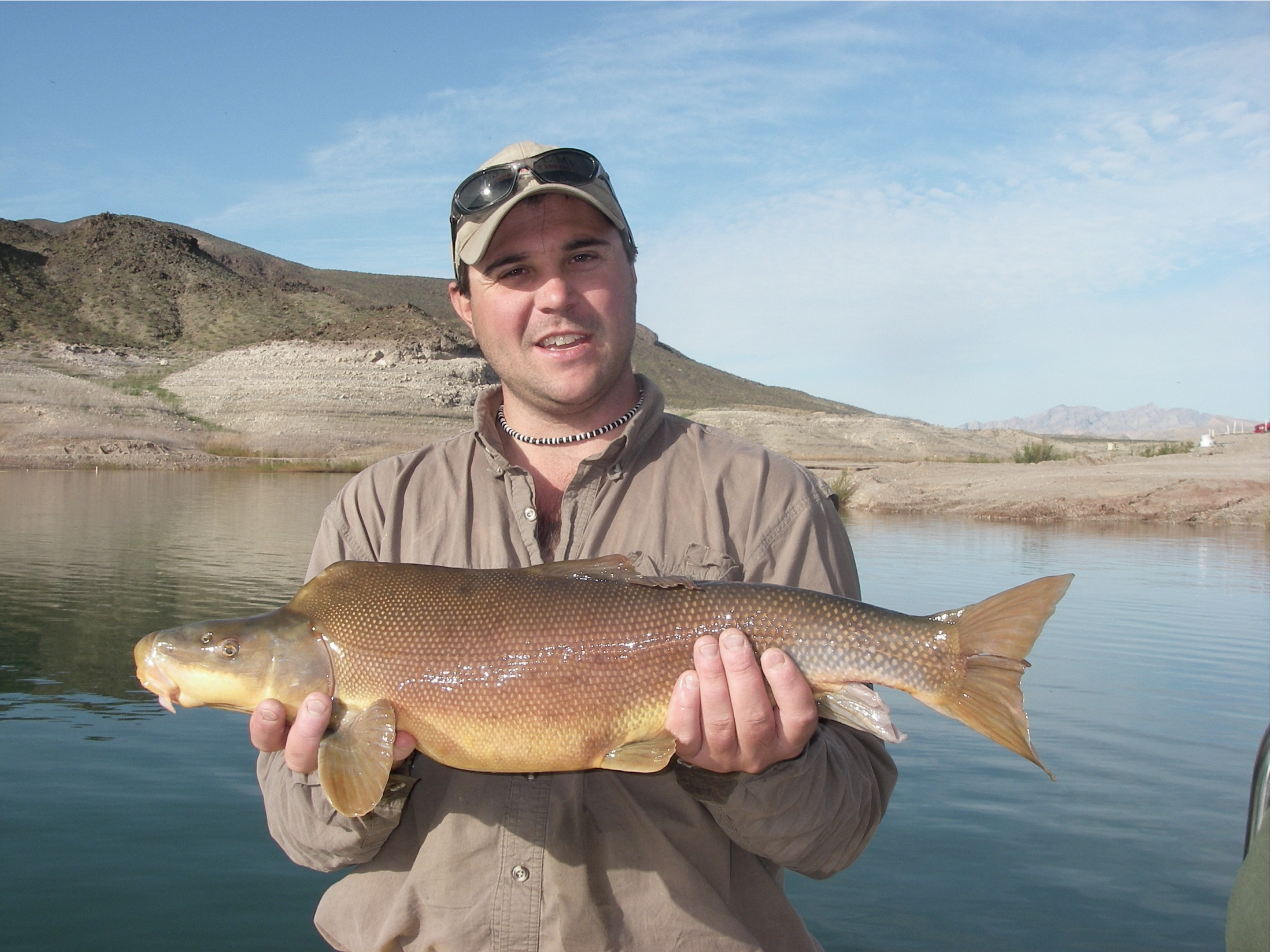
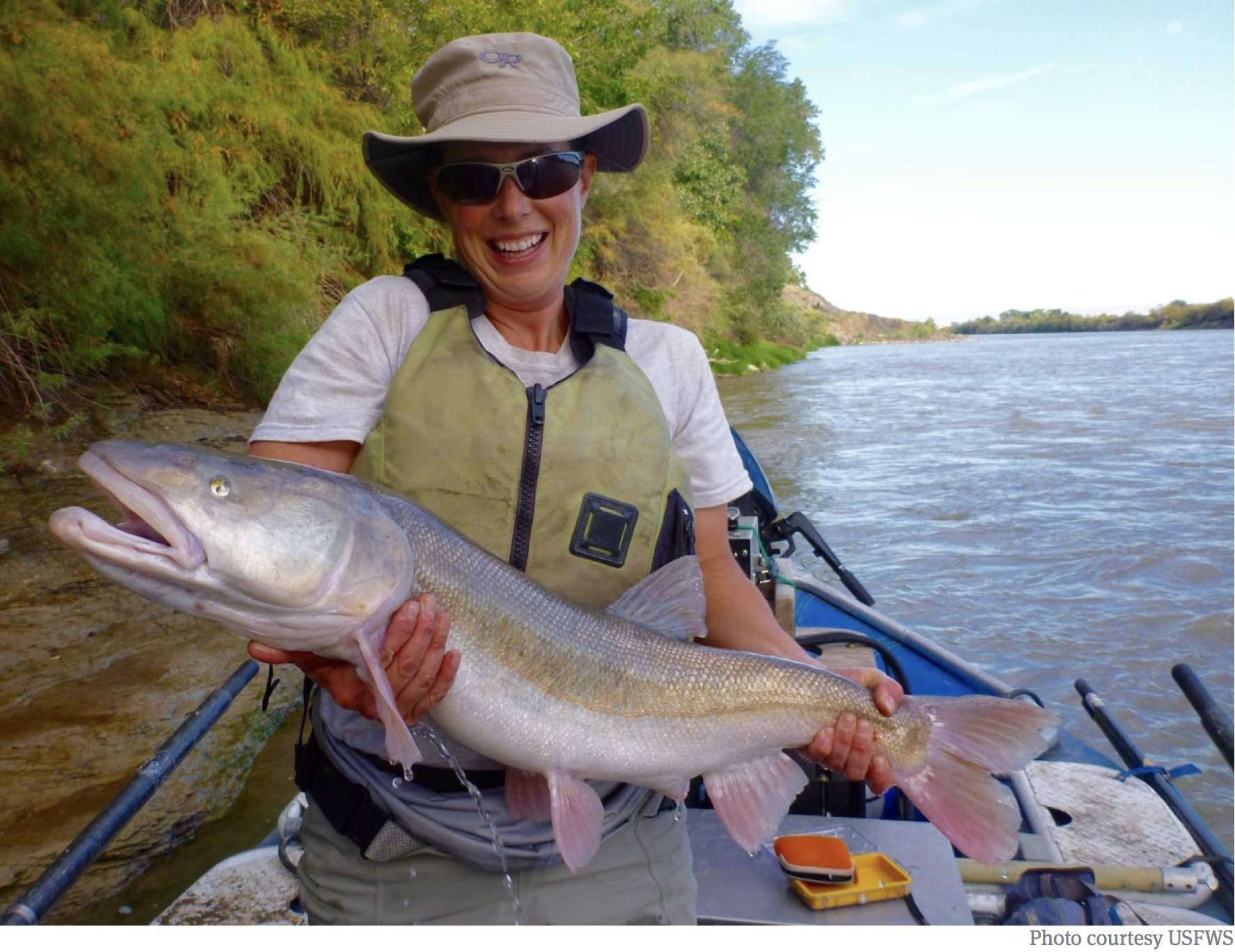
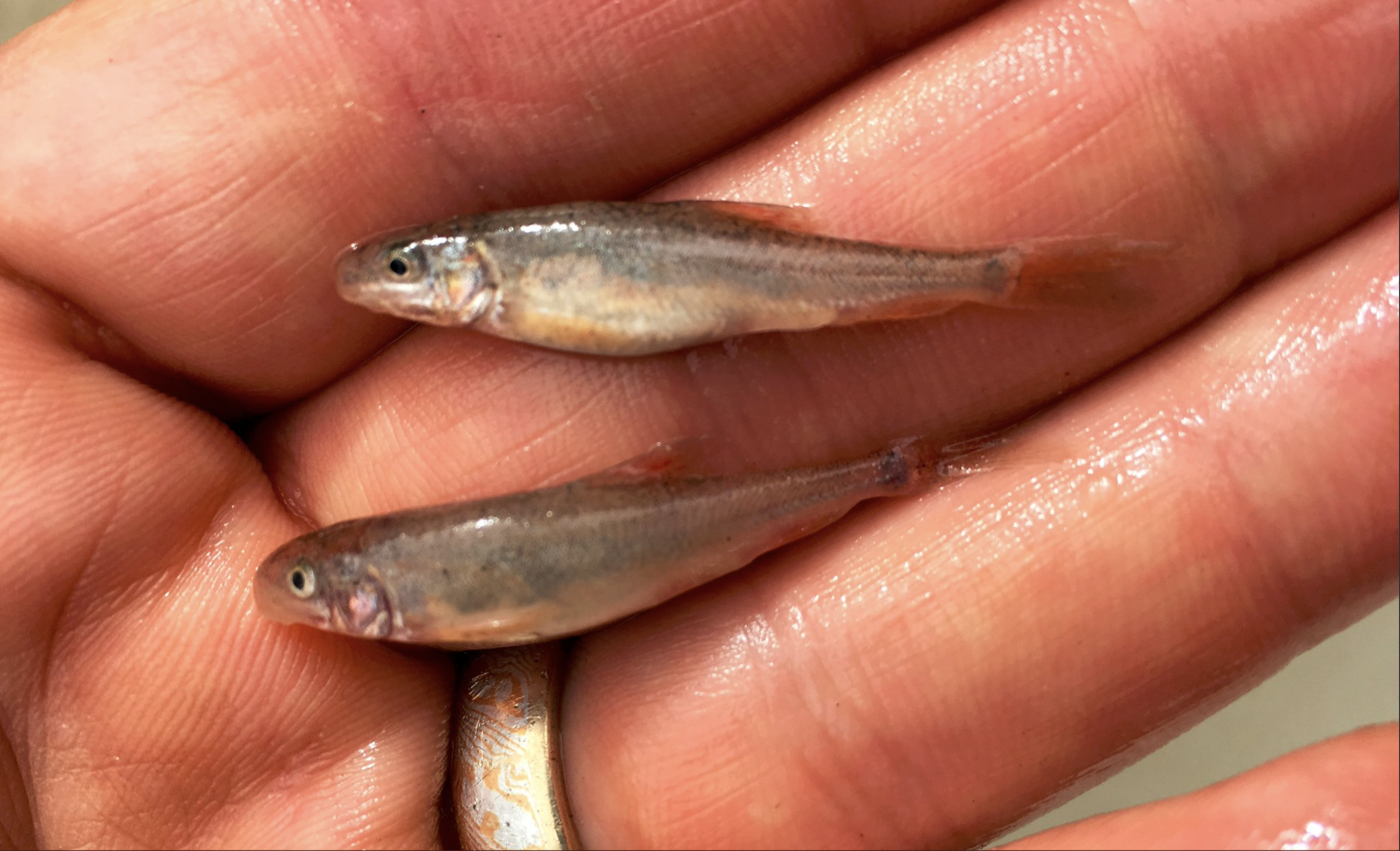
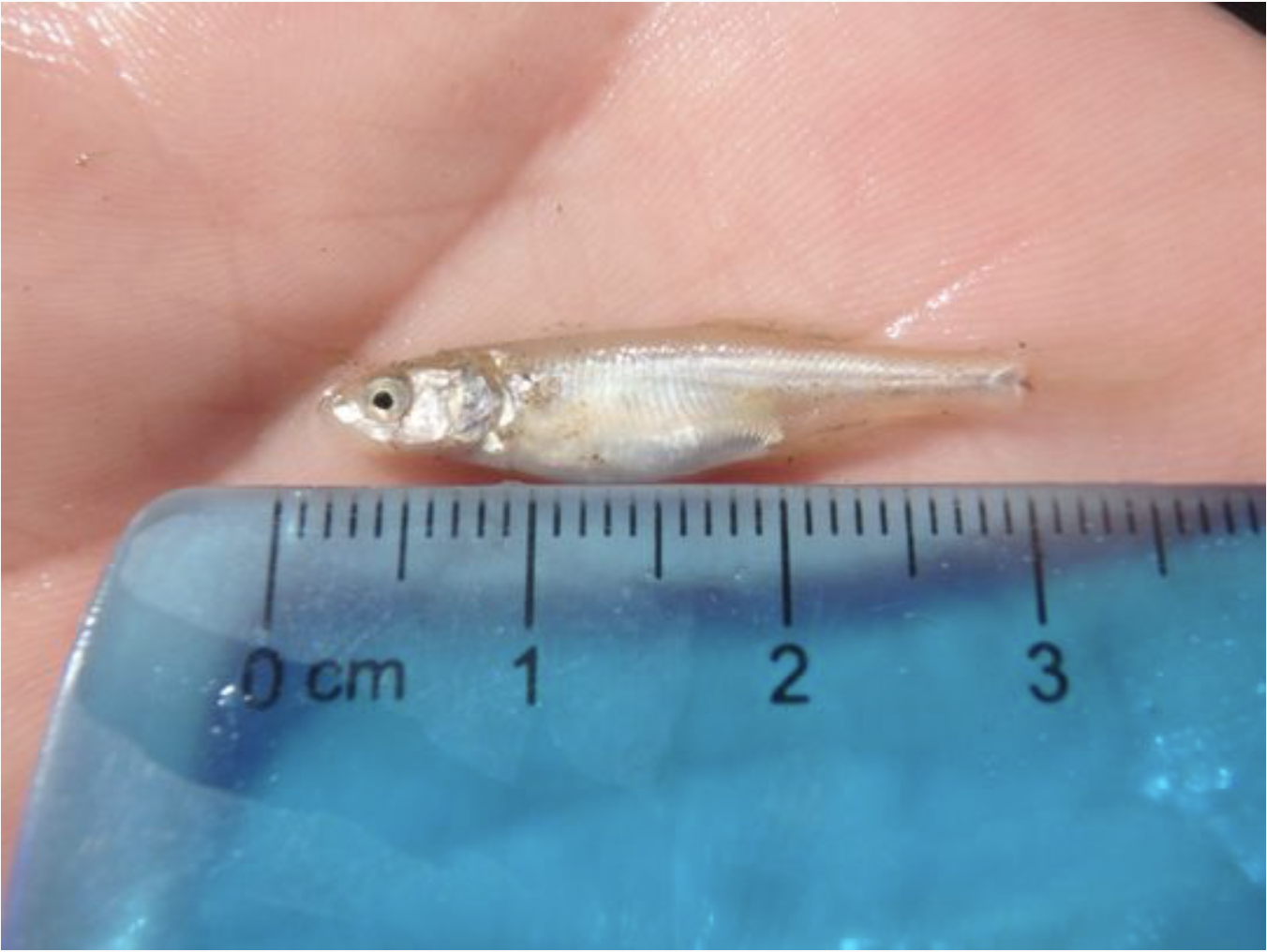
Ron Rogers biologist with Bio-West Inc., holds a large razorback sucker captured in Lake Mead near the Colorado River inflow area
Razorback sucker
Razorback sucker
Populations are stabilized due to an off stream hatchery program. From the Associated Press (Dan Elliot) via The Glenwood Springs Post Independent:
The U.S. Fish and Wildlife Service recommended reclassifying the ancient and odd-looking razorback sucker from endangered to threatened, meaning it is still at risk of extinction, but the danger is no longer immediate.
The Associated Press was briefed on the plans before the official announcement.
Hundreds of thousands of razorbacks once thrived in the Colorado River and its tributaries, which flow across seven states and Mexico.
By the 1980s they had dwindled to about 100. Researchers blame non-native predator fish that attacked and ate the razorbacks and dams that disrupted their habitat.
Their numbers have bounced back to between 54,000 and 59,000 today, thanks to a multimillion-dollar effort that enlisted the help of hatcheries, dam operators, landowners, native American tribes and state and federal agencies.
“It’s a work in progress,” said Tom Chart, director of the Upper Colorado River Endangered Fish Recovery Program. “We get more fish out in the system, they’re showing up in more places, they’re spawning in more locations.”
Chart’s program oversees the campaign to restore the razorback sucker and three other fish, all of them found only in the Colorado River system.
In March, the Fish and Wildlife Service recommended changing the humpback chub from endangered to threatened. It takes 18 to 24 months to complete the process, including a public comment period.
The razorback sucker’s name comes from a sharp-edge, keel-like ridge along its back behind its head. Chart thinks the ridge may have evolved to help the fish stay stable in the turbulent waters of the Colorado.
It can grow up to 3 feet (1 meter) long and live up to 40 years.
Razorbacks have been around for between 3 million and 5 million years, but trouble arrived as the population expanded in the Southwest. State and federal agencies began introducing game fish into the Colorado without realizing they would devour the native fish, Chart said. A spurt of dam-building was a boon to cities and farms but interrupted the natural springtime surge of melting snow, which in turn shrank the floodplains that provided a safe nursery for young razorbacks.
Dams also made parts of the rivers too cold for razorbacks, because they release water from the chilly depths of reservoirs. And they blocked the natural migration of the fish.
By the late 1980s, most of the wild razorbacks were old, an ominous sign they were no longer reproducing, Chart said. The Fish and Wildlife Service began capturing the remaining wild razorbacks and moving them to hatcheries to begin rebuilding the population.
The agency designated razorbacks an endangered species in 1991, although Utah and Colorado enacted state protections earlier.
Biologists began restocking rivers with hatchery-raised razorbacks in 1995. Now, about 55,000 are released into the Colorado and its tributaries annually.
The Fish and Wildlife Service began working with dam operators to time water releases to help razorbacks spawn and restore flood plains for them to mature. Some dams were modified to help razorbacks to get by…
Drought, climate change and increasing human demand are straining the rivers, which makes it harder for fish to survive.
McAbee said the Fish and Wildlife Service took the river’s uncertain future into account before recommending the change for the razorbacks. Their long lifespan helps them endure low-water years when few young fish survive, he said.
Cooperation among water users in 2018, a year of devastating drought in much of the Southwest, shows the razorbacks’ needs can be accommodated, McAbee said.
“Things could have been catastrophic,” he said.
Taylor McKinnon of the Center for Biological Diversity is doubtful about how healthy the razorbacks really are.
The government’s reliance on hatcheries to boost the population shows they are not self-sustaining, he said, and he worries about their future in the overtaxed Colorado River.
“I think the elephant in the room right now with regard to recovery is climate change and river flows and regional aridification,” he said.
“We’re skeptical of the merits of this,” McKinnon said.
The “minibus” appropriations bill is the result of a bipartisan, bicameral deal struck on [September 10, 2018] in a conference committee and is the first spending package to pass ahead of the end of the current fiscal year on September 30. “We are absolutely grateful to every member of Congress who supported this important funding bill,” said Julie Hill-Gabriel, Vice President of Water Conservation at the National Audubon Society. “Audubon and its more than one million members know that healthy water systems are vital to birds and to people. This legislation will help us build on the progress we’ve made in strengthening our water infrastructure.”
The bill advances programs that are important for birds and the places they need, including:
An extension of the System Conservation Pilot Program until the year 2022. As a key tool to address the prolonged drought in the West, this win-win program has provided anyone with Colorado River water rights the opportunity to receive a cash payment in exchange for conserved water that stays in rivers and reservoirs. Additional funding for the Bureau of Reclamation could also be used to increase the number of projects in this program that will reduce the threat of water shortages for the 36 million Americans who rely on Colorado River water.
With participation from ranchers, farmers, golf course owners and water system managers in seven states (WY, UT, CO, NM, AZ, CA, NV), this program allows for more water remaining in the seasonal habitats that birds like the Yellow-billed Cuckoo and Willow Flycatcher need to feed, rest and nest.
Increased funding for the Bureau of Reclamation’s WaterSMART Program, and other funding to address drought conditions in the West. WaterSMART invests in innovative, collaborative, and locally-led projects that conserve water across the West, and helps address the long-standing backlog of western water infrastructure needs. This means that organizations like state and local Audubon groups can continue to partner on projects such as lining canal walls, restoring native vegetation or clearing blocked streams, all of which contribute to the quantity and quality of water that people, birds and other wildlife depend on in an increasingly hot and dry West.
Funding for endangered species recovery and water quality control programs at the Bureau of Reclamation and Fish and Wildlife Service. These programs are critical for the recovery of endangered native fish species like the Colorado pikeminnow, humpback chub and razorback sucker, and for ensuring compliance with the Endangered Species Act for more than 2,500 water projects in the Colorado River Basin, including every Bureau of Reclamation project upstream of Lake Powell. This program helps ensure species that are lynchpins of local ecosystems and food chains are considered when water infrastructure projects are planned.
Important funding for construction of Everglades restoration projects through the U.S. Army Corps of Engineers. These projects will protect and restore wetlands in America’s Everglades, a unique ecosystem that is home to 70 threatened and endangered species and more than 300 native bird species like the Roseate Spoonbill. Completed restoration projects provide new options for managing water that can respond to toxic algae blooms in addition to intermittent flooding and drought. Audubon hopes to see the Army Corp direct some of its discretionary funds from this legislation towards Everglades restoration above and beyond the levels identified in this bill, including needed funding for Operations, Maintenance and Rehabilitation of Everglades projects.
A directive for the Department of Energy to pursue a “moonshot” goal for demonstrating energy storage technologies, critical funding for the Office of Energy Efficiency and Renewable Energy, and robust support for research and development supported by programs like the Advanced Research Projects Agency-Energy (ARPA-E). Each of these programs will help pave the way for important advances in storing and distributing electricity generated by renewable sources like wind and solar. Renewable energy, properly sited and managed for bird safety, is key to mitigating a changing climate, which is the greatest danger that birds face.
Importantly, the bill does not include harmful environmental riders from earlier versions of the legislation.
One excluded provision would have repealed the 2015 Waters of the United States (WOTUS) Rule. Repealing the Rule would reduce protections for wetlands and the one-third of North American bird species – including the Bald Eagle, Wood Stork, American Bittern and Prothonotary Warbler – that rely on wetlands for food, shelter, or breeding.
The bill also does not include a rider that would have banned spending funds to develop or issue regulations based on studies of the social cost of carbon. Climate change is the top threat that birds face, as it is both shrinking and shifting their ranges. Audubon supports research and policy that will reduce greenhouse gases such as carbon that are warming the planet.
Ron Rogers biologist with Bio-West Inc., holds a large razorback sucker captured in Lake Mead near the Colorado River inflow area
Here’s the release from the Bureau of Reclamation (Mark McKinstry, Amee Andreason):
The Bureau of Reclamation today awarded a $3.4 million contract to Bio-West Inc., of Logan, Utah, to determine how habitat, flows, water temperatures, trends in other fish species and other variables affect the endangered razorback sucker in the Lake Mead and the Grand Canyon inflow areas.
The razorback sucker is one of four large-bodied river fish native to the Colorado River Basin. Currently listed as endangered under the authority of the Endangered Species Act, the fish was historically abundant throughout the basin and was predominately found in the main stem river and major tributaries of Arizona, California, Nevada, New Mexico, Utah and Wyoming. The current distribution and abundance of razorback sucker is greatly reduced from historic levels. However, populations have persisted, made possible due to aggressive stocking efforts throughout the Colorado Basin.
Grand Canyon and Lake Mead currently have the only self-sustaining and recruiting population of endangered razorback suckers in the Colorado River Basin. Under this contract, researchers will be able to study this population of fish to determine their population numbers, age structure, movement patterns from the river back and forth to Lake Mead, and spawning areas in the lake and river. Understanding this population will help in the recovery of this critically endangered fish throughout its range.
The work accomplished under this contract will include seven 2-week efforts in Grand Canyon from March through September 2019 and will investigate adult razorback sucker spawning and movement patterns in Grand Canyon and Lake Mead. This will help to identify the types of habitat used by these fish in addition to determining a population estimate. These activities will support conservation efforts in the Grand Canyon and Lake Mead and will provide updated information on a U.S. Fish and Wildlife Service proposal to revise the recovery goals for the razorback sucker.
From Colorado Parks and Wildlife via The Pagosa Sun:
Colorado Parks and Wild- life (CPW) is continuing its work to make southwest Colorado a center for native cutthroat trout restoration. The agency will start a recla- mation project near the top of Wolf Creek Pass Sept. 11-13 to bring the native cold-water fish back to part of its native habitat.
Native cutthroat trout were nearly eliminated from Colorado during the pioneer days when water quality in many rivers and streams became polluted due to run off from timber and mining operations.
Also at that time, non-native trout — rainbows, browns and brook — were introduced to Colorado waters and muscled out the native trout. Fortunately, for more than 30 years CPW biologists searched for these indigenous fish and found sev- eral isolated populations in remote streams in the San Juan Basin.
“We’ve been working on cutthroat trout projects in this part of the state for more than 30 years and we’ve made great progress in restor- ing these fish to their native waters,” said Jim White, aquatic biologist in Durango.
Native cutthroat are only found and stocked in Colorado’s headwaters areas.
To re-establish native fish, CPW treats streams with an EPA-approved chemical to eliminate any non-native fish. In September, biologists will treat 1.5 miles of the south fork of Wolf Creek. The chemical, rotenone, has been used safely for years around the world for aquatic management projects. Used properly, it poses no threat to human health. On all stream projects, CPW adds another chemical to the water at the terminus of the treatment area to neutralize the effects of the rotenone. The treatment will be done on Sept. 12 and CPW staff will stay through the next day to monitor the water.
This tributary of Wolf Creek was selected for the project because it provides excellent trout habitat and it is separated by large natural barriers from the main stem of Wolf Creek. The barriers prevent non-native fish from moving upstream into the treated area.
This year is an ideal time for the treatment because the water level in the stream is low and easy to treat. The treated area will be void of fish until next summer. After the spring run-off in 2019, CPW biologists will check the stream to assure non-native fish have been eliminated. If none are found, the native cutthroats will be stocked next summer.
This and other native trout restoration projects are done in coop- eration with the San Juan National Forest.
Native cutthroat trout are restored in headwater streams where the water is pristine, free of whirl- ing disease and non-native fish. Pure native cutthroat trout are not stocked in major rivers because they cannot compete with established non-native rainbow and brown trout populations.
“Colorado Parks and Wildlife is dedicated to maintaining our state’s native species,” said John Alves, senior aquatic biologist for CPW’s Southwest Region. “Restoration work is done to assure that native trout remain a sustainable and important part of Colorado’s natural environment.”
North of Durango, CPW is in the final step of reintroducing native cutthroats into nearly 30 miles of stream in the Hermosa Creek area. The final section will be restocked next summer.
To learn more about CPW’s work to restore native cutthroat trout throughout the state, go to http:// cpw.state.co.us/learn/Pages/Re-searchCutthroatTrout.aspx.
Humpback chub are one of four federally endangered fish species that rely on habitat in the 15-Mile Reach of the Colorado River. Humpback chub photo credit US Fish and Wildlife Service.
NPS and USFWS use a seine net to trap humpback chubs in the Little Colorado River. Photo credit Mike Pillow via the Arizona Daily Sun.
November 2012 High Flow Experiment via Protect the Flows
The Colorado River wends its way through southern Utah and, at Glen Canyon, is impounded into Lake Powell. Photo/Allen Best
Macro Invertebrates via Little Pend Oreille Wildlife Refuge Water Quality Research
Glen Canyon Dam construction circa. 1961 via @USBR.
Water means life for all the Grand Canyon’s inhabitants, including the many varieties of insects that are a foundation of the ecosystem’s food web. But hydropower operations upstream on the Colorado River at Glen Canyon Dam, in Northern Arizona near the Utah border, disrupt the natural pace of insect reproduction as the river rises and falls, sometimes dramatically. Eggs deposited at the river’s edge are often left high and dry and their loss directly affects available food for endangered fish such as the humpback chub.
Ted Kennedy, a U.S. Geological Survey aquatic biologist, led a recently concluded experimental flow that is raising optimism that the decline in insects such as midges, blackflies, mayflies and caddisflies can be reversed. Conducted under the long-term, comprehensive plan for Glen Canyon Dam management during the next 20 years, the experimental flow is expected to help determine dam operations and actions that could improve conditions and minimize adverse impacts on natural, recreational and cultural resources downstream.
Western Water spoke with Kennedy about the experiment, what he learned and where it may lead. The transcript has been lightly edited for space and clarity.
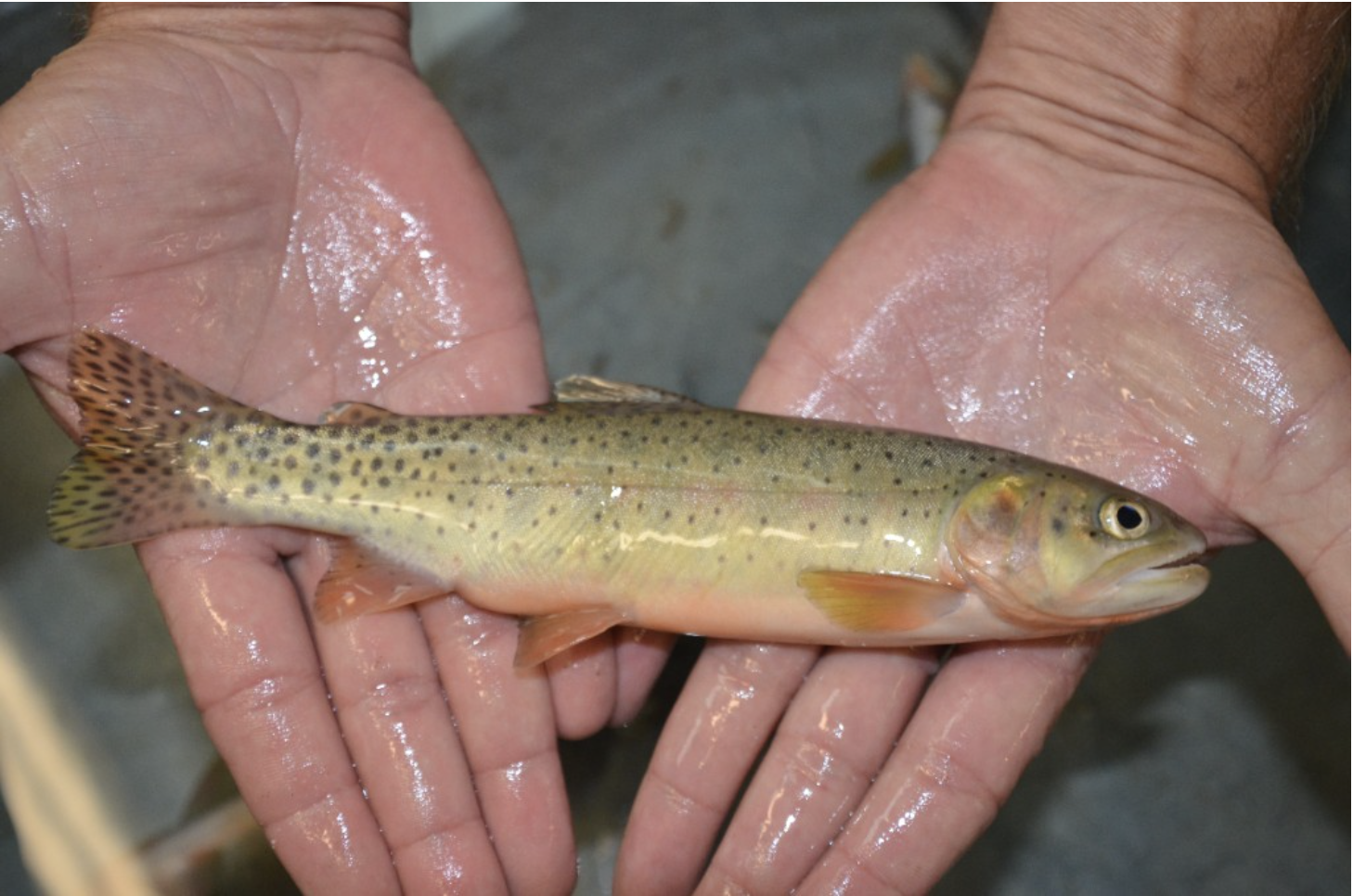
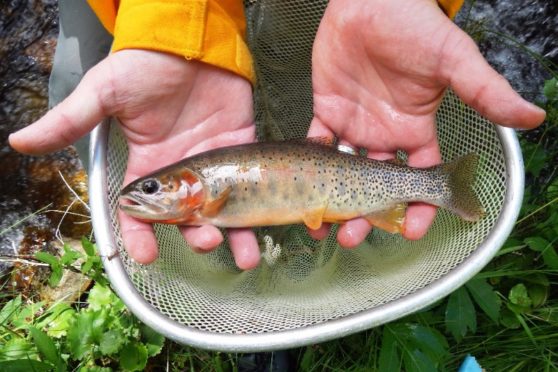
Colorado Parks and Wildlife has found cutthroat trout that are unique to the San Juan River Basin in southwest Colorado. The photo below is of a museum specimen found in the Smithsonian via Colorado Parks and Wildlife.
Here’s the release from Colorado Parks and Wildlife (Joe Lewandowski);
Colorado Parks and Wildlife biologists have discovered a unique genetic lineage of the Colorado River cutthroat trout in southwest Colorado that was thought to be extinct. The agency will continue to evaluate the findings and collaborate with agency partners to protect and manage populations of this native trout.
The discovery was officially recognized earlier this year thanks to advanced genetic testing techniques that can look into the basic components of an organism’s DNA, the building blocks of life. This exciting find demonstrates the value of applying state-of-the-art genetic science to decades of native cutthroat conservation management and understanding.
“Anyone who just looked at these fish would have a difficult time telling them apart from any other cutthroat; but this is a significant find,” said Jim White, aquatic biologist for CPW in Durango. “Now we will work to determine if we can propagate these fish in our hatcheries and reintroduce them into the wild in their historic habitat. It’s a great conservation effort and a great conservation story.”
Eight small populations of these trout have been found in streams of the San Juan River Basin within the San Juan National Forest and on private property. The populations are in isolated habitats and sustained through natural reproduction. U.S. Forest Service staff and landowners have been cooperative in CPW’s efforts; they will also be instrumental in further cutthroat conservation efforts.
In August, north of Durango, crews from CPW and the U.S. Forest Service hiked into two small, remote creeks affected by the 416 Fire and removed 58 fish. Ash flows from the fire could have severely impacted these small populations.
Cutthroat trout originated in the Pacific Ocean and are one of the most diverse fish species in North America with 14 different subspecies. Three related subspecies are found in Colorado: Colorado River cutthroat trout found west of the Continental Divide; Greenback cutthroat trout in the South Platte River Basin; and the Rio Grande cutthroat trout in the San Luis Valley. A fourth, the yellowfin cutthroat trout native to the Arkansas River Basin, went extinct in the early 1900s. Cutthroats from each of these areas have specific and distinctive genetic markers. CPW propagates the three remaining subspecies, and actively manages their conservation and recovery throughout the state.
White and other biologists ‒ including Kevin Rogers, a CPW cutthroat researcher based in Steamboat Springs, and Mike Japhet, a retired Durango CPW aquatic biologist ‒ have been surveying remote creeks in southwest Colorado for more than 30 years looking for isolated populations of cutthroat trout. They found some populations in remote locations long before advanced genetic testing was available. The biologists understood that isolated populations might carry unique genetic traits and adaptations, so they made sure to preserve collected samples for genetic testing later. Significant advances in genetic testing technology over the last 10 years were instrumental in finding the distinct genetic markers that identify the San Juan lineage trout as being unique.
In 1874, naturalist Charles E. Aiken collected and preserved samples of fish found in the San Juan River near Pagosa Springs. Two trout were deposited in the Smithsonian National Museum of Natural History in Washington, D.C. These samples were forgotten until 2012 when a team of researchers from the University of Colorado was hired by the Greenback Trout Recovery Team to study old trout specimens housed in the nation’s oldest museums. When the researchers tested tissue from those two specimens they found genetic markers unique to the San Juan River Basin. Armed with the knowledge of these genetic “fingerprints”, CPW researchers and biologists set out to test all the cutthroat trout populations they could find in the basin in search of any relic populations.
“We always ask ourselves, ‘What if we could go back to the days before pioneer settlement and wide-spread non-native fish stocking to see what we had here?’” White said. “Careful work over the years by biologists, finding those old specimens in the museum and the genetic testing gave us the chance, essentially, to go back in time. Now we have the opportunity to conserve this native trout in southwest Colorado.”
Developing a brood stock of these trout so that they can be reintroduced into San Juan River headwaters streams will be a key conservation strategy for increasing their distribution into suitable habitat and help their long-term stability. Protecting the fish from disease, other non-native fish, habitat loss and over-harvest are important factors that will be considered in a conservation plan that will be developed over the next few years. While that might seem like a long time, the discovery of this fish goes back more than 100 years.
Over the decades, CPW has worked with many partners throughout the state to find and conserve distinct cutthroat populations. Many of these efforts were conducted with assistance from the U.S. Forest Service, conservation groups and private property owners. CPW also works on projects with both the Colorado River Cutthroat Trout and Rio Grande Cutthroat Trout conservation teams.
All native cutthroats have been adversely affected by a variety of issues, including reduced stream flows, competition with other trout species, changes in water quality and other riparian-habitat alterations. Consequently, the various types of native cutthroats are only found in isolated headwaters streams. To ensure continued conservation of Colorado’s cutthroats, CPW stocks only the native species in high lakes and headwater streams. That stocking practice started in the mid-1990s.
CPW has also conserved cutthroats in headwaters streams by working with the U.S. Forest Service to build barriers to prevent upstream migration of non-native trout, removing non-native trout and subsequently stocking them with native trout. The conservation group, Trout Unlimited, has provided valuable assistance with many of these projects.
John Alves, Durango-based senior aquatic biologist for CPW’s Southwest Region, said the discovery shows the dedication of CPW aquatic biologists.
“These fish were discovered because of our curiosity and our concern for native species,” Alves said. “We’re driven by scientific inquiry that’s based on hard work and diligence. This is a major discovery for Colorado and it shows the critical importance of continuing our research and conservation work.”
The Dolores River, below Slickrock, and above Bedrock. The Dolores River Canyon is included in a proposed National Conservation Area. Photo: Brent Gardner-Smith/Aspen Journalism.
A view of the Dolores River below Slickrock.
August 16, 2017: Colorado ParksWildlife and John Sanderson found imperiled bluehead sucker fry on Dolores River — a hopeful sign.
San Miguel River from CO 141.
Ponderosa Gorge, Dolores River. Boating is popular on the Lower Dolores River, which is being considered as a National Conservation Area. Photo credit RiverSearch.com.
Dolores River Campground September 2016.
The Dolores River shows us what’s at stake in the fight to protect the American West — Conservation Colorado
Photo via the Sheep Mountain Alliance
Dolores River watershed
Dolores River south of Lizard Head Pass
Dolores River near Bedrock
Dolores River
Dolores River above Dolores
Dolores River Canyon near Paradox
FromThe Walton Family Foundation (Peter Skidmore):
In the Colorado River Basin, RiversEdge West leads a coordinated effort to restore critical habitat
Doug King’s family has been ranching the lands around the Dolores River in Southwest Colorado since the 1930’s. “It’s beautiful−I call it John Wayne country,” Doug says, proudly. “I’m the third generation on the land, my son will be the fourth generation, and his son will be the fifth.”
Over the decades, Doug experienced firsthand the steady, relentless creep of invasive plant species like tamarisk and Russian olive and its impact on the land he has cared for his whole life. The damage has been extensive, threatening the larger riparian—or river bank—habitat that in the Colorado River Basin ultimately supports more than 40 million lives across two nations.
As the unwelcome vegetation pressed in on essential farmland and fish and wildlife habitat, Doug and many others in the region understood it was time to lock arms and push back.
Originally conceptualized in 1999 to discuss strategies for addressing invasive plant species along rivers in western Colorado, the then-named Tamarisk Coalition was fueled by a desire to shape a landscape-scale solution. The group had observed that conventional site-by-site eradication simply wasn’t able to move quickly enough.
“People were getting grants to do five acres or half a mile” of tamarisk removal, recalls Tim Carlson, the coalition’s first executive director. “That wasn’t going to solve the problem. We started with a bold approach: If we were going to solve this problem, it’s got to be a regional solution.”
The introduction of the tamarisk is a story of unintended consequences. Long thought to prevent erosion along the banks of western rivers, its presence was so valued in earlier days that Boy Scouts would receive badges for planting it. But the persistent shrub with scale-like leaves took to its adopted habitat like a parasite, displacing native vegetation.
Restoring and sustaining the overall health of the Colorado River Basin has been a primary goal of the Walton Family Foundation’s Environment Program since its inception nearly a decade ago. And, the program’s first grant to the Tamarisk Coalition in 2009 supported its restoration efforts along the San Miguel and Dolores river systems. Gradually, the foundation expanded its support to also include work along the Escalante, Verde and Gila systems.
“We have a great relationship with the foundation where we present innovative ideas, and they help us scale up these efforts. The investment affects a vast landscape, bolsters our work and has helped us promote best practices to other organizations,” says Cara Kukuraitis, outreach and education coordinator for the organization now known as RiversEdge West.
The organization changed its name in 2018 to reflect its broader work in Western riparian areas and the surrounding communities. But it retains its unique and core operating model—to facilitate collaboration and information-sharing across diverse groups and individuals to accomplish riparian restoration at a larger scale than any one partner can attain on its own. As a result, RiversEdge West now supports 20 ambitious multi-stakeholder partnerships encompassing federal, state, and community organizations throughout the American West, teaching best practices to over 300 local public and private restoration organizations and successfully restoring some 11,500 acres—and counting—of riparian habitat.
The state of Colorado is among the group’s core partners.
“Our relationship with RiversEdge West has allowed Colorado Parks and Wildlife to more effectively meet our mission of improving the wildlife habitat within the state,” explains Peter Firmin, manager of the James M. Robb-Colorado River State Park.
“The networking and training opportunities provided by RiversEdge West allow us to leverage intellectual and financial resources to improve habitat along the Colorado River. As a group, we are able to accomplish more than we could as individuals.”
The work of RiversEdge West and its growing network is bolstered by an array of technical tools. For example, a multi-partner geodatabase stores and shares data with land managers, so they can see how their projects connect and positively impact the landscape over time.
“The data helps us establish and measure progress against quantitative goals, so the project can jump from removing tamarisk by just cutting trees to collecting data on the extent of the problem and promoting ways to encourage the ecosystem’s overall health,” says Cara.
It is a testament to the organization’s enduring value that its annual conference attracts upwards of 200 representatives from Colorado, Arizona, Nevada, New Mexico, California, Texas, Kansas, Oklahoma, Utah and Mexico to connect on riparian restoration science.
The organization also is working to convey the broad importance of these efforts through its ongoing “Riverside Stories” web series, which tells the personal stories of people who call this land home and are working to restore this habitat for future generations. Among them is Doug and his family.
“I have a theory that we should leave the land better than how we got it,” Doug notes in sharing his story. “The Colorado River is soon going to be the most important resource in the West. We are just caretakers. You are only going to be here 50-60 years, and then somebody else is going to have this land.
The dam that forms Ruedi Reservoir, above Basalt on the Fryingpan River. Photo: Brent Gardner-Smith/Aspen Journalism
From email from Reclamation (Peter Soeth)
The release from Ruedi will be increased Tuesday morning by approximately 45 cfs. After this change, the flow at the Fryingpan River gage below Ruedi Reservoir will increase from 178 cfs to approximately 223 cfs.
This flow increase was requested by the USFWS to support fish recovery efforts in the 15-Mile reach of the Colorado River.
This release rate will continue until further notice.
Colorado River Basin in Colorado via the Colorado Geological Survey
FromThe Grand Junction Daily Sentinel (Dennis Webb):
The Colorado River District has agreed to boost water levels to help fish in the Roaring Fork River watershed while also conserving water for use by local irrigators later in the season and improving the chances for boosting flows this fall for endangered fish.
The action also could help protect water quality in the case of anticipated ash in waterways due to expected flooding and debris flows resulting from the Lake Christine Fire near Basalt.
The river district is releasing water from Ruedi Reservoir above Basalt to boost flows in the Fryingpan River and Roaring Fork River to help reduce water temperatures to benefit trout. Low flows and warm temperatures in western Colorado have led to Colorado Parks and Wildlife urging anglers to avoid fishing later in the day on numerous western Colorado waterways due to the stress trout currently are facing.
The U.S. Bureau of Reclamation approved the river district releases last week. They are expected to range between 50 and 100 cubic feet per second.
River district spokesman Zane Kessler said the water to be released is owned and managed by the river district’s enterprise…
The water technically is being delivered downstream for Grand Valley irrigation needs but is creating environmental benefits on its way there. The water otherwise would have been delivered from Green Mountain Reservoir south of Kremmling.
Kessler said the Ruedi releases will allow for conserving a part of what’s called the historic users pool at Green Mountain Reservoir for use later in the season, which would benefit Grand Valley irrigators. The releases also increase the chances that, despite it being a dry year, that pool can be declared to have a surplus. That surplus could then be delivered in September and October to what’s known as the 15-Mile Reach, a stretch of the Colorado River in the Grand Valley where the flows would benefit endangered fish.
“This has never been done before,” Kessler said of the flow agreement. “But we’ve rarely seen river levels like this before either.”
The potential for easing the impacts of ash flow also could be felt in the Grand Valley. There is concern that ash flows could force the Clifton Water District to suspend use of Colorado River water. Area water providers have an agreement to help each other in meeting short-term water needs should that kind of emergency situation arise, but doing so this year would further deplete drought-stressed supplies.
Kessler said retaining some Green Mountain Reservoir water for release later in the year also could benefit recreational uses of the Upper Colorado River.
Meanwhile, the river district is taking another step aimed at helping ensure that benefiting fish in the Roaring Fork Valley doesn’t harm fish on the Colorado River upstream of the Roaring Fork confluence. The district is currently delivering what Kessler called “fish water” from Wolford Reservoir north of Kremmling into the upper Colorado River because it is having to lower the reservoir’s water level in preparation for doing some work on the dam there.
The Colorado River District is working with state and federal water managers to increase flows in the Fryingpan River by as much as 100 cubic feet per second (cfs), helping trout in the watershed survive warm temperatures while supplying water for downstream irrigation needs in the Grand Valley.
Anticipated releases are expected to range between 50 cfs and 100 cfs and will be coordinated between the River District, the U.S. Bureau of Reclamation and the U.S. Fish and Wildlife Service to increase flows in the Fryingpan and Roaring Fork rivers downstream from Ruedi Reservoir.
“This should significantly benefit flows below Ruedi Reservoir,” said John Currier, chief engineer for the district. “We expect that the supplement flows may also help to mitigate water-quality problems anticipated from fire-related ash and debris flows stemming from the Lake Christine Fire on Basalt Mountain.”
Technically, the water will be delivered downstream for Grand Valley irrigation needs while creating environmental benefits as it flows downstream. Green Mountain Reservoir releases will be reduced by an equal amount in order to conserve storage for late-season releases, which in turn will be needed to help endangered fish near Grand Junction.
The coordinated approach was given final approval by the Bureau of Reclamation on Monday. In order to boost Fryingpan levels while the plan awaited approval, the U.S. Fish and Wildlife Service implemented a 50 cfs release from its dedicated endangered fish pool in Ruedi on Friday. Those flows were supplemented by 30 additional cfs Monday, bringing the flow in the Fryingpan to 200 cfs.
Both Ruedi and Green Mountain reservoirs contribute water to the Upper Colorado River Endangered Fish Recovery Program. In this case, the changed water release plan will benefit trout below Ruedi while endangered fish still receive water from upstream Colorado River reservoirs.
Increased flows of cold water out of Ruedi should also help to alleviate some stress on trout fisheries in the watershed brought on by higher-than-normal water temperatures. Colorado Parks and Wildlife announced voluntary fishing closures earlier this month on sections of the Colorado and Roaring Fork rivers.
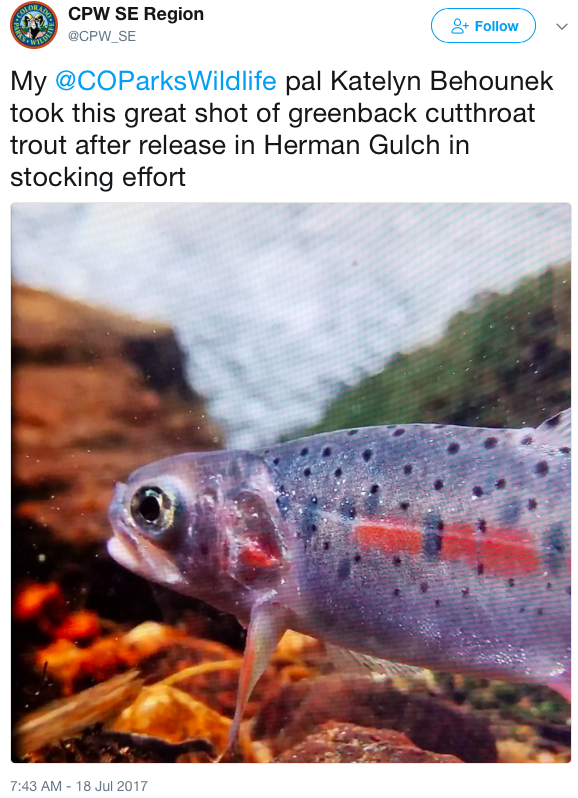
Last week, the endangered Greenback cutthroat trout got a major boost from Trout Unlimited volunteers and agency partners in Colorado.
Once thought to be extinct, this rare fish is making a big comeback thanks to the efforts of the Greenback Cutthroat Recovery Team – a partnership that includes the US Forest Service, Bureau of Land Management, US Fish and Wildlife, the National Park Service, Colorado Parks and Wildlife, the Western Native Trout Initiative, and Trout Unlimited.
Over the course of two days in mid-July, 1,700 Year 1 Cutthroats (~4-6 inches) made their way into two headwater drainages in the Clear Creek watershed, an hour west of Denver. The Dry Gulch and Herman Gulch creeks represent the first major river populations for this threatened species since it was rediscovered in 2012.
To help agency partners stock these important little fish, over 80 Trout Unlimited volunteers carried the cutthroats in large packs up steep switchbacks and bushwacked through dense brush to get to the remote rivers. Some people hiked over six miles into the top of the drainage (over 11,500 feet)! These volunteers came from 10 different TU chapters and represented all walks of life – anglers and conservationists coming together to recover this native trout.
“We couldn’t do it without the volunteers,” says Paul Winkle, Colorado Parks and Wildlife biologist for the Clear Creek drainage. It was a major undertaking that took a lot of support from agency staff, non-profit partners, and local businesses.
At Colorado TU, we are very proud of the hard work and dedication that our chapters and volunteers provide to these projects. It shows what can happen when people focus on collaboration and overcoming differences. It didn’t matter whether someone was young or old, Democrat or Republican, a dry fly purist or never fished before – we were all side by side, climbing those steep trails together. All to save the Greenback.
The event even drew local media attention and even made it on the nightly cable news:
Audubon Arizona’s objective is to make sure that the solutions to our water challenges serve both people and wildlife. Water management policies that provide more certainty and reliability for all users are of critical importance to Arizona’s economy as well as its cities, farmers, birds, and other wildlife.
As United States Bureau of Reclamation Commissioner Brenda Burman (her federal department manages the water on the Colorado River) highlighted in her recent visit to Tempe, Arizona, if the states cannot come together to stabilize Lake Mead through collective and collaborative agreements to leave more water behind Hoover Dam via the Colorado River Drought Contingency Plan (DCP) we face a potential crisis.
But why care? Water in Lake Mead and the surrounding environment is not the only game in town when it comes to birding and valuable wildlife habitat (never mind the nine Important Bird Areas that surround the Grand Canyon and the Colorado River). But really, as a bird and wildlife advocate, why care about the stabilization of Lake Mead? What’s at stake?
If Arizona-specific parties affected by DCP cannot get to yes, and instead hydrology catches up to us and Lake Mead declines to critical elevations, water users may look elsewhere for water to make themselves whole. Water resources like groundwater, and existing Arizona regulations that promote sustainable water planning, may come under increased scrutiny and pressure. Arizona’s valuable rivers, streams, and the habitats they provide for birds could be at risk if groundwater pumping increases. Not to mention the negative headlines that are sure to result if we cannot agree on a plan to use less Colorado River water.
As opposed to unmitigated shortages that leave people out on the hunt to solve their water supply problems, a much better option is a plan that everyone agrees to. Some of what that currently looks like in Arizona is monetary compensation to use less water, and changes in the way accounting is done on Lake Mead so that willing water users can leave more of their water behind the dam. Through careful negotiation with the affected water users, people can get to yes, and there can be faith in the process and the result.
Another reason to care? We’ll take Commissioner Burman’s lead on this one: Because if Lake Mead gets low enough, “dead pool” could be reached and that means no water is getting past the dam. No Colorado River water is flowing out of Mead. That’s a scary scenario for farmers, cities, and wildlife. Commissioner Burman is clearly worried about a situation like that—hence her urging of the states to commit to Drought Contingency Plans ASAP.
We’d like to thank Commissioner Burman for amplifying the message on this critical issue. We anticipate more information in the weeks and months ahead from the Arizona Department of Water Resources and the Central Arizona Water Conservation District on progress toward a DCP. Then, it will be in the hands of state lawmakers and Governor Ducey to construct and pass legislation that allows Arizona to participate in getting DCP done.
At Audubon Arizona, we’ll be watching and participating as the process continues. Being involved in the conversation when policymakers are talking water—one more way we are advocating for our rivers and the wildlife, habitat, and humans who depend on them.
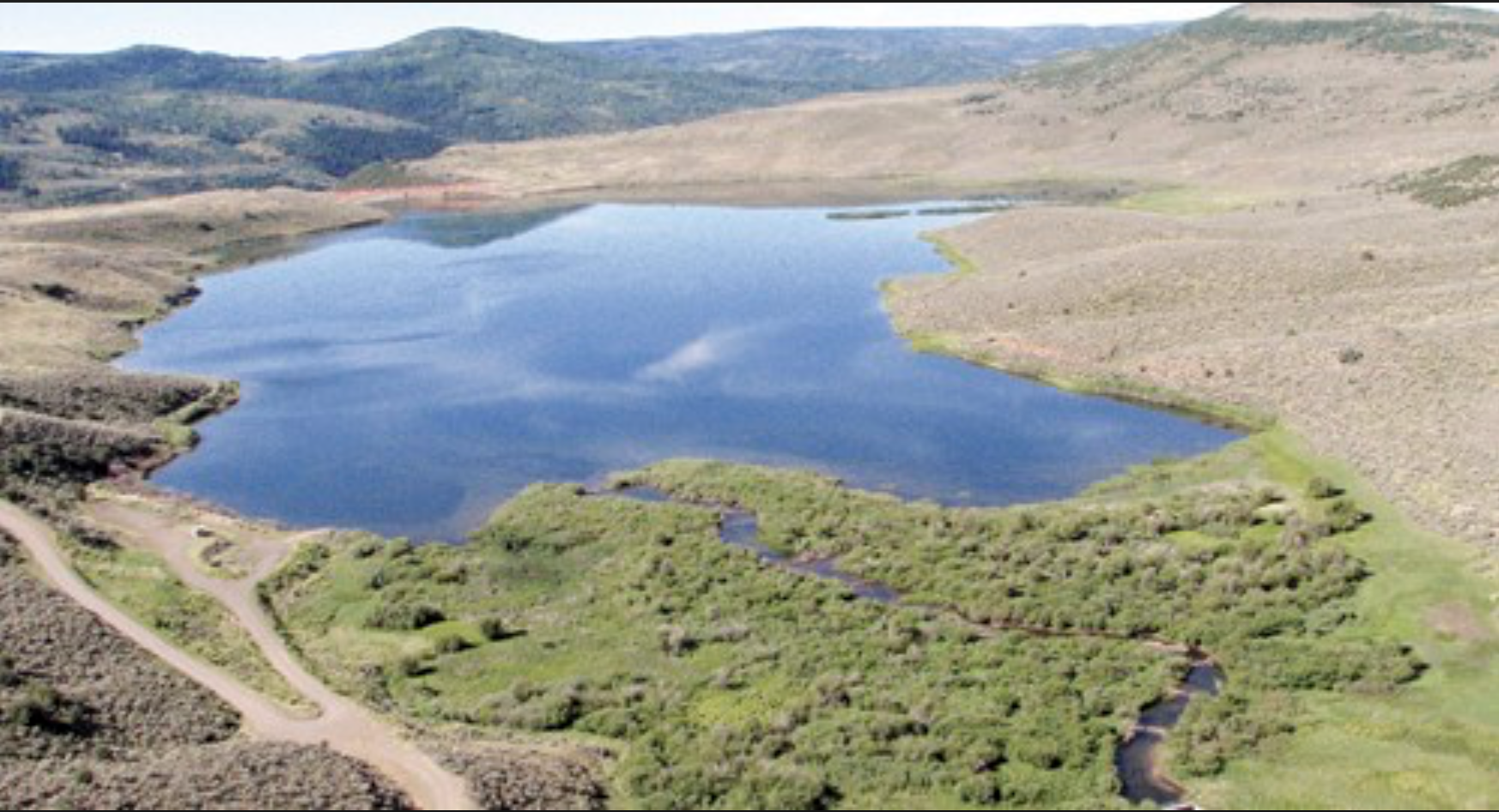
Lake Avery. Photo credit: Colorado Parks and Wildlife
From Colorado Parks and Wildlife via The Rio Blanco Herald Times:
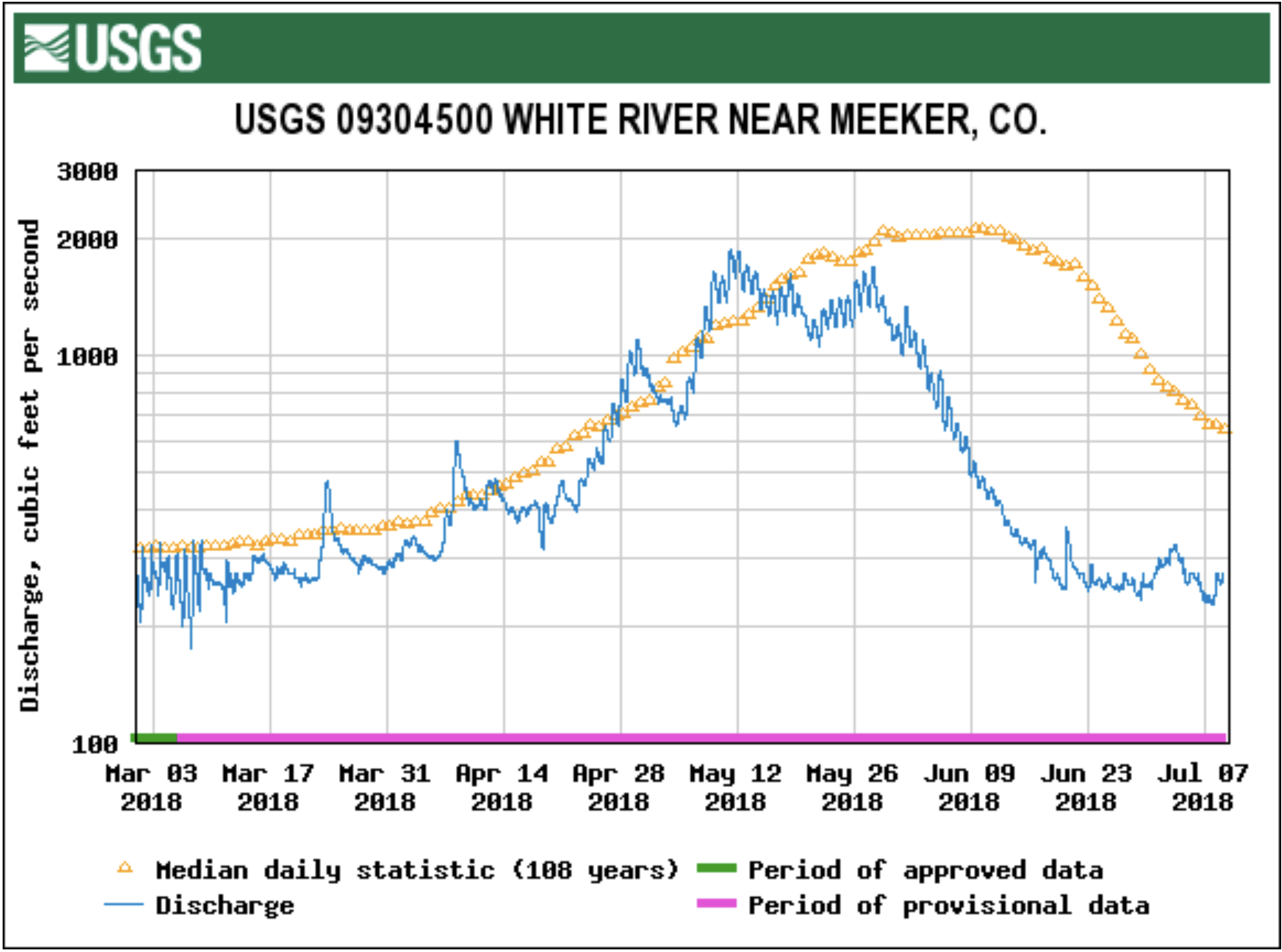
Due to low flows, dry conditions and extreme heat, water temperatures in the White River are nearing dangerous levels for cold-water fish. Colorado Parks and Wildlife officials are encouraging anglers to fish in the early morning, when water temperatures are cooler and less stressful to fish.
To help mitigate current conditions, Colorado Parks and Wildlife is considering releasing water from Lake Avery to increase flow in the White River, and potentially lower river water temperature.
To answer questions and address concerns about the possible release, CPW invites the public to a roundtable session, 7 p.m., July 9 at Kilowatt Korner (White River Electric Association—WREA), 233 Sixth St., in Meeker, Colo.
“We’ve been here before, and we know what we need to do, “ said Bill de Vergie, Area Wildlife Manager from Meeker. “It’s important that ranchers, landowners, ditch users, fishing guides, anglers, and other members of the public attend our meeting so that we can work together to protect this important fishery.”
Colorado Parks and Wildlife officials and the Colorado Water Conservation Board entered into a water lease agreement in 2012. The agreement allows the release of CPW’s water stored in Lake Avery to help meet the minimum instream flow on the White River of 200 cubic feet per second.
Anglers at Lake Avery will see declining water levels in the lake beginning when the release is initiated.
“When the flow from Lake Avery begins, we will ask users to avoid taking the additional water and instead leave it in the river to give fish a chance of surviving,” said de Vergie. “Everyone around here knows how important this river is to our economy, and we expect that people will comply to ensure the river continues to be a destination fishery.”
The endangered razorback sucker, a fish native to the Grand Canyon, has been hybridizing with another Colorado River fish – the flannelmouth sucker. Arizona Game and Fish biologist Pilar Wolters is conducting a 5-year research project to learn how hybridization could impact the recovery of wild razorback suckers. This video was produced by the Information Branch of the Arizona Game and Fish Department. Producer: David Majure
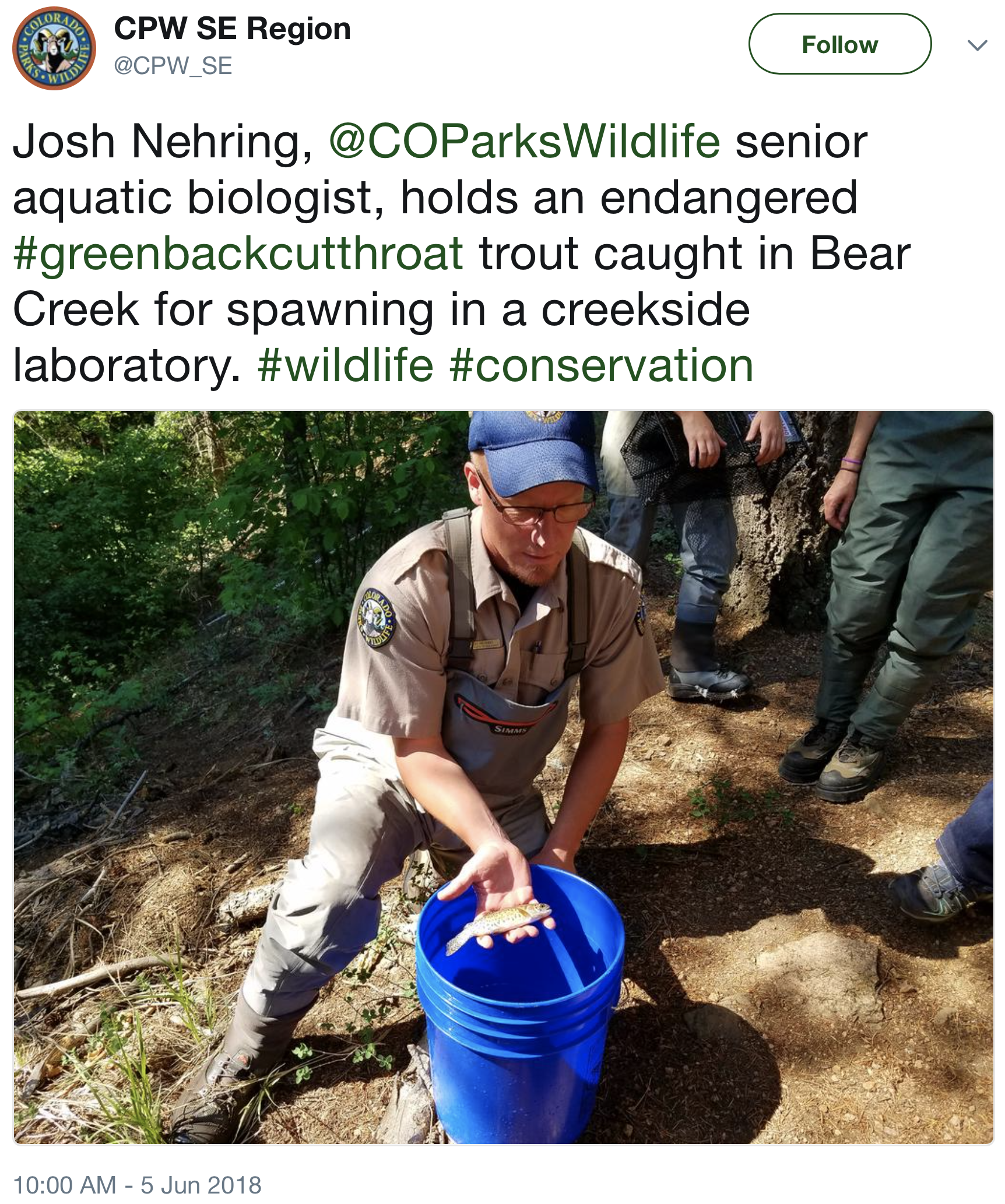
Colorado Parks and Wildlife biologists set up a creekside laboratory along Bear Creek Tuesday to catch and spawn an endangered trout species…
Each spring since the trout was located, CPW biologists have waded into Bear Creek to catch the greenbacks, spawn them, and send the fertilized eggs to the National Fish Hatchery in Leadville.
The headwaters of the Rio Grande River in Colorado. Photo: Brent Gardner-Smith/Aspen Journalism
From the New Mexico Political Report (Laura Paskus):
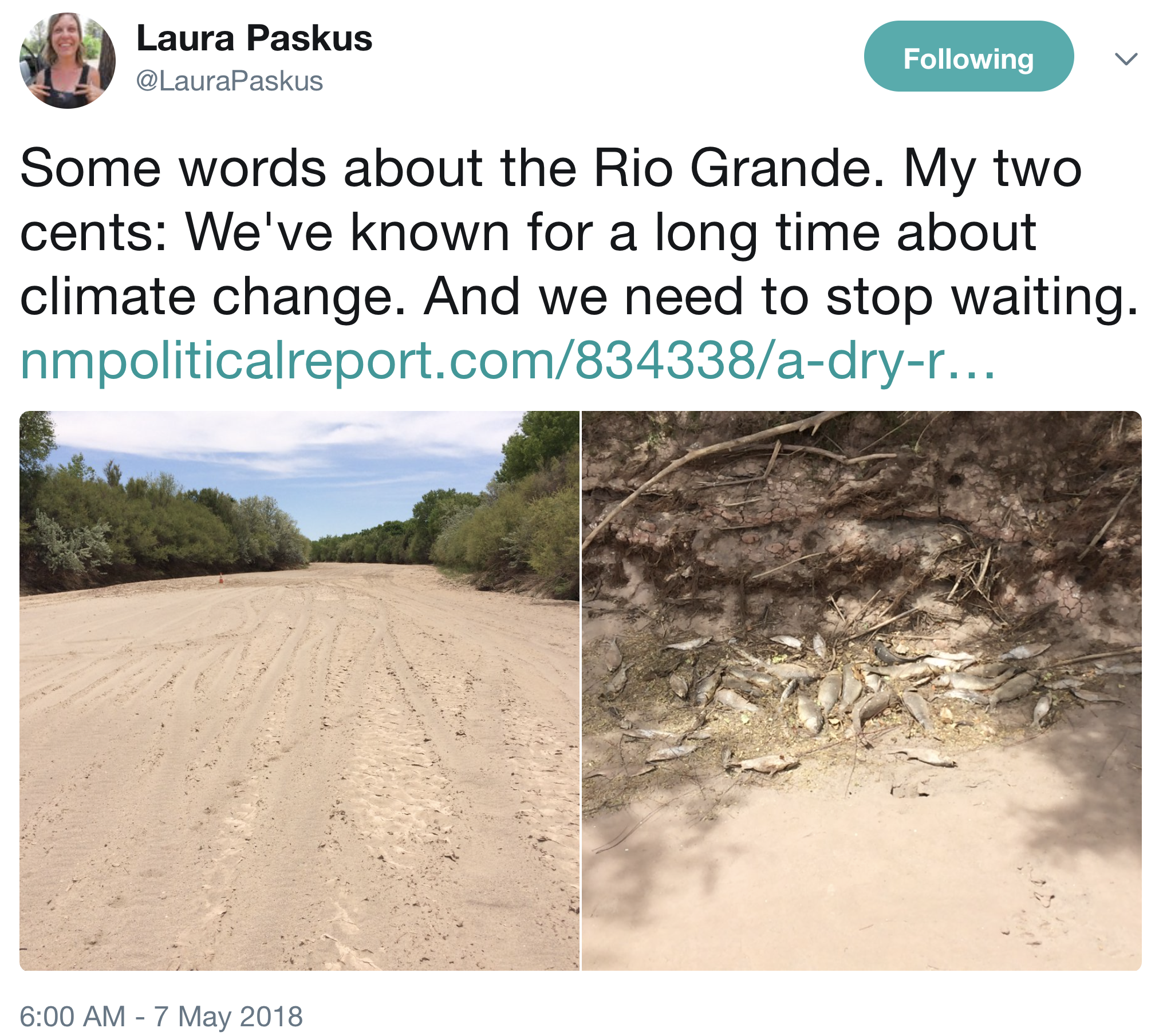
In early April, when the Middle Rio Grande should have been rushing with snowmelt, New Mexico’s largest river dried. It started through Bosque del Apache National Wildlife Refuge, spreading to more than 20 miles by now. The Albuquerque stretch may dry come June or July, which would mean some 120 miles dry altogether this summer.
Already, if you live in Albuquerque, you may have peered over the bridges and seen sandbars and slow water this spring. Even in places like Velarde or Española, historically low flows are trickling through your town, the result of not enough snow in the mountains this winter.
To see this happening in spring is shocking. But we shouldn’t be surprised. We knew this could happen. Just like we knew the climate was changing.
We know, for example, that warming makes an arid climate even drier.
On average, our snowpack is decreasing, moving north and melting earlier. That leads to less water in the rivers when we need it—spring and early summer before monsoons arrive.
And even when there is snow, warmer temperatures transform more of it to water vapor before it can liquefy its way into the watershed. Warming dries out soils and sends more dust into the air. That’s bad news, both for breathing creatures and snowpack, as topsoil-coated snowpack melts faster.
Warming means less water in rivers and reservoirs, and also less water underground.
Groundwater isn’t being recharged through snowmelt and streamflows, and we’re pumping more to compensate for the lack of surface water. New Mexicans survived the drought of the 1950s by pumping groundwater when the rivers slowed and the rains failed to fall. Since then, we’ve kept pumping, depleting aquifers and groundwater supplies.
Warmer, drier conditions also mean bigger, hotter wildfires and a longer wildfire season.
And after the fires, some of our forests can’t regenerate. Where they once thrived, ponderosa pine and mixed conifer forests can’t survive because it’s too warm—not to mention dry. In some places, even hardy junipers are drying out and dying off.
Before the Dome Fire and then Las Conchas, which burned here in the Jemez Mountains seven years ago, this was a dense conifer forest. Today, the climate is too warm for those trees to return.
In some places across this 30,000-acre burn scar, aspens and locust trees are sprouting where firs used to grow. In other places, the ground remains bare. When rains fall here, floods drive torrents of mud, ash and debris downstream.
Climate change means our forests change; our rivers and our grasslands change. It means our cities and small towns, farms and orchards change.
And we’ve known this for a long time.
In 1965, President Lyndon B. Johnson’s science advisers told him humans were “unwittingly conducting a vast geophysical experiment” by burning within a few generations fossil fuels that had accumulated over hundreds of millions of years. The carbon dioxide humans were injecting into the atmosphere would cause changes, they wrote, that would harm human beings.
In 1988, the New York Times reported on its front page that the Earth was warming. NASA scientist James Hansen testified before Congress, urging action to cut carbon emissions.
We knew what was happening.
In 2005, New Mexico released a report on the potential effects of climate change on the state. The 51-page summary report laid out a range of problems and potential solutions, related to everything from water and infrastructure to public health, wildfire and environmental justice.
New Mexicans then elected a governor who ended all state programs under her authority related to climate change.
Ten years later, scientists, economists and hydrologists worked together to understand New Mexico’s drought vulnerabilities. They handed off a report to the legislature that revealed problems with groundwater supplies in the Lower Rio Grande.
Our state Legislature didn’t renew their funding.
For decades, there have been scientific papers, government reports, planning documents, economic studies and international agreements.
We knew what was going to happen.
And yet, here we are.
No matter what you might hear from certain voices, this drying in the Middle Rio Grande is not normal for springtime.
That’s not to say that the river here has never dried in the spring, since records have been kept or before.
But just because something has happened before doesn’t mean it’s normal.
As it continues happening—as a river that supports millions of people in three states and two countries continues to dry—we all need to pay attention.
We also need to understand what biological, chemical and hydrological impacts are occurring, says Clifford Dahm, professor emeritus at the University of New Mexico’s Department of Biology and an expert on intermittent and ephemeral rivers.
“The aquatic creatures that live in the river, as it’s drying and staying dry longer, are going to change,” he said. “There will be a shift towards completely different communities of fish, algae, invertebrates and trees.”
Right now, we don’t know how quickly those shifts will occur, which species will survive, die or recover. But when the water table drops to more than ten feet below the surface, we do know cottonwood trees struggle and then die, Dahm said.
Right now, we know that in the Rio Grande Basin, warming will lead to a four to fourteen percent reduction in flow by the 2030s and an eight to 29 percent reduction by the 2080s.
On the Colorado River—which New Mexico also relies upon—scientists have predicted a 20 to 30 percent decrease in flows by 2050. And a 35 to 55 percent decrease by the end of the century.
Even on the Gila River in southwestern New Mexico, warming will decrease flows by about 5 to ten percent due to decreasing snowmelt runoff.
The decision to pull the license came after a five-year legal challenge from environmental groups including the Sheep Mountain Alliance, Rocky Mountain Wild and Center for Biologic Diversity. The groups have long opposed a plan hatched in 2009 by Energy Fuels Inc., of Toronto, Canada, to build a uranium mill on 880 acres in Paradox Valley, west of Nucla in Montrose County.
They filed a legal challenge against a key radioactive materials license granted for the project in 2013 by the Colorado Department of Health and Environment.
Energy Fuels has since sold the assets of the mill project, including the radioactive license, a company spokesman said Friday. Documents show the license was being held by Piñon Ridge Resources Corp.
On April 17, District Court Judge Richard W. Dana recommended the proposed mill’s radioactive license be revoked after concluding that Energy Fuels failed to demonstrate adequate environmental protections, including prevention of wind-dispersed radioactive materials, contamination of groundwater and protection of plants and wildlife. The ruling also questioned whether there was adequate water to operate the mill and tailings ponds.
Two days later, in an April 26 letter, the Colorado Department of Health informed Piñon Ridge Corp. CEO George Glasier that its radioactive materials license has been revoked.
“Although the Department believes the original decision on the license application was appropriate, the department has elected not to challenge Judge Dana’s decision. As such, this decision provides the Department with the rationale to revoke the license,” wrote Jennifer Opila, Radiation Program Manager for the health department’s hazardous materials division.
Environmental groups applauded the decision.
“We were extremely concerned with the impacts that a new uranium mill would have on the delicate sagebrush ecosystem of the Paradox Valley and the impacts downstream to endangered Colorado River fish,” said Matt Sandler, staff attorney with Rocky Mountain Wild. “Those impacts were simply unacceptable, and we’re happy to know that corporations who want to revive the uranium industry in Colorado will be required to fully comply with the laws aimed at protecting the environment.”
[…]
Lexi Tuddenham, executive director or Sheep Mountain Alliance, based in San Miguel County, said the decision helps to resolve the uncertainty about the project in the community and encourages a more diversified economic future that does not rely on the toxic uranium industry.
“The decision is a long time coming,” she said. “The impacts to the ecosystem and public were unacceptable. The mill was really a pipe dream, more speculation that contributes to the historic boom and bust cycle of mining that has been difficult for this area’s economy.”
The region is turning to hemp farming and outdoor recreation because they are more sustainable and do not pollute the environment, she said.
This is the second time the CDPHE granted, then revoked the radioactive license for Piñon Ridge. After it was granted in 2011, environmental groups challenged it, pointing out that the state had not held a public hearing as required. A judge agreed and invalidated the permit. After a five-day hearing in Nucla, the state reapproved the license in 2013, which was again revoked this week.
Travis Stills, an attorney with Energy and Conservation Law in Durango, represented the environmental groups in the case.
He said Dana’s ruling was based on community testimony and scientific evidence that indicated the mill plan questionable.
“The project plan had big holes in it and did not protect water, life and air,” he said. “Experts testified that micro-climates and inversions would have caused the valley to be socked in with industrial emissions.”
The towns of Telluride and Ophir also objected to the mill, fearing that prevailing winds would carry radioactive pollution onto the local snowpack and San Miguel watershed, Stills said.
Gunnison River Basin via the Colorado Geological Survey
Hay meadows near Gunnison
Gunnison River photo credit: HomeAway.com
Here’s the release from the Trust for Public Land:
Broad coalition protects more than 4,300 acres with help from the largest-ever GOCO grant
The Trust for Public Land today announced the final-stage closing in the protection of 4,377 acres of working ranchland in the scenic valleys of the Gunnison and East Rivers between Gunnison and Crested Butte. The protection effort, for land on the Trampe Ranch, was completed through three working-ranch conservation easements and with help from a $10 million grant from the Great Outdoors Colorado (GOCO) funding program, the largest single transaction grant in the organization’s history.
The easements prevent subdivision and development of scenic ranchlands stretching for 30 miles in one of Colorado’s most iconic landscapes. These lands are essential to agriculture, with Trampe Ranch generating 20 percent of Gunnison County’s agricultural economy. In addition, the conserved lands provide scenic views that attract tourists and visitors, include habitat for a wide variety of wildlife, and serve as research lands for scientists from the nearby Rocky Mountain Biological Laboratory.
“The lands and waters of the Trampe Ranch play such an important role in defining the character and sense of place of one of Colorado’s last, great mountain valleys,” said Jim Petterson, The Trust for Public Land’s Southwest and Colorado Director. “This project brought together a deep and broad partnership of individuals, governments and organizations, all allied around a shared commitment of helping local communities fulfill their visions for how they want to grow and what they want to preserve.”
Efforts to protect ranchlands and open space in the Gunnison Valley began in the 1980s in an alliance between local land trusts, national conservation groups, funders like GOCO, local governments, and agricultural landowners, including Trampe Ranch owner Bill Trampe, who has been a leader in encouraging ranchers to conserve their land with easements. With the completion of the most recent project, Trampe Ranch has more than 6,000 acres under easement.
“GOCO is proud to be one of the partners to help make this monumental land conservation effort possible, and our Board of Trustees and staff are eternally grateful to Bill Trampe for his vision, leadership, and generosity,” said GOCO Executive Director Chris Castilian. “Trampe Ranch received GOCO’s largest ever, single transaction grant award at $10 million, because conserving this iconic property means the protection of vital agricultural land and stunning scenic views for those who will recreate on beautiful, adjacent public lands for generations to come.”
“What this one very special place means to the Gunnison Valley and to our entire state cannot be overstated. Today we join our fellow Coloradans in celebrating Bill Trampe, his family, and all they have accomplished,” added Castilian.
In addition to the GOCO grant, funding for the project came from the Natural Resources Conservation Service, the towns of Crested Butte and Mt. Crested Butte, Gunnison County, The Rocky Mountain Biological Laboratory, Crested Butte Land Trust, and 1% for Open Space, a consortium of Gunnison County businesses that collects a voluntary donation of 1% of sales for its customers to fund open space conservation in Gunnison Valley. Additional private funding came from a multi-million dollar campaign. Trampe Ranch also donated a significant portion of the conservation easement value toward the project.
“This land has been the heart of our ranch for more than 100 years,” said Bill Trampe. “Conservation of our home place means this land is available forever for agriculture.”
Local partners cheered the completion of the conservation effort.
“We are very excited to see this critical step in the conservation of the East River Valley,” said Dr. Ian Billick, Executive Director of the Rocky Mountain Biological Laboratory. “Keeping the properties in ranching is one of the most important things we could do to leverage the nation’s large investment in the field research that helps us manage our water, air, and food.”
“Nothing is more important than the preservation of the natural state of Colorado and its heritage of ranching. Especially in this day and age when there seems to be a valid threat to open spaces throughout the West,” said Mayor Jim Schmidt from the Town of Crested Butte.
“We are very excited about the completion of this final conservation easement,” said Carlos Fernandez, Colorado State Director for The Nature Conservancy. “The Trampe Ranch is a spectacular property with some of the most outstanding scenery in Colorado. Conserving this iconic ranch leaves an amazing legacy for the Gunnison Valley, reminding us of Colorado’s history and landscape.”
One of the most significant land preservation actions in Colorado concluded Tuesday, April 10 with the closing of the last parcel of the Trampe Ranch property in Gunnison County. The final closing puts thousands of acres of prime ranchland stretching from Gunnison to Gothic into a conservation easement that is meant to keep the property free of development and focused on agriculture in perpetuity.
This multimillion-dollar deal was broken up into three parts totaling 4,377 acres. The first step took place in February 2017 when the 1,447-acre Trampe Home Ranch was preserved. That parcel, located near Gunnison, resulted in Gunnison sage grouse habitat being protected.
“This land has been the heart of our ranch for more than 100 years,” said Bill Trampe at the time. “The meadows and pastures are the resource base for ranch production, and also provide habitat for Gunnison sage grouse and other wildlife species. Conservation of our home place means this land is available forever for agriculture and for the birds.”
The second phase of the overall effort took place in October 2017 when 284 acres were preserved in the corridor between Gunnison and Crested Butte near Jack’s Cabin. And Tuesday’s 2,647-acre closing put land primarily located in the Upper East River Valley near Crested Butte into the conservation easement.
The Nature Conservancy is the holder of the Trampe Ranch conservation easement and the Trust for Pubic Land facilitated the transactions and led the public and private fundraising campaign…
While 4,377 acres were protected in these latest three closings, in sum total, the Trampe Ranch will have close to 6,000 protected acres from prior projects near Roaring Judy Fish Hatchery.
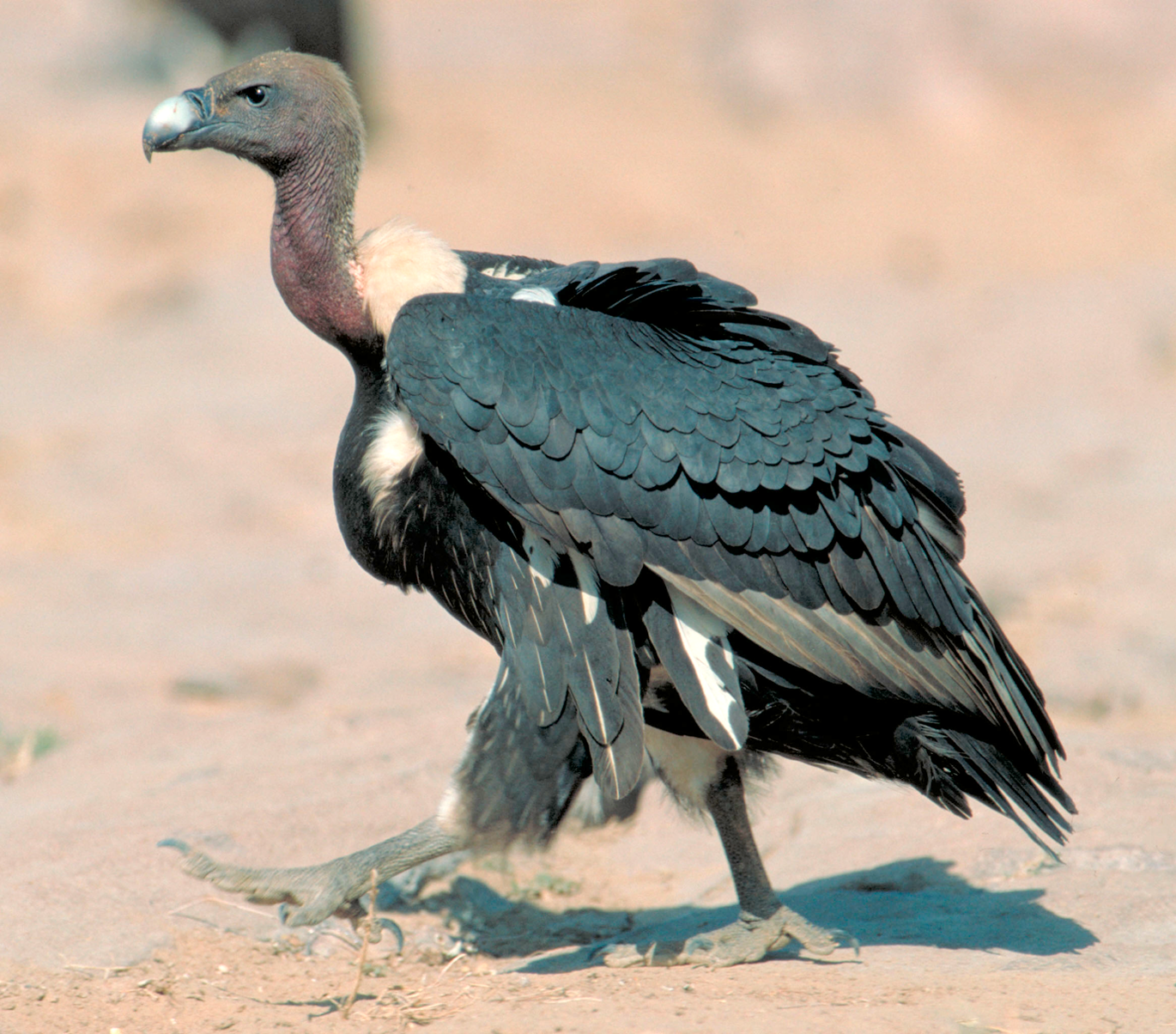
The White-Rumped Vulture (Gyps bengalensis) is an Old World vulture native to South and Southeast Asia. It has been listed as Critically Endangered on the IUCN Red List since 2000, as the population severely declined. White-rumped vultures die of renal failure caused by diclofenac poisoning. In the 1980s, the global population was estimated at several million individuals, and it was thought to be “the most abundant large bird of prey in the world”. As of 2016, the global population was estimated at less than 10,000 mature individuals. Photo credit: Wikimedia
Large numbers of pharmaceuticals found at levels dangerous for wildlife and the environment
River systems around the world are coursing with over-the-counter and prescription drugs waste which harms the environment, researchers have found.
If trends persist, the amount of pharmaceutical effluence leaching into waterways could increase by two-thirds before 2050, scientists told the European Geosciences Union conference in Vienna on Tuesday.
“A large part of the freshwater ecosystems is potentially endangered by the high concentration of pharmaceuticals,” said Francesco Bregoli, a researcher at the IHE Delft Institute for Water Education in the Netherlands, and leader of an international team that developed a method for tracking drug pollution “hotspots”.
A large number of drugs – analgesics, antibiotics, anti-platelet agents, hormones, psychiatric drugs, antihistamines – have been found at levels dangerous for wildlife.
Endocrine disruptors, for example, have induced sex changes in fish and amphibians.
Bregoli and his team used a common anti-inflammation drug, diclofenac, as a proxy to estimate the presence and spread of other medications in freshwater ecosystems.
Both the European Union and the US Environmental Protection Agency have identified diclofenac as an environmental threat. Veterinary use of it has driven a sub-species of vultures on the Indian subcontinent to the brink of extinction.
More than 10,000km of rivers around the world have concentrations of diclofenac above the EU “watch list” limit of 100 nanograms a litre, the new research found.
“Diclofenac emissions are similar to any of thousands of pharmaceuticals and personal care products,” said Bregoli.
Global consumption of diclofenac tops 2,400 tonnes a year. Several hundred tonnes remain in human waste, and only a small fraction – about 7% – of that is filtered out by treatment plants.
Another 20% is absorbed by ecosystems, and the rest go into oceans.
Bregoli and his team developed a computer model to predict current and future pharma pollution based on criteria such as population densities, sewage systems and drugs sales.
They compared the results to data gathered from 1,400 spot measurements of diclofenac toxicity taken from around the world. Most of the data points were in Europe and North America.
Pollution levels are likely to be substantially higher in much of Latin America, Africa and Asia where less than a quarter of waste water is treated, and with technology unable to filter out most pharmaceuticals.
Technology alone cannot solve the problem, said Bregoli.
“We need a substantial reduction in consumption,” he said.
In other research presented at the conference, scientists found that the rapid expansion of sewage systems in large urban areas has sharply raised river pollution because much of it is not adequately treated.
“In 2000, sewage was a source of pollution in about 50% of the rivers in the world,” said Maryna Strokal, a scientist at Wageningen University and Research in the Netherlands.
“By 2010, sewage was a source of pollution in almost all rivers worldwide.”
Antibiotics and chemicals waste is also driving the evolution of drug-resistant bacteria, UN Environment warned in a study in December.
Between 70% and 80% of all antibiotics consumed by humans and farm animals – thousands of tonnes – find their way into natural environments, it said.
NPS and USFWS use a seine net to trap humpback chubs in the Little Colorado River. Photo credit Mike Pillow via the Arizona Daily Sun.
Humpback chub are one of four federally endangered fish species that rely on habitat in the 15-Mile Reach of the Colorado River. Humpback chub photo credit US Fish and Wildlife Service.
Humpback chub
Upper Colorado River Endangered Fish Recovery Program
In a recent analysis, scientists at the U.S. Fish and Wildlife Service say the chub’s five distinct populations throughout the Colorado River watershed in Colorado, Utah, and Arizona are stable enough to reclassify the fish as threatened rather than endangered.
Humpback chubs all but disappeared as large dams began filling the Colorado River’s tight canyons, controlling flows and changing water temperature. The fish thrives in rapid, turbulent flows, which were tamed as dams went up throughout the watershed since the 1930s…
[Tom] Chart says efforts to better manage dams, releasing water to mimic seasonal high and low flows, have provided more habitat. The agency also attempts to control and kill non-native fish like small mouth bass that feast on the humpback chub…
The largest population of humpback chub, found at the confluence of the Colorado and Little Colorado rivers in the Grand Canyon of Arizona, is a stable group of about 12,000 adults according to USFWS estimates. Another 3,500 are in the Colorado River’s Westwater Canyon in Utah, plus 500 in Black Rocks in Western Colorado, near the Utah border. Other populations are found in Utah’s Cataract Canyon and Desolation and Gray Canyons. A previously documented group in Colorado’s Dinosaur National Monument haven’t been seen there since 2004.
The fish is not completely out of the woods just yet, Chart cautions. A full recovery of the humpback chub in the Colorado River will require more population monitoring, continued flow management from dams and coordinated kills of nonnative fish.
Greenback cutthroat trout photo credit: Colorado Parks and Wildlife.
More greenback cutthroats are headed to a creek near you, thanks to a $60k grant from the National Fish and Wildlife Foundation’s “Bring Back the Natives” (BBN) program.
This project to restore native greenback cutthroat trout to 14 miles of stream in George and Cornelius Creeks in the headwaters of the North Fork of the Poudre River, reached a major funding milestone with the award of the $60k grant. The BBN grant will go toward the design and construction of a temporary barrier to upstream fish migration in Cornelius Creek, enabling systematic eradication of non-native brook trout, brown trout, and whirling disease from the watershed.
“George Creek holds great promise for recovering Greenback cutthroat trout, but our conservation success depends on broad support from many partners,” said Canyon Lakes District Ranger Katie Donahue. “Receiving a national funding award from NFWF is a great step along our path.”
The grant is the direct result of continued support for the project from Colorado Trout Unlimited. In addition to this grant “The Greenbacks,” a chapter of CTU, previously leveraged funds from a crowd sourced fundraising effort to secure a grant from Patagonia’s World Trout Initiative, resulting in the contribution of $17k toward a permanent barrier at the downstream end of the project. This barrier will exclude non-native trout from the watershed in perpetuity.
“We’re proud of how our volunteers have risen to meet the call,” said David Nickum, Executive Director for Colorado Trout Unlimited. “From backpacking fish into high-mountain restoration sites and releasing them back into their native range, to helping install fish barriers to protect native recovery areas, TU members have been hardworking, enthusiastic partners in recovery.”
This recent BBN grant brings the total amount of funding raised from grant sources and other public fundraising activities to $162k for the project.
About the George Creek Multi-phase greenback recovery project
The George Creek greenback restoration project has been in the works for three years and consists of three phases: (1) eradicate nonnative trout from upper George Creek [Summer 2018], (2) eradicate trout from upper Cornelius Creek, (3) eradicate non-native trout in lower reaches of George Creek down to a permanent barrier near the confluence with Sheep Creek. The BBN grant will help fund phase 2.
Native greenback cutthroat trout will be re-stocked into the streams when it has been confirmed that all non-native trout and whirling disease have been completely eradicated, in the year 2025 at the earliest.
The George Creek restoration project will ultimately restore native greenbacks to 14 miles of quality trout stream habitat, more than tripling the number of stream miles currently occupied by greenbacks in their native range, the South Platte Basin.
“Our work has been benefitted greatly from our strong partnerships with Colorado Trout Unlimited and the U.S. Forest Service,” said Boyd Wright, Native Aquatic Species Biologist for Colorado Parks and Wildlife. “It is gratifying to work together to ensure that future generations will enjoy Colorado’s greenback cutthroat trout for years to come.”
Danielle Tremblay of Colorado Parks and Wildlife holding a Colorado pikeminnow collected on the Colorado River in Grand Junction. An apex predator in the Colorado, pikeminnows used to be found up to six feet long and weighing 100 pounds.
FromThe Grand Junction Daily Sentinel (Gary Harmon) via The Aspen Times:
the endangered Colorado pikeminnow faces a new threat, a predator that eagerly scarfs down young pikeminnow, taking a jagged bite out of the species’ overall numbers.
Unfamiliar predation on the pikeminnow comes from a species of fish that’s native to the flatwaters of Canada and the northern tier of the United States. Walleye is a prized food fish, but its voracious appetite for pikeminnow is proving to be a setback to expectations that the pikeminnow could be removed from the endangered species list.
“Walleye have gone gangbusters in Lake Powell,” said Tom Chart, a fisheries biologist who heads the Upper Colorado River Endangered Species Recovery Program for the U.S. Fish and Wildlife Service.
It’s likely that walleye found their way up the Colorado from Lake Powell, Chart said. It’s also possible that the hungry newcomers could have swum down from Rifle Gap and Elkhead reservoirs in Colorado and from two reservoirs in Utah, Red Fleet and Starvation, both near Vernal, said Henry Maddux, director of Utah’s species recovery programs.
On a barely encouraging note, “We haven’t seen walleye reproduce in the rivers,” Chart said. “Yet.”
Walleye nonetheless have taken up residence in waters where they don’t belong, feasting on the young pikeminnow that hatched in the critical 15-mile reach of the Colorado River through the Grand Valley and washed downriver into the slower waters where for eons they have grown to become the apex predators on the river.
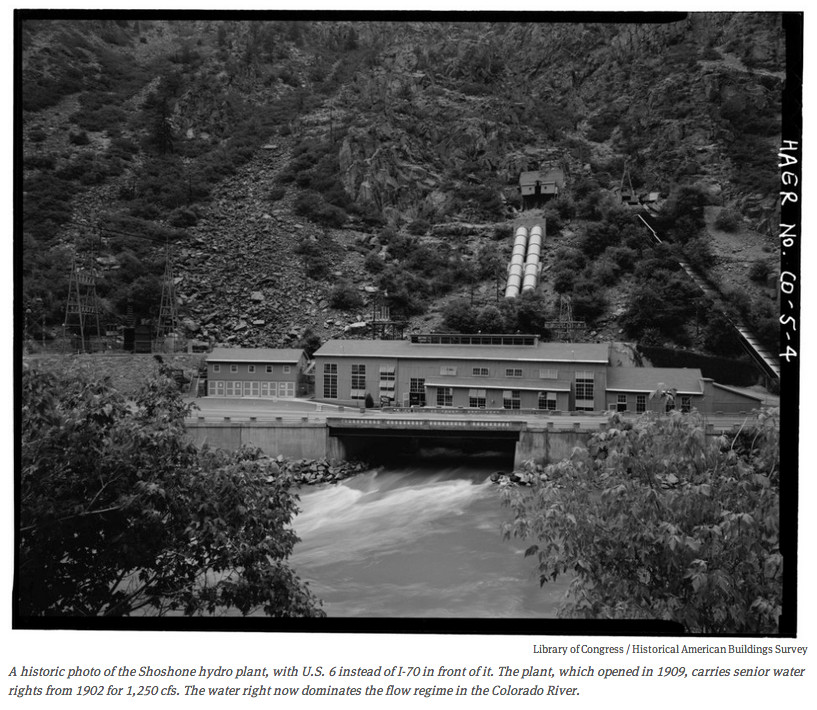
Head east from Glenwood Springs in western Colorado today, and you’ll encounter an isolated stretch of I-70 hugging the curves of the Colorado River. But 110 years ago, you would’ve hit “a thriving little city” of hundreds of people living in tents, nestled there between the high walls of the river canyon so its residents could build a hydroelectric plant.
That facility, the Shoshone power plant, still adds energy to the grid, but its true importance lies elsewhere: Shoshone is a cornerstone of the elaborate complex of water rights, laws, agreements and relationships that shape the management of the upper Colorado River. Because of the water rights it holds — and because it returns the water it uses to the river channel — the diminutive plant dictates how the river is managed in Colorado. “It’s an interesting historic relic with huge implications for the ecological health of the river,” says Brent Uilenberg, a manager in the U.S. Bureau of Reclamation’s Upper Colorado Region, “and (for) providing a reliable water supply for East and West Slope human uses.”
Shoshone Hydroelectric Plant back in the days before I-70 via Aspen Journalism
The water system Shoshone has shaped irrigates crops, supports endangered fish and keeps a nearly $8 million rafting industry afloat. Merely by existing, the plant helps keep the demands of Denver and other thirsty cities in check.
In what has long been a source of conflict and compromise among Colorado’s water managers, most of the state’s precipitation falls west of the continental divide, on the Western Slope, separated from the majority of the population by the Rocky Mountains. Since the early 1900s, a series of tunnels and ditches have addressed that mismatch by ferrying water out of the Colorado River basin, supplying cities and irrigating fields east of the Rockies. “The Shoshone power plant has played a dominant role on the river since it first came online,” says John Currier, chief engineer at the Colorado River Water Conservation District.
But Shoshone, because it predates those diversions, keeps some water that might otherwise cross the backbone of the continent in western Colorado. In the world of Western water, older rights get first dibs: So Shoshone gets priority, even if that means managers must let water flow past their tunnel intakes. Less water for eastern Colorado means the river keeps rushing downstream toward Shoshone, and people and ecosystems that depend on it.
Downstream communities draw drinking water from the Colorado, and growers near Palisade and Grand Junction use it to irrigate peaches and other crops. Keeping water in the river has also been fundamental to a collaborative program to recover four species of endangered fish in the Colorado River. “It comes back to, fish need water,” says Tom Chart, the director of the Upper Colorado River Endangered Fish Recovery Program.
Downstream of Shoshone, just above where the Gunnison River empties into the Colorado, there’s a stretch of river where endangered Colorado pikeminnow lay their eggs after spring floods have cleared the cobbles of silt. But human demands on the river tax it so much that during drought, it can get close to drying up. To prevent that, water users and managers work within a tangled web of agreements and rules, looking for ways to keep the river wet. The flows that come down from Shoshone anchor that effort. “I always view Shoshone as our first line of protection,” Reclamation’s Uilenberg says.
But that protection hasn’t always been assured: If the power plant needs maintenance or shuts down, it wouldn’t be allowed to exercise its water rights, because water must be put to “beneficial use” under Western water law. To preserve Shoshone’s influence on the Colorado River — to protect the wildlife, farms and economies that depend on it — water districts from both sides of the continental divide formalized a plan in 2012. They agreed upon a protocol for releasing water from upstream reservoirs that would mimic the Shoshone flows should the power plant go offline, effectively preserving the plant’s influence for the long term. Short shutdowns at the aging facility aren’t uncommon, and “hav(ing) that protocol in place to bridge those gaps is key,” Chart says.
A separate deal, however, allows reductions in the Shoshone flows. Xcel Energy, the owner of the plant, has agreed to allow more water to go to Denver during dry periods by running just one turbine — cutting the plant’s water needs in half — when certain conditions are met. But crucially, that “relaxation” of Shoshone’s water rights is typically limited to the season when it would be least impactful to others: mid-March through mid-May, when the Colorado is beginning to run high with snowmelt but irrigation and rafting seasons have yet to begin.
For its part, Xcel says their interests lie simply in running the plant, not in negotiating battles over water, according to Richard Belt, a water resources senior analyst for Xcel based in Denver. “Shoshone has sort of been a neutral third party there, kind of minding its own business,” he says, a role it has played for decades, through deluges and droughts, major repairs and evolutions in water management — and one which the tiny, century-old plant will likely hold for years to come.
Shoshone Falls hydroelectric generation station via USGenWeb
Shoshone hydroelectric generation plant Glenwood Canyon via the Colorado River District
March for Science, Denver, Colorado, April 22, 2017
FromThe Washington Post (Brady Dennis and Darryl Fears):
President Trump made his mark in the energy and environment world during his first year in Washington. Many of his actions aimed to undo work from the Obama era. Trump all but abandoned the nation’s efforts to combat climate change, and he shrank national monuments that President Barack Obama had established or sought to preserve. Trump scaled back regulations on the fossil fuel industry and pushed for more drilling on land and at sea.
And in turn, much of the world pushed back. Protesters descended on Washington to oppose his policies and campaign against what they saw as an attack on science. Other nations denounced his decision to back out of an international climate agreement, leaving the United States at odds with the rest of the globe.
Meanwhile, extreme weather nationwide wrought devastation. Hurricanes leveled homes, triggered floods and upended lives from Puerto Rico to Texas. Wildfires ravaged California, burning entire neighborhoods to ashes. It was a tumultuous year. Here are some of the most consequential environmental stories we covered along the way.
1. Withdrawal from the Paris climate accord. “I was elected to represent the citizens of Pittsburgh, not Paris,” Trump proclaimed from the Rose Garden in June. With those words, he declared his intention to withdraw the nation from a global effort to cut greenhouse gas emissions in an attempt to fend off the worst effects of climate change. The Obama administration had led the charge for the landmark deal in late 2015, helping to persuade other world powers — and major polluters — such as China and India to pledge to reduce their emissions in coming years.
Trump reversed course, despite widespread criticism from world leaders, claiming that the Paris accord was a bad deal for the United States that would disadvantage American workers. The United States is now the only nation in the world to reject the deal. While the U.S. withdrawal from the Paris agreement cannot officially be finalized until late 2020, the action sent a clear message: Climate action has little place in the Trump administration.
2. A sea change at the Environmental Protection Agency. “The future ain’t what it used to be at the EPA,” the agency’s administrator, Scott Pruitt, is fond of saying. That’s certainly true. In nominating Pruitt to head the agency that Trump once promised to reduce to “little tidbits,” the president chose a man who had long been one of its most outspoken adversaries. As Oklahoma attorney general, Pruitt sued the EPA 14 times, challenging its authority to regulate toxic mercury pollution, smog, carbon emissions from power plants and the quality of wetlands and other waters.
Now, as EPA’s leader, he has acted aggressively to reduce the agency’s reach, pause or reverse numerous environmental rules, and shrink its workforce to Reagan-era levels. He has begun to dismantle Obama’s environmental legacy, in part by rolling back the Clean Power Plan — a key attempt to combat climate change by regulating carbon emissions from the nation’s power plants. Along the way, Pruitt has become one of Trump’s most effective Cabinet members, as well as a lightning rod for criticism from public health and environmental groups.
3. The fight over national monuments. Trump issued an executive order in April to review 27 land and marine monuments. But it was clear that two particular monuments were in his crosshairs: Bears Ears and Grand Staircase-Escalante. Utah’s congressional delegation and its governor had lobbied Trump’s inner circle to reverse the monument designations of these parks in their state even before he was elected.
Utah Republicans called the designations by Obama and President Bill Clinton overzealous land grabs, and shortly after he took office, Trump adopted some of the same language. He promised to end what he called presidential “abuses” and give control of the land “back to the people.” In the end, Trump shrank both monuments by nearly 2 million acres last month, and Interior Secretary Ryan Zinke said the borders of other monuments in the Atlantic and Pacific oceans, as well as in the West, are being reviewed. Native American groups that had requested a Bears Ears designation are leading a wave of lawsuits against the Trump administration’s decision.
4. Drill, baby, drill. Drilling platforms already dot the Gulf of Mexico, where the fossil fuel industry has extracted oil and gas for decades. But the Trump administration wanted to make history. In early November, it did so by announcing the largest gulf lease offering for oil and gas exploration in U.S. history: 77 million acres.
The move was consistent with Trump’s push for “energy dominance.” He and Zinke are also opening more land to coal excavation in the West. One of Zinke’s first acts as interior secretary was to remove a bright and colorful picture of a western landscape from the Bureau of Land Management’s website and replace it with a black wall of coal. Oil prices are climbing after reaching record lows in recent years, but coal is struggling to make a comeback after the rise of natural gas. The Gulf of Mexico promises more oil, but it also might promise disaster. It’s the scene of the nation’s worst environmental disaster, the Deepwater Horizon oil spill, which fouled beaches and killed untold numbers of marine animals when oil spewed into the water for months.
Is drilling in the pristine Arctic National Wildlife Refuge next? The Republican-controlled Congress greenlighted leases for exploration in the recently passed tax bill completely along party lines. But let the buyer beware. Royal Dutch Shell drilled a $7 billion hole in the Chukchi Sea in 2014 and has nothing to show for it.
5. Action on the Dakota Access and Keystone XL pipelines. As winter began to fade, it became clear that camps of protesters in Canon Ball, N.D., who for months had fought a pipeline that they argued could threaten the drinking water and cultural sites of the Standing Rock Sioux tribe, had lost this particular battle. Days after Trump took office, he signed executive orders to revive two controversial pipelines that the Obama administration had put on hold — the 1,172-mile Dakota Access and the 1,700-mile Keystone XL oil pipeline, which would extend from the Canadian tar sands region to refineries on the Texas Gulf Coast.
Oil is now flowing through the Dakota Access pipeline. And the company behind the Keystone XL this fall cleared a key regulatory hurdle in its quest to complete the northern half of the pipeline, running from Alberta to Steele City, Neb., when it received approval from the Nebraska Public Service Commission. Opponents of both projects have vowed to continue legal fights, as well as to protest any other pipelines they view as a threat to public health or the environment. But Trump shows few signs of backing down, calling his actions “part of a new era of American energy policy that will lower costs for American families — and very significantly — reduce our dependence on foreign oil, and create thousands of jobs right here in America.”
6. Attacks on the Endangered Species Act. It is arguably one of the most powerful environmental laws in the world, credited with saving at least a dozen animal and plant species from extinction. But who will save the Endangered Species Act, which is under attack by political conservatives inside and outside Washington? Led by Rep. Rob Bishop (R-Utah), chairman of the House Natural Resources Committee, who said he wants to “invalidate” the 44-year-old act, some Republicans say the law interferes with commercial development, private landowner rights and excavation of natural resources such as coal and natural gas.
Bishop’s committee passed five bills that would weaken protections for wolves, force federal workers who enforce the law to consider economic impact when deciding how to save animals and strip away a provision of the law that requires the federal government to reimburse conservation groups that prevail in court. The bills have set up a potentially titanic battle between wildlife advocates and lawmakers supporting farmers, housing developers and the oil and gas industry. It’s not the first time that conservatives have attempted to weaken the act, but it is the first time a presidential administration and the department that oversees the act appear willing to go along.
7. Epic hurricanes and wildfires. Last year around this time, a strange wildfire rushed through the Tennessee mountains, killing 14 people, destroying homes and apartment buildings, and threatening a major recreation area in Gatlinburg. The 2017 fire disasters, some of which are still burning, were much more monstrous than that Great Smoky Mountain inferno. Two California fires, the Sonoma fire that burned north of San Francisco and the Thomas fire that burned north of Los Angeles, driven by fierce Santa Ana winds, have combined to kill 45 people, burn more than a half-million acres, destroy nearly 2,000 structures and cost hundreds of millions of dollars to fight. The Thomas fire appears to be finally contained near Santa Barbara after burning the second-most acreage in state history.
But fire wasn’t even the costliest disaster this year. Hurricane Harvey’s death toll in and around Houston was nearly double the number who perished in the two fires and sent 30,000 people in search of shelter. Miami, Jacksonville and Naples, Fla., were devastated by Hurricane Irma, which immediately followed Harvey. They were followed by Hurricane Maria, which leveled much of Puerto Rico and left at least 50 people dead, but that is probably a drastic under count and the toll could be as high as 500.
8. Criminal charges mount in the Flint water crisis. In June, Michigan Attorney General Bill Schuette charged the director of the state’s health department and four other public officials with involuntary manslaughter for their roles in the Flint water crisis, which has stretched into its fourth year. In addition to ongoing worries that thousands of young children were exposed to dangerous levels of lead in the city’s contaminated water supply, the crisis has been linked to an outbreak of Legionnaires’ disease that contributed to at least a dozen deaths. The manslaughter charges were the latest reckoning.
According to Schuette’s office, the investigation into the decisions that led to tainted water for a city of nearly 100,000 people has resulted in 51 criminal charges for 15 state and local officials. It remains unclear how many of the charges will stick. But the cases serve as a reminder of the human toll of the tragedy and how, even today, many residents in the largely low-income, majority-minority city trust neither the water from their taps nor the public officials charged with ensuring it is safe.
9. Climate march on Washington. It didn’t draw nearly the crowd that the Women’s March did in January. And it didn’t get as much national attention as the March for Science that came only a week earlier. Even so, on a sweltering Saturday in April, tens of thousands of demonstrators descended on Washington to mark Trump’s first 100 days in office. Their plea: Stop the rollback of environmental protections and take climate change seriously.
Building on a massive demonstration three years earlier in New York, the People’s Climate March brought its message — and its many clever signs — to the White House. “Don’t destroy the Earth. I buy my tacos here,” one read. “Good planets are hard to find,” another read. “Make Earth Great Again!” read another. Trump wasn’t around that day to witness the protests on his doorstep, and the march’s organizers didn’t expect to change his mind. But they were gearing up for a long fight ahead. By the next morning, some participants met to discuss how to get more allies to run for public office. “It can’t just be a march,” one activist said. “It has to be a movement.”
Here’s the release from the University of Washington (Michelle Ma):
Dams and fish have never been best friends.
The San Juan River’s Navajo Dam and reservoir above.U.S. Bureau of Reclamation
Thousands of dams built along U.S. rivers and streams over the last century now provide electricity for homes, store water for agriculture and support recreation for people. But they also have significant downstream impacts: They reduce the amount and change the timing of flowing water that fish rely on for spawning, feeding and migration.
Recognizing that many large dams are here to stay, a University of Washington team is investigating an emerging solution to help achieve freshwater conservation goals by re-envisioning the ways in which water is released by dams. The hope is that “designer flows” downstream from dams can be tailored to meet the water needs of humans while simultaneously promoting the success of native fishes over undesirable invasive fish species.
The team’s approach is described in a paper appearing Dec. 18 in Nature Communications.
“Rapidly changing water availability demands new dam management strategies to deliver water downstream that balances human and ecosystem needs,” said senior author Julian Olden, a UW professor of aquatic and fishery sciences. “So, the question is whether designer flows can be engineered to meet human water demands, and take advantage of mismatches between native and nonnative species’ responses to flow to provide the greatest conservation benefit.”
The Navajo Dam on the San Juan River.Photo credit Mike Robinson via the University of Washington.
The researchers examined the designer flow concept in the San Juan River, a major tributary to the Colorado River that flows through parts of Utah, Colorado, Arizona and New Mexico. Every drop of water is significant in this arid landscape, and along the river’s roughly 380-mile length, the mighty 402-foot Navajo Dam is impossible to ignore. The river is home to at least eight native fish species, but over the years a number of invasive fish species have also taken up residence, including predatory channel catfish, red shiner and common carp.
By integrating multiple decades’ worth of data about dam operations, river hydrology and fish species abundance into a multi-objective model, the researchers were able to identify specific water-release schedules that benefitted native fish over the invasive fish — while still ensuring that all of the domestic and agriculture needs that rely on the San Juan River’s water are met.
“We were also pleased to discover that our model predicts that the ecological benefits of designer flow releases do not evaporate during times of drought,” Olden said.
This method can guide water management in any river with large dams, Olden said. It’s particularly relevant in more arid regions of the American Southwest where water is at a premium, but major rivers like the Columbia or the Mississippi, which are similarly peppered with dams, also could have their dams programmed to release water in ways that aim to benefit both humans and freshwater ecosystems.
The key to the researchers’ approach is capitalizing on the fact that invasive fishes have only a recent evolutionary history in these river systems. Consequently, important life events of invasive fishes — such as spawning and habitat use — show slightly different relationships to patterns in streamflow compared with native fishes. The designer flows in their study exploited these small differences to identify dam releases during certain times of the year that would benefit native fishes and be detrimental to invasive fishes.
These tailored water releases are not trying to mimic the natural flow of a river before it was dammed, but rather emphasize the most important flow events for native fish in an altered river system, the researchers explained. According to their model, water releases in the San Juan River should occur in late winter, late summer and mid-autumn to get the best outcomes for native fishes over invasive ones.
Fly fishers on the San Juan River below the Navajo Dam.U.S. Bureau of Reclamation
While both designer and natural flows were predicted to be beneficial for native fishes, they found that designer flows could lead to double the loss of invasive fishes in the river, compared with a dam-release scenario that mimicked natural water flows, before the dam existed. Occasionally, dammed rivers will flush a deluge of water downstream, attempting to mimic natural river flows — but with mixed success for fish. This study suggests that such efforts could be better optimized.
This work is still in the modeling phase, and the researchers want to look next at how these water-release practices could potentially benefit other aspects of dammed river systems, such as restoring shoreline vegetation, benefiting aquatic insects and even bolstering river recreation by manipulating the water releases to encourage formation of large sandbars. Ultimately, the researchers hope to test their designer flows in a real river system, in cooperation with dam operators, engineers and water users.
“Let’s be honest: Carefully tweaking dam operations all year round to implement a designer flow regime would require a giant leap of faith, but anything new we do in water resource management involves some risk,” Olden said. “If we don’t try, we’ll never know how much better we actually could do.”
The paper’s lead author is William Chen, a recent graduate of the UW’s School of Aquatic and Fishery Sciences and the Quantitative Ecology and Resource Management Program.
The study was funded by the National Science Foundation’s Graduate Research Fellowship Program and Olden’s H. Mason Keeler Endowed Professorship.
From The Walton Family Foundation (Sheldon Alberts):
As director of Trout Unlimited’s western water and habitat program, Scott [Yates] builds partnerships with private landowners to find creative ways to reduce demand for water in the arid Colorado River basin.
The search for innovative ideas is driven by fears of future water shortages – and conflicts – in a region where a rapidly growing population, extended drought and changing weather are all combining to threaten supply. Declining snow pack and water supply also puts critical fish and wildlife habitat at risk.
Because the system, agricultural producers and fish all need water, there is significant incentive for cooperation among different stakeholders.
Some of the most promising water management solutions are being tested along the mountain-fed tributaries of the upper Green River, near the headwaters of the Colorado River system.
For more than a century, farmers and ranchers in Wyoming’s high desert rangeland have relied on irrigation water from these streams to raise crops and cattle, sustain their livelihoods and build the state’s agricultural economy.
Trout Unlimited has worked with landowners to construct fish passages to prevent trout from getting stuck in irrigation ditches and save water by improving the efficiency of aging canals, some of which were dug in the 1880s.
Over the past three years, the conservation organization has also focused on helping landowners enroll in the System Conservation Pilot Program, which compensates ranchers and farmers in the upper and lower Colorado basin for voluntarily reducing water consumption.
Started by the Bureau of Reclamation and large municipalities including Denver and Las Vegas, the program aims to help stabilize water levels in Lake Mead and Lake Powell. In Wyoming, landowners are paid to stop irrigating in early July when mountain runoff is lighter and trout benefit most from having more water in the stream.
“In higher elevation country like the upper Green River, ranchers have shown remarkable interest in marketing late-season water flows. It’s after haying season and their crop is already baled and harvested, so they have less need to irrigate,” Scott says. “That’s good news for fish because the water that flows in late July, August and September is of really high value to them – especially during drought years.”
Detailed Colorado River Basin map via the U.S. Bureau of Reclamation.
If streams become too shallow, water temperatures rise and trout die off. Streams can dry up and become disconnected from the main stem of the Green River.
While many of the creeks in the upper Green River are small, Trout Unlimited has sought to enlist multiple landowners to participate in water markets. “When you do that, there is a significant amount of land and a significant amount of water. It adds up.”
The Walton Family Foundation supports Trout Unlimited as part of its strategy to address the supply/demand imbalance of water throughout the Colorado River basin, which includes pursuing a flexible market-based water management system in cooperation with the agricultural community, rewarding water efficiency and restoring targeted flows.
Whether conversations about water management in the West occur in major cities, ranch houses or small town bars or coffee shops, they have the potential to stir controversy.
“These rural communities depend on that resource for their livelihood. It’s a hot bed issue,” Scott says.
The key to getting buy-in from landowners on reducing water use, he says, is to design a solution that adds value to their operation.
“The goal is to create a market so if it makes economic sense for a landowner to take land out of production – temporarily, on a voluntary and compensated basis – they can choose to leave the water in the stream,” says Scott. “That improves the overall reliability of the Colorado River system and provides maximum benefits for both ranchers and fish.”
Trout Unlimited staff work in small agricultural communities throughout the West, so they can build personal relationships with landowners and listen to their concerns and ideas.
“You have to bring something to the table that works for the community,” Scott says.
“The potential with water markets is that water can be acquired temporarily. The water right stays attached to the land. That’s important for landowners.”
For Scott, the personal reward is seeing the tributaries feeding the upper Green River remain healthy and viable for fish.
“The small streams draining out of the Wyoming Range support some of last native habitat for Colorado River cutthroat trout populations,” he says.
Cutthroat trout historic range via Western Trout
Many of these streams are no wider than a one-lane road but produce trout 16 inches long.
“That signifies that the fish have everything they need. The water is clean, and there’s enough of it, for the most part,” he says.
“You can’t get any closer to great fly fishing than right here. It is truly one of the last great places.”
They can track feral animals, survey invasive species, check fencelines and photograph rare plants on the highest, steepest cliffs. In doing so, the Nature Conservancy’s newest conservation workers float like butterflies over the native forest.
“Drones are revolutionizing the way conservation can be conducted, and for far less than the cost of a helicopter or sending in ground teams,” said Alison Cohan, the Conservancy’s director for Maui Nui forest programs.
Unmanned aerial vehicles—drones—are performing jobs that would otherwise be time-consuming, dangerous and, in some cases, impossible. And with every passing week, wildland managers are identifying new applications for this remarkable technology.
Like herding—using drones as airborne sheepdogs to move feral animals out of areas where they threaten native plant communities. Or taking drones out over the ocean to assess the health of coral reefs. Or flying up the side of a tall native palm to inspect flowers and fruit, to confirm it is a new find or an endangered species.
“We started thinking about this years ago, but the technology wasn’t there yet,” said Trae Menard, director of forest conservation for The Nature Conservancy of Hawai‘i.
FAA CERTIFICATION
Menard led the Hawai‘i program into the world of drones. At first, the batteries didn’t last long enough. They were far too expensive. And they didn’t have first-person viewing—the ability for the operator to see what the drone is seeing in real time.
About two years ago, those matters had been largely resolved. Drones were cheaper, you could view their imagery on an iPad or a cell phone, they were linked with cameras of superb quality, and they had enough power to do real work. But the Federal Aviation Administration (FAA) ruled that to use a drone for non-recreational purposes would require a pilot’s license.
“We would have needed pilots on staff,” said Melinda Ching, the Conservancy’s senior regional attorney.
Ching worked with the mainland law firm Morrison & Foerster, which in turn worked with the FAA to develop a special certification for conservation drone operators—detailed enough to ensure public safety, but you didn’t need to know how to fly a full-size plane.
“Morrison & Foerster has a whole team that does aviation law. We were able to influence regulations for small commercial operations and to develop a remote pilot certification. The Nature Conservancy’s examples of conservation use were cited in the commentary on the new rule,” Ching said.
MULTIPLE USES
The Conservancy’s Hawai‘i forest program operates drones from three of its offices—Kaua‘i, Maui Nui and Hawai‘i—and in just six months to a year of use, their value has become apparent. Shalan Crysdale, the Conservancy’s Hawai‘i Island director for forest conservation, listed a few of his drone applications:
● Assessing the effectiveness of a mountain slope to serve as a natural barrier against pigs by flying a drone out over the edge to measure its steepness.
● Gathering close-up imagery of suspect incipient weeds in remote areas, specifically vines in Ka‘ū that appeared to be banana poka or bitter melon, but were proven to be native hoi kuahiwi, or Smilax melastomifolia.
● Identifying endangered plant species in remote areas, such as Pritchardia lanigera, a rare loulu palm, in Ka‘ū preserve.
● Mapping trails and village sites within lava fields along the Hīlea coast at Kawa Bay.
“Shalan has also used drones to make a video for a grant proposal,” Menard said. “We realized that this could be an outreach tool, a way to bring the forest to the people.”
Maui Nui’s Cohan said her teams have used drones to check on the effectiveness of herbicide treatment on invasive Monterey pine, Mexican weeping pine and Sugi pine. Those weedy trees often grow on steep slopes that are too dangerous to access regularly on foot.
“We are able to fly these areas to do pre-and post-treatment comparisons—to monitor the dieback,” she said.
Drones are used on several islands to scout possible fenceline routes for natural geological barriers where fences can terminate. And once fences are in place, the drones can check their condition—to see whether pigs or deer have breached the wire mesh, or whether trees have fallen and damaged the fences.
LOWER COSTS, INCREASED SAFETY
At the Conservancy’s Kānepu‘u Preserve on Lāna‘i, drones are used to check on whether deer have managed to gain entry to the state’s best remaining natural assemblage of dryland forest, with its mature stands of native ebony (lama) and olive (olopua) sandalwood (‘iliahi) and Hawaiian gardenia (nā‘ū).
And if deer are observed, Cohan said, the buzzing drones can be used to drive them out of the protected forest area. “We can do this work at far less cost and with greater safety than traditional helicopter and ground operations,” she said.
Lucas Behnke, the natural resource manager for Kaua‘i, is one of the Conservancy’s certified drone pilots. He was licensed in September 2016.
“The drone changes the angle from which we can observe the environment,” he said. “That perspective is the most exciting part about drones.”
Of course, it’s not all good. Drones can also cause problems.
“They make a lot of noise. They clearly can affect invasive ungulates (hooved animals like goats, pigs and deer), but they also have the potential to affect bird behavior,” Behnke said. “We need to be careful.”
That said, drones have the potential to allow researchers to regularly fly the forest and create images that map changes over time—seasonal changes, changes in weed invasion, changes in forest composition, even progression of diseases through the landscape.
The Conservancy’s drone corps is anxious to hook up forward-looking infrared capacity to the drones—perhaps to identify the presence of invasive ungulates under the canopy. With the help of heat-sensors, drones could also potentially identify remnant hot spots after forest fires have been largely extinguished, Menard said.
MARINE APPLICATIONS
The Conservancy’s Hawai‘i marine program is also experimenting with drones. Community-based Program Manager Manuel Mejia and Fellow Bert Weeks are testing whether a drone called the “aquacopter” can be used to detect coral bleaching and the regrowth of invasive algae on patch reefs in O‘ahu’s Kāne‘ohe Bay.
The aquacopter can be programmed to land on water and uses a camera on its underbelly to capture underwater photos and video as it moves from point to point along a pre-determined flight path. “If we are successful, the aquacopter could substantially reduce the long man hours normally required for surveying,” Weeks said. “Another potential application is using the cameras to create 3-D models of the reefs.”
As Conservancy staff continue to identify new uses of existing drones, the drones themselves are getting better. The expectation is that engineering advances will create drones that are smaller, lighter and have a longer battery life.
“It’s powerful. A new frontier,” said Menard. “It’s changing the way we do conservation.”
Senator Cory Gardner (R-CO), along with Senators Orrin Hatch (R-UT), Michael Bennet (D-CO), Martin Heinrich (D-NM) and Tom Udall (D-NM), introduced the Endangered Fish Recovery Programs Extension Act of 2017. The legislation will continue to fund the Upper Colorado and San Juan fish recovery programs through FY2023, and aims to protect four primary endangered species in the Upper Colorado River Basin.
“Protecting endangered species living in Colorado’s natural habitat can be done in a responsible manner, and I’m proud to introduce this bipartisan legislation,” said Gardner. “Upper Colorado River Endangered Fish Recovery Program is a great example of a partnership between federal, state, and local agencies to promote conservation. It’s important we provide adequate resources to this project to ensure our partners on the ground have the necessary tools to protect these endangered species.”
“I’m happy to join my Western colleagues—including Utah’s newly elected Representative John Curtis—in introducing this commonsense legislation. Our bipartisan bill builds on the successful conservation efforts on the Upper Colorado River, encouraging the federal government to work in cooperation with Western states,” said Hatch. “This proposal will help guide the sustainable usage of our water resources in a way that fosters both species recovery and responsible development.”
“The Endangered Fish Recovery Programs are exemplary of the successful, collaborative conservation championed in the West by states, tribes, federal agencies, and other stakeholders,” said Bennet. “This bipartisan bill provides the resources to continue recovery efforts in the Upper Colorado River and to ensure that these endangered fish species are protected for years to come.”
“The San Juan and Upper Colorado River Fish Recovery Programs are vital to rebuilding our native fish populations that are an important part of our state’s heritage,” said Heinrich. “We cannot allow these important conservation programs to lapse and threaten the progress we’ve made up to this point. This bipartisan legislation will ensure federal, state and local agencies have the resources they need to continue protecting endangered species in the Upper Colorado River Basin.”
“The San Juan River Basin is an important region in New Mexico’s ecology, and I am pleased to introduce this bipartisan legislation to continue the collaborative efforts to help protect the area’s endangered species,” said Udall. “The most successful way we can balance the needs of water security with species conservation is to work collaboratively with local, state, Tribal, federal and non-governmental partners to find solutions. This initiative has been an excellent example of how we can conserve natural habitats by working together.”
Representative John Curtis (UT-3) introduced the House companion legislation.
CWC supports the bipartisan efforts in both the House and Senate to provide funding for the Endangered Fish Recovery Program through 2023, and will submit letters of support for both pieces of legislation by tomorrow, December 1st, 2017.
A huge Thank You to Tom Pitts, who has worked tirelessly to further protection for endangered species in the Upper Colorado River.
FromThe Grand Junction Daily Sentinel (Gary Harmon):
Three Republicans and four Democrat senators introduced legislation Wednesday to extend a program aimed at recovering endangered fish in the upper Colorado River Basin.
The legislation would extend the program until 2023. It includes three states, including Colorado, in the program that was designed to recover the Colorado pikeminnow, razorback sucker and the humpback and bonytail chubs.
The program was established in 1988 as a way of recovering the fish while also allowing development of the river on the Western Slope, in Utah and downstream…
Program officials had voiced optimism that they might be able to remove the pikeminnow from the endangered species list, but told The Daily Sentinel that the pikeminnow is falling prey to walleye in the Colorado River below the Grand Valley.
Predation by walleye is a setback to the hopes of removing the pikeminnow from the endangered species list or “downlisting” it as threatened.
The bill also was introduced by Sens. Orrin Hatch, R-Utah, and Martin Heinrich and Tom Udall, both New Mexico Democrats.
A Utah Republican elected this month, John Curtis, introduced companion legislation in the House.
Volunteers spread a native seed mix and applied biodegradable erosion control fabric along a section of a closed forest service road that runs adjacent to Lime Creek. In total, over three miles of a closed forest service road were decommissioned and rehabilitated through revegetation and subsequent erosion control. This effort will help protect cutthroat trout spawning habitat in Lime Creek.
Volunteers spread a native seed mix and applied biodegradable erosion control fabric along a section of a closed forest service road that runs adjacent to Lime Creek. In total, over three miles of a closed forest service road were decommissioned and rehabilitated through revegetation and subsequent erosion control. This effort will help protect cutthroat trout spawning habitat in Lime Creek.
Click here to read the newsletter. Here’s an excerpt:
Cutthroat Trout Habitat Restoration Project
Thanks to the very hard work of our volunteers, the U.S. Forest Service, and National Forest Foundation, the Watershed Council was able to complete our cutthroat trout habitat restoration project on Shrine Pass before the snow began to stick. Over 3 miles of a closed Forest Service road, which was contributing sediment to Turkey and Lime Creeks and degrading spawning habitat, was scarified (making it impassible to 4-wheel drive traffic) and reseeded with a native seed mix and erosion control fabric to return it to its natural state.
In total, three miles of stream bank, 10 acres of watershed, and 20 acres of wildlife habitat were enhanced. These efforts will establish a healthy riparian buffer which will improve instream water quality by filtering sediment and pollutants that would otherwise enter Turkey and Lime Creeks.
A team of Colorado Parks and Wildlife and U.S. Forest Service biologists, staff and volunteers fanned out along rugged Newlin Creek and four tributaries on Oct. 25, 2017, to search of cutthroat trout rescued from the South Prong of Hayden Creek during a 2016 wildlife. Photo credit Colorado Parks and Wildlife.
Here’s the release from Colorado Parks and Wildlife:
Conservation work often involves grueling slogs through dense forests
WETMORE, Colo. – On a recent cold October morning, a team of 20 aquatic biologists, other staff and volunteers from Colorado Parks and Wildlife and the U.S. Forest Service fanned out across five drainages in the rugged foothills of the Wet Mountains.
They split into six teams and bushwhacked up and down six miles, give or take, of the remote upper reaches of Newlin Creek and its four tributaries, following the creek beds as they snaked along treacherous cliffs, through jumbles of huge boulders and under fallen trees between Locke and Stull mountains.
The teams hiked for hours as the sun turned the day into short-sleeve weather, taxing some of the crew clad in rubber wading outfits and lugging 30-pound Electrofisher units on their backs.
The Electrofishers were needed to test the waters of each tributary for the presence of fish, especially any of the genetically unique cutthroat trout that had been rescued from the massive 2016 Hayden Creek wildfire.
At the time, CPW biologists ducked behind fire lines and rescued 194 of these fish from the South Prong of Hayden Creek. Of the total, 158 were taken to a CPW hatchery near Gunnison and placed in isolation. The other 36 were released in Newlin Creek in hopes they would reproduce naturally.
Hundreds more of these genetically unique fish were left behind in Hayden Creek with hopes they would survive. But monsoon rains later inundated the stream with debris, ash and sediment, leaving little hope the remaining cutthroats survived.
That knowledge gave special importance to the Newlin fish survey. Anywhere that trickles of water pooled enough to offer fish habitat, the CPW/USFS teams stopped and utilized the electrofishing units in hopes of catching a few of the 36 fish that were released.
They repeated the process dozens of times as they thrashed through the brush, scrambled over rocks, under felled trees and past caves and piles of bones from predator kills. At the end of a 10-hour marathon fish survey, the results were less than what they had hoped for: biologists were unsuccessful in locating any of the introduced fish.
But Josh Nehring, senior aquatic biologist for CPW’s Southeast Region, said the day was far from a wasted effort. In fact, it was a pretty typical day in the life of CPW biologists who are on the front lines of the agency’s efforts to perpetuate the wildlife of Colorado.
“We came to see if we can find any of the Hayden cutthroat,” Nehring said. “We wanted to see how they were doing. And we wanted to assess Newlin Creek for potentially re-introducing more of those fish here in the future.”
As with greenback cutthroat trout found in Bear Creek in Colorado Springs, CPW’s goal is to reintroduce native fish their historic landscape. And if Hayden Creek is unable to support fish in coming years as it recovers from the wildfire, CPW biologists need to find other creeks where they might thrive.
“Newlin Creek is a fairly small stream that we’ve had cutthroat in for a number of years,” Nehring said. “We presumed the upper portions of Newlin were fishless, but we needed to know definitively and assess the quality of the habitat. That’s why today’s fish survey was important. Now we know exactly what we’ve got in Newlin, if we decide we want to put more fish in it someday.”
Similar surveys on creeks, lakes and rivers go on year-round by CPW biologists and interns as they take study the state’s fish, assess the health of the various populations and decide whether to stock the waters. It’s the rarely seen conservation grunt work that pays off in gold-medal streams and lakes and attracts anglers from around the world to Colorado.
And it doesn’t matter if a grueling day of slogging through dense forests doesn’t result in big numbers of fish. Assessing the habitat and documenting what is there, and what is not, will help guide wildlife management and conservation into the future.
“Our mission is to perpetuate the wildlife of the state and conserve the native populations,” Nehring said. “That’s what days like today are about. These native fish were here before man was. If man hadn’t introduced rainbow trout, brown trout or brook trout – all these non-native fish – and altered their habitat, all these streams would be full of cutthroat.
“Unfortunately, they all out-compete the native cutthroat and some of them can mate with them diluting the uniqueness of these fish. I think it’s our duty to protect the cutthroat and make sure they are around for future generations.”
In coming months, Nehring and his team will assess other streams – hiking miles in the heat and cold – to search for new homes for the Hayden Creek cutthroat so they can get out of the hatchery and back in the wild where they belong.
Upper Colorado River Endangered Fish Recovery Program
FromThe Grand Junction Daily Sentinel (Gary Harmon):
Once dismissed as a “trash fish,” the Colorado pikeminnow has come to be regarded by Western Slope water officials as a powerful ally, one they hope retains its usefulness even when the magic of an endangered-species listing is gone.
And the listing could be gone relatively soon, once officials figure out how to deal with an infestation of walleye, an invasive predator that makes mincemeat out of pikeminnow juveniles.
The pikeminnow, along with the other three endangered fish species of the upper Colorado River, has been useful to western Colorado in that federal and state officials have worked diligently under a 30-year-old recovery program to ensure that there is enough water in the river to keep the fish alive.
“We’ve got the benefit of that,” said Mark Harris, general manager of the Grand Valley Water Users Association, one of the last diverters of water as the Colorado approaches Utah through the 15-mile reach of the Grand Valley, a critical pikeminnow spawning ground…
If the pikeminnow, however, is removed from the list of endangered species — and it was on the first list drawn up half a century ago — that means the recovery program could also go. It is set to expire in 2023.
During its three decades, the program has been used to keep water in the river while accommodating more than 2,000 diversions from the main stem of the river and its tributaries, including 1,225 in Colorado alone, all with no lawsuits.
Should the fish be delisted and the recovery program go away, the approach it inspired should remain, said Patrick McCarthy, deputy director of the Colorado River program for The Nature Conservancy.
When the fish is taken off the endangered list, “We just declare victory and keep working,” McCarthy said.
What victory looks like, though, isn’t clear, said Harry Crockett, who represents Colorado Parks and Wildlife on the recovery project’s biology committee.
“What happens after delisting is a really good question and one the recovery program is wrestling with right now,” Crockett said. “Who does all these things after the fish are no longer listed and there’s no longer a recovery program?”
Not the least of those questions concerns money. The recovery program has cost $380 million since it was established in 1989, the bulk of the costs being picked up by sales of hydroelectricity generated from dams along the Colorado system ($96 million,) the Bureau of Reclamation and Fish and Wildlife Service and other federal contributions ($189 million,) Colorado, $24 million and a variety of other sources.
The key issue, though, is species recovery, Crockett said.
“It’s important to us to recover the fish,” he said. “We are not resigned to having these fish on the list.”
The Colorado water plan wasn’t predicated on the continued endangered status of four of the river’s fish species, said James Eklund, who headed the Colorado Water Conservation Board during the plan’s drafting.
“I’d hope the plan would still be relevant” should the fish recover, Eklund said. “The goal of any listed species should be delisting after having been recovered, I would think.”
Whether endangered fish are an ally of Western Slope water interests ought not be a question, said Greg Walcher, a Grand Valley fruit grower and former chief of the Colorado Department of Natural Resources.
“There is no scenario under which having species in danger of extinction is better than having fully recovered healthy populations,” Walcher said in an email. “There will always be plenty of reasons to oppose further Front Range water diversions, and to ensure Colorado’s water entitlement is not threatened by downstream states, federal regulations, or transmountain diversions. But water issues should be decided based on Colorado and interstate water law, not the distraction of federal species regulation.”
Water is the most precious resource in the West—for people, birds, and other wildlife. Riparian habitats like the forests and wetlands that line the Colorado River support some of the most abundant and diverse bird communities in the arid West, serving as home to some 400 species. The Colorado River also provides drinking water for more than 36 million people, irrigates 5.5 million acres of farms and ranches, and supports 16 million jobs throughout seven states, with a combined annual economic impact of $1.4 trillion.
But dams, diversions, drought, and water demand along the Colorado River have devastated cottonwood-willow forests and other native riparian habitat that support more than 40 percent of bird species in America’s Southwest. Saline lakes—the landlocked saltwater lakes fringed with wetlands that dot the Intermountain West—are beacons for millions of birds crossing an otherwise arid landscape. But as water recedes and exposes toxic dust, not only is habitat lost, but surrounding communities are at higher risk for asthma and other health issues.
In short, precipitous declines in Western water quantity and quality are exacting a high toll on the health, prosperity, and quality of life for rural and urban communities, and putting birds and wildlife at jeopardy.
Water and Birds in the Arid West: Habitats in Declined represents the first comprehensive assessment of the complex and vital relationships that exist among birds, water, and climate change in the region. Our research focused on two of the most imperiled and irreplaceable Western ecosystems: 1) the Colorado River Basin; and 2) the West’s network of saline lakes—including the Great Salt Lake and Salton Sea as well as other smaller but vitally important lakes. To read the full report, click here. Have questions? Read the FAQ. Want to get up-to-date news on water issues in West? Join the Western Rivers Action Network.
American Avocets in the Salton Sea. Photo: David Tipling/NPL/Minden Pictures. Screen shot American Audobon Society western water website, October 4, 2017.
Here’s a report from Ian Evans writing for Water Deeply. Click through and read the whole article. Here’s an excerpt:
David O’Neill and Karyn Stockdale of the National Audubon Society talk about a recent report that highlights the threats to two major habitats used by migrating birds in the West: saline lakes and riparian habitat along the Colorado River.
The report highlights how drying saline lakes in the West and changing riparian habitat along the Colorado River are impacting migrating birds. But the two habitats also share a vulnerability to climate change and water management. The demand for water from growing metropolitan areas, like Salt Lake City, is often at the expense of these habitats and wildlife.
But David O’Neill, Audubon’s chief conservation officer, says that doesn’t have to be the case. In the report, Audubon highlights areas where environmentalists are working with policymakers, water managers and farmers to supply both birds and people in the West with enough water.
Saline lakes and riparian habitat on the Colorado both provide invaluable habitat for birds flying from Canada to Latin America and back every year.
Saline lakes, like the Great Salt Lake or the Salton Sea, provide valuable food and resting spots for shore birds, such as American avocets, while riparian shrubs and willows on the Colorado River provide food and shelter for vireos, warblers, flycatchers and more.
Water Deeply spoke with O’Neill and Karyn Stockdale, director of Audubon’s Western Water Initiative, about the report, the relationship between birds and water in the West and how Audubon hopes to help meet the water needs of people and the environment…
Water Deeply: Have you had success in solving the issues that you lay out in terms of the saline lakes and riparian systems along the Colorado River?
Stockdale: In the Grand Valley in Colorado, the Grand Valley Irrigation District has been implementing a few pilot projects, essentially doing more water conservation, upgrading old irrigation infrastructure, improving some of the flows on the Colorado. And while the volume of water is small, what’s really happening is that it’s demonstrating to water users and the decision-makers in the area, this kind of project’s possible, that it actually has mutual benefits. So there are a lot of small examples like that. Sort of, laying out the path and proving that this really works, being able to then talk in kind of the larger scale.
Platte River photo credit US Bureau of Reclamation.
Whooping Cranes
Pallid sturgeon
Least tern
Piping plover
Here’s the release from the US Bureau of Reclamation (Brock Merrill):
The Bureau of Reclamation is preparing an environmental assessment (EA) for the Platte River Recovery Implementation Program, Proposed First Increment Extension. Reclamation, working with the states of Wyoming, Colorado, and Nebraska, water users, and environmental and conservation organizations, proposes to extend the First Increment of the basin-wide, cooperative Recovery Implementation Program by 13 years. Reclamation is doing this to meet its obligations under the Endangered Species Act.
The purpose of this action is to continue implementing projects that provide additional water, in order to accomplish the following:
Reduce flow shortages in the Platte River aimed at conforming with U.S. Fish and Wildlife Service target flows
Continue land management activities necessary to provide habitat for target threatened and endangered species
Continue integrated monitoring, research, and adaptive management, in order to assess the progress of the program and inform future management decisions
Reclamation will hold four public scoping meetings during the 45-day scoping period to gather information from other agencies, interested parties, and the public on the scope of alternatives for the EA. The public is encouraged to attend the open house EA scoping meetings, to learn more about the proposal and to assist Reclamation in identifying issues.
The public scoping meetings on the EA are scheduled as follows (All meetings will be held 6:00 – 8:00 p.m.):
October 4, 2017, at Goshen County Fair Grounds, 7078 Fairgrounds Road, Torrington, Wyoming
October 5, 2017, at The Ranch Events Complex, 5280 Arena Circle, Loveland, Colorado (Located in the Larimer County Conference Center; park in Lot B)
October 11, 2017, at Hotel Grand, 2503 S. Locust Street, Grand Island, Nebraska
October 12, 2017, at Platte River Recovery Implementation Program Executive Director’s Office, 4111 4th Avenue, Suite 6, Kearney, Nebraska
At each meeting, the public will have the opportunity to provide written input on resources to be evaluated, significant issues or concerns, and potential alternatives.
Written comments are due by close of business November 2, 2017. Members of the public may submit written comments at the public scoping meetings, via email to platteriver@usbr.gov, or by mail to:
Bureau of Reclamation
Attention: Brock Merrill
P.O. Box 950
Torrington, WY 82240
FromThe Grand Junction Daily Sentinel (Gary Harmon):
Construction could begin this year on upgrading the hydroelectric plant on the Colorado River near Palisade with a $965,000 federal grant.
The Bureau of Reclamation on Tuesday awarded the grant to the Orchard Mesa Irrigation District and Grand Valley Water Users Association.
The grant is one of 43 WaterSmart grants made to agencies around the country and will help fund a $5.2 million project to replace and upgrade the turbines at the plant.
The turbines now in the plant are the original equipment installed in 1932, Orchard Mesa Irrigation District General Manager Max Schmidt said.
He decided to seek the grant last year after the plant was shut down and he inspected the turbines…
Better turbines will make it possible for the plant to generate 4.1 megawatts, or an expansion of 1.35 megawatts.
It also will allow for the plant to generate an additional 6,000 megawatt-hours.
The improvement and new power generation will maintain and protect the plant’s existing water right and help assure that there will be enough water in the Colorado River’s 15-mile reach for endangered fish, in particular the Colorado pike minnow, razorback sucker and humpback chub, the Colorado River District noted.
Bicycling the Colorado National Monument, Grand Valley in the distance via Colorado.com
August 16, 2017: Colorado ParksWildlife and John Sanderson found imperiled bluehead sucker fry on Dolores River — a hopeful sign.Blue head suckerDolores River watershed
Wyoming Governor Matt Mead released the following statement on today’s announcement from the US Department of the Interior (DOI) regarding Greater Sage-Grouse management:
“Secretary Zinke and the Department of the Interior made an earnest effort to collaborate with the states during the sage-grouse management review,” said Governor Mead. “The states have primacy over sage-grouse management and Wyoming’s plan is solid and should be allowed to work. The Wyoming approach balances energy, agriculture, conservation and recreation. The federal plans do not fully implement the Wyoming approach. While DOI identifies numerous ways to improve federal plans, I am concerned that the recommendations place more focus on population targets and captive breeding. Industry needs predictability, but the report does not explain fully how population targets provide that certainty. Wyoming will continue to rely on science and scientists to manage the species. I will continue to work with Secretary Zinke, state and local stakeholders on this issue.”
A fish that federal officials say was once widely known as the “salmon of the southwest” shows signs of recovering its diminished population in the San Juan River basin, according to data collected last year.
Scientists say they have found evidence that the Colorado pikeminnow is reproducing in the San Juan River, and the offspring are surviving.
This conclusion is based on data gathered last year following the spring peak release from Navajo Dam. Scientists found more Colorado pikeminnow in the San Juan River than in previous years, according to a press release from the U.S. Department of Fish and Wildlife Services. They also found 23 yearling fish. Prior to last year, only one juvenile fish had been caught by scientists since work began in the 1990s to restore habitat.
In a press release, Tom Wesche, a University of Wyoming professor emeritus and a member of the San Juan River Recovery Implementation Program’s biology committee, said finding the young fish that had been born in the river and survived the winter is great news. He said it “hopefully represents important progress along the road to species recovery.”
More than 540 Colorado pikeminnow were counted in the San Juan River last year, according to a press release from the U.S. Fish and Wildlife Service…
The San Juan River Recovery Implementation Program — which includes participation by several entities, including the state of New Mexico, that are working to improve habitat in the San Juan River — is credited with helping the endangered Colorado pikeminnow recover. The program’s goal is to eventually get the Colorado pikeminnow removed from the endangered species list.
One of 23 yearling endangered Colorado pikeminnow captured in 2016 in the San Juan River by the New Mexico Department of Game and Fish biologists is measured. This is only the second time that yearling fish have been captured in the San Juan River. (Photo: Courtesy of New Mexico Department Game and Fish) via The Farmington Daily Times.
Whitmore said finding the juvenile fish was a step toward reaching that goal. There are still other milestones that need to be met before the fish can be removed from the list.
There must be more than 800 adult Colorado pikeminnow and more than 1,000 juveniles in the San Juan River basin before the species can be delisted. Other criteria that must be met are listed on the program’s website.
Whitmore said the Colorado pikeminnow’s decline was likely caused by human development along the river, including dams, diversions and depletion of water for agricultural uses…
Snow melt, which increases the flow of the river, triggers the fish to spawn, but the dam at Navajo Lake has prevented large spring runoffs. When there is enough moisture, the U.S. Bureau of Reclamation increases the flow in the San Juan River to 5,000 cubic feet per second. The bureau has able to conduct the spring peak release for the past two years.
Danielle Tremblay of Colorado Parks and Wildlife holding a Colorado pikeminnow collected on the Colorado River in Grand Junction. An apex predator in the Colorado, pikeminnows used to be found up to six feet long and weighing 100 pounds.
Colorado Parks and Wildlife staffers prepare native Colorado River cutthroat trout for stocking north of Durango on July 27, 2017.
Here’s the release from Colorado Parks and Wildlife:
Restoration of native trout reached another milestone on July 27 when 3,000 Colorado River cutthroat trout were stocked in streams about 30 miles north of Durango by Colorado Parks and Wildlife.
The restoration project is being done in the Hermosa Creek drainage and is a joint project of CPW and the San Juan National Forest, with assistance from Trout Unlimited. So far, restoration work has been completed on three phases of the project which includes sections of the main stem of Hermosa Creek and East Hermosa Creek. One more phase remains that will take two more years to complete.
Last week about 50 volunteers helped to distribute the five-inch fish in about three miles of water in East Hermosa Creek, Relay Creek and Sig Creek.
“Restoring native species is a high priority for Colorado Parks and Wildlife and the Hermosa Creek drainage is an ideal location for pure Colorado River cutthroat trout,” said Jim White, CPW aquatic biologist in Durango who has coordinated the projects. “There are numerous tributaries streams that provide a variety of habitats and safe havens for populations in case of catastrophic events, such as fire, drought or disease.”
To restore native fish, the U.S. Forest Service has built two barriers on the creeks which block the passage of non-native rainbow and brook trout. Native cutthroats cannot compete with those fish in a stream. Following construction of the barriers, CPW treated the water to kill all fish in the stream. Generally, it takes two years for biologists to confirm that all fish have been eliminated. After that, native fish can be restocked.
Besides building the barriers, the Forest Service has also made improvements along the streams to improve fish habitat.
Fish are doing well on the section completed five years ago on Hermosa Creek, White said. A recent survey showed that more than 400 fish per mile now inhabit the creek.
“We know the fish are reproducing in that section and we are very pleased with what we’re seeing,” White said.
The last phase of the project will connect East Hermosa Creek with the main stem. The Forest Service is currently building another barrier just below the confluence of the two streams; treating the water to eliminate all fish will be done in 2018 and 2019. By 2020, if all goes as planned, nearly 25 miles of stream in the Hermosa Creek drainage will be home to the native trout.
Hermosa Creek is an excellent spot for anglers to get off the beaten path for catch-and-release-fishing. Anglers are reminded that fishing in this area is by fly and lure only, and that all cutthroat trout caught in the area must be returned to the water immediately.
Woods Lake photo credit Colorado Parks and Wildlife.
Here’s the release from Colorado Parks and Wildlife:
Native cutthroat trout are returning to a corner of the San Juan Mountains as part of a conservation project by Colorado Parks and Wildlife.
On Sept. 20, Parks and Wildlife biologists stocked more than 250 native cutthroat trout in Woods Lake southwest of Telluride. This location was selected because it will provide excellent quality cutthroat habitat: the area is isolated, the water is pristine and barriers protect the lake from non-native fish that live downstream. Once the population is established, the lake will provide the broodstock which will eventually assist in cutthroat conservation efforts throughout the Dolores and Gunnison river basins.
“This area was populated with native trout before settlers arrived in Colorado, but the fish haven’t been present in, probably, over a half a century,” said Dan Kowalski, an aquatic researcher with Parks and Wildlife in Montrose. “This is one of the few spots in southwest Colorado suitable for this type of restoration project and it will provide a great refuge for this important native fish. This project will help give the cutthroat a long-term foothold in the area, expand their numbers and range, and benefit native trout conservation throughout southwest Colorado.”
The reintroduced trout were captured from a small stream on the Uncompahgre Plateau earlier in the day and transported by horseback and then by truck to the lake. Wild fish from the small stream will also be spawned in the spring of 2013 so that larger numbers of fish can be introduced to Woods Lake and tributaries, Muddy Creek and Fall Creek, next summer.
“We’ll do that to give us multiple age classes of fish and to provide good genetic diversity,” Kowalski said.
Anglers can expect to start catching some cutthroat trout in the summer of 2018 but it will be a couple of years before there are large numbers of older-age fish to catch. Anglers are encouraged to release all fish they catch for the next couple of years to allow the population to grow. Fishing in the lake and streams above is restricted to artificial flies and lures only.
Cutthroat trout have been eliminated from many rivers and streams in western Colorado due to habitat loss, water quality impacts and the introduction of non-native. The native fish, which has been petitioned for listing as an endangered species, can now be found in only about 14 percent of its historic range in the Rocky Mountain West. This reintroduction project is an effort to restore the native trout to its former habitat, expand the fish’s range and prevent the need for an endangered species listing.
“Restoring these native fish should be important to all citizens and water users in the basin that depend on our rivers for irrigation and drinking water because a federal listing could affect the state’s management of the species and water use in the basin,” Kowalski said.
Colorado Parks and Wildlife worked cooperatively with the U.S. Forest Service during the last two summers to remove the non-native fish from Woods Lake and the tributaries.
Elsewhere in southwest Colorado — and only about 20 miles as the crow flies southeast of Woods Lake — another cutthroat restoration project is ongoing in the upper Hermosa Creek drainage near the Purgatory ski resort in San Juan County. When that project is completed in about five years, more than 20 miles of Hermosa Creek and feeder streams will be home to native cutthroats.
“Colorado Parks and Wildlife has been working on native trout restoration throughout the state for nearly 30 years and our work will continue,” said John Alves, senior aquatic biologist for the southwest region. “This is truly a long-term effort.”
At first, they look like a mirage on the edge of the horizon of southern Colorado’s broad and sweeping San Luis Valley. Then, as you rumble south down Highway 17 through Moffat and the other barely-holding-on valley towns, their wave-like ridges reveal a unique reality.
Finally, as you turn east and head into the Great Sand Dunes National Park and Preserve, mountains of sand tower almost 800 feet over you and the valley floor.
“A piece of Arabian desert transplanted into this plain,” wrote Dr. Friedrich Adolph Wislizenus, in his remembrance of an 1848 expedition to northern New Mexico.
But this isn’t the Arabian Peninsula. Nor is it the coast. These dunes were created in this landlocked valley by prevailing winds that pick up sand and deposit it in the shadow of the Sangre De Cristo mountains. The 30-square-mile dune field offers a view unlike any other in Colorado.
“I would rather go three days around, than travel once more over the sand hills with a wagon,” Wislizenus wrote more than 150 years ago, a thought echoed by many hikers since then.
These days, most visitors will play in the cool water of adjacent Medano Creek before they climb up one or two dunes. Few venture up into the mountains on the eastern side of the dunes. And it’s there the park is investing in an ambitious project that’s symbolic of how land managers are approaching one of their biggest long-term issues: climate change.
Largely Unscathed — So Far
Earlier this summer, President Barack Obama declared that climate change is the biggest issue the 100-year-old National Park Service now faces. The effects of warmer temperatures at places like Rocky Mountain National Park are clear — once-clear lakes are now warm enough to sprout algae blooms, for example.
In Colorado’s other national parks, the effects are more subtle: warmer temperatures are complicating already difficult climbs at the Black Canyon of the Gunnison. And in Mesa Verde, scientists wonder if the changing climate is affecting the stability of ancient Pueblo ruins.
Sand Dunes appears largely unscathed — so far. The park’s average annual air temperature has held steady around 42 degrees Fahrenheit (or 6 degrees Celsius) for more than 100 years.
The annual air temperature at the Great Sand Dunes National Park and Preserve has held fairly steady since 1895. Courtesy National Park Service via Colorado Public Radio.
A recent study looked at pikas, a tiny rodent-like mammal that lives on mountain peaks and can die from overheating after just a few hours at eight national parks across the West. Researchers concluded there’s “encouraging evidence” the small mammal will be able to survive at the Sand Dunes.
But one climate model from the National Park Service says that unless the world’s carbon emissions drop by 40 to 70 percent, temperatures at the park could rise by up to 9 degrees by 2100.
Under those scenarios, invasive plants like leafy spurge could move in, streams and creeks could run dry, and wildfires could become more frequent. That has staff at the Sand Dunes thinking hard about how they can help the park adapt to a warming climate.
Which brings us to trout.
Kevin Terry, a project coordinator for Colorado Trout Unlimited, holds up a Rio Grande cutthroat trout at Upper Sand Creek Lake.
One of the park’s current projects is the restoration of the native Rio Grande cutthroat trout to the Sand Creek watershed, which tumbles down the Sangres to the north side of the dunes. Fred Bunch, resource management specialist at the park, said the park has spent about $120,000 on it so far, and plans to spend about double that before it’s all said and done.
But Bunch said the money, which comes from visitor fees, Sand Dunes is spending on the trout project is worth it. It’s park service policy to restore native species. And the Sand Creek watershed, wildlife officials believe, is an ideal place for the fish now — and they hope it will be decades from now as well.
Elevation An Ally
“It’s all a function of elevation,” Bunch said. “Higher elevation streams may be a great area for habitat for the Rio Grande cutthroat as we see this climatic variability.”
Andrew Todd, a research biologist for the U.S. Geological Survey in Lakewood, has been collecting data for the Sand Creek project for a few years now. He developed his interest in fish years ago as a kid when his dad would take him and his siblings fishing near Aspen.
For some reason, Todd said, they would always catch a ton of fish. Finally, 10 years ago, his dad ‘fessed up.
“He’d make sure we were on the water right after the stocking truck came through,” Todd said. “So our whole childhood fishing experience was based on a lie.”
These days, Todd is devoted to the plight of the Rio Grande cutthroat. The state fish of New Mexico is native to that state and southern Colorado. It was decimated first by miners who overfished it in the 19th century, then by the invasive rainbow, brook and brown trout the miners brought in as replacements.
“Over time, your cutthroat trout population will lose out,” Todd explained. “They interbreed with rainbow trout and they don’t compete well with brown and brook trout.”
Today, the Rio Grande cutthroat exists only in 10-15 percent of its historic range. It’s so rare, in fact, that the Center for Biological Diversity, an Arizona-based environmental group, sued the federal government last month because they want the fish to be protected under the Endangered Species Act.
Taylor McKinnon, public lands campaigner for the Arizona group, said he supports the NPS-led project. He just wants more projects like it.
“This lawsuit is necessary because the fish, despite efforts from a lot of people, is continuing to decline,” McKinnon said. “Endangered Species Act protections will compel a more vigorous recovery program, a more coordinated recovery program. And it will provide the agencies the resources they need to get the job done.”
The surviving fish are mostly relegated to small rivers in the Rio Grande basin. Those isolated populations are particularly susceptible to the effects of climate change — droughts and wildfires can erase them in short order.
Wildlife officials got a scare earlier this summer during the Hayden Pass Fire about 60 miles north of the Sand Dunes. They were worried that another rare cutthroat trout that only lives in one small location in that area actually went extinct because of the fire.
It turns out the fish survived, but that wildfire made the stakes clear.
“If you have a really small stream, just one stream, [with] no tributaries, and it burns you could lose that entire population,” Todd said.
That’s not the case at Sand Creek, where nearly the entire watershed is on public land. The area they are trying to restore isn’t just one small piece of water. It’s a whole self-contained system, from snowmelt-fed lakes to where the creek seeps underground on the valley floor.
“You could potentially have a fire in there that burned a good portion of the watershed,” Todd said. “As long as it doesn’t burn the whole thing, you’re well buffered against things like wildfire.”
If the project is successful, Todd said that Sand Creek and its tributaries would make up one of the largest cutthroat trout watersheds in the state.
The water temperature data Todd has collected so far shows promise for the Rio Grande cutthroat. Up at the top of the mountain range, Todd said the sun actually warms Sand Creek quite a bit. But as it falls below treeline, and its colder tributaries dump into it, it gets really, really cold.
And that’s just how the trout like it.
“Our standard for cutthroat trout is around 17 degrees [Celsius],” Todd said. “In Sand Creek, where it hits the sand it’s about 12 or 13 [Celsius]. So we’ve got a good 4- or 5-degree buffer before we start to butt up against temperatures here that would preclude trout from being here.”
Water temperatures rise more slowly than air temperatures, Todd said. So even if climate change pushes air temperatures to the higher end of the park’s estimates, the trout could theoretically still survive.
If that kind of change takes place, the Sand Dunes will have “many other problems” to deal with, he surmised.
Killing Many Fish To Save A Few
Eventually, Colorado Parks and Wildlife will remove all the non-native fish from the watershed using a natural pesticide called rotenone. It kills only fish and leaves other wildlife unharmed.
After the creek, its tributaries and the nearby lakes are cleared and restocked with Rio Grande cutthroat, the fish will need about three years to recover. That means anglers who fish the drainage will have to look elsewhere for awhile.
“It’s the consequence of restoring,” said John Alves, Colorado Parks and Wildlife’s senior aquatic biologist for the southwest region. “There’s drainages nearby that also have trout.”
It’s possible that CPW could apply rotenone in stages; a waterfall halfway up the creek provides a natural barrier. So once the top half is cleared, they don’t need to worry about non-natives in the lower part invading again.
It’s also very difficult to reach Sand Creek, which helps keep out “bucket biologists” — anglers bent on undoing the government’s work by dumping non-native fish back into a cleared waterway.
“When you go in and you try to reclaim it for the natives, not everyone is always on board,” Todd said.
The whole idea of killing off a watershed is off-putting to at least one angler. Phil Armstrong has fished there for more than decade and said while he can appreciate the desire to restore a native fish, he’s disheartened by the “heavy-handed tactics” the state will use.
“Nothing natural is left in this state. People have been everywhere. Mining has been everywhere,” he said. “We’re only taking human intervention steps to get to some approximation of that. We don’t know what that watershed was like a hundred years ago.”
Andrew Todd concedes that point. He doesn’t have proof that Sand Creek historically held Rio Grande cutthroat. But philosophical arguments aside, Todd said the important thing is to strike a balance between native and non-native fish.
“We need to decide what level of biodiversity we want to protect,” Todd said. “It’s one of the prettiest fish in Colorado. And I think it’s worth preserving.”
The project is something of a sequel for the NPS’ Fred Bunch. The park restored Rio Grande cutthroat to Medano Creek using similar tactics back in the 1980s and 90s. Bunch said he’s excited to expand anglers’ chances of catching a native trout even more — especially given that their dollars are paying for the Sand Creek project.
“If this species is restored to 12 miles of prime habitat, that is a huge victory,” he said.
Bunch said he wants anglers to be able to count on a “consistent experience” at the park and preserve. With the climate forecasted to be anything but consistent, what the National Park Service does now, in southern Colorado and elsewhere across the country, faces its real test in the decades to come.
Sandy: This shot of the Great Sand Dunes National Park in southern Colorado is another which came out on top in the crop of 2015 images
Native westslope cutthroat trout swim in the north fork of the Flathead River in northwestern Montana. However, cutthroat trout populations are threatened by hybridization from mating with rainbow trout. Photo credit Jonny Armstrong/USGS via National Public Radio.
There’s an unplanned experiment going on in the northern Rocky Mountains. What’s happening is that spring is arriving earlier, and it’s generally warmer and drier than usual. And that’s messing with some of the fish that live there.
The fish is the iconic cutthroat trout. It’s a native North American fish that thrives in cold, small streams. Explorer Meriwether Lewis of Lewis and Clark Expedition fame was among the first European-Americans to catch this spangly, spotted fish. He used deer spleen as bait.
It’s relative rarity now makes it a favorite for catch-and-release anglers. But biologists have now found that it’s in danger. The much more common rainbow trout is invading cutthroat streams and mating with the native fish. Ecologist Clint Muhlfeld says that creates hybrids.
“It jumbles up the genes that are linked to the locally adapted traits that these fish have evolved with,” says Muhlfeld, who’s with the U.S. Geological Survey and the University of Montana’s Flathead Lake Biological Station.
Those traits have allowed cutthroats to survive through millennia in cold northern streams. And cold streams were thought to protect them from rainbows, which prefer warmer water.
But climate change is warming many high-altitude streams, and they frequently have less water, another change that favors rainbows. So they’re moving in.
Muhlfeld says that when rainbows and cutthroats breed, the resulting hybrids are feeble — “less fit,” in biological terms. “They don’t survive as well as the native fish,” he says. And hybrids that do survive continue to make more hybrids; there’s no going back to making cutthroats again.
Writing in the journal Global Change Biology, Muhlfeld and a team of scientists from several research institutions studied fish in hundreds of locations in the northern Rockies. Hybridization was widespread. It was most common in places where fish and game departments have introduced rainbow trout, a practice that goes back to the 19th century.
Some states are trying to solve the problem by getting rid of rainbow trout. That might not please some anglers, but Muhlfeld says the cutthroat species could disappear otherwise.
“There are so many places around the world where you can go catch a rainbow trout,” he says; it’s been introduced all over the world. “There’s very few places where you can actually go and catch a native fish that’s been around for thousands and thousands of years.
“Extinction is permanent. Once the native genomes and adaptive traits are gone, they are gone forever.”
Agreement includes largest native trout restoration in Colorado history
The U.S. Forest Service this week finalized a litigation settlement that will allow the Water Supply and Storage Company, a northern Colorado ditch company, to continue to use Long Draw Reservoir on the Arapaho-Roosevelt National Forests, and will launch a large-scale native trout restoration program for the Cache la Poudre river headwaters within the Forests, including the Neota and Comanche Peaks Wilderness Areas, as well as in Rocky Mountain National Park.
Completion of all project elements is expected to take more than 10 years, but when completed will provide for a connected “metapopulation” of trout across the watershed – the largest such restored native trout habitat in Colorado. The native trout restoration project will span more than 40 miles of connected river and multiple lakes, as well as Long Draw Reservoir itself. To protect the watershed from invasion by non-native species, fish barriers will be established on the Grand Ditch and on the mainstem Cache la Poudre below its confluence with La Poudre Pass Creek. Within the watershed, temporary barriers will also be installed to enable fishery biologists to complete restoration of native trout one section of the basin at a time. After installing temporary barriers, biologists will remove non-native fish from the upstream areas. Once the areas are confirmed to be free of non-native trout, they will be re-stocked with native greenback cutthroat trout. Work will be done in collaboration with the USDA Forest Service, Rocky Mountain National Park, the U.S. Fish and Wildlife Service, Colorado Parks and Wildlife, and Colorado Trout Unlimited.
Under the settlement, a trust will be established with $1.25 million from the Water Supply and Storage Company for purposes of funding these restoration activities. Colorado Trout Unlimited will serve as the Trustee, while the U.S. Forest Service will be the lead agency for project implementation.
David Nickum, executive director of Colorado Trout Unlimited, issued the following statement:
“The settlement finalized today is a great example of how open dialogue and a spirit of cooperation can yield conservation solutions. After years of litigation and debate, the U.S. Forest Service, National Park Service, Water Supply and Storage Company, and Trout Unlimited have agreed to launch a collaborative restoration project for Colorado’s state fish, the greenback cutthroat trout, which will be the largest native trout restoration effort in Colorado history.
“Over the next decade, we will be restoring a true Colorado native to the Cache la Poudre headwaters in spectacular alpine wilderness within both Rocky Mountain National Park and the Arapaho and Roosevelt National Forests. The watershed will be a stronghold for native trout, helping secure this piece of Colorado’s natural heritage for generations to come.
“We are pleased that settlement efforts enabled all the parties to find a solution for the area’s natural resources that meets federal stewardship responsibilities, respects the operating needs and challenges of long-standing water users, and achieves meaningful benefits for Colorado’s environment and the millions of residents of and visitors to our state who enjoy it.”
Keith Amen, president of the Water Supply and Storage Company said:
“We are pleased to have concluded the terms necessary for us to obtain a thirty year easement agreement for the continued operation of Long Draw Reservoir, a very valuable resource that contributes a great deal to the local, state and national economies.”
CPW staff spawn unique cutthroat trout rescued from Hayden Pass fire. Photo credit Colorado Parks and Wildlife.
Here’s the release from Colorado Parks and Wildlife:
Inside Colorado Parks and Wildlife’s Roaring Judy Hatchery, the staff is working to save and breed 158 unique cutthroat trout rescued from Hayden Creek during last year’s devastating Hayden Pass wildfire, southwest of Cañon City.
Throughout June, hatchery technicians have artificially extracted milt and roe – semen and eggs – from the unique cutthroat trout, which were first discovered in Hayden Creek by CPW biologists in 1996. Today they may be the last survivors because no fish were found in an initial survey of the South Prong of Hayden Creek in the aftermath of the wildfire and subsequent flooding.
The fire erupted from a lightning strike last July 8 and roared out of control for weeks, eventually charring 16,754 acres across the Hayden Creek and Big Cottonwood Creek drainages above the Arkansas River near Coaldale.
At the time, CPW staff and U.S. Forest Service (USFS) volunteers made a desperate dash behind the fire lines and captured roughly half of the cutthroats believed to be living in a one-mile stretch of the South Prong.
Of the rescued trout,158 were taken to Roaring Judy and placed in isolation. The other 36 were released in Newlin Creek south of Cañon City with a goal that they would reproduce naturally.
Several hundred fish were left behind in hopes they would survive and the monsoon rains would spare the drainage. Heavy rain events after a fire can inundate streams with debris, ash and sediment making it difficult for fish to survive and reproduce.
Indeed, soon after the fire, fall monsoons ravaged the watershed. Biologists returned to the area with sampling gear and could not find a single fish. They plan to return to the creek this fall in hopes of finding a few hardy survivors .
The Hayden Creek cutthroat are unique and different than the famed pure greenback cutthroat residing in Bear Creek, on the western edge of Colorado Springs. Those trout, which ironically are native to the South Platte River basin, were once thought to be extinct in the 1930s. A study headed up by scientists at CU Boulder in 2012 revealed that the only true greenback cutthroat resided in Bear Creek. That information led to the propagation and eventual reintroduction of those fish into several streams and one lake in the South Platte basin.
The cutthroat trout in Hayden Creek, and now in the hatchery, are unique and contain genes matching museum specimens collected by early explorers. In 1889, ichthyologist David Starr Jordan collected a pair of trout specimens from Twin Lakes, near Leadville. Today those specimens reside at the Smithsonian Institution’s National Museum of Natural History. The Hayden Creek cutthroat trout are the only known modern fish to share their genetics.
“The coordination that occurred between the USFS staff and CPW to rescue these fish from the wild during an active fire was truly amazing,” said Josh Nehring, CPW senior aquatic biologist. “Furthermore, our staff at Roaring Judy, lead by Seth Firestone, has provided exceptional care to these fish. It is not an easy task to take a wild fish into the hatchery and get them to survive let alone reproduce. Kudos to that team!”
Their spawning efforts began June 12 in the isolation unit located along the East River, north of Gunnison.
Firestone, hatchery manager, said roe was stripped from 10 female cutthroat and mixed with milt from 10 males the first day. Action continued June 19 and the staff is hopeful for more success the week of June 26.
But the rescue is not without risk. The trout are being treated for fungus attributed to male aggression.
“It’s a concern,” Firestone said, describing how the fish are receiving weekly baths in a mild saltwater solution to combat the fungus. “We are doing our best to keep it under control.”
Here’s the release from Colorado Parks and Wildlife:
Colorado Parks and Wildlife aquatic biologists and volunteers each carried 10-pound bags of rare greenback cutthroat trout up steep Herman Gulch near Georgetown this week in a bid to permanently return the state fish to its ancestral waters in an alpine stream fed by snowmelt.
CPW biologists hope the fish, each a year old and about 4 inches long, will thrive and continue the long process of restoring the native greenback in its historic habitat of the South Platte River drainage and remove it from the U.S. Fish and Wildlife Service’s list of threatened species.
But there are no guarantees that all the hard work will succeed in rescuing the rare fish. Still, CPW and its partners at USFWS, the U.S. Bureau of Land Management, the U.S. Forest Service and the National Park Service, are determined to try to save the greenback, honored as the official state fish of Colorado.
Since discovering in 2012 the pure greenback population in a tiny ribbon of water known as Bear Creek on the southwest edge of Colorado Springs in the Arkansas River drainage, CPW staff has mounted a massive effort to walk Bear Creek, collect and spawn the fish each spring, rear them in hatcheries and now painstakingly stock them in a reservoir and two streams that the agency cleansed of other non-native fish to create the best conditions possible for their survival.
Despite all that work, the first stocking effort of 4,000 tiny, one-inch greenbacks on Herman Gulch and Dry Gulch last September was somewhat disappointing. A recent survey of the streams found no survivors. As a result, CPW decided to restock July 17 with 960 older, more robust greenbacks. The earlier release date also was designed to give the fish more time to acclimate and grow before winter. What CPW researchers know is that it takes approximately 3 years to restock and establish fish in a stream.
Presiding over the restocking effort were Boyd Wright, CPW’s Northeast Region aquatic conservation biologist and Paul Winkle, area aquatic biologist. Also assisting was Harry Crockett, CPW’s native aquatic species coordinator and chairman of the multi-agency Greenback Cutthroat Trout Recovery Team.
“This is a really big deal,” Crockett said of the effort that saw dozens of volunteers serve as fish Sherpas hauling bags up fish up four miles of steep terrain to find ideal spots along Herman Gulch where the greenbacks might take residence. “We need to get these fish in here and see them survive.”
To prepare the streams as greenback incubator sites, CPW staff in 2015 walked each, mile by mile, electroshocking about 600 hybrid cutthroat and carrying them out for relocation in Clear Creek. The streams were chemically cleansed of other species so baby greenbacks might thrive.
Then came the stocking of tiny greenbacks last September, the survey for survivors last week and finally the second restocking July 17. Though greenbacks stocked into Zimmerman Lake west of Fort Collins are thriving, biologists want to see them restored in their more typical habitat: cold, clear, alpine streams.
“This is a fish that evolved in streams over thousands of years.” Wright said. “Then it was almost wiped out in a century and a half of human interference. This is where we want to see them back and thriving again. Here in the wild.”
The long-term goal is to have greenbacks populating a network of streams like Herman, Dry Gulch and Clear Creek, for example, throughout the South Platte drainage. But for now, CPW biologists have to get them to survive a winter.
“The vision is a metapopulation with connected streams,” Crockett said. “But that’s a long way away. For now, we’ve got to maximize the genetic diversity that’s left and get them to take in these streams.”
The survey and stocking efforts will be repeated next year and biologists will be able to track the cutthroats by scanning them with a wand to read identifying tags inserted in each fish.
Among the nonprofit conservation organizations providing a small army of several dozen volunteers to assist in the restocking was Trout Unlimited and its member, Joe Haak of Castle Rock. He labored up the trail about four miles, determined to get his fish in the water in the two-hour window allotted by the scientists, because he feels so strongly about the CPW mission to save the greenback.
“It’s an honor to be a part of this important work,” Haak said as he gently coaxed his 10 greenbacks into a calm pool under two boulders, protected from the swift whitewater of Herman Gulch.
“I feel like I’m kind of a dad to these fish,” Haak said, watching with pride as his greenbacks hovered in the stream, surfacing to eat insects on the surface. “I wanted to be a part of history.”
The effort to restore Colorado River cutthroat trout in Hermosa Creek dates back to the early 1990s when wildlife managers used a natural waterfall on the creek’s east fork as a protective barrier.
Colorado Parks and Wildlife cleared out non-native species of trout – specifically brook, brown and rainbows – using a short-lived, organic poison known as rotenone. And in their place, it released Colorado River cutthroat trout, giving the waterway to the native fish for the first time in probably 100 years.
The magnitude of the cutthroat’s loss has never been truly quantified, but its range – which once spanned Colorado, New Mexico, Utah and Wyoming – was dramatically reduced, mostly because of habitat loss, overharvesting and competition with non-native species.
Clay Kampf, a fisheries biologist for the San Juan National Forest, said the best estimates show the Colorado River cutthroat trout is now found in about 14 percent of its historic natural habitat.
Facing the possibility of the U.S. Fish & Wildlife Service listing the Colorado River cutthroat trout as “endangered,” which would bring a host of restrictive protections, Colorado, Utah and Wyoming entered a three-state agreement to lead an aggressive reintroduction program.
“It works well for both parties,” said Jim White, an aquatic biologist with Colorado Parks and Wildlife. “This way, the states and local groups have more say in where and how to manage these fish. And it benefits the (Fish & Wildlife Service) because their resources are stretched pretty thin.”
[…]
In the last decade, the state of Wyoming has restored more than 60 miles of Colorado River cutthroat habitat, with most of that occurring in the upper Green River drainage by the town of Big Piney.
There, Mark Smith of the Wyoming Game and Fish Department said the population has been struggling since reintroduction. The fish haven’t spawned early enough, he said, which means they don’t grow big enough to survive winter.
“The turnaround hasn’t been as quick as we would have hoped, but we’re getting there,” Smith said. “We’re certainly making gains and going in the right direction.”
In Utah, the program has been wildly successful, with hundreds of miles of streams restored with their native species of trout, said Randy Oplinger of the Utah Division of Wildlife Resources.
Oplinger said Utah has been the most ambitious of the three states, likely because of the fact many projects are located on federal lands managed by agencies open to large-scale restoration efforts.
This year alone, the department plans to restore 75 miles of cutthroat habitat within the Colorado River basin. And Oplinger said trout populations tend to fair well throughout the river system…
Hermosa project close to completion
Once a final barrier is constructed this summer on Hermosa Creek, just below its confluence with the east fork, an effort to dedicate more than 23 miles solely to the cutthroat trout will almost be complete.
Two decades ago, Hermosa Creek was recognized as an ideal place for a restoration project because of the creek’s outstanding water quality and because of its easy accessibility through Forest Service Road 578, which runs behind Purgatory Resort.
After the waterfall near Sig Creek Campground was used as a natural blockade from non-native intrusion in the early 1990s, two more human-made barriers were built in 2007 and 2013.
This summer, the U.S. Forest Service will begin construction on the final barrier at the Hermosa-east fork confluence to safeguard the waters above the blockade for the Colorado River cutthroat.
CPW’s White said that in the segments of the creek that have already been repopulated with cutthroat, population trends are encouraging. He said a recent sweep a few years ago found about 400 to 600 fish per mile.
“Populations above 400 fish per mile are usually ranked in the good to excellent category,” White said. “We’ve seen natural reproduction … very shortly after that project on the main stem (of Hermosa) was completed.”
Protecting the cutthroat
With a successful stretch of river returned to its native species, wildlife managers are expecting Hermosa Creek to get a lot of use from excited anglers.
As a result, a strict catch-and-release policy is on that section of river, White said, and there are other measures, such as habitat improvement and limiting bank erosion, that the agencies can take to protect the fish…
The quest to set right altered habitats continues to have strong cultural and ecological justifications, said Noah Greenwald of the Centers for Biological Diversity.
“We’re taking away what makes places like Colorado unique and special,” he said. “And we’re likely impacting other species when we replace a native with a non-native. It’s part of this larger extinction crisis.”
The Hermosa Creek restoration project is a coordinated effort between the U.S. Forest Service and Colorado Parks and Wildlife, as well as Trout Unlimited, which in total have spent more than a $1 million, Kampf said.
It will take a few more years for the waters upstream of the forthcoming barrier to carry only cutthroats, as non-natives still need to be removed, but Kampf said it will be worth the wait.
As local anglers, conservationists and wildlife managers get ready to celebrate another milestone in the restoration of Colorado River cutthroat trout to the upper reaches of Hermosa Creek, it is easy to forget that the effort, which dates back to the early 1990s, has its detractors.
Some local residents, and many long-time summer visitors to the popular area tucked behind Purgatory, think all the fuss over the fish – one of three native Colorado subspecies of trout named for the distinctive crimson slashes found on each side of the lower jaw – has ruined a fine local fishing hole.
From a short-term point of view, they have a point. The periodic poisoning of the creek to remove non-native trout, the building of barriers to keep non-natives downstream, the stocking of cutthroats and the rules against taking them for the frying pan have sent those seeking a stringer of fish further downstream, or elsewhere.
In 1992, the Colorado Division of Wildlife applied rotenone above the waterfall on the East Fork; not long after, Colorado River cutthroat were planted in the stream and the fish, estimated to occupy less than 15 percent of its original range on the tributaries of the Green and Colorado rivers, had a toehold in Hermosa headwaters once again.
It was an important step in the effort to keep the U.S. Fish and Wildlife Service from listing the fish as an endangered species, and mirrored similar restoration efforts on the fish’s native range in Utah and Wyoming.
Since then, barriers have been built and the process repeated on the main stem upstream of Hotel Draw. With the pending completion this summer of a barrier at the confluence of the East Fork and the main stem, the native-cutthroat-only stretch will soon comprise the largest continuous stretch of Colorado River cutthroat habitat in the state.
It has been an impressive effort, and like its supporters, we are confident of its future success. Those who remain unimpressed may benefit from a history lesson:
The same mining and population boom that decimated the cutthroat nearly extirpated Colorado’s elk. In 1912, elk from Wyoming were reintroduced to the state in the same Hermosa Creek drainage. The area remains, as the Denver Post noted in an article three years ago, “a hunter’s paradise, where trophy elk still die of old age.”
That story, and the Hermosa area’s more recent protected status, bode well for another rebounding native.
The biologists have purged this gulch of all other fish competitors.
But the first pure greenback cutthroat trout dropped into chilly streams Monday morning simply quivered at edges of eddies.
These captive-bred 1-year-olds — 960 of them — are thought to be hardier than the 4,000 hatchlings that Colorado Parks and Wildlife biologists put in Herman Gulch last year. State crews conducted a survey last week and found no evidence any of the hatchlings survived the hard winter.
A whole lot of people really want the greenback cutthroats to make it in their ancestral home.
So on Monday morning, an expanding cutthroats recovery team coordinated by CPW mobilized, with more than 50 volunteers from Trout Unlimited and other conservation groups hauling 20-pound bags of the 5-inch fish into the high-country basin…
Most understood this is something of an ecological longshot because greenback cutthroats — listed as threatened on the nation’s endangered species roster — have all but disappeared. After all, evolution is all about change, and species come and go.
Greenback cutthroats originated in the South Platte River Basin headwaters. They disappeared as humans settled the region, mining for gold that turned water toxic, stocking streams with nonnative fish in hopes of promoting tourism.
State wildlife managers declared greenback cutthroats extinct in the 1930s. But they rediscovered them in 1953 and celebrated them in 1994 as Colorado’s official state fish. However, the fish that Colorado wildlife officials touted as the state fish was a different species of cutthroat trout.
In 2012, University of Colorado genetics scientists determined that only a few greenback cutthroats survived in the wild, by a fluke, southwest of Colorado Springs, in the Arkansas River Basin. Back in the 1870s, aspiring hotel resort operator Joseph Jones had captured some greenbacks from South Platte headwaters and plopped them into Bear Creek near his property. CU scientists verified that only the descendants of those fish carried the true greenback cutthroat genes.
CPW officials now are working intensely, gathering genetic material from Bear Creek fish and breeding tens of thousands of greenback cutthroats in hatcheries created to stock Colorado streams with trout that compete with native species.
CPW crews already have transplanted some greenback cutthroats successfully into Zimmerman Lake, west of Fort Collins.
“This would be the first steam,” CPW aquatic biologist Boyd Wright said Monday, directing the transplanting operation along 3 miles of streams. “And this is a fish that evolved in streams.”
[…]
If this second attempt at getting greenback cutthroats to survive in Herman Gulch fails, CPW officials said they’ll try once more next year. State crews this year also are planning to drop cutthroats into Dry Gulch, to the west of this site, and into Rock Creek in South Park.
But much depends on how the fish respond in this ideal habitat, a basin considered ecologically healthy.
The Platte River is formed in western Nebraska east of the city of North Platte, Nebraska by the confluence of the North Platte and the South Platte Rivers, which both arise from snowmelt in the eastern Rockies east of the Continental Divide. Map via Wikimedia.
High Plains in eastern Colorado. Photo credit Bob Berwyn.
The plains around DIA were parched by the scorching 2012 drought, although groundwater pumping along the South Platte River enabled some farms to continue irrigating — photo by Bob Berwyn
Map of the South Platte River alluvial aquifer subregions — Colorado Water Conservation Board via the Colorado Water Institute
South Platte River Basin via the Colorado Geological Survey
The South Platte Master Plan is a study of flood mitigation and recovery possibilities along 130 miles of the South Platte River from the Morgan-Weld county line to the Nebraska State Line. Authorized and funded by the Colorado Department of Local Affairs, the plan will suggest ways to make the river more “flood resilient,” both to handle the flooding as it occurs, with minimal damage to property and structures, and to quickly recover from a flood in the aftermath.
Five big problem areas were identified in the evaluation, according to Brian Murphy, project director for CDM Smith of Denver, the contractor on the flood study. They were the amount of sediment the floods of 2013 and 2015 deposited in the study area, basically clogging the river and making flooding worse; uncontrolled water in ditches and canals, which can back up and cause damage to structures, homes, and fields; the railroad railroad right of way southwest of Messex, which contains the river along the northwest shoreline but worsens flooding on the opposite shoreline; the hunting lands along the river that provide game habitat but also blocks water flow during a flood, causing the water to spread out into neighboring cropland; and the washed-out headgates of the Henderson-Smith and Lowline ditches, which essentially turn those ditches into another channel of the river.
Stakeholders attending the meeting may have gotten some ideas of how to tackle those challenges from a 90-minute presentation by Jerry Kenny, executive director of the Platte River Recovery Implementation Program. That program comes from an agreement among Colorado, Nebraska, Wyoming, and the U.S. Department of the Interior to preserve habitat for whooping cranes, least terns, piping plovers and pallid sturgeons, four species on the endangered species list. The program maintains water at an adequate level along an 80-mile stretch of the Platte River the Nebraska cities of Lexington and Grand Island in an area call the Big Bend Area.
Kenny’s description of challenges faced in maintaining habitat for those four species brought home to the stakeholders how the river system has been affected by settlement all along its length. For instance, sediment – mostly sand – that once washed downstream past what is now Sterling and settled in the Big Bend area to create habitat for those species no longer makes it that far. Instead, repeated diversion of the river for irrigation reduces and slows down the water flow during what was once rapid spring runoff, depositing the sediment here.
That problem is exacerbated by Lake McConaughy on the North Platte near Ogallala, which traps sediment that once drifted down into Big Bend.
Kenny told the meeting that some of the challenges have been met by practices in all three of the states that have increased stream flow in the Platte River. Most notable in Colorado is the Tamarack Recharge Project near Crook, in which water is pumped into small reservoirs when there is no irrigation demand on the river, and allowed to seep back into the river so more water is available downstream.
Kenny also showed the group slides of off-stream water storage projects that have been used to create wetlands and much-needed sand islands in the project area. Presumably, some of those ideas could be used to mitigate flooding and provide some off-channel water storage in the South Platte basin as well.
After the meeting Morgan County Commissioners Jim Zwetzig and Laura Teague said they are encouraged by the “collaborative effort” shown in the PRRIP agreements…
Project manager Brian Murphy said one of the biggest challenges, once ideas and practices are identified, will be finding the dollars to do it. The PRRIP get about half of its funds from the federal government, and there is tremendous incentive in the form of a mandate to save endanger species. There is no such incentive, other than reducing unpredictable costs of recover, in flood mitigation.
“The big question is, what are the things that can bring dollars to fund this project,” Murphy said. “What are the drivers? There’s been a lot of discussion of duck habitat, open space, trails, and I think it’s going to come down to those things.”
On a more positive note, he said, the PRRIP process has broken new ground when working with the federal permitting process. Some of the techniques that project uses, such as tilling riparian areas to keep vegetation down, are considered agricultural, and so don’t need federal permits.
Monday’s meeting was the third since the plan was introduced to the public in February.
Proposed Hermosa Creek watershed protection area via The Durango Herald
Here’s the release from the San Juan National Forest:
Construction activities will begin in the Hermosa Creek Special Management Area on Monday, July 10, 2017 to erect a fish-migration barrier on Hermosa Creek as part of the ongoing Colorado River Cutthroat Trout Reintroduction Project. Trail users and visitors to the area should expect to encounter delays and closures until October 1, 2017. The barrier is being installed on the main stem of Hermosa Creek downstream of its confluence with the East Fork of Hermosa Creek. About one-half mile of the Hermosa Creek Trail from its northern trailhead must be widened to allow heavy equipment to access the construction site. The trail widening is temporary and will be rehabilitated to the extent possible. Tree removal is expected to be minimal.
Throughout the construction project, trail users traveling in both directions may encounter temporary delays of up to one hour. Short-term closures lasting up to a full day are also possible, especially when heavy equipment is being moved in and out of the area. No more than four days of closures are expected during the three-month project, but construction schedules are subject to changing conditions. Public notices will be posted when trail closures are expected. The project is not expected to affect fishing, because flows will be bypassed above the construction site; however, some sedimentation is expected downstream. The barrier represents the final and most important phase of the Hermosa Creek Colorado River Cutthroat Trout Reintroduction Project, which began almost 30 years ago. The goal is to protect native cutthroat trout above the barrier from non-native fish located downstream.
For more information, please contact the Columbine Ranger District at 970 884-2512 or Clay Kampf at 970-884-1403.