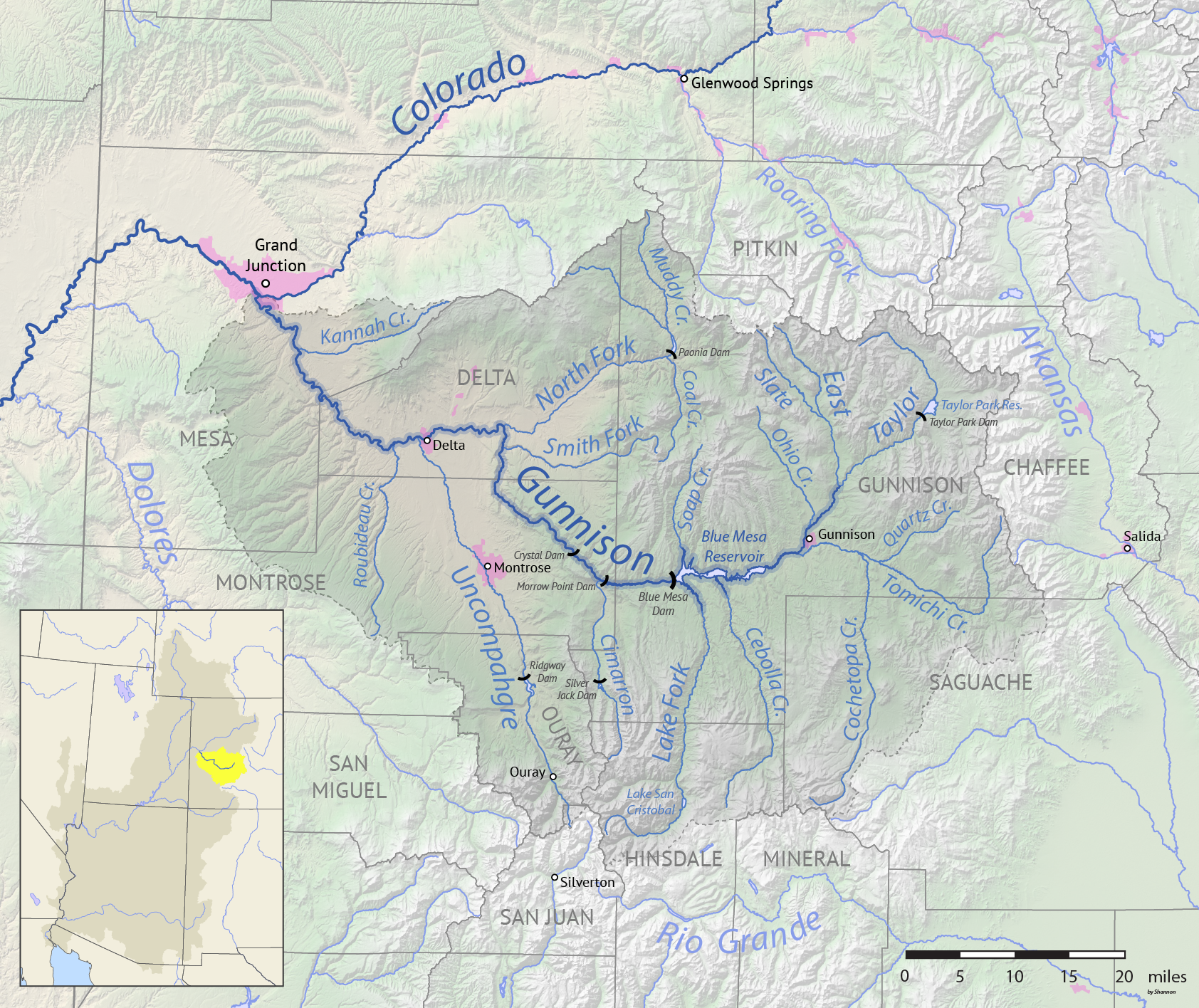
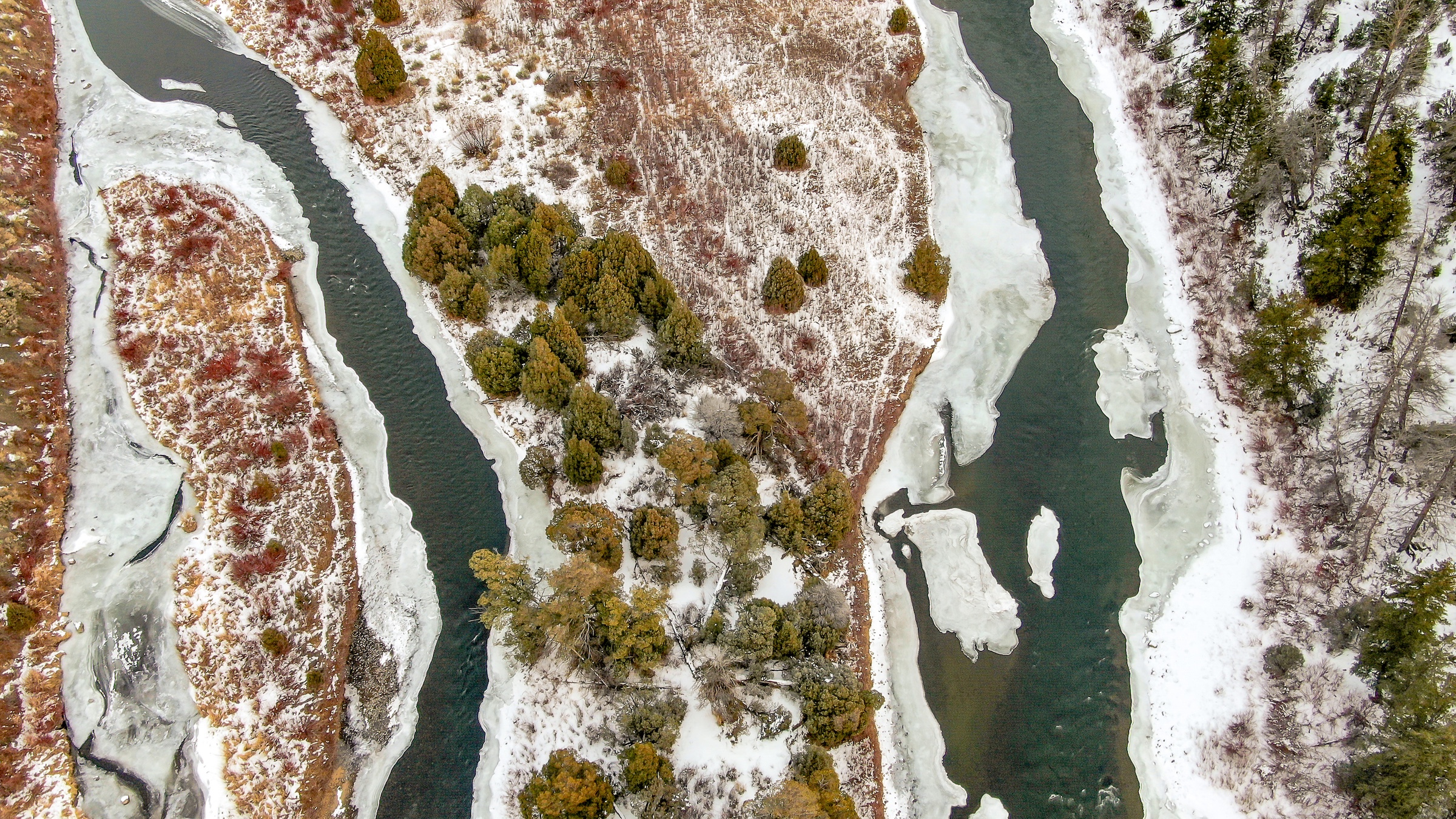
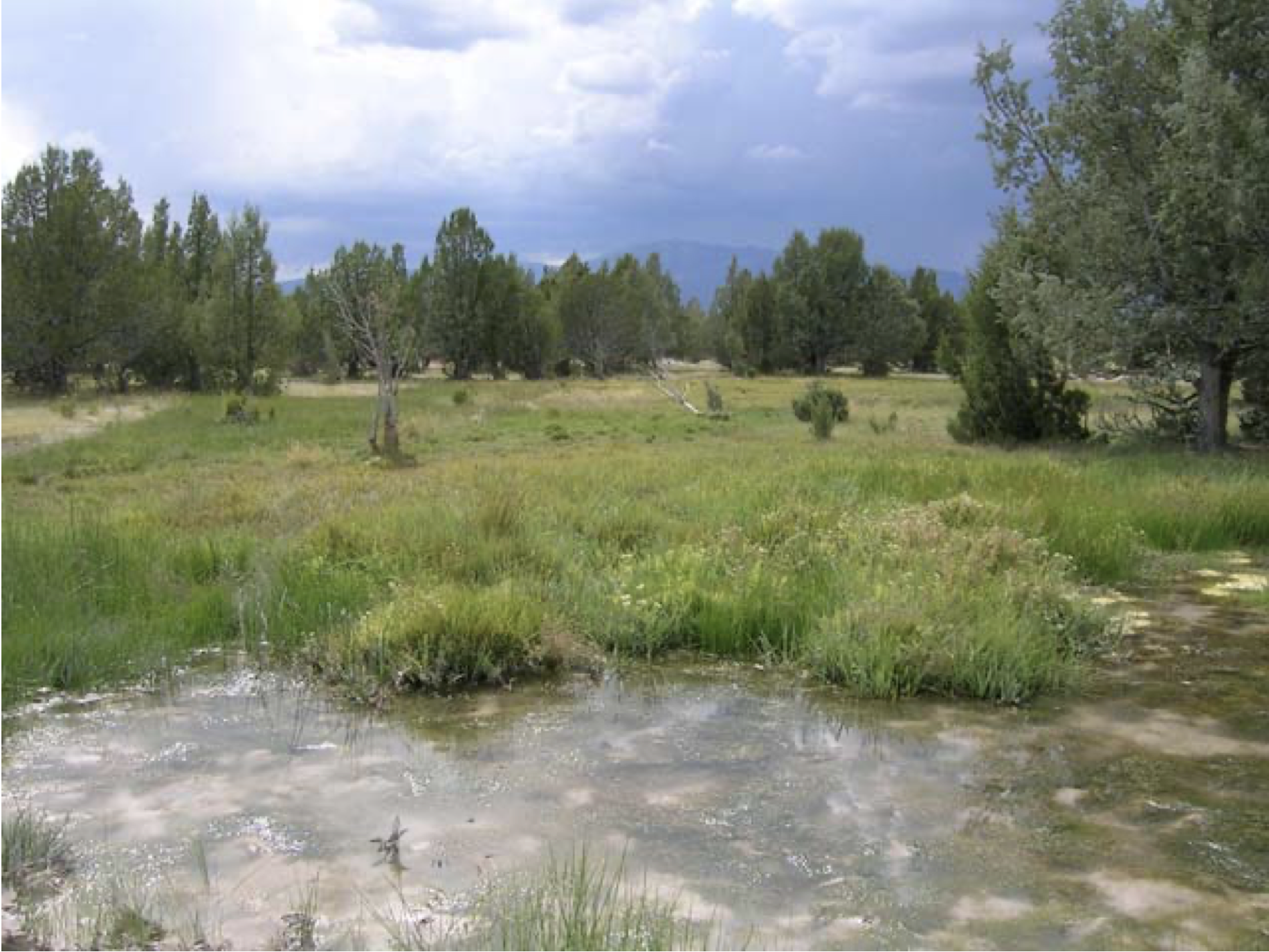
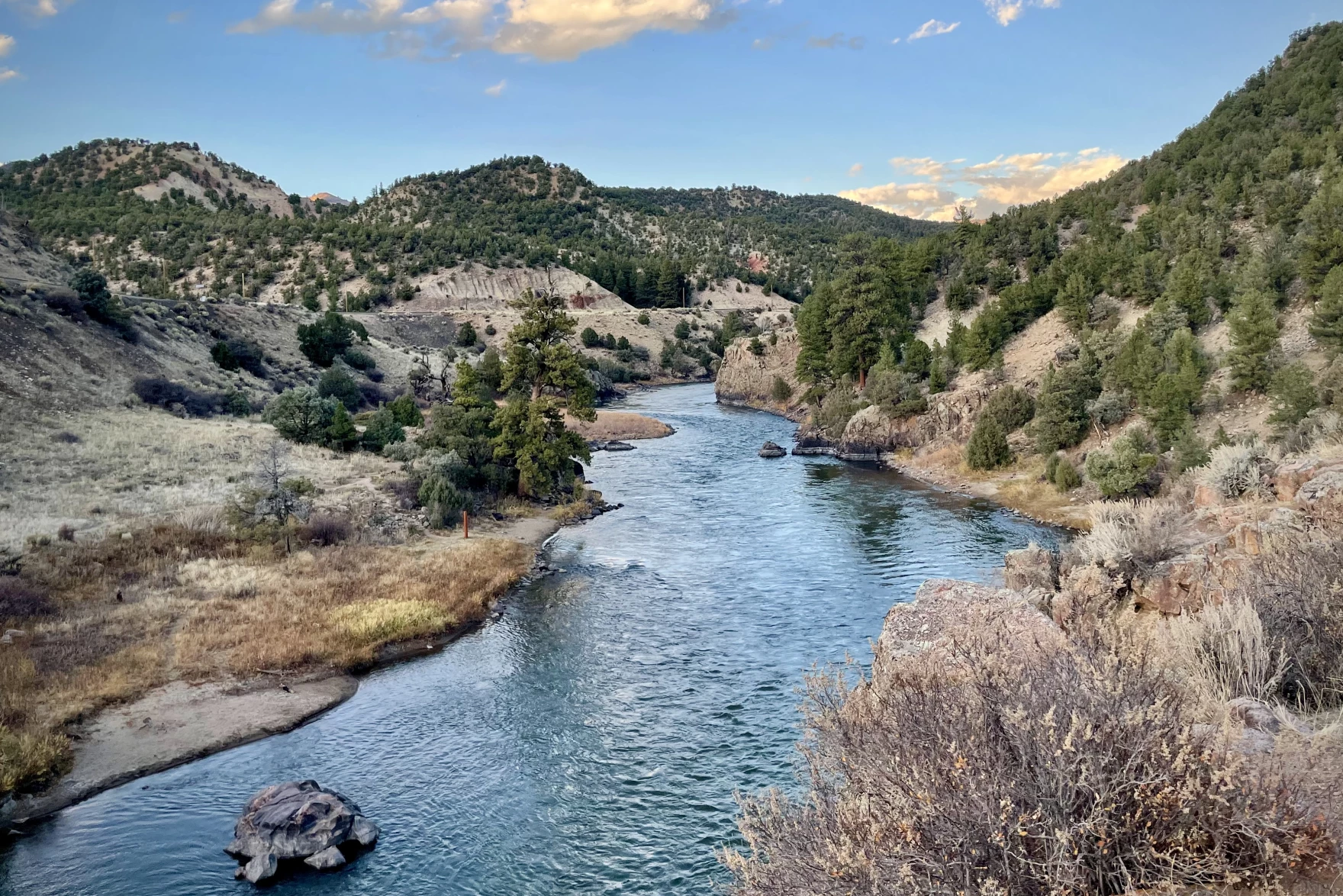
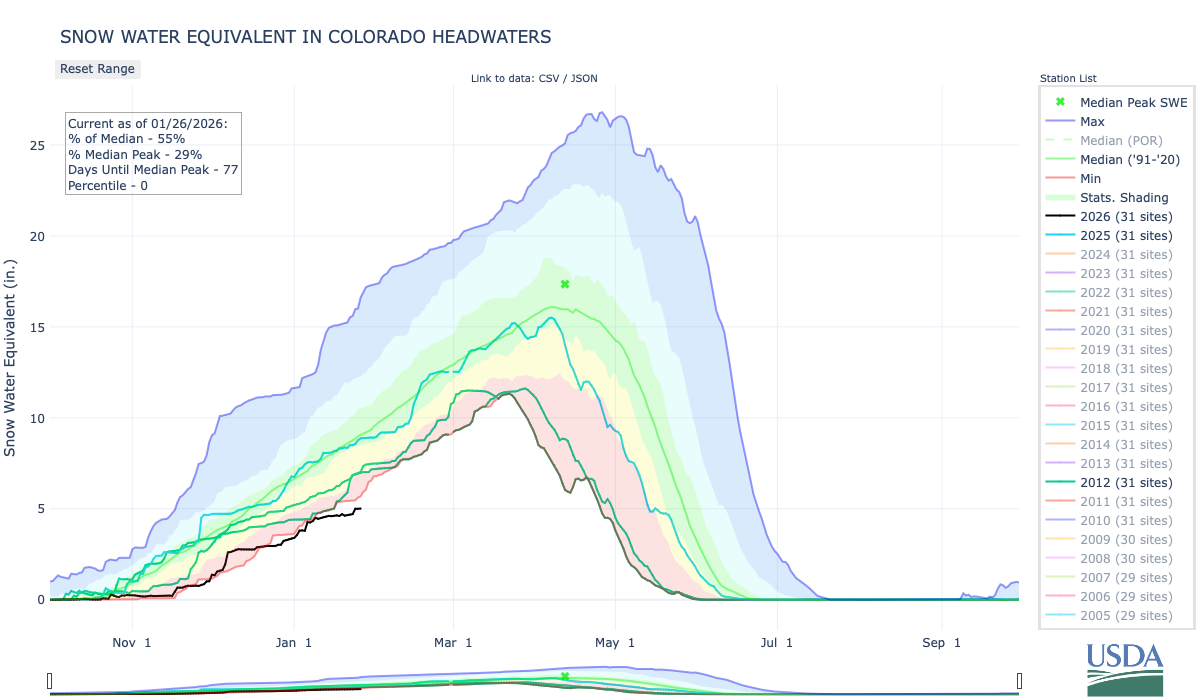
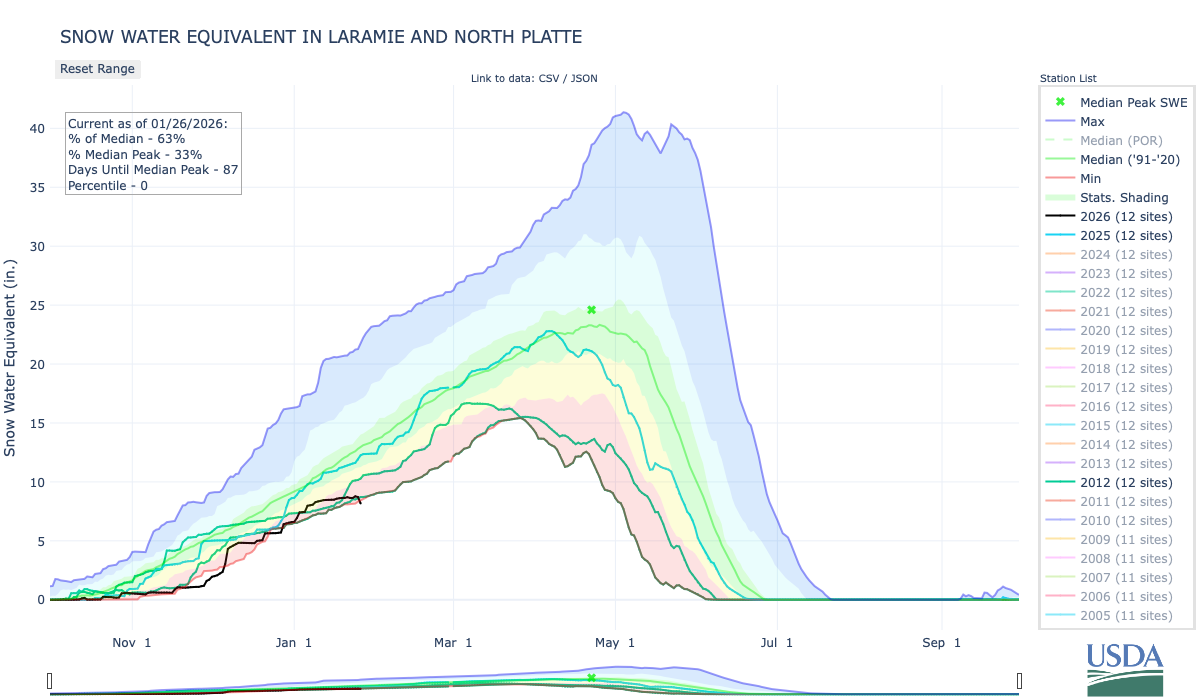
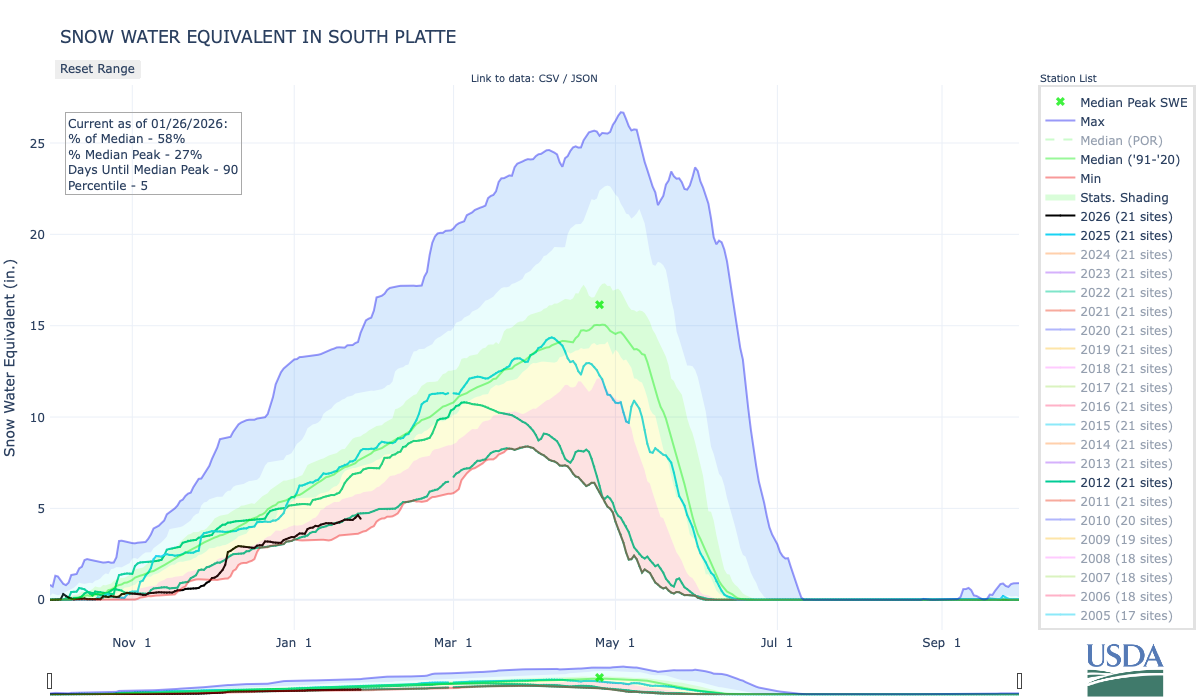
The Colorado River Water Conservation District spans 15 Western Slope counties. Colorado River District/Courtesy image
Click the link to read the article on the Glenwood Springs Post-Independent website (Ali Longwell). Here’s an excerpt:
February 3, 2026
As part of its spring tradition, the Colorado River District will give its State of the River address to a dozen Western Slope communities starting in March. Each State of the River will provide information on river forecasts, local water projects and key challenges impacting Western Slope water users. The events will take place everywhere from the Upper Yampa, Roaring Fork and the Middle Colorado river basins down to the Lower Gunnison and Uncompahgre river basins. While each program’s agenda will vary slightly and is tailored to reflect local water priorities, key topics at all events will include:
River flow forecasts, snowpack, and drought summaries
Updates on the Colorado River system and interstate negotiations
Shoshone Water Rights Preservation Project updates
Local water projects and priorities
Each event will also include a complimentary light dinner and an opportunity for residents to ask questions of water experts. While it is free to attend, the River District requests that all attendees register in advance at ColoradoRIverDistrict.org/2026-State-of-the-River-Meetings.
Click the link to read the article on the KJZZ webdsite (Howard Fischer). Here’s an excerpt:
February 4, 2026
Gov. Katie Hobbs said Monday that unless Upper Basin states actually offer up some firm commitments to conserve water she won’t agree to any deal for Arizona to cut its own withdrawals from the Colorado River. And that would lead to either Interior Secretary Doug Burgum imposing his own solution on the seven states that draw water from the river — or the situation having to be hashed out in court. Only thing is, Burgum has so far refused to do more than bring the governors of the affect states together, as he did on Friday. And Terry Goddard, president of the Central Arizona Water Conservation District, which oversees the state’s Colorado River supply, said the options put forward by the Interior Department “are not palatable to Arizona or California,” one of the two other Lower Basin states.
“All Burgum’s done is set us up for litigation,” he told Capitol Media Services. “And I think that’s sad.”
Still, [Governor Hobbs] said she thinks it doesn’t necessarily have to wind up in court, even though Arizona already has set aside $3 million for litigation.
“While we didn’t leave with a lot of specifics — the details are to be worked out through negotiation — I think that we came away with hearing that nobody wants to end up in litigation,” Hobbs said. “We want to find a way to get to a deal.”
But Hobbs said that means recognizing that Arizona, which already has agreed to give up 27% of the water it has been getting from the Colorado River, won’t give up a drop more unless there are firm and enforceable promises that the Upper Basin states will share in the burden.
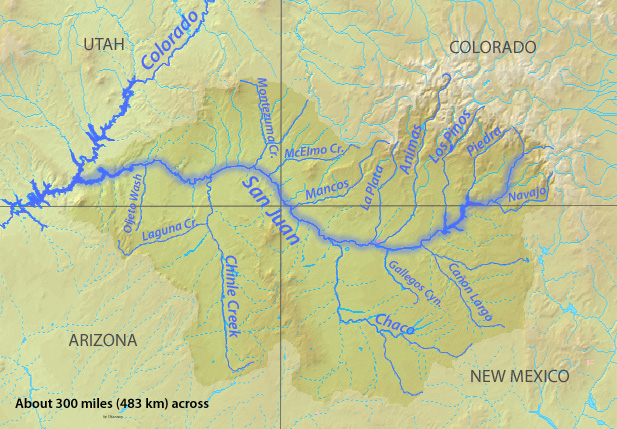
Map of the Colorado River drainage basin, created using USGS data. By Shannon1 Creative Commons Attribution-Share Alike 4.0
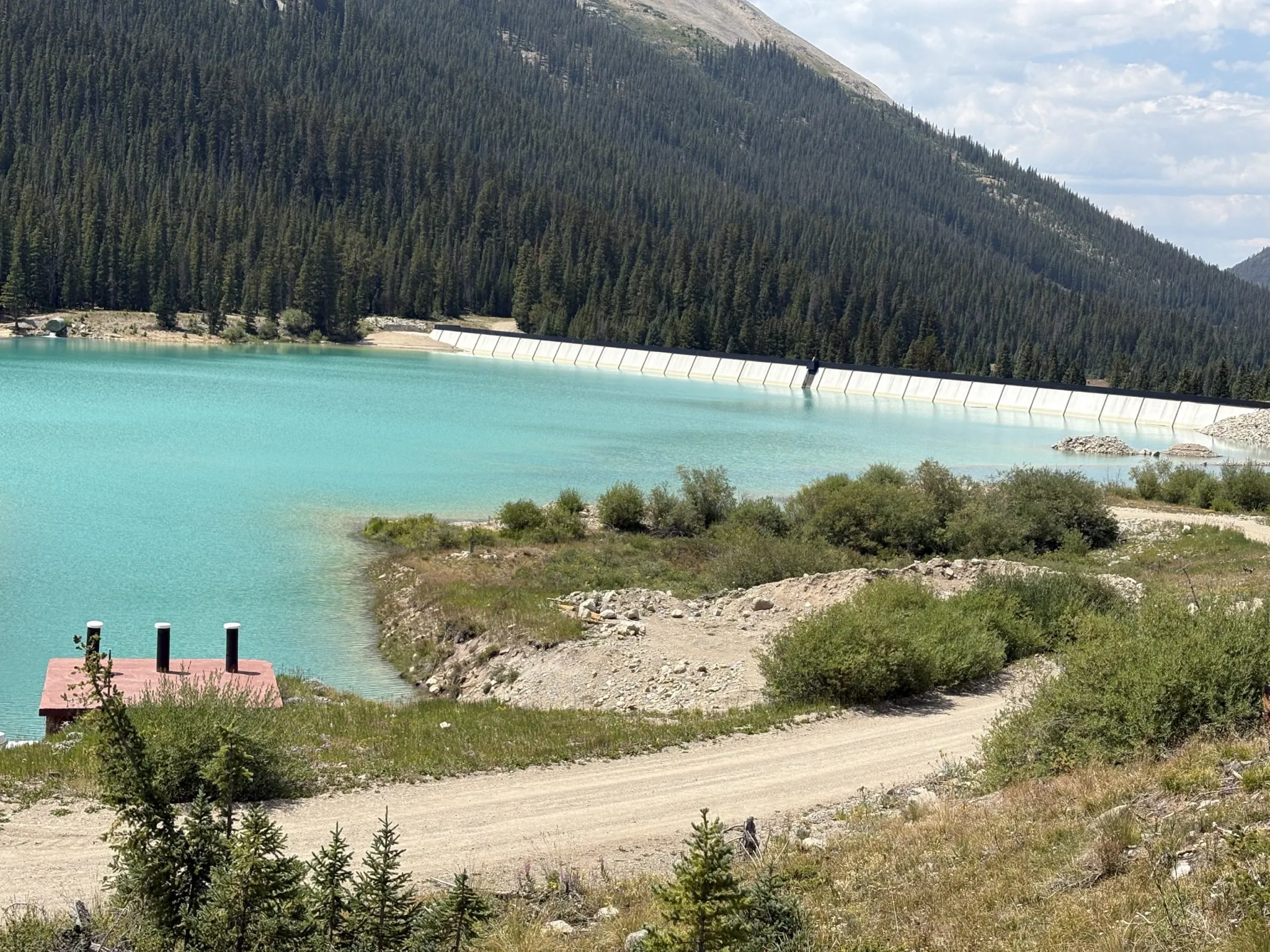
Goose Pasture Tarn. Photo credit: City of Breckenridge
Click the link to read the article on the Summit Daily website (Kit Geary). Here’s an excerpt:
February 4, 2026
A 54-year-old water treatment plant in Breckenridge has reached the end of its life, and preliminary cost estimates put rehabilitating it at $54 million. Breckenridge town staff members presented Breckenridge Town Council with plans for a series of projects to help the Gary Roberts Water Treatment plant reliably meet current demand at a Tuesday, Jan. 27, meeting. The Gary Roberts Water Treatment is located at the Goose Pasture Tarn. A staff memo stated the town first evaluated improvements and rehabilitation options in 2014, but they put those on hold to prioritize Goose Pasture Tarn dam repairs. The memo noted the continued aging of the plant now makes it a critical project. It included photos of the plan demonstrating pitting, corrosion and leaks in the water tanks at the plant…The project is currently proposed to be phased from 2027 to 2029. Staff members said there are no anticipated impacts to residents’ water service. While preliminary cost estimates put the project at $54 million, the budget the town planned for was $50 million. Officials asked staff members what tools were at the town’s disposal to make the project stay within a reasonable budget.
The Gunnison River Basin Roundtable recently announced grants of up to $1,500 for water education through its public education, participation and outreach committee. The 2026 Water Education Grant is now accepting applications. Funds are available to anyone engaged in water education, including public and private schools, libraries, scout troops, homeschoolers, 4-H clubs and other organizations offering programming for children up to 18 years old in the Gunnison Basin. Applications are due at 5 p.m. on Feb. 23. For more information, visit gunnisonriverbasin.org/.
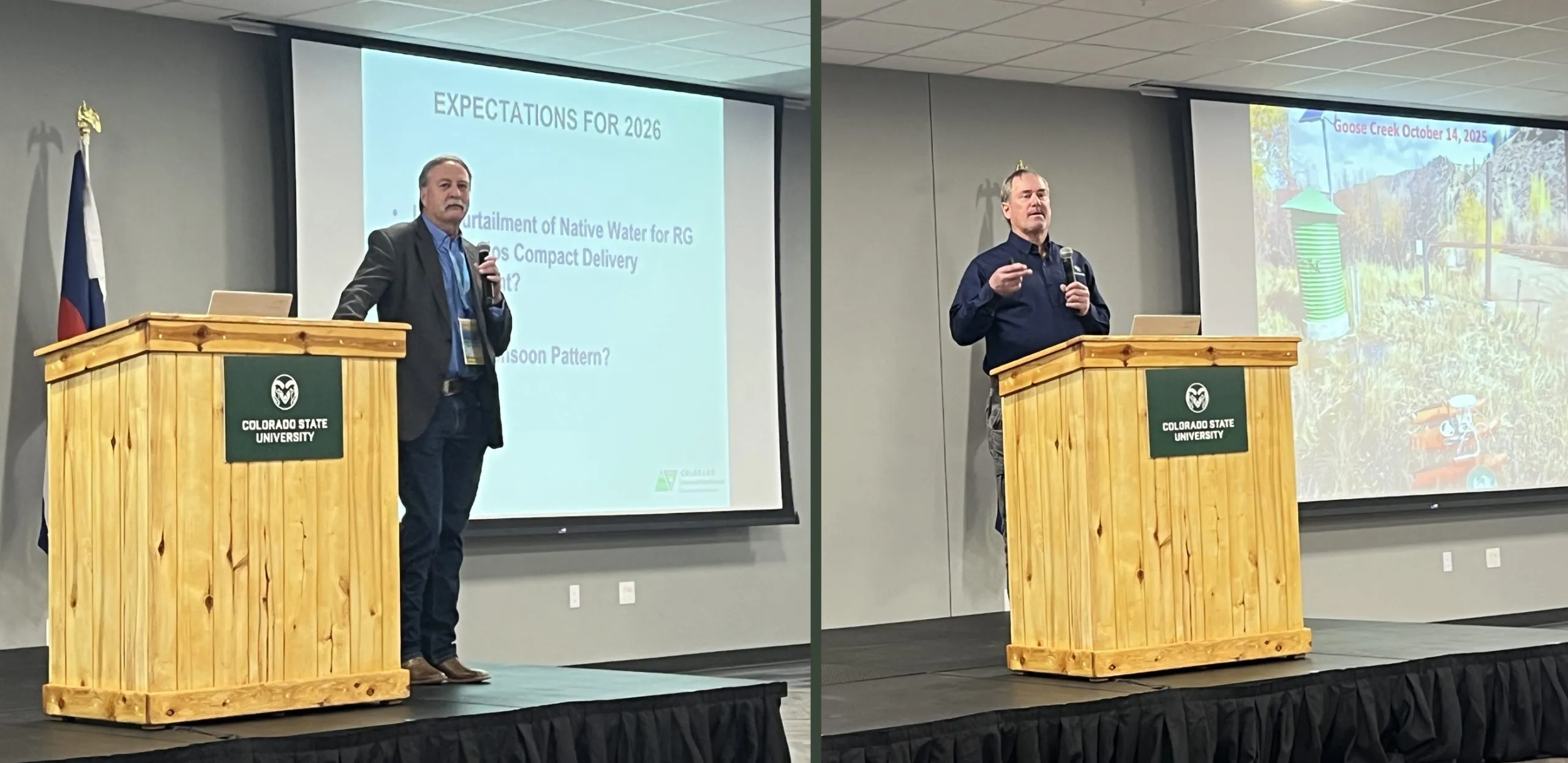
Division engineer Craig Cotten, left, and Pat McDermott of the Colorado Division of Water Resources, deliver the state water resources report on the final day of the 2026 Southern Rocky Mountain Ag Conference. Credit: The Citizen
An unconfined aquifer that is getting “worse and worse,” not better.
Such is the reality of the situation for the Upper Rio Grande Basin and warnings given to the San Luis Valley farming and ranching community on the final day of the 2026 Southern Rocky Mountain Ag Conference.
If you’re a praying sort, it isn’t too early in 2026 to fold your hands together toward the heavens. If not, a good wish or two would be fine as well.
The outlook is that dire. Except for the hope that a changing weather pattern from La Niña to El Niño at some point this year will deliver the goods and avoid even more of a collapse.
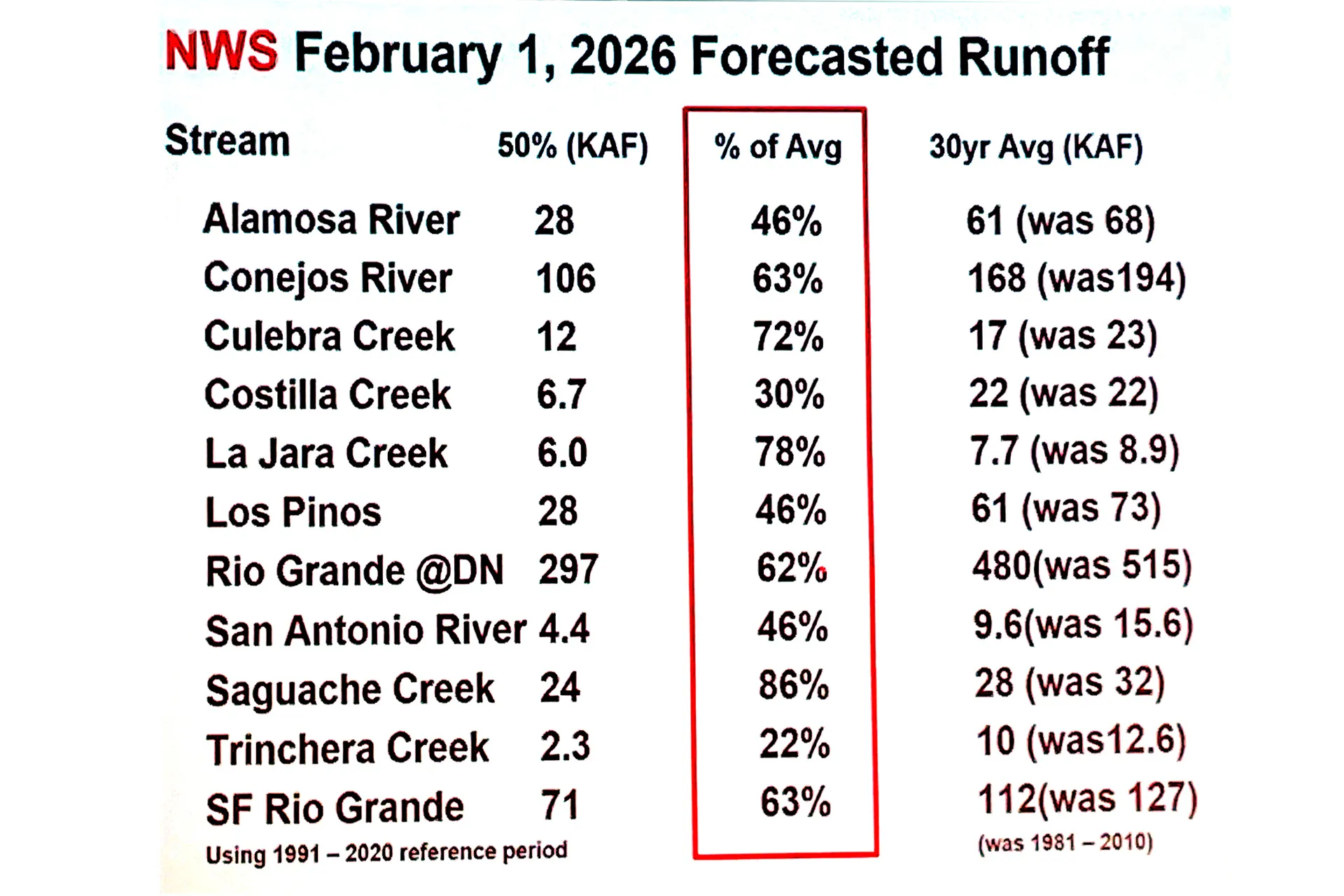
“We do anticipate at this moment, at this date that it’s going to be a poor runoff in 2026,” said Pat McDermott of the Colorado Division of Water Resources. It is customary for him and state division engineer Craig Cotten to provide a look back at the recent water year and a look ahead to the next spring runoff.
McDermott typically attempts a positive spin for the large audience that fills the main conference room at the Outcalt Center of the Ski Hi Complex in anticipation of the state water resources report. He did his best by pointing to a rosier outlook in the 2026 Farmer’s Almanac, the last annual edition.
It is the state, after all, that governs groundwater pumping in the San Luis Valley and has metrics Valley farmers are required to meet to stay in business. One is the recovery of the unconfined aquifer through buy-and-dry and reduced groundwater pumping strategies.
“It just kind of gets worse and worse every year that we look at it,” said Cotten in referencing the storage levels of the Upper Rio Grande’s unconfined aquifer and the greater level of recovery efforts crop producers in Subdistrict 1 are facing as a result.
“Unfortunately it’s going in the wrong direction and it has been for quite some time here,” Cotten said in referencing the latest five-year average for storage.
THE NUMBERS
Rio Grande 2025
493,000 acre-feet – Annual index flow or 80 percent of long-term average past 30 years
125,000 acre-feet – Obligation to New Mexico and Texas under Rio Grande Compact
Rio Grande saw an increase of 95,000 acre-feet due to October 2025 rain.
Conejos River 2025
205,000 acre-feet – Annual index flow or 68 percent of the long-term average of 300,000 acre-feet
46,900 acre-feet – Obligation to New Mexico and Texas
Conejos River saw an increase of 15,000 acre-feet due to October 2025 rain.
February’s current conditions
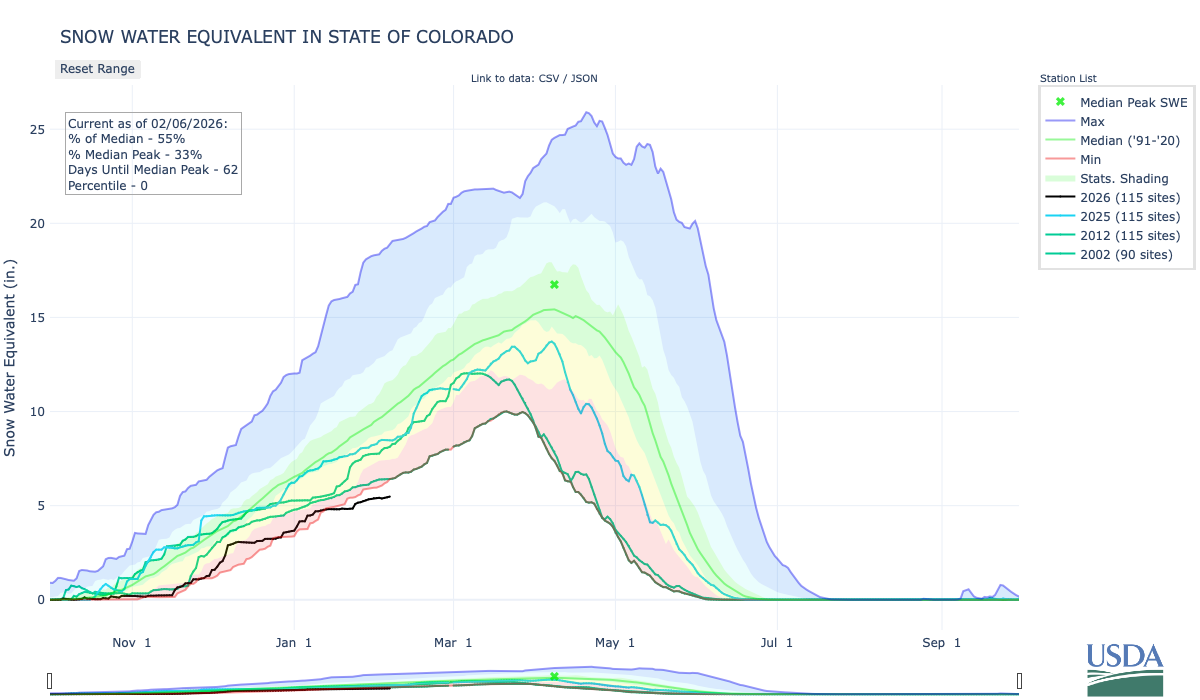
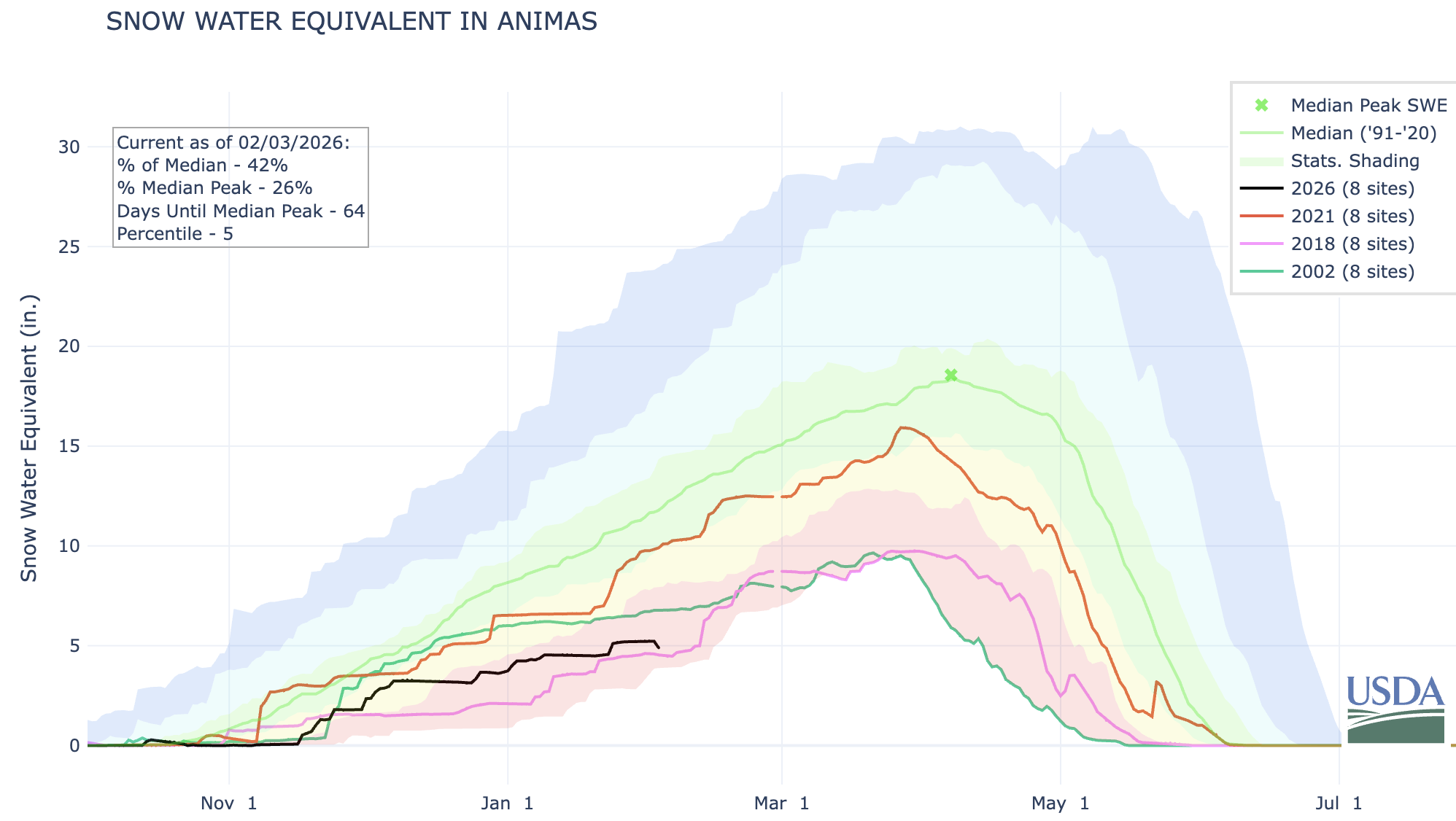
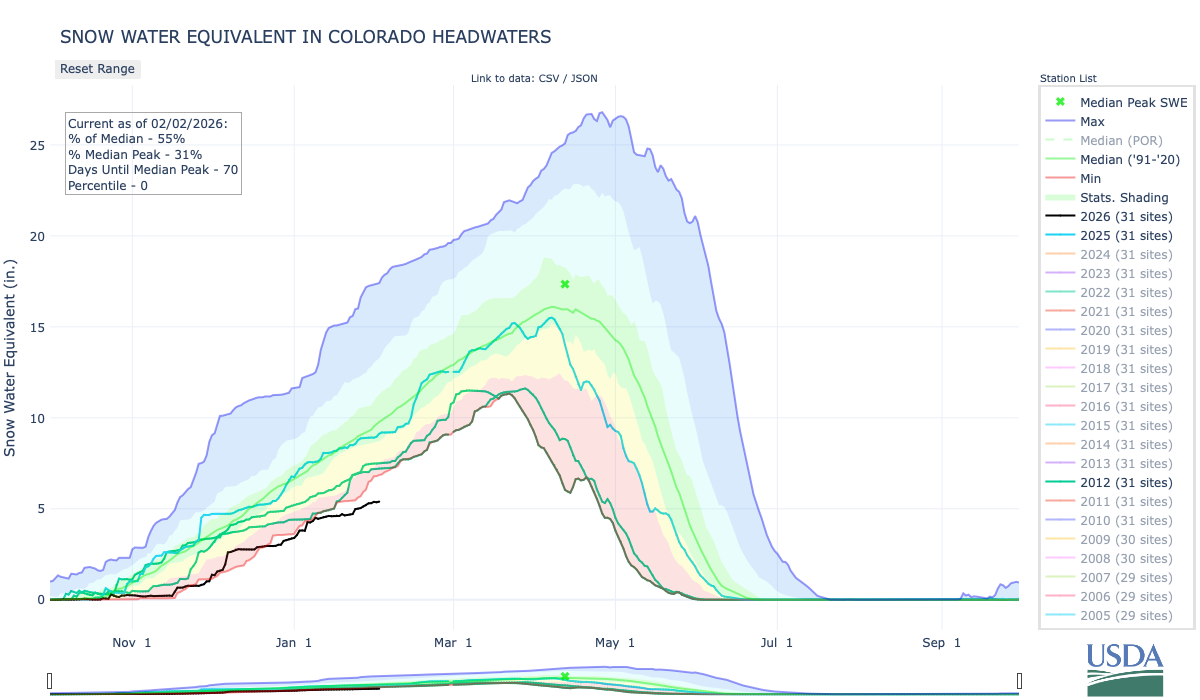
Statewide snowpack: 55 percent of median
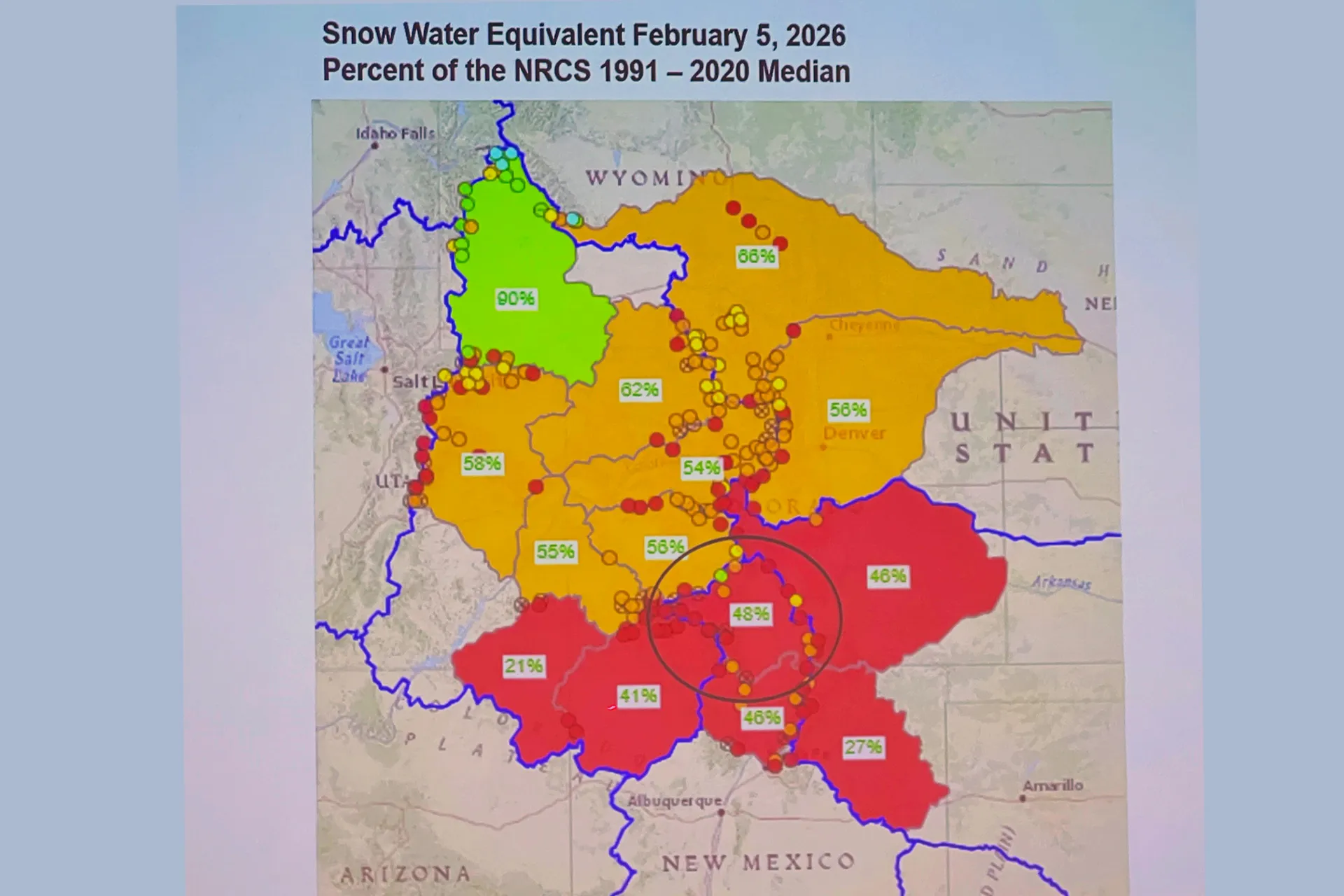
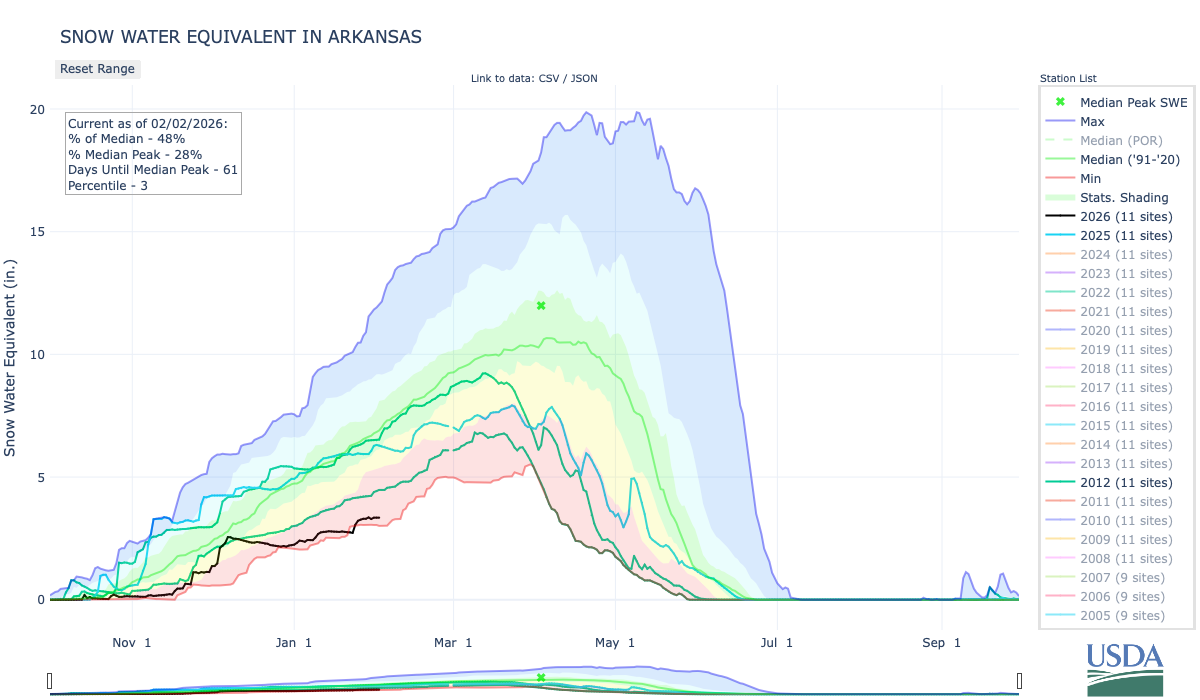
Upper Rio Grande snowpack: 48 percent of median
Warmest December on record for nine western states based on 131 years of temperature data.
Nathan Coombs and Heather Dutton, both key players in the water conservation world locally and at the state level, gave further explanation on the changing weather patterns that are impacting the basin and the amount of water available for irrigation.
Coombs pointed to the problem of overnight temperatures in the late fall and winter months, and the fact the Valley just isn’t getting the sub-zero temperatures it used to.
Look at December 2025, which saw an average daily low for the month of 11 degrees – double digits overnight – when the normal low for December is 0.8 degrees. January of this year had an average daily low of 4 degrees instead of the -1 that is a normal overnight low temperature for the month. It would have been higher than 4 degrees were it not for sub-zero overnight lows in 5 of the last 7 nights of January.
“We’re not sunburning that much harder, we’re just losing the cold,” Coombs said to his fellow farmers.
The timing of when the moisture comes is off, too. Look at the past two water years – 2024 and 2025 – when heavy rains in October came through and added to the total overall amount of water in the Rio Grande and Conejos River systems.
Too late to help irrigators, but good enough to help the amount of water in the Rio Grande and Conejos River, overall.
“Look at how it’s changing,” Coombs said. “Useful water for irrigation is changing in more ways than just volumes. We’re seeing timing change. So that’s part of what this is. Mother Nature is playing a big role in this. We’ve got to figure that component out a little better. We don’t need to look across the fence at what our neighbors are or aren’t doing. Let’s figure out how we correct to that.”
Rio Grande and Pecos River basins. Map credit: By Kmusser – Own work, Elevation data from SRTM, drainage basin from GTOPO [1], U.S. stream from the National Atlas [2], all other features from Vector Map., CC BY-SA 3.0, https://commons.wikimedia.org/w/index.php?curid=11218868
Sen. Mike Lee, the MAGAt from Utah, appears to be vying to be the most anti-public land politician in history. The Trump sycophant was, of course, behind last year’s congressional bids to sell off public land to real estate developers and various other schemes. His latest assault is the Historic Roadways Protection Act, which passed through a Senate committee yesterday. It would block the Bureau of Land Management from “closing historical roads” and implementing travel management plans across a broad swath of federal lands in Utah until a federal court rules on thousands of county RS-2477 claims.
RS-2477 is an 1866 statute that allowed highways to be constructed across federal lands to access mining claims and homesteads. It was repealed in 1976 when Congress passed the Federal Land Policy Management Act, or FLPMA. But FLPMA grandfathered in existing “highways” that had been constructed under RS-2477. In 2010 and 2011, Utah and its counties filed some 12,000 RS-2477 claims on about 35,000 miles of “highways” on federal lands, many of which are no more than old livestock tracks, in hope of gaining control of the paths so they can grade them, widen them, and even pave them. Settling all of these claims could take decades, meaning Lee’s bill would essentially be banning the BLM from managing travel on these areas forever.
Albert Bacon Fall, the New Mexico Senator and disgraced Interior Secretary under President Warren G. Harding still has my vote for the most anti-public land politician. But maybe that’s because Fall was actually a colorful character. Lee’s most interesting trait is that he holds Jell-O socials in his Capitol office.
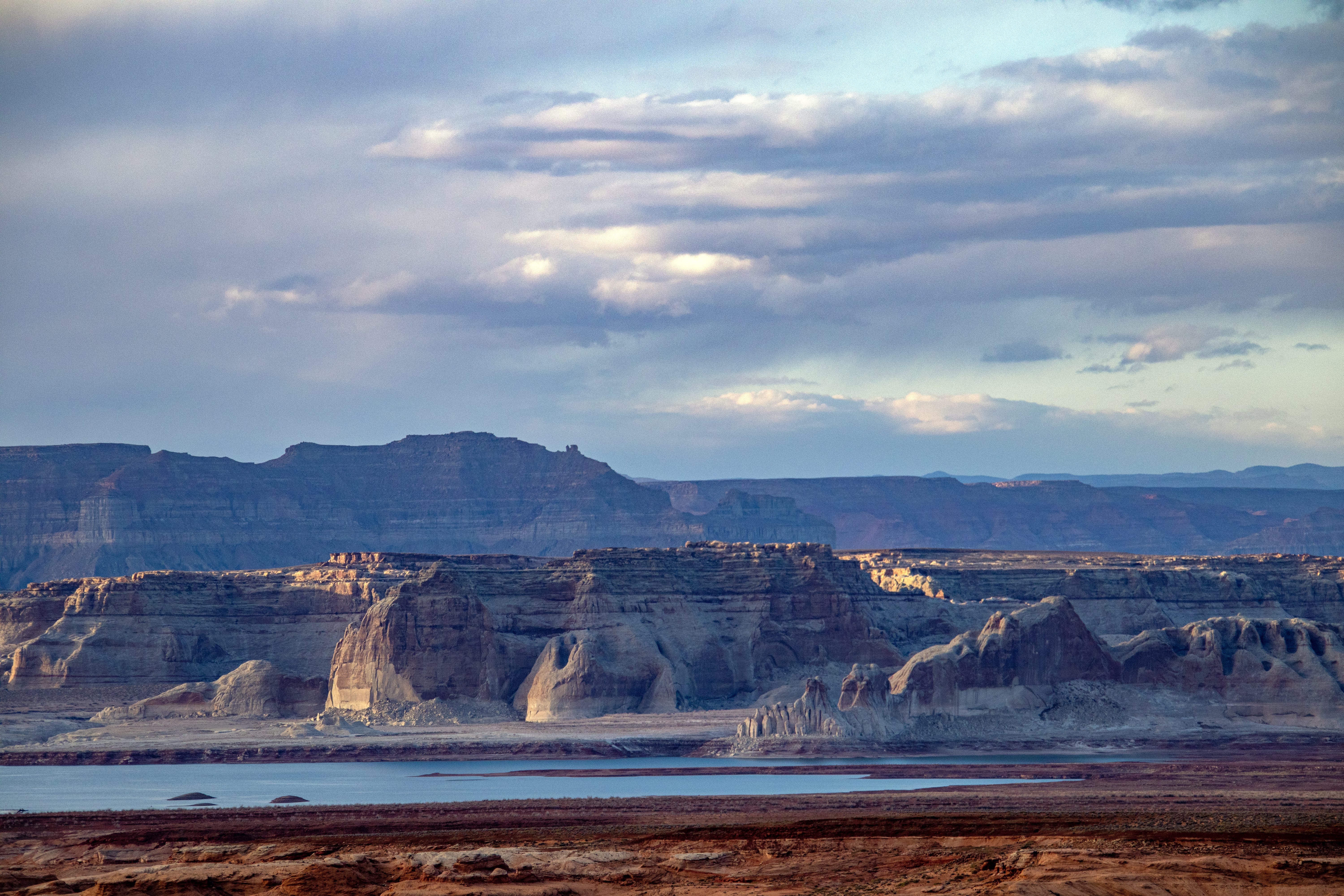
One of the things I like about Page, Arizona, are the weird and ubiquitous contrasts that characterize the place. There’s the surreality of a lakeside city in the desert and the striking juxtaposition of golf course greens against stone. But perhaps the most jarring of all is the sensation of wandering Safeway’s aisles in a distinctly American town and hearing fellow patrons speaking languages from all over the world.
The Southwest attracts visitors from across the globe and, as a result, the increasingly dominant tourism and outdoor recreation industries have come to depend on international travelers. After Trump was inaugurated and implemented his America First creed, which tends to manifest as hostility towards every other nation, international travel to the U.S. dropped. That’s in spite of the fact that Trump’s economic policies have also caused the dollar’s value to plummet, making the U.S. a cheap vacation spot for Europeans.
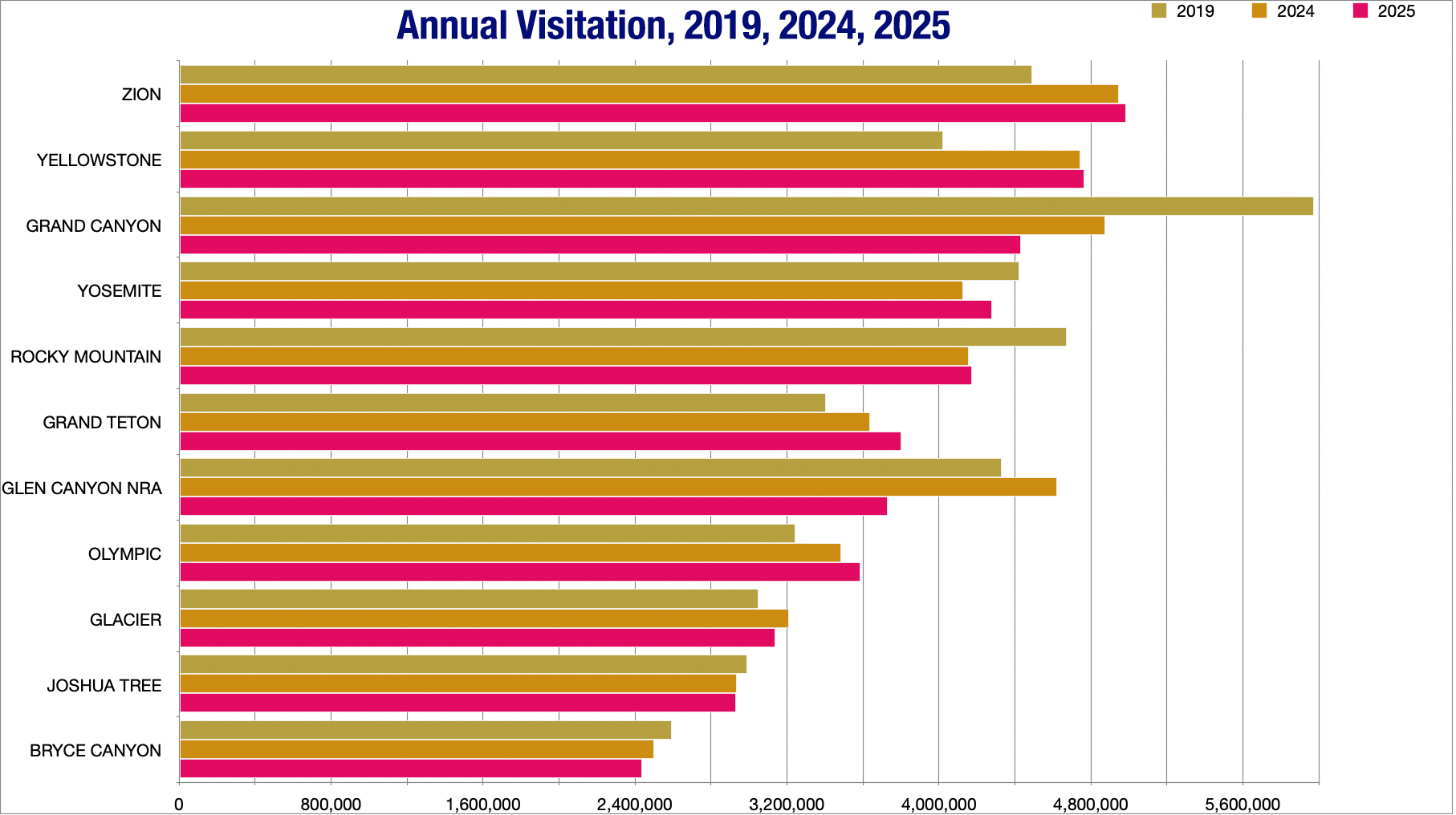
Over the summer of 2025, that appears to have led to a drop in visitation to most national parks in the Southwest. However, visitation tended to rebound in the fall — perhaps due to lower gas prices — bringing the annual numbers back up to close to what they were in 2024.
One exception was Glen Canyon National Recreation Area, which saw a huge drop in visitors last year, probably due to a combination of low reservoir levels at Lake Powell, a massive wildfire on the Grand Canyon’s North Rim, and the drop in international visitation. But if tax revenues are any indication, it hasn’t hurt the overall tourism industry in Page that badly. Sales tax, hotel/motel tax, and online lodging tax revenues for January through September 2025 were up significantly from the previous year, according to the City of Page’s statistics.
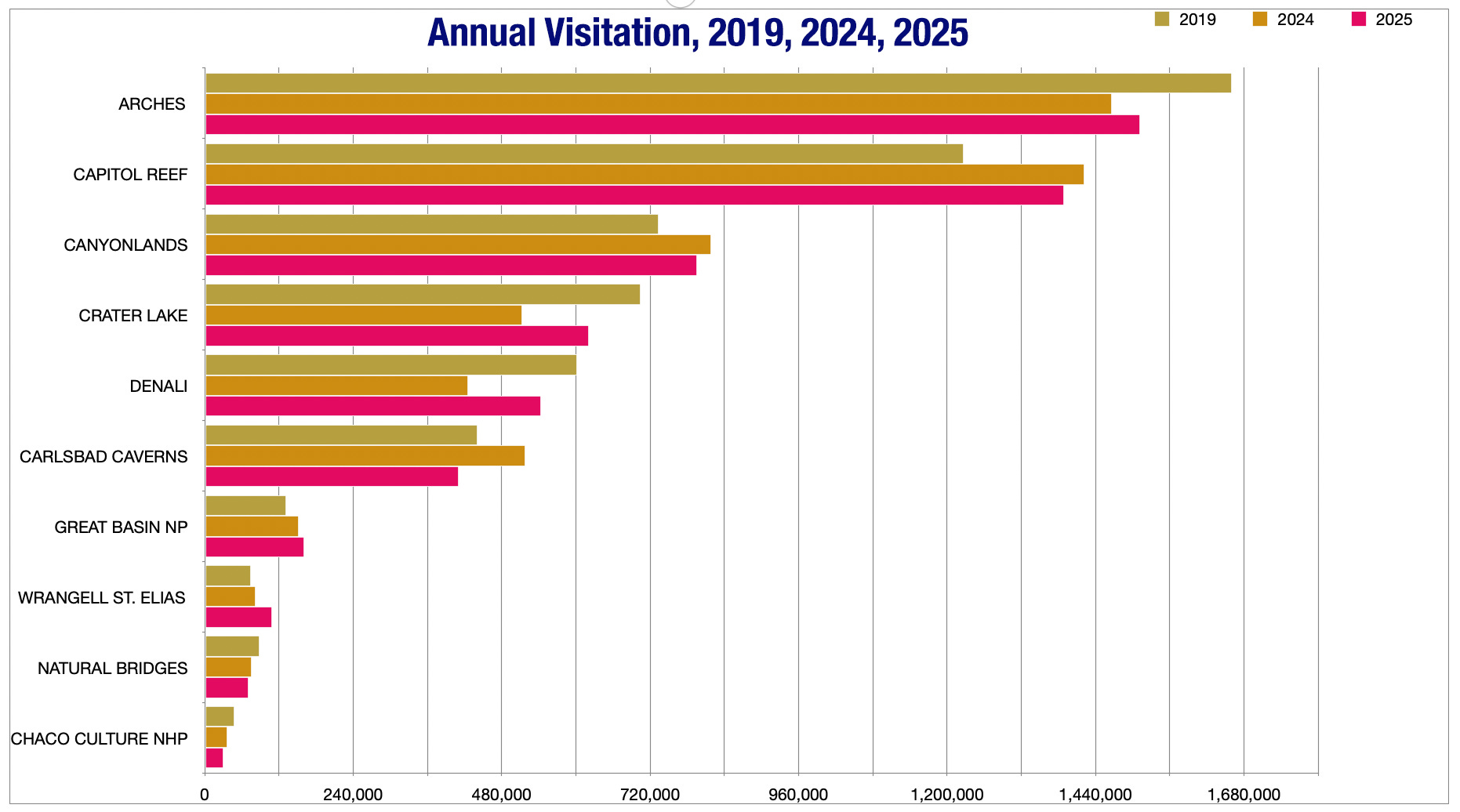
Grand Canyon NP and Glen Canyon National Recreation Area saw the biggest drops in year-over-year visitation in 2025, which may be due to a fire on the Grand Canyon’s North Rim and the drop in international travel to the U.S. Visitation continues to grow at Yellowstone, Grand Teton, and Olympic National Parks. Source: NPS.
Arches National Park saw a marked decrease in visitation following the implementation of a timed entry system in 2022, but since then it has held steady and increased between 2024 and 2025. Most other Southwest national park units saw a decrease in visitation last year, however.
🏠 Random Real Estate Room 🤑
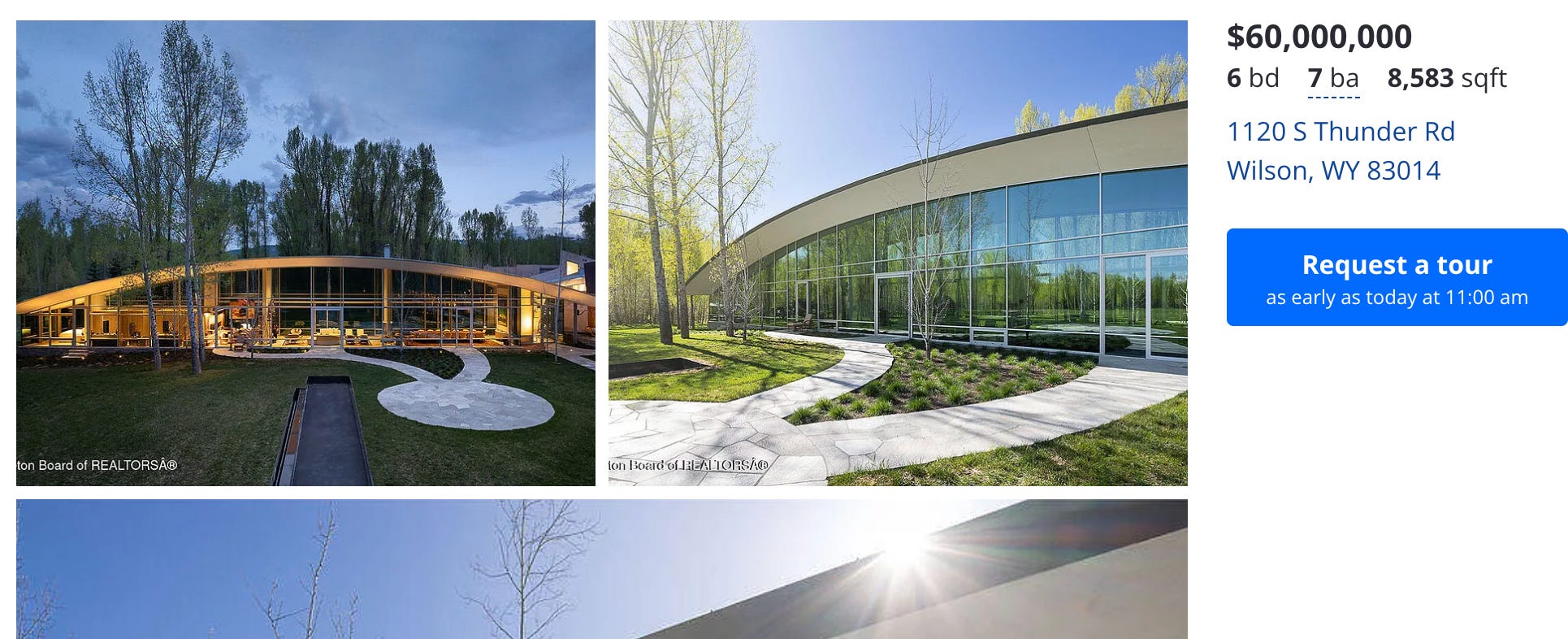
The most expensive home on the market in Jackson Hole currently. Source: Zillow.
You’ll all be thrilled, I’m sure, to learn that the uber-wealthy had a pretty good year in 2025, at least if high-end home and land sales are any indication. Luxury real estate sales in Jackson, Wyoming, reportedly are “surging” and “closed the year with exceptional momentum.” That’s the latest from The Viehman Group’s Jackson Hole Report, something I read when I want that lovely sensation of barfing in the back of my mouth.
Thirty-seven homes sold for over $10 million in the region last year, with 25 of them netting a sale price of over $15 million. The most expensive home sale was the Bar B Bar Ranch 4, with “multiple enhanced spring creeks for fishing,” which went for a modest $43 million.
But don’t worry! Overpriced luxury homes remain for the taking! For instance, you can buy a glorified quonset hut — er, an 8,583-square-foot steel, glass, and stone mansion — for $60 million. I know that seems like a lot, but according to Zillow’s BuyAbility calculator, the monthly payments would be a mere $320,673 after a $12 million down payment.
The median earnings for full-time year-round workers in Teton County are about $70,000 per year, which, according to Zillow’s mortgage calculator, could allow one to afford a $220,000 home with a $10,000 down payment. Meanwhile, the median home sale price in Teton County is about $3.8 million. And the cheapest home on the market is a 1970s, 644 sf condo listed for $695,000 (after a $30k reduction).
So, yeah, the West’s housing affordability crisis is as bad as ever, and the gap between the uber-rich and everyone else continues to grow.
🥵 Aridification Watch 🐫
The Abundance movement has reached the Colorado River, brought by an unexpected flag-bearer. The motorized recreation organization, BlueRibbon Coalition, is proposing the Colorado River Abundance Act. The vision, writes the coalition, is simple: “The American Southwest does not have to settle for managing a dwindling resource. It can choose abundance and start building.”
Building what? You ask. The answer: “A coordinated suite of desalination plants — offshore, onshore, and binational — supported by pipelines, pumping systems, brine-management facilities, and sediment removal programs.” These plants would crank out as much as 7 million acre-feet of water per year and deliver it to the river and/or directly to Lower Basin water users. That would allow more water to stay in Lake Powell and Lake Mead, thereby buoying reservoir levels.
And that would, among other things, improve boating and other recreation on those reservoirs, which is why the BlueRibbon Coalition is pushing the concept. In addition to creating funds for building a massive amount of water desalination and transportation infrastructure, the proposed legislation would also “elevate recreation to a coequal project purpose, establishing Recreation Modernization Plans for key reservoirs,” and pushing major upgrades to marinas, launch ramps, docks, trails, and shoreline facilities, “including a top-priority requirement to rebuild mid-lake services at Lake Powell with fast-track approval.”
That’s referring to the late Dangling Rope Marina, a remote floating boat refueling and restocking station in Dangling Rope Canyon, located about halfway between the down-lake marinas and Halls Crossing in the upper section of the reservoir. But low water levels and a damaged electrical system forced the National Park Service to shutter it in 2021, and it has not been reopened or replaced.
This abundance approach could work, in theory. But consider this: the largest desalination plant in the world, Ras Al Khair in Saudi Arabia, can treat about 306,500 acre-feet of water per year. It reportedly cost about $7 billion to construct, and uses about 3,626 megawatt-hours of electricity each day — that adds up to 1,323 gigawatt-hours annually, or enough to power tens of thousands of homes (or a handful of data centers). You’d need about 20 of those leviathans and a crapload of generation capacity to reach the 7 MAF/yr target of this plan, not to mention the extensive pumping and piping infrastructure to get the water to where it needs to go.
At some point, doesn’t it seem just a little bit easier, and a hell of a lot less expensive, to live within our means?
I will say that the Abundance approach is a step up from a, let’s say Archimedean, proposal to raise Lake Powell’s level by, wait for it, throwing a bunch of car batteries into the reservoir. If you’re wondering if this was a serious idea or not, just consider from where it came: The Sonoran Avalanche Center.
Sonoran Avalanche Center on Instagram: “Our first song about ba…
The Land Desk has been talking a lot about the effects the low snowpack will have on water supplies, Lake Powell, and irrigators. But it’s also hurting the ski industry — Vail Resorts reported a 20% drop in skier visits this winter — and that’s hurting the communities and workers that rely on that industry. The news clip below reports on how a Summit County food bank is being overwhelmed by new demand this winter.
The median home price in Summit County, by the way, is about $995,000.
🗺️ Messing with Maps 🧭
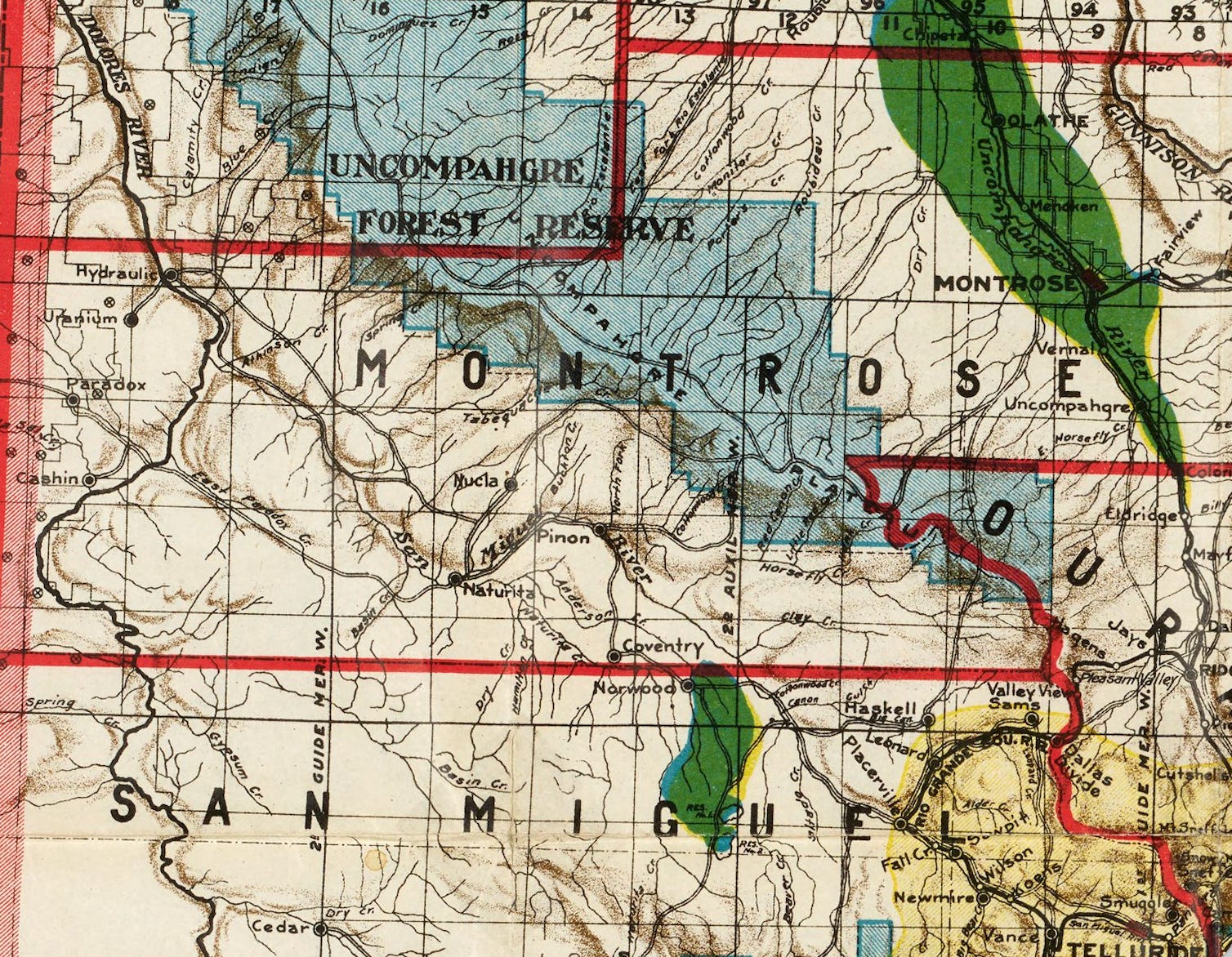
Detail from Clason’s Industrial Map of Colorado, circa 1904. Unfortunately, I only had space for one outtake from this one, so look for more in the future, because it’s cool. Note how back then the road from Naturita to Norwood followed the San Miguel River to Piñon before heading south to Coventry (which is now Redvale, I guess?). Also, the towns of Hydraulic and Uranium on the Dolores River downstream from the confluence with the San Miguel. If anyone can point out those locations on a modern map, I’d be much obliged!
Gross Reservoir, southwest of Boulder, Colorado, in October 2019. The reservoir, which supplies Denver Water customers on the Front Range, depends heavily on snowmelt. Photo by Mitch Tobin/The Water Desk. Aerial support provided by LightHawk.
This story was produced by The Water Desk, an independent journalism program at the University of Colorado Boulder’s Center for Environmental Journalism.
The American West’s snowpack is valuable for many reasons.
Snowmelt supplies much of the water flowing through the region’s streams, rivers, irrigation canals and household faucets—a vital role that has taken on new urgency this winter as much of the West struggles with scant snow cover.
Snowfall supports countless species, maintains forest health and helps keep a lid on wildfires. It even cools the planet by reflecting sunlight.
Snowflakes also underlie the region’s multi-billion-dollar winter sports industry, fueling local economies and drawing millions of participants. In warmer months, boating and fishing depend on water that was once frozen.
Snow performs all these functions, but can its worth be calculated in dollars and cents? And how is climate change affecting that value?
Like many aspects of nature, snow is easier to monetize in some domains than others. Its ecological benefits are complex, and its aesthetic qualities are subjective: some Westerners love the ice crystals, others dread them.
But in the economic realm, researchers have attempted to put a dollar figure on the region’s snow, and the numbers they’ve generated are huge.
“This stuff’s worth trillions, not billions” of dollars, said snow scientist Matthew Sturm, lead author of a widely cited 2017 paper in Water Resources Research that estimated the value of the water embedded in the West’s snowpack. “I turn on the tap in the Western states—what comes out of it is mostly snow.”
The Colorado River, which supplies drinking water to tens of millions of people and irrigates vast croplands, is primarily driven by snowmelt. The river generated an estimated $1.4 trillion in annual economic activity, according to a 2014 report commissioned by Protect the Flows, a business coalition, and conducted by Arizona State University. Adjusted only for inflation—not the region’s growth—that figure was equivalent to about $1.9 trillion in 2025, underscoring the high stakes of the ongoing, contentious negotiations over how to manage the Colorado River.
For some researchers, assigning a dollar value to snow is more than an academic exercise. In an era of tightening budgets and federal cutbacks in science, economic estimates can help justify investments in monitoring and studying snow—and highlight how much is at risk as the climate warms.
“If you want society to respond, you better talk about things that are fairly immediate, right at people’s doorsteps, and are easy to explain,” said Sturm, a professor of geophysics at the University of Alaska Fairbanks’ Geophysical Institute and the author of A Field Guide to Snow.
Or as Sturm’s paper puts it, “the ‘killer argument’ to the wider public that vigorous snow research is important would come by framing the argument in terms of money, something everyone understands.”
Peer-reviewed studies explicitly valuing the snowpack are rare, but some analyses have also calculated the sizable economic impact of snow sports. This winter, skiing and snowboarding in the West have been constrained not only by a lack of snowfall but also by record warmth that limited some resorts’ ability to make artificial snow.
A 2024 report from the National Ski Areas Association concluded that downhill snow sports generate $58.9 billion in annual economic activity in the United States and support an estimated 533,000 ski and snowboard jobs nationwide.
While the snowpack delivers tangible economic benefits—some easier to price than others—snowfall also carries real costs. Any accounting of snow’s economic impact must also reckon with the damage it causes.
Winter weather contributes to fatalities from avalanches in the mountains and from heart attacksin cities among people shoveling snow. But those deaths pale in comparison to the toll on slick roads. Each year, 24% of weather-related vehicle crashes happen on snowy, slushy or icy pavement, and 15% occur when snow or sleet is falling, according to the Federal Highway Administration. More than 1,300 people are killed and more than 116,800 are injured each year in crashes on snowy, slushy or icy pavement, the agency reports, though not all of those incidents are weather related.
The Animas River and San Juan Mountains in southwest Colorado in May 2023. The snowpack serves as a natural reservoir that releases water in warmer months. Photo by Mitch Tobin/The Water Desk. Aerial support provided by LightHawk.
Valuing the snowpack’s water
The 2017 paper began with a phone call that Sturm made to Michael Goldstein, a professor of finance at Babson College with whom he had previously collaborated.
“Hey, what do you think snowpack’s worth?” Goldstein recalled Sturm asking.
Goldstein wasn’t a snow expert, but he told Sturm, “If we make some simplifying assumptions here, I could value it for you.”
“I just thought it was a cool question,” said Goldstein, who is also the Donald P. Babson Chair in Applied Investments at Babson.
Since its publication, the study has been cited nearly 400 times, according to Google Scholar.
Viewed through an economic lens, the snowpack’s role as a mountain water tower provided a clear value that Goldstein could quantify.
“Nature naturally stores the water for you for free. You didn’t have to build a reservoir,” Goldstein said. “If that goes away, that actually has a cost. And the cost is the replacement cost of either storing the water or getting water from a different source.”
Climate change is already having a variety of profound effects on the West’s snow, such as shrinking the snowpack season, but the study focuses on one key impact: the shift from snow to rain as temperatures rise.
Even if total precipitation remains unchanged in the decades ahead, a transition from snow to rain—and faster melting of the snowpack—means runoff will occur earlier in the year. In much of the West, however, it may be impossible to capture all that earlier water for later use because dam managers must leave enough empty space in reservoirs to reduce the risk of catastrophic flooding.
“There is not enough reservoir storage capacity over most of the West to handle this shift in maximum runoff and so most of the ‘early water’ will be passed on to the oceans,” according to a 2005 study.
To estimate the declining value of the snowpack in a warming climate, the 2017 paper made some assumptions about the transition from snow to rain—an evolution expected to be more pronounced in warmer regions such as California and Oregon than in colder locations like the Northern Rockies.
Examining a range of future trajectories spanning five to 100 years, the researchers assumed that half of current snowfall would fall as rain by the end of the scenario.
For the 50% of snow that would eventually convert to rain, some of the water could be captured by existing reservoirs. But while Lake Mead and Lake Powell on the Colorado River currently have plenty of room to spare, the authors note that “virtually every report we have found on the heavily dammed water systems of the West suggests that reservoir capacity (except when immediately following drought) is maxed out.” As a result, the paper assumes that water systems would lose two-thirds of the reduced snowmelt runoff.
“We’re losing, essentially, the storage capacity of snow—meaning in lieu of snow, we get rain,” Sturm said.
With their estimates of the amount of water lost as snow shifts to rain, the researchers could then multiply those figures by the cost of water to begin determining the decline in monetary value. The paper uses two water prices to bracket its estimates: $200 and $900 per acre-foot (an acre-foot is the volume of water needed to cover an acre of land to a depth of 12 inches, or 325,851 gallons).
In reality, Goldstein said, the price of water would rise as supplies became scarcer. But the paper holds water prices constant over time, an assumption that yields a conservative estimate of the snowpack’s value.
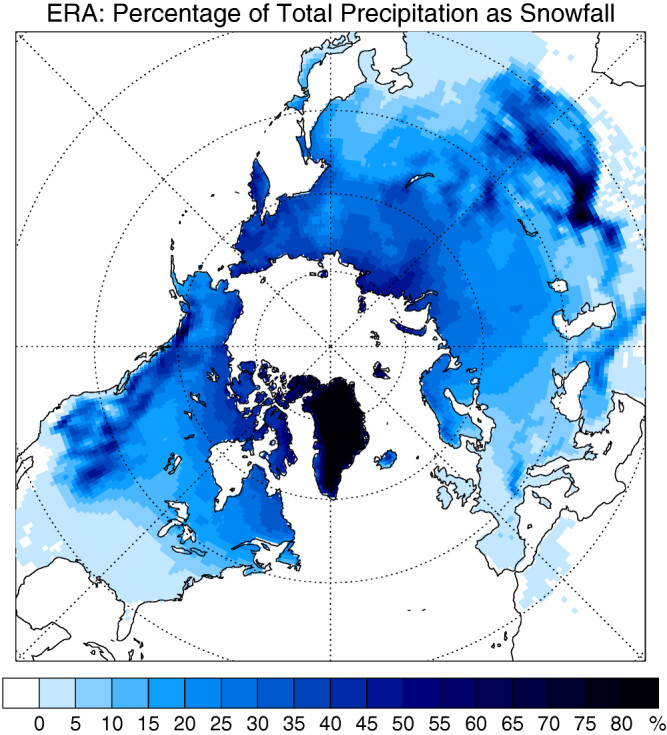
This map shows the share of annual precipitation that falls as snow over land, based on data from 2000 to 2010. In the Northern Hemisphere, the area where 40% or more of precipitation falls as snow covers more than 5.8 million square miles. At its peak, snow typically blankets more than 22 million square miles of the Northern Hemisphere. Source: Drew Slater, National Snow and Ice Data Center, via Sturm et al. (2017).
Discounting the future
The price of water varies greatly across the West, so estimates of the snowpack’s value will necessarily span a broad range. But water costs aren’t the only reason it’s challenging to pin down the snowpack’s monetary worth.
Another challenge the paper grapples with is the changing value of money over time. Even in the absence of inflation, if someone offered you $100 right now versus $100 in a year, the economically rational choice would be to take the $100 today. After all, a lot can happen in a year—and you could invest the $100 in the meantime. But what if the offer were $105 or $110 a year from now?
To convert future benefits into today’s dollars, economists use a “discount rate” that accounts for risk and the preference for receiving payments sooner rather than later. A discount rate is “like the foreign exchange rate between consumption today and consumption tomorrow,” Goldstein said.
The choice of the discount rate can make a big difference in how future costs or benefits are calculated, and it’s often a pivotal factor in studies of the economics of climate change. In the snowpack paper, the authors use three discount rates—1%, 3% and 6%—although they omit the 6% rate in their final valuation “because it is fairly extreme and unlikely to be correct in a water-stressed future world.”
The higher the discount rate, the more heavily future losses are discounted, reducing the economic justification for acting today, such as acquiring new water supplies or building additional reservoirs.
Assumptions about the discount rate, the price of water and future climate trajectories all weigh heavily on estimates of the value of the snowpack’s water. In summary, the authors conclude that about 162 million acre-feet of water is deposited as snow in Western mountains each winter. If half of that snowfall were to fall as rain in the future—and two-thirds of that water were to run off to the ocean without being captured—water systems would lose roughly 53.9 million acre-feet per year. That volume is roughly the combined storage capacity of Lake Mead and Lake Powell, the nation’s two largest reservoirs.
The total replacement cost for the lost water ranged from $120 billion to $4.76 trillion, according to the 2017 study. By comparison, the federal government’s budget totaled about $3.85 trillion in fiscal year 2016.
“To date, a full financial evaluation of the importance of snow in our lives has not been made, but computations here and elsewhere indicate it is on the order of trillions of dollars,” the authors write.
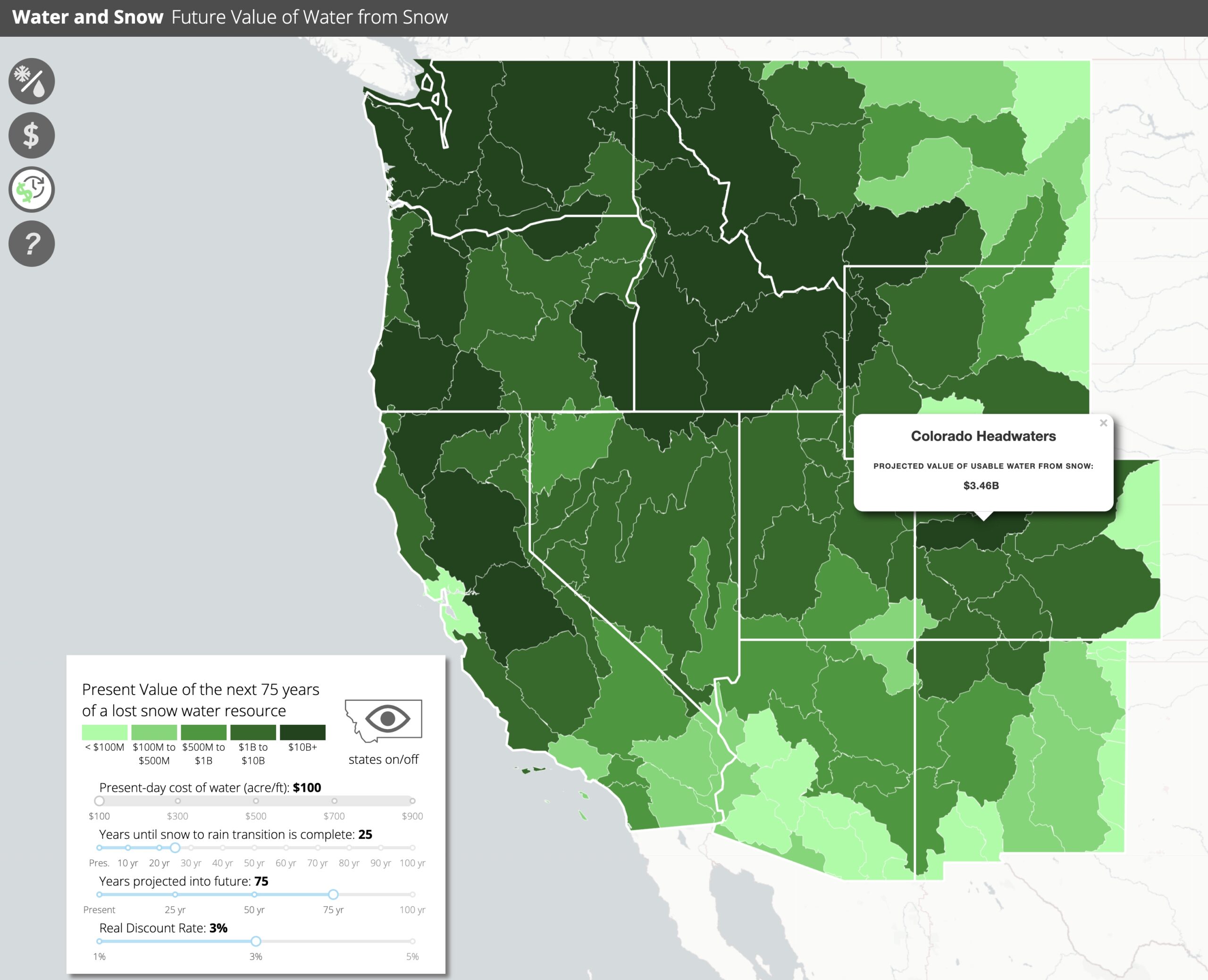
The snowpack’s importance and value vary across the West, with some watersheds more dependent on snowmelt than others. To estimate the local impacts of future snowpack losses, researchers used data from the 2017 study and another paper to create an interactive map that shows the share of water in each Western river basin derived from snow and lets users adjust key variables, including the discount rate, the price of water and the rate at which snow transitions to rain.
An interactive map shows the present value of future snowpack losses across Western river basins. Users can adjust key assumptions—including the price of water, the discount rate and the pace of the transition from snow to rain—to see how projected losses change by watershed. Map by Matthew Sturm and Ryan Bateman, based on data from Li et al. (2017) and Sturm et al. (2017).
Investing in snow science
Jessica Lundquist, a professor of civil and environmental engineering at the University of Washington, called the paper “interesting and unique.” Lundquist, who wasn’t an author of the study but is acknowledged for advising the researchers, said the paper not only tried to put a dollar value on the snowpack but “also was trying to put a value on the knowledge.”
“I like the paper because it was a collaboration between a snow scientist and an economist,” Lundquist said. While the estimates of the snowpack’s value are uncertain, Lundquist said the study provides a useful framework for assessing the financial implications of water management strategies.
In a commentary on the 2017 paper, subtitled “Investments in snow pay high-dollar dividends,” Lundquist wrote that the study “puts the value of snow one thousand times higher than the estimates of snow based on tourism alone.”
When the commentary was published, snow scientists were trying to convince NASA to launch a satellite mission to study the snowpack.
“We were often getting questions about what is the value not only of snow, but of studying snow,” Lundquist said.
A satellite dedicated to monitoring snow never launched. But scientists continue to track the snowpack using other spacecraft, along with a suite of tools that includes aircraft, automated stations and manual measurements.
“I think we’re getting progressively better at figuring out how much snow is in the mountains,” Lundquist said. “I think we’ve made tremendous progress in the last 10 years that we can actually quantify it quite well with a number of ways.”
In other parts of the world, however, snowpack monitoring may be very limited. “A lot of what still needs to be done is in other mountain ranges, other places that don’t have these observing networks,” Lundquist said. “There’s a lot of people who depend on water from the Himalaya who just have no idea whether it’s going to be a drought year or a flood year or what is upstream at all.”
The Yampa River, upstream from Steamboat Springs, Colorado, in December 2019. The Yampa is a tributary of the Green River, which feeds into the Colorado River—the water source for tens of millions of people. Photo by Mitch Tobin/The Water Desk.
Recreational impact of a shrinking snowpack
Beyond supplying water, the West’s snowpack also underpins the region’s winter recreation economy.
During the 2024–25 season, U.S. ski areas recorded 61.5 million skier visits, according to the National Ski Areas Association. This winter, however, visitation across much of the West has suffered amid a widespread snow drought.
In January, Vail Resorts, which is publicly traded on the New York Stock Exchange, reported that visits to its mountains so far this season were down 20% compared to last season, primarily because of poor snow conditions. In the Rockies, only about 11% of the company’s terrain opened in December, when snowfall was nearly 60% below the 30-year average.
A number of studies have examined how changes in the snowpack affect ski areas—both historically and in future projections.
Between 1999 and 2010, the U.S. downhill ski industry lost an estimated $1.07 billion in revenue between low- and high-snowfall years, resulting in 13,000 to 27,000 fewer jobs, according to a 2012 analysis by University of New Hampshire researchers. The report was commissioned by Protect Our Winters and the Natural Resources Defense Council, two advocacy groups.
A 2024 study estimated that U.S. ski areas lost more than $5 billion from 2000 to 2019 due to fewer visits and higher snowmaking costs. Compared to the 1960-1979 period, ski seasons from 2000 to 2019 shortened by 5.5 to 7.1 days, according to a model of operations at 226 ski areas.
Looking ahead, the study projected that by the 2050s, ski seasons would shrink by 14 to 33 days under a low greenhouse gas emissions scenario and by 27 to 62 days under a high-emissions pathway. Under those scenarios, annual industry losses ranged from $657 million to $1.35 billion.
The 2024 study accounted for the added expenses of snowmaking, which requires investments in equipment and labor while also increasing water and energy use. It did not, however, include the broader ripple effects of shorter ski seasons on surrounding communities, where hotels, restaurants, bars, retailers, and gas stations depend heavily on tourists’ spending.
A 2017 study examining future climate impacts on skiing and snowmobiling analyzed 247 winter recreation locations across the continental United States and projected how warming would shorten seasons. The authors concluded that “virtually all locations are projected to see reductions in winter recreation season lengths, exceeding 50% by 2050 and 80% in 2090 for some downhill skiing locations.”
Those shorter seasons “could result in millions to tens of millions of foregone recreational visits annually by 2050, with an annual monetized impact of hundreds of millions of dollars,” the researchers wrote. They also noted that limiting greenhouse gas pollution “could both delay and substantially reduce adverse impacts to the winter recreation industry.”
A smaller, less reliable snowpack can also affect summertime recreation by reducing streamflows and reservoir levels that support fishing, boating and other water-based activities.
In Colorado, for example, outdoor recreation accounted for 3.2% of the state’s gross domestic product in 2023, according to the Bureau of Economic Analysis. Boating and fishing generated $689 million in economic activity in the state, while snow-related recreation was valued at $1.56 billion—more than any other state.
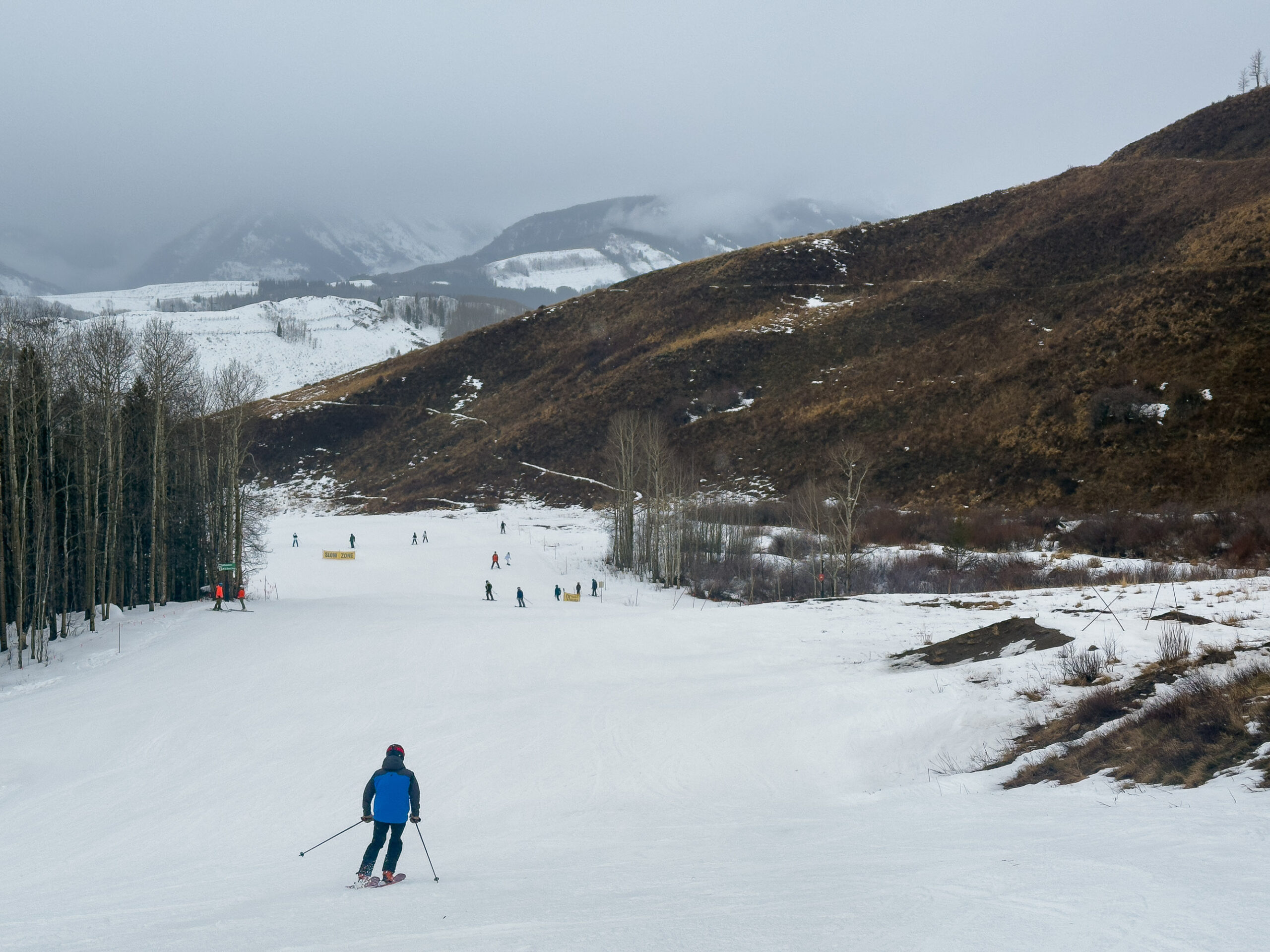
Limited natural snow cover on a rainy Christmas Day in 2025 at Colorado’s Crested Butte ski area. As winters warm and precipitation increasingly falls as rain rather than snow, ski resorts face growing challenges. Photo by Mitch Tobin/The Water Desk.
Other benefits—and costs—of snow
The snowpack’s importance to winter recreation and the West’s water supply are among the easier values to quantify, but they’re not the only benefits snow provides.
On a global scale, one of the most valuable functions of frozen water is that it reflects far more sunlight than bare ground or open ocean. This reflectivity—a property known to scientists as albedo—helps cool the planet.
A 2013 study examining the thawing Arctic attempted to monetize the loss of that cooling effect. The decline in Arctic snow and ice—along with increased methane emissions from melting permafrost—was estimated to cost society $7.5 trillion to $91.3 trillion from 2010 to 2100. “The frozen Arctic provides immense services to all nations by cooling the earth’s temperature—the cryosphere is an air conditioner for the planet,” the scientists wrote.
Then again, the loss of snow could reduce some costs to society.
“There’s some side benefits,” Goldstein said. “You might not have a flood because you’re not going to have a massive runoff all at the same time. That does happen. Some things will be reduced.”
If snow disappeared, so too would snow days that disrupt travel and hamper economic productivity. Winter road maintenance accounts for roughly 20% of state transportation department maintenance budgets, according to the Federal Highway Administration, which estimates that state and local agencies spend more than $2.3 billion annually on snow and ice control annually.
Between 1980 and 2024, the United States experienced 24 winter storms that each caused more than $1 billion in damages, according to the National Centers for Environmental Information. Collectively, those disasters cost $104.2 billion and claimed 1,453 lives.
While vehicle crashes, skier visits and acre-feet of snowmelt can be quantified and priced, snow’s benefits and costs also encompass many things that are difficult—if not impossible—to calculate.
In many ecosystems, for example, snow and snowmelt are vital for plants and animals that have their own economic value, not to mention their intrinsic worth. The 2017 snowpack study did not attempt to price these so-called ecosystem services, which include keeping forests healthy, maintaining cold-water fisheries and sustaining biological diversity.
Even more challenging to value are the mix of emotions that snow evokes. Beauty—and misery—are in the eye of the beholder.
“Some people want their white Christmas,” Lundquist said, “and others are like, please don’t shut down my city.”
The Colorado River, near Bond, Colorado, in December 2019. The river generated an estimated $1.4 trillion in annual economic activity, according to a 2014 report. Photo by Mitch Tobin/The Water Desk.
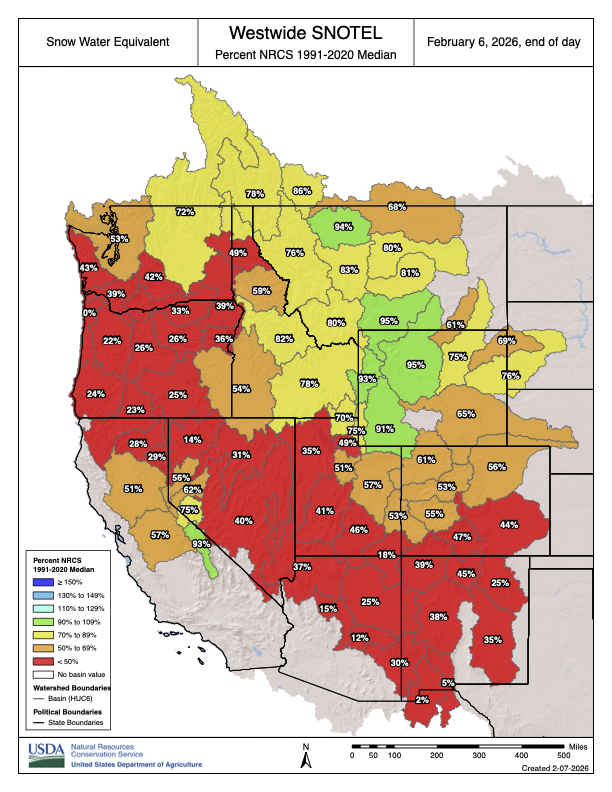
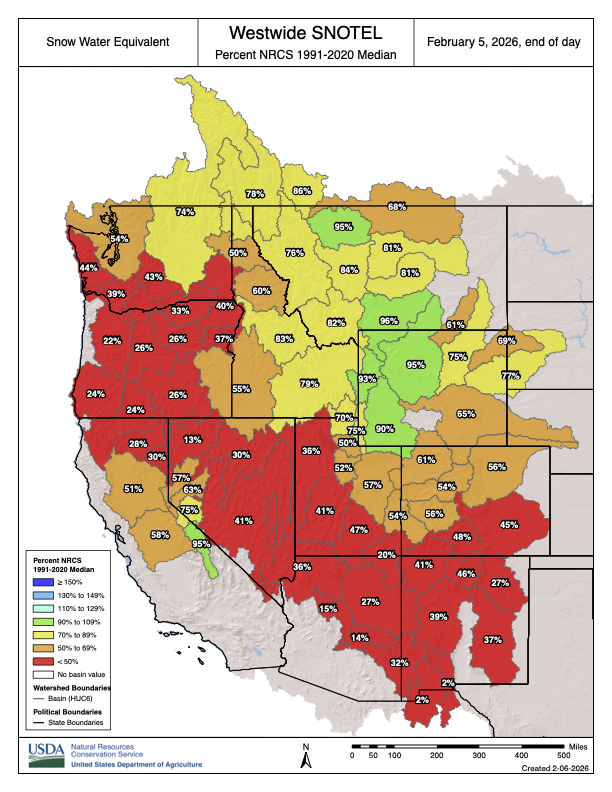
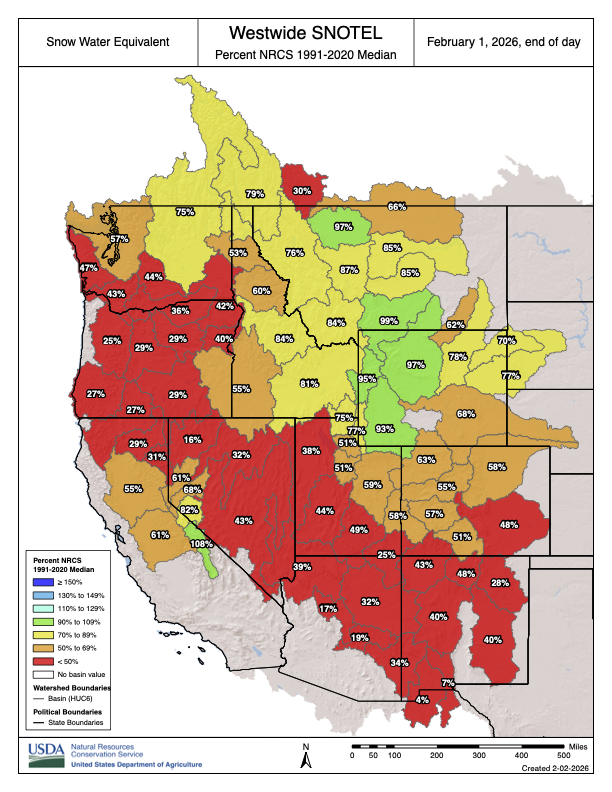
dWestwide SNOTEL basin-filled map February 6, 2026.
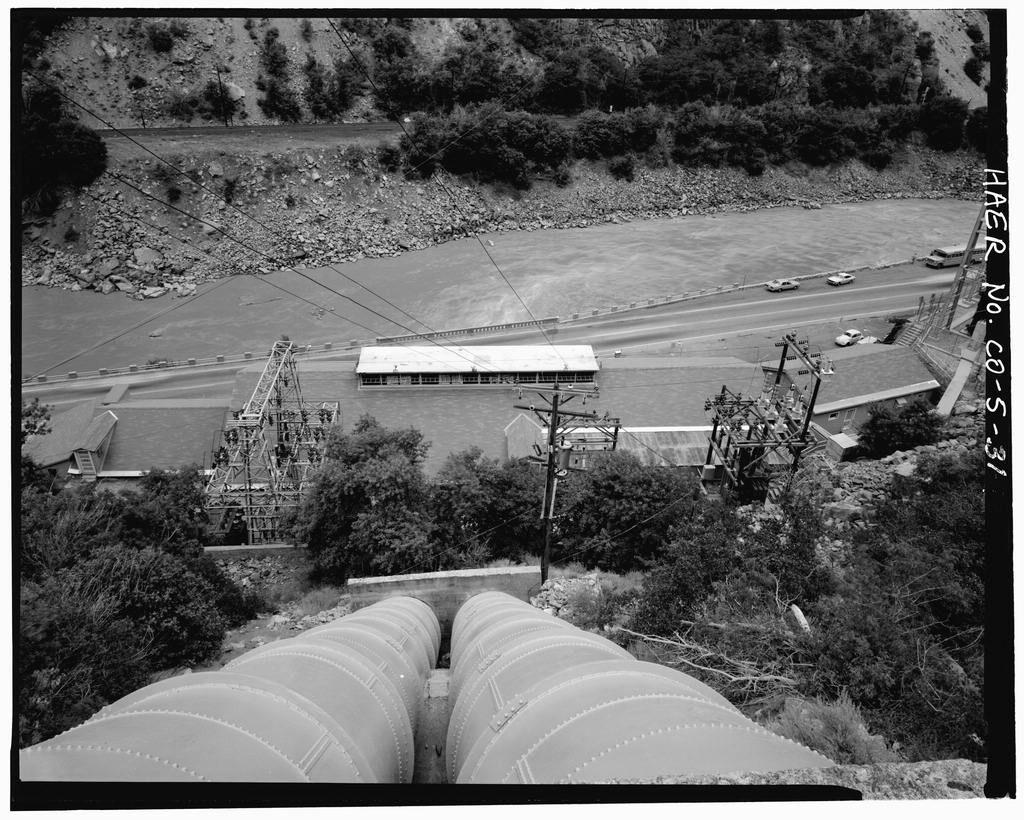
This historical photo shows the penstocks of the Shoshone power plant above the Colorado River. A coalition led by the Colorado River District is seeking to purchase the water rights associated with the plant. Credit: Library of Congress photo
Colorado water groups want a seat at the table to weigh in on a historic Western Slope bid to purchase powerful water rights tied to a small power plant on the Colorado River.
Cities, irrigation districts, hydroelectric companies and other groups submitted filings Friday to have a say in a water court case that will decide the future of Shoshone Power Plant’s rights to access water.
The Colorado River Water Conservation District submitted a request to the court in November to change the water rights tied to the power plant, a small facility tucked into Glenwood Canyon by Interstate 70. The water is used primarily to generate electricity, but the district wants to add an environmental use to help aquatic species during low flows or if the 117-year-old power plant a few miles east of Glenwood Springs were to shut down in the future.
Historically, groups have used opposition filings, like those made Friday, as a way to weigh in on water cases — it doesn’t necessarily mean they oppose all or any part of the proposal, the Colorado River District said.
The district declined further comment.
If the district’s bid is successful, it will end up buying the Shoshone’s water rights from an Xcel Energy subsidiary for about $99 million. The water rights would become the crown jewel of a state-led environmental preservation program and provide long-term certainty for water users across the state.
If the district cannot get court approval to change the water rights, it would scuttle the Colorado River District’s entire proposal.
Of the 60-plus parties in the case, some, like several major Front Range cities, have been concerned the water supplies for millions of people could be negatively impacted. Others filed mainly to watch or to support the effort.
These filings came from Western Slope irrigation districts, governments and water utilities, including Grand County, Breckenridge, Clifton Water District, Orchard Mesa Irrigation District, Summit County and Glenwood Springs.
“Eagle County filed as an ‘opposer’ because that is the term that’s used in water court for parties with an interest in the outcome of the case,” according to a statement from Eagle County staff. “In this case, the county has an interest in maintaining the existing Shoshone Water Rights flow regime as described in the application for change of water rights.”
Others watched to make sure their priorities were discussed during the hearings.
“Western Resources Advocates joined the Shoshone water rights change case as part of our ongoing work to preserve and improve the natural environment in the Colorado River in Colorado,” Bart Miller, WRA’s healthy rivers director, said in an email to The Colorado Sun.
The proposed change would also help support recommended flows for endangered fish many miles downstream, he said.
Some filings came from big water players on the Front Range who fought against the Colorado River District’s proposal during a state process to approve the environmental use. These include the city of Colorado Springs, Northern Colorado Water Conservancy District, the city of Aurora and the city and county of Denver.
These groups have cited concerns that changes in the water rights at Shoshone could impact their own water supplies, which are used by over 2.5 million people up and down the Front Range.
Shoshone’s oldest water right is more senior than some of the Front Range water rights, which allows it to use water first. Under Colorado water law, junior rights get cut off first in dry years.
Adding an environmental use might mean Shoshone is using water more frequently or in larger amounts than in the past, the providers argued.
Others joined to better follow the case, like the city and county of Broomfield and Southwestern Water Conservation District. The district, like the Colorado River District, was formed by the state legislature to act as stewards of water resources on the Western Slope.
“Generally we are in favor of the Shoshone water change,” Steve Wolff, SWCD general manager, said. “We’re watching … how the water right ultimately may have a role in interstate matters.”
There is a lot to be determined about the future of Shoshone’s water rights.
The Colorado River District’s plan to buy the rights comes with four stipulations: state approval to use the water to help instream flows; a successful petition in water court to change the legal rights; $99 million to pay the bill; and approval from the Colorado Public Utilities Commission.
The court case will identify how much water could be used to benefit the environment and identify any potential ways a change could harmfully impact water flows to farmers, cities, utilities or other water users.
“From a legal perspective, this potentially could be a landmark water case,” Wolff said. “We will certainly be involved in it.”
Financing for a potential sale is still to be determined: In January 2025, the Bureau of Reclamation offered $40 million in federal funding through a program authorized by the Inflation Reduction Act. But President Donald Trump’s administration froze that funding.
If the Colorado River District gets its way in court, they’ll take it to the utilities commission for consideration. The entire process could take years to finalize.
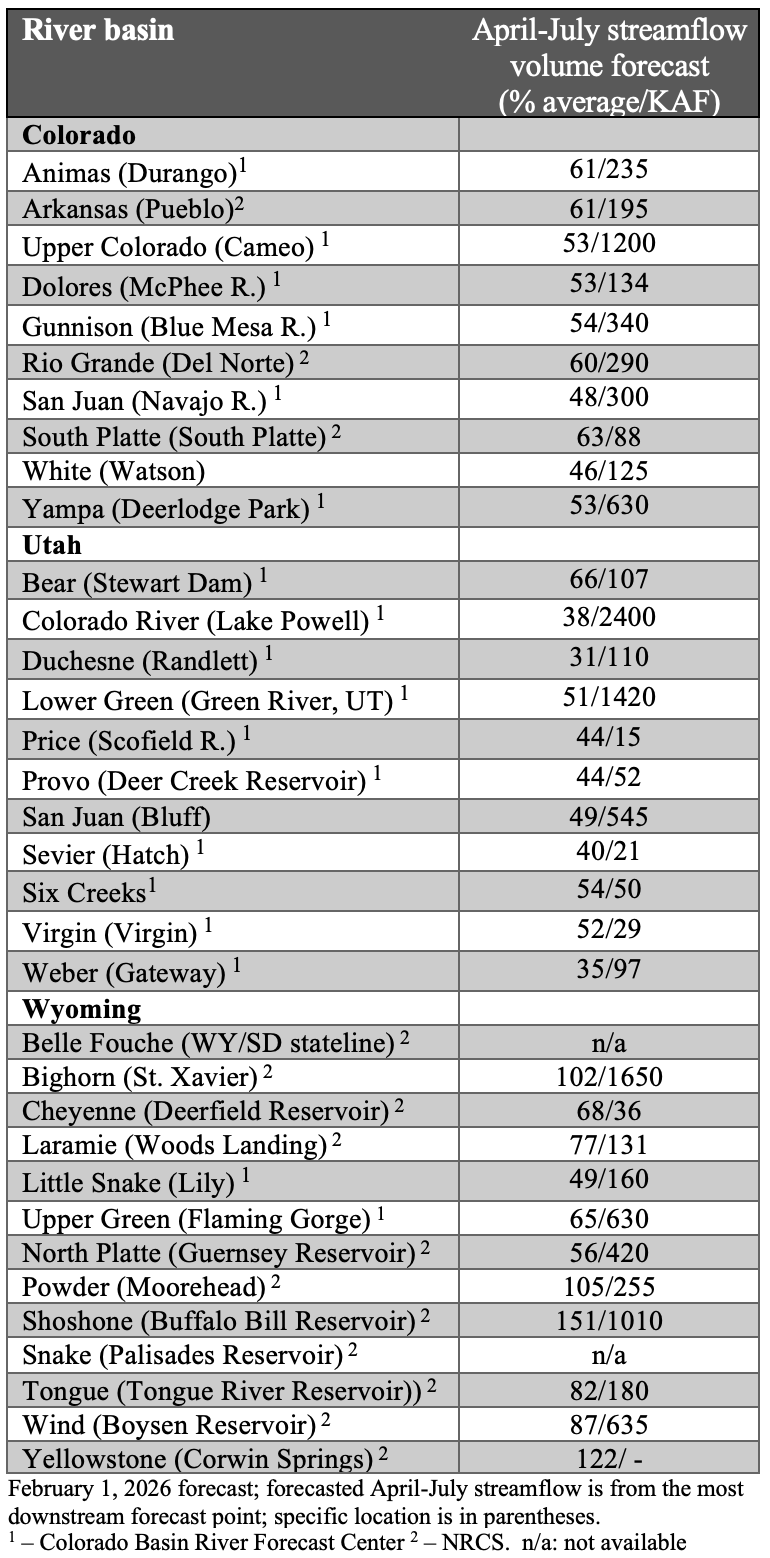
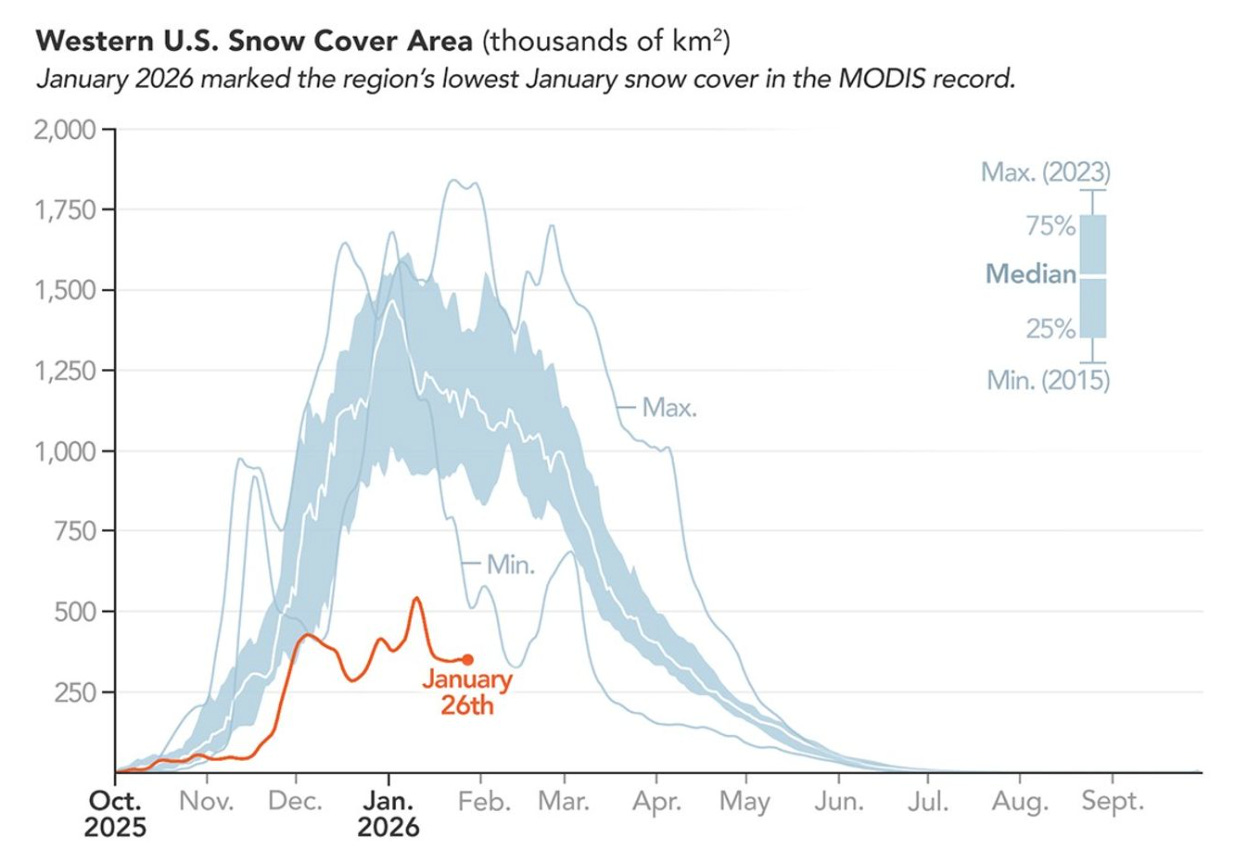
Continued drought conditions plagued much of the region during January. After significant regional precipitation during the first week and a half of January, dry conditions dominated, and little precipitation fell during the remainder of the month. Consequently, regional snowpack and streamflow volume forecasts are extremely low. Record low statewide snowpack conditions exist in Colorado and Utah while Wyoming statewide SWE is 84% of average, driven by wetter conditions in western and northern Wyoming. While northern Wyoming streamflows are near to above average, much below average streamflow volumes are forecasted for the remainder of the region including Lake Powell which is forecasted to receive 38% of average inflow. With Lakes Mead and Powell storage hovering just above 25%, forecasts of low Colorado River flows, and continued Post-2026 Guidelines negotiations, 2026 is certain to be a challenging year for regional water managers.
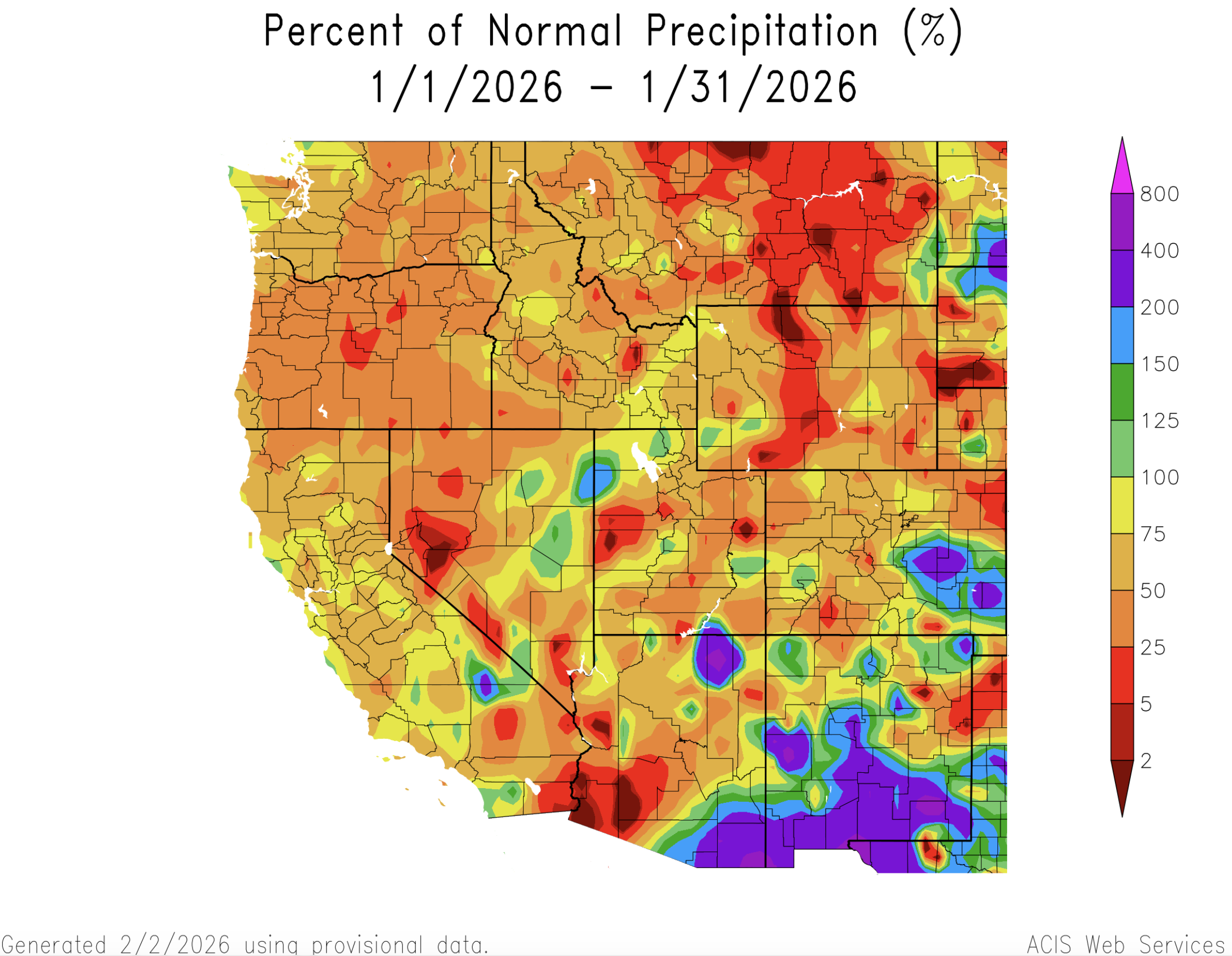
January precipitation was much below normal for the majority of Colorado, Utah and Wyoming and over three-quarters of the region received less the 75% of average precipitation. Small areas of near average precipitation fell in all three states and eastern Colorado received 125-400% of average January precipitation.
Temperatures were above average across the entire region during January. January temperatures in all of Utah and Wyoming and large portions of Colorado exceeded three degrees above average. Northwestern Colorado, northeastern Utah and western Wyoming observed January temperatures that were six to twelve degrees above average.
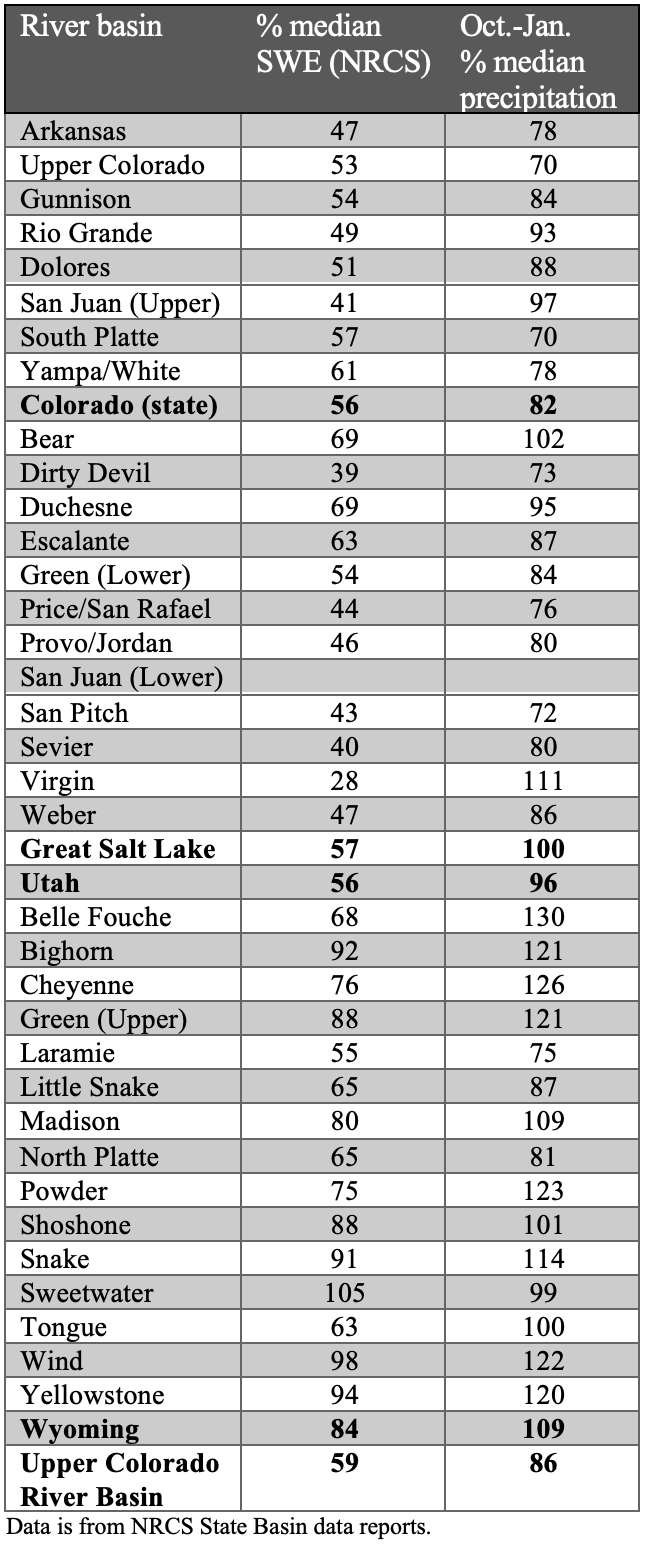
February 1st snowpack conditions were poor across most of the region. Colorado and Utah snow water equivalent (SWE) was 55% of median at the start of February and at record low levels. Snowpack conditions in Wyoming are slightly better with 84% median SWE statewide. Western Wyoming river basins (Bighorn, Green, Snake, and Yellowstone) had near median SWE. Regional snowpack conditions generally deteriorate from north to south with the worst snowpack conditions in the Arkansas, Rio Grande, and San Juan River basins where less than 50% median SWE has accumulated. Real-time estimates of SWE based on satellite imagery suggest significantly poorer snowpack conditions compared to SNOTEL measurements of SWE. These spatial estimates of SWE often differ from SNOTEL SWE measurements because they capture SWE across the entire elevation range while SNOTEL measures SWE across a narrower elevation range. In Utah, February 1 river basin percent SWE varied from 12-54% of average; in Colorado, basin percent SWE ranged from 19-54%; and in Wyoming, basin SWE ranged from 4-110%.
Westwide SNOTEL basin-filled map February 5, 2026.
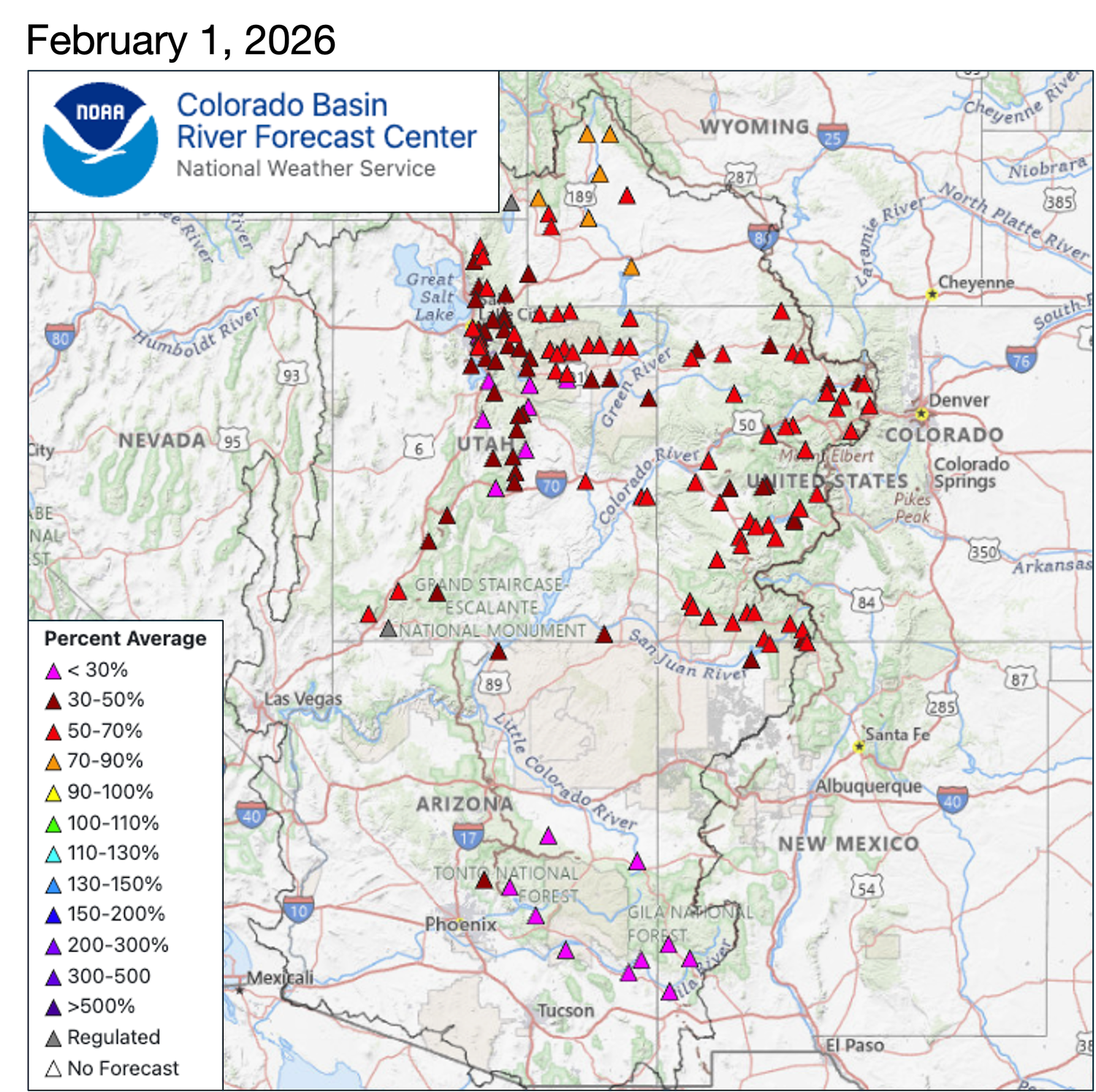
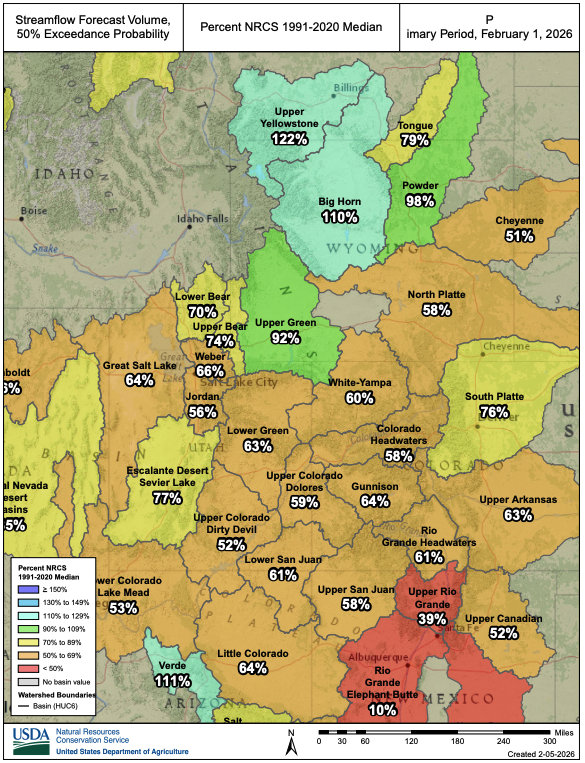
Seasonal streamflow volume forecasts for river basins in Colorado, Utah and southeastern Wyoming are much below average. Near to above average seasonal streamflow volumes are forecasted for much of Wyoming. In the Upper Colorado River Basin, streamflow volume forecasts ranged from 30-92% of average and seasonal inflow volume to Lake Powell is forecasted at 38% of average (2.4 million acre-feet). The Upper Green River Basin and other northern Wyoming basins (Big Horn, Powder and Yellowstone) are forecasted to receive 92-122% of average streamflow volumes. On the Great Basin side of the Wasatch Mountains and Plateaus of Utah, streamflow volume forecasts ranged from 35% of average for the Weber Basin to 54% of average for the Six Creeks watershed in Salt Lake County. Similarly, low streamflow volume forecasts were issued for the Arkansas (63%), Noth Platte (58%) and South Platte (76%) River Basins.
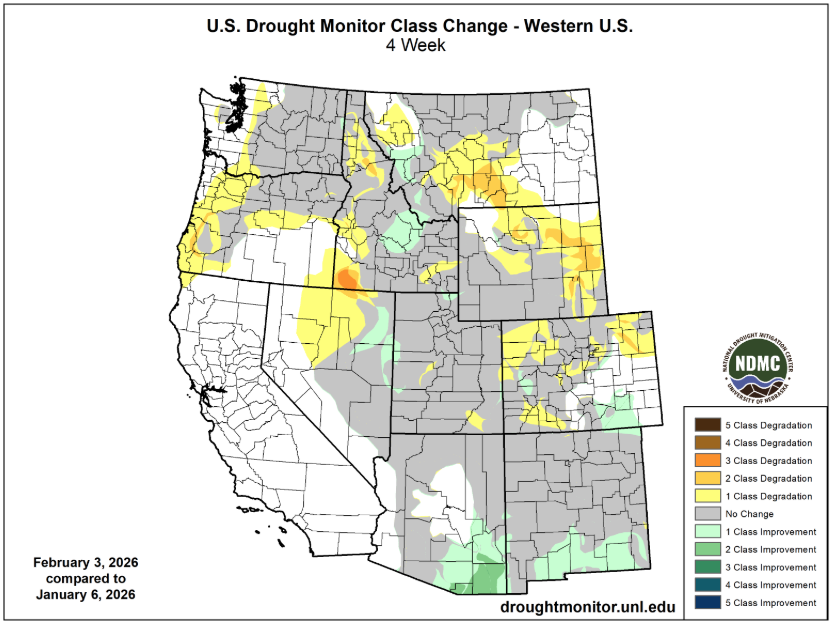
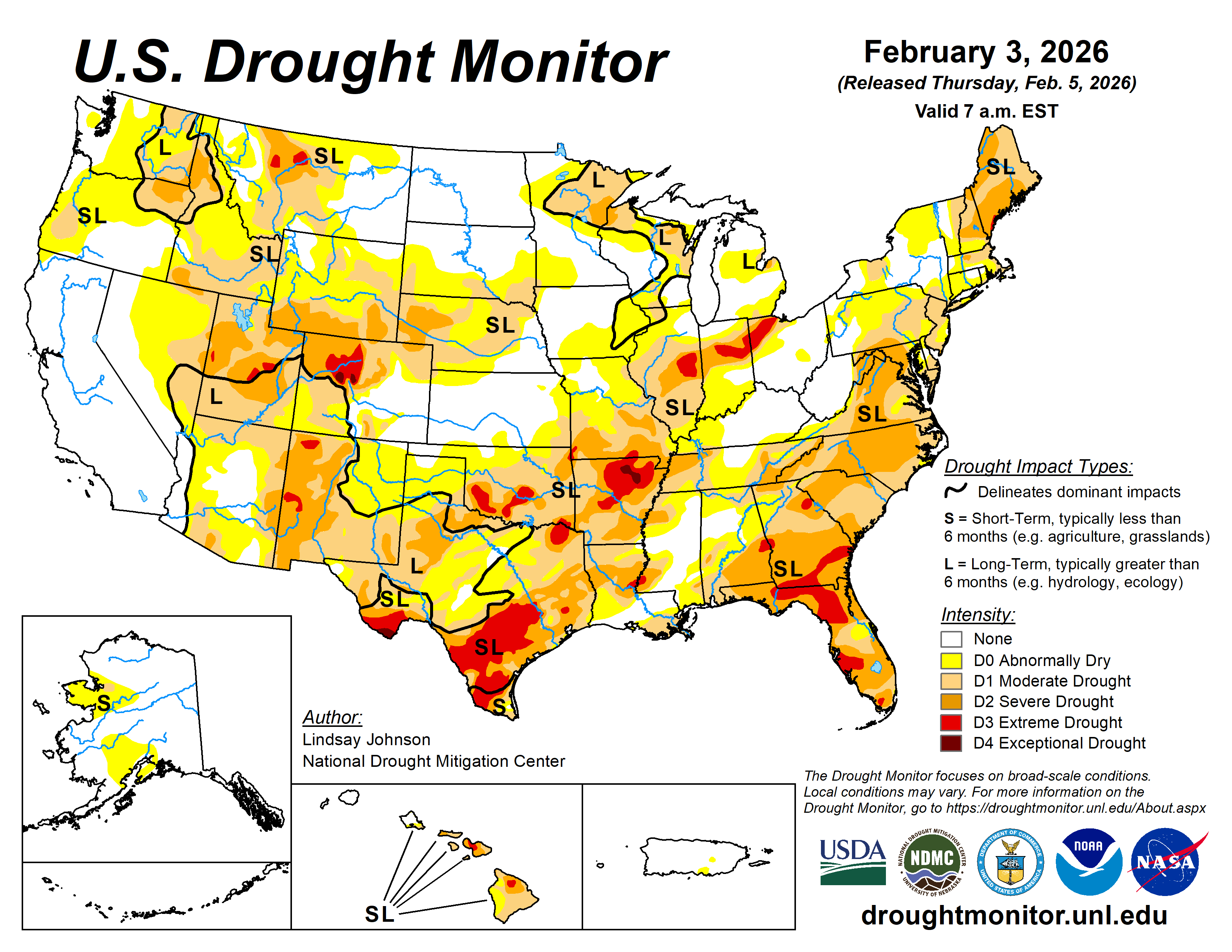
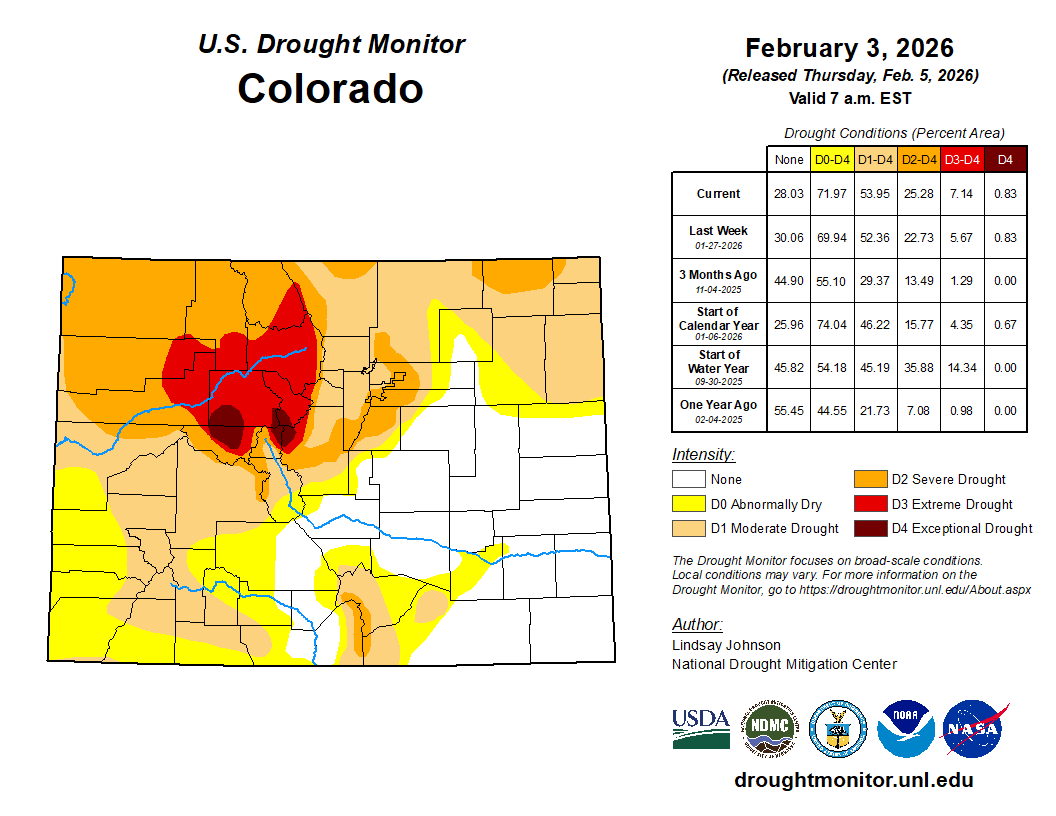
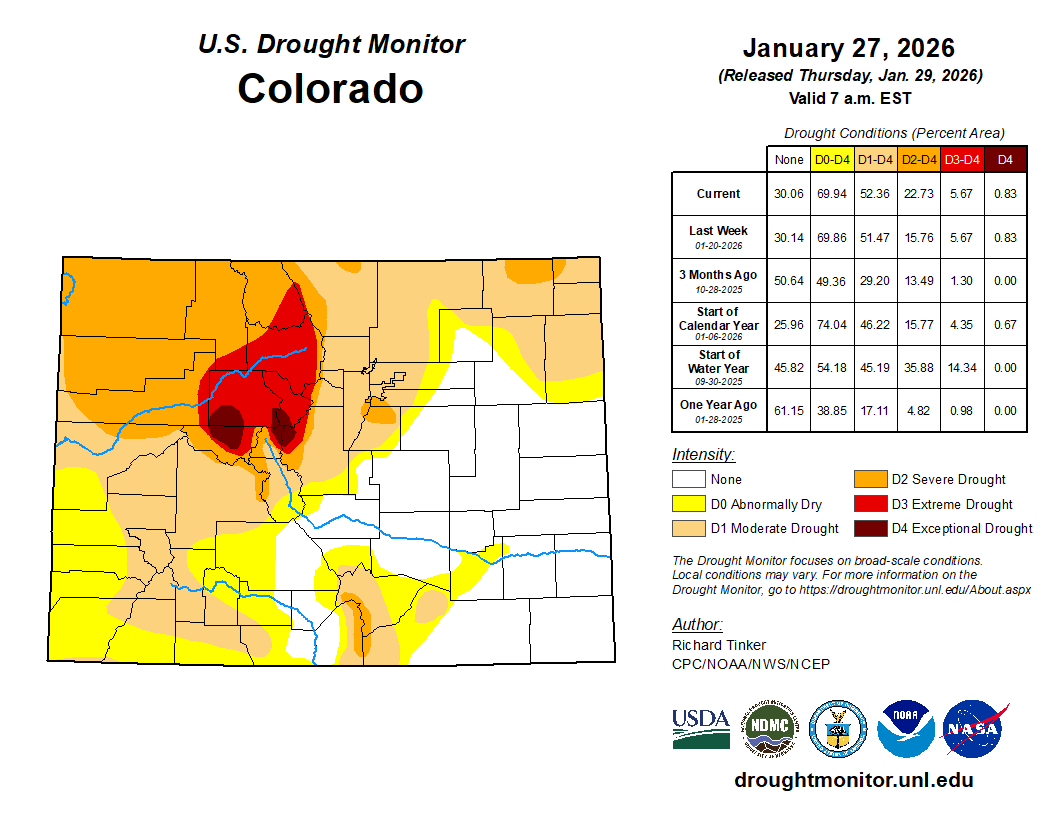
Dry and warm conditions during January caused regional drought coverage to increase to 63% (54% of region on 12/30/25). Drought conditions especially deteriorated in Colorado, where moderate drought emerged in northeastern and southwestern Colorado and severe drought expanded in western Colorado. The area of extreme and exceptional drought in the Colorado River headwaters increased in area during January. Drought emerged in eastern Wyoming and severe drought expanded in the southern portion of the state.
West Drought Monitor map February 3, 2026.
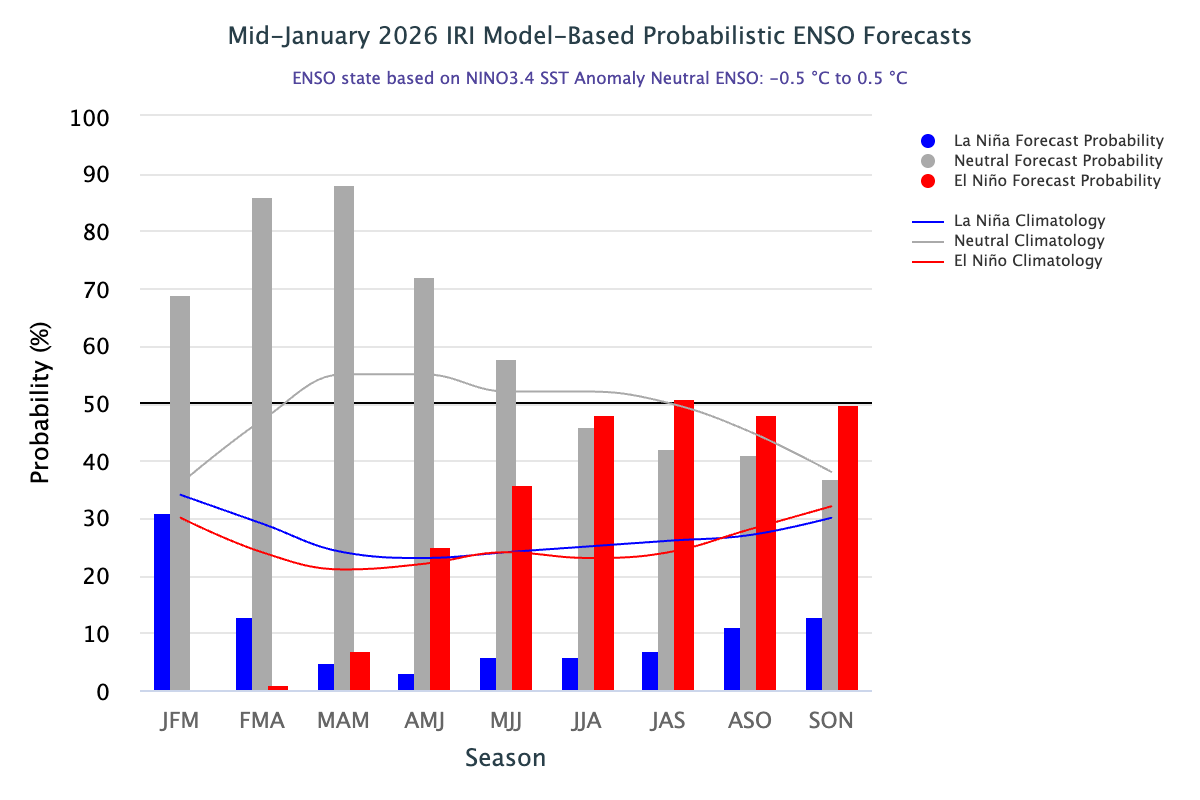
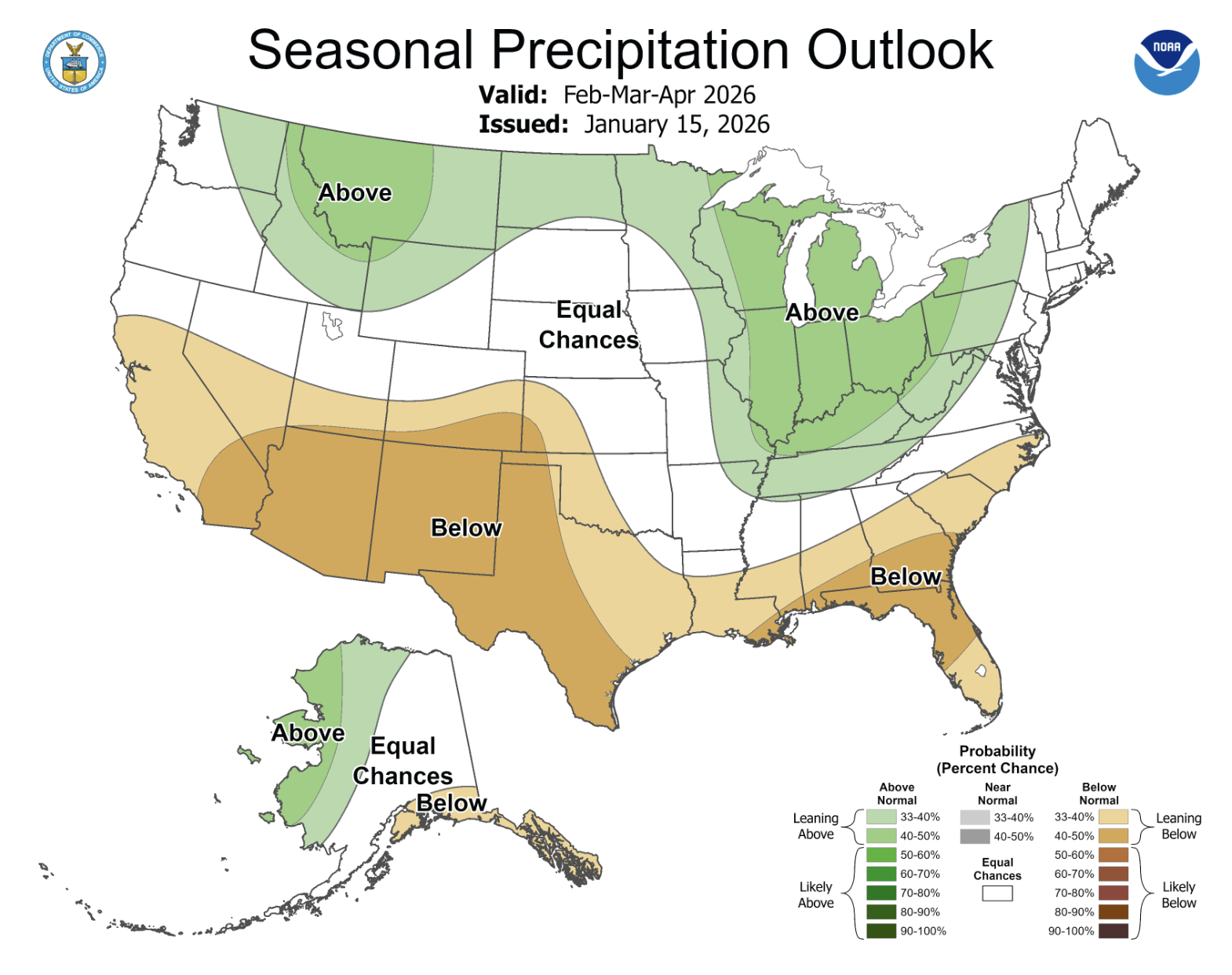
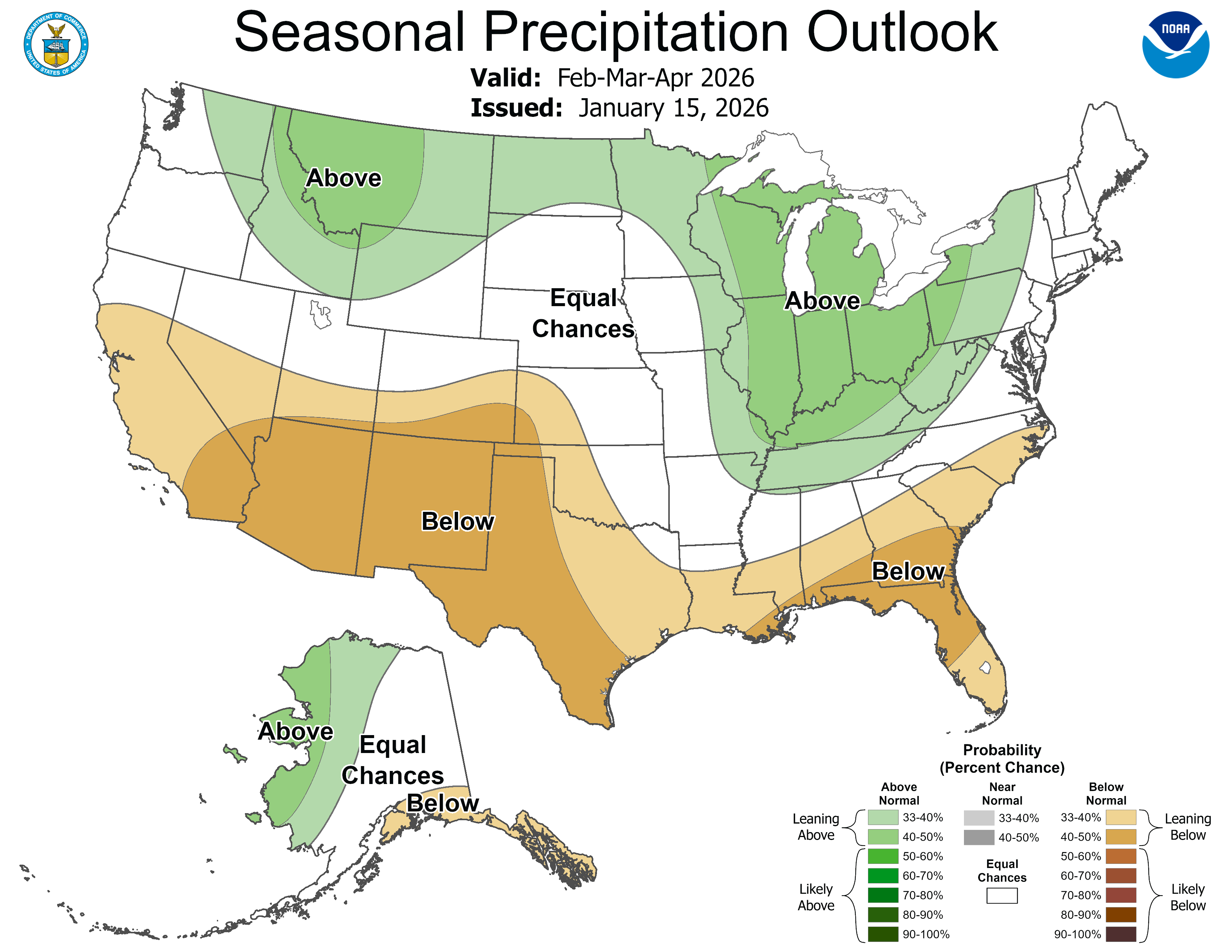
As of mid-January, La Niña conditions persist in the eastern Pacific Ocean. Pacific Ocean conditions are expected to warm and there is a 69% probability of neutral conditions emerging in the next two months. Despite the forecast for warming Pacific Ocean temperatures, ocean temperatures decreased slightly in late January. NOAA monthly forecasts for February suggest an increased probability for below average precipitation across the entire region and above average temperatures for Colorado, Utah and southwestern Wyoming. On the three-month timescale, NOAA forecasts indicate an increased probability of below average precipitation in southern Colorado and southern Utah. February-April temperatures are likely to be above average in Utah and southwestern Colorado.
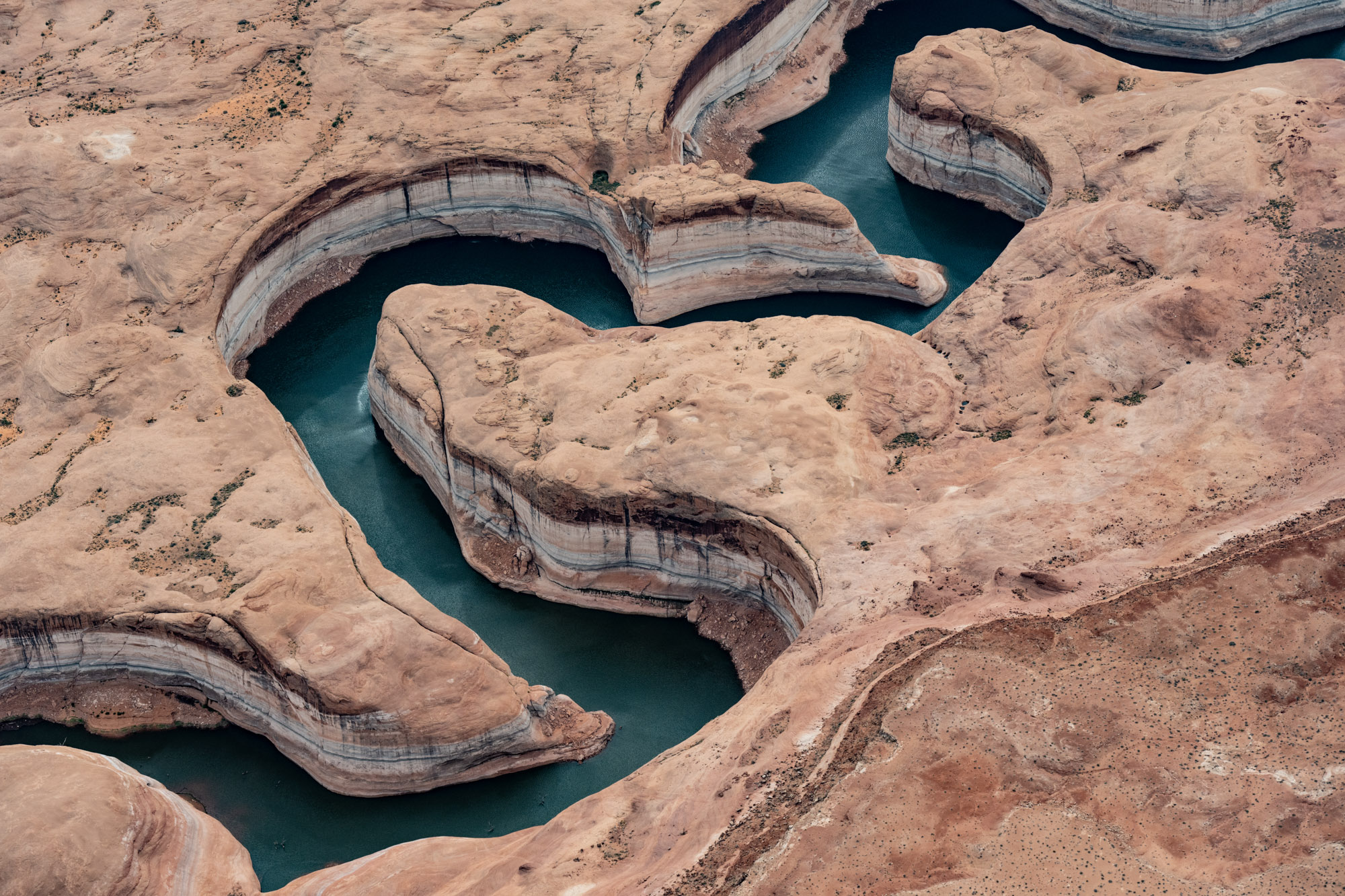
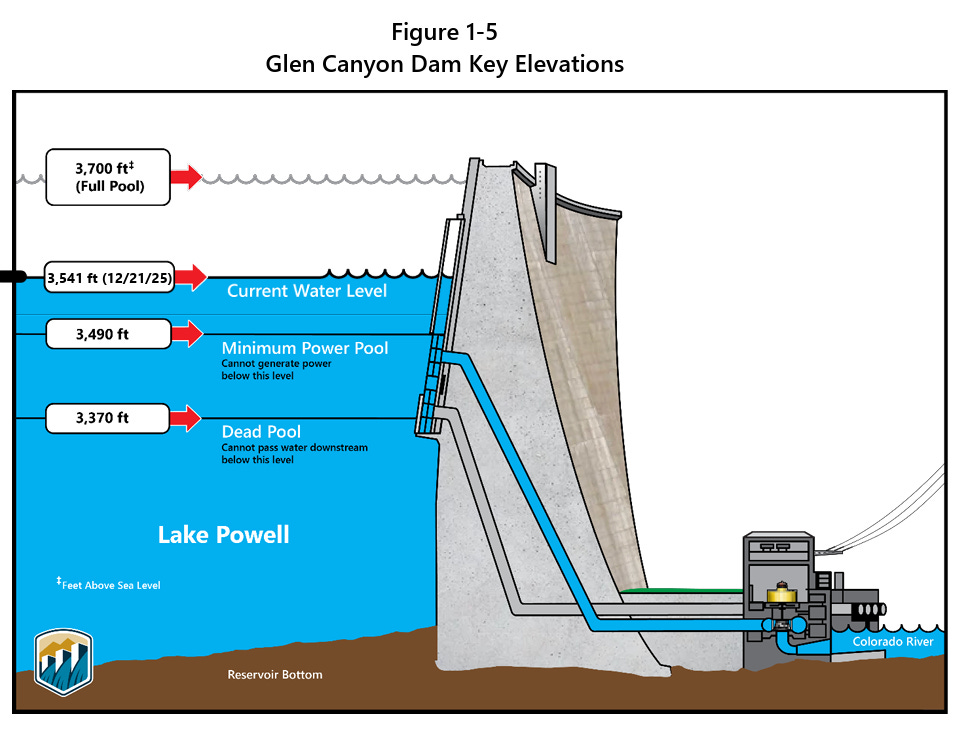
Significant weather event: Upper Colorado River Basin drought. The Upper Colorado River Basin (UCRB) began the 2026 water year with severe or extreme drought conditions covering nearly the entire watershed. Drought conditions have eased slightly, largely due to a wet October, but basin SWE is currently at 60% of median which is a record low (since 1986). If an average amount of SWE accumulates in the UCRB from February 10 to early April, then the 2026 peak SWE would remain low at 77% of average. Poor snow conditions and relatively dry soils throughout much of the UCRB have resulted in very low (38% of average) Colorado River inflow forecasts to Lake Powell. With a current Lake Powell elevation of 3,535 feet and poor Colorado River streamflow volume forecasts, low reservoir elevations will threaten Glen Canyon Dam’s ability to generate electricity by the end of 2026. The US Bureau of Reclamation’s 24-Month Study projects Lake Powell elevations two years into the future. Under the “Most Probable” scenario, Lake Powell elevation falls to 3,513 feet, just 23 feet above the elevation that the hydroelectricity-generating turbines must be shut down. Under the “Minimum Probable” scenario, reservoir elevations fall to 3,490.6 feet, just inches above the level that power generation at Glen Canyon Dam must cease. Operating Glen Canyon Dam is possible below 3,490 feet, but electrical generation must be bypassed and the alternate outlet for the dam was not engineered to run continuously. With Lakes Mead and Powell sitting at one-third and one-quarter full, only 15 million acre-feet (MAF) of combined water storage exists. However, only 6.3 MAF is available for consumption since nearly 9 MAF of water sits below the deadpool elevation of the reservoirs (Colorado River Research Group, “Dancing with Deadpool“). That means that current accessible storage in the two large reservoirs is less than one year of Lower Basin water deliveries from Lake Powell (7.5 MAF). While the UCRB has faced significant drought challenges over the last 25 years, current and forecasted conditions are taking the basin into truly unprecedented waters.
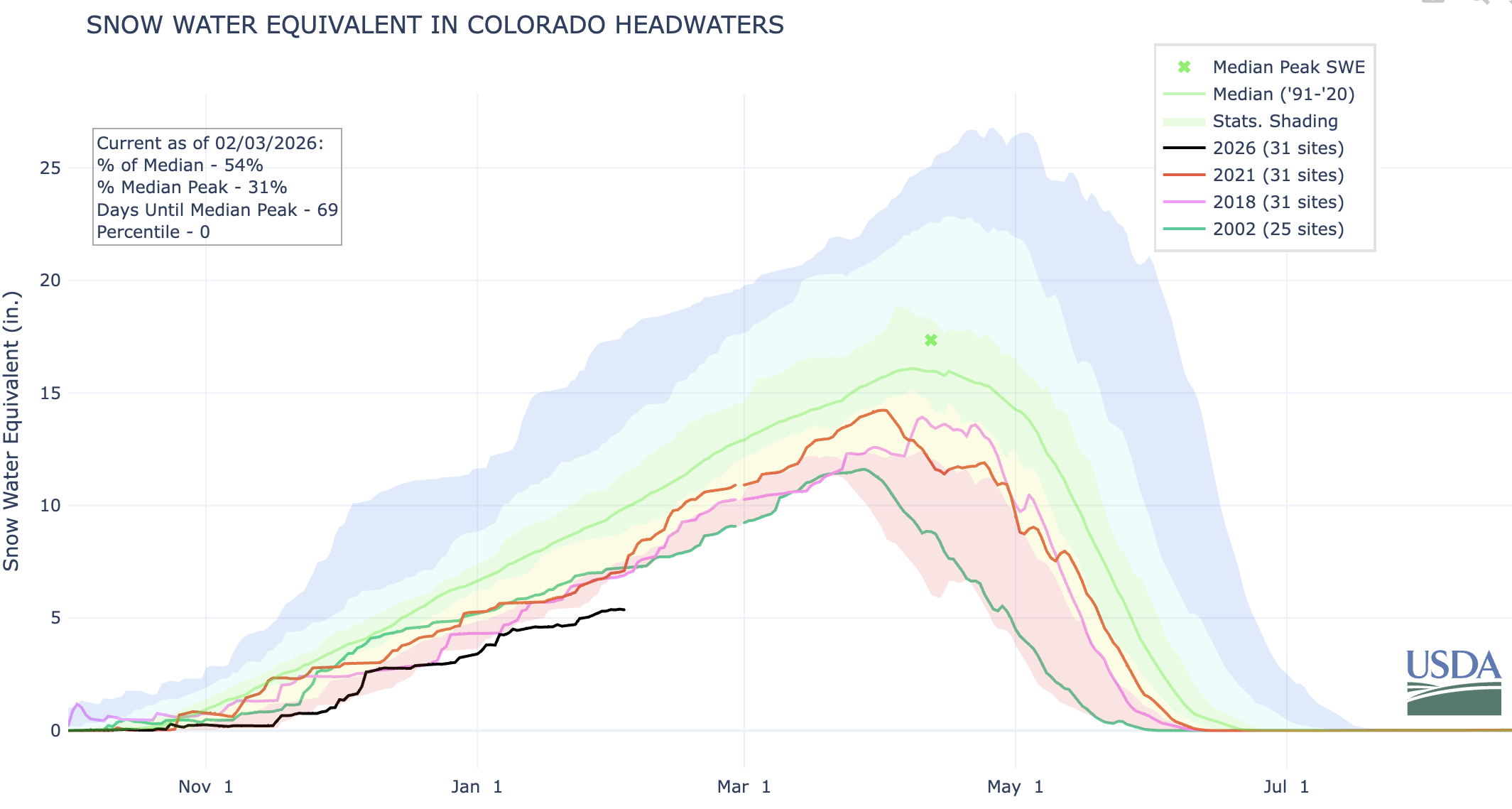
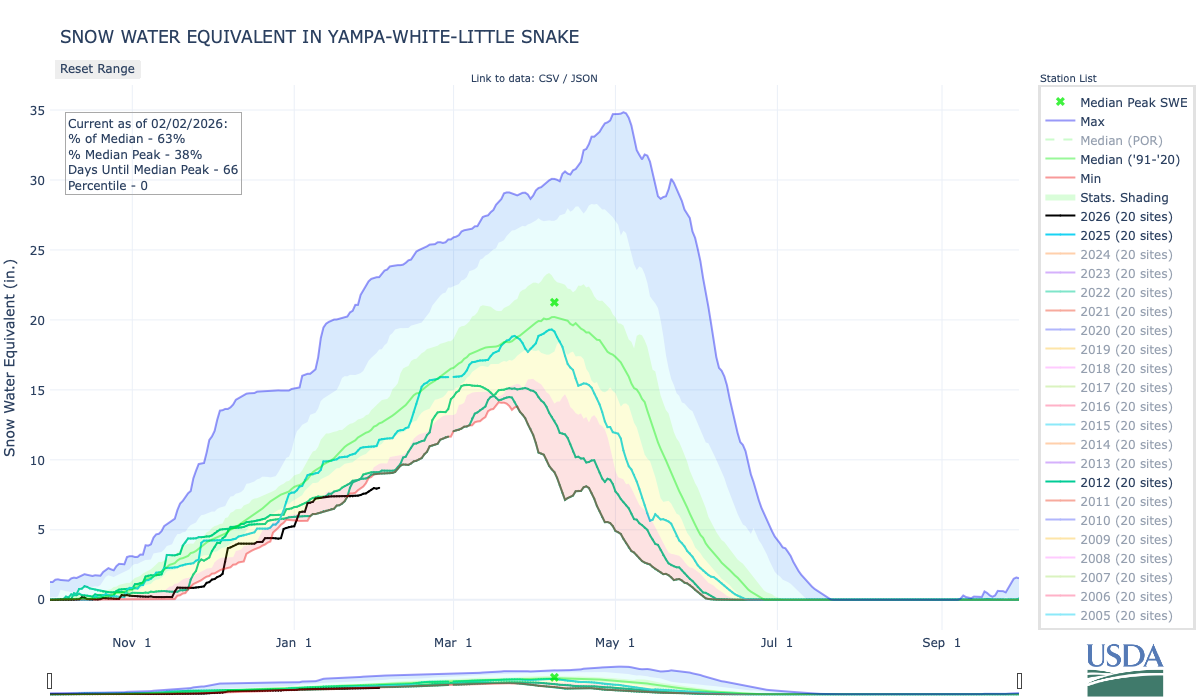
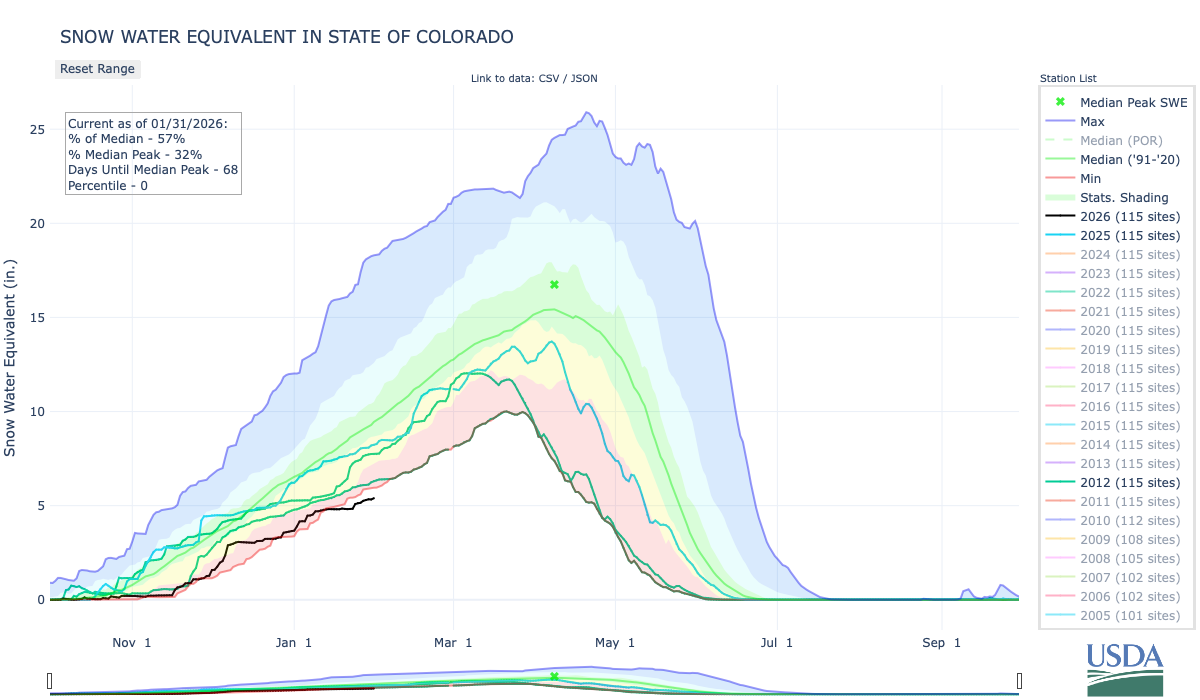
Colorado’s snowpack has remained at the zeroth percentile since about Jan. 15, 2026. While this snow telemetry data shows a record-low snowpack, longer term snow course measurements show the years of 1976-77 and 1980-81 may have been worse. Credit: NRCS
Click the link to read the article on The Aspen Times website (Ryan Spencer). Here’s an excerpt:
February 6, 2026
At some long-term snow measurement sites, the winters of 1976-77 and 1980-81 were worse than this year, but not by much
Across Colorado, the state’s array of snow telemetry, or SNOTEL systems, have documented record-low snowpack conditionsin numerous river basins and on a statewide level several times this winter. Since about Jan. 15, the snow telemetry system has had Colorado’s snowpack statewide sitting at the zeroth percentile, or the worst on record compared to the 30-year period from 1991 to 2020…
“We’ve been stuck for the most part in this warm and dry pattern across the West, going back really to the fall,” Colorado Climatologist Russ Schumacher said. “The snowpack numbers pretty much everywhere in Colorado are pretty ugly right now.”
Denver Water crews use a special tube [Federal Sampler] to gather snow samples near Winter Park as part of pre-set snow courses. Photo credit: Denver Water.
But going back in Colorado’s history, 1976-77 and 1980-81 are two winters often considered “the worst” for snow. Schumacher noted that the state’s snow telemetry system only began to be built out in the 1980s, so comparison can be difficult. That’s where snow course measurements come in. Snow course measurements, which have been taken by hand about once a month at some sites in Colorado since the 1930s, allow for more direct comparisons to those historically bad snow years.
“That allows you to actually make some comparisons to those really, really awful years from the 76-77, 80-81 that the longtimers there in the mountains will remember,” he said. “This year’s not as bad as those, but in a lot of places, it’s the second or third worst when you include those years.”
At Independence Pass, one site where snow course measurements have been taken for well over half a century, this is the second-worst snowpack on record, according to the data. The only year when Independence Pass had a worse snowpack was the winter of 1976-77. At a snow course measurement site in Blue River in Summit County that has about 70 years of data, this year was also the second-lowest snowpack on record, behind only the winter of 1980-81…Yet, at a snow course measurement site at Berthoud Pass, this year is only the 12th worst on record. The worst February snowpack on record at Berthoud Pass was, once again, during the winter of 1980-81.
Westwide SNOTEL basin-filled map February 5, 2026.
There is another emerging issue that decades of drought and the warming climate is causing in the San Luis Valley – elevated levels of heavy metals in drinking wells that can cause health issues for households that rely on them.
It’s a topic Kathy James, Ph.D., and associate professor with the Colorado School of Public Health, knows well after spending the past three years working with families in the Valley that rely on private drinking wells.
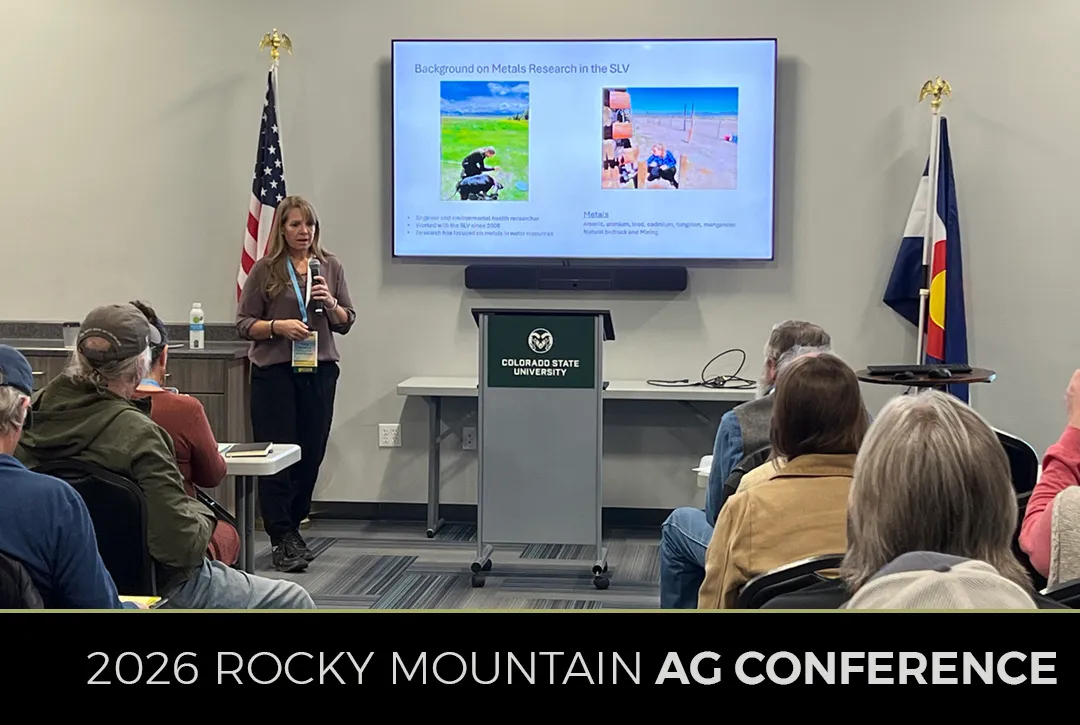
James provided an update to the work during Tuesday’s opening day of the 2026 Southern Rocky Mountain Ag Conference. She reported that 15 to 25 percent of the private groundwater wells used for drinking water in the San Luis Valley contain elevated levels of arsenic, uranium and other heavy metals.
Her confidence in the findings is bolstered by the fact that 850 households in the different counties of the Valley participated in the study and provided samples to help James and her team evaluate the effect drought is having on water quantity and water quality.
“The comprehensive information that we have about distribution of metals across the Valley is by far one of the best we’ve seen in most western states that do experience elevated metals,” James said.
She noted how low snowpack impacts the age of water underground and ultimately the quality of water people are drinking from a private well.
The Upper Rio Grande Basin, like the Colorado River, is suffering from snow droughtsin the high elevations of the west and below-normal spring runoff levels.
Less snow, less spring runoff for recharge of the aquifers, and higher levels of arsenic, uranium and other heavy metals is the emerging issue. James talks more about the study and the team’s findings in the next episode of The Valley Pod, which streams Wednesday on AlamosaCitizen.com.
Under pressure to provide water for drinking and irrigation, people around the globe are trying to figure out how to save, conserve and reuse water in a variety of ways, including reusing treated sewage wastewater and removing valuable salts from seawater.
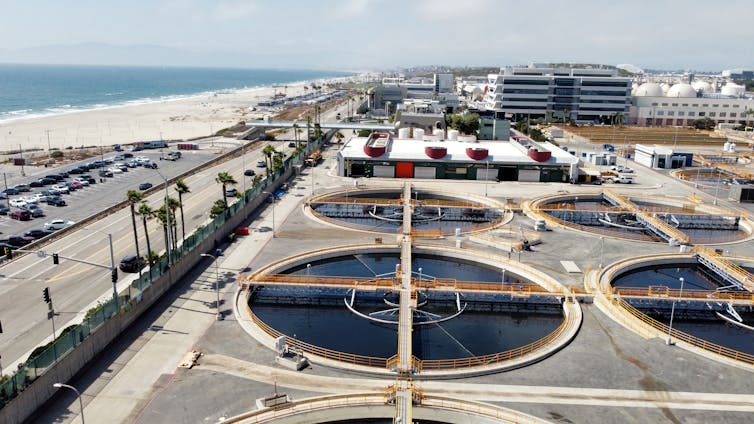
But for all the clean water they may produce, those processes, as well as water-intensive industries like mining, manufacturing and energy production, inevitably leave behind a type of liquid called brine: water that contains high concentrations of salt, metals and other contaminants. I’m working on getting the water out of that potential source, too.
However, most of these methods require strict environmental protections and monitoring strategies to reduce harm to the environment.
For instance, the extremely high salt content in brine from desalination plants can kill fish or drive them away, as has happened increasingly since the 1980s off the coast of Bahrain.
Brine injected into the earth in Oklahoma, including into wells used for hydraulic fracking of oil and natural gas, was one of several factors that led to a 40-fold increase in earthquake activity in the five-year period from 2008 to 2013, as compared to the preceding 31 years. And wastewater has been documented to leak from the underground wells up to the surface as well.
Researchers like me are increasingly exploring brine’s potential not as waste but as a source of water – and of valuable materials, such as sodium, lithium, magnesium and calcium.
Currently, the most effective brine reclamation methods use heat and pressure to boil the water out of brine, capturing the water as vapor and leaving the metals and salts behind as solids. But those systems are expensive to build, energy-intensive to run and physically large.
Other treatment methods come with unique trade-offs. Electrodialysis uses electricity to pull salt and charged particles out of water through special membranes, separating cleaner water from a more concentrated salty stream. This process works best when the water is already relatively clean, because dirt, oils and minerals can quickly clog or damage the membranes, reducing the performance of the equipment.
Membrane distillation, in contrast, heats water so that only water vapor passes through a water-repelling membrane, leaving salts and other contaminants behind. While effective in principle, this approach can be slow, energy-intensive and expensive, limiting its use at larger scale.
A trailer containing a small water reclamation system. Mervin XuYang Lim, CC BY-SA
A look at smaller, decentralized systems
Smaller systems can be effective, with lower initial costs and quicker start-up processes.
At the University of Arizona, I am leading the testing of a six-step brine reclamation system known as STREAM – for Separation, Treatment, Recovery via Electrochemistry and Membrane – to continuously reclaim municipal brine, which is salty water left over from sewage treatment.
The system combines conventional methods such as ultrafiltration, which removes particles and microbes using fine filters, and reverse osmosis, which removes dissolved salts by forcing water through a dense membrane, alongside an electrolytic cell – a method not typically employed in water treatment.
Our previous study showed that we can recover usable quantities of chemicals such as sodium hydroxide and hydrochloric acid at one-sixth the cost of purchasing them commercially. And our initial calculations indicated the integrated system can reclaim as much as 90% of the water, greatly reducing the volume of what remains to be disposed. The cleaned water in turn is suitable for drinking after final disinfection using ultraviolet or chlorine.
We are currently building a larger pilot system in Tucson for further study by researchers. We hope to learn if we can use this system to reclaim other sources of brine and study its efficacy in eliminating viruses and bacteria for human consumption.
There was a strong west-to-east temperature gradient this week, with temperatures below normal in the East, particularly in the Midwest and Northeast, and above normal in the West. Precipitation was scarce across large portions of the nation, with many areas receiving less than 25% of normal precipitation. Areas of localized precipitation fell across the Pacific Northwest, northern Rockies and the Great Lakes region. Out east, a winter storm brought snow and mixed precipitation to parts of the Tennessee Valley and the Carolinas, with locally heavy snowfall in some locations.
Across the West, snowpack remains well below the seasonal average. Even in areas that received snow, low snowpack combined with dry soils and low streamflows led to degradations across the Intermountain West. Along the West Coast, precipitation remained limited and uneven. Western Oregon saw dry and drought conditions expand toward the Pacific coast and into far south Washington and northwest California.
Elsewhere, scattered degradations occurred across the South and Southeast, where another week without precipitation added to growing precipitation deficits, except for localized areas of improvement that continued to benefit from last week’s heavy snowfall. Other isolated areas of improvement were seen in southern New Mexico and in the Midwest and Northeast…
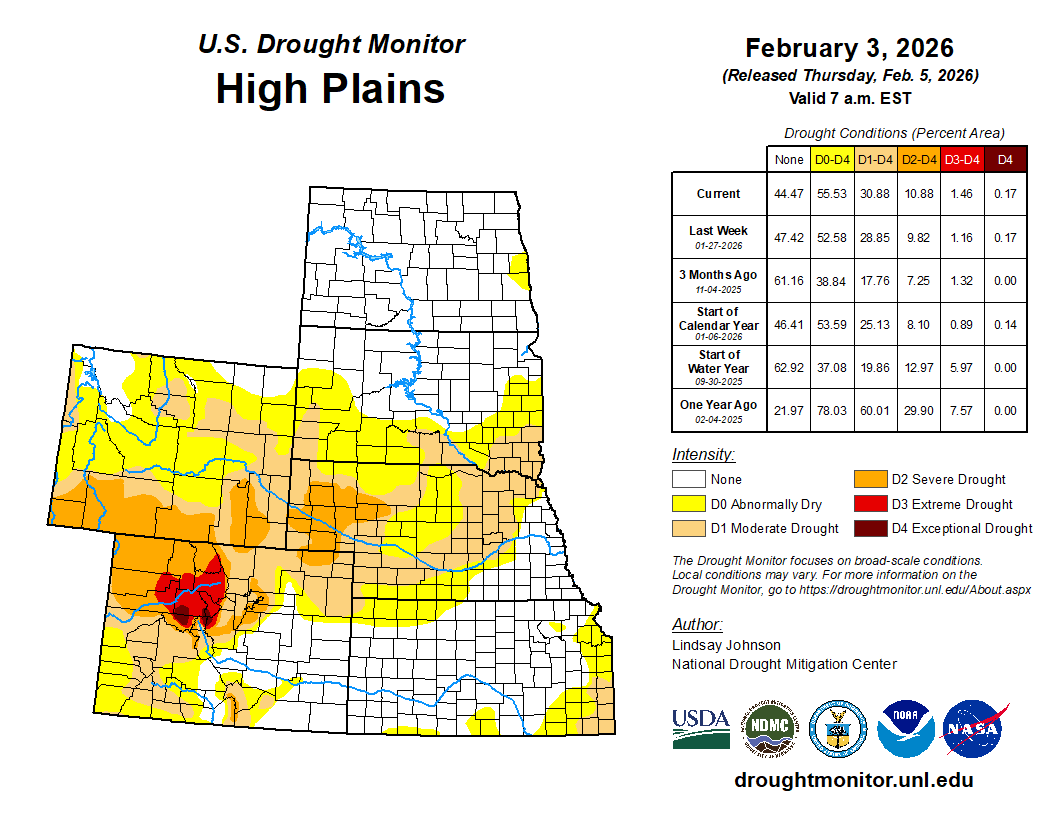
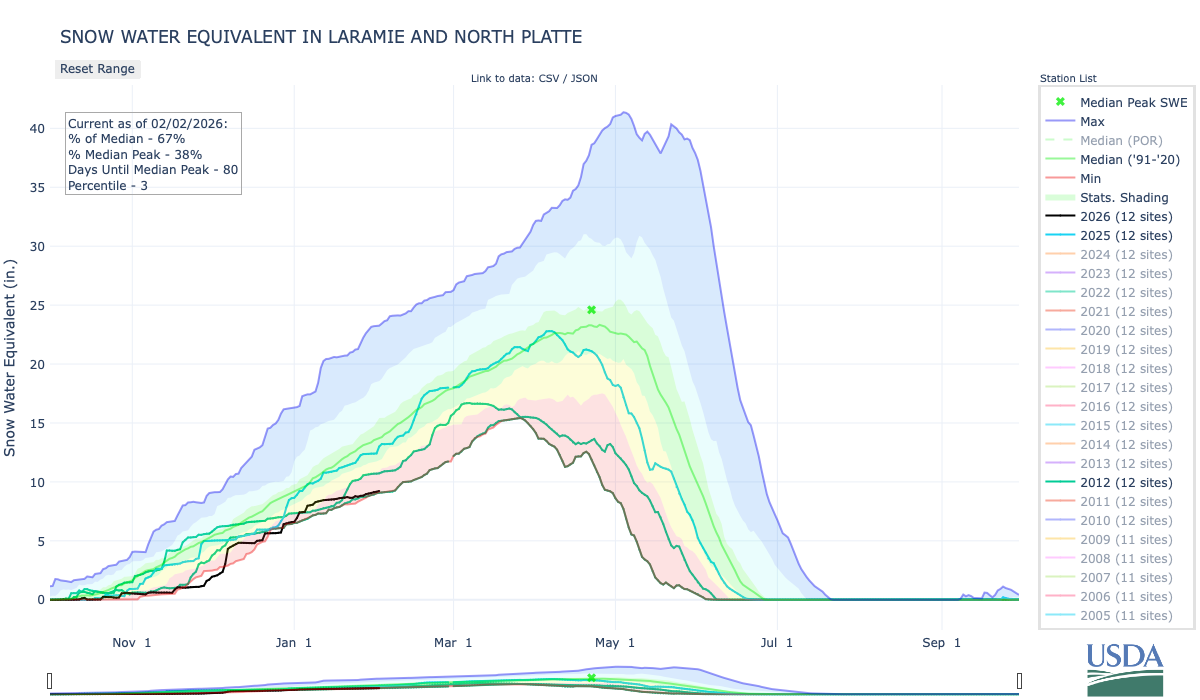
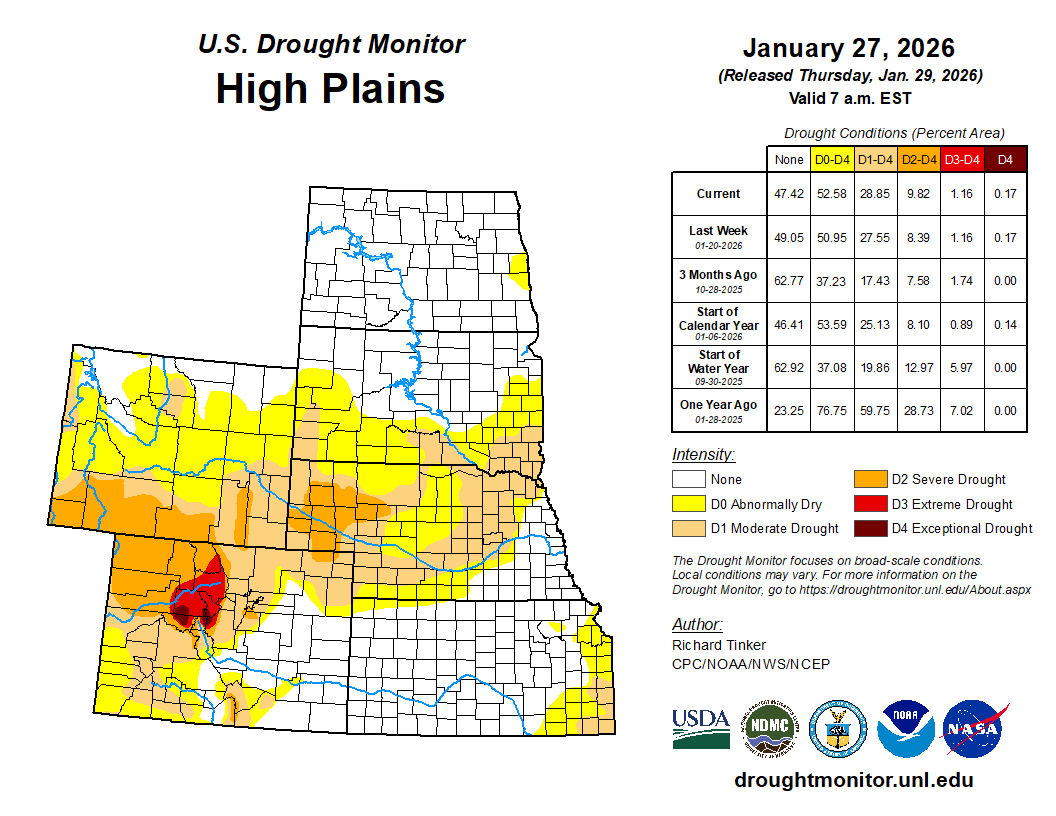
Conditions across the central and northern High Plains were mostly unchanged this week, as most of the region received little to no meaningful precipitation. Cold temperatures persisted, and where snow did fall, it remained largely frozen in place, limiting short-term benefits to soils or hydrologic conditions. Conditions across the Wyoming and Colorado Plains continued to deteriorate. Snow water equivalent (SWE) remains well below average, with SNOTEL data showing values generally in the 50 to 70 percent of median range, reflecting how snowpack continues to fall short for this time of year despite recent snowfall. Severe drought (D2) expanded from southeastern Wyoming into northeastern Colorado and a little into the Nebraska Panhandle. Abnormal dryness (D0) and moderate drought (D2) also expanded across portions of Kansas…
Colorado Drought Monitor one week change map ending February 3, 2026.
Across much of the West, conditions worsened, driven by a deepening snow drought, limited precipitation, and above-normal temperatures that continued to undermine snowpack development. While some mountain snowfall occurred, amounts were generally modest and failed to keep pace with early February climatological accumulation rates, causing snowpack deficits to expand across much of the region.
The Intermountain West saw conditions intensified as snow accumulation continues to fall well short of what is expected this time of the year. Numerous SNOTEL sites reported SWE below the 15th percentile, with several stations registering the lowest SWE on record for early February. These snowpack deficits were compounded by limited recent precipitation, declining soil moisture, and below-normal streamflows, particularly across northern Idaho and western Montana and extending into central and southern Montana and Wyoming. Similarly, Colorado and Utah saw conditions deteriorate as SWE levels are well below the median level along with drier soil moisture.
Across southwestern Idaho, northern Nevada and into eastern Oregon, persistent warmth, scarce precipitation, poor low-elevation snowpack, and low streamflows led to the expansion of abnormally dry (D0) and moderate drought (D1) conditions as well as the introduction of moderate drought (D2) along the Idaho-Wyoming border. SNOTEL stations in the Owyhee, Independence and Snake Mountains are reporting SWE levels between the ninth percentile to the worst on record…
Drought conditions across the South generally continued to worsen this week, as much of the region received little to no precipitation. Temperatures were near to slightly above normal across large portions of the region. Outside of a few localized improvements in northeast Louisiana and southeast Mississippi from last week’s winter storm, conditions continued to degrade across most of the region. Across the southern Plains into the Lower Mississippi Valley, one-category degradations were seen across parts of Texas, Oklahoma, Arkansas, Louisiana and southwest Mississippi after another dry week with no meaningful precipitation. Short- to mid-term precipitation deficits continue to grow and soil moisture continues to decline, along with streamflows…
Looking Ahead
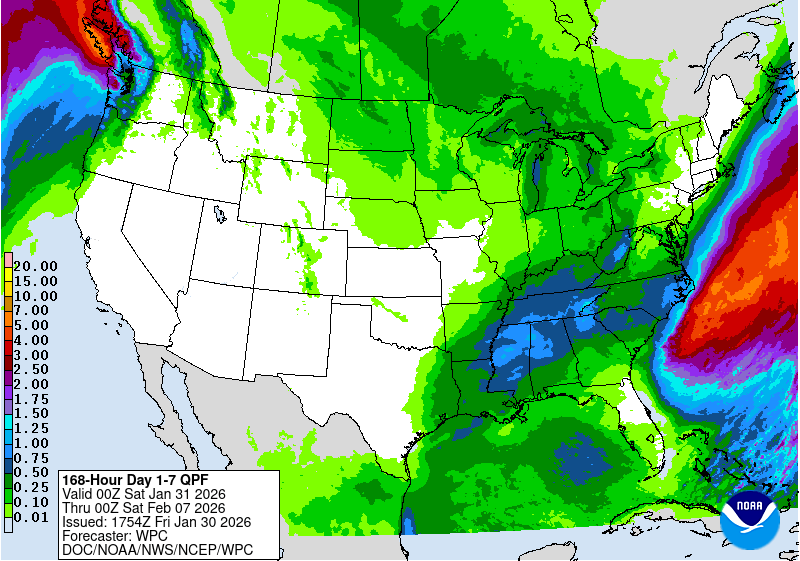
Over the next five to seven days, an active weather pattern is expected across much of the continental U.S., with several regions showing a strong signal for precipitation. The heaviest precipitation is forecast from the lower Mississippi Valley northeastward into the Ohio and Tennessee valleys, where widespread totals of 1 to 3 inches are expected, with locally higher amounts possible. Portions of the central Plains, Midwest, and Great Lakes are anticipated to receive generally 0.5 to 1.5 inches of precipitation during this period. Across the West, precipitation is expected to be widespread from the Pacific Northwest into the northern and central Rockies. Liquid-equivalent totals of 1 to 3 inches are forecast in the Cascades and northern Rockies, with locally higher amounts possible at higher elevations. Farther south into the Great Basin and Southwest, precipitation becomes more scattered, with most areas receiving less than 0.5 inches, and many locations remaining dry. Drier conditions are expected to persist across California, the northern Great Plains, central and southern Texas, and much of the Florida Peninsula, where little to no precipitation is forecast over the next week.
The Climate Prediction Center’s 6–10 day temperature outlook (Feb. 10-14) shows a strong and widespread signal for above-normal temperatures across much of the continental U.S. The highest probabilities of above-normal temperatures are centered over the central and southern Plains, extending northward into the northern Plains and Upper Midwest. Much of the Intermountain West, Rockies, and interior West also favors above-normal temperatures. Along the West Coast, temperatures are expected to be near normal, while parts of the Northeast show a transition from below normal in northern New England to near or above normal farther south. Portions of the Southeast, including Florida, are favored to see near-normal temperatures. Alaska shows a mix of near- to below-normal temperatures across the mainland, with near-normal conditions favored over the southern coast. Hawaii is favored to experience above-normal temperatures during this period.
The Climate Prediction Center’s 6–10 day precipitation outlook (Feb. 10–14) favors above-normal precipitation across much of the western U.S., including the Southwest and West Coast, with elevated probabilities extending into parts of the northern Rockies. Above-normal precipitation is also favored across Alaska and Hawaii during this period. In contrast, below-normal precipitation is favored across Florida and portions of the far Southeast, while much of the central U.S. is expected to see near-normal precipitation.
US Drought Monitor one week change map ending February 3, 2026.
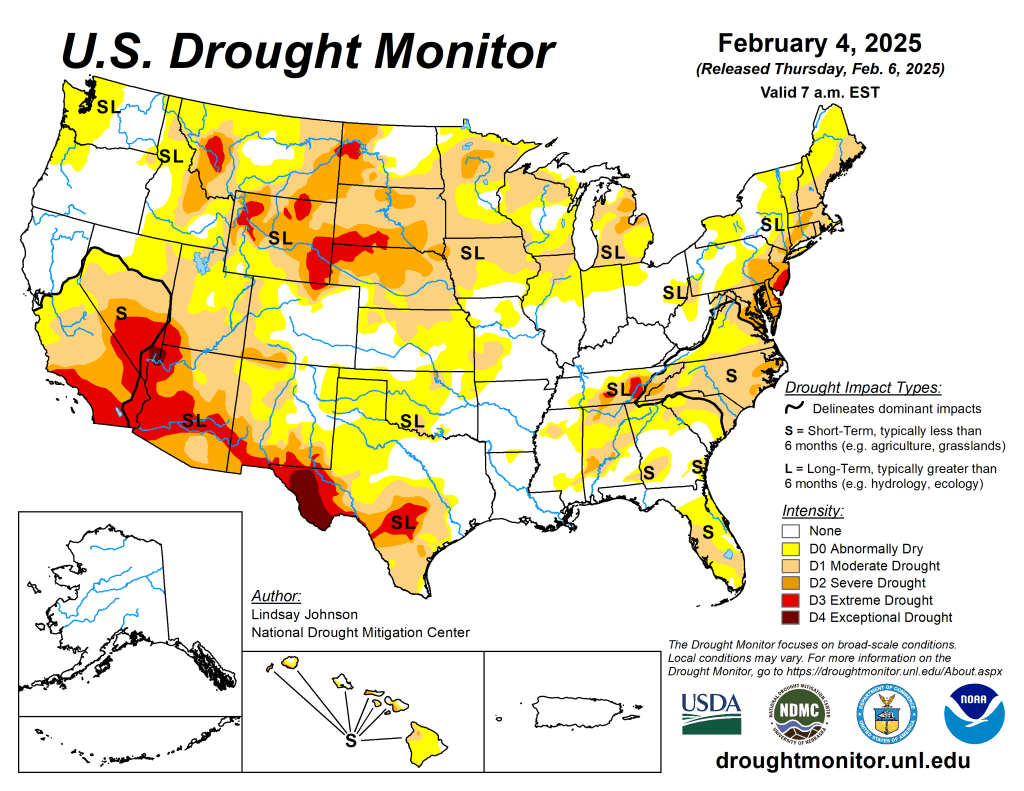
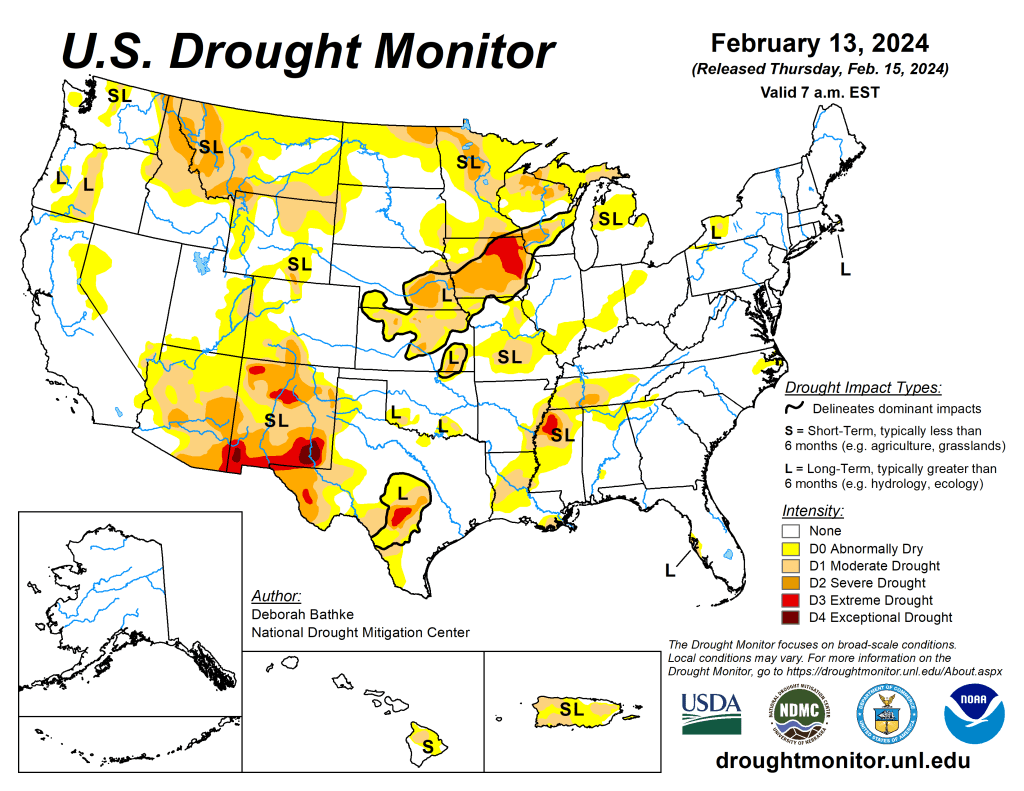
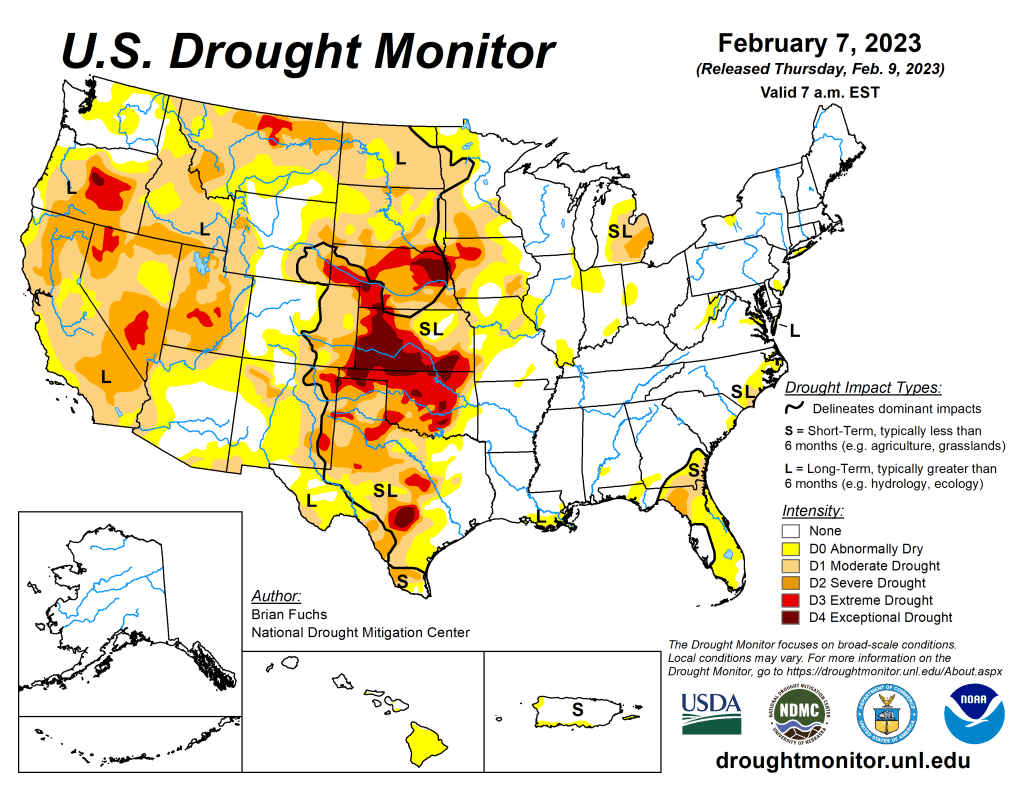
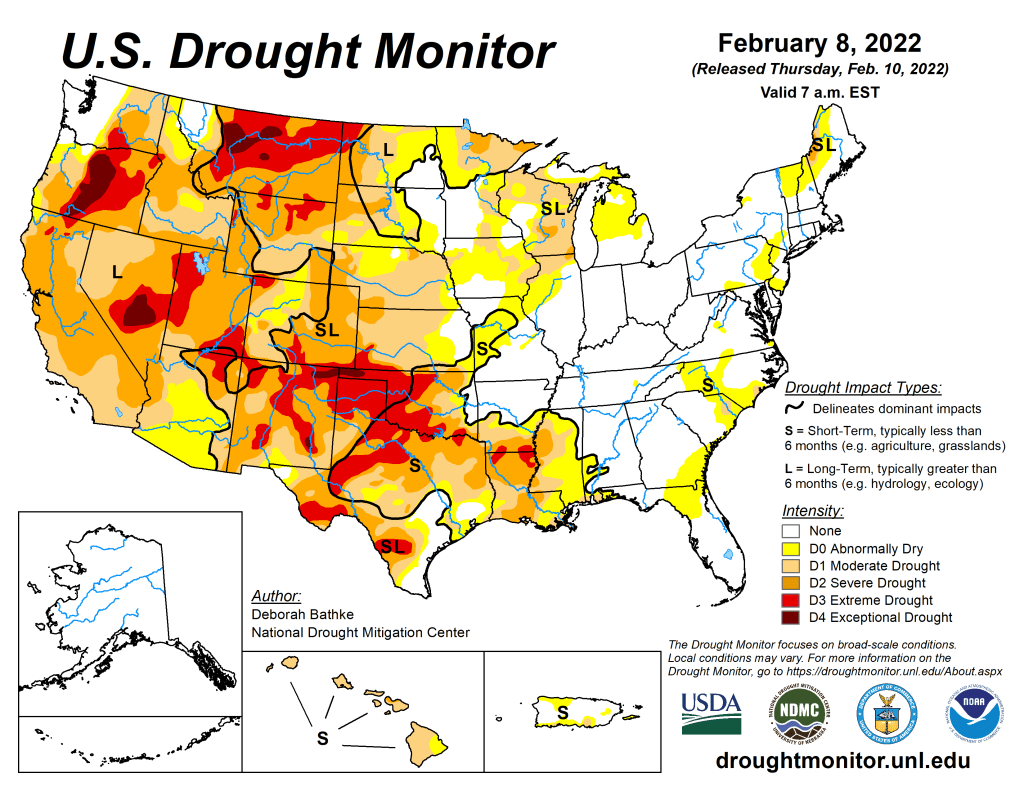
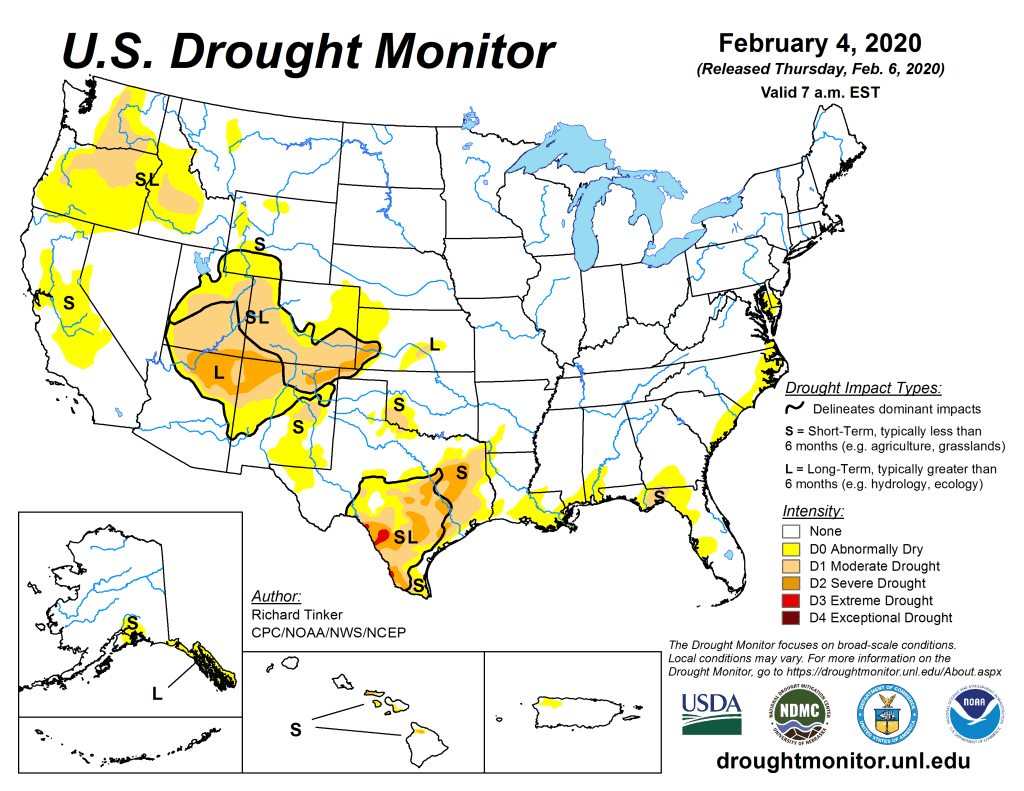
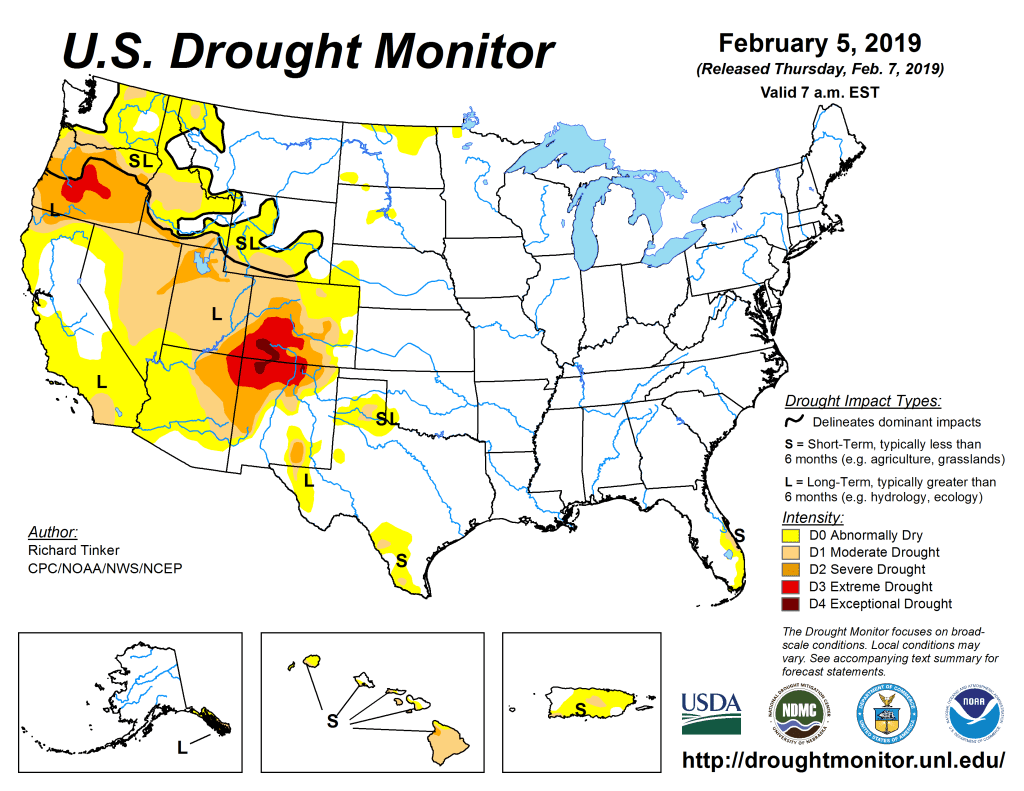
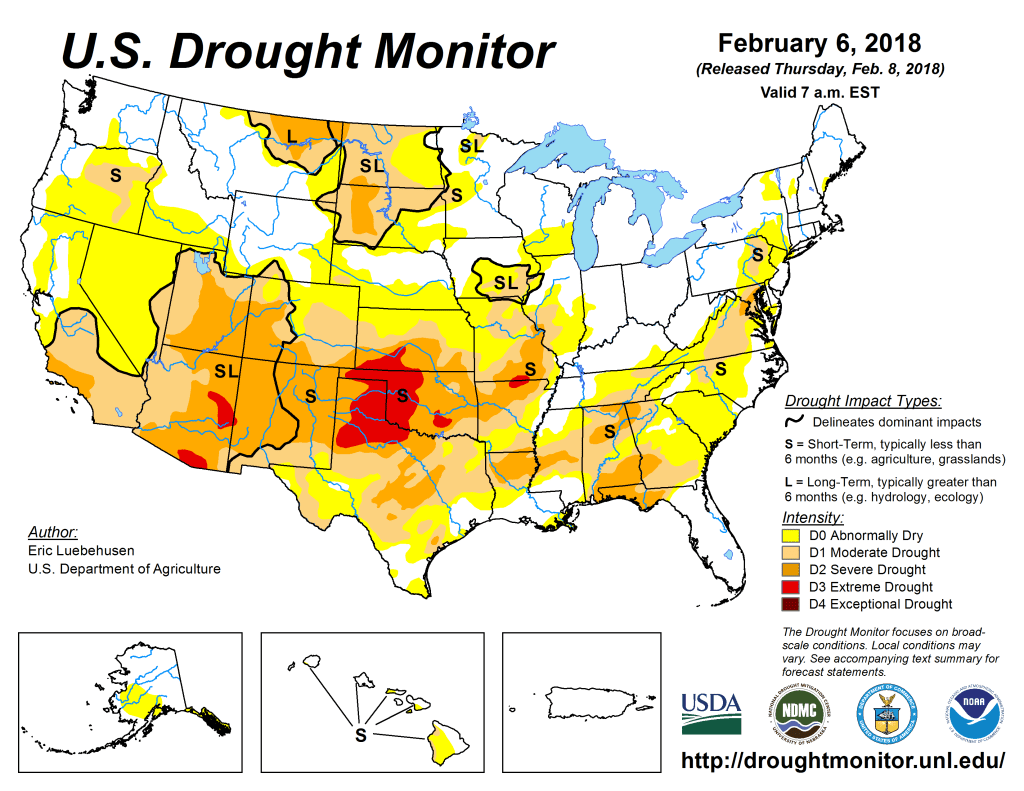
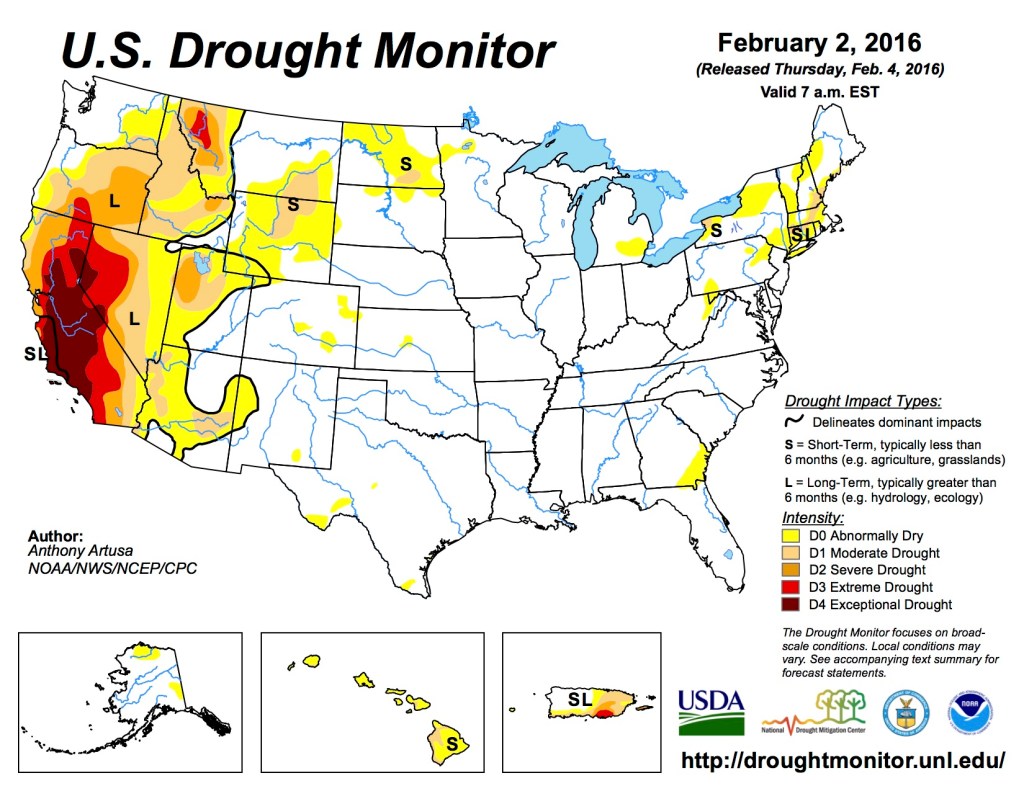
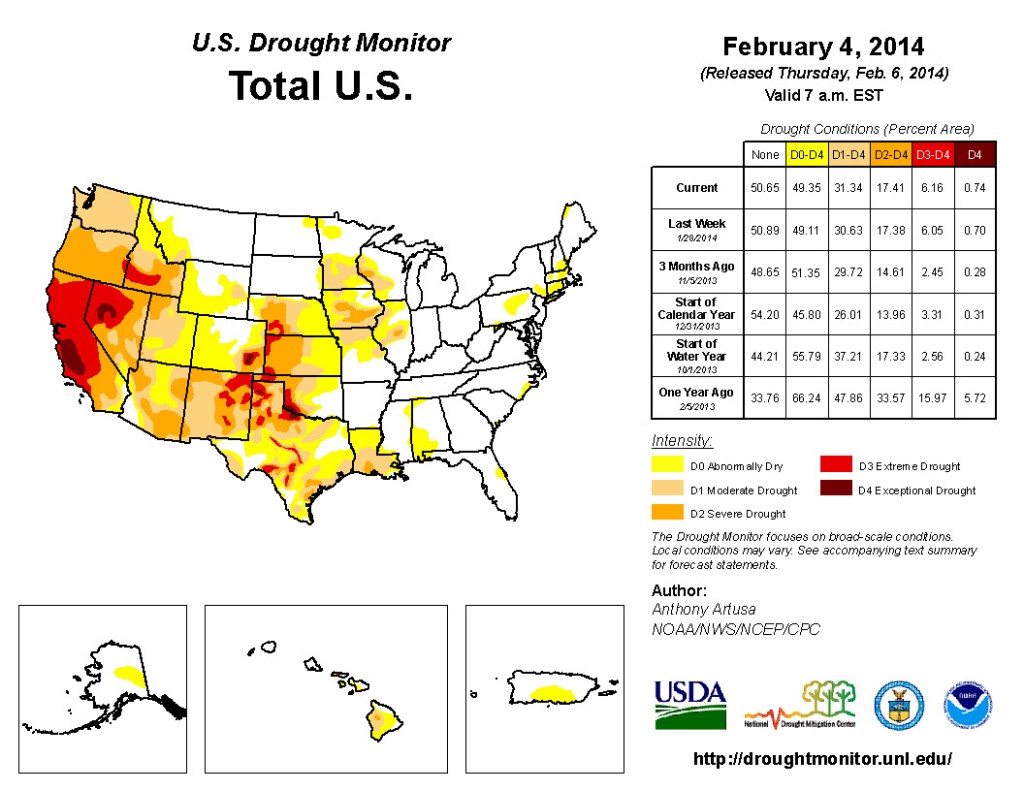
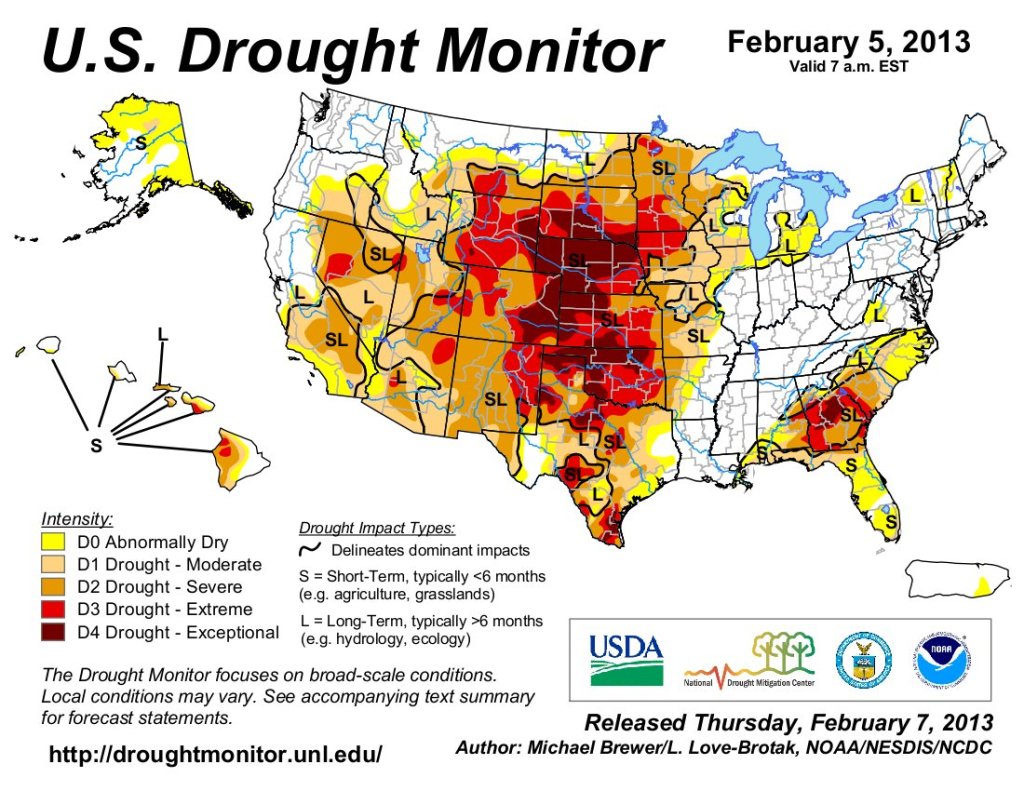
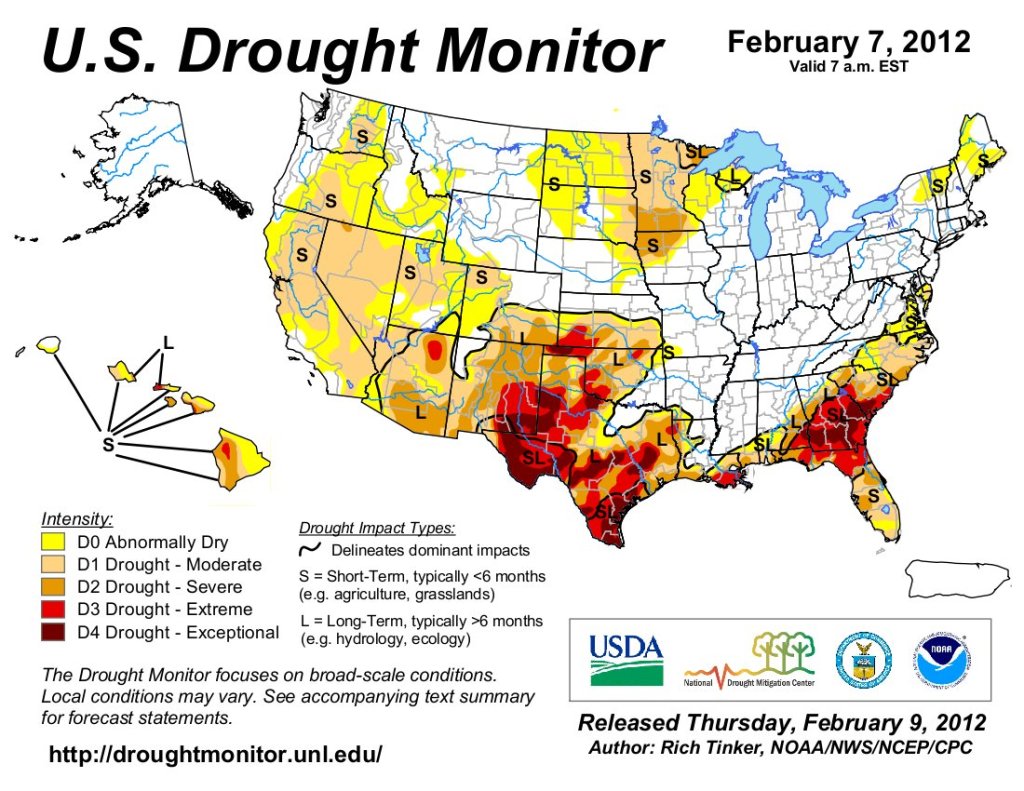
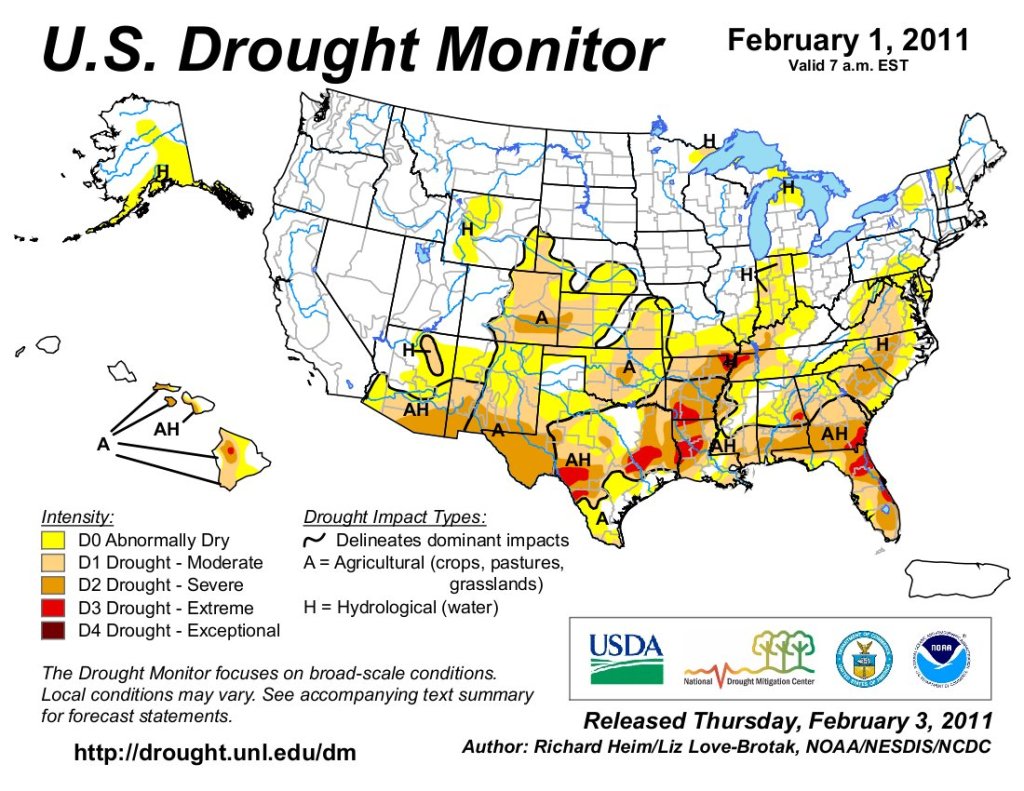
Just for grins here’s a slideshow of early February US Drought Monitor maps for the past few years.
With another federal deadline only weeks away and record-low snowfall further drying out the watershed, states have begun talking about whether they are prepared for litigation
Time and water are running low on the Colorado River.
Amid one of the driest winters on record, representatives from seven Western states have less than two weeks to meet an already-delayed federal deadline to find a new way to share the dwindling Colorado River—one that recognizes the megadrought and overconsumption plaguing the basin.
The current guidelines for implementing drought contingencies expire later this year, but as the Feb. 14 deadline looms, basin states, particularly Arizona and Colorado, have begun discussing the prospect of settling their disputes in court, suggesting that a deal is far from guaranteed. And while a meeting last week in Washington, D.C. between the Interior Department and all seven basin states brought some hope, state negotiators have again dug in their heels.
“I’ll certainly own whatever failure attaches [to me for] not having a seven-state agreement,” said Tom Buschatzke, the director of the Arizona Department of Water Resources and the state’s lead negotiator, in a meeting among the state’s stakeholders on Monday. “The only real failure for me, when I look in that mirror, is if I give away the state of Arizona’s water supply for the next several generations. That ain’t gonna happen, and I won’t see that as failure if we can’t come to a collaborative outcome. To me, that’s successfully protecting the state of Arizona.”
Those who hoped for a repeat of the winter of 2022-2023, when heavy snowfall across the West temporarily and partially replenished critical reservoirs, easing pressure on negotiators, are out of luck. With 2026’s winter about halfway over, it would take record amounts of snowfall for the Colorado River basin to climb back to merely average snowpack levels, said Eric Kuhn, the retired general manager of the Colorado River District and an author on Colorado River issues.
“People are mobilizing for potential litigation, and the question is, is somebody gonna pull a trigger?” Kuhn asked. “Hydrology may be the driving force. It may not be human action. It may be nature that forces us into litigation.”
The Colorado River basin spans parts of Arizona, California, Colorado, New Mexico, Nevada, Utah and Wyoming, and serves over 40 million people across the seven states, 30 tribes and Mexico. It contains dozens of watersheds, all but one of which—the Green River basin in Wyoming and slivers of Colorado and Utah—have experienced below-average or well below-average precipitation since October, when the new water year begins.
A storm in mid-January, which started in the West and brought several inches of snow to eastern parts of the country, did little to alleviate the drought.
“It’s a very critical situation right now,” Kuhn said. “This is climate change at work.”
Low Water, High Pressure
Low snowpack will result in less water melting into reservoirs across the basin come spring and summer. With less water stored, the Bureau of Reclamation’s options for managing the federal infrastructure along the river, including lakes Powell and Mead, the largest reservoirs in the nation, and their respective Glen Canyon and Hoover dams, will be constrained.
Loveland Pass in Summit County on Dec. 24, 2025. The lack of snow is clearly visible on the higher peaks. Photo credit: Denver Water.
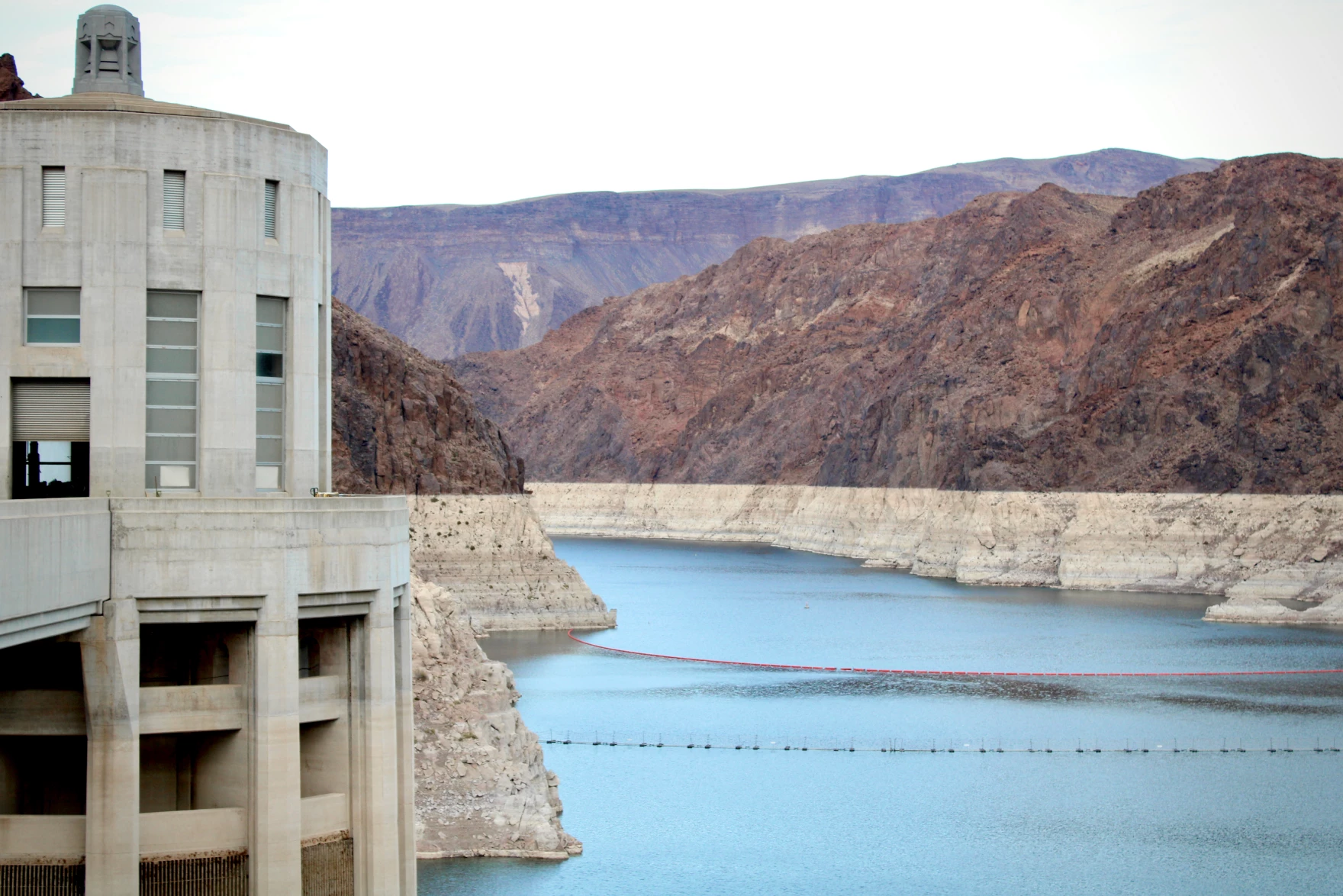
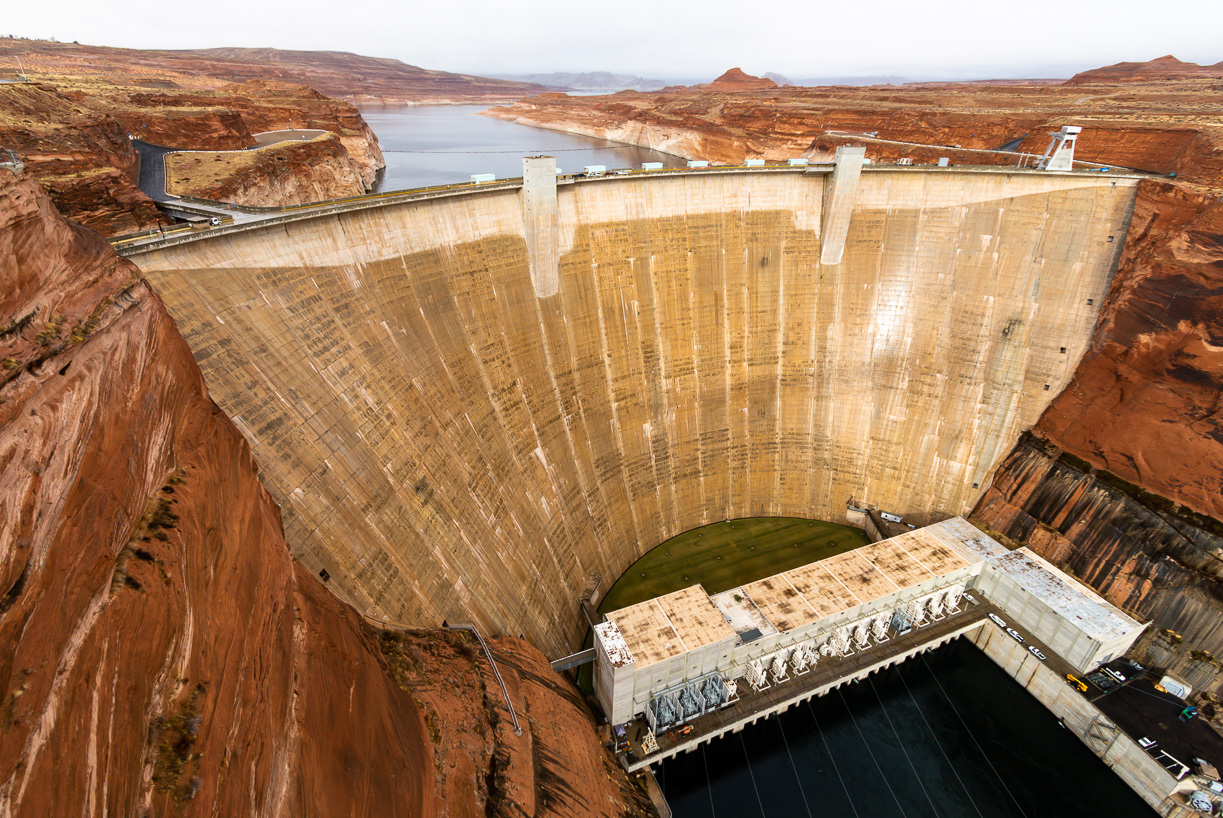
The dams provide hydroelectricity for more than a million people in the Southwest, but must hold water well above the turbines that generate power. If water levels at Lake Powell dip below “minimum power pool” for an extended period of time the agency would have to bypass the turbines, turning off the electricity they produce, and deliver water to the Lower Basin through lower outlets on Glen Canyon Dam, which could compromise the structure. At that point, the Bureau of Reclamation would have to choose between damaging the second-highest concrete-arch dam in the U.S. or reducing water releases to Arizona, California and Nevada, which would be a devastating blow to the region’s cities and economy. Some experts have predicted that could happen as soon as next summer or sooner if this winter’s dry spell continues.
Last September, Kuhn and a consortium of other hydrologists and Colorado River experts authored a report that found that if the current winter was similar to last year’s, Colorado River users would overdraw the river by 3.6 million acre-feet, and there would need to be “immediate and substantial” reductions in water use across the basin to prevent a total collapse of the system. One acre-foot is enough to supply water to two to four households.
Now, with winter looking even more dismal than initially forecast, Kuhn says the Bureau of Reclamation’s options are “further constrained, unless things get wetter in the next two months.”
One option that Kuhn found likely was a big release from Flaming Gorge near the Wyoming-Utah border, the largest federally managed dam upstream of Lake Powell. He guessed the release could be anywhere from half a million to 1 million acre-feet of water.
While today’s drought and low streamflows are a product of nearly three decades of aridification, water forecasters cannot say for sure how climate change will impact future water supplies. Under some models, precipitation remains low and consistent, but rising temperatures dry out soils across the basin, leading them to absorb more snowmelt and further reduce streamflow.
Other hotter futures could also be wetter, Kuhn said, but this would not reinvigorate the river. “We’re expecting stream flows to continue their downward trend,” he said.
And if that is the case, Mother Nature may be the deciding factor between a successful negotiation and litigation.
Hydrologically speaking, we are living through a winter where “that’s a possibility,” Kuhn said. “I think it’s gotta put a lot of pressure on the states.”
Looming Litigation
A resolution in the courts is looking increasingly likely.
During her state of the state address on Jan. 12, Arizona Gov. Katie Hobbs said the “Upper Basin states, led by Colorado, have chosen to dig in their heels instead of acknowledging reality” during negotiations.
The state, she said, had established a $1 million legal fund in anticipation of litigation, with a bipartisan bill introduced to add another $1 million to it. This will “keep putting Arizona first and fight for the water we are owed,” she said.
“As negotiations continue, I refuse to back down.”
Arizona Governor Katie Hobbs at signing ceremony November 19, 2024. Photo credit: ADWR
A week later, Colorado lawmakers asked Becky Mitchell, the state’s lead negotiator, about its prospects in litigation. “We are gonna have the best lawyer,” she said. “We will be ready.”
Earlier in the week, Colorado Attorney General Phil Weiser assured state lawmakers that he is prepared to go to court and blamed the other basin for the lack of a deal.
“The reason it’s hard to get a deal is you need two parties living in reality. And if one party is living in la la land, you’re not going to get a deal,” he said. “I’m committed to not getting a bad deal just to get a deal.”
The Upper Basin states of Colorado, New Mexico, Utah and Wyoming, and the Lower Basin states of Arizona, California and Nevada sounded far apart on a deal at the annual Colorado River Water Users Association conference in Las Vegas last December. Some negotiators advocated for a short-term agreement while others called for greater federal pressure.
Last week, negotiators from all seven basin states met in D.C. to try to break the impasse. After the meeting, governors Spencer Cox, of Utah, and Mark Gordon, of Wyoming, said in a joint statement that “all acknowledged that a mutual agreement is preferable to prolonged litigation,” and both felt encouraged by the results of the meeting.
In a separate statement, Arizona Gov. Hobbs said she was also encouraged, and that the states “reaffirmed our joint commitment to protecting the river.” Arizona has been and remains willing to continue bringing solutions, she added, “so long as every state recognizes our shared responsibility.”
Earlier this month, the federal government released a range of alternativesoutlining how it would manage the system if no deal is reached by Feb. 14. If that deadline passes without an agreement, the political and environmental situation across the basin may become as grim as the snowpack.
Arizona officials have said any of the federal government’s proposals would likely lead them to pursue litigation and that the Bureau of Reclamation’s draft Environmental Impact Statement puts all the risk of the river’s decline on the Lower Basin and does not comply with the bedrock law of the river. Under the outlined federal proposals, the vast majority of the cuts would affect Arizona, which relies heavily on the river for water but holds junior rights, often making it the first to face significant reductions. The state has already had a third of its water rights to the river cut.
“The entire weight of the river cannot fall on Arizonans, the Valley [Phoenix] and the Tucson metro areas,” said Brenda Burman, general manager of Central Arizona Project, the entity delivering Arizona’s Colorado River water, at a press conference Monday. “That’s not acceptable. We, as water managers … we will make sure that there is water flowing.”
The structural deficit refers to the consumption by Lower Basin states of more water than enters Lake Mead each year. The deficit, which includes losses from evaporation, is estimated at 1.2 million acre-feet a year. (Image: Central Arizona Project circa 2019)
The Lower Basin has volunteered to cut 1.5 million acre-feet, the amount of water lost to transpiration and evaporation in a year, and asked that the Upper Basin share in cuts after that amount. The Upper Basin, which has never used the full amount it is entitled to on paper, has proposed making only voluntary cuts to its use.
Sarah Porter, director of the Kyl Center for Water Policy at Arizona State University, said she’s felt litigation is increasingly likely since the basin states missed their initial federal deadline in the fall and their negotiations began to deteriorate.
“I believe that everybody has kind of stared it down and concluded that litigation isn’t such a horrible idea that it needs to be avoided,” she said.
As a former litigator, Porter said the threat of legal action may force both sides to develop their arguments along with facts and data supporting them, which could provide the clarity needed for a settlement. But a lawsuit would extend the uncertainty surrounding the region’s water supply, Porter said, affecting the planning of cities, tribes and farmers waiting for new guidelines.
Litigation would likely focus on one of the most crucial sections in the 1922 Colorado River Compact: Article III(d).
Under this part of the agreement, the Upper Basin “will not cause the flow of the river at Lee’s Ferry,” a point just south of Glen Canyon dam, “to be depleted below an aggregate of 75,000,000 acre-feet for any period of ten consecutive years.” Should the average flow at Lee’s Ferry fall below an average of 7.5 million acre-feet, which is a possibility given current hydrological conditions, the Lower Basin could sue the Upper Basin for failing to uphold this part of the compact.
“High-Stakes Poker”
Any lawsuit would be risky.
“That language has never been interpreted by a court,” said Anne Castle, a senior fellow at the Getches-Wilkinson Center at the University of Colorado and a former assistant secretary for Water and Science at the Interior Department. “This is high-stakes poker for both basins.”
The Lower Basin would presumably argue that Article III(d) means the Upper Basin has an obligation to deliver water, so it would have to adjust its consumption to ensure the Lower Basin receives 7.5 million acre-feet annually.
But the Upper Basin could counter that Article III(d) only prohibits it from overconsuming the river and leaving less than 7.5 million acre-feet at Lee’s Ferry, and climate change is actually responsible for the meager flows. In that case, they would bear no obligation under the compact to make cuts.
Porter said the Upper Basin’s interpretation flies in the face of history. The whole reason the compact exists was the fear California would take all of the river’s water at the time, she said, because that’s where the growth was.
“It is silly to think that California would agree to a deal with the Upper Basin that said they have no responsibility to leave water for California,” she said.
For decades, the Upper Basin cited its delivery obligation to California, Arizona and Nevada to justify building a series of dams and reservoirs above Lake Powell, Porter said.
“There’s a huge amount of evidence that the Upper Basin states … needed those reservoirs upstream because they had an obligation to deliver water to the Lower Basin,” she said.
Even if Congress originally authorized Upper Basin reservoirs to help satisfy provisions in the compact, “that doesn’t tell us what those obligations actually are,” Castle said. “Fixed number obligations don’t work with a changing climate that is causing shrinking flows.”
Not every state is eager to initiate litigation. Wyoming Senior Assistant Attorney General Chris Brown appeared before state lawmakers in January and warned of the pitfalls of letting Congress or the Supreme Court dictate what happens on the river.
Still, “as a headwater state, Wyoming has a long history of zealously defending its rights to use interstate waters, and the rights of its water users,” Brown said in an email. “The Colorado River is no different.”
Tina Shields, water manager for the Imperial Irrigation District, which is California’s biggest and most senior water rights holder, said in a statement that the state continues to work on finding a consensus agreement among all the states that depend on the Colorado River, but could not comment on the status of those negotiations.
“The Colorado River hydrology is unlikely to wait for a court decision, so any speculation about litigation is premature,” she said.
Although Arizona’s Lower Basin counterparts have not touted litigation as an option, Buschatzke said he is confident they will support the state, as compliance with Article III(d) affects them too, though less severely.
And the states may not be the only entities to sue. Under a 2004 water settlement, the Gila River Indian Community receives 653,000 acre-feet of Colorado River water a year, a significant allocation. But getting that water depends on the Central Arizona Project (CAP) not getting its water allotment cut.
Any unilateral action by the Department of the Interior to reduce that flow “would, in our view, constitute a blatant violation of the United States trust responsibility to protect our CAP water as established by Congress under the Arizona Water Settlement Act,” said Gila River Indian Community Gov. Stephen Roe Lewis at the Arizona meeting of water stakeholders.
While litigation may clear up some of the murkier language in the compact, Castle wasn’t sure that it is the best way forward for the river’s stakeholders—particularly since these kinds of disputes can take years to resolve.
“We might get answers to a few questions after years,” she said, “but we have a river to operate in the meantime.”
Map of the Colorado River drainage basin, created using USGS data. By Shannon1 Creative Commons Attribution-Share Alike 4.0
I don’t know if the groundhog saw its shadow yesterday or not (I can never remember whether the shadow is a sign of an early spring or a late one, anyway). But one thing is certain if the little dude was in the Western U.S.: He didn’t see much snow.
Ruh roh. Not looking good out there. Source: NASA.
Officially, meteorological winter ends in less than four weeks from now. In reality, the snowy season hasn’t really begun in much of the western swath of the nation. The aggregate snowpack at 130 monitoring sites across the Upper Colorado River Basin is at its lowest level for Feb. 1 in the last 40 years. Meaning, yes, it is even worse than in 2002, often considered the Winter of the Colorado’s Discontent, and is on a par with 2018.
The high-country snowy season can last until mid-June, so there’s plenty of time for a rebound, and a return to near normal conditions by April would not be unprecedented. The problem is that this year’s snow drought is the result not only of a lack of precipitation, but also unusually warm temperatures. A rebound, then, would require a major shift in both precipitation and temperature patterns, very soon, which to this amateur weather watcher seems pretty unlikely.
Snowpack in the Animas River watershed is tracking slightly better than in 2018 for this date, but is lagging behind 2002, which was one of the worst winters on record and was followed by a dry, fire-plagued summer (including the Missionary Ridge Fire).
This, of course, is very bad news for the beleaguered Colorado River. The U.S. Bureau of Reclamation’s January projections find that Lake Powell could drop below minimum power pool as soon as this December if the snowpack curve doesn’t veer up sharply in the next several weeks. The Rio Grande isn’t looking much better, snow-wise.
During the summer of 2021, farmers’ ditches in the Four Corners area ran dry as early as June, and the Bureau of Reclamation drew down Upper Basin reservoirs such as Blue Mesa and Flaming Gorge to help prop up Lake Powell’s surface elevation. If current trends continue, this year’s spring runoff threatens to be even slimmer. It could be a tough summer for irrigators, boaters, and anyone else who relies on abundant streamflows.
2014 Recapture protest. Jonathan P. Thompson photo.
Early on a May morning in 2014, I loaded my camera and notebook and myself into the Silver Bullet — my 1989 Nissan Sentra with a duct-taped window — and headed west to Blanding, Utah. Phil Lyman, a San Juan County Commissioner at the time, was planning on leading a convoy of OHV-riders along a closed-to-motorized-vehicle trail on public land in Recapture Canyon to protest what he called “federal overreach.” I was going to observe and report on the event.
I would lying if I said I wasn’t anxious. After all, this was just weeks after a heavily armed group of yahoos had descended on the Bundy Ranch in southern Nevada to stop Bureau of Land Management agents from rounding up cattle grazing illegally on federal land. If the BLM, or environmentalists, tried to interfere with Lyman’s lawbreaking, it could lead to an armed conflict — and I could get caught in the middle.
I’ve been thinking about that protest, the events that led up to it, and the general political atmosphere at the time. And about the similarities and vast differences of what’s happening today.
After Lyman had posted his plans on the Bundy Ranch Facebook page, commenters’ responses included statements like these:
“The BLM is about to learn they can’t push people around any more in the West. Our backs are up against a wall push back! Yet another case of the federal government taking tyrannical control of the people. They need to be put down and put down hard.”
“Why is the BLM still around? If they so much as throw a stone in your way, light ‘em up. Time to quite defending, being ever gnawed at, and go on offense. … Strike while you are still strongest.”
My unease only grew when I arrived at Centennial Park on the town’s southern fringe, where a pre-protest rally was getting underway. It was peopled by a contingent of locals and an equally large number of out-of-towners, many of whom were part of the Bundy group. This included Ryan Bundy, Cliven Bundy’s son, who circulated pocket versions of the U.S. Constitution, peppered with scripture, published by the National Center for Constitutional Studies, a right-wing organization. And Ryan Payne, a so-called militia leader, who told a reporter that during the Bunkerville standoff he had positioned snipers with their sights trained on federal employees: “If they made one wrong move, every single BLM agent in that camp would’ve died.”
Lyman and others spoke at the event, airing their grievances and reasons for protesting. Like the folks in Minneapolis today, their rhetoric suggested, these people were resisting a federal government that had slipped into tyranny and was taking away their Constitutional rights. “They target a community, they targeted Blanding,” Lyman said, (much as the Trump administration has targeted Democratic-leaning cities) adding that the feds had then sent jackbooted thugs in to harass and intimidate its residents. In the speeches, on the signs, and in comments from the crowd in Blanding, I heard words such as “despot,” “dictator,” “tyranny,” and “gestapo.”
***
***
What inspired such outrage in Blanding? For Lyman and friends, examples of “tyranny” and federal overreach included:
The BLM had prosecuted and fined two local men for constructing an OHV trail in Recapture Wash in 2005, a crime that included chopping down old-growth junipers, building a bridge across the creek, installing culverts, and using heavy machinery to clear a path through the riparian zone that was rich with cultural resources.
Then the BLM banned motorized vehicles on that section of Recapture.
In June 2009 the feds raided several homes of Blanding residents suspected of gathering or dealing in artifacts found on public land in violation of the Archaeological Resources Protection Act. This included at least one SWAT team equipped in tactical gear, responding to a potential threat, though they did not wear masks to conceal their identities. Included among those arrested was James Redd, a local physician. A day later, he killed himself; his family later sued the BLM for intentional infliction of emotional distress and wrongful death, but the case was dismissed.
In 2010, the Obama administration floated the idea of establishing a national monument on public land on Cedar Mesa, west of Blanding, sparking an uproar among the anti-federal land management movement.
And in 2008, the BLM subtly changed its resource management plan from considering all trails on public lands being open to motorized travel unless otherwise closed, to closing all trails unless specifically designated as open to motorized travel.
Lyman had organized this protest, and the Bundy crowd had joined, to push back against this. Was this enough to justify a protest? In my opinion: yes. These people were displeased with the federal government’s actions, so they were exercising their First Amendment right to demonstrate peacefully. And they would — like Henry David Thoreau before them — break the law, or practice civil disobedience and risk fines or jail time, to make their point.
Many of the attendees were also exercising their Second Amendment right to bear arms, from the older cowboy-hatted man with a six-shooter, to the young buck in an “American Venom” t-shirt with an AR-15, to the buzz-cut dude with a “REGULATOR” neck tattoo, a Glock semi-automatic sidearm holstered to his thigh, and a t-shirt that read: “United States Militia … Molon Labe.”
At one point during the pre-ride rally, after a shouted dialogue among the attendees in which they threatened any unfriendly journalists that might be among the crowd, an older man spoke up: “We have a treasure, a jewel, and it has been mugged. It’s been stolen from us by people back east. They have stolen our treasure. We have to stop this BLM police state. They come into our town, raiding our town …”
“You’ve got guns, too, by God, that’s what they’re for,” said another voice from the crowd.
***
A little while later, I was hoofing it down Recapture Canyon in an effort to get ahead of the protesters, most of whom would be on motorized three- or four-wheelers. The vehicles are allowed in the first mile or so of the canyon, meaning at that point it would be just a protest, not an act of civil disobedience. If the BLM was going to have its line of riot cops anywhere, it would likely be at the sign marking the motorized closure.
I was only a few hundred yards down the dusty two track when the incessant buzz of two-stroke engines alit on the air. I walked to the side to avoid getting squashed by one of them and snapped photos as one after another buzzed past, their diesel exhaust mingling with the pungent aroma of sage and dust.
A man driving a four-wheeler with a woman sidled up behind him slowed to a stop next to me, causing me to jump. “Hop on,” the man said, motioning to the little cargo area on the back. As we cruised down canyon, the woman asked who I reported for, and whether I was “for us, or against us.” “I’m a freelancer,” I said. “And I’m for the Truth.”
A crowd of OHVers coalesced at the motorized-ban line and my ride slowed to a stop, allowing me to jump off and capture some pictures. There were no flak-jacket-equipped BLM agents here, no riot cops, no tear gas. Just a few San Juan County Sheriff’s deputies, who made no motion to stop or discourage the protesters, even as they continued on past the line in violation of federal rules.
It may strike some folks as off to see a law enforcement officer watching idly as someone breaks the law right in front of them. It’s not. In 1997, the U.S. Supreme Court ruled in Printz v. United States that the federal government cannot compel state or local law enforcement to enforce federal regulations.
**
I continued past the non-motorized line on foot, following in the dust of the OHV convoy. From what I could tell all or almost all of the attendees chose to break the law that day, though most of them stopped at the end of the two-track and beginning of a more primitive trail that passes over archaeological sites.
While I had been anxious about my safety, given the large number of firearms and the intensity of the crowd’s hostility toward the press, I never worried that I would be arrested or detained or tear-gassed by federal agents simply for being present and observing. The same would be true even if I had stayed on the back of the OHV after its driver passed the non-motorized line.
That’s because I was there doing my job as a journalist, and any Democratic government with an inkling of respect for the U.S. Constitution would acknowledge and respect that, and allow me to do my job (while not always making it easy to do so) without fear of government reprisals.
But that was almost 12 years and a few administrations ago. Now, the government is attacking the First Amendment and, really, pretending it simply doesn’t exist. Last month, journalists Don Lemon and Georgia Fort entered a Minneapolis church to cover a protest against the Trump administration’s immigration crackdown, just as I had accompanied the Recapture protesters to cover that event. This time, though, the feds arrested Lemon and Fort and charged them with violating federal law, not long after Trump had reposted a social media post calling for Lemon’s arrest. Prosecutors accused Lemon of peppering the pastor — who also works for ICE — with questions. He was doing his job, in other words, which, under Trump, is apparently a federal offense and could even get him labeled a domestic terrorist.
**
I suppose I shouldn’t be surprised at the Trump administration’s authoritarianism.They promised this, after all, both at campaign rallies and in Project 2025, which the administration has followed closely. But I must say I am a bit surprised that almost none of the folks yelling about federal overreach and tyranny back in the Recapture protest days are speaking up, even mildly.
Lyman is Xeeting about the Gestapo, it’s true, but his target is not masked ICE or CPB agents running amok or even Greg Bovino in his Nazi-esque long coats, but the Utah Department of Natural Resources law enforcement division. Even “Sheriff” Richard Mack, who was a plaintiff in the Printz case, has remained silent or supported the administration’s actions.
It’s disappointing and unmasks the hypocrisy within the Sagebrush Rebellion and its ideological successors. I believe that, early on, the so-called Rebellion’s motives were honest. They saw the public lands as the manifestation of freedom and liberty, they resented having an absentee landlord take those freedoms away, and they stood up to the powers that be — regardless of party or creed — and resisted. But it is now abundantly clear that the movement was long ago hijacked, not only by the extractive industries, but also by the ideologues and demagogues. The old battle cries of Liberty and Freedom and Don’t Tread on Me are no more than empty slogans, the pocket Constitutions that they carry alongside their firearms carry less weight for them than the paper they’re printed on.
Study sites. (a–c) Nanika catchment in Western British Columbia, Canada. (d–f) Krycklan catchment in the boreal region of northern Sweden. (a, d) Satellite images and boundaries of Nanika and Krycklan. The red circle and yellow square show the locations of the catchment outlet and streamflow measurement station, respectively. (b, e) Topographic map showing the elevational pattern of both catchments. Note the distinct elevational ranges in the two catchments. (c, f) The distribution of slopes in the two catchments, reflecting a larger portion of very steep locations (∼100% or 45°) in the Nanika vs. Krycklan. Slope and elevation maps were generated at 90-m and 30-m resolution for Nanika and Krycklan, respectively.
Understanding how snowmelt is partitioned into different hydrologic flowpaths/storages—and how this partitioning varies over time—is essential for predicting water availability and quality under climate variability. In this study, we examine the time-variance of snowmelt partitioning patterns (SPP) in response to interannual variations in antecedent (Fall) rainfall before snowmelt seasons, across two snow-dominated catchments in Canada and Sweden with contrasting geologic and topographic features. Using integrated subsurface–surface flow and transport modeling, combined with observational data, we simulate the partitioning of snowmelt into shallow flowpath, deep flowpath, evapotranspiration, and long-term storage. To generalize our findings beyond the two case studies, we design a suite of virtual experiments that systematically vary catchment slope and the extent of the hydraulic conductivity’s vertical and lateral heterogeneity. Results show that lateral heterogeneity in conductivity mediates the sensitivity of snowmelt partitioning to interannual variations in antecedent rainfall. While laterally homogeneous catchments display minimal sensitivity of snowmelt partitioning pattern to wet or dry Fall rainfall conditions, catchments with heterogeneous lateral structure store a significantly larger portion of snowmelt and reduce snow-sourced shallow flow contributions in years with high pre-snow rainfall than years with low pre-snow rainfall. In contrast, while slope and vertical conductivity architecture govern SPP, they play a limited role in mediating SPP’s temporal sensitivity to antecedent rainfall variability. These findings reveal that subsurface structure—including the extent of lateral subsurface heterogeneity—modulates the influence of climate variability on snowmelt partitioning and catchment hydrologic function. This has implications for predicting streamflow responses, groundwater recharge, and solute transport under changing climate regimes, and highlights the importance of representing time-variable hydrologic behavior in hydrologic models.
Plain Language Summary
Knowledge of how snowmelt moves through a watershed is essential for managing water supplies and ecosystems in snow-dominated regions. Snowmelt can either run quickly to streams or infiltrate to recharge groundwater, and this balance shifts from year to year with climate and watershed structure. We studied two snowy watersheds that differ in slope and subsurface properties to test how late-summer/fall rainfall (which sets pre-snowmelt wetness) shapes winter snowmelt pathways. In steep terrain with horizontally variable (patchy) subsurface hydraulic conductivity, dry pre-snowmelt conditions direct meltwater horizontally to streams, whereas wetter pre-snowmelt conditions favored deeper infiltration and storage. To generalize, we ran virtual experiments that systematically altered the extent of horizontal variability of hydraulic conductivity. A consistent signal emerged: patchy subsurface hydraulic conductivity produced stronger year-to-year swings in how snowmelt is partitioned between runoff and storage, while horizontally uniform subsurface hydraulic conductivity led to more predictable, stable watershed responses. These results show that antecedent wetness and the horizontal structure of subsurface permeability jointly control the time-variability of snowmelt partitioning. Incorporating these controls can improve forecasts of streamflow and groundwater recharge, and guide planning for flood and drought risks in snow-dependent watersheds under increasing climate variability.
Key Points
Pre-snow rainfall variability alters snowmelt partitioning pattern (SPP) into storage versus runoff, with the magnitude of impact mediated by the extent of hydraulic conductivity’s lateral heterogeneity
Catchments with greater lateral heterogeneity in hydraulic conductivity store (release) a larger (lesser) portion of snowmelt in years with large pre-snow rainfall
Slope and vertical conductivity architecture influence SPP but exhibit limited modulation of SPP temporal sensitivity to pre-snow rainfall variability
Carly Jerla speaking at the Colorado River Water User’s Association Conference December 5, 2024. Photo credit: USBR
From email from Brian McNeece:
January 27, 2026
Colorado River negotiations have bogged down, but dozens of experts at the Bureau of Reclamation (BOR) have been streaming right along. On Jan. 14, the BOR released its draft Environmental Impact Statement (EIS), which is bureaucratese for a report on options for the negotiators after the current rules expire this year.
It’s a bit complicated. The report includes a modeling of 1,200 possible future scenarios for the entire Colorado River system and runs 1,600 pages. Just the Executive Summary is 66 pages. The theme of this massive undertaking is deep uncertainty. In fact, that is the name of the modeling process: Decision Making Under Deep Uncertainty.
What’s uncertain? Well, in a word: the weather. And not just the weather, but also population growth and water use patterns. Most scientists agree that climate change includes aridification, or a general drying of the Colorado River basin, but it’s impossible to quantify reliably. Thus the 1,200 futures.
This massive report took two and a half years to compile with the help of around 150 people with expertise in everything from hydrology to chemical engineering to wildlife management to socioeconomics to anthropology to law. Browsing through it, I marveled at the depth of analysis and the advanced computational and mathematical tools brought to bear on a question, which at the end of the river, is a political one. I thought, does anyone understand all of it? But when I looked at the top of the list of preparers, I realized that yes, someone does.
And that is Carly Jerla. She’s the Senior Water Resources Program Manager for the Bureau of Reclamation. Ms. Jerla was hired by the BOR in 2005 as a graduate student at the University of Colorado’s Center for Advanced Decision Support for Water and Environmental Systems. She is trained in civil and environmental engineering and public policy. Twenty years on, she’s the boss of this effort.
I’ve watched Ms. Jerla in action at several of the recent Colorado River Water Users Association (CRWUA) conferences in Las Vegas. A petite woman, Carly has a disarmingly low, warm voice. Speaking to a crowd of 1,700 people, she talks as if she’s having an over-the-fence conversation with a neighbor. But as the overlays of data stacked up on her slides, I could sense her losing the audience. It was just too much.
We saw a draft of the current report in 2024. Since then, it has grown massively, but the same dilemma exists and can actually be summed up simply. In re-writing the rules for how the water of the river gets divvied up, they need to decide what triggers shortage conditions, how much cuts each contractor must take under those conditions, and where shortages are measured. In the past, Lake Mead and Lake Powell had separate conditions, and the reservoirs above Lake Powell were not in play. Ms. Jerla’s report emphasizes that the entire system should be considered in the rules, not just the two giant reservoirs.
There are currently five major alternatives being proposed. This first one, called the No-Action Alternative, is also the no-go alternative, since it returns us to the world prior to the 2007 guidelines for shortages. The No-Action Alternative would drain the reservoirs. So negotiators must choose one of the other four alternatives. All of them make heavy cuts, either based on prior appropriation (i.e. the Law of the River) or pro rata (i.e. proportional cuts for everyone).
Is there a Goldilocks alternative among the other four? One that splits the difference between the historical, asymmetrical Law of the River and the fairness in a pro rata plan? No, there isn’t. That’s why we’re stuck.
There’s one future scenario that is completely omitted from the alternatives. Colorado’s negotiator Becky Mitchell has repeatedly called for the Upper Basin states to get MORE water. She points out that the Colorado River Compact of 1922 allocated the Upper Basin the same amount allocated to the Lower Basin states — 7.5 million acre feet. But that’s 3 million more acre-feet than the Upper Basin has ever drawn from the system.
None of the five alternatives, and apparently not one of Carly Jerla’s 1,200 possible futures, includes that premise. So if the Upper Basin negotiators are staking their claim on the river to include more water for them, they are way off the mark. Their next best hope is to take no cuts, but that option won’t float in the Lower Basin.
Trying to make a decision under Deep Uncertainty is tough, tough work. Carly Jerla and her team have laid out the buffet for the representatives from the states along the Colorado River. Time to pick from the menu.
Map of the Colorado River drainage basin, created using USGS data. By Shannon1 Creative Commons Attribution-Share Alike 4.0
“Ken Neubecker, a long-time Colorado River observer affiliated with environmental groups, said mandatory cuts to Colorado River water use would require an amendment to Colorado’s state constitution and likely those of other upper-basin states. Colorado’s constitution has been… https://t.co/qwkPJDPF7G
Vallecito Dam is due for some serious upkeep…But aging materials and erosion have caused significant damage to the dam’s emergency support structures, and a major repair project is coming down the pipeline sometime in the next several years.
“We’ve got this issue and we know it’s here. It hasn’t been clandestine; we’ve told people about it forever,” said Ken Beck, superintendent of the Pine River Irrigation District. “But it’s a nail-biter for a superintendent and dam tender.”
PRID operates, maintains and manages Vallecito Dam and Reservoir, which holds and delivers supplemental irrigation water to 65,000 acres of land downstream – the lifeblood for ranchers and farmers who hold water rights with the district…The repair project – about which little has been decided beyond the fact that it must happen – will be a massive undertaking. Beck estimated it could take roughly two to four years to complete once ground is broken, likely changing some of the regular operations of the reservoir. There is the potential that irrigators, ranchers and farmers who rely on consistent water deliveries would feel some impact – but Beck said how much and if at all is dependent on a variety of factors, like the weather and the time of year when the construction is done…The project is also important from the standpoint of the Southern Ute Indian Tribe, which is entitled to one-sixth of the reservoir’s total storage capacity. That water is used primarily for tribal agriculture and water management…
The primary issue is the dam’s upper spillway, a critical safety structure designed to release water during extreme runoff or flood events. Vallecito’s upper spillway includes three radial gates and a concrete chute that carries water to be released downstream safely without damaging the dam itself. Any damage to that infrastructure is a critical issue, and can compromise the dam’s ability to manage high water and protect downstream communities…In 2017, PRID conducted a dye test to assess the spillway’s integrity, Beck said. Dye placed upstream later appeared in areas downstream where it should not have surfaced if the structure were intact, confirming that water was migrating beneath the concrete spillway.
That process – known as “piping” – can carry sediment out from under the structure and weaken its foundation. After the dye test, the Bureau of Reclamation launched a series of investigations that revealed large underground voids – some as large as 4 by 10 feet – beneath portions of the spillway. Beck said it was determined the upper spillway is unsafe to use except in dire emergencies, because uncontrolled flows could accelerate erosion and threaten the dam’s integrity.
Federal Water Tap is a weekly digest spotting trends in U.S. government water policy. To get more water news, follow Circle of Blue on Twitter and sign up for our newsletter.
The Rundown
South Dakota representatives introduce three bills to authorize feasibility studies for regional water supply projects, including two Missouri River diversions.
BLM revises its publication date for a final environmental assessment of a proposed groundwater pipeline in southwest Utah.
White House advisory group recommends changes to FEMA’s disaster response.
USGS researchers assess a less-toxic means of controlling a non-native, ecologically-damaging reed in the Great Lakes.
And lastly, a federal financial oversight board’s annual report notes that the Trump administration removed climate-risk guidance for large financial institutions.
“The associated mission drift can also lend itself to political ends, such as excessive focus on climate risk and the effective debanking of certain industries. Collectively, this increases distraction and compliance costs while impeding responsible lending and risk-taking.” – Excerpt from the Financial Stability Oversight Council’s 2025 annual report. The council, established after the 2007-09 financial crisis, oversees the nation’s banking system. The report argues that the council should focus on “material financial risks” instead of things like climate risk. Last year, the Trump administration retracted federal climate-risk guidance that applied to financial institutions with more than $100 billion in assets, saying it was “distracting.”
By the Numbers
11: Features that the departments of Agriculture, Commerce, and Interior should incorporate into their agreements with tribes that would strengthen tribal co-management of land and waters, according to a Government Accountability Office report. The features include clear definition of roles and goals, dispute resolution, and accountability. The three agencies signed a joint order in 2022 to collaborate with tribes on natural resources management.
News Briefs
Water Bills in Congress Representatives in the western states introduced several water-supply bills in the last week.
South Dakota’s delegation introduced a trio of bills in the House and Senate that would require the Interior Department to study the feasibility of new or expanded rural water supply projects in that state and its neighbors. One study, authorized at $10 million, regards a potential diversion of Missouri River water to the growing Rapid City area. This bill failed in the previous Congress. Another bill is to study a potential Missouri River diversion to a separate regional water system in eastern South Dakota, Iowa, and Minnesota. Still another bill is to study an expansion of the Lewis and Clark rural water system, which extends into Iowa and Minnesota and has been under construction for more than two decades.
Rep. David Schweikert (R-AZ) is seeking to protect his state in the tussle over the Colorado River. His bill would require proportional cutbacks among Arizona, California, and Nevada, instead of relying on the Supreme Court’s decreed rights, which do not favor Arizona.
Sen. Ruben Gallego (D-AZ) introduced a bill to establish a $15 million per year grant program for “natural water retention and release” projects that hold water in aquifers and floodplains.
Studies and Reports
Proposed FEMA Changes A White House advisory group is preparing to recommend an overhaul in how FEMA distributes post-disaster aid, according to Politico’s E&E News.
A draft of the plan would shift post-disaster funding to a “parametric” model – paying out based on thresholds like river height and wind speed – rather than the current one that is derived from estimated loss and damage.
The change would prioritize speed over precision, disaster aid experts told the news site.
Great Lakes Phragmites Fight Phragmites is a reedy, non-native wetland plant that has grown into dense, ecologically-damaging clusters along Great Lakes shorelines.
Weedkillers are a common management strategy, but U.S. Geological Survey researchers contributed to a study that assessed a less toxic alternative.
They found that “cut-to-drown” – cutting phragmites stems below water – was an effective way of “drowning the plant and depleting its stored resources.”
On the Radar
Senate Cybersecurity Hearing On February 4, the Senate Committee on Environment and Public Works will hold a hearing on cybersecurity for America’s water infrastructure systems. Witnesses include a researcher and water utility representatives.
Southwest Utah Groundwater Pipeline The Bureau of Land Management now expects to publish a final environmental impact statement for the Pine Valley Water Supply Project on February 27, 2026.
The initial publication date of November 2025 was delayed due to the government shutdown.
The project is a 70-mile pipeline to pump 15,000 acre-feet of water per year from wells in Beaver County to customers in neighboring Iron County.
Click the link to read the article on the Big Pivots website (Allen Best):
February 2, 2026
Snowpack realities must be recognized by all seven Colorado River Basin states, says Becky Mitchell, Colorado’s chief negotiator
Becky Mitchell was particularly busy during the last week of January. On Wednesday, Jan. 28, she opened the annual Colorado Water Congress conference with a 1,100-word speech (the prepared remarks are below) that reiterated Colorado’s position in the stalemated Colorado River discussions.
Lower-basin states, said Mitchell, Colorado’s chief negotiator in Colorado River affairs, must fully come to terms with the changed realities on the Colorado River. “This means releases from Lake Powell must reflect actual inflows, not political pressure,” she said. “If reductions aren’t real, reservoirs won’t recover.”
The next day, Mitchell was in Washington D.C. along with Colorado Gov. Jared Polis and the governors of five of the six other basin states. California Gov. Gavin Newsom, who cited pre-existing family commitments, was the only governor absent.
The New York Times on Saturday reported that the governors achieved “no breakthrough — and whether they made progress was unclear.” Mitchell was quoted in that story saying upper basin states “cannot and will not impose mandatory reductions on our water rights holders to send water downstream.”
In other words, as she had said Colorado water users must live with the hydrologic realities, including this one of almost no snow. Colorado does not have the giant reservoirs of Powell and Mead upstream.
Others, including Eric Kuhn, the former general manager of the Glenwood Springs-based Colorado River Water Conservation District, have urged a new model based on proportionate cutbacks, not absolute numbers. See: “Dancing With Deadpool on the Colorado River,” Big Pivots. Dec. 12, 2025.
That is how the four upper-basin states among themselves apportioned their share of the river flows in their 1948 compact. The 1922 compact used absolute numbers, i.e. 7.5 million acre-feet for each basin.
The Colorado River Compact of 1922 among the seven basin states uses some language that can be interpreted very differently about delivery obligations. That is a long, involved story — that may eventually be decided by the Supreme Court.
The Arizona Daily Star, however, reported a nuance of possible importance in statements made by Mitchell and Polis afterward. Mitchell emphasized “voluntary” conservation in the upper basin, while Polis said Colorado remained “committed to working collaboratively to find solutions that protect water for our state, while supporting the vitality of the Colorado River and everyone who depends on it.”
An Arizona source told the Daily Star’s Tony Davis that some Upper Basin governors appeared open to possible mandatory, as opposed to voluntary, conservation measures. “I think the other Upper Basin states expressed a willingness to put water on the table in a way that Colorado has not,” said the source, who asked for anonymity to protect continued participation in interstate river discussions.
But again, Colorado insists that it already has mandatory cutbacks — the ones imposed by Mother Nature. Using the prior appropriation doctrine to sort out priorities, Colorado restricts uses even in the more water-plentiful years. This year, the most “junior users” will most definitely not get water.
The black line in this chart represents snow-water equivalent in Colorado’s snowpack as of Feb. 1 relative to 1991-2020, a time frame of which about two-thirds consisted of drought and aridification. The map below shows the snow-water equivalent as of Jan. 31 by basin. More can be found at the Natural REsources Conservation Service.
Amy Ostdiek, the Colorado Water Conservation Board’s chief for interstate, federal, and water information, made that point in remarks at the Water Congress the day after Mitchell’s speech.
“These reductions in the upper basin are mandatory. They’re uncompensated. They’re the job of each state engineer’s office to go out and shut off water rights holders when that water isn’t available. And what that means in practice is that many years you have pre-compact water rights dating back to the 1800s getting shut off.”
The complications of mandatory reduction of water uses also came up in a session with state legislators at the Water Congress.
Ken Neubecker, a long-time Colorado River observer affiliated with environmental groups, said mandatory cuts to Colorado River water use would require an amendment to Colorado’s state constitution and likely those of other upper-basin states.
Colorado’s constitution has been amended repeatedly since 1876, when Colorado achieved statehood, but the provision setting forth prior appropriation has not been touched.
“I don’t think you will get an amendment that will give the state any kind of authority to enact mandatory cutbacks beyond existing administrative cutbacks,” said Neubecker. “That’s just not in the cards.”
The upper-basin states also differ fundamentally with lower-basin states in that the lower basin states have just a few giant diversions, such as the Central Arizona Project and the Imperial Valley. The headwaters states have thousands of legal diverters. That also makes application of mandatory diversions more difficult.
These facts would together make mandatory costs a legal and logistical nightmare to administer.
The states have a deadline imposed by the federal government, as operator of the dams, to agree how to share a shrinking river.
Later this year, Mother Nature may impose an even harsher deadline if current thin snowpack continues to prevail. The statewide snowpack was 58% of average as of late January when the Water Congress conference was getting underway.
One barometer, if imperfect, of the snowpack is the snowpack on Vail Mountain. On Jan. 15, the Vail Daily’s John LaConte reported that the Snotel measuring site at the ski area showed the worst snowpack reading in 44 years of measurements.
The opening of Vail’s Back Bowls also testifies to dryness of the Colorado River headwaters. As recently as 2012, a notoriously dry year, that south-facing ski terrain was not opened until Jan. 19, according to David Williams of the Vail Daily. On Jan. 26, he reported another foot of snow was necessary to open it.
In June 2023, Polis appointed Mitchellto her current position, as Colorado’s first full-time commissioner to the Upper Colorado River Commission. She had previously overseen the Colorado Water Conservation Board.
“Mitchell will now navigate the deep challenges of the Colorado River in this upgraded position, supported by an interdisciplinary team within the Department of Natural Resources and support from the Colorado Attorney General’s Office,” said the announcement.
“The next few years are going to be incredibly intense as we shift the way that the seven basin states cooperate and operate Lakes Powell and Mead,” Mitchell said in that 2023 announcement. “Climate change coupled with Lower Basin overuse have changed the dynamic on the Colorado River and we have no choice but to do things differently than we have before.”
Colorado River “Beginnings”. Photo: Brent Gardner-Smith/Aspen Journalism
Click the link to read the article on the Summit Daily website (Ali Longwell). Here’s an excerpt:
January 27, 2026
As Colorado continues to negotiate with the seven Colorado River basin states on the post-2026 operations of Lake Powell and Lake Mead, the state’s attorney general and lead negotiator are ready for a legal battle if the states continue to clash.
“If it comes to a fight, we will be ready,” said Becky Mitchell, the Colorado River commissioner, who represents the state on the Upper Colorado River Commission, at the Jan. 23 SMART Act hearing for the Colorado Department of Natural Resources, where the agency provided its annual update on priorities and programs to lawmakers.
After two years of back and forth, Colorado River basin states remain deadlocked, unable to agree on the guidelines for how Lake Powell and Lake Mead should operate beyond 2026. The operations of these two critical reservoirs have widespread implications for the approximately 40 million people, seven states, two counties and 30 tribal nations that rely on the river…In Colorado, the Colorado River and its tributaries provide water to around 60% of the state’s population.
“We developed priorities that continue to serve as my north star as we negotiate these post-2026 operational guidelines,” Mitchell said. “The most important of these priorities is to protect Colorado water users. This means that our already struggling water users and reservoirs cannot be used to solve the problem of overuse in the lower basin.”
[…]
Despite disagreements over how the reservoirs should operate in an uncertain future, reaching a consensus between the seven Colorado River basin states remains the objective for all involved, but time is ticking. The U.S. Bureau of Reclamation — which manages Lake Powell and Lake Mead — has given the states until Feb. 14 to reach an agreement before the federal agency steps in and makes the decision itself. Mitchell told lawmakers that she was still “optimistic” about reaching a consensus by the deadline, adding that she will “sit in the room with the full intent to negotiate,” as long as there are “willing parties.”
“Folks should start worrying when I’m no longer in the room,” she said. “I will, 100%, be focused on a deal until there’s not a deal to be had.”
Map of the Colorado River drainage basin, created using USGS data. By Shannon1 Creative Commons Attribution-Share Alike 4.0
The Arizona Water Infrastructure Finance Authority (WIFA) has welcomed proposals from project teams on diverse strategies like ocean desalination, surface water importation, wastewater reclamation, and novel technologies to develop new renewable sources that bolster the state’s long-term water security amid growing shortages. The effort by WIFA come as the state faces additional cutbacks in its Colorado River supplies and its existing sources of groundwater are stressed to the limit. 1
Concept 1: Reactivating the Yuma Desalting Plant
Persistent Colorado River shortages since the 2000s have prompted Arizona stakeholders, including the Central Arizona Project (CAP) and ADWR, to evaluate the Yuma Desalting Plant operation as a supply augmentation tool. Legislative proposals like Sen. Martha McSally’s 2020 bill sought to mandate repairs and restart, though dismissed as unfeasible due to $160-450 million in upgrades plus $25-40 million annual operations. 2
As of 2025, the plant remains in “ready reserve” with ongoing evaluations of tech upgrades and alternatives like well-field pumping to protect the Ciénega de Santa Clara wetland in Mexico, which relies on untreated drainage flows. Environmental groups oppose reactivation, citing $670+ million costs for partial operation and habitat risks, while Bureau officials prioritize conservation over YDP use. 3
Concept 2: Trading water saved through Ag conservation for Mexico’s 1.5 million acre feet of Colorado River water
Arizona has shifted away from the original IDE Technologies proposal for a Sea of Cortez desalination plant near Puerto Peñasco, Sonora, which faced transparency issues and was not exclusively pursued. Instead, the Water Infrastructure Finance Authority advanced four alternative proposals in November 2025 for further feasibility analysis.4
One of those alternative proposals has a water exchange as a core mechanism: desalinated water output supplies Mexican users (e.g., local communities or agriculture), which would free an equivalent volume of Mexico’s Colorado River allocation for Arizona diversion northward via the Central Arizona Project canal to Phoenix and Tucson. This aligns with broader WIFA-approved initiatives from partners like EPCOR and Acciona-Fengate, which propose similar Gulf of California or Baja plants producing 150,000–500,000 acre-feet by 2031–2034 in “equal-for-equal” swaps, avoiding long-distance Arizona pipelines. Challenges include high costs ($3,000+ per acre-foot), U.S.-Mexico approvals, environmental compliance for brine discharge, and contract risks in surplus years, but it leverages proven global tech to onshore supplies without Upper Basin conflicts.5
Concept 3: Investing in a new desal plant in Southern California
Arizona has explored offering to invest state funds, through its water financing authority, in a large new seawater desalination plant on or near the Southern California coast, with the core idea that Arizona would help underwrite construction and then receive a contractual share of the plant’s output. In turn, that desalinated water would be used within California to free up an equivalent portion of California’s Colorado River allocation, which Arizona would then take upstream via the Colorado River and Central Arizona Project canal, effectively turning ocean water into an additional Colorado River supply for Arizona through an interstate exchange mechanism.6
If you’ve ever floated the Gunnison River in western Colorado through the Dominguez-Escalante National Conservation Area between Delta and Grand Junction, you’ve probably noticed that the land on either side of the stream alternates between public parcels and private ranch land. If the Bureau of Land Management has its way, some 4,000 acres of that private land will soon be entering the public domain, according to reporting from the Grand Junction Daily Sentinel. That’s right, the agency is putting more lovely land into the public’s hands.
The parcels were formerly operated as a ranch by Dick Miller. After he died, the Conservation Fund purchased the land from Miller’s son for an undisclosed amount in order to sell it to the BLM. The associated BLM grazing leases will reportedly be transferred back to the BLM, but it isn’t clear whether they’ll be made available for grazing again.
The BLM is also looking to put a lot of public land into oil and gas companies’ hands. The agency is seeking public input on proposals to lease 74 parcels covering 33,530 acres in New Mexico, and 271 oil and gas parcels totaling 357,358 acres in Wyoming.
The New Mexico parcels are mostly in the Permian Basin, but do include tracts in the San Juan Basin located north and northeast of Chaco Culture National Historical Park (but not within the ten-mile buffer zone, which remains in place — for now).
The Wyoming parcels are concentrated in the southern part of the state between Rawlins and Green River, the central part of the state, and the Powder River Basin.
🦫 Wildlife Watch 🦅
Wolves in the West have had a rough go of it ever since white settlers showed up in the 1800s and proceeded to slaughter them en masse. And while they’ve been able to recover somewhat in the Northern Rockies, thanks in part to endangered species protections and reintroduction efforts, the move to bring them back to Colorado and the Southwest has hit obstacles — and tragedy, including:
Another reintroduced wolf has died in Colorado, reports the Colorado Sun’s Tracy Ross, bringing the total number of wolf fatalities since the start of reintroduction to 11. The cause of death has not been determined.
Meanwhile, Colorado Parks and Wildlife has paused new wolf reintroductions because it hasn’t been able to find another state or tribal nation to provide the animals.
Utah Department of Agriculture officials killed three wolves in the northern part of the state on Jan. 9. While wolves are protected by the Endangered Species Act in most of the state, they were delisted in one small section along the Wyoming border when protections were lifted for the Northern Rockies population. Now, apparently, the state will kill any wolves that wander into that area, just because they can, and to prevent them from going into the protected zone. That’s despite the fact that the three animals had not killed or stalked any livestock. “I have not heard any of my neighbors, and we haven’t had the experience ourselves that we’ve had actual issues with our cattle and wolves,” area livestock owner Launie Evans told KSL.
And in more sad news: “Taylor,” the Mexican gray wolf that wandered out of southern New Mexico and into the Mt. Taylor region, was found dead on I-40 near Grants. Taylor first roamed onto Mt. Taylor early last year, apparently not realizing that the feds don’t allow wolves to cross I-40. Wildlife officials captured him and deported him back to the southland, but he was persistent, and simply turned around and headed north again. He was removed again in November, but couldn’t stay away from Mt. Taylor. This time, on his return journey, he was struck by a vehicle.
“Taylor’s death is a heartbreaking reminder that highways like I-40 are not just lines on a map, they are lethal barriers for wildlife,” said Claire Musser, executive director of the Grand Canyon Wolf Recovery Project, in a statement. “Abolishing I-40 as a management boundary is long overdue. If we are serious about recovery, we must allow wolves to move freely across suitable habitats and invest in wildlife crossings and landscape-scale connectivity so highways no longer function as death traps.”
And, finally, CPW’s latest map of wolf activity is out (at the top of this section), and it shows that wolves have been wandering into new parts of the state. Folks in the Silverton area might just be seeing some soon. If you think you see one, but aren’t sure if it’s a wolf or coyote, this little guide from CPW might help:
Public Citizen just released an accounting of some of the ways the Trump administration is subsidizing global mining corporations and their operations on public lands — and the ways in which executives made off like bandits as a result. It’s worth reading the whole report, but here are just a small sampling of highlights:
$8.8 million: Amount 13 mining corporations, including Rio Tinto, Resolution Copper, South32, Lithium Americas, and Ambler Metals, spent on lobbying in 2025.
$3.5 million: Amount Lithium America paid Interior Department official Karen Budd-Falen’s husband for water rights for its Thacker Pass mine in Nevada. The federal government also took a 5% stake in the company and the mine as a condition of preserving a Biden-era loan.
$400 million: Amount the U.S. Defense Department paid for a stake in Las Vegas-based MP Materials, which owns the Mountain Pass rare earths mine in California. The Pentagon also loaned the company $150 million.
The Bureau of Land Management approved the Grassy Mountain gold and silver mine on 469 acres of public land in Malheur County, Oregon. The action allows Paramount Gold Nevada to develop an underground mine, an onsite mill, and “associated storage” (which I’m taking to mean they’ll be able to dispose of toxic mill tailings on public land mining claims).
📖 Reading (and watching) Room 🧐
Here’s a great piece by Leah Sottile, who has written authoritatively on right-wing movements and more, on the plague of hypocrisy going around right now.
The Border Chronicle is indispensable reading these days and, well, always. This piece, titled Border Patrol Nation, is an important look at the violent history of the Border Patrol.
Speaking of hypocrisy: I’m sure most of you have heard Trump administration officials saying that federal ICE and/or CPB agents shot Alex Pretti because he brought a gun to a protest. The photos below were all captured at the May 2014 Recapture rally in Blanding, Utah. Quite a few of the attendees — who were on hand to protest “federal overreach” — were armed. None of them were shot. Just sayin’.
Folks exercising the right to bear arms at Recapture Canyon to protest federal overreach. Photo credit: Jonathan P. Thompson
Silverton, Colorado is pictured in this William Henry Jackson photograph dated between 1876 and 1880. (Courtesy of Denver Public Library Digital Collections, X-1717)
In the years leading up to Colorado statehood, nearly all of the territory’s western half still belonged to the Ute people, who had inhabited the northern Colorado Plateau for centuries.
An 1868 treaty between the U.S. government and six bands of the Ute tribe reserved nearly all of the western half of the Colorado Territory for their “absolute and undisturbed use and occupation,” and stated that “no persons … shall ever be permitted to pass over, settle upon, or reside in the territory described.”
The agreement lasted just four years.
Ouray and subchiefs, 1873. Ute Indians and agents in Washington, DC after conclusion of the 1873 Brunot Agreement. Front row, left to right: Guero, Chipeta, Ouray, and Piah; second row: Uriah M. Curtis, James B. Thompson, Charles Adams, and Otto Mears; back row: Washington, Susan (Ouray’s sister), Johnson, Jack, and John. Photo credit: Colorado Encyclopedia
By 1872 prospectors for gold and silver in the San Juan Mountains were routinely trespassing on Ute lands, and the following year the federal government — under pressure from territorial leaders demanding access to the region’s “large bodies of mineral and agricultural resources” — pushed the Utes to cede a 3.7-million-acre area surrounding the San Juans in what was known as the Brunot Agreement.
So began the Colorado Territory’s next major mining boom, and the first to be concerned principally with silver — the extraction and minting of which would dominate the soon-to-be state’s economy and politics for the next several decades.
By 1876, fortune seekers could reach the San Juans by taking the Denver and Rio Grande Railroad to Cañon City, and from there traveling on grueling mountain toll roads to mining settlements like Ouray, Silverton and Lake City. In late January 1876, the Silver World of Lake City advised that despite “the unusual quantity of snow,” the wagon road that passed through Saguache was manageable with sleighs, but the more southerly route through Del Norte was “almost impassable.”
(Courtesy of the Colorado Historic Newspapers Collection, Colorado State Library)
The silver rush had helped revive the fortunes of southern Colorado, turning towns like Pueblo and Cañon City, where residents had long felt ignored by the territory’s northern establishment, into important transportation and commercial hubs serving the remote San Juan mining district.
Other Front Range towns, including Colorado Springs, regretted “the outflow of men consequent upon the San Juan and other mining excitements.” A gold rush to the Black Hills of the Dakota Territory was also underway at the time — another treaty-breaking incursion into Native American lands, which would soon lead to a war with the Lakota people and the Battle of Little Bighorn later in 1876.
The San Juan mines, wrote the Silver World, required “earnest, energetic men … who can submit to the deprivation of the luxuries of a higher civilization.” The paper’s weekly editions from the winter of 1876 contained few reports of serious crime, though the threat of “snowslides,” frostbite and mountain lions were often mentioned.
But by then the region’s boomtowns were beginning to evolve from rough-and-ready mining camps into something more established — incorporating municipal governments, forming school districts and issuing bonds for the construction of new wagon roads and other public improvements. Ordinances approved by Lake City’s new board of trustees included a schedule of fines levied for misdemeanors, published in the Silver World on Jan. 15.
“Read the ordinances which appear in this issue,” the paper’s editors advised, “and save yourself the possibility of being fined or getting in the ‘jug.’”
Public intoxication or animal cruelty could cost an offender up to $50, while the penalty for impersonating a police officer or “immoderately” riding or driving horses on town streets could run up to $100. To “quarrel in a boisterous manner” was considered a breach of the peace and carried a fine of between $5 and $25.
Arriving in Denver for the meeting of the territorial Legislature in January, Rep. Reuben J. McNutt of Silverton had brought a petition from his fellow settlers for the creation of a new county encompassing the western San Juan boomtowns. The Legislature soon passed House Bill No. 1, and Gov. John Routt signed it into law on Jan. 31, officially creating the new San Juan County, from which the present-day counties of Ouray, San Miguel and Dolores would later be carved out.
Alongside these administrative necessities, some inhabitants of the remote mining towns aimed for the cultural betterment of settlements like Lake City, where the Silver World reported billiards were still the “principal amusement.” The Lake City Dramatic Club staged its first theater production on Feb. 2, 1876, performing George Melville Baker’s “Among the Breakers,” and the cast of amateurs won a rave review from the local paper.
“The universal testimony of all who witnessed it was that it would have been difficult for professionals to have surpassed it,” declared the Silver World. “The play was in all respect (was) well mounted and in no instance were there any of those hitches so common in entertainments of this nature, and which tend alike to embarrass the performers and distract the attention of the audience.”
The gradual dispossession of Ute lands in western Colorado would not end with the Brunot Agreement and the rush to the San Juans. The so-called northern or White River Utes were expelled from Colorado beginning in 1880, and today reside on the Uinta and Ouray Indian Reservation in Utah. Three other bands of the tribe grouped together as the southern Utes — the Capote, Mouache, and Weenuche — agreed in 1878 to cede all but a small portion of their lands in far southwest Colorado along the New Mexico border.
The southern Utes later split into the Southern Ute Indian Tribe, consisting of the Capote and Mouache bands, and Ute Mountain Ute Tribe, made up of the Weenuche band. Today, the Southern Ute and the Ute Mountain Ute are the only two federally-recognized tribes within Colorado’s borders.
Sunset from the western shore of Antelope Island State Park, Great Salt Lake, Utah, United States.. Sunset viewed from White Rock Bay, on the western shore of Antelope Island. Carrington Island is visible in the distance. By Ccmdav – Own work, Public Domain, https://commons.wikimedia.org/w/index.php?curid=2032320
Utah Gov. Spencer Cox has proposed a plan to fill the Great Salt Lake by 2034, aiming to restore the lake that currently supports approximately 7,000 jobs…
Brian Steed, the Great Salt Lake Commissioner, highlighted efforts to conserve water among local residents and the agricultural community. “I think we have a lot of work to do to get there obviously we all work for the governor and I’m really happy to set that as our metric and we’re going to strive really hard to make that goal,” said Steed. He noted that the goal is not just about filling the lake but also about encouraging sustainable water use practices in the surrounding communities.
Steed indicated that strategic plans have been in place for years to identify areas where water can be shared with the Great Salt Lake. This includes working with local agriculture to promote efficient water usage that benefits both farmers and lake levels.
Colorado statewide annual temperature anomaly (°F) with respect to the 1901-2000 average. Graphic credit: Colorado Climate Center
By Kiley Bense, Bob Berwyn, Keerti Gopal, Lee Hedgepeth, Lisa Sorg
January 26, 2026
This article originally appeared on Inside Climate News, a nonprofit, non-partisan news organization that covers climate, energy and the environment. Sign up for their newsletter here.
Climate change is making disasters more intense and unpredictable. FEMA is less prepared than it was a year ago.
A sprawling winter storm that left hundreds of thousands without power, grounded thousands of flights and disrupted travel across the eastern half of the U.S. could be the first real test of the second Trump administration’s Federal Emergency Management Agency.
The president has said that he wants to eliminate FEMA, and the agency has lost thousands of employees since his second term began. Emergency-management experts have braced for the moment that a weakened FEMA would face a multi-state disaster.
“We’ve been lucky, really, over the last year,” said Alan Gerard, a retired National Oceanic and Atmospheric Administration meteorologist who now writes the newsletter Balanced Weather. “We didn’t have any landfalling hurricanes. We haven’t really had a wide-ranging natural disaster-type situation in the last several months.”
FEMA typically plays a key role in coordinating and delivering resources when an emergency hits multiple states at once. “FEMA and the whole federal infrastructure is really critical in terms of organizing big responses like this,” said Mathy Stanislaus, a former assistant administrator for the Environmental Protection Agency’s Office of Land & Emergency Management.
President Donald Trump has so far approved federal disaster declarations for 12 states, mostly in the South, in the wake of the storm.
The Trump administration’s cuts to FEMA come at the same time that climate change is making large-scale weather disasters more likely and more intense, even as the president continues to question the basics of climate science. On Friday, Trump posted on social media about the storm and cold snap, asking followers, “WHATEVER HAPPENED TO GLOBAL WARMING???”
In fact, scientists say, global warming has reshaped the atmospheric engine in ways that can make winter storms and extreme cold outbreaks more disruptive than ever.
Rapid Arctic warming and melting, stronger and more intense ocean heat waves, increased atmospheric moisture and more frequent disruptions of the stratospheric polar vortex are all factors “contributing to the extreme winter weather unfolding across the U.S. this week,” Jennifer Francis, an atmospheric scientist and senior scientist at the Woodwell Climate Research Center in Falmouth, Massachusetts, said via email.
More than a foot of snow fell across the U.S. from Arkansas to Massachusetts, with some places seeing nearly two feet. Ice blanketed much of the South, bringing down tree limbs and knocking out power from Texas to North Carolina.
At least 20 people were killed during the storm, and thousands are navigating power loss, dangerous travel conditions and freezing temperatures. More than 600,000 homes and businesses were without power as of Monday afternoon.
Emergency management experts and government officials warned that the situation is still unfolding, particularly in Southern states impacted by ice. Falls, traffic accidents, hypothermia and carbon monoxide poisoning are among the possible threats in the storm’s aftermath.
“The danger period is much higher immediately after the storm passes,” said Craig Fugate, a former FEMA administrator.
How Climate Change Reshapes Winter
Scientists agree that human-caused warming has changed the way air and energy move around the planet in complex and interrelated ways that influence outbreaks of extreme winter weather.
The current cold wave is not happening in isolation, but in a fundamentally altered climate system. At a basic level, the oceans are warmer and the atmosphere holds more moisture than 50 or 100 years ago. Both fuel stronger storms, including nor’easters, which have intensified significantly in recent decades, according to a 2024 study.
Nor’easters spin up along the East Coast, drag subtropical moisture from the south and pull frigid polar air from the north. Both their maximum wind speeds and hourly precipitation rates have increased since 1940, said University of Pennsylvania climate scientist Michael Mann, a co-author of the paper.
That research, he said via email, for the first time was able to quantify the changes. He warned that “more intense storms, with greater amounts of snowfall” are to be expected, even as the planet warms.
“Stronger storms, as they spin, pull up more warm air on one side and pull more cold air down on the other side, so we see both warm and cold temperature extremes associated with them,” he said.
Along with warmer oceans and a wetter atmosphere, global warming has also reduced Arctic sea ice by nearly a third since the 1980s, which is enough to change the path of the jet stream, the wavy, fast-moving river of air that separates cold Arctic air from warmer air to the south.
Extreme cold events are usually linked to big north-south bends in that flow, said Francis, the Woodwell Climate Research Center scientist, who is known for her research on rapid Arctic warming and its influence on mid-latitude weather patterns.
Right now, the jet stream is bulging far north over the western U.S. while plunging deep south over the east, allowing Arctic air to spill unusually far south. The pattern is becoming more common as the Arctic warms faster than the rest of the planet, weakening the temperature contrast that normally keeps the jet stream straighter and faster.
“Big waves like this are more common when the Arctic is unusually warm, and it’s near record-warm right now,” she said. The pattern has been common this winter and likely is linked with a strong and persistent ocean heat wave in the North Pacific, she added.
An ocean heat wave in that area bulges the jet stream north over the West, causing a southward dip downstream, over the central and Eastern U.S., followed by another northward bulge that brought extreme warmth to Greenland.
Adding complexity is the fact that Arctic warming is uneven, said atmospheric scientist Judah Cohen, director of seasonal forecasting at Atmospheric and Environmental Research and a visiting scientist at the Massachusetts Institute of Technology’s Parsons Laboratory. He’s known for his work on how Arctic variability influences winter weather and the polar vortex, a pool of frigid air usually locked high over the Arctic.
Especially intense heating north of Scandinavia ripples the atmosphere in a way that disrupts the polar vortex. When the ripples caused by uneven warming turn into larger waves, they reach the high-altitude polar vortex and distend it, like a soft water balloon.
In that stretched position, Cohen said, the polar vortex pulls extremely cold air from Siberia across the Arctic and into the central and eastern U.S. Because the air travels quickly, it has little time to warm, increasing the likelihood of severe and long-lasting cold outbreaks.
Meanwhile, some areas of the U.S. that rely on snow are increasingly out of luck. While the East shivers, much of the West has been gripped by warm and dry conditions for weeks, with winter snowpack—critical for summer stream flows—near record low in many areas.
A Deep Freeze in the Deep South
Louisiana, Mississippi and Tennessee were among the states hardest hit during the storm, with more than half a million customers still without power as of Monday morning. Utility companies in Tennessee described “catastrophic damage,” and in Mississippi, one company warned it could be weeks before power was fully restored.
That grim news comes as the region faces extremely low temperatures tonight. These conditions could be dire for some people if they are trapped without power in their homes for an extended period of time.
In Louisiana, at least two people died due to hypothermia in Caddo Parish, according to the state’s Department of Health. The Tennessee Emergency Management Agency confirmed three deaths related to weather conditions in Crockett, Haywood and Obion counties near Memphis.
The mayor of Oxford, Mississippi, Robyn Tannehill, said in an interview with meteorologist Matt Laubhan that the damage in her town was “extensive.”
“It looks like there’s been a tornado on every street in Oxford,” she said. “Trees on houses, trees on cars, trees blocking roadways, trees that have pulled whole power lines down and power poles that have snapped. It is an emergency situation right now.”
Fangs of ice hung from trees and power lines in Tennessee, where Gov. Bill Lee told residents in an online briefing Sunday that the storm was “unusually dangerous in many ways.”
Freezing rain, strong winds and temperatures in the lower single digits “can hamper our ability to respond” amid widespread power outages, said Patrick Sheehan, director of the Tennessee Emergency Management Agency.
“It looks like there’s been a tornado on every street.”— Robyn Tannehill, mayor of Oxford, Mississippi
Residents in Adamsville, Tennessee, located near the Mississippi border, lost access to running water and won’t get it back until power is restored.
In North Carolina, some of the worst impacts of the storm occurred in the western mountains, which are still recovering from damage Hurricane Helene inflicted in September 2024.
“We are concerned about the double-whammy impact,” Gov. Josh Stein said during an online briefing Saturday. “Any future trees falling will add more fuel on the ground once we get into wildfire season.”
In Mississippi, Gov. Tate Reeves said on Sunday that the situation in the state would get worse before it got better as ice on trees and power lines continued to cause power outages in gusting winds.Reeves said the state was coordinating with FEMA to bring in additional generators and supplies for warming centers, such as cots, water and blankets.
Some people may have difficulty getting to those warming centers. Road travel continues to be impacted across the South, where temperatures are expected to remain at or below freezing throughout Monday.
“As the governor said, we can sum up our road conditions and road travel with one word, and that is, ‘nope,’” said Brad White, the executive director of the Mississippi Department of Transportation. “We would love to see y’all but not zigzagging across three lanes of traffic at 40 miles per hour.”
In Alabama, 27-year-old Morgan Lakesha Hawkins of Birmingham was killed and another person was seriously injured after their vehicle struck a guardrail in nearby Mountain Brook.
The danger for people in the South is not over, especially for those without power. “An extremely cold night is forecast tonight with low temperatures in the single digits,” said Gerard, the meteorologist. “This level of cold is highly unusual, and buildings are not generally built for [it]. The danger of hypothermia and infrastructure damage to things like water pipes and mains is significant.”
“Torturous” Cold in Chicago
The Arctic air brought Chicago its lowest recorded wind chill since 2019, at 36 degrees below zero on Friday, according to the National Weather Service’s local office. Chicago Public Schools closed that day, with the city on an extreme cold watch then and throughout the weekend. NWS warned that just 10 minutes outside could result in frostbite on exposed skin.
Extreme cold poses other serious health hazards, including hypothermia and the exacerbation of chronic conditions. From Thursday through Monday afternoon, 339 patients were seen for cold-exposure injuries at Chicago emergency departments, according to the city’s Department of Public Health.
The number on Saturday alone, 119, was almost four times more than the city expected. Nearly half of the patients were Black, which speaks to the unequal impact of weather hazards.
Cold-related health hazards are most acute for the elderly and those without access to consistent shelter. Rev. Shawna Bowman, executive director of Friendship Community Place, a neighborhood hub in Jefferson Park on the city’s Northwest Side, coordinated with volunteers to keep the space open as a warming center over the weekend and helped unhoused residents find safe places to spend the night.
Bowman said it can be challenging for residents to know what resources are available and to travel to warming centers not in their neighborhood. The Northwest Side has “a real dearth of resources,” they added, and mutual-aid efforts like theirs are working to fill in the gaps.
Early Saturday evening, the community-run center had a handful of visitors, some eating instant ramen to warm up from the cold.
Ivon Ivans sat on a sofa near the entrance, preparing to go to a nearby church with her boyfriend, Miguel Martinez, for the night. Ivans has been homeless for three years and is on the waitlist for housing through the Chicago Housing Authority, she said. Martinez said he has been unhoused for about 20 years.
Ivans said she has several chronic health conditions that are exacerbated by the cold, including cirrhosis of the liver and anemia. Martinez has chronic obstructive pulmonary disease that flares up in the winter, making it harder for him to breathe.
“It’s torturous,” Ivans said of the weather.
Across the street from the community center, five people were taking refuge for the night at a police station—all of which are open 24 hours for shelter from the cold.
Yvette Hausman and her fiancé, Nathan Watkins, who are both unhoused, sat on the floor of the station with blankets and some belongings. Hausman said she didn’t know the cold was coming, but that she was grateful for community members who mobilized quickly to provide and spread the word about impromptu warming resources.
“There has been a lot of warming centers that have popped up randomly,” Hausman said. “You just see the community come together.”
“The First Boots on the Ground”
It’s not yet clear how turmoil at FEMA under the Trump administration could be impacting response and recovery for the storm, but experts are concerned that delays in the allocation of funding, leadership upheaval and staffing cuts mean that the agency’s ability to function effectively during and after an emergency has been seriously constrained. FEMA did not respond to multiple requests for comment.
“Certainly the dysfunction at FEMA over the past year is affecting any response that happens across the country,” said Samantha Montano, an associate professor of emergency management at Massachusetts Maritime Academy and the author of the book “Disasterology: Dispatches from the Frontlines of the Climate Crisis.”
The Trump administration laid off or forced out more than 2,000 FEMA employees in 2025 and had planned to end the contracts for thousands more this year until Thursday, when the agency paused that effort amid preparation for the winter storm. More than 300 CORE, or Cadre of On-Call Response/Recovery Employees, had already been let go by that point.
CORE workers are critical at FEMA, said Michael Coen, a former chief of staff at the agency. “These employees are usually the first boots on the ground,” he said.
The agency has struggled with leadership turnover and the departure of experienced senior staff; FEMA has cycled through three directors in the past year. The agency’s current leader, Karen Evans, lacks relevant experience, Coen said.
Montano said rural parts of the country affected by a storm like this one typically need federal help more than urban areas. In places with smaller emergency management departments and fewer resources, “that extra support from the federal government is even more important,” she said.
Coen said he thought FEMA had done well so far coordinating with the states affected by the storm. “Hopefully the current Trump administration saw value in how FEMA coordinated and convened a meeting with 21 governors to talk about a national effort to ensure preparedness and how they would all respond together,” he said. Coen praised career staff at FEMA who have handled the response.
But he’s worried about future disasters. The effects of climate change mean that the next large-scale weather event may not be far behind this one. The agency has not said whether it will resume contract non-renewals after this storm has passed.
“FEMA is supposed to be ready for no-notice events. The current political leadership isn’t taking that into account, and they just react to storms as they happen,” Coen said. “For someone like me who has had a career in emergency management, that’s very troubling.”
Map of the Colorado River drainage basin, created using USGS data. By Shannon1 Creative Commons Attribution-Share Alike 4.0
Click the link to read the article on the Tucson.com website (Tony Davis). Here’s an excerpt:
January 31, 2026
Arizona Gov. Katie Hobbs and leaders of the six other Western states that rely on the Colorado River ended a Friday meeting in Washington, D.C. with no deal to end a stalemate over rights to the river’s dwindling water supply. Hobbs indicated that progress was made thanks to newfound flexibility from upstream states over their willingness to make commitments to cut some of their river water use, as the Lower Basin states, including Arizona, have already done. But Colorado officials all but directly contradicted Hobbs’ comments, saying they and Upper Colorado River Basin states were sticking to their position opposing any mandatory water use cuts on their part. The meeting was hosted by U.S. Interior Secretary Doug Burgum…
“I was encouraged to hear Upper Basin governors express a willingness to turn water conservation programs into firm commitments of water savings,” [Katie] Hobbs posted on social media after the two-hour meeting. “Arizona has been and will continue to be at the table offering solutions to the long-term protection of the river so long as every state recognizes our shared responsibility…
Mitchell said, “Colorado is committed to being part of the solution, and with our Upper Basin partners, we have offered every tool available to us. This includes making releases from our upstream reservoirs and establishing a contribution program as part of a consensus agreement. However, any contributions must be voluntary, and we have real ideas and plans to achieve the goals…”As several upper basin governors clearly stated at the meeting, we cannot and will not impose mandatory reductions on our water rights holders to send water downstream,” she wrote. “Our water users are already facing uncompensated reductions through state regulation. In many cases, these reductions impact 1880s water rights that predate the (Colorado River) Compact. Any contribution program must recognize our hydrologic realities: we simply cannot conserve water that we do not get to begin with.”
[…]
Mitchell spoke in even stronger terms earlier in the week at a public talk she gave in Aurora, a suburb of Denver. She spoke at the annual meeting of the Colorado Water Conference, a professional association that advocates for policies and laws that protect the state’s waters.
“For more than a century, we built a system on optimism and entitlement. We planned for abundance, labeled it normal, wrote it in the law, and when the water showed up, we spent it,” Mitchell told the gathering, in remarks reported by the Colorado Sun news website. “When it didn’t, we blamed the weather, climate change or each other. Anything but the simple math.”
The seven states need to tie reservoir releases more closely to the actual amount of water coming in, Mitchell said in an interview after the speech. That was a nonnegotiable for the Friday meeting, she said. Overuse by the Lower Basin is draining the system, Colorado officials say.
Udall/Overpeck 4-panel Figure Colorado River temperature/precipitation/natural flows with trend. Lake Mead and Lake Powell storage. Updated through Water Year 2025. Note the tiny points on the annual data so that you can flyspeck the individual years. Credit: Brad Udall
Welcome to the Landline, a monthly newsletter from High Country News about land, water, wildlife, climate and conservation in the Western United States. Sign up to get it in your inbox. Screenshot from the High Country News website.
The latest iteration of the Information Age appears to have arrived in full-force, manifested as AI, the digital cloud, remote work and the mass migration from the material world into cyberspace.
A couple of decades ago, when I was feeling optimistic, I envisioned this future as a Jetsons-esque world, where the noisy clang of machinery would give way to a soft electrified hum while robots and artificial intelligence performed menial and mundane tasks, freeing us to live like George Jetson, working a leisurely nine hours a week as a digital index operator at a space sprocket firm.
This new era would be a vast improvement over the worn-out Industrial Age, mainly because it would come with an energy transition. We would ditch our clanky old machinery — all the smokestacks and pollution and internal combustion engines — trading them for sleek cars that, if not flying, would at least be electric, powered by cleaner, gentler and quieter forms of energy, like wind and solar.
Data center construction at 49th & Race, Denver. Photo credit: Allen Best
But now, the future is here and AI is everywhere, whether you want it to be or not. It can’t yet wash the dishes, and even though it’s begun taking people’s jobs, it hasn’t erased the need to work for a living. It can, however, correct your spelling errors, help researchers crunch huge datasets, diagnose illnesses and even provide what passes for mental health counseling. It can also inject language you never intended into your messages without your knowledge, churn out inane emails and stilted high school essays, and casually plagiarize artists, writers and journalists.
This new age has its marvelous aspects, I suppose, but it is also disappointing — even baffling. It’s true that it has coincided with the clean(er) energy transition; coal-burning for power generation has been declining since 2007, while solar, wind and battery storage have boomed. And yet instead of allowing us to abandon the most outdated component of the Industrial Age — the production of power via fossil fuel combustion — the Information Age has helped perpetuate this dirty habit. Our most futuristic, newfangled technologies continue to rely on prehistoric energy.
Every AI query or other cyber-operation that relies on cloud computing is processed by data centers, warehouse-like buildings housing row after row of servers that churn through digital information. Each individual operation might use a fairly small amount of power, but a single data center handling millions of queries per day can guzzle as much electricity as an entire city.
And now, the buildup of energy-intensive, AI-processing hyperscale data centers threatens to outpace the energy transition, while giving fossil fuel-boosters justification for continuing to rely on dirty energy sources. To meet the burgeoning demand for power, utilities are nixing plans to shutter old coal and nuclear plants, and data center developers are even constructing new natural gas generators to power their facilities.
Each time you or I queue up an old Jetsons episode on YouTube or ask ChatGPT whether a video was real or fabricated by Grok, the request travels at roughly the speed of light to a data center. Perhaps that data center happens to be a grid-connected facility in, say, the Phoenix metro area, where hyperscale data centers are sprouting like cheatgrass. The facility’s GPUs and CPUs run off electricity funneled in from transmission lines that connect to power plants spread across the utility’s entire grid.
That means there’s a good chance that some of that power is coming from the Four Corners coal power plant in northwestern New Mexico, or from natural gas plants burning methane from the oil and gas fields in the nearby San Juan Basin.
How did all that coal and methane get there in the first place? We have to go back some 145 million years to the beginning of the Cretaceous period, when a shallow, briny sea covered much of what is now the Interior West. Over thousands of millennia, the sea advanced and retreated numerous times, laying down layers of sediment — sand, mud, clay — each time, supplemented by silt carried by huge rivers originating in adjacent mountain ranges.
An artist’s reconstruction of a ‘Sarabosaurus dahli’ swimming with ammonites and fish in southern Utah 94 million years ago. Andrey Atuchin/Bureau of Land Management
Embedded within the sediment was organic material, including plants, algae, bacteria, plankton and other microorganisms — along with much larger creatures, from Cretalamna (a megatooth shark) to the Sarabosaurus dahli, which might have resembled some combination of fish, seal and lizard. As the sediment piled up and was subjected to heat and pressure, each layer was transformed into a rock formation: the Dakota sandstone, the Mancos shale, the Mesa Verde sandstone and more. Meanwhile, the organisms decomposed in an oxygen-free environment, eventually transforming into crude oil and methane, or natural gas.
In the Late Cretaceous, before the dinosaurs went extinct 66 million years ago, the sea retreated for the final time, leaving behind vast freshwater swamps in what is now the San Juan Basin. The climate back then was downright sultry — rainy and warm and almost tropical. Trees and plants grew profusely in and around the shallow marshes, and fallen leaves and toppled trees decayed rapidly, leaving behind deep accumulations of decayed vegetal matter, or peat. Ultimately, this, too, would be transformed by pressure, heat and millions of years into thick, methane-infused coalbeds that are now part of the Fruitland formation.
Coal Mine Canyon is lined with reddish sandstones and siltstones of Mesozoic age. The Canyon is situated in a remote locale bordering the eastern edge of the Painted Desert. On the mesa above the canyon, are longitudinal sands dunes. The quality of coal in the canyon is poor and active coal mining was discontinued decades ago. Photo credit: Ted Grussing/University of Arizona
These days, huge draglines with house-sized shovels tear into the earth at the Navajo Mine, exhuming the remnants of those swamps at a rate of about 14,000 tons daily. The carboniferous rocks are then shipped a few miles north to the Four Corners power plant. In the nearby gas fields, drillers have poked tens of thousands of holes in the ground and hydraulically fractured the rock formations to get at the hydrocarbons, the physical memories of ancient sea creatures, which are then processed and piped to natural gas power plants.
The fuels are burned, releasing carbon and other pollutants that have been stored for millions of years underground, to generate enough steam to turn turbines to spark an electromagnetic field and send electrons across the desert in massive transmission lines to the Arizona grid. From there, they travel to the data center’s server banks, businesses and homes, ultimately ending up in the outlet next to your bed where you charge your phone.
Fossil fuel combustion made the Industrial Age possible and continues to drive much of society, both in and out of cyberspace. Yet when you factor in the immense amounts of time, human labor, energy and downright violence required to extract and process and transport these fuels, the whole endeavor seems increasingly bizarre. The strangeness is only magnified by the fact that this ancient form of energy powers the newfangled technology of the Information Age, especially when the same technology has given us access to an abundance of renewable, cleaner forms of power.
With the deadline to reach a water usage agreement looming, leaders from the seven Colorado River Basin states expressed cautious optimism that their “historic” meeting in Washington, D.C., will spur the compromise needed to reach a consensus.
U.S. Secretary of the Interior Doug Burgum called the meeting at the request of Arizona Gov. Katie Hobbs, after the states blew past a Nov. 11 deadline to reach an agreement. The new Feb. 14 deadline was set by the Bureau of Reclamation, which manages water in the West under the Interior Department.
Arizona stands to see the largest cuts if the states can’t reach an agreement, because its Central Arizona Project is one of the newest users of the river water, making it legally one of the first to be cut.
The Colorado River is a vital source of drinking water for 40 million people in the seven basin states, Mexico and 30 Native American tribes, and provides water for farming operations and hydroelectricity.
One of the biggest disagreements between the Lower Basin states — Arizona, Nevada and California — and Upper Basin states — Colorado, New Mexico, Utah, and Wyoming — is over which faction should have to cut back on their water use, and by how much.
“This is one of the toughest challenges facing the West, but the Department remains hopeful that, by working together, the seven basin governors can help deliver a durable path forward,” Burgum, the former governor of North Dakota, said in a statement. “Looking at this as a former governor, the responsibility each of them carries to meet the needs of their constituents cannot be understated, and we are committed to partnering with them to reach consensus.”
The meeting in the nation’s capital lasted more than two hours, Christian Slater, a spokesman for Hobbs, told the Arizona Mirror. The governors of all of the basin states attended the meeting, except for Gov. Gavin Newsom of California, who had a prior family commitment and sent California Natural Resources Secretary Wade Crowfoot in his place.
“It’s actually a pretty historic meeting, and I don’t use those words lightly,” John Entsminger, Nevada’s Colorado River negotiator, said. “I’ve been working on the river for more than 25 years, and I’ve never seen that many governors and a cabinet secretary in one room talking about the importance of the Colorado River.”
“I was encouraged to hear Upper Basin governors express a willingness to turn water conservation programs into firm commitments of water savings,” Hobbs wrote. “Arizona has been and will continue to be at the table offering solutions to the long-term protection of the river so long as every state recognizes our shared responsibility.”
Udall/Overpeck 4-panel Figure Colorado River temperature/precipitation/natural flows with trend. Lake Mead and Lake Powell storage. Updated through Water Year 2025. Note the tiny points on the annual data so that you can flyspeck the individual years. Credit: Brad Udall
Reaching a water usage agreement is vital to the basin states because the Colorado River’s water supply has been in decline for around 25 years due to a persistent drought spurred on by climate change. The decline is expected to continue into the future.
Water levels in the two major reservoirs on the river, Lake Mead and Lake Powell, have also been in decline for the last quarter century.
“One thing is certain: We’ll have less water moving forward, not more,” New Mexico Gov. Michelle Lujan Grisham said in a statement. “So, we need to figure this out. There is still a lot of work ahead to get to an agreement, but everyone wants an agreement, and we’ll work together to create a pathway forward.”
Lower Basin states want all seven states to share mandatory water cuts during dry years under the new guidelines. But the Upper Basin, which is not subject to mandatory cuts under the current guidelines, argue that they already use much less water than downstream states and should not face additional cuts during shortages.
State negotiators for both the Upper and Lower Basin have said they would prefer a seven-state agreement over alternative river management options proposed by the federal government.
Tom Buschatzke, director of the Arizona Department of Water Resources, told reporters last week that the Grand Canyon State does not like the options proposed by the federal government as they place almost the entire burden for cuts on Lower Basin states.
The Colorado River Compact dates back to 1922, when the seven states made their initial agreement, allocating 7.5 million acre-feet of water each year to be shared by the Upper Basin states and another 7.5 million to be used among the Lower Basin states.
In 2025, for the fifth year in a row, the federal government imposed water allocation cuts on the Colorado River due to the ongoing drought and Arizona’s cut amounts to a loss of 512,000 acre-feet of water for the year.
“Today’s discussion was productive and reflected the seriousness this moment requires,” Colorado Gov. Jared Polis said in a statement. “Since 2022, Colorado and the Upper Basin states have shown up to the negotiating table ready to have hard conversations. We have offered sacrifices to ensure the long-term viability of the Colorado River and we remain committed to working collaboratively to find solutions that protect water for our state, while supporting the vitality of the Colorado River and everyone who depends on it.”
Complicating matters this year is scant snowpack in the Rocky Mountains. Small snowpack means very little runoff, the source for almost all of Colorado’s water.
The Lower Basin states have undertaken significant conservation efforts for Colorado River water since 2014 and have reduced their consumption from 7.4 million acre-feet in 2015 to just over 6 million in 2024.
The Upper Basin states have increased their usage in the past five years, from 3.9 million acre-feet in 2021 to 4.4 million in 2024.
Buschatzke, who attended the meeting in D.C. on Friday alongside Hobbs, has remained insistent that it’s time for the Upper Basin states to do their part. Hobbs’ statement indicated that the states had made some progress toward that.
If the states can’t reach an agreement and are forced to take one of the federal government’s proposals, it will likely lead to litigation — something that the states agree they would prefer to avoid.
“We all have to keep working together,” Entsminger said. “We have to find a compromise, and we have to find a way that the states stay in control of this process and don’t turn it over to the courts.”
Last year, Arizona put a total of $3 million to its Colorado River legal defense fund, and Gov. Katie Hobbs’ proposed budget for this year would put another $1 million toward that fund.
Entsminger said that he thinks the meeting improved the chances of the states meeting the Feb. 14 deadline.
“Whether we have a final deal on February 14 or not, we’re still going to have to keep working,” he said. “That’s not to say I don’t think we’ll meet the deadline, but I do think we keep working until we have a deal, regardless of what day in the future that occurs.”
Jeniffer Solis of the Nevada Current contributed to this report.
Map of the Colorado River drainage basin, created using USGS data. By Shannon1 Creative Commons Attribution-Share Alike 4.0
Most precipitation across the contiguous United States fell in association with a large, impactful storm system that affected a broad area from the southernmost Rockies and the southern Plains eastward across a large part of the Mississippi and Ohio Valleys, the Southeast, and the Eastern Seaboard. Winter storm warnings at one point covered about one million square miles. Heavy to excessive amounts of snow, sleet, and freezing rain were widespread throughout the region. Numerous locations across Pennsylvania, New York, and New England recorded 1 to 2 feet of snow or snow and sleet. Elsewhere, totals reached as high as 17 inches in Ohio and West Virginia; 15 inches in Oklahoma, Missouri, Illinois, and Indiana; and 1 foot in Arkansas, Kentucky, Maryland, and Delaware. Intense sleet fell farther south, overlapping the southern sections of the heavy snow area. Sleet totals topped out near 7 inches in Arkansas, Louisiana, and North Carolina; near or slightly over 6 inches fell on scattered sites across Oklahoma, Texas, Louisiana, Mississippi, Tennessee, and Maryland; and localized amounts reached 4 inches in Texas, South Carolina, North Carolina, West Virginia, and Virginia. Freezing rain fell in abundance across portions of the South, and in some areas that experienced a changeover from sleet. States with at least one site reporting 1 inch thick ice accumulation included Oklahoma, Louisiana, Mississippi, Alabama, and South Carolina while peak amounts of 0.7 to 0.8 inch were reported in Texas, Kentucky, Tennessee, Georgia, Virginia, and West Virginia. Widespread power outages and tree damage was reported in many locations that received heavy freezing rain. Liquid-equivalent precipitation totals associated with this system exceeded an inch in parts of the southernmost Rockies, in a band from eastern Texas and western Arkansas eastward through Alabama, most of Tennessee and Kentucky, the central and northern Virginias, Maryland, Delaware, New Jersey, and in scattered locations across adjacent areas, including the Northeast. Scattered areas across the southern tier of the Lower-48 recorded over 3 inches of precipitation, including central Texas, southern Louisiana and adjacent Texas, and a fairly solid band from northeastern Texas through northern Louisiana, northern Mississippi, and northwestern Alabama. Up to 10 inches fell on one patch in southwestern Louisiana, and localized amounts exceeded 4 inches in northern Mississippi and a few other scattered areas.
However, despite the extensive coverage of impactful precipitation, the storm has not yet brought about broad areas of drought relief. Improvements were made where some of the heaviest liquid-equivalent precipitation fell, including a few places where it fell in frozen form. However, Arctic air has settled into the eastern states in the wake of the storm, and in many if not most areas, the water that could eventually help ease drought conditions was locked up in accumulated frozen precipitation, and can’t provide tangible improvements to drought impacts until it has melted. In the South, this may be only a matter of a few days, and relief was depicted more quickly there than farther north, especially in the northern tier of the East where temperatures may remain below freezing for extended periods of time.
Along the northwestern and southeastern edges of the winter storm, light to moderate precipitation was recorded, with totals ranging from a few tenths to nearly an inch over the western half of Texas and from much of Oklahoma northeastward through most of Missouri, Illinois, Michigan, Indiana, Ohio and the upper reaches of the Northeast. Similar amounts were noted to the south of the heaviest precipitation, generally across portions of the Carolinas, southeastern Georgia, Florida, and the immediate central Gulf Coast.
In other parts of the Lower-48, very little if any precipitation was recorded. The single widespread and extremely impactful winter storm was responsible for almost all of the precipitation observed this week…
Most of the High Plains Region was dry last week, with an amounts of a few tenths to approaching one inch fell on much of central and eastern Kansas and on scattered higher elevations in Colorado and Wyoming. Otherwise, little or nothing fell. The Region – outside the higher elevations – is climatologically cold and dry, so precipitation deficits increase very slowly, and demand is lower this time of year. Dryness and drought was essentially unchanged in most of the High Plains Region, with some scattered deterioration introduced in parts of western Colorado (to D1 or D2). Drought intensification was also introduced around the Black Hills and adjacent western South Dakota (to D0 or D1), where snowpack is deficient and slowly declining…
Colorado Drought Monitor one week change map ending January 27, 2026.
The southern fringe of the West Region was impacted by the western edge of the winter storm, resulting in over 1.5 inches of precipitation across a few patches from southeastern Arizona across southern New Mexico. Amounts exceeded 3 inches in parts of south-central New Mexico north of the Texas Big Bend. The precipitation fell mostly in liquid form in southeastern Arizona, and was sufficient to bring improvements into that area. Farther east, although amounts were a little heavier, the precipitation was primarily in frozen form, and remained unmelted. Therefore, only a few targeted improvements were introduced in a few small areas reporting the highest precipitation amounts (over 3 inches). Elsewhere, most of the Region received no measurable precipitation, with just a few tenths falling on some of the higher elevations of the Rockies. Still, there was no tangible deterioration across the Region during the dry week, in part because it followed a few weeks of relatively abundant precipitation. As a result, the Drought Monitor depiction was unchanged outside parts of the southern fringes of Arizona and New Mexico…
One to several inches of precipitation was widespread across most of Tennessee, Mississippi, Louisiana, central and southern Arkansas, the eastern Texas. Improvements were introduced in a number of areas, generally the areas that received the most precipitation, where much of the precipitation fell in liquid form, or where drought was already waning. To wit, some relatively broad improvements were introduced in Tennessee and to a lesser extent Mississippi. Farther west, where subnormal precipitation dates back at least several months, improvements were more targeted to the areas receiving the heaviest precipitation, especially from central Louisiana northward where precipitation remained unmelted. Despite the precipitation accompanying the massive winter storm, Many areas in a band from northern Arkansas to the Louisiana Gulf Coast recorded 8 to 10 inches less than normal precipitation over the past 90 days, with a few spots in northeastern Arkansas and east-central Louisiana recording deficits approaching 12 inches during this period. Farther west, moderate to heavy precipitation was fairly widespread in eastern Texas, with lesser amounts toward the central part of the state. Southeastern Oklahoma reported amounts similar to eastern Texas (1.5 to locally 3.0 inches), but most areas farther northwest recorded less than an inch. With much of the precipitation remaining locked up in frozen form, only a few surgical improvements were introduced in the areas with the most extreme totals in eastern Texas. A few inches of liquid-equivalent precipitation also fell farther southwest over south-central Texas. Temperatures were above freezing there at the end of the period, and the environment was beginning to respond to the moisture infusion, so somewhat more aggressive improvements were introduced there…
US Drought Monitor one week change map ending January 27, 2026.
Rebecca Mitchell, John Entsminger, Estevan Lopez, Gene Shawcroft, JB Hamby, Tom Buschatzke at the Getches-Wilkinson Center/Water and Tribes Initiative Conference June 6, 2024. Photo credit: Rebecca Mitchell
Click the link to read the remarks on the Coyote Gulch website. Thanks to Michael Elizabeth Sakas for sending them in email:
January 28, 2026
Fellow Coloradans,
First I want to thank Christine Arbogast and the Colorado Water Congress for allowing me to speak today. I will be brief as Amy Ostdiek will be on a panel tomorrow giving a bit more detail of the status of the negotiations. I will be heading to Washington DC with my fellow commissioners to have more discussions.
Let’s start with a truth that somehow still feels radical:
The Colorado River is not broken.
We are.
Udall/Overpeck 4-panel Figure Colorado River temperature/precipitation/natural flows with trend. Lake Mead and Lake Powell storage. Updated through Water Year 2025. Note the tiny points on the annual data so that you can flyspeck the individual years. Credit: Brad Udall
The river is doing exactly what rivers do when you take too much from them for too long. It is responding to reality. And right now, for many, reality is inconvenient.
For more than a century, we built a system of optimism and entitlement. We planned for abundance, labeled it “normal,” and wrote it into law. When the water showed up, we spent it. When it didn’t, we blamed the weather, climate change, or each other—anything except the simple math.
The river never signed those agreements. And it is not interested in our love story with the past.
Lake Powell and Lake Mead were supposed to protect the system. Instead, we turned them into shock absorbers for delay. We wanted them to be savings accounts, when in reality we treated them like credit cards—use now, pay later.
Well, interest has accrued and the bill has arrived. Both reservoirs are in a treacherous situation.
The Colorado River fills Glen Canyon, forming Lake Powell, the nation’s second-largest reservoir. The reservoir could drop to a new record low in 2026 if conditions remain dry in the Southwestern watershed. (Alexander Heilner/The Water Desk with aerial support from LightHawk)
Lake Powell was never meant to be drained so that hard decisions could be postponed downstream. It was designed to stabilize the system, to smooth out highs and lows; not to prop up demand that no longer matches supply. Year after year, Powell has been drawn down to protect uses elsewhere—even as inflows decline and the margin for error disappears.
Hoover Dam at low water. Jonathan P. Thompson photo.
Lake Mead tells the same story from the other end. Despite conservation programs, pilot projects, and voluntary agreements, Mead keeps dropping. Not because we lack creativity—but because we are still taking more water out of the system than the river is putting in.
Reservoirs don’t lie.They are the silent accountants of what we actuallydo, not what we say we’re doing.
Here in Colorado, when the river runs low, the impacts are immediate. We don’t have a giant reservoir upstream to hide behind. Shortages here are hydrologic. They are real. Farmers fallow fields. Municipalities restrict use. Communities adapt—not next year, not after another study or more modeling, but now. These impacts should be the indicator of the level of action that is needed across the entire Basin.
That lived experience matters—especially as we head into a post-2026 world.
Post-2026 is not just another chapter in the Law of the River, it is a reckoning.
The Interim Guidelines were written for a different river–-a river of the past. The drought contingency plans were emergency patches—not as a permanent fix but to buy time at a cost of more than a billion dollars until the next deal. We all know now those bandaids don’t fix holes in reservoirs. And the idea that we can simply extend these frameworks or merely modify them —while Powell and Mead hover near critical elevations—is not leadership. It’s hope, not based on reality or experience, but avoidance.
In the post-2026 world, operations must be supply-based. Not demand-based. Not entitlement -justified. And not built on the hope that the next big year will save us. The harm will be irreversible because the Colorado River is NOT TO BIG TO FAIL.
Map of the Colorado River drainage basin, created using USGS data. By Shannon1 Creative Commons Attribution-Share Alike 4.0
Right now, the Basin States have a chance to prevent further irreversible damage and try to avoid bankruptcy. But that will only be possible if we all work together and see the stark reality of our present circumstances with clear eyes. We must build a framework that recognizes and adapts to the math problem–supplies that regularly give us all less than our full rights and entitlements, that improves efficiencies for water intensive sectors, allows us flexibilities to help our neighbors when we can, and requires full transparency for measurement, monitoring, and accounting across the Colorado River System to build trust between us. Trust is difficult to rebuild when some don’t acknowledge or adhere to the agreements already made.
That means releases from Lake Powell must reflect actual inflows, notpolitical pressure.
It means protecting critical elevations is not optional.
And it means Lake Mead cannot continue to serve as a pressure valve for overuse.
We cannot manage scarcity with delay.
We cannot store our way out of imbalance with water that isn’t there-that may never be there.
And we cannot negotiate with the simple arithmetic, no matter how many times we tell ourselves it will be different this time.
As sparks fly in the interstate negotiations, it is important to keep these realities in mind despite the rhetoric that attempts to distract.
Colorado is often told to “come to the table,” as if we’ve been absent. But we’ve been here the entire time—bringing hydrology, realism, and a simple message: if reductions aren’t real, reservoirs won’t recover. It is telling that what some refer to as an extreme negotiating position is based solely on the simple facts of hydrology—using more than the supply will bankruptthe entire system for everyone. How does the saying go? Doing the same thing over and over again and expecting a different result is the definition of insanity.
We are not asking for special treatment. We are not asking for a pass on doing our part to help save the system from collapse. We are asking for honesty. For reductions from both basins that are measurable, enforceable, and in proportion to use—not in proportion to who can avoid the truth the longest.
Because if we don’t choose how to live within the river’s limits, the river will choose for us. And it will not be gentle.
This is not a call for conflict.
It’s a call to face the reality of this unprecedented situation and come together to manage the River with wise and mature decision-making.
Lake Powell and Lake Mead are no longer warnings. They are verdicts. They are telling us—clearly and without spin—that the era of surplus,overuse, of clever deals is over.
The question facing all of us post-2026 is simple:
Do we align the rules with the river we actually have—or keep clinging to a past that no longer exists?
So as I head East I take you with me, because I know you all are doing the real work back on the home front. This year’s current hydrology demands it. I know Coloradans will be prepared, like they always have been. Fields will be fallowed, municipalities will be preparing to manage within their resources, deals will be made to protect fish and flows. Junior priority water users know that years like this one will call for collaboration and innovation, senior priority water users will work within the law and with those that are suffering, you will help each other pay the bill from Mother Nature because you know we all rise and fall together.
You all are here doing the real and hard work, and I will take that with me.Coloradans should be proud that we are choosing reality over fantasy, science over slogans, and responsibility over delay.
That is not weakness.
That’s leadership.
Colorado River “Beginnings”. Photo: Brent Gardner-Smith/Aspen Journalism
Water policymakers from (left to right) Utah, New Mexico, Colorado and Wyoming speak on a panel at the Colorado River Water Users Association conference in Las Vegas on December 5, 2024. State leaders are deeply divided on how to share the shrinking water supply, and made little progress to bridge that divide at the annual meetings. Photo credit: Alex Hager/KUNC
Click the link to read the article on the KUNC website (Scott Franz):
January 29, 2026
This story is part of ongoing coverage of the Colorado River, produced by KUNC in Colorado and supported by the Walton Family Foundation. KUNC is solely responsible for its editorial coverage.
Governors in the Colorado River basin and their negotiators are meeting with Interior Secretary Doug Burgum in Washington on Friday to try and break a yearslong impasse among states over how to share the dwindling waterway.
On the eve of the high-stakes summit, negotiators from both the upper and lower river basins are not sounding confident they can reach an agreement before a fast-approaching Feb. 14 deadline.
“It depends on the day that you ask me,” Colorado’s negotiator, Becky Mitchell, said Tuesday when asked by KUNC News if she thinks the states are heading toward a court battle. “But I will tell you the level of commitment that we have, both within Colorado and the upper basin, is strong to try to find some way to make a deal. There’s some things that we can’t give on.”
Mitchell said negotiators are continuing to talk at least twice each week.
But leaders from the upper and lower basin states say they still have sticking points.
They continue to differ on how water cuts should be handled and how releases from Lake Powell should be managed during dry years.
“Some in the lower basin wanted some sort of guaranteed supply, irrespective of hydrologic conditions,” Mitchell said. “And I think asking people to guarantee something that cannot be guaranteed is a recipe that cannot get to success.”
The lower basin states of California, Arizona and Nevada are proposing to cut 1.5 million acre feet of their water use. They’re also asking for water restrictions to be mandatory and shared among all seven states.
Negotiators from the different basins spoke at public events on Wednesday to set the stage for the summit in Washington.
“It’s tough to say I’m looking forward to it, because that would be a lie,” Mitchell told a large crowd Wednesday at a water conference in Aurora.
Her speech was fiery at times.
Colorado River negotiator Becky Mitchell speaks to the Colorado Water Congress convention in Aurora on Jan. 28, 2026. Scott Franz/KUNC
“Operations must be supply based, not demand based, not entitlement justified, and not built on a hope that the next big year will save us,” she said. “That harm will be irreversible, because the Colorado River is not too big to fail.”
As Mitchell was addressing the water conference in a hotel ballroom, California’s water negotiator, J.B. Hamby, was talking to roughly 600 people on a webinar about his take on the state of negotiations.
He largely focused on his desire to still find a compromise among the seven states in the river basin.
“It’s better to be able to work something out across the negotiating table, to do something that makes sense and protects our users and people and agriculture in our state, and as a result of that, getting a seven-state agreement that protects those interests,” he said.
Hamby said the federal government is “leaning in” and becoming more involved in the negotiations by offering potential options.
Hamby called the feds’ ideas helpful.
“Continued back and forth between the basins haven’t really been moving the ball forward,” he said. “The administrations…have this important role in sometimes knocking heads together, sometimes encouraging consensus, and having diplomatic discussions between the states to be able to move conversations forward.”
“It’s going to take everyone chipping in and making the necessary (water) reductions to balance the supply with the demand we have moving forward,” Hamby said.
Members of the Colorado River Commission, in Santa Fe in 1922, after signing the Colorado River Compact. From left, W. S. Norviel (Arizona), Delph E. Carpenter (Colorado), Herbert Hoover (Secretary of Commerce and Chairman of Commission), R. E. Caldwell (Utah), Clarence C. Stetson (Executive Secretary of Commission), Stephen B. Davis, Jr. (New Mexico), Frank C. Emerson (Wyoming), W. F. McClure (California), and James G. Scrugham (Nevada) CREDIT: COLORADO STATE UNIVERSITY WATER RESOURCES ARCHIVE via Aspen Journalism
Udall/Overpeck 4-panel Figure Colorado River temperature/precipitation/natural flows with trend. Lake Mead and Lake Powell storage. Updated through Water Year 2025. Note the tiny points on the annual data so that you can flyspeck the individual years. Credit: Brad Udall
Click the link to read the report on the Center for Colorado River Studies website (Kathryn Sorensen1, Sarah Porter2, Anne Castle3, John Fleck4, Eric Kuhn5, JackSchmidt6, Katherine Tara7). Here’s the executive summary and recommendations:
January 2026
As Colorado River supplies and demands reach razor-thin margins, new tools to provide adaptive capacity will play a critical role in sustaining communities across the West. We must reduce our consumption of water, while finding ways to cushion the impact. One of the most innovative tools for doing this, developed over the last two decades, is “Assigned Water” – giving users the ability to store conserved water earmarked for their own future use.
Originally developed as “Intentionally Created Surplus” in the 2007 Colorado River Interim Guidelines, Assigned Water has been revised and expanded through U.S.-Mexico Treaty Minutes and as part of the 2019 Drought Contingency Plan. While conceptually simple and demonstrably valuable – a savings bank for conserved water – it is crucial to get the policy tools right as Colorado River management rules evolve.
For agencies granted access to the tool, Assigned Water provides important adaptive capacity to prepare for and manage shortfalls on a volatile river with shrinking supplies. But nearly two decades of operational experience also have exposed unintended consequences. With Assigned Water likely to play a critical role in basin management going forward – including its potential expansion to the Upper Colorado River Basin – it is important to review the strengths of the existing program, and essential lessons learned, to guide the development of river management policies after the current operating rules expire at the end of 2026.
HOW ASSIGNED WATER WORKS
Assigned Water allows some users to either conserve water that would have been used, import some categories of tributary water to the mainstem, or to fund system improvements to conserve water that would otherwise have been lost to inefficiencies. This water is then earmarked for the creating agencies’ use, sitting outside of the priority system through which the rest of the Colorado River’s water is allocated. Agencies can pay users to take out their lawns, or fallow farm fields, banking the saved water for future use. By planning ahead, water agencies secure a reliability hedge against shortages as the river shrinks.
But at a time when overall water supplies are declining, Assigned Water creates a category of “private water,” available only to specific users, while remaining water allocated to all users under the existing priority system continues to shrink.
Assigned Water created a tool to overcome the “use it or lose it” problem that left little incentive for water agencies to conserve. Its usefulness and subsequent expansion have led to the existence of 3.5 million acre feet now are stored in Lake Mead, representing the bulk of the available water currently in the reservoir.
UNINTENDED CONSEQUENCES
Delaying Shortage Actions
By keeping Lake Mead levels higher than they otherwise would have been, Assigned Water delayed formal shortage declarations in the Lower Colorado River Basin. While this was an intended benefit, it has had the practical effect of putting off water use reductions to the detriment of reservoir storage.
Subsidizing Evaporation
Although current rules apply some reductions to Assigned Water accounts, they often fail to fully account for actual evaporation. This results in a subsidy for Assigned Water holders at the expense of water available to everyone else.
Crowding Out
Assigned Water creates incentives for agencies to focus their conservation efforts primarily on programs that benefit their own users, potentially at the expense of the kind of broader efforts that will ultimately be needed to bring Colorado River Basin use into balance with physical supply. We must remember that Assigned Water does not permanently reduce the use of a quantity of water; instead it stores it for later, simply deferring that use to the future.
Inequitable Access
Assigned Water is currently available only to a select group of major Colorado River water agencies, depriving other users of the program’s benefits.
KEY RECOMMENDATIONS
Operational Neutrality
Assigned Water should not be included in the reservoir levels used to make shortage declaration and determine reservoir operations.
System Assessment
Agencies granted access to Assigned Water should pay a “system assessment” for the privilege. This mechanism would credit their earmarked storage account for a portion of the conserved water while converting the remainder to “System Water,” helping to rebuild storage and meet broad Basin needs.
Evaporation Assessment
Accounting for evaporation should use the best available science, to avoid subsidizing Assigned Water accounts at the expense of the rest of the Basin’s water users.
Expand Access
A wider range of users should be given the opportunity to participate in and benefit from Assigned Water tools.
ADDRESSING THE COLORADO RIVER BASIN’S TRAGEDY OF THE COMMONS
For more than a century of development, Colorado River governance has lived under a tension between individual communities’ desires to use more water and the collective need to balance basin-scale supply and use for the benefit of the region as a whole. Incentives favoring individual communities at the expense of the collective good have brought us to the edge of the current crisis.
Going forward, Assigned Water can provide a crucial management tool, but the policies we use to implement it must find the balance between individual benefit and collective good.
GLOSSARY OF KEY TERMS
Priority Water: Water diverted within the U.S. generally under the prior appropriation system of water allocation.
Mexican Water: Water that flows past the international border into Mexico pursuant to the 1944 U.S.-Mexico treaty
Assigned Water: Water resulting from water use reduction programs that is stored in Colorado River Basin reservoirs earmarked for the specific use of the users who created it, outside the normal priority system. Assigned water functions as a sort of private water savings account for those agencies granted the privilege of using the tools.
System Water: System Water: The collective term for all water in the reservoirs, including Priority, Mexican, and Assigned Water.
Intentionally Created Surplus: The term used for the Assigned Water initially created under the 2007 Colorado River Interim Guidelines, which became the prototype for similar programs that followed.
System Conservation: Programs that fund reductions of water use to benefit the
Colorado River Basin as a whole by creating System Water for rebuilding reservoir storage or general use under the priority system rather than being allocated to the accounts of specific users.
APPENDIX OF ALL RECOMMENDATIONS
NEUTRALITY
In any newly developed operational guidelines for Lake Powell and Lake Mead,volumes of Assigned Water created after 2026 should be invisible for purposes ofdetermining shortage conditions.
Other than for flood control releases, volumes of Assigned Water created after2026 should be invisible for purposes of determining surplus in Lake Mead.
Volumes of Assigned Water in Lake Mead and Lake Powell created after 2026should spill before all other water, a condition that also functions as a de-factolimit on total accumulation of Assigned Water.
In any newly developed operational guidelines for Lake Powell and Lake Mead,volumes of Assigned Water created after 2026 and held in Lake Mead or LakePowell should be invisible for purposes of calculating annual releases from LakePowell.
EVAPORATION
Reclamation should establish evaporation coefficients applicable to calculation ofevaporation caused by storage of Assigned Water. These evaporationcoefficients should be based on on-going monitoring and best available scienceand appropriately funded. Evaporation coefficients should be reassessed everyfive years, especially in light of a changing climate.
Future volumes of Assigned Water in any reservoir should be assessed arealistic and conservatively high annual evaporative loss based on thesecoefficients and on the amount of Assigned Water in storage.
Future deliveries of Assigned Water should be assessed transit losses whereappropriate. Transit losses should also be estimated based on best availablescience, updated by monitoring and scientific studies, and revised every fiveyears.
Future volumes of Assigned Water in any reservoir should proportionately sharethe evaporative (and transit) losses that occur due to Mexican Water deliveryobligations (other than for Mexican Assigned Water, which should bear its ownlosses) and should be assessed a realistic and conservatively high annualevaporative loss based on these coefficients and due to Mexican Water deliveryobligations. The evaporative assessment should reflect the proportionate shareof Assigned Water and Priority Water in storage.
Evaporative losses should be assessed under all conditions, including shortage.
SHORTAGES AND DELIVERIES
Deliveries of Assigned Water should be restricted if necessary to protect criticaldam infrastructure.
Alternative: The federal government should compel the sale of Assigned Waterfor immediate conversion to System Water during years in which reservoirs are atcritically low levels.
PARTICIPATION
In years in whichSystem Water storage in Lake Powell and Lake Mead isdeemed to be inadequate, any Assigned Water developed or acquired by thefederal government in those years should immediately be converted to SystemWater. Use for other purposes should be allowed only in conditions in whichSystem Water storage is adequate.
Dedication of federally-controlled Assigned Water for purposes other thanconversion to System Water should occur through a robust and transparentpublic process.
Because they are among those most exposed to involuntary shortage, CAWCDsubcontractors that rely on deliveries of Colorado River water to surface watertreatment plants should be allowed to create, own and acquire Assigned Water.
Entities without an entitlement to Colorado River water should not be allowed toown Assigned Water.
The Secretary’s approval should be required for all agreements for creation,transfer, or sale of Assigned Water.
Any Colorado River entitlement holder, with the concurrence of the Secretary,should be allowed to participate in transactions in any state to develop, own oruse Assigned Water created from projects in the U.S. (So long as adequateprotections are afforded Priority Water and there is agreement between thestates regarding accounting for Assigned Water deliveries under the Compact).
To avoid profiteering, the Assigned Water held by any given Colorado Riverentitlement-holder should be proportional to its Colorado River entitlement. Theannual accumulation and balance of Assigned Water for a single entity in anyreservoir should be limited to some (relatively small) multiple of its annualentitlement to Colorado River water.
To ameliorate concerns about permanent water transfers between states,agreements to create Assigned Water from consumptive-use reductions in onestate for delivery in another state should be structured such that there isreasonable means for entities within the state in which the reduction inconsumptive-use derives to make use of that water within the state in the future.One means to do so would be to allow agreements to create Assigned Waterfrom consumptive-use reductions in one state for delivery in another state only ifthe agreements expire after five years and do not include a provision forautomatic renewal. Existing Assigned Water storage could continue beyondexpiration.
To ameliorate controversies associated with the transfer of agricultural water formunicipal use, agreements to create Assigned Water from consumptive-usereductions in agriculture should include a requirement that the funder of theAssigned Water pay a tax assessed per acre-foot paid to the county or countiesfrom which the consumptive-use reductions derive. The tax could derive from thevalue of the agricultural economy. Waivers could apply if the Assigned Watercreation program creates a net increase in economic value in an agricultural area(e.g., crop switching or crop insurance).
ASSIGNED WATER CREATED THROUGH SYSTEM EFFICIENCIES
The federal government should fund efficiency projects for creation of SystemWater up until the amount of water that results from such projects sufficientlyameliorates the impacts of the annual, national obligation to Mexico to PriorityWater users.
Thereafter, the creation of Assigned Water via efficiency projects in theU.S. should only be allowed if a) System Water storage in Lake Powelland Lake Mead is deemed to be adequate or b) the efficiency projectbenefits System Water over Assigned Water on a ratio of 90/10 over theensuing five years.
To the extent participation is offered, participation in efficiency projects in the U.S.in exchange for Assigned Water should be awarded based on an allocationmethod determined through an open and transparent process (e.g. highestbidder) and should be subject to any limitations on participation, total AssignedWater annual accumulation and balance for that entity.
The federal government should hold the right of first refusal to purchase anyMexican Assigned Water up for sale and to fully fund any conservation projects inMexico that can become Assigned Water during years in which System Waterstores are deemed to be inadequate for the sole purpose of converting it toSystem Water.
Mexican treaty obligations increase the risk of shortage in the Lower Division andincrease the risk of a Compact call. Those in the Lower Division with lowestpriority contracts and subcontracts and those in the Upper Division most at risk ofcurtailment due to a Compact call should be given the second right of refusal upto an amount that equals projected involuntary cuts to Priority Water for eachentity over the next two years.
Thereafter, purchase of Mexican Assigned Water should be awarded to domesticentity with the highest bid and should be subject to any limitations onparticipation, total Assigned Water annual accumulation and balance for thatentity.
MEASUREMENT AND BASELINES
An audit independent of Reclamation should be conducted on the existingAssigned Water program in the Lower Division and Mexico. The goals of theaudit should be:
to examine claimed savings for accuracy,
to assemble a list of lessons learned on measurement and accountingfrom twenty years of program administration and
to assemble a list of qualifying activities for reduction of consumptive use,alongside recommended terms and conditions, that can form thefoundation of future agreements.
The audit should be made available to the public with and opportunity to reviewand comment.
Assigned Water in any reservoir should only be allowed under a program thataccurately measures Assigned Water creation, shepherding, storage anddeliveries.
Owners of Assigned Water should be assessed an annual fee to fund robustmeasurement and enforcement programs.
Assigned Water created through water savings should derive from a baseline ofhistoric consumptive use, not entitlement or filed water right claims.
FORBEARANCE/SHEPHERDING
Forbearance/shepherding should be based on qualifying activities, notparticipants. In other words, withholding of forbearance/shepherding should notbe a veto used to exclude participants that would otherwise qualify fordevelopment of Assigned Water.
The means of creating Assigned Water that meet the threshold for agreements toforbear/shepherd should be decided ahead of time. Allowing additional qualifyingactivities down the road increases flexibility but also potentially undermines trustin Assigned Water programs between participants and more importantly amongnon-participants who rely solely on the prior appropriation system.
TRANSPARENCY
Reclamation should compile a centralized, searchable, easily accessible libraryof all agreements and documents associated with Assigned Water programs.
Reclamation should develop a new Assigned Water annual report that clearlyshows ownership of the several different types of Assigned Water, the status offunding agreements and the flow of dollars, transactions involving AssignedWater, Assigned Water creation by creation category, method and partner,relevant shepherding arrangements, assessments, evaporative losses, deliveriesand ending balances and other relevant details.
Graphs and charts of reservoir elevations should clearly delineate AssignedWater by ownership and method of creation.
PROGRAM LENGTH
The ability to create or purchase Assigned Water under a given Assigned Waterprogram should expire 20 years after program initiation, a duration long enoughfor bond financing of capital projects. The ability to store Assigned Water shouldexpire no more than 5 years after expiration of the program under which it wascreated.
LOANS AND CONVERSIONS
Loans against Assigned Water balances should not be allowed where defaultdiminishes the amount of System Water in storage.
Conversion of existing Assigned Water into another form of Assigned Watergoverned by different rules should only be allowed after a robust and transparentpublic process.
Loans between Assigned Water owners for Assigned Water should be allowed infuture programs.
With proper guardrails, loans from Assigned Water owners to Priority Water usersshould be allowed, including across state lines.
With proper guardrails, loans and/or conversions from Assigned Water to thePriority Water pool should be mandatory when Priority Water stores are deemedto be seriously inadequate.
ADDRESSING THE TRAGEDY OF THE COMMONS
Future creation of Assigned Water should be assessed a percentage deductionthat becomes System Water at the time of creation to help rebuild System Waterin reservoirs.
The assessment should be determined based on a sliding scale; a 30%assessment should apply in water years in which System Water stores aredeemed to be inadequate. The assessment should then decreaseincrementally to 10% as total storage increases.
Alternative: Colorado River entitlement holders must agree to take shortagesabove and beyond shortage levels described in the 2007 Guidelines before beingallowed to create Assigned Water.
The amount of shortage should equal 30% of the proposed deposit inyears in which System Water stores are deemed to be inadequate. Theshortage should then decrease incrementally to 10% as total storageincreases.
During years in which System Water stores are deemed to be inadequate thefederal government should hold the right of first refusal to purchase any AssignedWater offered up by willing sellers for the sole purpose of converting it to SystemWater.
ASSIGNED WATER OPPORTUNITIES IN THE UPPER DIVISION
Where possible while still maintaining neutrality to Priority Water, and assumingagreement between the states on how to account for Assigned Water deliveriesbetween the Divisions under the Compact, the amount of Assigned Water storedin different reservoirs should be adjusted to optimize for hydropower,environmental and recreational benefits.
Assigned Water created in the Upper Division must be properly shepherded intothe relevant downstream reservoir and assessed appropriate transit losses.
1 Director of Research, Kyl Center for Water Policy, former Director, Phoenix Water Services
2 Director, Kyl Center for Water Policy
3 Senior Fellow, Getches-Wilkinson Center, University of Colorado Law School, former US Commissioner, Upper Colorado River Commission, former Assistant Secretary for Water and Science, US Dept. of the Interior
4 Writer in Residence, Utton Transboundary Resources Center, University of New Mexico
5 Retired General Manager, Colorado River Water Conservation District
6 Director, Center for Colorado River Studies, Utah State University, former Chief, Grand Canyon Monitoring and Research Center
7 Staff Attorney, Utton Transboundary Resources Center, University of New Mexico
Map of the Colorado River drainage basin, created using USGS data. By Shannon1 Creative Commons Attribution-Share Alike 4.0
A nearby stream gauge reported that the Roaring Fork River, shown here at Rio Grande Park in Aspen, was flowing at about 9 cfs when this photo was taken in August 2021. Pitkin County plans to buy shares of Twin Lakes water to boost flows in the Roaring Fork. CREDIT: CURTIS WACKERLE/ASPEN JOURNALISM
Pitkin County is making a historic deal to buy water currently used on the Front Range and put it back into the Roaring Fork.
The county plans to buy 60 shares of water from Twin Lakes Reservoir and Canal Co. and 34 shares from Fountain Mutual Ditch Co. For $6.5 million, Pitkin County will acquire about 71 acre-feet, although only 45 of those acre-feet represent Western Slope water that is currently diverted to the Front Range.
Pitkin County Commissioner Francie Jacober made the announcement at Wednesday’s board meeting of the Colorado River Water Conservation District.
“This is obviously going to help with the flows in the upper Roaring Fork,” Jacober said at the meeting. “It’s really exciting.”
The money for the purchase will ultimately come from the Pitkin County Healthy Rivers fund, which is supported by a 0.1% countywide sales tax. However, a portion of the funds for the purchase will initially come from the general fund, and the county will issue bonds before the end of the year that will be repaid using Healthy Rivers revenues.
According to a purchase and sale agreement related to the transaction that was posted online Friday, the Twin Lakes shares are being sold by Castle Concrete Co., while the Fountain shares are owned by Riverbend Industries, which is Castle Concrete’s parent company. Historically, the water involved has been used in the operation of a gravel pit and for gravel processing.
A memo outlining the deal noted that in order to purchase the Twin Lakes shares, the seller also required the county to buy the Fountain shares, which are estimated to yield about 26 acre-feet per year, but that water is not decreed for use on the west side of the Continental Divide.
“We are exploring options for disposing of these shares, either by trading for additional Twin Lakes shares or through sale, thereby offsetting a portion of the purchase price for the Twin Lakes shares,” the memo says.
Jacober told Aspen Journalism that the county worked with brokers West Water Research on the deal, which is set to close on April 2. Representatives from the company declined to comment on the pending transaction.
The Healthy Rivers board approved the expenditure in a 6-1 vote Jan. 15, and the Board of County Commissioners are set to consider the deal at the Jan. 28 regular meeting.
“I think the [Healthy Rivers] board is moved by the fact that water is really scarce in Colorado and there are not that many opportunities to own and control the timing of water, and that’s what we are excited about here,” said Healthy Rivers chair Kirstin Neff.
Pitkin County Deputy Attorney Anne Marie McPhee said the county heard that the shares were going to become available before they officially hit the market and officials approached the seller with an offer.
“That’s how we were able to get the shares,” McPhee said. “Because it’s very rare for these type of shares to come on the open market and usually the municipalities on the eastern slope are trying to get them as quickly as they can.”
Grizzly Reservoir is part of Twin Lakes’ transmountain diversion system at the headwaters of the Roaring Fork River. Pitkin County plans to buy shares of water from Twin Lakes that are currently used on the Front Range, and put it back into the Roaring Fork River. CREDIT: HEATHER SACKETT/ASPEN JOURNALISM
Twin Lakes system
The Twin Lakes system is a complex and highly engineered arrangement of reservoirs, tunnels and canals that takes water from the headwaters of the Roaring Fork near Independence Pass and delivers it to Front Range cities in what is known as a transmountain diversion. Across the state’s headwaters, transmountain diversions take about 500,000 acre-feet per year from the Colorado River basin to the Front Range.
Four municipalities own 95% of the shares of Twin Lakes water: Colorado Springs Utilities owns 55%; the Board of Water Works of Pueblo has 23%; Pueblo West Metropolitan District owns 12%; and the city of Aurora has 5%.
Twin Lakes collection system
The project is able to divert up to 46,000 acre-feet annually, or nearly 40% of the flows in the Roaring Fork headwaters, which can leave the Roaring Fork through Aspen depleted. Pitkin County’s purchase will return a small amount of that water to the Roaring Fork.
Twin Lakes President Alan Ward said the company is not directly involved in transactions between buyers and sellers of water shares. Twin Lakes must simply approve the transfer of certificates between the two.
County officials said they plan to release the water down the Roaring Fork during the irrigation season when flows are low, but not when the Cameo call is on, which already results in additional water in the Roaring Fork.
When irrigators in the Grand Valley place the Cameo call, which happens most summers, those with upstream junior water rights, such as Twin Lakes, have to stop diverting so that irrigators can get their share. When Twin Lakes shuts off, it boosts flows in the Roaring Fork.
McPhee said that although the deal is not cheap, it is a once-in-a-lifetime opportunity.
“You don’t get these opportunities to put physical water in the river anymore, particularly up at the headwaters,” she said. “So we are excited about this.”
Aspen Journalism is supported by a grant from the Pitkin County Healthy Community Fund.
I started the Land Desk five years ago this month to fill what I saw as a gap in coverage of public lands, energy, climate, water, economics, and communities in the Western U.S. — along with the politics around all of those issues. I certainly wasn’t planning on covering national or partisan politics.
But it so happens that my first dispatch ran four days after the infamous events of Jan. 6, 2021, which had echoes — if not direct connections — to Western land-use politics. So, less than a week after launching, I found myself, well, delving into national partisan politics.
The United States is again in turmoil, the administration is a full-on dumpster fire, and federal agents are executing people in the streets of Minneapolis — and then lying about it and slandering the victim.
To say I’m horrified, outraged, and heartbroken would be an understatement.
I’m not going to offer any analysis here — others have done a much better job than I could. But I would plea with and urge Western elected officials from both parties to stand up and do whatever you can to curb these authoritarian and reprehensible actions, even if it means shutting down the government, and to hold the administration accountable. [ed. emphasis mine]
On a brighter note, it is the Land Desk’s fifth birthday this month. Actually, it was on Jan. 10, and I totally missed it until now. I just want to take this opportunity to thank all of my readers, but especially the Founding and Sustaining Members and the other paid subscribers and “Buy Me a Coffee” supporters who keep this thing — and the Silver Bullet and now El Burro Blanco — going. I couldn’t do it without you.
☘️ Annals of Alfalfa 🍀
Yes, I’m going to talk about alfalfa. Again. Why? Because the Colorado River is on my mind, and as John Fleck, author, former journalist, and Writer in Residence at the Utton Transboundary Resources Center at the University of New Mexico School of Law, once wrote: “Golf and the Bellagio Fountain are easy targets. But if you’re not talking about alfalfa, you’re not being serious.”
That’s because alfalfa and, to a lesser degree, other livestock forage crops, are collectively the largest users of Colorado River water. So, any serious efforts to cut consumption on the river are going to involve alfalfa, in some form or another. In recent years, this has included paying farmers to fallow some of their alfalfa fields and leave the water in the ditches, canals, or the river.
But a report1published last year2 posits a less extreme solution: Keeping the alfalfa, but watering it less during the summer months in dry years — a practice known as deficit irrigation. The farmer could then sell the surplus water to other users to offset the losses resulting from lower crop yields. The authors estimate that this approach could save up to 3.4 million acre-feet of water annually across the Southwest3, or about 50% of total alfalfa water use.
In some ways, this method is analogous to something called “demand response” on electrical power grids. That’s when large power users, or a collection of smaller users, are paid to reduce electricity consumption during times of high demand to ease grid strain. So, for example, during a heat wave, when everyone’s air conditioners are running full blast, the utility or grid operator would signal a factory, say, or a data center to scale back their operations during the hottest time of the day when solar generation might be dropping off. The targeted drop in consumption has the same effect as increasing power generation would, keeping supply and demand in balance.
Alfalfa is a good crop for water-demand-response in part because it uses a lot of water in the first place, but also because putting it on a temporary water diet won’t kill it. The authors argue that this approach is preferable to fallowing fields, replacing alfalfa with other crops, or even increasing irrigation efficiency. Alfalfa is high in nutrients and digestible fiber, making it a valuable livestock feed; its deep roots facilitate nitrogen fixation; and it has high salt tolerance.
They note that drip irrigation and fertigation (a new term to me that is where liquid fertilizer is applied with irrigation water) have increased crop yields, but have also resulted in “a water savings paradox, especially greater net consumptive use (CU) due to expansion of cropped areas and reduced groundwater recharge and return flows to streams.” Fallowing, meanwhile, has its own unintended economic and environmental consequences, including increased weeds and dust mobilization, loss of green space, and loss of wildlife habitat.
In addition to saving between 16% and 50% of water used to irrigate alfalfa, the authors write, “Summer deficit irrigation could also be an attractive strategy for alfalfa growers particularly if market water prices at the peak of the growing season are high enough to offset the remaining alfalfa cutting revenues.”
It all sounds good on paper, but implementing it in the fields would be far more complicated than simply shutting off the ditches for a couple of months. And whether this approach could actually pay for itself depends on the price of alfalfa, the price of water, and on whether it’s logistically feasible to sell the saved water to someone else.
Still, deficit irrigation is certainly one useful tool for farmers and water managers to consider. Because cuts are coming to the Colorado River one way or another. And it behooves everyone to make it as painless as possible.
📈 Data Dump 📊
Here’s a few alfalfa charts for your perusing pleasure.
Alfalfa acreage has decreased in most states over the last several years. Data Source: National Agricultural Statistics Service.
Top ten Western counties for acreage planted in alfalfa. Data Source: USDA NASS.
Colorado River state alfalfa production increased steadily over the decades before peaking in the early 2000s. Then, as the megadrought/long-term aridification settled in, it started decreasing. Data Source: NASS
Hay exports, especially to China, have dropped off considerably in recent years after a steady climb. This may have to do with the Trump administration’s tariffs. Source: Foreign Agriculture Service.
California’s largest hay export market used to be China. Source: FAS
Arizona’s biggest hay export market has long been Saudi Arabia, but that has dropped off in the last year. Source: FAS.
🔋Notes from the Energy Transition 🔌
In somewhat related news: The vast and powerful Westlands Water District has voted to move forward on a plan to build up to 21 gigawatts of new solar-plus-battery energy storage capacity on fallow, water-constrained agricultural fields in the San Joaquin Valley. In choosing this path, the water district defied the growing anti-solar backlash that seems to have infected even more progressive areas. And it opened the door for farmers to continue to earn an income on land that they simply can’t farm anymore because the water is no longer there. As a Westlands representative told Canary Media, it will “give farmers another crop to grow, which is the sun.”
***
Rio Tinto/Kennecott’s Bingham Canyon copper mine in the snow. Jonathan P. Thompson photo.
Rio Tinto’s Kennecott copper mining and smelting operation near Salt Lake City is the state’s largest polluter, spewing about 193 million pounds of toxic chemicals into the air each year. That kind of puts a grimy shadow over the company’s efforts to become more sustainable — like switching from diesel to battery-electric trucks — but it is better than business as usual, I suppose. And on that note, they are bringing online a 25 megawatt solar array to help power its operations, which is notable since they have started to produce tellurium, an ingredient in photovoltaic panels.
***
I have similarly mixed feelings about this next news item: MGM Resorts just acquired more solar power, bringing their onsite and offsite solar-plus-storage facilities combined capacity to a whopping 215 megawatts, allowing the company to meet up to 100% of daytime electricity load at its Las Vegas Strip operations.
1 “Reimagining alfalfa as a flexible crop for water security in the Southwestern USA,” by Emily Waring, et al.
Reclamation has released a Draft Environmental Impact Statement (DEIS), a required step in the process to develop new operating guidelines for Colorado River operations by the end of the year when the current operating guidelines expire. It comes amid two-plus years of ongoing meetings and negotiations led by Reclamation working with the seven Colorado River Basin states, the Colorado River Basin tribes and other stakeholders.
The DEIS lays out five alternatives for how the Colorado River might be managed after 2026. These include one “no action” alternative required by law, three alternatives that would require agreements among the basin states, and one “no deal” alternative which may be imposed if there is no agreement among the states.
The DEIS places all the risk of a dwindling Colorado River on the Lower Basin, and all the alternatives proposed are harmful to Arizona.
The “no deal” alternative in particular piles virtually all the mandated cuts on the State of Arizona and Central Arizona Project. The DEIS ignores the obligations of the Upper Basin states to deliver water under the Colorado River Compact and the federal government to release water from the Colorado River Storage Project dams.
The “no deal” alternative would result in a crushing blow to Central Arizona’s water supply, including tribal water supplies. Millions of Arizona residents would be negatively affected – including those in the fifth largest city in the United States, as would several of the nation’s key industries, including manufacturing, microchips and national defense.
Our economy is integrated regionally and nationally, which means if Arizona is suffering, neighboring businesses and our national defense are too.
In contrast, the “no deal” alternative imposes no federal cuts to the Upper Basin and allows the Upper Basin to increase water use in the future.
Implementation of any of the DEIS alternatives would likely force Arizona to seek legal options. [ed. emphasis mine]
The basin states and the Bureau of Reclamation can do better than any of these alternatives with a negotiated agreement. As history has shown, the Colorado River has worked best when all basin states agree on how it is managed.
We remain committed to working with the basin states and Reclamation so long as the path is toward recognizing the shared risks and responsibilities for the river and fairly sharing reductions to protect vital infrastructure that benefits the entire Colorado River Basin.
Here’s what CAWCD’s Board members have to say about the DEIS:
“Each alternative put forward places the risk of a dwindling Colorado River on the Lower Basin – none of them are good for Arizona and certainly not for Central Arizona Project. In the Lower Basin, we’ve demonstrated that we can accept that the River has less water now and likely in the future. But we cannot bear the shortage alone. The Upper Basin shows no willingness to conserve and in fact demands more water, yet these alternatives do nothing to deny their greed. That’s not acceptable to CAP whose millions of water users and billions in industrial investments will bear the brunt of these devastating alternatives.” – Terry Goddard, CAWCD Board President
“The alternatives laid out for post-2026 Colorado River operations are potentially disastrous for millions of Arizonans – including the residents of the fifth largest city in the United States. Further, these alternatives all negatively impact several of the nation’s key industries, including manufacturing, microchips and national defense. This means harm not just to Arizona, but to the entire country.” – Alexandra Arboleda, CAWCD Board Vice President
“Arizonans have been smart water stewards, conserving water for decades in our desert environment. What’s more, we’ve worked with our Lower Basin partners to protect Lake Mead, by voluntarily conserving water beyond the mandatory reductions Arizona has taken for the past several years. We’ve done our part and it’s so disappointing to see alternatives that make Arizona bear the burden for all Colorado River users.” – Karen Cesare, CAWCD Board Secretary
“Pinal County has already shouldered the brunt of the Colorado River reductions Arizona has been taking for the past several years. And this has had a monumental negative impact on our agricultural community. We’ve already felt a great deal of pain and these alternatives would be rubbing salt in the wound and would continue to devastate Arizona.” – Stephen Miller, CAWCD Board Member, Pinal County
“CAP delivers more tribal water than any other entity in the United States. The alternatives proposed for post-2026 Colorado River operations would have a damaging effect on those deliveries, which are part of settlement agreements with the federal government. The negative effects of these alternatives impact all of CAP’s water users – cities, industries and tribes.” – Justin Manuel, CAWCD Board Member, Pima County and member of Tohono O’Odham Nation
Map of the Colorado River drainage basin, created using USGS data. By Shannon1 Creative Commons Attribution-Share Alike 4.0
Grosvenor Arch in Grand Staircase-Escalante National Monument. Credit: (c) TimPetersonPhotography.com
January 26, 2026
A Government Accountability Office opinion found that the resource management plan for the Utah monument must undergo congressional review, which could lead to a new policy that is far friendlier to development of the protected area.
A recent, non-binding opinion from the Government Accountability Office may pave the way for Congress to begin rescinding management plans for national monuments across the country, environmentalists and experts say, potentially leading to protected areas being further opened up for resource extraction. And Grand Staircase-Escalante National Monument in southern Utah is yet again at the center of the renewed threats to the nation’s monuments.
Designated by President Bill Clinton in 1996 and spanning 1.87 million acres of public land, it protects scores of wildlife, archeological resources and sacred sites for local tribes. Despite vast public support for the monument, Utah Republicans in Congress and the Trump administration for years worked to dismantle and downsize it, with the first Trump administration cutting 900,000 acres from the monument before the Biden administration restored it to its original size.
The monument’s resource management plan, the Government Accountability Office (GAO) opinion finds, must undergo congressional review. Local tribes and environmental groups expect Utah’s congressional delegation to introduce a “resolution of disapproval” in the House of Representatives to overturn the monument’s management plan using the Congressional Review Act (CRA)—a 1996 law that Congress enacted to overturn certain federal agency actions through a special review process. Then Congress would have 60 days to vote on the matter. If the management plan is rescinded, the CRA requires any new plan to be substantially different from the current one that prioritizes conservation.
“Utah politicians are at it again, doing whatever they can to erode protections for our public lands,” said Tom Delehanty, senior attorney at Earthjustice, in a statement. “The monument management plan was created by local officials, Tribes, and communities working together to provide certainty in how this national treasure is managed and protected. Now Utah’s elected officials want to flush that effort down the toilet — a situation that benefits no one.”
Downsizing or rescinding national monuments has been a major goal of the Trump administration. Secretary of the Interior Doug Burgum issued secretarial orders calling for the review of national monuments to determine which should be downsized or eliminated to make way for more resource extraction. The Department of Justice, at the White House’s request, issued an opinion that the president has the power to review and eliminate national monuments. The Trump administration eliminated the two most recently created national monuments in California, but then walked back that decision.
The administration’s threats to the nation’s national monuments have been met with protests across the country. Polling has shown that presidential use of the Antiquities Act to create national monuments is widely popular, and polling in Utah shows that three-fourths of registered voters support Grand Staircase-Escalante.
Last year, the GAO issued similar opinions regarding resource management plans issued by BLM field offices, which Congress then struck down. But those previous decisions were all for general, multi-use public lands, not national monuments.
Steve Bloch, legal director at the Southern Utah Wilderness Alliance, said the newest GAO opinion is a major escalation of efforts to upend land management plans, and targets national monuments specifically rather than public lands in general. This month, Congress has extended the use of the CRA to include overturning protections from mining for Minnesota’s Boundary Waters Canoe Area Wilderness, an unprecedented move to rescind an executive mineral withdrawal to allow a mine to be permitted in the area.
Resource management plans are the blueprint for how the Bureau of Land Management, which manages Grand Staircase, and other land agencies oversee protected lands, he said, guiding everything from how to protect endangered species to where new bathrooms can be built. Unlike other overturned management plans under the CRA, the overarching priority for monuments is protecting resources, he said.
For Grand Staircase, those include preserved fossils, cultural sites and unique biology and geology, Bloch said. Overturning the plan will only lead to confusion.
Ancient Pictographs in Catstair Canyon in Grand Staircase-Escalante National Monument with modern graffiti defacing the nearby rock. Credit: (c) Tim Peterson
“We know in a place like Grand Staircase, confusion can breed on the ground impacts,” he said.
Last June, Utah Rep. Celeste Maloy, a Republican representing the district encompassing Grand Staircase-Escalante and a vocal opponent of the Antiquities Act that allows presidents to designate national monuments, wrote a letter to the GAO requesting its opinion on whether the recently approved management plan for the monument was a formal “rule”—a legally binding decision issued by federal agencies. Management plans issued by the Bureau of Land Management or other land agencies have historically not been viewed as such and have consequently not been subject to the CRA.
But the GAO’s opinion found that a resource management plan is a formal rule because it has a “future effect” on how the land within the monument is managed and has “substantial effect on non-agency parties,” such as limiting cattle grazing, mining, logging and the use of off-highway vehicles in sensitive areas.
Many of the monuments targeted are significant to local tribes, which has been a top consideration in their management. Last year, the Hopi Tribe, the Navajo Nation, the Kaibab Band of Paiute Indians, the Paiute Indian Tribe of Utah, the Ute Mountain Ute Tribe and the Zuni Tribe formed the Grand Staircase-Escalante National Monument Inter-Tribal Coalition to advocate for the protection of the monument and help shape how it is managed. The coalition has strongly denounced the GAO’s opinion and has urged members of Congress not to overturn the current resource management plan.
Without a strong plan, the coalition said, the tribes’ ancestral lands and cultural sites will be at risk of looting and degradation.
“Whether it is through the careful stewardship of sacred sites, educating others about our respective cultures, or the deliberations that guide the balance between access and protection, our active participation in these processes reflects our sovereignty and our commitment to a shared future,” said Cassidy K. Morgan, programs and projects specialist with the Navajo Nation Heritage and Historic Preservation Department who is a member of the coalition, in a statement. “Grand Staircase-Escalante National Monument reflects a truth we hold sacred: the land is inseparable from who we are. No matter the complexity of today’s debates, our guiding principle is clear: these places must be protected and honored as part of our shared heritage and as part of the life-giving system of Mother Earth.”
The Antiquities Act of 1906 was signed into law by Theodore Roosevelt, for “… the protection of objects of historic and scientific interest” through the designation of national monuments by the President and Congress. National monuments are one of the types of specially-designated areas that make up the BLM’s National Conservation Lands. Some of the earliest national monuments included Devils Tower, the Grand Canyon, and Death Valley. They were initially protected by the War Department, then later by the National Park Service. More recently, the BLM and other Federal agencies have retained stewardship responsibilities for national monuments on public lands. In fact, the BLM manages more acres of national monuments in the continental U. S. than any other agency. This includes the largest land-based national monument, the Grand Staircase-Escalante National Monument in Utah featured here. National monuments under the BLM’s stewardship have yielded numerous scientific discoveries, ranging from fossils of previously unknown dinosaurs to new theories about prehistoric cultures. They provide places to view some of America’s darkest night skies, most unique wildlife, and treasured archaeological resources. In total, twenty BLM-managed national monuments, covering over five million acres, are found throughout the western U. S. and offer endless opportunities for discovery. Photos and description by Bob Wick, BLM.
A close-up view of a portion of a “relatively fresh” crater, looking southeast, as photographed during the third Apollo 15 lunar surface moonwalk. Credit: NASA
Click the link to read the article on the NASA website (Rachel Barry):
January 23, 2026
A new NASA study of its Apollo lunar soils clarifies the Moon’s record of meteorite impacts and timing of water delivery. These findings place upper bounds on how much water meteorites could have supplied later in Earth’s history.
Research has previously shown that meteorites may have been a significant source of Earth’s water as they bombarded our planet early in the solar system’s development. In a paper published Tuesday in the Proceedings to the National Academy of Sciences, researchers led by Tony Gargano, a postdoctoral fellow at NASA’s Johnson Space Center and the Lunar and Planetary Institute (LPI), both in Houston, used a novel method for analyzing the dusty debris that covers the Moon’s surface called regolith. They learned that even under generous assumptions, meteorite delivery since about four billion years ago could only have supplied a small fraction of Earth’s water.
The Moon serves as an ancient archive of the impact history the Earth-Moon system has experienced over billions of years. Where Earth’s dynamic crust and weather erase such records, lunar samples preserve them. The records don’t come without challenge, though. Traditional methods of studying regolith have relied on analyzing metal-loving elements. These elements can get muddied by repeated impacts on the Moon, making it harder to untangle and reconstruct what the original meteoroids contained.
Enter triple oxygen isotopes, high precision “fingerprints” that take advantage of the fact that oxygen, the dominant element by mass in rocks, is unaffected by impact or other external forces. The isotopes offer a clearer understanding of the composition of meteorites that impacted the Earth-Moon system. The oxygen-isotope measurements revealed that at least ~1% by mass of the regolith contained material from carbon-rich meteorites that were partially vaporized when they hit the Moon. Using the known properties of such meteorites allowed the team to calculate the amount of water that would have been carried within.
“The lunar regolith is one of the rare places we can still interpret a time-integrated record of what was hitting Earth’s neighborhood for billions of years,” said Gargano. “The oxygen-isotope fingerprint lets us pull an impactor signal out of a mixture that’s been melted, vaporized, and reworked countless times.”
The findings have implications for our understanding of water sources on Earth and the Moon. When scaled up by roughly 20 times to account for the substantially higher rate of impacts on Earth, the cumulative water shown in the model made up only a small percent of the water in Earth’s oceans. That makes it difficult to reconcile the hypothesis that late delivery of water-rich meteorites was the dominant source of Earth’s water.
“Our results don’t say meteorites delivered no water,” added co-author Justin Simon, a planetary scientist at NASA Johnson’s Astromaterials Research and Exploration Science Division. “They say the Moon’s long-term record makes it very hard for late meteorite delivery to be the dominant source of Earth’s oceans.”
For the Moon, the implied delivery since about 4 billion years ago is tiny on an Earth-ocean scale but is not insignificant for the Moon. The Moon’s accessible water inventory is concentrated in small, permanently shadowed regions at the North and South Poles. These are some of the coldest spots in the solar system and introduce unique opportunities for scientific discovery and potential resources for lunar exploration when NASA lands astronauts on the Moon through Artemis III and beyond.
The samples analyzed for this study came from parts of the Moon near the equator on the side of the Moon facing Earth, where all six Apollo missions landed. The rocks and dust collected more than 50 years ago continue to reveal new insights but are constrained to a small portion of the Moon. Samples delivered through Artemis will open the door for a new generation of discoveries for decades to come.
“I’m part of the next generation of Apollo scientists —people who didn’t fly the missions, but who were trained on the samples and the questions Apollo made possible,” said Gargano. “The value of the Moon is that it gives us ground truth: real, physical material we can measure in the lab and use to anchor what we infer from orbital data and telescopes. I can’t wait to see what the Artemis samples have to teach us and the next generation about our place in the solar system.”
The Colorado River flows through Grand County, Colo. on Oct. 23, 2023. Negotiators from seven states remain at an impasse over how to share and conserve the river’s water despite four days of recent meetings together in Utah.
Click the link to read the article on the KUNC website (Scott Franz):
January 25, 2026
This story is part of ongoing coverage of the Colorado River, produced by KUNC in Colorado and supported by the Walton Family Foundation. KUNC is solely responsible for its editorial coverage.
It’s crunch time for negotiators from seven western states trying to strike a deal before Feb. 14 on how to share the dwindling Colorado River.
But four days of talks in a Salt Lake City conference room earlier this month did not appear to have sparked a breakthrough.
“We got tired of each other,” Utah’s negotiator, Gene Shawcroft, said Tuesday at a public board meeting, days after the meeting ended. “And two of the days, we made some progress, but one day we went backwards almost as much progress as we made in two and a half days.”
The states in the lower and upper basins remain at an impasse over how cuts to water use should be handled during times of drought.
A spokesperson for Colorado Gov. Jared Polis confirmed the meeting invitation to KUNC and said in a statement that Polis “hopes to attend this meeting if it works for the other Governors.”
John Berggren, a water policy expert at Western Resource Advocates, said many of the scenarios on the table can only be taken if all the states in the basin agree to them.
“The fact that the states don’t have a seven state agreement right now means that we can’t consider some of these really good, new, innovative tools that are in some of the alternatives,” he said Tuesday. And so that’s pretty frustrating.”
What could management of the vital waterway look like after the current rules expire in August?
Berggren, who got his Ph.D. at the University of Colorado focusing on sustainable water management in the Colorado River Basin, helped KUNC’s water desk summarize the five options on the table from the feds.
He said an eventual deal might incorporate pieces from several of the alternatives.
Basic coordination
This is the only path the feds say they currently have the legal power to take if the seven states fail to reach an agreement.
Berggren said this option would likely ‘normalize’ 1.48 million acre feet of water shortages each year in the lower basin states.
“And this would just basically say every year, that’s a given,” Berggren said.
Water in Lake Mead sits low behind Hoover Dam on December 16, 2021. The nation’s largest reservoir, which has reached record-low levels in recent years, serves as the main source of water for the Las Vegas area. It is mostly filled with mountain snowmelt from Utah, Colorado, Wyoming and New Mexico. Photo credit: Alex Hager/KUNC
Upper basin states, including Colorado, would not be forced to contribute more water in dry years.
Berggren said this option “does not do enough.”
“There’s many years where the system crashes,” he said.
A crash means Lake Powell and Lake Mead reach deadpool, a scenario where they’re so critically low that hydroelectricity stops and water stops flowing through their dams.
Millions of water users in the west could see impacts.
Enhanced coordination
Berggren calls this plan ‘a little more innovative.’
Highlights include the power to use conservation pools that encourage and incentivize states and water users to find ways to save water.
That could mean the feds paying states to conserve water. Lower basin states could also put water they save in Lake Mead to stay there until they need it.
“It’s water security, because if we can save water today, we’ll put it into storage and we can withdraw it later when we need it,” Berggren said.
This option also includes contributions from the upper basin states each year that would gradually increase over time.
The Interior Department writes this option “seeks to protect critical infrastructure while benefitting key resources (such as environmental, hydropower, and recreation) through an approach to distributing storage between Lake Powell and Lake Mead that enhances the reservoirs’ abilities to support the Basin.”
No action
This plan might sound like the path with the least impact, but that’s far from the case.
This path would revert the operating procedures at Powell and Mead to what they were almost 20 years ago.
“It basically says Reclamation will shoot to release 8.23 million acre feet of water from Powell, and that’s kind of it,” Berggren said. “Not a lot of authority for lower basin shortages, not a lot of authority to modify your reservoir operations to try and prevent the worst from happening. No action very clearly crashes the system quickly, and no one wants it.”
According to the Interior Department, “there would be no new mechanisms to proactively conserve and store water in Lake Powell or Lake Mead.”
This option was legally required to be included in the feds report on operating scenarios.
Maximum flexibility
This proposal was developed by a group of seven conservation groups.
Interior said this alternative is “designed to help stabilize system storage, incentive proactive water conservation, and extend the benefits of conservation and operational flexibility to a wide range of resources.”
It’s also designed to give dam operators more flexibility to respond to the impacts of climate change.
As water levels in Lake Powell keep dropping, some say they could fall too low to pass through Glen Canyon Dam at sufficient levels. Ted Wood/The Water Desk
Berggren said this option allows water users to conserve water and store it in reservoirs.
It would also change the way water releases are handled.
A “climate response indicator” would be introduced to help decide how much water should be released from Lake Powell.
“If the last three years have been really dry or exceptionally dry, then you adjust your Lake Powell releases,” he said.
Berggren and his environmental group, Western Resource Advocates, had a hand in developing this alternative along with the six other organizations.
All seven of the organizations that crafted the river management proposal have received funding from the Walton Family Foundation, which also supports KUNC’s Colorado River coverage.
Supply driven alternative
“All this does is say that what you release from Lake Powell down to Lake Mead is based on some percentage of the preceding three years,” Berggren said. “You look at the past three years, and you take some percentage of that, and that’s what you release from Glen Canyon Dam, and that’s basically it.”
He said the plan, which incorporates ideas from the states themselves, was nicknamed “the amicable divorce of the basins.”
“Because it was basically the upper basin will do its thing with Lake Powell and its upper basin reservoirs,” he said. “And then whatever gets released, lower basin deals with that, deals with Lake Mead, deals with lower basin shortages.”
Shortages in the lower basin could be up to 2.1 million acre feet a year in this scenario, according to the Interior Department.
Click the link to read the article on the Sky-Hi News website (Ali Longwell):
January 25, 2026
During a Jan. 22 Water Conditions Monitoring Committee, Brian Domonkos, the Colorado snow survey supervisor for the U.S. Natural Resources Conservation Service, reported that the best snowpack conditions in Colorado, in the Rio Grande basin, still rank as the fourth worst in the last 40 years on record. Statewide snowpack and snowpack in the Colorado River Headwaters basin are both at record lows for the period on record, Domonkos reported.
“At this point in the year, we are 51% of the way through the winter or the snowpack accumulation season,” Domonkos said. “There’s a very, very small chance that we could get back to normal at this point.”
“We have 4.8 inches of water content on average across all of our snow measuring sites in Colorado,” Domonkos said. “Typically, at this point in the year, we have about 8.5 inches of water content (in the snowpack).”
While it’s a bit early to look at predictions for the spring runoff, “it’s very likely that we’ll wind up seeing below normal runoff projections this year,” Domonkos said.
For Colorado to end the winter with a normal amount of snowpack, the state “needs about 145% of normal snow accumulation,” he said, adding that this is “close to needing the maximum amount of snow accumulation that we’ve ever seen in the last 40 years in order to get back to normal.”
When people think about agricultural pollution, they often picture what is easy to see: fertilizer spreaders crossing fields or muddy runoff after a heavy storm. However, a much more significant threat is quietly and invisibly building in the ground.
Across some of the most productive farmland in the United States, a nutrient called phosphorus has been accumulating in the soil for decades, at levels far beyond what crops actually require. While this element is essential for life-supporting root development and cellular chemistry to grow food, too much of it in the wrong places has become a growing environmental liability.
Phosphorus is one of the three primary nutrients plants require for growth, along with nitrogen and potassium. Without enough phosphorus, crops struggle and production suffers.
For decades, applying phosphorus fertilizer has been a kind of insurance policy in American agriculture. If farmers weren’t sure how much was already in the soil, adding a little extra seemed safer than risking a shortfall. Fertilizer was relatively inexpensive, and the long-term consequences were poorly understood.
However, phosphorus can still be carried off fields when rain or irrigation water erodes phosphorus-rich soil, or some of the built-up phosphorus dissolves into runoff.
Years of application have led to something no one initially planned for: accumulation.
How much phosphorus has built up?
Since the mid-20th century, farmers across the United States have applied hundreds of millions of tons of phosphorus fertilizer. From 1960 to 2007, phosphate fertilizer consumption in the U.S. increased from approximately 5.8 million metric tons per year to over 8.5 million metric tons annually.
In more recent decades, fertilizer use has continued to rise. In corn production alone, phosphorus applications increased by nearly 30% between 2000 and 2018. Crops absorb some of that phosphorus as they grow, but not all of it. Over time, the excess has piled up in soils.
Scientists call this buildup “legacy phosphorus.” It’s a reminder that today’s environmental challenges are often the result of yesterday’s well-intentioned decisions.
If phosphorus stayed locked in the soil, farmers would have wasted money on fertilizer they didn’t need. And excess phosphorus in soil can hinder the uptake of essential plant micronutrients and alter the soil microbial community, reducing diversity that is important for good soil health.
Unfortunately, phosphorus doesn’t always remain in place. Rainfall, irrigation and drainage can transport phosphorus – either dissolved in water or attached to eroded soil particles – into nearby canals, streams, rivers and lakes. Once there, it becomes food for algae.
The result can be explosive algal growth, known as eutrophication, which turns clear water a cloudy green. When these algae blooms die, their decomposition consumes oxygen, sometimes creating low-oxygen “dead zones” where fish and other aquatic life struggle to survive. This process is primarily driven by phosphorus leaching, as seen in the Florida Everglades.
Another prime example is the largest dead zone in the United States, covering about 6,500 square miles (16,835 square kilometers), which forms each summer in the Gulf of Mexico. Cutting back on nitrogen without lowering phosphorus can worsen eutrophication.
Some algal blooms also produce toxins that threaten drinking water supplies. Communities downstream may be told not to drink or touch the water, and face high treatment costs and lost recreational opportunities. National assessments document toxins associated with algal blooms in many states, particularly where warm temperatures and nutrient pollution overlap.
Rising global temperatures are exacerbating the problem. Warmer waters hold less oxygen than colder waters, increasing the likelihood that phosphorus pollution will trigger eutrophication and dead zones.
A phosphorus monitor operates next to a small stream near an agricultural field in Ohio. AP Photo/Joshua A. Bickel
Flawed testing hid the problem
Given the risks, a natural question arises: Why don’t farmers simply stop adding phosphorus where it isn’t needed?
Part of the answer lies in how the amount of phosphorus in the soil is measured. Most soil tests used today were developed decades ago and were designed to work reasonably well across many soil types. But soils are incredibly diverse. Some are sandy; others are rich in organic matter formed from centuries of decayed plants.
And those traditional soil tests use acids to extract phosphorus from the soil, delivering inaccurate findings of how much phosphorus plants can actually access. For instance, in soils that have more than 20% organic matter, like those found in parts of Florida and other agricultural regions, the tests’ acids may be partially neutralized by other compounds in the soil. That would mean they don’t collect as much phosphorus as really exists.
In addition, the tests determine a total quantity of phosphorus in the soil, but not all of that is in a form plants can take up through their roots. So soil where tests find high phosphorus levels may have very little available to plants. And low levels can be found in soil that has sufficient phosphorus for plant growth.
When farmers follow the recommendations that result from these inaccurate tests, they may apply fertilizer that provides little benefit to crops while increasing the risk of pollution. This isn’t a failure of farmers. It’s a mismatch between outdated tools and complex soils.
Soil testing determines levels of various nutrients, but the results don’t always line up with what’s available to plants. Wayan Vota via Flickr, CC BY-NC-SA
A smarter way forward
The solution isn’t to eliminate phosphorus fertilization. Crops still need it, and many soils genuinely require additional nutrients. The challenge is knowing when enough is truly enough.
Researchers, including me, are developing improved testing methods that better reflect how plants actually interact with soil. Some approaches mimic plants’ root behavior directly, estimating how much phosphorus crops can realistically take up from any given field or type of soil – rather than only measuring how much exists chemically.
Other tests look at the amount of phosphorous a field’s soil can hold before releasing excess nutrients into waterways. These approaches can help identify fields where farmers can use less phosphorus or pause it altogether, allowing crops to draw down the legacy phosphorus already present.
The phosphorus problem is a slow-moving one, built over decades and hidden below ground. However, its effects are increasingly visible in the form of algal blooms, fish kills and contamination of drinking water supplies. Farmers can measure and manage soil nutrients differently and reduce pollution, save money and protect water resources without sacrificing agricultural productivity.
“What makes this year so unusual is it’s been so warm for so long,” said [Russ] Schumacher, who is also a professor in the Department of Atmospheric Science at Colorado State University…
The reasons behind the rise in temperatures and the increase in dryness are fiercely debated, with a mix of focus on the impacts coming from global climate change and those that are attributable to the weather variability that has long shaped what is experienced on the ground. Globally, the 10 warmest years on record have occurred in the last decade, according to the World Meteorological Organization. The same group determined that the global average concentration of carbon dioxide in 2024 surged to the highest level since modern measurements began in 1957…According to a series of scientific studies published last year and collated by the Yale Center for Environmental Communication, researchers determined that climate change is complicit in the drying and warming of the American Southwest. The studies found emissions from the burning of fossil fuels are driving an ongoing 25-year shortfall in winter rains and mountain snows across the region. Dryness has accompanied the elevated temperatures felt by Coloradans this fall and winter, with the state tallying its 34th-driest December in 130 years of record-keeping, according to the Colorado Climate Center. Much of the state is in some level of drought, according to the U.S. Drought Monitor, though a broad swath of the Eastern Plains is not. Denver had its second-latest first accumulating snow — on Nov. 29. As of Thursday, mountain snowpack was at 56% of the median for that date, according to data collected by the U.S. Department of Agriculture’s National Water and Climate Center. The snowpack was well below the lowest level recorded at this point in the season in records that go back to 1987…
Jason Ullmann, the state engineer for the Colorado Division of Water Resources, said that despite the recent dry conditions, water storage levels across the state were in pretty good shape.
“We’re in an OK position with reservoir storage on average statewide,” he said.
But Ullmann noted that if things didn’t ramp up significantly on the storm front over the next two months or so, a different conversation could be in the offing by spring.
“It’s not time for panic — there is time for it to improve,” he said. “One of our snowiest months, March, is still to come.”
I’m having trouble accessing the SNOTEL basin-filled maps this morning and also the Yampa-White-Little Snake and State of Colorado SWE Interactive graph. I will try to update this post if things clear up in time. (Technology is great when it works!)
The Antiquities Act of 1906 was signed into law by Theodore Roosevelt, for “… the protection of objects of historic and scientific interest” through the designation of national monuments by the President and Congress. National monuments are one of the types of specially-designated areas that make up the BLM’s National Conservation Lands. Some of the earliest national monuments included Devils Tower, the Grand Canyon, and Death Valley. They were initially protected by the War Department, then later by the National Park Service. More recently, the BLM and other Federal agencies have retained stewardship responsibilities for national monuments on public lands. In fact, the BLM manages more acres of national monuments in the continental U. S. than any other agency. This includes the largest land-based national monument, the Grand Staircase-Escalante National Monument in Utah featured here. National monuments under the BLM’s stewardship have yielded numerous scientific discoveries, ranging from fossils of previously unknown dinosaurs to new theories about prehistoric cultures. They provide places to view some of America’s darkest night skies, most unique wildlife, and treasured archaeological resources. In total, twenty BLM-managed national monuments, covering over five million acres, are found throughout the western U. S. and offer endless opportunities for discovery. Photos and description by Bob Wick, BLM.
St. George, in Utah’s southwest corner, is one of the nation’s fastest growing communities. This is partly because of a nice climate, access to a major interstate, and relative closeness to Salt Lake City and Las Vegas. But it’s also because the landscape in which it sits is stunning, characterized by burnished red sandstone punctuated by dark volcanic formations and the green ribbons of the Santa Clara and Virgin Rivers, all set against the backdrop of the Pine Valley Mountains. In 2009, Congress created the Red Cliffs National Conservation Area on about 45,000 acres of BLM land just north of St. George to protect some of this landscape and its wildlife, and to offer a refuge from the burgeoning mass of humanity.
Satellite view of St. George, the southern end of the Red Cliff National Conservation Area, and the proposed highway corridor just approved by the BLM (in purple). The highway would fragment desert tortoise habitat and near-town hiking areas. Google Earth image.
But the Trump administration — and the state of Utah — have other plans. This week, the Bureau of Land Management approved Utah’s plans to build a four-lane highwaythrough the south end of the conservation area. The stated aim is to accommodate growth, reduce congestion, and speed up the car trip from one section of sprawl to another. But really it will only induce growth and more traffic, while also diminishing one of St. George’s most appealing assets.
The idea for a Northern Corridor Highway has been bantered about for a couple of decades. The proposal seemed to perish in 2016, when the BLM denied Washington County’s bid to build the road through the national conservation area. But when Donald Trump was elected president the first time, the county and the Utah Department of Transportation seized the opportunity to apply for a right of way to build a 4.5 mile, four-lane highway across a portion of the conservation area.
Red Cliff National Conservation Area. The Northern Corridor Highway would connect to the Red Hills Parkway in the mid-ground of the photo about one-third of the way in from the left. Jonathan P. Thompson photo.
In January 2021, the outgoing Trump administration’s BLM approved the right of way, even though its own analysis acknowledged that it would destroy tortoise habitat, spread invasive species, and essentially chop off the southern end of the conservation area, destroying trails and damaging the recreation experience. A large coalition of environmental groups under the banner of the Red Cliffs Conservation Coalition sued the BLM, and the agency ultimately agreed to redo the environmental analysis — finally rejecting the proposed highway at the end of 2024 and recommending an expansion of the existing Red Hills Parkway, instead.
Once Biden was out of office, however, the state and Washington County once again appealed to the feds to grant them a right-of-way, arguing that the Red Hills Parkway idea was not feasible. And since the Trump administration and Utah’s elected leaders tend to value roads and more suburban sprawl over tortoises, beauty, and the thriving desert landscape, the BLM opened the door to bulldoze more land to indulge Utah’s road fetish and to make way for yet another monument to America’s car-centric culture.
***
A couple of dispatches ago, I wrote about how curious it was that the Trump administration had yet to move to diminish or eliminate any national monuments during this second term. It may be because they are outsourcing the task to Congress.
Utah’s congressional delegation is expected to introduce federal legislation that would use the Congressional Review Act to overturn the Biden-era Grand Staircase-Escalante National Monument management plan. If the “resolution of disapproval” passes both chambers of Congress with a simple majority vote, it would erase the plan and bar the Bureau of Land Management from issuing another plan that is “substantially the same” in the future.
This wouldn’t change the boundaries of the monument, but would likely cause management of the area to revert back to the 2020, Trump I-era plan. That plan was not only less protective than the newer one, but only applied to a much smaller area, since in 2017 Trump had significantly shrunk the national monument. Revoking the current management plan, then, would leave vast areas of the monument in a sort of management limbo.
“I strongly denounce any attempt to use the Congressional Review Act to overturn the Grand Staircase-Escalante National Monument Resource Management Plan. This plan reflects years of public input, scientific research, and meaningful Tribal consultation, and dismantling it through procedural shortcuts undermines good governance, responsible land stewardship, and the protection of irreplaceable cultural landscapes,” said Autumn Gillard, Southern Paiute,Grand Staircase-Escalante Inter-Tribal Coalitionmember, in a written statement. “At this time, I urge lawmakers from both sides of the aisle to uphold the approved resource management plan from January 2025.”
Utah officials often say they dislike new national monument designations because, in their minds, protecting land and cultural resources is bad for the economy, mostly because they block new mining and drilling. A new study shows they are wrong.
Headwaters Economics analyzed economic conditions and trends in 30 national monument gateway communities, and found that national monument designations do not disrupt local economies. They also don’t give nearby communities a substantial economic boost. “Employment and population trends continue on the same trajectory after designation,” Headwaters found, “and income growth tends to improve modestly over time.”
From Headwaters Economics’ economic performance of communities near national monuments report.
The findings match up with what one would intuitively expect. National monuments are rarely designated in areas that are currently targeted for new drilling and mining, meaning they are unlikely to affect the existing extractive economies. Meanwhile, they are often established in places that are already experiencing an increase in visitation, meaning that designation wouldn’t necessarily cause a significant jump in tourism.
Take Bears Ears National Monument, for example. It was established in 2016 on federal land in San Juan County, Utah. Both the oil and gas and uranium mining industries were (and are) active in the county. But they weren’t interested in drilling new wells or opening new mines within the monument’s boundaries. Previous oil and gas wells had mostly come up dry — drillers have found much more success in the Aneth and McElmo fields east of the monument. And the Daneros uranium mine, which is been on standby status for years, is outside the boundaries, as well. In other words, monument designation had absolutely zero effect on either industry.
Meanwhile, fears that establishing a national monument in this corner of southeastern Utah would lead to its “discovery” by the masses were overblown, simply because the internet and social media had already lured folks to the area. Indeed, part of the reason people pushed for designation was to try to get a handle on increased visitation and its impacts on natural and cultural resources.
Headwaters has a nice interactive graphic on which you can check out the economic trends around the 30 national monuments. The trends, themselves, are interesting to see: They make it abundantly clear that other factors, especially COVID-19, had a much bigger effect than any national monument designation.
The Big Data Center Buildup is accelerating. Nearly every day I get news of another proposed hyperscale facility somewhere in the West. A lot of them are not planning on connecting to the power grid, which is good for other utility users, because they won’t have to pay for associated infrastructure upgrades. But in almost every case, their proposed power sources include at least some gas-fired generation. And natural gas, i.e. methane, is not clean energy by any means.
So, while the data center boom has the potential to accelerate the clean energy transition by encouraging more solar, wind, and battery storage, it is also slowing the transition by perpetuating fossil fuel burning and even prompting construction of new fossil fuel-fired facilities.
Projects that have come onto my radar recently include:
Laramie County, Wyoming’s commissioners approved Crusoe Energy Systems’ and Tallgrass’ proposed AI data center complex near Cheyenne, despite residents’ pushback over the project’s massive scale. If this thing is built as planned, it will be ginormous, with estimated capital costs of $50 billion. That would not only include the Project Jade’s five data centers and associated structures, but also a 2,700 MW gas-fired power plant — which would be among the largest of its kind in the West. The developers plan to use a closed-loop cooling system, which is less water-intensive than conventional evaporative systems but uses more energy.
About 150 miles west of there, Power Company of Wyoming, an Anschutz Corporation subsidiary, is proposing a 2,000 MW gas generating facility in Carbon County to serve growing data center-driven power demand. These are the same folks who are building the Chokecherry Sierra Madre wind project and the TransWest Express transmission line. The controversial, 732-mile TransWest Express was originally billed as a clean-energy line that would carry Wyoming wind to California. Looks like it also will be moving fossil fuel-fired power, as well.
Residents of Surprise, Arizona, a section of Phoenix’s sprawl, are getting a little surprise of their own: A proposed data center and dedicated 700 MW natural gas plant adjacent to a residential neighborhood. Residents are not too pleased, according to a story in the Arizona Republic, and are worried about the environmental and health impacts of a gas plant and the data center. The data center would run off the gas plant for the first couple years of operation before connecting with the grid. Then the plant would serve as backup for the center as well as a “peaker” plant, meaning it is fired up during peak demand.
🫣 Correction 🙀
In this week’s Colorado River glossary and primer I inadvertently shrunk the Colorado River watershed quite significantly by leaving out two zeros. It covers about 250,000 square miles, not 2,500. Duh.
Cool Opportunity
The Wright-Ingraham Institute is now taking applications for its three-week immersive fellowship for graduate students and early-career professionals in science, design, policy, the arts, and beyond. This year’s field workshop focuses is on “designing for adaptation in a time of prolonged drought,” and will be held in the San Luis Valley and Taos Plateau from July 6-27. Read more and apply here.
📸 Parting Shot 🎞️
This one popped up on my Facebook feed and I just had to purloin it. It’s downtown Grand Junction in the 1960s (I believe), not long after they refashioned the main drag to make it more people-friendly. It’s funny because a lot of folks in my hometown of Durango are freaking out about a proposal to do something kind of like this, but even less radical, to its downtown. They claim that widening sidewalks and so forth will destroy the historic integrity of the streetscape. In my mind, this photo illustrates how untrue that claim is.
The structural deficit refers to the consumption by Lower Basin states of more water than enters Lake Mead each year. The deficit, which includes losses from evaporation, is estimated at 1.2 million acre-feet a year. (Image: Central Arizona Project circa 2019)
From email from the Colorado River Water Conservation District (Andy Mueller):
January 17. 2026
The Colorado River system is on the brink of collapse, drained by decades of overuse in the lower basin states and accelerated by the impacts of climate change. While this is not the first time that we have stared down a crisis at Lake Powell, in the past, we have gotten lucky, saved by big snows and cold winters.
This year, however, it does not appear that Mother Nature is going to bail us out.
On the Western Slope, we spent our holidays staring at snowless, brown hillsides and dry, rocky riverbeds as water year 2026 began setting records — all in the wrong direction. At the Colorado River District, our job is to protect the water security of the Western Slope, regardless of the condition of the snowpack. We can’t make it snow, but we can hold decision-makers accountable for their choices, and as we near the deadline of the post-2026 river operation guideline negotiations, we can demand that they do not continue to make the same mistakes which have driven us to this crisis.
In recent months, as pressure and public scrutiny have grown around the negotiations between the seven Colorado River Basin states, it has become clear that the Lower Basin states of Arizona, California, and Nevada are looking for a scapegoat. They have begun loudly accusing the Upper Basin states of Colorado, Utah, Wyoming, and New Mexico of being inflexible and unwilling to compromise on a solution to balance the system. They believe that their political might and economic clout entitles them to continue to use more than their share and absolves them of responsibility for their part in the collapse of the system.
But that is not reality.
Over 100 years ago, the Colorado River Compact was designed with exactly this moment in mind. It was created to allow Upper and Lower Basin states to develop their water separately, to meet the needs of their unique communities on their own timeline, and to steward their resources responsibly.
In eight pages, the Compact makes it clear that the communities of suburban Phoenix are not more important than those of western Colorado.
Think about it like this: in 1922, the Upper and the Lower Basin each bought a brand-new truck. Both came with contracts and manuals explaining proper use and maintenance, limits and legal obligations.
For years, their engines hummed.
During this time, the Lower Basin chose to modify their purchase contract to upgrade. They signed on the dotted line to accept the feds as their water master when they wanted to build Hoover Dam, and Arizona agreed to take junior water rights on the system to develop the Central Arizona Project.
But as things heated up in the early 2000s, the warning lights began to come on.
The Upper Basin quickly adapted to changing conditions, slowing down, or driving carefully around uncertain terrain. Without large reservoirs upstream and guaranteed water deliveries, water managers and agricultural producers in these states had to make tough decisions every month based on how much water was actually in the river.
Udall/Overpeck 4-panel Figure Colorado River temperature/precipitation/natural flows with trend. Lake Mead and Lake Powell storage. Updated through Water Year 2025. Note the tiny points on the annual data so that you can flyspeck the individual years. Credit: Brad Udall
The Lower Basin, however, chose to ignore the warning lights on their dashboard. Despite being told by multiple mechanics that they couldn’t continue to drive full speed anymore, they kept their foot on the gas.
Regardless of worsening hydrology, they overused their allotment by as much as 2.5 million acre-feet per year by not accounting for evaporative and transit loss or their full tributary use. In addition to this, Arizona hoarded over 300,000 acre-feet annually of Colorado River water by dumping it into the ground.
Left unaddressed, the problems compounded. Now their truck is seizing up, and the driver is trying to explain to everyone onboard why their broken vehicle is someone else’s fault.
In western Colorado, we have never had the luxury of looking away from the wear and tear caused by prolonged drought. Every year, we adjust our use to meet our obligations downstream and protect the health of our communities.
The 1922 Compact is not being renegotiated, but the interim rules governing water apportionment on the river are.
Any new agreements must recognize the hydrologic reality that water is a finite and shrinking resource and be consistent with our existing legal framework. New agreements must end the fiction that growth can continue without considering hydrology and reject any deal that forces western Colorado to subsidize decades of overuse elsewhere.
Beef production provides a valuable contribution to human health while also impacting the natural environment. Brandee Gillham courtesy of the Colorado Department of Agriculture., CC BY
Cowboys guided a herd of longhorn cattle through downtown Denver to celebrate the opening of the annual National Western Stock Show on Jan. 8, 2026. As ranchers bring their best cattle to compete for blue ribbons over the course of this month, it’s a good time to consider whether beef production can be part of a circular economy.
Longhorn cattle are herded through downtown Denver in a parade marking the beginning of the National Western Stock Show on Jan. 8, 2026. John Eisele, CSU Photography, CC BY
Circularity is an economic model where raw materials are responsibly sourced, waste products are put to best use and the system maximizes ecosystem functioning and human well-being.
As with most human activities, beef production provides a valuable contribution to human health while also impacting the natural environment, sometimes in negative ways.
We are innovators and researchers who live in Colorado and study the beef supply chain. Our work broadly focuses on investigating ways to make beef production more circular and sustainable.
Kim Stackhouse-Lawson and Sara Place are experts in cow burps and technologies to mitigate the methane associated with them. Jennifer Martin is an expert in meat processing and supply chains for byproducts like organ meats. Jordan Kraft Lambert is an expert in commercializing technologies that help farmers and ranchers steward the environment while feeding the world.
Cows can process waste that other animals and humans can’t, making them an important part of a circular economy. Matthew Staver, CC BY
New tech to reduce environmental impact
Cows are able to digest tough, fibrous plant material that humans, pigs and chickens can’t. This makes them an important part of a circular economy because they can digest what would otherwise be considered waste from other industries, like the grain left over from making beer and almond hulls from almond milk. By using these ingredients to feed cattle instead of letting it rot in landfills, U.S. feedlots decreased the amount of human-edible feeds required to produce more beef protein.
When cattle are being fed waste products like almond hulls and spent grain, it’s easy for producers to include feed additives, like herbs and custom-made molecules. These additions may reduce the cows’ methane production by changing how the microbes in their stomachs process carbohydrates.
Cattle getting their burps measured at the Colorado State University Fort Collins Agricultural Research, Development and Education Center. CSU AgNext, CC BY
For the same reason that cows can digest what would otherwise be considered waste, cows are able to eat grass. Grazing is important in dry regions like the mountains and high plains of Colorado. If the grass isn’t removed via grazing, it dries and becomes tinder for wildfire. In addition, many of these mountainous areas are too cold, rocky and steep to grow crops. Grazing can turn land that would otherwise be difficult to farm into food-producing land.
Until now, grazing required physical fences, which are costly to maintain and limit wildlife movement. But new technologies like virtual fencing allow Western Slope ranchers to use their smartphones to set digital boundaries. A collar on the cow beeps and buzzes to tell the cows where to go. Virtual boundaries are easy to change and visible only to the cow; thus, they support more environmentally-friendly grazing practices, protect streams and wildlife habitat and reduce wildfire fuel in dry seasons. While our recent research shows that this technology needs more development, it could be an important tool for beef’s role in a circular economy.
Cattle in a pasture with virtual fence collars on the Central Plains Experimental Range near Nunn, Colo., within the larger Pawnee National Grasslands area. CSU AgNext, CC BY
Beyond steak: Organ meats, pet treats and leather
In our experience, many U.S. consumers rarely eat cuts beyond steaks and ground beef — often due to a bad first experience with organ meats, like liver, or unfamiliarity with how to cook lesser-known cuts, like heart.
When customers won’t buy these cuts, Colorado’s beef producers who sell online or at farmers markets have to send them to the landfill. That costs the producer money and wastes the water, land and feed used to make these cuts.
Rather than letting these hides rot, they can be turned into leather, a durable, breathable and biodegradable high-performance material. When consumers choose to buy genuine leather boots, belts and car seats, they’re engaging in the circular economy.
For these reasons, Colorado State University is hosting Future Cowboy on Jan. 25, 2026, at the National Western Stock Show. It’s an event that lets Colorado foodies, fashionistas and cattle producers come together to explore circularity firsthand. The event will feature a leather fashion show, a ranch technology showcase and an opportunity try chef-prepared bison tongue and beef heart.
Coyote Gulch on the Yampa River Core Trail August 2022 on the bicycle ride to the Colorado Water Congress Summer Convention.
Click the link to read the article on the KUNC website (Scott Franz). Here’s an excerpt:
January 20, 2026
Steamboat Springs author and adventurer Eugene Buchanan has lived near the banks of the Yampa River long enough to notice its rhythms and moods are often mirrored by the residents in his northwest Colorado ski town.
“The river’s pulse kind of matches your own,” he said Thursday. “You know, come springtime, you’re jazzed up, and the rivers crankin’ and flooding, and the surf waves are in and people are rafting it and (stand up paddleboarding). Then it slows down to a trickle later in the summer and people are inner-tubing it. Fly fishing it. That’s a little more of a tranquil time.”
Yampa River Basin via Wikimedia.
But as Buchanann warns in the first chapter of his new book, Yampa Yearnings, “not all is hunky dory in Yampaland.” Last summer marked the fourth time in history that there was a call on the Yampa due to drought conditions and upstream users were forced to cut back their intake. And like other rivers across the West, Buchanan said the waterway faces growing threats from climate change and increased demands from water users. Buchanan’s book is not all about hard times and drought on the river. In between his history lessons about the Yampa and the challenges it has faced, readers will also learn about the fate of Buchanan’s efforts to help a rancher get his lost cattle back across the raging waterway. There’s also a tale of his friend’s paddling adventure from Colorado to Utah to prove the waterway can facilitate ‘interstate commerce.’ KUNC water and environment reporter Scott Franz interviewed Buchanan about his book and the state of the Yampa. Answers have been lightly edited for length and clarity.
Franz: What impact do you hope this book has for the Yampa River and its future?
Buchanan: It’s hard to say how much impact a book like this will have. It’s my hope that those who are familiar with the Yampa learn to appreciate it a little more. Maybe look at it with a different eye next time they see it. If people aren’t familiar with the Yampa and they live somewhere else, maybe they’ll look outside and see their backyard creek flowing through their town and just think about it a little more. Maybe they’ll donate to a local nonprofit that’s trying to help preserve it, or they’ll pick up some trash or get involved. Or they’ll vote appropriately, how they want to, perhaps preserve it.
Floating the tiger, “Tiger Wall” Yampa River, 2014. Photo: Brent Gardner-Smith/Aspen Journalism
After last week’s somewhat wonky dispatch on the Colorado River, a couple of readers asked about some of the terminology used. That, along with the fact that the deadline for an agreement on how to operate the river’s plumbing is fast approaching, prompted me to put together a bit of a glossary/primer on the Colorado River to give a little more context to related news, which is likely to come fast and furious over the next several weeks.
If I miss anything, or if you have other questions, please let me know and I’ll try to answer them soon. Also, I’ll be doing a host of data-driven, Colorado River-related dispatches in coming weeks to go over some of last year’s statistics on water consumption, water pricing, alfalfa production and exports, and so forth.
Colorado River Basin: A 250,000 square-mile watershed that includes southwestern Wyoming, western Colorado, southern and eastern Utah, southern Nevada, western New Mexico, Arizona, and eastern California. For administrative purposes, it has been split into the Lower Basin (CA, AZ, NV) and the Upper Basin (CO, WY, UT, NM), with the dividing line at Lees Ferry.
Law of the River: This isn’t an actual law, but rather a collection of agreements, compacts, treaties, laws, and Supreme Court decisions that serve as a framework for governing the Colorado River.
Doctrine of Prior Appropriation, aka First In Time, First in Right: This is the basis for most Western water law, which says that the first entity to put a set amount of water on a stream to beneficial use at a specific place has the highest or most senior priority of water rights. If a senior rights holder is not receiving their full appropriation due to drought or overuse, they can make a “call” on the river, forcing upstream, junior rights holders to stop diverting water from the stream or its tributaries.
Acre-foot (AF): Amount of water that would cover one acre one foot deep. 1 acre-foot = 325,851 gallons. MAF = million acre-feet.
Consumptive Use: The amount of water diverted from a stream minus the amount returned to it. For example, last year Nevada pulled about 443,000 acre-feet of water from the Colorado River, mostly via pumping plants in Lake Mead. But it returned about 244,000 acre-feet of treated wastewater to the reservoir via Las Vegas Wash, leaving it with a total consumptive use of about 198,000 acre-feet for the year. Evaporation and transpiration (or uptake by and evaporation from plants) are considered consumptive uses. Agriculture is the largest consumptive user in both the Upper and Lower basins.
Colorado River Compact: In 1922, representatives from the seven Colorado River states entered into a compact aimed at ending interstate conflict and litigation to clear the way for developing dams and diversions on the river. The compact gives each basin exclusive beneficial consumptive use of 7.5 million acre-feet of water per year, but also mandates that the Upper Basin “not cause the flow of the river at Lee Ferry to be depleted below an aggregate of 75 million acre-feet” for any 10-year period. A 1944 treaty reserved an additional 1.5 million acre-feet to Mexico, which would be covered by surplus or borne equally by the two basins.
I like to run this one again from time to time, just to remind folks how much the population of the West has grown over the last century. This is what the signers of the Colorado River Compact were dealing with as far as water users go — compared to some 40 million users now. Source: USGS.
The Upper Basin divided its 7.5 MAF by percentage: 51.75% to Colorado; 11.25%to New Mexico; 23% to Utah; 14% to Wyoming (plus an additional 50,000 acre-feet for the portion of Arizona in the Upper Basin).
The Lower Basin allotted 4.4 MAF to California; 2.8 MAF to Arizona; .3 MAF to Nevada.
20 million acre-feet: Presumed total annual natural flow of the river upon which the compact was based and which was considered “more than sufficient to water all lands now being irrigated and all lands which can be economically developed for forty years to come.”
17.3 million acre-feet: The actual annual flow recorded by the he U.S. Geological Survey during the nine years leading up to the compact’s ratification, with yearly flows ranging from 9.9 million acre-feet to 26.1 million acre-feet. That was during an unusually wet period.
14.3 million acre-feet: Median annual natural flows at Lees Ferry from 1907 to 2025.
8.5 million acre-feet: Estimated natural flow at Lees Ferry in 2025.
2 million to 4 million acre-feet: Estimated amount of consumptive use that must be reduced to bring the Colorado River supply and demand into balance.
September 21, 1923, 9:00 a.m. — Colorado River at Lees Ferry. From right bank on line with Klohr’s house and gage house. Old “Dugway” or inclined gage shows to left of gage house. Gage height 11.05′, discharge 27,000 cfs. Lens 16, time =1/25, camera supported. Photo by G.C. Stevens of the USGS. Source: 1921-1937 Surface Water Records File, Colorado R. @ Lees Ferry, Laguna Niguel Federal Records Center, Accession No. 57-78-0006, Box 2 of 2 , Location No. MB053635.
Natural Flow at Lees Ferry: This is a calculated estimate of the amount of water that would flow past Lees Ferry if there were no upstream dams, diversions, or human consumptive use. This estimate would guide the supply driven option for dividing up the river. The USBR describes the method for determining it as such:
Provisional Natural Flow at Lees Ferry = observed annual flow at Lees Ferry + average Upper Basin consumptive use for the last 5 published years +/- net change in mainstream storage +/- net change in off-mainstem storage +/- net change bank storage + mainstem reservoir evaporation.
The estimated “natural flow” at Lee Ferry. Some of the alternatives would base Lake Powell releases on recent average natural flows at Lee Ferry. If the recent past is an indicator of what’s to come, we could expect a relatively minuscule amount of water running through the Grand Canyon to the Lower Basin states. Source: Bureau of Reclamation.
Winters v. the United States: 1908 Supreme Court ruling establishing that when the federal government “reserved” land for a tribal nation, it also reserved rights to water. And the appropriation date for those water rights would be the date the reservation was established, whether or not the tribe put the water to “beneficial use” at that time. Winters did not quantify the amount of water tribes were entitled to, except that it should be “sufficient … for irrigation purposes.”
By rights, this would give the 30 tribal nations within the watershed the most senior rights to most if not all of the water in the Colorado River. Five lower Colorado River tribes currently have quantified and settled rights to about 900,000 acre-feet, while Upper Basin tribes have settled and quantified about 1.1 million acre-feet. But other tribes have yet to settle or quantify their rights, so they remain in a sort of limbo.
In many cases, the tribal nations lack the infrastructure for putting their water rights to use, meaning they end up relying on federal infrastructure — and on the respective appropriation dates for the infrastructure. An example: The Ute Mountain Ute tribe has 1868 water rights on the Dolores River in southwestern Colorado. But they actually receive their water via the Dolores Project, which only has 1968 rights — which are junior to most of the white farmers on the river. That means during very low water years, the tribe can lose most of its water.
Eugene Clyde LaRue measuring the flow in Nankoweap Creek, 1923. Photo credit: USGS
Eugene C. LaRue: One of the early 20th century’s foremost authorities on the Colorado River, who warned the Colorado Compact signatories that their negotiations were based on overestimates of the river’s supply. In 1916, he wrote: “Evidently, the flow of the Colorado River and its tributaries is not sufficient to irrigate all the irrigable lands lying within the basin.” LaRue also warned against building Hoover Dam because evaporation would further deplete water supplies and suggested banning trans-basin diversions, or exporting water from the Colorado River watershed to other parts of the seven basin states. The signatories heard LaRue but clearly didn’t heed his warning, even though he repeated it many times prior to the compact’s signing. (He eventually resigned in protest.)
Minimum Power Pool: Surface elevation of Lake Powell or Lake Mead below which hydroelectric production is no longer possible because it is lower than the dam’s penstocks. This is especially critical at Lake Powell because if water can’t be released through the penstocks and turbines, it must go through lower river outlets, which are not equipped for long-term releases and could be damaged by constant use. Also, the electricity from the dam is critical to Southwestern power grids, and sales of it raise revenue for endangered native fish recovery programs.
Deadpool: Surface elevation of Lake Powell or Lake Mead below which no water can be released from the dam. So in Lake Powell, this means the water would drop below the river outlets, which could happen if the reservoir is drawn down to the river outlet level, and then reservoir seepage and evaporation exceeds inflows (which could happen late in a hot, dry summer).
Run of the River: This is the term for when releases from a dam are equal to reservoir inflows minus evaporation and seepage at any given time. In other words, if inflows were 20,000 cfs, releases would be slightly lower, and the dam wouldn’t hold any water back (or release any storage). Glen Canyon dam operators could use this method to keep Lake Powell from dropping below minimum power pool.
Transbasin Diversion: Moving water from one watershed to another, within the same state, e.g. from the Colorado River’s headwaters to the state’s populous Front Range, or from the Navajo River (a tributary of the San Juan, which is a tributary of the Colorado) to the Chama River (a tributary of the Rio Grande).
Central Arizona Project: The 366-mile canal and pumping system that delivers Colorado River water to the Phoenix and Tucson areas. The project’s water rights have a 1968 appropriation date, making them junior to California users such as the Imperial Irrigation District. That has meant that Arizona must reduce consumption prior to California.
Imperial Irrigation District: A major agricultural area in southern California and the Colorado River’s largest single water user.