@Northern_Water: “We will deliver day in and day out, every single day of the year, 18 [CFS]” — Jerry Gibbens

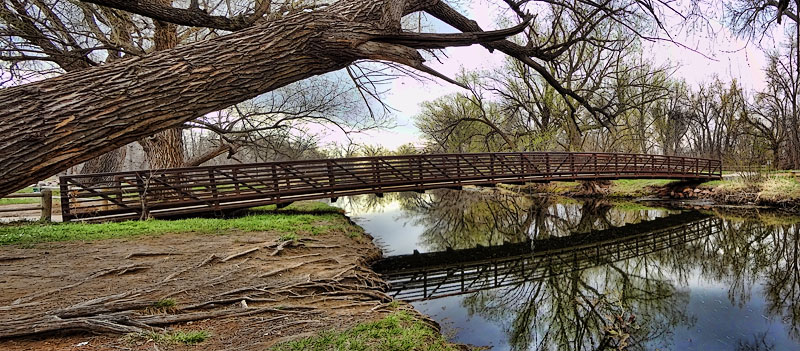
Poudre River Bike Path bridge over the river at Legacy Park photo via Fort Collins Photo Works.

From The Loveland Reporter-Herald (Pamela Johnson):

[Tom] Donnelly and Lew Gaiter met with representatives of Northern Water during their administrative matters meeting Tuesday to consider input previously given to the commissioners from the Larimer County Environmental and Science Advisory Board.

The volunteer citizen members of the committee expressed several concerns with the plan, including the plans for flushing the river, the flow levels and what advisory members considered to be “fuzzy at best” plans for paying for promised mitigations and enhancements.

From Northern Water, general manager Eric Wilkerson and project manager Jerry Gibbens explained to the commissioners Tuesday that those issues had been addressed. They showed figures explaining how the mitigation plan improves the frequency of flushing the river and how it will ensure water in the river through all seasons as opposed to now when there are times that certain sections in Fort Collins are dried up.

“We will deliver day in and day out, every single day of the year, 18 (cubic feet per second) in the winter and 25 cfs in the summer down river,” said Gibbens…

As far as the funding, Northern Water is committing to $53 million in mitigation and improvements. They agreed to pay $13.8 million outright, Gibbens said. While Northern Water will look for partners and other funding sources for the rest ($39.2 million), they will make sure that every aspect of the plan is completed, according to Gibbens…

After hearing from Northern Water, the commissioners decided not to forward any comments to the Colorado Parks and Wildlife Commission, which will vote on the plan next week. They said they appreciate the concerns brought forward by their advisory commission and are satisfied that Northern Water has addressed them to the county’s satisfaction.

Commissioner Lew Gaiter said he was pleased that the information presented by both the environmental board and Northern Water served as education for the community…

The wildlife mitigation plan is available online at http://www.gladereservoir.org and information on how to submit comments, due this Friday, is available at http://www.cpw.state.co.us.

Fort Collins councillors approve sending staff NISP wildlife mitigation comments to state

Poudre River Bike Path bridge over the river at Legacy Park photo via Fort Collins Photo Works.

From The Fort Collins Coloradoan (Kevin Duggan):

The City Council on Tuesday approved sending staff-generated comments on a Wildlife and Fish Mitigation Enhancement Plan proposed by Northern Water for NISP to the Colorado Parks and Wildlife Commission.

The council voted 4-3 in favor of sending on the comments, with members Bob Overbeck, Ross Cunniff and Ken Summers opposed, although for different reasons.

For Overbeck and Cunniff, the comments by staff do not go far enough in criticizing the project and insisting on more mitigation. Cunniff said he did not like the process used by the state for addressing mitigation and the controversial water-storage project…

Summers, who supports NISP, said the comments should not be sent.

Staff’s comments touched on numerous areas of concern, including water quality and the amount of funding designated for wildlife mitigation. It includes recommendations for improving the plan, such as guaranteeing three days of peak flows on the river for critical “flushing” to support the river’s health.

John Stokes, director of the city’s Natural Areas Program, said the comments do not imply support for NISP. But they were generated with the thinking that if the project is built, then steps should be taken to mitigate its impacts…

The commission will weigh the plan in upcoming meetings and potentially forward it to the Colorado Water Conservation Board and the governor for approval. If approved, the plan would likely be included in the federal permitting process for NISP.

Wellington water system taste and odor impacted by algae

Graphic credit Encyclopedia Britannica.

From The Fort Collins Coloradoan (Jacy Marmaduke):

From the gravel road that borders the fenced North Poudre Reservoir No. 3, you can’t see the blue-green algae that is to blame for Wellington’s water woes.

But if you poured yourself a glass from any faucet this summer, you probably tasted and smelled it. Your senses would’ve detected geosmin, the same compound that gives mud and rain-soaked streets that familiar earthy smell.

In a perfect world, geosmin levels in the town water supply would hover no higher than about 20 parts per trillion parts of water, town administrator Ed Cannon said.

As of early July, geosmin levels in North Poudre Reservoir No. 3 were about 15 times that. Summer heat invigorates the algae…

The good news: As of Wednesday, geosmin levels were down to less than 2.5 parts per trillion in the town’s raw water thanks to a copper sulfate treatment on the reservoir, Cannon said.

While the water tastes better than it did earlier this summer, history shows that the town has a long, expensive fight ahead of it.

The algae problem isn’t unique to Wellington. Loveland’s Green Ridge Glade Reservoir became a veritable algae garden during last year’s steaming summer, making for earthy, pondlike water similar to what Wellington’s residents are experiencing this year.

Loveland’s algae hasn’t gone away, but the city invested thousands of dollars in tools to beat it back, including hydrogen peroxide, four reservoir mixers and activated carbon compounds. If those tools aren’t enough, Loveland has a backup plan in the form of plentiful Big Thompson River water rights.

Wellington’s backup plan is less airtight.

Three algae-free wells supplement the reservoir water, but their output is limited. The town must draw even more water from the reservoir as its ranks swell and residents use more water on their lawns. That throws off the ratio of algae-free well water to algae-filled reservoir water and makes the stuff coming out of the tap smell and taste worse.

The algae visits Reservoir No. 3 every summer, like an unwelcome house guest. Town officials say the guest was even more obnoxious this year because it started earlier and bloomed more fiercely.

“To attack (the algae), we’re going to get extremely aggressive,” Cannon said during an interview at his office in Wellington’s town hall.

In July, a gang of boats blasted the reservoir with copper sulfate to kill off the algae. They’ll probably have to make the rounds again this summer, Cannon said.

The town hired additional workers for its water treatment plant and is adding another filtration process to increase the output of its Wilson Well facility, Wellington’s secondary water source. The $400,000 upgrade will supply the town with another 100,000 gallons of algae-free water each day once it comes online by this fall.

Ashley MacDonald, one of Wellington’s six trustees, said Wellington needs to — and plans to — do two things to truly solve its water problem: Revamp the town water treatment plant and find new water sources…

“I feel for them,” he said. “I’m dealing with the same issues. I don’t have an answer that’s going to please everybody, other than to make some assurances that we feel the investment we’re making in our water treatment plant will address that.”

Cannon is referencing a plan to overhaul Wellington’s water treatment facility, which was built when the town was about two-thirds its current size. The upgrade will increase the plant’s capacity so it can treat water for as many as 16,000 residents. It will also make its filtration process more sophisticated so the water tastes better.

That project is still in its design phase and will take at least 12 to 18 months to finish once Wellington’s trustees approve a game plan, Cannon said. Costs have not yet been projected.

The other big goal to solve the problem is locking down higher-quality water sources for Wellington. The Board of Trustees hired Denver consulting firm Wright Water Engineers to help them evaluate options, including water from the City of Fort Collins, the East Larimer County Water District, the Poudre River and the Colorado-Big Thompson Project.

The board will narrow down those options based on cost and efficiency in coming weeks, MacDonald said.

Water treatment is important, but cities like Fort Collins have better-tasting water primarily because they store it in colder, deeper and higher-altitude reservoirs that are less vulnerable to algae attacks, according to Lisa Rosintoski, customer connections manager at Fort Collins Utilities…

Wellington’s water doesn’t violate any water quality regulations, according to its most recent round of state tests in 2016. Those tests included tests for copper, lead, chlorine and uranium, among other compounds.

A state test of raw water in North Poudre Reservoir No. 3 this summer came back absent of microcystin and cylindrospermospin, two compounds sometimes present in algae that are of public health concern.

Fort Collins: Spring Creek Flood spurred increased flood preparedness

Fort Collins, Spring Creek flood July 28, 1997

From KUNC (Jackie Fortier):

As the evening wore on, people living in two trailer parks just south of campus began to panic. Located in a low gully near Spring Creek, between College Avenue and a 15-foot railroad embankment, the trailers had begun to fill with water.

“The rain kept falling hard on the same areas that had just had the heaviest rain so it was building this flood surge,” said state climatologist Nolan Doesken…

Over the course of 24 hours, 14 inches of rain fell in southwest Fort Collins in a highly-localized storm.

“And if anything that was what set the 1997 storm apart, everything was already soaked before it started — I mean really soaked — and then it dumped five hours of heavy rain, with the last hour being the heaviest of all,” said Doesken.

Most of the water was building up behind the 15-foot railroad embankment near Spring Creek — where the trailer parks were.

“Spring Creek is tiny. When you look at it, you can almost jump over it most times of the year,” said Marsha Hilmes-Robinson, floodplain administrator for the city of Fort Collins.

During the flood, the railroad embankment was holding back 8,250 cubic feet of water per second.

“Think of each cubic foot per second being one basketball going by a location in one second,” Hilmes-Robinson said. “So we had 8,250 basketballs flowing into the area behind the railroad embankment every second. That’s a lot of water.”

The railroad embankment couldn’t hold. One of the culverts that had intentionally been filled blew out and water pounded through and eventually over the top. As the rain continued to pour through the night, residents of the trailer parks clung to trees and huddled on rooftops before rescuers in rubber rafts could reach them.

“Then there was the fires, because some of the trailers had floated and the gas lines had been ruptured there was another explosion at a liquor store just to the north of the mobile home park, and then the train cars derailed,” Hilmes-Robinson said.

Four train cars full of lumber and grain had been knocked off the tracks at the top of the embankment as the water began to go over the top.

Rescuers worked through the night saving hundreds of people. Meanwhile at Colorado State University, 40 buildings were flooded, sustaining damages over $100 million, including to the newly renovated Morgan Library and the Lory Student Center.

In all, five women died in the Spring Creek Flood and 200 homes were destroyed, including both trailer parks. Damages to the city and campus totaled $200 million.

Since the Spring Creek Flood, an extensive rain gauge network has been installed in the foothills and in the city as an early warning system. The city has also taken an integrated approach to new projects, according to deputy director of the Colorado Resiliency and Recovery Office Iain Hyde.

“When a new bridge or culvert or park is built, [Fort Collins] build risk reduction into that process, really thinking about floodplain management and sound regulations, and those actions are reducing risk but they’re also reducing risk for flood insurance for members of the community as well,” Hyde said.

Now a gleaming apartment complex and strip malls sit where the trailer parks were. But the new construction had to meet need code regulations put in place after 1997, says Marsha Hilmes-Robinson.

“Those city codes required the buildings to be raised by 18 inches above the 100-year floodplain,” she said.

Flood mitigation also means giving the water somewhere to go. Fort Collins has used sales taxes to purchase two-thirds of the land in the 100-year Poudre River floodplain within city limits, turning it into natural areas and parks. The idea is to give the water somewhere to spread out and slow down. So far, it seems to be working.

TU hails Long Draw settlement and native trout benefits

From Colorado Trout Unlimited (Jeff Florence):

Agreement includes largest native trout restoration in Colorado history

The U.S. Forest Service this week finalized a litigation settlement that will allow the Water Supply and Storage Company, a northern Colorado ditch company, to continue to use Long Draw Reservoir on the Arapaho-Roosevelt National Forests, and will launch a large-scale native trout restoration program for the Cache la Poudre river headwaters within the Forests, including the Neota and Comanche Peaks Wilderness Areas, as well as in Rocky Mountain National Park.

Completion of all project elements is expected to take more than 10 years, but when completed will provide for a connected “metapopulation” of trout across the watershed – the largest such restored native trout habitat in Colorado. The native trout restoration project will span more than 40 miles of connected river and multiple lakes, as well as Long Draw Reservoir itself. To protect the watershed from invasion by non-native species, fish barriers will be established on the Grand Ditch and on the mainstem Cache la Poudre below its confluence with La Poudre Pass Creek. Within the watershed, temporary barriers will also be installed to enable fishery biologists to complete restoration of native trout one section of the basin at a time. After installing temporary barriers, biologists will remove non-native fish from the upstream areas. Once the areas are confirmed to be free of non-native trout, they will be re-stocked with native greenback cutthroat trout. Work will be done in collaboration with the USDA Forest Service, Rocky Mountain National Park, the U.S. Fish and Wildlife Service, Colorado Parks and Wildlife, and Colorado Trout Unlimited.

Under the settlement, a trust will be established with $1.25 million from the Water Supply and Storage Company for purposes of funding these restoration activities. Colorado Trout Unlimited will serve as the Trustee, while the U.S. Forest Service will be the lead agency for project implementation.

David Nickum, executive director of Colorado Trout Unlimited, issued the following statement:

“The settlement finalized today is a great example of how open dialogue and a spirit of cooperation can yield conservation solutions. After years of litigation and debate, the U.S. Forest Service, National Park Service, Water Supply and Storage Company, and Trout Unlimited have agreed to launch a collaborative restoration project for Colorado’s state fish, the greenback cutthroat trout, which will be the largest native trout restoration effort in Colorado history.

“Over the next decade, we will be restoring a true Colorado native to the Cache la Poudre headwaters in spectacular alpine wilderness within both Rocky Mountain National Park and the Arapaho and Roosevelt National Forests. The watershed will be a stronghold for native trout, helping secure this piece of Colorado’s natural heritage for generations to come.

“We are pleased that settlement efforts enabled all the parties to find a solution for the area’s natural resources that meets federal stewardship responsibilities, respects the operating needs and challenges of long-standing water users, and achieves meaningful benefits for Colorado’s environment and the millions of residents of and visitors to our state who enjoy it.”

Keith Amen, president of the Water Supply and Storage Company said:

“We are pleased to have concluded the terms necessary for us to obtain a thirty year easement agreement for the continued operation of Long Draw Reservoir, a very valuable resource that contributes a great deal to the local, state and national economies.”

Fort Collins takes a deep dive into @NorthernWater’s proposed NISP mitigation plan for Cache la Poudre through town

Poudre River Bike Path bridge over the river at Legacy Park photo via Fort Collins Photo Works.

From The Fort Collins Coloradoan (Kevin Duggan):

The plan proposed by Northern Water, proponent of Glade and the controversial Northern Integrated Supply Project, or NISP, contains “new, useful and encouraging mitigation measures,” according to a staff memo to the Fort Collins City Council.

However, the effort falls short of addressing the city’s long-running concerns about how reducing flows on the Poudre to store water in Glade would affect the river’s ecological health and water quality.

More needs to be done in several areas addressed by the $59 million Fish and Wildlife Mitigation and Enhancement Plan to make it adequate as far as the city is concerned, John Stokes, director of Fort Collins Natural Areas, told City Council members Tuesday.

Areas of concern include ensuring flows on the river during the spring runoff are high enough to flush sediment and protect fish and wildlife habitat. High flows also are needed to protect water quality, city officials said.

City staff members recommend establishing an annual three-day period during peak flow on the river when no water would be taken for NISP in hopes of “cleaning” the river and boosting its health.

Another issue is the amount of funding in the plan that would be set aside for mitigation and channel improvements. The $7.8 million in the plan for restoration and enhancement should be increased by $14.2 million, city staff said.

City Council members were divided on the staff’s comments and recommendations for the mitigation plan, with council member Ken Summers saying they seemed “extreme” while others said they weren’t strong enough…

Northern Water has listened to the city’s concerns and changed its plans to address them, said agency spokesman Brian Werner in a telephone interview.

Operational plans include “flushing flows” when river conditions and water rights allow, he said. Northern also has agreed to minimum flows through Fort Collins of 25 cubic feet per second, or cfs, in the summer and 18 cfs in winter to support habitat.

The mitigation plan could be changed as NISP continues through the permitting process, he said.

“We think this a great opportunity to make that river better,” Werner said.

The city’s comments on the NISP wildlife mitigation plan will be sent to the Colorado Parks and Wildlife Commission, which must approve the plan as part of the lengthy permitting process for project. So even if the wildlife mitigation plan gets approved, other agencies would still have to approve permits for NISP to become a reality.

In 2008 and 2015, the council adopted resolutions stating the city could not support NISP as described in draft environmental impact statements…

While not supporting NISP, the city’s comments and recommendations on how it might operate are based on the scenario that “if” the project is built, “then” certain steps should be taken to protect the city’s interests, Stokes said.

If the mitigation plan is approved by the Parks and Wildlife Commission, it will be submitted to the Colorado Water Conservation Board and then the Governor’s Office for approval.

Federal agencies that ultimately would permit NISP are likely to defer to the state’s position on mitigation plans, Stokes said, so communicating the city’s views on the project to the state is a critical step in the process…

What’s next

The Fort Collins City Council on Aug. 8 is scheduled to consider the city’s comments on the fish and wildlife mitigation plan for the Northern Integrated Supply Project that has been submitted to the Colorado Parks and Wildlife Commission.

The commission is scheduled to discuss the plan during its Aug. 10-11 meeting in Trinidad and its Sept. 7-8 meeting in Steamboat Springs.

Comments on the city’s proposed comments may be made at http://www.fcgov.com/nispreview through July 30.

Comments may be emailed directly to the Colorado Parks and Wildlife Commission at dnr_cpwcommission@state.co.us.

Northern Integrated Supply Project (NISP) map July 27, 2016 via Northern Water.

A look back at the Spring Creek flood

Fort Collins, Spring Creek flood July 28, 1997

From The Fort Collins Coloradoan (Kevin Duggan):

It was a Monday. The day felt sodden and clammy after heavy rain in the foothills and around town the night before. The ground, which had been baked hard by weeks of hot, dry weather, was saturated.

There were rain showers of varying intensity throughout the day, especially on the west side of the city and around Laporte, but the rain really started to come down around 5 p.m.

It continued for hours, coming in pounding waves. Water ran fast and deep in the streets while lakes formed in unexpected places in the darkness…

If you didn’t live near the creek or the CSU campus, you might not have realized anything happened.

Spring Creek Flood retrospective

Fort Collins flood July 28, 1997

Here’s a retrospective about the July 28, 1997 flood from Erin Udall running in the The Fort Collins Coloradoan. Click through to read the whole article. Here’s an excerpt:

The water reached over heads, its strong current carried cars from roads and pulled people from their doorsteps or out of the grasp of loved ones.

Witnesses could hear yells for help, see trailers wash off their foundations and smell the propane that streaked the debris-filled floodwaters.

“It was emergency sensory overload,” retired Poudre Fire Authority Captain Steve Fleming said, as he recalled the night Fort Collins’ ankle-deep Spring Creek turned the small city into a scene of tragic flooding, fires and fatalities.

As July 28, 1997 ended and a new day began, Fort Collins was faced with a new city — one full of twisted debris, totaled cars and forever-changed families.

Twenty years later, walk through the events of that night with this timeline of the Spring Creek Flood. See how heavy rain turned a creek into a deadly river. Watch as a festival-like atmosphere — with people kayaking in the streets — gave way to a somber city the next morning. And revisit the places that were washed away and rebuilt.

How it started — Heavy rainfall pounded parts of Fort Collins, with isolated storms wetting the city on July 27, 1997. The following day, it was about to get worse.

Nolan Doesken — Colorado Water Foundation for Water Education President’s Award Presentation 2011

The flood moved Nolan Doesken to create CoCoRaHS. Here’s a report from Kevin Duggan from The Fort Collins Coloradoan. Here’s an excerpt:

In the wake of the flash flood, which killed five women, injured 54 people and caused $200 million in damage, Doesken wanted to understand the storm and how events played out as they did.

Through the Coloradoan and other media outlets, he asked community members to report as accurately as possible rainfall amounts at their homes and businesses. High school students went door to door looking for reliable measurements.

About 300 reports were collected.

While the official weather station at Colorado State University measured about 6 inches of rainfall, data collected from the community revealed that 10 to 14.5 inches of rain fell on the west side of the city during a 30-hour period.

During the same period, the city’s east side received about 2 inches.

The heaviest rainfall centered on the area near Drake Road and Overland Trail and the foothills. The deluge set a record for rainfall over an urban area in Colorado that still stands.

The variance in rainfall totals across the city inspired Doesken to find ways to correlate weather radar estimates of rainfall amounts with what happens on the ground. And the Community Collaborative Rain, Hail and Snow, or CoCoRaHS, network, began.

Volunteers use rain gauges, aluminum-wrapped hail pads and rulers to measure precipitation. Daily results are reported through the program’s website, maintained by the Colorado Climate Center at CSU.

Since its start in Larimer County in 1998, CoCoRaHS has spread across the country to all 50 states and the District of Columbia, Puerto Rico, Canada and the Bahamas.

Data from reports are used in a variety of areas, including weather forecasting, water management, transportation planning and mosquito control.

CoCoRaHS and other observation networks provide important information for weather forecasters, said Thomas Trunk, a meteorologist with the National Weather Service’s Office of Observations in Silver Springs, Maryland.

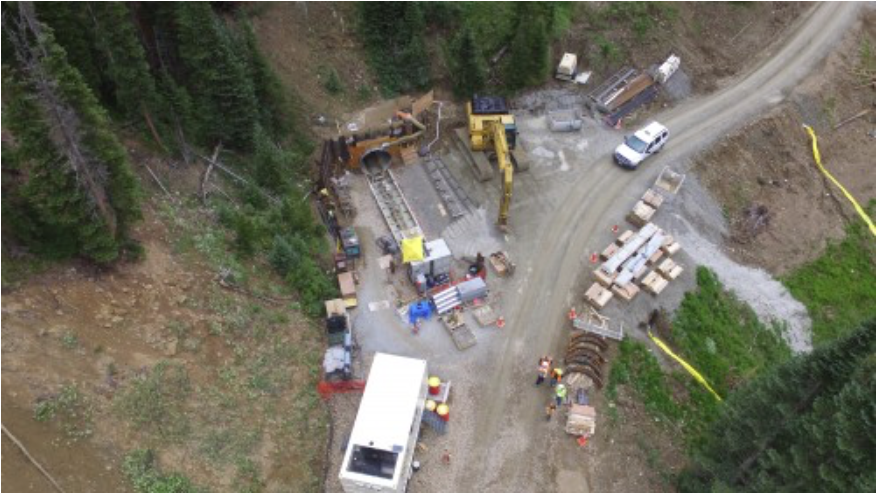
Lithos Engineering Michigan Ditch Tunnel Construction Overview

Milton-Seaman Reservoir expansion update

From The Greeley Tribune (Tyler Silvy):

Expanding the 5,000-acre-foot capacity reservoir has been on Greeley officials’ to-do list for more than a decade. But the type of work the city is planning takes a lot of time, mainly because it involves the federal government.

If everything goes without a hitch, Greeley officials have circled 2030 as the year they’ll increase Seaman to 10 times its current capacity…

Here’s why:

» Greeley has never expanded any of its six reservoirs, and most have been around for nearly a century.

» Increasing Seaman to 53,000 acre-feet of water from 5,000 acre-feet will put Greeley in position to satisfy the city’s water needs for decades. (An acre foot of water is enough water for two families to use for a year). The city uses between 25,000-30,000 acre-feet of water per year: That’s expected to reach 40,000 acre-feet by 2030.

Harold Evans, chairman of the water and sewer board in Greeley, likens the Seaman’s expansion to the kind of planning that has kept water flowing from the city’s Bellvue Treatment Plant area since 1907…

Right now, Greeley is working with a consultant and in conjunction with the Army Corps of Engineers to develop an environmental impact statement.

Greeley is still about two years away from having a draft of that statement.

In the meantime, Greeley officials are working to secure more water rights. The city doesn’t have enough rights to fill the expanded Seaman Reservoir. They’re 40 percent there, and as Reckentine said, it’s an everyday process. Every year, in fact, Greeley commits millions toward purchasing water rights.

Expanding the reservoir could cost $95 million more just in construction costs, according to an estimate provided in a Colorado Water Conservation Board document.

Water rights come from a variety of places, including retiring farms.

Today, Greeley typically uses its reservoirs as drought protection.

Basically, Greeley has water rights from the Colorado, Poudre, Laramie and Big Thompson rivers. But whether Greeley is able to get all of the water it’s owed depends on the rivers’ flow levels.

In drier years, Greeley would have to do without some of that water. That’s where reservoirs come in. Evans said the first reservoirs were used to finish Greeley area crops when river flows weren’t strong enough to do so in late fall.

Snowmelt and water diverted into reservoirs could be tapped for that purpose. Evans said it’s like putting money in the bank. Pound-for-pound, water’s worth more than money, though.

If and when the Seaman Reservoir expansion is complete, Greeley will likely use some of the water from that reservoir every year.

For Evans, that’s a perfect example, among many, of an investment in the future.

Evans mentions the new pipeline from the Bellvue Water Treatment Plant being installed now, with a lifespan of 75-100 years. The Seaman Reservoir has been around since the 1940s.

ABOUT MILTON SEAMAN RESERVOIR

» Built 1941

» Storage: 5,008 acre-feet

» Elevation: 5,478 feet

» Dam height: 115 feet

» Proposed enlargement date: 2029

» Proposed storage: 53,000 acre-feet

SET FOR LIFE?

The Seaman Reservoir expansion will put Greeley in a good position, but Deputy Director of Greeley Water Eric Reckentine hesitates to call it the final answer.

Greeley has a four-point plan when it comes to water:

» Maintain what you have — Greeley has reinforced water lines with concrete and fiberglass to reduce leaks.

» Secure supply to stay ahead of demand — The Windy Gap Project, which ensured water during lean times, is an example of this.

» Build storage for the lean times — The Milton Seaman Reservoir expansion project is the best example of this.

» Conserve the water you have — Greeley has a state-approved water conservation plan, and the new water budgets are another example of conservation.

THE OTHER RESERVOIRS

Here’s a quick look at Greeley’s other five reservoirs:

» Barnes Meadow Reservoir — Built in 1922 and located across Colo. 14 from Chambers Lake in the Roosevelt National Park, Barnes Meadow Reservoir holds 2,349 acre-feet of water.

» Peterson Lake Reservoir — Built in 1922, and located southwest of Chambers Lake and adjacent to Colo. 156, Peterson Lake Reservoir holds 1,183 acre-feet of water.

» Comanche Reservoir — Built in 1924, and located along Beaver Creek and west of the Colorado State University Mountain campus, the Comanche Reservoir holds 2,628 acre-feet of water.

» Hourglass Reservoir — Built in 1898, and also located along Beaver Creek and west of the Colorado State University Mountain campus, the Hourglass Reservoir holds 1,693 acre-feet of water.

» Twin Lakes Reservoir — Built in 1924, and located southwest of Pingree Park off Colo. 14, Twin Lakes Reservoir holds 278 acre-feet of water.

From The Greeley Tribune (Tyler Silvy):

Doug Billingsley doesn’t know what he’s going to do to replicate the peace and quiet of his work when he retires and re-enters the hubbub of normal life. Greeley pays Billingsley to live at Milton Seaman Reservoir, about 15-20 minutes from the mouth of the Poudre Canyon. Billingsley lives in a city-provided house, and has lived there for the past eight years with his wife, who suffers from multiple sclerosis, and her caretaker.

Billingsley monitors the Seaman Reservoir. The reservoir is Greeley’s largest, and its water levels can rise and fall quickly. He must ensure the banks and dams are sound and functioning properly, and he’s charged with releasing water down the Poudre Canyon when necessary. Call him the water shepherd.

He’s used to the solitude, if not the quiet.

“I drove over the road truck for 18 years, and was by myself for up to 30 days at a time — I lived in a truck,” Billingsley said. “This is no biggie; this is heaven.”

The city pays him a salary as well as his living expenses. But there’s a catch: He’s on call 24 hours per day, seven days per week.

The floods of 2013 are a prime example. And Billingsley spent the better part of a week stuck at home after a bridge went out, trapping folks up the canyon. Of course, he had to monitor Seaman’s water levels during the flood, as well.

Billingsley’s wife loves having him at home every night, and he loves being there.

Apart from animals there’s nothing to bother a Seaman Reservoir caretaker. They’ve seen elk, mountain lions, bears, but none of them hurt anybody, he says.

Federal resolution aims to streamline water storage permits

Northern Integrated Supply Project (NISP) map July 27, 2016 via Northern Water.

From The Fort Morgan Times (Jenni Grubbs):

House Resolution 1654 would set the U.S. Bureau of Reclamation as the agency in charge of permitting water storage projects. That agency then would coordinate all the federal agencies involved in that process, as well as the reducing redundant requirements at state and local levels that currently are part of the permitting process.

While this legislation becoming law could have substantial impacts on some proposed water storage projects in Colorado, it would not be likely to impact the process for the proposed Northern Integrated Supply Project (NISP)…

“Obviously we support the basic idea of streamlining the permit process,” Brian Werner from Northern Water said of the legislation. “We’re all for finding out how we can tweak this process.”

For example, many of the studies and other preparatory work on a large water storage project like NISP could have been conducted concurrently, rather than sequentially, Werner suggested.

“Streamlining doesn’t mean that we don’t do the studies,” he said, “but we could do it more efficiently.”

[…]

Congressman Ken Buck, R-CD4, voted in favor of the resolution, even speaking for it on the House floor and mentioning proposed water storage projects in Colorado, like NISP, as why he supported it…

House Resolution 1654 would set the U.S. Bureau of Reclamation as the agency in charge of permitting water storage projects. That agency then would coordinate all the federal agencies involved in that process, as well as the reducing redundant requirements at state and local levels that currently are part of the permitting process.

While this legislation becoming law could have substantial impacts on some proposed water storage projects in Colorado, it would not be likely to impact the process for the proposed Northern Integrated Supply Project (NISP).

That proposed water storage project would have Northern Water build two reservoirs, Galeton northeast of Greeley and Glade northwest of Fort Collins. They would provide water to the 15 NISP participants, including the city of Fort Morgan and Morgan County Quality Water District.

“Obviously we support the basic idea of streamlining the permit process,” Brian Werner from Northern Water said of the legislation. “We’re all for finding out how we can tweak this process.”

For example, many of the studies and other preparatory work on a large water storage project like NISP could have been conducted concurrently, rather than sequentially, Werner suggested.

“Streamlining doesn’t mean that we don’t do the studies,” he said, “but we could do it more efficiently.”

Congressman Ken Buck, R-CD4, voted in favor of the resolution, even speaking for it on the House floor and mentioning proposed water storage projects in Colorado, like NISP, as why he supported it.

“Unfortunately, many water storage projects in my state face significant setbacks in permitting due to a long list of regulatory checkboxes,” he said in prepared remarks. “Much of this delay occurs because each level of government-local, state, and federal-requires (its) own studies and permitting checklists, even though many of those requirements are the same or only slightly different.”

The goal would not be to eliminate environmental or safety requirements for getting the permits, Buck pointed out. Instead it would be to seek to get the “different levels of government to work together so that our water projects can earn the permits they rightly qualify for” during the initial permitting process.

The legislation next faces debate in the Senate Committee on Energy and Natural Resources, but a hearing date had not yet been set as of Monday afternoon. That committee includes Colorado’s Sen. Cory Gardner as a member.

#Runoff news: Low-head dam hazards

From The Fort Collins Coloradoan (Alicia Stice):

In the past 10 years, more than 15 people have drowned on the river from various accidents. Lopez’s death was the first in years involving a low-head dam.

These [weirs] dot rivers across the country, including in Fort Collins, where there is one low-head dam every 1.5 to 2 miles along much of the Poudre.

In Colorado, there is no agency in charge of overseeing safety at these dams. Instead, the Division of Water Resources has a team charged with overseeing the risks associated with large dams at sites such as Horsetooth Reservoir that could pose a hazard if they failed, Colorado Division of Water Resources Dam Safety Chief Bill McCormick said.

“I think these are some of the most dangerous type of structures we have in the country because most people are unaware of the dangers,” said Bruce Tschantz, a Knoxville, Tennessee, water resources engineer who has studied low-head dams extensively. “People tend to overestimate their ability to overcome the current and underestimate the dangers.”

General currents upstream and downstream from a low-head dam. Graphic via Bruce a. Tschantz

In much of the country, low-head dams have been in place for more than 100 years to serve now defunct mills. In Colorado, many of these dams are still active, diverting water into irrigation ditches for agricultural use. While the structures are old, the danger is relatively new.

“The problem of safety around them is more a recent phenomenon as people are using the rivers more,” McCormick said.

The dams slow water upstream and divert it away from the main channel. The water that flows over them creates a rapid on the downriver side that mimics the hydraulics of a washing machine. The water can force victims underwater and spin them around, making it nearly impossible to swim back up to the surface.

“These structures are often very deceiving,” said Kenneth Smith, Indiana Department of Natural Resources assistant director…

Simple engineering solutions can make low-head dams built today much safer by breaking up the flow of water as it moves over the dam. Solutions could include a set of concrete stairs or large rocks on the downstream side of the structure. In many cases, those solutions could be added to existing dams, but that can be costly, and it can be difficult to track down the owners of these century-old structures.

Poudre Fire Authority has been in discussions about what might be done to make sure people know about the dangers of the dams, including the possibility of installing signs along the river warning people of where they are.

@NorthernWater proposes $53 million for mitigation for NISP

From The Fort Collins Coloradoan (Jacy Marmaduke):

[Northern Water] unveiled a $53 million fish and wildlife mitigation and enhancement plan for the Northern Integrated Supply Project (NISP), which proposes to funnel Poudre water into two reservoirs for 15 Northern Colorado municipalities and water districts. Among the involved communities are Windsor and the Fort Collins-Loveland Water District. The city of Fort Collins is not one of the entities that would receive water from the project.

Northern Water’s mitigation plan includes strategies to preserve some of the Poudre’s peak flows, protect wildlife habitat near the project’s larger proposed reservoir, improve the river channel and keep more water than originally planned in the river through Fort Collins.

But that’s not enough, opponents say. Project opponent Save the Poudre argues the Poudre sorely needs the high springtime flows that NISP would use to fill its reservoirs…

Northern Water project manager Jerry Gibbens, who is leading NISP mitigation efforts, highlighted four key parts of the plan for those who don’t get through all 144 pages of the document.

Keep some water in the Poudre through Fort Collins: NISP aficionados have heard of this one. Northern Water plans to run 14,000 acre feet of diverted water down a 12-mile stretch of the Poudre in Fort Collins before recapturing it for storage. The goal is to prevent dry-up spots on the Poudre in Fort Collins and preserve flows between 18 and 25 cubic feet per second.

Preserve some peak flows: Basically, Northern Water would hold off on Poudre diversions for up to three peak flow days each year, depending on whether conditions are wet, dry or about average.

During wet conditions when the reservoirs are full, Northern Water would divert no water from the Poudre during the three peak flow days. On average years, Northern Water would aim for up to three high-flow days with no diversions.

“During dry years when we’re trying to get every drop, we probably won’t have any opportunity to bypass (diversions),” Gibbens said.

Improve the river channel: The plan earmarks money for a channel and habitat improvement plan along the river. Northern Water plans to focus on 2.4 miles specifically: 1.2 miles within a reach of the Poudre from the Poudre Valley Canal to the intersection of Highway 14 and Highway 287, and 1.2 miles in the Watson Lake area north of Bellvue. Northern would fund channel reconstruction and habitat improvements. Northern also identified five sites for riparian vegetation improvement.

Conserve wildlife habitat near Glade Reservoir: Northern Water plans to put a conservation easement on land it owns around the proposed location of Glade Reservoir, the project’s larger reservoir northwest of Fort Collins. Northern plans to buy more land in the area for the same purpose. A conservation easement would protect the land from being sold for urban development, Gibbens said.

The plan also addresses water quality monitoring, water temperature mitigation, fish and bird habitat and a host of other issues. Check out northernwater.org for the full plan – but do it sooner rather than later. Colorado Parks and Wildlife is accepting public comments on the plan for 60 days, until early August.

CPW will hold an open house to talk to the public about the plan at The Ranch in Loveland at 4-7:30 p.m. June 27. Later this summer, the Colorado Parks and Wildlife Commission might suggest changes to the mitigation plan…

Gibbens said NISP won’t hamper the Poudre’s peak flows during about 82 percent of years, either because of Northern’s plans to sometimes preserve peak flows or because Northern Water’s water right is out of priority during peak flow days. Colorado water rights operate on a first-come, first-served basis, so those who own older water rights get to use the water before those who own newer water rights.

Still, NISP would result in lower average springtime flows on the Poudre, according to Northern Water’s projections. Project proponents point out it would also increase low flows during the fall and winter.

“We still will have diversions for water supply purposes, but we feel that this plan really allows those water supply withdrawals and environmental needs of the river to coexist and actually make the river a better river with the project than without it,” Gibbens said.

If approved by the U.S. Army Corps of Engineers, NISP will yield 40,000 acre-feet of water per year to participants. An acre-foot is about 326,000 gallons, enough to meet the water needs of three to four urban households for a year.

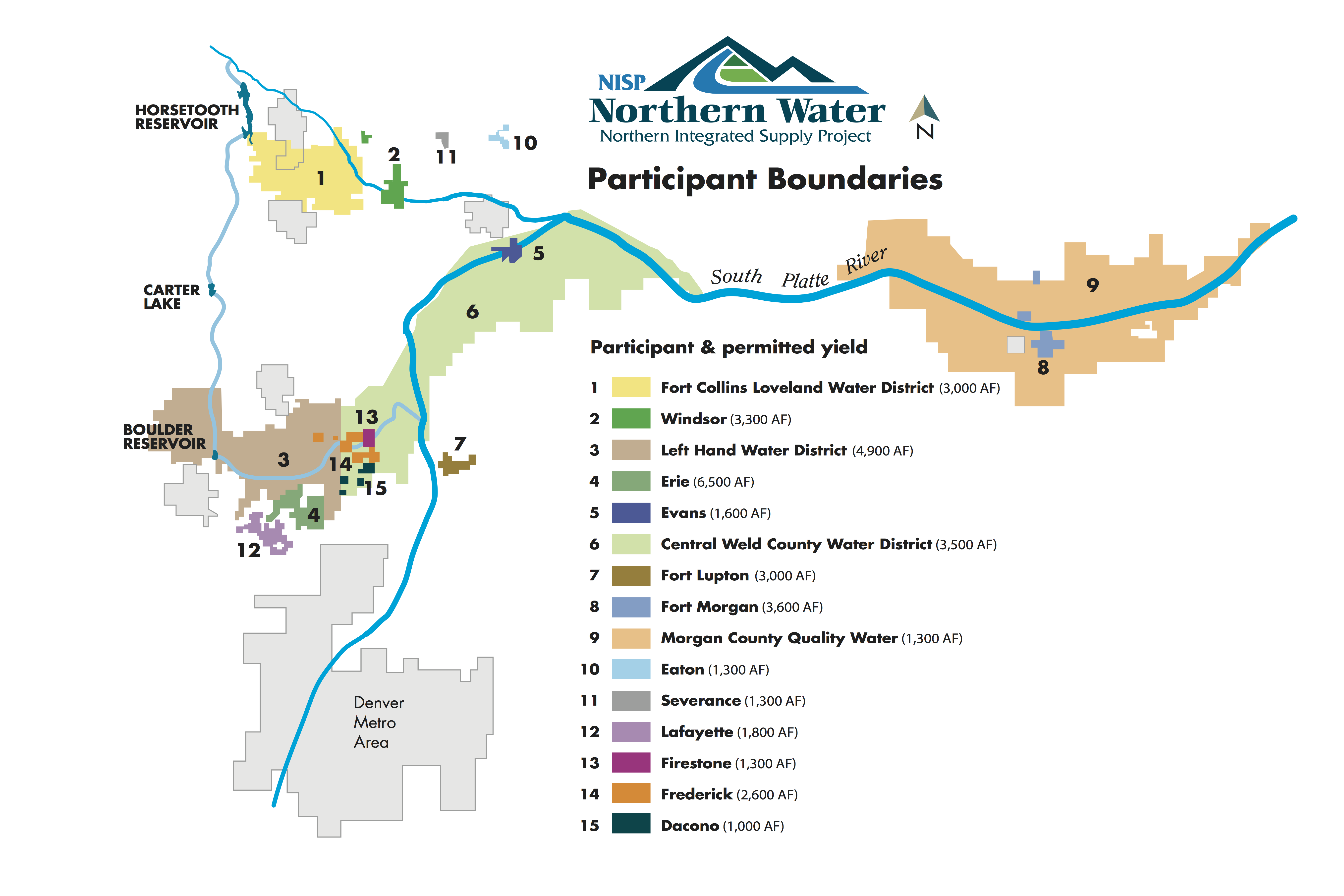
NISP participants include Windsor, Eaton, Firestone, Frederick, the Fort Collins-Loveland Water District, Fort Lupton, Fort Morgan, Severance, Lafayette, Erie, Evans, Left Hand Water District, Morgan County Quality Water District, Central Weld County Water District and Dacono.

Northern Integrated Supply Project (NISP) map July 27, 2016 via Northern Water.

@GreeleyWater wins 13th annual “Best of the Best” Tap Water Taste Test

Cache la Poudre River

From The Greeley Tribune (Tyler Silvy):

Greeley ought to bottle this stuff.

The water in your tap — the stuff you pay pennies per gallon for — just earned recognition as the best tasting water in the United States.

This week, the American Water Works Association rated Greeley’s water the best tasting in the nation, as Greeley beat out 33 other regional winners. The city also became the first to win the national competition and People’s Choice Award at the organization’s annual conference in the 13-year history of the competition.

Greeley also is the first Colorado municipality to win the award.

And then there’s this: This was the first year Greeley has entered the contest.

“I was hopeful,” Greeley Water and Sewer Director Burt Knight said. “But I never expected to win both awards.”

Still, Knight said the awards didn’t tell him anything he didn’t already know.

“What it does is it confirms the choice our forefathers made when they went up to the mouth of the Poudre and built the treatment plant and pipeline in 1907,” Knight said. “I know we have high-quality water. All we needed to do is get everybody else to agree.”

Now that they have, Knight and others are pondering how, exactly, they’ll spike the football.

“It’s something we’ll need to think about leveraging,” City Manager Roy Otto said, adding the city has used its extensive water portfolio to attract businesses in the past. “But quality is something we need to spend time communicating to people — not only to residents, but others who might be coming to Greeley, as well.”

There are strict rules for the water competition. Greeley was sent special containers and coolers. Officials took water from one of the treatment plants and shipped it off to Philadelphia, where the annual convention was held.

Once there, contest officials remove any labels to ensure a blind taste test for judges.

To get there, Greeley had to win its regional competition last fall. And as a result of its national win this year, Greeley gets an automatic bid to the national competition next year.

Will the city enter?

“If you’re the Broncos, and you win the Super Bowl, you want to defend your title,” Knight said.

But that’s for next year. For now, Greeley officials are happy celebrating the victory.

Otto said he’s proud of the tradition and legacy of water in Greeley, saying the award is an affirmation of that.

W.D. Farr

“W.D. Farr has a big smile on his face in heaven right now,” Otto said, referencing the Greeley water pioneer.

After Farr died, Greeley bottled some of the town’s water, labeling it “Greeley Gold.” Otto still has a bottle.

“I would put Greeley’s water supply up against any bottled water across the country,” Otto said.

From The Denver Post (Tom McGhee):

Greeley, a city known for both agriculture and food processing businesses, can now boast it has the best tasting tap water in the United States and Canada.

The Greeley Water and Sewer Department won the 13th annual “Best of the Best” Tap Water Taste Test conducted by the American Water Works Association. Montpelier, Ohio, took second place and Bloomington, Minn., had the third-best tasting tap water.

Greeley represented the Rocky Mountain Section of the American Water Works Association in the contest held in Philadelphia, Pa. The Rocky Mountain group includes water companies from cities in Colorado, Wyoming and New Mexico, said Greg Baker, spokesman for the organization. It is the first time that any member of the Rocky Mountain association has won the contest, Baker said.

The event, composed of regional winners from water-tasting competitions across North America, was held at American Water Works Association’s Annual Conference and Exposition in Philadelphia, Pennsylvania. Fifteen regions participated in the contest, including some in Canada and Puerto Rico.

Cache la Poudre River watershed via the NRCS

#Runoff news: Flood advisory for the Cache la Poudre

From The Fort Collins Coloradoan (Miles Blumhardt):

Our hottest weather of the season toady through the weekend will increase snowmelt and prompted the National Weather Service to issue a flood advisory for the Poudre River.

The advisory runs today through 4 p.m. Monday from the mouth of the Poudre Canyon through Fort Collins. The hot weather in the mountains is expected to accelerate melting of an abundant snowpack, resulting in minor flooding of bike paths and trails in low-lying areas around Fort Collins…

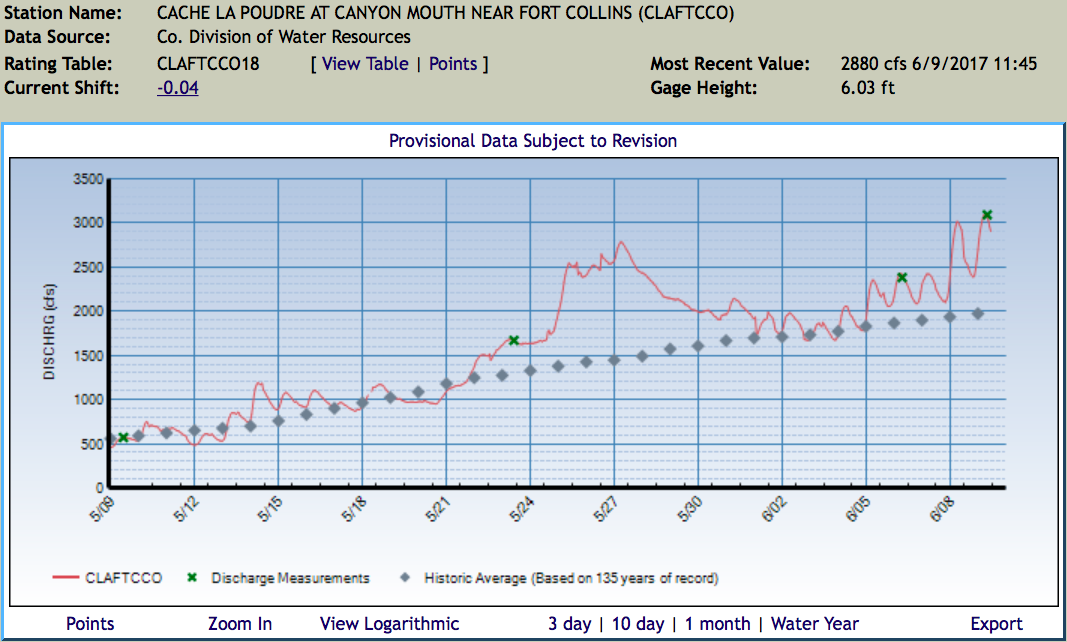
Flood stage is 7.5 feet on the river. At 4:45 a.m. Friday, the river was at 6.2 feet. The forecast is for the river to rise to near 6.3 feet Saturday morning. At 6 feet, water spills into low-lying areas.

The Poudre was running at 2,310 cubic feet per second Friday morning through Fort Collins, which is strong enough to carry people downstream.

How NISP works — @Northern_Water

Report: State of the Poudre — @fortcollinsgov

Click here to read the report. Here’s the executive summary:

Executive Summary
The purpose of this first State of the Poudre River (SOPR) is to provide a description of the current health of the Cache la Poudre River (Poudre) from approximately Gateway Natural Area to I-25. The Poudre is a complex natural system that has been altered by nearly two centuries of human influence. This has resulted in dramatic changes to the physical structure of the river, water quantity and quality, floodplain, forests, and wildlife communities. The human footprint continues to expand, placing additional pressure (or stresses) on the river ecosystem and the natural processes that sustain it. This river health assessment provides the City of Fort Collins with a new tool to track trends and benchmark progress towards its vision of sustaining a healthy and resilient Cache la Poudre River.

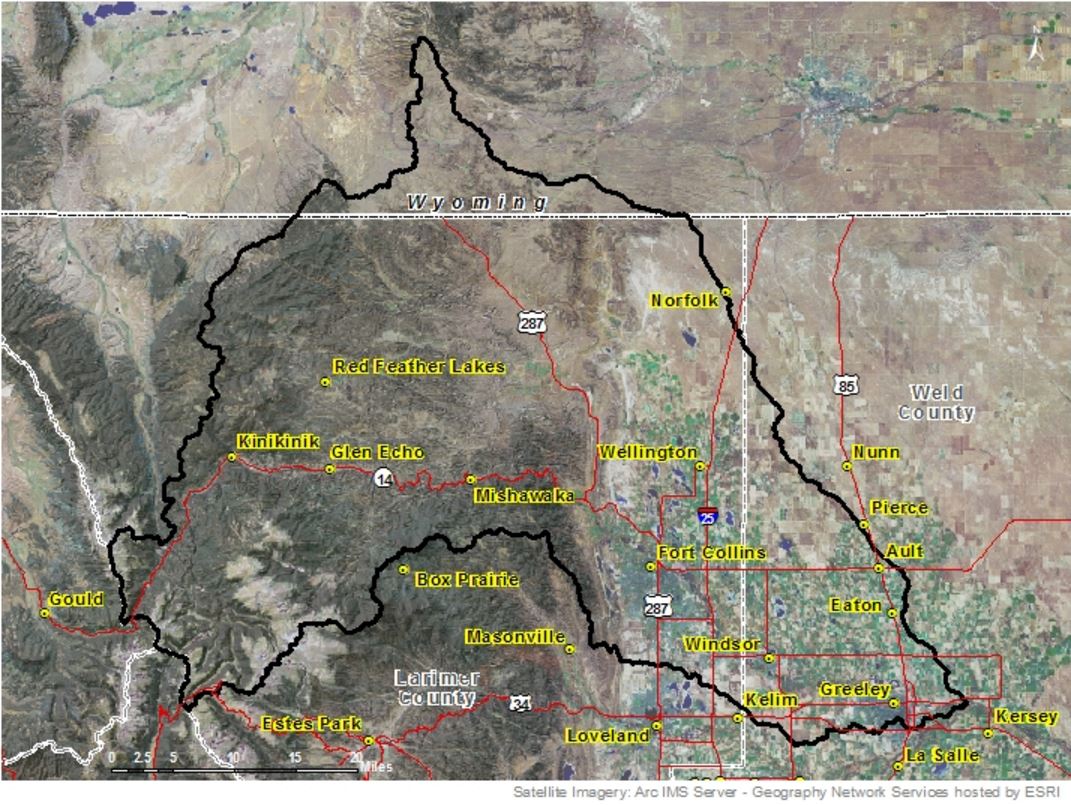
While the Poudre flows 126 miles from its headwaters to its confluence with the South Platte near Greeley this study focuses on a 24-mile reach from the lower canyon through Fort Collins. The study area was divided into four zones (Canyon, Rural, Urban, and Plains) and further into 18 study reaches based on natural changes on the landscape and human influences.

Overall Grade: For the 24-mile study area the Poudre River received an overall grade of C. This grade indicates the even though the Poudre has been altered and degraded by a suite of local and system wide stresses that impair its health, it continues to support basic elements of a functioning river ecosystem.

The framework for this baseline assessment includes nine indicators of river health which are informed by 25 indicator-specific metrics. Collectively these provide a thorough evaluation of how well the system is functioning. Metrics grades are developed by collecting and incorporating many types of data, which were then translated into an A-F grading system. Indicator and metric numerical scores and their corresponding letter grades were calibrated to categorical definitions relating to degree of functionality or impairment.

Recommended ranges developed for each metric (as established in the River Health Assessment Framework, City of Fort Collins, 2015) and were developed based on the City’s concept of working towards a functioning river ecosystem. The recommended ranges consider the contemporary real- world context and reasonable expectations for future change and the potential for improvement. They should, however, be used as a guide and aspiration rather than a directive. Also, when interpreting results for a comprehensive scientific assessment such as this, it is important to consider that uncertainty and variability exists across scientific disciplines, data sources, and river reaches. The methods and grading guidelines provide an explicit description of the analytical approaches used and can help the reader understand this variability.

This report is structured to allow the reader to understand the project approach (Sections 1 and 2) followed by identification of potential influences, or stressors, on river health in Section 3. The health assessment scores (Section 4) reveal the ramifications these anthropogenic stressors are having on ecosystem condition. Results indicate there is considerable variability across aspects of river health as scores vary widely (from A to F) at smallest unit of measurement (metrics scores by reach). In Section 5, the focus shifts to an overview of river health, describing the link between stressors and degree and type of impairment for each of the four zones. Poudre River health indicator grades for each zone are compared to the ranges recommended in the City’s Poudre River Health Assessment Framework (2015)—to highlight areas where there is the greatest gap between the City’s goals for the river and today’s conditions. This section also includes an analysis of the causes of impairment and explores which problems are tractable to practical solutions. Section 6 looks toward the potential future applications and improvements for the project.

From The Fort Collins Coloradoan (Jacy Marmaduke):

In their first-ever health assessment of a 24-mile stretch of the Poudre River, a group of Fort Collins water experts awarded the river an overall grade of a C.

In other words, the river is functional, the assessment’s authors said. But it could, and should, be better.

City officials aspire to a B grade for the river, which would mean the assessed stretch is considered “highly functional.”

The report was put together by a group of ecologists and resource managers from the city’s natural areas and utilities departments, Colorado Parks and Wildlife and several consulting firms. The goal was to develop a tool city officials can use to benchmark progress toward a healthier river.

The study focused on the Poudre from the lower canyon near Gateway Natural Area to Interstate 25 and used an A-F grading system. The spotlight was on six key indicators of river health:

  • Flows, the primary driver of river health
  • Sediment, a natural component of rivers that can be harmful if amounts are too much or too little
  • River channel, including shape, width and depth
  • Water quality
  • Aquatic life
  • Riparian corridor, including riverside forests, wetlands and grasslands
  • The overall grade of C “indicates that even though the Poudre has been altered and degraded by a suite of local and system-wide stresses that impair its health, it continues to support basic elements of a functioning river ecosystem,” the report states.

    The river’s lower canyon zone fared better than the urban, rural and plains zones, scoring an overall B-minus with high marks for riparian corridor health, water nutrients and land and channel erosion. The canyon zone scored poorly on habitat connectivity and water temperatures, the latter because warming water temperatures represent risks for aquatic life.

    The river’s urban zone earned a C grade with high marks for water nutrients, trout population and land erosion. The urban zone failed in riparian corridor health, habitat connectivity and river flows.

    Overall, river flows were an issue for most of the 24-mile stretch.

    “The Poudre is characterized by major changes in flow volumes and timing,” the report states. “Reductions have significantly altered peak and base flows, the effects (of) which are exacerbated the further one travels downstream. Diversions also cause unnatural fluctuations in flow volume, which likely affects critical habitat and reproductive needs of fish and insects in the river.”

    Fort Collins: Possible ballot initiative about Poudre River through town

    Poudre River Bike Path bridge over the river at Legacy Park photo via Fort Collins Photo Works.

    From The Fort Collins Coloradoan (Kevin Duggan):

    The group [Save the Poudre] is considering asking Fort Collins voters to require the city to “actively oppose and work to stop” new water projects that would reduce the river’s flow through Fort Collins, according to a city memo.

    Save the Poudre, which has fought the proposed Northern Integrated Supply Project, or NISP, and its Glade Reservoir for more than a decade, might soon start the process of getting an initiative on the November ballot that could change city water policy.

    Watering down the war: How we may move forward on the issues of growth on the Front Range

    Northern Integrated Supply Project (NISP) map July 27, 2016 via Northern Water.

    From The Rocky Mountain Collegian (Julia Rentsch):

    More than 4 million acre-feet of water has left the state via the South Platte River since 2009, and in an arid environment like the Northern Front Range of the Rockies, a drop unused inside the state boundaries is considered a drop wasted – especially as the area grows in population and demand for water subsequently increases.

    Experts say that the growth of Northern Front Range towns and cities will not be limited by physical access to water – the supply exists. What is up for debate is how we allocate the resource to provide a sustainable supply of water to meet both human and environmental needs.

    One attempt to solve this problem is the Northern Integrated Supply Project, also known as NISP – a proposed water storage plan that has been in the stages of federal permitting and review since 2004. It may be the most famous – or, depending on who you ask, infamous – water project in the region…

    On the surface, debate over the project seems to be gridlocked as participants wait for the final Environmental Impact Assessment to be complete. Discussion has stagnated over the basic question of whether the NISP project is in fact a dam on the Poudre.

    However, at the heart of the debate are larger questions about how to manage growth on the Front Range without sacrificing the health of the region’s rivers and agricultural land.

    “It’s really a deeper question of what do we want Northern Colorado to look like and how do we want to get there,” said Reagan Waskom, director of the Colorado State University Water Center and the Colorado Water Institute.

    NISP basics

    The current project plan calls for the building of two reservoirs: Glade in Larimer County and Galeton in Weld. Additionally, there would be a small reservoir for temporary storage near the mouth of the Poudre Canyon, three pump plants and pipelines to deliver the water to the participants and updates to an existing small canal.

    Designed to provide a reliable 40,000 acre-feet supply of water annually to the fifteen participating cities and water districts to meet needs through the year 2030. The project’s participant list includes the cities of Dacono, Eaton, Erie, Evans, Firestone, Fort Lupton, Fort Morgan, Frederick, Lafayette, Severance and Windsor; participating water districts are Central Weld County, Fort Collins-Loveland, Left Hand and Morgan County Quality. Per Northern Water’s estimates, these 11 towns and four districts serve about 240,000 residents in total.

    In order to do this, Northern plans to divert water from the Poudre during wet periods of the year — under projected conditions, the June rise of the river would be considerably lower than ecologists say is healthy. Northern Water is working on a plan to abide by guidelines that will be set by Colorado Parks and Wildlife, but what constitutes a healthy flow is up for debate.

    “We’re willing to work on a flushing flow plan because we know it’s a big enough issue,” said Brian Werner, a public relations officer for Northern Water.

    NISP was originally expected to cost $500 million; at this price, participants will pay about $12,500 per acre-foot of water they receive from the project. An equivalent amount of water from the Colorado-Big Thompson costs around $40,000 to $50,000 per acre-foot.

    However, more recent changes to make the project plan more feasible and sustainable have pushed the estimated price up to around $800 million.

    The project’s effects on the Poudre are of particular concern to ecologists.

    “The Poudre … is a working river, and it’s been developed to meet human needs since the late 1800s,” said Leroy Poff, a doctor of aquatic ecology at CSU. “But it continues to function ecologically in the lives of the citizens of Fort Collins… Proposed future development of the Poudre presents strong challenges to sustaining the ecosystem that we have today.”

    Planning the future of the Front Range

    The Colorado Department of Local Affairs reports that population in Larimer and Weld counties is forecast to increase by 92 percent from 2015 to 2045, exceeding the 53 percent growth forecast in the statewide population. In addition to the increased municipal demand for water, this level of growth has been attributed as responsible for traffic problems, both local and statewide housing shortages, and increasingly unaffordable housing.

    Despite the region experiencing a slight economic dip due to layoffs in the oil and gas industry as the price of oil lowered, the estimates of the North Front Range Metropolitan Planning Organization say that employment in the region is projected to increase by 80 percent between 2010 and 2040.

    The rising cost of living associated with these trends is causing people who hold jobs in metropolitan areas, but who cannot afford the high price tag of living within city limits, to move to smaller communities to take advantage of the more affordable sprawl. These ‘bedroom communities,’ as they’re termed, predominantly consist of residences, schools and churches and lack the commercial development that characterizes a healthy, balanced city.

    “We’re pushing people who don’t have two good incomes out of Fort Collins because of growth,” Waskom said. “What happens is that growth is now occurring in those places that weren’t here (before) and developed water supplies early on in the game.”

    Growth in these areas indicates that there is a lot of logistical work ahead for the various entities coordinating the region’s infrastructure. In addition to issues of water supply, there must also be planning to ensure adequate water quality, air quality and transportation to support the population. Numerous infrastructure improvement plans are in the works, but none have been as publicly contentious as NISP.

    While some opponents of NISP say that stopping the project, and therefore limiting the supply of water available to these developing communities, might be a solution to curb growth, experts say that this is not the case. If absolutely no action is taken, agricultural water rights would be on the hook to make up the difference.

    “I think it’s true and evident that water is probably not going to be what limits sprawl or growth in this area,” Waskom said. “It’s just got to come out of ag, and it comes out of the environment. Those are the two sectors that are at risk, and the economics of it are such that, as agriculture dries up and houses grow on top of what were cornfields, the economy grows. It doesn’t skip a beat.”

    Solutions

    Some groups are seeking to transcend the back-and-forth over NISP by way of compromise.

    Rather than depending on large new reservoirs and diversions, the nonprofit group, Western Resource Advocates, proposes an alternative plan with a diverse water supply portfolio. WRA’s ‘A Better Future for the Poudre River’ plan would, like NISP, provide 40,000 acre-feet of water to participants annually, but would utilize conservation, reuse, water transferred as a result of growth onto irrigated agricultural lands and voluntary agreements with agriculture.

    The Poudre Runs Through It, a group of professionals facilitated by CSU’s Colorado Water Institute, is looking at ways to bring together the diverse stakeholders on the river and to explore the continuing challenges and opportunities for collaboration.

    “I think until we start to engage more people in that discussion and more groups in that discussion, this is going to be a real tough thing to crack,” said Kehmeier, who is also a member of The Poudre Runs Through It. “It’s going to take more of the water users on the system than just one to make this work.”

    Denver: Federal judge dismisses Water Supply & Storage Company lawsuit

    From The Fort Collins Coloradoan (Kevin Duggan):

    A water-and-fish dispute that began in 1994 just ended. A federal judge in Denver on Tuesday dismissed a lawsuit filed in 2011 by Fort Collins-based Water Supply & Storage Co. over a U.S. Forest Service decision about the management of Long Draw Reservoir and requirements to restore the native greenback cutthroat trout in the reservoir and surrounding streams.

    Long Draw Reservoir sits below the east side of the Continental Divide, about 35 miles west of Fort Collins in the Arapaho-Roosevelt National Forest. Some of its water comes from the Western Slope via the Grand River Ditch, which traverses a section of Rocky Mountain National Park.

    Water from the reservoir is released into La Poudre Pass Creek, a tributary to the Poudre River. The water goes toward downstream agricultural and municipal uses. The reservoir was built in 1929 and expanded in 1974.

    That 53-acre expansion was the root cause of the ensuing fight. The original 300-acre reservoir was permitted under a permanent easement, said Dennis Harmon, general manager of the irrigation company: The expansion required a separate, renewable easement and permit.

    In 1994, Trout Unlimited sued the Forest Service over an Environmental Impact Statement for the permit that would have allowed La Poudre Pass Creek to be dry during the winter.

    In 2004, a U.S. District Court threw out the permit, forcing the Forest Service to start the permitting process over and include a plan to protect trout habitat and restore the greenback cutthroat trout to the watershed.

    A deal to make that happen involving Trout Unlimited, Colorado Parks and Wildlife and Water Supply & Storage was reached in 2010. But the forest supervisor at the time said the irrigation company would have to be responsible for full cost of the restoration project.

    That prompted another lawsuit and more years of haggling. Under the new deal, Water Supply & Storage will put $1,250,000 into a trust that will pay for the restoration program.

    Trout Unlimited will be the trustee. It will work closely with the Forest Service, the National Park Service and Colorado agencies to implement the largest trout restoration project in state history.

    The work will entail building barriers in the reservoir and more than 40 miles of streams to block out non-native fish species. Once non-native fish are eliminated section-section from streams, the waters will be restocked with greenback cutthroat trout.

    The project is likely to last more than 10 years, said David Nickum, executive director of Colorado Trout Unlimited. It could cost more than the earmarked $1,250,000, he said, but fundraising and in-kind donations from volunteers and government entities should help get the work done.

    Water Supply & Storage is glad to have the matter settled after so many years, Harmon said. It wound up with a 30-year easement agreement to continue managing the reservoir.

    He declined to say how much the company paid in legal fees.

    Nickum said the restoration work will be challenging, especially given the limitations on equipment that may be used inside designated wilderness areas. But it will be worthwhile for the environment and people who enjoy fishing.

    And the greenback cutthroat trout – the Colorado state fish and a threatened species – will be back in it home waters.

    Cutthroat trout historic range via Western Trout

    2017 #coleg: NISP-related bill fails in committee

    Northern Integrated Supply Project (NISP) map July 27, 2016 via Northern Water.

    From The Fort Collins Coloradoan (Jacy Marmaduke):

    The bill would have allowed Northern Water to run Northern Integrated Supply Project, or NISP, water through 12 miles of the Poudre River in Fort Collins and recapture it at the Timnath Reservoir inlet for storage east of Fort Collins.

    The bill failed 6-5 last week in the Senate Agriculture, Natural Resources and Energy Committee, with Democrats and Republicans voting against it…

    Northern Water spokesman Brian Werner said the district will still go through with its plan to run 14,000 acre feet of water through the river in Fort Collins with the goal of maintaining flows of 18 to 25 cubic feet per second. He attributed the lack of consensus on the bill to “uneasiness” in the water community about unintended impacts of the legislation.

    “We’re still going to do it,” he said of the so-called “conveyance refinement plan.” “We’re just going to look at Plan B, probably.”

    Whether Northern Water needs legal permission to carry out the plan remains a “gray area,” Werner said. But he added Northern Water will pursue the plan regardless of whether formal legislation is passed.

    Werner wasn’t sure if Plan B would come in the form of another bill or pursuing the plan without legislation. He said Northern Water was trying to pass a bill to make its case “air-tight.”

    Fort Collins craft brewers cooperating on water issues

    From The Fort Collins Coloradoan (Jacob Laxen):

    On Tuesday night, Brewater hosted a panel open to the public at New Belgium Brewing.

    “We all understand 100 percent how important water is to our product and our community,” said Horse & Dragon Brewing co-owner Carol Cochran.

    While Oregon and Washington both have state brewery watershed groups, Brewater is the only formal collection of craft brewers from the same city to collaborate on water conservation issues.

    Fort Collins craft brewers collectively use about two percent of town’s water. About half of what the craft breweries use is treated and returned to the Poudre River.

    “We feel we need to do our part,” said Katie Wallace, New Belgium’s assistant director of sustainability.

    Since Brewater was formed in 2013, equipment redesigns have saved 3 million gallons annually at Odell Brewing, 1 million gallons at New Belgium and 40,000 gallons at 1933 Brewing — which has since closed but has plans to reopen with a new concept under new owners.

    “My biggest advice is to challenge your equipment supplier,” said Odell engineer Matt Bailey. “Just because it is out there doesn’t mean it’s the best practice.”

    Water conservation tactics in Fort Collins range from New Belgium — the state’s largest craft brewer — having its own water treatment plant and converting some of its used water into electricity, to much smaller operations that do much more simple methods such as tracking beer loss.

    “The bigger breweries in town have been fantastic mentors,” Cochran said. “They set a great example.”

    And while the Fort Collins craft breweries may compete for sales and tap space, they work together on conserving water.

    “We would like to make beer in the future,” said Zach Wilson, the new owner of 1933 Brewing. “So it is really important to be involved now.”

    Fort Collins breweries to hold panel on water issues, April 18, 2017 — BizWest

    New Belgium brewery. Photo credit Wisconsin Distributors.

    From BizWest (Jensen Werley):

    Northern Colorado breweries are gathering for Earth Day to discuss how breweries can help protect the local watershed.

    Fourteen area breweries, including Odell Brewing Co. and Horse and Dragon Brewing Co., are gathering at 6 p.m. on Tuesday, April 18, at New Belgium Brewing Co. for the BreWater panel discussion.

    “We’ve been gathering for the last couple of years to share water conservation practices and to learn about critical watershed issues from local experts,” Katie Wallace, assistant director of sustainability at New Belgium, said in a prepared statement. “This event will allow the greater community to hear about water issues that affect local brewers and to provide feedback on what matters to them.”

    BreWater has already had success in helping fund the removal of the defunct Josh Ames Division Dam. Members have also toured the local watershed and hosted water experts.

    “Brewers in Fort Collins are united on a lot of fronts,” said Carol Cochran, co-founder of Horse & Dragon Brewing Co., “but our common interest in great water is perhaps our strongest bond.”

    The 14 breweries that are part of BreWater are 1933 Brewing, Black Bottle Brewery, CooperSmith’s Pub & Brewing, Equinox Brewing, Fort Collins Brewery & Tavern, Horse & Dragon Brewing Co., Intersect Brewing, Maxline Brewing, New Belgium Brewing, Odell Brewing Co., Pateros Creek Brewing Co., Snowbank Brewing, Soul Squared Brewing Co. and Zwei Brewing.

    Guest who attend the panel will be able to get discounted beers and the chance to win local brewery gear.

    #Snowpack/#Drought news: Is there snow on the horizon for Fort Collins?

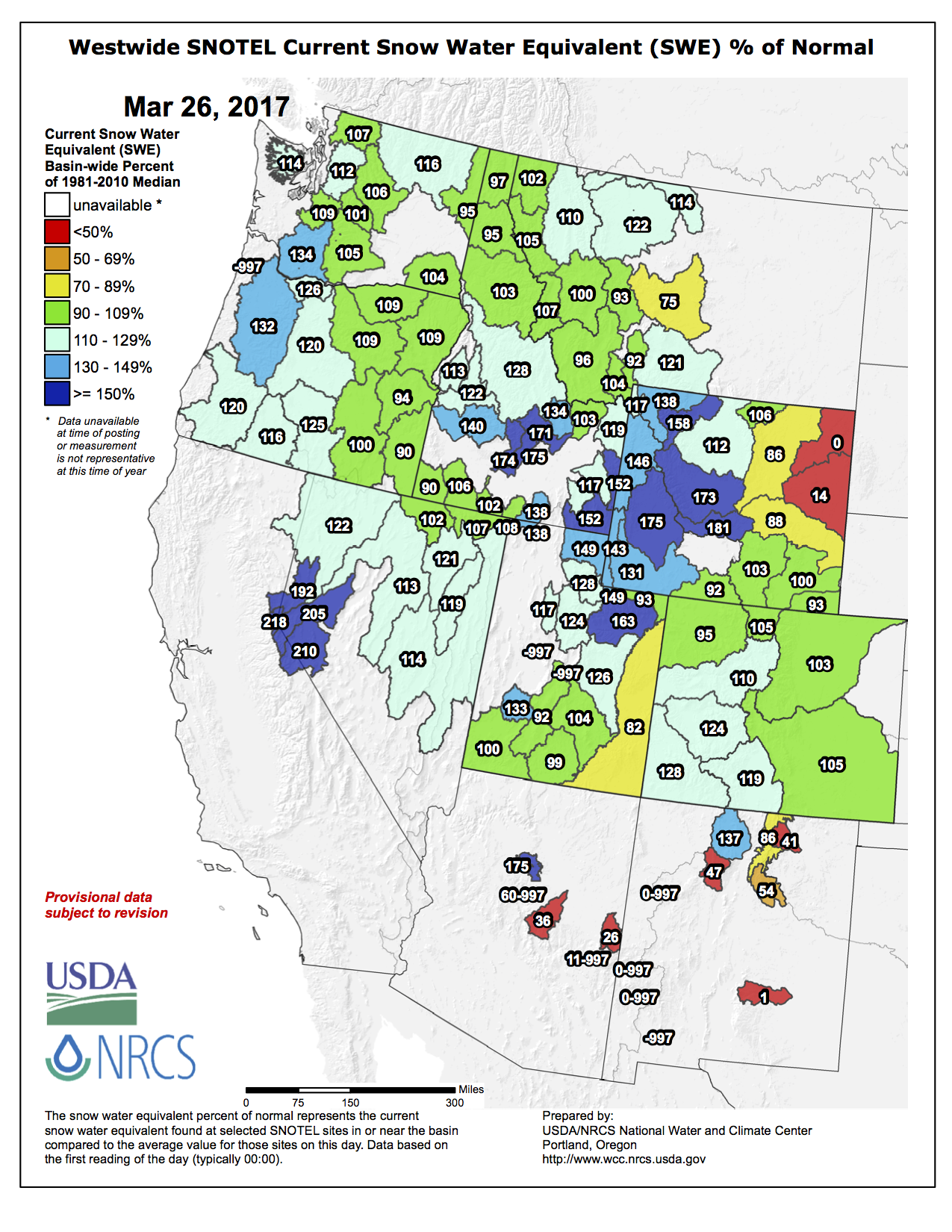
    Westwide SNOTEL basin-filled map March 26, 2017 via the NRCS.

    From The Fort Collins Coloradoan (Jacy Marmaduke):

    Weekend rains dropped up to half an inch of rain on parts of a parched Choice City, and more rain is on the forecast for this week. But with one week left of what’s historically our snowiest month of the year, forecasters are divided on whether we’ll see any measurable snow at all.

    The Coloradoan’s official Community Collaborative Rain, Hail & Snow Network rain gauge at 1300 Riverside Avenue recorded 0.16 of an inch of rain Sunday…

    Meanwhile, our lack of snow is becoming downright strange.

    Fort Collins receives an average of 12.6 inches of snow in March, according to 1981-2010 normals from the Colorado Climate Center. This March, we’ve received only a trace of snow. Fort Collins hasn’t seen measurable snow in about a month, since a late-February storm left us with about 3.4 inches and 0.1 inches fell on the last day of February.

    We’re also way behind on precipitation this month, with 0.19 inches compared to a normal amount of 1.31 inches by March 26. Rains this week should inch us a bit closer to the monthly normal of 1.59 inches, but barring any big downpours, we’ll probably still fall short for March.

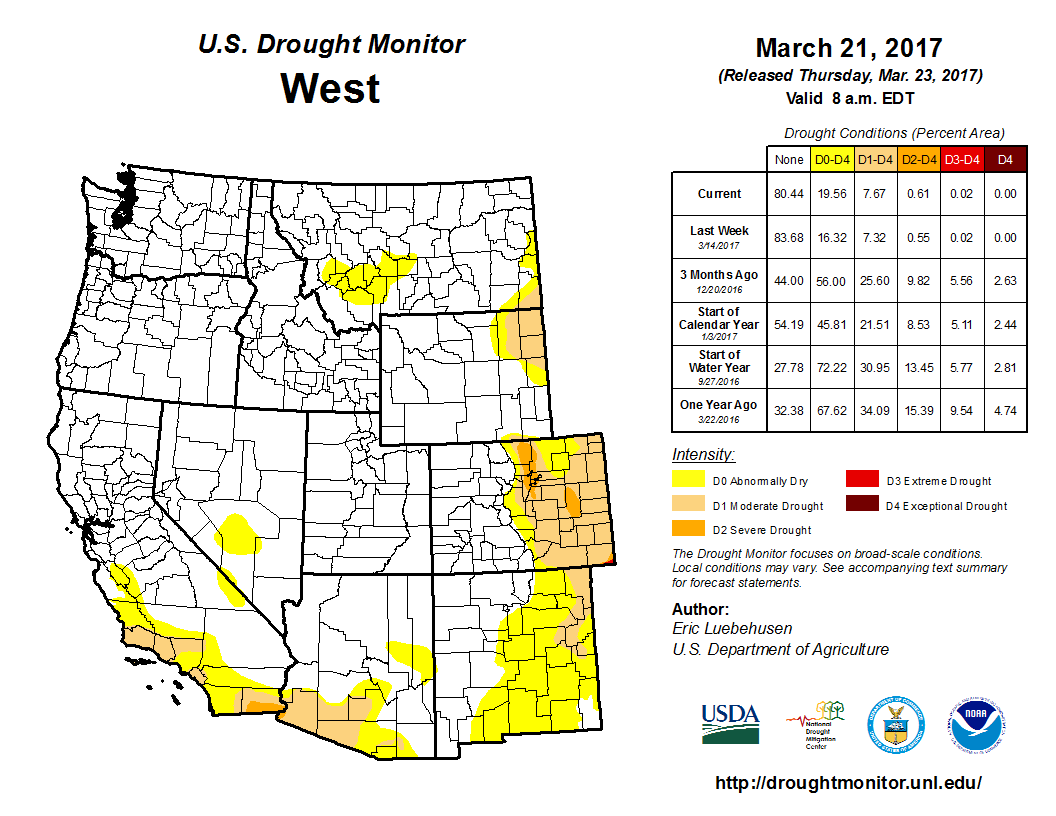
    The lack of moisture matters because Fort Collins has been in a drought since August. Our drought classification was recently elevated to “severe,” the third of five levels of drought intensity. The National Weather Service’s Climate Prediction Center predicts we’ll remain in drought during the next three months.

    If drought persists, residents can expect damage to crops and pastures, developing or imminent water shortages and a request for voluntary water-use restrictions. Snowpack in the South Platte River Basin mountains, which make up much of our regional water supply, has been steadily slipping during the last few weeks and now sits at 103 percent of the average for this time of year.

    A snowless March is highly unusual but not unprecedented in Fort Collins. It’s happened about six times in recorded history, most recently in 2011 and 2012, when historic drought covered the state and Fort Collins received a trace of snow in March. The last March before that with no measurable snow was March 1966.

    West Drought Monitor March 21, 2017.

    Poudre River Forum: Powerpoints, video footage, program and more now available

    CLick here to go to the website to view the materials. From the website:

    Nearly 280 people registered to learn more from and about the diverse stakeholders of the Poudre River, and to explore the continuing challenges and opportunities for collaboration.

    Poudre River Bike Path bridge over the river at Legacy Park photo via Fort Collins Photo Works.

    Will Fort Collins voters get a chance to weigh in on NISP?

    Northern Integrated Supply Project (NISP) map July 27, 2016 via Northern Water.
    Northern Integrated Supply Project (NISP) map July 27, 2016 via Northern Water.

    From The Fort Collins Coloradoan (Nick Coltrain):

    After hearing dozens of public comments, and having their email inboxes flooded with input, the council voted 6-1 late Tuesday night to take a place at the table with the Northern Water Conservancy District, the lead proponent of NISP and representative of 15 backers of the project. NISP would include two reservoirs fueled by the Poudre River, including one near the mouth of the Poudre Canyon.

    Council members were also clear that they didn’t view opening discussions as giving in to the project. Councilman Bob Overbeck — the only vote against it — added to the Tuesday resolution that the council outright opposed the project in 2008 and voted in 2015 not to support the project in its current form. The word “negotiate” and phrase “mutual interests,” referring to the city and Northern Water, were also struck from the resolution.

    Nonetheless, Gary Wockner, of Save the Poudre, said his group is looking at putting the question of whether the city should support NISP before city voters…

    Advocacy group Save the Poudre conducted an opinion poll, via 556 automated phone calls, which results found an overwhelming amount of opposition to the project among city voters.

    About 50 of the 60 or so people who made public comment Tuesday opposed the resolution or NISP outright…

    John Stokes, head of the city’s natural areas department, said Wednesday staff was happy to get more direction from council, in terms of having discussions with Northern Water regarding city concerns and mitigation proposals. He was also clear that staff didn’t view it as authority to make any decisions regarding the city’s support or efforts of NISP.

    “Council makes the decisions about all of this, and, clearly, if we’re going to make any progress on this, it needs to be with council on board,” he said…

    Brian Werner, spokesperson for Northern Water, said his group was grateful to be able to have more robust conversations about NISP with the city. There have been some talks with the city about its concerns, but it always felt “sort of like walking on egg shells,” without formal backing, Werner said.

    He noted Northern Water and its constituents have already shifted plans to address concerns about low-flow periods of when the Poudre River might dry up by including promises of base flows. Werner cited the city’s softening positions between 2008 and 2015 as proof of Northern Water’s efforts.

    “They’ve gone from an almost hell no, to a we’re not happy right now, but maybe make some changes and come back with another proposal,” Werner said. “… I would argue that shows we’ve been listening to Fort Collins as we’ve been trying to craft and draft this plan.”

    From The Rocky Mountain Collegian (Gabriel Go):

    Update: The council adopted an amended version of the resolution with a 6-1 vote. Bob Overbeck was the only dissenting vote.

    The Fort Collins City Council discussed Resolution 5217, which would begin discussions with the Northern Colorado Water Conservancy District, a public agency which provides water to northeastern Colorado, on Tuesday. The discussion revolved around a controversial proposal known as the Northern Integrated Supply Project.

    The NISP is a proposed project meant to deliver 40,000 acres of water a year to 15 Northern Colorado communities. While the city itself would not a participate in the NISP, a portion of southeastern Fort Collins would partake in the project.

    The NISP would consist of three reservoirs along the Cache La Poudre River, including a large reservoir to the north of the city known as Glade Reservoir which would divert over 1,200 cubic feet per second of the river’s peak flows. This would reduce annual river flows by 20 percent and by 30 percent during the peak flow months of May, June and July, a staff report said.

    However, the project is not without opposition. According to non-profit organization Save the Poudre, the NISP/Glade Reservoir project would cause immense ecological damage to the Poudre River.

    According to the organization’s website, the project’s aim of reducing peak flows would prevent the river from cleaning itself of algae, endangering the Poudre’s water quality as well as the habitat of a number of aquatic plants and animals.

    The staff report also acknowledges that “it is likely the health of the river will be negatively impacted by NISP, especially without well-planned and extensive mitigation actions.” The report states that although the river is able to support a number of ecological systems, the Poudre is approaching “critical thresholds below which the river’s health and resilience will suffer.”

    The city’s Natural Resources Director John Stokes recommended the City Council to begin discussions with the Northern Colorado Water Conservancy District. In particular, he recommended to negotiate with the public agency, saying it would be the best alternative outcome.

    If the city were to forego consulting with Northern Water the project would be left to federal and state agencies who would not consider the NISP’s impacts on Fort Collins.

    Close to 40 Fort Collins citizens approached the council for public comment, some urging the council to negotiate with Northern Water and some voicing their reservations.

    “I’ve noticed a marked decline in the river corridor already… I see virtually nothing anymore,” said one Fort Collins citizen about the current state of the Poudre.

    The city owns around 60 percent of the river’s corridor and the city has already engaged in a number of projects with regards to the Poudre, such as clean-ups and the creation of trails.

    Negotiations with Northern Water does not mean that the city has already agreed to the NISP’s construction. In order to construct the reservoirs a permit must be obtained from the U.S. Army Corps of Engineers who must assess the environmental impacts of the project.

    The NISP has been in the federal permitting process for 12 years and thus requires many state and federal permits in order for the project to push forward. In 2015 the council passed a resolution which stated “the City Council cannot support NISP as it is currently described and proposed (as of 2015).”

    @FortCollinsGov NISP meeting recap

    Northern Integrated Supply Project (NISP) map July 27, 2016 via Northern Water.
    Northern Integrated Supply Project (NISP) map July 27, 2016 via Northern Water.

    From The Fort Collins Coloradoan (Kevin Duggan):

    City staff members have proposed beginning in-depth discussions with Northern Water to explore areas of “mutual interest” and possibly negotiate an agreement. City Council would have to approve any agreement, if one were reached.

    Discussions with Northern Water, if approved by council, would be lengthy and touch on “endlessly complicated” details, said John Stokes, director of the city’s Natural Areas Department.

    Fort Collins is not among the 15 municipalities and water districts participating in NISP, though as a stakeholder it has been involved with the project’s permitting process for many years.

    In 2008 and 2015, the city submitted comments critical of the project to the U.S. Army Corps of Engineers, which is overseeing the Environmental Impact Statement process for NISP.

    The Corps and other state and federal agencies will be involved in determining mitigation measures for NISP, which would reduce flows on the Poudre through the city 20 percent a year on average and 30 percent during peak flows in spring.

    Experience tells the city it cannot rely on other entities to look out for the best interests of Fort Collins in assessing the negative impacts of NISP through town, Stokes said during a recent city-sponsored open house.

    “They are not likely, in our view, to require mitigation at a level that we think would be important to the city if we didn’t negotiate,” Stokes said…

    The final Environmental Impact Statement, or EIS, for the project is expected to be released by the Corps later this year. A record of decision on whether the project may be permitted is expected in 2018.

    If the project is permitted, construction could begin in 2025, city officials say.

    Discussions and negotiations between the city and Northern Water would be outside of the permitting process, said John Urbanic, project manager with the Corps of Engineers…

    Mitigation of environmental impacts are part of the permitting process. It’s possible a mitigation agreement between the city and Northern Water could be included in the permit, Urbanic stated in an email to the Coloradoan.

    Whether an agreement would facilitate a permit being issued “depends on what’s in the agreement,” he said.

    Fort Collins’ focus regarding NISP is on the area crossed by the river between the mouth of the Poudre Canyon and Interstate 25. The city owns several natural areas along the river corridor.

    Stokes said the city has many concerns about the impacts of lowering baseline and peak flows on the Poudre, including:

  • Reduced water quality and additional stresses on city water treatment facilities
  • Reductions in the health of the river’s ecology and biological resources
  • Reductions in the river’s ability to convey flood water
  • Diminished recreation and aesthetics
  • Specifics of what city staff would seek from Northern Water through negotiations and what it might have to do in return have not been determined, Stokes said.

    About 200 people attended a city-sponsored open house on the issue Monday at the Lincoln Center. Longstanding opponents and proponents of NISP were on hand, stating familiar positions.

    Lower South Platte Water Conservancy District board meeting recap

    Northern Integrated Supply Project (NISP) map July 27, 2016 via Northern Water.
    Northern Integrated Supply Project (NISP) map July 27, 2016 via Northern Water.

    From The Sterling Journal-Advocate (Jeff Rice):

    The Lower South Platte Water Conservancy District’s board of directors decided Tuesday to not object to a plan to move the proposed Galeton Reservoir from its original site.

    Galeton is part of the Northern Colorado Water Conservancy District’s controversial Northern Integrated Supply Project, which would use water from the Cache la Poudre and South Platte rivers to irrigate, provide domestic water, and bolster the Poudre through Fort Collins.

    Northern Water originally planned to build the reservoir on the southeast side of Colorado Highway 14 near Galeton, but in the 10 years since the project was proposed Nobel Energy has drilled almost two dozen oil and gas wells in the area. Those wells would have to be capped, at tremendous cost to Northern, in order to use the site for a reservoir.

    Northern has applied to have the water rights instead transferred to land on the northwest side of the highway.

    LSP board member Brad Stromberger, who also is on the Northern board of directors, said the Berthoud-based water district is “in the design stages” on the project already and plans to begin construction on the reservoir within about five years.

    “This is a big project,” he said. “This is a new water source we need.”

    The LSP’s water lawyer, Kim Lawrence, had recommended that the district file an objection to Northern’s request. Such objections are commonplace primarily to get access to crucial engineering and financial information about water projects. LSPWCD has previously gone on the record as being entirely in support of NISP, and during Tuesday’s meeting the district’s manager, Joe Frank, cautioned that objecting to the change in the Galeton application could be used by NISP opponents to claim that the lower South Platte doesn’t support NISP.

    “We could, potentially, see about 10,000 acre feet of return flow per year from this project,” Frank told the board. “There might be a day here and there when they would take water that might have come down (the South Platte River) but the return flows will more than make up for that.”

    After a brief conference call with Lawrence, the board decided to not take any action on the Galeton Reservoir…

    The board did, however, vote to file an objection to an application by the Arapahoe County Water and Wastewater Authority to pipe 1,500 acre feet of water from the South Platte River into the off-channel Binder Reservoir, also known as the Brighton Lateral Reservoir. ACWWA wants to use the water to exchange with other water entities along the river. Lawrence’s recommendation to the LSP was to file an objection because the proposed project “affects many (irrigation) ditches in this reach.”

    Michigan Ditch: “the biggest excavators we could bring in were nearly hanging off the edge of the mountain on the way up” — John Beckos

    Aerial view of Michigan tunnel entrance via City of Fort Collins.
    Aerial view of Michigan tunnel entrance via City of Fort Collins.

    From TrenchlessTechnology.com (Jim Rush):

    The Michigan Ditch is a 5.2-mile conveyance system that brings water from the high mountains into the Joe Wright Reservoir, a part of City’s two water sources. Over the years, the Michigan Ditch, a combination of pipeline and open channel originally built around 1900 and purchased by Fort Collins in the 1970s, was subject to the whims of Mother Nature. Specifically, one portion of the water supply route that crosses an area known as “the mudslide” was subject to periodic damage when the slides occurred.

    The City was accustomed to making simple repairs that involved digging up the pipe and moving or replacing it when the slide moves. But in September 2014, crews noticed something unusual. The pipe, which typically moved only during snowmelt in the spring, had moved substantially since its repair that summer. The following spring, even more movement showed that a more permanent fix was needed.

    “It was apparent that this wasn’t something we could simply dig up and put back in place like previous years,” said Owen Randall, chief engineer for Fort Collins Utilities. “We knew we needed a long-term solution that could cost upwards of $10 million. When I told City management the response was: ‘The water is worth $180 million, so go fix it.’”

    In summer 2015, the City got to work with a geotechnical assessment that included seismic refraction as well as vertical and horizontal borings. Meanwhile, the City put together a team of consultants and contractors to help ascertain the best way to move forward. After exploring the options, the team decided that a tunnel that would re-route the water through the mountain in stable rock was the best solution…

    The tunnel option provided the long-term solution the City was looking for while having the added benefits of less maintenance, less environmental impact and a construction cost comparable to other options…

    The logistics of working on the side of a mountain also presented challenges. The project site was located 2.5 miles up a narrow, winding dirt road that dictated the weight and dimensions of the equipment that could be safely transported. Additionally, the nearest town (Walden, Colorado; population 3,000) was located 30 miles away, with Fort Collins 70 miles away. Even cell phone service had to be brought in.

    “Due to the nature of the road, we were limited to about an 11-ft wide load,” said John Beckos, project manager for BT Construction. “We were unable to get a crane to the site, and the biggest excavators we could bring in were nearly hanging off the edge of the mountain on the way up.”

    The site access also dictated the type of tunnel boring machine that could be used to excavate the tunnel. After evaluating the options, the project team elected to use an Akkerman hard-rock TBM that had a mixed face cutterhead to deal with the highly fractured, hard rock and abundant fault and shear zones. The machine was compact enough to accommodate the limited space at both the launch and retrieval pits, light enough to be handled by the available equipment, and had enough power to drill through rock that reached strengths of 15,000 psi…

    The tunnel was mined from the downstream portal to the upstream portal. The first 40 ft of the alignment was straight before it transitioned into the 630-ft radius curve spanning 726 ft. The TBM was equipped with a conveyor system and dual muck boxes to remove the spoil. Spoil was stockpiled near the site to be used by the City for future repairs to the ditch and pipeline, as well as the access road, which the City also maintains…

    Randall said the ground made tunneling a challenge. “The only thing consistent about the ground was that the rock was inconsistent,” he said. “We would find hard zones 2-3 inches thick, 2-3 feet thick and 30-feet thick. We knew we were going to get into difficult geology, but it still posed a challenge.”

    Once the TBM was completely launched into the mountainside, the team had originally planned to be tunneling for about 6 weeks from early July through the middle of August. The inconsistent rock in the middle of the drive would end up slowing productions down and delaying the hole out until Sept. 29. And, despite the challenging ground, the TBM holed through precisely on target. Project team members credited the VMT guidance systems, typically used for larger and longer tunnels, for keeping the tunnel on line and grade…

    Over the last 20 years, Fort Collins has implemented and refined its delivery system known as the Alternative Product Delivery System (APDS). Fort Collins retains a group of prequalified contractors and consultants on an annual contract basis – known as master service agreements – and when a project is needed, the City can call on its team of service providers with expertise in a particular area to negotiate a contract. This allows the City to quickly gather a team to develop the project from start to finish.

    In the case of the Michigan Ditch Tunnel, the project team was brought on board to determine the best solution for the problem. As the project began to take shape as a tunnel, the City negotiated further contracts for tunnel design, construction and TBM procurement. The project team additionally developed a risk register to help identify and mitigate potential occurrences that could impact the project.

    “Rather than trying to write a contract for the whole project up front, we can write contracts that are very well defined, knowing what our scope of work is going to be as planning and design progresses,” Randall said.

    The added benefit of having the project team in place was that the project goals were defined by the team, rather than by an individual party or parties. “This was a very challenging and difficult project, but when you have everybody working toward the same goal, it makes all the difference in the world,” Randall added.

    “The team functioned at a very high level and with great communication,” Dornfest said. “It was extremely challenging, but there was never any finger pointing and we were able to get the job done on schedule and under budget.”

    Thanks to planning, teamwork and determination, the Michigan Ditch Tunnel project was successfully completed approximately $1 million below the initial budget of $8.5 million. The ditch system is now back online, assuring Fort Collins citizens of a reliable source of water for the years to come.

    Fort Collins water facility wins prestigious award — Fort Collins Coloradoan

    The water treatment process
    The water treatment process

    From The Fort Collins Coloradoan (Jacy Marmaduke):

    Fort Collins Utilities’ water treatment facility recently won the American Water Works Association’s “Presidents Award,” which was given to 34 treatment plants in the nation.

    The award honors water treatment plants with high-level filter performance. The Fort Collins facility uses a meticulous treatment process to remove potential contaminants from source water, and the end product has consistently met federal safety requirements and won accolades for taste.

    “Receiving the Presidents Award status demonstrates the hard work and dedication of our employees and their commitment to provide great-tasting, high-quality drinking water to our community,” Water Production Manager Mark Kempton said in a city press release.

    For more information on local water, visit http://fcgov.com/water , email utilities@fcgov.com, call 970-221-6700 or V/TDD 711. To learn more about the Partnership for Safe Water, visit http://awwa.org/partnership.

    ‘As the Poudre Flows — Forest to Plains’ theme of Poudre River Forum

    Scott Hummer, general manager of North Poudre Irrigation Company, talks about how his agency worked with Fort Collins Natural Areas and Colorado Parks and Wildlife to include a fish passage when the irrigation company replaced a diversion structure on the Poudre River that was destroyed by the 2013 floods. Work was completed [in February 2016]. (Pamela Johnson / Loveland Reporter-Herald)
    Scott Hummer, general manager of North Poudre Irrigation Company, talks about how his agency worked with Fort Collins Natural Areas and Colorado Parks and Wildlife to include a fish passage when the irrigation company replaced a diversion structure on the Poudre River that was destroyed by the 2013 floods. Work was completed [in February 2016]. (Pamela Johnson / Loveland Reporter-Herald)

    Here’s the release from Colorado State University (Jim Beers):

    The Cache la Poudre River, which flows from the mountains through Fort Collins, Timnath and Windsor to the plains east of Greeley, is at the heart of countless activities: from irrigating crops and lawns to providing drinking water for more than 365,000 people and hosting numerous recreational activities.

    Those with connections to and concerns for the Poudre River will gather on Friday, Feb. 3 for the fourth annual Poudre River Forum. After its first three years at Larimer County Fairgrounds, the forum is moving down the river to Greeley as a reminder that the Poudre River is important to all who benefit from it — from its headwaters to its confluence with the South Platte. This year’s forum — the theme is “As the Poudre Flows — Forest to Plains” — will be held from 8:30 a.m.-4:30 p.m. at the Island Grove Events Center, 501 N. 14th Ave., Greeley. Pre-registration is required for all participants.

    Understanding the river, each other

    Sponsored by the Poudre Runs Through It Study/Action Work Group, the forum serves as a community-wide gathering of people from agricultural, municipal, business, recreational and environmental backgrounds to learn about and discuss issues related to the Poudre River.

    “The Poudre River Forum brings together those who use the river for agricultural and urban diversions and those who work to improve its ecological health. In the past those groups have not necessarily seen eye to eye,” said MaryLou Smith, PRTI facilitator. “Increasingly our participants are open to the idea that it takes collective vision and action to make the Poudre the world’s best example of a healthy, working river.”

    Once again, this year’s event will be facilitated by the Colorado Water Institute at Colorado State University. “The Forum is a great opportunity for the communities connected by the Poudre River to come together to better understand the entire watershed, and each other,” said Reagan Waskom, director of CWI.

    Forests and water quality/quantity

    Laurie Huckaby with the U.S. Forest Service, will present “The last 1,000 years in the Poudre according to the trees,” to kick off the topic of how important the upper watershed is to water quantity and quality.

    “Water quality and forests are inextricably linked,” said Joe Duda of the Colorado State Forest Service, who will join Huckaby as one of the presenters. “Forest conditions and insects, disease and fire all can have profound impacts on water flow and quality. Only healthy, resilient forests can continuously supply clean water.”

    Global lessons for local success

    “Finding the Balance: Managing Water for People and Nature” is the message of keynote speaker Brian Richter. Richter has been a global leader in water science and conservation for more than 25 years, and currently serves as chief scientist for the Global Water Program of The Nature Conservancy in Washington D.C. Richter’s ideas about the importance of recognizing the balance of working river/healthy river are the basis for which PRTI was initially formed. He has consulted on more than 120 water projects worldwide, and has served as a water advisor to some of the world’s largest corporations, investment banks, the United Nations, and has testified before Congress on multiple occasions. Richter co-authored,with Sandra Postel, the 2003 book Rivers for Life: Managing Water for People and Nature and in 2014 wrote Chasing Water: A Guide for Moving from Scarcity to Sustainability.

    Change affects all sectors

    An afternoon panel session will probe the impacts of change — positive and negative — along the Poudre River and how they have been similarly and differently addressed by agriculture, urban, and environmental sectors. They will discuss what anticipated future changes might these three sectors see as opportunities or incentives for mutually beneficial collaboration that could result in a healthier, working river?

    “It has been said that the only thing that is constant is change,” said John Bartholow, retired ecologist from U.S. Geological Survey, and panel coordinator/moderator. “The question is, can we learn to adapt to those changes sure to come on the Poudre in ways that benefit agriculture, municipalities, and the environment?”

    The panel will include Eric Reckentine, deputy director, City of Greeley Water and Sewer; John Sanderson, director of science, Nature Conservancy of Colorado; and Dale Trowbridge, general manager, New Cache la Poudre Irrigating Company.

    Videos, displays and music too

    The day-long forum also includes “River Snapshots” highlighting more than 15 projects undertaken by a variety of groups on the Poudre last year; “My How the Poudre Has Changed,” featuring historical 1970’s footage of the Poudre; updates from both the cities of Greeley and Fort Collins on current water programs; and over two dozen river-focused displays from community organizations and agencies. The day concludes with a social hour including food, beer and other beverages, and river-themed door prizes.

    Registration is $50 and includes lunch. Scholarships for students and reduced rates are available. The deadline to register is Friday, Jan. 27 at http://prti.colostate.edu/forum_2017.shtml.

    For more information, contact event coordinator Gailmarie Kimmel at PoudreRiverForum@gmail.com or 970-692-1443.

    Big snow for Fort Collins

    Westwide SNOTEL basin-filled map via the NRCS.
    Westwide SNOTEL basin-filled map via the NRCS.

    From The Fort Collins Coloradoan (Jacy Marmaduke):

    It never looked like a blizzard outside, but three straight days of snow landed Fort Collins with upwards of 9 inches in the city’s northern reaches and at least 7 inches everywhere else by the end of Thursday. That makes it the biggest snow storm Fort Collins has seen this season and pushed the city above its average for this time of year.

    “Water storage is ‘integral’ to Fort Morgan’s future” — Ron Shaver

    Northern Integrated Supply Project July 27, 2016 via Northern Water.
    Northern Integrated Supply Project July 27, 2016 via Northern Water.

    From The Fort Morgan Times (Jenni Grubbs):

    A community that does not have enough water is a community that does not survive, and Fort Morgan city leaders want to ensure that is not what happens here.

    As such, the Fort Morgan City Council approved continuing the city’s role in the Northern Integrated Supply Project and the $360,000 expenditure that will require in 2017.

    Fort Morgan has been gambling on NISP, a massive water storage project, getting permitted and built for 13 years now, according to Water Resources/Utilities Director Brent Nation.

    But it’s a gamble that could pay off in water security for as long as the next five decades, according to City Manager Jeff Wells.

    About NISP

    That’s because NISP would include Northern Colorado Water Conservancy District (aka Northern Water) building both Glade Reservoir north of Fort Collins and Galeton Reservoir northeast of Greeley and east of Ault.

    If these reservoirs get built, it would mean “40,000 acre feet of new, reliable water supplies” for the 15 NISP participants, which include Fort Morgan, Morgan County and Morgan County Quality Water District.

    But getting it built involves both completion of the final environmental impact statement for he project and getting a record of decision on a permit from the U.S. Army Corps of Engineers.

    As of January 2017, Northern Water was estimating that the Corps likely will finish the FEIS yet this year and then issue the record of decision on the permit sometime in 2018.

    Large cost, lengthy timeline

    Fort Morgan, alone, will have spent more than $1.3 million toward NISP and the city’s 9 percent stake in it over the project’s 13 years of planning and studies. And there could be another 10 to 12 years yet to go before NISP and its reservoirs conceivably would go online and the city would have water stored in Galeton Reservoir and pumped back to Fort Morgan.

    As the project progresses, the city’s annual payments for it will get larger and larger, Nation warned. He called the 2017 one among the last of the “smaller payments.”

    Depending upon what the Corps does this year, the larger NISP payments could start next year.

    “Next year, in 2018, we’ll start moving into the larger engineering payments, and then hopefully within a year or two after that we’ll be moving into construction-type payments, where we’re getting into millions of dollars for our portion of that work,” Nation said.

    Regardless, if and when it does get built, NISP would provide enough water to give the city water security for the future and whatever residential, commercial and industrial growth may come, according to Mayor Ron Shaver, Wells and Nation.

    And such a lengthy timeline is not unusual for this large of a water storage project, according to both Nation and officials from Northern Water.

    Reasons to continue

    But continuing to support it will be worth it for the city in the long term, Nation stressed.

    He shared his reasons why the city should “move forward on this project” with the council.

    “We continue to exist on a base water supply that we have to rent what we need for our current needs. We still have times of the year where we’re using some rental C-BT water in order to meet all of our water demands,” Nation said.

    Also, the Fort Morgan Water Treatment Plant is experiencing record levels for demand for treated water, with 1.5 billion gallons treated over the last 12 months.

    “Six out of the last seven months we had record production at treatment facility,” Nation said, adding that the local industry was “driving those numbers.”

    Specifically, large industrial water customer Cargill Meat Solutions is continuously pulling in water.

    “We’re not seeing a lot of downtime with Cargill,” Nation said. “And even when they’re down on that seventh day, they’re using a lot of water just to clean the facility.”

    And expansions at both the Leprino Foods cheese plant and the Western Sugar Cooperative beet plant have meant increased demand for water from Fort Morgan.

    “We just continue to see our industrial/commercial numbers go up as we continue just to exist at the current population that we’re at,” Nation said. “It kind of drives home to me that this project is important to us. It’s something that we need to continue to participate in and see it to the finish line. This is something we need as a community.”

    Wells agreed, adding that the city has previously looked into many other options for obtaining enough water for the city’s future.

    “Today, there are no more viable alternatives than NISP for the city of Fort Morgan,” he said.

    Shaver, who served as the city’s utilities director before retiring from the city and then serving on the council and now as mayor, said NISP is what the city needs for its future.

    Northern Integrated Supply Project (NISP) map July 27, 2016 via Northern Water.
    Northern Integrated Supply Project (NISP) map July 27, 2016 via Northern Water.

    Poudre River Forum February 3, 2017

    Click here to register.

    http://www.reporterherald.com/news/ci_30684388/big-t-river-rehab-begin

    Flood damage Big Thompson Canyon September 2013 -- photo via Northern Water
    Flood damage Big Thompson Canyon September 2013 — photo via Northern Water

    From The Loveland Reporter-Herald (Pamela Johnson):

    This year, actual work will begin to repair habitat along and inside several stretches of the Big Thompson River through a grassroots group, The Big Thompson Watershed Coalition, that formed after the 2013 flood.

    “2017 is going to be a big year for projects happening on the ground,” said Shayna Jones, watershed coordinator with the coalition. “We’re talking millions of dollars in river restoration.”

    A couple of projects through the coalition have already begun, but several others are going to kick off in 2017. Early in the year, the coalition will put out bids for a contractor to work on a stretch about a mile long from Jasper Lake through Narrows Park, which is in the lower section of the canyon.

    Estimated to cost $900,000, the project will include stabilizing sections of the banks, planting vegetation and creating what are called flood plain benches to allow the water space to spread out in the event of a future flood, explained Jones and Tracy Wendt, assistant watershed coordinator.

    The work also includes improving fish habitat in several ways, such as building pools within the river and planting vegetation in strategic places to provide shade and cover.

    “There will be habitat improvements for all different life stages of trout,” Wendt said. “It’s all the phases of their life to help them.”

    Because of the fish habitat component, the coalition, in partnership with Rocky Mountain Flycasters, recently received a $4,500 grant from the Trout and Salmon Foundation. And the Flycasters, a local chapter of Trout Unlimited, also contributed $2,000 to the project.

    The bulk of the funding, about $500,000, will come from the Natural Resources Conservation Service with the rest of the money from the Colorado Water Conservation Board, Jones explained.

    This piece of the river winds through both private and public properties and ends just before the Narrows near the Colorado Cherry Company.

    Other projects also are planned further west along the river with more money coming from the NRCS and the Colorado Water Conservation Board. The exact amounts of money and grants are still being finalized, though Jones did confirm the total work would be in the millions.

    Other projects to rehabilitate the river and river corridor are occurring simultaneously including one that will begin in 2017 as a partnership with the coalition and Sylvan Dale Guest Ranch.

    Work began in October and will continue this spring on West Creek, and other improvements began two weeks ago on Fox Creek. Both, located along the North Fork near Glen Haven, are being built in partnership with Larimer County, NRCS and the Colorado Water Conservation Board.

    Also, Larimer County, private property owners, Colorado Parks and Wildlife and Colorado Department of Transportation officials are working on separate stretches of the river, with everyone working together for overall river benefit.

    “We’re making sure our projects are complementing each other to make for an overall healthy watershed,” Jones said.

    She expects the work to continue over the next three years as the Colorado Department of Transportation completes the permanent repairs of U.S. 34, which also include massive river restoration work.

    The November 2016 eWaterNews is hot off the presses from @Northern_Water

    First water through the Adams Tunnel. Photo credit  Northern Water.
    First water through the Adams Tunnel. Photo credit Northern Water.

    Click here to read the newsletter. Here’s an excerpt:

    The C-BT Project water year ended on Oct. 31. C-BT Project storage levels on Nov. 1 were above average for a third consecutive year, with 548,274 acre-feet in active storage. The Nov. 1 average is 444,177 AF. Deliveries increased in 2016 over 2015 levels, with 204,078 AF delivered (including quota, Carryover Program and Regional Pool Program water). Forty-six percent of the deliveries were from Horsetooth Reservoir, 40 percent from Carter Lake and the remaining 14 percent went to the Big Thompson River, Hansen Feeder Canal and the South Platte River. Estimated deliveries to municipal and industrial users totaled 102,157 AF, while agricultural deliveries were approximately 101,921 AF.

    How Fort Collins’ biggest brewery reduced its thirst — Fort Collins Coloradan

    Photo credit Colorado Brewed.
    Photo credit Colorado Brewed.

    From The Fort Collins Coloradoan (Jacy Marmaduke):

    Anheuser-Busch’s Fort Collins facility reached a water-to-beer ratio of about 2.9 gallons this year, the lowest of the city’s 21 breweries.

    Brewery leaders say there’s still plenty of wiggle room for water conservation, especially for a facility that churns out about 10 million barrels of beer each year using only Fort Collins Utilities water from Horsetooth Reservoir and the Cache la Poudre River. That’s a lot of water to make the brewery’s popular beverages, and with the city entering its first weeks of severe drought, the spotlight on conservation is as bright as ever.

    “Every year, we’re watching that snowpack,” A-B senior brewmaster Katie Rippel said. “It can turn on a dime. We’ve had a couple good winters in a row — I call it fat, dumb and happy — but it was only a few years ago when that wasn’t the case.”

    A-B’s water use decreased 11 percent between 2011 and 2015, thanks in part to a tweak that allows re-use of the water used to rinse the brewery’s towering fermentation tanks.

    The brewery didn’t provide its total water usage, but Coloradoan calculations indicate it now uses upwards of 900 million gallons of water each year, equal to the annual water use of about one-sixth of Fort Collins households. The estimate comes from the brewery’s water-to-beer ratio and its 2014 production volume.

    Brewer Bill Workman, who designed and implemented the rinsing water change with maintenance technician Tim Burge, came up with the idea after noticing how much water and yeast drained out of the brewery’s massive, multi-story fermentation tanks during rinsing.

    Workman, a Berthoud native who’s worked at A-B since the year after it opened in 1988, wondered if all that water could be re-used in earlier steps of the brewing process.

    “We were told it couldn’t be done,” he recalled during an interview in the brewery’s upper-level tasting room. “We were like, ‘Wanna bet?’ Katie said, ‘Go find a way.’

    Workman and Burge spent close to a year engineering a programming pathway for their idea that wouldn’t sacrifice the quality of the brewery’s two-dozen-odd beers or interfere with other parts of the brewing process.

    The change was fully implemented in summer of 2015 and saves about 800,000 gallons of water each year. Other North American A-B breweries are now starting to implement the change and finding comparable water savings.

    Other conservation methods have helped the brewery reduce its water use, including installation of low-flow nozzles on every tank, re-use of water throughout the cleaning and bottling process and technology that helps brewers determine when equipment is truly clean, reducing rinse water.

    The floor for water use is about 1 gallon of water for every gallon of beer, plus a smaller amount used for cleaning, Rippel estimated.

    “Everything else is on the table,” she said, adding the brewery will next look for even more ways to re-use water and cut down on water used during cleaning.

    Water conservation means cost savings for the brewery, which pays for its Fort Collins Utilities water like any other customer. It also means something more personal to employees, many of whom have worked in the brewery and lived in the Fort Collins area for decades.

    “That’s why we’re trying to minimize our impact: All of us love the area we live in,” Rippel said. “I mean, we want to be good corporate citizens, but it’s more about, ‘I live here, and I’m using the same water to brew that I’m using at home.’ So I’m protecting mine.”

    Water usage at other Fort Collins breweries

  • The Nos. 2 and 3 breweries for production, New Belgium Brewing Co. and Odell Brewing Co., respectively use about 4 gallons and 3.6 gallons of water per gallons of beer produced. Economy of scale makes it difficult for smaller breweries to achieve the same water savings as larger producers.
  • The industry average water-to-beer ratio is about 7:1, according to the Brewers Association
  • .

    CCWCD closes on two projects

    Geisert Reservoir photo via the Central Colorado Water Conservancy District.
    Geisert Reservoir photo via the Central Colorado Water Conservancy District.

    Here’s the release from the Central Colorado Water Conservancy District (Randy Ray or Kathy Parker):

    ““CCWCD is pleased to announce the acquisition Geisert Reservoir. Every opportunity CCWCD can, we partner with good people such as Weld County – it’s proven to be a win-win for the two agencies. The support of the Weld County Commissioners regarding irrigated agriculture is so impressive, the residents of Weld County have to be proud.” –Randy W. Ray – CCWCD Executive Director

    “CCWCD staff and Board of Directors constantly evaluate projects which provide the best benefit for our constituents as economical as possible. The CCWCD Board was successful in siting a diversion point on the South Platte River for the Bijou Hill Recharge Project – will provide a supply of water to the South Platte River when operational that will last for years.” — Randy W. Ray – CCWCD Executive Director

    Central Colorado Water Conservancy District and Weld County Commissioners formally executed a closing on Geisert Reservoir November 8th. This water storage project takes advantage of a mined-out gravel pit on the north bank of the Cache La Poudre River, near 11th avenue, in north Greeley. Geisert Reservoir has a perimeter slurry wall that limits interaction of groundwater, the slurry wall liner was tested and approved by the Colorado Division of Water Resources. The reservoir capacity is 1,257 acre-feet and should be full by the end of November. The water being used to fill Geisert Reservoir during the months of November and December originates from a lease with the City of Thornton and other water supplies owned by CCWCD upstream of Greeley. The water will be held in storage for a short time period and released in approximately January of 2017 for augmentation of Central’s 1,000-member agricultural irrigation wells. The CCWCD agricultural members are located in parts of Adams, Morgan and Weld Counties.

    A second closing was held on November 10th for CCWCD’s Bijou Hill Recharge Project in western Morgan County near the town of Orchard, Colorado. This land near the South Platte River will become a new point of water diversion in which water will be pumped south of the river several miles to recharge projects. These recharge projects include ponds which will be constructed as shallow infiltration basins with the intent of rapid seepage into the underlying groundwater aquifer. The water after delivered to the groundwater aquifer becomes as water supply to be used for augmentation of agricultural wells in CCWCD’s plans of augmentation which include roughly 1,000 wells in parts of Adams, Morgan and Weld Counties. The groundwater recharge project will be a tremendous benefit to the CCWCD augmentation plans operated by the CCWCD Sub-Districts – the Groundwater Management Subdistrict and the Well Augmentation Subdistrict.

    Augmentation plans are Water Court decreed legal agreements which allow irrigation wells to pump out of priority while preventing injury to more senior water rights using projects such as Geisert Reservoir and Bijou Hill Recharge.

    Bijou Hill Recharge and Geisert Reservoir will not only help farmers and livestock producers with their needed water supplies, but also offer an added benefit of creating new wildlife habitat and water quality improvements.

    CCWCD – Where the Future Flows

    If you would like more information about this topic, please contact Randy Ray or Kathy Parker at 970-330-4540 or email at rray@ccwcd.org

    South Platte River alluvial aquifer
    South Platte River alluvial aquifer

    TOUR de POUDRE, October 23, 2016

    fish-on-bicycleviathescarletdogma

    Click here for all the inside skinny. Here’s an excerpt:

    Please join Save The Poudre at the first bike “TOUR de POUDRE!” Come dressed as your favorite river species, or just come dressed! We’ll ride along the Poudre River bike trail from Watson Lake in Bellvue downstream to the Environmental Learning Center, and then rendezvous at Avogadro’s for libations and cheer.

    Fort Collins: Water and sewer rate hikes in the works for budget

    Fort Collins back in the day via Larimer County
    Fort Collins back in the day via Larimer County

    From the Fort Collins Coloradoan (Kevin Duggan):

    The recommended 2017-18 budget for Fort Collins calls for higher rates in all of the city’s utilities — electrical, water, wastewater and stormwater. Inflation and higher operating costs are driving the proposed increases, but so are long-range plans to build and maintain costly infrastructure needed to provide services to a growing community, said Mike Beckstead, the city’s chief financial officer.

    Although charges would vary, the proposed rate increases would add approximately $6.29 per month to the average residential customer bill in 2017, bringing average monthly payments to $166.69. Another $4.65 per month would be added in 2018.

    Overall rates for water service would increase 5 percent in 2017 and 2018, wastewater service would increase 3 percent each year, and stormwater charges would increase 5 percent next year but would not change in 2018.

    Those increases would help the utilities build up funds to pay for projects in 10-year capital improvement plans, said Lance Smith, strategic financial director for utilities…

    Reducing the water and stormwater rate increases from 5 percent to 3 percent would in 2017 save the average residential customer about $1.15 a month, Smith said.

    Without the 5 percent increases, plans to hire two full-time water conservation specialists and a construction inspector would have to wait a year, Smith said. A $1.4 million project to rehabilitate Mail Creek in southeast Fort Collins would not be funded.

    Utilities projects currently funded in the proposed budget include:

  • Replacement of aging water mains in high-priority areas: $1.9 million in 2017; $1.35 million in 2018.
  • Replacement of infrastructure in the city’s Water Quality Lab: $1.3 million each year.
  • Replacement of a raw water line running from the Poudre River to the city’s water treatment facility: $800,000 in 2017.
  • Replacement of equipment used to remove water for wastewater sludge and stabilize biosolids to be spread at Meadow Springs Ranch: $2.1 million each year.
  • Improvements to the oxbow levee on the Poudre River and to keep the Buckingham neighborhood out of the designated 100-year floodplain: $850,000 in 2017.
  • Construction of the third phase of a stormwater system between Lemay Avenue and Redwood Street: $1.6 million in 2017; $1.7 million in 2018.
  • The addition of 10 full-time employees in a variety of roles, including conservation programs: $793,000 in 2017.
  • […]

    The council is scheduled to adopt the budget in November. For online information about the budget, visit http://fcgov.com/budget.

    Michigan Ditch tunnel hits daylight

    Boring machine photo via City of Fort Collins.
    Boring machine photo via City of Fort Collins.

    From The Fort Collins Coloradoan (Kevin Duggan):

    The rotating cutting wheel of a custom-built tunnel boring machine began to slowly emerge from a mountainside around 5 a.m., said Owen Randall, chief engineer with Fort Collins Utilities.

    The breakthrough was an exciting moment for crews that have been working on the 760-foot-long tunnel near Cameron Pass since June…

    Crews still have four to six weeks of work to wrap up the project, which will carry Michigan Ditch and its valuable water to city-owned Joe Wright Reservoir.

    Dismantling and removing a tunnel boring machine from the mountain will take three to four days. Hydraulic and electronic equipment used to operate the machine will be stripped from the tunnel before a 60-inch diameter pipe is installed to carry the water.

    Weather could be a challenge as crews hustle to wrap up the project before heavy snowfall comes to the area. A few inches of snow fell last weekend, Randall said, but has since melted away…

    Crews have been working on the project 24 hours a day since mid-September to make up for delays caused by equipment problems and the challenge of cutting through exceptionally hard rock.

    Michigan Ditch provides the city with 2,000 to 3,000 acre-feet of raw water a year. The water is used to meet return flow obligations on the Poudre River mandated through various water-exchange agreements.

    The market value of water supplied through the Michigan Ditch-Joe Wright Reservoir system is about $180 million, according to the city.

    The tunnel project is in response to a slow-moving landslide that has been affecting the ditch for several years. Damage was especially severe in 2015.

    City officials decided to protect the piped ditch by sending it through bedrock that the slide can’t affect. The project is expected to cost Fort Collins Utilities about $8.5 million.

    For more information on the project, see http://fcgov.com/michigan-ditch-tunnel.

    Joe Wright Reservoir (Courtesy of Dick Stenzel at the Applegate Group) and the City of Fort Collins.
    Joe Wright Reservoir (Courtesy of Dick Stenzel at the Applegate Group) and the City of Fort Collins.

    Michigan Ditch tunnel update

    Joe Wright Reservoir (Courtesy of Dick Stenzel at the Applegate Group) and the City of Fort Collins.
    Joe Wright Reservoir (Courtesy of Dick Stenzel at the Applegate Group) and the City of Fort Collins.

    From the Fort Collins Coloradoan (Kevin Duggan):

    After overcoming equipment problems and putting in 24-hour work days, crews on Wednesday were within 35 feet of reaching the end of what will be a 764-foot-long tunnel.

    “We’ve made tremendous progress …,” said Owen Randall, chief engineer with Fort Collins Utilities. “We should be out sometime (Thursday) or Friday at the very latest.”

    Breaking through the mountain will be done slowly and carefully to avoid destabilizing the mountainside, he said.

    Crews still have four to six weeks of work to wrap up the project, which will carry Michigan Ditch and its valuable water to city-owned Joe Wright Reservoir near Cameron Pass.

    Dismantling and removing a custom-built tunnel boring machine from the mountain will take three to four days. Hydraulic and electronic equipment used to operate the machine will be stripped from the tunnel before a 60-inch diameter pipe is installed to carry the water.

    Colorado communities worried about glacier water supplies — The Pueblo Chieftain

    Big Thompson River near RMNP
    Big Thompson River near RMNP

    From the Associated Press via The Pueblo Chieftain:

    Colorado communities that rely on water from dozens of glaciers and glacier features in Rocky Mountain National Park are concerned because the glaciers are shrinking as temperatures climb and winter snowfall becomes more uncertain.

    Water from the Poudre, Colorado and Big Thompson rivers get meltwater from dozens of glaciers and glacier-like features around the park.

    Park glaciers always vary in size depending on the seasons, but low snowfall amounts could keep them from being replenished. A change of a few degrees when temperatures are near the freezing point can turn snow into rain.

    Between the 1990s and 2005, the glaciers started to shrink at an increasing rate. Rocky Mountain National Park’s glaciers were already small by comparison.

    The biggest glacier in Rocky Mountain National Park is about 31 acres (13 hectares), according to a study in 2007.

    A two-year study is underway to find out how the glaciers have changed in area and volume since 2005. Scientists will be using historic maps, climate records, photographs and measurements to better understand what’s happening.

    Scientists will also study how glacier melt influences rivers, by measuring streamflow and collecting water samples to see how much water glaciers contribute to rivers…

    Even a small loss in the snow and ice that feed rivers in northern Colorado could have a big effect on water supplies to Fort Collins and other nearby communities.

    Paul McLaughlin, an ecologist at the park’s Continental Divide Research Learning Center, said changes in the amount of water and temperatures could also damage delicate river ecosystems.

    Public to get say next year on final NISP impact statement — BizWest

    Northern Integrated Supply Project July 27, 2016 via Northern Water.
    Northern Integrated Supply Project July 27, 2016 via Northern Water.

    From BizWest (Dallas Heltzell):

    “We don’t know if that’s early or late 2017,” said Brian Werner, communications manager for the Berthoud-based Northern Colorado Water Conservancy District, the driving force behind the proposed Northern Integrated Supply Project. Noting that the planning process for NISP now is in its 13th year, he added that “given the pace so far, we’d expect to see it released to the public toward the latter part of the year.”

    […]

    The additional opportunity for public input “is not something we’d ordinarily do,” said John Urbanic, a Littleton-based senior project manager for the Corps’ Omaha District. “There’s typically no comment period on the final because the studies have been completed.”

    The change in Corps policy was decided, Urbanic said, because the Corps has done additional water-quality analyses since it issued a Supplemental Draft EIS in June 2015. The final EIS will include updated environmental studies, as well as refinements that project manager Northern Water has made to its proposal.

    In April, Northern Water responded to last year’s sharp criticism from citizens and some governmental bodies by revising its plans in order to provide a larger, steadier flow of water in the Cache la Poudre River as it flows through Fort Collins. The change would include releasing 14,000 acre-feet of water a year from Glade Reservoir into the Poudre for a 12-mile stretch through the city, then capturing it again at the “Timnath Inlet” near East Mulberry Street west of Interstate 25 through a pumping station and pipeline that would carry it down the Larimer-Weld county line to Northern Water’s Southern Water Supply Project, which serves communities from Broomfield to Fort Morgan.

    Northern Water designed the revision to help allay opponents’ fears that by draining water from the Poudre, NISP would limit opportunities for recreation that include tubing, whitewater kayaking and fishing. The Fort Collins City Council late last summer unanimously voted to conditionally oppose the project, based on a report from a broad range of city departments that listed concerns about water-quality degradation because of reduced streamflow that could cause the city to spend tens of millions of dollars on extra water treatment, as well as what they saw as an incomplete supplemental draft EIS by the Corps.

    Northern Water’s revised plan also would eliminate a proposed pipeline from Horsetooth Reservoir, west of Fort Collins, into the NISP system, Werner said — another response to public concerns.

    Then in July, Werner said the proposed Galeton Reservoir might have to be moved because the site is home to about two dozen active oil and gas wells operated by Noble Energy…

    “The move of the Galeton Reservoir site will not slow down the process further,” Werner told BizWest on Monday.

    Urbanic said all public input received during the comment period for the final EIS will be reviewed and addressed in the “Record of Decision,” which completes the Corps’ permitting process.

    About a dozen cities and towns and four water districts have signed up to buy water from the project if it wins final approval from the Corps. Supporters see NISP as crucial to keeping up with the growing demands of development, industry and agriculture along the Front Range and catching rainwater and snowmelt for use in drier years.

    @OmahaUSACE: Update for pending Northern Integrated Supply Project Final EIS

    Northern Integrated Supply Project (NISP) map July 27, 2016 via Northern Water.
    Northern Integrated Supply Project (NISP) map July 27, 2016 via Northern Water.

    Click here to go to the project page. Here’s the release:

    The Omaha District, U.S. Army Corps of Engineers will accept public comments on the Northern Integrated Supply Project (NISP) Final Environmental Impact Statement (EIS), which is due to be released in 2017.

    A formal comment period for the Final EIS provides the public an opportunity to review and provide comment about additional water quality analyses that have been taking place since the Supplemental Draft EIS was released in June 2015. The Final EIS will include updated environmental studies as well as refinements to Northern Colorado Water Conservancy District’s proposed action.

    All public input received during the comment period for the Final EIS will be reviewed and addressed in the Record of Decision, which completes the U.S. Army Corps of Engineers permitting process.

    Larimer County, Colorado Parks and Wildlife coordinate Greenback cutthroat trout release

    Cutthroat trout historic range via Western Trout
    Cutthroat trout historic range via Western Trout

    From the Loveland Reporter-Herald (Pamela Johnson):

    Specialists with the Larimer County Department of Natural Resources and Colorado Parks and Wildlife carried 269 greenback cutthroat trout in backpacks — protected in small plastic bags filled with water — about 2.5 miles to a section of Sand Creek.

    There, they placed the fish in the waters and let them swim free — an effort to reintroduce Colorado’s state fish into its native region, the Platte River Basin, and to study whether they will thrive in a unique stream versus non-native brook trout…

    The greenbacks made their way onto the endangered species list until, several decades ago, researchers discovered what they thought were a population of this species. Efforts to revive and reintroduce the species led to the fish being downgraded to a threatened species by 1978.

    But genetics, which have improved in the past 15 years, proved experts wrong. These fish were not genetically pure greenback cutthroat trout.

    A colony of fish in Bear Creek near Colorado Springs, however, was discovered within the past five years and is believed to be the only one left in the state.

    Genetic testing by researchers from Colorado Parks and Wildlife, University of Colorado and Colorado State University compared these fish to samples that were collected in the 1860s and preserved at the Smithsonian Institution and Harvard Museum and proved that they were in fact, pure greenback cutthroat trout, Kehmeier explained.

    Fish biologists have since been conserving and growing the population of this fish to put them back into their native habitat.

    Populations have been introduced into Zimmerman Lake on top of Cameron Pass and Rock Creek in South Park and now into Sand Creek on Larimer County’s Red Mountain Open Space. This fall, more will go into Sand Creek, a small 3-mile stretch that is sustained by spring inputs and rainfall, as well as into Herman Gulch in Clear Creek.

    Larimer County had hoped to reintroduce the greenback cutthroat trout into Sand Creek and included that as a goal in its plan for the open space.

    And recently, the timing was right because there were extra fish available at the Colorado Parks and Wildlife hatchery near Salida.

    So, together, the county and state agencies put fish into the middle third of Sand Creek.

    But first, they delivered an electrical shock to the one-mile middle section of the stream and removed all the nonnative brook trout to create a setting in which to study the fish. (The 875 trout they removed were donated to the Rocky Mountain Raptor Center for lunches and dinners.)

    The first release, on July 21, involved putting yearlings that were about 5 inches long into one section of the water.

    The second release, in September, will put fish into a section of the river in which brook trout still exist as well as the stretch that was recently stocked. These 1,000 fish will be 1-month old.

    Then, biologists will study the population for years to come and see how the greenback cutthroat trout survive. And in about three years, time will reveal whether the fish not only survive but also are able to reproduce and thrive.

    NISP update: Galeton Reservoir North?

    Northern Integrated Supply Project (NISP) map July 27, 2016 via Northern Water.
    Northern Integrated Supply Project (NISP) map July 27, 2016 via Northern Water.

    From The Fort Morgan Times (Jenni Grubbs):

    The latest change to plans for NISP would be potentially moving the location for Galeton Reservoir about two miles to the north and a little bit west of its previously planned site northeast of Greeley, according to Fort Morgan Water Resources/Utilities Director Brent Nation.

    This would be due to all the oil wells that have sprung up recently on the site originally planned by Northern Water for Galeton, which would be the part of NISP that held Fort Morgan’s 9 percent stake in the overall water storage project.

    “We as participants have been well aware of the possibility of needing to move the Galeton Reservoir site,” Nation said. “That’s been in all of the applications, it’s been in all of the engineering work. The original site that was selected for that is now, basically, it looks like a large oil field. There’s well sites all over it.”

    But Northern Water (aka Northern Colorado Water Conservancy District) has found another possible site for Galeton, and it’s not very far from the original plan, making much of the work done on studying and understanding the proposed location still useful, Nation said.

    “As they were drilling more and more, it became obvious that they needed to maybe look into an alternative site,” he said. “And so they’re literally identifying a piece of ground that’s two miles further north. It’s in the same draw, it’s got the same formation. None of the characteristics really change, other than a little bit of pipeline length to get the water there and (some pumping to) get the water out.”

    “We have found a site in the same vicinity as Galeton and believe it makes sense to make this move,” stated Carl Brouwer, project management manager from Northern Water.

    Northern Water is doing more studies on the proposed new location for Galeton, but the district’s officials do not expect any problems with that site, according to information Nation provided to the Fort Morgan Times from both Brouwer and Northern Water General Manager Eric Wilkinson.

    “We are doing ‘due diligence’ on Galeton North and have contacted parties that own land within the Galeton North Reservoir basin,” stated Wilkinson. “We have not found a fatal flaw associated with Galeton North. … The site will require two miles of additional pipeline, as it is further north, and (a) small amount of additional pumping. However, these additional costs appear to be more than offset by the additional costs associated with plugging and re-drilling the oil wells within the existing Galeton Reservoir footprint.”

    #NISP: Galeton Reservoir proposed site now hosts 24 Niobrara shale wells

    Northern Integrated Supply Project (NISP) map July 27, 2016 via Northern Water.
    Northern Integrated Supply Project (NISP) map July 27, 2016 via Northern Water.

    From The Greeley Tribune (Catharine Sweeney):

    Galeton was slated to go east of Ault and south of Colo. 14, but during the lengthy permitting process, a landowner in the area ended up leasing to Noble Energy.

    Now there are 24 active wells on the site.

    “You can’t fault the landowner, if somebody’s going to come in and offer (them) money,” said Brian Werner, a spokesman for Northern Water Conservancy District, which acts as the project’s lead agency.

    Now the organization has to decide: mitigate or move.

    “It can get mitigated,” Werner said. “We can cap those wells.”

    But it will be expensive and difficult. In some areas moving might be the more difficult choice, but it’s looking as though that isn’t the case for the Galeton reservoir.

    “(There’s) a very similar site across (Colorado) Highway 14 to the north,” Werner said. “And it doesn’t have 24 oil and gas wells in the footprint.”

    Niobrara Shale Denver Julesberg Basin
    Niobrara Shale Denver Julesberg Basin

    More coverage from Jacy Marmaduke writing for the Fort Collins Coloradan:

    To mitigate contamination risk, wells on the proposed reservoir site would need to be plugged according to state regulations, said Ken Carlson, an environmental engineering professor at Colorado State University.

    “As long as they do what (the Colorado Oil and Gas Conservation Commission) says, there’s not a risk,” Carlson said. “There’s over a million wells drilled in this country. This is not a new situation.”

    […]

    The plugging process is highly regulated and basically involves inserting huge plugs — at least 100 feet long and usually made of cement — into the drilled hole of the well. The top of the well is then sealed and covered with dirt. Carlson said the process cancels out any risk of contamination, although some research suggests that abandoned wells emit small amounts of methane.

    However, plugging a well can cost hundreds of thousands of dollars. The 15 communities and water districts signed on to use the additional water stored by NISP would probably have to foot the bill, and the costs wouldn’t stop there.

    If the wells haven’t reached the end of their useful lives by the time construction of the reservoir begins, Noble could reasonably demand additional reimbursement for plugging them, Carlson said. Noble Energy representatives didn’t immediately respond to a request for comment.

    The wells were built in 2010 or later, Northern Water spokesman Brian Werner said. The average lifespan of an oil and gas well in the Weld County area is about 11 years, according to data analysis by Colorado Public Radio. So although the construction timeline for Galeton is several years away — assuming NISP gets federal approval and wins the court battle that would almost assuredly come after — construction could prompt closure of the wells before they’re done producing.

    Werner said the decision to move the proposed reservoir location remains up to the project participants.

    Oil wells may force Galeton Reservoir relocation — the Fort Collins Coloradoan

    Map of the Northern Integrated Supply Project via Northern Water
    Map of the Northern Integrated Supply Project via Northern Water

    From the Fort Collins Coloradan (Jacy Marmaduke):

    Northern Water might change the location of a proposed reservoir northeast of Greeley because the site is home to about 24 active oil and gas wells, spokesman Brian Werner said Monday.

    The wells, operated by Noble Energy, could lead to water contamination risk if left uncapped.

    The reservoir in question, Galeton Reservoir, is the smaller storage component of the…Northern Integrated Supply Project

    Northern Water picked the spot for Galeton Reservoir before Noble built wells there, Werner said. The agency couldn’t do anything to stop the wells from being built because it didn’t own the land.

    “We just hadn’t gotten that far yet,” Werner said.

    The wells were drilled within the last decade. If Northern Water wanted to keep the reservoir location, the wells would have to be capped before construction, which could be costly.

    That’s why Northern Water is now leaning toward a different location across Colorado Highway 14 to the north. The location doesn’t contain any wells but still needs to be vetted, Werner said. He added the move wouldn’t be much more expensive than first plan because the new spot is nearby the original proposal…

    The decision to move the proposed reservoir site is up to project participants, Werner said, but he added the move “probably” won’t happen if it would mean a significant cost increase or extension of the project’s timeline. He couldn’t provide an estimate of when participants will decide what to do…

    About Galeton Reservoir

    • Galeton Reservoir would take water from the South Platte River, while Glade Reservoir would take water from the Poudre River. The Poudre flows to join the South Platte near Greeley.
    • Galeton Reservoir could hold up to 45,600 acre-feet of water, roughly one-fourth of Glade Reservoir’s projected capacity of 170,000 acre-feet.
    • For reference, one acre-foot is enough water to meet the needs of two to three households a year, and Horsetooth Reservoir holds 157,000 acre feet.
    • The current proposed location for Galeton Reservoir is just east of Ault on the southeast side of Colorado Highway 14.
    Northern Integrated Supply Project (NISP) map July 27, 2016 via Northern Water.
    Northern Integrated Supply Project (NISP) map July 27, 2016 via Northern Water.

    @USBR Releases Draft Environmental Assessment for Tri-Districts Long-Term Excess Capacity Contracts

    Colorado-Big Thompson Project east slope facilities
    Colorado-Big Thompson Project east slope facilities

    Here’s the release from Reclamation (Buck Feist):

    The Bureau of Reclamation has released the Draft Environmental Assessment (EA) for the proposed Tri-Districts Long-Term Excess Capacity Contracts for public review and comment.

    The Draft EA evaluates environmental impacts associated with Reclamation’s proposed approval of 40-year excess capacity storage, exchange, and conveyance contracts between Reclamation and East Larimer County Water District, Fort Collins-Loveland Water District, North Weld County Water District (collectively referred to as Tri-Districts).

    “Excess capacity contracts are very important,” said Eastern-Colorado Area Manager, Signe Snortland. “These provide a needed benefit of water management flexibility, so Districts are better equipped to address drought, changes in municipal demand, and temporary changes in the watershed affecting water quality.”

    Tri-Districts have annually requested annual excess capacity contracts to mitigate poor water quality conditions in the Cache La Poudre River due to increased particulate matter due to the High Park and Hewlett wildfires in 2012. The long-term contracts would allow Tri-Districts to utilize excess capacity in Horsetooth Reservoir for storage, exchange and conveyance of the Tri-Districts’ water supplies for delivery to the Soldier Canyon Water Treatment Plant. Each district would execute a separate contract with combined total exchange and storage contract volumes not to exceed 3,000 acre-feet (af).

    The Draft EA is electronically available at http://www.usbr.gov/gp/ecao/nepa/cbt_tridistricts.html.

    Comments on the Draft EA can be sent to: tstroh@usbr.gov; Terence Stroh, Bureau of Reclamation, 11056 West County Road 18E, Loveland, CO 80537; or faxed to 970-663-3212. For additional information or to receive a printed copy of the Draft EA, please contact Terence Stroh at 970-962-4369 or tstroh@usbr.gov. Reclamation requests comments on the Draft EA on or before August 5, 2016.