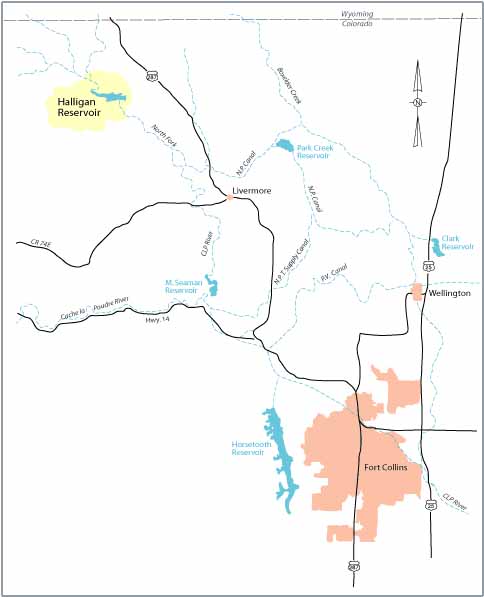
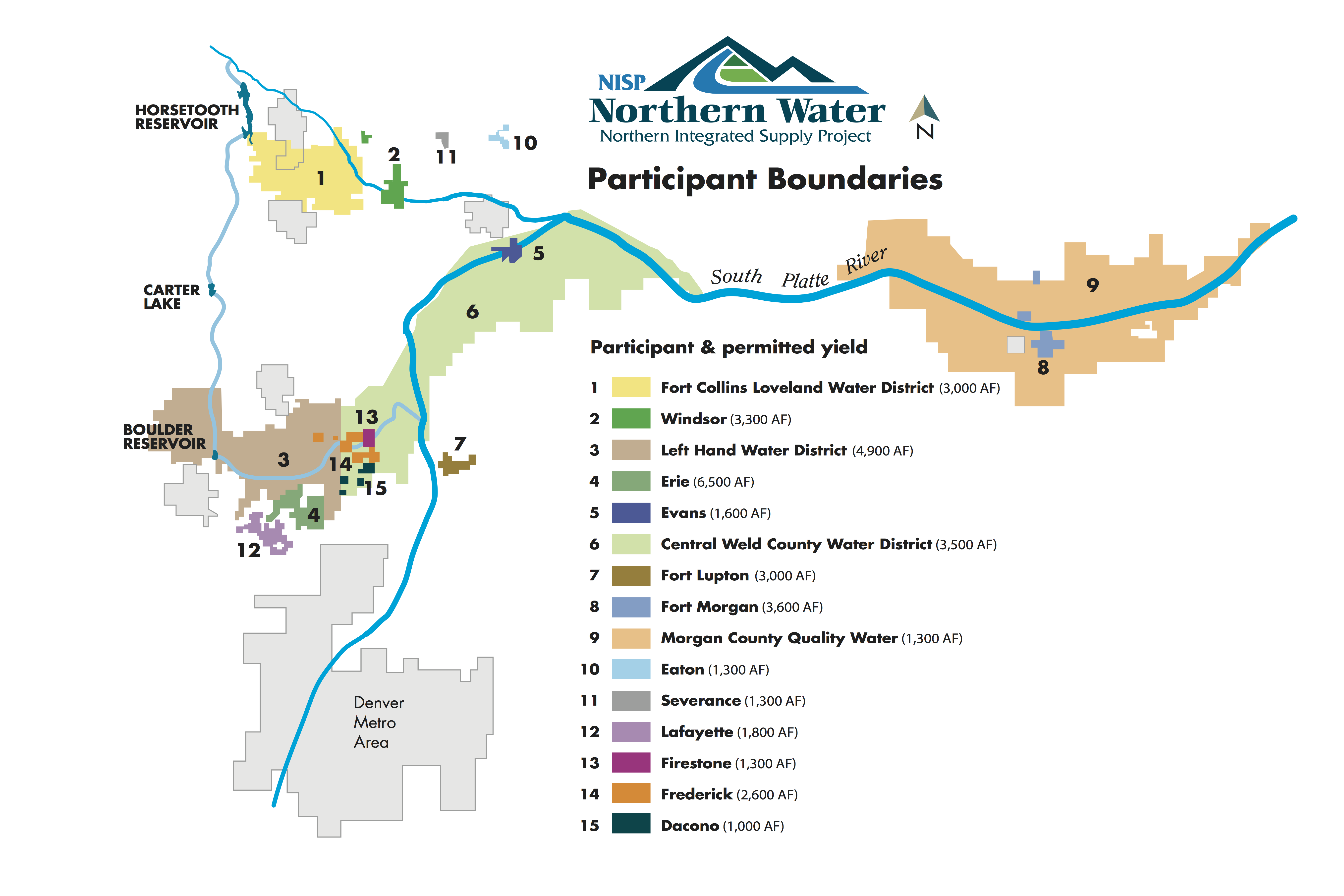
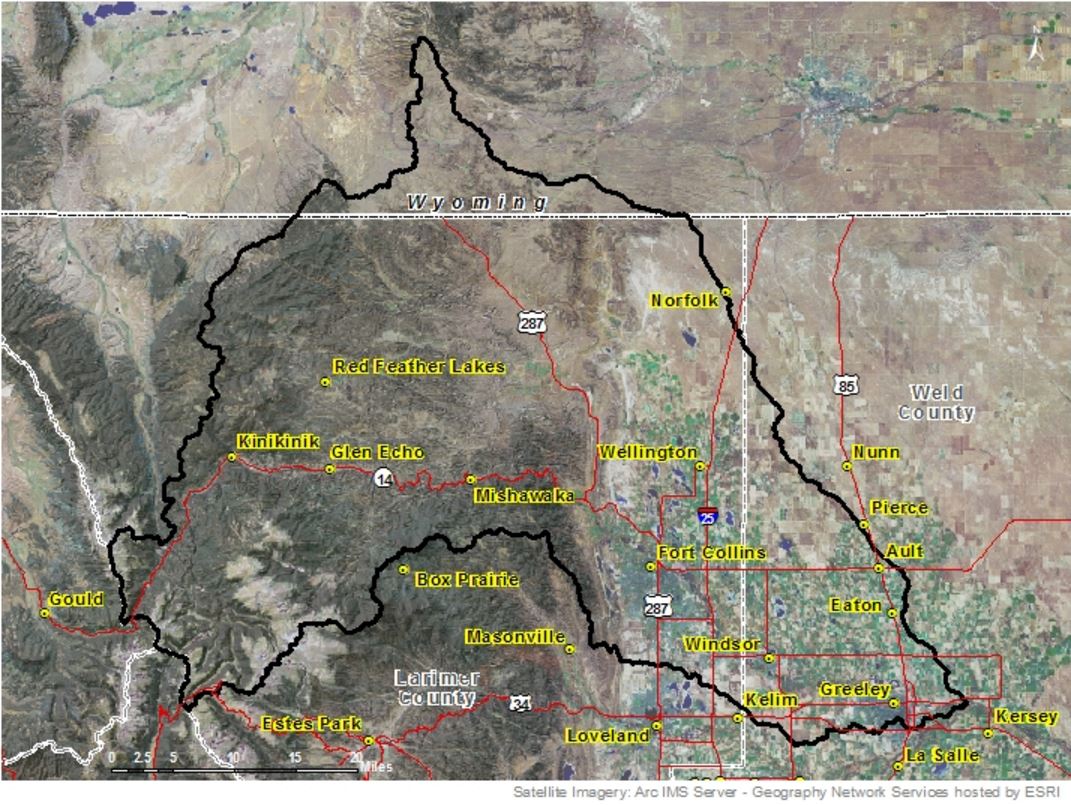
Northern Integrated Supply Project (NISP) map July 27, 2016 via Northern Water.
Here’s the release from the Larimer County Board of Commissioners:
The Board of Larimer County Commissioners and three members of the Northern Colorado Water Conservancy District Board will host a meeting at 1:30 p.m., July 24, 2019, at the Larimer County Courthouse Offices Building First Floor Hearing Room, 200 West Oak St., Fort Collins to discuss the proposed Northern Integrated Supply Project [NISP] Intergovernmental Agreement [IGA].
The IGA will address issues related to recreation, the relocation of U.S. Highway 287 and siting of conveyance pipelines in Larimer County.
The public is invited to observe the discussion. Staff from Larimer County and Northern Water will be available following the meeting to answer questions from the public and written comments will also be accepted.
An element of the proposed IGA is to include public meetings and public hearings with Northern Water, the Larimer County Planning Commissioners and Board of Larimer County Commissioners.
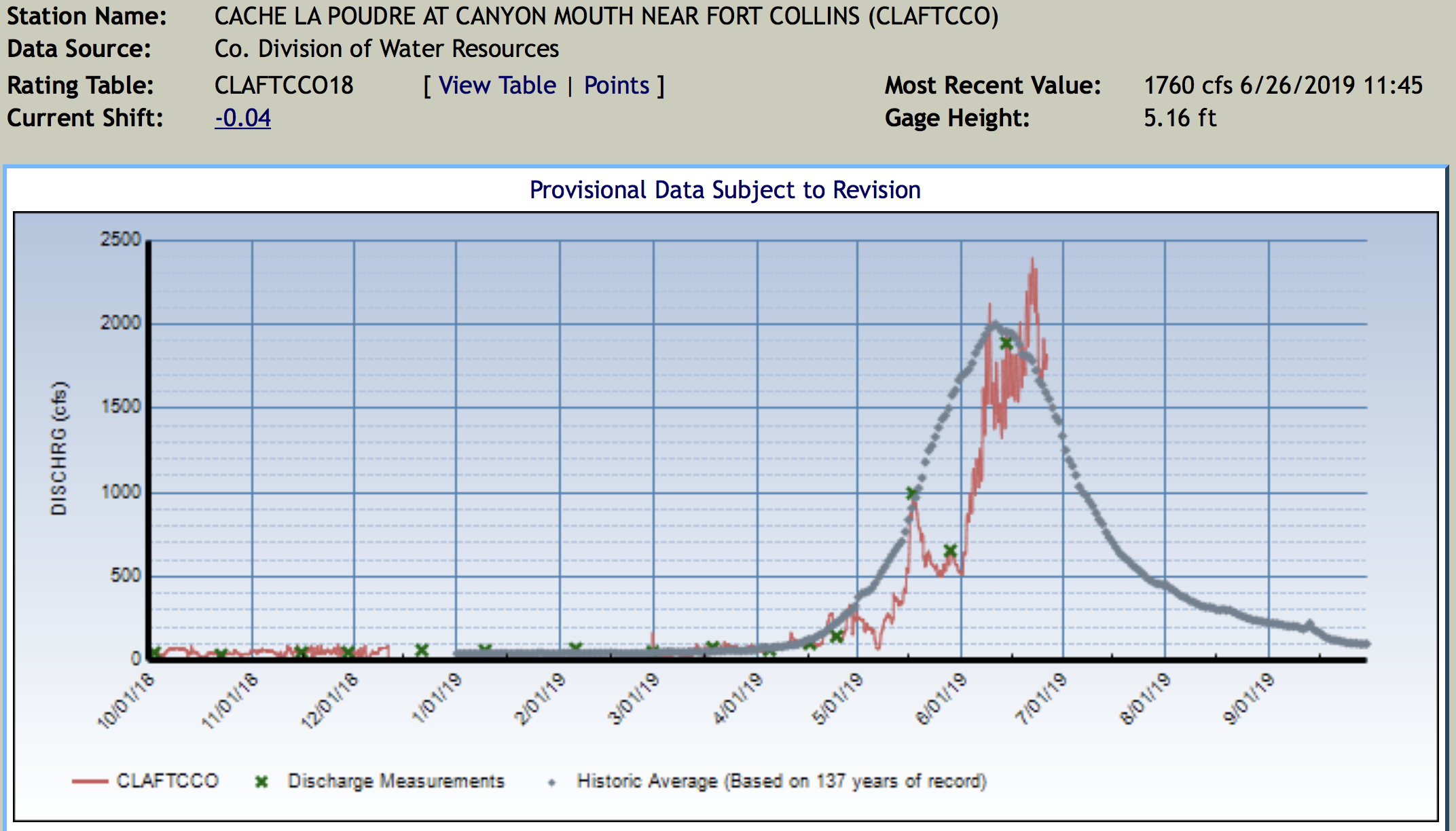
The Poudre and Big Thompson rivers are gushing as a wave of warm weather sends mountain snowmelt rushing toward Northern Colorado, but regional officials say flows should taper this week and don’t expect major flooding.
The Poudre flowed about 4.3 feet high at the Lincoln Street gauge Tuesday afternoon. Its volume of 956 cubic feet per second was nearly three times the median for this time of year…
A blast of summer heat will bring Fort Collins a string of days with highs above 90 degrees, starting Wednesday and holding on through Saturday, according to the National Weather Service. Hodges said flood risk isn’t a big concern, though, because so much of the mountain snowpack that feeds the Big Thompson and Poudre rivers has already melted…
Remaining snowpack is plummeting in both the North Platte and South Platte river basins, according to the Natural Resources Conservation Service…
The onset of summer also means people will divert more water from the Poudre, which loses over 60% of its water before it even gets to Fort Collins…
The Big Thompson and Poudre rivers have likely already reached their peaks, Hodges said. The Big Thompson reached about 5.8 feet — action stage for flooding is 6.5 — above the canyon mouth on Thursday, according to the Colorado Division of Water Resources…
The Poudre reached about 5.7 feet at the canyon mouth Friday. Action stage is 6.5 feet. It peaked at about 5.5 feet through town on Friday, well below the action stage of 9 feet.
The warmer temperatures in Colorado’s mountains are expected to melt quite a bit of snowpack. Be warned that Colorado’s rivers and waterways will be swollen with fast moving and powerful water, making them very dangerous. Three people have died in three separate incidents over the past week in Colorado rivers.
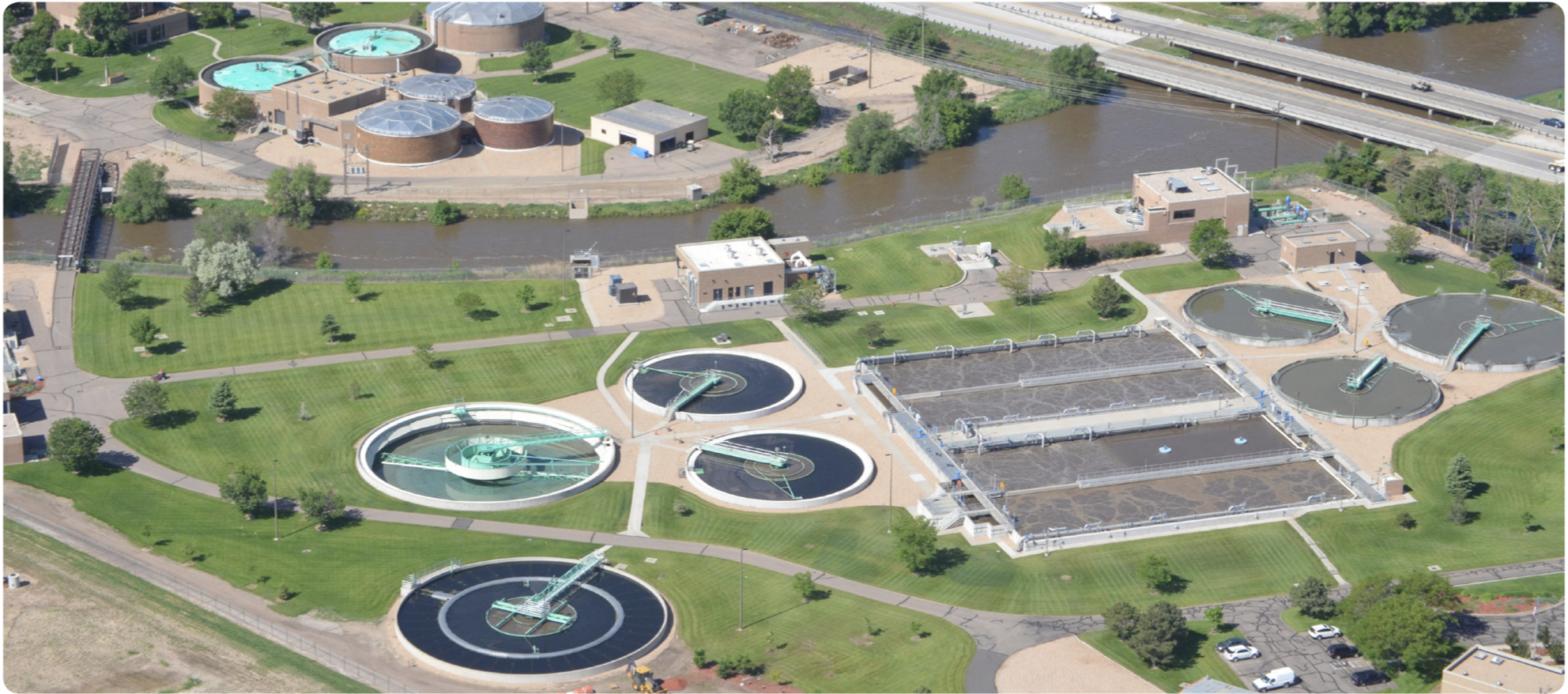
NACWA recognizes wastewater plants that achieve 100% compliance with the National Pollutant Discharge Elimination System (NPDES) over a consecutive five-year period.
The Greeley wastewater plant discharges more than 7 million gallons of treated water back into the Poudre River daily. Compliance with permitted requirements ensures that water is safe for downstream users, aquatic habitats, and the environment, according to a Greeley news release…
The wastewater plant maintains compliance through the operation and support of various systems that remove pollutants from the wastewater. Samples of the water are then tested and analyzed to ensure that the proper treatment has been performed…
or more information on the plant, water and sewer utilities, or to inquire about a tour, call (970) 350-9360 or visit http://www.greeleygov.com/water.
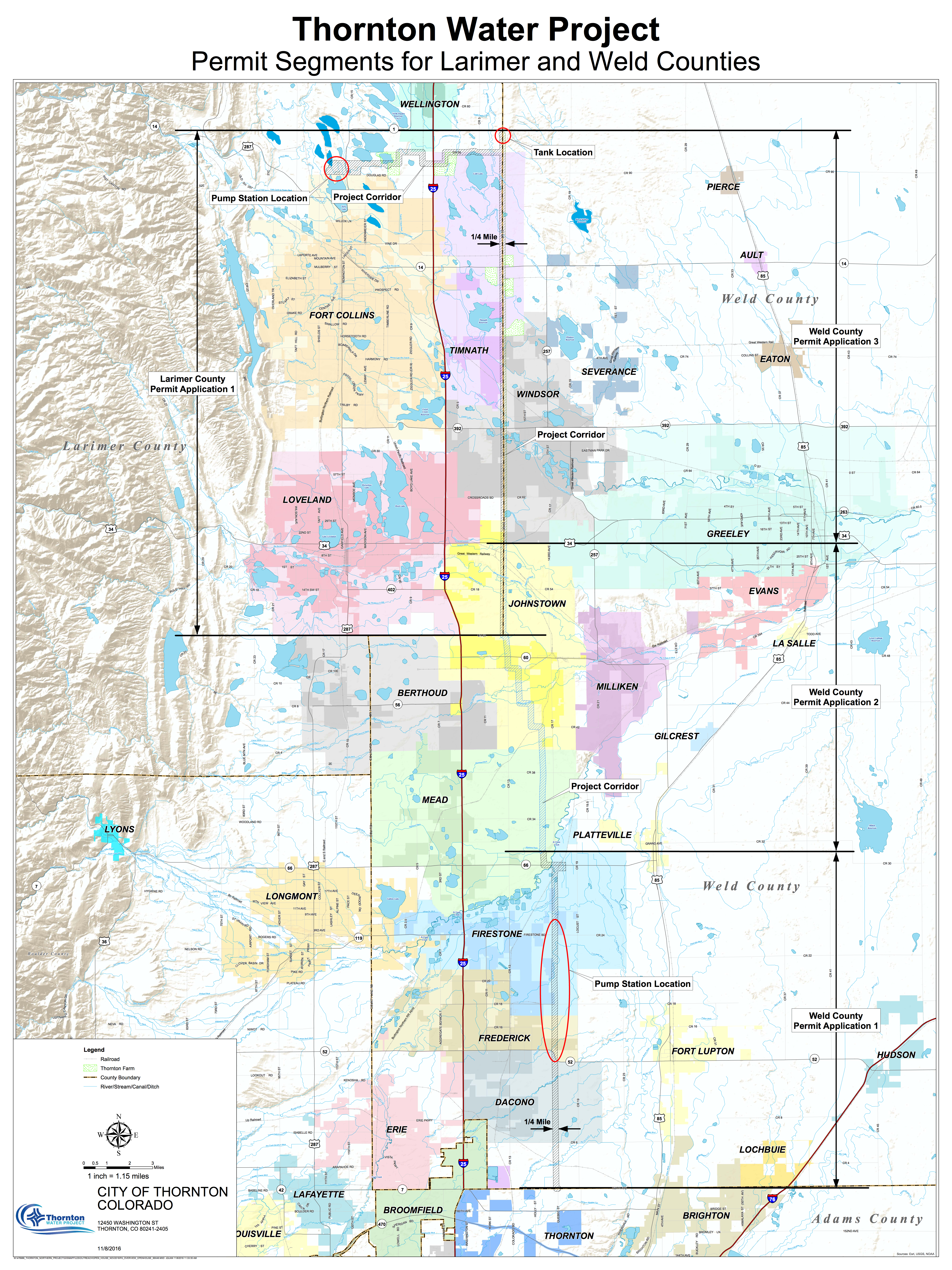
Larimer County leaders are asking a court to uphold their rejection of the Thornton pipeline.
The city of Thornton sued Larimer county commissioners in April, asking the Larimer County District Court to overturn the board’s decision and either approve one of the two proposed pipeline routes or force the county to do so. Larimer County commissioners filed their response to Thornton’s lawsuit Monday afternoon.
The legal battle is the latest twist in a yearslong fight over a proposed pipeline that would carry Poudre River water from reservoirs north of Fort Collins to Thornton…
Pipeline opponent No Pipe Dream and river advocacy group Save the Poudre both plan to intervene in the lawsuit, those groups’ leaders told the Coloradoan. If the court allows the groups to intervene, they’ll become parties in the lawsuit…
Commissioners argue the court must affirm their decision if there’s any “competent evidence” in the record supporting it. Competent evidence is a legal term describing evidence that tends to prove a matter in a dispute.
The county also argues the court doesn’t have the authority to substitute its own judgment on the pipeline path. If the court decides commissioners made the wrong call, it must send the case back to the board for reconsideration and correction, the answer argues.
Next steps in the lawsuit could include a motion for judgment or a scheduling conference for the parties to discuss the potential of a settlement or plan a discovery period and timeline for a trial.
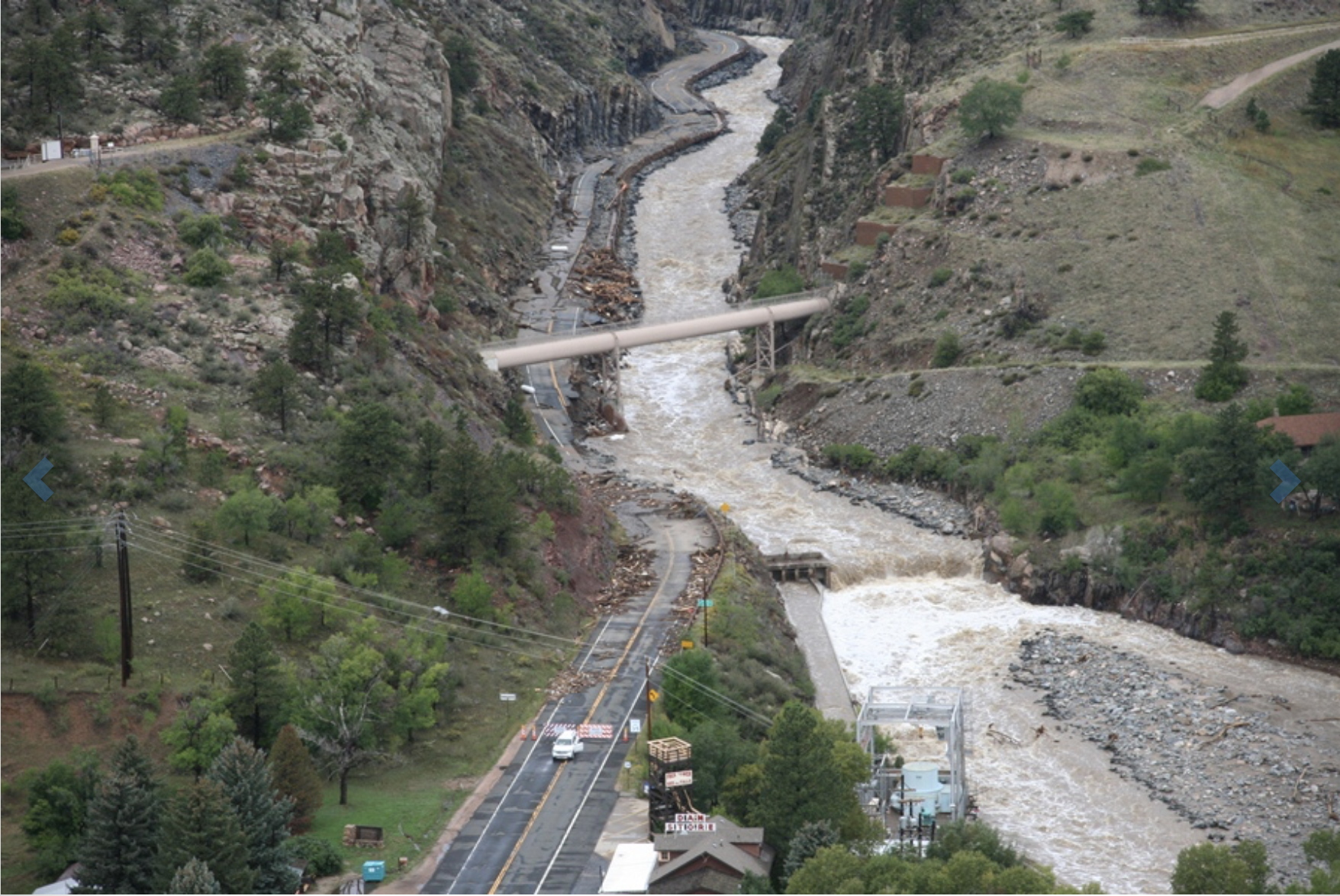
Nearly six years after the Big Thompson River flood wrecked U.S. Highway 34, stranded Estes Park and wiped out bridges and homes, the U.S. government has yet to fund $20 million of repairs in Larimer County.
The county hasn’t started construction on County Road 47 (Big Elk Meadows) and County Road 44H (Buckhorn) because of the lack of funding. The county finished work on Big Thompson River bridges destroyed and rebuilt after the flood but hasn’t been reimbursed by the Federal Emergency Management Agency for the project.
The delay in FEMA funding for Larimer County’s last three flood recovery projects has county officials in a bind: As another construction season looms without federal money, so does a crucial state deadline.
Colorado’s general fund has paid for about 13% of Larimer County’s flood restoration work since 2013. Come September 2020, state funding for the projects will dry up.
“We will not be able to meet that deadline with the delays we’ve had because of this issue,” said Lori Hodges, Larimer County emergency management director. “Our biggest projects are at risk because we haven’t gotten the guidance we need.”
The holdup is essentially a bureaucratic issue. Congress passed a law in October 2018 changing the way FEMA awards money for disaster recovery work.
FEMA used to deny funding for all projects that didn’t meet a strict set of code compliance guidelines. The guidelines had little wiggle room for projects on roads and bridges in complex terrain — like the ones destroyed by the flood in the Big Thompson canyon. For example, a road repair in a narrow, rocky canyon probably couldn’t meet FEMA’s requirement for shoulder width.
The Disaster Recovery Reform Act of 2018 instructed FEMA to award money for projects that don’t meet the strict guidelines as long as a local engineer signs off on the work and agrees a waiver is necessary. Congress gave FEMA 60 days to give its regional offices guidance on how to award funding under the new law.
But FEMA hasn’t done that yet, so regional officials won’t fund the implicated Larimer County projects, Hodges said. FEMA Region 8 spokesperson Lynn Kimbrough told the Coloradoan the office paused a Larimer County funding appeal as it waits for policy guidance from headquarters…
CR 47, partially destroyed by the flood, branches off U.S. Highway 36 between Lyons and Estes Park. The road is accessible but unpaved. An 11-mile stretch of CR 44H, located in Buckhorn Canyon and the Roosevelt National Forest, was heavily damaged in the flood and the High Park Fire in 2012.
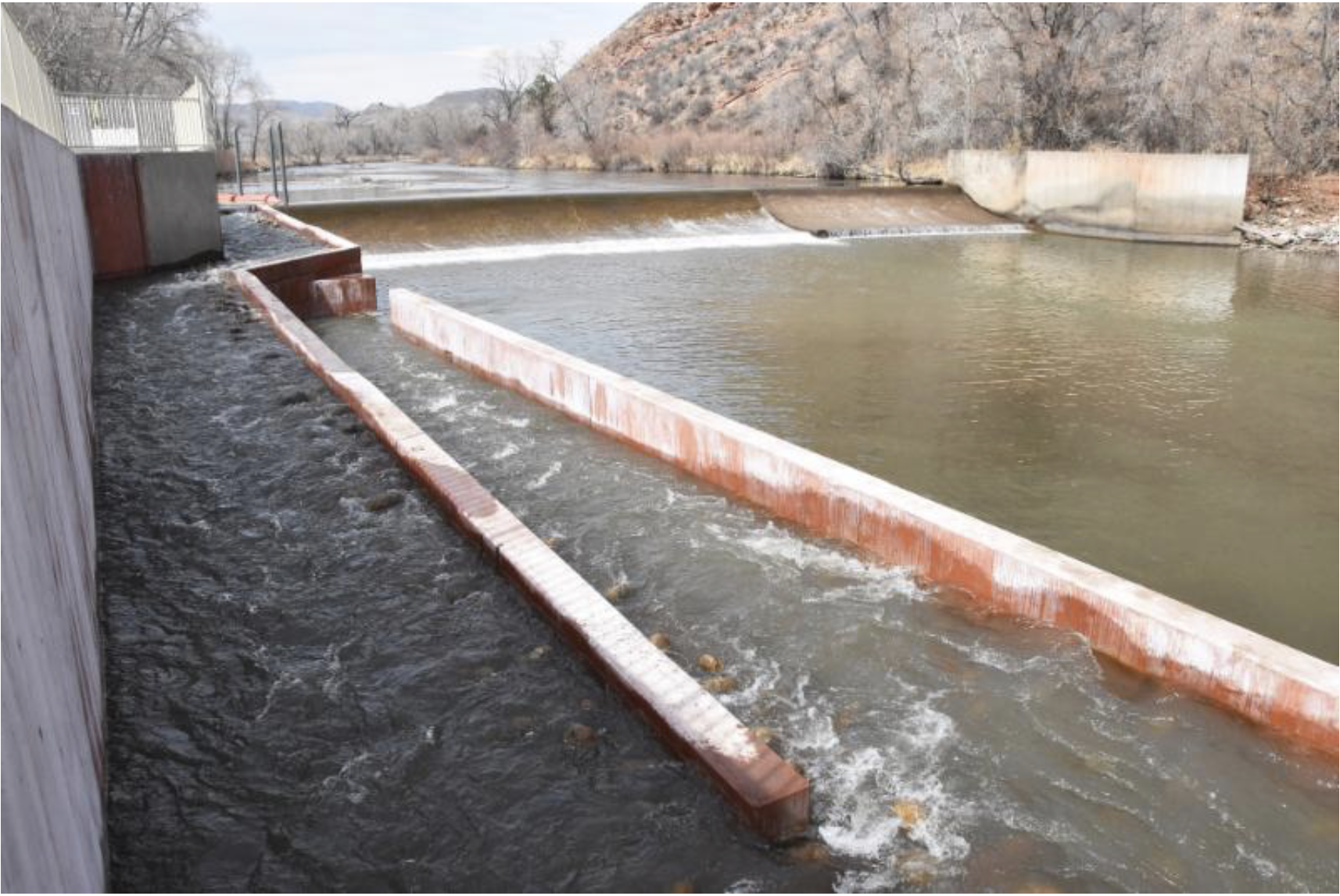
Water courses through the new fish passage at Watson Lake State Wildlife Area. The passage allows fish to swim up and down the river past a diversion dam. Photo credit: Northern Water
Here’s the release from Colorado Parks and Wildlife:
The Graves family, owners of Morning Fresh Dairy and noosa yoghurt, was honored Thursday night with the Colorado Parks and Wildlife Northeast Region Partner of the Year Award for 2019.
The award was announced at the annual Partners in the Outdoors Conference awards dinner held at the Beaver Run Resort & Conference Center.
The Graves’ were nominated by CPW Assistant Area Wildlife Manager Jason Surface. Rob and Lori Graves were on hand at Thursday’s dinner and banquet to accept the award.
“The entire Graves family, and Rob in particular, deserve this award for their unwavering commitment to the natural resources of Colorado and the mission of CPW,” Surface said. “Through all facets of his life, Rob has recognized the importance of connecting all Coloradoans, including his employees, children, grandchildren and community members to their natural resources and building successful partnerships.”
Rob Graves is co-founder of noosa yoghurt and the Graves family owns a sixth generation dairy farm, Morning Fresh Dairy, in Bellvue, Colo.
The Graves family epitomizes a CPW partnership and has improved the state’s natural resources through stewardship, education, and monetary contribution.
The recently completed fish ladder at the Watson State Wildlife Area and Watson Lake is one recent project that exemplifies their commitment and generosity, and it will be on display next week with the ribbon cutting ceremony to showcase the project’s completion. Graves has been heavily involved with the project from its inception in 2016, funding the conceptual design in 2017 and his leadership and contributions were instrumental in moving the habitat improvement project a reality.
The Watson Lake fish ladder is reconnecting over two river miles on what was a fragmented Poudre River. The stretch there at Watson Lake contains important spawning habitat and deep pool that provides refuge for aquatic life.
“The Graves family have been and continue to be a great partner to CPW and truly help us achieve the goals laid out in both our Strategic Plan and Statewide Comprehensive Outdoor Recreation Plan (SCORP),” Surface said.
“Both of these plans emphasize the importance of wildlife conservation, outdoor stewardship and connecting people to the great outdoors by providing sustainable access and opportunities to outdoor recreation. These are goals they believe deeply in and he has made these a priority for not only himself, but his family, employees and the community of Bellvue as well.”
There are many arenas where the Graves’ family plays a hand in sharing the mission of CPW through conservation and community enhancement.
They develop and make outdoor stewardship ethics a priority, organize volunteer work and maintenance on our public lands, particularly at the Watson State Wildlife Area that they have adopted as their own. They organize and host events like the Pleasant Valley Days, which is focused on bringing the community together and getting people of all ages outdoors.
The ribbon cutting event for the Watson Lake fish ladder is taking place on Wednesday, May 1, 2019, at 11 a.m.
Water courses through the new fish passage at Watson Lake State Wildlife Area. The passage allows fish to swim up and down the river past a diversion dam. Photo credit: Northern Water
Here’s the release from Colorado Parks and Wildlife:
The ribbon cutting ceremony for the completion of the fish ladder at Watson Lake has been rescheduled and will now take place on May 1 at 11 a.m.
It was originally set for April 12, but due to inclement weather during that week, was postponed.
Watson Lake is located in Bellvue, Colo., just west of Laporte, on Rist Canyon Road.
More Information:
Colorado Parks and Wildlife (CPW) along with funding partners noosa yoghurt, Northern Water, Morning Fresh Dairy, Poudre Heritage Alliance and Trout Unlimited will celebrate the completion of the fish ladder at Watson Lake.
The collaborative project is helping to reconnect a fragmented Poudre River. The stretch contains important spawning habitat and deep pools that provide refuge for aquatic life. This Watson Lake fish ladder is reconnecting over two river miles. The group hopes this will be one of many ladders along the Poudre River that will allow fish to travel freely upstream and downstream, improving the health of the fishery and the ecosystem without impacting water delivery.
Noosa yoghurt has been heavily involved with the project from its inception in 2016, funding the conceptual design in 2017. The vision for noosa has always been to give back to the community in a meaningful way.
“The Poudre River is a treasure in Northern Colorado,” said Stephanie Giard, community outreach coordinator for noosa yoghurt. “The project area is frequently visited by neighbors in the Pleasant Valley for fishing, birdwatching, or just enjoying nature. It is our responsibility to protect this valuable resource in our community.”
Watson Lake Diversion Structure is a channel spanning structure that represented a complete barrier to all upstream fish movement in the Poudre River. The structure delivers water to the Watson State Fish Hatchery and is owned and operated by CPW. The new fish ladder allows for passage through the diversion for all species present within the river reach including longnose dace, longnose suckers, white suckers, brown trout, and rainbow trout.
Designed by OneFish Engineering and built by L4 Environmental, the fish ladder at the Watson Diversion was completed in record time. Biologists and engineers from across CPW came together to work with OneFish Engineering to find the optimal design to provide upstream fish movement through the diversion structure. The construction project started in November at the end of the irrigation season. It had to be completed before spring runoff, which can start as early as March. The project was blessed with ideal weather for construction this winter.
“This project will improve river connectivity and benefit the aquatic resources by allowing fish to move freely back upstream as they wish,” CPW Aquatic Biologist Kyle Battige said. “Outside of the benefits to aquatic life, this project is important as it showcases the feasibility of fish passage at these large diversion structures and will hopefully further momentum for these types of projects. It also serves as an example of the collaboration and team effort from multiple entities that these large-scale conservation projects will have to have in order to be successful in today’s world.”
Northern Water General Manager Brad Wind said this project will be an example of future cooperative efforts on the river.
“This will be the first of several projects like these to create a healthier Poudre River for generations to come,” he said. “Northern Water and the NISP participants are proud to have been part of the cooperative effort to get this project completed.”
“This is a first step in improving the health and resiliency of the Poudre River,” said Rob Graves, owner of Morning Fresh Dairy and co-founder of noosa yoghurt. “Through collaboration, we can preserve and protect this critical natural resource that flows through our community.
“The river has played an important role in our business and in our family for over 100 years and we want to protect it for generations to come. We hope this project and future projects will be the legacy of our family and Morning Fresh Dairy.”
Water courses through the new fish passage at Watson Lake State Wildlife Area. The passage allows fish to swim up and down the river past a diversion dam. Photo credit: Northern Water
Click here to read the newsletter. Here’s an excerpt:
Fish passage begins its work reconnecting Poudre River segments
Construction crews have completed a new fish passage along the Poudre River at Watson Lake State Wildlife Area northwest of Fort Collins.
Built with the cooperation of the participants of the Northern Integrated Supply Project, Colorado Parks and Wildlife, noosa yoghurt and Morning Fresh Dairy, the passage serves to reconnect stretches of river that had been separated by a diversion dam.
Fort Collins company OneFish Engineering designed the project, and the construction company L4 Environmental built it over the past four months.
A dedication ceremony for the new structure is planned for early May. The Poudre Heritage Alliance and Trout Unlimited are also providing assistance, and a public celebration for the new passage is planned during the Pleasant Valley Rendezvous on June 2 at Watson Lake.
Thornton has filed a lawsuit against Larimer County commissioners in protest of their rejection of the Thornton pipeline, kicking off a legal battle on the Poudre River.
The city is asking the Larimer County District Court to overturn the commissioners’ decision and either approve one of the two proposed pipeline routes or force the county to do so.
Thornton’s complaint, filed in the Larimer County District Court on Tuesday night, argues the Board of Commissioners’ decision “exceeds its jurisdiction and/or is contrary to law, misinterprets and misapplies its criteria, and was arbitrary and capricious because its findings lack competent evidence to support the Board’s denial of Thornton’s application.”
In a statement, city spokesman Todd Barnes said Thornton “has taken action to represent the interests and property rights of their constituents.”
[…]
Thornton’s water plans wouldn’t diminish flows in the Poudre River because the project’s water is already diverted from the river for agriculture. But the “Poudre River alternative,” which would involve running Thornton’s water down the river and nixing the northern segment of the pipeline, picked up considerable public support during a series of hearings on the project.
“In discussion of Thornton’s proposal during the hearings, it is clear that the Board, contrary to its authority, factored into its decision the notion that Thornton should not build a pipeline but rather send its water down the Cache la Poudre River or down the Larimer County canal,” Thornton wrote in its complaint.
Larimer County attorney Jeannine Haag told the Coloradoan she learned Thornton would be filing a lawsuit when she called the city’s attorney and asked whether the city would pursue legal action contesting the pipeline decision.
Thornton will file a lawsuit in Larimer County District Court next week, Haag said. Thornton spokesman Todd Barnes told the Coloradoan the city doesn’t comment on issues of potential litigation…
Thornton officials have kept quiet about their plans since commissioners unanimously rejected their proposal to build a pipeline to carry Poudre River water through Larimer County. Thornton leaders said they wouldn’t decide what to do until they could review commissioners’ written explanation of the vote. Commissioners approved that document March 18…
It was also possible that Thornton officials would pursue an agreement with the city of Greeley, which has extra capacity in a water pipeline that might have been useful for Thornton. The cities met on the matter last month.
In the written explanation of their decision on the pipeline, Larimer County commissioners said Thornton didn’t meet eight of the 12 criteria for the 1041 permit required to build the pipeline. The commissioners’ ruling was the county’s first-ever rejection of a 1041 permit.
Commissioners wrote that Thornton didn’t meet the following criteria:
The proposal is consistent with the county’s master plan for land use and development
The applicant presented reasonable siting or design alternatives or explained why no reasonable alternatives are available
The proposal conforms with county standards and mitigation requirements for environmental impacts
The proposal won’t have a significant adverse effect on the land on which it’s situated and adjacent land, or will adequately mitigate significant adverse effects
The proposal won’t negatively impact public heath and safety
The benefits of proposed development outweigh the losses of any natural resources or resulting reduction of productivity of agricultural lands
The proposal demonstrates a reasonable balance between the costs to the applicant to mitigate significant adverse effects and the benefits achieved by that mitigation
A key element of NISP, the “Water Secure” program represents a shift away from “buy-and-dry” and is instead an outside-the-box approach to meeting the future water needs of Northern Colorado’s growing communities while also preserving our vital ag industry and environment.
Northern Water will have to buy “dozens and dozens” of Larimer and Weld county farms to lock down enough Poudre River water to fill a proposed reservoir for the planned Northern Integrated Supply Project.
The unprecedented approach could substantially raise the price of NISP, a $1.2 billion storage and delivery project funded by the 15 Northern Colorado municipalities and water districts that will use the water. Northern Water leaders say the approach will also prevent the dry-up of thousands of acres of farmland in Larimer and Weld counties because the agency won’t strip the properties of water.
Instead of taking the buy-and-dry route of diverting a purchased property’s water rights to a new use, Northern Water plans to trade its South Platte River water rights for the farms’ Poudre River water rights. That means Northern Water will divert water from the Poudre River to store in the proposed Glade Reservoir and give the farmers a slightly larger portion of South Platte water from the proposed Galeton Reservoir.
Northern Integrated Supply Project (NISP) map July 27, 2016 via Northern Water.
Northern Water’s newly minted Water Secure program addresses a giant question mark that has lingered on the NISP road map for more than 15 years: The agency only has about half of the Poudre River water it needs for NISP. But it does have a lot of water from the South Platte River, which is less-suited for drinking than Poudre water and more expensive to treat.
This problem has never been a secret, but until now, Northern Water’s public plans included the assumption that farmers would willingly trade their water with the agency for free.
Those voluntary exchanges aren’t off the table, but Northern Water now plans to secure much of the water it needs by buying farms in two irrigation ditch systems — the New Cache la Poudre Irrigating Co. and the Larimer and Weld Irrigation Co. Once Northern Water owns those farms and their water, the agency will essentially be trading water with itself.
“We’ve just become the most willing shareholder on the ditch,” said Greg Dewey, a Northern Water water resources engineer and Water Secure project manager.
How we got here
Shares of Poudre River water in the New Cache la Poudre and Larimer and Weld ditches are coveted because they’re senior water rights, which means their owners have first dibs for usage. That becomes important during dry years when there isn’t enough water for everyone who’s claimed a slice of an overallocated pie.
Senior water shares are crucial for NISP because Northern Water’s current Poudre River supply (known as the Grey Mountain right) is a junior water right that will only be useful during wet years.
Dewey called Water Secure’s approach a “risk management strategy” born during negotiations with the two ditch companies. He said it became clear that the farms Northern Water was eyeing for trades are vulnerable to buy-and-dry, a controversial practice that has fed Colorado population growth at the expense of irrigated farmland.
“If that happens over the long-term, that jeopardizes our ability to exchange water with those systems,” Dewey said. “So this is a way to help preserve that exchange and also (address) a common interest we have with those companies to keep water in the system.”
Northern Water unveiled the Water Secure program in February after closing a deal on its first farm, a 28-acre property northeast of Greeley. The farm cost $330,000 and came with 30 acre-feet of Poudre River water. Northern Water will need to buy “dozens and dozens” of farms to secure about 25,000 acre-feet’s worth of water exchanges for NISP, spokesman Brian Werner said. An acre-foot of water meets the annual needs of about three or four urban households…
[Brian] Werner said staff is still evaluating how Water Secure will affect the price of NISP. He said the cost impact will depend on the ratio of farm purchases to willful water exchanges — and how much money Northern Water makes when it eventually sells the farms back to farmers.
Northern Water plans to pursue legal contracts that permanently bind the water to the farmland regardless of its owner, which would shield the farms from buy-and-dry and protect the agency’s water exchange agreements. The water provider plans to lease the land to the original owner or another farmer until selling it to another entity that would be required to keep the South Platte River water on the property.
“If we buy a farm and establish that water agreement, then we’ll be looking to sell it back into private hands,” Northern Water spokesman Jeff Stahla said. “Our goal is not to be the major landowner up there.”
[…]
The legal agreements, likely conservation easements or covenants, would be the first of their kind in the region if not the state. Boulder County leaders have found success with a similar approach for preserving open space, Werner said.
He argued more federal review is unnecessary because Northern Water has included the water exchanges in its NISP planning documents since at least 2004. Northern Water’s water court decree for the South Platte River water allows the trades.
Dewey, a Kersey native and former farmer, is Northern Water’s “boots on the ground” for the program, Werner said. Dewey said Water Secure is getting positive feedback from farmers who’ve watched irrigated agriculture dwindle in Larimer and Weld counties.
It’s important to pick metaphors carefully. Writers try to explain complex subjects in few words and in ways everyone can understand. Metaphors — words or phrases that imply that one thing can symbolically represent another — become one way to accomplish that task. This thought crossed my mind when I attended the 6th Annual Poudre River Forum on Feb. 1. (See http://prti.colostate.edu/forum_2019.shtml)
Trying to sort out what allows a river to serve human needs while still providing the ecological services that keeps the world over which it flows alive is about as complex a problem as one can imagine. So, I picked my article title carefully. Rivers do not deliver water like a concrete ditch. Instead, like the arteries and veins of a living organism, they convey not only water, but also oxygen, nutrients and host of microbial servants to needed destinations in the biosphere. As we use a river’s resources for human needs, we should take her pulse regularly to ensure the health of the greater body she nourishes.
MaryLou Smith via the Colorado Water institute.
After attending the forum last year, I wrote a four-month series in the “North Forty News” that ran from March to June 2018. Please refer to that for background information on some of the basic issues of Poudre River ecology and management. This year I would like to focus on some of the people who make the forum work, and the process of talking TO each other rather than AT each other. That process was largely established under the leadership of MaryLou Smith, policy and collaboration specialist with the Colorado Water Center at Colorado State University. Since she will retire after this year, someone else must replace her leadership — and her optimism.
John Stokes, head of the Natural Areas Department of the city of Fort Collins, made a special point of highlighting Smith’s optimism. It’s easy to get pessimistic about complex problems with no simple solutions, but Smith manages to stay upbeat. She says she has “devoted her career to encouraging an open dialogue between people.” That was exemplified in 2011 when the concept for the Forum first developed.
In 2011, Ray Caraway, chief executive officer of Community Foundations of Northern Colorado, invited Smith to host a community forum discussing issues relating to NISP — the Northern Integrated Supply Project (https://www.northernwater.org/sf/nisp/home) — a collection of communities along the Front Range intending to build Glade Reservoir northwest of Fort Collins. Opposed by Friends of the Poudre and other conservation groups, Smith felt that a conference built solely around NISP would tend to create more polarization. She proposed the Poudre River Forum instead, with the intent of bringing together a wide swath of people from agriculture, urban planning, recreation, conservation and business — all with a stake in maintaining “a healthy working river.”
This year, approximately 360 people met to have that discussion — roughly, a 17 percent increase over last year. Smith said she was gratified that discussions at the various tables seemed earnest and forthright. They listened to water commissioners, city managers, water lawyers, engineers, ecologists, farmers, conservationists, land developers, and others. The keynote speaker, Professor Edward B. Barbier, from the Department of Economics at Colorado State University, tackled the growing problem of water scarcity. (Yale University Press will release his new book about this problem, “Water Paradox,” in February.)
Another Colorado State researcher, Brad Udall (not in attendance at this conference), highlighted this problem in a 2017 study published in “Water Resources Research.” Colorado River flows in the 21st century are 19 percent lower than those in the 20th. Predicted flows could drop by up to 55 percent by 2100 as a consequence of global warming. (See “Re-engineering the Colorado River” in the February issue of Scientific American.) We can expect similar reduced flows in the Poudre River.
Ecologist Dr. LeRoy Poff from Colorado State said, “We need to face up to the ecological damage our pioneering spirit has caused to the Poudre River.” To do that requires gathering the data necessary to understand just what makes a river healthy. In an online report (https://natsci.source.colostate.edu/sustainable-dams-possible-csu-expert-weighs/) he said, “As a researcher, I am concerned about biodiversity conservation, and about sustaining rivers at a level of functional integrity that enables them to provide both biodiversity support as well as ecosystem goods and services.”
Northern Integrated Supply Project (NISP) map July 27, 2016 via Northern Water.
Here’s the release from Northern Water (Brian Werner):
The recent purchase of a Weld County farm marks a new venture for Northern Water and Northern Integrated Supply Project participants – one that’s part of the ongoing, collaborative effort to secure future water supplies for both the region’s communities and our vital agricultural industry.
On Jan. 31, Northern Water and the NISP participants purchased a 28-acre farm northeast of Greeley and the property’s water rights. The farm was purchased through the NISP Water Secure program, a cooperative effort to maintain the exchange of water for NISP while keeping water on participating farms. This investment is a shift from the “buy-and-dry” approach that has stressed our agricultural communities.
This innovative program will eventually provide supplemental water to approximately 500,000 residents in northern Colorado while preserving thousands of acres of irrigated farmland. Water Secure is part of a strategic long-term plan to better plan for future growth and to consistently apply Colorado Water Plan principles to protect water for our communities, farms and the environment. Without innovative approaches such as Water Secure, the region is on pace to see hundreds of thousands of irrigated acres dried up by mid-century.
“This is an outside-the-box, ‘buy-and-supply’ approach we’re taking to address the tightening water supplies facing Northern Colorado and its future generations,” said Northern Water General Manager Brad Wind.
The recently purchased farm sits within an area of Weld County that is key to NISP – a project that, once built, will include Glade Reservoir near Fort Collins and Galeton Reservoir near Ault, and deliver approximately 40,000 acre-feet of water annually to 15 local communities and water districts.
As part of the project, Northern Water and the NISP participants are working with the New Cache la Poudre Irrigating Company and Larimer and Weld Irrigation Company ditch and reservoir systems in Weld County, to use a portion of their senior water rights in exchanges that will ensure the NISP participants receive the water from the project.
These exchanges with the two systems will keep water flowing to those farms, as well as include compensation that will enhance the long-term viability of their operations.
To avoid water leaving those farms permanently through buy and dry purchases from other entities, Northern Water will buy land and water from willing sellers to ensure those supplies remain in the two ditch systems and available for exchange.
The senior water rights in the New Cache and Larimer-Weld systems are currently among the most sought after by water providers looking to obtain future supplies.
Farms in the New Cache and Larimer-Weld systems bought by Northern Water will remain in production, through limited land use easements on the property, lease-back agreements or other arrangements that will require continued irrigation on those farms.
Furthermore, the purchase of any irrigated lands will be done with the goal of eventually returning them to private ownership.
“The Water Secure program maintains irrigated agriculture and provides open space benefits while eliminating many of the long-term challenges with the practice of buying and drying,” Wind added.
As part of the newly implemented Water Secure program, Northern Water purchased the 28-acre farm northeast of Greeley on Jan. 31 with communities that participate in the Northern Integrated Supply Project, which will result in two reservoirs and more water for 15 communities…
Instead of municipalities buying up water rights on farmland and leaving them to dry out, the district is looking at the initiative as a way to both preserve irrigated farmland and provide supplemental water to an estimated 500,000 northern Colorado residents.
During a phone interview Thursday, Northern Water spokesman Brian Werner said it’s critical to make sure water is delivered annually to farms.
“It’s what makes this project work,” he said. “Keeping water on farms, as opposed to the good old way it’s been done in the past in this state. The American West, you bought land and you dried it up. We’re buying it and we’re calling it ‘buy and supply’ rather than buy and dry. So we need to keep the water on the property.”
This is how the program will work:
Northern Water and the NISP participants, which include Evans and Windsor, will work with the New Cache la Poudre Irrigating Company and the Larimer and Weld Irrigation Company ditch and reservoir systems in Weld County to use a portion of their senior water rights to make sure the NISP communities get water from the project.
In turn, the exchanges with the two systems will ensure water keeps flowing to participating farms and include compensation. Farms in both systems purchased by Northern Water will remain in production through arrangements such as limited land use easements and lease-back agreements.
“To avoid water leaving those farms permanently through buy and dry purchases from other entities, Northern Water will buy land and water from willing sellers to ensure those supplies remain in the two ditch systems and available for exchange,” according to the news release.
For the district, getting rights from both systems is significant — senior water rights in New Cache and Larimer-Weld systems are among the most sought after by water providers who are looking for supplies.
Werner said the company isn’t sure yet how much the district will invest in the program but said it will likely take millions of dollars.
Still, Northern officials emphasized that the purchase of any irrigated land will happen with an end goal in sight: return the farms to private ownership again eventually.
The Windsor Town Board voted unanimously Monday to approve the second water rate increase of the year for residents as officials look to strengthen their plans to add more water supplies.
The increase will bring rates up by an additional 6.21 percent, a hike that will appear on water bills April 1. In December, the board approved an annual increase of 3.29 percent that will be reflected on the March bill.
For water users, the increase means average single-family monthly consumption charges will be about $38.37. In 2018, bills were $35.06 per month on average.
During Monday’s meeting, town board said they didn’t come to the decision to raise the rates easily.
When one resident expressed concerned about how the rate increase might impact residents, Mayor Kristie Melendez said town officials came to the decision over several meetings…
The town, which currently owns shares in the North Poudre Irrigation Company and the Colorado-Big Thompson Project, is seeking to strengthen its participation in the Northern Integrated Supply Project, a massive project that will result in two new reservoirs and serve 11 communities and four water districts along the Front Range…
As it stands now, Windsor owns 4,100 acre-feet of water. But it’s going to need another 15,800 acre-feet in the future to keep up with demand, officials said…
In the town’s agreement with Northern Water, which manages the supply project, the town is scheduled to pay $100 million to the project by 2026, Town Manager Shane Hale said. The town won’t have enough money on its own to pay for that, he said, so officials will need a base of between $30 million and $33 million to issue debt to help pay for the cost in the future.
Of the total cost Windsor will pay toward NISP, 12 percent will come from water users who will pay the rate approved Monday. The other 88 percent comes from town development fees.
But Hale said town officials didn’t want to place the burden solely on developers and discourage them from coming to Windsor.
Windsor has worked with consulting firms since 2009 to work on ways to secure water. Most recently, officials worked with Stantec Consulting to develop a plan to pay for Windsor’s place in the water supply project and operations, including collecting, cleaning, filtering, disinfecting and testing water.
Windsor’s residential water rates will increase by 6.21 percent to help fund the town’s involvement in the Northern Integrated Supply Project…
The rate increase, paired with another increase that took effect Jan. 1, will raise the average single-family residential water bill from $35.06 a month in 2018 to $38.37 a month in 2019.
Windsor is one of 15 municipalities and water districts that will receive water from the Northern Integrated Supply Project, or NISP, a proposal to build two new reservoirs and fill them with Poudre River water. Participants are funding the costs of the project, and Windsor’s involvement will cost over $100 million, according to Mayor Kristie Melendez…
The town is looking to ratepayers to fund about 12 percent of the project cost. The other 88 percent will come from a water resource fee leveled on each new home in Windsor, an approach that Melendez called “growth pays for growth.”
[…]
NISP will supply about 3,300 more acre-feet if it jumps through all regulatory hoops. An acre-foot of water is equivalent to the average annual water use of 2 to 3 urban households.
In all, NISP is expected to provide about 40,000 acre-feet of water to its participants. Windsor’s share of NISP is the third-largest among municipalities involved in the project.
The two proposed NISP reservoirs include Glade Reservoir, which would be located near Ted’s Place north of Fort Collins, and Galeton Reservoir, which would be located northeast of Greeley.
For comparison’s sake, Glade Reservoir’s capacity of 170,000 acre-feet is about 108 percent of the capacity of Horsetooth Reservoir. Galeton would hold about 46,000 acre-feet.
The Army Corps of Engineers is expected to issue a record of decision on NISP in 2019. Affirmation from the Army Corps will likely trigger a legal challenge from NISP opponent Save the Poudre. Northern Water expects to begin storage in Glade Reservoir in 2025.
Is it possible for a working river to be a healthy river? This years Poudre River Forum will give us a chance to puzzle through that question. The Poudre Runs Through It Study/Action Work Group (PRTI) was formed in 2012 to bring together those who are most concerned about the Poudre as a working river—delivering urban and agricultural economic benefits—and those concerned about the river’s health. Building relationships and finding common ground for action has led to this annual Poudre River Forum.
Register now to join us! Registration includes the full day’s program, as well as breakfast, lunch, and a closing beer/soft drinks celebration with opportunities get to know other Poudre River enthusiasts.
Featuring Keynote Speaker, Ed Barbier
Author of Water Paradox and CSU Professor of Economics
Barbier’s book, to be released by Yale University Press in February 2019, is touted as
“a radical new approach to tackling the growing threat of water scarcity.”
ALSO ON THE PROGRAM...
Water Rights: Answers to frequently asked questions like: What gives Thornton rights to take Poudre water south? What kind of water right does Northern Water have for filling Glade Reservoir if NISP is approved? How are water rights expanded to benefit habitat and recreation? Does the new whitewater park in downtown Ft. Collins have any impact on agricultural water rights? How are Poudre water rights administered? Does having water rights include responsibility for water quality?
Thinking Outside the (Puzzle) Box: What are the looming challenges for the Poudre and are there any new approaches we might take to tackle them?
Water Sharing: Experiments underway that apply creativity and collaboration toward working/healthy river balance.
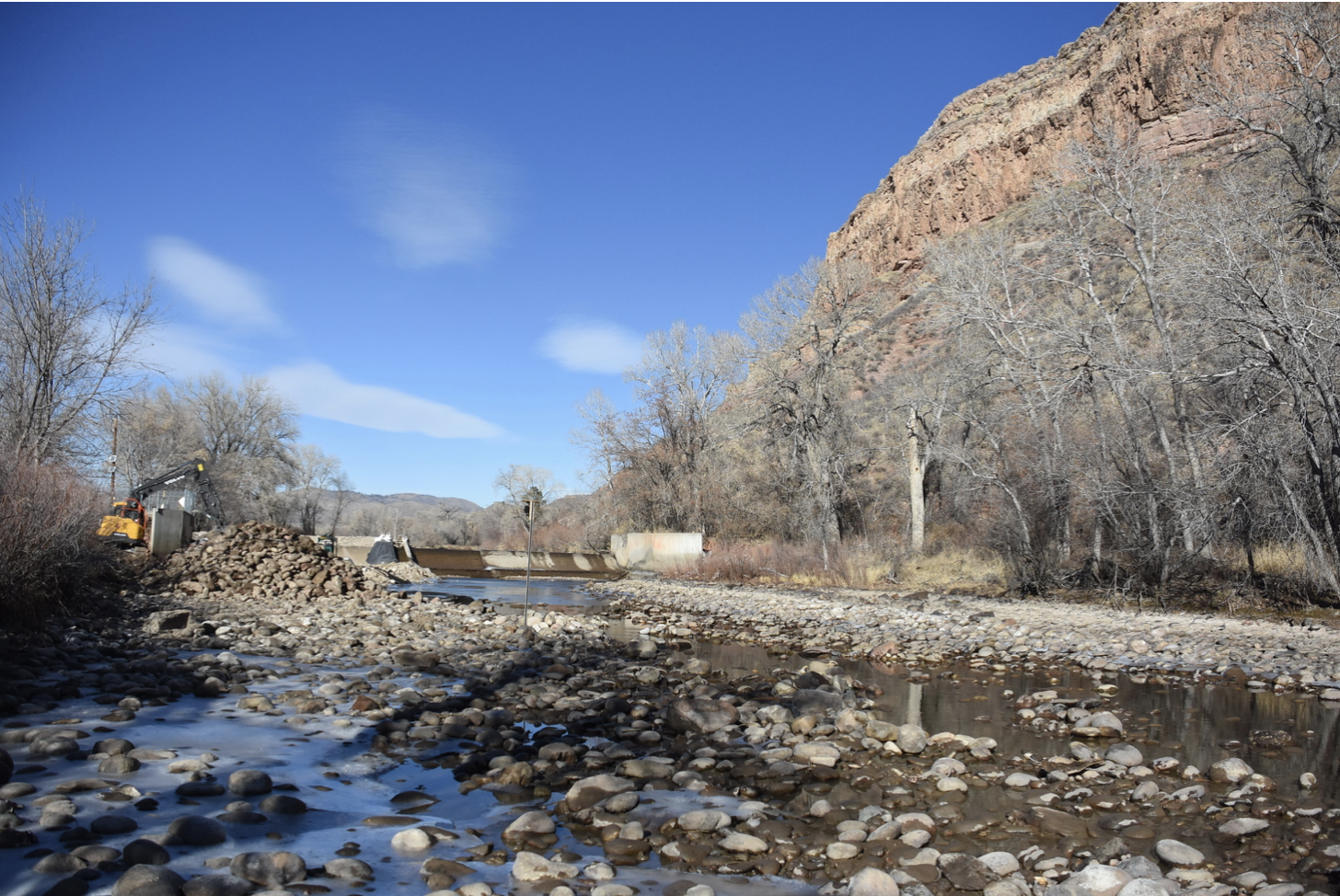
Construction begins on Cache la Poudre River for fish ladder near Watson Lake. Photo credit: Jason Clay/Colorado Parks and Wildlife
Here’s the release from Colorado Parks and Wildlife:
CPW partners with noosa yoghurt, Northern Water and Morning Fresh Dairy on project
[In December 2018] a project [broke ground] that will help reconnect a fragmented Poudre River.
In a collaborative effort, Morning Fresh Dairy, Northern Water and noosa yoghurt are partnering with Colorado Parks and Wildlife (CPW) to put in a fish ladder at the Watson Lake Diversion. They hope this will be one of many ladders along the Poudre River that will allow fish to travel freely, improving the health of the fishery and the ecosystem.
This Watson Lake fish ladder will reconnect over two river miles. The stretch contains important spawning habitat and deep pools that provide refuge for aquatic life.
Watson Lake Diversion Structure is a channel spanning structure that represents a complete barrier to all upstream fish movement in the Poudre River. The structure delivers water to Watson State Fish Hatchery and is owned and operated by CPW.
“We appreciate the collaboration from the project partners on this important fishway that will reconnect over two miles of stream habitat for the aquatic species,” said Kyle Battige, aquatic biologist for CPW. “Supporting fish passage at Watson Lake aligns with CPW’s goal through improving several facets: ecosystem health, angler access, public safety and public education.”
Designed by OneFish Engineering, the fish ladder will provide upstream fish movement through the diversion structure for all species present within the river reach including longnose dace, longnose suckers, white suckers, brown trout and rainbow trout. The State Wildlife Area and Hatchery, where this project is located, receives a lot of visitors whether they are fishermen, birders, or families enjoying nature. Onsite educational material discussing fish passage will be an important component of the project providing a learning experience for school children and all other visitors.
“The Poudre River has been an integral part of our family farm for over 100 years. We would like to be part of the solution for fish passage along the Poudre River, starting at Watson Lake,” says Rob Graves, owner of Morning Fresh Dairy and co-founder of noosa yoghurt. “We would like to find additional community partners and reconnect the river from Fort Collins all the way up through the Poudre Canyon.”
The new fish ladder also fulfills one of the promises made by the participants of the Northern Integrated Supply Project to improve the Poudre River, outlined in the NISP Fish and Wildlife Mitigation and Enhancement Plan.
“This project shows the commitment of project participants to address the overall health of the Poudre River,” said spokesman Jeff Stahla. He noted that participants have committed to spending $50 million on a state of Colorado Fish and Wildlife Mitigation and Enhancement Plan that includes minimum daily flows on the Poudre River through downtown Fort Collins, the construction of fish bypasses and other measures throughout the area
The project started in December 2018 and will be completed in March 2019 before spring runoff begins on the Poudre River. One of the goals is to help move other fish passage projects forward on the Poudre River. Local ditch companies will be able to observe one of these projects first-hand and see that there is no negative impact to water delivery. This will be an important resource to move fish passage initiatives forward with other diversion structures.
Cache la Poudre River May 2018. Photo credit: Greg Hobbs
From the Thornton Northglenn Sentinel (Scott Taylor):
A Thornton plan to improve the flows of water through Cache Poudre River isn’t meant to clear the way for a drinking pipeline Larimer County officials demurred on this summer — but it might help.
Thornton City Councilors pledged their support to an effort called Poudre Flows with Greeley and Fort Collins officials, the Cache La Poudre Water Users Association and the Northern Colorado Water Conservancy District to redirect an estimated 3,000 acre-feet of water Thornton owns to flow through the river annually.
“All along the river there are flow targets, flow rates set by the Colorado Department of Park and Wildlife, that required to keep the fish alive in the river,” Thornton Water Resources Manager Emily Hunt said. “There’s a higher threshold required to improve the environment to a reasonable degree and those are the flows we are trying to reach.”
[…]
But it’s not as easy as turning on a spigot, Hunt said, and Thornton and the coalition behind the Poudre Flows proposal need to negotiate difficult legal and water rights issues before it can happen.
“Say we dump that water someplace upstream and we hope to deliver it some 20 miles downstream,” Hunt said. “If there’s no specific water right associated with that water, any user can come along and divert it themselves. And the users downstream that own those rights lose it.”
The coalition hopes to designate that water as an “instream flow,” but that’s a designated water right that only the state can hold currently. The coalition will have to work to get that instream flow designation recognized.
If the Colorado Water Conservation Board signs off on the idea, the Poudre Flows coalition can file a request with the state Water Court. Hunt said she expects a decision from the conservation board early in 2019.
Hunt said the coalition and the City of Thornton have been working on the plan for three years.
The Northern Integrated Supply Project and the Windy Gap Firming Project, both projects managed by the Northern Colorado Water Conservancy District, have been decades in the making, and once they’re complete, they’ll result in three new reservoirs intended to address a growing Front Range population.
During the Northern Colorado Water Conservancy District’s fall water users meeting Wednesday in Fort Collins, officials took an audience through the progress of both projects.
The Northern Integrated Supply Project, which would affect Windsor and Evans, hit a major milestone in July after an Environmental Impact Statement was released.
“In 2019, we’re hoping for a really big, exciting year, in addition to the really big year we had this year,” said Stephanie Cecil, water resources project engineer for Northern Water.
The Windy Gap Firming Project, which would affect Greeley, is moving forward even as the project has been hit with a federal lawsuit.
In July, the U.S. Army Corps of Engineers released its final Environmental Impact Statement on the project — a process that took 14 years.
“It’s a really significant step in the project to be able to have all of those things done,” Cecil said.
Right now, the group is focused on design, particularly for the Glade Reservoir and the Galeton Reservoir. One pressing step in the project will be to relocate a section of U.S. 287 to allow for construction of the reservoir.
Additionally, the organization is working on mitigation projects, including one to help pass fish though a diversion structure and measure the amount of water the group is handling.
The group is also working on permitting with counties and the state, and developing a financing plan.
“How is this over $1 billion project going to be financed, and how is the construction schedule going to line up with the financing plan?” Cecil asked.
Construction could start by 2021, Cecil said, and the projects that will likely get started first are the Glade Reservoir and the U.S. 287 relocation. Cecil said the group hopes that the reservoir will be filled in 2026 and able to serve water in 2030.
“We’re looking at about a five-year timeline, but it’s dependent on weather,” she said. “Hopefully by 2026, we’ll have some really wet years and we can fill it really fast.”
[…]
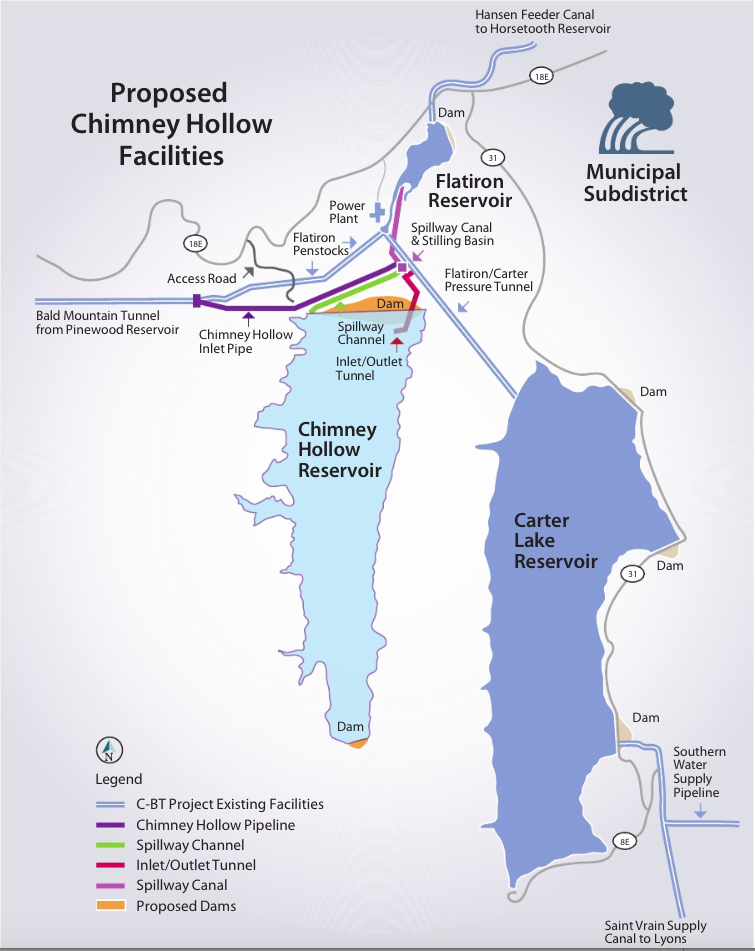
A graphic from Northern Water showing the lay out of Windy Gap Firming Project.
The Windy Gap Firming Project, a collaboration between 12 northern Colorado water providers, including Greeley, will result in a new reservoir — the 90,000 acre-foot Chimney Hollow Reservoir — and the largest dam on the Front Range.
When it’s complete, the project intends to make water supplies more reliable by installing the reservoir west of Carter Lake in Larimer County.
For the past year, the project has been in the middle of a lawsuit filed by environmental groups against federal agencies. The lawsuit questions the need for the project, saying it would make significant water diversions from the Colorado River, and that the U.S. Bureau of Reclamation and U.S. Army Crops of Engineers did not have enough information before they issued initial permits to the district.
Still, Jeff Drager, director of engineering for Northern Water, said the project hasn’t been stalled by the lawsuit, especially because funding from the Natural Resource Conservation Service requires the group to use the money within the next five years…
Right now, the project is in the permitting process. So far, the organization has $11 million and is seeking ways to fund the final $4 million…
The project has been in the process of permitting the project for 15 years, Drager said…
Drager said the group hopes to start construction in 2021 or 2022.
Thornton leaders plan to lend up to 3,000 acre-feet of water to the ailing Poudre River.
The effort is part of a long-term plan to create a virtual barter market on the Poudre, where cities, farmers and ditch companies can lend their water rights to a stretch of the river before taking it back at a downstream point. Thornton is working with Fort Collins, Greeley, Northern Water and other stakeholders on the so-called Poudre Flows project.
The Poudre Flows project still needs sign-off from Colorado’s water court. Thornton leaders and other stakeholders previously told the Coloradoan they’re planning to carry out the project without infringing on other people’s water rights.
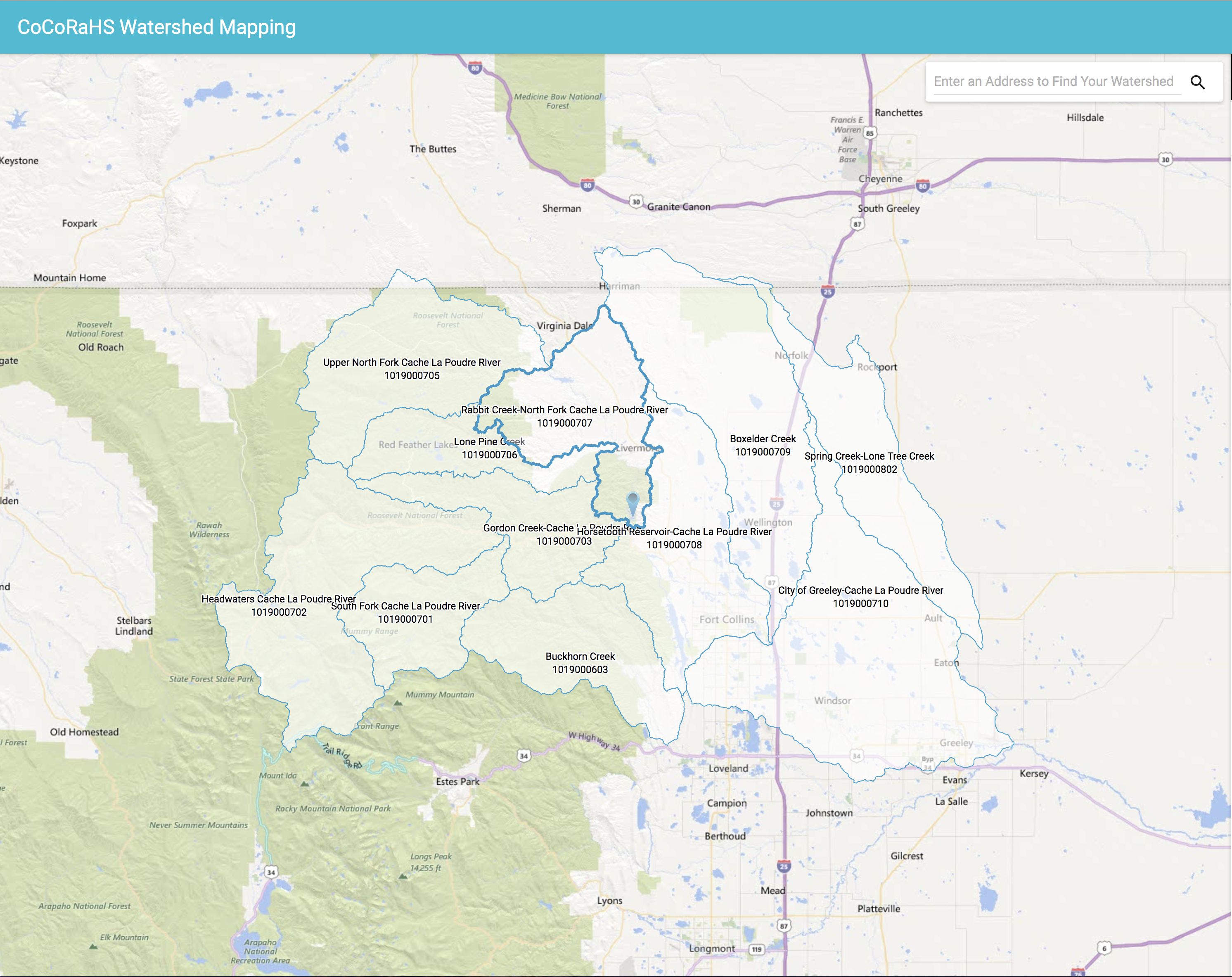
Outline of the watershed above Seaman Reservoir via CoCoRaHS and the Colorado Climate Center. The Seaman Fire is pinned near the S. side.
Noah from the Colorado Climate Center sent along this information about the Seaman Fire near Seaman Reservoir. I asked if the fire was in the Seaman Reservoir watershed which is Greeley’s water supply. It is. If it gets over the hill Fort Collins’ and other municipal supplies can be affected from burn scar runoff:
Yes, but just over the hill puts it into another watershed of the main branch of the Poudre. Check out the CoCoRaHS watershed map to see how Seaman is in the HUC [watershed] for Rabbit Creek –North Fork Cache La Poudre and just south of the reservoir – up the hillside – is the Gordon Creek-Cache La Poudre River.
Cache la Poudre River May 2018. Photo credit: Greg Hobbs
FromThe Fort Collins Coloradoan (Jacey Marmaduke):
A group of Northern Colorado water users and stakeholders is quietly piecing together a plan to prevent that from happening down the road. If the group’s efforts succeed, their plan could increase flows in the Poudre through Fort Collins and beyond. It could also mitigate the impacts of future water storage projects.
The project is somewhere between back-of-the-napkin and final draft stage, but the goal is to create a virtual barter market on the Poudre where cities, farmers and ditch companies can lend their water rights to a stretch of the river before taking it back further downstream. Fort Collins, Greeley, Thornton and other stakeholders are involved in the project, which has been in the works for years.
“All these diverse interests are collaborating and cooperating on an approach to help flows in the Poudre,” said Linda Bassi, the Colorado Water Conservation Board’s Stream and Lake Protection Section chief. “Everyone’s putting all their brain power into it to find a way to make it work.”
The Poudre starts running out of water as soon as it tumbles from the canyon mouth. More than 20 major diversions suck water from the river before it even gets to Fort Collins…
For decades, the river that fostered growth in Northern Colorado communities has been plagued with low flows and dry spots that hurt recreation, tourism, water quality and flood resilience.
Preserving river flows “is not just about ecology and fish,” Fort Collins Natural Areas Director John Stokes said. “It’s also about how we manage this volatile natural system in order to create all the co-benefits we care about.”
The cities, joined by the Cache la Poudre Water Users Association, Colorado Water Trust, Colorado Water Conservation Board and Northern Water, are parsing nearly 50 miles of the Poudre into five segments running from the canyon to the river’s confluence with the South Platte. They’re working together to decide target flows for each section and draft a water court application.
A lot of crucial details still need to be worked out: The water users involved in the plan need to identify “seed water” for the project and figure out where to release it and where to pick it back up. The organizers say it’s crucial to craft a plan that doesn’t infringe on other people’s water rights.
Putting the plan in action could take years, if it works. But Poudre water users have already spent decades trying to tackle the problem of low river flows.
The Poudre was the birthplace of western water law, a notoriously complex system that allows people who possess older or “senior” water rights to use their water before junior users. Seniority becomes important during dry times when there might not be any water left for the users at the end of the line.
Our water laws have allowed cities, farmers and industry to coexist along the Poudre, but the system can make it hard to keep water in the river.
“There really isn’t any water out there that isn’t going to be managed and used and owned by somebody,” Stokes said.
The Colorado Water Conservation Board is the only entity in the state allowed to hold a water right purely for the purpose of preserving or enhancing river flows. Everyone else must prove they’re using the water for something else, like municipal drinking supply or irrigation.
The board has a couple ways to protect water in rivers: It can create a new, junior water right, or it can buy an older water right from someone else.
“Both of those have limitations,” said Emily Hunt, water resources manager for city of Thornton. “Appropriating new water rights on a stream that’s already stressed isn’t going to get you very far, because you’re at the end of the line. And acquiring senior water rights requires a willing seller and money.”
The new approach is different because it would basically allow water users to temporarily sell or lease their water to the Colorado Water Conservation Board. That means the water would be protected from diversions or exchanges and the user that loaned the water would be able to take it back downstream.
“There’s currently no mechanism to protect that flow from point A to point B,” Hunt said. “That’s the real issue. If entities are going to voluntarily do this, we want to make sure the water is protected.”
The planning group was born as a sub-group of the local Poudre Runs Through It work group. Colorado Water Trust, a statewide group that works to restore river flows, pitched the concept. It’s essentially a scaled-up version of the program that allows the Colorado Water Conservation Board to purchase senior water rights, said Zach Smith, Colorado Water Trust’s staff attorney.
Building the legal foundation for the water transactions ahead of time will simplify the process, and the program will also offer flexibility because people who participate won’t be obligated to put water in the program every year, Smith said.
“Colorado already has a water market,” Smith said. “Water rights are property rights, and they’re bought and sold all the time. A program like this just gives the environment a seat at the table.”
The group could submit its application to Colorado water court as early as next year. Group leaders plan to conduct more outreach with Poudre River water users to help them nail down the specifics of the plan.
“People are committed to solving the problem,” Hunt said. “This is one approach. It has some legs and we hope it keeps them, but by no means are we there yet.”
Northern Integrated Supply Project (NISP) map July 27, 2016 via Northern Water.
Here’s the release from Northern Water:
Officials from the Army Corps of Engineers have released a Final Environmental Impact Statement that explores the alternatives for supplying a reliable water supply to 15 municipalities and water providers in northeastern Colorado.
The document outlines the impacts of Northern Water’s preferred alternative, the Northern Integrated Supply Project, as well as three other potential reservoir projects. It also looks at the effects to the environment if no action alternative is approved.
Northern Water officials began the formal permitting process to build NISP on behalf of the 15 participants in 2004, which resulted in a Draft Environmental Impact Statement in 2008. A Supplemental Draft Environmental Impact Statement was released in 2015.
“This is another step in the process and a very thorough one at that,” said Northern Water General Manager Brad Wind. “We’re encouraged that it shows that no new significant issues have popped up and that the impacts can and will be mitigated.”
The Northern Integrated Supply Project includes the construction of Glade Reservoir northwest of Fort Collins and Galeton Reservoir northeast of Greeley. Five pump stations and 85 miles of pipeline would convey water to communities participating in the project as well as some farmers in the Cache la Poudre River basin.
The operation of the project would include minimum guaranteed stream flows through downtown Fort Collins, bypass of peak flows in most years, improvements to stream channel and riparian areas along the Poudre River and establishment of a recreation complex at Glade Reservoir.
“The NISP participants have really come a long way and stepped up to put together one of the most-robust mitigation and enhancement plans ever,” said NISP Participants Committee Chairman Chris Smith. Smith, the general manager of the Left Hand Water District added, “We are committed to the $60 million plan to protect and enhance the environment.”
In the 14 years since the permitting began, Northern Colorado has continued to grow at a record pace with seven of the top-growing cities within the NISP Participants Committee. Smith said, “we are the bullseye for growth in Colorado with the fastest-growing cities in the state all being NISP participants.”
In addition to NISP, which is the preferred alternative, federal officials looked at alternatives that included a different combination of reservoirs and conveyance methods. Out of 215 elements studied such as reservoir expansion, new reservoirs and groundwater storage, the Corps identified four that would meet the project purpose and need. The Corps also considered the impact of removing irrigation water from nearly 100 square miles of land in Northern Colorado, which, the FEIS illustrates, would occur if NISP is not approved.
NISP participants include the communities of Erie, Windsor, Fort Morgan, Evans, Fort Lupton, Eaton, Severance, Lafayette, Firestone, Frederick and Dacono. Also, the Fort Collins-Loveland Water District, Left Hand Water District, Central Weld County Water District and Morgan County Quality Water District are participants.
The public has 45 days to provide comments to the Corps on the FEIS. A Record of Decision based on the document and public input will be issued by the Corps and is expected in 2019.
The Army Corps of Engineers’ report, about 1,400 pages in all, explores all facets of the project, which leverages water rights purchased by Northern Water in the 1980s along with proposed reservoirs to store and release those rights as necessary.
Getting to this point has taken 14 years, and puts in site potential approval of the project in 2019.
“There’s a lot of smiles around here today,” said Brian Werner, Northern Water spokesman. “This has been a long process.”
Werner said the participants can now see light at the end of the tunnel. He could have said water, as the NISP plan would provide 40,000 acre feet of water per year to the partners. That’s roughly enough water for 80,000 families.
The proposal calls for two reservoirs: one called Glade Reservoir north of Fort Collins, and the other, Galeton Reservoir, north of Eaton.
The Glade Reservoir would be fed by the Poudre River, and the Galeton Reservoir would be fed via a pipeline from the South Platte River.
The Corps also looked at three potential alternatives, and analyzed impacts ranging from fish and wildlife to vegetation and water quality.
Most of the impacts analyzed in the report were considered minor or subtle, but there were areas of concern highlighted:
» Water quality in the proposed Galeton Reservoir, north of Eaton.
» Destruction of wildlife habitat with the Glade and Galeton reservoirs.
» Reduced flows along the Poudre River, particularly during peak flow months.
The U.S. Army Corps of Engineers has now opened a public comment period, which will stay open until Sept. 4.
Werner said he saw no surprises in the report, and he said Northern Water is prepared to mitigate any impacts.
Werner said there will be a guaranteed minimum flow through Fort Collins throughout the year, something he said hasn’t been done.
“It’s taken 15 years, and those participants’ need hasn’t lessened. They still need the water, and that need has increased,” Werner said.
Windsor stands to get about 3,300 acre-feet of water, which would amount to double what the town’s currently uses, 3,400 acre-feet per year. When reached for comment Friday, Town Manager Shane Hale said officials there are pleased to have reached this step.
“Windsor’s one of the fastest growing communities in the state,” Hale said. “This is the cost of growth.”
Evans will get 1,600 acre-feet of water from the project, and City Manager Jim Becklenberg called the environmental impact statement an important milestone.
“Evans looks forward to continued community discussion of the project’s value to the community and how it fits into our long-term water and development planning,” Becklenberg said in a prepared statement.
The Central Weld County Water District, which supplies much of the rural residential tap water in Weld County, would gain 3,100 acre-feet from the project, adding to it’s 5,800 acre-foot annual allotment today.
“This would carry us for many years,” said Jim Park, president of the district’s board.
Greeley is not part of the project, and officials here have expressed concerns throughout the process. The official line, City Manager Roy Otto said, is that the city recognizes the need for all reservoirs in northern Colorado.
“Our only concerns are impacts to our water supplies, and how to mitigate (those impacts),” Otto said.
First and foremost, Otto said, he wanted to congratulate Northern Water.
“I think it’s very safe to say our water board is on the record supporting every single water storage project,” Otto said.
The plan goes beyond storage, or at least it’s storage-plus. The proposed Glade Reservoir would offer recreation opportunities, including boating and fishing, and would feature a visitor’s center.
There’s no such luck for Weld County residents, as the Galeton Reservoir would be off limits to those kind of recreation opportunities, apart from, perhaps, wildlife viewing, Werner said.
Even then, the Galeton Reservoir is expected to remove 215 acres of prairie dog colonies, 1,753 acres of swift fox habitat, 777 acres of grasslands and 964 acres of native shrublands, according to the report.
Werner, for his part, stands by Northern Water’s work to mitigate the negative impacts of the NISP.
“They’re always saying it’s not enough mitigation,” Werner said. “I would argue this is the most robust mitigation plan of any Colorado water project — it’s 136 pages. There will be impacts whether you’re building a highway, a school or a reservoir. We certainly believe we’ll mitigate those impacts.”
As anyone who has watched as more and more cars stack up during the morning commute can attest, the population here keeps booming.
But if that’s the case, why is the city’s water use continuously going down?
Seriously. In 2000, the city of Fort Collins treated 31,594 acre-feet of water.
In 2017, the city treated three-fourths of that, or 23,512 acre-feet — despite an additional 15,400 people tapping into the city’s water. (Fort Collins Water serves the majority of businesses and residences in the city limits, but not all.)
[…]
People are paying attention and they’re asking about (water),” Fort Collins Water Conservation manager Liesel Hans said. “Are we going to be on restrictions this year? Is there enough water to go around? So I think people are more aware of it, for sure.”
Hans traces the awareness back to the multi-year drought that gripped Colorado and the West starting in 2001. People, presumably in an effort to save their lawns and otherwise stave of the heat, were using on average 200-plus gallons of water per day. It was also when water conservation messages starting sprouting up in Fort Collins and statewide.
Then, average gallon-per-capita use in Fort Collins started falling. In 2017, that measurement hit 141 gallons per capita per day, a 33 percent drop. Residential use dropped at an even greater clip: It went from 126 gallons of water per person per day to 73 — a 43 percent decline.
That put overall water use within the city’s goal of 2020 water use. That is a moving target, however. The city has since shifted to a 2030 goal of 130 gallons per capita per day and plans to make another goal change come 2022.
These days, the historic plant is in the process of changing. Greeley is building a new water treatment plant on the same property to replace water filtration systems, marking the first major change to the facility since 1947. The $25 million project will centralize water filtration processes that currently are spread out between two buildings, and with further expansion one day could give the plant the capability to treat 40 million gallons of water per day. The initial phase of the project is expected to be completed by mid-2019.
During the city’s annual summer water and sewer tour, a group of Greeley residents saw the past and into the future, learning about the extensive filtration, miles of pipeline that bring water from Bellvue to Greeley and the construction that will upgrade the system.
“We’re kind of turning the page on what the treatment plant will look like between yesterday and into the future,” said Burt Knight, Greeley’s water and sewer director.
CENTURY-OLD SYSTEM
For Mohr, the Bellvue plant is fascinating. Between breaking down the technical process associated with treating water at the plant and showing residents decades-old filters during the tour, he stopped a few times to express his awe for the plant, first envisioned by Greeley leaders at the turn of the century, back when the city had a population of 5,000.
In 1905, 97 percent of Greeley’s voters approved a ballot measure to build the plant at the mountain location — just west of Fort Collins — to bring the city water produced by Rocky Mountain snowmelt.
“The one thing I’m overly impressed with is we’ve got over 30 miles of pipeline from this facility to Greeley, and we don’t use pumps to move water from there to there,” Mohr said.
The 36-mile pipeline envisioned by Greeley water pioneer W.D. Farr brings water to the city’s storage facilities by gravity as it flows down from the mountains. Mohr said choosing Bellvue for the plant was a strategic part of the process.
“W.D. Farr over 100 years ago worked together with a number of other very smart people and said, ‘If we’re going to serve water to the residents of Greeley, this is a great place to do it,’ ” he said. “And it is, for a number of reasons.”
For one, Mohr said, Bellvue is still responsible for filtering most of Greeley’s water more than a century later. Though the Boyd Lake Water Treatment Plant in Loveland helps supplement the city’s production in the summer when residents use more water for lawns and plants, it runs only seasonally, leaving most of the work to Bellvue.
And in 2017, water produced at the plant won the American Water Works Association’s award for best tasting water in the nation, beating 33 other regional winners. It also won the competition’s People’s Choice Award, making Greeley the first city to win both awards in the contest’s 13-year history.
But even with the recognition and the plant’s long life, Mohr said Bellvue needs to be upgraded.
Greeley City Manager Roy Otto said for the city, the job is fairly commonplace. It’s important for the water and sewer department to constantly expand and upgrade its facilities, he said, and the Bellvue project is just one of several projects the city is working on to accomplish that goal.
At Bellvue, upgrades will replace equipment that has been in place for decades.
With water filters that have been in operation since the late 1940s and early ’50s, Mohr said, Bellvue’s current buildings are going to be obsolete soon.
“It’s been working very, very hard for a very long time,” he said, “and it’s kind of time for us to think about the future.”
NEXT PHASE
After the city won the American Water Works Association awards, Knight, the water and sewer director, said he called Bellvue’s Water Treatment Manager Andrew Kabot, jokingly, to suggest the city cancel the project because Greeley’s water was right where it needed to be.
“He assured me that was a bad idea,” Knight said during the tour.
The project, which broke ground in October, started after the water and sewer department found it would cost more to rehabilitate Bellvue’s vintage filters, placed there in 1948 and 1953, than it would to start from scratch to build a modern system. Mohr said the new technology will automate the filtration processes. City officials also plan to improve piping at the plant so water can enter the system more quickly.
At the current plant, the city brings water in through the system between two different buildings to complete the water treatment process.
Knight said when the new plant is completed those processes will be under the same roof. The city will maintain the plant’s old buildings, he said, and use them as gathering places for tour groups or meetings.
Before construction started, Knight said, the city decided to award the project to Fort Collins-based Hydro Construction as part of a construction manager risk contract, a form of a design-build contract. That means city officials will make decisions with the company as construction progresses.
“Our choice, predominantly, is investment in water treatment,” Knight said. “So we’ll have an attractive building, but it’s really about the equipment inside the building.”
From Kevin Duggan writing on the opinion pages of The Fort Collins Coloradoan:
The cost of a water-storage project Fort Collins has been pursuing for more than a decade continues to float higher and higher.
But even at its current estimated cost of $74.1 million — $27.3 million more than estimated just a few years ago — city officials say expanding Halligan Reservoir along the North Fork of the Poudre River remains the city’s best and most affordable option for securing future water supplies that would be needed in the event of drought.
That’s a big-ticket item by any measure. The cost would be covered by reserves in a fund that gets money from water rates paid by Fort Collins Utilities customers and fees charged to developers for tapping into the city’s water system.
Those development fees could go up 23 percent in coming years to help pay for Halligan, according to a memo to City Council…
Part of the reason for the project’s rising cost estimates is the uncertainty that comes with going through the National Environmental Policy Act process. The current projected cost includes $16.3 million in contingency funds to cover potential surprises in federal and state requirements for permitting and mitigation.
Fort Collins has been working on and paying for an Environmental Impact Statement, or EIS, for the proposed expansion of Halligan for 12 years. The latest estimate for when a draft EIS for the project will be released by the U.S. Army Corps of Engineers is April 2019, said Adam Jokerst, the city’s project manager.
Construction costs have gone up over the years and continue to rise. If the project is permitted, construction on the expansion, estimated to cost $31.3 million, could begin in 2023 and be completed in two years.
It would be quite an effort. The city has proposed enlarging Halligan’s capacity from 6,400 acre-feet to about 14,525 acre-feet by raising its concrete dam 25 feet…
The Halligan project has faced a lot of issues over the years. For a time, the EIS process included the city of Greeley’s proposal to expand its Milton Seaman Reservoir, which also is on the North Fork of the Poudre. Greeley wanted to expand its 5,000-acre-foot reservoir to 53,000 acre-feet.
The Halligan-Seaman project included the cities in partnership with North Poudre as well as the Fort Collins-Loveland, East Larimer County and North Weld County water districts, also known as the Tri-Districts.
The Tri-Districts backed out of the project in 2009, citing mounting costs and a lack of progress on environmental studies. North Poudre withdrew in 2014 over the same concerns.
Those withdrawals required scaling back the project, changing its environmental impacts and adding time to the review process, Jokerst said. There’s also been a lot of turnover at the Corps over the years with personnel overseeing the EIS.
The Seaman project was separated from Halligan in 2015 because of changing scopes for the projects and differing time frames. Greeley is now proposing to expand Seaman to 88,000 acre-feet to meet its water supply needs to 2065, according to the Corps’ website.
Fort Collins officials maintain the Halligan project still makes sense for the city even with its escalating costs. It makes use of an existing reservoir and could potentially improve flows on the North Fork through mitigation. The city has the water rights it needs to fill the reservoir, Jokerst said.
And Halligan is still less expensive than other water supply sources, according to the city. The going rates for an acre-foot of firm yield from the Colorado-Big Thompson project is $60,000. Under current estimates, water from the Halligan project would cost $8,800 per acre-foot.
So far, Fort Collins Utilities has spent $12.6 million on the project. The city has appropriated $37.4 million for it and would have to come up with another $36.7 million under current projections.
Looking east toward the Chimney Hollow Reservoir site, which is just this side of the red ridge. On the other side is Carter Lake Reservoir and beyond that, the Loveland area.
In western Larimer County a sedimentary rock ridge runs parallel to the gradual beginnings of the Rocky Mountain foothills, forming a large valley known as Chimney Hollow.
In May 2017, federal agencies approved plans to flood the valley — which is between Longmont, to the south, and Loveland, to the north — to create a 90,000 acre-foot reservoir.
But while the 14-year federal permitting process has now come to an end and construction slated to begin early next year, a federal lawsuit from six environmental groups could stop the project from moving forward.
“We are just trying to inject some sanity and stop the madness,” said Gary Wockner, director of Save the Colorado, an environmental nonprofit based in Ft. Collins that supports the Colorado River and is the lead petitioner in the case. “The Colorado River is the most dammed, drained, depleted river on the planet.”
The construction of Chimney Hollow Reservoir is the foundation for the $400 million Windy Gap “firming project,” a supplemental storage plan tied to the existing Windy Gap dam and reservoir, which is on the main stem of the Colorado River in Grand County. The firming project also includes construction of a bypass channel at Windy Gap’s original diversion point in order to help mitigate existing impacts on fish and water quality.
The relatively modest Windy Gap reservoir, which holds 445 acre-feet, was built in 1985 to draw water from the Colorado River and pump it uphill to Lake Granby and into the Colorado-Big Thompson project. The water is then sent under the Continental Divide and into Larimer and other Front Range counties.
The Northern Colorado Water Conservation District based in Berthoud, owns the Windy Gap reservoir, operates the Colorado-Big Thompson system, and is intent on constructing Chimney Hollow reservoir to store additional Colorado River water.
Fourteen municipalities and water districts throughout the Front Range are signed up to help pay for the Chimney Hollow reservoir, based on the share of the water they intend to use.
Though the existing Windy Gap Project can today draw as much as 90,000 acre-feet of water from the Colorado River, due to junior water rights and a lack of storage, the project is often unable to provide any water at all to the Front Range.
With the Chimney Hollow Reservoir in place, the Windy Gap project could supply a guaranteed 30,000 acre-feet of water per year to its customers.
A graphic from Northern Water showing the lay out of Windy Gap Firming Project.
Other alternatives?
Wockner and Save the Colorado have been joined by five other environmental groups — Save the Poudre, Wildearth Guardians, Living Rivers, Waterkeeper Alliance and the Sierra Club — in suing the Bureau of Reclamation and the Army Corps of Engineers over their environmental review of the Windy Gap firming project.
The petitioners allege that the agencies violated the National Environmental Protection Act and the Clean Water Act by failing to consider alternatives, like water conservation, instead of building a new project.
“Rather than rigorously exploring and objectively evaluating ways to meet (Northern’s) actual water supply needs, the federal agencies accepted (Northern’s) claimed need at face value and only considered reservoir options that would further (Northern’s) preconceived goal of “firming” Windy Gap water supplies,” says the petitioner’s complaint.
Both the Bureau of Reclamation and the Army Corps of Engineers declined interview requests for this story, but according to the Bureau’s Final Environmental Impact Statement, the firming project would supply only about 10 percent of its customers projected 2050 water demand.
Because conservation cannot account for the entire projected gap, the FEIS states that the agency did not consider conservation as an alternative to the firming project.
The agencies’ assumptions about the demand gap are consistent with those of the 2015 Colorado Water Plan the state’s official water strategy document, which estimates that water demand in 2050 could exceed supplies by as much as 560,000 acre-feet.
To make up for this gap, the plan calls for conservation measures and also the significant expansion of water storage facilities.
Because of the water plan’s call for storage, the Windy Gap firming project is considered a critical storage project by the state and received endorsements from both the Colorado Water Conservation Board and Gov. John Hickenlooper.
Outflow from the dam across the Colorado River that forms Windy Gap Reservoir. Taken during a field trip the reservoir in September, 2017.
Conservation included
Northern, which is not a defendant in the lawsuit, filed a motion in March to intervene on behalf of the defendants in the lawsuit to help defend the permit process.
When asked why conservation was not considered as an alternative, officials from Northern said that the demand estimates already assume that municipalities will increase water conservation.
“We did not count conservation as an alternative. We built conservation into our demand projection,” said Jeff Drager, Northern’s director of engineering and the project manager for the Windy Gap firming project. “So when we looked at how much water our participants need we figured we factored in some level of conservation already.”
Though Northern and the state use the projected demand gap to justify the firming project, the petitioners say the demand estimates are inflated.
On May 3, the petitioners filed a motion to add a statistics report to the case’s administrative record.
According to the report, the Bureau of Reclamation and the Army Corps failed to update the estimated water use statistics in their impact statements with the actual water use data as it became available over the course of the 14-year permitting process.
The report found that the agencies’ estimates for municipal water use were between 9 and 97 percent higher than the actual water use figures.
“The thrust of our claim is that the federal government just took the project participants word for how much water they would need,” said Kevin Lynch, the attorney for the petitioners. “The agency has a duty to independently verify that need and they didn’t do anything. They took projections from 2005 and that data was wildly over-inflated.”
The court is now reviewing the petitioners’ administrative motions as well as motions by both Northern and the Colorado Department of Natural Resources to intervene on behalf of the defendants.
These changes will likely delay court proceedings for at least several months.
There already are six projects being pursued in the South Platte Basin to extend the water supply. These are not included in the recent South Platte Storage Survey, but have been considered and under way for some time:
Northern Integrated Supply Project (NISP) map July 27, 2016 via Northern Water.
• The NISP/Glade project — The Northern Integrated Supply Project is a proposed water storage and distribution project that will supply 15 Northern Front Range water partners with 40,000 acre-feet of new, reliable water supplies.
Map from Northern Water via the Fort Collins Coloradan.
• Chimney Hollow Reservoir — A 360-foot high dam that will hold 90,000 acre feet to help supply the thirsty Thompson Valley urban area. The water will come from the Windy Gap Project, a diversion dam and pumping station completed in 1985 to provide extra irrigation and municipal water out of the Colorado River. The water originally was stored in Grand Lake, but when that is full, the water cannot be stored. Chimney Hollow, also known as the Windy Gap Firming Project, solves that problem.
Reservoirs NW of Fort Collins
• Halligan reservoir enlargements — Halligan Reservoir near Fort Collins is about 100 years old. Its capacity is about 6,400 acre feet of water and the City of Fort Collins wants to add 8,125 acre feet to the reservoir by raising its dam about 25 feet.
• Milton Seaman Reservoir enlargement — Greeley originally had wanted to expand Seaman Reservoir in conjunction with Halligan, but because of diverging goals Greeley withdrew from the joint project. The expansion of Seamon now is targeted for design in 2028 and construction by 2030.
Gross Dam enlargement concept graphic via Denver Water
• Gross Reservoir enlargement — Gross Reservoir is one of 11 reservoirs supplying water to the City of Denver and surrounding urban areas. It is on the city’s Moffat System, which diverts water from the Western Slope to the metro area. Denver Water has proposed raising the dam height by 131 feet, which will allow the capacity of the reservoir to increase by 77,000 acre feet.
Proposed reallocation pool — Graphic/USACE
• Chatfield Reallocation Plan — The U.S. Army Corps of Engineers has determined that Chatfield Reservoir, built primarily for flood control after the 1965 South Platte River flood, can accommodate an additional 20,600 acre feet of water storage for water supply without compromising its flood control function. This additional storage space will be used by municipal and agricultural water providers to help meet the diverse needs of the state. No actual construction is required, but the legal, environmental, and engineering concerns of allowing the reservoir to hold more water all have to be satisfied.
The council voted 5-2 to allow city staff to negotiate, with Councilmembers Ross Cunniff and Bob Overbeck against, and those in agreement largely arguing it couldn’t hurt anything. City staff would need to go to council to approve any final deals.
“We need to be in the game and to negotiate and look out for Fort Collins’ best interests,” Mayor Wade Troxell said.
The agreement to negotiate doesn’t affect the city council’s overall negative disposition toward the Northern Integrated Supply Project. NISP would lead to the creation of two reservoirs, the Glade to the northwest of the city and the Galeton near Greeley. It would divert nearly 40,000 acre feet of water from the Poudre River. Fort Collins Water Resources Engineer Adam Jokerst noted for comparison that the city typically treats about 25,000 acre feet of water a year, about half of which is from the Poudre.
With a key final report looming for two proposed Poudre River-fueled reservoirs, Fort Collins City Council will weigh whether staff will try to negotiate over the city’s remaining concerns.
Past city comments helped steer the Northern Integrated Supply Project in a more agreeable direction, according to a staff report for Tuesday night’s City Council meeting. But concerns still remain. Staff members hope a negotiation might quell, or at least mitigate, some of them…
According to city staff, the prime concerns are:
a reduction of peak flows in the river, and related loss of river health and increased flood risk;
the unknown effect the project may have on water quality;
an unclear and “inadequately funded” adaptive management plan;
concerns that there’s not enough money gong to mitigation or river enhancement.
Officially, the city does not support NISP, but it has engaged in conversations with project organizer Northern Water on the project that has been talked about for more than a decade.
City staff is pushing for more formal negotiations — the City Council stripped that specific language in a similar resolution in February 2017 — because the permitting process is nearing its end. The Army Corps of Engineers is poised to release its final environmental impact statement at the end of June, according to the city.
The city isn’t a direct participant in the Northern Integrated Supply Project, though it is considered a stakeholder. The Corps doesn’t usually accept public comment on final environmental impact statements but is poised to do so this time, according to city staff. However, it will also likely be late enough in the process that public comment alone won’t be able to make change much.
Any negotiations would likely include a give-and-take with Northern Water, such as the city’s help in expediting remaining permits, though staff didn’t speculate about what else it may be.
“As with any such discussions regarding complex matters and potential agreements, there are no guarantees of success,” according to the staff report [ed. Click through to the Coloradoan to read the report]. “Furthermore, the approach will depend on Northern Water’s willingness to participate.”
The [Larimer County Planning Commission] voted 4-2 [May 16, 2018] to recommend that county commissioners turn down the project at their July 9 meeting. The Board of County Commissioners doesn’t have to listen to the planning commission’s guidance, but it holds special weight.
At the end of a packed five-hour hearing, several planning commissioners said Thornton’s application for the Larimer County portion of its proposed 75-mile pipeline lacked detail, especially when it came to potential alternatives and a proposed pump house that would sit adjacent to the Douglas Road section of the pipeline…
Now county staff will convene with the planning commission to determine where Thornton’s proposal needs more detail. Thornton leaders will provide that information to county commissioners before their July meeting, Thornton Water project spokesman Mark Koleber said.
Thornton hopes to begin construction of its pipeline in 2019 and use it for water deliveries by 2025. The pipeline would eventually funnel an average of 14,000 acre-feet of water annually along Douglas Road, then south…
Thornton’s pipeline wouldn’t draw additional water from the Poudre because the city purchased the water rights in the ’80s from farms that have continued to use it. Still, opponents argued that adding additional water to the beleaguered Poudre through Fort Collins would offset other diversions and make the river healthier…
[Mark] Koleber told the board running the water through the Poudre would present several issues for the city and its residents:
The water would run past three wastewater treatment plants and sections of urban runoff, degrading its quality and making it expensive and complicated to treat. Fort Collins and other municipal users divert their water upstream for the same reason.
Running the water down a roughly 18-mile section of the Poudre would result in a 9 percent loss of water.
Thornton’s water court decree requires diversion from the Larimer County canal upstream, and the city’s water rights could be reduced if it asked water court for a modification.
The city wouldn’t be able to use reservoirs north of Fort Collins for storage of its water, and building new reservoirs elsewhere “is no easy prospect,” Koleber said.
But some of the commissioners were unconvinced that Thornton did enough to fully evaluate all alternatives and declare the Douglas Road route the best option…
Commissioners spent little time discussing Thornton’s larger plans during deliberation. Commissioner Gary Gerrard, who joined commissioner Curtis Miller in dissenting votes for the recommendation for denial, said he doesn’t have the right to “stand in the way” of another community’s access to water it legally purchased.
“It’s not like they’re Russians,” he said. “They are our neighbors. …They’re people just like us; they need water. Clean, potable water is important to all of us.”
Chairman Sean Dougherty, commissioner Mina Cox, Caraway and Jensen voted to recommend denial of the Thornton pipeline permit.
Although it’s true that long-term plans could include more pipelines, the city is currently proposing just one, Thornton Water Project director Mark Koleber said.
This much is clear: Thornton is moving through the permitting process for a single pipeline, not three, to convey water from reservoirs north of Fort Collins to the growing Denver metro city. The 70-mile pipeline, if approved, will eventually funnel an average of 14,000 acre-feet of Poudre River water annually along Douglas Road, then south to Thornton…
The city has rights to more water that it could one day seek to transport through additional pipelines. Its long-term water plan could look a lot like what’s described in the decades-old documents, but nothing is for sure at this point.
The operative word here is “could.” Thornton will only pursue additional pipelines if they prove necessary, Koleber said, and any additional infrastructure must be permitted through a lengthy review process similar to what’s going on now. The city would also need to go through water court proceedings to use its additional water rights.
Thornton projects the single pipeline will meet its water needs through 2065, so additional pipelines wouldn’t be necessary for half a century, Koleber said…
Construction along the pipeline route could begin in 2019. The project, currently estimated to cost $430 million, needs to be operational by 2025 to meet Thornton’s water supply needs, Koleber said…
Dick Brauch, who owns the farm where Thornton plans to place its pump house, is worried the city will hurt his operations.
“The farm’s been in my family for 60 years, and I have no desire to sell,” he said, but he’s negotiating with the city to avoid eminent domain.
The planned location for the 2.8-acre pump house would “take a big chunk out of the middle” of Brauch’s land and be difficult to farm around, he said. Koleber said Thornton is working with Brauch and can probably accommodate his concerns.
The plan would pull the water from the Poudre River from a location close to Ted’s Place where the river crosses U.S. 287, to be stored in a network of reservoirs north and west of Douglas Road. A pump station would be built near the intersection of Douglas Road and Starlight Drive just east of North Shields Street. The permit was filed in January 2018…
In the 1990s, the case went to the Colorado Supreme Court to determine if Thornton could use the water rights to convert the water from agriculture to municipal use. At this time, Thornton leased some of the farms back to farmers along with the water. Many of these farmers were the same people from whom Thornton bought the land. Some of the farmers use the dryland grass cover as forage for their animals. In addition, Thornton has been making voluntary tax payments to Larimer and Weld counties, $45,000 to Larimer and $257,000 to Weld in 2017.Koebler estimated Thornton has paid close to $6 million in voluntary tax payments since 1985.
Four years ago, Thornton attempted to address the concerns of their water program and pipeline. Open houses were held in Firestone, Johnstown, Windsor and Fort Collins. HOAs were consulted. The locals were asked for advice on the routing of the pipeline.
Construction would begin in Windsor and proceed in Weld County. The pipeline is expected to be completed by 2025.
Residents along Douglas Road north of Fort Collins are standing in the way of the pipeline project that would deliver Poudre River water to Thornton. It’s water the city of Thornton says it will desperately need in just seven years, in order to sustain its current and projected population booms.
“This will (help) take us from the current population of about 130,000 up to about 242,000,” said Mark Koleber, water project director for the City of Thornton.
Koleber said Thornton is simply trying to tap the water rights it bought from Weld County farmers decades ago.
“The city started — in the mid-1980’s — to acquire these water rights and the farms that went along with it,” Koleber said…
“We’re certainly going to give it our best try,” said Lynn Utzman-Nichols, Hillman’s neighbor who also lives just a few blocks from Douglas Road. “We really hope we can find a solution that works for everyone.”
One of those solutions: Keep the water in the Poudre River until it’s further downstream near I-25.
Thornton says that plan doesn’t work for them, because then it becomes a water quality issue; the further the water must travel, the more contaminated and polluted it becomes, especially passing through the City of Fort Collins. And that would add to the cost of water treatment.
Thornton wants the water to come directly out of the reservoirs it owns north of Fort Collins.
“Those are the reservoirs that Thornton invested in back in the mid-1980’s,” Koleber said…
But Larimer County officials also see an opportunity in working with Thornton on the plan to bury the pipeline under Douglas Road. The county wants to widen the road – and sees the pipeline as a chance to widen the road earlier than expected.
“If (Larimer County is) going to be tearing up the pavement, there’s an opportunity there to put the pipeline in at the same time and minimize the disruption to the area residents,” Koleber said.
As of March 14, the state sits at about 67 percent of the average snowpack, according to the Natural Resources Conservation Service.
Things are looking slightly better in northern Colorado, with the two basins that impact Weld County — the Upper Colorado and the South Platte — at 77 percent and 81 percent of the average year, respectively…
Eric Brown, spokesperson for the Northern Colorado Water Conservancy District, said the dry weather is on Northern Water’s radar, just like it’s on farmers’, but there may be one saving grace — a healthy amount of water in reservoir storage.
Northern Water’s reservoirs are at one of their highest ever levels, with storage at 121 percent of average. Across Colorado, reservoir storage is at about 117 percent of the historic average. While Brown said the water district is optimistic that, in true Colorado fashion, there’s a big spring storm a’comin’, its prepared to use some of its reserves to combat an abnormally dry year.
“In general, farmers who have access to some sort of water in storage should be okay for 2018, as Northern Water’s C-BT Project and reservoirs across the South Platte Basin are sitting at solid levels for the most part,” Brown said. “But for the farmers who don’t have access to water that’s in storage, they really need snow and/or spring rains in the near future.”
But for everyone, use of the water in storage this year creates uncertainties down the road, as some of the current surplus will be used up. Plus, a good, wet snow would bring some much-needed moisture to the plains and help with soil quality, which plays an important role in crop health.
The Northern Water Board will set its quota for C-BT deliveries for the remainder of the 2018 water delivery season at its April 12 board meeting. Both snowpack and C-BT and local non-C-BT reservoir levels will factor into this decision. The board sets a quota each year to balance how much water can be used and how much water needs to stay in storage, and the historic average for the quota is 70 percent.
Colorado-Big Thompson Project Map via Northern Water
Water quality is a sticking point for Thornton, which faces challenges getting all its water to drinking quality standards. Much of the city’s water comes from the South Platte River and requires extensive treatment because it’s diverted downstream of many areas of runoff and pollution, [Emily] Hunt said.
If Thornton drew the water from the Poudre near Windsor as suggested, the city would end up with water run downstream of three wastewater treatment plants and numerous runoff areas, [Mark] Koleber said.
“Urban runoff, agricultural runoff, wastewater plants, industrial discharge — it’s just not what you do for a municipal drinking water supply,” he said.
Especially considering Thornton bought the [rights to divert] because of its high quality, Hunt added.
Here’s the release from Colorado State University (Mary Guiden):
When it snows in Fort Collins, Alyssa Anenberg heads west to Lory State Park, but not to snowshoe or ski. Instead, the Colorado State University graduate student gathers information about how nutrients move through the soil after snow falls and eventually melts.
Anenberg, who is pursuing a master’s degree in Watershed Science, is part of a team monitoring snowpack, soil moisture and streamflow at different elevations across the state. Their goal is to determine how melting snow affects the flow of rivers and streams, which has an impact on agriculture, recreation and Coloradans’ everyday lives.
John Hammond, who is working on a doctorate in Earth Sciences through the Warner College of Natural Resources, said the team is monitoring conditions at 11 watersheds across the state. In addition to on-the-ground tracking, researchers use satellite information from NASA and snow monitoring information from the Natural Resource Conservation Service’s SNOTEL network.
“It’s surprising how few people realize so much of their water supply depends on mountain snowpack,” said Hammond. “Snow isn’t just about recreation. It’s about everybody’s livelihood and it’s a very important resource for water used at home and in agriculture.”
Over the long haul, states like Colorado have measured high-elevation snowpack and used the measurements to forecast water supply. The CSU team is studying snowpack at middle and low elevations, where the snow does not last as long.
“These areas sometimes contribute large amounts of water to streamflow, but they aren’t measured by SNOTEL or other organizations,” said Stephanie Kampf, associate professor in the Department of Ecosystem Science and Sustainability, who oversees this research in the Natural Resource Ecology Lab at CSU. “Predicting water supply is not just about high-elevation snow. Low elevations with mixtures of snow and rain also matter, and we need a better understanding of how much water they produce.”
To date, researchers have identified a few trends, including one that may not sound too surprising.
“Overall, we see that low snow years give us less streamflow,” said Hammond. “In Colorado, it’s typically drier. If you have a small input from a small snow event or rainfall, it might only partially wet the soils.”
What’s the solution? Hammond said one option is to change the way reservoirs, dams and ditches are managed. At the same time, reservoir management is complex.
“Reservoirs are only so large, and they’re managed for multiple objectives, including municipal water supply, recreation, irrigation and flood control,” he said. “If snow melt occurs earlier, by a few weeks or months, you’d have to store that water for a longer period. Management objectives can be in competition with each other.”
One way water experts make progress is through collaboration, a key theme in Friday’s presentations and discussions at the fifth annual Poudre River Forum at the Island Grove Events Center, 501 N. 14th Ave. But working together isn’t always easy…
Even in the world of water experts, facts and evidence will often grab the attention of only the people whose biases are confirmed by the evidence. We learn in ways that don’t simply confirm our biases, Carcasson said, when we have genuine conversations with people we respect.
Ruth Quade, coordinator for Greeley’s Water Conservation program, said she’s worked with others her entire career in water conservation. Yet Carcasson’s presentation still rang true to Quade…
A panel of speakers highlighted some collaborations in the world of Colorado water: how state officials work with local water authorities to plan for water needs on a statewide scale, how the Fort Collins Water Utility worked with nearby water districts and more.
Kerri Rollins, manager of the Larimer County Open Space program, garnered the most questions after her presentation on a deal between the Larimer County Department of Natural Resources and the city and county of Broomfield. Larimer officials purchased a farm and its water rights southwest of Berthoud in 2016. They hoped to keep the farm in production, while offsetting costs through a water-sharing agreement. In August 2017, the alternative transfer method was finalized.
The agreement helps provide drought water to cities without the dichotomy that comes with “buy and dry” operations, where farms are permanently dried up. Rollins said the agreement was the first of its kind to share water from agricultural use to municipal use.
Click here to view the Twitter hashtag #poudreriverforum from last Friday.
One way water experts make progress is through collaboration, a key theme in Friday’s presentations and discussions at the fifth annual Poudre River Forum at the Island Grove Events Center, 501 N. 14th Ave. But working together isn’t always easy…
A panel of speakers highlighted some collaborations in the world of Colorado water: how state officials work with local water authorities to plan for water needs on a statewide scale, how the Fort Collins Water Utility worked with nearby water districts and more.
“Listening to Understand” is the theme of our fifth annual Poudre River Forum.
Register now to join us! Registration includes the full day’s program, as well as breakfast, lunch, and a closing beer/soft drinks celebration with opportunities to win Poudre prizes. Topics include:
Provocative, dialogue-stimulating “lightening talks” from a range of speakers with contrasting views about what can damage and what can improve Poudre flows
Can We Grow Water Smart?
Poudre Farmers Improving Poudre Water Quality through Air Quality Monitoring
Keynote Speaker: Colorado Supreme Court Justice Greg Hobbs (retired) will give a glimpse from his co-authored upcoming book—little known facts about Greeley’s water history
AND MORE!
Back from last year:
Poudre Splashes—snapshots of the past year’s Poudre activities—check our website for how to submit your entry
New this year:
Awarding of our first annual Poudre Pioneer Award. Check our website to find out how to nominate someone.
Breakfast! Enjoy a breakfast sandwich as you take in 20+ Poudre educational displays
Greenback cutthroat trout photo credit: Colorado Parks and Wildlife.
More greenback cutthroats are headed to a creek near you, thanks to a $60k grant from the National Fish and Wildlife Foundation’s “Bring Back the Natives” (BBN) program.
This project to restore native greenback cutthroat trout to 14 miles of stream in George and Cornelius Creeks in the headwaters of the North Fork of the Poudre River, reached a major funding milestone with the award of the $60k grant. The BBN grant will go toward the design and construction of a temporary barrier to upstream fish migration in Cornelius Creek, enabling systematic eradication of non-native brook trout, brown trout, and whirling disease from the watershed.
“George Creek holds great promise for recovering Greenback cutthroat trout, but our conservation success depends on broad support from many partners,” said Canyon Lakes District Ranger Katie Donahue. “Receiving a national funding award from NFWF is a great step along our path.”
The grant is the direct result of continued support for the project from Colorado Trout Unlimited. In addition to this grant “The Greenbacks,” a chapter of CTU, previously leveraged funds from a crowd sourced fundraising effort to secure a grant from Patagonia’s World Trout Initiative, resulting in the contribution of $17k toward a permanent barrier at the downstream end of the project. This barrier will exclude non-native trout from the watershed in perpetuity.
“We’re proud of how our volunteers have risen to meet the call,” said David Nickum, Executive Director for Colorado Trout Unlimited. “From backpacking fish into high-mountain restoration sites and releasing them back into their native range, to helping install fish barriers to protect native recovery areas, TU members have been hardworking, enthusiastic partners in recovery.”
This recent BBN grant brings the total amount of funding raised from grant sources and other public fundraising activities to $162k for the project.
About the George Creek Multi-phase greenback recovery project
The George Creek greenback restoration project has been in the works for three years and consists of three phases: (1) eradicate nonnative trout from upper George Creek [Summer 2018], (2) eradicate trout from upper Cornelius Creek, (3) eradicate non-native trout in lower reaches of George Creek down to a permanent barrier near the confluence with Sheep Creek. The BBN grant will help fund phase 2.
Native greenback cutthroat trout will be re-stocked into the streams when it has been confirmed that all non-native trout and whirling disease have been completely eradicated, in the year 2025 at the earliest.
The George Creek restoration project will ultimately restore native greenbacks to 14 miles of quality trout stream habitat, more than tripling the number of stream miles currently occupied by greenbacks in their native range, the South Platte Basin.
“Our work has been benefitted greatly from our strong partnerships with Colorado Trout Unlimited and the U.S. Forest Service,” said Boyd Wright, Native Aquatic Species Biologist for Colorado Parks and Wildlife. “It is gratifying to work together to ensure that future generations will enjoy Colorado’s greenback cutthroat trout for years to come.”
Thornton recently submitted its 1041 application to Larimer County, a key point in the review process for the contested portion of the pipeline route.
The Larimer County Planning Commission will hold a hearing for the project Feb. 21 at 6:30 p.m., and Larimer County commissioners are set to review the issue March 26.
Fort Collins Utilities is changing some of its procedures after breaking two state water quality rules last month.
The associated incident happened Dec. 14 and lasted 18 minutes, from 8:41 to 8:59 a.m. Water users were never at risk as a result of the incident, which involved a malfunction in the water treatment system, water resources and treatment operations manager Carol Webb said.
The malfunction involved a portion of the system that adds lime to water to prevent pipe corrosion. Though lime is a safe and state-approved drinking water additive, the system added too much lime to water on Dec. 14, causing a spike in turbidity, or cloudiness.
The overfeeding of lime caused water midway through the treatment process to spike to 2.5 times the mandated maximum cloudiness. The state enforces turbidity requirements because high turbidity can interfere with disinfection and offer a medium for microbial growth. Turbidity can also indicate the presence of disease-causing organisms in water, according to the Colorado Department of Public Health and Environment.
By the time the water reached users, its cloudiness was below state-mandated levels, but the turbidity spike in the combined filter effluent is still considered a violation because the state requires monitoring of water quality at several stages throughout the treatment process.
Fort Collins Utilities also failed to notify the state of the turbidity spike within 24 hours, which elevated the issue to require public notice. The city didn’t immediately notify the state in part because the department has never before experienced a situation like this one, water production manager Mark Kempton said.
The department is reviewing its training procedures and considering changes to automated alarms to prevent future violations, utilities staff said. They also said they plan to get to the bottom of the treatment malfunction to avoid a recurrence.
DENVER — Beneath the dim red glow of string lights at the Mercury Cafe in downtown Denver, about 25 people gathered Tuesday afternoon to rally support for a lawsuit against the state on behalf of the Colorado River.
The case, the first of its kind in the United States, has the potential to shift American environmental law by granting nature a legal standing. The suit lists “the Colorado River Ecosystem” as the plaintiff along with people who hope to serve as “next friends” for the river and represent its interests in court.
Five potential next friends were named in the original complaint — Deanna Meyer, Jennifer Murnan, Fred Gibson, Susan Hyatt and Will Falk — all members of the environmental group Deep Green Resistance, which states its goal is to “deprive the rich of their ability to steal from the poor and the powerful of their ability to destroy the planet.”
In an amended complaint, filed on Nov. 6, two more “next friends” were added to the case.
Owen Lammers of Moab is the executive director of Living Rivers, “which empowers a movement to realize social-ecological balance within the Colorado River watershed,” the amended complaint states. Living Rivers is a member of the Waterkeeper Alliance, a New York-based nonprofit dedicated to clean water founded by Robert F. Kennedy Jr.
“Because of Mr. Lammer’s significant relationship with, and dedication to, the Colorado River ecosystem, he is qualified to serve as next friend,” the amended complaint states.
This is a change from the original complaint, which did not cite any particular relationship between the Colorado River and the members of Deep Green Resistance.
Also added to the case was John Weisheit, who is “the person designated as the on-the-water ‘keeper’ per the Waterkeeper Alliance policies. In other words, Mr. Weissheit is the ‘Colorado Riverkeeper,'” the amended complaint states.
Weisheit, 63, “has enjoyed the Colorado River and its tributaries since childhood,” the complaint says. A resident of Moab, he’s been a river guide since 1980 and “continues to lead river trips that support scientific research and public education, in fulfillment of Colorado Riverkeeper’s mission statement.”
Weisheit is also a co-author of the 2004 book “Cataract Canyon, a human and environmental history of the rivers in Canyonlands,” which is a detailed 268-page guide to the “center of the universe.”
Jason Flores-Williams, the lawyer representing members of Deep Green Resistance in Colorado River Ecosystem v State of Colorado, speaks at a rights-for-nature meeting at the Mercury Cafe in Denver on Nov. 14, 2017. The state has moved to dismiss the lawsuit, and is expected to do so again in response to a recently amended complaint filed by Flores-Williams.
Signs of protest
Though the novel case is seeking personhood for the Colorado River ecosystem, the suit’s proponents hope to use it as a launching pad for a broader rights-of-nature movement.
“For you or I to defend a river in court right now we have to show how injury to the river injured us,” said Mari Margil, the associate director for the Pennsylvania-based Community Environmental Legal Defense Fund, a rights-for-nature legal group and a legal adviser on the Colorado River case. “There is a growing understanding that our environmental laws are starting in the wrong place.”
Rather than maneuvering within existing environmental law, where nature is considered property, rights-of-nature lawsuits seek to give the natural world rights to exist beyond its use to humanity.
Margil and other rights-of-nature proponents say that our current environmental legal framework — which is based on legislation like the Clean Air Act and Clean Water Act — does not go far enough. They point to past court decisions that have granted legal rights to corporations, like the 2010 Citizens United case, and say nature should have that same standing.
“I’ve long acknowledged that what we are doing in the environmental movement has not created change,” Meyer, one of the potential next friends in the lawsuit, said in a recent interview. “We see every biotic system on the planet in decline and nothing has gotten better. Until the river has rights, I don’t see any change happening in the way it is being used and exploited.”
At the meeting in the café in Denver on Tuesday, activists supporting the lawsuit propped up poster boards that said “The Colorado River runs through us” and “Legal standing for the Colorado River,” that were made for a courthouse rally held earlier that morning. They kicked off their meeting with a slow chant praising “sacred Colorado waters” before sitting down to strategize about building support around the lawsuit.
The group is planning protests, awareness campaigns and other rights-of-nature lawsuits in an effort to open up the courts for cases defending ecosystems from environmental ills.
“The court isn’t going to just give us anything,” Jason Flores-Williams, the Denver-based lawyer representing Deep Green Resistance and the potential next friends in the lawsuit, said at the meeting. “How we won’t lose is not based on whatever will happen inside the courtroom, but what happens outside of it.”
So far, the case has moved forward only a couple of short steps. Flores-Williams filed the case on Sept. 25, which the state followed with a motion to dismiss on Oct. 17 on the grounds that the case does not fall under federal jurisdiction and lacked specific injuries attributable to the state.
“The complaint alleges hypothetical future injuries that are neither fairly traceable to actions of the state of Colorado, nor redressable by a declaration that the ecosystem is a ‘person’ capable of possessing rights,” reads the motion to dismiss, which was filed by the Colorado attorney general’s office.
The plaintiffs were then allowed to amend their complaint, and on Nov. 6 Flores-Williams filed a new complaint, invoking rights under the U.S. Constitution in order to keep the case in federal court.
The map of the Colorado River basin included in the amended complaint filed on behalf of the Colorado River ecosystem by members of Deep Green Resistance and other next friends. The map understates the contribution of the Green River to the Colorado River system.
246,000 square miles
Flores-Williams used the opportunity clarify aspects of the original complaint. For example he added that the Colorado River has the right to “be restored” in addition to the right “to exist, flourish, regenerate, [and] naturally evolve.”
He also defined the scope of the plaintiff in the case, the “Colorado River Ecosystem,” saying it “encompasses the area bound by the highpoints and ridgelines where drop-by-drop and grain-by-grain, water, sediment, and dissolved materials ebb their way toward the Gulf of California: some 246,000 square miles (640,000 km2) in southwest North America including portions of Colorado, New Mexico, Wyoming, Utah, Nevada, Arizona, California in the United States, and portions of Baja California and Sonora in Mexico.”
The amended complaint states that the Colorado River ecosystem includes the river’s “major tributaries” and “all the creeks, streams, and tributaries that feed them, along with the surrounding landscape where water percolates and flows underground,” and it includes a map of the entire Colorado River basin.
It also cites the native endangered fish species that are struggling to survive in the Colorado River basin and says the Endangered Species Act “has failed to reverse the pace of biodiversity degradation.”
In terms of the connection between the river ecosystem and those who wish to be seen as “next friends” by the court, the amended complaint claims that “as the human part of the Colorado River ecosystem, next friends and guardians are capable of speaking through words on behalf of the natural communities that comprise the Colorado River ecosystem.”
The amended complaint also elaborates on the idea of personhood for the river, noting “the recognition of the Colorado River ecosystem as a ‘person’ is far less of a stretch than bestowing upon inanimate corporations the status of personhood.'”
And the amended complaint argues that by lack of such recognition the river’s rights are being denied under the due process and equal protection provisions in the U.S. Constitution.
On thing the amended complaint did not do is correct claims in the original complaint that the state of Colorado operates a number of dams and reservoirs on the Colorado River system that are, in fact, operated by the Bureau of Reclamation or other water-management organizations, including Blue Mesa Reservoir on the Gunnison and Green Mountain Reservoir on the Blue River, both tributaries of the Colorado River.
Will Falk,a member of Deep Green Resistance, speaking at the Mercury Cafe in Denver on Nov. 14, 2017. Falk is one of the named plaintiffs in Colorado River Ecosystem v State of Colorado, and has recently been traveling along portions of the Colorado River.
Beyond the law
The courthouse rally and the following rights-of-nature meeting were originally scheduled around a status conference slated for Tuesday, but the court vacated the hearing and gave the state until Dec. 1 to respond to the amended complaint. Flores-Williams expects the state will again move to dismiss the case.
Regardless of the outcome of the lawsuit, the case’s plaintiffs plan to keep fighting against what they see as exploitation on the Colorado River and hope to inspire others to file rights-of-nature cases.
“Our case by itself is not going to transform the American legal system,” Falk, a potential “next friend” in the case said in an interview. “People who care about the environment need to realize that one court case is not going to be a quick fix for a system that has a tradition of exploiting the natural world.”
The amended complaint notes that Falk “recently traveled the waters of the Colorado River.”
“To support the idea that the Colorado River needs rights, I wanted to go see firsthand the problems along the river,” Falk said in a recent interview.
Grand River Ditch July 2016. Photo credit Greg Hobbs.
“It started a couple weeks ago when we went up to La Poudre pass north of Rocky Mountain National Park to see the headwaters of the river,” Falk said. “And you don’t really find a whole lot of natural or wild water. What you find is the Grand Ditch, which is a ditch build in the 1880s that is still carrying water across the Continental Divide and over the Rocky Mountains and to the Front Range. From the very beginning, the river is being exploited. The water is taken from her birthing grounds. From the moments she begins to flow she is being stolen.”
Editor’s note: Aspen Journalism is covering rivers and waters in collaboration with the Glenwood Post Independent, The Aspen Times, the Vail Daily and the Summit Daily News. The Post Independent published a shorter version of the story on Sunday, Nov. 19, 2017.
Watershed science majors listened to and discussed water quality control and clean water regulations for an interdisciplinary water resources seminar class Monday evening.
Patrick J. Pfalzgraff, the director of the Water Quality Control Division of the Local Public Health and Environment Resources Department, spoke to watershed sciences majors for a GRAD 592 interdisciplinary water resources seminar class, which are open to the public. Pfalzgraff works with regulations of water quality control in terms of clean water and drinking water.
According to the syllabus, the purpose of this course is “to prepare students in water resources by increasing their understanding of how water is actually managed in Colorado.” The seminar class brings in professionals in the water resources industry to speak about their work in the field.
The Water Quality Control Division issues regulations on water treatment, pollution control, and does some water tests, with regulation standards finalized by state politicians.
“Almost all of the decisions we make are based on some form of data, whether that is science data or weather data, we pull the data from these sources to determine the stream or lake health,” Pfalzgraff said.
The division also aides smaller communities with meeting water regulation standards by providing funds or services if the communities do not have access to them.
“A lot of small towns don’t have a lot of revenue because they don’t have a big population or industry, and they may or may not have the resources or revenue in order to do necessary upgrades,” Pfalzgraff said. “That’s where we can step in and get them back on their feet.”
Patrick J Pfalzgraff, the Director of the Water Quality Control Division of the Local Public Health and Environment Resources Department (Julia Trowbridge | Collegian)
Clean water, like the water in the Poudre River, have to pass regulations regarding pollution levels. A common pollution level issue is the concentrations of nitrogen and phosphorous in water levels, which can either come from human pollution or agricultural pollution.
High concentrations of these elements in water, called nutrient loadings, can make the crops have excessive amounts of these elements, and the crops might not pass regulation standards for consumption.
“We try to maintain that environmental balance with how pollutants are discharged throughout the state,” Pfalzgraff said.
Clean water and clean drinking water are completely different standards. Drinking water is regulated through chemically treating clean water to insure that the water is safe and clean to distribute out to the public to prevent things like waterborne diseases being distributed in the drinking water.
“In Puerto Rico, there are waterborne diseases,” Pfalzgraff said. “That’s not an issue in Colorado. We haven’t had a wate borne disease in the last five years.”
The study of watershed sciences and the design of water flow is especially important in Colorado. According to Pfalzgraff, the population of Colorado is predicted to double by 2050, which creates a strong need in water quality regulation and the delegation of water resources.
“There are a lot of uses on what are already stressed resources,” Pfalzgraff said.
Stressed resources has been brought up by groups like Save the Poudre, who advocate that diversion plans made by the Northern Integrated Supply Project would drain even more water from the already depleted river. The river also has to pass a minimum water flow, which could cause problems with these diversion plans.
Regardless, the growing population of Colorado needs to access water, whether it is by the proposed plan or another alternative.
Cache la Poudre River from South Trail via Wikimedia Foundation.
From the Iowa Flood Center at the University of Iowa:
Stream Stage Sensors
Design
The sensors were developed as a student project to design an affordable, yet effective way to measure stream and river heights. The sensors are solar powered and attached to the side of bridges. A sonar signal is used to measure the distance from the water surface to the sensor and data is transmitted via a cell modem to IFIS where the data is publicly available.
As Thursday morning’s fog and autumn chill gave way to sunlight and intensely blue skies, Dan Ceynar of the Iowa Flood Center toiled to install a sensor on a pedestrian bridge over the Poudre River near Bellvue.
The sensor is different than conventional gauges along the river that rely on hydraulics to measure the height and flow of the water. This self-contained device uses a sound pulse to measure the distance between the water surface and the bridge.
“It’s basically an ultrasonic range finder,” he said. “We have it pointed at the water level, so what gets reported back is the elevation of the water above sea level. It’s an automated stage gauge.”
Measurements are taken every 15 minutes, day and night. The sensor is powered by a battery charged by a solar panel. It transmits signals using a cellular connection.
Ceynar is a project engineer with the Iowa Flood Center, or IFC, based at the University of Iowa…
About 250 ultrasonic sensors have been installed in Iowa, which Ceynar described as river-rich and flood-prone. The Bellvue monitor is the second to be placed outside the state…
Riverside has modeled maps along that stretch of the river that show where water would go in a flood event, said Sean McFeely, product manager for the company.
Data from the sensor will be used to refine the inundation maps. Coordinating data from the sensor with inundation mapping could have far-reaching ramifications, McFeely said. Project partners included Colorado State University and the University of Kansas.
At roughly $5,000 a piece, the ultrasonic sensor is significantly less expensive to build and maintain than hydraulic gauges, which require time-consuming calibrations to ensure their accuracy.
The council will officially vote on the $367 million budget Oct. 17…
The city has a variety of construction projects on the horizon for 2018, but none are more costly than those projects related to water.
Greeley’s portion of a new reservoir will cost $38.2 million, and the city will spend $44.4 million to renovate the Bellvue Water Treatment Plant near the mouth of the Poudre Canyon. Bellvue has been in operation one way or another for more than 100 years.
Water-related projects often are paid for through municipal bonds, and the city’s water department is allowed to take on the debt without a vote of the residents because it is an enterprise fund and can charge more for services to pay down the debt.
Longstanding plans to ship millions of gallons of Poudre River water to Thornton are about to flow through a series of regulatory and permitting hoops.
Thornton water officials have selected a preferred route for a 48-inch-diameter pipeline that would run from Water Supply and Storage Co. reservoirs north of Fort Collins to the east side of Interstate 25.
From there, the pipeline would follow Weld County Road 13 through Timnath, Windsor and other communities all the way to water treatment facilities in Thornton. The project requires permits from each governmental entity along the way as well as agreements with property owners.
Thornton has proposed placing the pipeline under Larimer County’s jurisdiction within the right of way of Douglas Road, which is also County Road 54. The pipeline would run from roughly Bayshore Road past Turnberry Road before heading north through Thornton-owned farmland and farther east.
Construction along the 70-mile pipeline route could begin in 2019. The project, currently estimated to cost $430 million, needs to be operational by 2025 to meet Thornton’s water supply needs, said Mark Kobeler, water project manager.
The proposed alignment through Larimer County came after reviewing numerous alternative routes, Kobeler said. The city and its consultants talked to county officials, property owners, residents and homeowners’ associations to get opinions on the best route…
Thornton expects to make a formal application to Larimer County for the project within a few weeks. Hearings before the county planning commission and the county commissioners likely will be scheduled in early 2018, said Rob Helmick, senior planner with Larimer County.
A separate site-review plan process will be used in considering the design and location of a pump station for the pipeline capable of moving 40 million gallons of water a day.
The facility likely would be placed between the Water Supply and Storage Co. reservoirs and Douglas Road. Details for the pump station have not been decided, Kobeler said, but it would be designed to blend into the surrounding area…
Thornton’s share of the Poudre is diverted near Bellvue. It moves along Water Supply and Storage Co. ditches to a set of reservoirs west of Colorado Highway 1 and north of Douglas Road.
The panel last week gave its unanimous support to Northern Colorado Water
Conservancy District’s plan, which set out to address the impacts of the Northern Integrated Supply Project on fish and wildlife.
Concerns about the plan have centered on peak water flows and whether flows outlined in the plan will be enough to allow for a flushing that is vital to the Poudre River’s health…
Both Fort Collins City Council and Larimer County commissioners reviewed the plan, which was released in June.
Council sent comments back to the commission with recommendations, such as guaranteeing three days of peak flows on the river for critical flushing.
Commissioners opted not to send feedback to the commission, and its members said they were comfortable with the plan…
Northern Water is working with 15 Front Range partners who seek to build the project to meet water demands brought upon by future growth.
“Lack of water doesn’t stop growth. It just changes where it comes from,” Northern Water General Manager Eric Wilkinson told the Coloradoan Editorial Board on Monday. “In Colorado, it’s going to come from ag. … Without this project, there are 100 square miles of farms that will be dried up to provide that water.”
[…]
Now NISP must go through more water quality mitigation as part of the Federal Clean Water Act.
An Army Corps of Engineers decision on whether to allow the nearly $1 billion project is expected in 2018, after the proposal has cleared regulatory hurdles in Colorado.
Aerial view of the roposed Glade Reservoir site — photo via Northern Water
FromThe Sterling Journal-Advocate (Jeff Rice) via The Fort Morgan Times:
The plan that was approved Thursday addresses the impacts to fish and wildlife due to the development and water diversion associated with NISP. Brian Werner, spokesman for Northern Water, said Friday the approval is a significant advancement of the plan.
“This was a significant step, there’s no question about that,” he said. “This is a big box we can check off, but there are still a few boxes ahead of us.”
The plan now goes to the Colorado Water Conservation Board, which could give its approval to the project as early as the Sept. 20 board meeting, and then to the governor’s desk for signature.
There are plenty more boxes to be checked after that; the Environmental Impact Statement could be finished by the spring of 2018, Army Corps of Engineers approval could come sometime in early 2019, and then it’s back to the state level for what’s called a 401 Water Quality Certification.
Northern’s Werner said it could be 2021 or 2022 before anybody starts moving dirt. He said a proposed law to shorten the length of time it takes to bring water projects online wouldn’t affect NISP..
According to a CPW statement released on Thursday, the agency has been talking with Northern Water about the concept of this project for the last decade. Northern Water, CPW and the Department of Natural Resources have been discussing the fish and wildlife mitigation and project in earnest since October 2015. After more than two years of discussions, Northern Water presented and released a public draft of the plan at the June commission meeting. Ken Kehmeier, senior aquatic biologist with CPW, said Thursday he thinks the plan “provides a reasonable solution for fish and wildlife mitigation.”
“We understand the public’s concern for the river which is why CPW staff has been engaged in discussions for close to a decade,” he said. “If we were not involved from the onset, the level of mitigation, enhancement and protection of the river corridor and aquatic habitat would not be such a large part of Northern’s plans.”
A significant part of the mitigation plan, Kehmeier said, is what’s called the “conveyance refinement” flow, or year-round baseline flow plan for the river. The conveyance refinement intended to eliminate existing dry-up points on a 12-mile stretch of the Poudre River through Fort Collins. Average winter flows at the Lincoln Street Gate will be nearly doubled compared with current levels.
“The conveyance flow program is significant to the fishery and aquatic life because it keeps water in the river on a year round basis,” Kehmeier said. “Overall, the conveyance flow will significantly benefit the aquatic life in the river during the low flow times of the year.”
As part Northern Water’s plan, a new reservoir will be created for water storage and recreation opportunities for the public. Northern Water has agreed to provide $3 million plus an additional $50,000 per year for CPW hatchery expansion so that the new Glade Reservoir can be managed as a recreational fishery. Additional fishing opportunities will benefit the local and Colorado economy, as the fishing industry generates $1.9 billion in economic activity annually.
Northern Water has also agreed to provide wildlife habitat mitigation and enhancements on the west side of the reservoir, including the purchase of 1,380 acres to protect the reservoir drainage area and big-game habitat from development. This is critical winter range habitat for a non-migratory elk herd.
From email from Northern Water:
The Colorado Parks and Wildlife Commission unanimously approved the Fish and Wildlife Mitigation and Enhancement Plan submitted by Northern Water for the Northern Integrated Supply Project at its meeting Thursday in Steamboat Springs.
The plan will protect the environment, fish and other wildlife in and near the Cache la Poudre River during and after NISP construction.
“This is a significant milestone for us,” said Jerry Gibbens, Northern Water’s NISP mitigation coordinator.
“We believe the plan is one of the most robust, if not the most robust, mitigation and enhancement plans ever proposed for a water project in Colorado,” said Northern Water General Manager Eric Wilkinson.
After years of discussion and multiple modifications to the proposed plan, CPW staff and commissioners expressed satisfaction with the updated plan.
“If you look at this as a package, we’ve hit a balance,” said Ken Kehmeier, CWC’s senior aquatic biologist. “This is a reasonable approach.”
Northern Water incorporated CPW’s recommendations into the revised plan to help minimize impacts to fish and wildlife habitat during all phases of the project. Northern Water also agreed to minimize the impacts of NISP operations on peak flows in the Poudre River, including adjusting water diversion rates gradually to avoid sudden changes in river flows.
The peak flow mitigation is a first-of-its-kind commitment to maintain peak flows in the Poudre River nearly every year for geomorphic and aquatic habitat purposes.
The refined conveyance portion of the plan “will get us water in the river 24/7, 365,” said Kehmeier.
This year-round baseline flow plan will be crucial for the river’s aquatic habitat and connectivity. The conveyance refinement flow is intended to eliminate existing dry-up points on a 12-mile stretch of the Poudre River through Fort Collins. Average winter flows at the Lincoln Street Gage will be nearly doubled compared with current levels.
In addition, wildlife habitat mitigation and enhancements will be made on the west side of Glade Reservoir. This includes the purchase of 1,380 acres that will be used to protect the reservoir drainage area from development and to preserve big-game habitat, including that of non-migratory elk.
Trout Unlimited also supports the NISP Fish and Wildlife Mitigation and Enhancement Plan. David Nickum, executive director of Trout Unlimited said at the meeting Thursday, “We feel this is a solid mitigation plan.”
After a decade of conceptualization and two years of serious discussion, CPW’s approval was made possible by the dedicated efforts of both Northern Water and CPW staff.
“The NISP participants want to thank all who have worked on this mitigation plan, CPW and Northern Water staff, for developing a plan we all can stand behind,” said Chairman Chris Smith of the NISP participants committee. “The plan makes for a better Poudre River.”
Thanks to all NISP supporters who sent comments to the CPW prior to yesterday’s vote!
Here’s the release from Colorado Parks and Wildlife:
The Colorado Parks and Wildlife Commission has unanimously approved the Fish and Wildlife Mitigation and Enhancement Plan submitted by Northern Water for the Northern Integrated Supply Project on the Poudre River in Northeast Colorado. This plan is designed to address the impacts to fish and wildlife due to the development and water diversion associated with NISP.
Colorado Parks & Wildlife (CPW) staff has been talking with Northern Water about the concept of this project for the last decade. Northern Water, CPW and the Department of Natural Resources have been discussing the Fish and Wildlife Mitigation and Enhancement Plan project in earnest since October 2015. Following more than two years of discussions, Northern Water presented and released a public draft of the Plan at the June Commission meeting.
CPW staff feel that Northern Water’s plan provides a reasonable solution for fish and wildlife mitigation.
“We understand the public’s concern for the river which is why CPW staff has been engaged in discussions for close to a decade,” said Ken Kehmeier, senior aquatic biologist with CPW. “If we were not involved from the onset, the level of mitigation, enhancement and protection of the river corridor and aquatic habitat would not be such a large part of Northern’s plans,” said Kehmeier.
Northern Water has made modifications to its project design and operations, and has committed to work with CPW. Recommendations by CPW are aimed at minimizing impacts to fish and wildlife habitat during all phases of the project. Some of these include:
Peak Flow Operations Plan, pg. 46
the “conveyance refinement” flow, or year-round baseline flow plan for the river;
the retrofit of four diversions that currently do not allow fish passage or sediment transport;
Big game habitat mitigation and enhancements
The Peak Flow Operations Plan will minimize the impacts of NISP operations on peak flows, higher flows in the spring. Peak flow is important for maintaining spawning habitat for fish and aquatic life. Northern Water has agreed to ramping water diversions gradually to avoid sudden changes in river flows and allow fish to adjust.
The conveyance refinement is crucial for aquatic habitat and river connectivity. This process is intended to eliminate existing dry-up points on a 12-mile stretch of the Poudre River through Fort Collins. Average winter flows at the Lincoln Street Gate will be nearly doubled compared with current levels.
“The conveyance flow program is significant to the fishery and aquatic life because it keeps water in the river on a year round basis,” Kehmeier said. The conveyance flow will also meet the Fort Collins River Health Assessment Framework flow of 20 cfs 97 of the time at the Lincoln Street Gage.
“Overall, the conveyance flow will significantly benefit the aquatic life in the river during the low flow times of the year,” Kehmeier said.
As part Northern Water’s plan, a new reservoir will be created for water storage and recreation opportunities for the public. Northern Water has agreed to provide $3 million plus an additional $50,000 per year for CPW hatchery expansion so that the new Glade Reservoir can be managed as a recreational fishery. Additional fishing opportunities will benefit the local and Colorado economy, as the fishing industry generates $1.9 billion in economic activity annually.
Northern Water has also agreed to provide wildlife habitat mitigation and enhancements on the west side of the reservoir, including the purchase of 1,380 acres to protect the reservoir drainage area and big-game habitat from development. This is critical winter range habitat for a non-migratory elk herd.
CPW recognizes that the water quality mitigation is not complete and the proposed project still needs to go through a 401 certification as part of the federal Clean Water Act process. This certification will be conducted by Colorado Department of Health and Environment. As part of a recommendation prompted by the Colorado Water Plan, CPW staff will participate in that process and feel that it will further enhance protection of the Poudre River.
Temperature issues occur in the river on a year-round basis; the conveyance refinement and multi-level outlet tower at Glade Reservoir will aid in mitigating the temperature issues and other potential water quality issues, for example, sediment transport during low flow. The releases from the reservoir will be aerated and the multi-level outlet will allow water to be mixed if it is needed at a particular temperature.
The Poudre River Adaptive Management Plan, pg 97, will allow a collective group of interested parties that include the City of Fort Collins, Northern Water, CPW, Larimer County and others to go back and make corrections to the plan and operation if any are necessary. The plan will also allow CPW and other parties to continue conducting projects to benefit the river to include floodplain connection, fish habitat enhancements and mitigate sediment transport.
The Fish and Wildlife Mitigation and Enhancement Plan will now go to the Colorado Water Conservation Board for review.