Aspen: The Aspen Institute was surprised by $140,000 stormwater bill and is considering building its own stormwater system

A picture named detentionpond.jpg

From the Aspen Daily News:

The Institute, which postponed a scheduled hearing before Aspen City Council this week to work on its plan, has to bring something to the city before a Nov. 23 meeting. The Institute was caught off guard by the size of the fee, which assesses $2.88 per square foot of impervious surface area, which includes paved areas and most roofs. However, the fee isn’t just for new construction. If an addition larger than 500 square feet is built onto an existing building, then the fee applied to all the impervious area associated with the building. About 55 percent of the tab was for a project adding about 1,000 square feet of impervious area (600 square feet of built space) to the Paepcke Auditorium building. The rest is for a project installing a rock and dirt ground covering for the 21,000-square-foot Greenwald Pavilion tent. “Very few people realize the magnitude” of the stormwater fee, Institute planning consultant Jim Curtis said.

More stormwater coverage here.

Fountain Creek: 25 apply for director of the Fountain Creek Watershed Flood Control and Greenway District

A picture named fountaincreekwatershed.jpg

From The Pueblo Chieftain (Chris Woodka):

The Fountain Creek Watershed Flood Control and Greenway District board took its first look at 25 applications for the position Friday, and assurances that $100,000 is now in place to fund administrative expenses of the district next year. The board could decide on an interim director at its Dec. 4 meeting, if the executive committee – made up of the board’s officers – is able to pare the list to a handful of finalists in early November. In any event, finalists will be interviewed. The district also will set its budget at the meeting…

Those who have applied for the interim director’s job are, in alphabetical order:

Steve Anselmo, president of a Pueblo engineering company.
Gary Barber, manager of El Paso County Regional Water Authority and a water rights broker. Barber is chairman of the Arkansas Basin Roundtable and played a key role in drafting legislation that set up the district as a member of the Vision Task Force.
Janna Blanter, a Colorado Springs financial consultant.
Mark Carmel, former Pueblo County administrator.
Heather Gunn, a Fountain media consultant.
Scott Hahn, of Salida, who most recently served as city manager of Cordova, Alaska.
Thomas Karwaki, director of economic development for the Port Gamble S’Klallam Tribe near Seattle, Wash.
Ricky Kidd, engineer-administrator of the Pueblo Conservancy District and a private engineer.
Andy Long, owner Roberts Mortgage, Colorado Springs.
Kevin McCarthy, a Pueblo businessman and member of the Pueblo Board of Water Works.
James McGrady, general manager of the Castle Pines North Metro District
Dennis Maroney, Pueblo stormwater director and a key player on the Vision Task Force. Maroney serves on the district’s technical advisory committee.
Jim Munch, former Pueblo city planning director and most recently director of development for Pueblo Springs Ranch, a position he left in April. He now is a private consultant.
Randy Newman, a government contractor at Guantanamo Bay, moving back to Colorado Springs.
Allen Nichols, most recently marketing director for Cleveland Vocational Industries, Shelby, N.C.
John Plutt, a Colorado Springs businessman.
Ingrid Richter, director of development for InCompass Development, Colorado Springs.
Roberta Ringstrom, environmental scientist, Colorado Springs.
Alaina Ruscovick, a file clerk for a Colorado Springs law firm.
Rodney Scott, an Air Force supply specialist and administrative assistant in Colorado Springs.
Steven Shane, most recently a technology director for an electronic manufacturing firm, now living in Colorado Springs.
Bob Simmons, most recently, a lieutenant in the Aurora Fire Department.
Richard Stettler, Colorado Springs, University of the Rockies vice president and chief of staff.
Donald TeStrake, of Centennial, most recently site manager for an electronics consultant.
Eve Triffo, a lawyer and experienced grant writer living in Canon City.

More coverage from Chris Woodka writing for The Pueblo Chieftain. From the article:

A picture named sdspreferredalternative.jpg

The Southern Delivery System pipeline will cross Fountain Creek and discharge into the creek from a new reservoir on Williams Creek, the Fountain Creek Watershed Flood Control and Greenway District learned Friday. Those two actions are in the direct jurisdiction of the district. The district also will have an advisory role to the El Paso County commissioners in the permit process.

“We would like to make a presentation with a summary of the project, saying ‘here are the impacts, and here are the recommendations for mitigation,’ ” Colorado Springs Utilities Fountain Creek specialist Carol Baker told the district’s board Friday. The board agreed to hear the presentation in January, after its technical advisory committee and citizens advisory group have had a chance to review the project and make recommendations. The district, by state law, has primary land-use authority in the floodplain of Fountain Creek, so will be able to tie its own conditions to the project…

The board also agreed Friday to adopt the March 2009 strategic plan of the Vision Task Force, the January 2009 Army Corps of Engineers management plan and appropriate local zoning and land use regulations in reviewing technical merits of projects.

Meanwhile, Teller County hopes to weigh in on Fountain Creek issues through the Fountain Creek Watershed Flood Control and Greenway District. Here’s a report from Chris Woodka writing for The Pueblo Chieftian. From the article:

The Teller-Park Conservation District has asked the Fountain Creek Watershed Flood Control and Greenway District to include projects for flood impacts, erosion and water quality on Upper Fountain Creek, which extends about 12 miles into Teller County. “Property owners have incurred property damage and livestock (loss) due to flooding in this area, and several horse properties are located right within the floodplain of (Teller and El Paso) counties,” Vern Vinson, conservation district president, wrote in a letter to the Fountain Creek board. Woodland Park is trying to obtain a floodplain easement through the Natural Resources Conservation Service as well, and Vinson indicated there would be a better chance if the conservation district had a cooperative agreement with the Fountain Creek district…

When it came time to form the district, only Pueblo and El Paso counties were included in the legislation, because they were the primary areas causing an impact or affected by changes on Fountain Creek. The district board indicated it would be able to make a place for Teller County on its technical advisory committee and citizens advisory group, but that the membership of the Fountain Creek board was determined by statute. “We’re pleased to see you folks here,” Pueblo County Commissioner Jeff Chostner, a member of the Fountain Creek board, told representatives of the conservation district. “We do not want to leave the impression that Teller County was left out.”

Finally, the new district is using a $25,000 CWCB loan to evaluate how stormwater relates to land-use policies in the Fountain Creek watershed. Here’s a report from Chris Woodka writing for The Pueblo Chieftain. From the article:

The Fountain Creek Watershed Flood Control and Greenway District board voted unanimously to oversee the grant from the Colorado Water Conservation Board. The grant aims at a process that has been envisioned for several years to develop uniform stormwater policies throughout the region…

“This project will implement many of the recommendations contained in the Fountain Creek Watershed Strategic Plan,” [Rich Muzzy, of the Pikes Peak Area Council of Governments] said. The strategic plan, along with the Corps study, will be used as policy guidelines until the district can develop its own. The district also will use local land-use recommendations as a guide…

The CWCB-funded project would synthesize existing information and develop a policy evaluation regarding how “non-point sources” – basically any discharge that is not covered by a state permit – are treated. The results would be reviewed by the district’s technical advisory committee and citizens advisory group. Then, workshops would held to determine how to implement strategies, and finally regional groups would be formed to put the information to practical use.

More Fountain Creek coverage here and here.

Aspen: Proposed stormwater regulations public meeting October 27

A picture named stormwateroutlet.jpg

From the Aspen Times:

The city of Aspen will hold a public meeting regarding proposed stormwater regulations contained in the newly published, draft city stormwater manual. The meeting will be Tuesday, Oct. 27, from 5 to 6 p.m. in the Rio Grande meeting room, 455 Rio Grande Place. Following a brief presentation on the proposed regulations, public comment will be accepted. City staff will present the stormwater manual, with public input, to the City Council at a meeting in December. The council is slated to make a final decision on the regulations at that time.

For a copy of the manual, visit http://www.aspenpitkin.com and click on the “Engineering Department” page.

More stormwater coverage here.

Aspen: Stormwater runoff

A picture named stormwateroutlet.jpg

From the Aspen Daily News (Catherine Lutz):

At one major downtown outlet, Aspen allows 11 times more sediment to flow into the river than the national average. City officials monitored the Mill Street “outfall” from 2003 to 2007, and found that the ratio of suspended solids going into the river averaged 1,700 parts per million. That’s 11 times the national average of 150 parts per million, said April Barker, the city’s stormwater manager. The Mill Street outfall is located at the bridge that crosses the Roaring Fork River leading to Red Mountain. It’s the largest of three major drainages in the downtown area, and, with nothing to filter the runoff, the most impacted one, said Barker. At one point the monitoring results showed sediment levels at 20 times the national average, she said. “In rural areas stormwater has the ability to hit a street or roof and then hit grass before going into the river,” she said. “But in an urban area [stormwater] carries pollutants with it without the ability to get filtered in grass. So that’s why lot line to lot line development has more impact than if everyone was more spread out. It’s something that has to be controlled; we need to find way to treat it.”[…]

Aspen can be said to have more responsibility than other Roaring Fork River communities, because it’s essentially the first place manmade pollutants can enter the river. “We are the upstream component to this watershed, so we are putting in the pollutants,” said Barker. “It comes out of Independence Pass clean.”

More stormwater coverage here and here.

Aspen: Water quality projects take funding hit

A picture named roaringfork.jpg

From The Aspen Times (Carolyn Sackariason) via the Vail Daily:

April Barker, the city’s stormwater manager, told the council that the fee was originally estimated to generate $900,000 annually. This year, it will bring in $430,000. Projections over the next decade have been adjusted to reflect a 4 percent increase each year. As a result, several projects have been put on hold, most of which have to do with flood control. However, three projects related to water quality have been given high priority and will be funded with money available.

More Roaring Fork watershed coverage here and here.

Boulder: City Council lukewarm to water, sewer and stormwater rate increases

A picture named waterfromtap.jpg

From the Boulder Daily Camera (Heath Urie):

At a study session Tuesday night, several council members indicated they wouldn’t support a proposal to increase the rates for water, wastewater and stormwater management beginning next year.

The Boulder Water Resources Advisory Board is recommending an increase of 3 percent on water bills, 2 percent for wastewater and 1 percent for stormwater. Together, the increases would mean most residential customers would pay $1.40 more a month — or about $17 more annually. Under the recommendations, water bills for businesses, such as restaurants, would increase about $162 a year, while heavy industrial uses would go up by $5,100.

While the City Council won’t make any formal decisions about the rates until September, Councilwoman Susan Osborne said she wouldn’t support increasing the rates this year because of the downtrodden state of the economy.

More Coyote Gulch infrastructure coverage here.

Durango: City Council approves modified stormwater regulations

A picture named animasriver.jpg

From The Durango Herald (Jason Gonzales):

The amendments adhere to state standards, which address a few key points, said Kinsey Holton, storm-water quality program coordinator for the city:

•A permit now can be issued to a developer or general contractor along with the property owner.

•A lot without landscaping that is sold to a homeowner can be removed from storm-water management coverage.

•The city now has the power to enforce a fee schedule. The fee schedule will allow inspectors to cite permit holders without stopping work entirely, Holton said.

“It gives us an alternate tool instead of having to issue a stop-work order for a site that isn’t in compliance,” he said. “When stop-work orders are issued it sends everyone home, from the electrician to the plumbers who don’t have anything to do with the regulations.”

More Coyote Gulch stormwater coverage here.

New stormwater regs for Durango?

A picture named animasriver.jpg

From The Durango Herald (Shane Benjamin):

On Friday, the city held a public meeting at the Durango Community Recreation Center to discuss the proposed changes. About 45 people attended, including contractors and a representative from the Colorado Department of Public Health’s Water Quality Control Division, which is charged with monitoring water quality and control throughout the state. The Planning Department is expected to vote on the proposed changes at its regular meeting July 27. The proposed changes will then go to the City Council for consideration.

More Colorado Coyote Gulch stormwater coverage here.

Aspen: Jenny Adair wetlands project doing its job

A picture named roaringfork.jpg

From the Aspen Daily News (Will Grant):

The city of Aspen’s Jenny Adair Regional Stormwater Quality Project is an artificial wetlands area off N. Mill St. intended to reduce pollutants into the Roaring Fork River by channeling stormwater runoff through a series of filters. The city built the wetlands in 2007 and says the wetlands have saved the river 144 tons of trash, sediment and oil in two-plus years. “We’re so impressed with the project,” said city of Aspen stormwater manager April Barker. “It’s only been here two years, and already it’s doing exactly what we wanted.”

What the city wanted was someplace where the flushed pollutants could settle out before the stormwater runs into the river. The wetlands system acts as a filter by slowing down the water, which allows most things suspended in the water to settle out and, later, for microbes to do their part to improve the water quality. Sediment is the number one pollutant in stormwater runoff in Colorado, Barker said. Sediment can change the river morphology, increase the water temperature and often acts as a place for other pollutants to attach themselves.

The process starts when stormwater runoff from the city is diverted to one of several vaults buried in the ground between Aspen and the Roaring Fork River. The vaults are concrete boxes about 9 feet deep and 20 feet square. The water runs through a 3-foot-wide convoluted channel intended to slow the water through the vault. The water gradually drops its sediment load in the channel; heaviest sediments form at the front of the channel, finer sediments collect downstream. A metal grate catches anything floating on the surface. The vaults remove about 50 percent of the runoff’s initial sediment load, Barker said, and the wetlands remove 80 percent of the sediment that makes it through the vaults. Before the water leaves the vault, it runs through a small opening at the base of a division wall within the vault. By forcing the water through an opening at the bottom of the wall, any oil on the surface of the water will be left in the vault…

After the water leaves the vault it flows into the wetlands. Vegetation in the wetlands keeps the water moving at a slow pace and absorbs some nutrients in the water that are considered pollutants…

After slowly running through the vegetation, the water enters a settling pond, which is its last stop before running into the river. Although the pond allows further settling out of pollutants, it is also where the microbes do their part. Microbes in the water perform denitrification, meaning they convert nitrate in the water to nitrogen gas. Nitrate in high concentrations is harmful to nearly everything, including humans, but the microbes grow off it. The microbial treatment is a significant one, according to Dr. Diane McKnight, a professor of civil, environmental and architectural engineering at the University of Colorado. She has researched the dynamic interaction of chemical, biological and hydrologic processes in aquatic ecosystems and says the microbes do an important job. “What the wetland does is create areas where the water has retention time,” McKnight said, “as opposed to having that process happening more slowly in the stream or not happening until way down stream.” The microbial process affects a chemical change in the water, as opposed to the physical change when the pollutants settle out. After the microbes do their thing, “the metals have a changed chemistry so they’re no longer moving with the water,” McKnight said. “The water leaves the wetlands without the metals.”[…]

The Jenny Adair project has received two awards: The 2008 President’s Award from the Associated Landscape Contractors of Colorado, and an award from the American Society of Landscape Architects. The AALC President’s Award is not given every year and has been awarded only once in about 30 years, Ellsperman said. It recognizes the functionality and sustainability of the project. The ASLA award recognizes the project’s attractive, natural design.

More Coyote Gulch coverage here.

Montrose: City to crack down on stormwater violations

A picture named stormwateroutlet.jpg

From the Montrose Daily Press (Kati O’Hare and Dick Kamp):

The city of Montrose is cracking down on violations of the Colorado Department of Public Health and Environment Stormwater Discharge Permit after the state found the city’s current enforcement “inadequate.” “The state came out and inspected subdivisions … they said we better start enforcing. They were not pleased,” said Jennifer Powell, the city’s environmental compliance technician. Powell said that Montrose is Colorado’s third worst urbanized area for stormwater permit violations. Since 2007, the Colorado Department of Public Health & Environment’s Water Quality Control Division has issued civil penalties exceeding $150,000 to local developers.

More Coyote Gulch coverage here and here.

Windsor: Detention pond ordinance would set up enforcement mechanism

A picture named detentionpond.jpg

From the Windsor Beacon (Ashley Keesis-Wood):

An ordinance regulating the Town of Windsor’s storm water maintenance facilities met with controversy on Monday, but still passed on first reading. “This ordinance is an effort to become proactive and partner with the homeowner’s associations (HOAs) to prevent problems,” said Mayor John Vazquez. The ordinance will make the town responsible for the proper conveyance of storm water through the town limits and will provide an enforcement tool for the town to use with other entities that may not maintain their detention ponds in the form of property liens. “The intent is not to use the liens for the first couple of years at all, as we educate people who are probably not even aware they have detention ponds to maintain,” said Director of Public Works Terry Walker.

More Coyote Gulch coverage here and here.

Southern Delivery System: Corps of Engineers accepting comments for Clean Water Act permit until June 4

A picture named sdspreferredalternative.jpg

Colorado Springs Utilities has filed their application — with the U.S. Army Corps of Engineers — to build in federal watersheds. The Corps is accepting comments until June 4. Here’s a report from Chris Woodka writing for the Pueblo Chieftain. From the article:

The permit is required under Section 404 of the Clean Water Act of any project that affects waters of the United States. The permit is needed anytime there is work within the the flood plains of major rivers or their tributaries. In this case, Colorado Springs and its SDS partners – Security, Fountain and Pueblo West – are proposing to alter the river outlet at Pueblo Dam and to build new structures in Fountain Creek – two reservoirs on Williams Creek and a return pipeline from the lower reservoir. Less than an acre of land would be permanently disturbed and 14 acres would be temporarily affected, according to the initial review of SDS. “Our preliminary review indicates this project will not impact any threatened or endangered species or critical habitat,” said Lt. Col. Kimberly Colloton, commander of the Albuquerque district of the Corps. The Corps also has found no disturbance of historic or cultural resources and said the SDS partners are in compliance with state water quality regulations.

The Corps review can look at a wide range of impacts including stream conditions, safety, flood hazards, fish, wildlife, land use, property ownership and “in general, the needs and welfare of the people,” Colloton said.

More Coyote Gulch coverage here and here.

Brush: Stormwater rate increase?

A picture named stormwateroutlet.jpg

From the Brush News Tribune:

It is possible that storm water rates will be increasing in the near future. If done, the increase will help fund the current five storm water projects. These include improvements and fixes on basins located in the downtown area, Williams Street, Ray and Mill Streets, Sunset Park and Cambridge and Emerson Streets. To assist in the projects, the city is proposing to increase rates by three cents per linear foot and will prepare a resolution to adopt the increase at the next regular meeting, rescheduled to Tuesday, May 26, due to Memorial Day on May 25.

Boxelder Basin Stormwater Authority: Some within district boundaries water to opt out of fees

A picture named southplattealluvialaquifer.jpg

From the North Forty News (Cherry Sokoloski):

The group of about 30 property owners, calling themselves the Boxelder Coalition, include residents of the Waverly and Wellington areas, as well as some who live east of Interstate 25. “We’re not anti-growth or anti-development,” said spokesman Larry Newman, “but we think the whole project has been pushed to favor developers.”

The Boxelder Authority was formed last year by Wellington, Larimer County and Fort Collins to construct stormwater facilities in the Boxelder Basin. The basin is large, extending from southern Wyoming to south of Timnath. When complete, the project will change the Boxelder Creek’s 100-year floodplain so that 642 properties are no longer included. Newman said the group has four major complaints. They claim that all properties west of County Road 11 should be out of the fee area, contending that floodwaters west of there would be contained by Reservoir 8. They also question why the fee area’s northern boundary is County Road 70, instead of extending all the way to the state line. In addition, Newman said, the authority partners should have allowed property owners to vote on the plan, instead of imposing fees without a vote. And finally, the group believes that property owners and developers along I-25 are the main beneficiaries of the Boxelder stormwater plan.

More Coyote Gulch coverage here and here.

Fountain Creek: New board to get its feet wet overseeing gravel pit operation

A picture named fountaincreekwatershed.jpg

The shiny new Fountain Creek Watershed Flood Control and Greenway District is looking at an application by LaFarge to run a gravel mining operation along the creek. Here’s a report from Chris Woodka writing for the Pueblo Chieftain. From the article:

Up until now, the La Farge request would have been handled solely by El Paso County, but the new district has land-use authority within the 100-year flood plain of Fountain Creek between Fountain and Pueblo. That means at least part of the gravel pit decision will be up to the district. The district will have a nine-member board, made up of four representatives each from El Paso and Pueblo counties and a final member selected from a citizens’ advisory group. A “supermajority” of seven votes is needed to make any decisions. The governing board was set up earlier this year as a stop-gap measure between a Vision Task Force, which suggested the new district, and the district, which was signed into law by Gov. Bill Ritter last week. The La Farge proposal was, in fact, one of the major concerns of the Vision Task Force in the past. Two years ago, the group heard about the proposal, along with two wastewater treatment plants and a gas-fired power plant, and wondered whether the projects on the ground were outpacing the group’s ability to shape Fountain Creek…

The La Farge proposal is upsetting to neighbors who object to the noise and dust that could be generated by up to 780 trucks per day at the new gravel pit. “It’s across the creek from our conservation easement, and we’ve written several letters to El Paso County Planning Commission,” said Ferris Frost, whose family ranches and farms along the creek. Besides those land-use issues, she worries about the impact on water quality and the flow of Fountain Creek from the proposed operation. The asphalt and batch plant would create a new “hard point” along the creek that could send waters from the near flood across the farm’s fields. Landowners along Fountain Creek know all too well the propensity of the creek to eat away farmland…

Two committees of the governing board will meet Thursday on the La Farge proposal. A technical advisory committee, which is building on the work done for an Army Corps of Engineers study, and a citizens advisory group, which is continuing the Vision Task Force effort, will have separate meetings to discuss it. The governing board is expected to transition into the appointed board after July 1, but legally the two are separate entities, [Pueblo County Commissioner Jeff Chostner] explained.

The district has no money, and the governing board is living on resources donated by the two counties or cities within the county. The district, which includes all of El Paso and Pueblo counties, has the power to charge fees and levy taxes with a vote of the people. So far, there is only one source of funding in sight, however. If the Southern Delivery System comes through Pueblo County, and after it is built, the district would receive $50 million over a five-year period. The money is part of conditions applied by Pueblo County commissioners required for a 1041 land-use permit granted to SDS last month.

More Coyote Gulch coverage here and here.

Colorado Springs: City targets stormwater fee scofflaws

A picture named stormwateroutlet.jpg

From the Colorado Springs Gazettte (Daniel Chacon): “After a two-year reprieve, the city of Colorado Springs has decided to put its foot down and go after delinquent property owners who owe a combined $2.44 million in outstanding Stormwater Enterprise fees. “I think it’s only fair to those people who are paying their bills and paying their fair share of making sure the stormwater infrastructure is taken care of,” Mayor Lionel Rivera said Thursday.”

Southern Delivery System: Colorado Springs City Council approves Pueblo County permit requirements

A picture named sdspreferredalternative.jpg

From the Pueblo Chieftain (Chris Woodka):

Now, Colorado Springs Utilities will spend the next few months evaluating the expense and scheduling of the Pueblo County route versus a fallback option in Fremont County to determine where the pipeline will go. Pueblo County commissioners are expected to give final approval to the 1041 permit next Tuesday. Fremont County commissioners approved permits in February and continue to meet with Colorado Springs Utilities about the possibility of that route. “We need to choose the route before the end of the year,” Mayor Lionel Rivera said. “We’re working on the alignment through El Paso County, so we have to know where we’re coming in.”

Although the decision hasn’t been made, it sure sounded like the pipeline would come through Pueblo, however, with many calling Tuesday’s vote “historic,” including Rivera. “This is a new beginning for Pueblo and El Paso counties to work together for regional economic development,” Rivera said…

Councilman Darryl Glenn voted in favor of Pueblo conditions after staff assured him that northern El Paso County communities would be able to use the pipeline for water supplies. In his remarks at the meeting, Pueblo County Commissioner Jeff Chostner said northern El Paso County’s use of the pipeline is fine, so long as water is not taken over the Palmer Divide into the South Platte basin.

Chostner also hailed the agreement as beneficial to Fountain Creek, pointing out that the money for improvements will not go to Pueblo County or Pueblo, but to the newly formed Fountain Creek Flood Control and Greenway District, a joint body that represents interests in both counties. “Fountain Creek will not continue to be a no-man’s land, but can become a true amenity,” Chostner said. He also praised the benefits to the Arkansas River that would come of preserving the Pueblo flow agreement and regional cooperation. “I look to this as an opportunity for our communities to work together. . . . Let’s move forward.”

More Coyote Gulch coverage here, here, here and here.

New porous pavement uses recycled glass

From Glass On Web:

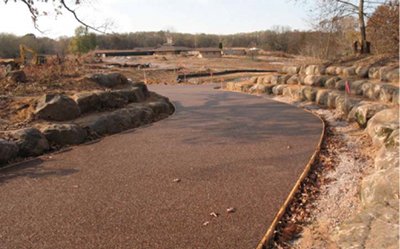
The new environmentally friendly pavement, called FilterPave™, combines a durable and decorative surface with porosity that minimizes runoff by quickly percolating stormwater into the ground or an underground storage system. Recycled Glass Key Component Although various kinds of porous pavements have been around for more than 25 years, the FilterPave system is the first to use recycled glass as one of its components. Presto Geosystems, Appleton, WI, and Kaul Corporation, Lakewood, CO, designed the patented FilterPave pavement for driveways, parking lots, walkways, golf-cart paths, landscaped areas, or anywhere else that needs to combine a smooth, hard surface with environmentally friendly stormwater control. Presto Geosystems Director Bill Handlos, P.E., says that Presto chose recycled glass as a main component because glass meets the application’s physical requirements and is plentiful everywhere at low cost. “A bottle manufacturer usually wants recycled glass in just one trademark color,” he says, “so recycled glass of mixed color often ends up in landfills.

We know how to turn that unwanted glass into aggregate for FilterPave porous pavements.” Handlos says the recycled glass undergoes a special process to round its edges and reduce the particles into specifically sized and shaped “glass aggregate” that is harder than stone aggregate but no more brittle when bound. The recycled glass is supplied through certified glass suppliers. Structure Combines Strength With Porosity The FilterPave system’s other key ingredients are an open-grade clear-stone base course, small various-colored granite and the tough but flexible elastomeric glue that binds the glass-and-granite surface layer together, yet leaves it porous. Although the binder is strong, it is safe for use around plants and animals. The elastomeric binder, granite chips and glass aggregate set up strong and hard, with a top surface that’s smooth, like finished concrete, and an inner structure that is about 38 percent porous. The depths of the base course and the top layer are matched to each application’s water-handling needs and strength requirements. Handlos explains, “Usually, a top layer and base deep enough to hold and pass the required amount of water will also provide more than enough pavement strength.