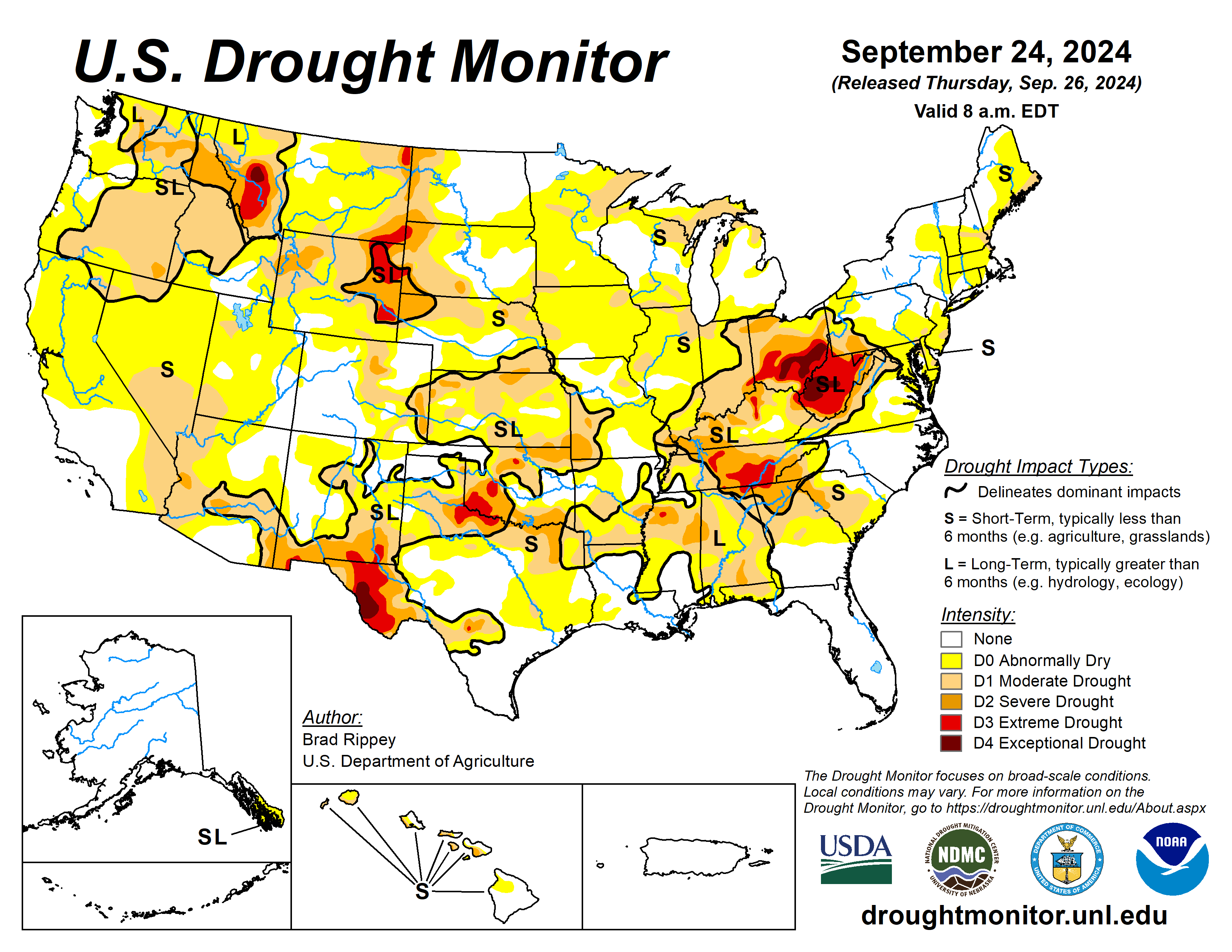
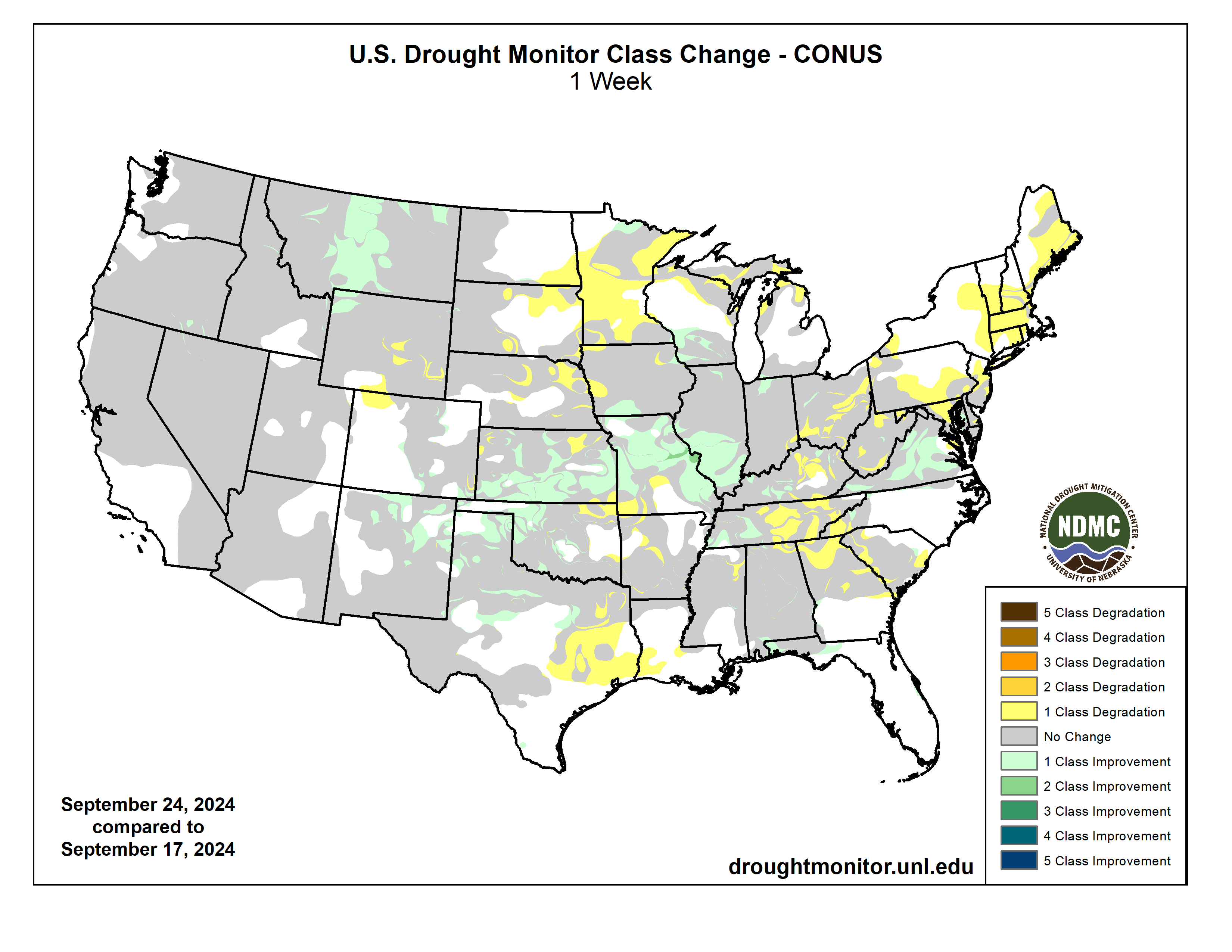
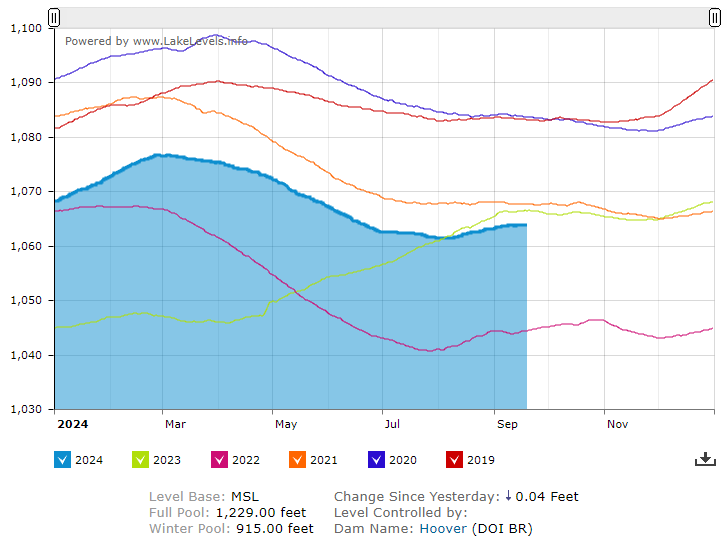
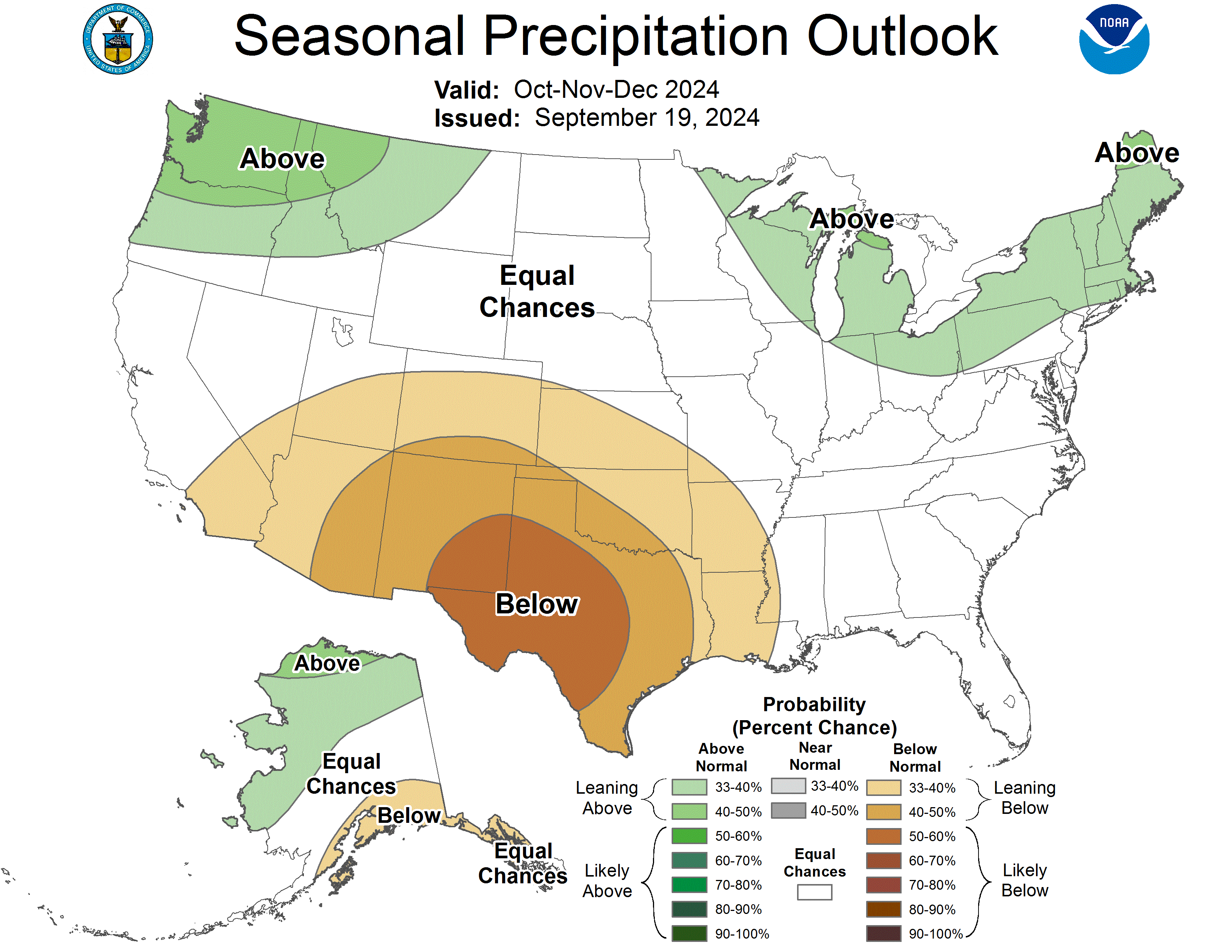
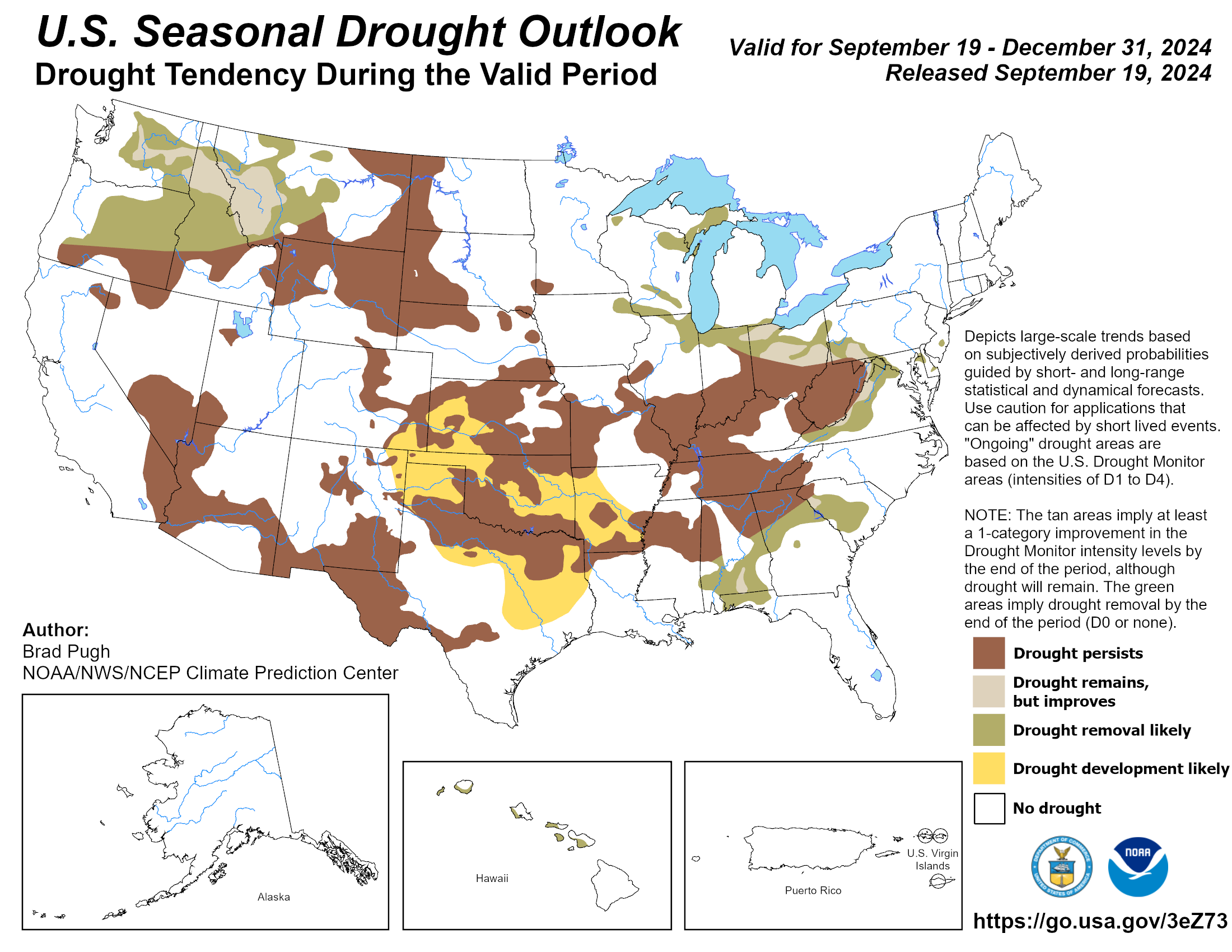
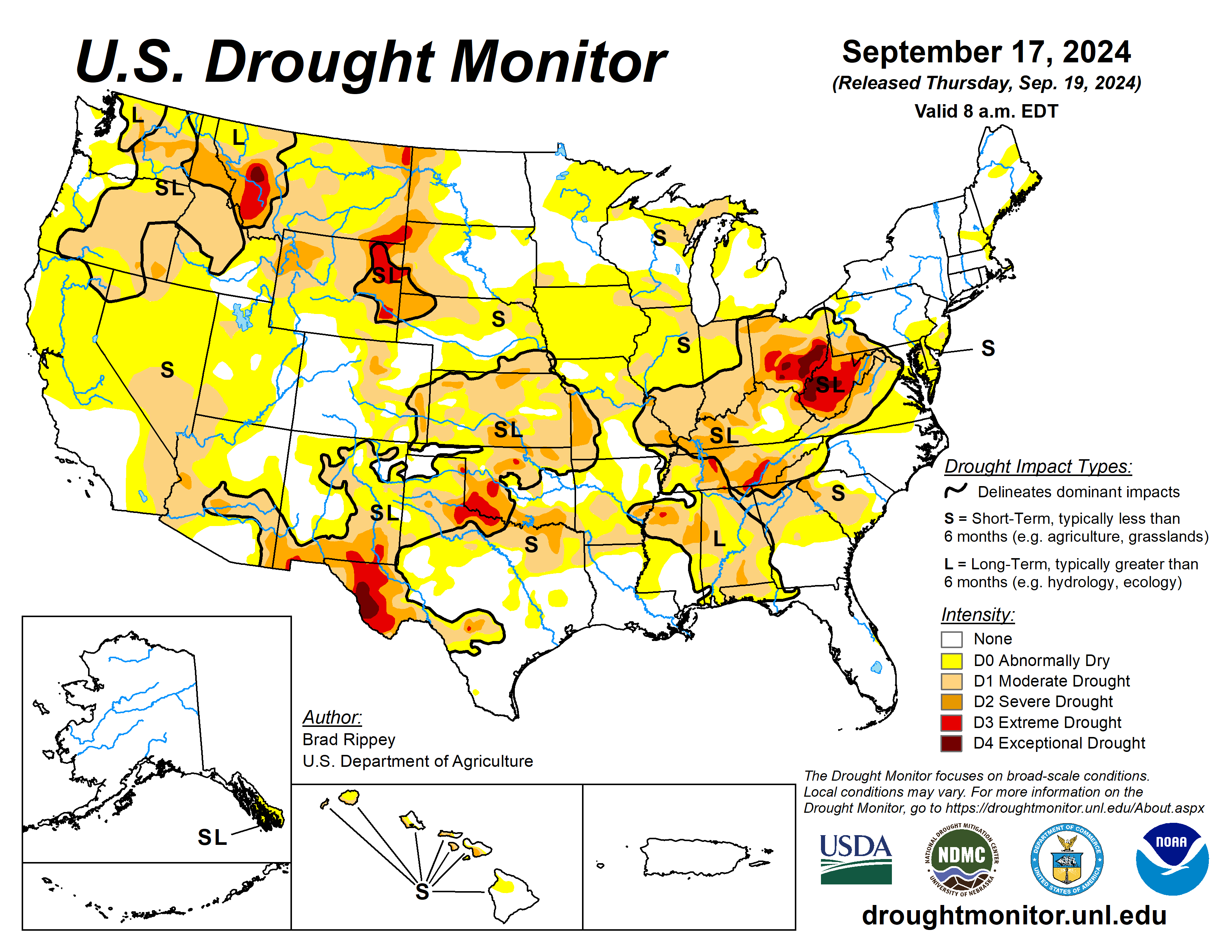
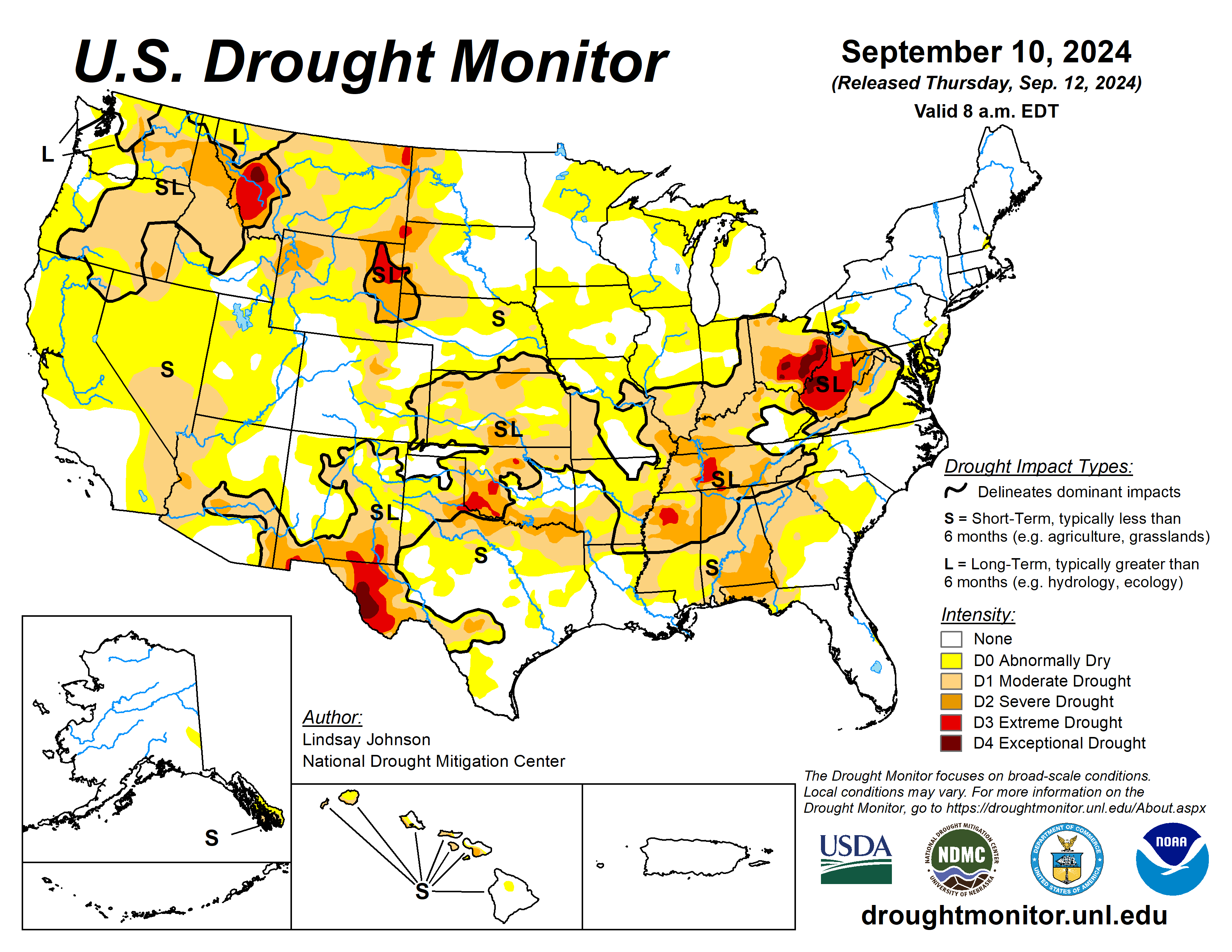
Following the previous drought-monitoring period’s extensive rainfall associated with Hurricane Francine and Potential Tropical Cyclone Eight, drought-easing precipitation developed farther west, across portions of the central and southern Plains and the middle Mississippi Valley. Another area of significant precipitation fell across the northern High Plains and environs, including parts of Montana. However, large sections of the country remained dry, with worsening drought conditions. Some of the most notable increases in the coverage of dryness and drought occurred in the upper Midwest and the Northeast, as well as parts of the western Gulf Coast region and the interior Southeast. Nationally, nearly one-half (45%) of the rangeland and pastures were rated in very poor to poor condition on September 22, according to the U.S. Department of Agriculture, up from an early-summer minimum of 19%…
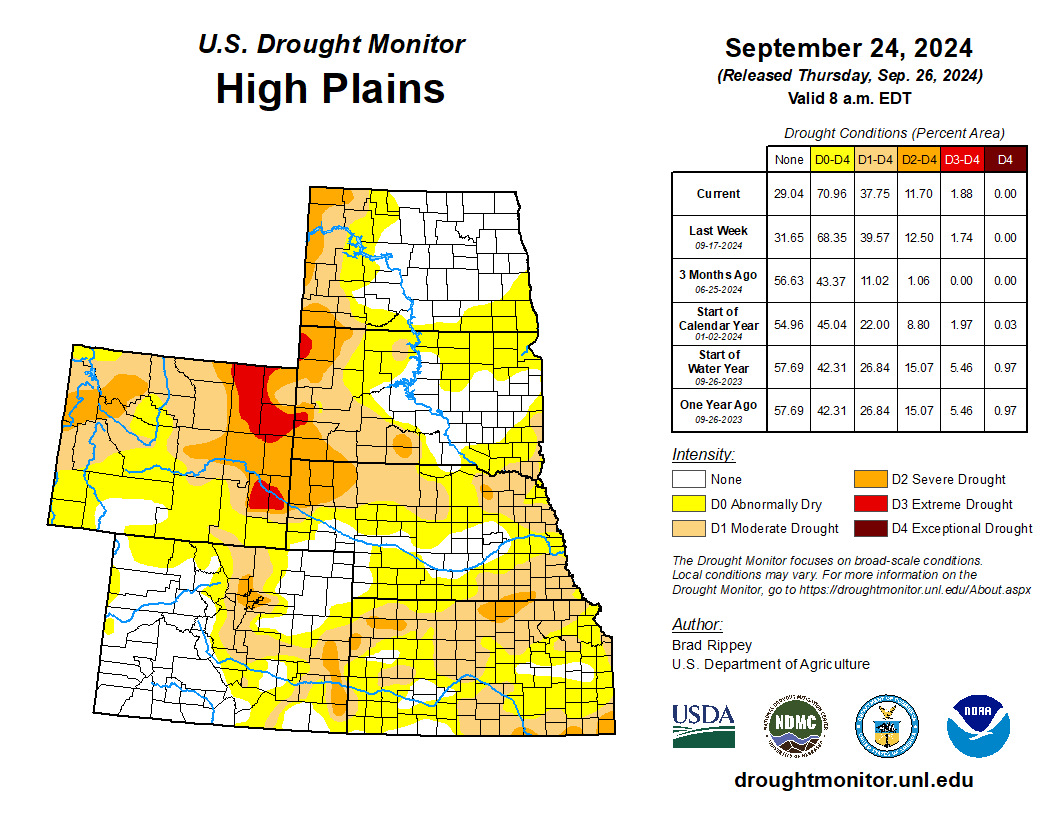
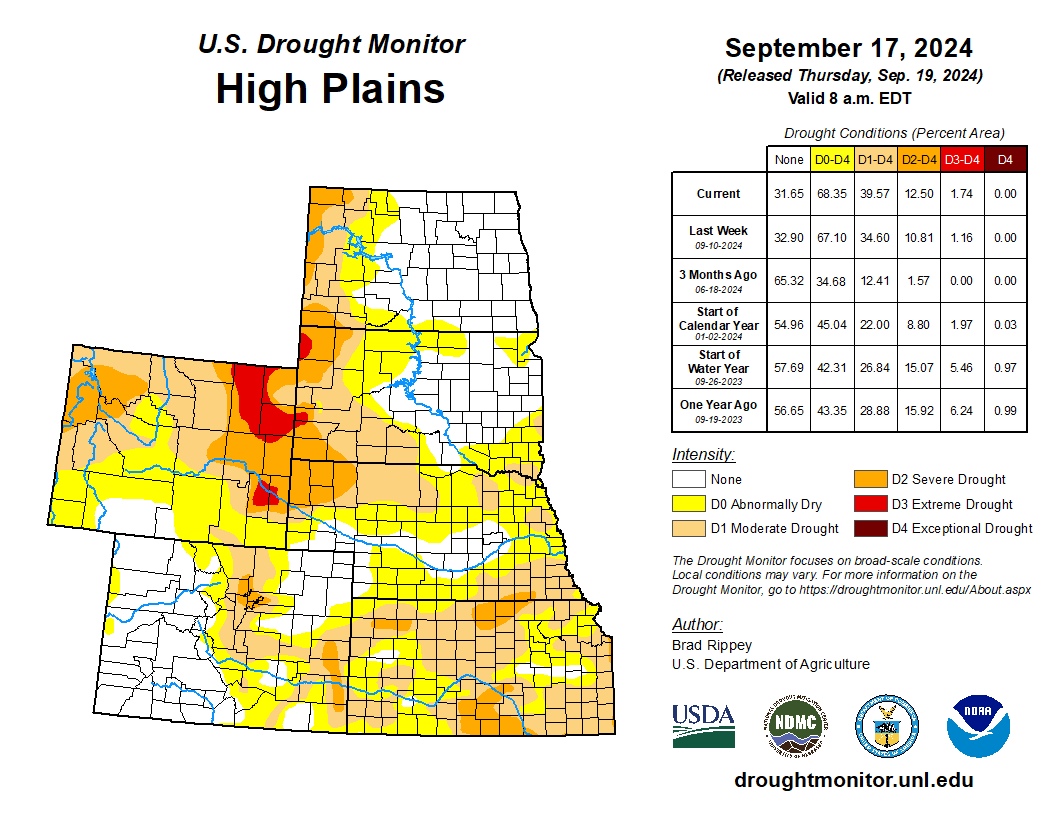
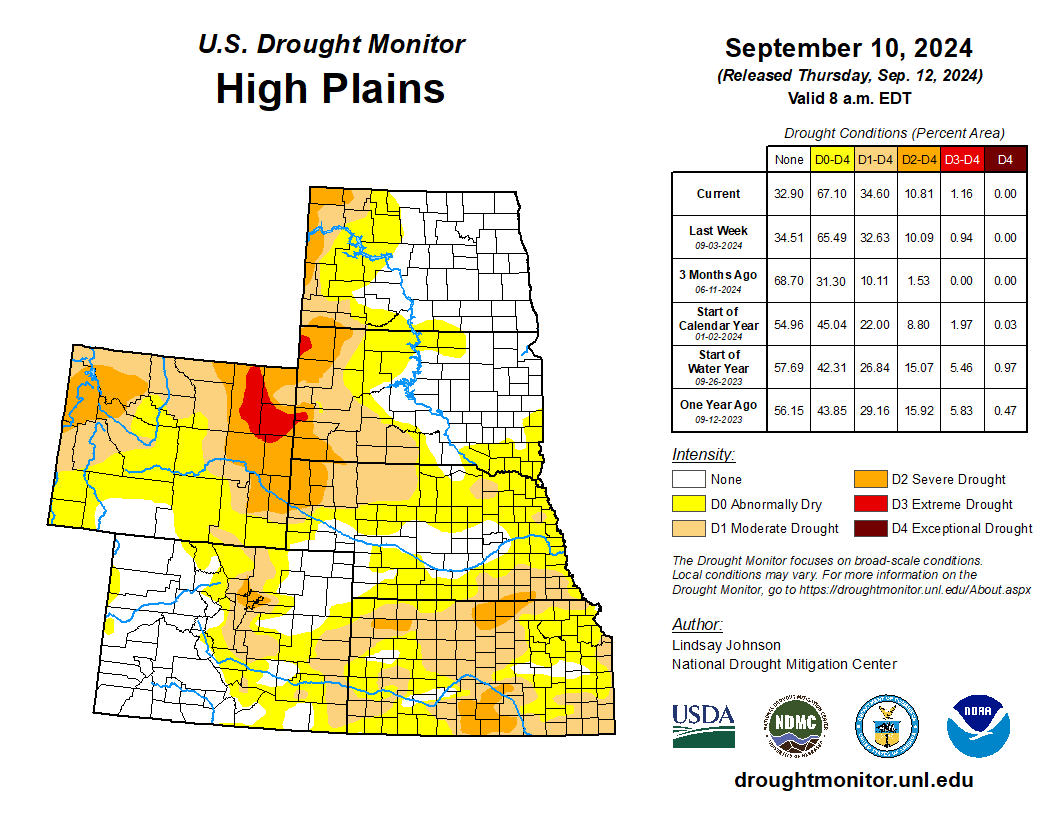
Aside from Kansas, where rainfall provided widespread drought relief, most of the High Plains experienced unchanged or worsening drought conditions. On September 22, topsoil moisture rated very short to short ranged from 29% in North Dakota to 84% in Wyoming, with values also above 50% in Colorado, Kansas, and Nebraska. Wyoming led the region on that date with 68% of its rangeland and pastures rated very poor to poor, followed by South Dakota at 44%…
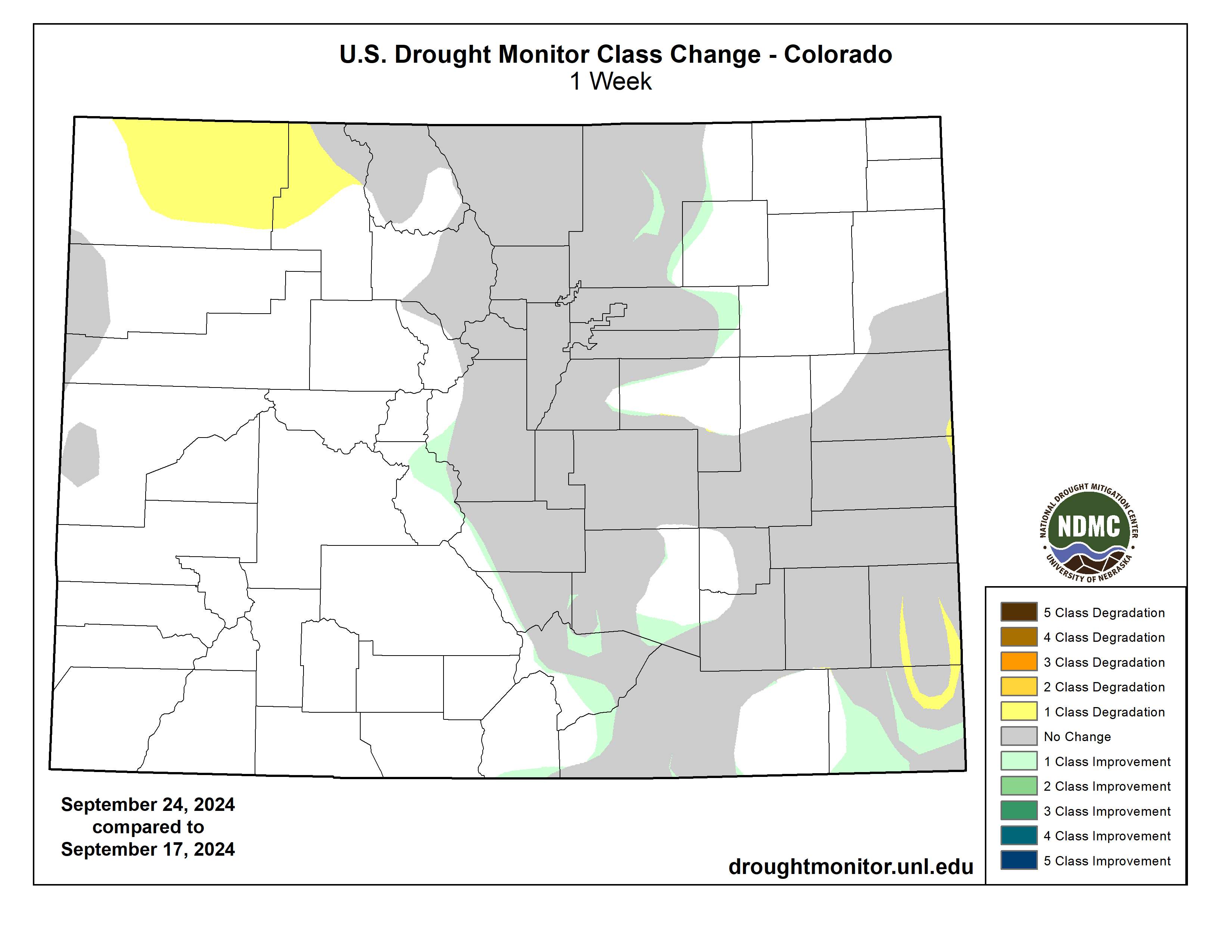
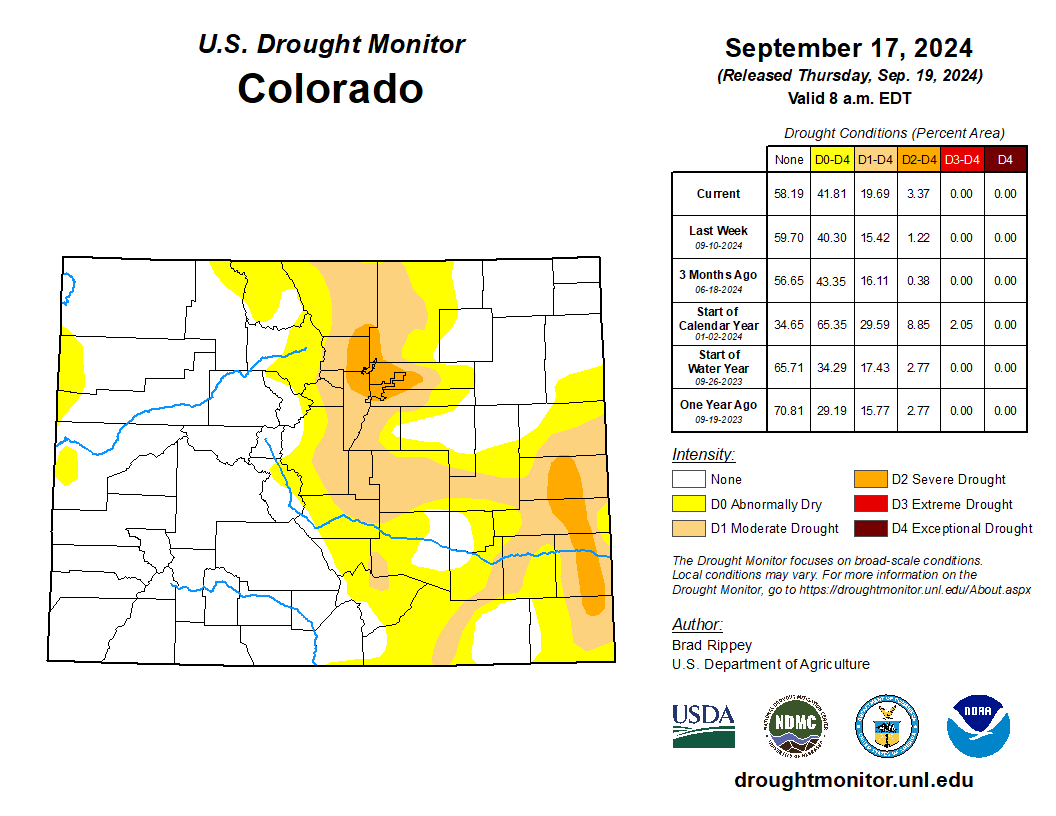
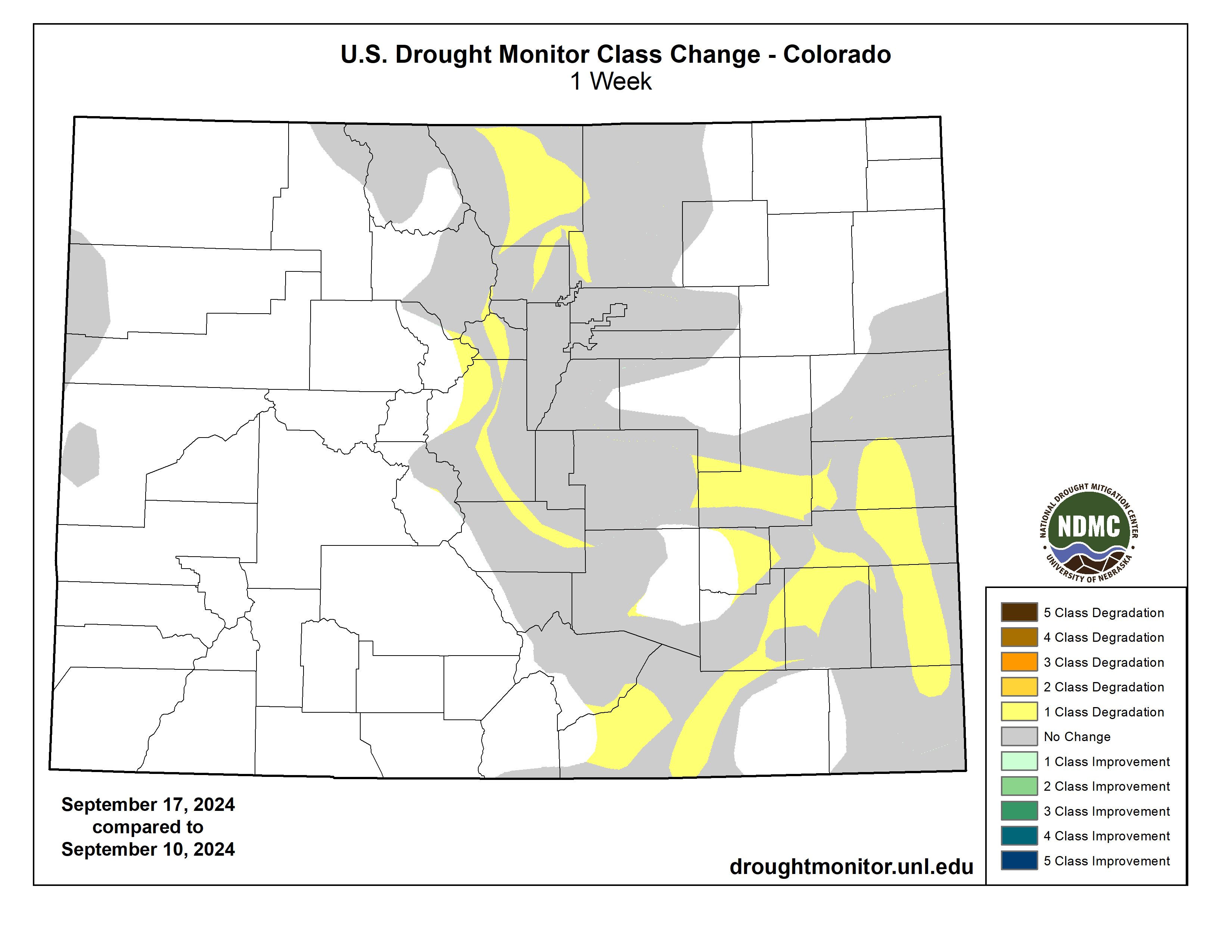
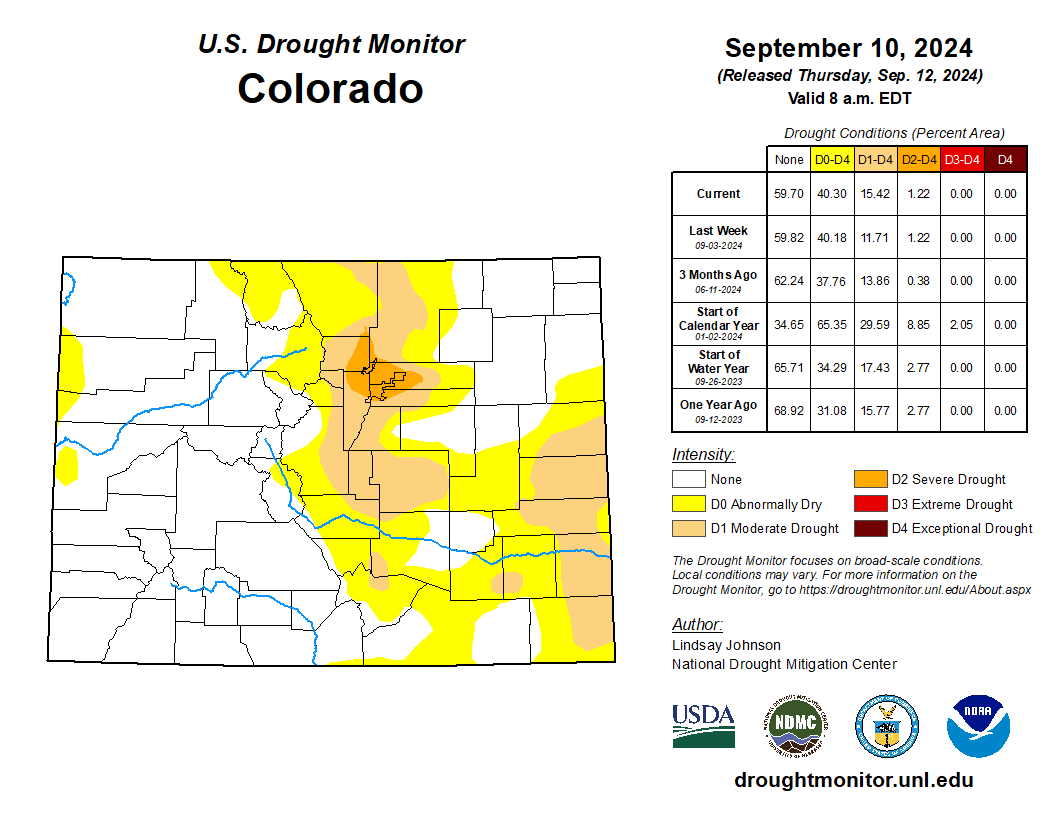
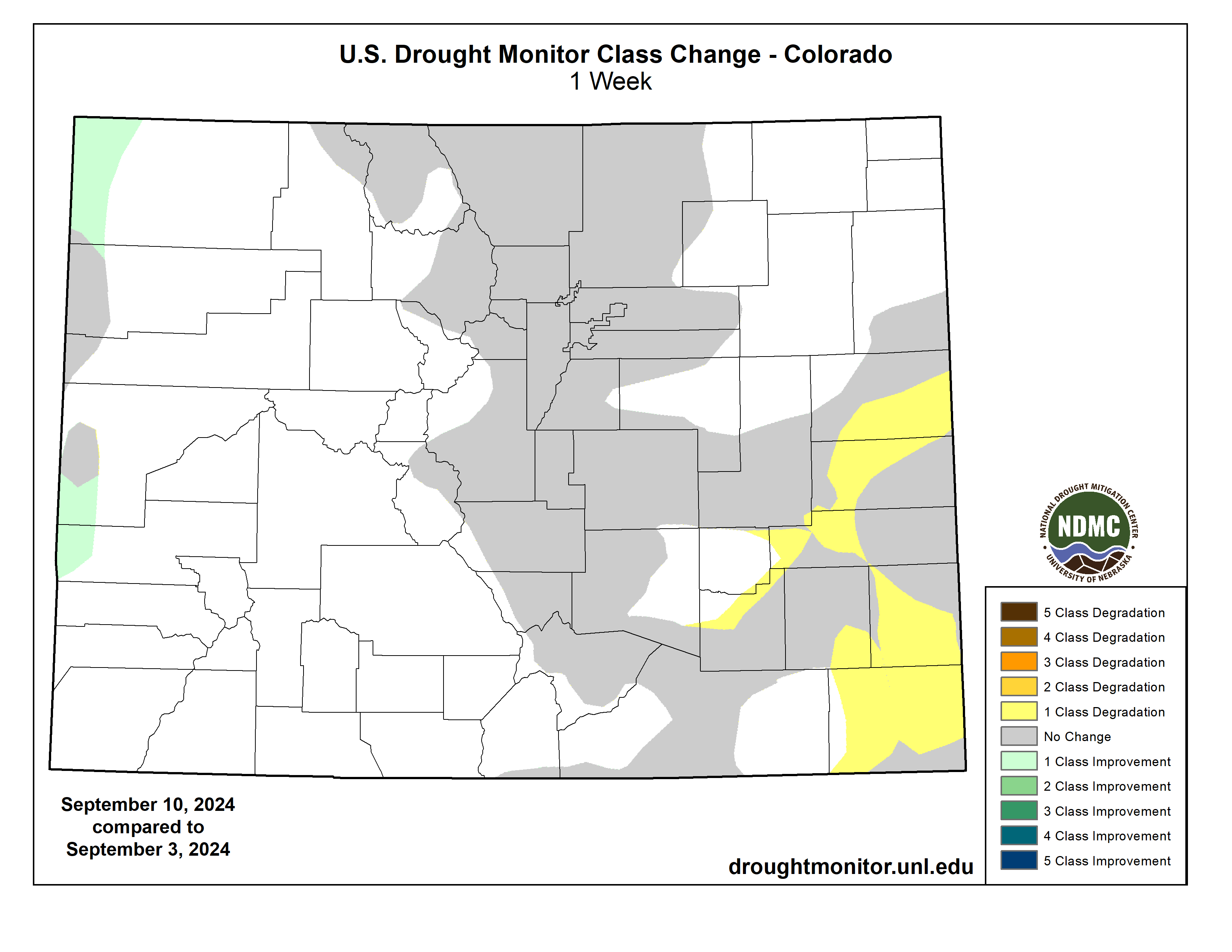
Colorado Drought Monitor one week change map ending September 24, 2024.
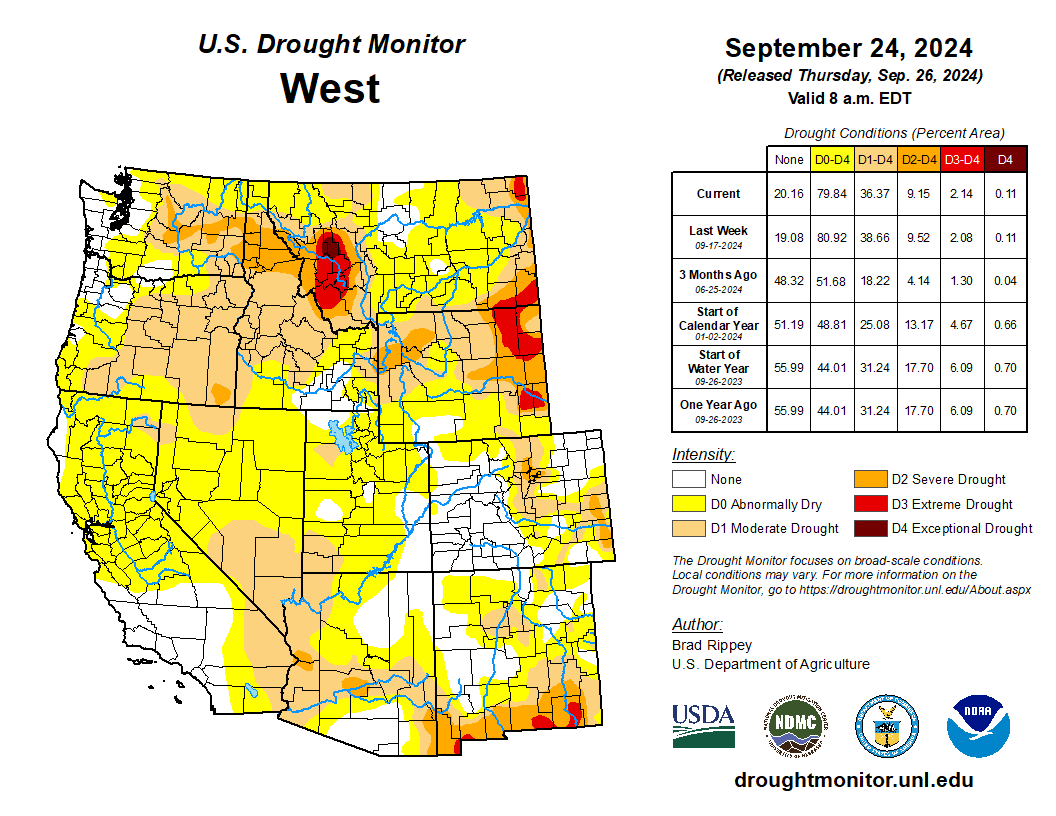
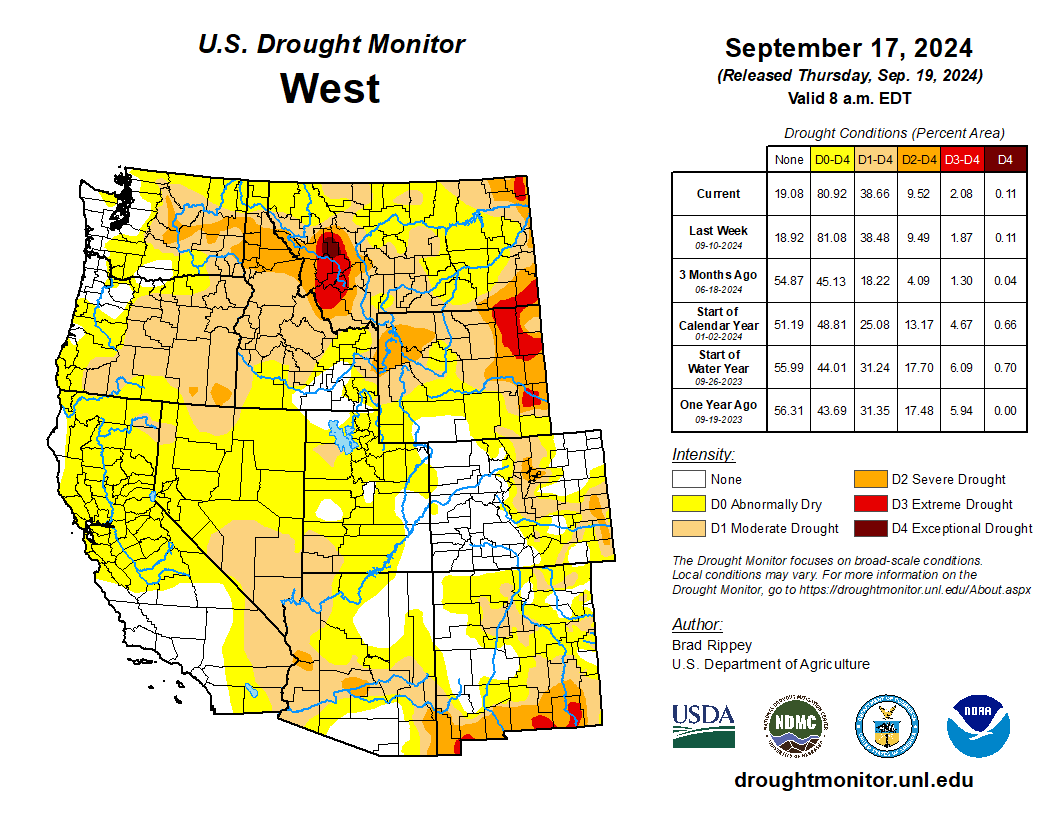
There were only minor changes in the Western drought depiction, aside from improvement due to heavy precipitation in parts of Montana. Dry conditions remained a concern in many areas, with statewide topsoil moisture rated very short to short on September 22 as high as 84% in Montana and 74% in Oregon. Northwestern rangeland and pastures remained largely in terrible shape, following a hot, dry summer, and by September 22 were rated more than 60% very poor to poor in Montana, Oregon, Washington, and Wyoming. Dry conditions also favored winter wheat seeding, with Washington leading the nation on September 22 with 54% of its intended acreage planted…
The South remained an odd mix of drought improvement and deterioration. Tennessee and Texas were notable for seeing large drought changes in both directions, with Tennessee noting drought deterioration in central and eastern areas and improvement in the west. Similarly, Texas saw improvement in some northern and central areas, along with a large expansion of abnormal dryness (D0) in the east-central part of the state. Oklahoma led the region on September 22 with statewide topsoil moisture rated 57% very short to short, followed by Texas and Tennessee both at 49%. Meanwhile, at least one-half of the rangeland and pastures were rated in very poor to poor condition in Tennessee (53%) and Texas (50%). Texas also led the U.S. with 48% of its cotton rated in very poor to poor condition on that date, well above the national value of 33%…
Looking Ahead
Hurricane Helene is forecast to strike Florida’s Big Bend late Thursday, with an intensity and pre-landfall path similar to that observed with Category 3 Hurricane Idalia, on August 30, 2023. Less than 2 months ago, Category 1 Hurricane Debby also moved ashore in the same general area of Florida. With Helene, a potentially catastrophic storm surge may occur along and to the east of where the eye crosses the Gulf Coast, with notable surge-related impacts also expected along the west coast of Florida’s peninsula. In addition, a significant inland push of hurricane-force winds (74 mph or greater) is expected across north-central Florida and southwestern Georgia, with likely impacts on timber and crops such as cotton and pecans. Damaging winds could reach higher elevations of the southern Appalachians. After punching inland, Helene should veer northwestward and decelerate due to interaction with a disturbance over the lower Mississippi Valley, heightening the risk of Southeastern flooding. Storm-total rainfall could broadly reach 6 to 12 inches, with locally higher amounts. During the next 5 days, much of the remainder of the country will experience warm, dry weather, ideal for summer crop maturation and harvesting, as well as winter wheat planting. However, lack of soil moisture for the establishment of winter grains and cover crops will remain a concern in drought-affected areas.
The NWS 6- to 10-day outlook for October 1 – 5 calls for near- or above-normal temperatures nationwide, with the Southwest having the greatest likelihood of experiencing warm weather. Meanwhile, near- or below-normal precipitation across much of the country should contrast with wetter-than-normal weather a few areas, including western Washington, peninsular Florida, and much of the Northeast.
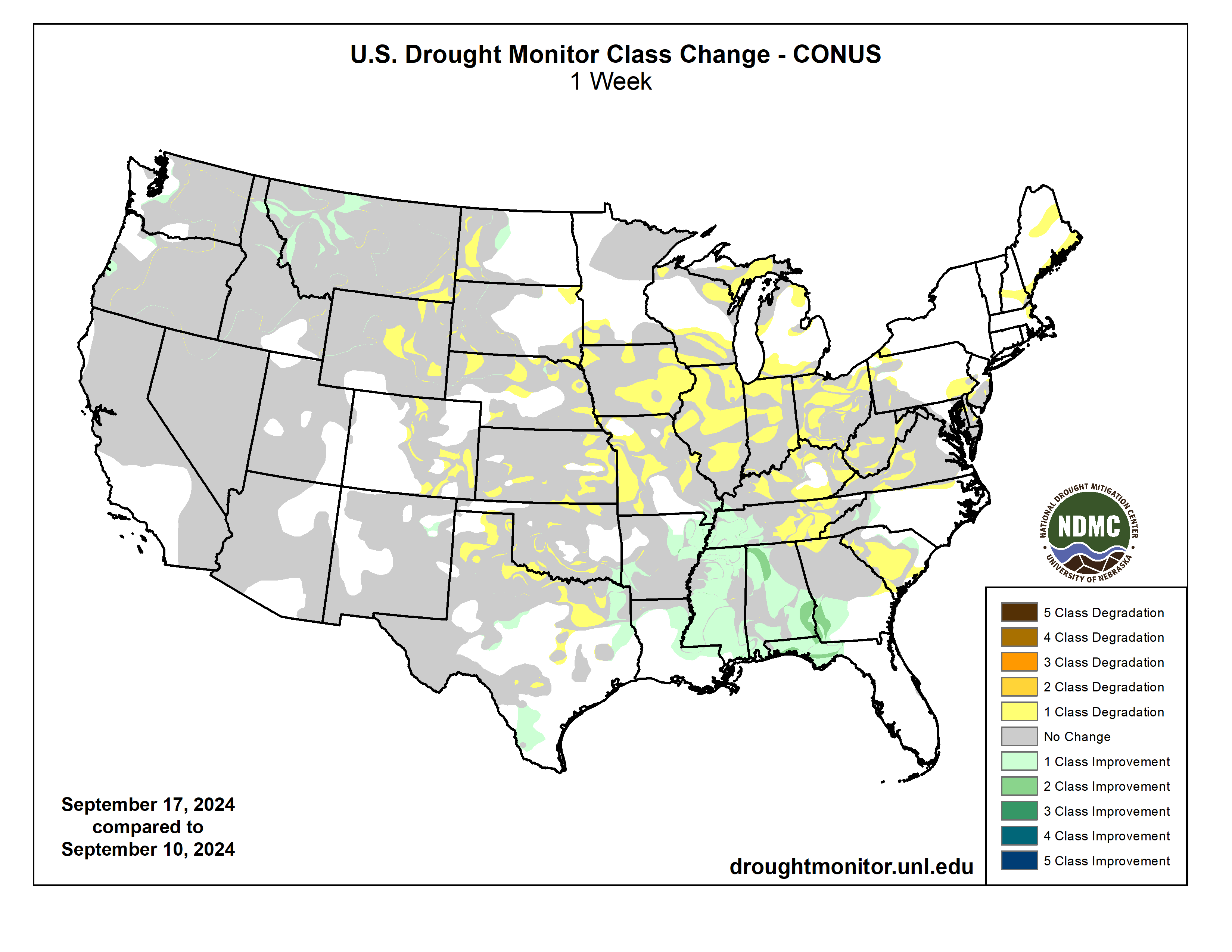
US Drought Monitor one week change map ending September 24, 2024.
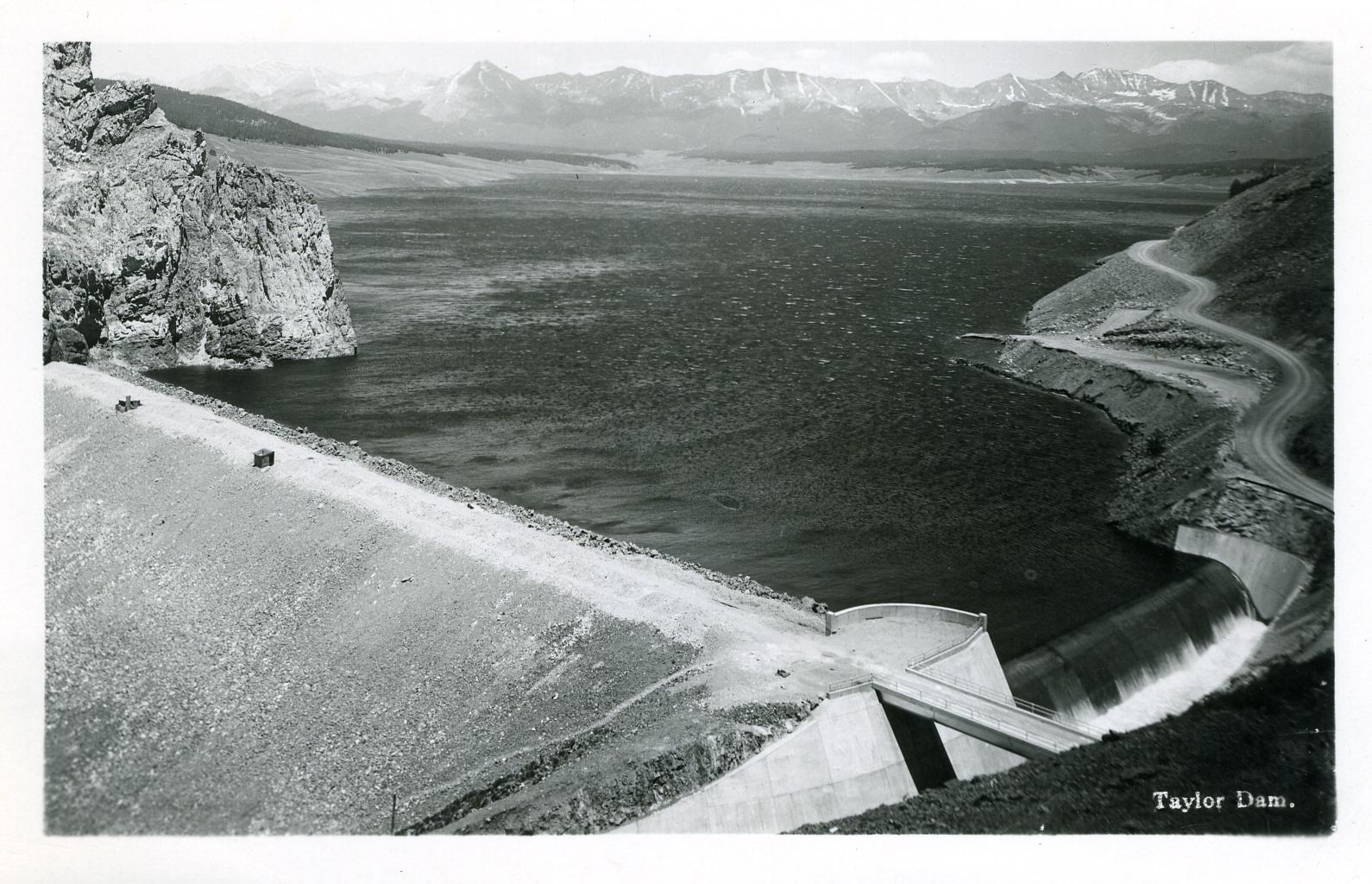
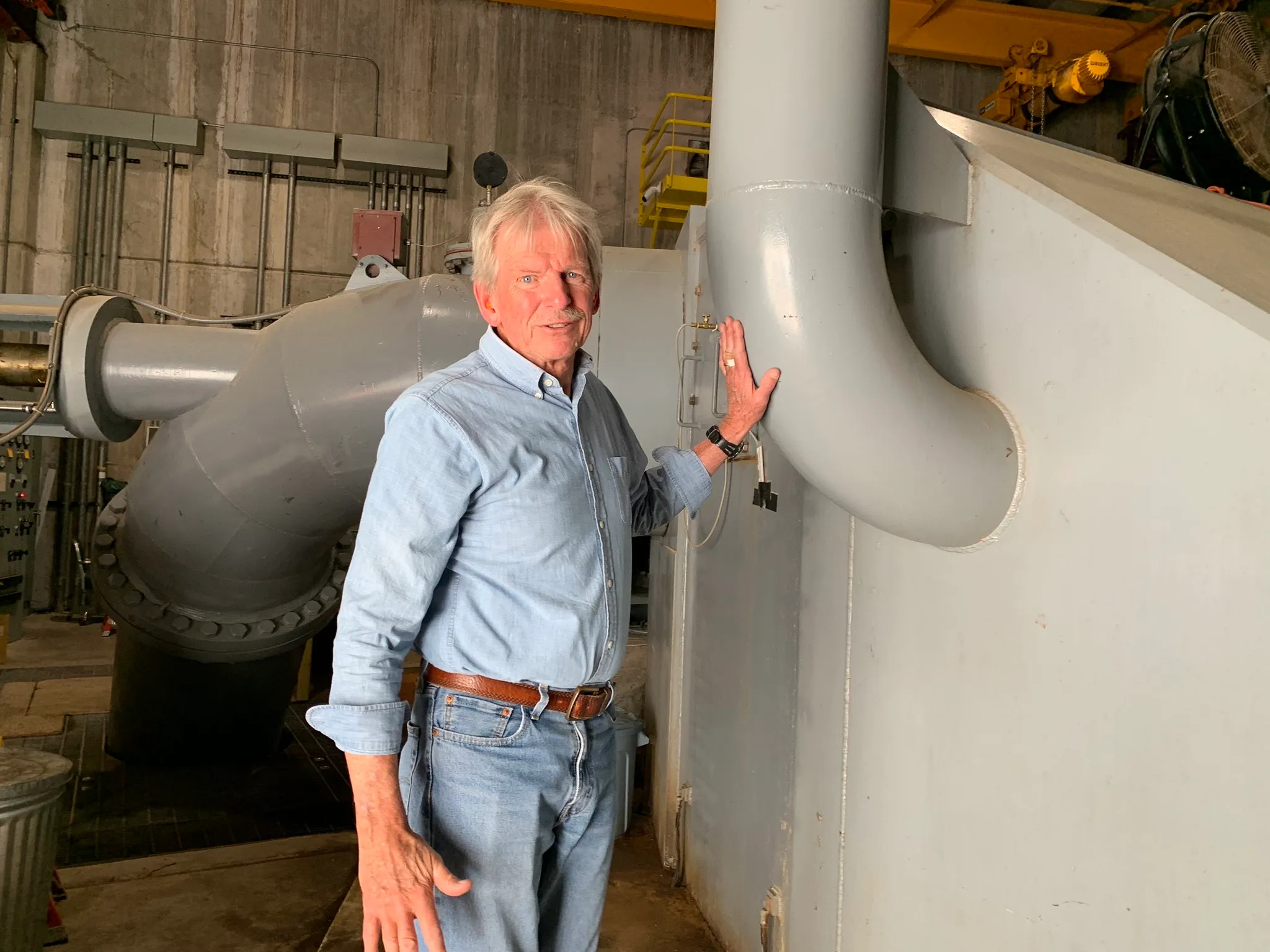
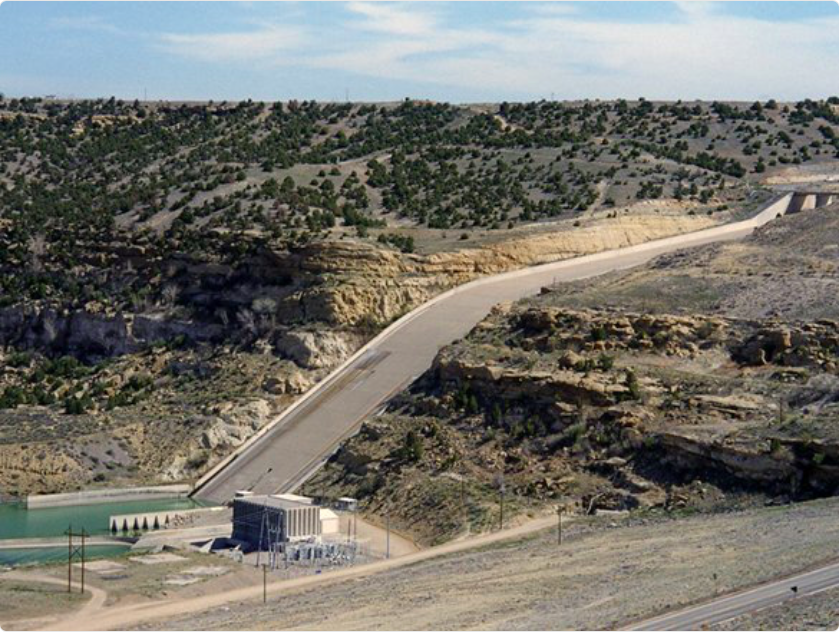
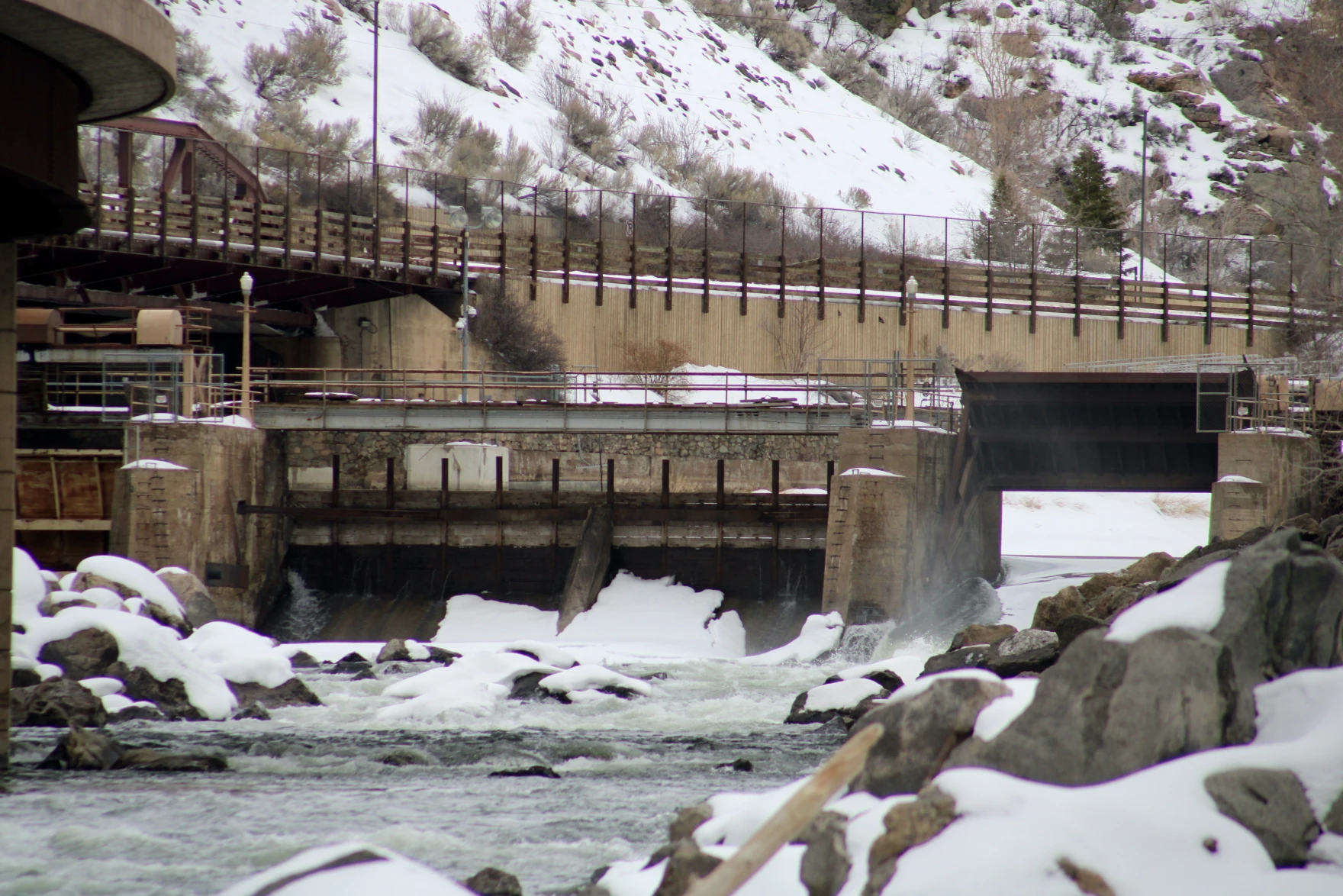
Local electric cooperative Gunnison County Electric Association (GCEA) has a new way of generating energy for the Gunnison Valley with the recent completion of its Taylor River Hydropower construction project. GCEA and the Uncompahgre Valley Water Users Association (UVWUA) commemorated the completion of the plant’s construction phase last week with a ribbon cutting ceremony, and plan to begin commercial power production around September 20. The $3.6 million project located at the Taylor Park Dam is a partnership between GCEA and the UVWUA. The new 500-kilowatt (kW) hydroelectric turbine and generator at the site will operate at or near full capacity 24 hours a day, year round, to produce an average of 3.8 million kilowatt-hours (kWh) annually. That amount of generation compares to some 2,500 kW (2.5 megawatt) fixed tilt-solar arrays and, according to GCEA strategy execution specialist Matt Feier, will provide clean electricity to approximately 500 local homes and businesses in Gunnison County…Construction on the project began in May 2023, but the hydroelectric vision has been in the works far longer…
GCEA provides the electric infrastructure and UVWUA manages the water flowing through the dam. The plant connects to the existing dam penstock and GCEA’s single-phase distribution line. Feier explained the process: “The new facility draws approximately 65 cubic feet per second of water out of the eastern penstock within the existing valve house. This water is piped to our Frances turbine within the newly constructed metal building at the base of the dam. The turbine spins, which in turn spins the generator and generates an electric current. This energy flows into GCEA’s existing distribution system and down to GCEA’s Alkali substation (located near Jack’s Cabin Cutoff) where it is distributed within GCEA’s service territory. After turning the turbine, the water flows back into the same spilling basin as the Taylor Dam’s main outflow,” he said. “This hydro generator will be a ‘run of the river’ facility and will not affect river flows within the Taylor River.” Feier said the Taylor River Hydro project is a welcome addition to GCEA’s current clean energy portfolio, and it will bump up GCEA’s local renewable energy generation. “This new hydroelectric facility will get us to approximately 3% local generation and we are working to gain the other 2%+ from local solar array developments,” he said.
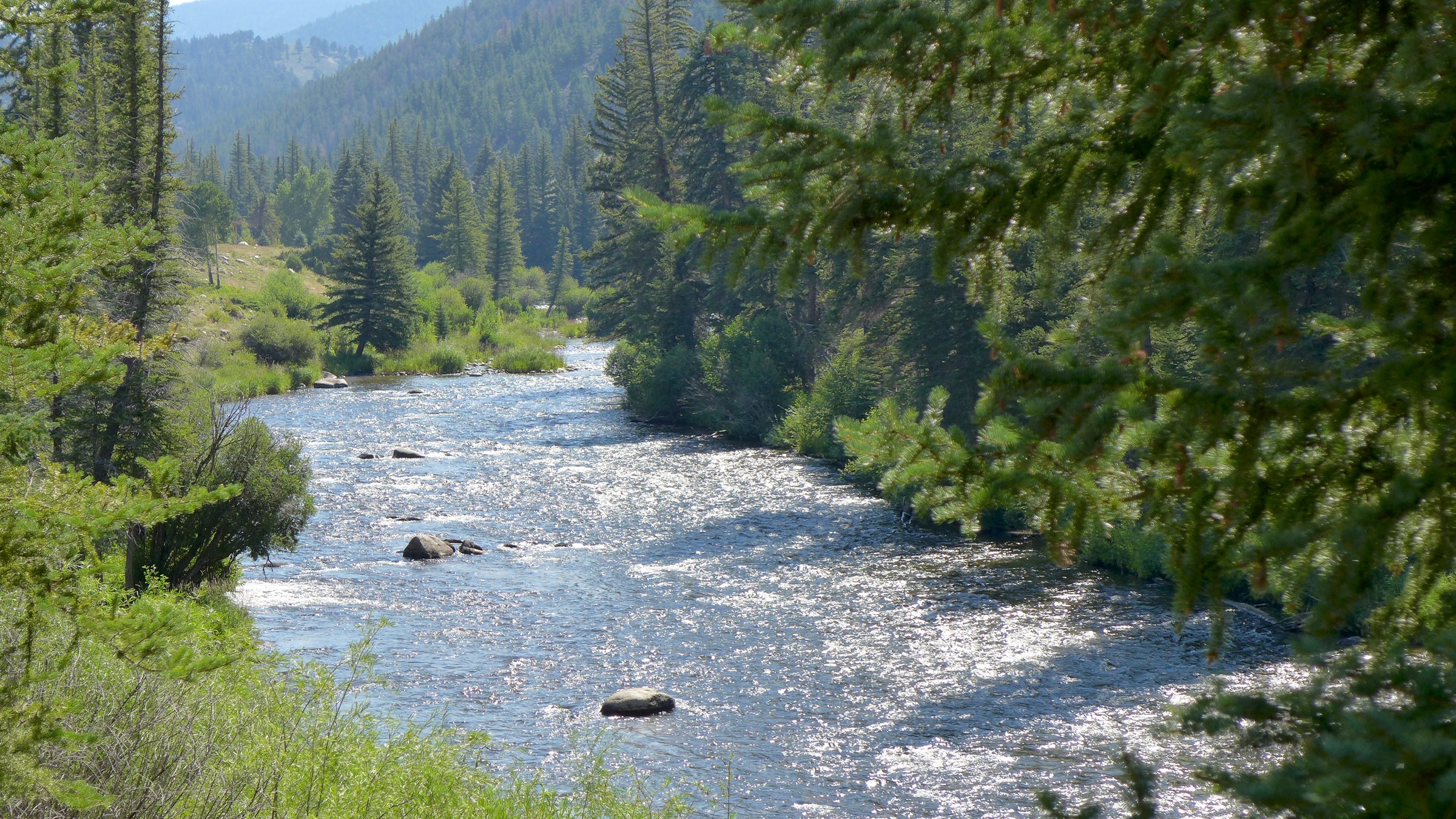
The Taylor River, jewel of the Gunnison River basin. Photo: Brent Gardner-Smith/Aspen Journalism
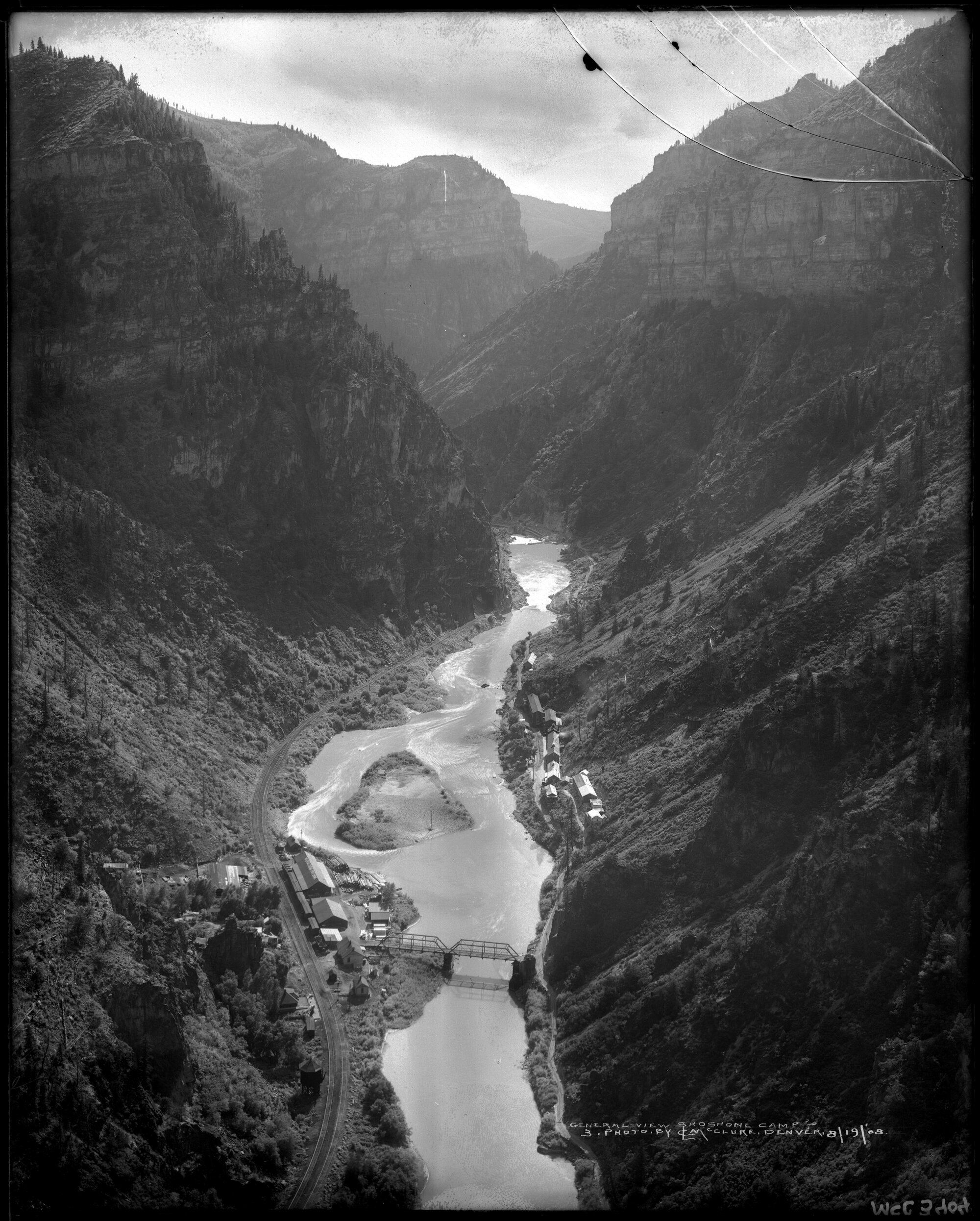
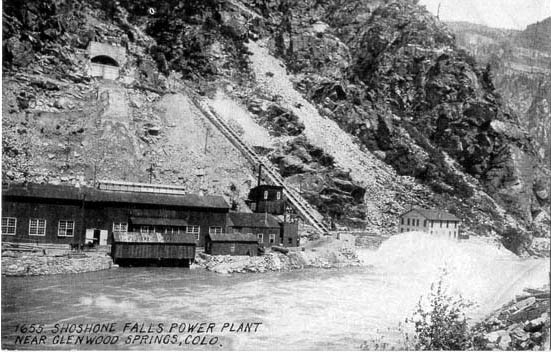
View of Shoshone Hydroelectric Plant construction in Glenwood Canyon (Garfield County) Colorado; shows the Colorado River, the dam, sheds, a footbridge, and the workmen’s camp. Creator: McClure, Louis Charles, 1867-1957. Credit: Denver Public Library Digital Collections
The 2024 Annual Water Seminar was hosted by the Colorado River District at Colorado Mesa University. The event featured many big names in the community including John Marshall, Andy Mueller, David Payne, Merrit Linke, Bart Miller, Cleave Simpson, and many more…Their goal was to highlight the challenges the Western Slope faces now and will face in the future. These challenges pertain to the ever-present climate change crisis and bureaucracy…
According to Andy Mueller, the general manager of the Colorado River Water Conservation District, one of those bureaucratic obstacles is an agreement that was signed in the 1920s. This limits our entitlement to around 55% of the flow of the Colorado River. Another issue he tells us is communities in the Lower Basin—areas in California and Arizona—are keen on securing water. And with a growing population on the Front Range, Mueller says there is a heightened emphasis on securing the Shoshone Water Rights. “We are concerned that if we do not lock in the Shoshone Water Rights, we will see more water leave the Colorado River Basin, and there will be less water for the population and environment on the Western Slope.”
The Shoshone Water Plant is expected to have a $99 million price tag and is slated to increase the amount of available water to farmers and consumers. So far, we are told $56 million has been raised.
“New plot using the nClimGrid data, which is a better source than PRISM for long-term trends. Of course, the combined reservoir contents increase from last year, but the increase is less than 2011 and looks puny compared to the ‘hole’ in the reservoirs. The blue Loess lines subtly change. Last year those lines ended pointing downwards. This year they end flat-ish. 2023 temps were still above the 20th century average, although close. Another interesting aspect is that the 20C Mean and 21C Mean lines on the individual plots really don’t change much. Finally, the 2023 Natural Flows are almost exactly equal to 2019. (17.678 maf vs 17.672 maf). For all the hoopla about how this was record-setting year, the fact is that this year was significantly less than 2011 (20.159 maf) and no different than 2019” — Brad Udall
Click the link to read “Climatologist: Warming of state almost certain to continue” on the Grand Junction Daily Sentinel website. Here’s an excerpt:
September 21, 2024
On the heels of Grand Junction’s hottest summer on record, Colorado’s state climatologist advised Friday that the state’s warming trend over recent decades is all but certain to continue in coming ones. Russ Schumacher, also director of the Colorado Climate Center at Colorado State University, said at an event at Colorado Mesa University that temperatures in Colorado and globally have been warming and the projection is for continued warming in the future, “and there is very high confidence in that.”
Colorado statewide annual temperature anomaly (F) with respect to the 1901-2000 average. Graphic credit: Becky Bolinger/Colorado Climate Center
There’s less certainty about what the future holds for precipitation levels in the future in the state, other than that they will continue to be highly variable. But increasing temperatures will have water-related impacts even if precipitation patterns don’t change much, he said during the Colorado River District’s annual water seminar. He said seven of Colorado’s nine warmest years on record, averaged across the state, have occurred since 2012 and the warming trend has been particularly notable in the summer and fall. This year’s climatological summer, from June through August, tied for the sixth-warmest on record in the state, and the nine hottest summers all have been since 2000, he said. The average summer temperature at the Grand Junction Regional Airport this year was the hottest on record, he said…lows in the Colorado River have been declining since 2000. Annual flows at Lees Ferry below Lake Powell averaged 15 million acre feet during the 20th century but have averaged about 12.5 million acre feet since 2000, which has had some very dry years, he said…
The Colorado Climate Center addressed the impacts of climate change in the state in a report it issued in January. It projects that by 2050, under a medium-low carbon emissions scenario, Colorado statewide annual temperatures will warm between 2.5 to 5.5 degrees Fahrenheit compared to a 1971-2000 baseline, and 1 to 4 degrees compared to today.
Shumacher said that although there’s less certainty how climate change will affect precipitation in the state, warmer temperatures along with wind and low humidity result in increased evaporative demand, with dry air pulling moisture from trees, soils, crops and surface waters. That means there are times even when precipitation levels are higher that the water doesn’t go as far. Higher evaporative demand also increases the odds of drought happening and makes droughts more intense…At the Colorado River at Dotsero, peak flows already are declining and there has been about a 25% decline in flows in July and August, he said. Climate projections for the river at Dotsero show increased streamflows in the spring as runoff happens earlier due to earlier snowmelt, but then big declines in flows in July and August, “which is when you really need (water), especially if you don’t have storage,” Schumacher said. The changing climate also is expected to result in a continued trend of more and bigger wildfires, and possibly cause more extreme precipitation and flooding, among other hazards. But Schumacher said it’s important to remember that what is projected to happen in the Colorado Climate Center report isn’t all locked in, as it is a trajectory based on where things are headed now in terms of carbon emissions and the climate policies currently in place.
Bonita Mine acid mine drainage. Photo via the Animas River Stakeholders Group.
Click the link to read the article on The Denver Post website (Elise Schmelzer). Here’s an excerpt:
September 24, 2024
Organizations and local governments that want to fix the acidic drainage from a mine outside of Alma — and the hundreds of thousands of other abandoned mines across the West — are hopeful about new legislation under consideration in Congress. By removing liability burdens, the bill would finally give them more leeway to stop the pollution seeping into the streams relied upon for drinking water, recreation, and fish and animal habitat.
“This is a problem that is generally unseen to the general public,” said Ty Churchwell, a mining coordinator with Trout Unlimited who has worked for more than two decades to create better policy for abandoned mine cleanup. “As long as they can walk over to their tap and turn it on and clean water comes out, too often people don’t think about what’s happening at the top of the watersheds. “But it’s a horribly pervasive problem, especially in the West. It’s hurting fisheries, tourism and recreation, domestic water — it’s a problem that needs to be solved.”
Acidic drainage pollutes at least 1,800 miles of Colorado’s streams, according to a 2017 report from state agencies. About 40% of headwater streams across the West are contaminated by historical mining activity, according to the Environmental Protection Agency…But nonprofits, local governments and other third parties interested in fixing the problem are deterred by stringent liability policies baked into two of the country’s landmark environmental protection laws: Superfund and the Clean Water Act. Anyone attempting to clean up sources of pollution at a mine could end up with permanent liability for the site and its water quality…State officials, nonprofit leaders and lawmakers for decades have worked to find a solution that allows outsiders — called “good Samaritans” — to mitigate the pollution infiltrating thousands of miles of streams. That work may finally bear fruit as Congress considers a solution that advocates believe has a good chance of passing. Federal legislation to address the problem cleared the Senate with unanimous support, and on Wednesday it passed out of the House Transportation and Infrastructure Committee — the farthest any good Samaritan mine cleanup bill has proceeded.
The Animas River running orange through Durango after the Gold King Mine spill August 2015. Photo credit: Jonathan P. Thompson/The Land Desk
Mount Elbert Forebay Dam seen in winter with snow part of the Frying-Pan Arkansas Project. Elbert Forebay Dam seen in winter. Reclamation is investing in snow monitoring technologies for water supply forecasting. Photo credit: USBR
Reclamation awarded $4.6 million to five projects to advance snow monitoring technologies for water supply forecasting. Projects awarded include an additional $4.6 million in cost share funding, totaling over $9.2 million in investment for snow monitoring.
“Reclamation is thrilled to announce this award to advance five pivotal projects focused on snow monitoring advancement,” said Reclamation’s Senior Advisor for Research and Development Levi Brekke. “Our Research and Development Office remains dedicated to supporting innovative solutions that address critical water challenges and foster sustainable practices for our communities.”
Reclamation’s Research and Development Office sought proposals for projects implementing airborne lidar snow surveys for the improvement of water supply forecasting and water management decision making. All of the selected projects include acquisition of lidar snow survey flights, demonstration of the use of lidar snow survey data in water supply forecasting, and the development of techniques to maximize the value of the snow survey data for water supply forecasting.
Funding Awardees:
Arizona State University: Fusing Airborne and CubeSat Methods for Snow Estimation and Supply Forecasting into Salt River Project Reservoirs. Reclamation Funding: $974,265 Total Project Cost: $1,274,265
Friant Water Authority: Snow Water Supply Forecasting in the Upper San Joaquin River Watershed Reclamation Funding: $ 702,169 Total Project Cost: $ 3,556,798
Oregon State University: Fusing LIDAR and In-Situ Community Measurements to Improve Estimates of Snowpack Reclamation Funding: $ 946,203 Total Project Cost: $ 1,198,187
Oregon State University: The utility of aerial LiDAR snow surveys to improve water supply forecasts across the western United States: comparing the relative importance of current snow conditions and future weather Reclamation Funding: $ 971,862 Total Project Cost: $ 1,230,504
Utah Division of Water Resources: Wings Over Weber Reclamation Funding: $ 975,844 Total Project Cost: $ 1,951,689
Reclamation’s Snow Water Supply Forecast Program aims to enhance snow monitoring and to advance emerging technologies in snow monitoring and subsequent water supply forecasts. The program activities are working to build climate change resilience by enabling improved water management. To learn more and read full project descriptions, please visit the program website.
Audubon supports the Yavapai-Apache Nation’s water rights settlement and pending legislation, the Yavapai-Apache Nation Water Rights Settlement Act of 2024.
The Yavapai-Apache Nation and other parties in Arizona have come to a historic agreement with the settlement now before Congress. Not only will this settlement—when passed by Congress and signed by the President—ensure a reliable and sustainable water supply for the Yavapai-Apache Nation in north central Arizona’s iconic “Verde Valley,” it will preserve the Verde River and its precious habitat by reducing reliance on groundwater.
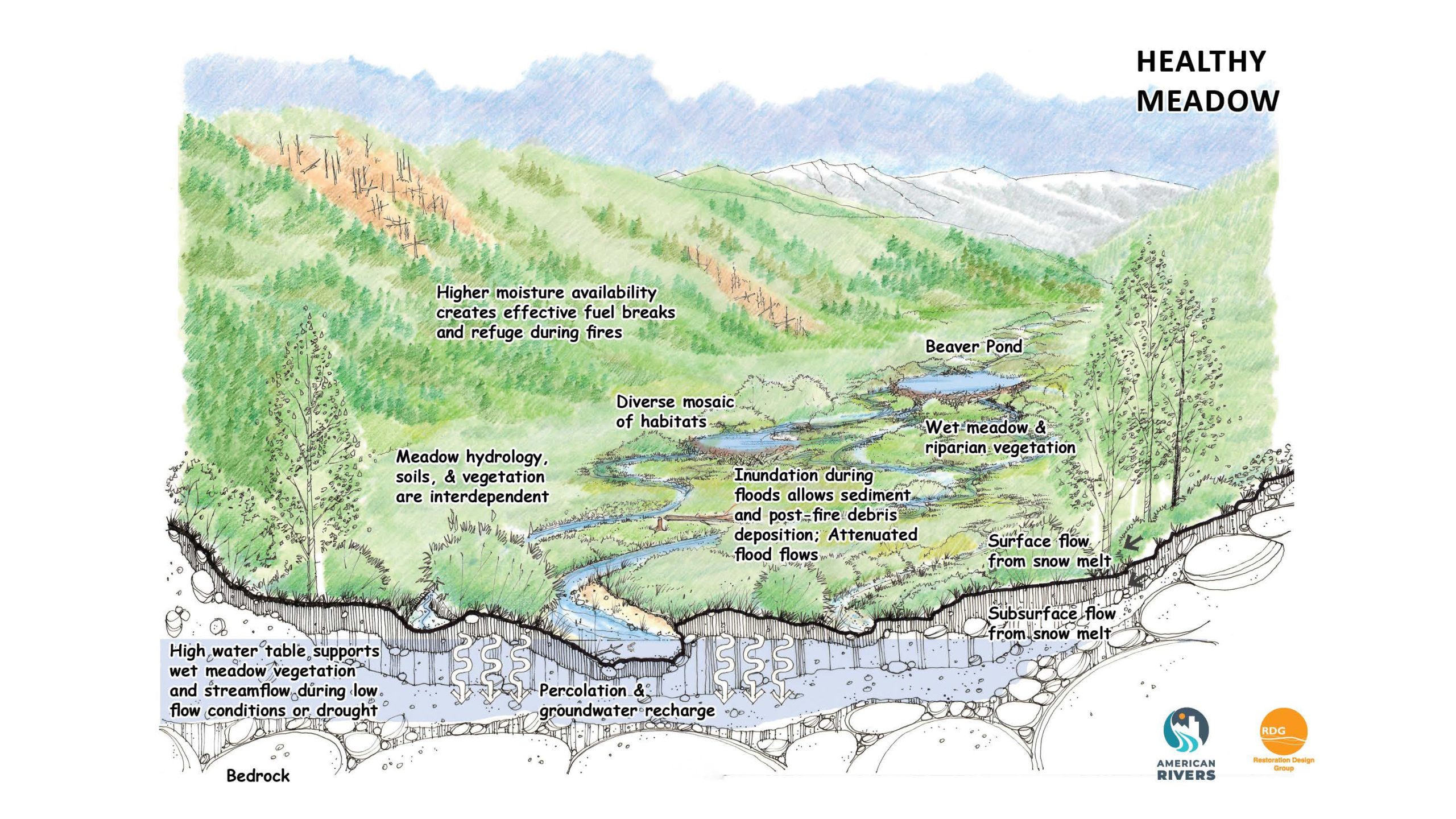
Healthy mountain meadows and wetlands are characteristic of healthy headwater systems and provide a variety of ecosystem services, or benefits that humans, wildlife, rivers and surrounding ecosystems rely on. The complex of wetlands and connected floodplains found in intact headwater systems can slow runoff and attenuate flood flows, creating better downstream conditions, trapping sediment to improve downstream water quality, and allowing groundwater recharge. These systems can also serve as a fire break and refuge during wildfire, can sequester carbon in the floodplain, and provide essential habitat for wildlife. Graphic by Restoration Design Group, courtesy of American Rivers
Within the Verde Valley, Audubon has identified four Important Bird Areas, all of which rely on healthy groundwater levels to sustain flowing rivers and streams and the rich plant life and wildlife they support. One of the many benefits of this settlement includes helping to sustain a portion of the Verde River downstream of the Yavapai-Apache Nation that was designated as a Wild and Scenic River by Congress in 1984.
The settlement is the result of innovative and creative thinking from the Yavapai-Apache Nation, Salt River Project, the Town of Camp Verde, the Town of Cottonwood, the Town of Clarkdale, and others. The settlement includes building a 60-mile water pipeline from C.C. Cragin Reservoir on the Mogollon Rim, north of Payson, increasing the capture of wastewater into sewer systems, boosting the use of reclaimed water, and the potential for regional water planning and collaboration among nearby municipalities and the Yavapai-Apache Nation.
Audubon Southwest, our regional office in Arizona and New Mexico, is also part of the Water for Arizona Coalition. In 2022, Water for Arizona outlined a vision for how to improve Arizona’s water outlook, called the Arizona Water Security Plan. One of the six key tenets is: Continue to support Tribes in resolving Tribal water issues. This settlement is a key milestone as Arizona works to improve its overall water security.
It is long past due for the Yavapai-Apache Nation to have secure and reliable water supplies, and this settlement is a monumental step forward for their growing community. Bipartisan, bicameral legislation to enact and fund the settlement is sponsored by Arizona’s Senators Kelly (D) and Sinema (I) in the U.S. Senate. Representative Schweikert (R) introduced the U.S. House bill, cosponsored by Representatives Ciscomani (R), Lesko (R), Stanton (D), and Gallego (D).
Audubon supports the passage of the settlement legislation and the provision of approximately $1 billion to ensure the project is brought to completion. As part of our support, we sent a letter to Arizona’s Congressional delegation, which you can view below.
Note: Here’s the second and final part of this little essay/data dump. Yeah, it’s paywalled AGAIN! I know, I know. I’ll be back next week with more good content for you free-riders. In the meantime, consider becoming a paid supporter of the Land Desk and knock down that paywall in the process.
The math and the charts in Part I of this essay are discouraging to many of us because they mess with our value system. There’s just not enough water in the places that we feel should be cut, for moral or practical or aesthetic reasons, to make much of a difference. I mean, sure, halting evaporation from the reservoirs would get you about 2 million acre-feet in cuts. But the only way to do that is to come up with a couple 250-square-mile swimming pool covers — one for Lake Mead and one for Lake Powell. Or you could just take down the dams, but I won’t wade into that one right yet.
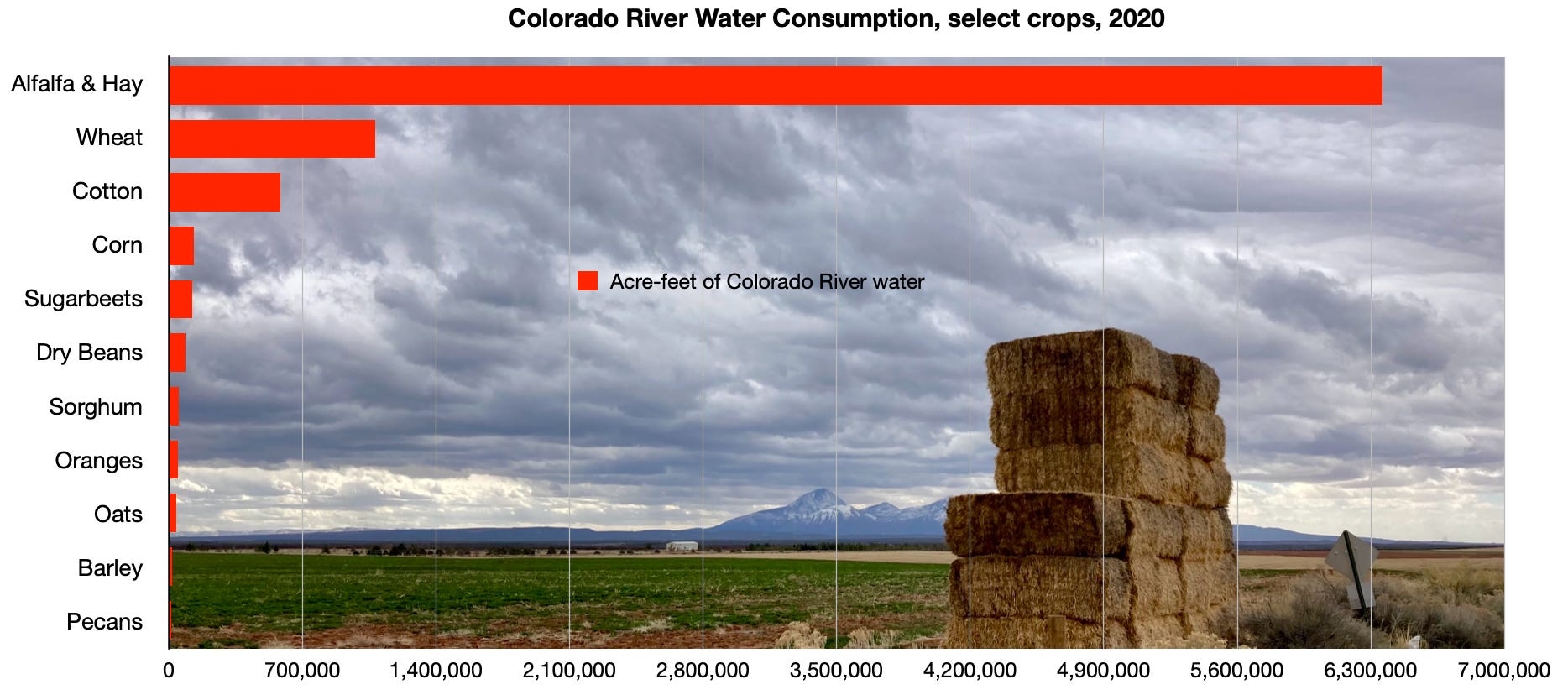
The math dictates that the biggest user, irrigated agriculture, is going to have to make the biggest cuts. And the crop that uses the most water? Alfalfa — by a mile. About 6.3 million acre-feet of Colorado River water is consumed to irrigate alfalfa and other hay crops.
If all irrigation of alfalfa and hay was stopped, it would put more than 6 million acre-feet of water back into the Colorado River system. But it would also wreak havoc — and conflict with the law and values. Credit: Jonathan P. Thompson/The Land Desk
This isn’t news to Land Desk readers; I’ve been pointing it out for a long time. And it’s this simple observation, this acknowledgment of the math, that has the Family Farm Alliance demonizing me for supposedly demonizing alfalfa. Apparently those folks would rather we journalists ignore these numbers and fuzzy-up the math, make some insignificant cuts here and there while continuing to send gobs of water to hay fields, and continue drawing down the reservoirs until there’s no savings account left. Then, when we have another year like 2002 or 2021, when there were 10 million acre-feet deficits, the entire region will devolve into chaos. Seems like a bad idea to me.
Alfalfa has a lot of uses: It can be made into pellets for rabbits and other animals, it is a good cover crop that retains soil nutrients, it can be fed to horses, and you can even go down to your health food store and pay a small fortune for some alfalfa extract, which is apparently full of nutrients. But mostly it goes to livestock, especially cattle.
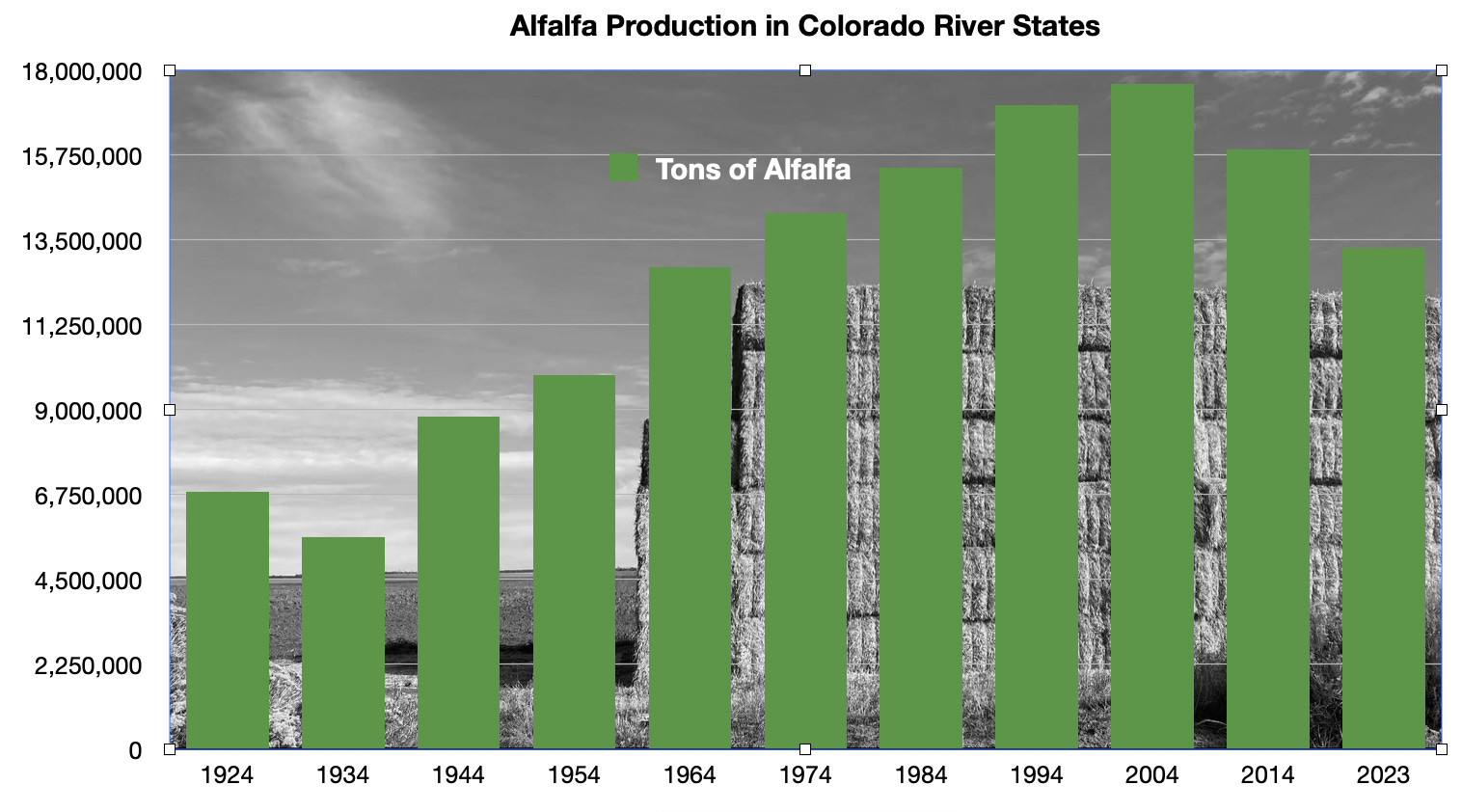
This is state-level data, so includes alfalfa grown with water that’s not from the Colorado River system. But a look at the county level shows similar trends in Colorado River-irrigated areas, especially in Arizona and California. Also note that some alfalfa in Arizona is grown using groundwater, which is not included in Colorado River accounting (although really, it should, since groundwater pumping ultimately affects surface water). Credit: Jonathan P. Thompson/The Land Desk
Over the past five decades, the Colorado River states have grown more and more alfalfa. There are a number of reasons for this. Alfalfa is a valuable crop that is relatively drought tolerant, it can be harvested a couple of times each summer even in cold climates — more than that in southern California — and it’s a perennial, meaning you don’t have to till the soil every year.
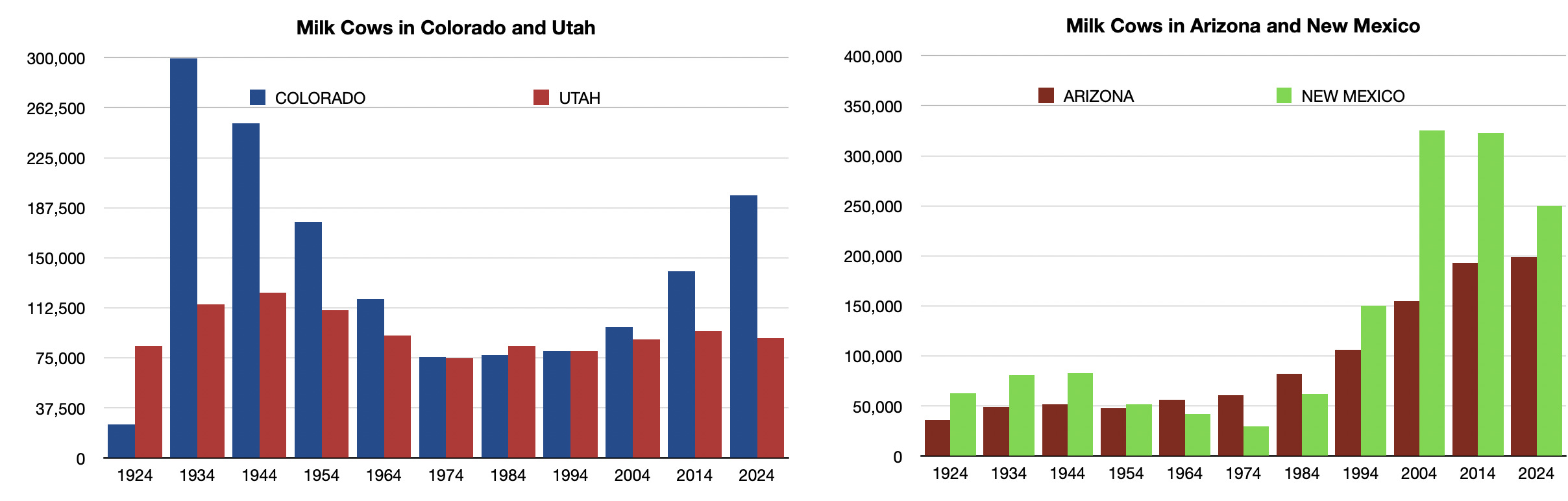
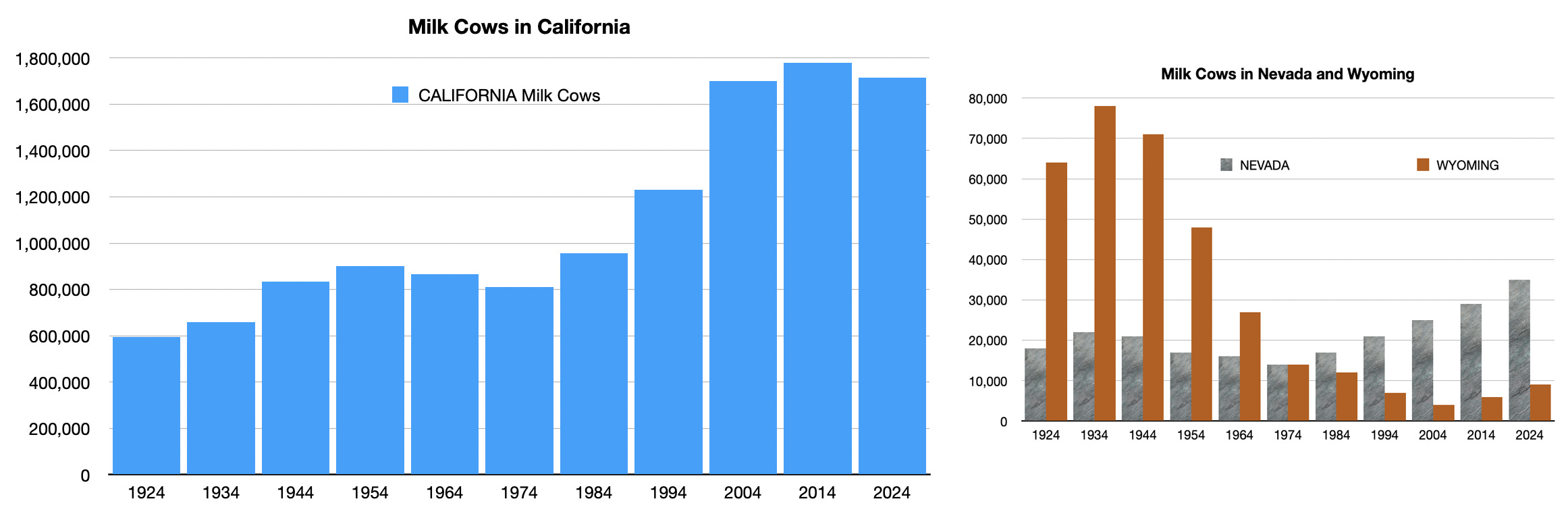
But the main driver is demand, and demand is growing because people want more beef, right? Well, yeah, maybe. But — to the chagrin of my vegetarian friends — beef is not the primary culprit, it’s the world’s ever-growing hunger for dairy. Because of the specific nutrients in alfalfa, it is favored by dairy operators: At least 75% of the 3 million tons of alfalfa grown annually in California goes to milk cows. Which is to say that my ice-cream and cheese habit is playing an even bigger role in draining the Colorado River dry than my green-chile hamburger. The growing demand is regional: Over the past several decades there has the astronomical rise in the number of large-scale dairies in the West, especially in California and New Mexico.
Colorado was a big milk state back in the 1930s, then the dairy industry collapsed over time before bouncing back (my grandparents’ small-scale dairy farm outside Durango shut down in the mid-1970s). New Mexico and Arizona, meanwhile, have seen a substantial increase in industrial dairies over the last couple of decades. Credit: Jonathan P. Thompson/The Land Desk
California has more than twice the number of dairy cattle now — more than 1.7 million — than it did fifty years ago. Wyoming is one of the only Western states where beef cattle dominate. Note: Different charts have different scales. Credit: Jonathan P. Thompson/The Land Desk
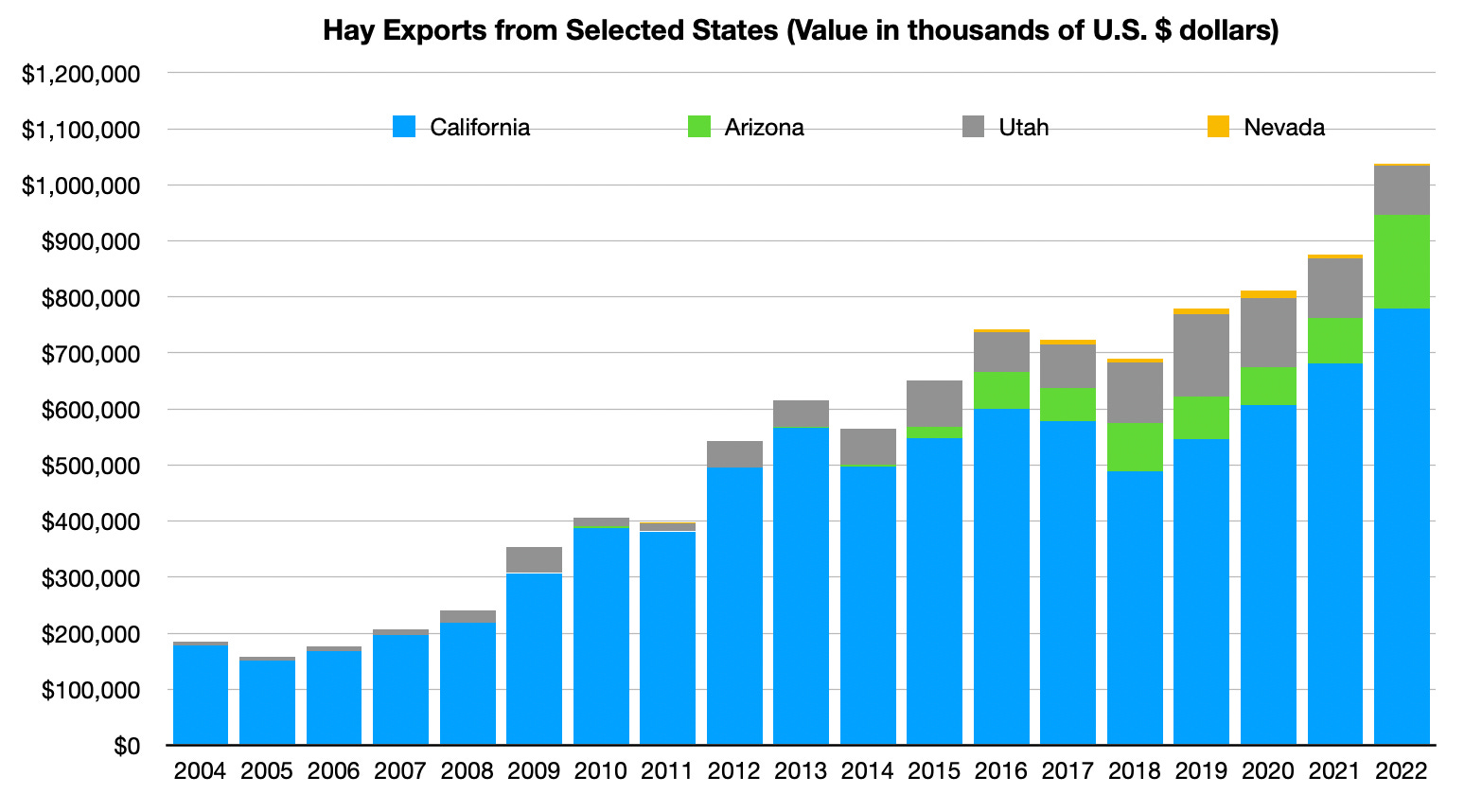
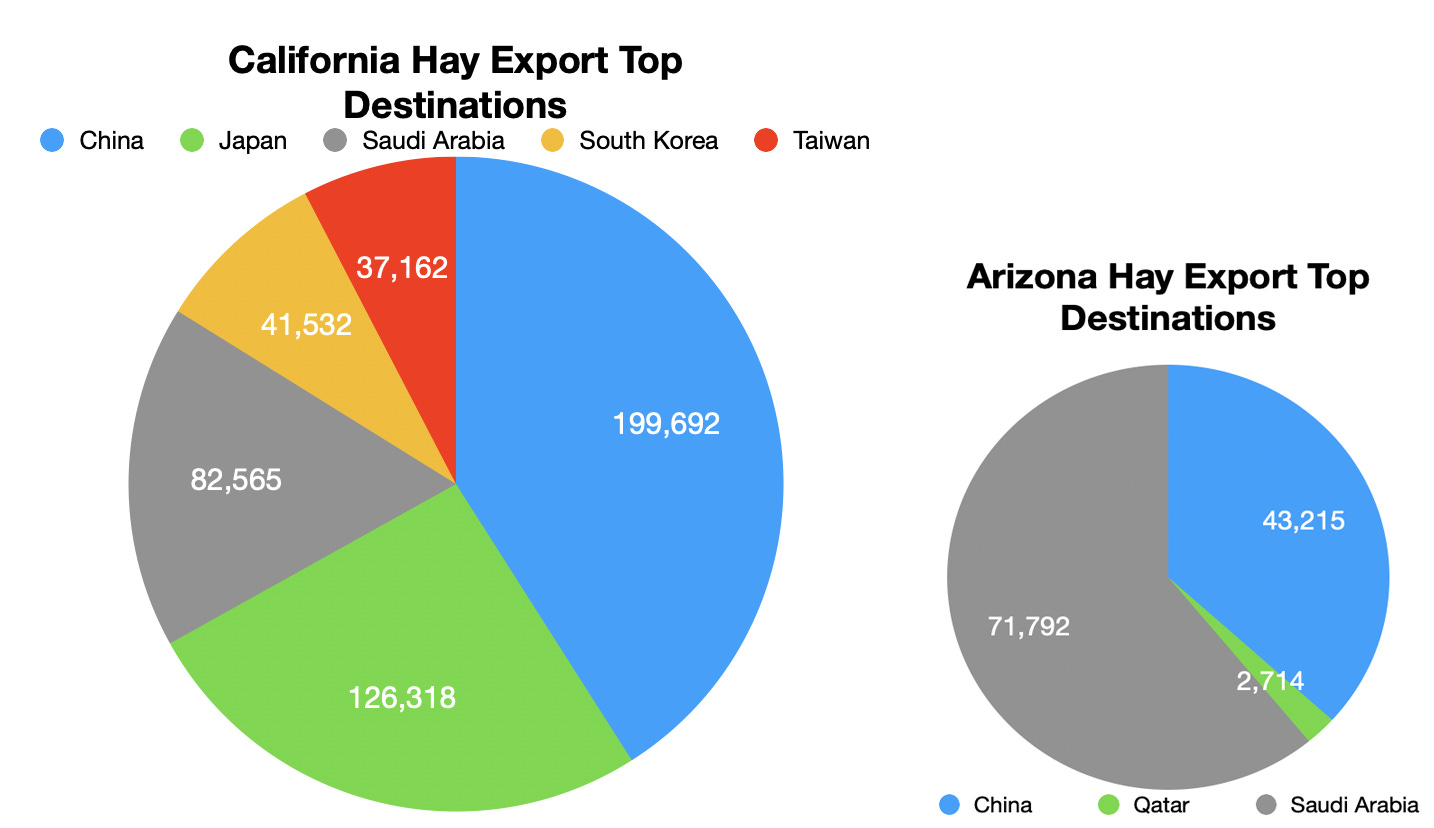
There’s also been an explosion of demand on the global level, as other nations that once mostly relied on goat or sheep milk have developed a taste for cow’s milk. That has led to a rise in alfalfa exports from Western states — hitting over $1 billion in value in 2022. However, exports still represent a small proportion of total production.
Credit: Jonathan P. Thompson/The Land Desk
Credit: Jonathan P. Thompson/The Land Desk
So, that’s the math. And it seems to suggest the Colorado River’s problems all could be solved if growing alfalfa stopped, right?
Maybe. But I kind of doubt it. This isn’t about a crop. It’s about water consumption.
This is where the law comes in and screws with both the math-oriented and the value-oriented solutions.
I mean, first of all, I doubt that a state or federal decree banning alfalfa growing would fly in the courts unless alfalfa was determined to be an illicit drug or something. And even if you could pull that one off, it wouldn’t accomplish much.
Alfalfa tends to be thirstier than other crops, but not significantly so. It uses such a huge percentage of Colorado River mostly because there’s so much of it and because of its long growing season. That means that if you were to replace all the alfalfa with other crops, you wouldn’t necessarily cut water consumption by that much. Maybe the new crop would use less water, but would the farmers then simply return the surplus water to the river? Not likely. Probably they would just grow more of the new crop and, ultimately, consume the same amount of water.
The only thing that would work is cutting off irrigation to all of those alfalfa fields, no matter what is being grown there. That would certainly be effective, though it would probably lead to a Dust Bowl, would make Ben & Jerry’s ice cream — and a lot of other food products — more expensive, and would wreck economies. And legally? I think not.
Western water law can be distilled down to one sentence: First in time, first in right. It is an almost sacred concept among Western water users, akin to the first lines of the U.S. Constitution or even the Bible.
It means, in the simplest of terms, that whoever appropriates a set amount of water for “beneficial use” first has the most senior rights to it1. When there’s not enough water in the river to fulfill all of the rights, then the senior users can make a “call,” forcing the most junior rights-holders to take the first cuts, and it goes on down the line from there. These rights are usually for a particular ditch or diversion, not an individual user. In the North Fork Valley, for example, the Farmers Ditch has some of the most senior rights, with 1896 appropriation and 1901 adjudication dates; individual property owners own shares of that ditch and the water in it. During dry years, Farmers Ditch is usually among the last to lose water. But if a downstream, more senior user were to put a legitimate call on the river, Farmers Ditch might also be shut down. These water rights are administered state-by-state.
If you have two shares of the Farmers Ditch, then you have no incentive to use less than that. If you conserve, the surplus water will simply keep going down the ditch to the next person. In fact, in most states there’s a “use it or lose it” provision. Though rarely enforced, and revoked in some places, it is still a dominant mindset; I’ve seen property owners pull their full share of water out of the ditch just to let it run down their driveway, perhaps because they just want what’s “theirs,” or maybe because they worry about losing their rights due to non-use.
The largest single water user on the Colorado River, which happens to have some of the most senior water rights, is the Imperial Irrigation District in southern California. They grow a lot of crops, but their primary one is alfalfa. The Colorado River Compact — and a series of compacts and court cases that ensued — adds another layer to all of this by apportioning water between the basins and the states2. Under this set of laws, California and the Imperial Irrigation District are senior, for example, to the Central Arizona Project, which conveys Colorado River water to Phoenix and Tucson.
In theory, the Upper Basin states and Lower Basin states are on an equal footing: Each gets 7.5 million acre-feet of water from the river. Since the Upper Basin uses less than its full allotment, it should be able to continue to use water at its current rate. But there’s one little provision in the Compact that makes that impossible, and that essentially makes the Upper Basin into the junior water rights holders. It reads:
There are conflicting interpretations over the clause, “will not cause … to be depleted.” But for now let’s go with the predominant, historic understanding of the whole sentence, which is that an average of 7.5 million acre-feet must come out of Lake Powell, the Upper Basin’s savings account, and pass Lee Ferry each year to be “delivered” to the Lower Basin’s savings account, i.e. Lake Mead.
This is no problem during an especially wet decade, or even during a dry one when Lake Powell is fairly full. But a string of drought years now, when the savings account has been depleted, could theoretically force the Upper Basin to either violate the provision, or to make some seriously painful cuts to comply.
So if values are trumped by math, and math is trumped by law, how the hell are we supposed to make this all work?
“New plot using the nClimGrid data, which is a better source than PRISM for long-term trends. Of course, the combined reservoir contents increase from last year, but the increase is less than 2011 and looks puny compared to the ‘hole’ in the reservoirs. The blue Loess lines subtly change. Last year those lines ended pointing downwards. This year they end flat-ish. 2023 temps were still above the 20th century average, although close. Another interesting aspect is that the 20C Mean and 21C Mean lines on the individual plots really don’t change much. Finally, the 2023 Natural Flows are almost exactly equal to 2019. (17.678 maf vs 17.672 maf). For all the hoopla about how this was record-setting year, the fact is that this year was significantly less than 2011 (20.159 maf) and no different than 2019” — Brad Udall
All I know for sure is there are no easy answers. We all can eat less cheese and ice cream and beef, we can install low-flow shower-heads and tear out those turf lawns. Cities can limit the size of or ban swimming pools and golf courses, implement tiered and progressive water rates that incentivize efficiency and hit gluttons in the pocketbook, and ban ornamental turf. They can embark on major leak-detecting and repair programs (it’s amazing how much water is lost to leaky pipes). And they can recycle water by treating it and reusing it for, at the very least, irrigation. With today’s treatment technology “toilet-to-tap” is just fine, and is not as gross as it sounds.
Federal and state governments can lease water from farmers for a year or so, paying them to shut off their headgates so the water stays in the river, instead. And they can incentivize folks to put less water on their crops, be it alfalfa or something else. That’s happening in the Imperial Valley, where the federal government is paying farmers some $700 million to stop irrigating alfalfa for 60 days this summer3. The effort is expected to save about 700,000 acre-feet of water, or twice the amount southern Nevada uses each year, through 2026, according to an excellent story by the Desert Sun’s Janet Wilson. Already the effects are being seen, with the IID forecast to pull their lowest amount of water from the Colorado River since 1941, according to John Fleck at his Inkstain blog. That should leave more water for the savings account-reservoirs, and for the river, itself.
As Wilson points out, there are drawbacks to the plan: irrigation runoff from the Imperial Valley fields runs into the Salton Sea. Without as much of it, the waterbody will shrink, exposing an additional 13,000 acres of lakebed, which is bad for the sea and for the air, as it will liberate a lot of pesticide-laden dust that will be picked up by the wind and dropped on nearby communities. The savings are large, but still not large enough. Plus, what happens when the funding runs out?
And, finally, the small ditch companies and farmers, including the ones in the North Fork or McElmo Canyon, are going to have to get more efficient. This will probably mean lining some laterals, piping some ditches, replacing flood irrigation with low-evaporation sprinklers or drip lines, and replacing water-intensive crops with ones that can get by on less irrigation. My question is how can this be done without destroying the distinct, post-irrigation character of these places? Could you leave some leaks to allow water to flow to some of the artificial wetlands? Could you lease water from the guy who allows the ditch to run down his driveway unused and irrigate the cottonwoods, willows, and milkweed? I’d love to hear readers’ ideas on this and, especially, examples of places where efficiency measures have worked to save water — without killing the character.
It’s true that the water saved would likely reach California, eventually, and might even be used to water a lawn or irrigate an alfalfa field. But in the many miles in between the two places, it would also add a little more water to the river for the fish and for boaters and for all of us. Maybe values, math, and Western water law can align.
The upcoming election may be the most important one of your lifetime. It is no less than a referendum on our climate and our future. It is that serious and urgent.
According to a study by the nonprofit Climate Central, large fires that burn 1,000 acres or more have tripled in the Western U.S. between 1970 and 2015. Last year was the warmest on record, a trend that is expected to continue. The country has been warming more rapidly than the global average since the late 1970s, and the West and Alaska have been at the forefront of that trend.
Concerns about the economy, housing, transportation infrastructure, farming, public health are climate issues, too — and increasingly so. Any vote this election, whether local or national, will be a vote on the climate.
I’m not trying to fan your doomsday fears. Quite the opposite: I want to try to drive us all into action. We must move from climate despair to climate repair, even though that can feel so abstract and seemingly insurmountable.
One reason climate repair feels out of reach involves the kind of people we’ve been choosing to represent us. Currently, there are 123 climate deniers in the U.S. Congress who have received lifetime fossil fuel contributions totaling $52,071,133, according to data analyzed by the Center for American Progress policy institute. If you happen to live in Wyoming, Montana, Utah, Colorado, Idaho, Arizona, California, Nevada or Oregon, you have elected officials who may be single-handedly blocking the way to climate-friendly policies. Three-fourths of the congressional representatives of Western states publicly claim that climate change isn’t real and are therefore unwilling to invest any time and resources in climate solutions.
These public officials aren’t just refusing to work on solutions to our climate reality — they are outright denying that a problem exists. If that doesn’t make you mad, it should. But what are you going to do about it? Anger, like repair, can be abstract and insurmountable; anger can even be harmful unless we can channel it toward change. Toward votes.
I’ve been thinking a lot about this since last year, when the Pew Research Center found that half of people living in the West said that climate change is going make life in their region harder over the next three decades. As someone who has lived in the Southwest for most of my adult life, I have witnessed those rising temperatures and longer wildfire seasons and worsening drought conditions, and I share in this collective fear.
But here’s what else last year’s Pew data pointed to: Younger adults are more likely than older adults to expect adverse impacts from climate change in their communities. Whether they lean Democratic or Republican or are unaffiliated, people between 18 and 29 years old say that they are more concerned about climate impacts than the rest of us. The older we get and the farther we live from the reality of wildfires and the floods, the less alarmed we seem to be about climate change.
This shouldn’t surprise anyone. Young people have been carrying the climate action torch these last few years, filing lawsuits against Big Oil and protesting fossil fuel-friendly public officials. And now, just two months before the presidential election, polls are showing that the teenagers and the 20- and 30-year-olds will continue to lead the rest of us.
Earlier this summer I spoke with Magaly Saenz, a 33-year-old small-business owner who runs Tres Leches Café in Phoenix with her partner. In her free time, she volunteers with Chispa Arizona, a grassroots group that invites local Latinos into environmental justice actions and conversations. She also volunteers with the Sierra Club and The Wilderness Society, advocating for the protection of Arizona public lands.
“Historically, when our (the Democratic) party is in office, when we have a majority in the House and in the Senate, we get very complacent and we make excuses (for public officials),” she told me. “We’ll say, ‘At least they’re not that guy.’” So, Magaly said, when she compared them to other politicians that were even worse on climate issues, she generally let it go. Magaly told me that she used to be the kind of person who thought of voting as a document you sign every four years. She would cast her vote, but didn’t push to get measures into the ballot to begin with. Then, five years ago, she began volunteering and protesting, talking with other Latino families and encouraging them to do the same. Her coffee shop has become a hub for grassroots political activism, a place where people come to brainstorm about the best ways to use their civic muscle.
“Younger generations are looking at (most politicians today) and saying, ‘Nope.’ They’re lighting a lot of fires,” she said. “And hopefully this will inspire other people to run for office.”
There is already some change underway: The number of climate deniers in Congress continues to go down — from 150 four years ago, around the time Magaly became politically engaged, to 123 today. If we want to see more public officials embrace climate repair in the way we need, we need to take that one basic first step: Vote for the right people. Do your part. (If you aren’t yet registered to vote, you can do it here: https://www.usa.gov/register-to-vote .)
“Encounters” is a serial column exploring life and landscape during the climate crisis.
Pitkin County’s Healthy Rivers Board voted unanimously to approve a $28,000 grant request from the Roaring Fork Valley Wildfire Collaborative to fund a project that will produce a wildfire action plan for the valley’s watershed. The project will identify high-risk areas and potential post-fire hazards in the Roaring Fork Valley’s water systems to create an action plan in the event of a wildfire. Several town and city water sources come from single streams. In the event of a wildfire, ash could contaminate stream water, degrading the quality of the water system, and potentially making it undrinkable, said Roaring Fork Valley Wildfire Collaborative Executive Director Angie Davlyn during her Thursday presentation to the board in Basalt…
While the Roaring Fork Valley is at significant risk for wildfires, a state evaluation also noted the high susceptibility of the Roaring Fork Watershed’s water infrastructure in the event of a wildfire. This leaves residents, property, and natural resources vulnerable to this disaster but also to other post-wildfire hazards, like flooding and mudslides, Davlyn said…Davlyn also said that the region has been pro-active in performing wildfire mitigation tasks, but there is a lack of a data-driven approach to identify the most critical threats and most opportune areas for a wildfire…To bridge this gap, the Wildfire Collaborative applied for funding from several sources, including Pitkin County. Last week, Wildfire Collaborative signed a contract with the Colorado Water Conservation Board for $224,000 and more than $150,000 in technical assistance for this project, which Davlyn said is the first of its kind in this area. These funds, however, require a 25% match before work can begin. The Wildfire Collaborative will provide half of the match through staff time, but the organization needs Pitkin County’s $28,000 to complete the match. Fire Adapted Colorado also awarded $5,000, the town of Carbondale awarded $3,000, Roaring Fork Conservancy awarded $500, Holy Cross Energy awarded $3,000, and other municipalities, counties, and the Colorado River District awarded $5,000. These funds, along with Colorado Water Conservation Board’s $374,000 and Pitkin County’s $28,000, totals $446,500.
hen the state of Colorado created the Groundwater Compact Compliance Fund with $30 million earmarked for recovering the aquifers of the Upper Rio Grande Basin, there was an intention to steer a good portion of the money toward irrigators working in Subdistrict 1 of the Rio Grande Water Conservation District.
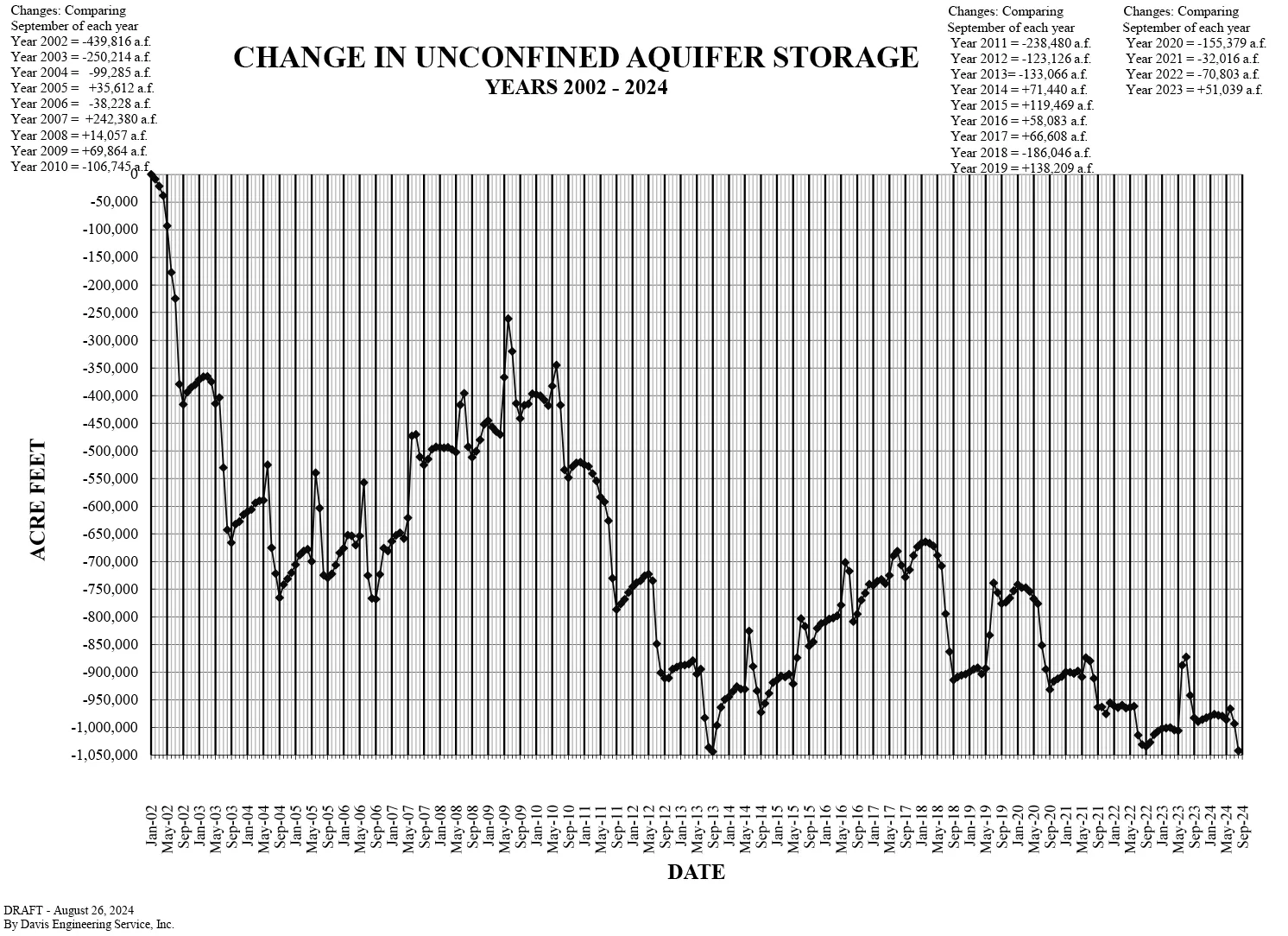
Whether the strategy will work is under question. Last month’s reading of the unconfined aquifer storage levels shockingly showed it at its lowest point, despite millions in tax dollars that have been spent to retire groundwater wells.
San Luis Valley Groundwater
The motivation behind Senate Bill 22-028 was to use state tax dollars to continue to dry out farming fields located in the most productive area of the San Luis Valley because that’s where the depleted unconfined aquifer of the Upper Rio Grande Basin runs through. For the past two decades the state Division of Water Resources has been working with Rio Grande Water Conservation District and the farmers and ranchers who operate in Subdistrict 1 to reduce the amount of groundwater they pump each growing season to help recover the struggling aquifer.
The 2022 state senate bill would bring new money into the effort. Of the $30 million allocated from Groundwater Compact Compliance Fund to the Upper Rio Grande Basin, nearly $14 million has been directed to retire 44 more groundwater wells in Subdistrict 1, with more money likely to come to further the strategy.
The state monitors the amount of groundwater pumped with flow meters tied to center pivot sprinklers which water the fields. The meter reading will tell the farm operator how many acre-feet of water they’ve used during the irrigation season, and each fall figures from those flow meters are reported to the state.
The assumption has been that by reducing the amount of groundwater pumped from the unconfined aquifer, the aquifer would recharge over time. Over the past decade, it appeared the strategy had validity with the aquifer at times showing a bounce back.
Then came the reading from this August which showed the unconfined aquifer storage near its lowest level, and state and local water managers found themselves scratching their heads in disbelief and frustration.
“It is disappointing to see that the aquifer has dropped lower this year. We had hoped to see an increase in aquifer levels, but another lower-than-average river flow year meant that less water was available to recharge the aquifers,” said Craig Cotten, the state division water engineer in the San Luis Valley.
The continued decline in unconfined aquifer levels is the reason the state engineer this year approved a new Groundwater Management Plan that is included in the Subdistrict 1 Fourth Amended Plan of Water Management. The plan was more than a year in the making and still needs approval from the state water court to go into effect. That won’t happen at the earliest until sometime in 2026.
Meanwhile, the clock is ticking.
“It is very concerning, especially given that Subdistrict #1, under its current plan, has just seven more years in which to recover the unconfined aquifer to a sustainable level. If the aquifer has not recovered by then, and if the subdistrict is still operating under its current Groundwater Management Plan, then the State Engineer will have no choice but to curtail all of the non-exempt wells in this area,” Cotten said.
There are several “ifs” in that scenario, all of which should get addressed when the state water court takes up the new Groundwater Management Plan for Subdistrict 1. But again, that’s not until 2026, and the clock, as Cotten mentions, is ticking.
Amber Pacheco, deputy general manager for the Rio Grande Water Conservation District, said there are 3,614 wells included in the Subdistrict 1 annual replacement plan. The idea that the state would come in and shut those down because farmers couldn’t recover the unconfined aquifer to a sustainable level is the constant worry Subdistrict 1 farm operators work under.
“There is no specific timeline in which the Subdistrict will meet its objective to reach a Sustainable Water Supply by reaching an Unconfined Aquifer Storage Level between 200,000 and 400,000 acre-feet below that storage level that was calculated to exist on January 1, 1976, but it may be 20 years or less depending on the hydrologic conditions following the period the new plan is implemented,” Pacheco said.
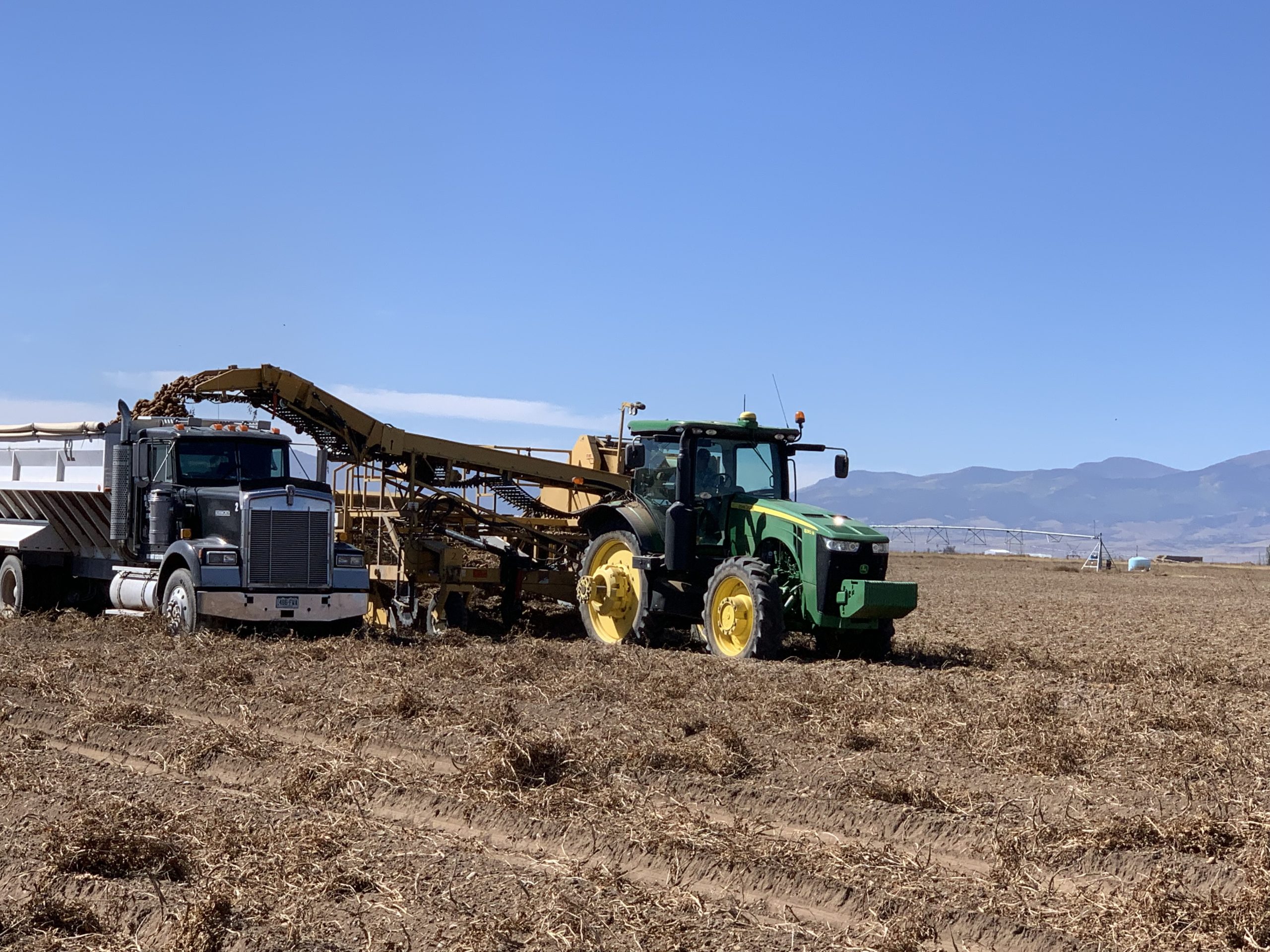
Take a drive down County Rd E or any of the other country roads that cross through Rio Grande and Alamosa counties and you’ll notice the Valley’s potato harvest in full swing. Take a bit closer look, and in the midst of the harvested fields is a growing amount of agricultural acreage once productive that is now intentionally dried out to save on the groundwater below.
The last days of the potato harvest. Photo credit: The Alamaosa Citizen
With the unconfined aquifer showing little to no bounce back after years of attempted recovery, the expectation is that the western and northern ends of the San Luis Valley will see more dry fields in the growing seasons to come. The money spent through the state’s Groundwater Compact Compliance Fund to retire more groundwater wells will begin to show up in the 2025, 2026 planting seasons and beyond.
As Cotten said, Subdistrict 1 is “one of the most productive irrigated farming areas in the state.”
Farming with a struggling aquifer is making it less so.
Milkweed, sweet peas, and a plethora of other flora billow from Farmer’s Ditch in the North Fork Valley of western Colorado. Jonathan P. Thompson photo.
Note to readers: Sorry this piece is late. I injured my hand in a way that makes typing a bit difficult and that has slowed me down a bit. And to non-paid subscribers: Sorry for the paywall and all, but we gotta pay the bills — and give the paid folks their premium content! If you’re interested, consider knocking down that paywall and accessing all the archives by becoming a paid subscriber!
This spring, I had the pleasure to sit on a panel on water in the West with Paolo Bacigalupi and Heather Hansman, two writers I’ve long admired. During the question & answer period, a local woman lamented the fact that some ditches were being piped or lined with concrete, because it would dry out the wetlands and ecosystems that had come to rely on the leaky laterals and ditches. And she was angry because the point, as she understood it, was to save water only to send it downstream to California. Her beloved valley, it seemed, was being dried out to fill up LA pools, which just seems wrong.
Jonathan P. Thompson, Paolo Bacigalupi, and Heather Hansman on a writer’s panel in Paonia in April, 2024.
I’ve thought about this a lot in the months since, because I think it gets down to the big, conceptual tug-of-war that’s happening around the Colorado River. There’s one battle between the different users of the river’s water. And then there’s another in which the values different communities hold are clashing with the “law of the river” and the overwhelming math that is driving the need to make massive changes.
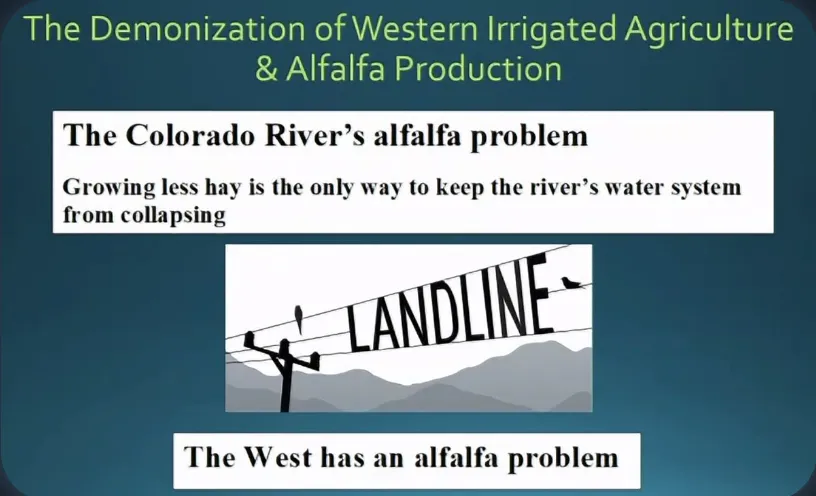
The following meditation on this clash was catalyzed by a slide a friend sent me from a Family Farm Alliance presentation at the Colorado Water Congress’s summer meeting. It accused me — via a piece I wrote for High Country News — of “demonizing” alfalfa.
Well, Family Farm Alliance, this is my response to you:
VALUES
The woman at the panel was referring to the North Fork Valley in western Colorado, a place with an extensive network of open canals, laterals, and ditches that irrigate peach, apple, and pear orchards, small vineyards, organic farms, and alfalfa fields. A handful of center-pivot sprinkler systems reveal themselves in the geometric perfection of their dependent fields, but most of the farms rely on older methods to bring water to the crops, namely by flooding the field or directing water down dirt rows where they soak into the plants’ roots.
Most of the canals and ditches are unlined and uncovered, and have been that way since they were built over a century ago. Many of them leak, some prolifically, their fugitive water blanketing the beige-gray earth with grass and nourishing cottonwoods, feral apricot and plum trees, sunflowers, willows, cosmos, reeds, sweet peas, milkweed, and cattails — along with a host of fauna that depend on those plants.
The intentional and accidental irrigation combine to form an irregular, pastoral patchwork of relative lushness amid the arid landscape of the kind that can be found in northern New Mexico, where a network of acequias irrigate long, rock-lined fields, or McElmo Canyon, where voluptuous pink sandstone rises up from a sea of emerald alfalfa. These places, where the cultivated and feral and wild collide, evoke the Provence of Jean Giono’s novels.
These are artificial landscapes, colonial ones, even, created by damming rivers and diverting their waters away from the fish and aquatic life in the streams and throwing off the natural balance of things. They rely heavily on inefficiencies in the system, from leaky laterals and ditches to flood-irrigation runoff. But they are, to my eye, lovely nonetheless, and contrast favorably with the more efficient farming areas, where high-tech irrigation systems deliver every drop of water to the linearly planted crops in laser-leveled fields.
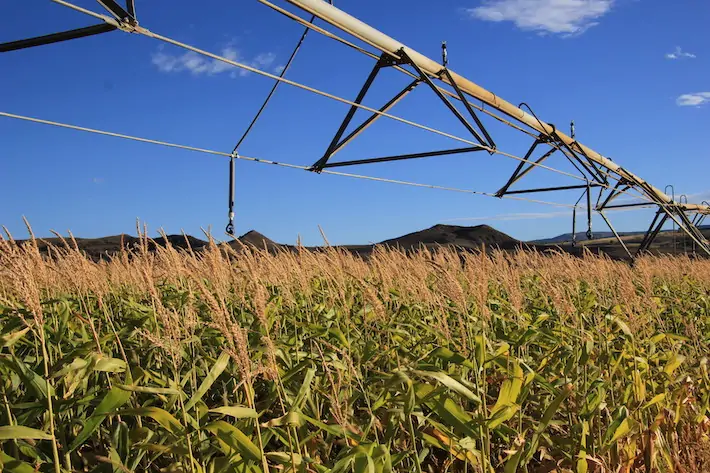
Agricultural productivity has grown 20% in the 21st century. Organic corn in Colorado’s North Fork Valley. Photo credit: Allen Best
And yet, because of math and water laws and compacts and the need to devote every drop of the shrinking Colorado River to “beneficial uses,” the character of these landscapes is likely doomed. It won’t happen next month or even next year, but over time. Nor will the lands be dried up altogether: In places like the North Fork the ditches — at least the ones with senior water rights — will continue to deliver water to the fields.
But more and more, those old leaky ditches will be upgraded, lined with concrete or other impermeable materials, or even put into pipes so that all of the water goes to those who hold the rights to that water, not to evaporation or the accidental ecosystems that have sprung up along the ditches’ banks. The farmers, too, may be forced or incentivized to become more efficient, replacing the flood irrigation with sprinklers or drip lines. Some will be paid to not irrigate at all. Most of the open ditches like the ones my cousins and I held stick-boat races in on my grandparents’ Animas Valley farm will be gone, along with the runoff of the kind that spilled from their corn and alfalfa fields to fill the cattail- and willow-tangled slough down below.
It is this loss that the woman in Paonia is mourning. It is heartbreaking. And it’s something I think about every time I write about the Colorado River and the looming crisis it and the communities and industries that rely on it face in the not-so-distant future.
If the crisis could only be solved — and the needed cuts in consumption made — based on our values alone, things would certainly be a lot easier. There would likely be fairly wide agreement that we should fallow the golf courses and drain the swimming pools before drying up the leaky-ditch wetlands and leaving the red-winged blackbird homeless. Farmers might join me in calling for tearing out thirsty turf lawns from Denver to San Diego, implementing progressive water rates to stem gluttony, and putting hard limits on household water use — if it meant keeping the sprinklers flowing to food crops, including alfalfa and other forage. After all, I value cheese and ice cream and green-chile burgers over the Sultan of Brunei or Miriam Adelson, who guzzled 12 million and 10 million gallons of water, respectively, last year to keep their Las Vegas estates green.
Ah, and yes, if all of this could be solved by prioritizing cuts based on values, alone, the Family Farm Alliance would have no reason to accuse me of “demonizing” alfalfa and other livestock forage crops (though I imagine the golf groupies would get me for vilifying them). But, alas, it’s just not that simple. Why? Because even the most lofty values are trumped by the cold, hard math.
MATH
The pertinent numbers in the equation include:
16.5 million acre-feet: Total human-related consumptive use of Colorado River water in 2020. This means all of the water that was withdrawn from the river and not put back into it, including reservoir evaporation. It does not include the 2.8 million acre-feet consumed via riparian and wetland evapotranspiration, nor does it include the 1.7 million acre-feet of water use from the Gila River, a tributary to the Colorado.
14.5 million acre-feet: The Colorado River’s median “natural flow” at the Lee Ferry stream gage, which is the official dividing line between the Upper Basin and Lower Basin, from 1906 through 2023. This is used as a measure of how much water is in the Colorado River, since downstream tributaries are relatively insignificant.
12.4 million acre-feet: The Colorado River’s average natural flow at Lee Ferry from 2000 through 2023.
This leaves us a few options for the big math problem that needs solving:
The optimistic equation (assumes the last 20 years was an anomaly and the river will go back to its old-normal flow soon, i.e. the median for 1906-2023):
14.5 million – 16.5 million = 2 million acre-feet deficit
The new-normal equation (assumes the next few decades will look like the most recent couple of decades — which is to say a megadrought) :
12.4 million – 16.5 million = 4.1 million acre-feet deficit
The pessimistic (realistic?) equation (assumes human-caused climate change will continue to deplete the river):
10.4 million – 16.5 million = 6.1 million acre-feet deficit
Estimated natural flow of the Colorado River at Lee’s Ferry (the dividing line between the Upper Basin and the Lower Basin). The natural flow is basically the total amount of water the river delivers each year, or the volume that would pass by Lee’s Ferry if there were no upstream diversions. Source: USBR.
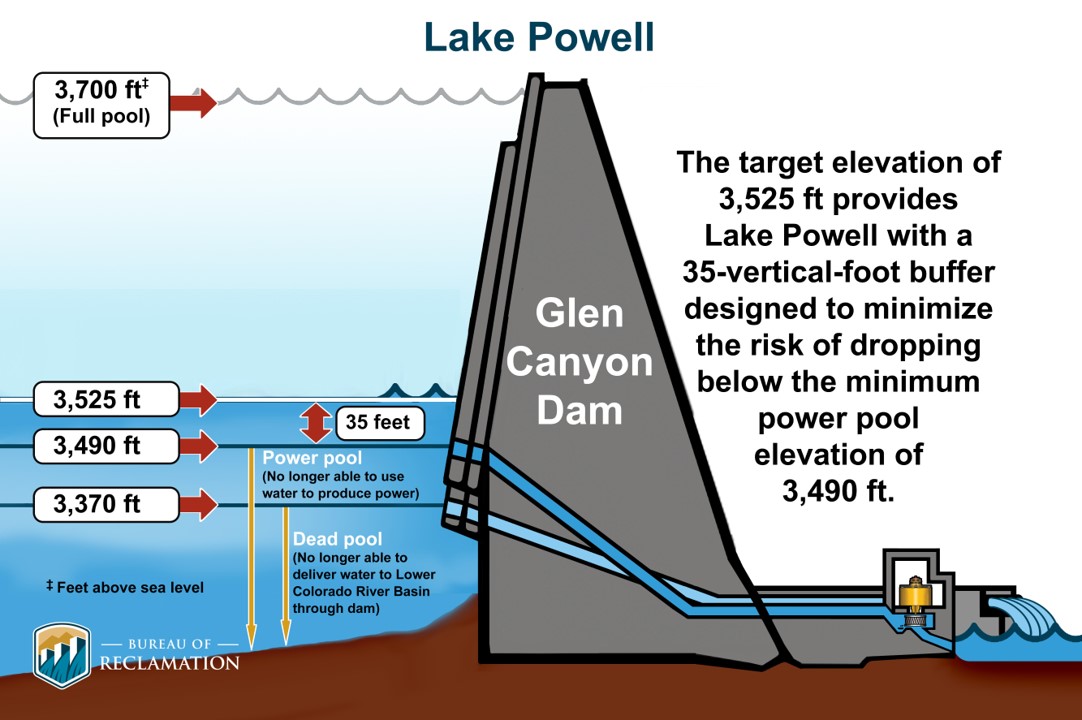
Which is to say … we’re screwed no matter how you juggle the numbers! Sorry, that’s not very solution-oriented is it? No matter how you cut it, though, the Colorado River budget is running a massive deficit and has been for a while. That’s why Lake Powell, the Upper Basin’s savings account, has been shrinking and now is less than 40% full — even after a couple of decent winters. A couple of consecutive new-normal winters could bring the reservoir down below minimum power pool, shutting down the hydropower turbines and potentially setting the scene for a mega plumbing disaster.
While it’s highly unlikely that the Colorado River’s flows will increase enough to fill Lakes Powell and Mead to capacity anytime soon, it’s not impossible. During the extraordinarily wet and snowy four years between 1983 and 1986, nearly 80 million acre-feet of water ran into Lake Powell — which should be enough to fill both reservoirs and still deliver adequate flows downstream. If it happens, great! It would be foolish and potentially catastrophic to bet on a repeat, however.
That means the users of the river must erase the deficit by cutting anywhere from 2 million to 6 million acre-feet of consumption annually. The big question, and one that the basins and their member states have been debating, is: Where will those cuts come from? I’m not going to get into the many layers of these negotiations here, as that’s not the purpose of this essay, which is a bit of a thought experiment. Suffice it to say it’s complicated, and made more so by glaring errors and injustices committed when the Colorado River Compact was originally crafted.
Let’s say we’re going to make these cuts based on values. Obviously everyone has different values, so we’ll just go with those expressed at the Q&A session I lead this piece with, which can be summed up as prioritizing rural farmland, food crops, and the artificial wetlands that can be found in the North Fork Valley over urban lawns, golf courses, and billionaires’ estates.
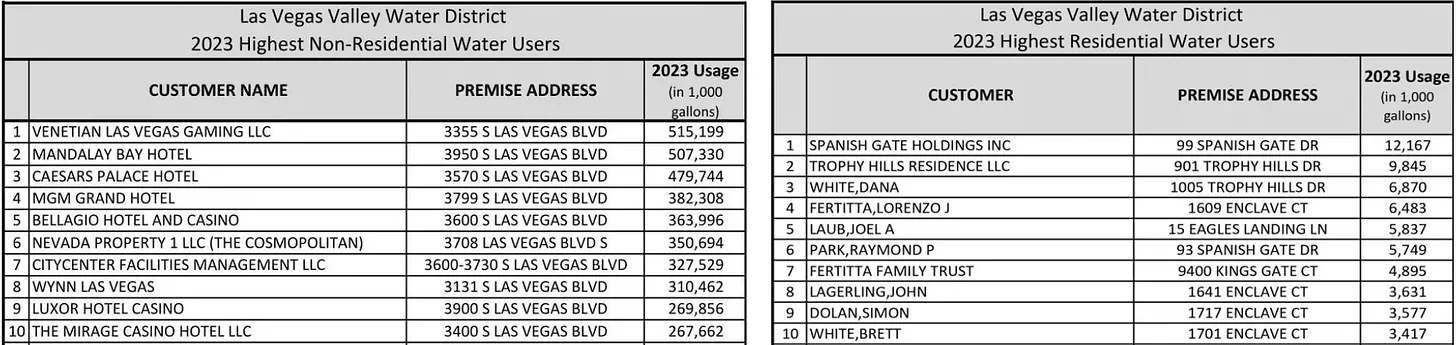
Where better to begin than Las Vegas? Let’s pull up some water user data and, holy cow! Look at those numbers. The Vegas resorts and the rich sure know how to use water:
The Venetian and Mandalay Bay resorts each use more than 500 million gallons of water per year. Meanwhile the top residential water users are mostly billionaires: 99 Spanish Gate Dr. — which goes through 12 million gallons per year — was owned by the Sultan of Brunei until tech-giant Jeff Berns purchased the 37,500 sf mansion for $25 million. Other top water gluttons include Miriam Adelson — a top Trump donor — and UFC CEO Dana White. The average Las Vegas household uses about 120,000 gallons per year, though newer, more efficient homes use far less.
When folks start throwing $25 million around for an unfinished house is when you know it’s time for a wealth tax. And when they use 100 times as much water as the average home, it’s also time for a new, progressive water rate structure, that incentivizes conservation and punishes gluttony. Las Vegas already has something like this, but the rates in the upper tiers are too low to be meaningful; they need to be so high that this kind of profligacy will sting even a billionaire’s pocketbook. Hell, better yet, why not just fallow these properties and xeriscape them?
When the numbers are added up, you’ve got:
227,243,000 gallons Top 100 Las Vegas residential water users’ combined consumption in 2023.
3,774,780,000 gallons Top 10 Las Vegas non-residential water users’ combined consumption in 2023.
Wow, so by shutting down just these folks, we could save 4 billion gallons of water, or … 12,275 acre-feet? Oh, that’s not as much as it seemed.
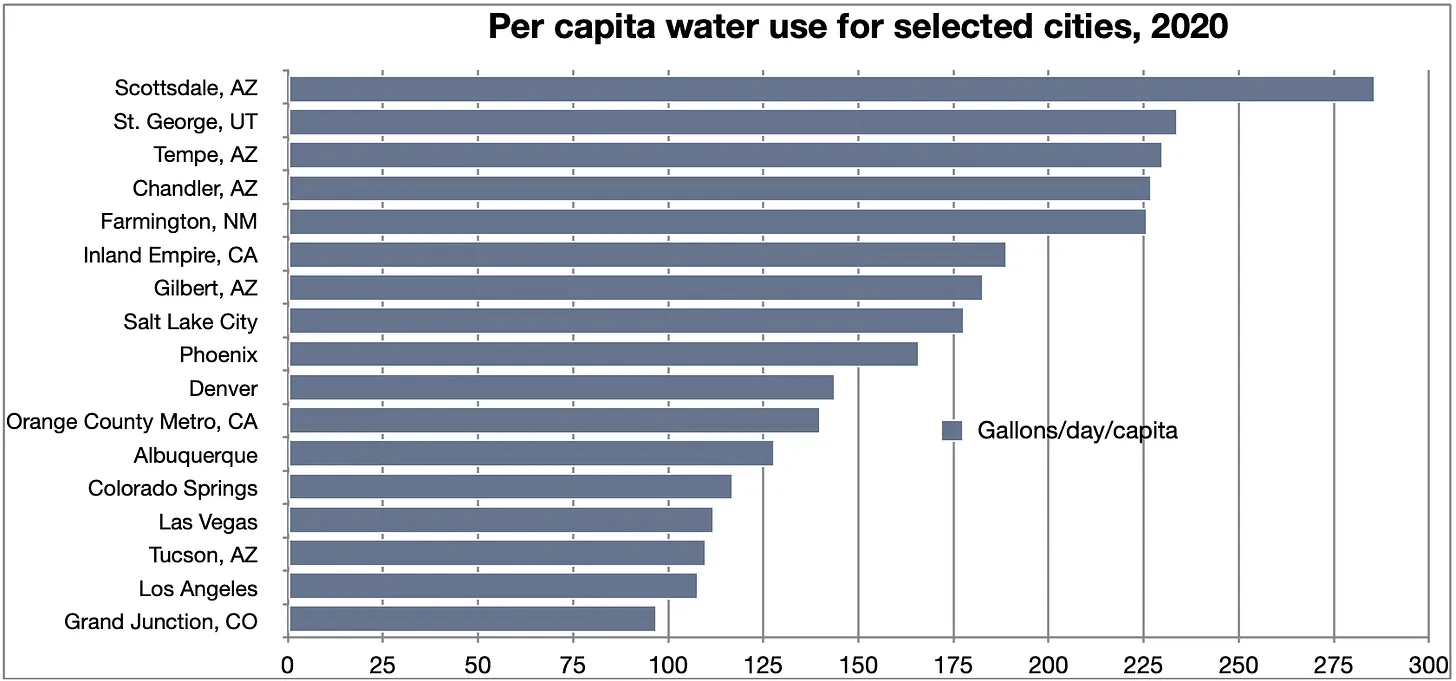
So how about we go to other cities and tear out turf, mandate low-flow appliances, ban lawn watering and swimming pools. I mean, if you could get Scottsdale and St. George residents to cut back to Tucson or Los Angeles per capita water levels, you’d make some more huge cuts.
If Scottsdale’s per-capita consumption were cut to Tucson’s levels it would save about 42 million gallons per year.
You could save millions of gallons through that effort, which is great. The problem is, this problem requires bigger thinking — you’ve got to make multiple cuts in the tens of billions of gallons range for it to make a significant difference. Once again, math, the ultimate buzz killer, raises its ugly head. See, as noble as all of these efforts might be, there just isn’t enough overall water use in the urban sector to come up with all the necessary cuts. You could drain the pools, dry up the lawns, seal up the Bellaggio fountains — hell, even shut off the massive pumps that convey water from Lake Mead to the Las Vegas metro area altogether — and you would still need to come up with at least another 1.6 million acre-feet of cuts. Entirely cutting off all of the Basin’s cities and industrial applications wouldn’t even get you to 4 million acre-feet of cuts. But boy, it sure would be interesting to watch — from afar.
To conclude Part I, some charts that drive the point home:
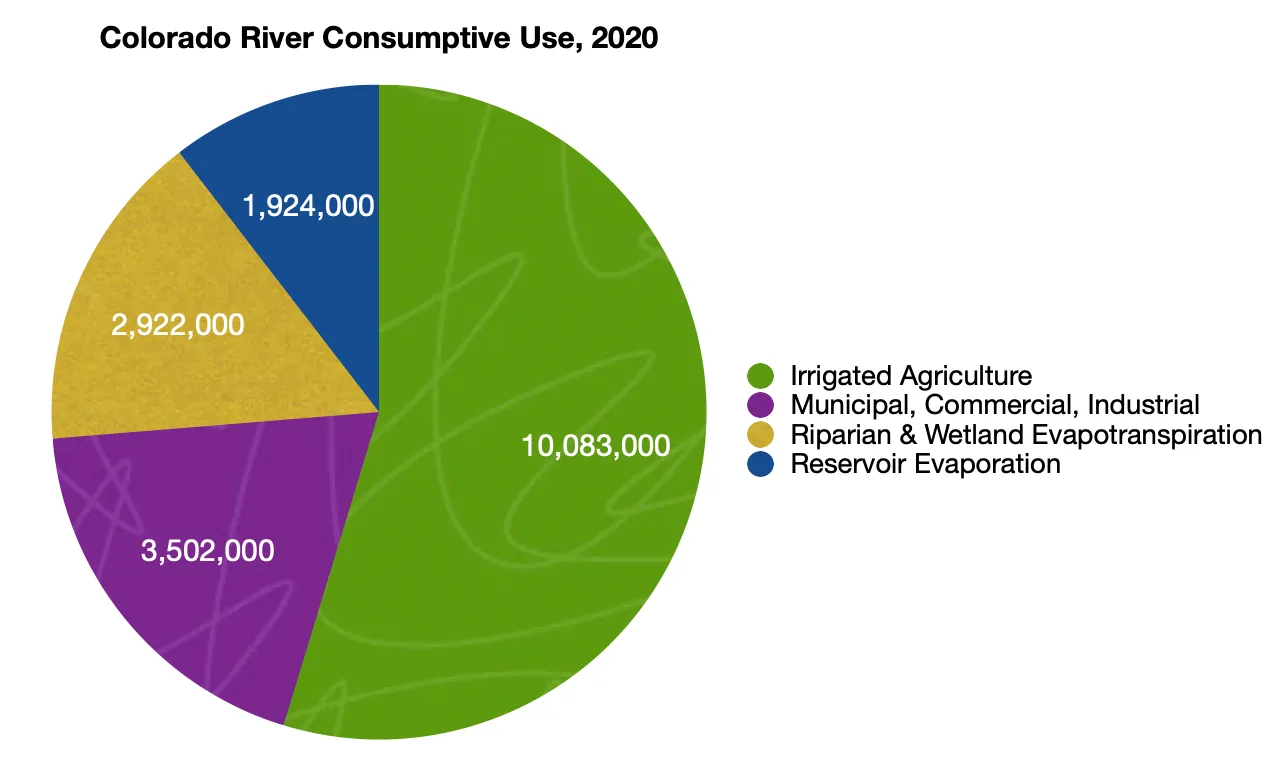
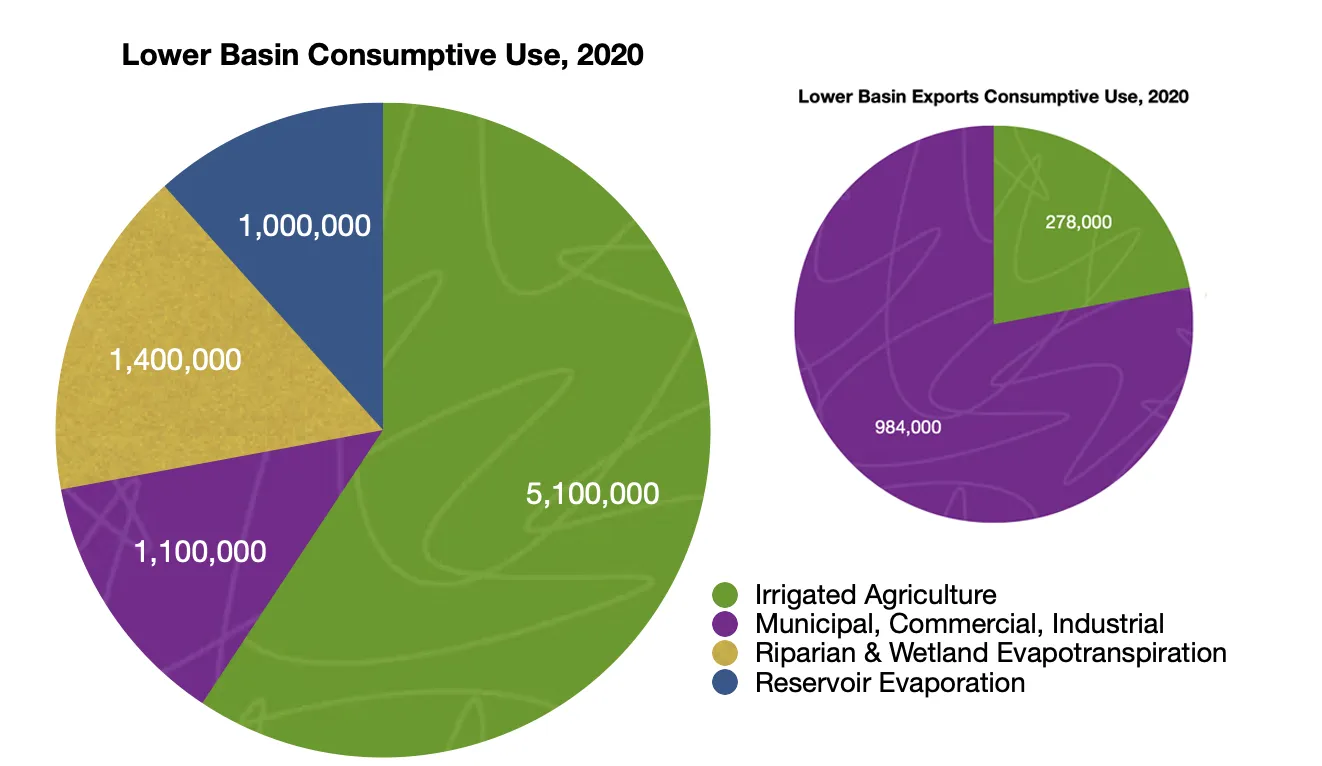
Irrigated agriculture gulps up about 10.1 million acre-feet per year, accounting for about 52% of the total consumptive use on the Colorado River. Meanwhile the municipal, commercial, industrial sector only uses 3.5 million acre-feet, meaning if you cut off all of the water to every Southwestern city, you still might have a water deficit in the Colorado River Basin. Source: New water accounting reveals why the Colorado River no longer reaches the sea, by Brian Richter et al
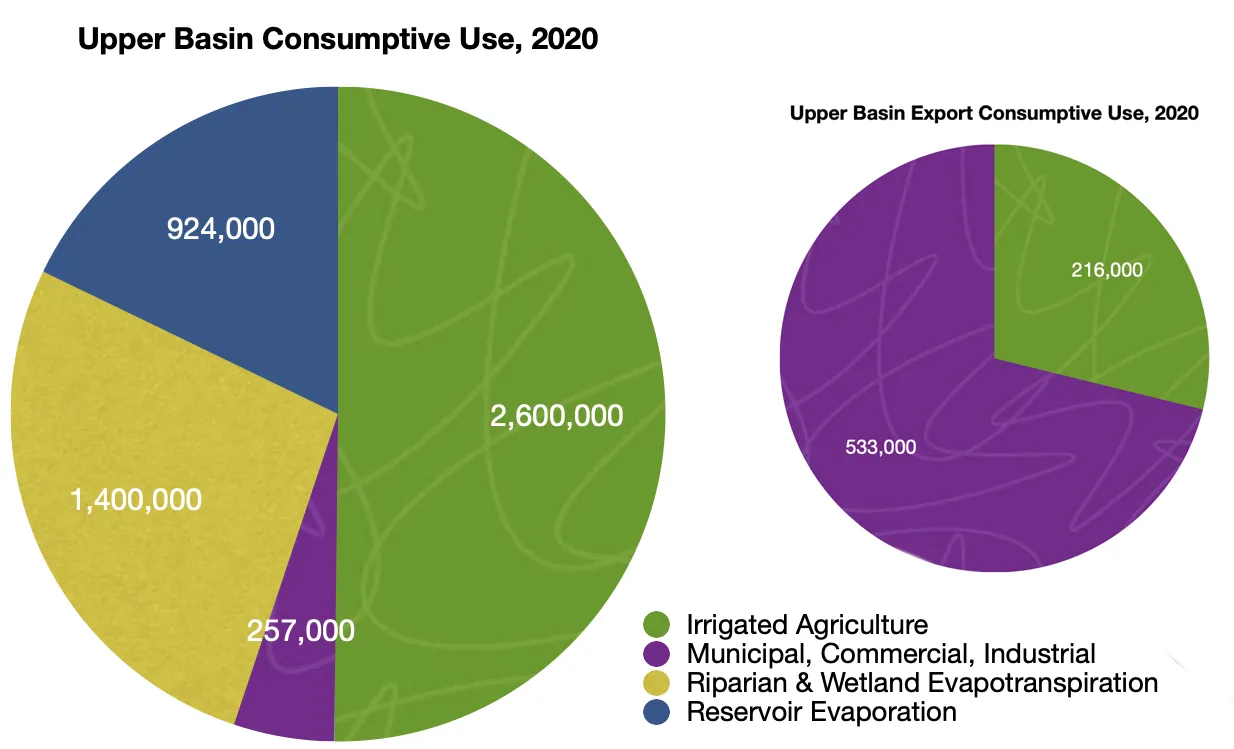
The chart on the left shows consumptive use within the Colorado River watershed only, where irrigated agriculture uses about 50% of the water. By contrast, Colorado River water sent over the Continental Divide to Colorado’s Front Range and New Mexico’s Rio Grande watershed is mostly used by cities, with about one-third going to agriculture.
About 59% of the non-exported Lower Basin consumptive use goes to irrigated agriculture. Exports follow the same pattern as in the Upper Basin, with most of the water going to urban use.
SOURCES: New water accounting reveals why the Colorado River no longer reaches the sea, by Brian Richter et al.; Decoupling Urban Water Use from Population Growth in the Colorado River Basin, by Brian Richter; Bureau of Reclamation, Las Vegas Valley Water District, Southern Nevada Water Authority, Zillow.
The Soldier Canyon Dam is located on the east shore of Horsetooth Reservoir, 3.5 miles west of Fort Collins, Colorado. The zoned earthfill dam has an outlet works consisting of a concrete conduit through the base of the dam, controlled by two 72-inch hollow-jet valves. The foundation is limey shales and sandstones overlain with silty, sandy clay. Photo credit Reclamation.
Nearly 150,000 residents will have greater access to safe drinking water without high costs for decades to come, after an approval by the Colorado Department of Public Health and Environment (CDPHE). This authorization will increase capacity at the Soldier Canyon Water Treatment Plant from 60 to 68 million gallons per day (MGD).
“The approval from CDPHE is a big win and a huge savings in dollars for the Tri-Districts all operating from the Soldier Canyon Water Treatment Authority’s Plant,” says Eric Reckentine, General Manager of North Weld County Water District.
The re-rating by the CDPHE which increases capacity from 60 to 68 million gallons per day (MGD), was successfully accomplished by the collective work of the three water districts operating out of Northern Colorado – North Weld County Water District (NWCWD), East Larimer County Water District (ELCO), and the Fort Collins-Loveland Water District (FCLWD).
“The expansion ensures that we can continue to provide water supplies to match our customers’ future growth needs and provide added resilience to our water supply systems,” states Mark Kempton, P.E, CWP, General Manager of Soldier Canyon Water Treatment Authority. “The Authority achieved the 8 MGD expansion using the Plant’s existing facilities, resulting in no construction and minimal costs. This efficiency has allowed us to keep our water rates low for our customers while continuing to provide a reliable, safe, and affordable drinking water supply to the Tri-Districts.”
The CDPHE expansion will provide water and larger capacity many years into the future for the tremendous development and population growth that Northern Colorado towns are experiencing.
“We continue to see projections for additional growth in the northern Colorado region and expanding water treatment capacity is a fundamental building block to sustain that growth. This treatment capacity increase represents the most cost-effective expansion in Soldier Canyon’s history and ensures all three partners can continue delivering high-quality drinking water well into the future,” explains Chris Pletcher, P.E., General Manager of Fort Collins – Loveland Water District.
“Like much of Northern Colorado, we anticipate continued growth within the East Larimer County Water District (ELCO) service area, and this addition of water treatment capacity will aid in meeting that new demand,” states Mike Scheid, General Manager of ELCO.
“I am very proud of the work of the other water districts and the staff and board of North Weld County Water District for helping to make accomplishments like this happen – it further stands by our commitment that we follow-through on what we promise for our customers,” says Reckentine. “This collaborative undertaking between the districts ensures we have secured the highest quality treated water for our Northern Colorado customers today, tomorrow, and into the future.”
ABOUT THE SOLDIER CANYON WATER TREATMENT AUTHORITY:
The Soldier Canyon Water Treatment Authority (SCWTA) owns and operates the Soldier Canyon Filter Plant, which is a 68 million gallon per day (MGD) conventional water treatment plant located in Fort Collins, CO. Since 1961, the Authority has provided high quality, reliable, safe, and affordable drinking water to over 145,000 people living in three water districts and adjacent communities in the Northern Colorado region. The three water districts (Tri-Districts) are:
The U.S. Air Force has a plan for cleaning up a decades-old jet fuel spill from a base near Albuquerque.
However, the local water authority said last week that the plan is inadequate, in part because it scales back current remediation efforts and doesn’t mention how the Air Force will address sudden issues.
In 1999, officials discovered a fuel leak, assumed to be more than 24 million gallons, in the jet fuel loading facility at Kirtland Air Force. The leak could be twice the size of the infamous Exxon Valdez oil spill of 1989, according to the Global Atlas of Environmental Justice.
It’s unclear when the leak – the largest underground toxic spill in U.S. history – first occurred, but it had been spilling fuel into the ground for decades by the time it was discovered, according to Kelsey Bicknell, environmental manager at the Albuquerque Bernalillo County Water Utility Authority.
An Air Force report says existing measures have prevented further migration of the fuel contaminants and that officials are regularly taking groundwater samples to ensure that drinking water remains safe both on and off-base.
Bicknell said there are concerns with the way the Air Force plans to go forward, including a lack of forward-looking analysis and the absence of a “trigger action plan” that identifies possible changes and prescribes a response to those changes.
She told the water authority’s Technical Customer Advisory Committee that the fuel soaked its way through almost 500 feet of soil, and ultimately reached the water table, where rock wouldn’t permit it to drop further. Then, she said, it began to pool underground.
Bicknell said the fuel not only contaminated the groundwater but also released volatile vapor into the nearby atmosphere.
She said the Air Force used a vapor extraction system to clean up more than a half-million gallons of fuel.
“This was a really successful system,” Bicknell said, adding that the program was shuttered after about a decade.
Bicknell said the Air Force is now using a groundwater pump-and-treat system that targets the dissolved fuel components that have moved away from the source of the leak and area. There are also four extraction wells, brought online between 2015 and 2018; they draw out and treat groundwater.
Bicknell said the Air Force has announced plans to turn off two of the wells. But that was done without input from the water authority and without including the agency in decision-making.
Air Force representatives did not immediately respond to phone and email requests for comment.
Bicknell said the goal now is to try to get the Air Force to reverse its decision before the wells are shut down. State and federal regulators have jurisdiction over the cleanup plan, she said, but the water authority cannot veto what the Air Force wants to do.
“Ultimately, we’re the water carrier, the ones that are impacted,” Bicknell said. “If the Air Force messes up, it is our source water that’s impacted, and it’s us that lose out on access to a supply source, so including us in the room and in project discussions and decision-making is something that is paramount.”
The San Juan Water Conservancy District (SJWCD), with a grant from the Colorado Water Conservation Board, has released the first of three short educational films regarding the watershed and the future of the water supply in Archuleta County. The video, “The Value of Snow,” will be shown in multiple venues in the county and can also be viewed online via the SJWCD website: sjwcd. org. The SJWCD is organized and funded by the citizens of Archuleta County to be an active leader in all issues affecting the water resources of the Upper San Juan River Basin. In order to enhance the understanding of our limited water resources, the district employed professional filmmaker Christi Bode to produce these films.
All water uses — environmental, agricultural, recreational, industrial and municipal — are important and need to be understood. It is the goal of the SJWCD to use these tools to help our constituents gain knowledge and understanding of the benefits and the risks associated with our watershed and the water it provides. Our community’s economy and our residents’ well-being are directly dependent on the health of our watershed. The risks are many and include drought, wildfires, mass earth movements (landslides), pollution and diversions.
Currently, Colorado’s hunters and anglers have perhaps a once-in-a-lifetime opportunity to protect a wide swath of public lands habitat in southwest Colorado’s Dolores River Canyons region. In April, we joined hunters, anglers, rafters, business owners, and many others from across the state and region in supporting a proposed Dolores River Canyons National Monument…The Dolores River faces threats from industrial scale mining, habitat fragmentation, and unmanaged recreation. Protecting intact habitat for mule deer, elk, and desert bighorn sheep, particularly winter range and movement corridors, is essential for retaining quality sporting opportunities. Now is the time for action. A national monument designation will help everyone better manage the change that is already occurring while also protecting public lands habitat and ensuring future generations of hunters, anglers, and many others experience the area as we have. For additional information see Sportsmen for the Dolores.
Decades of drought and taking more water from the Colorado River than it can afford to give have put both the river and the $1.4 trillion economy it supports in jeopardy. Investing in water resilience is essential for companies operating in the region, but it requires a different approach than many are used to.
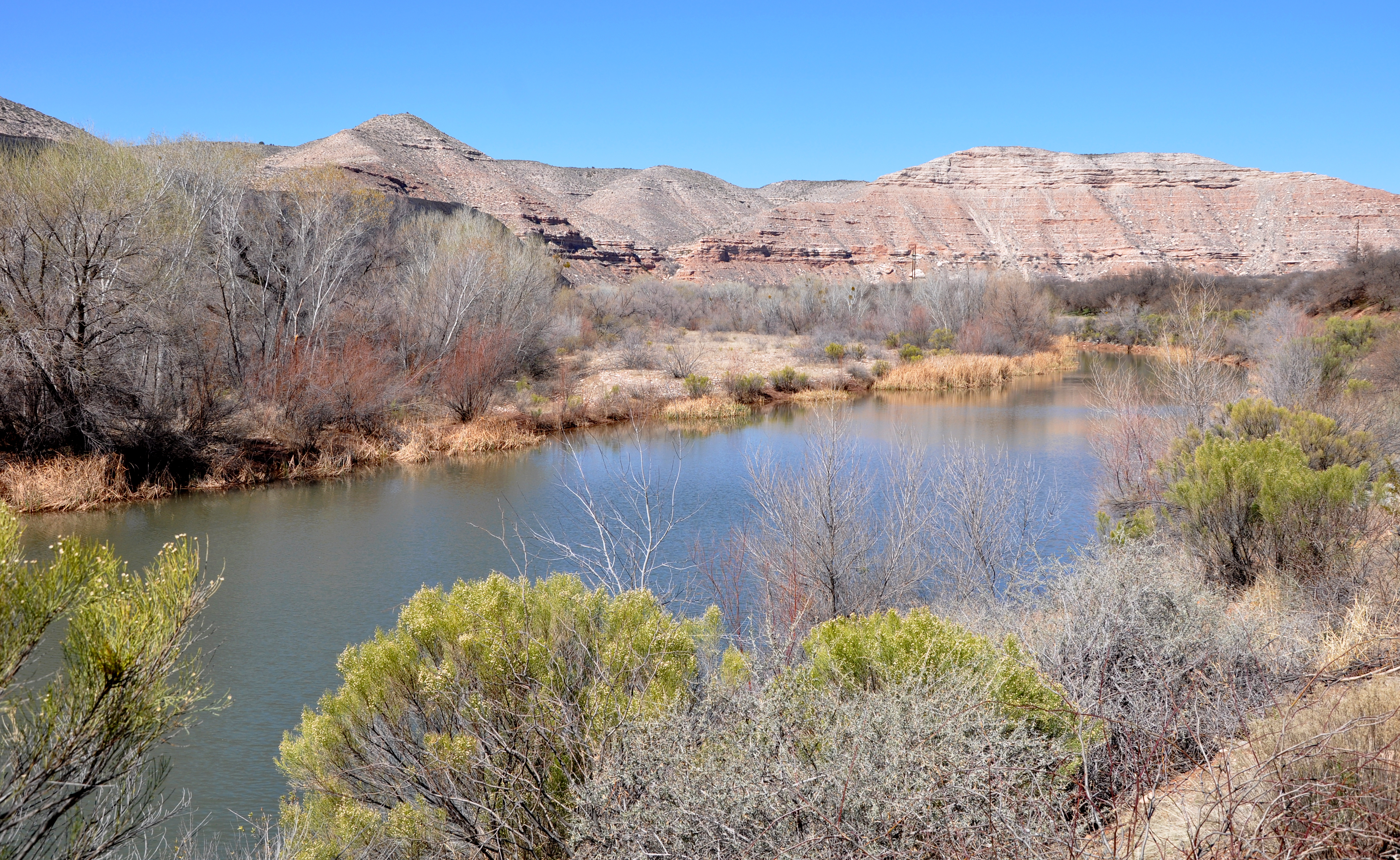
A tested and successful model can be found on the Verde River, a Northern Arizona tributary of the Salt River in the Colorado River Basin. The Verde River provides water for local farms and delivers up to 40 percent of in-state surface water for major urban locations in the Phoenix metro area. But its long-term health is at risk from withdrawals, groundwater pumping, a warming climate and drought.
Companies including Boeing, REI, Coca-Cola, Meta, Microsoft, Cox, PepsiCo, Google, Procter & Gamble, EdgeCore and Intel have partnered with groups such as The Nature Conservancy, Friends of the Verde River, National Forest Foundation and the Salt River Project to support dozens of resilience projects over the past decade in the Verde River. The Nature Conservancy (TNC) reports that over the past five years, projects spanning seven irrigation districts have saved nearly 50,000 acre-feet of water. That’s enough to support 100,000 U.S. households for a year.
These projects have focused on creating healthier streams and wetlands, reducing the risk of catastrophic wildfires and increasing the efficiency of water delivery systems. Here are some examples.
Reducing wildfire risk
An overabundance of small shrubs and trees in the Verde River’s forested headwater areas significantly increased the risk of devastating wildfires that would affect communities and regional water supplies and infrastructure. Partnerships that include agencies, nongovernmental organizations and corporate funders have scaled up projects that remove overgrowth and restore healthy forest conditions. This work has reduced fire risk, improved water availability and increased water security for the region. Corporate partners, including EdgeCore, PepsiCo, Apple, Meta and Google, were critical to the success of these projects.
“Meta’s water stewardship efforts include investing in projects that help put in place the enabling conditions for sustainable water management,” said Stefanie Woodward, water stewardship lead at Meta. “We’re proud to support projects that help to restore healthy forest conditions in the Verde and empower environmental nonprofits and communities to build long-term capacity in Arizona.”
Increasing water conservation
Outdated irrigation ditches convey water from the Verde River to farms across the middle Verde watershed. Leakage across many miles of the system increased the amount of water withdrawn from the river and made it difficult to irrigate farmland.
Multiple Verde River irrigation districts partnered with The Nature Conservancy to pipe more than 4 miles of irrigation ditch and improve water management by installing new water control structures. The work has increased water conservation and improved streamflows. Companies participating in the project include Swire Coca-Cola USA, Coca-Cola, Procter & Gamble, Meta, Coors Seltzer, Microsoft, PepsiCo, Advanced Semiconductor Materials (ASM) and Pulliam Trust.
“Together with The Coca-Cola Company, our support of conservation organizations along the Verde River aims to address the critical water challenges facing this vital ecosystem,” said Mike Bernier, director of sustainability at Swire Coca-Cola. “By funding projects like the piping of the Verde Ditch, we’re helping implement a long-term solution to reduce leakage, in turn improving water-efficiency and ensuring the sustainability of this water source for millions downstream.”
Shifting agricultural water demand
Many traditional crops in the Verde Valley are water-intensive and require significant irrigation during summer months when river flows are low. A partnership that includes Sinagua Malt, TNC and local farmers implemented an innovative program that replaced high-water-use crops, such as alfalfa, with barley, which requires less water in the summer season. The project delivered a solution that provides brewers with premium Arizona malt while improving water flows in the Verde River.
Tamarisk
Improving river flows
In addition to conservation and efficiency projects, removing invasive plant species can also improve water flows. Companies and funders including REI, Intel and Forever Our Rivers each funded work to remove invasive Arundo and Tamarisk plants from the middle Verde River and areas near the mouth of the Verde on the Salt River. These plants force out native vegetation and can use water at a higher rate. Removing them has helped restore habitat, improve biodiversity and keep more water flowing in the Verde River.
Setting the stage for success
Ready-to-fund water resilience projects that directly reinforce corporate goals are rare. Understanding the history and context for the Verde River work can help companies replicate success in other areas.
Social stronghold: Most projects in the Verde developed in areas where extensive groundwork had already been done by organizations that would later partner with corporations. Nonprofit groups and agencies spent time building relationships and credibility with landowners, agencies and partners prior to corporate investment. A foundation of social infrastructure was in place, or was positioned to expand.
Takeaway:Consider the need to support essential enabling actions such as planning, project design or outreach. It’s rare that “shovel-ready projects” are lined up in the right places and on the right timeline to perfectly align with corporate goals. Understanding and supporting pre-project strategies, including relationship building, can be essential.
Community relevance: A shared understanding of water challenges and solutions is necessary to achieve progress. There must be an overlap between community, corporate and conservation goals. On the Verde River, an analysis conducted by TNC and others of water issues, challenges and solutions helped identify areas where community interests intersected with corporate and conservation priorities.
Takeaway: Long-term, larger-scale resilience projects require significant community buy-in to succeed. Specific corporate stewardship, volume or replenishment goals should be based on a solid understanding of local priorities and context. This includes current public sentiment as well as the availability, likelihood, cost and timing of projects in a given location.
The long game: Many projects require years of preparation — for example, overhauling and improving centuries-old irrigation ditches that cross many land ownership boundaries required years of trust-building, engineering, problem-solving and fundraising. In the case of the Verde, several philanthropic organizations, including the Walton Family Foundation and the Nina Mason Pulliam Charitable Trust, provided early funding that allowed on-the-ground partners to build trust incrementally and set the stage for later success. It took 5-10 years to fully develop a pipeline of projects that could be funded and linked to corporate goals.
Takeaway: Be realistic and informed about the timeline and partnerships required for success. Corporate timelines should reflect real conditions and needs on the ground.
Setting flexible goals: Goals that rigidly define success metrics can create a scenario in which targets cannot be achieved — or where corporate goals do not address the real issues and concerns of local communities. For example, a narrow, inflexible goal such as “by 2030, our company will support projects that reduce water contaminants by at least 20 percent in all regions where we operate” will make it difficult to adapt to real conditions and needs that reflect evolving water challenges and community priorities across diverse locations.
Takeaway: Invest in multiple projects and set goals that are flexible enough to respond to local conditions, needs and context. Don’t expect a single project or narrow approach to meet both corporate water objectives and relevant regional needs.
On a cold, wet Monday morning, hidden away in a tall aspen stand, Rosalee Reese and Connor Born whisper so they don’t disturb the nearby rehabbing bears and bobcats. They walk into a large chain-link enclosure. In one corner sits a stock tank filled with murky water. In the other corner is a den-like structure of hay. A piece of plywood is laid over the top. Reese, Born and two employees of the Frisco Creek animal rehab center use sticks and their wits to corral five beavers into kennels.
Credit: Owen Woods
These beavers are part of the Beaver Translocation Program and are the third group this year to be relocated from the Valley floor to the Rio Grande National Forest. “Problem” or “nuisance” beavers are more often than not, just killed. When their dam building collides with agriculture or when they are perceived to be displacing water levels or threatening water rights, beavers are seen as pests and are treated as such. The hope is that this program will eventually lead to less conflict and more coexistence.
The future, Reese and Born say, is coexistence.
From Frisco Creek to Rios de los Piños
The Beaver Translocation Program is a part of the Rio Grande National Forest Wet Meadows Restoration Project. The Rio Grande Headwaters Restoration Project and the Forest Service have partnered on a new pathway for beavers to be placed higher in the mountains where they can have more direct influence on the watersheds and avoid the nuisance label. Projects like these have sprung up over the United States and in Canada, but work really didn’t start in Colorado until about two years ago.
“There’s always going to be conflicts on the Valley floor,” said Born, stewardship coordinator for the Rio Grande Headwaters Restoration Program. “I think of this as much a service to irrigators and water rights holders in the Valley as it is a benefit to the forest.”
Beavers play a vital role in watershed health; their impacts on the environment as a whole are widespread and well-known. However, where beavers excel in some places, they can be real problems in others. Particularly on the Valley floor, where their work and the work of farmers and ranchers collide.
“If you have suitable habitat for beaver, you’re going to continue to have problems with beavers,” said Reese, forest fisheries biologist for the Forest Service. “If we come and trap them out and move them, if you shoot them, the likelihood is that they’re going to come back at some point.”
She said that coexistence and making areas resilient against the beavers can “make your life easier because you’re not going to be dealing with the same issue over and over again. Because you’re not going to be able to eliminate beaver from the Rio Grande Basin.”
There are ways to create cohabitation, but it takes time and it takes money. The money, though, won’t come out of the pockets of those in conflict with the beavers. In fact, Born said, the approach is to offer funds to encourage people not to kill nuisance beavers and allow the animals to be relocated.
Credit: Owen Woods
Reese and Born, with two adult beavers, two yearlings and a kit, load into a Forest Service truck and drive the length of the Valley until they are high in the Rio Grande National Forest. For those few hours, the five beavers traveled faster and further than they ever have before.
Beavers are nature’s engineers, second perhaps only to humans. Yet there is an age-old tension between us and them that has forced us to think differently about what techniques can reduce conflicts and make sure that the Rio Grande National Forest’s watersheds and the Rio Grande stay healthy.
Overgrazing and drought are two factors at play that threaten watersheds and streams. The relocated beavers will call the Rios de los Piños home and even though their future is somewhat cloudy, they have been given another shot at life and an opportunity to do their jobs.
If there’s enough habitat, they’ll stay together as a multi-generation family unit. But if there’s limited food or habitat they’ll move away.
At the release site, Reese and Born pull on their waders. Reese comforts the beavers who at this point have huddled into the corners or against the gates of the kennels, eyes wide and hearts racing.
Credit: Owen Woods
Reese and Born tie two ratchet straps around the kennel and thread two wooden poles on either side. They take three trips from the truck to the drop off site, up to their thighs in water, carrying the beavers on makeshift gurneys.
The summer rains have created a swift and flowing rush of water.
The three kennels sit side by side. Reese and Born open the gates and coax the beavers with words of encouragement. Nothing happens for a moment. The animals are afraid and a little camera shy.
The kennels are tipped up and lightly shaken. The first beaver to take a swim is the baby. Then one by one, the other four beavers make their way into the water, where they slide in and slip under the surface.
And just like that, the job is done.
Credit: Owen Woods
The Forest
Beavers are considered an Aquatic Focal Species or Aquatic Priority Species. This means biologists and experts can look to them as an indicator of watershed health.
“So then we monitor a beaver and do the beaver relocation program as a metric of monitoring our watershed and riparian health and hopefully improving it in areas where we can re-establish them,” Reese said.
The beavers are being introduced to some areas they inhabited 20 to 30 years ago, but were pushed out due to drought or overgrazing, food and habitat pressures, or even simply by being killed.
In the short term, beavers are most threatened by predation, mostly by bears and mountain lions.
In the long term, besides climate change and overgrazing, human conflict remains the biggest threat to beaver populations.
Reese said that even when problem beavers are moved up into the mountains, they can still be seen as a problem and killed. And there’s not really a lot anyone can do about it.
“They’re just getting killed,” she said. “We have to change people’s perspectives on beavers. Humans are going to be one of the major issues for recovering larger beaver populations.”
Beavers are a protected species in Colorado, but if beavers are damaging property or causing problems to irrigation or agriculture they can be killed under state law.
Not all farmers and ranchers are so eager to kill beavers. Some are quite understanding of beavers’ role in nature, but just don’t want them gunking up agricultural gears. Born said that some landowners who are willing to participate in the relocation program are also willing to wait until next season to have their problem animals removed.
Understanding beavers’ role in the ecosystem is half the battle.
However, it doesn’t mean that people like Reese and Born won’t continue to try and give the watersheds and the beavers another shot. In the national forest, there’s no shortage of good places for beavers to be left alone to do their work. Particularly in meadows.
In the meadows that beavers occupy, their dams act like sponges, soaking up water and dispersing it far and wide. Born said, “You have this whole mini-aquifer of groundwater that if the beaver dam is there is just full. And that sponge is going to help release water longer into the season and keep the river wet. It’s just the same as the Rio Grande and the aquifers here.”
There’s a direct relationship between beavers and water health.
Credit: Owen Woods
“If the stream is cut off or forced to one side of the Valley,” he said, “that sponge is no longer fully wet so you’re more prone, if there’s no rainfall or low snowpack, then all of a sudden you lose flows completely or greatly reduced.”
On the car ride to the Rio Grande National Forest office in Del Norte, Born tells The Citizen that because of this mini-aquifer effect, some people may take it a step further and say that beavers and processed-based restoration have a potential to create a “second run off.”
“I don’t exactly like that terminology because I think it really overplays the potential,” he said.
Thinking on a stream-by-stream basis, he said, “we are so, so far from having any kind of meaningful influence on a river like the Rio Grande or Conejos. These are small streams that we’re doing habitat improvements for fish, for riparian habitat, and the groundwater recharge is almost secondary in these projects.”
On a statewide level, specifically through the Colorado Water Conservation Board, there is an effort to determine the exact influence that beaver structures have on streamflows.
Born said that would entail installing groundwater transducers and streamflow gauges before and after one of these restoration projects. That has never really occurred in the San Luis Valley before. The hope, he said, is to show that they are either increasing flows or doing very little.
The Valley Floor
Born said no one knows how many beavers live on the Valley floor. It would be a tough number to gauge. He thinks that there are far fewer beavers on the Valley floor than there are up in the national forest.
However, to give The Citizen an idea of just how often beaver conflicts occur, Born said that a farmer just a few miles upstream from Alamosa killed nearly 70 beavers in 2023. That number is normally around 30 to 40 a year.
“Alamosa proper might have a lot more beaver conflict if he wasn’t there. Ultimately, you have this philosophical issue of beavers are ecosystem engineers, we are the top ecosystem engineers. Beavers are pretty much number two. Which is really awesome. But we don’t like sharing.”
There are ways to create cohabitation. One of those methods is through the use of a “beaver deceiver.”
The most common and most frustrating headache beavers cause is building dams up against culverts. Using hog panel fencing, about six or so feet offset from the culvert, the beavers would be able to build a dam around that fence but wouldn’t limit the ability of the culvert to pass water.
Beaver deceivers aren’t always successful, Born said. “There’s always going to be a place for trapping and relocating.” He said there are many more beavers on the Valley floor than they are able to deal with, meaning they have to be “pretty choosy.”
That typically means establishing a priority list and going after the beavers giving people the most trouble and going after the largest colonies.
To do that, you’ve got to have someone who knows how to humanely trap beavers. Their trapper, who works through the USDA’s Animal and Plant Health Inspection Service, works pretty much alone and often has to trap animals other than beavers – like mountain lions, for example.
Because there is only one trapper, that priority list is important as the team doesn’t want to waste his time with beavers that aren’t quite a big enough problem.
Colorado Parks and Wildlife permits trapping beavers for this relocation program from June 1 to Sept. 1, but work doesn’t really kick off until closer to July. The team wants to make sure that the kits are grown enough to be able to survive and to make sure that mothers aren’t pregnant. Due to the Valley’s limited window of warm days, it leaves about eight weeks to trap, quarantine, and release.
Credit: Owen Woods
Beavers are good vectors. The Rio Grande Cutthroat trout is a threatened species and is currently seeing a resurgence in the Rio Grande’s watersheds, but it is a sensitive species, particularly to Whirling Disease. When beavers are taken from one water source to another they have to be quarantined for three days and have their water changed every 24 hours to ensure they won’t be carrying any diseases with them.
They are also quarantined to avoid the spread of Chytrid fungal disease, which affects amphibians.
All of these precautions are taking place because Reese and Born want to see these animals thrive and they want to ensure the health of the environment. Again, beavers are second only to humans in their ecosystem engineering. They are the water’s guides, and despite their conflict with humans, are a keystone species that we would sorely miss.
What comes out of this program has yet to be seen, but it’s promising. Whatever data and answers can be drawn will be shared for years to come.
Even if the success rate is 30 to 50 percent and not every beaver released doesn’t make it, Reese said she still feels “like the effort we’re putting in is worthwhile for the potential benefits of having more beaver on the landscape.”
Click the link to read the article on the Associated Press website (Hallie Golden). Here’s an excerpt:
August 30, 2024
Workers breached the final dams on a key section of the Klamath River on Wednesday [August 28, 2024], clearing the way for salmon to swim freely through a major watershed near the California-Oregon border for the first time in more than a century as the largest dam removal project in U.S. history nears completion. Crews used excavators to remove rock dams that have been diverting water upstream of two dams, Iron Gate and Copco No. 1, both of which were already almost completely removed. With each scoop, more and more river water was able to flow through the historic channel. The work has given salmon a passageway to key swaths of habitat just in time for the fall Chinook, or king salmon, spawning season.
Amy Cordalis brings in a salmon for processing at the family dock at Requa, California. Photo credit: Daniel Cordalis
Standing at Iron Gate Wednesday morning, Amy Bowers Cordalis, a Yurok tribal member and attorney for the tribe, cried as she watched water spill over the former dam and slowly flow back into the river. Bowers Cordalis has fought for the removal of the Klamath dams since 2002, when she saw some of the tens of thousands of salmon die in the river from a bacterial outbreak caused by low water and warm temperatures. She said watching the river return to its natural channel felt like she was witnessing its rebirth.
Click the link to read the release on the Tó Nizhóní Ání website (Mike Eisenfeld, Jane Pargiter, Robyn Jackson, Eleanor Smith, Rose Rushing):
August 24, 2024
Advocates have been working for years to facilitate a transition to clean energy, ending coal’s polluting legacy and the region’s economic over-dependence on fossil fuels.
Waterflow, N.M. – At 9 a.m. on Saturday morning, explosions rocked the bases of the four massive smokestacks that dotted the horizon just west of Farmington for a half century, and they then came crashing down in a thundering cloud of dust. The demolition of the 400-foot-tall behemoths at San Juan Generating Station (“SJGS”) marks the close of yet another chapter in more than 50 years of coal and its domination of the economy in the Four Corners region.
The San Juan Generating Station in mid-June of 2022 The two middle units (#2 and #3) were shut down in 2017 to help the plant comply with air pollution limits. Unit #1 shut down mid-June 2022 and #4 was shut down on September 30, 2022. Jonathan P. Thompson photo.
The plant opened in 1973 and originally had four coal-burning units. Units 2 and 3 were closed in 2017 and Units 1 and 4 continued operating until September 2022, when they were also retired permanently. Units 1 and 2 were jointly owned by Public Service of New Mexico (“PNM”) and Tucson Electric Power. Units 3 and 4 provided power to PNM and a mix of municipal utilities and rural electric cooperatives in New Mexico, Colorado, Utah and as far as California.
Operating at full capacity, the plant was a major source of pollution, pumping more than 12 million tons a year of greenhouse gases into the atmosphere and emitting more than 10,000 tons of nitrogen oxides annually, a major component of the region’s notoriously smoggy air. It also consumed billions of gallons of water every year from the San Juan River.
Following are reactions of local and regional advocates who collectively have been working for decades to accelerate the region’s transition from polluting fossil fuels to renewable resources for generating electricity, most of which serves distant communities.
***
“Indigenous advocates have long brought attention to the many adverse public health, land, and water quality impacts resulting from the operations at SJGS and Four Corners Power Plant (“FCPP”), pointing out the environmental injustice that Indigenous and local communities were saddled with in living so close to two coal mines and plants”, said Robyn Jackson, executive director of Diné C.A.R.E. “We can remember the terrible air quality that both plants produced in our region. It therefore came as no surprise that health disparities existed among our population, compared to the rest of the U.S. general population when it came to childhood asthma, as well as other illnesses like heart disease, cancer, and stroke. Our tribal-led organization recognizes that it is necessary and inevitable that our local economy be rebuilt around development that is renewable, sustainable, and regenerative. The health of our communities, economy and climate will require a transition away from fossil fuels if we are to survive and succeed.”
***
“We are hopeful that after the demolition of San Juan Generating Station, the Four Corners area and its communities will no longer have to sacrifice our health and safety for fossil fuels,” said Rose Rushing, attorney at Western Environmental Law Center. “There is work to be done to ensure that the region can transition to a sustainable, diversified economy, starting with fulfilling the commitments of the Energy Transition Act. We look forward to working with community groups in the next year to make sure our community receives the full benefits the Energy Transition Act promises.”
***
“The closure and demolition of PNM’s San Juan Generating Station marks yet another milestone, a step in the right direction away from fossil fuels and a step toward what we hope will be a just and equitable transition to more fossil-free energies such as wind, solar, and other sustainable, renewable, and real solutions that will truly combat climate change, said Eleanor Smith, Community Organizer of the Diné grassroots community organization Tó Nizhóní Ání. “Our hope is also that false solutions such as blue hydrogen and carbon capture sequestration are not sought nor implemented. The Navajo Nation and the Four Corners area have long histories of environmental injustices that continue to contribute to the climate chaos we are in. Now is the time for us, the impacted people who live and work in the Four Corners area, to plan and write the narrative of our fossil-free energy future, rather than the historical dictation by industry, energy companies, or others. We must say K’adí (stop) the harm to Nihimá Nahasdzáán, our Mother Earth, which includes us all.”
***
“I’ve lived in Farmington for 26 years, and it wasn’t until 2022 when the plant finally shut down that the brown haze lifted and we could see to the horizon,” said Mike Eisenfeld, the climate and energy program director for San Juan Citizens Alliance. “It’s always difficult to close one chapter and begin a new one, but knowing that children can breathe air that isn’t as polluted and being able to see this region for its beauty, which has been cloaked in smog for 50 years, is a good thing. There is huge potential for clean energy development and for diversifying our economy beyond just energy, and the demolition of these smokestacks is important symbolically for turning that page.”
A hot summer in Las Vegas pushed water consumption in August to the highest it has been all year, but the 2-year outlook for Lake Mead continues to improve. The U.S. Bureau of Reclamation’s 24-month study, updated each month with projections that guide how dams along the Colorado River are managed, shows continued stability for Lake Mead for the rest of the year and through 2025. Currently, Lake Mead is at 1,063.77 feet, about the same as it has been since mid-June, give or take a foot. Lake levels are expressed as feet above sea level — altitude, not depth. Lake Mead is the nation’s largest reservoir, and it’s currently about 165 feet down from “full pool” level — 1,229 feet. It’s down to a third of its maximum capacity.
A chart shows Lake Mead’s levels from 2019 to present. The lake is currently at 1,063.77 feet.
Southern Nevada used 188,000 acre-feet of water in 2023. That’s far less than the state’s allocation from the Colorado River. So far this year, use is at 157,872 acre-feet.
American beaver, he was happily sitting back and munching on something. and munching, and munching. By Steve from washington, dc, usa – American Beaver, CC BY-SA 2.0, https://commons.wikimedia.org/w/index.php?curid=3963858
Beavers, Castor canadensis in North America and Castor fiber in Eurasia, are widely referred to as nature’s engineers due to their ability to rapidly transform diverse landscapes into dynamic wetland ecosystems. Few other organisms exhibit the same level of control over local geomorphic, hydrologic, and ecological conditions. Though freshwater ecosystems are particularly vulnerable to changing climate, beavers and their wetland homes have persisted throughout the Northern Hemisphere during numerous prior periods of climatic change. Some research suggests that the need to create stable, climate-buffered habitats at high latitudes during the Miocene directly led to the evolution of dam construction. As we follow an unprecedented trajectory of anthropogenic warming, we have the unique opportunity to describe how beaver ecosystem engineering ameliorates climate change today. Here, we review how beavers create and maintain local hydroclimatic stability and influence larger-scale biophysical ecosystem processes in the context of past, present, and future climate change.
Jasper Reservoir, in the Indian Peaks Wilderness Area in Western Boulder County, has been sold under a set of covenants will ensure it waters are available to Middle Boulder Creek during the fall, when it is driest. Courtesy: The Colorado Water Trust
Ten years ago, an anonymous benefactor approached the Colorado Water Trust intent on providing it with an interesting gift: a reservoir high in the forests of the Indian Peaks Wilderness Area in western Boulder County.
The 23-year-old nonprofit was thrilled, understanding that the ultimate sale of the gift would insure its financial future, and making sure its mission to keep water in rivers continues.
The trust set to work immediately looking for a buyer who would agree to some very tough restrictions: permanent public access for fishing, hunting and camping, keeping the tiny reservoir full during the summer, and releasing the water down through Barker Reservoir in Nederland into Middle Boulder Creek during the fall, when the 37-mile stream segment is driest. Equally important is a conservation easement that prohibits any development of the water and land around the reservoir.
“The covenants are quite strict,” said Kate Ryan, the trust’s executive director. “We’ve taken away the development potential of the reservoir, so we had to have the right person come along.”
The trust’s day job is to connect private water-right owners with threatened streams, helping set up financing and the legal agreements necessary to ensure the water can be transferred to the state, where it becomes part of the state’s environmental program leaving water in streams that would otherwise be diverted.
Jasper Reservoir/Boulder Creek. Credit: Colorado Water Trust
If that sounds like a tall order, it often is. And finding a buyer for this reservoir would prove equally daunting. It turns out there aren’t a lot of people interested in buying covenant-restricted reservoirs, even in a water-short state such as Colorado.
But in August, the trust and Boulder County’s Tiefel family finalized the deal.
“The trust wanted a partner to help manage the reservoir and run the water down Boulder Creek,” said Doug Tiefel, a real estate developer whose family farms in eastern Boulder County and also has a small reservoir of its own. The family uses its reservoir to irrigate its operations and it leases any excess water to other growers in the area when water is available.
Tiefel said the Jasper Reservoir deal fit his family’s water needs, and their environmental ethic.
“For the ecosystem it is critical to keep more water in the river in late summer and early fall, and that’s why we forged this partnership agreement,” Tiefel said.
Prior to the sale, the reservoir’s water was often leased to other entities, such as the City of Boulder, which would in turn lease it to growers east of town. But the reservoir was managed differently every year. Under the Tiefel’s management plan, the water will flow more consistently, providing Middle Boulder Creek more certainty than it has had in the past, and a continuing supply of water for growers, Tiefel said.
Kim Hutton, the City of Boulder’s senior water resources manager, said the sale is a step forward for the entire Boulder Creek watershed, especially as climate change continues to reduce stream flows.
“The benefit of this sale is to release water when stream flow is low, and that is complementary to what we’re doing,” said Hutton, referring to the city’s efforts to keep water in the creek system.
Ryan hopes the deal will be the first of many in Colorado in which permanent protective easements can be placed on water. She said she’s also grateful for the financial security it provides the nonprofit.
“The revenue gives us the certainty for years to come that we will be able to add water back into Colorado’s rivers and streams,” she said.
On September 11, Francine became the third and strongest hurricane of the season to strike the U.S. Gulf Coast, following Beryl (in Texas) in early July and Debby (in Florida) in early August. Francine briefly achieved sustained winds near 100 mph while making landfall around 5 pm CDT in Louisiana’s Terrebonne Parish. Hurricane-force wind gusts (74 mph or higher) spread as far inland as New Orleans, where a gust to 78 mph was clocked at Louis Armstrong International Airport. Meanwhile in the Mississippi Delta, antecedent dryness minimized flooding, although rainfall topped 4 inches in many locations and localized wind gusts briefly topped 50 mph. As the former hurricane drifted farther inland, days of locally heavy showers led to pockets of flash flooding, extending as far east as Alabama and the Florida Panhandle. Less than a week later, on September 16, Potential Tropical Storm Eight moved ashore in northeastern South Carolina and delivered flooding rainfall (locally a foot or more) across southeastern North Carolina. By the morning of September 17, the end of this drought-monitoring period, much of North Carolina and portions of neighboring states had received significant rain. The remainder of the country largely experienced dry weather, leaving widespread soil moisture shortages across the Plains and Midwest—a classic late-summer and early-autumn flash drought. In the western U.S., a cooling trend was accompanied some rain and high-elevation snow, heaviest across the northern Rockies and environs. As the long-running Western heat wave subsided, late-season warmth replaced previously cool conditions across the Plains, Midwest, and Northeast. Nationally, nearly one-half (46%) of the rangeland and pastures were rated in very poor to poor condition on September 15, according to the U.S. Department of Agriculture, up from an early-summer minimum of 19%…
Warm, mostly dry weather led to general expansion of abnormal dryness (D0) and various drought categories. Across the six-state region, topsoil moisture rated very short to short on September 15 ranged from 30% in North Dakota to 80% in Wyoming. In fact, values were above 50% in all states, except North Dakota. Some of the worst conditions—extreme drought (D3)—existed across northeastern Wyoming and southeastern Montana, an area still recovering from last month’s Remington and House Draw Fires, which collectively burned across more than 370,000 acres of vegetation, including rangeland. Wyoming led the region on September 15 with 70% of its rangeland and pastures rated very poor to poor, followed by Nebraska at 45% and South Dakota at 42%…
Colorado Drought Monitor one week change map ending September 17, 2024.
Despite widespread precipitation in the northern Rockies and environs, only slight drought improvement was introduced, as concerns related to poor vegetation health and water-supply shortages were ongoing. In one piece of good news, however, a summer-long Western heat wave effectively ended. On September 17, the maximum temperature of 93°F in Phoenix, Arizona, halted a record-setting, 113-day streak (May 27 – September 16) with afternoon readings of 100°F or greater. Given the turn toward cooler weather and the gradual increase in cool-season precipitation, the wildfire threat has diminished in some areas. In southern California, however, the Airport, Bridge, and Line Fires collectively burned more than 115,000 acres of vegetation earlier this month. On September 15, topsoil moisture in agricultural regions ranged from 54 to 80% very short to short in eight of eleven Western States—all but California, Arizona, and Utah. Similarly, rangeland and pastures were rated 40 to 70% very poor to poor in eight Western States—all but California, Utah, and Colorado…
Hurricane Francine delivered heavy rain across much of Mississippi, as well as parts of Arkansas, Louisiana, and Tennessee. On September 11, daily-record totals included 7.33 inches in New Orleans, Louisiana, and 4.14 inches in Gulfport, Mississippi. For New Orleans, it was the second-wettest September day on record, behind only 7.52 inches on September 25, 2002. On September 12, Apalachicola, Florida, received a daily-record sum of 6.29 inches, helping to boost the 3-day (September 11-13) total to 12.77 inches. Elsewhere on the 12th, daily-record totals reached 4.22 inches in Memphis, Tennessee; 3.95 inches in Jonesboro, Arkansas; and 3.05 inches in Tupelo, Mississippi. By September 13, rain loosely associated with the remnants of Francine spread as far east as Georgia, where Columbus collected a daily-record total of 3.22 inches. In Alabama, daily-record amounts for September 14 totaled 4.72 inches in Muscle Shoals and 3.63 inches in Birmingham. A separate area of heavy rain, prior to Francine’s arrival, soaked a small geographic area in southeastern Oklahoma, northeastern Texas, and southwestern Arkansas. However, areas outside the range of these downpours largely experienced worsening drought conditions. On September 15, Oklahoma led the region with topsoil moisture rated 61% very short to short, followed by Texas at 54%. Meanwhile, Texas led the region with rangeland and pastures rated 48% very poor to poor, followed by Oklahoma at 35%. On that date, Texas led the country with 36% of its cotton rated very poor to poor, well above the national value of 26%. Several patches of extreme drought (D3) continued to affect key agricultural regions of both Oklahoma and Texas. In Texas’ northern panhandle, record-setting highs for September 13 included 102°F in Borger and 101°F in Amarillo. For Amarillo, it was the latest triple-digit reading on record, supplanting 101°F on September 11, 1910. Both Borger (101°F) and Amarillo (100°F) logged triple-digit, daily-record highs again on September 14. Meanwhile, Texas led the region with rangeland and pastures rated 48% very poor to poor, followed by Oklahoma at 35%. On that date, Texas led the country with 36% of its cotton rated very poor to poor, well above the national value of 26%. Several patches of extreme drought (D3) continued to affect key agricultural regions of both Oklahoma and Texas. In Texas’ northern panhandle, record-setting highs for September 13 included 102°F in Borger and 101°F in Amarillo. For Amarillo, it was the latest triple-digit reading on record, supplanting 101°F on September 11, 1910. Both Borger (101°F) and Amarillo (100°F) logged triple-digit, daily-record highs again on September 14…
Looking Ahead
During the next 5 days, active weather across the nation’s mid-section could lead to significant precipitation in from the central sections of the Rockies and Plains into the upper Midwest. While rain could slow agricultural fieldwork, including harvest activities, rangeland, pastures, and recently planted winter wheat will benefit from a boost in topsoil moisture. In contrast, generally dry weather will prevail across the remainder of the country, excluding the Atlantic Coast States. However, the western Caribbean Sea will need to be monitored for tropical cyclone development, with possible future implications for the eastern U.S.
The NWS 6- to 10-day outlook for September 24-28 calls for of near- or above-normal temperatures nationwide, with the West, North, and southern Texas having the greatest likelihood of experiencing warmer-than-normal weather. Meanwhile, near- or below-normal precipitation across the western and north-central U.S., as well as northern New England, should contrast with wetter-than-normal conditions from the central and southern Plains to the Atlantic Coast, extending as far north as the Ohio Valley and southern New England.
US Drought Monitor one week change map ending September 17, 2024.
On April 16, 2024, the Yorba Linda Water District (YLWD/District) Board of Directors rededicated its state-of-the art PFAS Water Treatment Plant in honor of former YLWD Board President Dr. J. Wayne Miller. The J. Wayne Miller, Ph.D. Water Treatment Plant – capable of treating up to 25 million gallons of water per day – provides clean drinking water for the 80,000 customers the Yorba Linda Water District serves. Credit: Yorba Linda Water District
…in the past few years, Yorba Linda has picked up another distinction: It’s home to the nation’s largest per- and polyfluoroalkyl (PFAS) water treatment plant of its kind, according to the city.
“This December will be [three] years we’ve been running, and we’re the largest PFAS treatment plant using resin,” says J. Wayne Miller, former board president at the Yorba Linda Water District, for whom the plant is named.
The Yorba Linda PFAS treatment plant took over a long, narrow strip of the water district’s parking lot, not quite the length of a football field. A series of giant tanks sit atop a concrete platform. “Honestly, they look like large propane cylinders,” says Todd Colvin, chief water system operator for the district. Each tank looms about 10 feet tall and can hold around 4,500 gallons. There are 22 of them, arranged in a double row, painted pristine ivory white. The tanks are packed half-full with a kind of resin – special polymer beads – that pull PFAS out of the water. Every gallon of water pumped from the district’s wells now passes through a few of these tanks for treatment, before going to the homes and businesses of 80,000 people.
The Yorba Linda Water District built the largest PFAS water treatment plant of its kind because it had a big PFAS problem. In February 2020, the water district had to take all of its wells offline because they were drawing groundwater contaminated with PFAS…But where is all this PFAS coming from? In Orange County, one of the primary culprits appears to be the Santa Ana River Almost a hundred miles long, the Santa Ana River flows through mountains and canyons, the cities and suburbs of San Bernardino and Riverside. Along the way, it picks up PFAS. “We find it in some of just the natural runoff that goes into the river during the winter, during storms,” says Jason Dadakis, executive director of water quality and technical resources at the Orange County Water District. ”We also detect some PFAS coming out of the sewage treatment plants upstream.” There’s also the legacy of factories and military bases in the area.
Utilities Engineer for the City of Aspen Phil Overeynder at the hydroelectric plant at Ruedi Reservoir. Releases from the reservoir in recent years have been too high in the summer and too low in the winter for Aspen to make hydropower efficiently. Credit: Heather Sackett/Aspen Journalism
The city of Aspen wants to add a second turbine and generator unit to its hydroelectric plant at the base of Ruedi Dam, which officials say will allow for more power generation during times of high and low flows.
Officials say an additional turbine, which is estimated to cost about $4.6 million, will restore the plant’s power production capacity to its originally intended 5 megawatts and allow the city to maintain its renewable energy goals. Since 2012, increased releases from Ruedi to benefit downstream endangered fish have meant that late summer and early fall flows are too high for the existing turbine to operate efficiently.
Adding another turbine requires amending Aspen’s license for the Ruedi facility with the Federal Energy Regulatory Commission. According to the city’s draft FERC application for an amendment posted on the Aspen Community Voice website, which officials say they plan on filing by the end of the month, the timing and amount of water released from Ruedi Reservoir has changed since the hydro project began operating in 1986. Power production has diminished in recent years to just 68% of what was originally intended.
Hydroelectric Dam
“After 40 years of reservoir and hydroelectric operations, it is now clear that achieving power output (maximum capacity and energy values) that approximates the original level authorized under the license will require additional generation equipment,” the application reads.
The City of Aspen has a hydroelectric power plant at the base of Ruedi Reservoir, which helps them meet renewable energy goals. Aspen officials want to add a second turbine to make power more efficiently. Credit: Heather Sackett/Aspen Journalism
The facility is most efficient at flows between 100 and 225 cfs. But summer and fall flows are often higher than this range and winter flows often lower. Aspen has no control over how much water is released from the reservoir, which is managed by the U.S. Bureau of Reclamation.
According to the city’s application, gross energy production has declined from an average of 18.5 million kilowatt hours annually from 1986 to 2004 to 15 million kWh over the last decade.
“The equipment is kind of mismatched for what’s going on with those releases,” said Phil Overeynder, utilities engineer for the city of Aspen. “So we’re losing all of that energy above 225 cfs. If we have an additional turbine, we’ll be able to hit the sweet spot for the releases and generate the full amount of energy when it’s available.”
Also, an error in the design of the powerplant introduces air into the water column, reducing the efficiency of the turbine. Because of this flawed design, the hydro plant can’t efficiently make power above about 225 cfs. The city looked at options to fix this problem, Overeynder said, including raising the floor of the building, but the least expensive solution is adding another turbine.
A new turbine would be rated for 1.2 megawatts of production and the original turbine would be downgraded to a 3.8 megawatt capacity, for a total of 5 megawatts — the same as the plant’s current rating, but split between two turbines. During periods of higher releases, about 230 cfs would be routed through the existing turbine and 70 cfs would be routed through the new turbine for about 92% efficiency.
The project would also upgrade the hydro plant so it can be operated remotely, and would let the city continue making hydropower with one turbine if the other one is down for maintenance. The total project cost including the new turbine would be around $8.6 million, according to Overeynder.
“The proposed second turbine at Ruedi, together with other planned actions, will enable Aspen to restore the balanced power supply, which will maintain grid reliability and resiliency while continuing to provide 100% renewable energy,” the application reads.
Ruedi Reservoir on the Fryingpan River is operated by the U.S. Bureau of Reclamation. Releases for the Colorado River Endangered Fish Recovery Program have boosted late summer and fall river flows in recent years. Credit: Heather Sackett/Aspen Journalism
Fish flow
Releases out of Ruedi have changed since the hydro plant began operating, with the reservoir now one of the most important sources of water for the Colorado River Endangered Fish Recovery Program. The program, designed to get water into a chronically de-watered section of the Colorado River near Grand Junction known as the 15-mile reach, has about 15,000 acre-feet of water available most years in Ruedi. Entities that own water in Ruedi such as Garfield County, Caerus Energy, Grand Junction area water provider Ute Water and the Colorado River Water Conservation District have also in recent years leased their water to the recovery program to boost flows beyond the dedicated 15,000 acre-foot pool.
All of the recovery program’s releases are made in July through October, when streamflows naturally are reduced, but irrigation demands in the Grand Valley leave diminished river levels for endangered fish. According to numbers provided by recovery program staff, the Ruedi fish water releases increased from an average of 18,586 acre-feet in the time period from 1998 to 2012, to 20,460 acre-feet in the time period of 2013-2023.
“Ruedi is an essential piece of our ability to manage water for the endangered fish,” said Juile Stahli, director of the Upper Colorado Endangered Fish Recovery Program. “Ruedi has become really critical in helping us affect the ecology downstream.”
According to Tim Miller, a hydrologist with the U.S. Bureau of Reclamation who manages Ruedi, the current reservoir release pattern — higher flows in the late summer and lower flows in the winter — began after 2012 when the water in the reservoir was fully contracted. The owners of this contracted water (like those mentioned above) release it when they need it, and many lease it to the recovery program. Because more contract water is released from Ruedi, Miller said he has to make up that loss to the reservoir by releasing less water over the winter, resulting in low winter flows.
“I can tell you with absolute certainty that since Ruedi has been fully contracted we have released more water for fish augmentation than we did since the program started,” Miller said. “Because we’ve released more contract water, given an average fill, it’s going to take more water to fill the reservoir the next year. So my releases during the winter were lower to recover that.”
According to data from USBR, the average flow out of the reservoir from July to October before the endangered fish recovery program started from 1980 to 1997 was 180 cfs. The average release after the program began in 1998 has been 204 cfs. The number of days releases have exceeded 225 cfs has also been trending upward since the recovery program began.
Aspen’s 100% renewable energy goals
Aspen first achieved its goal of 100% renewable energy in 2015, when a project that retrofit the Ridgway Reservoir dam in the Uncompahgre River basin to generate hydroelectric power came online. The city of Aspen was integral in launching the project, funding a feasibility study in the early 2000s and signing a 10-year contract in 2012 to purchase about 10 million kwh a year from Ridgway once it became available. Ridgway now accounts for about one-seventh of Aspen’s total power portfolio, according to Overeynder. In an effort to continue meeting its 100% renewable goal, the city is also looking to continue and potentially expand its hydroelectric power generation capacity on Maroon Creek.
Aspen has begun the process of relicensing the project with FERC, which is smaller than the Ruedi project and has a capacity of 450 kilowatts. Aspen is also proposing to add additional units on Maroon Creek for a total of 500 kw.
Hydropower, including energy Aspen buys from projects at Ridgway Reservoir and Western Area Power Administration, is supposed to make up about 45% of the city’s energy portfolio. But that percentage has dropped with the declining power production at Ruedi in recent years. The city also buys wind and solar power to achieve 100% renewable energy.
“If we do this (project at Ruedi) plus what we did already at Ridgway and are proposing to do at Maroon Creek, we will get back up to that 45%,” said Justin Forman, Aspen’s Utilities Director. “For us, every megawatt counts and if it’s something local like this, we’re super proud of it and it certainly fits into the values that we have.”
The FERC relicensing process will take several years, with sign-offs also needed from the Colorado Department of Public Health and Environment, the U.S. Army Corps of Engineers and Pitkin County. Overeynder expects the new turbine to be operating sometime in 2027.
The city of Aspen supports Aspen Journalism with a community nonprofit grant. Aspen Journalism is solely responsible for its editorial content.
The U.S. Forest Service has finalized a land exchange with Mt. Emmons Mining Company located in Gunnison and Saguache counties.
Under the agreement, finalized on Aug. 29, the Forest Service exchanged 539 acres of federal land located adjacent to the Keystone Mine for 625 acres of land owned by Mt. Emmons Mining Company located within the Grand Mesa, Uncompahgre and Gunnison National Forests and Rio Grande National Forest.
Iron Fen. Photo credit from report “A Preliminary Evaluation of Seasonal Water Levels Necessary to Sustain Mount Emmons Fen: Grand Mesa, Uncompahgre and Gunnison National Forests,” David J. Cooper, Ph.D, December 2003.
The land exchange allows the Forest Service to improve wildlife habitat and recreation opportunities by reducing private inholdings and creating more contiguous public land. The parcels acquired by the Forest Service include riparian and wet meadow habitats, which are vital to various bird and aquatic species.
Additional benefits of the land exchange include an established Conservation Easement and Mineral Extinguishment Agreement, prohibiting mining and allowing for non-motorized recreation in the future. It allows Mt. Emmons Mining Company to address mining remediation efforts, including water quality and facilitated the transfer of ownership and administration of the Kebler Winter Trailhead to Gunnison County.
“We are pleased to see this momentous exchange finalized,” said Dayle Funka, Gunnison district ranger. “This project was truly a collaborative effort with local non-profits, private landowners and local and federal governments working to benefit future generations. We encountered obstacles throughout the process but found ways to move forward in the spirit of collaboration. As a result of many people’s dedication and perseverance, this land exchange will enhance public access and enable future non-motorized recreational opportunities. I commend the Mt. Emmons Mining Company for their commitment to mining remediation efforts and water quality, while honoring the values of the community.”
Q: Do you believe that climate change is largely driven by human activity, including the burning of fossil fuels? If not, is there a different cause you would cite?
A: Harris calls climate change an existential threat and says the United States needs to act urgently to address it. As a presidential candidate in 2019, she released a $10 trillion climate plan that calls for investing in renewable energy, holding polluters accountable, helping communities affected by climate change and protecting natural resources. As California attorney general, she prosecuted oil companies for environmental violations. As vice president, she was the tie-breaking vote in the Senate for the Inflation Reduction Act, which provided about $370 billion to reduce greenhouse gas emissions to 40 percent below their 2005 levels by the end of this decade.
A: Trump believes human activity is just one cause of climate change, not necessarily the dominant factor. Pressed in a 2020 debate about whether human pollution contributes to warming, Trump said, “I think a lot of things do, but I think to an extent, yes.” Trump told The Washington Post’s editorial board in 2016 that he is “not a great believer in man-made climate change.” He has also long rejected climate science, sometimes calling global warming a “hoax.”
Q: Do you believe climate change is making disasters such as hurricanes, wildfires and heat waves more intense?
A: Harris has said the United States must take action to fight climate change in the face of increasing drought, floods, hurricanes, wildfires and sea level rise. As vice president, Harris announced more than $1 billion in grants in 2022 for states to address flooding and extreme heat exacerbated by climate change. “The frequency has accelerated in a relatively short period of time,” she said. “The science is clear. Extreme weather will only get worse, and the climate crisis will only accelerate.’’
A: At a rally in March 2022, Trump mocked the threat posed by sea-level rise and the nation’s concern with combating climate change. “And yet you have people like John Kerry worrying about the climate! The climate!” Trump said. “Oh, I heard that the other day. Here we are, [Russian President Vladimir Putin is] threatening us [and] he’s worried about the ocean will rise one-hundredth of one percent over the next 300 f—in’ years.” In 2019, Trump also exclusively blamed forest mismanagement for more destructive and deadly wildfires, rather than climate change. Scientists have said that no amount of forest management can stop wildfires in a more flammable world.
Marshall Fire December 30, 2021. Photo credit: Boulder County
Click the link to read the article on The Durango Herald website (Christian Burney). Here’s an excerpt:
September 14, 2024
About 20 people attended the event. They heard the panelists discuss Florida and Animas river trends, how Southwest Colorado’s climate is changing over time and fast facts about where Durango’s water comes from. Pool said Durango’s water comes predominantly from the Florida River and is supplemented by the Animas River. The city uses about 1.5 billion gallons of water per year for all utility use types, he said…He said both the Florida and Animas rivers are trending downward in total water volume; in dry years, groundwater recedes, which affects the total amount of surface water available. But Durango’s water consumption has remained flat despite a growing population, he said.
“Per capita, water use is going down. Total water use is staying pretty flat, with some seasonal fluctuations due to irrigation,” [Marty Pool] said.
While the city uses all the water from the Florida River it has legal rights to every year, it’s not even approaching the maximum usage of water from the Animas River, he said…Durango is lucky in that not all communities have that many second or third water options, he said.
We are pleased to present this in-person, full day water law course. Don’t miss this rare opportunity to learn with Aaron Clay in Norwood, CO!
This full day course will cover all aspects of the law related to water rights and ditch rights as applied in Colorado. Subject matter includes the appropriation, perfection, use, limitations, attributes, abandonment and enforcement of various types of water rights. Additional subject matter will include special rules for groundwater, public rights in appropriated water, Federal and interstate compacts and more.
Even if you have taken this course or one of the on-line short courses, it is a great refresher as there is so much information offered.
We welcome EVERONE, from anywhere in Colorado, including land owners, realtors, assessors, lawyers, water district employees, teachers, students and anyone interested in water law.
Register now to reserve your seat. General attendance is $125.00 (plus Eventbrite service fee) which includes lunch, course materials and a copy of the Citizen’s Guide to Colorado Water Law. ** $160.00 (plus Eventbrite service fee) if you wish to receive Continuing Education Credits (includes lunch, course materials and Citizen’s Guide to Colorado Water Law)
Past Participant Comments: “This is a great course and should be mandatory for real estate agents licensed in Colorado.” “Excellent speaker, good explanations. Stayed on topic, stayed on schedule, good diagram, good materials.” “Aaron is very intelligent, had answers thorough explanations for each question, and was informative on Colorado (and other state/federal) water law.” “One of the most relevant and effective CLE presentations I’ve to over past 25 years.”: “Very helpful. This is the 1st time it’s actually all made sense.”
Figure 1. A bridge where the Bear River used to flow into Great Salt Lake. Photo: EcoFlight.
Click the link to read the release on the Utah DWR website (Shaela Adams,Kelly Good, Wade Tuft):
September 16, 2024
SALT LAKE CITY—Great Salt Lake will benefit from 10,000 additional acre-feet of water thanks to a partnership between the National Audubon Society and The Nature Conservancy—as co-managers of the Great Salt Lake Watershed Enhancement Trust—in partnership with Jordan Valley Water Conservancy District, the Church of Jesus Christ of Latter-day Saints, the Utah Division of Wildlife Resources, and the Utah Division of Forestry, Fire and State Lands. The water will be delivered from upstream storage in Utah Lake, and flow through the Jordan River to Great Salt Lake’s Farmington and Gilbert Bays through mid-October.
Jordan Valley Water Conservancy District (Jordan Valley Water) is donating 5,300 acre-feet of water, the Church of Jesus Christ of Latter-day Saints (Church) is donating 1,700 acre-feet of water, and the Great Salt Lake Watershed Enhancement Trust (the Trust) is leasing 3,000 acre-feet of water, with all water sourced from Welby Jacob Water Users Company shares. The Utah Divisions of Wildlife Resources (DWR) and Forestry, Fire and State Lands (FFSL) will place the water to beneficial use at Great Salt Lake.
“Delivering new water to Great Salt Lake is essential to preserve the health of the lake and Utah communities, as well as protect the habitats for millions of birds that rely on it,” said Marcelle Shoop, Executive Director of the Trust and National Audubon Society’s Saline Lakes Director. “We are grateful for the vision and commitment of many partners, for this innovative late season water release to diversify benefits to the lake and its wetlands, as well as the Jordan River. We look forward to future opportunities to repeat these efforts in years to come.”
While the 2024 spring season flows increased Great Salt Lake water levels, ongoing flows are needed to reach healthy levels. Now the lake will receive additional flows this fall through this key collaboration.
“This release to Great Salt Lake is made possible by four key factors: water conservation efforts of residents and businesses in Salt Lake Valley, important changes to water rights laws adopted by the legislature over the last few years, Jordan Valley’s effective use of its existing water storage and conveyance infrastructure, and a strong snowpack,” says Alan Packard, General Manager of Jordan Valley Water.
Migrating shorebirds, waterfowl and other waterbirds will benefit as their habitats receive these additional flows. Increased water flows to the lake can also aid with salinity management in the South Arm, and in some cases improve capacity to control the spread of botulism and other diseases.
“Additional flows late in the water season are particularly beneficial during dry, warm conditions when there are risks of avian botulism,” DWR Director J Shirley said. “Over 12 million birds, represented by 339 species, utilize the Great Salt Lake and its associated wetlands. The ecosystem that the Great Salt Lake and its wetlands provide is crucial for these birds, and we applaud the ongoing efforts to conserve these habitat areas and the lake.”
The release will take place during Jordan River Commission’s Get To the River Festival, highlighting that in addition to the benefits to Great Salt Lake, these flows will benefit Jordan River and bordering communities, ecologically and recreationally, as the water moves down some 51 river miles.
“The Church continues to look for ways to care for the Great Salt Lake and the ecosystem that depends on it. This latest donation is another step in that effort. We consider it a divine responsibility to care for the earth and be wise stewards of God’s creation,” said Bishop W. Christopher Waddell, First Counselor in the Presiding Bishopric, The Church of Jesus Christ of Latter-day Saints.
On September 3, 2024 the board of the Pagosa Springs Sanitation General Improve- ment District (PSSGID) voted to move $500,000 from town funds to kick-start critical repairs on its sewer system, pushing off a bigger decision on financing for a larger overhaul of the system. Public Works Director Karl Johnson said that he fears a “catastrophic event” could be in the cards if the district doesn’t do something now to shore up the system.
Town Manager David Harris added, “We need to get moving here … and we need to move sooner rather than later.”
Johnson explained to the board that the biggest project on the district’s radar would be to continue repairing what has been deemed category 4 and 5 problems with sewer pipes, as well as its obligation to upgrade the Vista Treatment Plant, owned and operated by the Pagosa Area Water and Sanitation District (PAWSD), to bring it into compliance with state Regulation 85.
From email from the Reclamation Western Colorado Area Office:
With a wetter weather pattern and increasing forecast flows downstream, the Bureau of Reclamation has scheduled a decrease in the release from Navajo Dam from 800 cubic feet per second (cfs) to 700 cfs for Tuesday, September 17th, at 4:00 AM.
Releases are made for the authorized purposes of the Navajo Unit, and to attempt to maintain a target base flow through the endangered fish critical habitat reach of the San Juan River (Farmington to Lake Powell). The San Juan River Basin Recovery Implementation Program recommends a target base flow of between 500 cfs and 1,000 cfs through the critical habitat area. The target base flow is calculated as the weekly average of gaged flows throughout the critical habitat area from Farmington to Lake Powell.
This scheduled release change is subject to changes in river flows and weather conditions. If you have any questions, please reply to this message, call 970-385-6560, or visit Reclamation’s Navajo Dam website at https://www.usbr.gov/uc/water/crsp/cs/nvd.html.
States, Native American tribes and local communities could get help accessing federal funds for water infrastructure projects in drought-stricken areas under new U.S. Senate legislation.
The Water Project Navigators Act — sponsored by U.S. Sens. Jerry Moran and John Hickenlooper and Reps. Brittany Pettersen and Juan Ciscomani — would create a program in the Bureau of Reclamation to place “navigator” positions in local, state and tribal communities. Navigators would help connect communities to resources.
In a news release announcing the legislation, Moran, a Kansas Republican, said federal resources to help preserve water can be difficult to access.
“Widespread drought is impacting many communities across Kansas, hurting family farms, local municipalities and businesses,” Moran said.
Hickenlooper, a Colorado Democrat, said the same.
“Rural and Tribal communities deserve their fair share of federal funds to address drought, but all too often are left out,” Hickenlooper said.
Fellow Coloradoan Pettersen said water scarcity is felt throughout Colorado, but rural communities struggle to respond.
“It is critical that we invest in these areas to strengthen and protect our water resources and help communities draw down federal dollars,” Pettersen said.
Kansas and Colorado — along with Ciscomani’s home state of Arizona — struggle with continual drought and limited access to water. As of last week, according to the U.S. Drought Monitor, more than 51% of Kansas is in some level of drought, mostly moderate or severe. Almost 5% of Arizona is in extreme drought. Colorado is currently the least affected with about 12% of the state in some level of drought.
“In Arizona, water is our most precious resource,” said Ciscomani, a Republican. “As the drought worsens in the West, it is now more important than ever that impacted communities have the necessary tools to secure federal dollars for critical multi-benefit water infrastructure projects.”
The legislation is backed by conservation groups, according to the news release, along with the Kansas Water Office, Kansas Department of Health and Environment and the Kansas Department of Agriculture.
Click the link to read the article on the E&E News website (Miranda Willson). Here’s an excerpt:
September 12, 2024
“It’s absolutely everywhere,” said Sarah Hale, an environmental researcher who manages ZeroPM, a project funded by the European Union. “Trifluoroacetic acid (TFA) will be the next discussion in America, I can guarantee it. It will be about how should we treat it and what should we do.”
The attention on TFA underscores the game of whack-a-mole that scientists and communities face with forever chemicals. With thousands of identified versions of the substances, the chemicals are practically ubiquitous in the global economy, and researchers are still determining the exact health risks associated with many of them. But TFA could pose a particularly difficult problem down the line, due to how much it would cost to take it out of drinking water, experts say. The substance is extremely small, mobile and water soluble. As a result, it cannot be removed from water using the filtration systems that many communities are installing now for large, widely studied forever chemicals, said Rainer Lohmann, a professor of oceanography at the University of Rhode Island.
Trifluoroacetic acid (TFA) is a very persistent contaminant that has gained attention due to its multitude of anthropogenic sources, widespread occurrence in the environment, and expected accumulation in (semi-)closed drinking water cycles. Here, we summarize and assess the current knowledge on the anthropogenic sources of TFA to better understand the human-induced environmental TFA burden and highlight future research needs. Formation of TFA from the degradation of volatile precursors leads to diffuse and ubiquitous contamination of the environment. The analyses of ice core and archived leaf records have undoubtedly demonstrated that atmospheric depositions of TFA have increased considerably over the last decades in the Northern Hemisphere. Moreover, many point sources of TFA have been identified, which can lead to contamination hotspots posing a potential threat to human and environmental health. Also, unintentional formation of TFA during per- and polyfluoroalkyl substance (PFAS) remediation might become a major secondary source of TFA.
Click the link to read the article on the NOAA website (Emily Becker):
September 12, 2024
The tropical Pacific is still in neutral, but nature continues giving us signs that La Niña is on the way, and our La Niña Watch remains. Forecasters estimate a 71% chance that La Niña will emerge during September–November and expect it will persist through the Northern Hemisphere winter. A weak La Niña is the most likely scenario.
Opening credits
While there are no plot twists since Tom’s August post—frequent readers could be forgiven for fast-forwarding this month’s update—that 71% chance of La Niña developing this autumn is a small upward tick. Also, the slower-than-expected development of La Niña is a great example of how the short-term (subseasonal) and very long-term (climate change) complicate seasonal outlooks. I’ll run the numbers in a minute, after a word from our sponsor.
Hello folks! Do you wish you could get a heads-up about what your winter rain, snow, and temperature conditions might be like? Ask your forecaster about ENSO, the El Niño/Southern Oscillation! This seasonal climate phenomenon is made from the surface temperature of the tropical Pacific, including warmer-than-average water (El Niño) and cooler-than-average water (La Niña), and can be predicted months in advance. ENSO changes global atmospheric circulation in known ways; common side-effects may include shifts in the jet stream and changes in global temperature and precipitation patterns, droughts, and heatwaves.
Back to our regularly scheduled program
ENSO forecasters get their information from two general areas: climate prediction models and current observed conditions in the ocean and atmosphere. Climate models are up first, today. (See footnote.)
Line graph showing observed and predicted temperatures (black line) in the key ENSO-monitoring region of the tropical Pacific from early 2024 though spring 2025. The gray shading shows the range of temperatures predicted by individual models that are part of the North American Multi Model Ensemble (NMME, for short). Most of the shading appears below the dashed blue line by the fall, meaning most models predict that temperature in the Niño-3.4 region of the tropical Pacific will be cooler than average by at least 0.5 degrees Celsius (0.9 degrees Fahrenheit)—the La Niña threshold. NOAA Climate.gov image, based on data provided by Climate Prediction Center.
The North American Multi-Model Ensemble (NMME) is a collection of computer models that take information about current global conditions and apply physical equations to make predictions about upcoming weather and climate. For more about the NMME, check out this ENSO Blog post and this recent one from our friends at Seasoned Chaos.
This set of climate models has been predicting the development of La Niña since last winter, and continues to do so, although it’s taking a little longer than initially expected. This isn’t particularly surprising, since predictions made in the spring are often less accurate than predictions made at other times of the year. Overall, though, the models’ prediction of La Niña this upcoming winter has been consistent, including from last month to this month, providing continued confidence in the forecast despite the slowdown.
Reality TV
Time to check in with a few of our favorite characters. Our primary metric for ENSO, the surface temperature of the tropical Pacific Ocean in the Niño-3.4 region, was about 0.1 °C cooler than the long-term average (long-term = 1991–2020) in August, according to the ERSSTv5 dataset. This is solidly neutral—the La Niña threshold is 0.5 °C cooler than average—and only a small drop from July.
2-year history of sea surface temperatures in the Niño-3.4 region of the tropical Pacific for all strong El Niño events since 1950 (gray lines) and the recent (2023-24) event (purple line). Five of the eight gray lines dip below the dashed blue line (the La Niña threshold) in the winter following the El Niño. The 2023-24 event appears headed in the same direction. Graph by Emily Becker based on monthly Niño-3.4 index data from CPC using ERSSTv5.
The winds over the tropical Pacific play an important role in ENSO’s dramatic arc. When the near-surface winds in the tropics—the trade winds—are stronger, they cool the surface and keep warmer water piled up in the far western Pacific. They can also trigger an upwelling Kelvin wave, an area of cooler-than-average water under the surface that moves from west to east. Throughout August, the trade winds were stronger than average across most of the tropical Pacific, helping to maintain the gradual surface cooling tendency and to bolster the amount of cooler water under the surface. This cooler subsurface water will provide a source to the surface over the next few months.
Beneath the surface of the tropical Pacific Ocean at the equator, a deep pool of cooler-than-average (blue) waters has been building up over the past couple of months (July 12–Sept. 5, 2024). This pool of relatively cool water is a key factor behind the prediction for La Niña later this fall and winter. NOAA Climate.gov image, based on analysis from Michelle L’Heureux, Climate Prediction Center.
Character development
We started this La Niña Watch party back in February. Looking back at that forecast, the probability of La Niña developing by June–August was about 55%, with about a 42% chance of ENSO-neutral during that period. These probabilities mean that La Niña’s development in June–August was favored, but there was still a good chance that neutral would linger. As it turned out, the June–August average sea surface temperature in the Niño-3.4 region, the “Oceanic Niño Index,” was 0.1 °C below average, in the neutral range.
So why is La Niña behind schedule? Honestly, nature is wild and crazy and it amazes me that we can predict anything ever, especially many months in advance. In this case, though, there are a couple of complicating factors we can point to. The first is our old frenemy, short-term variability, or, essentially, unpredictable weather events that complicate seasonal or longer predictions. For example, just a few periods of weaker trade winds can delay surface cooling. Unfortunately, predicting such short-term variations is an ongoing challenge, and currently we can only predict these trade wind fluctuations a week or so in advance.
On the other side of the timeline, we have climate change. The global ocean temperatures are still way above average, and they are predicted to drop only slightly over the next several months. We don’t yet have a clear picture of how global warming may affect ENSO in general, or the development of La Niña this year in specific.
Coming up on La Niña Watch
That said, the most likely outcome is still that La Niña will be in place this winter, with slightly greater than 80% chance of La Niña in November–January, probably a weaker event (see strength probabilities here).
Out of the three climate possibilities—La Niña, El Niño, and neutral—forecasts say that neutral conditions are the most likely for the August–October season (tall gray bar above the ASO label, slightly over 60 percent chance). By the September-November (SON) season, La Niña has the highest chance of occurring (blue bar, 71 percent chance). NOAA Climate Prediction Center image.
A weak La Niña wouldn’t play as large a part in steering global atmospheric circulation patterns, meaning a lower chance of La Niña’s typical impacts on winter conditions. However, even a weak La Niña can nudge the winter climate and would likely factor into CPC’s winter outlook.
Stay tuned here for recaps and predictions about your favorite program, ENSO!
Footnote
There are two kinds of prediction models, dynamical and statistical. The model information I discuss in this post is from dynamical models. Statistical models use historical observations and their relationships to predict how conditions might evolve. Statistical models do not use physical equations, but rather statistical formulations that produce forecasts based on a long history of past observations of sea surface temperature, atmospheric pressure, subsurface temperature, and others. Statistical models have been around longer than dynamical models, because the dynamical ones require high performance computers.
“New plot using the nClimGrid data, which is a better source than PRISM for long-term trends. Of course, the combined reservoir contents increase from last year, but the increase is less than 2011 and looks puny compared to the ‘hole’ in the reservoirs. The blue Loess lines subtly change. Last year those lines ended pointing downwards. This year they end flat-ish. 2023 temps were still above the 20th century average, although close. Another interesting aspect is that the 20C Mean and 21C Mean lines on the individual plots really don’t change much. Finally, the 2023 Natural Flows are almost exactly equal to 2019. (17.678 maf vs 17.672 maf). For all the hoopla about how this was record-setting year, the fact is that this year was significantly less than 2011 (20.159 maf) and no different than 2019” — Brad Udall
Click the link to read the article on the KUER website (David Condos). Here’s an excerpt:
September 10, 2024
“We will have less water. Forever,” Rice said. “We have to accept that and … it’s up to us to be more efficient.”
That’s why Rice applied for funding from Utah’s Agricultural Water Optimization Program — a big money push to help farmers and ranchers modernize their irrigation. With roughly three-fourths of the state’s water going to agriculture, the situation has put a bullseye on farming when it comes to stretching that H20. Utah is counting on the program — which covers half the cost of buying new, more efficient gear — to save more water for communities, rivers and reservoirs downstream.
As he stood next to a center pivot irrigation system the program helped pay for, Rice reached for one of the dozens of spray nozzles that dangle a few feet over the ground. Compared to the equipment it replaced, he said, the difference is night and day.
“If hundreds of farms can save millions of gallons of water, I mean, we can fix it. … And do I feel like we have a responsibility to do that? Yeah, hell yeah.” — [Andy Rice]
That’s the idea behind Utah’s optimization program. If state money lowers the financial barrier for farmers to upgrade, the water savings might add up to help Utah maximize the little moisture it has…
Rice is just one example of the state’s approved projects, 551 of them and counting, said Program Manager Hannah Freeze, since the program began in 2019. The Utah Legislature has allocated $276 million so far and $108 million has gone to approved projects. A majority of that money is flowing toward the Great Salt Lake — $23 million has been approved for 112 projects in Utah’s Colorado River Basin. It’s a good start, Freeze said, but a drop in the bucket compared to what it might take to significantly improve Utah’s water outlook.
“If we were going to make a real dent or reach the majority of the farmers that we have, it’s more like a $2 billion number.”
Map of the Colorado River drainage basin, created using USGS data. By Shannon1 Creative Commons Attribution-Share Alike 4.0
The Colorado River flows through the Shoshone diversion structure on Jan. 29, 2024. Northern Water, which supplies cities and farms on the Front Range, is asking for more data about how much water will stay on the Western Slope after the Colorado River District purchases rights to the water that flows through Shoshone. Photo credit: Alex Hager/KUNC
Click the link to read the article on the KUNC website (Alex Hager):
September 11, 2024
This story is part of ongoing coverage of the Colorado River, produced by KUNC and supported by the Walton Family Foundation. KUNC is solely responsible for its editorial coverage.
A Front Range water distributor is pushing back on a planned transfer of rights to water from the Colorado River. It has led to a disagreement between two major water agencies — a minor flare-up of longstanding tensions between Eastern Colorado and Western Colorado, which have anxiously monitored each others’ water usage for decades.
Northern Water, which serves cities and farms from Fort Collins to Broomfield, is asking for more data about the future of the Shoshone water right. Meanwhile, the Colorado River District, a powerful taxpayer-funded agency founded to keep water flowing to the cities and farms of Western Colorado, says Northern Water may be attempting to stymie its purchase of the water rights.
In early 2024, The Colorado River District announced it would spend nearly $100 million to buy rights to the water that flows through the Shoshone power plant, near Glenwood Springs. Shoshone’s water right is one of the oldest and biggest in the state, giving it preemptive power over many other rights in Colorado.
Shoshone Falls hydroelectric generation station via USGenWeb
Even in dry times, when water shortages hit other parts of the state, the Shoshone power plant can send water through its turbines. And when that water exits the turbines and re-enters the Colorado River, it keeps flowing for a variety of users downstream.
Since that announcement, the river district has rallied more than $15 million from Western Colorado cities and counties that could stand to benefit from the water right changing hands. Those governments are dishing out taxpayer money in hopes of helping make sure that water stays flowing to their region, even if demand for water goes up in other parts of the state.
The river district plans to leave Shoshone’s water flowing through the Colorado River. It’s an effort to help settle Western Colorado’s long-held anxieties over competition with the water needs of the Front Range, where fast-growing cities and suburbs around Denver need more water to keep pace with development.
The water right is classified as “non-consumptive,” meaning every drop that enters the power plant is returned to the river. The river district wants to ensure the water that flows into the hydroelectric plant also flows downstream to farmers, fish and homes. The agency plans to buy rights to Shoshone’s water and lease it back to the power company, Xcel Energy, as long as Xcel wants to keep producing hydropower.
Almost all of the $98.5 million for the river district’s purchase of Shoshone’s water will come from public funds. In addition to money from its own coffers and Western Colorado governments, the river district also plans to apply for federal funding to pay for its purchase of Shoshone’s water. It is planning to seek $40 million from the Inflation Reduction Act.
Despite decades-long tensions between water users on the Western Slope and the Front Range, leaders on the East side of the mountains have stayed mostly quiet about the Shoshone transfer.
Bicycling the Colorado National Monument, Grand Valley in the distance via Colorado.com
Northern Water’s recent statements about Shoshone perhaps mark the most notable public pushback to the pending deal. The agency supplies water to Front Range cities such as Loveland and Greeley, as well as farms along the South Platte River all the way to the Nebraska border.
The agency outlined its concerns in a letter to elected representatives, including Colorado Senators Michael Bennet and John Hickenlooper and congresspeople Joe Neguse, Lauren Boebert, Yadira Caraveo and Greg Lopez.
In short, Northern said it supports the concept of the transfer, but wants an independent study of how much water the Colorado River District plans to send down the river each year.
“We want to make sure that we’re all going into this with the same data to make sure that everyone’s interests are being addressed,” said Jeff Stahla, Northern Water spokesman.
Northern posits that the Western Slope could pull more water than the amount that has been historically used by Shoshone – enough to increase strain on upstream reservoirs that also supply the Front Range.
The River District calls that claim a “gross mischaracterization” of its plans.
“Their points ignore the stated intent of the effort and are counter to the stated values,” said Matthew Aboussie, a spokesman for the River District, “And they 100% know that.”
The River District published its own letter about the matter. The agency’s director said Northern Water’s efforts “were received as intentional obstacles intended to threaten the viability of the Shoshone Permanency Project,” and said Northern’s calls for more data collection could require a time-intensive study of the project and tie it up in litigation for up to a decade.
“We are not looking to change the historic flows,” Aboussie said. “So the intention is to protect the status quo.”
The River District is currently compiling data about the history and future of the Shoshone water right and plans to present it in Colorado’s water court, which is part of the state’s normal process to approve the transfer or sale of water rights.
Four years after a high-profile dam restoration project was completed in the scenic headwaters of the Rio Grande, promises to deliver water for fish during the winter and other recreational benefits have not been met, environmental groups charge.
The Rio Grande Reservoir Project was funded by state loans and public grants provided by the Colorado Water Conservation Board, which often bases financing approvals, in part, on a project’s ability to serve multiple purposes, including water for fish, habitat and kayakers.
“The Colorado Water Conservation Board … provided $30 million in the form of loans and grants to complete the project,” the CWCB said In a project update posted on its website. “Benefits include: instream flow enhancement; channel maintenance; outdoor recreation opportunities; terrestrial and aquatic wildlife habitat; irrigation, augmentation; and storage to comply with the Rio Grande Compact between Colorado, New Mexico, and Texas.”
The public-private project was completed in 2020.
The CWCB declined an interview request for this story, but said in an email that there were no specific conditions in the loans and grants tied to providing environmental benefits.
“CWCB does not have the ability to impose extra terms on the recipients of funds that are not articulated in the funding agreements. In the case of the Rio Grande Reservoir Rehabilitation, the final deliverable was completion of the project,” a spokesperson said.
Still Kevin Terry, southwest program director for Trout Unlimited, said the project would likely never have been funded without assurances that the dam would be operated differently to help the river, including releasing water in the winter to aid the fish and changing the time water is released throughout the summer to keep the river cooler and healthier during prime fishing and kayaking season.
“There were lots of environmental benefits touted before the Colorado Water Conservation Board and the roundtable,” Terry said, referring to the Rio Grande Basin Roundtable. The roundtable is one of nine public groups across the state’s major river basins that help address local water issues and funnel state grants to projects they approve.
The San Luis Valley Irrigation District, which owns and operates the dam, serves farms around Center and has delivered water from the dam since 1912, according to its website. Neither District President Randall Palmgren nor Superintendent Robert Phillips responded to numerous requests for comment.
The district uses the reservoir to store water for irrigators. Trout Unlimited and others aren’t asking for any water, they say, just that existing water that would be released anyway be sent downstream at times that are beneficial to the river.
Screenshot from Google Maps
Among key complaints by environmentalists is that the irrigation company is not allowing water to flow out of the rehabilitated dam during the winter, something that would benefit young fish and allow them to grow larger for the next fishing season.
Terry said the irrigation district has said it can’t deliver that winter water because it is difficult to operate the new equipment in freezing winter weather. But Terry said he doesn’t understand how the project could have been built without the ability to deliver in cold weather, something that occurs routinely in other reservoirs in the valley.
Jim Loud, a Creede resident and avid angler who lives on the river, said he and others are tired of waiting for the river to receive the benefits many believed would have been delivered by now.
“All we want is to get them to do what they said they were going to do,” said Loud, citing numerous CWCB documents dating back several years outlining the environmental benefits of the project. Loud is part of the Committee for a Healthy Rio Grande.
Rio Grande and Pecos River basins. Map credit: By Kmusser – Own work, Elevation data from SRTM, drainage basin from GTOPO [1], U.S. stream from the National Atlas [2], all other features from Vector Map., CC BY-SA 3.0, https://commons.wikimedia.org/w/index.php?curid=11218868
The old days weren’t fun
The conflict comes as the Rio Grande Basin, which begins high above Creede and flows south to the Gulf of Mexico, continues to struggle with declining aquifer levels due to heavy agricultural use and low stream flows due to drought and climate change. In Colorado, the Rio Grande waters a potato industry that is one of the largest in the nation.
The last days of the potato harvest. Photo credit: The Alamaosa Citizen
Creede local Dale Pizel, who owns a ranch on the river and caters to the fishing community, said river conditions have improved some since the dam was rebuilt. Prior to the project, the irrigation company would routinely dry up the river for weeks during the high summer tourist season to make repairs to the dam.
“That doesn’t happen anymore,” Pizel said. He too serves on the Rio Grande Basin Roundtable, which also approved some grants for the project.
“I voted for that project knowing it would have environmental benefits, and it did,” Pizel said, because there is no need for the irrigators to dry up the river to repair a failing dam anymore.
Still, he said, if environmental promises are being made publicly, the state needs a better way to make sure they are kept.
Trout Unlimited’s Terry said for years he was hopeful that the rehabilitated dam would serve as another multiuse storage project in the water-short valley helping farmers and the environment.
“We are so disappointed in the delivery of what was promised and the lack of the CWCB holding the irrigation district accountable in any way,” he said.
Altering the dam’s new equipment so that winter releases can occur will likely require spending about $5 million, according to Terry.
Pizel and others hope a resolution between the farmers and the environmentalists can occur without legal action.
“We don’t want to start thumping each other in the chest,” Pizel said. “That’s the way it was in the old days. It was not fun.”
Click the link to read the article on the Big Pivots website (Allen Best):
September 11, 2024
Electric vehicles and plug-in hybrids reached 22.1% of all new vehicle sales in Colorado during the second quarter of 2024.
In the first quarter, Colorado was third in the nation in proportion of EVS and plug-in hybrids to total sales. During the second quarter an auto industry analyst reported that Colorado lagged only California, although the economist did not cite the source of the data.
Colorado’s incentives, among the nation’s most attractive, have helped swell the state’s sales. EVs constituted 16.1% of all new-vehicle sales in Colorado from April through June and plug-in hybrids another 6%. Hybrids with internal-combustion engines constituted another 10.89%.
EVs and plug-in hybrids had constituted 17.1% of all sales in the third-quarter of 2023, another milestone.
But does Colorado need more tricks in its bag to continue the upward mobility?
Colorado currently has 138,060 EVs (98,202 battery-electric vehicles and 39,858 plug-in hybrids) on its roads. It has a goal of achieving 940,000 by 2030.
In March 2023, a new state roadmap for EV adoption set a goal of having 25% of new vehicle sales by 2025. That seems doable.
However, the Polis administration’s goal is to boost EV sales to at least 70% of new vehicle sales by 2030. Is that within reach using current strategies?
Matthew Groves, the chief executive of the Colorado Auto Dealers Association, suggests that Colorado has some serious work ahead to achieve that goal. A “sprint” is how he describes the task.
A fundamental task he identifies is to create confidence among buyers that they will not get stranded without access to a faster-charging station if they buy an EV.
Range anxiety, if tamed somewhat by charging infrastructure that has tripled in the last five years in Colorado, remains an issue. This is despite impressive figures about charging stations, including the 4,200 level-2 public chargers in Colorado as of early August.
Coyote Gulch’s Leaf charging at Red Rock Hyundai in Grand Junction May 23, 2023.
DC fast chargers? 1,079 ports altogether, according to Atlas Public Policy. As of February they were located within 30 miles of 78% of the state’s geographic area.
More are coming. The state expects the first of 400 additional fast-chargers funded through the federal DCFC Plazas grant program to be in place by the end of 2024. Those chargers will be placed at 65-plus locations across Colorado, although supply chain constraints for transformers and other components may slow the complete rollout to two years or more,
Also material to charging infrastructure are Colorado laws and funding that require and help fund sharing in multifamily housing projects and workplaces.
Instilling consumer confidence
Sounds good, but Groves describes it as an incomplete picture. “Not every car works with every charger,” he points out. Tesla was supposed to make its chargers accessible to other technologies, but that has not happened yet.
Charging stations that don’t work are a problem, and the anecdotal reports suggest a significant one, at least in public perception.
“We can say that we have charging stations every 25 miles along major highways, but if there are six plugs at a stop in the middle of, say Rifle, and only two of them work, and they’re both occupied, what do I do? I may not have enough charge to make it to the next set of stations.”
Beyond the data, says Groves, what will matter most are the anecdotes shared among buyers and others. The importance of those anecdotes will vary from person to person.
Coyote Gulch’s Leaf charging at the Kremmling Town Park (Between Steamboat Springs and Denver) August 23, 2021.
“If I know somebody who got stuck between Steamboat Springs and Denver and heard they had to wait three hours for AAA to get to them, that is a more compelling (story) than the state telling me that our chargers are up 92% of the time.”
Colorado’s surging sales can be attributed in large part to the bucket of carrots offered buyers. The American Council for an Energy Efficiency Economy ranked Colorado third in the nation on its transportation electrification score in a 2023 report. That scorecard evaluating EV policies that states have taken to reduce barriers puts Colorado behind California and New York. Incentives are part of that package.
These incentives by the state, federal government and, in some cases, utilities can be “stacked.” In other words, the state EV tax credit can be combined with the federal tax credit as well as several other Colorado incentives that are available to income-qualified residents.
Groves said that he has seen purchase orders where a buyer can get back $23,000 on the purchase of a new vehicle.
Colorado also has another incentive that makes EVs particularly attractive. Beginning in 2017, purchasers could assign the state tax credits to a financing entity. A 2023 state law made it even easier. HB23-1272 allowed purchasers to assign the tax credit to a participating auto dealer in January. Dealer assignability is also available for the federal tax credit.
If it has some relatively minor problems, this program has yielded packages that have motivated consumer demand. For example, Groves reports knowing of leases for EVs that come in at about $2,100 a month. “Which is phenomenal,” he says. The sheer economics of the heavily subsidized market has some people getting EVs because of the low cost regardless of how they feel about the technology.
How long?
How long can Colorado outpace most of the nation?
National media have carried many stories since late last year about a slowdown in EV sales. Lately comes news that Ford Motor Co. has abandoned plans to roll out a large electric SUV. Tesla has been forced to offer deeper discounts, General Motors has delayed its plans for an EV pickup.
The Washington Post, in an editorial on Aug. 30, urged state and federal policymakers to leave room for plug-in hybrid sales in the medium term.
“The industry is now in the phase that researchers call ‘the technology-adoption lifecycle’ or cross-industry adjustment. When a new technology enters the market, there is a chasm between the enthusiastic early adopters who embrace it right away and the critical mass of consumers who need longer to be convinced,” the newspaper opined.
“Most of the early EV adopters have already purchased their vehicles. It might take time to bring along the critical mass of wait-and-see consumers. Offering electric-fuel hybrids is a way to ease that transition while providing practical solutions to some common concerns.”
The Wall Street Journal on Aug. 25 reported that automakers were already there: they have 47 models of plug-in hybrids available, nearly double those in 2019. They can run on electricity for between 20 and 40 miles before reverting to a gas engine.
Groves is skeptical we will see many lower-priced EV models arriving. “There is a finite supply of the rare-earth metals that we need for EV batteries. And when there’s a finite supply and demand surges, costs tend to go up.”
What would benefit Colorado, says Groves, would be greater flexibility in the methods used to reduce pollution from cars under the Clean Air Act. States have two choices: the federal standards for reducing emissions from cars or taking the lead of California, which federal law permits. Colorado and 16 other states have chosen to work within the constructs of what California is doing.
He cites Colorado’s Clean the Air Foundation program as an example of the innovation. “That was a uniquely Colorado program.”
An attorney, Groves had law-enforcement training and spent 17 years in Washington D.C. working on tax policy and national security issues for three different members of the House of Representatives.
“We’ve shown that we can be a leader in this field,” he says, and should not be “handcuffed by the preemptory effect of federal law.”
Click on a thumbnail graphic to view a gallery of drought data from the US Drought Monitor website. Here’s an excerpt:
US Drought Monitor map September 10, 2024.
High Plains Drought Monitor map September 10, 2024.West Drought Monitor map September 10, 2024.Colorado Drought Monitor map September 10, 2024.
This Week’s Drought Summary
There was a sharp difference in temperatures across the U.S. this week (Sep. 3 to Sep. 10). Temperatures in the West were above normal, whereas areas from Texas to Wisconsin and east saw temperatures of 3 to 9 degrees below normal. Very little precipitation fell, with Hurricane Francine providing most of it along the Gulf Coast. Overall, the central and eastern portions of the country saw continued deterioration, adding onto already expansive deterioration from last week. The Ohio River Basin continues to be the epicenter of the extremely dry conditions, though moderate and severe drought conditions are spreading through the southern Midwest into the Southeast. Improvements made along the Gulf Coast were primarily due to the well-above-normal precipitation brought by Hurricane Francine. There were some other areas of improvement in New Mexico, northeastern Arizona, eastern Utah, southern Wyoming and northwestern Montana. Areas of the West that have not seen any meaningful precipitation in a while are beginning to see dropping streamflows and drying soils…
The High Plains saw a mixed bag of improvements and degradations. The area remained hot and dry, except for eastern Nebraska and Kansas. Higher elevations of Colorado and Wyoming did receive some precipitation, but conditions remained mostly status quo. Kansas has experienced feast or famine precipitation since the beginning of summer. Some isolated, slow-moving thunderstorms provided good moisture in the center of the state, but abnormally dry or moderate drought conditions expanded along the Kansas western, southern and eastern borders. Eastern Colorado is beginning to show signs of a prolonged dry period, with moderate drought creeping further eastward from the Kansas border. Similarly, central and northern Wyoming are showing drier signals in the short-term, including soil moistures. These same conditions brought abnormally dry conditions along the North and South Dakota border and into southern and eastern Nebraska…
Colorado Drought Monitor one week change map ending September 10, 2024.
The West remained mostly dry with little to no precipitation and above-normal temperatures, except for southern New Mexico where conditions improve mainly on the residual effects of a wet few weeks and aided by below-normal temperatures. Central and northeastern Arizona into southeastern Utah also saw some improvements. Arizona also saw the expansion of moderate drought, overflowing into southern California. Central California also saw abnormally dry conditions expand. Northern Nevada, eastern Oregon and west-central Idaho saw widespread moderate drought expansion due to warm temperatures, lack of precipitation and drying soils. Washington into northwestern Idaho saw severe conditions expand, but extreme dryness was removed in Grant County, Washington as conditions were similar to the surrounding severe drought conditions.
The western portion of the South saw widespread improvements from central Texas to central Mississippi. Heavy rainfall from Hurricane Franciene dropped 2 to 6 inches of rain and the southeastern tip of Louisiana got as much as 14 inches of rain. Outside of the Gulf Coast, precipitation was lacking with precipitation hovering below normal. Temperatures were 2 to 6 degrees below normal, with localized areas being 6 to 8 degrees below normal. Central and southern Texas continued to see one-category improvements. Louisiana saw most of the abnormal dryness added last week removed due to abundant precipitation. Things started to degrade in Oklahoma, northeast Texas, Arkansas and northern Mississippi, where one-category degradations were widespread…
Looking Ahead
Over the next five days (September 11-16), precipitation is expected in the high elevation of Alberta Canada into Montana and Idaho, southern Arizona, and across the Gulf and southern Atlantic Coasts. Precipitation amounts of 2 to 5 inches are expected in Mississippi, northern Alabama, western Tennessee, the Florida Panhandle, and coasts of North and South Carolina.
The National Weather Service Climate Predication Center’s 6-10 day outlook heavily favors above-normal temperatures from the north-central to eastern Canadian border to Texas-Mexican border with Minnesota, Wisconsin, and Michigan 80 to 95% likely to see above normal temperatures. Conversely, southern California and Arizona are 70 to 90% likely to see below-normal temperatures. Shifting northward towards the western Canadian border, there is a change of at- or slightly below-normal temperatures. Hawaii and northern Alaska are leaning toward above-normal temperatures.
The National Weather Service Climate Predication Center’s 6-10 day outlook heavily favors above-normal precipitation in Montana and central Idaho, as well as the Atlantic Coast of Maryland, Virginia and North Carolina. Alaska and Hawaii are also leaning toward above-normal precipitation. Arizona, New Mexico, the Gulf Coast of Texas and Louisiana, and the Great Lakes region are leaning towards below-normal precipitation.
US Drought Monitor one week change map ending September 10, 2024.
Denver Water’s sustainability operations include generating energy from solar power panels installed on the roof of its Administration Building, parking garage and over its visitor’s parking lot at its Operations Complex near downtown. Photo credit: Denver Water.
Denver Water’s mission is water, but efforts to cut energy use and carbon emissions have become more front and center over the last decade.
After all, climate change threatens water supplies, so water utilities need to do their part to reduce the fossil-fuel ingredients that are warming the atmosphere and jeopardizing snowfall and river flows. [ed. emphasis mine]
Already, Denver Water powers its main Administration Building with solar panels, harnesses the power of water to generate enough hydroelectricity to juice 6,000 homes and employs a system that uses water, not air, to heat and cool its headquarters, making it easier and cheaper to keep temperatures comfortable.
But it’s not stopping there.
Always on the lookout for new sustainability features, Denver Water last year set a goal to cut its energy use by one gigawatt-hour. That’s 1 million kilowatt-hours — a ton of electricity (or, in some cases, the equivalent amount of fuel, like gasoline) — enough to power 750,000 homes for one hour, or roughly 100 homes for a year.
And, in the last 12 months, the utility accomplished its goal.
Employees scoured the organization for low-hanging fruit, the relatively easy fixes that could be done at little or no cost or would provide a rapid payback by quickly cutting energy expenses.
It takes all kinds of passionate people to ensure a clean, safe water supply for 1.5 million people. Join the team at denverwater.org/Careers.
And it unleashed its in-house expertise, including personnel specializing in electrical, HVAC, plumbing, information technology, vehicle fleet, dams, reservoirs and the network of pipes that moves water through the city.
Teams pinpointed energy savings that could be snared by closing unused facilities that were still drawing power, replacing outdated boilers in the utility’s Winter Park facilities, updating old lighting, reducing the idling of fleet trucks (which wastes gas and diesel) and adding its first batch of electric vehicles — among other steps.
“This was an energy treasure hunt,” said Adam Hutchinson, an energy management specialist and part of Denver Water’s Sustainability Team. “We’ve focused on energy efficiency for many years now, but we wanted to take another hard look across the organization for relatively quick and easy energy-saving opportunities.”
Hunt they did, and Denver Water employees put their expertise to work to find savings large and small.
A new, more efficient boiler saves some 300,000 kilowatt-hours of electricity per year. Photo credit: Denver Water.
Some of the finds were big, like taking out a problem boiler used to heat a key Denver Water facility in Winter Park, home to workers and a fleet of heavy equipment that helps keep things running in the high country.
The new equipment installed in Winter Park was more energy efficient, with an efficiency rating of 96% (compared to the old boiler’s 80% efficiency), and the switchover saved some 300,000 kilowatt-hours of electricity per year.
“We installed a more efficient boiler that uses flue gas that would otherwise be expelled. The new equipment keeps it in the boiler to provide more heat,” said Jeffrey Gulley, who leads the trade shop for Denver Water. “We wanted to have efficiency and reliability with the frigid temperatures up there.”
The utility’s transmission and distribution employees determined that a few small, scattered facilities in the metro area could be closed and their functions consolidated. That amounted to cutting another 100,000 kilowatt-hours via reductions in heating, cooling and lighting.
Smaller changes also added up.
At Marston Treatment Plant in southwest Denver, an air bubbler keeps the water intake from freezing in winter months. Typically, the bubbler stays on constantly from November through May. But the simple addition of a temperature sensor means the bubbler can shut down when winter weather hits a warm stretch.
And boom! That simple sensor produced another 9,000 kilowatt-hours of savings — enough to pay for itself in 18 months.
Installing a temperature sensor on a water intake at Marston Treatment Plant in southwest Denver produced additional energy savings. Photo credit: Denver Water.
All told, the gigawatt project fit cleanly into the second phase of Denver Water’s Sustainability Plan, which includes a goal to reduce greenhouse gas emissions by 50% by 2025 from a 2015 baseline.
And it chips away at a broader strategy: To drive down energy usage as low as possible, then get what power you still need through renewable energy.
“All of this aligns with Denver Water’s overall push to aggressively do our part to address climate change,” said Kate Taft, the utility’s sustainability manager. “On the water planning side, we must adapt to the ongoing changes, but we can work on our operations side to reduce our own footprint. That is why we continue to move forward with change.”
And continue it does. After reaching the 1-gigawatt (that is, 1 million kilowatt-hours) goal, ongoing work has found more savings.
Denver Water is now at 1.2 million kilowatt-hours in energy savings since setting the goal a bit over a year ago.
And all of this isn’t good news only for the environment. By cutting energy costs, Denver Water can also keep expenses down.
“We’re driven on our sustainability goals,” Hutchinson said. “Along with that, we’re keeping in mind our customers and our rates.”
Beavers have constructed a network of dams and lodges on this Woody Creek property. Pitkin County is betting big on beavers, funding projects that may eventually reintroduce the animals to suitable habitat on public lands. CREDIT: HEATHER SACKETT/ASPEN JOURNALISM
Hunter and Woody Creeks and Avalanche and Thompson creeks in the Crystal River Basin are now designated Outstanding Waters by the Water Quality Control Commission. The Colorado Water Quality Control Commission on Aug. 21 unanimously designated roughly 385 miles of waterways across 15 rivers and streams in the upper and lower Colorado, Eagle, Yampa, and Roaring Fork River basins as Outstanding Waters. The Outstanding Waters designations are authorized by the Colorado Water Quality Control Act and the Clean Water Act…
“An Outstanding Waters designation is a protection that can be given to reaches of streams that offer water quality protection. It is the highest level of water quality protection that can be given by the state of Colorado,” [Mathew] Anderson said. “With the protection, future projects that may happen along these reaches have to ensure that the water quality will not be diminished.”
[…]
This designation can protect creeks and rivers from future developments and pollution. He noted that all existing industries, ranches, homes, and utilities along these sections of designations will be grandfathered in…He said that obtaining this designation took a coalition between different watershed groups that ranged from the Yampa to Eagle rivers…or creeks, streams, and rivers to receive this designation, the water quality must already be of a high standard. Eleven respective criteria points must be met as it relates to water quality before this designation can be obtained.
Screenshot from the Highland Ditch Company website.
Here’s the release from the St. Vrain and Left Hand Water Conservancy District (Sean Cronin):
September 9, 2024
LONGMONT, COLO – This fall, the St. Vrain and Left Hand Water Conservancy District (“District”) and the Highland Ditch Company are collaborating on a unique pilot project to save fish in St. Vrain Creek. As ditch diversions are closed off for the fall, fish often become trapped in standing pools behind the headgates, which eventually dry up. The pilot project will rescue these fish and return them to the adjacent creek, protecting local fish populations and aligning with the community’s values of environmental stewardship.
Healthy fisheries are essential not only for the ecological health of local streams but also for supporting the recreational fishing economy—well worth the half days’ work it will take to move the fish back into the creek.
“The District and Highland are piloting this salvage effort, in the hopes that the results may be scaled up across the District, and potentially in other parts of Colorado,” said the District’s Watershed Program Manager Jenny McCarty.
Highland Ditch Company, which has been diverting water for over a century, sees this initiative as an example of the symbiotic relationship that can exist between local agriculture and environmental health.
The channel’s water “is used to irrigate 35,000 agriculture acres in this valley. Those farms are part of the fabric of this community… residents eat food from [these] farms,” said Wade Gonzales, Highland’s Ditch and Reservoir Superintendent. “We are all connected, and this pilot project will show how we can work together toward common goals.”
“Our constituents across the St. Vrain and Left Hand Valley have time and again supported approaches that balance water needs for thriving agriculture and a healthy environment”, said Sean Cronin, the District’s Executive Director. “We’re honored to be a trusted partner to Highland in leading this effort.”
Media are invited to the fish salvage effort in late September, 2024. Date to be determined. Please email jenny.mccarty@svlh.gov if you are interested in attending.
About the St. Vrain and Left Hand Water Conservancy District
The St. Vrain and Left Hand Water Conservancy District, created in 1971, is a local government, non -profit agency that serves Longmont and the surrounding land area. The District is dedicated to safeguarding water resources for all and promotes/partners on local water protection and management strategies that align with the five pillars of its Water Plan. Learn more at http://www.svlh.gov.
About the Highland Ditch Company
The Highland Ditch Company, based in Longmont, CO, was established in 1871 and irrigates about 35,000 acres of land along St. Vrain Creek, the most of any within District boundaries. The Highland Ditch Company pursues its mission to manage and deliver water for its shareholders by embracing innovative opportunities. Learn more at http://www.highlandditch.com.
In this undated photo, water flows through Glen Canyon Dam’s river outlet works. The pipes will undergo $9 million in repairs, but conservation groups want to see more permanent renovations at the dam, which holds back Lake Powell as Colorado River supplies shrink. Photo credit: Reclamation
Click the link to read the article on the KUNC website (Alex Hager):
September 9, 2024
This story is part of ongoing coverage of the Colorado River, produced by KUNC and supported by the Walton Family Foundation. KUNC is solely responsible for its editorial coverage.
Federal water managers will repair a set of little-used pipes within Glen Canyon Dam after discovering damage earlier this year. The tubes, called river outlet works, have been a focus for Colorado River watchers in recent years. If Lake Powell falls much lower, they could be the only way to pass water from the nation’s second-largest reservoir to the 25 million people downstream of the dam.
The Bureau of Reclamation will use $8.9 million from the Bipartisan Infrastructure Law to apply a new lining to all four pipes, which were originally coated more than 60 years ago. Conservation groups, however, say Reclamation should turn its attention and finances to bigger, longer-term fixes for the dam.
“Duct tape and baling wire won’t work in the long run,” said Kyle Roerink, executive director of the nonprofit Great Basin Water Network. “These short-term efforts are myopic in the grand scheme of things.”
The river outlet works were originally designed to release excess water when the reservoir nears full capacity. Now, Lake Powell is facing a different problem: critically low water levels.
After more than two decades of climate-change-fueled drought and steady demand, the reservoir is less than 40% full. It was only 22% full as recently as 2023.
Lake Powell key elevations. Credit: Reclamation
Currently, water passes through hydroelectric generators inside Glen Canyon Dam before flowing into the Colorado River. Water experts fear that shrinking supplies and unsustainably heavy demand will keep sapping Lake Powell, bringing the top of the reservoir below the intakes for the generators.
Bob Martin, who manages hydropower at Glen Canyon Dam, shows the effects of cavitation on a decommissioned turbine on Nov. 2, 2022. When air pockets enter the dam’s pipes, they cause structural damage. Similar damage is the focus of upcoming repairs. Photo credit: Alex Hager/KUNC
Not only would such a drop jeopardize power generation for about 5 million people across seven states, but it would leave the river outlet works as the only means of passing water from Lake Powell to the other side of the dam.
The pipes are only capable of carrying a relatively small amount of water. If they become the only means of passing water through the dam, the Colorado River’s Upper Basin states — Colorado, Wyoming, New Mexico, and Utah — could fail to meet a longstanding legal obligation to share a certain amount of water with their downstream neighbors each year.
That could mean less water for cities like Las Vegas, Phoenix and Los Angeles, as well as massive farm districts that put vegetables in grocery stores across the country.
Recent boosts in Lake Powell water levels are mostly due to back-to-back snowy winters, which climate experts say are becoming increasingly rare.
Conservation groups are putting pressure on policymakers to rein in demand. Some environmental advocates are asking them to consider draining Lake Powell altogether and storing its water elsewhere.
“We need to start planning for a river with less water,” said Eric Balken, executive director of the nonprofit Glen Canyon Institute. “That means drastically rethinking infrastructure that was built for a much bigger river. As climate change and overuse continue to put pressure on this river system, Glen Canyon Dam’s plumbing limitations will become more and more problematic.”
The back of Glen Canyon Dam circa 1964, not long after the reservoir had begun filling up. Here the water level is above dead pool, meaning water can be released via the river outlets, but it is below minimum power pool, so water cannot yet enter the penstocks to generate electricity. Bureau of Reclamation photo. Annotations: Jonathan P. Thompson
In the two years since the Inflation Reduction Act (IRA) was passed, domestic capacity for producing solar modules has nearly quadrupled, according to the U.S. Solar Market Insight report released today by the Solar Energy Industries Association (SEIA) and Wood Mackenzie. Generous incentives in the Biden administration’s landmark climate law have driven solar module manufacturing capacity to more than 31 gigawatts. That’s a stark change from August 2021, one year before the IRA became law, when the country could produce just 8.3 gigawatts. The U.S. installed 32.4 gigawatts of solar in 2023, a figure expected to climb even higher this year, meaning the country’s solar manufacturing capacity is now close to matching its pace of solar deployment. The massive expansion of home-grown solar manufacturing ensures that the U.S. is no longer dependent on the market’s hyperdominant supplier, China, for its solar modules. “Module” is the industry term for what’s more commonly known as a solar panel…
Most solar modules are constructed with photovoltaic cells based on polysilicon wafers. While the U.S. has roughly enough polysilicon capacity to meet its needs, it still has no operational facilities that can turn that raw material into the solar wafers and cells that do the physics magic act of transforming light into power. That could change early next year, when Hanwha Qcells starts manufacturing wafers and cells at its end-to-end factory in Cartersville, Georgia. In the meantime, China still makes most of the U.S.’s solar wafers…
Nevertheless, U.S. module capacity continues to expand faster than the rest of the domestic supply chain. Last quarter, production started up at a new Qcells factory in Georgia, a Sirius PV, facility in Georgia, and a Meyer Burger pant in Arizona. Since the IRA was signed, the big names in Chinese module manufacturing, along with more than 30 other companies, have announced plans to launch U.S. factories or grow their current capacity. The recent rush to produce solar panels in the U.S., spurred by the IRA’s cleantech manufacturing incentives, stands as proof that the carrots approach of the climate law is far more effective than the dead-end sticks approach of imposing tariffs on Chinese goods taken by the Obama, Trump, and Biden administrations.