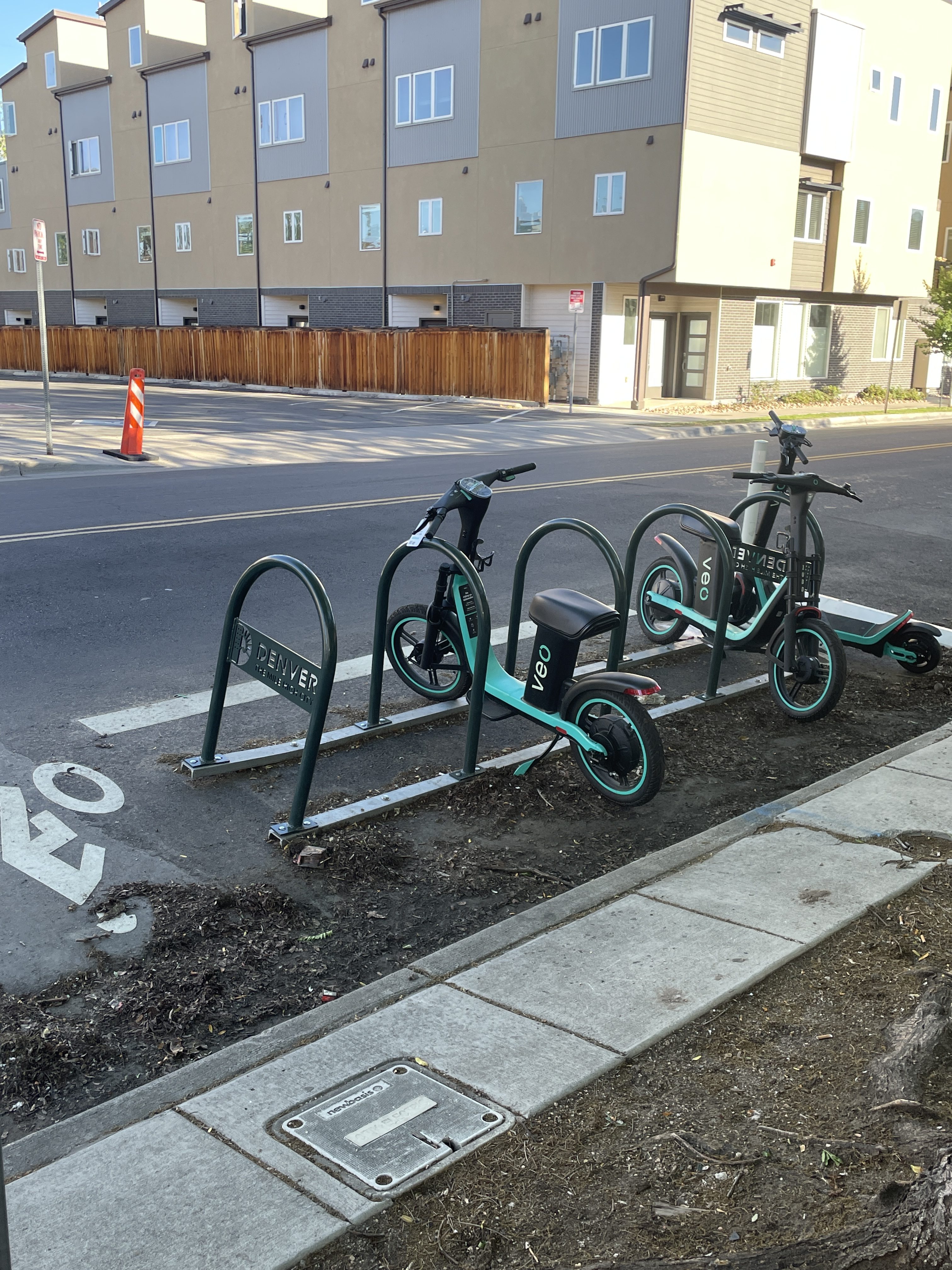
Public bicycle parking near W. 39th & Tennyson June 12, 2026.
Councilmember Sandoval’s staff reached out to the Denver Department of Transportation and Infrastructure. I received a response from DOTI which basically said that Veo can use the public bicycle parking but is encouraged to not fill it up so that it is also available for other bicycle riders.
Public bicycle parking near W. 41st & Tennyson June 12, 2026.
Public bicycle parking near W. 43rd & Tennyson June 12, 2026.
Public bicycle parking near W. 44th and Tennyson June 12, 2026.
As the Veo vehicles get distributed around the city they are ending up in the neighborhoods.
Veo vehicle on the street in front of my house June 12, 2026. I’m okay with this as it helps Denver’s carbon goals. I don’t need the parking space.
An archipelago of ancient bioherms living on the Great Salt Lake’s southeastern side. Photo by Robert Marcos.
“This day we arrived in the valley of the great Salt Lake. My feelings were such as I cannot describe. Everything looked bloomy and I felt heart sick.”Lorenzo Young, Brigham Young’s younger brother
by Robert Marcos
Utah’s Great Salt Lake sits at dangerously low levels
The Great Salt Lake is currently locked in a critical structural decline, hovering in a “serious adverse effects” range at nearly seven feet below its minimum healthy level. Decades of excessive human water diversions for agriculture and rapid urban growth, coupled with a warming climate, have stripped the lake of over half its historic water volume. This trajectory directly parallels the Aral Sea disaster in Central Asia, where Soviet-era river diversions for cotton farming completely decimated a massive inland sea, turning it into a barren desert of toxic salt flats. If Utah fails to drastically alter its current water policies and consumption, the Great Salt Lake faces the exact same fate of complete ecological collapse.1
The Source of Half of the Wasatch Front’s Precipitation
The potential disappearance of the lake would critically disrupt the regional water cycle because half of the convective precipitation along Utah’s heavily populated Wasatch Front relies on the lake’s evaporation. As a terminal lake, its vast surface area fuels a vital localized hydrological sub-cycle, generating the famous “lake-effect” storms that dump immense snowpacks into nearby mountains. Recent research from Utah State University confirms that if the lake dries up completely, regional precipitation will face an approximate 50% reduction. This would trigger a devastating, self-perpetuating drought loop: less lake surface area means fewer storms, which shrinks mountain snowpacks and further dries the rivers needed to refill the basin.2
Potential for a Widespread Respiratory and Cardiovascular Crisis
The long-term consequences of a completely dried lakebed would be catastrophic for Utah’s public health, economy, and environment. With nearly 1,000 square miles of exposed lakebed, heavy winds would unleash massive, toxic dust storms laced with naturally occurring arsenic, mercury, and other hazardous minerals directly into the Salt Lake City metropolitan area. This airborne pollution would trigger widespread respiratory and cardiovascular crises, rendering the region largely uninhabitable. Furthermore, the collapse would wipe out the lake’s multi-billion-dollar mineral extraction and brine shrimp industries, decimate the habitat of 10 million migratory birds, and permanently cripple Utah’s iconic multi-million-dollar ski industry due to the permanent loss of winter snowpack.3
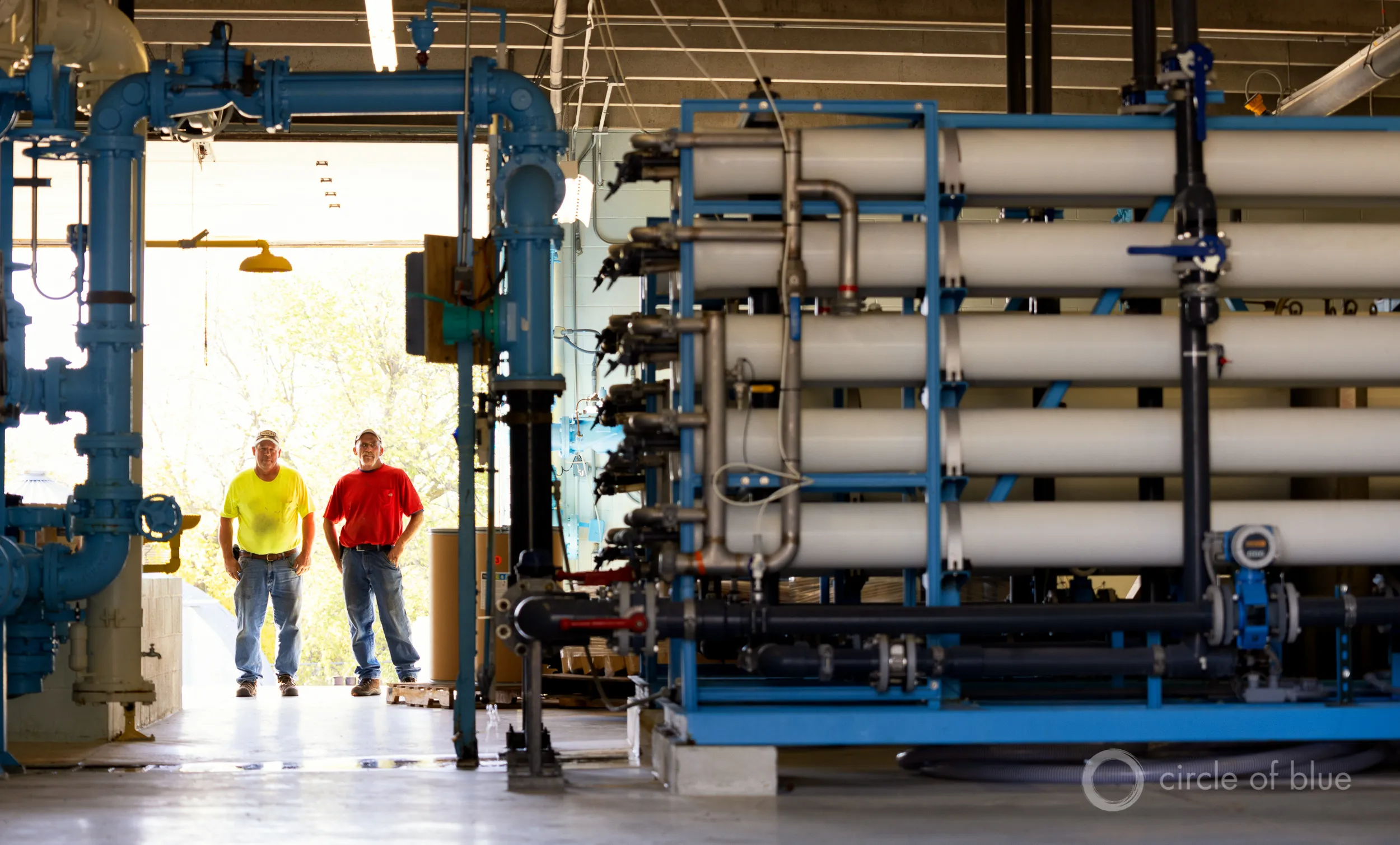
The country’s most severe drinking water problems, from high levels of contaminants and foul-smelling water to pipe breaks, low water pressure, and expensive rates, are generally found in the thousands of small systems that serve dozens of people up to a few thousand.
These systems are public health crises waiting to emerge, said Denise Schmidt, director of water at the Environmental Policy Innovation Center, a group that works with water utilities on infrastructure funding.
Though some are perpetually struggling, small water systems, especially those serving low-income communities, are encountering a fresh set of economic and political hurdles in their quest for safe drinking water.
In recent industry surveys, small utilities report that accessing financing to repair and upgrade their systems is becoming increasingly difficult. Their credit ratings are deteriorating, making borrowing more expensive. The rates they charge customers are not covering the cost of providing water service, thus digging a long-term financial hole. Extreme weather is burdening them with unexpected and daunting repairs to their reservoirs, treatment plants, and pipe networks. Federal water quality mandates for PFAS and lead pipe replacements, though both providing public health benefits, are an added cost.
Small systems, in effect, are walking a precarious path. They are trying to survive today while also staring at a gathering wave of necessary replacements to aging pipes and treatment plants.
The Trump administration and Republican allies in Congress, meanwhile, are casting more obstacles. The White House’s tariffs have increased the price of equipment and materials. And the House’s fiscal year 2027 budget would cut the main federal water infrastructure program by about a quarter.
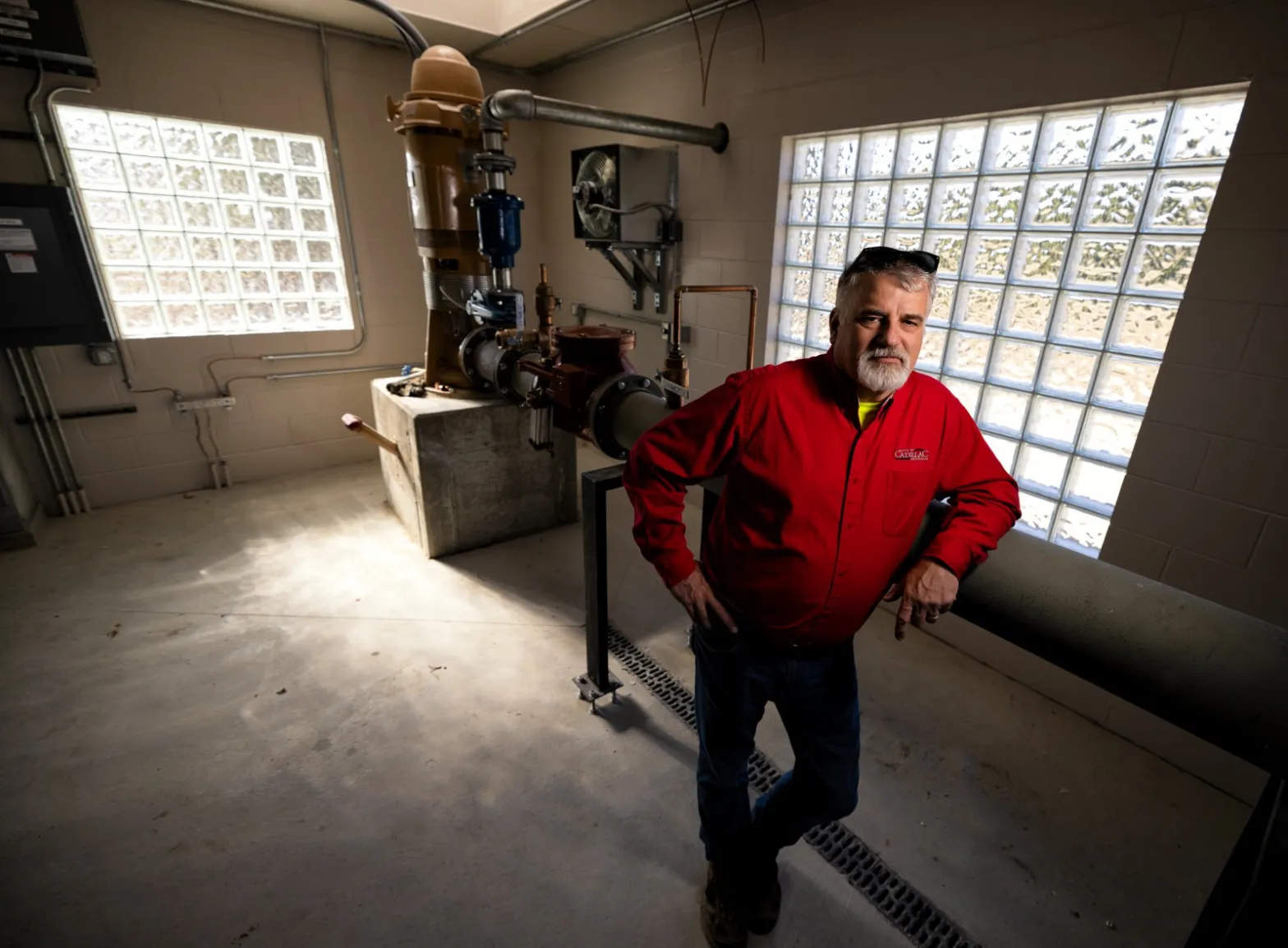
“I don’t think people realize how big this wave is and how much it’s going to cost,” said Blake Anderson, president and founder of Mogollon Water Management, a company that operates and maintains 11 small water systems in northeast Arizona. “The utilities that were built in 1970 now are 56 years old. There was a lot of development that happened back then. And all of these waves are going to start crashing.”
Negative Outlook
Crashing sounds are gaining strength.
Last year, for the first time, S&P Global, a credit rating agency, lowered the financial outlook for small water and wastewater utilities from stable to negative. Large and medium utilities remained stable.
The increased pessimism for small water utilities is due to stiffening financial headwinds, said Malcolm D’Silva, an associate director at S&P, which rates roughly 1,700 water and wastewater utilities. Ninety-one percent of the agency’s credit downgrades last year were for small systems, he said. Credit downgrades increase the cost of borrowing.
D’Silva narrated a story in two parts. One is the “expense squeeze.” Costs are rising across the board. First from the post-Covid inflation and supply chain shortages, and now from the Trump administration’s tariffs. Half of the utilities that responded to the American Water Works Association’s annual survey said that tariffs had “moderate or considerable” pressure on equipment and materials costs. At the same time, revenue is not keeping up. In the same survey, only 43 percent of utilities said they charged customers enough to fully cover service costs.
The second part is managerial. Small systems typically do not have the technical expertise, staff, or budget to analyze their infrastructure and apply for funding in the way that larger utilities do. Some might keep only paper records of their pipe networks. The smallest systems have volunteer board members or staff that might also oversee the fire department and run a business.
The positive news is that last year might have been the bottom for small systems, D’Silva said. S&P is seeing some improvement in the first half of 2026, with the rate of downgrades slowing. More utilities have instituted rate increases to fill budget holes, D’Silva said.
Federal Question Mark
Just as one hole is closing, however, another might be opening.
Every year the White House lobs a spending plan toward Capitol Hill and members of Congress decide whether those numbers are a good idea. For fiscal year 2027, the Trump administration proposed a roughly 90 percent cut to the two state revolving funds, the main federal sources of water infrastructure funding.
Congress usually sustains the state revolving funds, which have broad support. But this budget cycle could be different.
A House spending bill cuts the revolving funds by about 24 percent combined. The House Appropriations Committee approved the bill on June 3.
The bill provides $1.2 billion for the Clean Water State Revolving Fund (27 percent cut) and $911 million for the Drinking Water State Revolving Fund (19 percent cut). The Senate has not yet introduced its version.
The Environmental Policy Innovation Center, or EPIC, tracks state revolving fund expenditures and project proposals in 15 states. At Circle of Blue’s request, EPIC analyzed small system and very small system requests for drinking water funding. By EPA’s definition, small systems serve fewer than 10,000 people and very small systems fewer than 3,300.
The data indicate high demand from these systems. Some 61 percent of projects seeking drinking water funding were small or very small. However, only about a third of these proposed projects advanced to the next step in the funding process. This “highlights significant unmet infrastructure needs,” EPIC analysts wrote.
Water infrastructure funding needs and the status of the revolving funds were a point of discussion during a House Energy and Commerce Committee hearing on May 20.
Jessica Kramer, the head of the EPA Office of Water, defended the administration’s proposed cuts. Her justification: the states have $14.8 billion in uncommitted state revolving funds, those sitting in coffers for more than a year without being allocated. That money should be distributed first, she argued.
“It doesn’t do any good to get the money to the states if the states aren’t actually getting it out to the communities that need it,” Kramer said.
Schmidt, the EPIC water director, had a different view. Two issues are being wrapped into one, she said. If state administrative capacity to review and approve applications is the problem, then focus on that. But don’t use it to rationalize disinvestment in an otherwise successful decades-long infrastructure program.
“Uncommitted does not mean unneeded,” Schmidt said. “Cutting moves us farther from the solution.”
The View from Arizona
The financial pressures that populate D’Silva’s and Schmidt’s spreadsheets are the on-the-ground reality for Blake Anderson.
Anderson is the president and founder of Mogollon Water Management, a company that operates and maintains 11 small water systems in the White Mountains of northeastern Arizona. Mogollon oversees the smallest of the small – systems ranging in size from 29 service connections to roughly 1,100.
These are not the sophisticated, professionally managed systems that you would see in Phoenix or Flagstaff.
“They’re volunteer board members and they’re aware that there’s some sort of money for water out there but they don’t know where it is, or if they do know, they aren’t sure how to go about applying and accessing it,” Anderson said, describing the challenges for small systems in securing grants and loans.
“Most of them have never done a capital improvement project over $50,000,” he added. “And so there is not institutional knowledge in how do you manage a federally funded program or a state funded program? How do you go about securing engineers or contractors? What are the proper procurement practices?”
One school of thought for solving the small systems problem is that there should be fewer of them. By connecting with larger systems or forming regional partnerships, small utilities could grow into medium-sized utilities with favorable economics: more customers to cover expensive infrastructure costs, better credit ratings, money to hire knowledgeable staff.
Research from Manny Teodoro at the University of Wisconsin indicates that the target size for utility consolidations should be about 20,000 service connections, or about 60,000 people. At that point the most serious water quality violations become far less common and operating costs become more reasonable.
Where might funding for consolidations come from? States like California have dedicated programs, though even those are facing funding shortfalls. Another source is federal: the state revolving funds that House Republicans want to cut.
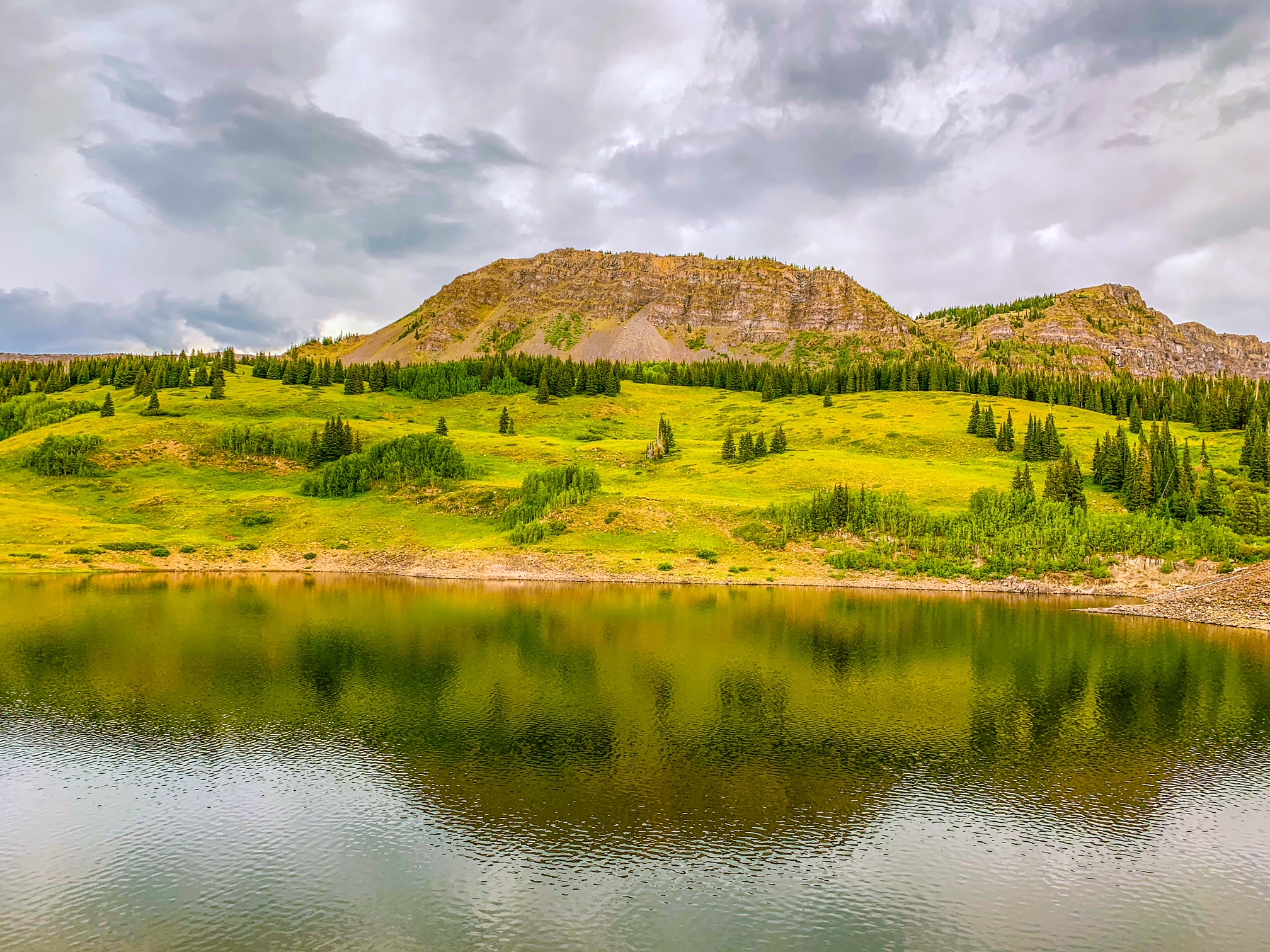
At the Yampa Town Board meeting last week, Andi Schaffner with the Bear River Reservoir Company presented plans and cost estimates for a Stillwater Reservoir project that would lead to removal of its storage restriction. The plan consists of two phases involving installation of a strain and a sand filter to alleviate seepage into the dam’s embankment, the primary concern that led to the storage restriction designation…Currently, the town of Yampa owns 112 shares in Stillwater Reservoir, or about 2% of the reservoir. Phase 1 of the project consists of a blanket drain and filter collar and is estimated to cost $730,717. Phase Two of the project will be stabilizing the channel and the removal of the culvert and the flume, at a total estimated cost $209,874. Schaffner said that the team at Bear River Reservoir Company has spent hours on engineering and studies at the reservoir in order to determine the best solution for the dam. “We finally opted for the least expensive fix, which is what we’re working on right now,” said Schaffner…The project has received a significant amount of grant funding despite higher than anticipated bids, including a $202,000 loan from the Colorado Water Conservation Board. This loan was the primary expected cost for the town of Yampa, and is expected to be approved with an increase to $404,000 ahead of the project’s notice to proceed with the contractor on July 13. The project is expected to be completed by the end of October. The Colorado Water Conservation Board loan is 30 years with 1.85% interest, or $3.40 per share per year. For the town of Yampa’s 100 or so shares, this amounts to $381 a year. Schaffner did not expect any more expenses besides an assessment of the shares which amounts to about $5.
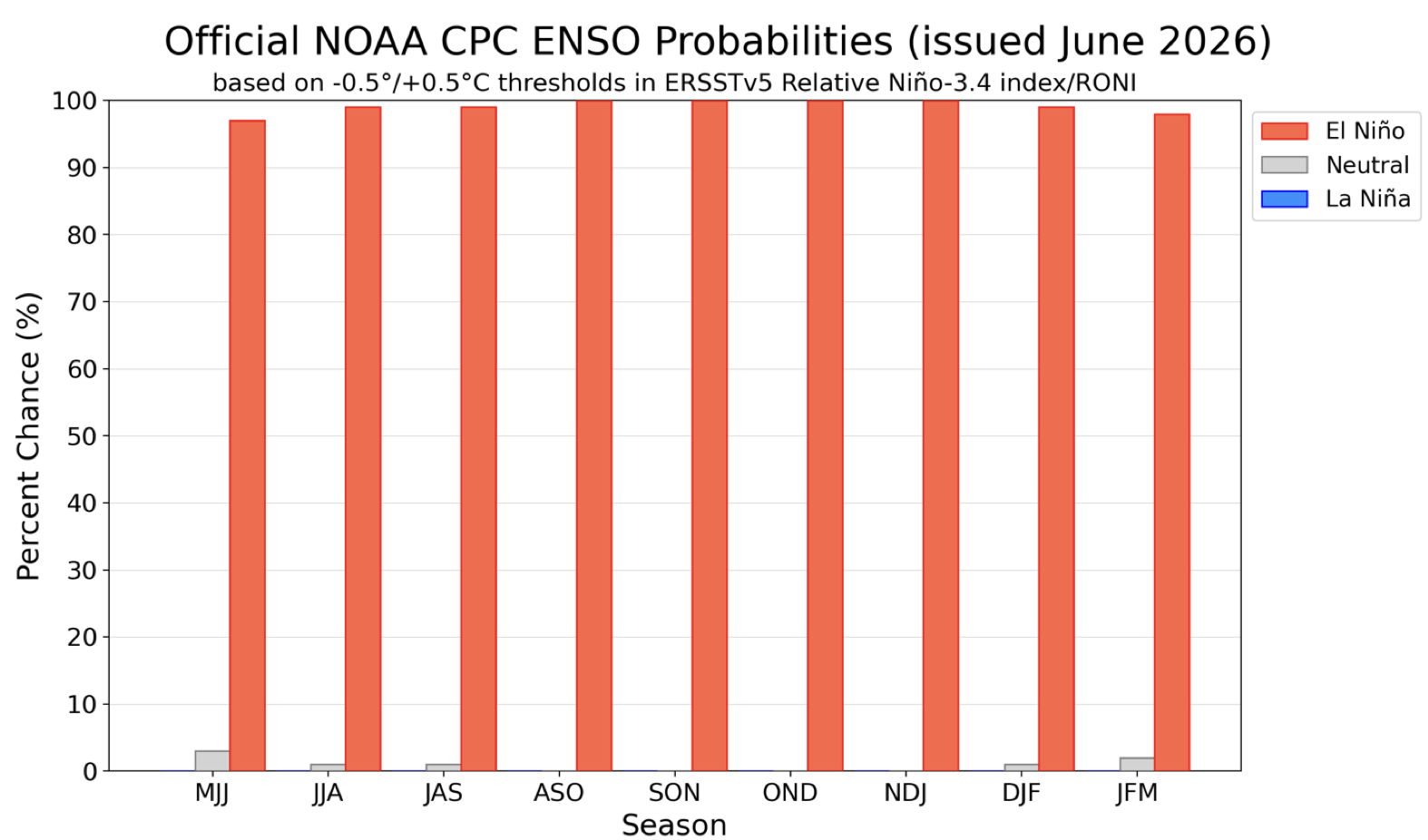
Official ENSO probabilities for the Niño 3.4 relative sea surface temperature index (5°N-5°S, 170°W -120°W) minus tropical mean (20°N-20°S). The relative index is re-scaled to match the variance of the traditional index. Figure updated 11 June 2026. Higher resolution image/table: https://cpc.ncep.noaa.gov/products/analysis_monitoring/enso/roni/probabilities/
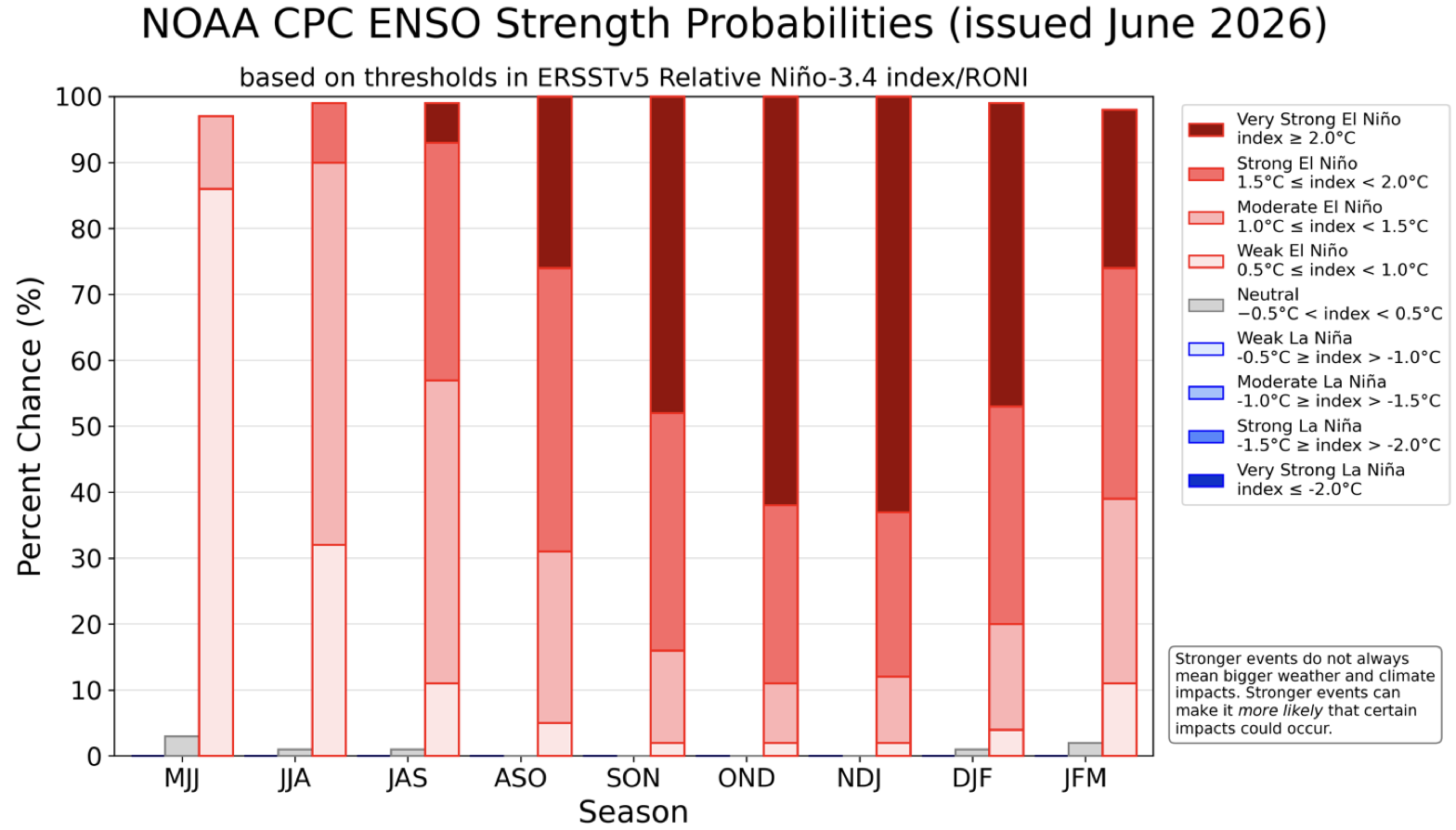
Synopsis: El Niño conditions are present and expected to strengthen into the NorthernHemisphere winter 2026-27.
El Niño conditions developed over the past month, as shown by above-average sea surface temperatures (SSTs) across the central to eastern equatorial Pacific Ocean. The latest weekly Niño-3.4 index value was +0.7ºC, with the westernmost (Niño-4) and easternmost (Niño-1+2) indices at +0.7ºC and +2.1ºC, respectively. The equatorial subsurface temperature index (average from 180º-100ºW) decreased in the past month, but significantly above-average subsurface temperatures remained in the central and eastern equatorial Pacific. Low-level westerly wind anomalies and upper-level easterly wind anomalies were evident over the central equatorial Pacific. Convection was slightly above average over the central and east-central equatorial Pacific and was near or below average over Indonesia. The traditional and equatorial Southern Oscillation indices were negative. Collectively, the coupled ocean-atmosphere system reflected the onset of El Niño conditions.
The North American Multi-Model Ensemble (NMME) average, including the NCEP CFSv2 , forecasts El Niño to intensify into the Northern Hemisphere winter 2026-27. High confidence in El Niño is also linked to anomalously high oceanic heat content and expanding westerly wind anomalies across the equatorial Pacific Ocean. There is a 63% chance of a very strong El Niño during November-January that would rank among the largest El Niño events in the historical record going back to 1950. Even very strong El Niño events do not lead to the expected impact everywhere, but stronger events can more significantly tilt the odds in favor of expected outcomes (see CPC outlooks for probabilities of seasonal anomalies). In summary, El Niño conditions are present and expected to strengthen into the Northern Hemisphere winter 2026-27.