
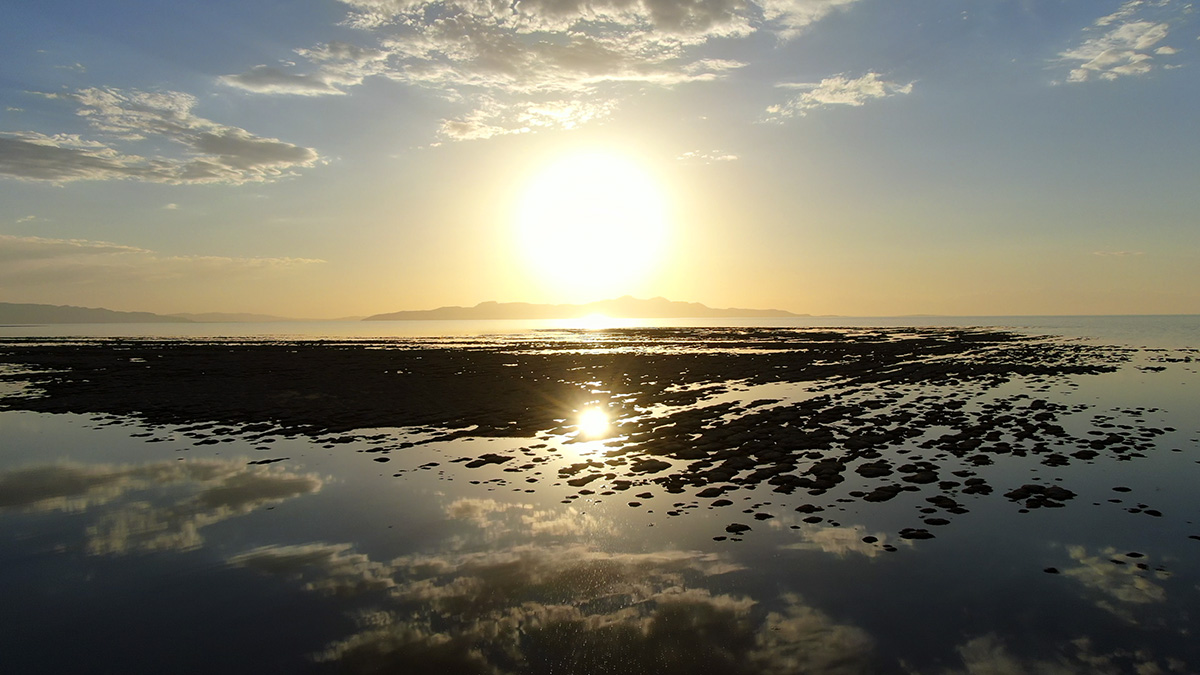
“This day we arrived in the valley of the great Salt Lake. My feelings were such as I cannot describe. Everything looked bloomy and I felt heart sick.” Lorenzo Young, Brigham Young’s younger brother
by Robert Marcos
Utah’s Great Salt Lake sits at dangerously low levels
The Great Salt Lake is currently locked in a critical structural decline, hovering in a “serious adverse effects” range at nearly seven feet below its minimum healthy level. Decades of excessive human water diversions for agriculture and rapid urban growth, coupled with a warming climate, have stripped the lake of over half its historic water volume. This trajectory directly parallels the Aral Sea disaster in Central Asia, where Soviet-era river diversions for cotton farming completely decimated a massive inland sea, turning it into a barren desert of toxic salt flats. If Utah fails to drastically alter its current water policies and consumption, the Great Salt Lake faces the exact same fate of complete ecological collapse.1
The Source of Half of the Wasatch Front’s Precipitation
The potential disappearance of the lake would critically disrupt the regional water cycle because half of the convective precipitation along Utah’s heavily populated Wasatch Front relies on the lake’s evaporation. As a terminal lake, its vast surface area fuels a vital localized hydrological sub-cycle, generating the famous “lake-effect” storms that dump immense snowpacks into nearby mountains. Recent research from Utah State University confirms that if the lake dries up completely, regional precipitation will face an approximate 50% reduction. This would trigger a devastating, self-perpetuating drought loop: less lake surface area means fewer storms, which shrinks mountain snowpacks and further dries the rivers needed to refill the basin.2
Potential for a Widespread Respiratory and Cardiovascular Crisis
The long-term consequences of a completely dried lakebed would be catastrophic for Utah’s public health, economy, and environment. With nearly 1,000 square miles of exposed lakebed, heavy winds would unleash massive, toxic dust storms laced with naturally occurring arsenic, mercury, and other hazardous minerals directly into the Salt Lake City metropolitan area. This airborne pollution would trigger widespread respiratory and cardiovascular crises, rendering the region largely uninhabitable. Furthermore, the collapse would wipe out the lake’s multi-billion-dollar mineral extraction and brine shrimp industries, decimate the habitat of 10 million migratory birds, and permanently cripple Utah’s iconic multi-million-dollar ski industry due to the permanent loss of winter snowpack.3