Field in Palo Verde, California. Photographed by Robert Marcos.
By Robert Marcos, photojournalist
If the U.S. Department of the Interior (through the Bureau of Reclamation), decided that the most immediate way to stabilize water levels in Lake Mead and Lake Powell was for them to release less water, one way to achieve that would be to start buying up the water rights of farms in the Lower Basin. While this would save an amazing amount of water it would come at the expense of rural agricultural economies and domestic food production. But if the Bureau of Reclamation acted “surgically” and bought up water rights from major forage producers first, it would primarily disrupt only the livestock and dairy industries.
Key Benefits
Maximum “Bang for the Buck” Water Savings
Eliminates the largest single drain. Alfalfa is an incredibly water-thirsty crop which often requires up to 4 to 5 acre-feet of water per acre annually. A targeted buyout of just a portion of forage land could entirely wipe out the river’s structural deficit, leaving millions of acre-feet in Lake Mead.1
Saves vegetablesfor people. The Lower Basin (especially the Imperial and Yuma valleys) produces roughly 90% of the United States’ winter leafy greens. Leaving these high-value food crops untouched avoids an immediate national grocery crisis.2
More productive use of water. Fruit orchards and fresh vegetables generate much higher economic revenue per gallon of water than forage crops, preserving the highest-yield sectors of the agricultural economy.3
Easier target for public policy. Public and political support is much easier to secure when buyouts target cattle feed – a large portion of which is exported overseas to countries like Japan, China, and Saudi Arabia, rather than the reduction of fresh food for American families.4
Key Detriments
Negatively impacts Southwest Dairy and Beef Industries
Triggers a regional feed shortage. California and Arizona are major dairy producers. Local dairies rely heavily on a constant, nearby supply of fresh alfalfa to sustain milk production.5
Drives up dairy and meat prices. Moving forage production out of the Southwest forces dairies to truck feed from other states. The increased transportation costs will drive up consumer prices for milk, cheese, and beef.6
Eliminates operational flexibility. Farmers often use alfalfa as a financial safety net. It is cheap to plant, highly resilient, and requires very little human labor compared to vegetables.7
Increases farming risk. Without forage as a low-risk fallback option, farmers become entirely exposed to the highly volatile, expensive, and labor-intensive market of fresh produce.8
Harms rural agricultural hubs. While large cities often have many sources of employment, rural areas that are more focused on ranching, feedlots, dairies, forage sales, and the transport of livestock – would suffer from a wholesale loss of water.9
Massive Water Savings: Forage crops are incredibly water-intensive. Completely retiring the water rights of a significant portion of Lower Basin alfalfa fields would easily save 1 to 2 million acre-feet of water annually
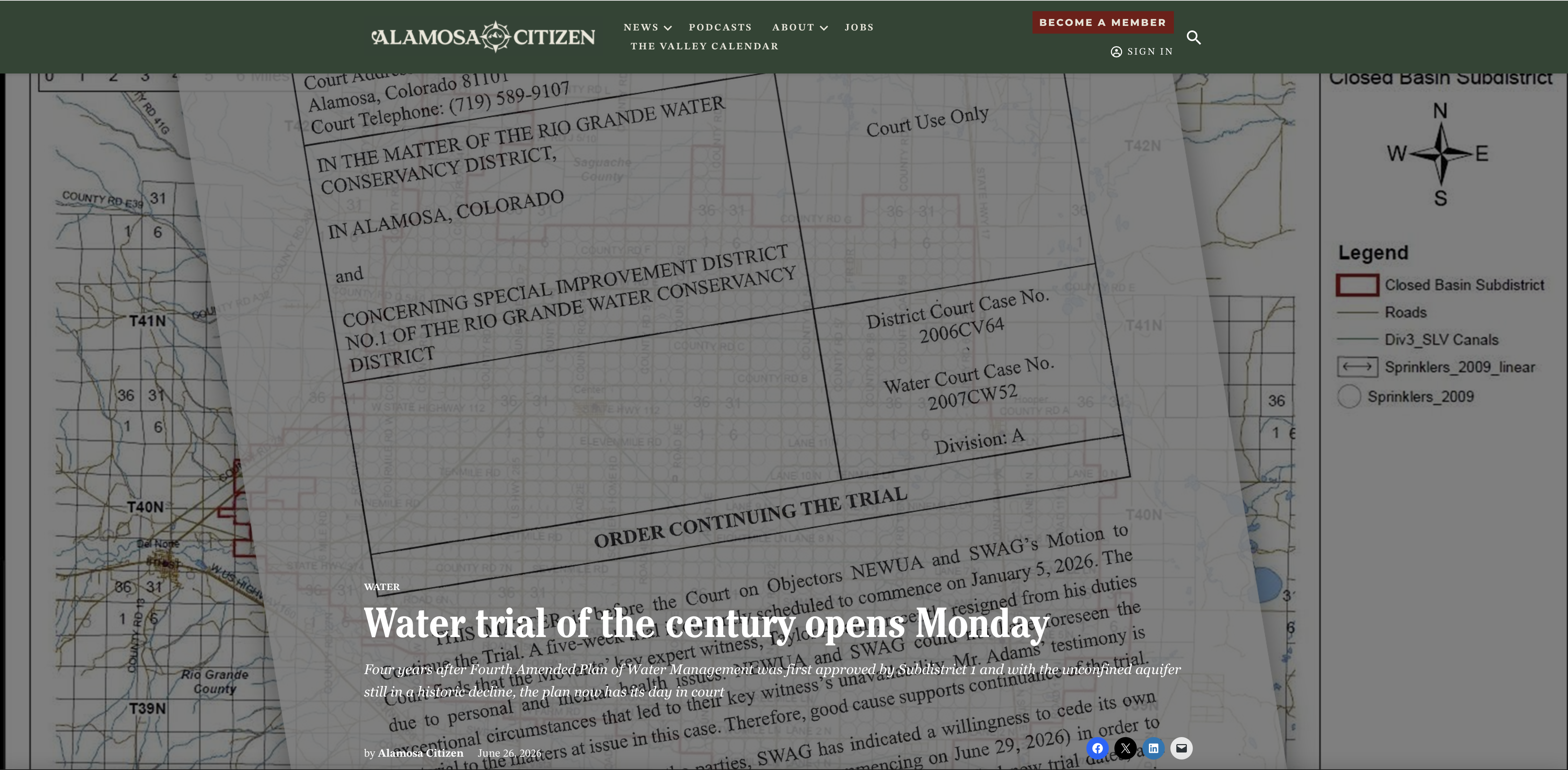
The most significant water trial the San Luis Valley has ever seen opens this Monday morning in Courtroom A of the Alamosa County Judicial Center. At stake is the Fourth Amended Plan of Water Management for Subdistrict 1 of the Rio Grande Water Conservation District, which calls for a dramatic shift designed to match the amount of groundwater pumping to the amount of natural surface coming into the subdistrict.
Producers in Subdistrict 1 are under pressure to recover the unconfined aquifer of the Upper Rio Grande Basin, but so far the subdistrict has made little to no progress in creating a sustainable aquifer. The trial is scheduled for five weeks before Colorado Water Court Division 3 Judge Michael Gonzales.
The San Luis Valley’s highly-anticipated district water court case — the water trial of this century if you will — was originally scheduled to last five weeks beginning in January. It was pushed back six months to this summer due to the departure of a key witness in the fallout from a series of contentious October emails.
The Fourth Amended Plan of Water Management by Subdistrict 1 in the Rio Grande Water Conservation District has lived a precarious life without ever being implemented, going back to 2022 when it was originally crafted by subdistrict managers and January 2023 when it was adopted by Rio Grande Water Conservation District board.
Later came approval by the state engineer, and then after objections were filed against the new amended plan, Colorado Water Court Division 3 Judge Michael Gonzales set a trial date to commence on Jan. 5, 2026, and to last five weeks.
That is, until the week before Thanksgiving when Gonzales scrapped the January date in favor of June 29, 2026, some four years after the plan was first approved at the subdistrict level and the unconfined aquifer still in a historic decline. The judge did so after a series of emails sent by a key expert witness for the main objectors to the plan surfaced.
The effect is that a new plan to recover the Rio Grande’s unconfined aquifer, which has been approved at the local and state levels but still requires sign-off from district water court, remains in limbo.
Following filings by the Northeast Water Users Association and Sustainable Water Augmentation Group requesting a six-month continuance to the start of the trial, and the Rio Grande Water Conservation District and state Division of Water Resources objecting to the request, Gonzales ruled the two main objectors challenging the new aquifer recovery plan had good reason to ask for a six-month continuance after Taylor Adams, an environmental and water resources engineer for Hydros Consulting in Boulder, resigned from the case due to “personal and family circumstances.”
Adams was set to challenge the Subdistrict 1 water plan on a variety of engineering fronts until a series of emails he sent in October to State Engineer Jason Ullman and Senior Assistant Attorney General Preston Hartmann came to light. In one email, he tells Ullman, “Also, GFY.” In another, he emails that he is “no longer interested in anything other than publicly exploding the rampant corruption at DWR and the AG Office.”
And in an email sent Sunday, Oct. 19, to Attorney General Phil Weiser, Adams writes, “We haven’t met, but I understand that you’re running for governor of Colorado. You should know that if you continue this pursuit without addressing the persistent and laughable perjury that has been carried out in your name by Preston Hatman (sic) and Jason Ullman, you will be the subject of my attention throughout your campaign…”
The Rio Grande Water Conservation District asked Gonzales not to delay the water court proceedings due to the urgency to recover the unconfined aquifer and the lack of “credible evidence that demonstrates that Mr. Adams is unavailable. Rather, they now assert that he ‘should not be pressured into returning to the case at the risk of further harm to his mental health.’”
“In any event,” district water attorneys argued in their objection to a trial delay, “none of this changes the fact that the unconfined aquifer is still over 1.3 million acre-feet below the water levels measured in 1976, and more than 830,000 acre-feet below the water levels previously determined by this Court and the Colorado Supreme Court to be sustainable.”
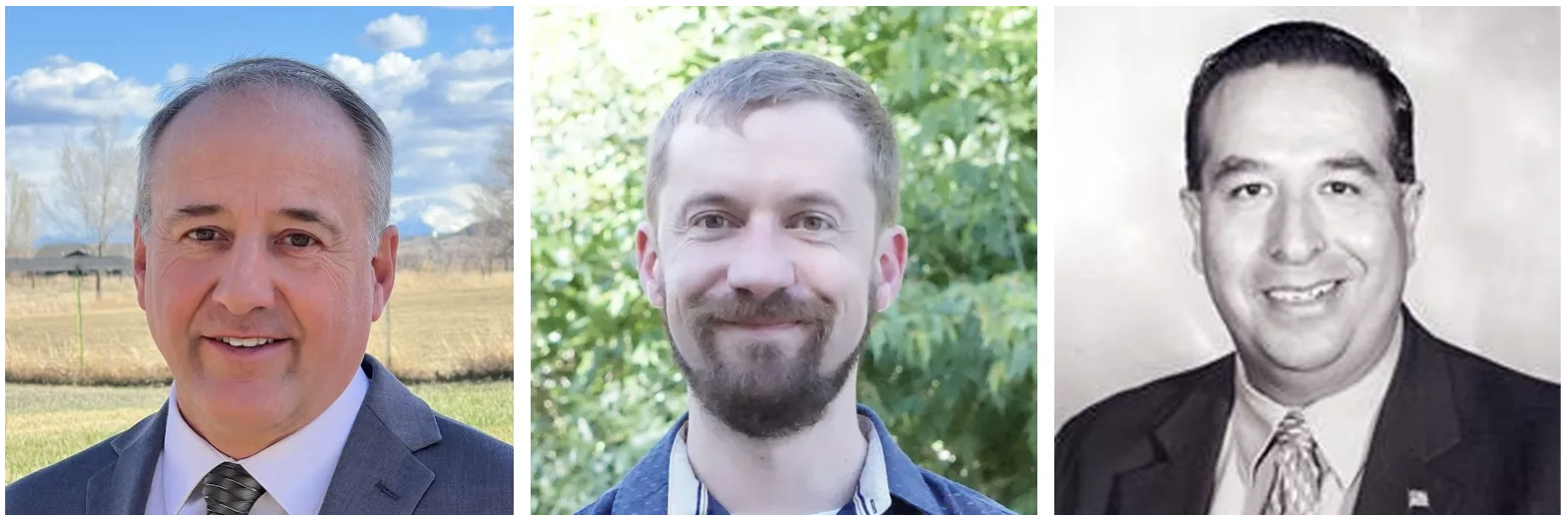
State Engineer Jason Ullman, consultant Taylor Adams, Colorado Water Court Division 3 Judge Michael Gonzales
Subdistrict 1 is home to the San Luis Valley’s richest crops of potatoes, barley and alfalfa. Without recovery of the shallow aquifer, the state is threatening mass shut down of groundwater pumping wells and requires both a master plan and annual replacement plans to show recovery efforts.
The subdistrict’s proposed Fourth Plan of Water Management is its most drastic effort yet to meet the state’s orders. The new plan, crafted in 2022 and adopted by the Rio Grande Water Conservation District in January 2023, is designed to “match the amount of groundwater pumping to the amount of water coming into the subdistrict.”
It does this through a 1-to-1 augmentation, meaning for every acre-foot of water used, an acre-foot has to be returned to the unconfined aquifer through recharging ponds. The amended plan relies on covering any groundwater withdrawals with natural surface water or the purchase of surface water credits.
Farmers in the subdistrict have expressed support for the plan, which includes a $500 per acre-foot overpumping fee that farmers would pay if they exceed the amount of natural surface water tied to the property in their farming operations.
Objections are coming from farmers who do not have natural surface water coming into their property and around the steep fee for purchasing surface water credits from a neighboring operation to offset groundwater pumping irrigation. Both proponents and opponents of the plan say the $500 per acre-foot overpumping fee could put farmers who rely on groundwater pumping out of business.
The five-week water trial will sort through these issues in much more granular detail. Any new strategy to recover the Valley’s ailing aquifer will shift into 2027 at the soonest.
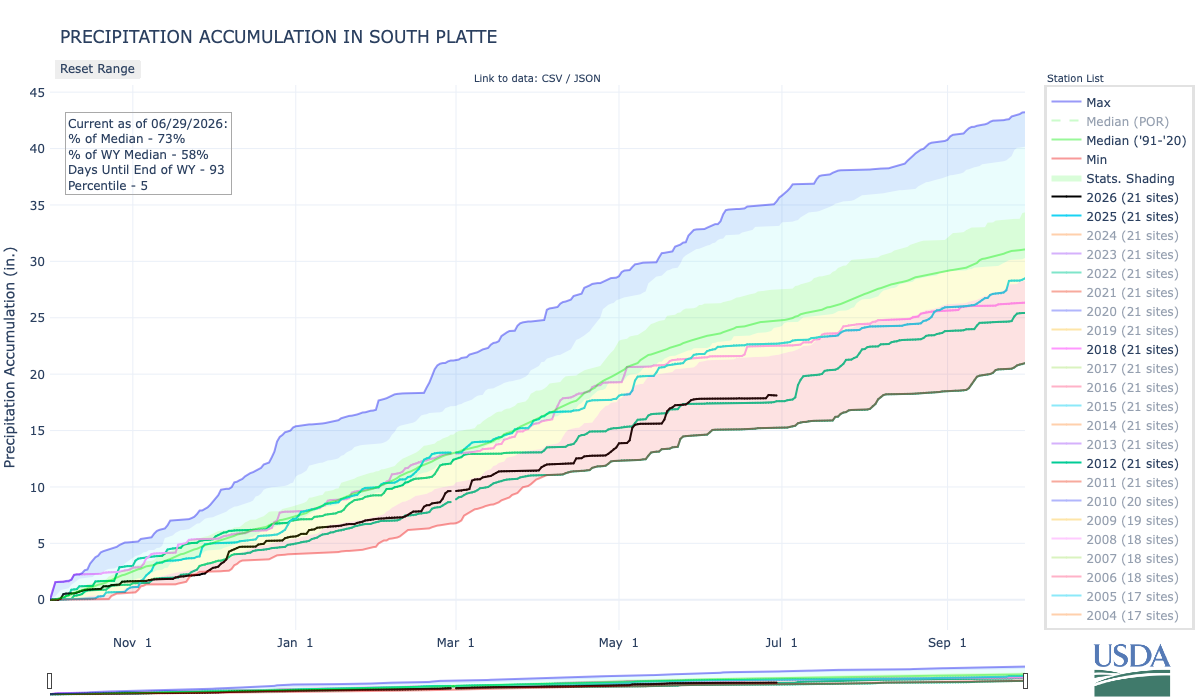
Below is the Precipitation Accumulation in South Platte graph from the NRCS for June 29, 2026. Precipitation is at 73% of the median (no change one week) and 58% of the water year median (up 1% one week), this morning. There are 93 days left in the water year.
There is a slight chance for showers and thunderstorms Sunday in the central mountains, otherwise breezy and warm. There is a slight chance for showers and thunderstorms Sunday in the northern mountains, otherwise breezy and warm. There is a slight chance for showers and thunderstorms Sunday down here, about 101 miles from Leadville, near the Willow Fire. From the Summit Daily: “A wildfire that grew to more than 1,000 acres in a matter of hours near Leadville in the evening Sunday, June 28, sent smoke rolling into Summit County and led emergency officials to ask residents not to call 911 unless they detect a distinct column of smoke or flames. Summit County’s emergency alert system notified residents shortly before 6 p.m. that smoke from what has been dubbed the Willow Fire had entered the county and may remain visible through the evening and coming days…The Willow Fire ignited Sunday afternoon around 3:30 p.m. on U.S. Forest Service land near Twin Mounds below Mount Massive — about two miles northwest of the Leadville National Fish Hatchery, according to the fire detection app Watch Duty and the Lake County Office of Emergency Management. Initial estimates placed the fire at three to five acres, but by around 4:38, incident commanders estimated it had nearly quadrupled in size, according to Watch Duty. Around 5 p.m., firefighters shifted focus toward evacuating residents near Turquoise Lake and the hatchery ahead of the advancing fire. By Sunday evening around 6:50 p.m., Watch Duty and Egp.Wildfire.gov estimates the Willow Fire has grown to 1,066 acres.”
Willow Fire making itself known down here in Salida:
Here’s a look at the 7-Day Colorado precipitation map through June 28, 2026 from the High Plains Regional Climate Center. Precipitation in the South Platte Basin along the Continental Divide of the Americas ranged from 0.00” to 2.00”.
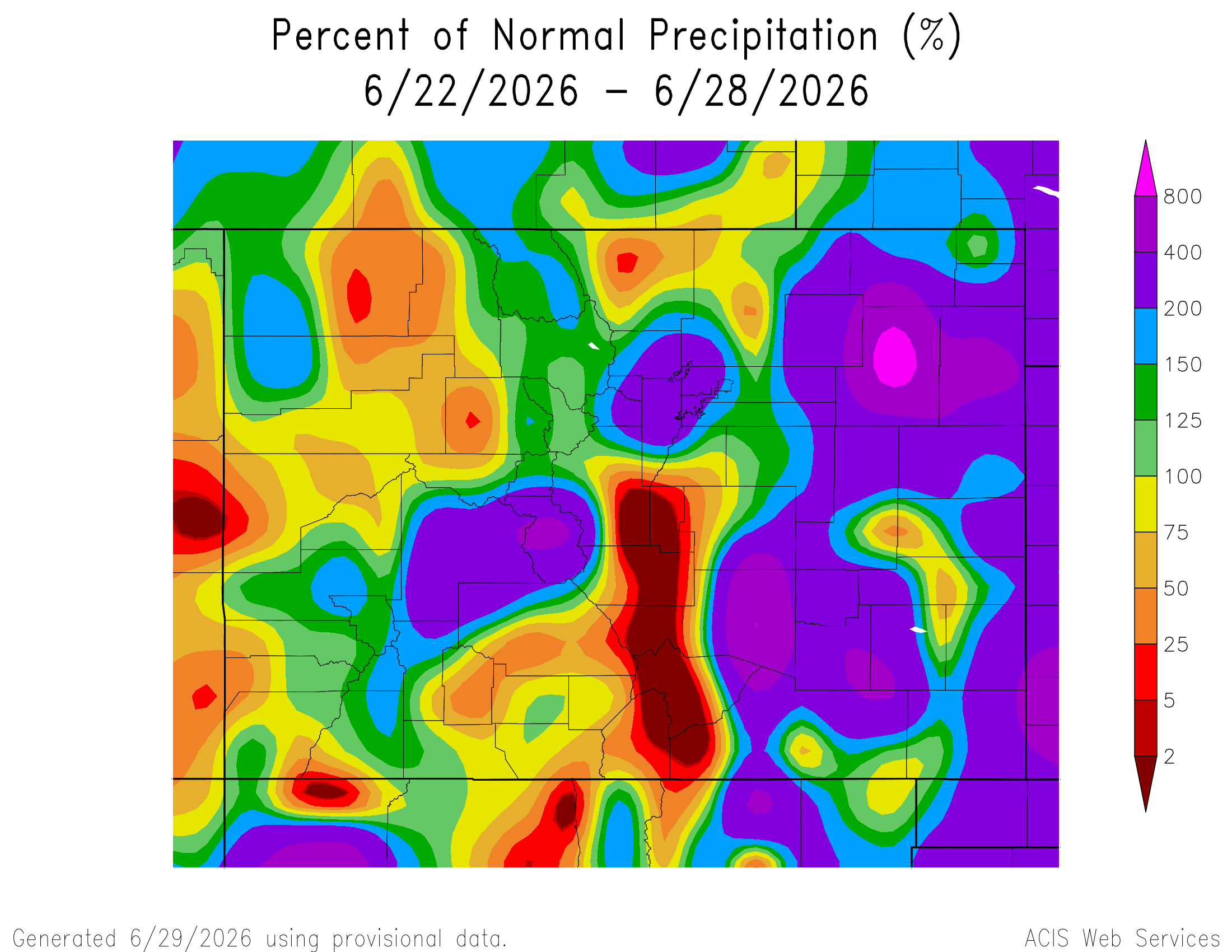
Here’s the 7-Day percent of normal precipitation map through June 28, 2026 from the High Plains Regional Climate Center. Precipitation in the South Platte River Basin along the Continental Divide of the Americas ranged from 5% to 400% of normal.
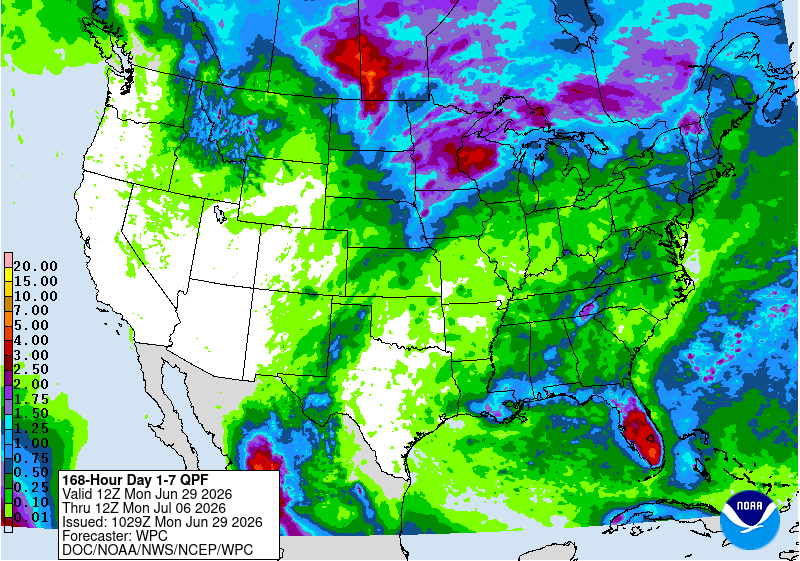
Here’s the 7-Day Quantitative Precipitation Forecast issued June 29, 2026 by NOAA. Precipitation is anticipated for the mountains of the South Platte River Basin and may total 0.01”.
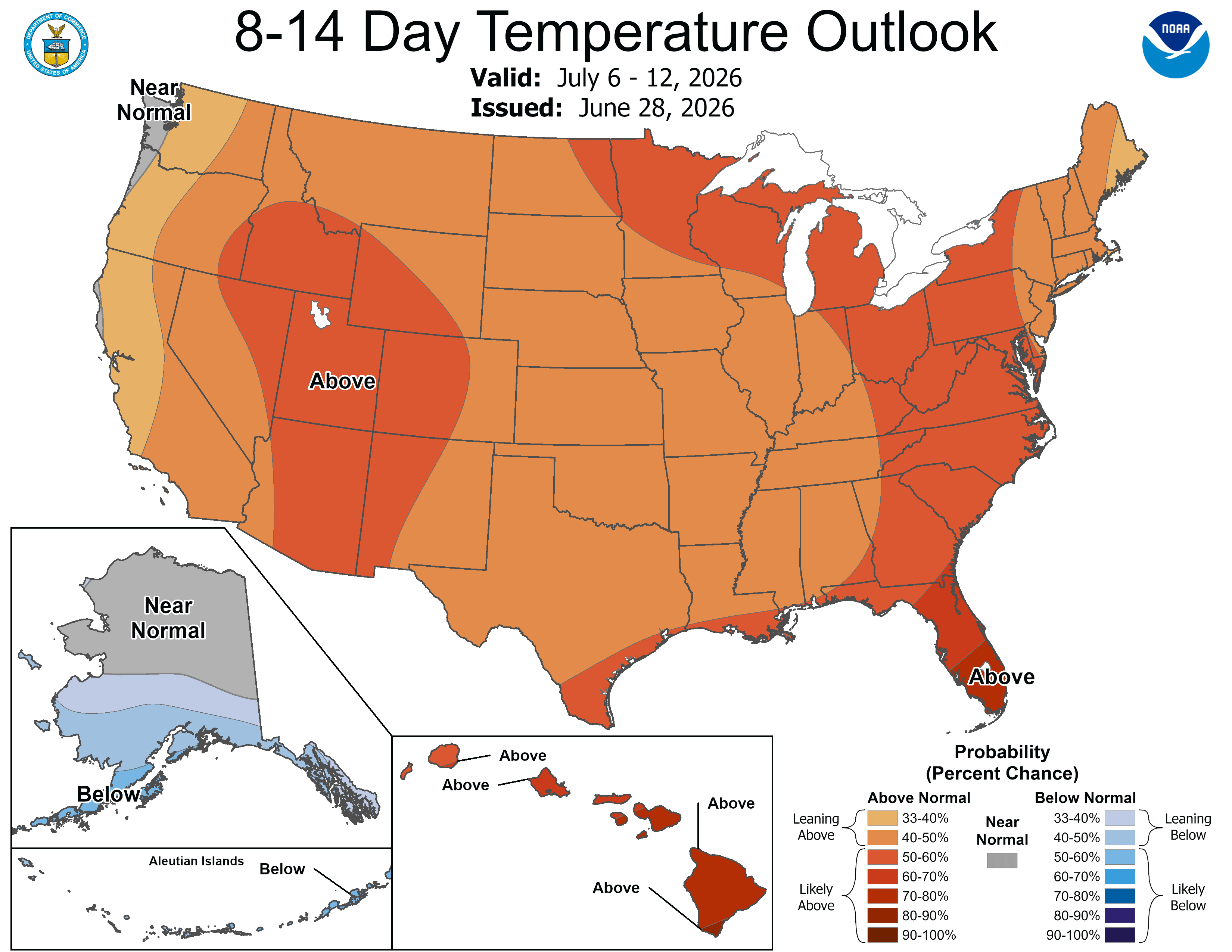
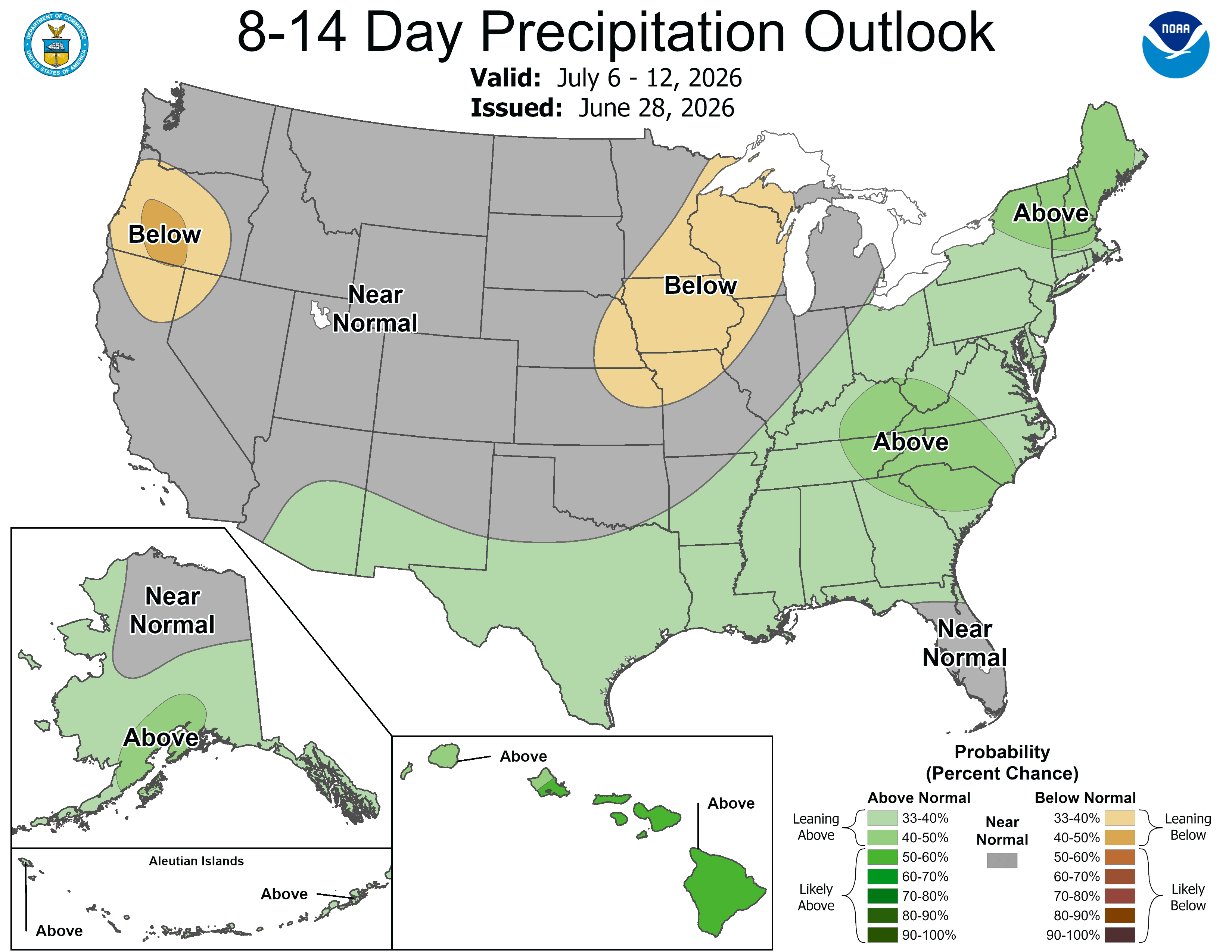
Below are the 8-14 day outlooks from the Climate Prediction Center, issued June 28, 2026, for temperature and precipitation, for the week starting July 6, 2026. The CPC expects above normal temperatures and near normal precipitation for the mountains of the South Platte River Basin.
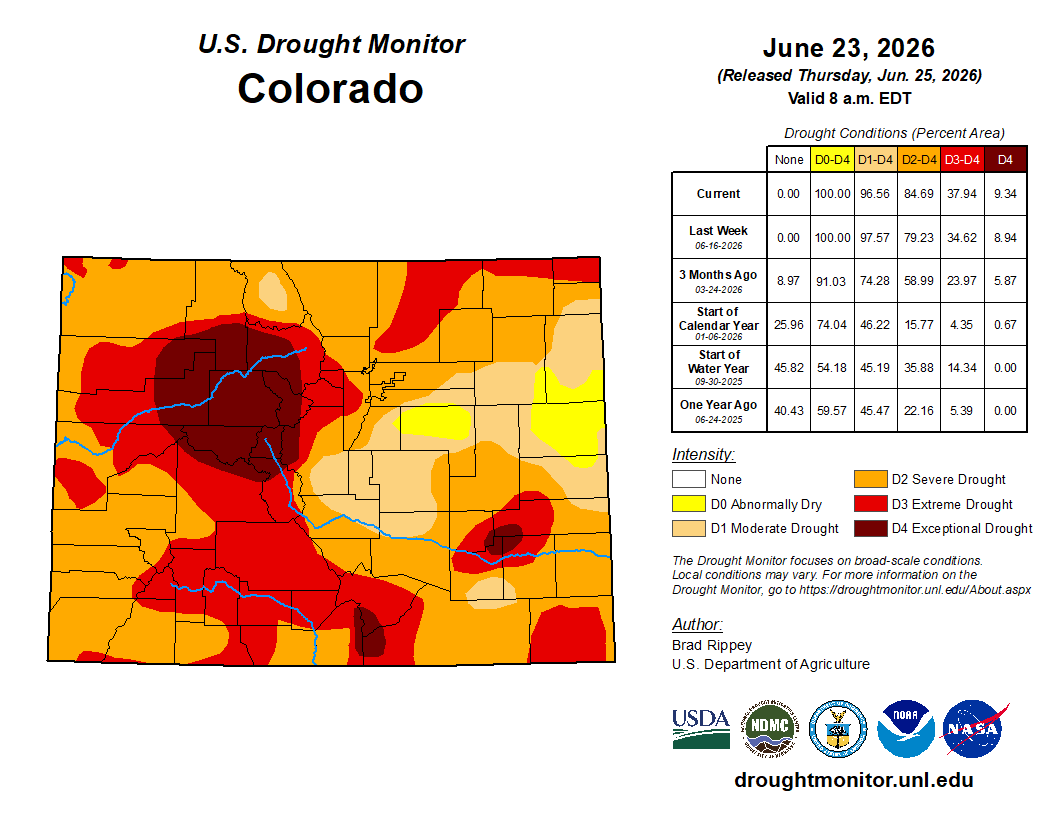
Below is the Colorado Drought Monitor map from June 23, 2026. There were one class degradations in Larimer, Weld, Jefferson, Clear Creek, and Park counties. Drought and abnormal dryness covers 100% of Colorado. The South Platte Basin is experiencing Abnormally Dry, Moderate, Severe, Extreme, and Exceptional drought conditions.
Colorado Drought Monitor map June 23, 2026.
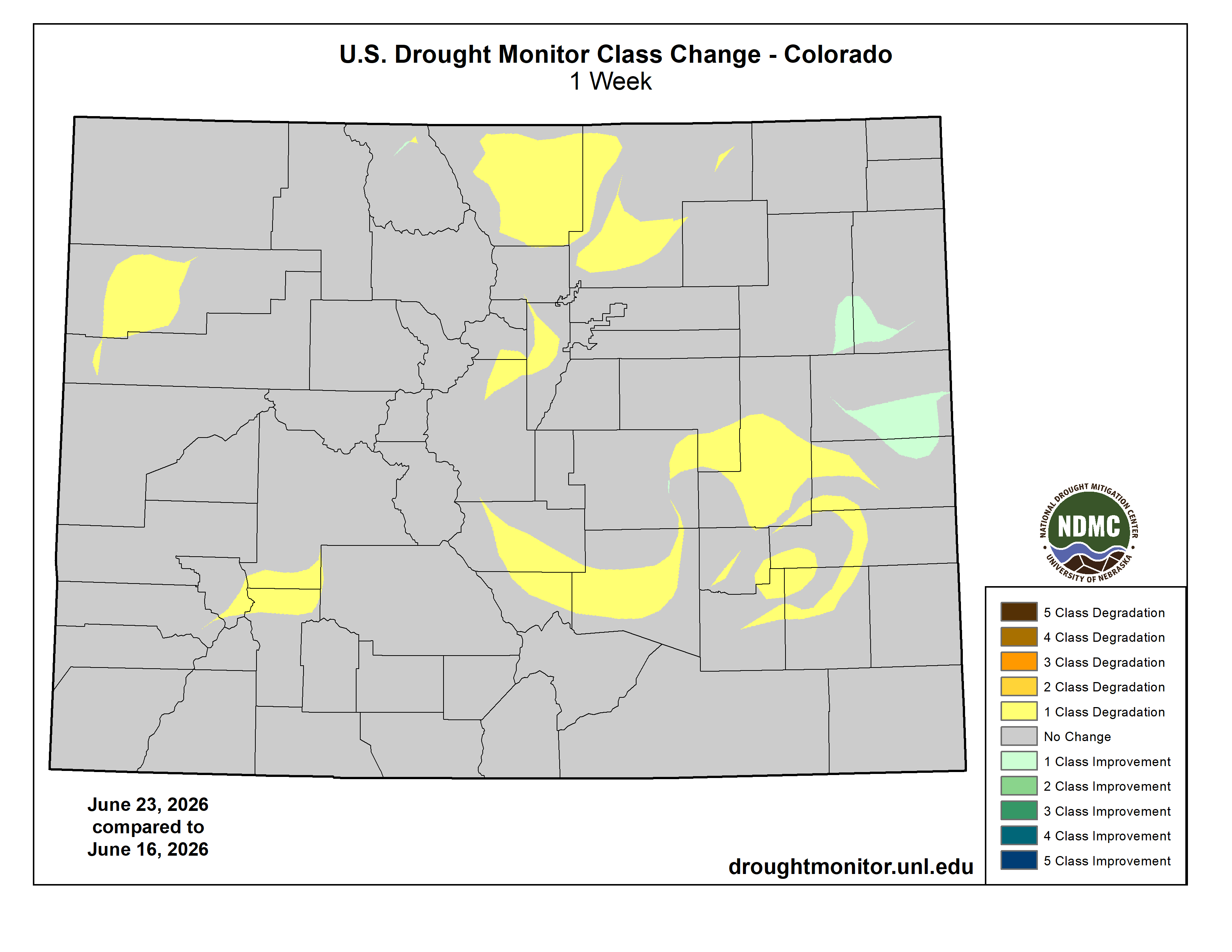
Below is the Colorado Drought Monitor one week change map ending June 23, 2026.
Colorado Drought Monitor one week change map ending June 23, 2026.
Here’s the US Drought Monitor Map from last week along with the one week U.S. change map.
US Drought Monitor map June 23, 2026.
US Drought Monitor one week change map ending June 23, 2026.
For roughly 80 years after the Compact was signed, the prospect of a Compact call was purely theoretical. Then the Millennium Drought set in. By 2005, the two flagship reservoirs on the Colorado River — Lakes Mead and Powell — were half empty.
The drought was pushing the river’s flows closer to a Compact violation trigger, making the risk of a call by the Lower Basin a growing probability. The Lower Basin, particularly Arizona, was insisting on guaranteed releases of water from Lake Powell. And because Colorado has the biggest share of the river within the Upper Basin and uses a greater portion of its apportionment than the other upstream states, it is most at risk. It began searching for a way to slip out of the legal noose of a Compact call.
In September 2005, the seven states’ top negotiators met in Albuquerque, New Mexico. During a lunch break, Colorado’s team made its pitch. The state’s negotiators proposed that the Lower Basin waive its right to force a downstream delivery through a Compact call. In exchange, the Upper Basin states would limit their water use to less than what’s strictly apportioned in the Compact, thereby reducing potential demand in the headwaters of Colorado and Wyoming that supply nearly the entirety of the river’s flow.
But in the midst of a climate change-fueled megadrought that has already robbed the river of at least 20% of its flows, experts say temporary measures no longer cut it. Water managers are reckoning with the reality that the river will probably never again deliver what was promised a century ago by the Colorado River Compact. The demand for water now far outstrips the dwindling supply.
“Are we going to continue to spend hundreds of millions of dollars a year and not have a permanent solution?” said author and Colorado River expert Eric Kuhn. “I think, at some point, it just makes economic sense to go ahead and say, ‘Let’s buy out the existing demand.’”
Map of the Colorado River drainage basin, created using USGS data. By Shannon1 Creative Commons Attribution-Share Alike 4.0