Conservation easements: Land Owners United wins access to appraiser’s records

A picture named saguachecreek

From The Pueblo Chieftain (Chris Woodka):

Land Owners United, a group that represents landowners who are having difficulty with conservation easements in Southeastern Colorado, filed for the information under the Colorado Open Records Act. Last week, Judge Sheila A. Rappaport ruled the state Division of Real Estate wrongly withheld material on appraisers Bill Milenski, who surrendered his license in 2008, and John Stroh, who was put on probation in 2006. “The ruling by the Denver District Court is a significant step forward for our group,” said J.D. Wright of Fowler, president of Land Owners United. “Some of us have been trying to get to the bottom of charges against our appraisers for the last six years. The only answer we received has been that the appraisal value was too high.”[…]

The appraisers had provided information to numerous owners of farm and ranch lands in Southeastern Colorado who entered into conservation easements.

More conservation easements coverage here and here.

Alamosa: City attorneys deny libility in 2008 salmonella outbreak

A picture named salmonella

From The Pueblo Chieftain (Matt Hildner):

The city also denied that a covered reservoir and a pair of water towers were in significant disrepair, as the plaintiffs had claimed. The Colorado Department of Public Health and Environment had pointed to the covered reservoir on the city’s northwest side as the likely cause of contamination in a November report. The report, which was cited in the plaintiffs’ lawsuit, also found the city had failed to follow up on a 1997 report from a private engineering firm that found cracks in the foundation.

In the response, the city’s attorneys also maneuvered to deny or otherwise limit any damages the city might face, citing Colorado law that limits judgments to a claim from multiple parties at $600,000. State law also allows that the immunity of a government against damage claims can be waived under a number of instances, including those involving the operation of a public water system. Alamosa denied that the plaintiffs’ claims fell within the circumstances that warrant a waiver of immunity.

More Alamosa coverage here and here.

Energy policy — nuclear: The Colorado Mined Land Reclamation Board sets hearing schedule for proposed uranium mining rules

A picture named uraniuminsituleaching

From The Grand Junction Daily Sentinel (Gary Harmon):

Most of the information uranium prospectors must provide in a notice of intent to conduct prospecting, or a modification to such a notice, would be a public record subject to the state’s Open Records Act. The regulations contain no requirement, however, that prospecting be subject to administrative review or public comment before permits are issued. Prospectors could maintain the confidentiality of information about the size, location and nature of a mineral deposit, as well as other information deemed proprietary that is deemed by the board to be a trade secret.

The board will take public comments from 1 to 9 p.m. May 13 at the Courtyard and Residence Inn by Marriott, 765 Horizon Drive. The hearing could end early if all testimony is complete.

Meanwhile the Piñon Ridge Mill is waiting on their permit from the Colorado Department of Public Health and Environment hoping to start operation in 2011, according to a report from Gary Harmon writing for The Grand Junction Daily Sentinel. From the article:

The mill project is “pretty much on schedule,” Energy Fuels Inc. founder George Glasier said at the spring meeting of Club 20 at Two Rivers Convention Center. The Colorado Department of Public Health and Environment is considering the company’s application for the mill. Energy Fuels invested $10 million in acquiring the mill site and preparing its application, Glasier said.

Energy Fuels has mines in Colorado, and “we expect those mines to start operations as soon as this mill permit is issued,” probably in early 2011, Glasier said. Right now, no mines are operating in Colorado, but two mines are operating in Utah, Glasier said.

More nuclear coverage here and here.

2010 Colorado elections: Rafting rift update

A picture named raftingarkriver

From The Denver Post (Jessica Fender):

Gov. Bill Ritter thought the situation could be resolved in a better way when he directed Schumacher, a neighboring outfitter and a Jackson-Shaw representative to develop a use agreement that allowed the two rafting companies to continue their operations, said spokesman Evan Dreyer. “The two sides have a very specific conflict,” Dreyer said. “Seems like they should be able to find some common ground and reach a compromise that doesn’t require a new state law.”

Eric Anderson, a spokesman for a group of landowners fighting the bill and the initiative, said the Schumacher-Shaw matchup upset a balance between river rafters and private landowners that had been working for years.

More 2010 Colorado elections coverage here.

Denver Water Board of Commissioners names James Lochhead to replace Chips Barry

A picture named firstwaterovercheesman

Here’s the release from Denver Water (Stacy Chesney):

The Denver Board of Water Commissioners has selected Jim Lochhead to be the next CEO/Manager of Denver Water.

“Jim brings deep experience and expertise in Colorado water issues and the political process, as well as outstanding leadership, strategic visioning and management skills,” said Penfield Tate, president of the Board of Water Commissioners. “We believe he has the necessary ability to maintain and build relationships with the myriad external stakeholders that work with Denver Water, and also the ability to be a dynamic, visionary leader for our staff and internal operations.”

Jim LochheadLochhead currently is a lead shareholder at Brownstein Hyatt Farber Schreck, LLP, where he has negotiated many complex transactions regarding water and other natural resources in the Rocky Mountain West. He has a bachelor’s degree in environmental biology and a law degree from the University of Colorado. Lochhead began his career practicing water law in Glenwood Springs in the early 1980s. He served as the executive director of the Colorado Department of Natural Resources under Gov. Roy Romer from 1994 to 1998.

“I’m excited to lead the premier water utility in Colorado,” said Lochhead. “Denver Water is a solid, well-run utility. At the same time, we will face a number of challenges in the future, and I look forward to bringing my experience to bear and work with the employees to meet those challenges.”

“Jim is well-respected in the water industry,” said Tate. “We found him to be the most qualified candidate to lead our organization among the more than 100 people who were considered.”

For the past 20 years, Jim Lochhead has represented the state of Colorado and a coalition of major water utilities and districts — including Denver Water — with regard to interstate Colorado River operations and issues. He was Colorado’s commissioner for and vice-chairman of the Upper Colorado River Commission.

“We are confident Jim will continue Denver Water’s role in delivering outstanding service to our customers, continuing our message of conservation and helping secure water for our future,” said Tate. “Jim will help Denver Water define and champion the next generation of our goals, strategies and performance.”

Lochhead will begin his work with Denver Water in June. He and his wife, Abby — a fourth-generation Coloradan — will begin their transition to Denver from Glenwood Springs over the next few weeks. Lochhead was selected to replace Chips Barry, who announced his retirement plans in January. Barry will remain CEO/manager until June.

More coverage from The Denver Post (Bruce Finley):

He’ll take the helm of a 1,100-employee water agency — which supplies 1.3 million metro-area residents — as it wrestles with major projects to repair aging urban infrastructure and divert more water from mountain rivers west of the Continental Divide. The hard part lies beyond. At its current rate of growth, Denver is expected to face water-supply shortfalls starting in 2016, with a projected shortfall of 34,000 acre-feet of water by 2030. The Colorado River Basin, source of more than half Denver’s water, is about maxed out — and new studies anticipate climate change reducing total water available.

Lochhead said he expects Denver, Las Vegas, Los Angeles, Phoenix and Salt Lake City — and Mexico — increasingly will have to collaborate on managing water supply and demand. “The challenge will be to enhance the supply of the system in a way that preserves the environment for Colorado and preserves the economy of the state and enhances the reliability of the system,” Lochhead said. “The basin is about at full demand right now. If climate change means we have less water to work with, then we may be already in a deficit situation.”[…]

Environmental advocates welcomed the decision. Lochhead’s “wealth of experience working to diplomatically resolve contentious water disputes makes him uniquely qualified for his new post,” said Bart Miller, director of Western Resource Advocates’ water program. “He’ll bring a a steady hand and level head to this important position.”

More Denver Water coverage here.

Loveland: Annual water cleanup Saturday

A picture named bigthompson

From the Loveland Reporter-Herald:

The cleanup is 9 a.m. to noon Saturday.

Check-in will be at the following locations:

• Civic Center, 500 E. Third St.

• World Beverage, 3655 Garfield Ave.

• Substation, half mile north of Taft Avenue and West 57th Street.

• Thompson School District headquarters, 800 S. Taft Ave, south gate.

• Walmart, U.S. 34 and Denver Avenue.

Residents are reminded to wear old clothing, work gloves and hats, and if they have them, bring waders. More information about the cleanup and other starting sites is available by calling 962-2627.

Arkansas Basin Water Forum recap

A picture named arkansasbasinalluvialaquifersubregions

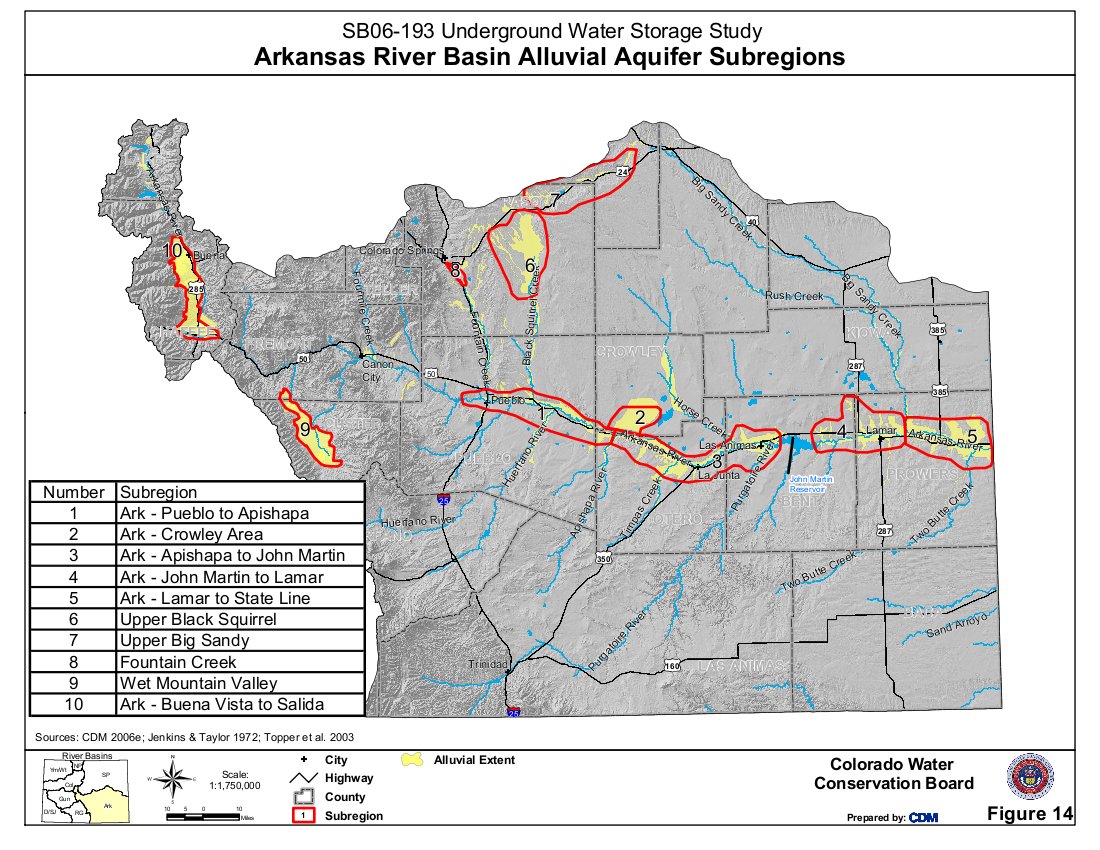
From The Pueblo Chieftain (Chris Woodka):

Water providers from Canon City, Penrose and Custer County shared their experiences at the Arkansas River Basin Water Forum last week. “You need to base water rates on the true cost to water users, while having tap fees for new growth that are defensible,” said Bob Hartzman, Canon City water supervisor.

About one-third of Canon City’s water mains need to be replaced, because some cast iron lines are more than 100 years old. Canon City will face about $42 million in upgrades over the next 20 years, and recently borrowed $12.5 million for the first phase. It’s not alone. Statewide, $5 billion needs to be invested in municipal infrastructure in the next two decades, Hartzman said. “This has made for tough decisions for our City Council,” he said…

Penrose is making plans for a new well-field delivery system of water rights it purchased a couple of years ago, and planning is essential, said Lissa Pinello, president of the local water district…

The Round Mountain Water and Sanitation District had to come to grips with its own aging system in the last few years, said Chris Haga, a board member. The district, which serves Westcliffe and Silver Cliff, completed a new well and upgraded service lines, using grants from the state Department of Local Affairs and Colorado Water Conservation Board, through the Arkansas Basin Roundtable. Those were just the most recent steps in a 15-year process to upgrade a water system that had aging water lines and often lost pressure on heavy-use days.

More infrastructure coverage here.

Gunnison River Basin: The North Fork River Improvement Association board approves merger with the with Western Slope Environmental Resource Council

A picture named northforkgunnisonriverirrigationdiversions

From the Delta County Independent:

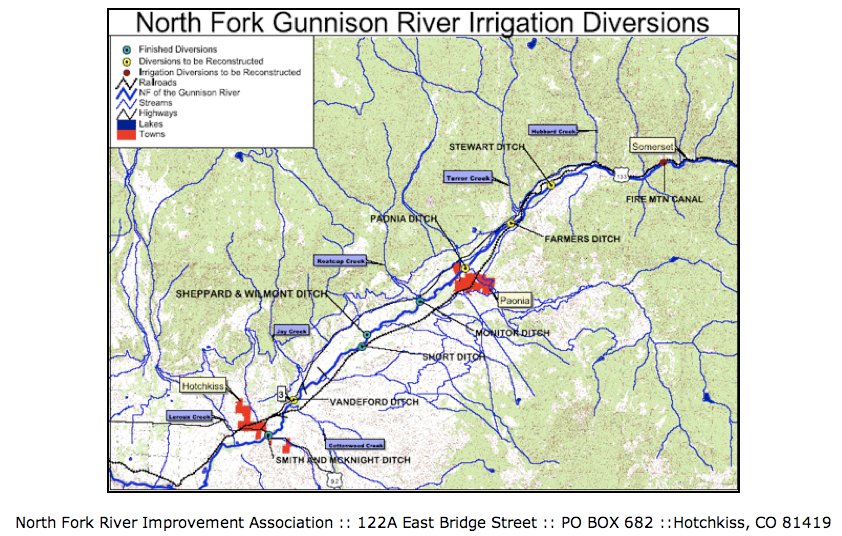
Meeting twice to review and consider an agreement and plan of merger between NFRIA and the WSERC, the board held two votes at its second special meeting on March 26. The board voted unanimously to approve the agreement and plan of merger and again voted unanimously to adopt a resolution to present for a vote the agreement and plan of merger to the membership at the annual meeting.

More Gunnison River Basin coverage here and here.

A look at climate change and the water resources picture in the Colorado River Basin

A picture named roaringfork

Here’s an in-depth look at what we think we know about climate change and water resources, from Allen Best writing for The Aspen Times. Click through and read the whole thing. Here are a couple of excerpts:

The image of Colorado’s water resources in the future remains a blurry one. Laurna Kaatz, a climate scientist with the Denver Water Department, said decisions involving multimillion-dollar water infrastructure should not be made based on the results so far. “To say you’re going to plan for a single future based on one of the climate models with one emissions scenarios is, I don’t think, a responsible way of using the information,” she says.

But more than anything else, the study suggests that management of water resources will become more difficult. That’s the view of Mark Fuller, the executive director of the Ruedi Water and Power Authority. Needs of endangered species and population growth have already made management more complicated. “Our margins for error for who we manage water are getting thinner and thinner,” he says. He points out that existing infrastructure, institutions and policies were designed for water on a crude scale. The uncertainties of the future suggest a need for more subtlety, he says.

All water officials and scientists agree this and other studies estimating the possible effects of global climate change on the American West are hardly the last word. “We will have to recognize that 20 years from now we will know a lot more than we know now,” said Kuhn.

More Climate Change coverage here and here.

Englewood/Littleton wastewater treatment plant is testing ultraviolet disinfection

A picture named ultravioldisinfectionsystems

From the Englewood Herald (Tom Munds):

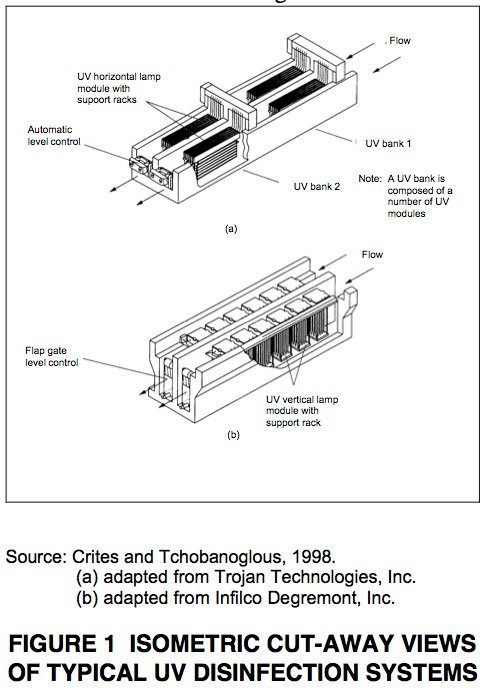
Dennis Stowe, plant manager, said the current chlorine system does a pretty good job of killing bacteria but new technological data reports the ultraviolet system provides better disinfection action on some bacteria than chlorine. Also, the chlorine used is similar to bleach. But while the chlorine is a good disinfectant, federal and state requirements mandate that an additional chemical must be added during the process to remove the bleach-like material before the water is allowed to flow into the river because it is bad for the aquatic life, Stowe said. “The system we are testing disinfects with the portion of the ultraviolet rays that cause sunburn,” he said. “Those rays eliminate the bacteria by making them infertile so they die out. It also means there are no chemicals to remove before the water is put into the river.”

The plant has already tested one company’s system and currently is putting another company’s system through its paces. For about the next two months, plant crews will have the pilot-project system up and running so the technicians can collect performance data on the disinfection performance of the ultraviolet system. “We’ll evaluate the data to determine if we definitely are going to move forward with an ultraviolet disinfection system,” Stowe said. “Once all the data is collected, it’ll take a couple months to complete the evaluation. Then, if we decide ultraviolet is a better disinfecting system, we’ll begin the process necessary to move ahead with eventual installation.”[…]

Provided the state approves the plan, the plant will design the project and begin installation. Stowe said the target date for switch over to ultraviolet is 2014 and the project will cost $8 million to $10 million. He said the cost of operation for the chlorine and ultraviolet system will be about the same because while chemical costs will be less, the ultraviolet system uses more electricity.

More wastewater treatment coverage here.

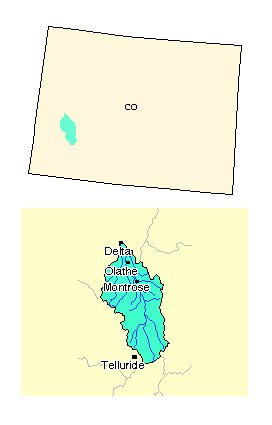
Uncompahgre Watershed Partnership meeting Wednesday

A picture named uncompahgrewatershed

From the Montrose Daily Press:

The new Uncompahgre Watershed Partnership will meet from 4 to 6 p.m. Wednesday at DMEA in Montrose. The meeting is open to the public. Partners will review more than 50 years worth of water quality data on the Uncompahgre River, from its source at Lake Como to the mouth at Delta. This will provide water resource specialists, city planners, agency experts and citizen groups a scientific foundation from which to establish watershed goals…

For more information, e-mail sarah@coloradowater.org or call 303-408-1312.

More Uncompahgre River watershed coverage here and here.

The Northern Colorado Water Conservancy District sets the Colorado-Big Thompson quota at 80%

A picture named coloradobigthompsonin2007

From the Northern Colorado Business Report:

At its meeting Friday, the board set the C-BT Project quota at 80 percent, a 30 percent increase from the initial quota set in October, which will make available a total of 248,000 acre feet. A quota of 80 percent means that each unit of C-BT water will yield eight-tenths of an acre foot…

Northern Water boundaries encompass portions of eight counties and a population of approximately 830,000 people. C-BT allottees – those water users within the boundaries who own units of C-BT water – include municipalities, domestic water districts, industries and farmers.

Here’s a report on C-BT happenings from Reclamation (Kara Lamb):

Just a quick note to let you know that this afternoon we will be turning off the pump to Carter Lake and resuming our filling of Horsetooth Reservoir. Carter Lake is basically full. It is only half a foot down from full. Once the pump is off, approximately 490 cfs of water will be flowing into Horsetooth. Horsetooth is currently at an elevation of about 5409. It will begin rising faster over the weekend at a rate around half a foot a day. We anticipate this fill rate to continue through April.

More Colorado-Big Thompson coverage here and here.

Lake Mead storage update

A picture named drylakemead

From Las Vegas Now:

Right now, the lake level is at 1,100 feet and the water [Southern Nevada Water Authority] has managed to store, lease, or buy enough water to keep things running smoothly even if Lake Mead was to drop below 1,025 feet. But if the lake drops below that point, there will be shortages. Right now, forecasts could have the lake below 1,025 feet in less than two years. “There is a 20-percent probability that we would hit an elevation that would take us below 1,025 (feet), which would result in a shortage. There is a 13-percent probability that we would be in surplus and a 67-percent probability that it would be normal,” said Lorri Gray-Lee, Lower Colorado Regional Director with the Bureau of Reclamation.

More Colorado River Basin coverage here.

Upper Eagle Regional Water Authority drops rates 19%

A picture named watertreatment

From the Vail Daily:

The authority’s board of directors last month approved a 19 percent decrease in the “debt service rate.” The new monthly rate of $3.16 per single-family equivalent is down from $3.91. A single-family equivalent is a generic Residential Unit, the use of which is estimated to have an impact upon the water system equal to that of the average single family, or 2.3 persons. The authority provides water service to the metropolitan districts of Arrowhead, Beaver Creek, Berry Creek, Eagle-Vail and Edwards; the town of Avon; and Cordillera and Bachelor Gulch.

More infrastructure coverage here.

Energy policy — oil and gas: West Divde Creek resident calls for county action about contamination

A picture named derrick

From the Glenwood Springs Post Independent (John Colson):

Lisa Bracken has argued since mid-2008 that chemical compounds have seen seeping from natural gas formations, breached by drilling operations that began in 2004, into West Divide Creek and possibly into ground water in the area. In 2004, a seep sent hydrocarbons, such as cancer-causing benzene, into the creek from an improperly completed nearby gas well. EnCana Oil & Gas USA was fined more than $300,000 for the violation of state regulations in the incident…

In a letter to the BOCC dated March 30, Bracken wrote that two gas operators — EnCana Oil and Gas, USA and Bill Barrett Corp. — in February of this year “self reported” the appearance of “hydrocarbons” in two domestic water wells in her neighborhood. Judy Jordan, the county’s oil and gas liaison, said the COGCC has already begun an investigation into the reports from the gas companies…

She asked the board to support her in calling for renewal of a drilling moratorium, which she said is necessary in order to conduct a thorough study of the hydrology and geology of the West Divide Creek area. “For the COGCC to continue to allow drilling under these circumstances is nothing less than egregious negligence which places the health and safety of residents of this area at unnecessary risk,” she declared.

More oil and gas coverage here and here.

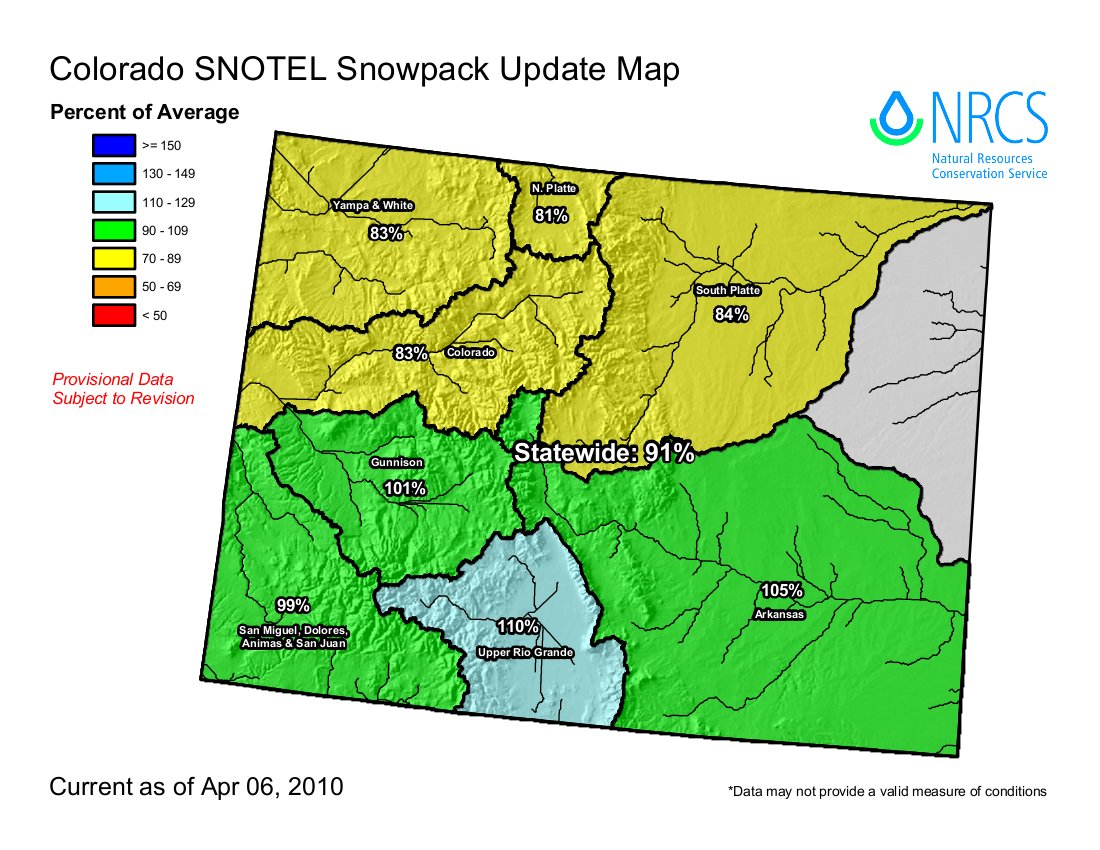
Snowpack news: Lake Pueblo dropping some

A picture named snowpackcolorado04082010

From The Pueblo Chieftain (Chris Woodka):

The past five years have been close to or even above average in terms of precipitation, causing Lake Pueblo to fill for the first time in a decade last month. In March, Vaughan and other water managers were worried about the possibility of a spill. Since then, Lake Pueblo has stopped filling, as farmers are running out water stored in winter water and project accounts from last year. That water has to be out of the reservoir by May 1. Farmers may actually need the water despite good soil moisture coming into the spring, because high winds raked the plains for more than a week. Those same winds could have diminished the snowpack in the mountains with dust, which causes snow to melt faster, or sublimation, which blows some of the snowpack away, but that was offset with a foot of new snow in the mountains that affect the Arkansas River watershed and imports. Meanwhile, Pueblo, Colorado Springs and Aurora are continuing to store by exchange in Lake Pueblo…

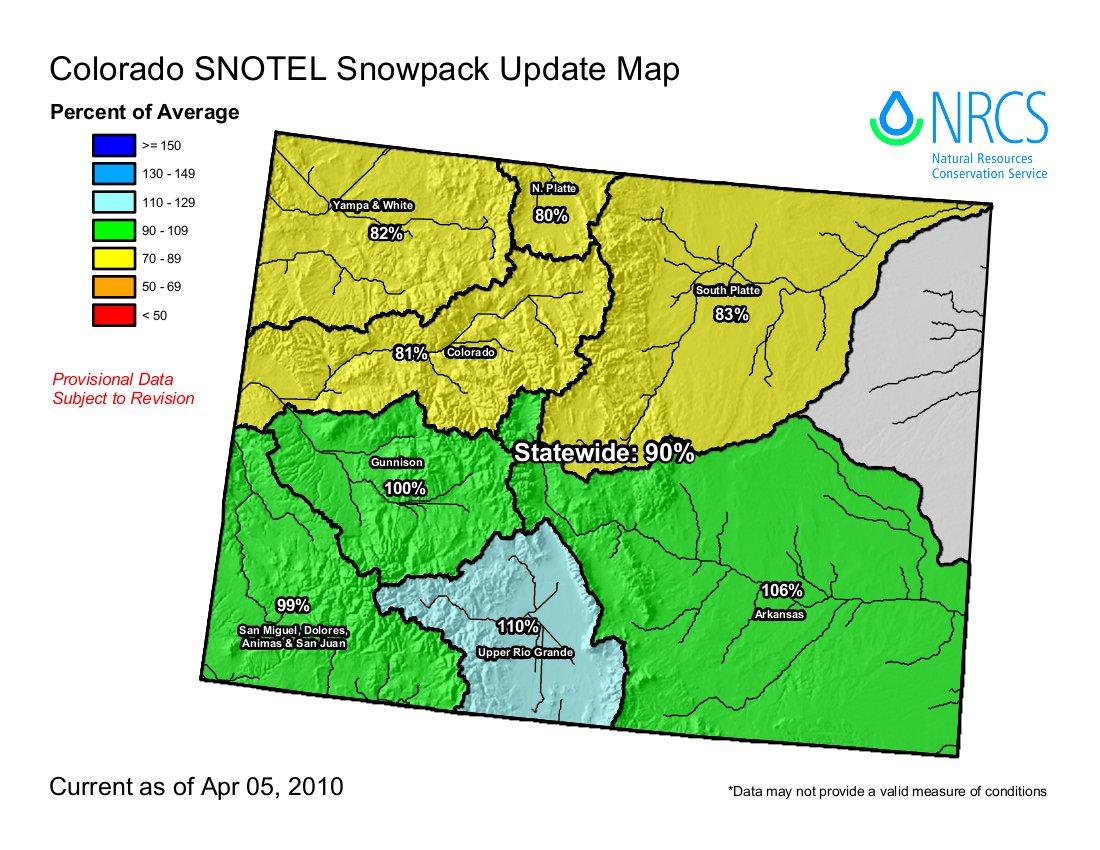
As of Friday, snowpack was 94 percent of average in the Upper Arkansas, although the Arkansas River basin as a whole was 105 percent because of snow in the southern mountains. The Roaring Fork basin was 96 percent of average Friday, slightly more than the 86 percent average of the Colorado River basin as a whole. Fry-Ark and the bulk of other diversions into the Arkansas River rely on Roaring Fork. Vaughan said if current conditions hold up, it should be an average year for Fry-Ark imports, about 50,000-55,000 acre-feet. Reclamation made space for that water in Turquoise Lake over the winter, by running some water into Lake Pueblo. “Right now, it looks like everything is going to work out,” Vaughan said.

From the Cortez Journal (Kimberly Benedict):

2010 precipitation levels through March were at 4.46 inches for the Cortez area, according to Jim Andrus, the National Weather Service’s cooperative weather observer in Cortez. That is 134 percent of the average 3.3 inches for the first three months of the year. Overall, Cortez has seen a winter snowfall total of 69.1 inches – just under six feet…

Lizard Head Pass between Rico and Telluride has received 12.7 inches of precipitation during the season, and Sharkstooth Peak northeast of Mancos sits at 20.4 inches. That puts Lizard Head Pass at only 75 percent of average, according to data collected by the Natural Resources Conservation Service. The Sharkstooth station is too new to accurately predict an average. Two other sites, El Diente Peak southwest of Telluride and Lone Cone south of Norwood, both rest at 97 percent of average. The Scotch Creek site near Rico is measuring close to 83 percent of normal. “As it’s turned out, what we’ve got as far as snowpack and everything, it is fairly close to equivalent to last year,” said Mike Preston, general manager of the Dolores Water Conservancy District. “There was more low snow this year, but less high snow. We are right on the border between filling the reservoir (McPhee Reservoir) and maybe having a small spill.”[…

The final piece of the 2010 water forecast is the unexpected amount of snow at lower elevations. Dolores Water Conservancy District measurement’s placed this winter’s low-elevation snowfall at 152 percent of average, the highest since 2005. No one is quite sure how that will affect reservoir levels.

Energy policy — nuclear: The Colorado Mined Land Reclamation Board sets hearing schedule for proposed uranium mining rules

A picture named uranuim.jpg

From The Greeley Tribune:

The…hearing, April 15, will be in Loveland. Other meetings are scheduled for May 13 in Grand Junction, May 26 in Salida and June 10 in Denver.

The rulemaking is being conducted primarily to implement three bills passed by the Colorado General Assembly in 2008, one of which concerns reclamation standards to in-situ uranium mining, which is being proposed for an area in northern Weld County. The rules and amendments have been proposed by the Colorado Division of Reclamation, Mining and Safety. The board may accept, reject or modify any or all of those proposals.

The Loveland meeting will be from 1-9 p.m. May 15 at the Embassy Suites Hotel, 4705 Clydesdale Parkway. A live, listen-only feed will be available at http://mining,state.co.us/Rulemaking.htm. There also is a draft of the proposed rules at that site.

More nuclear coverage here and here.

Idaho Springs wins the Colorado Rural Water Association ‘Wastewater System of the Year’ award for 2009

A picture named wastewatertreatmentwtext.jpg

From the Clear Creek Courant (Ian Neligh):

Water/wastewater superintendent Chris Brownell said the award is a big achievement, considering the shape of the facility in past years. “We were the embarrassment of the industry until about four years ago,” Brownell said. “We just turned it around (from the) top down.”[…]

“In this case the reason we were nominated and got (the award) was because of nutrient removal, and so it is just operational changes,” Brownell said. “The plant was not built for or designed to do what we’re doing, so it is just quality people.”

Brownell said downstream users nominated Idaho Springs for the award — users who once were less than pleased with the wastewater leaving the city. “We were actually nominated by down-streamers who used to hate us,” Brownell said…

Water/wastewater employee Mike McElhaney was given the 2009 Rookie Wastewater Operator of the Year.

More wastewater coverage here.

Colorado River Water Availability Study

A picture named coloradoriverbasin.jpg

Here’s a look at what we think we know about future water supplies in the Colorado River Basin according to the Colorado River Water Availability Study, from Allen Best writing for the Vail Daily. From the article:

A new $1 million study suggests snowier and rainier winters in the northern mountains and drier ones in the south by the mid-21st century. But everywhere across the Western Slope, summers will be hotter, longer and drier, putting more stress on reservoirs. Those tentative conclusions are found in the draft Colorado River Water Availability Study, a $1 million effort described by state water officials, who commissioned it, as cutting edge. “I don’t know of any other state that is putting the time, resources and money into this,” said Jennifer Gimbel, executive director of the Colorado Water Conservation Board, a state agency charged with overseeing protection and development of Colorado’s waters…

In plotting the possible futures for 2040 to 2070, the climate scientists, hydrologists, and water engineers examined 112 existing computer simulations of climate change. The simulations varied for many reasons, including uncertainty about the volume of greenhouse gases emissions during coming decades. Because of the complexity of atmospheric conditions that create what we call weather — and, over time, climate — these models have been unable to simulate the complex topography of mountainous areas that comprise the Colorado River headwaters. That topography, in turn, greatly influences precipitation. Investigators in this study believe that “downscaling” techniques allowed them to get a better bead on precipitation. While models have been clear about rising temperatures, until recently they swung broadly in precipitation. This study provides more definition, and the news for northern Colorado, where Colorado’s ski areas from Aspen to Steamboat and Winter Park are clustered, is not terrible. Winters will shorten, but plenty of snow will remain — if also drenched more often with rain. “It doesn’t seem to indicate there’s a doomsday scenario for the ski industry or the fisheries of the upper Colorado River,” says Kuhn. “But it also means that while things are good for Summit and Grand counties, plus the upper Roaring Fork and Yampa (rivers), there’s still less water at Lee’s Ferry (Ariz.). And that means less water for Colorado to develop.”[…]

Kuhn describes the study like a casino slot machine. While there is no certainty with any one pull, the odds favor the house. Similarly, the downscaling compilation of the computer simulations shows probability of a distinctly drier Colorado River Basin. The dryness is the result of increased temperatures everywhere, although proportionately greater in lower elevations and in the more southerly areas. Crops such as corn and alfalfa will need more water. Winters will likely become shorter, runoff will occur earlier, and the hot, generally drier months of summer will last longer. Effects suggested by the modeling vary by location. For example, temperatures by 2040 at the farming town of Delta, located in west-central Colorado, may rise 3.3 to 3.7 degrees Fahrenheit. Growing season will last 15 to 22 days longer. And crops will need 2.6 to 6.7 inches more of water per year. Ridgway Reservoir, which impounds snowmelt from the San Juan Mountains for use by farms, may start showing shorelines in June instead of July or August.

But even reservoirs located on drainages with increased winter precipitation may struggle to meet water demands. In effect, global warming will speed up the calendar by two or three weeks — and perhaps leave too little water for some farmers during late-season irrigation. “When I saw these graphs, there was one word that came to my mind, and that was storage,” said Eric Wilkinson, who directs the Northern Colorado Water Conservancy District, at a public unveiling of the draft report in January…

The study, still in draft form, is now available for a 90-day public review. It can be found at http://cwcb.state.co.us/.

More Colorado River Basin coverage here.

Paonia: Trustees to raise water rates?

A picture named waterfromtap.jpg

From the Delta County Independent (Kathy Browning):

The base rate for residential now is $12. The proposed base rate is raised to $14. For commercial users the current base rate is $18, and proposed to be increased to $20. Out of town base rates are proposed to be raised from $15 to $18 for residential and from $28 to $32 for commercial.

Residential usage rates would be raised from $1.10 per 1,000 gallons for less than 5,000 gallons to 25,000 gallons to $1.20 per 1,000 gallons for less than 5,000 gallons to 10,000 gallons. From 10,000 to 20,000 gallons the rate is proposed to be $1.30. Over 20,000 to 30,000 gallons could be raised to $1.60. The proposed usage rate for over 30,000 to 100,000 gallons is $2.40 per 1,000 gallons. Any amount over 100,000 gallons could be charged $3.60.

Commercial usage rates are proposed to be raised from $1.10 to $1.30, from $1.50 to $1.80 and from $2.20 to $2.60.

Proposed out of town usage rates range from $1.30 for under 5,000 gallons, $1.80 between 5,000 and 10,000 gallons, $2.90 for over 10,000 to 20,000 gallons, $3.20 for over 20,000 to 30,000, and $6 for over 30,000 to a 100,000 gallons and more.

Commercial out of town usage rates are proposed to be raised from $2.40 to $2.90, $3.60 to $4.30, $4.80 to $5.80 and $6 to $7.20.

Any water rate increases will have to be approved at a town council meeting — the next one is scheduled for Tuesday, April 13, at 7 p.m.

More infrastructure coverage here.

Orchard City: Colorado Division of Water Resources dam safety seminar April 15

A picture named tetoncollapse.jpg

From the Delta County Independent (Hank Lohmeyer):

Owners and operators of dams will be interested in a dam safety training seminar scheduled to take place at Orchard City Town Hall. The Thursday, April 15, session is being hosted by the Colorado Division of Water Resources. The event will run from 9 a.m. to noon and will cover topics relating to laws, rules and fundamental aspects of dams and dam safety in Colorado. The program will be focused on four primary areas: an overview of the Division of Water Resources dam safety program; the fundamentals of dam and dam safety; a review of owners’ responsibilities and general maintenance aspects of dams; and emergency action planning. Anyone who owns or operates a dam will be interested in attending this seminar. There is no cost. The program will also be offered in Montrose at the DMEA facility on Friday, April 16, from 9 a.m. to noon. For more information, call 249-6222.

More infrastructure coverage here.

Rivers are awesome

A picture named riversareawesome.jpg

Click on the thumbnail graphic to see for yourself that rivers are awesome. The comic is from the Brevity comic strip. Thanks to Loretta Lohman for the link.

Poncha Springs trustees approve takeover of sewer system by Salida

A picture named sewerusa.jpg

From The Mountain Mail (Audrey Gilpin):

Effective today, Poncha Springs Sewer Enterprise fund and system, including customers, will be transferred to Salida. Poncha Springs residents will pay the same as Salida residents, with the first billing cycle at the end of April. City attorney Karl Hanlon wrote in a memorandum to the council, “From Salida’s perspective, these agreements put to bed a longstanding dispute … . More importantly, (they) provide a road map for the regional sewer plan.” Salida has provided sewer service for the town since the 1970s. Failed and flawed agreements between the municipalities have occurred for 30 years, making the two recent agreements “a momentous moment,” Salida resident Jim Elmore said during public comment…

Councilmen said the city is already obligated to provide sewer service – the agreements create a standard of service and make Salida the regional “utility provider.” Because the system is operated through the sewer enterprise fund, infrastructure improvements to the treatment plant are driven by rates and improvement fees, not taxpayer money, Hanlon said…

Salida personnel are responsible for billing and collecting from service customers. Regional designation will initially add about 440 customers to the Salida billing list, Hanlon said. As a regional system, Poncha Springs residents will pay the same as Salida residents. In-town Poncha Springs residents pay $34.54 per single-family dwelling and out-of-town residents pay $48.81 per month. The residential rate for Salida sewer customers is $47.25 per quarter. They also pay $1.05 per 1,000 gallons of water used, which equals about $15.75 per quarter for the average household. City finance director Jan Schmidt said it equals about $21 per month for an average household. Salida sewer customers are charged quarterly; however, city personnel are considering monthly billing.

More infrastructure coverage here.

Painted Sky Resource Conservation and Development Council scores $400,000 to replace the Hartland diversion dam on the Gunnison River

A picture named gunnisonriver.jpg

From the Montrose Daily Press:

The money enables Delta’s Painted Sky Resource Conservation and Development Council to proceed with the dam replacement. “This is incredible,” said Painted Sky Project Director Mike Drake in a news release from the Fish and Wildlife Service. “The level of coordination and the amount of work put in by all parties made this project possible. The entire area will benefit from this project for years to come.” The project is a cooperative effort between Painted Sky, Fish and Wildlife, the Colorado Water Conservation Board, private landowners and recreation organizations, plus other state and federal partners. The 6-foot Hartland dam will be removed and replaced with a new, natural boulder field structure. The service previously committed $600,000 of stimulus funds and $200,000 through the National Fish Passage Program for the project.

More Hartland Dam coverage here.

SB 10-052 (Alter Designated Groundwater Basin Area): Governor Ritter signs the bill

Colorado designated groundwater basins.

From the Sterling Journal-Advocate (Marianne Goodland):

Under the bill, the Ground Water Commission, which manages the eight designated basins along the Eastern Plains and the Front Range, could revise a basin’s boundaries to remove previously-included areas only if the area does not include wells for which final permits have been issued. The bill includes an exception for current legal cases winding through the courts, a nod to the 2006 Gallegos v. Colorado Ground Water Commission case where the Colorado Supreme Court ruled that a surface water rights holder who has senior water rights can challenge the permit of a ground water well in a designated basin if the senior water rights holder can prove their surface water rights are being affected. That case, affecting water rights in the Upper Spring Creek Basin in northern Larimer County near the Colorado-Wyoming border, has not reached final resolution.

More 2010 Colorado legislation coverage here.

HB 10-1188 (Clarify River Outfitter Navigation Right): Colorado Water Congress’ Doug Kemper says the bill is, ‘is a failure to use the network’

A picture named raftingarkriver.jpg

From The Pueblo Chieftain (Chris Woodka):

The head of the [Colorado Water Congress] said this has been a “failure” in water negotiations. While emotions run high over the bill, it is actually an example of how the connections often promoted by the CWC broke down in this case, said Doug Kemper, CWC executive director, at the Arkansas River Basin Water Forum at The Abbey this week. “HB1188 is a failure to use the network,” he said…

The House in February passed a version that gave both commercial rafters the right to float through property around obstacles. The Senate last month passed a different version of the bill, saying current law is unclear and ordering a study of the issue by the Colorado Water Congress to be completed by Oct. 31. The House has yet to reconsider the bill…

The original bill, drafted by Rep. Kathleen Curry, Unaffiliated-Gunnison, had warning flags for the water community, particularly in referring to English common law and the right of navigability, Kemper said. “The CWC came out opposed to the bill,” Kemper said. “Our concern was the word navigable has a meaning at the federal level that starts bringing in federal regulations. “We also wanted to make sure water rights operations were not impacted either with diversion structures or permitting on projects.”

In Colorado, the rafting issue is clouded by a state Supreme Court ruling that said there was no right to float across private property and a subsequent ruling by a state attorney general that said rafters made no criminal trespass if they float through private property, provided they do not touch the banks or bed of the stream…

Kemper said the various ballot titles might boil down to “two or three on each side,” and said regardless of which path the Legislature takes, some are likely to reach the ballot. “It’s coming down to rafters vs. property interests, and if that happens, it’s a failure of the network,” Kemper said. Kemper, who worked for the City of Aurora as it developed water interests in the Arkansas River basin, said the flow agreements and formation of the Arkansas Headwaters Recreation Area show where cooperation can lead. “There has been too much hard work in the Arkansas Valley between rafting interests and the water rights holders for this to become a wedge,” Kemper said.

More HB 10-1188 coverage here.

Woodmoor Water and Sanitation District approves purchase of three High Line Canal farms

A picture named arkbasinditchsystem.jpg

From The Pueblo Chieftain (Chris Woodka):

he water district will pay three sellers $1.79 million for 41.2 shares of High Line Canal water rights if the sales are closed following due diligence investigations. The purchase would amount to $4,300 per acre. A smaller water right is also included in the package. The farms are a small part of the High Line’s 2,250 shares, and all are near the end of the 85-mile long ditch in Otero County. The High Line diverts south of the Arkansas River east of Boone and ends at Timpas Creek.

“We anticipate using the water in accordance with our exchange decree filed in December,” said Jessie Shaffer, manager of the Woodmoor district. Under that application, water would be exchanged upstream along the Arkansas River and Fountain Creek to Woodmoor, which is in the far northern part of El Paso County, just east of Interstate 25…

Woodmoor would still need to obtain approval from the High Line board and obtain a change of use decree in Division 2 Water Court to move the water. The district does not know when it would seek those changes, Shaffer said…

Two conservancy districts are opposing Woodmoor’s exchange application in Water Court. The Southeastern Colorado Water Conservancy District board voted to file a statement of opposition in the case in January in order to protect its own exchange capacity on the Arkansas River below Pueblo Dam, which eventually will be needed for the Arkansas Valley Conduit. The district also is concerned the Woodmoor exchange could use Lake Pueblo, part of the Fryingpan-Arkansas Project, to take water outside the district’s boundaries. The Lower Arkansas Valley Conservancy District opposed the Woodmoor exchange application largely because it could be used to move water outside the Arkansas River basin…

Woodmoor serves 8,400 people in 3,300 homes. About 400 of the homes are on the other side of the Palmer Divide in the South Platte River basin. All sewer return flows from the district come down Monument Creek, but flows from lawn watering on some homes would end up in the South Platte basin, Shaffer said…

Woodmoor, a part of the [Pikes Peak Regional Water Authority], dropped out of Super Ditch negotiations because of the objections to taking water over the Palmer Divide.

More infrastructure coverage here.

Cedaredge: CWCB Grand Mesa permitting process public meeting

A picture named grandmesa.gif

From the Delta County Independent:

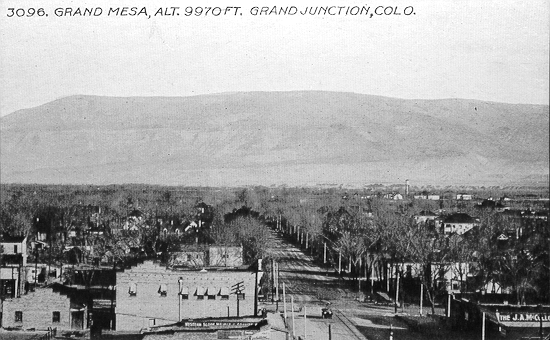
The Colorado Water Conservation Board (CWCB), which funds many of these projects, is developing a simple, user-friendly permitting mechanism. Painted Sky and Westwater Engineering will support CWCB on this project. A public meeting to discuss this effort will be held Monday, April 12, at 7 p.m., at the Cedaredge Community Center. Kirk Russell, CWCB’s project manager, will be in attendance. Grand Mesa water providers are the key stakeholders in this project. Input is needed from these stakeholders to develop an alternative permitting mechanism. This effort will also include input from various federal and staff agencies.

More CWCB coverage here.

Snowpack news

A picture named snowpackcolorado04082010

From The Greeley Tribune (Bill Jackson):

Karen Rademacher, a senior water resources engineer with Northern Water, said reservoir storage within the district’s boundary is at record high and soil moisture is in excellent condition going into the growing season. But the high-mountain snowpack, in particular that area of the upper Colorado River where Northern gets its supplemental water supply for the Colorado-Big Thompson Project, is dismal at best. That bad news, however, has improved somewhat in the past week, Rademacher said, with early spring storms dumping a lot of snow in the mountains…

That’s the scenario Northern’s board will face when it meets Friday to set this year’s quota for the C-BT, and while Rademacher said the staff decision has not yet been set in stone, chances are good for a 70 percent quota to start the year. That means for every acre-foot of water a C-BT shareholder has, it will get 0.7 of an acre-foot it can use. An acre-foot is enough water to supply two families with a year’s supply of water. That water goes to both agricultural, as well as municipal and industrial users…

Because of the low snowpack, streamflow from the snowpack runoff is forecast at about 50 percent to 80 percent of average in the tributaries for both the Colorado and South Platte rivers. However, Rademacher and Jim Hall, head of the Division 1 office of the Colorado Division of Water Resources in Greeley, said reservoir storage throughout northern Colorado is at record levels. “It’s the best storage I’ve seen in the last 10 years,” Hall said of eastern Colorado reservoirs. And because of soil moisture, he said there has not yet been a call for water from the South Platte, which is unusual. “I won’t say we’re in a great situation, because streamflow at this point isn’t looking good. But soil moisture is good, and since we haven’t had a call on the river, so I would say that I’m very optimistic,” Hall said.

Meanwhile here’s the April 1 Colorado Basin Outlook Report from the NRCS listing the current streamflow forecasts.

From the Sky-Hi Daily News (Matt Barnes):

USDA Natural Resources Conservation Service (NRCS) Kremmling Field Office snow surveyors Mark Volt and Matt Barnes took the April 1 snow survey measurements during the last days of March, when the monthly precipitation for the upper Colorado River Basin was a scant 68 percent of average. Snowpack in the mountains above Middle Park now ranges from 59 percent to 107 percent of the 30-year average, with the highest readings on the southeast side of the valley, and the lowest readings along Rabbit Ears Divide on the north side of the valley. This is slightly more snow than on April 1 in the drought years of 2002 or 2004…

Snow density is averaging 31 percent, which means that for a foot of snow there are 3.7 inches of water. This is less water than normal for this depth of snow on April 1. Muddy, Troublesome, Corral, and Willow creeks in Middle Park, and the North Platte River in North Park, have the lowest snowpack in the state. According to the U.S. Drought Monitor, most of Grand County and adjacent parts of Jackson and Routt counties are now in moderate drought, with northern Summit County and most of the rest of northwest Colorado abnormally dry.

Northern Colorado Water Conservancy District’s 2010 Spring Water Users meeting recap

A picture named coloradobigthompsonin2007

From The Greeley Tribune (Bill Jackson):

Jim Martin, executive director of the Colorado Department of Natural Resources, was the luncheon speaker for the 2010 Spring Water Users meeting of the Northern Colorado Water Conservancy District at the Radisson Conference Center. Martin said the [Environmental Protection Agency] has a major role in determining the approval of any of the nation’s proposed water projects, and that includes several in Colorado now in the planning and permitting process. Those include the Northern Integrated Supply Project, which would provide an additional 40,000 acre-feet of water per year for 15 entities in northern Colorado, and the Windy Gap Firming Project, which provides a storage facility in a new reservoir west of Loveland. Both those projects are in the process of undergoing Environmental Impact Studies and, if approved, will be built in the next five to 10 years. The problem, Martin said, is that the EPA doesn’t get involved until after the Environmental Impact Study of a project is complete. “As a result, it doesn’t have the history of the planning that go into those projects. That’s a serious institutional problem and it’s one that I don’t have a solution,” Martin said.

More Colorado-Big Thompson coverage here and here.

Arkansas River Basin Water Forum recap

A picture named arkansasriverbasin.jpg

From The Pueblo Chieftain (Chris Woodka):

The subject [agriculture to urban tranfers and HB 10-1159] was revisited this week at the Arkansas River Basin Water Forum, an annual convention that brings together water interests up and down the river.

“The Colorado Water Congress had not taken a position on the bill. It died on a Friday and we were due to consider it the next Monday,” said Doug Kemper, director of the CWC, in remarks to open the forum. Kemper explained the CWC, a powerful lobby for state water interests, was divided about the bill, with some members making the argument that the IBCC was already working on mitigation issues.

“I think it’s something we need to look at,” said Jeris Danielson, a former state engineer who is now a water consultant. Among his clients is Aaron Million, who wants to build a pipeline from Flaming Gorge to Colorado’s Front Range. “That whole issue has to be examined.” Danielson has frequently advocated transmountain diversions as an answer to what he terms: “That giant sucking chest wound we call Denver.”

Denver will need an additional 700,000 acre-feet of water by 2050, and addressing that gap was the main reason the IBCC was formed in 2005 by the Legislature. Its work has been slow — some say glacial — with most of its time spent building trust and honing data. Members have shifted from making political statements early on to conducting tabletop exercises of which strategies — conservation, ag dry-up or imports — might work best to meet the gap. In January, at the CWC convention, Gov. Bill Ritter also pressed the IBCC to work faster and meet more often toward developing compacts within the state. “The days of Denver taking the water and saying, ‘see you,’ are over,” Danielson said. “But the Front Range will get the water. We need to make it palatable for everyone involved.”

More Arkansas River Basin coverage here.

Parker Water and Sanitation and Colorado State University pilot project is testing water saving cropping practices

A picture named irrigation.jpg

Here’s the release from Colorado State University:

In 2007, Parker Water and Sanitation District, a Front Range water supplier, and Colorado State University joined forces to develop a new approach to meeting Colorado’s water challenges.

Growing municipal and industrial water demand has led to the “drying-up” of irrigated farms in Colorado. Farms – and their water rights – are being purchased by municipalities and water rights are transferred from agricultural to municipal purposes. More “buy-and-dry” of irrigated agricultural land is projected in the future as the demand for municipal water resources increases across Colorado’s Front Range.

Parker Water Sanitation District, or PWSD, is exploring ways of meeting its water needs while benefiting irrigators and rural communities, thereby preserving both rural and urban economies. PWSD and Colorado State researchers initially embarked on a one million dollar study of water saving cropping practices with reduced irrigation based on a farm near Iliff. Subsequently, PWSD has secured two grants from the Colorado Water Conservation Board for $627,500 to supplement the research project.

“Parker Water was very forward thinking in establishing this project,” said Tom Holtzer, head of the Department of Bioagricultural Sciences and Pest Management and team coordinator of the study. “It has led others in the state to see alternatives to drying up irrigated farmland.”

Now three years into the study, important results are being found. “A simple but important result from the research is that there are better ways to save water than fallowing irrigated land,” said Neil Hansen, associate professor in the Department of Soil and Crop Sciences and one of the CSU scientists leading the project.

Hansen said that water lost to evaporation from bare farmland was almost as high as water usage from a non-irrigated winter wheat crop. “As a minimum, when irrigation is terminated, the land should be used to produce a crop without irrigation,” Hansen said.

The study evaluated a variety of crop rotations that alternate irrigated and non-irrigated crops as a means of saving water. This “rotational cropping” approach is efficient because the non-irrigated crop scavenges water and nutrients left by the previous irrigated crop. The approach reduces water use by as much as 40 percent.
Limited irrigation cropping is another water savings approach being evaluated in the PWSD study. For limited irrigation, all crops in a rotation are irrigated with reduced amounts of water.

The project has shown how to monitor soil moisture and crop growth stage to get the most return out of the limited amounts of applied irrigation. Crops under limited irrigation yield less than fully irrigated crops, but the yields are much better than for non-irrigated crops.

So far the study has shown limited irrigation as a successful approach for traditional crops like corn and sugar beets as well as for potential alternative crops, like soybeans and canola.

Part of the study is to project how saving water and moving it to cities will affect regional economies in rural areas of the state. The approach used to save the water at the farm scale can have a large influence on the economic impacts.

The PWSD-CSU study will conclude later this year. With the additional support from the Colorado Water Conservation Board, the project is addressing means to put the new ideas into practice. Researchers are evaluating methods the state can use to verify water savings at the farm level, and how water savings from individual farms can be aggregated at larger scales.

“We are heading toward a train wreck and we need to look at the tough question and find some answers,” said Frank Jaeger, district manager of PWSD. “This project addresses one important part of answers we are looking for. Providing urban water supplies, while also preserving agriculture instead of ‘buying and drying’ agricultural lands, will help avoid that train wreck.”

More conservation coverage here.

Albedo effect

A picture named albedoeffect.jpg

From Red Orbit (Cheryl Dybas):

“More than 80 percent of sunlight falling on fresh snow is reflected back to space,” says Tom Painter, Director of the University of Utah’s Snow Optics Laboratory. “But sprinkle some dark particles on the snow and that number drops dramatically.”

That’s exactly what’s happening in Colorado’s high peaks. When the winds are right and the desert is dry, dust blows eastward from the semi-arid regions of the U.S. Southwest. In a dust-up, Western style, small dark particles of the dust fall on Colorado’s pristine white snowfields. “The darker dust absorbs sunlight, reducing the amount of reflected light and in turn warming the now ‘dirty’ snow surface,” says scientist Chris Landry, Director of the Center for Snow and Avalanche Studies (CSAS) in Silverton, Colo.

Painter’s and Landry’s research on dust-on-snow events, as they’re called, is supported by the National Science Foundation’s (NSF) division of Atmospheric and Geospace Sciences, which is part of the directorate for geosciences.

Interview with Anders Halverson author of ‘An Entirely Synthetic Fish: How Rainbow Trout Beguiled America and Overran the World’

A picture named rainbowtrout.jpg

Here’s the interview from Ed Stoddard writing for Thomson Reuters Foundation. Here’s the Tattered Cover link for the book An Entirely Synthetic Fish: How Rainbow Trout Beguiled America and Overran the World.

More restoration coverage here.

Creede: Rio Grande Headwaters Restoration Project fundraiser April 18

A picture named riograndevalleynearcreede.jpg

From The Monte Vista Journal:

The Dow Live Earth Run for Water is a series of 6 km run/walks —the average distance women and children walk every day to secure drinking water — taking place over the course of 24 hours in 150 countries across the world, featuring activities to ignite a massive global movement to raise awareness of the water crisis. Local organizers are proud to host the High Country Hustle near the headwaters of the Rio Grande. There is a $20 pre-registry event fee, which will include an event t-shirt and post-run/walk refreshments. All monies raised will be donated to the RGHRP.

The worldwide water movement will begin at 10 a.m. near the Creede Ball Park and travel along the running trail south of town, down the Airport Road to the Deep Creek Bridge on the Rio Grande, and back to town…

For more information, please see the website at www.tinyurl.com/hchustle, or contact Forrest at Freeride600@gmail.com, or Heather at Hmessick@rams.colostate.edu.

More Rio Grande Basin coverage here and here.

2010 Colorado elections: Rafting rift makes the national news

A picture named taylorriver.jpg

From The Wall Street Journal (Stephanie Simon):

That blissful setting is fairly well destroyed, [Steve Roberts] contends, when dozens of rubber rafts come bumping past, crammed with tourists of a less contemplative sort. “They come bebopping right on through…going over the dam I built for the fish, yelling ‘Whee!’ ” Mr. Roberts says. “I’ve got 60 boats a day doing that. My guests are unhappy.”

Too bad, the rafting community responds. The state constitution declares Colorado’s river water a public resource. Private landowners can reasonably lay claim to the structural frame of a river—the bottom, the banks, perhaps even the boulders. “But that doesn’t mean they own the water,” says Duke Bradford, who owns two commercial rafting companies. “You can’t privatize a river.”

More 2010 Colorado elections coverage here. More HB 10-1188 coverage here.

HB 10-1204 (Plumbing Code Water Conservation Standards)

A picture named waterefficenttoilet.jpg

From Governor Ritter’s Office:

“House Bill 1204 is an important step in conserving Colorado’s water and ensuring that we are moving forward with sustainable water standards for the future,” said Gov. Ritter. “Conservation is a critical component in managing one of our state’s most precious resources – water. Our state’s livelihood depends upon a reliable water source, from recreation to agriculture to business to our families, and we must be prudent with our use of it.” Conservation standards under [HB 10-1204], sponsored by Rep. John Soper and Sen. Lois Tochrop, include water efficiency fixtures and installation guidelines that meet or exceed national standards. The bill also encourages the use of locally produced materials.

More conservation coverage here.

Conservation groups seeking an emergency endangered species listing for Arapahoe Snowfly

A picture named arapahoesnowfly.jpg

From the Fort Collins Coloradoan (Bobby Magill):

The high volume of dogs, hikers and cyclists who trample and defecate in the snowfly’s habitat in Young Gulch and grazing and resort effluent in Elkhorn Creek have driven the snowfly nearly to extinction, claim the petitioners, who include CSU professor entomology Boris C. Kondratieff. Elkhorn Creek is the snowfly’s only known habitat, but early last decade, scientists spotted the snowfly in Young Gulch, too, where it still might exist. In the petition, the conservationists worry that a planned trail system for the Elkhorn Creek drainage will help pollute the creek and kill the last remaining snowflies.

Nicole Rosmarino of the WildEarth Guardians said Tuesday that it normally takes about two years for the government to include a threatened species on the endangered species list, but the snowfly is so close to extinction that it doesn’t have that long to wait. An emergency listing, she said, could force the U.S. Forest Service, which manages Young Gulch and Elkhorn Creek, to crack down on sources of water pollution, including dogs defecating in the stream in Young Gulch…

Through time, listing the snowfly as endangered would force the Forest Service and the Fish and Wildlife Service to take a hard look at what kind of recreation they permit in the two canyons while keeping the survival of the snowfly in mind, Rosmarino said…

The plight of the snowfly, she said, is really the plight of the Poudre River. Scientists consider the snowfly an “indicator” species, which is a harbinger of the overall health of the Poudre River watershed ecosystem. As goes the snowfly, so goes the Poudre River and the region’s water quality, they say. “The snowfly is a small insect that needs fast, cold, clear, clean streams to survive, and unfortunately, the two streams it’s known from are being impacted by everything from cattle grazing to too much recreation to septic tank pollution,” said Scott Black, a former Colorado State University student who is now the director of the Xerces Society for Invertebrate Conservation in Portland, Ore.

More coverage from The Greeley Tribune (Bill Jackson):

Jon Monson, director of the city of Greeley Water and Sewer Department, said he had not heard of the filing. “We try to support the environment, because we live in it. But I have not heard of this and don’t know at this time if it will have any effect on the expansion of the Milton Seaman Reservoir,” Monson said. The city-owned reservoir is north of the Poudre River in the canyon northwest of Fort Collins and the city has long-range plans to enlarge that facility, which provides drinking water for Greeley.

Brian Werner, spokesman for the Northern Colorado Water Conservancy District, which is administering the building of the proposed Northern Integrated Supply Project that includes reservoirs off the Poudre River and northeast of Greeley, said the survey would have no effect on those projects because the insects are upstream from the Glade Reservoir site.

The Xerces Society claimed the species — sometimes called winter stoneflies — is threatened by habitat damage from intensive recreation, livestock grazing, timbering projects, stream de-watering, insecticide application close to water bodies connected to Elkhorn Creek, sedimentation and runoff from roads and trails, and effluent from residential and destination resort septic systems.

More endangered/threatened species coverage here.

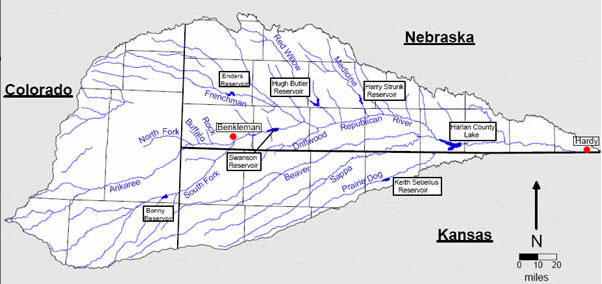
Republican River Basin: New arbitration timeline announced for Republican River Compact compliance pipeline

A picture named republicanriverbasin.jpg

From The Yuma Pioneer (Tony Rayl):

A new arbitration timeline finally has been set in regards to Colorado’s proposed compact compliance pipeline. A crediting dispute raised by Nebraska also is included in the arbitration process. Colorado, Kansas and Nebraska issued a joint notice of arbitration two weeks ago, and held an initial meeting with arbitrator Martha Pagel on Monday, March 29. Motions and briefs, and responses to them, will take place through May, culminating with Pagel issuing a decision on legal motions by May 17. The trial is to be held July 12-14 (the location has not been announced), and Pagel is supposed to issue a decision by September 30. The states have until November 1 to give notice on whether they accept the decision.

Click through for the schedule details.

More Republican River Basin coverage here and here.

U.S. Bureau of Land Management in Colorado seeking public nominations for Resource Advisory Councils

A picture named doloresrivercanyon.jpg

Here’s the release from the BLM (Jim Sample):

The Bureau of Land Management in Colorado announced today that it is seeking public nominations for 15 open positions on its three Resource Advisory Councils, which advise the BLM on public land issues. The BLM will consider the nominations for 45 days after today, when the agency is publishing its formal call for nominations in the Federal Register.

The BLM’s Resource Advisory Councils (RACs), composed of citizens chosen for their expertise in natural resource issues, help the Bureau carry out its stewardship of 253 million acres of public lands. The Bureau, which manages more land than any other Federal agency, has 24 RACs across the West, where most BLM-managed land is located. Each RAC consists of 12 to 15 members with an interest in public land management, including such individuals as conservationists, ranchers, outdoor recreationists, state and local government officials, Tribal officials, and academics. The diverse membership of each RAC is aimed at achieving a balanced outlook that the BLM needs for its mission, which is to manage the public lands for multiple uses.

“I value the advice given to the BLM by these citizen-based Resource Advisory Committees, and I know that Interior Secretary Ken Salazar shares my view of their importance,” said BLM Director Bob Abbey. “The people who live, work, and recreate near or on BLM-managed lands deserve a formal voice on public land issues, and their input will enhance our agency’s ability to manage the public lands for multiple uses while conserving resources for future generations.”
Individuals may nominate themselves or others to serve on an advisory council. Nominees, who must be residents of the state or states where the RAC has jurisdiction, will be judged on the basis of their training, education, and knowledge of the council’s geographical area. Nominees should also demonstrate a commitment to consensus building and collaborative decisionmaking. All nominations must be accompanied by letters of reference from any represented interests or organizations; a completed background information nomination form; and any other information that speaks to the nominee’s qualifications.

The 15 RAC positions open in Colorado are in the following categories:

Category One – Public land ranchers and representatives of organizations associated with energy and mineral development, the timber industry, transportation or rights-of-way, off-highway vehicle use, and commercial recreation.

Category Two – Representatives of nationally or regionally recognized environmental organizations, archaeological and historical organizations, dispersed recreation activities, and wild horse and burro organizations.

Category Three – Representatives of state, county, or local elected office; representatives and employees of a state agency responsible for the management of natural resources; representatives of Indian Tribes within or adjacent to the area for which the RAC is organized; representatives and employees of academic institutions who are involved in natural sciences; and the public-at-large. The nomination form is available here.

Nominations should be sent by May 10, 2010 to:

Front Range RAC
BLM Front Range District Office
Cass Cairns, RAC Coordinator
3028 East Main Street
Cañon City, Colorado 81212
719-269-8553
FAX 719-269-8599
cassandra_cairns@blm.gov

Northwest RAC
David Boyd, RAC Coordinator
BLM Colorado River Valley Field Office
2300 River Frontage Road
Silt, CO 81652
970-876-9008
FAX 970-876-9090
david_boyd@blm.gov

Southwest RAC
Erin Curtis, RAC Coordinator
BLM Grand Junction Office
2815 H Road
Grand Junction, Colorado 81506
970-244-3097
FAX 970-244-3083
erin_curtis@blm.gov

Snowpack news

A picture named snowpackcolorado04062010

From The Greeley Tribune (Bill Jackson):

This year’s water content is 8 percent below the same time a year ago. In a typical year, mountain snowpack totals reach their seasonal maximum totals during the month of April, which leaves only a few weeks remaining for improvements. But given the current deficit across northern Colorado, the odds of reaching a near-average snowpack are less than 10 percent at this time, [Allen Green, state conservationist with the NRCS] said…

Given the marginal snowpack conditions across much of the state, the outlook for spring and summer water supplies remains below average for most of Colorado. Near-average runoff is only expected in portions of the southern basins; elsewhere across the state, runoff volumes remain below average to well below average…

Reservoir storage continues to track at near-average volumes across most of the state, and that water should help alleviate late-summer shortages in those basins producing below-average runoff this year, state conservationist Allen Green said. Statewide, storage is 6 percent above the long-term average and 3 percent above last year.

From the Summit Daily News (Robert Allen):

The local and statewide snowpack continues to measure below average, with the Blue River Basin at 74 percent of average, as 2010 levels near their seasonal maximum…

But reservoir storage levels continue to measure near average across the state, with the Dillon Reservoir at 112 percent of average and Upper Colorado River Basin reservoirs overall at 111 percent of average…

The Blue River Basin snowpack by the end of March had fallen 3 percent from February’s level of 77 percent. The measurement at the Snake River fell 9 percent last month to 24 percent of average — or only 10 inches of snow depth and 1.9 inch of water content.

From the Pikes Peak Courier View:

The April 1 snowpack reports shows that local snowpack is well above normal, according to measurements collected by the Woodland Park Natural Resource Conservation Service office…

On the Pikes Peak watershed area, snowpack is 143 percent of the long term average on the North Slope and 140 percent on the South Slope…

Snowpack totals reflect these dry conditions and remain well below average. Snowpack percentages in these basins range from only 73 percent of average in the combined Yampa and White river basins to 81 percent of average in the South Platte basin. The highest snowpack percentages in the state remain in the Arkansas and Rio Grande basins, at 109 and 115 percent of average, respectively.

From The Aspen Times:

Thick dust, whipped up by high winds and probably blown in from Utah, gave parts of the Roaring Fork Valley a red, muddy rain late Monday, and left Aspen-area ski slopes sporting an off-color layer beneath Tuesday’s powder…

Aspen Mountain and Snowmass both picked up 7 inches of new snow overnight, but Beaver Creek and Vail were the big winners as the latest spring storm swept into the mountains of Colorado. Beaver Creek reported 14 inches of new snow Tuesday morning, while Vail had 13 inches.

From Real Vail.com (Reid Griebling):

Vail reported 11 inches this morning and the Beav’ has reported a whopping 13 inches as of 5 a.m…

Storm totals will range between 16 and 24 inches by Wednesday morning, with the highest elevations seeing well over 2 feet. Great news for snow riders and summer water enthusiasts as the Colorado River Basin has been thirsty for months.

Energy policy — nuclear: HB 10-1348 gets state house approval moves on to the state senate

A picture named cottercontamination.jpg

Bump and update: From the Cañon City Daily Record (Rachel Alexander):

“Today’s vote is absolutely amazing,” said Matt Garrington, of Environment Colorado, which helped develop the bill. “Never before have we seen such strong bipartisan support on uranium legislation.”[…]

“Uranium processing has left behind a dirty, dangerous legacy in Colorado,” Garrington said. “Today, the Colorado House told the uranium industry that business as usual is not acceptable. This legislation is an important step to help protect Colorado’s air and water from toxic, radioactive uranium pollution.”

From The Pueblo Chieftain (Patrick Malone):

By a vote of 62-2, HB1348 sponsored by state Rep. Buffie McFadyen, D-Pueblo West, advanced. Its next stop will be a Senate committee…

Cotter officials testified before a House committee that the bill would be “a poison pill” for the plant, while Canon City residents testified that the poison from the uranium processing plant has been tainting groundwater there for decades. “I vehemently disagree that this would close the Cotter mill,” McFadyen said. “It doesn’t affect their current operation, and only requires them to clean up the mess they’ve made before accepting new waste they aren’t already permitted to process.”[…]

Under the bill, uranium processors would be required to clean up existing contamination before they are permitted to accept new materials, as Cotter has proposed to do beginning later this year. Company officials have said the expansion would create up to 100 jobs at the uranium processing site that now has 31 employees.

The bill also would require annual reports from processors to residents of areas near groundwater plumes of uranium contamination. They would include updated reports on the status of the contamination and the steps taken to address them. Another portion of the bill requires uranium processors to carry bonds sufficient to pay for cleanup of contamination, rather than saddling taxpayers with the cost.

From State Bill Colorado (Debi Brazzale):

House lawmakers agreed Monday that increased oversight to ensure groundwater is not contaminated from uranium processing is a good thing for Colorado’s water supply, and gave their final approval to House Bill 1348 before it moves to the Senate for consideration. The measure requires that prior to obtaining a license to begin or expand uranium processing operations, the applicant has to show that the existing site is not in violation of existing environmental or public health laws…

Republican Marsha Looper of Calhan told the committee that most of her district derives its water from groundwater, and said the measure is crucial to the state’s agriculture industry. “Water is a precious resource for our state. We need to do our utmost to protect this important resource,” said Looper. Looper went on to say that the processing of uranium ore has a terrible track record when it comes to groundwater contamination. According to Looper, Durango and Grand Junction are seeing increased levels of contamination decades after the uranium operations have ceased. Looper said she welcomes the additional accountability the measure would provide.

More HB 10-1348 coverage here.

2010 Arkansas River Basin Water Forum recap

A picture named sdspreferredalternative.jpg

From The Pueblo Chieftain (Chris Woodka):

[Jay Winner, general manager of the Lower Arkansas Valley Water Conservancy District] defended the [Arkansas Valley Super Ditch] concept as the best way to keep water rights in the hands of farmers while allowing cities to meet future needs. Aurora is the only community outside the Arkansas River basin that has discussed lease possibilities with Super Ditch, he said. “It’s important to retain water rights in the Arkansas basin. The lease-fallowing program (Super Ditch) is only stop-gap, but it keeps water rights from being sold,” Winner said. “In 20 years, we don’t know what the world is going to look like. We’re trying to keep water in the valley. That goal has not changed.”

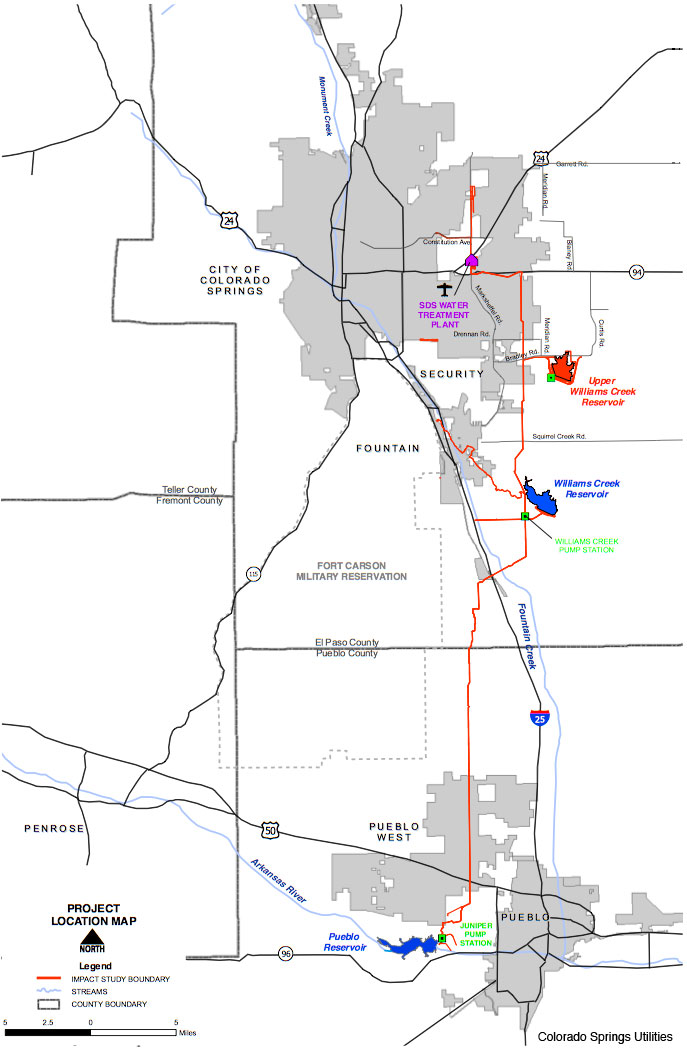
Winner also said moving the water to El Paso County water districts outside Colorado Springs could be accomplished in the short term by using the [Southern Delivery System] pipeline. Colorado Springs Utilities is wrapping up studies started last year to look at that possibility, said John Fredell, SDS project director.

In fact, a committee looking at changing Colorado Springs’ policy of not providing water outside city limits is finalizing its work today for possible action later this month by City Council, sitting as the utilities board. SDS also would serve Fountain, Security and Pueblo West. Colorado Springs already has carriage contracts with other communities, but opening SDS to more water providers could be a way for the Pikes Peak Regional Water Authority to accept deliveries from Super Ditch after SDS is completed in 2016. “They would have to go through their own NEPA (National Environmental Policy Act) process,” Fredell said…

Meanwhile, the High Line Canal is looking at the possibility of another pipeline heading north from Boone, said Dan Henrichs, High Line superintendent…A preliminary study of a pipeline in that general area last year by the Pikes Peak water group showed it too would cost more than $1 billion.

More Arkansas Basin coverage here.

The University of California at Los Angeles develops atmospheric-pressure plasma desalination membranes

A picture named ucladesalinizationmembrane.jpg

From Inventor Spot (Myra Per-Lee):

… the UCLA membrane is made of a polyamide thin film composite that is activated by atmospheric-pressure plasma, rather than high pressure. The plasma creates active sites on the new membrane where reactions are initiated that create a ‘brush layer’ on the polyamide surface. Because the brush layer is constantly moving, it makes it nearly impossible for impurities to stick to it.
Another aspect of the membrane is that the chemistry of the brush layer can be chosen to repel molecules of an opposite charge, making the membrane extremely adaptable to different water environments. Nancy H. Lin, a UCLA Engineering senior researcher and the study’s lead author, indicated that “The cost of desalination will therefore decrease when we reduce the cost of chemicals [used for membrane cleaning], as well as process operation [for membrane replacement]. Desalination can become more economical and used as a viable alternate water resource.”

More water treatment coverage here.

Water Wise Landscape Seminars

A picture named watersprinkler.jpg

From email from the Center For Resource Conservation (Jeff Woodward):

The CRC, in partnership with local utilities, is hosting a series of 10 free water-wise landscaping seminars over the next two weeks. The seminars cover a wide range of topics on xeriscaping and sustainable landscaping, and are taught by local experts such as Jim Knopf and Mikl Brawner…

The Center for ReSource Conservation presents….
WaterWise Landscape Seminar Week!

All seminars are FREE and open to the public.

Wednesday, April 7th Introduction to Xeriscaping, Ray Daugherty, Thornton
Monday, April 12th Introduction to Xeriscaping, Curtis Manning Boulder
Tuesday, April 13th Drip Irrigation, Ron Boyd, Longmont
Tuesday, April 13th Tricks of Xeriscaping, Mikl Brawner, Boulder
Wednesday, April 14th Renovating an Existing Landscape with Xeriscape, Bill Melvin, Lafayette
Wednesday, April 14th Permaculture, Zia Parker, Boulder
Thursday, April 15th Edible Xeriscape, Alison Peck, Lafayette
Thursday, April 15th Introduction to Xeriscape, Julie Hauser, Louisville
Saturday, April 17th Xeriscaping on a Budget, Jim Knopf, Longmont
Saturday, April 17th WaterWise Landscape Renovation, Alison Peck, Westminster

For more information and to register, please visit www.ConservationCenter.org.

The Water-Wise Landscape Seminars are offered in partnership with the cities of Boulder, Longmont, Lafayette, Louisville, Thornton and Westminster.

More conservation coverage here.

Aspinall Unit update

A picture named curecantibluemesa.jpg

From email from Reclamation (Dan Crabtree):

The Gunnison Tunnel continues to increase irrigation diversions from the Gunnison River and generally Crystal releases have been increased to satisfy this demand while maintaining flows in the Gunnison Gorge and Black Canyon in the 600 cfs range. The April 1st forecast from the Colorado Basin River Forecast Center is 560,000 ac-ft of unregulated inflow to Blue Mesa Reservoir during the April through July runoff period. This is down 10,000 ac-ft from the March mid-month forecast. If this forecast holds to May 1st , the Black Canyon water right one day spring peak target is about 3,900 cfs.

Don’t forget to put the Aspinall Operations meeting on your calendar for 1:00 p.m., April 22nd , to be held in Reclamation’s Western Colorado Area Office – Grand Junction, 2764 Compass Drive, Suite 106. We’ll be discussing spring operations and other Gunnison River basin water related activities The public is welcome.

Please contact Dan Crabtree (dcrabtree@usbr.gov) with questions or suggested agenda items.

More Aspinall Unit coverage here.

Snowpack news

A picture named snowpackcolorado04052010

From The Aspen Times (Scott Condon):

The overall snowpack for the Roaring Fork basin was 93 percent of average Monday, compared to 88 percent of average in the state as a whole, according to the Natural Resources Conservation Service, an agency in the U.S. Department of Agriculture…

The Roaring Fork basin has benefited from storms in late March and early April. The conservation service measures snowpack at seven automated sites in the basin. The Independence site east of Aspen is 92 percent of average. Snowpacks were higher at sites in the Crystal Valley and lower in the Fryingpan Valley, both parts of the Roaring Fork basin. In the Crystal, Schofield Pass had a snowpack at 97 percent of average. McClure Pass was at 102 percent of average, and North Lost Trail, near Marble, was at 95 percent of average. In the Fryingpan Valley, Ivanhoe was at 94 percent; Kiln was at only 79 percent, and Nast was at 75 percent…

The average reservoir storage is above average in the state, so that will alleviate the low runoff.

From The Durango Herald (Dale Rodebaugh):

In the Animas/San Juan/ Dolores basin, the snowpack was 101 percent of its April 1 average and 116 percent compared with April 1 last year. In the Gunnison, Colorado, South Platte, North Platte and Yampa/White basins, snowpacks ranged from 73 to 94 percent of average April 1 and from 70 to 97 percent of last year’s snowpack on the same date. Statewide, the snowpack was 88 percent of average April 1 and 92 percent compared with last year…

The Arkansas and Rio Grande basins had the most snow compared with normal, the NRCS said. The Arkansas basin has 109 percent of its average April 1 snowpack and 113 percent of last year’s total. The corresponding averages for the Rio Grande basin were 115 and 119 percent…

Reservoir storage continues to be near average, however, with the state overall at 106 percent of the April 1 average and 103 percent of last year’s amount. The Animas/ San Juan/Dolores basin had the lowest reservoir storage, 87 percent of average and 81 percent of last year.

From The Grand Junction Daily Sentinel (Dennis Webb):

Statewide, the April 1 snowpack was at 88 percent of average, unchanged from a month earlier. The Colorado River Basin is at only 76 percent of average, the agency said…

The conservation service estimates that there’s only a 10 percent chance of the state still reaching a near-average snowpack this season. “It would take a pretty dramatic storm series to really make even much of a dent in this. It can happen and it has in the past a few times but at this point it’s not looking promising,” [Colorado snow survey supervisor, Mike Gillespie] said…

Statewide reservoir storage is 106 percent of average. It’s 111 percent in the Colorado basin.

From CBS4Denver:

The snowpack was about 90 percent of average statewide as of Monday, according to the U.S. Department of Agriculture’s Natural Resources Conservation Service. That was up slightly from 88 percent on April 1. However, reservoir storage was at about 106 percent of average.

From The Mountain Mail (Sue Price):

While statewide snowpack levels remain at 88 percent of average, the Arkansas River Basin made up for past deficits by increasing to 109 percent of average. The April 1 survey by the Natural Resources Conservation Service shows “remarkably little change in percentages statewide,” Mike Gillespie, snow survey supervisor, said. “The greatest increase this month was in the Arkansas River basin – from 95 percent of average March 1 to 109 percent of average April 1,” he said. As far as Arkansas River flow projection, Gillespie said it “won’t be that much different” from last year. In 2009, river flow was slightly above average at 108 percent…

Porphyry Creek, near Monarch Pass, continued its steady build-up to 99 percent of average. Fremont Pass decreased from 80 percent to 74 percent of average while Brumley stayed high at 103 percent. “Next door, in the Rio Grande basin, they improved a bit also,” Gillespie said. The Upper Rio Grande, now reporting the highest percentage in the state, increased from 109 percent last month to 115 percent April 1.

Flaming Gorge pipeline: Drew Peternell — ‘It’s time to stick a fork in it’

A picture named flaminggorgepipelinemillion.jpg

Here’s an opinion piece listing some of the reasons that should keep the project from moving forward, from Colorado Trout Unlimited’s Drew Peternell running in the Fort Collins Coloradoan. From the article:

> Exorbitant cost. Million recently released a list of potential project customers. Almost all are irrigators. According to a recent analysis by Western Resource Advocates, the value of irrigation water in eastern Colorado is less than $100 per acre-foot. By comparison, water from the $3 billion pipeline would cost an estimated $2,200 per acre-foot. There’s not an agricultural operation in the state that could afford Million’s water, and few municipalities have expressed interest in the project. The economics don’t add up, and it appears Million is engaging in water speculation, which is illegal according to Colorado law…

> Environmental impacts. Million has said that if the pipeline proposal has adverse environmental impacts, he’ll be the first to “stick a fork in it.” It’s time to stick a fork in it…The pipeline itself would cut across and degrade sensitive wildlife habitat, such as Wyoming’s spectacular Little Mountain area, renowned for its trophy elk and native cutthroat trout populations. And it could spread invasive aquatic species – such as zebra mussels and burbot – to Wyoming and Colorado waters…

> Economic fallout. The pipeline could inflict an economic double whammy on the region. Communities in Utah and Wyoming that depend heavily on tourism and recreation dollars associated with Flaming Gorge Reservoir and the Green River could see their economic livelihood dry up. But the other shoe would eventually fall in Colorado, too, when water users in Colorado find that Million’s go-for-broke pipeline has used Colorado’s last remaining allocation of water under the Colorado River Compact, effectively shutting off the tap on other municipal water development projects on both sides of the Continental Divide…

> Missed opportunities. With their enormous economic and environmental costs, big dams and pipelines are water-supply solutions of the past. The West is entering a challenging new era of water scarcity and limits, one that requires a new spirit of cooperation, pragmatism and innovation. We have cost-effective and common-sense water solutions available to us, such as voluntary leasing arrangements with irrigators, aquifer recharge, water reuse and municipal conservation.

More Flaming Gorge pipeline coverage here and here.

Dry Times

A picture named spainsunflower.jpg

A Coyote Gulch reader sent this link to an article (pdf) Dry Times Ahead from 5280 Magazine written by Patrick Doyle and Natasha Gardner that deals with the current state of water in Colorado. Thanks for the link Peter. From the article:

Go into the kitchen. Turn on your faucet. Nice, right? Last winter, those drops of water most likely fell as snowflakes, somewhere high in the Rocky Moun- tains. Maybe up by Winter Park; maybe up above Dillon; maybe in the foothills. The snow melted, found a river, was piped into the city by Denver Water, and right now you can turn a knob and fill a glass with pristine snowmelt. There’s just one problem, and it’s a big one: Colorado’s water is running out. Fast. Just 20 years from now, we’ll have packed another 2 million people into the state, on top of Colorado’s current 5 million residents. That’s 2 million water guzzlers taking showers, washing clothes, watering gardens, hosing down lawns, and sucking down water after their workouts. Those 2 million people will run our streams and wells dry: Experts say we’ll be short 630,000 acre-feet of water annually. That’s about the same amount of H2O that Denver and the suburbs currently gulp down every year. Read that again: We need to find enough water for Denver and the ’burbs, over again, in the next 20 years. And it’s only going to get worse: By 2050, our state’s population will likely double to 10 million thirsty souls.

More Colorado Water coverage here and here.

Denver: Walk for better water today

A picture named effluent.jpg

From The Denver Daily News:

Local Denver Aveda salons are hosting a four-mile walk today from 9 to 11 a.m. to bring awareness of the need for local and global action to protect local waterways, promote organic farming, empower communities and help make clean water accessible to everyone. The Aveda Walk for Water calls on the company’s network of salons and community members in a series of 100+ walks around the world. All proceeds from this walk will go to Global Greengrants Fund. Denver’s walk begins at the Aveda Institute Denver, on 16th Street Mall between Stout and California. The walk will lead participants to the capitol, towards Little Raven and a walk along the Platte River. For more information or to donate to Aveda’s 11th annual Earth Month, visit www.aveda.yourcause.com or http://www.greengrants.org.

More water pollution coverage here.