Interbasin Compact Committee water transfer meeting recap

A picture named coloradotransmountaindiversions.jpg

From The Pueblo Chieftain (Chris Woodka):

“We’ve been given a pop quiz,” Chips Barry, former director of Denver Water told the Interbasin Compact Committee. “If the reaction to Denver’s [Moffat Collection System Project] and Northern’s [Northern Integrated Supply Project] proposals are any indication, the IBCC has not fixed anything yet. We’ve got a ways to go.”[…]

Now, Denver faces the same sort of opposition to the enlargement that it experienced with Two Forks, even though it has done more than it was asked on the other two points. “We don’t oppose (Gross Reservoir enlargement),” said Drew Peternell, of Western Resource Advocates, who attended the IBCC meeting. “We want to see more documentation for conservation and reuse to make sure everything that can be done is being done.”

Barry, however, said the Gross Reservoir enlargement has every aspect the IBCC has talked about, with increased water and cash payments for Grand County concerns on the Western Slope and environmental flows on Boulder Creek in the South Platte. “We’ve done everything that we’ve been talking about,” Barry said. Barry acknowledged that basin roundtables and the IBCC have served to make Denver aware of concerns in the state, but said if the IBCC is going to succeed, it needs to address wider concerns. “If we take care of agriculture and recreation, what’s left?” Barry said. “There needs to be an economic test for the area from which the water was moved.”[…]

Other members of the IBCC see more sharing of water as the best solution for preserving agriculture while meeting the needs of cities. The roundtable’s central task Thursday was to begin talking about how “fairness” in water transfers can be measured. The IBCC began last year looking at factoring agricultural demands in with municipal demands to determine the future of the state…

While it was suggested that the amount of irrigated acreage could be a standard, [Jeris] Danielson suggested more profitable crops could be grown — cantaloupes and peppers rather than alfalfa and corn, for example — allowing water to become an additional “crop.”

Peter Nichols, a water lawyer appointed by Gov. Bill Ritter to the IBCC, said there has to be more bargaining in the process. “There has to be a willingness to give up something to get something,” Nichols said. He cited the example of the Palo Verde Irrigation District in Blythe, Calif., which he visited with a group of farmers in 2007 as a step in forming the Arkansas Valley Super Ditch. The Metro District paid more for the water than it was worth to lease from farmers as a way of mitigating economic impacts. “As a result, Blythe is thriving,” Nichols said…

IBCC Director Alex Davis also answered concerns raised by state Rep. Sal Pace, D-Pueblo, about how the IBCC is dealing with the question of water transfer mitigation. Pace said his legislation on empowering conservancy districts to work out mitigation plans was killed because some claimed the IBCC was already doing the work. “Mitigation is a narrow question that applies to the basin of origin. We need to meet all of the environmental and economic needs of each basin,” Davis said. “If we’re successful, we’ll answer those questions.”

More IBCC — Basin Roundtables coverage here.

Third annual Ridgway River Festival June 26

A picture named uncompahgreriver.jpg

From The Telluride Watch:

One of the festival’s most popular events is the whimsical Junk of the Unc race. Sure to inspire shoreline laughter, this competition invites novice and experienced boaters alike to launch homemade vessels into the water and demonstrate their river-worthiness. Boaters will attempt to successfully float one quarter of a mile from the Rollans Park foot bridge to the eddy just south of the railroad bridge. Most any vessel is acceptable and awards are given for creativity. Start designing and building your vessels now…

A variety of river events will round out the rest of the River Festival, including boat races in three categories (racing kayaks, inflatable crafts and whitewater kayaks), as well as a whitewater rodeo. Registration for all events will take place at the event, at a well-marked picnic bench in Rollans Park from 9 to 11 a.m. Participants can also register before the festival by downloading the River Event Form online at http://www.ridgwayriverfestival.org. Contestants are encouraged to bring their American Canoe Association card with them to receive discounts on registration fees.

For more information or to volunteer, visit the official Ridgway River Festival website, ridgwayriverfestival.org.

Flaming Gorge pipeline: Aaron Million pitches the project to the Lower Arkansas Valley Water Conservancy District

A picture named flaminggorgepipelinemillion.jpg

From The Pueblo Chieftain (Chris Woodka):

“We have a fairly short window to get other users into the project before the train leaves the station,” Million told the board at its monthly meeting. The Lower Ark board agreed to consider Million’s proposal at its May meeting. The district is only being asked to declare an intent to participate, and would not pay any money at this time, Million said…

Million’s company would not own the pipeline if it is built, but instead turn it over to a special district made up of cities or agricultural districts interested in using the water. Million did not provide details on what kind of financial investment that would take or how much water would cost under the plan, but said the pipeline would have obvious benefits to Colorado by providing an additional source of clean water, improving water quality and relieving pressure on agricultural water rights. The project also fits in with both the Colorado River Compact and the Upper Colorado River Compact by developing the state’s share of water, Million said…

A second group, the Colorado-Wyoming Coalition, a coalition of water users that was organized by the South Metro Water Supply Authority that includes Donala Water and Sanitation District in the Arkansas River basin, along with major players in the South Platte basin, wants to develop the pipeline as well. Million said his plan differs substantially because he would provide some water for agriculture — “at ag prices” — that would be protected by conservation easements. He proposes cost-plus pricing for municipalities. The projected price of water could be between $15,000 to $20,000 per acre-foot at the high end of the scale, Million said.

The Arkansas Basin and Denver Metro water roundtables are studying whether to form a task force to study both Million’s proposal and the Colorado-Wyoming Coalition plan.

More Flaming Gorge Pipeline coverage here and here.

Energy policy — oil and gas: Veolia Water Solutions and Technologies divsion pitching new treatment system for produced water

A picture named derrick.jpg

From the Glenwood Springs Post Independent (John Colson):

Called the “OPUS II,” the system is made by VWS Oil & Gas, a global division of Veolia Water Solutions and Technologies. It involves sending produced water, as well as “flowback water” from the hydraulic fracturing process, through a series of ceramic membranes and other filtration devices. Once the treated water has made it through the process, what comes out is “high-quality water suitable for reuse” and “very low volumes of waste” in the form of bricks that can be dumped in a landfill, according to Patrick Ryan and LNSP Nagghappan of Veolia, who gave the presentation to the board of county commissioners.

The OPUS II system, according to Nagghappan, is a step up from current disposal options, which include deep-well injection — which he said has a limited capacity — and evaporative ponds, which have the potential to emit volatile organic compounds into the atmosphere and ground water. Or, said Nagghappan, the liquids can be hauled away for disposal, which creates traffic impacts, is expensive, and relocates rather than eliminates the problem of ultimate disposal.

The process is undergoing pilot testing at a Chevron oil drilling operation in San Ardo, California, and Nagghappan said that it is able to remove up to 99 percent of the contaminants in the water to be treated. The two men told the board of county commissioners that they are hoping to sign up companies working the Piceance Basin gas patch, noting that the use of the OPUS system reduces truck traffic, because the water is treated and reused on site rather than being hauled in and then hauled away after it is used.

More oil and gas coverage here and here.

40th Earth Day

A picture named bootprintearth.jpg

Don’t forget to celebrate Earth Day today. Take a bike ride around North Denver for example. The saucer magnolias on Wolfe St. just south of Berkeley Park are in their glory as are pears all over the neighborhood. Redbuds are just starting to bloom and of course you have the early bulbs like tulips, daffodils and hyacinths to gawk at.

Here are some tips for making every day earth day from the Summit Daily News.

Colorado Science and Engineering Fair recap

A picture named studentslesherjhsamples.jpg

From the Fort Collins Coloradoan:

Rocky Mountain High School sophomore Kelli Lynch won five first-place awards, a $3,000 scholarship to the school of her choice, $800 in prizes and a second-place award during the fair. Lynch will represent Colorado at the Intel International Science and Engineering Fair in San Jose, Calif., on May 9-14.

Currently attending the International Sustainable World Project Olympiad, or ISWEEEP, in Houston, Texas, Lynch is the first student from PSD asked to compete at both international competitions.

Pete Justice, a Colorado State University professor, mentored Lynch as she developed her two-year project, “Irradiation Extermination: A Portable System to Eliminate Water-Borne Microorganisms Part II.”

Her project and research won first place in the Microbiology Division. Special awards include first place, Water Environment Federation; first place, Colorado Environmental Health Association; first place, Society of Women Engineers; first place, SPIE-The Inter-national Society for Optics and Photonics; second place, American Water Works Assoc-iation and Rocky Mountain Water Environment Association.

Other high school and middle school students also earned recognition, including Poudre High School freshmen Gerri Roberts and Jessica Constant. Roberts took second place in the Chemistry Division; and Constant earned an honorable mention in the Math and Computer Sciences Division and a special award from the National Oceanic and Atmospheric Administration.

Blevins Middle School eighth-graders who earned recognition for their projects include Evan Hummel, first-place special award from Hands and Minds Inc.; Grant Wray, honorable mention for the Animal Sciences Division; and Kaitlyn Nagel, third place in the Medicine and Health Division. Preston Middle School seventh-grader Kaily Adair earned first place in the Behavioral and Social Sciences Division and second place for the Junior Division Best Individual Project Award.

Preston Middle School science teacher Mary Klass received a PACE Teacher Award.

CWCB: Combined Water Availability and Flood Task Force Meeting

A picture named trinidadlake.jpg

Below are my notes from yesterday’s meeting:

Water Supply

Nolan Doesken (Colorado State Climatologist) reported that, “Warm weather has kicked in.” There was an early heat wave in March which resulted in some minor flooding in the Wet Mountain Valley. Runoff has started and the, “green up is well underway,” he said. A heavy wet snow in early March really helped the Yampa Valley in Routt and Moffat counties.

The eastern slope and Sangre de Cristo Mountains have been wetter than average. He added that, “Grand Lake is the poster child for dry conditions in Colorado…No matter what happens across the state it seems to miss Grand Lake.”

Reports by weather station: Burlington still tracking at near record moisture; Akron is close to average; Fort Collins has had good moisture; and Kassler was tracking at near record moisture but is now at the average; Boulder is down to near average moisture for the water year.

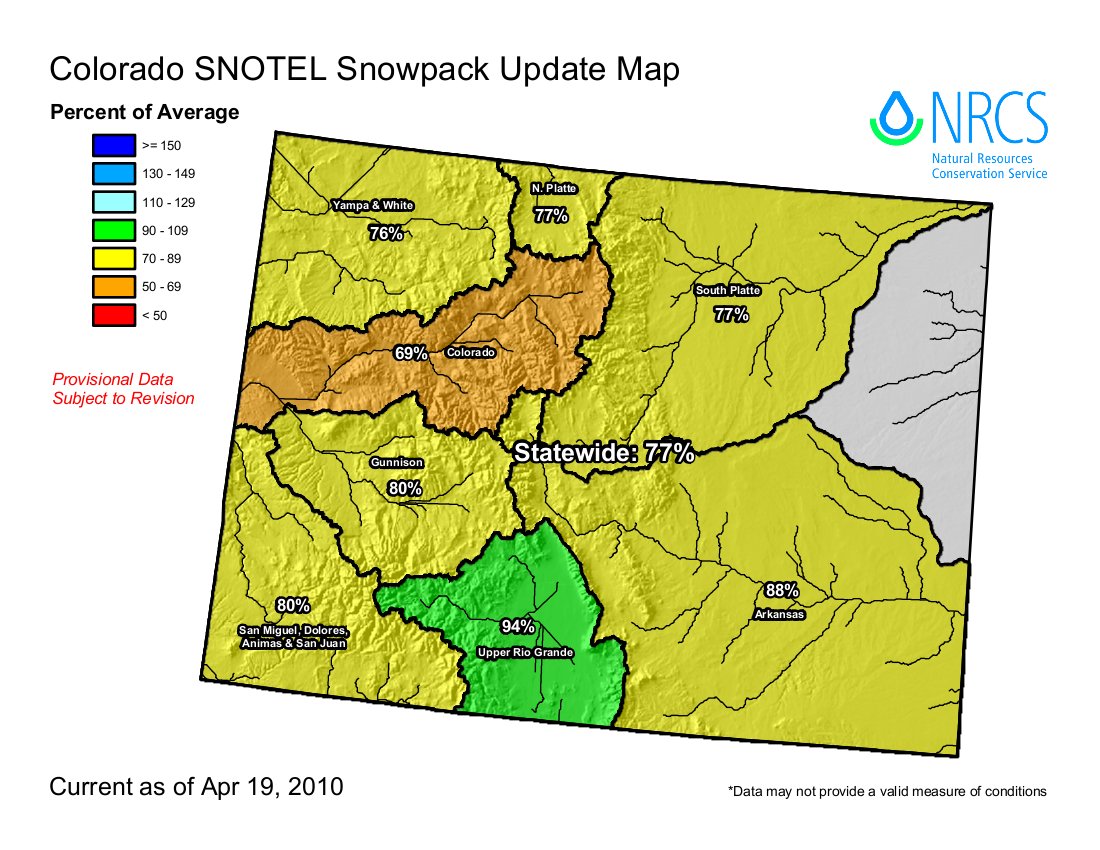
Mike Gillespie (NRCS) reported that snowpack in the South Platte Basin is well below average at 75% of average on April 20. The peak was 89% of average on April 9. Storage in the basin is at 102% of average.

Clear Creek and the Poudre River are expected to have below average runoff this season.

Klaus Wolter (University of Colorado) reported that, “El Nino is starting to founder…It probably peaked in January.” He said that Colorado can expect 1-2 inches of moisture over the next two weeks from two storms. The cool temperatures over the next two weeks, “will slow snowmelt.”

Thomas Ley (Colorado Division of Water Resources) reported that streamflow in the Poudre is dropping as is the South Platte at Kersey. He felt that the reason was probably an increase in diversions with the start of irrigation season.

Flood Risk

As at the March meeting the National Weather Service representative rates the risk of flooding from snowmelt as very low. Conditions, “are not indicating any flooding due to snowpack.”

A representative from the Colorado Water Conservation Board asked all municipalities to send comments on the proposed new floodplain rules. Here’s the link: http://cwcb.state.co.us/NR/rdonlyres/98D13420-A1B5-4910-8EA2-345D2C53853A/0/FINALDRAFT2010Rules.pdf

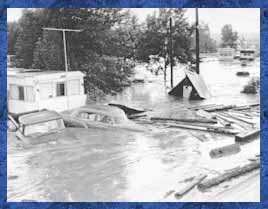
Doesken took the opportunity to remind people that flooding does not always depend on high runoff in the streams. He said that Colorado’s largest flood occurred in 1999 (Pueblo County?) on April 30 in what had been a very dry year.

The CWCB flood threat webpage (http://www.hdrwebprojects.com/COSWP/) is still not active but CWCB staff indicated it would be up and running by May 1.

More CWCB coverage here.

U.S. Environmental Protection Agency Administrator Lisa P. Jackson announces President Barack Obama’s selection of James B. Martin to be the Agency’s Regional Administrator for EPA’s Region 8

A picture named eparegion8.jpg

Here’s the release from EPA Region 8:

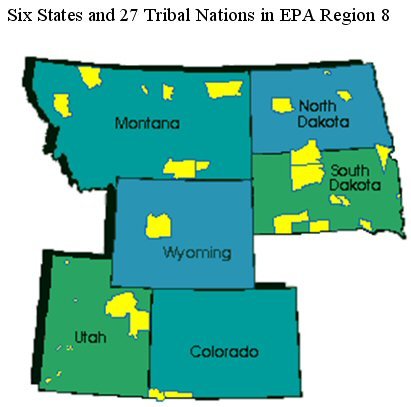
Today, U.S. Environmental Protection Agency Administrator Lisa P. Jackson announced President Barack Obama’s selection of James B. Martin to be the Agency’s Regional Administrator for EPA’s Region 8. This region encompasses Colorado, Montana, North Dakota, South Dakota, Utah, Wyoming and 27 Tribal Nations.

“I look forward to working closely with James Martin on the range of urgent environmental issues we face, in Region 8 and across the nation,” said EPA Administrator Lisa P. Jackson. “At this moment of great challenge and even greater opportunity, I’m thrilled that James will be part of our leadership team at EPA. He will certainly play an instrumental role in our Agency’s mission to protect our health and the environment.”

Regional Administrators are responsible for managing the Agency’s regional activities under the direction of the EPA Administrator. They promote state and local environmental protection efforts and serve as a liaison to state and local government officials. Regional Administrators are tasked with ensuring EPA’s efforts to address the environmental crises of today are rooted in three fundamental values: science-based policies and programs, adherence to the rule of law, and transparency.

James B. Martin has worked in the environmental field for more than 20 years, most of them spent in Colorado. He most recently was the Executive Director of the Colorado Department of Natural Resources, managing and administering a department of more than 2,000 employees that oversee the state’s environmental protection policies. He was also the Executive Director of the Colorado Department of Public Health and Environment. There he managed an organization of 1,225 employees with a budget of $470 million, with responsibility over both state environmental and public health programs. From 2005 to 2007, he managed a non-profit organization that focuses on energy, public lands, and water issues. In 2004, he headed the Natural Resources Law Center at the University of Colorado School of Law where he managed an interdisciplinary public policy think tank with a staff of lawyers, economists and scientists. He also taught advanced seminars on energy law and policy and land use planning. Martin spent a decade as the senior attorney for the Environmental Defense Fund in Boulder, Colorado and Oakland, California. Earlier in his career, he was State Director for then U.S. Senator Tim Wirth. He earned his bachelor’s degree from Knox College and his J.D. from Northwestern Law School, Lewis and Clark College.

Reclamation: Stimulus funds to pay for Flatiron Powerplant penstocks maintenance

A picture named hydroelectricdam.jpg

Here’s the release from Reclamation (Kara Lamb):

The Department of the Interior announced today that the Bureau of Reclamation has awarded $12.2 million to contractor Abhe & Svoboda for the recoating of the Flatiron penstocks above Flatiron Powerplant in Loveland, Colo.

The work is being conducted under the American Recovery and Reinvestment Act as part of the package awarded to the Department of the Interior, including the Bureau of Reclamation. Reclamation received $1 billion of ARRA funding to restore aging infrastructure, repair aging dams, provide drought relief, and improve conservation of water across its five-region service area of the 17 Western United States.

“This contract will improve power plant efficiencies at the Colorado-Big Thompson Project,” Secretary of the Interior Ken Salazar said. “Recovery Act dollars are making a difference, not only updating aging infrastructures, but also putting Americans to work.”

The Flatiron Penstocks are an integral part of Reclamation’s Colorado-Big Thompson Project, in the Great Plains Region. The C-BT provides supplemental water to approximately 720,000 people in northeastern Colorado and generates hydroelectric power though a series of six power plants.

The protective coating on the penstocks is over 50 years old and in need of replacement. Recoating the penstocks includes removing the old paint from the exterior and interior of the pipes. In addition, new ultrasonic flow meters will be installed that will improve power plant efficiency.

The American Recovery and Reinvestment Act passed in 2009 gave $3 billion to the Department of the Interior.

The ARRA funds represent an important component of the President’s plan to jumpstart the economy and put a down payment on addressing long-neglected challenges so the country can thrive in the 21st century. Under the ARRA, Interior is making an investment in conserving America’s timeless treasures – our stunning natural landscapes, our monuments to liberty, the icons of our culture and heritage – while helping American families and their communities prosper again. Interior is also focusing on renewable energy projects, the needs of American Indians, employing youth and promoting community service.
“With its investments of Recovery Act funds, the Department of the Interior and its bureaus are putting people to work today to make improvements that will benefit the environment and the region for many years to come,” Secretary Salazar said.

Secretary Salazar has pledged unprecedented levels of transparency and accountability in the implementation of the Department’s economic recovery projects. The public will be able to follow the progress of each project on http://www.recovery.gov and on http://www.interior.gov/recovery. Secretary Salazar has appointed a Senior Advisor for Economic Recovery, Chris Henderson, and an Interior Economic Recovery Task Force to work closely with Interior’s Inspector General and ensure the recovery program is meeting the high standards for accountability, responsibility, and transparency set by President Obama.

More coverage from the Loveland Reporter-Herald. From the article:

The penstocks are large pipes that carry water from Pinewood Reservoir to the power plant behind Carter Lake, as part of the Colorado-Big Thompson water project, which provides water and power in northeastern Colorado. Lamb said the protective coating on the penstocks is more than 50 years old and in need of replacement. The contractor will remove the old paint from the exterior and interior of the penstock pipes, repaint them and install new ultrasonic flow meters to measure water flow and improve power plant efficiency.

More Colorado-Big Thompson Project coverage here.

Centennial Water & Sanitation District names Tim Gotheer as Director of Operations

A picture named southplattereservoir.jpg

Here’s the release from the district:

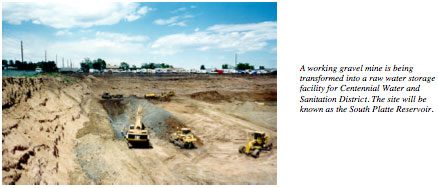
Centennial Water & Sanitation District has named Tim Grotheer as Director of Operations. Grotheer will oversee operations of the water and wastewater plants that serve Highlands Ranch.

Grotheer brings 21 years of responsibility for all aspects of operations, maintenance, and administration of the Plum Creek Wastewater Authority (PCWA) in Douglas County. Duringhis tenure, PCWA received the Environmental Protection Agency’s Region VIII award for Excellence in Operations and Maintenance in 1994, and the National Award for Excellence in Operations and Maintenance from the EPA in 2000.

“Tim brings a long history of plant operations through his prior role as manager of the PCWA. He has been active in several regional organizations focused on water quality. His most recent role was managing a major construction contract for the Aurora Reservoir Water Purification Facility as an employee of Carollo Engineers,” said Centennial Water General Manager John Hendrick.

Grotheer gained familiarity with Centennial Water through his leadership in the Pankake Ranch land application project. He will be responsible for both water and wastewater plant operations in addition to other department leadership and administrative functions.

Grotheer is a graduate of Southern Illinois University with a BS in Industrial Technology. He earned an MS in Management from Regis University, and holds certifications in water and wastewater treatment, and water distribution and collection systems. Grotheer has been a member of the board and is also a past chair of the Chatfield Watershed Authority, and for four years chaired the Colorado Wastewater Utility Council. He served 10 years on the Colorado Water and Wastewater Plant Operator’s Certification Board and is involved in a number of water and wastewater organizations.

Over the past 30 years, Centennial Water has built a reliable and highly-respected water portfolio, based on a conjunctive use system, to serve its customers. Its major water source is surface water from the South Platte River, supplemented with groundwater from deep aquifer wells throughout Highlands Ranch.

For more information about Centennial Water & Sanitation District, which serves Highlands Ranch, please visit http://www.highlandsranch.org, or call 303-791-0430.

More South Platte River Basin coverage here.

Marty Richardson named executive director of Friends of the Lower Blue River

A picture named blueriver.jpg

From the Summit Daily News (Julie Sutor):

Richardson took over as the local conservation organization’s executive director on March 30. In her new role, she will represent the nonprofit’s 150 dues-paying members in their efforts to protect the rural character and environmental values of the Lower Blue Valley, which stretches from Dillon Reservoir to the Colorado River near Kremmling…

Now among FLBR’s top issues is a proposal for improvements to Green Mountain Reservoir’s campground and boating facilities by the U.S. Forest Service. “We are really wanting to watch that whatever improvements are made at the reservoir are consistent with the Lower Blue Planning Commission and Friends of the Lower Blue objectives to preserve the rural character of the valley,” Richardson said.

More Blue River watershed coverage here.

State Representative Sal Pace may introduce another basin mitigation bill

A picture named arkbasinditchsystem.jpg

From The Pueblo Chieftain (Chris Woodka):

Last month, Pace queried the IBCC about what efforts it has undertaken to assure districts of origin aren’t harmed in water transfers. Last week, Eric Hecox, section chief for water supply planning of the Colorado Water Conservation Board, answered.

Hecox’s letter cited two examples of how the IBCC is addressing the transfer issue. One was a discussion of issues surrounding movement of water between basins and between uses. The other was a transfer committee of the Arkansas Basin Roundtable, which produced a report on the concerns associated with transfers of water from agricultural to urban uses, particularly in municipalities outside the basin. “The work of the Interbasin Compact Committee and Basin Roundtables is creating trust between parties and identifying solutions to our state’s water supply challenges,” Hecox’s letter stated.

“I was disappointed in their response,” [state Rep. Sal Pace] said. “They’re nowhere close, by their own admission, to brokering substantial mitigation for water transfers…

Pace said the roundtables’ work on transfer mitigation was the key to his bill’s defeat, because lawmakers had the impression that the matter was in hand. If it’s not, he said, another run at legislation may be in order next session. “I would consider bringing the bill back because so many legislators thought work was being done, that we now know clearly isn’t,” Pace said.

More IBCC — Basin roundtable coverage here. More HB 1-=1159 coverage here.

Colorado’s water efficient appliances rebate website swamped on first day

A picture named waterefficientwashingmachine.jpg

From the Boulder Daily Camera (John Aguilar):

An enthusiastic response Monday to the beginning of Colorado’s energy-efficient appliances rebate program spurred some complaints from Boulder County consumers who had trouble getting through on the state’s Web site and toll-free line to claim the popular rebate…

Todd Hartman, spokesman for the Governor’s Energy Office, said there had been “hiccups” throughout the day with spiking traffic on the state’s site — rechargecolorado.com — bogging it down since it opened for business at 8 a.m. But he said the site never crashed. Periodically throughout the day, the Governor’s Energy Office stripped its site of its usual content and dedicated it solely to the rebate program to expedite the flow of traffic, Hartman said.

The state’s program, dubbed Recharge Colorado, was created from federal economic stimulus money and aims to give Colorado $18 million in rebate funds, the bulk of which is earmarked for the larger-scale energy-efficiency projects like solar and wind installations. It is loosely modeled after the popular Cash for Clunkers automobile rebate program that ran last year, except that it doesn’t require that people trade in their old appliances. The most popular part of the program, which amounts to $4.5 million of the total Colorado received, is dedicated to the appliance rebates. Of that, 14,000 rebates worth $1.25 million were made available for the purchase of common household appliances — fridges, washing machines and dishwashers — that meet a certain energy-efficiency standard. Around 9,000 rebates worth $3.25 million cover energy-efficient boilers, hot-water tanks and furnaces. Hartman said about 8,500 rebates for all appliances were claimed by Monday evening, leaving around 14,000 rebates still available. He said the rebates would probably all be claimed by Wednesday. “They will go fast,” he said.

More conservation coverage here.

Snowpack news: Dust covers accelerates runoff

A picture named snowpackcolorado04202010.jpg

From The Denver Post (Scott Willoughby):

As the Aspen/Snowmass director of community and environmental responsibility, Schendler’s concerns for the disconcerting dust and dirt layers that have blanketed the slopes of his local ski areas along with mountains throughout the state this spring are considerably more comprehensive. And like so many observers of the reddish-brown dust layers that seem to be playing a more prominent — if not permanent — role in Colorado’s precious spring snowpack, he has more questions than answers. “There’s no question that it’s happening. But there’s always been dust out there, so has this always happened? Is it getting worse? All we know for sure is that it’s really bad,” Schendler said. “Our CEO has come into my office after these storms very agitated and said, ‘Auden, climate change may put us out of business eventually, but this is right now and this is a serious problem.’ Essentially your product is damaged.”

Along with its spectacular mountain scenery, Colorado’s most prized commodity arguably is its snow. Skiers and snowboarders are drawn by the millions annually to sample the celebrated snows of the Colorado Rockies, followed in spring and summer months by whitewater rafters, kayakers and fishermen savoring the snowmelt-fed rivers and streams. That’s not to mention the millions who depend upon the fresh water supply simply for survival…

Thanks to scientific studies conducted by former Coloradan Tom Painter at the Snow Optics Laboratory at the University of Utah, this much is known: In 2005 and 2006, dust-covered snow melted up to 35 days earlier than a purely clean snowpack would have in Colorado’s San Juan Mountains. Last year — which included 12 measurable winter/spring dust storms — snow melted 48 days earlier in the same area…

[Jeff Deems, a research scientist at the NOAA Western Water Assessment and the National Snow and Ice Data Center at the University of Colorado in Boulder said,] “…the biggest impact is hydrologic. We’re seeing earlier and faster runoff, which makes it harder to manage resources. In the West, we depend on the snowpack as a reservoir. We can store a lot more water in the snowpack than in our surface reservoirs. If you melt everything off a month early and melt it off faster, that’s a big challenge for water managers.”[…]

As for the origin of the dust episodes impacting the Colorado snowpack, the scientists have that one figured out. Collaborating with Chris Landry at the Center for Snow and Avalanche Studies in Silverton, Painter and Deems examine the effects of the dust events on the snowpack. Using satellite observations and weather modeling tools, they have traced the origin of the dust to the Colorado Plateau in the Four Corners region, where impacts of years of disturbance of the fragile desert topsoil have created large quantities of dust just waiting for a strong wind to carry it away. “Basically any activity that disturbs the soil crust and vegetation in the desert causes dust,” Deems said. “When we go out and disturb it — whether by drilling, plowing, driving, cow’s hooves, mountain bikes or feet — then all of the sudden the dust is ready to be blown away by the next wind storm.”[…]

For Schendler and those who depend on snow, the ultimate question remains: What can be done to stop it? “Recognizing the driving mechanism, that topsoil disturbance, is the key. Looking for solutions that minimize and reduce the disturbance to desert dust-emitting regions, that’s the overarching goal,” Deems said. “As recreationists enjoying the desert, it’s a matter of awareness, paying attention to public land use issues, as well as being careful about where we camp and how we travel, minimizing our impact on the land. Just some common sense.”

Gunnison Tunnel update

A picture named gunnisontunnelnps.jpg

From email from Reclamation (Dan Crabtree):

Spring is officially here. The East Portal Road was officially opened for public access today, April 19th.

More Gunnison River Basin coverage here. More Uncompahgre River watershed coverage here.

Upper Arkansas Water Conservancy District: Four board seats up for grabs June 1

A picture named upperarkansasvalley.jpg

From The Mountain Mail:

Applications are being accepted for potential directors representing Division 2 and Division 3, (areas encompassed by School District R-32-J and R-31, both in Chaffee County, Division 4 (Custer County) and Division 5 (Fremont County School District RE-1). Any person 18 years or older owning property within the appropriate division of Upper Arkansas Water Conservancy District and residing within the division for which appointment is sought, is eligible. Applicants should have backgrounds reflecting agricultural, municipal, industrial and other interests in the beneficial use of water within the district.

Terms of office will commence June 1 for a four-year term expiring June 1, 2014…

Applicants should submit letters in writing describing desire and qualifications to be on the board. Application deadline will be May 2. Applications should be made to all of the following:

• The Honorable Charles M. Barton, Chief District Judge, 11th Judicial District, P.O. Box 279, Salida, CO 81201.

• The Honorable O. John Kuenhold, Chief District Judge, 12th Judicial District, Alamosa County Courthouse, 702 Fourth St., Alamosa, CO 81101.

• The Honorable Kirk S. Samelson, Chief District Judge, 4th Judicial District, P.O. Box 2980, Colorado Springs, CO 80903.

More Upper Arkansas Water Conservancy District coverage here and here.

Snowpack news: Runoff starting early?

A picture named snowpackcolorado04162010.jpg

From The Pueblo Chieftain (Chris Woodka):

“The runoff started Friday (April 9) and some sites are melting off,” said Roy Vaughan, manager of the Fryingpan-Arkansas Project for the Bureau of Reclamation…

Runoff has occurred earlier than historic records indicate for the past decade, and sometimes in an unusual way. Last year, there were three distinct runoffs through mid-June. The patterns — or lack of them — have required Reclamation to stay on top of imports into the Arkansas River basin from the Western Slope. “Our guys are setting up the system and should be ready to start sending water through the (Boustead) Tunnel shortly,” Vaughan said…

“There was a drastic warm-up in the Wet Mountain Valley, and the flow on Grape Creek went from 20 cubic feet per second to 700 cfs overnight,” said Steve Witte, Water Division 2 engineer…

…this year’s weather patterns look like other years where Reclamation has brought over an average amount of water — between 50,000 and 55,000 acre-feet — so there should be ample water to bring over. There is plenty of space to store the water in Turquoise and Twin Lakes as water was moved to Lake Pueblo over the winter months, Vaughan said. Reclamation was granted a waiver Thursday by the Army Corps of Engineers to continue storing water in Lake Pueblo because snowpack is below average. The waiver allows for storage of up to 10,000 acre-feet in the portion of the reservoir normally reserved for flood control after April 15. The move allowed storage of more than 6,400 acre-feet that otherwise would have been evacuated, Vaughan said. By May 1, as more water is stored, used and evaporates, the current level in Lake Pueblo, 263,000 acre-feet should drop by about 10,000 acre-feet.

Yampa River: Rusty crayfish invade headwaters

A picture named rustycrayfish.jpg

From the Summit Daily News (Julie Sutor):

[Colorado Division of Wildlife] officials have identified rusty crayfish (Orconectes rusticus) in the headwaters of the Yampa River, prompting an immediate closure to the take of live crayfish from the waters in the Yampa River basin. Crayfish, also known as “crawdads,” are a popular bait and food item. It is not uncommon to find people collecting the animals from Colorado waters. Rusty crayfish are an aggressive species native to the Ohio River basin in the upper Midwest, but human activity has moved them throughout the northeast and into southern Canada. The discovery of rusty crayfish in the Yampa basin is a first in Colorado. Because of their large size and aggressive nature, rusty crayfish can impact fish populations by consuming small fish and fish eggs. The species can also negatively impact fish and spread unwanted aquatic plants by aggressively harvesting underwater plant beds. “They’re not selective in their feeding, so they’ll eat whatever fish eggs are there and whatever plants are there,” said Elizabeth Brown, Division of Wildlife aquatic nuisance species coordinator. “Any native species is at risk for food-web disruption from these critters.”

More invasive species coverage here.

CWCB: The board postpones new floodplain rulemaking session until November

A picture named southplatteflood.jpg

From The Greeley Tribune (Bill Jackson):

The Colorado Water Conservation Board had planned a rulemaking session on the plan to expand flood plains in the state from 100-year-flood to 500-year-flood level next month. But Tom Browning, chief for the board’s watershed protection and flood mitigation section, said that has been put off until November because of concerns expressed by officials statewide. And while he confirmed that there are some “proposed rules” for the state’s flood plains, he did not offer details.

Development may suffer in Severance if the new rules are drawn as planned, according to a report from Sherrie Peif writing for The Greeley Tribune. From the article:

For the past 18 months, Severance has dealt with a flood plain expansion from the Federal Emergency Management Agency. That expansion cut a path through town, essentially throwing its comprehensive growth plan in the trash. Now, with the additional proposed regulations from the Colorado Water Conservation Board, Severance may not be able to be developed at all.

More CWCB coverage here.

Southeastern Colorado Water Conservancy District water court update

A picture named arkbasinditchsystem.jpg

From The Pueblo Chieftain (Chris Woodka):

“The district has concerns about the use of winter water and the Fryingpan-Arkansas facilities,” said Bob Hamilton, engineering supervisor. The district also wants to protect its own exchange application in connection with the Arkansas Valley Conduit, Hamilton said. The board voted unanimously to oppose the application…

A filing in Water Court does not necessarily mean complete opposition to an application, but is often used as a stepping stone to a negotiated settlement between parties to prevent injury to existing water rights.

The board also voted unanimously to oppose an application by Pioneer Natural Gas and other companies drilling for coal-bed methane in the Raton Basin near Trinidad. The application seeks to settle issues surrounding produced water from drilling. Methane is trapped in coal seams below the ground and in the first stages of drilling water is produced…

Southeastern has filed to make sure the determination of non-tributary wells listed in the application is accurate and that the new water rights would not violate the Arkansas River Compact with Kansas, Hamilton said.

The district will settle with applicants in two other cases, in lieu of obtaining conditions applied to past court decrees settled by the district. Those involved Stratmoor Hills and Rocky Ford conversion of former ditch water rights to municipal use.

The board also took action to shore up its own water rights, agreeing to file for due diligence on conditional Eastern Slope rights. Last year, the district filed a due-diligence application on its Western Slope water rights, said attorney Steve Leonhardt.

More Arkansas River Basin coverage here.

Energy policy — nuclear: Schwartzwalder Mine uranium tainted water threatens Ralston Creek/Ralston Reservoir

A picture named nukeplantcattenomfrance.jpg

From the Cañon City Daily Record (Rachel Alexander):

Groundwater near the Schwartzwalder Mine contains uranium levels that are 1,000 times higher than the human health standards, according to an Associated Press article. The contaminated groundwater is near Ralston Creek, which flows into Ralston Resevoir. The resevoir supplies water to Denver and Arvada.

John Hamrick, Cotter’s vice president of milling, said the company had been working with the Department of Reclamation and Mining Safety to address the issue. “We have a plan that is due to them Monday about different remedial alternatives,” Hamrick said. The mine is located north and west of Golden. Hamrick said it started operations in the 1950s and was closed in 2000.

He said there were three parts to the mine when it was in operation: the underground mine, an ore sorter and a water treatment plant for water used in the mining operation. The company has a license through the Colorado Department of Public Health and Environment for the ore sorter and water treatment plant. “We’re in the final process of terminating that license,” he said…

Hamrick said the groundwater flow from the creek goes through waste rock from the mine and that is probably where it is picking up uranium. While the mine itself has water in it, that water level is steady. “We do not think that the mine water is getting into the creek,” he said.

Here’s some history for the mine from Wikipedia:

In 1949 janitor and weekend prospector Fred Schwartzwalder discovered uranium at an abandoned copper prospect in Jefferson County about ten miles northeast of Central City and eight miles north of Golden. The deposit consists of Tertiary hydrothermal veins filling fracture zones oriented predominantly NNW-SSE in gneiss, schist, and quartzite of the Precambrian Idaho Springs Formation. The chief ore mineral is pitchblende, which occurs with adularia and ankerite. Schwartzwalder could interest no one in his discovery, so he drove the first adit of the Schwartzwalder mine by himself, made the first ore shipment in 1953, and sold the mine in 1955. The Schwartzwalder mine was the source of more than 99% of the uranium produced from the Front Range province. The mine operated until 1995, producing 17 million pounds (7700 metric tons) of uranium oxide. The mine is owned by General Atomics subsidiary the Cotter Corporation, which estimates that there are an additional 16 million pounds (7300 metric tons) of uranium oxide resource remaining in the mine.

More coverage from The Denver Post (Bruce Finley):

Uranium concentrations in groundwater 30 feet beneath the brim of the Schwartzwalder Mine exceed the human health standard for uranium by more than 1,000 times, according to state records reviewed Thursday. Unhealthy concentrations also were detected in Ralston Creek, which eventually enters Denver Water’s Ralston Reservoir. The reservoir supplies water to Denver and Arvada.

Denver Water managers say no uranium contamination has entered the drinking-water supply…

Neither Cotter nor the Colorado Department of Public Health and Environment, which is responsible for water quality, notified Denver Water. “It would have been nice to know,” said Brian Good, Denver Water’s manager of operations and maintenance. Denver Water now will increase testing for uranium, Good said, calling on Cotter to clean it up. Because Denver’s Moffat water- treatment plant is closed for maintenance, no Ralston Reservoir water currently enters Denver’s drinking-water system, Good said. “Our water is safe,” he said, “but it’s a little bit troubling that (uranium) is coming into our reservoir in those concentrations.”[…]

Colorado’s Division of Reclamation, Mining and Safety “does not believe conditions requiring an emergency response currently exist. If they should arise, (the state) can require Cotter to pump and treat mine water to bring down levels and ensure groundwater is not jeopardized,” state spokesman Theo Stein said.

From the Associated Press via the Sky-Hi Daily News:

Cotter vice president John Hamrick says they’re considering several methods to deal with the contamination, including creating a wetland.

More nuclear coverage here and here.

Craig: Water treatment plant upgrades detailed

A picture named watertreatment.jpg

From the Craig Daily Press (Brian Smith):

…what [Craig Water and Wastewater Director Mark Sollenberger] is most proud of is not so much the advanced technology the plant uses to turn Yampa River water in to drinking water, but that he and his staff of four operators, one maintenance technician and Craig Public Works Director Bill Earley brainstormed and designed the upgrades they wanted. “We picked the technology ourselves because we knew how much funding we had,” Sollenberger said. “We came up with what we felt would be the best design and then we went to the engineers and said, ‘Here is what we think. Can you do it for us?’”[…]

The top upgrades the plant received include a new dissolved air flotation pretreatment system, an ultraviolet ray supplemental treatment process and increased water storage capacity. With the new upgrades, the water plant meets or exceeds all state standards and guidelines for necessary water capacity and sanitation. All told, the new upgrades have made the plant’s water much safer and faster in processing water, Sollenberger said. A gallon of water from the Yampa River once took up to eight hours to be processed. Now the plant can treat the same gallon in less than two hours. And the water hitting sinks in Craig is cleaner and safer than most bottled water, Sollenberger said…

…the new dissolved air floatation pretreatment system is the only one of its kind on the Western Slope and one of four in the state.

Sollenberger and his staff chose the system because of the unique nature of the water in the Yampa River. It works by introducing chemicals, which, when combined with the water, electrically charge and bond with dirt particles. Microbubbles of air then are pushed through the water and the particles float to the top of the tank and are slowly scraped away. The new air flotation system is an improvement from the old system, which relied on dirt particles sinking to the bottom of the tank because the water in the Yampa River is cold most of the year making it harder for particles to sink. The new upgrades also increased water storage capacities from six million gallons per day to 12 million gallons per day. The “extremely high powered” ultraviolet treatment serves as a supplemental treatment process and has a “higher kill rate” on parasites such as giardia. It also cuts down on some of the chlorine used to treat the water, which helps with the end taste, while still meeting state and federal sanitary guidelines.

More water treatment coverage here.

Snowpack news: Runoff starting early?

A picture named snowpackcolorado04162010.jpg

From The Colorado Springs Gazette (R. Scott Rappold):

For the second year in a row, heavy winds out of the south and west have coated the mountains – the source of Colorado Springs’ water – with a layer of reddish-brown dust from the deserts of Utah, Arizona and New Mexico. The dust absorbs heat from sunlight and melts the snow more quickly.

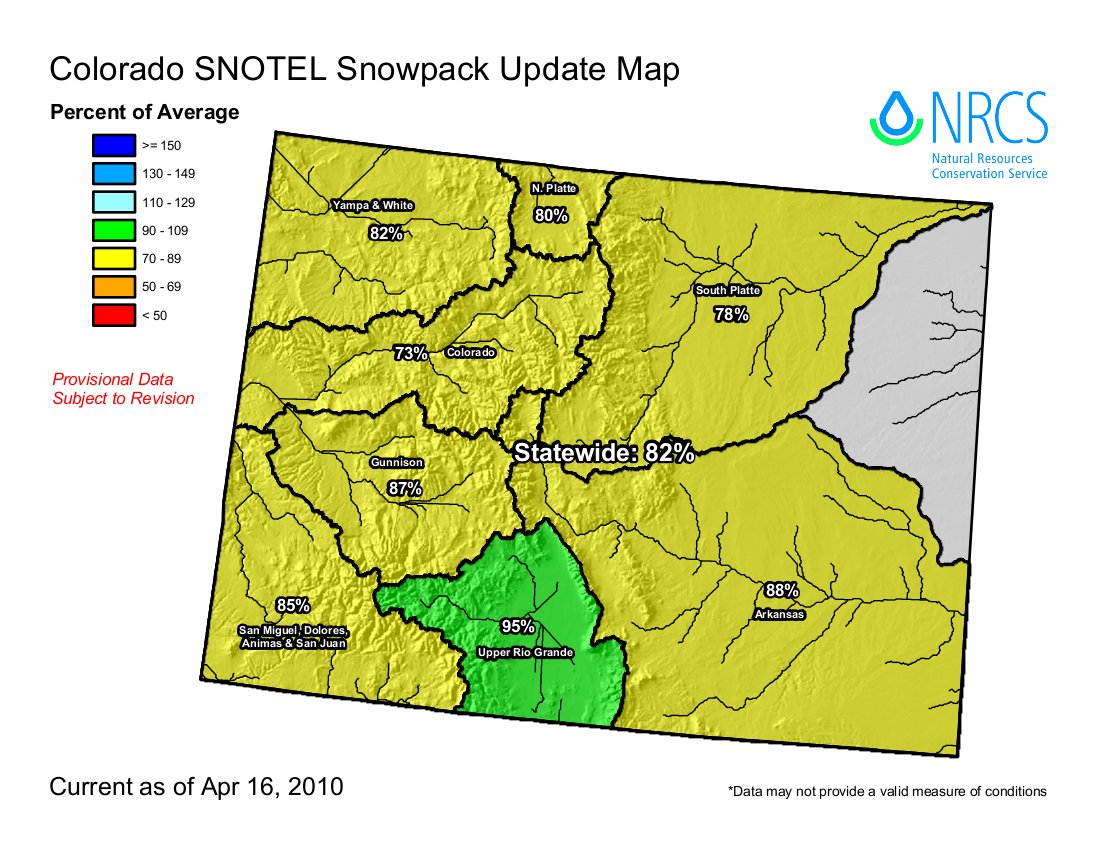
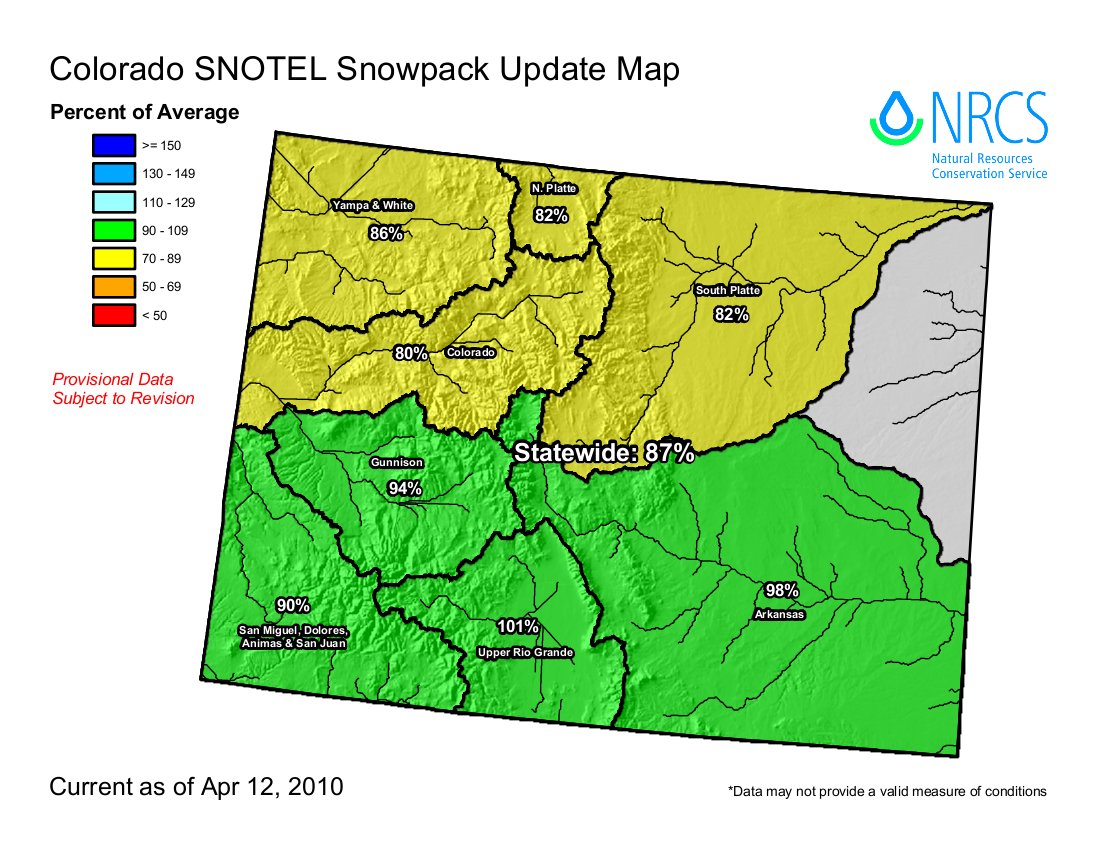
Snowpack in the Arkansas River Basin, 107 percent of average three weeks ago, was at 87 percent Friday. The Upper Colorado River Basin dropped from 78 to 73 percent of average in the same period. At the same time, river levels are rising. The flow of the Arkansas River near the mouth of the Royal Gorge doubled in the past week, from 400 cubic feet per second to 800. In southwest Colorado, melting snow combined with a fresh storm caused flooding fears for this weekend.

“The combination of the dust being on the surface (of the snow) and the warm air temperatures, we’re getting a pretty good surge,” said Kimberly Buck, assistant to the director of the Center for Snow and Avalanche Studies in Silverton…

[Colorado Springs] Utilities has reservoir space available to capture the runoff, he said. Utilities’ storage was at 79 percent of capacity at the end of March…

…there was good news in the forecast. A spring snowstorm Friday was expected to drop up to a foot in southwest Colorado and a few inches in the central mountains, enough to cover the dust.

Animas-La Plata Project: Colorado lawmakers give initial approval for state to buy project water

A picture named ridgesbasindam.jpg

From the Cortez Journal (Joe Hanel):

The $36 million idea would give the state up to 10,460 acre-feet in the reservoir, which it could then sell or lease to other water districts. The state could also keep the water as a hedge against a future legal demand from downstream states, said Jennifer Gimbel, director of the Colorado Water Conservation Board.

The Senate Agriculture and Natural Resources Committee unanimously accepted the idea as an amendment to House Bill 1250, the annual bill that authorizes water projects. The amendment gives the CWCB the power to buy into Animas-La Plata if it decides the move would make sense. “We want to make sure we have legitimate reasons before buying the water,” Gimbel said…

The U.S. Bureau of Reclamation, which built the dam, is willing to sell the water to the state in return for a share of the construction costs. The price works out to less than $3,400 an acre-foot. The Legislature has authorized projects for six times the cost per acre-foot, Whitehead said.

The CWCB is waiting on the results of a market study to see what it could do with the water. “What it’s worth is probably a lot more than what it costs,” Gimbel said.

From the Associated Press via the Sky-Hi Daily News:

Lawmakers gave intial approval to a plan for the state to buy up to 10,460 acre feet of water for $36 million from the Animas-La Plata project. The plan given the intial approval Thursday now goes to the Senate Appropriations Committee.

More Animas River watershed coverage here.

Southern Delivery System: Colorado Springs Utilities names some contractors

A picture named sdspreferredalternative.jpg

From The Pueblo Chieftain (Chris Woodka):

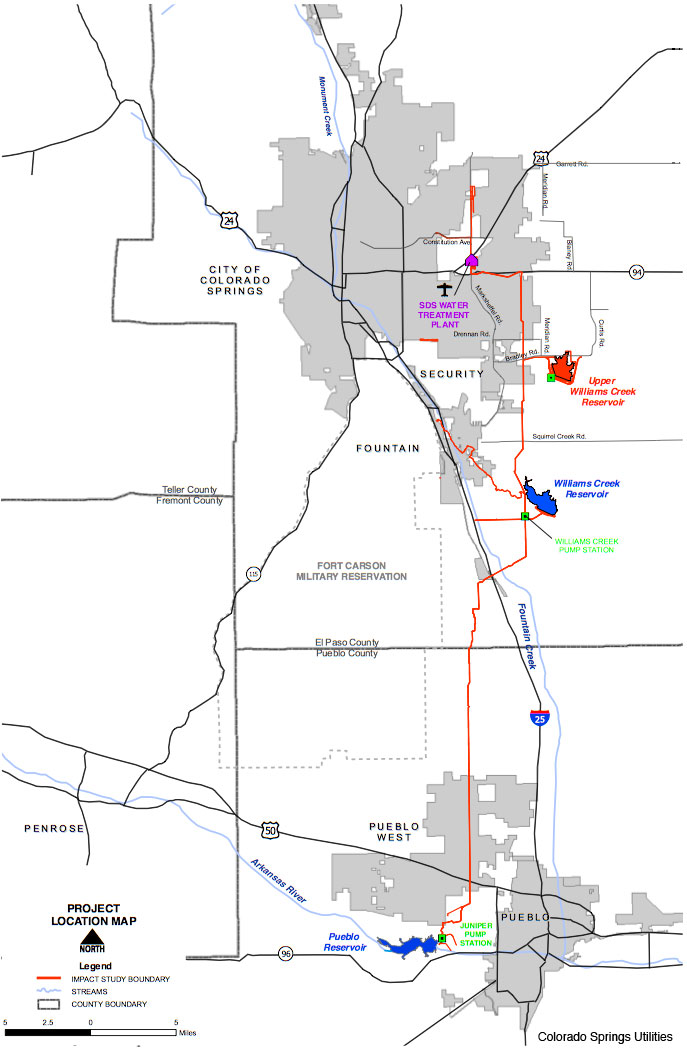
ASI Constructors of Pueblo West has been chosen as the primary contractor for the North Outlet Works connection to Pueblo Dam as part of the Southern Delivery System. The contract will be for roughly $6 million, but negotiations are still continuing, according to Colorado Springs Utilities. Other area subcontractors were also chosen, including High Country Pipeline of Fremont County, Transit Mix of Pueblo and Springs Fabrication and Rocky Mountain Crane Service of Colorado Springs…

Construction cannot begin until the Bureau of Reclamation approves a contract to use the dam for SDS. Pueblo Dam was constructed in the early 1970s as part of the Fryingpan-Arkansas Project and Colorado Springs must get approval to hook up to the dam and build a pumping station on federal property. Contracts also are needed for conveyance and exchange for Lake Pueblo in order for SDS construction to begin…

Once Colorado Springs obtains contracts, it would take about one year to complete the dam connection. [Lee Schermerhorn, vice president of ASI Constructors] said the first step in the project would be to use a crane on a barge and divers to install a bulkhead upstream of Pueblo Dam on the river outlet. Water would be diverted through another outlet on the face of the dam during construction. “That will provide extra safety to the workers in the tunnel during construction,” Schermerhorn said.

After that, a 30-foot cube of concrete would be installed upstream of the dam, where releases over the past 35 years have cut a deep pool by the face of the dam. Finally, a manifold that could direct flows to the river, the SDS pumping station and a future cross-connection to the joint use manifold would be built. “It’s a neat job,” Schermerhorn said.

More Southern Delivery System coverage here and here.

Brighton: The Metropolitan Wastewater Reclamation District briefs residents about plans for new regional wastewater treatment plant

A picture named wastewatertreatmentwtext.jpg

From the Brighton Standard Blade (Gene Sears):

The public meeting, hosted by representatives from the Metro Wastewater Reclamation District, was a dissemination of plans for the facility, slated for construction near the intersection of U.S. Highway 85 and Weld County Road 2. Representatives answered questions for the 100 or so attendees who wandered in and out of the recreation center. A crew of Metro Wastewater staffers and public relations contractors displayed placards detailing plant construction, location, environmental impacts and the service area for the plant, scheduled to open in 2015…

In a project overview published last month, Metro Wastewater District noted that communities in the northern metropolitan area need updated and expanded water treatment, as existing facilities are pushing capacity limits. The district claims the new $220 million facility is more cost effective and efficient than upgrading current facilities and will benefit area communities by eliminating seven neighborhood lift stations. In preparation for the upgrade, the Metro Wastewater Reclamation District sold $250 million in sewer improvement bonds in August in New York. The bond issue included $63 million in tax-exempt bonds and $187 million in taxable Build America Bonds, which are available through the American Recovery and Reinvestment Act. A portion of the bonds will directly finance the new plant.

The road to building the plant has been a long and bumpy one, beginning with talks more than a decade ago. It nearly failed when plans assembled under the original 2005 partnership – known as the Regional Wastewater Treatment Plant Authority and consisting of three members from each Brighton, South Adams County Water and Sanitation District and the Metro Wastewater Reclamation District – dissolved in disagreement. Brighton subsquently signed on with MWRD as a member entity. The new plant will effectively treat 22 to 26 million gallons of water per day at full operating capacity. Brighton’s current wastewater facility treats 2.3 million gallons per day.

Rather than face large capital expenditures for a new Brighton-owned plant, the city will simply pay tap fees like every other municipality in the district. Tap fees are the charge for hooking homes and businesses up to a water and sewer system and are typically paid by developers, who in turn roll them into the cost of the home or business.

More wastewater coverage here.

Fort Lupton: Water line replacement

A picture named fountainpavementdrawing.jpg

From the Fort Lupton Press:

Construction is expected to begin next week on a waterline replacement project on Fourth Street between Grand and McKinley avenues. Chris Zadel, of Fort Lupton’s Northern Colorado Constructors, said the firm expects to begin work on or around April 19. The project will include the installation of a new 8-inch waterline, milling of existing asphalt and overlay with new asphalt on Fourth Street from Grand Avenue east to McKinley Avenue. Northern Colorado Constructors was awarded the project through the citybidding process.

More infrastructure coverage here.

Colorado River District board meeting April 20, CRWAS public review period extended to July 21, 2010

A picture named coloradorivergranby.jpg

From email from the Colorado River District (Martha Moore):

Second Regular Quarterly Meeting of the Board of Directors of the Colorado River Water Conservation District, Hotel Colorado, 526 Pine Street, Glenwood Springs, CO

Here’s the link to the website. I couldn’t find the agenda posted there.

From email from the Colorado Water Conservation Board:

The Colorado River Water Availability Study (CRWAS) Phase 1 Draft Report public review period has been extended an additional 30 days for a total of 120 days. The new comment period end date is July 21, 2010.

The Colorado River Water Availability Study (CRWAS) is available for public review on the CWCB website. We value your input; please send your comments to Ray Alvarado (ray.alvarado@state.co.us).

More Colorado River Basin coverage here.

CWCB: Board meeting May 18-19

A picture named spinneymountainreservoir.jpg

From email from the Colorado Water Conservation Board:

Notice is hereby given that a meeting of the Colorado Water Conservation Board (CWCB) will be held on Tuesday, May 18, 2010, commencing at 8:00 a.m. and continuing through Wednesday, May 19, 2010. This meeting will be held at 1580 Logan Street, Suite 610, Denver, CO 80203…

Complete information about these activities can be found on CWCB’s Website: www.cwcb.state.co.us.

More CWCB coverage here.

HB 10-1188 (Clarify River Outfitter Navigation Right): Colorado Water Congress’ role

A picture named coloradocapitolfront.jpg

Here’s an opinion piece penned by Charles White running in The Denver Post. Mr. White maintains that the CWC is the right organization to help shepherd the bill. From the article:

The Colorado Senate made the right decision in referring the contentious proposal to establish a “right to float” on the state’s waterways to the Colorado Water Congress. This was not, as suggested by The Post, a “punt” of the issues. Rather, it was a realistic recognition that more work is needed to address the serious flaws in the original bill. Under House Bill 1188…

The Colorado Water Congress is ideally suited to address each of these issues. Since 1957, it has brought divergent interest groups together to study, negotiate, and propose legislation on a wide variety of topics related to Colorado water. The CWC would convene a broadly representative panel to make recommendations for new legislation that could have much broader public support. This common-sense solution to the current impasse deserves The Post’s endorsement.

More HB 10-1188 coverage here.

Energy policy — nuclear: Colorado Mined Land Recreation Board uranium mining rules public meeting recap

A picture named uraniuminsituleaching.jpg

From the Loveland Reporter-Herald (Tom Hacker):

The seven-member Colorado Mined Land Reclamation Board rented a spacious conference room at the Embassy Suites Hotel in Loveland, believing that controversy surrounding a uranium mining proposal in Northern Colorado would drive attendance. But two hours into the hearing, billed to run 1-9 p.m., only four people had shown up to offer testimony in the room that would accommodate more than 150. “I’m shocked,” board chairwoman Catherine Kraeger-Rovey said in an interview after declaring a recess following the four brief comments. “I was sure there would be more than this,” she said. “Where are they? I should have brought a book.” But by 5 p.m., the room had nearly filled with opponents of a Canadian mining company’s plan for a large mining operation in northwestern Weld County near Wellington…

“It’s not that I oppose nuclear power, or that I oppose mining,” Fort Collins resident John Dixon said. “This is about quality of the groundwater contained in an aquifer that’s within 15 miles of a population of 300,000 people.” Dixon said Powertech had failed in its assurances that groundwater quality would not be harmed during the mining process, nor in the early prospecting operations that pull water out of test bore holes to measure uranium content…

The reclamation board will gather public input in other Colorado communities affected by uranium development, including Grand Junction and Salida, and conclude its public comment period in Denver in June. The board will issue rules in July following hearings.

More coverage from the Fort Collins Coloradoan (Bobby Magill):

Uranium mining proponents lambasted state mining regulators Thursday for attempting to stall any attempt to mine uranium in Northern Colorado, while others accused the mining industry of trying to weaken proposed uranium mining regulations…

The Colorado Mined Land Reclamation Board’s proposed rules will govern how Powertech Uranium Inc. and other companies will be able to mine using a process called in situ leaching, or ISL mining. Powertech is proposing to open such a mine in Weld County, a few miles northeast of Fort Collins at the company’s Centennial Project site. The proposed rules will implement a 2009 state law requiring uranium mining companies to fully clean up groundwater near their mine sites after mining is complete. The rules are also expected to provide a measure of transparency to the uranium prospecting process and implement other environmental safeguards…

“This in situ mining is a great opportunity,” said Bill Bibbey of Greeley, who called the proposed rules onerous and too restrictive for mining companies. Comparing the rules to the recently-passed federal health-care bill, Bibbey said they’re full of pages of “stuff” meant to stall the mining process.

Likewise, University of Denver law professor and former uranium geologist K.K. DuVivier said in situ leach mining is a much cleaner method of extracting uranium than the underground mining methods used elsewhere in the West. Uranium, she said, is likely already in groundwater, and extracting it via in situ leaching won’t necessarily make water quality any worse. “I would just like to specifically say I have some concern about rules that really don’t help with monitoring the water, that are just there to delay things, to make it economically infeasible for Powertech to come in,” she said…

Cañon City resident Kay Hockley said she’s afraid that mining companies prospecting for uranium won’t be held to the same environmental standards as oil and gas explorers under the new rules. The rules, she said, don’t require companies to measure how pristine groundwater is prior to prospecting, preventing regulators and water well owners from ever knowing the true extent to which the mining companies have contaminated the groundwater.

More coverage from The Greeley Tribune (Colin Lindenmayer):

[Wallace Mays], the chief operating officer, chairman and director of Powertech USA, made a rare appearance Thursday at one of the many gatherings where residents have expressed opinions about the proposed uranium mine Mays hopes to build near Nunn. In his southern accent — Mays is from Texas — he explained he wanted to hear what the locals were saying about his company…

After three more public hearings hosted by the Colorado Mined Land Reclamation Board, Mays will have an opportunity to share his thoughts on the situation, which so far has raised loud opinions from several angles.

More nuclear coverage here and here.

Wiggins: Town augmentation project update

A picture named wetlandspondgrass.jpg

From The Fort Morgan Times (Dan Barker):

Holbrook said a biological assessment of the water project was sent to the U.S. Fish and Wildlife Service, but it will take three to four weeks before the agency will send a letter to USDA on its findings. It would then take four to eight weeks for Industrial Facilities Engineering to put together bid-ready design documents for the USDA to look at, he said. Unfortunately, a representative of USDA said that even after the Wildlife Service approved the report the town must publish the report and wait for 30 days for any response, said Town Clerk Craig Trautwein. Then there must be a finding of no significant impact on the environment, which could take another 15 days. These waits for agencies could hinder the construction end date, because it sounds like it could take months before Industrial Facilities Engineering gets the go-ahead to do the final process design report to submit to USDA, Longcor said.

However, all of this waiting will be worth it for a potentially nice grant and a 40-year loan, Holbrook said. Wiggins Town Administrator Bill Rogers said parts of the project could run concurrently, which means the pumping station could be built at the same time as sections of the pipeline and various sections of the pipeline could be built simultaneously to keep the project on schedule.

More Wiggins coverage here and here.

Custer County: Round Mountain board elections

A picture named wetmountainvalley.jpg

From The Wet Mountain Tribune (Nora Drenner):

The special district election will be held Tuesday, May 4, with the polls open from 7 a.m. to 7 p.m. at the county courthouse on that day. Those wishing to receive a ballot in the mail have until April 28 to submit a request, if the ballot is to be mailed. The cut-off date to request a mail-in ballot that the voter is going to pick-up at the courthouse is April 30.

Click through to read Ms. Drenner’s candidate profiles.

More Custer County coverage here.

Reclamation accepting applications for ‘Catch a special thrill’ fishing event at Horsetooth Reservoir for families with disabled children

A picture named horsetoothreservoir.jpg

From email from Reclamation (Kara Lamb):

I am now accepting registration for families of disabled children interested in our annual CAST (Catch a Special Thrill) event at Horsetooth Reservoir. If you, or someone you know, has a child with disabilities between the ages of 5-18 who might be interested in a day of fishing and fun up at the reservoir, please contact me either by phone or e-mail for more information…

Just a quick update on Horsetooth Reservoir: we are still filling the reservoir at a rate of about half a foot per day. We are currently at an elevation of just under 5412. We anticipate this rate of fill will last through the month.

More Colorado-Big Thompson coverage here.

Republican River Basin: The Republican River Water Conservation District asks the CWCB for one year extension use compliance pipeline loan

A picture named republicanriverbasin.jpg

From The Yuma Pioneer (Tony Rayl):

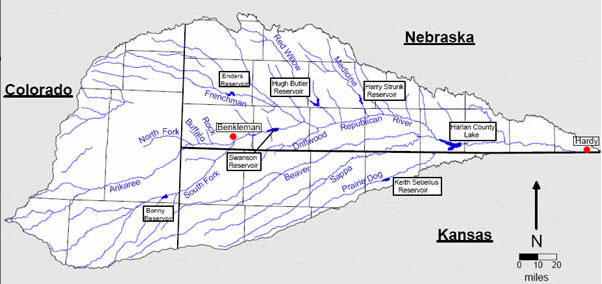
The $60 million loan from the Colorado Water Conservation Board initially was finalized on November 3, 2008, with the completion date set for November 3, 2010. RRWCD authorized spending $45 million last June to purchase the water rights to more than 50 wells north of Laird, to be used for the proposed pipeline that would deliver water to the North Fork of the Republican River at Colorado-Nebraska state line. The board made the move at that time as concerns arose the loan money might be taken away if not used due to Colorado’s financial crisis. The remaining $15 million is to be used toward the actual construction of the pipeline.

However, getting to the construction phase has proved difficult. Kansas and Nebraska, who along with Colorado comprise the Republican River Compact Administration, have voted against the pipeline, as each has raised several concerns both states would like to see addressed to their satisfaction before granting approval. After the RRCA rejected Colorado’s revised proposal last August, Colorado invoked the matter go to fast track arbitration, as allowed by the final stipulation agreed to by the three states. Even that has gone slowly, with an arbitration schedule finally settled just two weeks ago. Due to all those circumstances, it has become obvious the pipeline would not be completed by the initial deadline. Attorney David Robbins recommended during the RRWCD Board’s regular quarterly meeting, last Thursday in Yuma, that the district request the completion date be extended for one year…

Peter Ampe of the Colorado Attorney General’s Office met briefly with the RRWCD Board, last Thursday. He said Colorado’s stance will be that all the objections raised by Kansas and Nebraska are purely arbitrary and really have nothing to do with the pipeline itself. If [Arbiter Martha Pagel] agrees, during the motions phase of the process, then the trial itself simply will be about how the pipeline plan meets compact guidelines. The arbitrator’s decision is non-binding, but Ampe said it is admissible if the case ends up going to the U.S. Supreme Court.

More Republican River Basin coverage here and here.

SB 10-027 (Fine illegal surface water diversions): Governor Ritter signs the bill just in time for irrigation season

A picture named submersiblepump1.jpg

Here’s the release from the Governor’s office:

GOV. RITTER SIGNS SEVERAL BILLS INTO LAW TODAY

Gov. Ritter signed the following bills into law today:

HB10-1044 Neighborhood youth org requirements
HB10-1107 Urban Renewal Area Ag Lands
HB10-1135 Define domestic violence child custody
HB10-1233 Relocation of stalking statute
SB10-27 Fine illegal surface water diversions

More SB 10-027 coverage here. More 2010 Colorado legislation coverage here.

Denver Water Board of Commissioners names James Lochhead to replace Chips Barry

A picture named firstwaterovercheesman.jpg

From The Grand Junction Daily Sentinel (Dennis Webb):

Denver Water has reached across the Continental Divide to select Glenwood Springs attorney Jim Lochhead as its next manager and chief executive officer. He replaces Chips Barry, who will be retiring at the end of May after 20 years on the job. Lochhead’s hiring is another signal of increasing cooperation between Denver and the Western Slope over water issues, and it is being well-received by the Colorado River Water Conservation District. “It’s a tremendous selection on the part of the Denver Water board,” district spokesman Jim Pokrandt said…

Lochhead said, “I’m looking forward to kind of bringing that broader perspective to Denver Water and not only advocating for Denver Water but also hopefully bringing an understanding of the Western Slope and the state and the West and some of the issues and challenges that we face,” he said. He said today’s world is more interdependent, and it’s important to find ways for entities to work through a lot of common challenges. “Denver Water holds the key to a lot of that as the premier water utility in Colorado,” he said…

Gov. Bill Ritter praised Lochhead’s hiring in a news release. “In the West, water issues touch every part of our life and having a leader like Jim will benefit the whole state. Jim’s leadership and experience dealing with water issues makes him a perfect fit for this position,” Ritter said.

More coverage from the Vail Daily (Julie Sutor):

Lochhead is currently a lead shareholder at law firm Brownstein Hyatt Farber Schreck, LLP, where he has negotiated many complex transactions regarding water and other natural resources in the Rocky Mountain West. He has a bachelor’s degree in environmental biology and a law degree from the University of Colorado…

Denver Water obtains much of its water supply by pumping the precious resource from the Colorado River Basin across the Continental Divide to growing Front Range cities and suburbs. Those transbasin water diversions have often been a source of tension between West Slope and Front Range communities…

“By selecting a current West Slope resident to head its agency, Denver Water chose a leader who understands the statewide repercussions of Denver Water’s decisions. [Western Resource Advocates] looks forward to working with Mr. Lochhead as Denver Water continues to improve its conservation programs, water supply planning, and role as a leader to help resolve water issues statewide,” [Western Resource Advocates water program director Bart Miller] added.

More Denver Water coverage here.

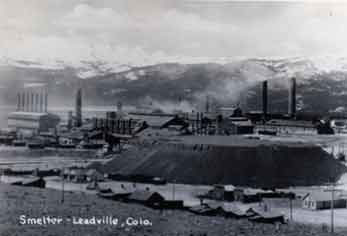
Leadville to celebrate 150 years of mining

A picture named californiagulchleadville

From The Pueblo Chieftain (Tracy Harmon):

The April 1860 discovery of gold in California Gulch by Leadvillite Abe Lee set this town on its mining path filled with plenty of colorful characters and their rags-to-riches stories. The 150th anniversary celebration of mining in Leadville is scheduled at 5:30 p.m. April 24 at the National Mining Hall of Fame and Museum, 120 W. Ninth St. The event will begin with tours of the museum and a wine tasting. A three-course gourmet dinner will follow at 7 p.m…A silent auction and Victorian dance featuring the music of the Shadow Mountain Sting Band will follow starting at 9 p.m. Victorian or miners’ attire is encouraged. Cost is $80 per person or $150 per couple or $20 per person for dance-only tickets. Reservations for the event are requested by Monday by calling 1-719-486-1229.

Garnet Mesa Dam spillway poses threat to dam State Engineer warns

A picture named sweitzerlake.jpg

From The Grand Junction Daily Sentinel:

A hydrology study found the existing spillway is inadequate and could pose a threat to the safety of the dam, so the state is limiting water in the lake to a level not to exceed 1-foot below the crest of the spillway. Lowering the lake level a vertical foot has decreased the length of the boat ramp to 17.5 feet and launching is not recommended for vessels over 18 feet long. A concrete curb at the end of the ramp marks a water depth of 3 feet. Beyond this curb, there is a 4-foot to 5-foot drop off. If boaters back their trailers beyond this curb, it could result in trailer and/or vessel damage. The storage restriction will remain in effect until a state-registered engineer proposes a solution to increase the capacity of the spillway.

More infrastructure coverage here.

Ridgway State Park open for boating

A picture named ridgwayreservoir.jpg

From The Grand Junction Daily Press (Dave Buchanan):

To prevent the spread of aquatic nuisance species, all trailered vessels entering and leaving the park are required to be inspected. The inspection station is open from 8 a.m. through 4:30 p.m. seven days a week through May 3. After then to May 15, hours will be 8 a.m. until 6 p.m. After May 15, the summer inspection hours will go into effect: 7 a.m. to 8 p.m. Sunday through Thursday and 7 a.m. to 10 p.m. on Fridays and Saturdays through Labor Day.

More Uncompahgre River watershed coverage here.

Montrose County Commissioners support the Lower Dolores River Working Group’s proposals

A picture named doloresrivercanyon.jpg

From the Montrose Daily Press (Katharhynn Heidelberg):

Those supporting alternate plans to protect the Lower Dolores River can count Montrose County in. Montrose commissioners are supporting the Lower Dolores River Working Group’s efforts to develop protections for the river that also protect private property and water rights, the commission decided in a resolution last week. Parts of the Lower Dolores, which flows through Montrose County’s West End, are listed as “suitable” for federal Wild and Scenic River designation.

More Dolores River watershed coverage here.

Norwood: Total trihalomethanes and haloacetic acids well below requirements

A picture named watertreatment.jpg

From The Norwood Post (Ellen Metrick):

When measured at the end of last month, the TTHMs were at 44.7 ppb, and the HAA5s were at 27.7, both far below the set standard for the first time.

More water treatment coverage here.

Fort Morgan: Council hears that the city needs to bump rates 5% in each of the next two years

A picture named waterfromtap.jpg

From The Fort Morgan Times (John Brennan):

Council members seemed to agree on the need for the water rate increases, and Mayor Terry McAlister directed the city staff to bring back a proposal soon that the council could vote on.

The biggest reason for the rate hikes is the looming $40 million debt that the city will incur when its share of the cost of the Northern Integrated Supply Project (NISP) starts coming due in the next several years, Ullman noted.

The good news, which came out of an accompanying study of city sewer rates presented by Ullman at Tuesday’s council work session, is that he sees no need for an increase in those rates at this time. He did, however, suggest that the city raise its plant investment fee, or sewer tap fee, for new hookups to the sewer system.

More Morgan County coverage here and here.

HB 10-1250 (Water Conservation Bd Construction Fund): La Plata-Archuleta Water District update

A picture named lospinos.jpg

From The Durango Herald (Dale Rodebaugh):

The water district, created in 2004, wants to provide drinking water in a 400-square-mile area in southeastern La Plata County and southwestern Archuleta County. La Plata County would be developed first. But before it can move ahead, residents must agree to tax themselves to pay for planning, capital improvements, construction, maintenance and administration. If they approve ballot Issue A, voters are authorizing a levy on the market value of their property of 5 mills (half a penny), expected to raise $5.1 million in 2011. The levy could vary in future years but may never exceed 5 mills. The 5-mill levy would cost the owner of a $200,000 house $7 a month.

[Board president Dick Lunceford] and Amy Kraft with Harris Water Engineering, the district’s consulting engineer, told commissioners they’ll soon begin discussing technical issues with county planners and the Southern Ute Indian Tribe on whose reservation much of the area to be serviced lies. They’ll also be evaluating the project’s overall viability in light of possible drops in revenue, Kraft and Lunceford said. BP is the largest gas producer and the largest source of property-tax revenue for the district. But as gas production eventually falls off, so will revenue. For now, however, a 5-mill property tax levy – applied to the $1.2 billion of assessed value in the district – will produce the $5.1 million annually that the district anticipates, Lunceford said…

The district has several water sources in mind, Lunceford said. For starters, it owns a total of about 22 cubic feet a second from the Piedra, Pine, Animas and Florida rivers. It also is interested in buying 500 to 1,000 acre-feet from the state if Colorado exercises its right to Animas-La Plata Project water. The district has its eye on leasing 200 to 300 acre-feet from the Pine River Irrigation District. The district will need an estimated 2,750 acre-feet to serve about 5,000 customers in the two counties over the next 20 years…

Eventually, a joint water-treatment plant with Bayfield is anticipated, Lunceford said. But whether it would be constructed before a treatment plant at the base of Lake Nighthorse, the A-LP reservoir, depends on which water source comes on line first, he said. If the A-LP is developed first, distribution lines would be extended to Florida Mesa. If the joint project with Bayfield comes about first, Gem Village and points south and west would be the first area to receive district water.

Meanwhile State Senator Bruce Whitehead is pushing the state of Colorado to buy water from the Animas-La Plata project, according to a report from Joe Hanel writing for The Durango Herald. From the article:

The proposed sale – financed by state natural-gas and oil tax money – raises the question of why the state should buy the same water that the tribes can get for free. “I might have the same question,” said Scott McElroy, an attorney for the Southern Ute Indian Tribe.

The answer lies in control of the water. “It comes down to whether you would rather own the water or do long-term leases,” Whitehead said. Whitehead was the executive director of the Southwestern Water Conservation District until last year, when he filled a vacancy in the state Senate. The district has pushed the state for years to buy rights in the Animas-La Plata Project.

The Southern Ute tribe also welcomes state participation, McElroy said. But if the state doesn’t buy in, the tribe is willing to talk with local water districts about supplying water, McElroy said at a Colorado Water Conservation Board meeting on March 29…

The new La Plata Archuleta Water District wants to buy up to 1,400 acre-feet from the state. The La Plata West Water Authority also has told the state water board it is interested in buying water out of the state’s future share. The La Plata Archuleta district has not talked to either Ute tribe about leasing water, said Steve Harris, the district’s consulting engineer. The district would need the lease to be permanent, Harris said. “But if they were reasonable terms, of course, we’d be willing to talk,” Harris said…

The federal government built the reservoir [Lake Nighthorse] primarily to settle American Indian water rights claims. Both the Southern Ute and Ute Mountain Ute tribes get 33,050 acre-feet, enough to turn the tribes into two of the biggest water owners in the Four Corners. Smaller amounts go to the Navajo Nation and water districts in Colorado and New Mexico. The state of Colorado has an option to buy 10,460 acre-feet, half of which could be consumed in any year. It’s roughly enough water for a city the size of Durango. If Colorado does not buy the water, it would go to each Ute tribe in equal parts…

On Thursday, the Senate Agriculture and Natural Resources Committee will consider an amendment to House Bill 10-1250 to spend $36 million over three years to buy the water from the federal government…

The last two years, the Legislature has raided most of Colorado’s water funds in order to balance the budget. An improved forecast for gas and oil tax money has given state officials the confidence that they will have enough money to complete the Animas-La Plata deal.

Ballots for the election will be mailed to residents in the district on Thursday, according to a report from Dale Rodebaugh writing for The Durango Herald. From the article:

Votes must be cast by May 4. Voters may mail their Issue A ballot or hand-carry it to the office of Harris Engineering, the district’s consulting engineer.

Voters are asked to approve a 5 mill (half a penny) property-tax increase to raise $5.1 million in 2011, and future mill levy increases cannot exceed 5 mills annually. Approval of Issue A also would remove the La Plata Archuleta Water District’s revenue limit set by the Taxpayer’s Bill of Rights Amendment – allowing it to spend such proceeds and any other revenue such as from grants.

The mill levy could be adjusted annually by the district’s board of directors. [ed. This is the TABOR exemption — the mill levy adjustment does not require taxpayer approval.]

More infrastructure coverage here.

2010 Colorado elections: Governor Ritter wades into rafting rift rapids

A picture named taylorriver.jpg

From The Pueblo Chieftain (Patrick Malone):

Ritter has met with rafting interests and landowners hoping to broker a compromise “so this doesn’t become some kind of ballot Armageddon.” Since the Senate amended [HB 10-1188] last month, it has been a fixture on the House calendar with no action…

Since a Colorado Supreme Court ruling in the late 1970s that allowed rafters passage through private lands, outfitters and landowners have coexisted mostly harmoniously, Ritter said Monday. But the Western Slope acrimony and resulting bill created a rift. “The controversy that was normally dormant came to the surface,” Ritter said.

The governor said his office has intervened because the specter of numerous ballot initiatives further muddying the water over who can travel Colorado’s rivers and where looms large. To date, 12 proposed initiatives swirling around those questions have been filed with the state for possible placement on the November ballot. Talks between both sides of the issue have been productive at times, and broken down at others, Ritter said. It’s likely a conference committee of the Legislature will soon hear the bill in its amended form, but ideally, Ritter would like to see rafters and landowners calm the waters themselves.

More 2010 Colorado elections coverage here.

SB 10-181 (Municipal Authority To Lease Land) passes the state senate

A picture named purgatoireriver.jpg

From The Pueblo Chieftain (Patrick Malone):

The Senate on Tuesday passed a bill that would allow Walsenburg, Rocky Ford and about 150 other statutory towns and cities to lease the land they own with water rights. Until now, only home-rule municipalities have had that authority. In Walsenburg’s case, a prospective tenant already is on the doorstep. A wind farm proposed by Denver-based Viento Claro Energy may be built by Torch Renewable Energy on 2,300 acres of land in Huerfano County owned by the city of Walsenburg. Viento Claro has proposed to pay Walsenburg about $11 million in royalties over 25 years for the site.

More SB 10-181 coverage here. More 2010 Colorado legislation coverage here.

The Northern Colorado Water Conservancy District sets the Colorado-Big Thompson quota at 80%

A picture named coloradobigthompsonin2007

From The Fort Morgan Times:

The 80 percent quota will make available a total of 248,000 acre-feet of C-BT Project water. C-BT allottees — those water users within Northern Water boundaries who own units of C-BT water — include municipalities like the city of Fort Morgan, domestic water districts like the Morgan County Quality Water District, industries and farmers…

In determining the quota, the board also considers the need to maintain C-BT Project storage reserves. The board strives to utilize the supplemental water supply provided by the C-BT Project to complement the supplies available from native sources to ensure adequate regional water supplies through the current water year.

More Colorado-Big Thompson coverage here and here.

Morrison, Idaho Springs and Georgetown pool their resources and share de-watering and de-sludging equipment

A picture named wastewatertreatmentwtext

From the Clear Creek Courant (Ian Neligh):

The municipalities entered into a partnership in 2008 to purchase a unit worth $300,000. They received a $200,000 grant from the Colorado Department of Local Affairs and are splitting the remaining cost.

The mobile system is mounted inside a small trailer and can be moved from town to town along the Interstate 70 corridor. “So (the unit) will be on site here for the time we need it. It will be hauled to Georgetown and also to Morrison,” said Idaho Springs City Administrator Cindy Condon. “So all of us are getting cooperative effort out of one piece of machinery — instead of everybody having to own their own.” Condon said she came up with the idea after talking with the other town administrators. “We were (all) contracting out to a company … that comes in and does (the work) for a …five-day period (or) whatever it takes to take the sludge out of the system,” Condon said. “And when you’re talking $100,000 a year among the three of us, we felt like within a short time we could pay this piece of equipment off and have it be a real asset to the citizens.” The three municipalities will work together to train operators, schedule use of the equipment and share maintenance expenses.

More wastewater coverage here.

Snowpack news: Dust storms blanket snowpack with dust

A picture named snowpackcolorado04122010

From The Aspen Times (Carolyn Sackariason):

The red dust blanketing area mountains and virtually every surface in town is a result of oil and gas development and off-road vehicle activity in southeastern Utah, according to David Garbett, staff attorney with Southern Utah Wilderness Alliance. He informed the Aspen City Council on Monday of the effects the dust has on the community. The snow stained by dust melts faster because it absorbs more solar energy, which affects the snowpack in Aspen and surrounding areas…

Beyond an expedited snowpack and quicker spring runoff, dust-covered snow affects Aspen’s water supply, officials said. The city’s water department has to spend more money in increased treatment chemicals to remove the dust, which resists coagulation. It makes its way through the city’s filters and is difficult to remove, according to city officials. “Water treatment plants in Colorado are experiencing this phenomena throughout areas affected by these storms,” wrote Chuck Bailey, the city’s water treatment plant supervisor, in an e-mail regarding the issue. “It is usually temporary during spring/summer runoff, but still a new challenge to us.”

Destabilization of the soil on the Colorado Plateau in Utah is the primary cause of the local dust storms, contrary to other reports that it’s from rockslides in Mexico or weather events as far away as Mongolia, Garbett said…

A cold front was expected to move across Utah and Arizona, generating strong south-southwesterly winds with gusts potentially reaching 50 mph. The strong winds were expected to cause blowing dust in parts of Arizona, Utah, New Mexico and Colorado, which could be transported long distances, causing hazy skies and restricted visibility at times even in areas where the winds are lighter.

Cherokee Metropolitan District looks to Colorado Springs Utilities for help in meeting summer demand

A picture named coloradodesignatedgroundwaterbasins

From KRDO.com (Mireya Garcia):

In the last agreement, Cherokee provided it’s own water, and Colorado Springs provided services – -that aid ended in 2009. The current proposed agreement is different. Cherokee is asking for both water and services from the Springs. “We are in a really good situation in terms of having a robust water supply, so Cherokee approached us and explained their need for drinking water in their system,” says Patrice Quintero, of Colorado Springs Utilities.

The agreement will take effect Wednesday if approved by the Colorado Springs City Council on Tuesday. It would include provisions to prevent any sale of the water and services that would violate city code. “As we understand it, they are in a critical situation where their residents are in need of safe and reliable drinking water, ” Quintero tells NEWSCHANNEL13.

More Cherokee Metropolitan District coverage here and here.