


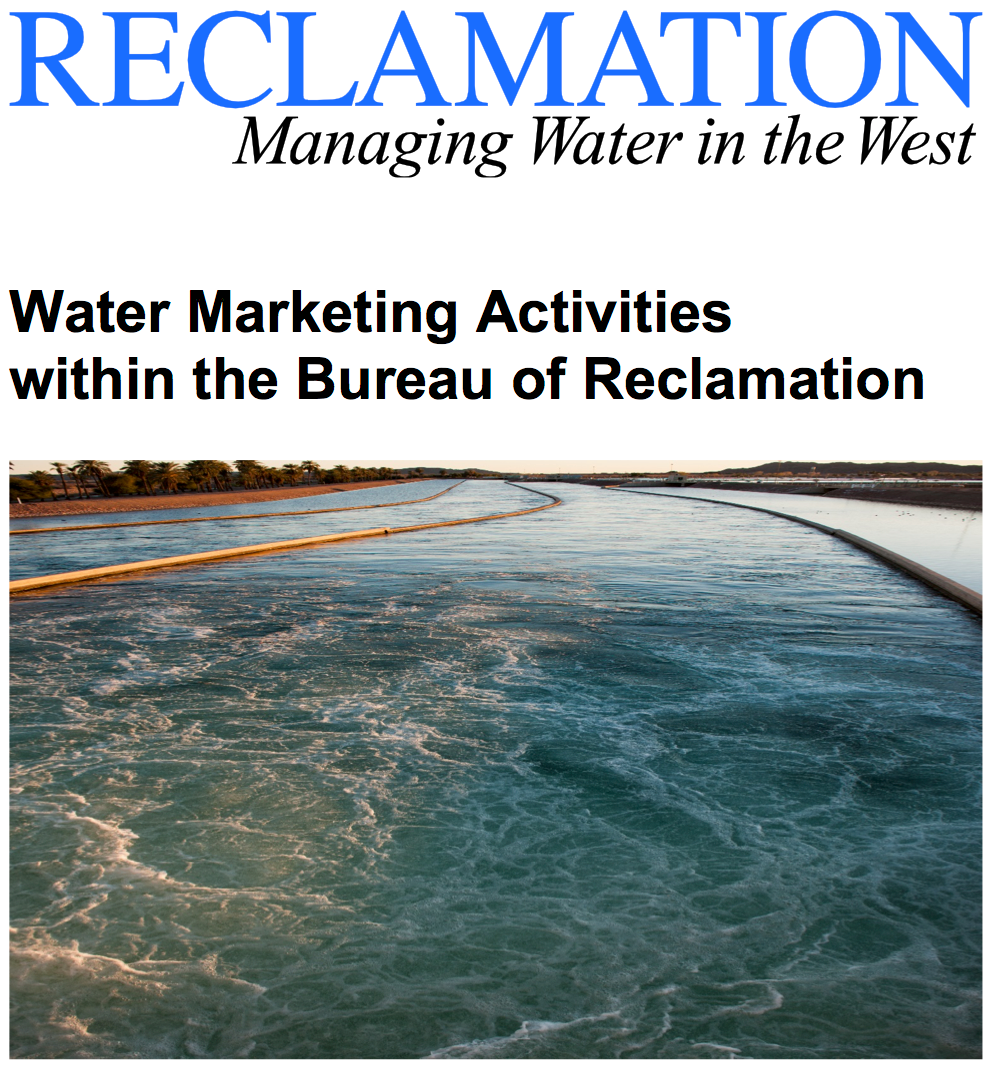
Here’s the release from the US Bureau of Reclamation (Peter Soeth/Martin Doyle):
The Department of the Interior and the Bureau of Reclamation released a report this week reviewing the role of Reclamation in water markets. For decades, water users in the West have used many different approaches to address water needs particular to their location. In some instances, these approaches have created market conditions in which buyers and sellers voluntarily trade water rights. Such water market transactions can often involve Reclamation facilities.
This new report, “Water marketing activities within the Bureau of Reclamation,” highlights the ways Reclamation has partnered with water users to enable such transactions. The report reviews a series of case studies which illustrate a tremendous amount of locally-led innovation. The cases also illustrate how locally-led transactions have created collaborations and programs that enable greater flexibility in the use of project water or facilities.
Reclamation Commissioner Estevan López said, “States and local water users are quietly solving water resource challenges in the West through market-based agreements. This report will help us identify ways that Reclamation can enable and support continued innovation in the face of increasing pressures on scarce water supplies.”
Reclamation is continuing its role in supporting locally led water markets through a new grant program. Starting in Fiscal Year 2017, the WaterSMART grant program will provide grants to conduct planning activities to develop water marketing strategies to establish or expand water markets and water marketing transactions. Reclamation will make available $3 million for this program. This new funding opportunity is expected to be posted in February 2017.
Going forward, Reclamation will continue to work with states and local water users to promote innovation through water markets in order to provide flexibility, promote conservation and stretch scarce water supplies.


Click here to go to the US Drought Monitor website. Here’s an excerpt:
Summary
During the past 7-days, several frontal systems moved across the contiguous United States. Heavy precipitation (generally 2-6 inches, locally 10 inches or more) fell from southern Texas east-northeast across the Gulf Coast states and the Tennessee Valley. Two inches of precipitation (liquid equivalent) or more was also reported across portions of the Northeast and the Pacific Northwest. Within the first 48 hours of the new drought week (which started at 7am EST Tuesday, Nov 29), there were approximately 215 preliminary, filtered reports of severe weather across this region, as indicated by the Storm Prediction Center in Oklahoma. Most of the remainder of the Lower 48 states reported light to moderate precipitation (less than 2 inches)…
Northern and Central Great Plains
Recent snowstorms played a key role in the removal of moderate drought (D1) in south-central North Dakota, where AHPS 14-day departures from normal precipitation (DNPs) span 2-4 inches. In the past month, conditions have generally improved over most of the state. The exception is in extreme southwest North Dakota, where D0 was expanded slightly northward, and D1 was introduced to Bowman County, based on precipitation data and anecdotal testimonies. In nearby South Dakota, northeast portions of the state were improved by a category, based on 30-day DNPs. However, some degradations were made to the depiction in the southwest portion of the state based on precipitation deficits and abnormally warm temperatures, particularly over the last 30-days. Other considerations that went into the changes were the 1-month SPEI (Standardized Precipitation Evapotranspiration Index) for November, seasonal snowfall maps, and current VIC (Variable Infiltration Capacity) soil moisture conditions…
Southern Great Plains
In Texas, a reassessment of drought conditions was made to incorporate the latest precipitation data, and many smaller-scale changes were made. AHPS 14-day DNPs reveal precipitation departures on the order of 1-5 inches in south-central and southern Texas, and 2-10 inches in eastern Texas. Small-scale changes were also made to the depiction in north-central Oklahoma (Counties of Garfield, Noble, Kingfisher, Logan, Oklahoma and Lincoln), where farmers and livestock operators reported instances of failed wheat, very dry conditions, and low farm ponds…
Rockies and Intermountain Region
The only changes rendered to this portion of the national drought depiction was made in the High Plains of eastern Colorado. In northern Prowers County (extreme southeast part of state), moderate drought (D1) was expanded due to a dry autumn making its mark on local vegetation, while in the eastern portion of adjacent Kiowa County, a small patch of severe drought (D2) was introduced due to lower precipitation and grasses in poor shape. In the northeast part of the state, D1 was expanded into northern Washington County, northeast Yuma County, Phillips County, and eastern Logan County. This is to account for very spotty winter wheat germination…
California
No changes were deemed necessary to the depiction this week…
Looking Ahead
During the next 5 days (December 8-12), moderate precipitation (0.5-1.5 inches) is anticipated from Tennessee through the Great Lakes region, which will at least help preclude additional deterioration for the Tennessee and Ohio Valleys. For most other areas east of the Rockies, precipitation amounts are expected to be less than a half-inch. Locally heavy amounts of precipitation (liquid equivalent of 2-4 inches) are predicted for the higher elevations of the Rockies. Most of the expected precipitation for the Pacific Coast states is forecast to fall in areas that are not currently in drought, with the exception of the Sierras where up to 7 inches (liquid equivalent) is anticipated.
For the ensuing 5-day period (December 13-17), odds favor above-median precipitation across approximately the northern and eastern halves of the contiguous U.S., while odds favor below-median precipitation from Arizona eastward to the southern Great Plains, and Alaska.
From the National Young Farmers Coalition (Chelsey Simpson) via Alternet:
A new short film, Conservation Generation, offers a look into the lives of four young farmers and ranchers in Colorado and New Mexico who are following their passion for agriculture amidst historic drought, climate change, development, and heightened competition for water.
Fifteen percent of all U.S. crops are grown with irrigation water that originates in the Colorado River Basin, making Western agriculture an issue that is crucial to the lives and dinner plates of all Americans. Many of the holiday meals consumed in the coming weeks will include produce grown by farmers in the arid West.
Despite the importance of Western agriculture, farmers are in increasingly short supply. The average age of the American farmer is 58, and farmers over 65 outnumber farmers under 35 by a ratio of six-to-one. According to the National Young Farmers Coalition (NYFC), the nonprofit organization that produced Conservation Generation as well as a report by the same name, lack of access to affordable land and water are two of the biggest issues preventing more young people from succeeding in agriculture.
“There are a number of challenges faced by young farmers, but in the West, all of those issues are compounded by the increasing demands on water,” says Kate Greenberg, western water program director for NYFC. “As the film shows, young farmers face these challenges with a spirit of innovation and a deep commitment to conservation and place. A good sense of humor helps, too.”
According to the report produced by NYFC, 97 percent of young farmers surveyed considered water conservation important and 94 percent reported using some form of conservation on their farms.
Conservation Generation features four young farmers in Colorado and New Mexico:
Harrison Topp of Topp Fruits in Paonia, Colorado and Fields Livestock in Montrose, Colorado Tyler Hoyt of Green Table Farm in Mancos, Colorado Nery Martinez of Santa Cruz Farm & Greenhouses in Espanola, New Mexico Casey Holland of Red Tractor Farm in Albuquerque, New Mexico Each of the farmers has also been blogging about the joys and challenges of farming in the arid West; view the film and read their stories at http://youngfarmers.org/conservationgeneration.