Here’s the abstract from the USGS (Steven M. Peterson, Amanda T. Flynn, and Jonathan P. Traylor):
The High Plains aquifer is a nationally important water resource underlying about 175,000 square miles in parts of eight states: Colorado, Kansas, Oklahoma, Nebraska, New Mexico, South Dakota, Texas, and Wyoming. Droughts across much of the Northern High Plains from 2001 to 2007 have combined with recent (2004) legislative mandates to elevate concerns regarding future availability of groundwater and the need for additional information to support science-based water-resource management. To address these needs, the U.S. Geological Survey began the High Plains Groundwater Availability Study to provide a tool for water-resource managers and other stakeholders to assess the status and availability of groundwater resources.
A transient groundwater-flow model was constructed using the U.S. Geological Survey modular three-dimensional finite-difference groundwater-flow model with Newton-Rhapson solver (MODFLOW–NWT). The model uses an orthogonal grid of 565 rows and 795 columns, and each grid cell measures 3,281 feet per side, with one variably thick vertical layer, simulated as unconfined. Groundwater flow was simulated for two distinct periods: (1) the period before substantial groundwater withdrawals, or before about 1940, and (2) the period of increasing groundwater withdrawals from May 1940 through April 2009. A soil-water-balance model was used to estimate recharge from precipitation and groundwater withdrawals for irrigation. The soil-water-balance model uses spatially distributed soil and landscape properties with daily weather data and estimated historical land-cover maps to calculate spatial and temporal variations in potential recharge. Mean annual recharge estimated for 1940–49, early in the history of groundwater development, and 2000–2009, late in the history of groundwater development, was 3.3 and 3.5 inches per year, respectively.
Primary model calibration was completed using statistical techniques through parameter estimation using the parameter estimation suite of software with Tikhonov regularization. Calibration targets for the groundwater model included 343,067 groundwater levels measured in wells and 10,820 estimated monthly stream base flows at streamgages. A total of 1,312 parameters were adjusted during calibration to improve the match between calibration targets and simulated equivalents. Comparison of calibration targets to simulated equivalents indicated that, at the regional scale, the model correctly reproduced groundwater levels and stream base flows for 1940–2009. This comparison indicates that the model can be used to examine the likely response of the aquifer system to potential future stresses.
Mean calibrated recharge for 1940–49 and 2000–2009 was smaller than that estimated with the soil-water-balance model. This indicated that although the general spatial patterns of recharge estimated with the soil-water-balance model were approximately correct at the regional scale of the Northern High Plains aquifer, the soil-water-balance model had overestimated recharge, and adjustments were needed to decrease recharge to improve the match of the groundwater model to calibration targets. The largest components of the simulated groundwater budgets were recharge from precipitation, recharge from canal seepage, outflows to evapotranspiration, and outflows to stream base flow. Simulated outflows to irrigation wells increased from 7 percent of total outflows in 1940–49 to 38 percent of 1970–79 total outflows and 49 percent of 2000–2009 total outflows.
Following a closed-door session on Longmont’s water supply, the City Council tabled some of the water rate increases that were slated to start on Jan. 1.
The water rates were slated to increase by 17 percent in both 2017 and 2018, 8 percent of which in both years would go toward financing Longmont’s 10,000 acre-feet participation level in the Windy Gap Firming Project. However, on Tuesday, council decided rates will rise 9 percent in both years.
The council voted unanimously to table the water rate increase, which was on second reading Tuesday, until the U.S. Army Corps of Engineers issues a 404 permit for the Windy Gap Firming Project.
While design work is ongoing for the Windy Gap Firming Project, no construction work can start until the Corps issues the permit, Dale Rademacher, Longmont general manager of public works and natural resources, told the council Tuesday. While staff hoped it would come before the end of 2016, that doesn’t seem to be the case.
Statewide income from farms and ranches is projected to fall to $444 million in 2016 from about $1.3 billion in 2015.
It’s a level that Colorado agriculture hasn’t seen since 1986, according to a report from the University of Colorado Boulder.
The fall can be largely attributed to the decline in cattle prices because the industry accounts for the largest portion of the state’s agriculture economy, said Stephen Koontz, a professor at Colorado State University.
He expects prices for cattle will not level off until 2018, and producers will likely not see the gains that the Trans-Pacific Partnership could have fueled.
Colorado’s economy depends on water: where it is, where the people who need it live and work, who has rights to it. Fights over those needs are a core part of the state’s history, and they tend to follow a pattern. So in some ways, the fight over the Fraser River in Colorado’s Grand County is familiar.
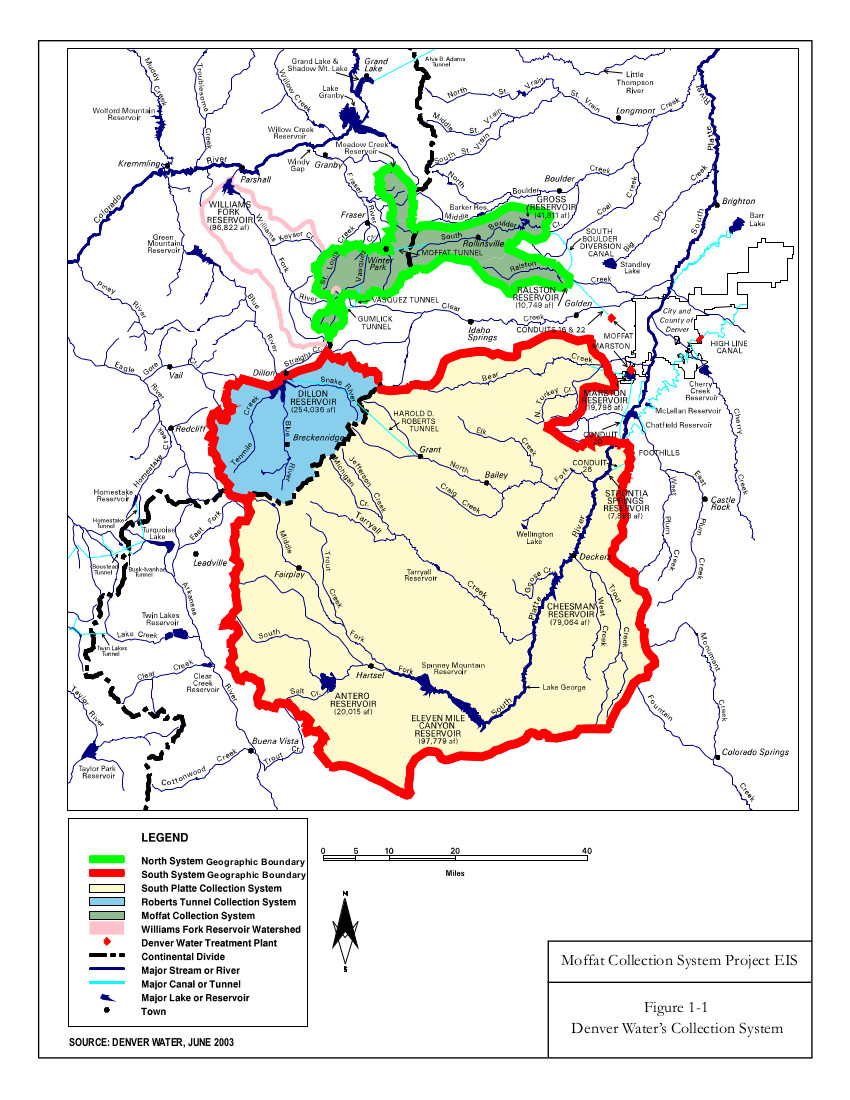
Denver Water holds unused water rights on the river, which starts in the shadow of Berthoud Pass and courses down the western side of the Continental Divide past Winter Park, Fraser and Tabernash to join the Colorado River outside of Granby.
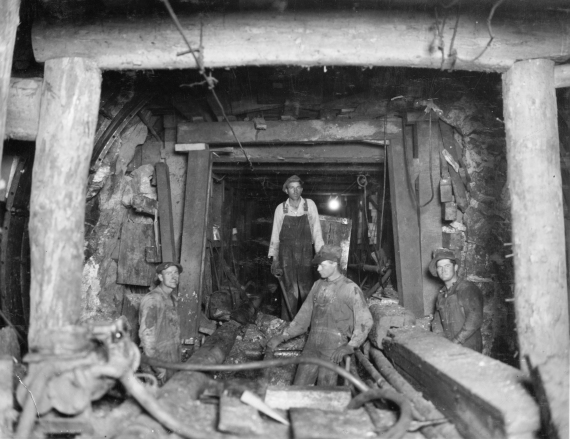
Workers pose for a photo in the Moffat Water Tunnel in this 1930 photo.
The agency, looking at the booming population and economy in Denver, now wants to exercise those rights. That means taking more water from the river, piping it under the Indian Peaks and sending it into Gross Reservoir near Boulder.
Some conservationists and environmental groups are crying foul, saying that the river has already been overtaxed (about 60 percent of its existing flow is already diverted to slake Denver’s growing thirst) and it’s time to let the river alone.
But the fight’s pattern is taking some unfamiliar twists and turns. Influential groups like Trout Unlimited and American Rivers, who’ve historically fought diversion projects, support this one. In exchange, Denver Water says it will will help protect and enhance what’s left of the Fraser River.
That compromise has fractured traditional lines in Colorado’s conservation and environmental advocacy community, and fostered new alliances. While these organizations more or less agree on their ultimate goal — to protect and restore the environment — the strategies they use are very different. The big question that divides them: When to compromise?
Denver Water Extends An Olive Branch
Decades ago, environmentalists were not at the top of list of Denver Water’s concerns when it would try to build dams and add capacity. In the 1980s, environmental groups pushed back on a huge proposed dam called Two Forks.
“[Denver Water] told us in so many words: ‘We’re the experts. You’re little environmentalists. Get out of the way,’ ” Dan Luecke, then head of Environmental Defense Fund’s Rocky Mountain office, told High Country News in 2000.
Then, in 1990, an EPA veto torpedoed the project at the last minute.
“That was really a turning point for our organization,” said Kevin Urie, a scientist who’s worked for Denver Water for nearly 30 years. “I think we realized with the veto of Two Forks that we needed to think about things differently.”
He believes that while Denver Water has long taken environmental impacts into consideration with its plans, it didn’t engage with local stakeholders — like conservation and environmental groups and Western Slope governments — until after the Two Forks project died.
There’s a demographic change underway as well: Many of the Denver metro area’s new residents also want to play in Western Slope rivers on the weekends. That has pushed Denver Water leadership to put a larger emphasis on environmental stewardship, Urie said.
But all those new residents still need water. Denver Water delivers water to about 1.4 million people across the metro, about double what it did some 60 years ago. Conservation efforts have kept overall demand relatively low in recent years. But with more people moving to Denver every day, Denver Water expects its demand to rise 37 percent by 2032 from 2002 levels.
The Fraser River is key to Denver Water’s plan to head off a shortfall in the relatively near future. The agency wants to divert half of the remaining flows from the Fraser and its tributaries through the Moffat Tunnel to Gross Reservoir near Boulder. (The proposed expansion of Gross has started its own fight, which CPR News’ Grace Hood chronicled last month.) It would be treated at the agency’s plant in Lakewood, and eventually delivered to customers across the metro.
The agency expects to have all of its necessary permits by 2018 and construction could begin in 2019 or 2020. But to get those permits, Denver Water has agreed to be part of a group that includes Grand County officials and environmentalists called “Learning by Doing.” These different players are often at odds when it comes to water issues.
Urie said Denver Water’s participation shows its desire to do right by the environment and local stakeholders. They’ve helped fund an ambitious project that will engineer the Fraser River’s flow on a nearly mile-long stretch between Fraser and Tabernash, squeezing it to make it narrower, deeper and colder — and thus healthier.
But is that what’s best for the river?
Urie thought about that question for a minute, and then chose his words carefully:
“Clearly the system would be better if we weren’t using the water resources for other uses. But that’s not the scenario we are dealing with,” Urie said.
Trout Unlimited Sees Opportunity
The Fraser River project’s biggest booster is Kirk Klancke, president of the Colorado River Headwaters Chapter of Trout Unlimited. For him personally, it’s a way to help a river that he’s lived near and played in for 45 years.
“I can’t talk about it without getting all emotional. My life’s been spent on this river,” he said.
He sees it as a chance to restore a part of the river popular with anglers called the Fraser Flats. Here, the brush-lined river levels out after tumbling through the pine forests of Berthoud Pass.
His playground is popular with others, too. Grand County is a short one- to two-hour drive from Denver. From fly fishing to alpine and nordic skiing to snowmobiling, it’s a tourist-based economy. And in Klancke’s eyes, all of that rests on the health of its water.
He’s watched the river dwindle and get warmer as more water has been pulled out of it. And that’s changed how his family has used it. When his children were young, they could stay in the river for only a minute or two.
“They’d come out and their lips would be purple and they’d be squealing,” Klancke said. “Now I throw my grandchildren in the river and they’re not in a hurry to get out. We spend up to an hour in a pool in the river.”
He’s watched this river that means so much to him get sicker and sicker; warm, shallow channels aren’t suitable for native fish and bugs. For years, he blamed the deteriorating environment on the Front Range and its water managers.
“I was a little radical because I urinated in diversion ditches. It’s about all I knew to do. I’ve matured quite a bit since then,” he said.
His turning point came when he got involved with Trout Unlimited.
“I loved their approach,” he said. “They were able to look at it in someone else’s shoes, which is what all mature people do. And then, move forward with opening up conversation.”
Such conversations are what led to the Fraser Flats project, Klancke said. When flows are low, like they were this fall, the river is shallow as it stretches across its native bed. The new channel will allow the river to recede and stay deeper — and cooler.
Essentially, that stretch of river will be turned into a creek. On its face, downsizing a river doesn’t sound like a big victory for environmentalists. But that’s not how Klancke looks at it. During peak flows in the spring, Klancke points out, the river will be nearly just as wild as it is now.
And moreover, Denver Water has to stay involved in the Learning by Doing group. So if environmental issues arise down the road, Klancke said the agency will be there to help solve them.
Is it a compromise? Yes, Klancke admits. But water managers own water rights in the upper Colorado Basin that they’ll use — with or without his blessing. The right to divert water for “beneficial uses” is enshrined in the Colorado Constitution.
“We have to face reality here,” Klancke said. “There is no more mighty Upper Colorado. There’s only keeping what’s left healthy.” [ed. emphasis mine]
WildEarth Guardians Stakes Out Moral High Ground
Like Klancke, Jen Pelz, wild river program director for WildEarth Guardians, has had her own evolution in thought toward environmental causes. Earlier in her career, she was a water lawyer in Denver who represented clients like the city of Pueblo that were taking water from Western Slope rivers.
But eventually she felt a pull toward environmental advocacy. Pelz credits that with childhood days spent on the banks of a tributary to the Rio Grande in New Mexico.
“It was kind of the place that I could go just be myself,” she said. “I developed a really strong connection to the river there.”
She was drawn to the confrontational, no-holds-barred approach used by WildEarth Guardians. The group is known for its headline-grabbing lawsuits. Most recently they sued the federal government over haze in Western Colorado and leases to coal mines.
The approach seems to be working, at least by WildEarth Guardian’s measure. The haze lawsuit ended in an agreement where a coal mine and coal-fired power plant in Nucla, south of Grand Junction, will shut down in the next six years. A power plant in Craig, Colorado will shut down one of its units too.
“We’re willing to not be liked by the general public, or by particular industries,” Pelz said. “And I think it takes that kind of moral integrity and just knowing where you stand on the issues, to really push the envelope.” [ed. emphasis mine]
Pelz is not interested in compromise on the Fraser River. She faults Trout Unlimited for starting negotiations at the wrong place. In her view, the baseline shouldn’t be where the river is now with about 60 percent of it being diverted. The conversation needs to start with the river at its natural flows, she said.
“The harm has already been done,” Pelz said.
If the Fraser River is going to be saved, she says, it’ll happen by letting more water back into the river — not by taking more out. As the climate warms, she says the river will need all the help it can get.
“Let’s start dealing with it now. Let’s have that hard conversation now, not 50 years from now when there’s no water left to have a conversation about,” she says.
Pelz says her organization, and another group called Save the Colorado, are considering litigation once final permits are approved. That could happen in 2018.
Such tactics doesn’t make Pelz a lot of friends. She said she’s been ostracized from her former clique of water lawyers. It’s hard for her to get meetings with government regulators.
WildEarth Guardians’ relationship with the greater environmental community is similarly strained. She said Denver Water is more willing to meet with environmentalists now because they’ve softened. And she’s upset with what Trout Unlimited has become in the eyes of regulators.
“Trout Unlimited has been deemed by Denver Water and the state of Colorado as being the environmental voice,” Pelz said. “They get invited to the table because they have this role in communities, which I don’t think is a bad thing, but they don’t necessarily represent all of the different interests in the environmental community.”
As a result, she said, groups like hers are being left out of the conversation.
“They don’t talk to us. They don’t ask us what we think. And I’ve called them. And I’ve had meetings with them. I’ve asked them what they think. And they’ve told me they don’t like our approach. And I understand that. But I think that it works both ways.”
Pelz said it can be hard to be out “towing the left line.” Everybody likes to be liked, she said. But she’s decided that over the long run, her methods are what will make a difference. To do anything else would be surrender.
“I don’t want to have to explain to my kids that I gave up the fight for this river that is the namesake of our state, the state they were born in, because I was willing to compromise,” she said. “We may not win, but damn we are going to try.”
American Rivers Finds Room To Maneuver
When Matt Rice, Colorado River basin director for American Rivers took the job a few years ago, he made the decision to put aside his dreams for what he really wanted. Instead, he focuses on what he thinks he can actually pull off.
“In a perfect world, I’d like to see all the wild rivers in this country and in this state flowing freely and filled with fish, doing what rivers should do,” Rice said. “It’s not realistic.”
But he acknowledges that groups like WildEarth Guardians can make his job easier at times. When Guardians files a lawsuit and makes a bunch of people mad, a group like his can step in and talk with state regulators and businesses. Guardians essentially provides cover for groups closer to the political center, he said.
“Their advocacy pushes everybody, not just conservation organizations, kind of further to the left. And I think that’s good,” Rice said.
But there’s a downside. Lawsuits and sharply worded press releases can sting, and are not easily forgotten. And Rice worries that aggressive tactics from far-left groups lead to skeptical parties like ranchers or Front Range water managers lumping all environmentalists together.
“That has the potential to undermine the progress we’re making,” he said.
Looking To The Future
A screenshot from the website for Colorado’s Water Plan.
With the publication of last year’s Colorado Water Plan, a first for the state, officials are trying to turn the page on Colorado’s long fight over water. The plan, which officials describe as a roadmap to sustainability, stresses collaboration between competing interests and conservation of the increasingly precious resource.
“Now is the time to rethink how we can be more efficient,” Gov. John Hickenlooper said at the water plan’s introduction in November 2015.
Diverting more water should be the last-possible solution, Hickenlooper said. That’s welcome news to environmentalists like Matt Rice of American Rivers.
Rice said they are supportive of the Fraser River diversion plan for the same reasons Trout Unlimited is, though they aren’t part of the Learning by Doing group. But he hopes the Fraser diversion, and another major project in the works called Windy Gap, are the last trans-mountain diversion projects.
There just isn’t enough water on the Western Slope, he said. And if another one comes up, Rice said they’ll fight it with everything they have.
“We’re kind of at the cliff right now in the Colorado River Basin,” he said.
Collaboration and compromise will certainly be part of environmentalism’s future in Colorado. But as groups like WildEarth Guardians continue to find success in the courts, the advocacy ecosystem has room for other strategies too.
A long-term plan for protecting Lake Mead and preventing severe shortages in deliveries of Colorado River water to Arizona and two other states won’t be approved before the Obama administration ends, throwing more uncertainty into the outlook.
While the three states keep discussing a drought contingency plan, Arizona water officials say they’ve reached general agreement with water users here for a shorter-term fix for Lake Mead’s chronic declines.
The Arizona plan calls for cities, farms and Indian tribes to keep enough water in Mead through 2019 to lower the risks of the first round of shortages of Central Arizona Project water deliveries. Such shortages would hurt agriculture significantly, although not enough to threaten viability of the CAP, which delivers drinking water to Tucson and Phoenix and irrigation water to central Arizona farmers.
Federal and state water officials announced at [the Colorado River Water Users Association Annual Conference in Las Vegas] last week that too many issues remain unresolved to wrap up the major regional drought plan, in the works for three and a half years. They’re optimistic agreement can be reached next year and perhaps in the first few months. They said they hope that if they’re close to agreement, the new Trump administration won’t want to change it radically.
The Arizona plan can act as a bridge, helping the over-allocated Colorado River water system until a long-term plan is in place, said Arizona Water Resources Department and CAP officials at the Colorado River Water Users Association conference.
Standing in the way of the short-term fix, however, is money. It will cost up to $60 million to compensate Arizona users who give up their CAP water to make the short-term plan work, said Terry Fulp, Lower Colorado regional director for the U.S. Bureau of Reclamation, which runs the river reservoir system.
Asked how confident he is of finding that money in the next few months, Fulp replied, “That’s a really good question. I don’t know if we have a really good answer. All I can tell you is that we’re working hard to do that.”
Meanwhile, standing in the way of the long-term fix are two longstanding water disputes in California. One is the fate of the Salton Sea in the southern California desert, which in January 2018 is slated to lose 200,000 acre feet of water that’s to be transferred to San Diego under a 2003 agreement.
At that point, many authorities are worried that the exposed playa’s salt and heavy-metal tainted soils will blow around, triggering massive air pollution.
The sea’s water is runoff from the neighboring Imperial Valley Irrigation District, which controls huge amounts of Colorado River water and is reluctant to give up more under the proposed drought plan unless something can be done to shore up the sea. It wants to see a detailed “road map” outlining what California will do to fix the looming problems there.
The other is a $15 billion proposal to build twin tunnels under the Sacramento-San Joaquin Delta to improve the reliability of water deliveries from northern to southern California.
The Metropolitan Water District in Los Angeles wants to see progress toward building the tunnels — which are heavily opposed by other groups — to ensure that it will have enough other water if it gives up Colorado River water under the drought agreement.