The Environmental Protection Agency this week told state, local and tribal governments about how much they would receive in Gold King Mine spill reimbursements, with most falling far short of what was requested…
“I was disappointed in this most recent letter, but not surprised,” La Plata County Manager Joe Kerby said of the notification.
La Plata County was among the 12 affected governments listed as Gold King reimbursement recipients, according to EPA documents. The state of New Mexico was expected to receive the most at $1,072,585, but this money will be split among 14 different local governments and state agencies.
Allocations to the states of Utah and Colorado are still pending.
But the other governments have been directed to the appeals process if they disagree with the reimbursement decision, EPA letters said.
It is unknown how long an appeal might take, said Andrew Mutter a spokesman for EPA.
“We don’t have a specified time line, but we will work as fast as we can to resolve any appeals,” he said.
Kerby believes at least another $29,000 in reimbursements mostly to cover La Plata County staff time is warranted.
This would cover time the staff spent in meetings after Oct. 31, the date the agency closed its incident command in Durango. The county has asked the EPA multiple times to consider reimbursements for expenses that occurred after this date, he said.
“The EPA has reimbursed us for a substantial amount, I believe they should reimburse us 100 percent,” he said.
Pending legislation would allow Gold King expenses after Oct. 31 to be reimbursed, according to a statement from Sen. Michael Bennet’s office.
Bennet also expressed disappointment in the EPA in a written statement.
“Although we’re relieved the EPA has finally ended its long drawn-out reimbursement process, it’s disappointing that the agency has not reimbursed the communities for more of their costs,” Bennet said in a statement. “We will continue to fight for our measure to enable further reimbursements and establish a long-term water monitoring program.”
La Plata County’s total request included about $2.5 million for future costs, which were denied as well.
Part of the problem may be communication.
“We didn’t have a clear direction from the EPA as to what they would and would not reimburse,” Kerby said.
The city of Durango requested $444,032 for costs it incurred during the toxic waste spill and about $5.2 million for future costs through 2030, according to an EPA letter.
The EPA approved $55,403 in reimbursement related to the spill, and the city has already received these funds, said Sherri Dugdale, assistant to the city manager.
The city staff members have not reviewed the EPA’s decision enough to say whether they might consider an appeal, she said.
The city was asked to anticipate future costs and include those in its request, but the city had not included these funds in the city budget, she said.
The EPA will also fund a cooperative agreement with the Colorado Department of Public Health and Environment that will cover the city’s request for $101,465 for improvements to the Santa Rita pump station monitoring system, the letter said.
The city pumps water from the Animas River at the station.
The costs that the EPA decided not reimburse the city for include lost revenue from the sale of water, travel costs and working lunches.
Food is not a reimbursable cost under the Comprehensive Environmental Response and Liability Act, which is governing the reimbursements, Mutter said.
San Juan County and Silverton received $349,565 of the $8.4 million the two governments requested.
The county and the town would consider an appeal together, if one is warranted, Town Manager Bill Gardner said.
He could not say, yet, if that is the case.
“They are extremely helpful, and I think it is fair we are reimbursed,” he said, of reimbursements.
The EPA’s regional representatives have done their best to get the town and city reimbursed, he said.
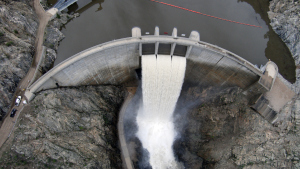
Strontia Springs Reservoir started spilling on May 2, 2015. Between 1,200 and 1,700 cubic feet per second has been flowing out of the spillway since that time.
Colorado environmental officials are planning to spend tens of thousands of dollars studying the state’s 400 “high hazard” dams to map where floodwaters might go in the event of heavy rain and snow melt.
The dams are classified by the state as high hazard not because they are in poor condition or likely to fail, but because a failure would likely cost people their lives.
State officials say the dams are all well-maintained and inspected, but flooding in 2013 and 2015 linked to historic heavy rains and snow melt pointed out a vulnerability in the state’s dam safety system.
“We found that the spillways flowed, the dams operated just fine, they performed as we expected them,” explained Bill McCormick, chief of the state’s dam safety branch. “But the flows that went through the spillways in some cases created dangerous conditions and did damage downstream anyway.”
McCormick said the state does not have maps that predict where such overflows might go in the future, but hopes to address that problem with the study.
“People downstream might not expect the flows. They think the dams are flood control dams, but really these dams are storage reservoirs — they store the snow melt that we see, they’re going to store this for use next year. And so the owners of those like to keep those full,” McCormick said.
By the end of the six-month study, the state hopes to rank and prioritize which dams and reservoirs could cause the most problems, and how to address those potential problems.
State officials are still seeking a vendor to conduct the study, but expect the project will cost less than $100,000 from both state and federal funding sources.
Proposals to conduct the study are due by Dec. 16.
Here’s an interview with Luzma Nava from Matt Weiser and Water Deeply. Click through and read the whole thing. Here’s an excerpt:
IF THERE’S EVER been a river at the mercy of international politics, it would have to be the Rio Grande.
The river begins in southern Colorado, flows the length of New Mexico, then forms the entirety of the border between Texas and Mexico. As such, the Rio Grande (known as the Rio Bravo in Mexico) is not only the subject of water battles but also disputes involving public access, legitimate international trade, illegal drug trafficking and, of course, illegal immigration…
Several treaties govern the flow of water in the Rio Grande, as well as trade and travel across the international border. Because of intense water development and diversion, parts of the river are completely dry and fishless for hundreds of miles during much of the year. The treaties ensure that everyone who is entitled to water gets their share, on both sides of the border.
Forgotten in all this is what’s best for the river itself – its wildlife and its habitats – and for the people who simply want to enjoy a wet river. Luzma Nava recently explored this problem in a study published in the journal, Water. The study was completed while Nava was a postdoctoral fellow at the International Institute for Applied Systems Analysis, an independent think-tank based outside Vienna, Austria.
Nava, a native of Guanajuato, Mexico, is now completing a doctoral degree in international studies at Laval University in Quebec. For the Rio Grande study, Nava conducted more than 70 interviews with people involved in Rio Grande water management, on both sides of the border, and concluded that it is possible to amend the Rio Grande treaties to free up water for environmental purposes. Nava spoke recently with Water Deeply about her work…
Water Deeply: What is the condition of the river today?
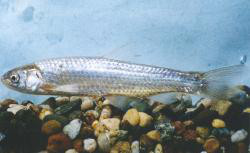
Rio Grande Silvery Minnow via Wikipedia
Nava: If I have to answer in one word, I would say fragile. The main issue is the lack of water. Also the water quality is in danger. And when water quality of the river is not good enough, then we have ecological issues as a consequence.
The fact we don’t have enough water translates into other issues that depend on the quantity of water. There is a loss of habitat, water quality degradation, pollution, salinization, sedimentation. The community of fish is very, very low. In terms of water quality, the more fish we find in the river, the better the quality of the water. But in the case of the Rio Grande, it doesn’t work like that because there are no fish in the river. They have disappeared because there is not enough water.