The health of our waters is the principal measure of how we live on the land — Luna Leopold
#RioGrande: Tackling The Mosaic Puzzle of a Fragile Ecosystem — Water Deeply
Rio Grande and Pecos River basins
Here’s an interview with Luzma Nava from Matt Weiser and Water Deeply. Click through and read the whole thing. Here’s an excerpt:
IF THERE’S EVER been a river at the mercy of international politics, it would have to be the Rio Grande.
The river begins in southern Colorado, flows the length of New Mexico, then forms the entirety of the border between Texas and Mexico. As such, the Rio Grande (known as the Rio Bravo in Mexico) is not only the subject of water battles but also disputes involving public access, legitimate international trade, illegal drug trafficking and, of course, illegal immigration…
Several treaties govern the flow of water in the Rio Grande, as well as trade and travel across the international border. Because of intense water development and diversion, parts of the river are completely dry and fishless for hundreds of miles during much of the year. The treaties ensure that everyone who is entitled to water gets their share, on both sides of the border.
Forgotten in all this is what’s best for the river itself – its wildlife and its habitats – and for the people who simply want to enjoy a wet river. Luzma Nava recently explored this problem in a study published in the journal, Water. The study was completed while Nava was a postdoctoral fellow at the International Institute for Applied Systems Analysis, an independent think-tank based outside Vienna, Austria.
Nava, a native of Guanajuato, Mexico, is now completing a doctoral degree in international studies at Laval University in Quebec. For the Rio Grande study, Nava conducted more than 70 interviews with people involved in Rio Grande water management, on both sides of the border, and concluded that it is possible to amend the Rio Grande treaties to free up water for environmental purposes. Nava spoke recently with Water Deeply about her work…
Water Deeply: What is the condition of the river today?
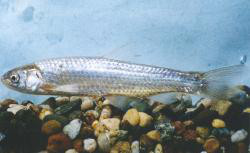
Rio Grande Silvery Minnow via Wikipedia
Nava: If I have to answer in one word, I would say fragile. The main issue is the lack of water. Also the water quality is in danger. And when water quality of the river is not good enough, then we have ecological issues as a consequence.
The fact we don’t have enough water translates into other issues that depend on the quantity of water. There is a loss of habitat, water quality degradation, pollution, salinization, sedimentation. The community of fish is very, very low. In terms of water quality, the more fish we find in the river, the better the quality of the water. But in the case of the Rio Grande, it doesn’t work like that because there are no fish in the river. They have disappeared because there is not enough water.