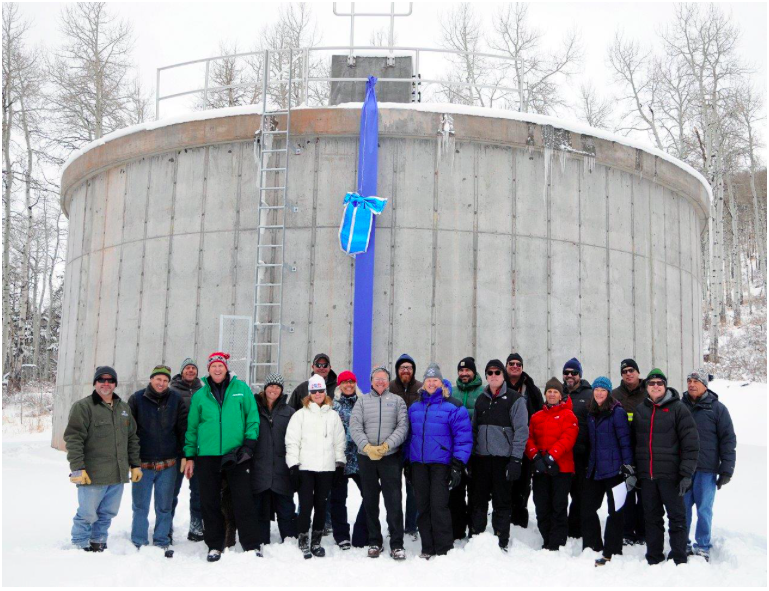
Eagle River Water & Sanitation District staff members with Upper Eagle Regional Water Authority board members and representatives of the town of Avon, Mountain Star Association, and contractors involved in developing and constructing the 270,000-gallon water storage tank in Mountain Star.
Here’s the release from the Eagle Valley Water and Sanitation District:
Water Authority brings new water storage tank online.
Representatives of the Upper Eagle Regional Water Authority, town of Avon, and Mountain Star Association gathered Dec. 8 to mark the completion of a new water storage tank that serves the Mountain Star community.
The Water Authority put the 270,000-gallon tank into service Nov. 15, after it was completed on time and under budget during a six-month construction window.
Envisioned in 1993 – when Avon originally approved the subdivision – the tank is one of five that along with five booster pump stations comprises the potable water supply system that had to be built to deliver water from the valley floor to the high alpine development north of Avon.
The 1993 subdivision approval anticipated this tank being built at a future date when suitable U.S. Forest Service land could be obtained. The then-existing Avon Metro District agreed that it would collect tap fees from homes that were built and served by a somewhat-temporary water supply system until this storage tank could be constructed.
The Water Authority acquired the necessary Forest Service property in May 2013 as part of the complex, multi-year Eagle Valley Land Exchange agreement. With the site acquisition costs and ongoing pump station improvements, the Authority has recently spent about $2.2 million on the Mountain Star system.
Mountain Star, Avon, and Authority representatives worked together for several years to agree on funding and construction of the final storage tank, which resulted in an Implementation Agreement. The project cost estimate of $1.85 million was more than the amount of tap fees collected by Avon since 1993, so Mountain Star homeowners agreed to fund the remaining cost. The Authority committed $135,000 to upgrade to a longer-lasting, less maintenance-dependent tank. The Agreement also included a guaranteed maximum price contract and a provision that Mountain Star homeowners would receive any cost savings.
The Water Authority used an integrated project delivery method for the tank and the actual cost is projected to be $1.55 million, a savings of about $300,000. The Authority will refund this savings to Mountain Star after final accounting of the actual project costs.
At 9,380 feet, the new tank serves higher-elevation residences and benefits public safety via enhanced fire protection. While the tank provides additional water storage, the parties are committed to efficient water use with many homeowners participating in the Authority’s water demand management pilot study to establish new irrigation practices that benefit landscapes while decreasing overall water use.
Contact: Linn Brooks, General Manager: 970-476-7480
A long-awaited ruling issued Monday by the Colorado Supreme Court sends Aurora back to court to discern exactly how much water the municipality can divert from the headwaters of the Fryingpan River through the Busk-Ivanhoe Tunnel under Hagerman Pass.
And the ruling clarifies that transmountain water rights under the Continental Divide in Colorado do not automatically come with a right to store water in a reservoir, anymore than other water rights do.
Aurora had argued there had always been an implied right in its decree to store water from the Fryingpan headwaters in Turquoise Reservoir. But the court didn’t agree.
“The supreme court concludes that the right to store water in the basin of import prior to use is not an automatic incident of transmountain water rights, but rather, must be reflected, or at least implied, in the decree,” the court’s majority opinion stated. “In this case, the decree is silent with respect to storage of the water on the eastern slope prior to use for supplemental irrigation and, on the facts of this case, the record does not support the water court’s finding of an implied right in the decree for such storage. To the extent that unlawful storage of the water on the eastern slope expanded the decreed rights, such amounts cannot be included in the quantification of those rights.”
The Colorado River District, which represents 15 Western Slope counties, said Tuesday in a statement it is “very pleased with the supreme court’s well-reasoned opinion in which it reversed the Division 2 water court. In particular, we are pleased with the court’s recognition that transmountain water rights are subject to the same legal principles as all other water rights in the state.”
As might be expected, Aurora officials were less pleased.
“The city is disappointed with [Monday’s] supreme court opinion reversing the trial court’s earlier decision,” said an Aurora representative in a statement. “The city regrets the departure from what it believed to be settled law regarding use of transbasin waters.
“Additionally, it appears due consideration was not given to aspects of the trial court’s determinations regarding the state of the law when the water rights were originally requested,” the statement said. “Aurora is currently evaluating its possible next steps.”
One possible next step is for Aurora to file a petition within 14 days for the supreme court to rehear the case.
If Aurora does not petition for a rehearing, the case will be sent back to water court in Pueblo for a recalculation of how much water Aurora is allowed to divert via the Busk-Ivanhoe Tunnel for municipal purposes, instead of for irrigation purposes.
The supreme court said the new calculation should include the 22 years from 1987 to 2009 when Aurora used the water for municipal purposes without a decreed right to do so.
And by factoring in those 22 years of “zero use,” the new calculation is expected to lower the amount of water the Front Range city can divert from the Fryingpan in the future.
Another aspect of the ruling could also reduce the size of Aurora’s water right, as the court found that much of the water diverted through the Busk-Ivanhoe Tunnel since 1928 had been stored without a decreed right to do so.
“Because undecreed storage of a direct flow water right may amount to an expansion of that right, any expansion of the Busk-Ivanhoe water rights resulting from the unlawful storage of those rights on the eastern slope cannot be included in an historic consumptive use analysis,” the ruling stated.
The court also suggested that harm may have been caused to junior water rights owners on the Western Slope by undecreed diversion and storage of the Busk-Ivanhoe water.
“Storage of a decreed direct flow right can potentially expand that right by permitting the diversion of available water not immediately needed for beneficial use — water that would otherwise be left in the stream for junior water users,” the ruling said. “This impact on junior users does not cease to exist just because the water is diverted for export to another basin. Junior users in the basin of export have a right to divert and use water not lawfully diverted in the first place under a senior water right, regardless of whether that water is diverted for transmountain use.”
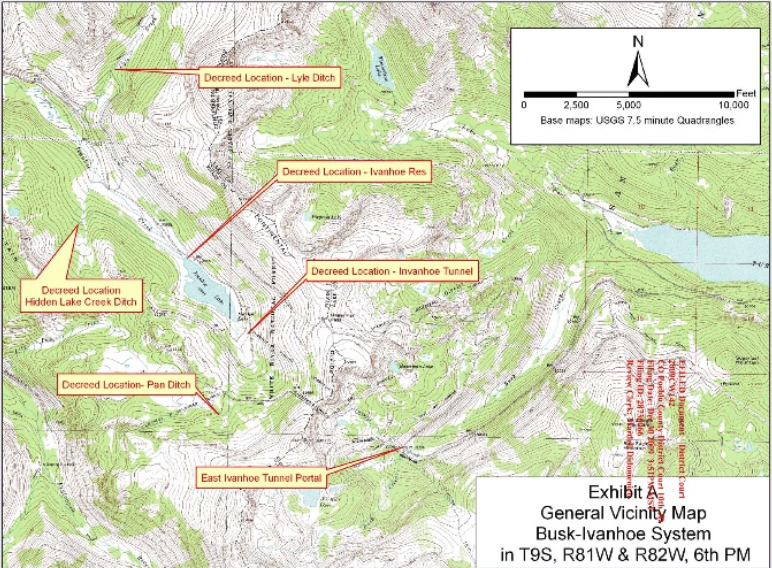
A map of the Busk-Ivanhoe system, with Ivanhoe Reservoir on the left side of the map and Turquoise Reservoir on the right.
Worth the fight
Pitkin County has been opposing Aurora in the case since 2009 and has now spent $353,000 in the process.
“It was worth it,” said John Ely, Pitkin County attorney. “It was important for Pitkin County to assert that transmountain diverters are subject to the same legal consideration as any other water diverter or water user, because Pitkin County hosts two of the larger water diversions in the state.”
In addition to the relatively small level of diversions through the Busk-Ivanhoe Tunnel by Aurora and Pueblo, significant amounts of water are diverted off the top of the Fryingpan and Roaring Fork rivers to the Front Range as part of the larger Fry-Ark and Twin Lakes projects.
Aurora still has a valid water right from 1928 to divert 2,416 acre-feet of water through the tunnel for irrigation uses in the Arkansas River basin.
But officials now want to use the same water for municipal purposes in Aurora, which is in the South Platte River basin.
And when the growing Front Range city came into the court in 2009 seeking a change to its water right, it admitted it was already using the Fryingpan water for municipal purposes without a decreed right to do so, and had been doing so since 1987.
However, Aurora told the court that that fact should not count against it in its change case. It also said it shouldn’t matter to the Western Slope how it used its water once it was sent under the Continental Divide, including if the water was stored in an East Slope reservoir or not.
A judge in Division 2 water court in Pueblo agreed with Aurora and ruled in its favor in August 2014. That decision was appealed by a list of Western Slope interests directly to the supreme court, which issued its opinion on Dec. 6, 2016.
Both the broad ruling, that storage is not an inherent right for transmountain diversions, and the narrow ruling, that Aurora needs to recalculate its historic consumptive use, were welcome news for Western Slope water interests.
“The reason our clients stayed involved is [that] from the get-go, Aurora was asserting some untenable legal positions that seemed to rely in large part on the concept that, ‘Well, we’re a transmountain diverter, so we look at things differently,’” said Kirsten Kurath, an attorney in Grand Junction.
She represented the Grand Valley Water Users Association, the Orchard Mesa Irrigation District, and the Ute Water Conservancy Districts in the case.
The other Western Slope parties in the supreme court case were Eagle and Grand counties and the Basalt Water Conservancy District.
The Colorado state engineer, and engineers in Divisions 1 and 5, were also in the case, and had sided with the arguments made by the Western Slope.
On the Front Range side of the arguments were Aurora, Colorado Springs, Denver Water, Pueblo Board of Water Works, Greeley, Northern Water, Southeastern Water Conservancy District, Twin Lakes Reservoir and Canal Co., Lower Arkansas Valley Water Conservancy District, Busk-Ivanhoe Inc., Cache La Poudre Water Users Association, and the city of Northglenn.
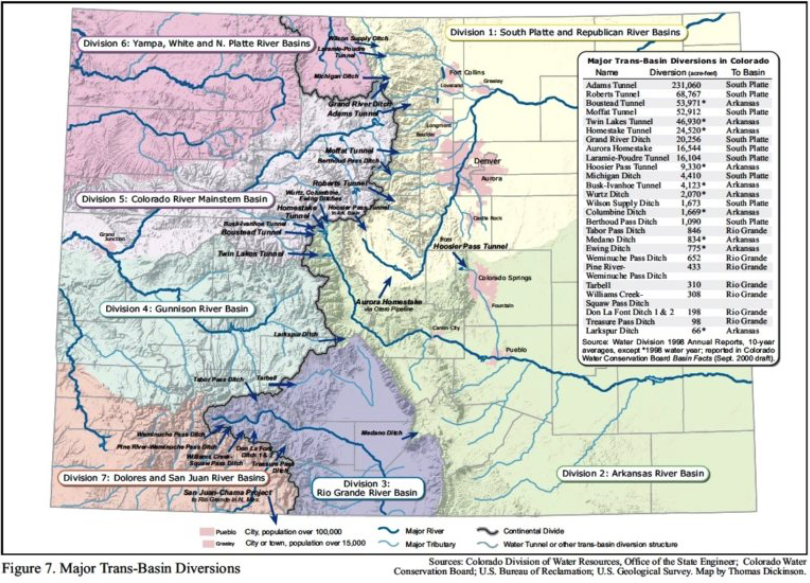
This graphic shows the transmountain diversions in Colorado. The Bousted Tunnel, at 53,871 AF, the Twin Lakes Tunnel, at 46,930 AF, and the Busk-Ivanhoe Tunnel, at 4,123 AF, have taken (in this data set) a combined average of 105,024 AF a year from the top of the Roaring Fork and Fryingpan rivers headwaters.
Editor’s note: Aspen Journalism, the Aspen Daily News, and Coyote Gulch are collaborating on the coverage of rivers and water. The Aspen Daily News published this story on Wednesday, Dec. 7, 2016.
Native range data for Arkansas darter provided in part by NatureServe via USGS.
Here’s the release from Colorado Parks and Wildlife:
The Arkansas darter is a two-and-a-half inch native perch found throughout southeastern Colorado, Kansas and a few other states. On Oct. 6, 2016, after a 12-month finding, these fish were official categorized as “ not warranted” for federal listing by the U.S. Fish and Wildlife Service, bringing some relief to more than 40 years of concern for the species.
Arkansas darter were listed as threatened at the state level by Colorado Parks and Wildlife in 1975, and through a collaborative effort with FWS and other state wildlife management agencies, were designated a federal candidate species in 1991. Candidate species under the Endangered Species Act of 1973, are described as “having sufficient concern for their biological status but for which development of a proposed listing regulation is precluded by other higher priority listings.”
In 1994 (with recent updates) these status listings prompted CPW biologists to partner with the FWS and other wildlife agencies to develop an individual recovery plan for the species. The plan included ramping up conservation efforts, such as work with private landowners, habitat conservation, hatchery propagation, reintroduction and re-establishment of populations, and long term monitoring and research, among other actions.
“This ‘not warranted’ decision is a testament to the dedication and effort of many CPW staff over many years,” said Harry Crockett, CPW Native Aquatic Species Coordinator.
The decision was based on a recent status assessment of the Arkansas darter throughout its range in Arkansas, Colorado, Kansas, Missouri, and Oklahoma. Representative species biologists from each state, FWS biologists, as well as climate and hydrology scientists worked throughout 2014 and 2015 on assessing the species’ health, distribution and potential future.
“The Species Status Assessment Report for the Arkansas darter, and the FWS’s resulting 12-month finding was a superb collaboration between the affected states and the FWS,” said Vernon Tabor, Species Biologist, FWS; Arkansas darter assessment lead. “While the finding was solely FWS responsibility, we needed the excellent data, coordination and expertise we found in our state partners, including Colorado Parks and Wildlife. This allowed us to make our decision based on the most sound and recent science available.”
Threats to Arkansas darters still persist, as illustrated by their listing as a Tier One species in CPW’s 2015 State Wildlife Action Plan.
“Probably our greatest concern for the long term stability of Arkansas darters is specifically related to the future of water, especially spring water and headwater reaches, that provide good habitat on the plains of the Arkansas River Basin,” said Paul Foutz, Native Aquatic Species Biologist – CPW Southeast Region.
The darter occupy cool, clear spring-fed streams and seeps with abundant vegetation and feed primarily on invertebrates. The fish are found throughout the Arkansas River Basin, however populations are now typically isolated from one another. These populations are primarily found in the Big Sandy Creek, Chico Creek, Fountain Creek, and Rush Creek drainages, as well as several drainages north and east of Lamar, Colorado.
Historical records of Arkansas darters date back to 1889, but records were scant until a 1979-1981 CPW native fishes inventory of the Arkansas River Basin identified a far more widespread distribution of the species.
CPW will continue to make recovery and conservation of Arkansas darters a high priority.
“CPW is fully committed to continuing work to ensure that the species persists and fulfills its important niche in a fundamentally water-scarce region which is likely to become drier in the future. However, we, along with our partner agencies throughout the species’ range, can all be proud to have achieved the level of security and stability for the species that this ‘not warranted’ decision reflects,” said Crockett.
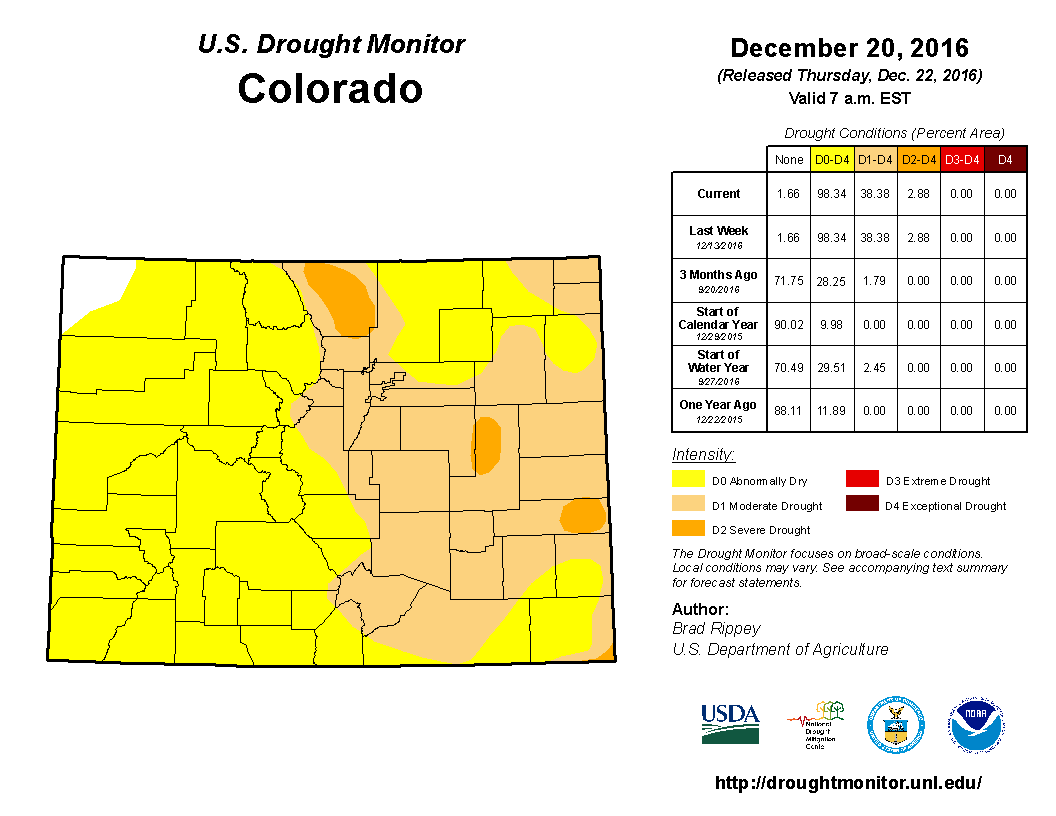
Despite recent snow storms, drought conditions in Colorado have remained largely unchanged over the past few weeks, with nearly all the state in some level of dryness.
With the continued exception of [northwest] Moffat County, all of western Colorado is considered abnormally dry, the lowest level of drought.
Much of northeast Colorado, including large areas of Weld, Adams, Morgan, Washington, and Logan Counties are also abnormally dry, along with portions of Las Animas, Baca, Prowers and Bent Counties.
Most of the remaining area in eastern Colorado is in moderate drought, however much of Larimer, western Lincoln and most of eastern Kiowa Counties are in severe drought. Extreme southeast Baca County is also showing severe conditions.
One year ago, 90 percent of the state was drought-free, with the remainder abnormally dry.
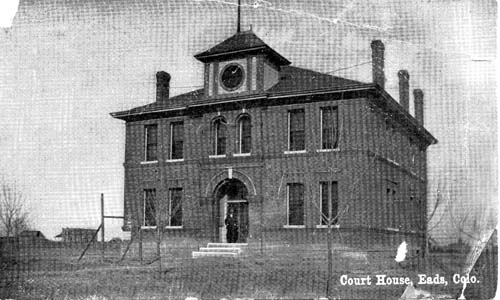
Kiowa County Courthouse, Eads, Colorado, 1903 via wikimedia.
From the Natural Resources Conservation Service via the Kiowa County Press:
Producers in Colorado who are interested in implementing conservation practices to improve natural resources on their private agricultural land have until Friday, February 17, 2016, to submit applications for FY 2017 funding through the Natural Resources Conservation Service’s (NRCS) Environmental Quality Incentives Program (EQIP). Eligible applications that are received after February 17th will be considered during a later time and will be processed throughout the fiscal year as needed.
EQIP is a voluntary incentives program that provides financial assistance for conservation systems such as animal waste management facilities, irrigation system efficiency improvements, fencing, and water supply development for improved grazing management, riparian protection, and wildlife habitat enhancement.
NRCS continually strives to put conservation planning at the forefront of its programs and initiatives. Conservation plans provide landowners with a comprehensive inventory and assessment of their resources and an appropriate start to improving the quality of soil, water, air, plants, and wildlife on their land.
Conservation planning services can also be obtained through a Technical Service Provider (TSP) who will develop a Conservation Activity Plans (CAP) to identify conservation practices needed to address a specific natural resource need. Typically, these plans are specific to certain kinds of land use such as transitioning to organic operations, grazing land, or forest land. CAPs can also address a specific resource need such as a plan for management of nutrients. Although not required, producers who first develop a CAP for their land use may use this information in applying for future implementation contracts.
To find out more about financial and technical assistance available to help Colorado farmers and landowners improve and protect their land, visit the Colorado NRCS website at http://www.co.nrcs.udsa.gov.
The High Plains Aquifer provides 30 percent of the water used in the nation’s irrigated agriculture. The aquifer runs under South Dakota, Wyoming, Nebraska, Colorado, Kansas, Oklahoma, New Mexico and Texas.
By mid-century, says a new study, some of the biggest grain-producing regions could run dry.
Rising temperatures and growing demands for thirsty grains like rice and wheat could drain much of the world’s groundwater in the next few decades, new research warns.
Nearly half of our food comes from the warm, dry parts of the planet, where excessive groundwater pumping to irrigate crops is rapidly shrinking the porous underground reservoirs called aquifers. Vast swaths of India, Pakistan, southern Europe, and the western United States could face depleted aquifers by midcentury, a recent study finds — taking a bite out of the food supply and leaving as many as 1.8 billion people without access to this crucial source of fresh water.
To forecast when and where specific aquifers around the globe might be drained to the point that they’re unusable, Inge de Graaf, a hydrologist at the Colorado School of Mines in Golden, Colorado, developed a new model simulating regional groundwater dynamics and withdrawals from 1960 to 2100. She found that California’s agricultural powerhouses — the Central Valley, Tulare Basin and southern San Joaquin Valley, which produce a plentiful portion of the nation’s food — could run out of accessible groundwater as early as the 2030s. India’s Upper Ganges Basin and southern Spain and Italy could be used up between 2040 and 2060. And the southern part of the Ogallala aquifer under Kansas, Oklahoma, Texas, and New Mexico could be depleted between 2050 and 2070.
“The areas that will run into trouble the soonest are areas where we have a lot of demand and not enough surface water available,” says de Graaf, who presented her results last week at the American Geophysical Union conference in San Francisco.
Farming has mushroomed across arid regions like these in the past half-century. With scarce rains and few rivers and lakes, they depend on water pumped up from underground. Since 1960, excessive pumping has already used up enough groundwater worldwide to nearly fill Lake Michigan, estimates de Graaf, who projects that with climate change and population growth, future groundwater use will soar. She considers an aquifer depleted when its water level falls below a depth of around 300 feet, at which point it becomes too expensive for most users to pump up.
Shrinking groundwater supplies will dent the world’s food supply, says de Graaf’s co-author Marc Bierkens, a hydrologist at Utrecht University in the Netherlands. Bierkens points out that 40 percent of global food production now relies on irrigation with groundwater. If the amount of available groundwater were cut in half, for example, he estimates that farm output would drop by roughly 6 percent—reflecting the portion that’s absolutely dependent on unsustainable groundwater use.
“It’s not that the whole population will starve,” says Bierkens, “but it will have an impact on the food chain and food prices.”
To an untrained eye, the Colorado River near Kremmling looks, well, like a river. It winds through a wide valley dotted with ranches and covered by a western blue sky.
But Paul Bruchez, a Grand County rancher and fly fisherman, does not have untrained eyes.
He sees the lifeline for his ranch and others like it in this otherwise arid corner of the Western Slope. The river’s been decimated by a one-two punch: water diverted to the Front Range, and a surprise erosion that dropped the river bed by two feet nearly overnight.
“It was jaw-dropping for all the landowners to realize just what dire straits this river and our ag systems were really in,” Bruchez said, standing on the banks of the river in late September.
Bruchez and 12 other ranchers now have reason to celebrate. They’ve been working with environmental groups like American Rivers and Trout Unlimited to get grants to help with vital restoration work — and now a big federal grant has come through. Bruchez and his neighbors will receive about $2.5 million from the Natural Resources Conservation Service, part of the U.S. Department of Agriculture.
“This news is life-changing for the headwaters of the Colorado River and those who rely on it,” Bruchez said in a press release announcing the grant…
So the ranchers devised a cost-effective way to help the river: riffles. Rock walls are sunken into the river bed in an open v-shape form. They back up the water slightly which helps raise the water table, re-introduce oxygen to the water to help with fish habitat, and re-steers the river current to keep it from crashing into the banks and causing erosion.
Bruchez and other ranchers put up hundreds of thousands of dollars to get the project off the ground. Two riffles on Thompson’s land were the first to be constructed.
“It’s working,” [Bill Thompson] said. But the final price tag will be more than $6 million. Bruchez needed help raising the rest of the cash — and found it from a somewhat unlikely source: environmentalists.
Ranchers and environmentalists have historically been at odds over things like livestock grazing and water pollution. But in this case, Bruchez’s group caught the eye of Trout Unlimited.
“We believe agriculture has very important role to play,” Mely Whiting, legal counsel for Trout Unlimited, said from her home office in Pagosa Springs. “If you do it right, if you minimize the amount of water that you need to use through improvements, then you can leave more water for the fish.”
The ranchers are not incorporated. So Trout Unlimited is the fiscal agent for the new federal grant, and an older state grant. That made some ranchers, like Thompson, nervous. But he said he got over it pretty quickly.
“I had to have them to get it done,” he said.
Over 30 Miles To Be Rehabilitated
About $2.5 million of the $7.75 million grant will go toward the ranch project, which will take years to complete. The rest will help another Trout Unlimited-led project — a channel to bypass the Windy Gap Reservoir upstream from Kremmling.
Put together, the two projects will help improve the river’s health over more than 30 miles. Both are now close to their funding goals.
Trout Unlimited took a collaborative approach to the bypass project as well, enlisting help from the county government, Northern Colorado Water Conservancy District and other groups that are often at odds.
While Trout Unlimited and American Rivers have worked with Front Range water managers in the Colorado River headwaters area, that’s caused tension in the greater environmental community. Others, like Save the Colorado and WildEarth Guardians, say those conservation groups are making compromises that will ultimately lead to the death of Western Slope waterways.
But Drew Peternell, director of Trout Unlimited’s Colorado water project, says this week’s grant news shows their approach is working.
“The posture on the Colorado [River] has started to change,” Peternell said. “Groups that were once at odds with each other are now working together. This $8 million grant from the NRCS is really sort of the capstone for all of that.”
“We are more connected than we’d like to admit” — Travis Smith (from the film “The Great Divide“)
The Colorado Water Congress folks have released the Wednesday workshop schedule for the Annual Convention. Here’s the email from Doug Kemper:
Colorado water community:
Wednesday Workshops Program
I am pleased to announce the program for the Wednesday Workshops on January 25 at the 2017 Colorado Water Congress Annual Convention at the Hyatt Regency Denver Tech Center is now posted on CWC’s website. To view, click HERE. There are 25 opportunities for connecting with your colleagues as you learn about the latest happenings in Colorado water.
Annual Convention Program
The main program for the Convention is being built and should be ready next week. Our theme for the Annual Convention is Connectivity. We will go live with the new Colorado Water Congress Strategic Plan and link members with the future direction of our organization.
Flowing from the 2015 member survey, we learned that our outlook must be toward helping members feel connected to the Colorado Water Congress and engaged with our work to protect the interests of Colorado’s water community. And that is our goal!
The top thing that we will work on in 2017 is our communications. We will launch a new Communications Standing Committee at the Convention. Expressing your thoughts as to what you would like to see occur in this dynamic age of communications will be very helpful.
Annual Convention Registration
To receive the standard 10% early registration discount, register by December 31, 2016. Register for the Convention here – 2017 AC Registration
Hotel Registration
For room reservations at the Hyatt Regency DTC, please visit Hyatt Regency – CWC</a