@USGS: Assessment of Moderate- and High-Temperature Geothermal Resources of the United States

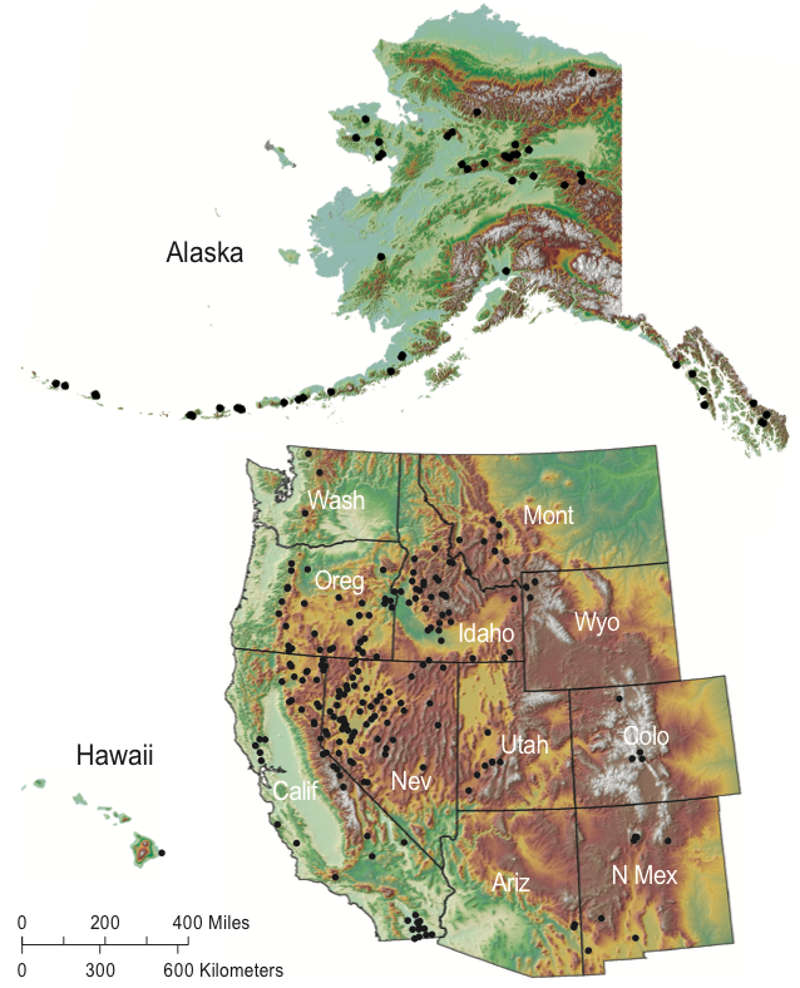
Map showing the location of identified moderate-temperature and high-temperature geothermal systems in the United States. Each system is represented by a black dot. Credit USGS.

Here’s the release from the USGS:

Scientists with the U.S. Geological Survey (USGS) recently completed an assessment of our Nation’s geothermal resources. Geothermal power plants are currently operating in six states: Alaska, California, Hawaii, Idaho, Nevada, and Utah. The assessment indicates that the electric power generation potential from identified geothermal systems is 9,057 Megawatts-electric (MWe), distributed over 13 states. The mean estimated power production potential from undiscovered geothermal resources is 30,033 MWe. Additionally, another estimated 517,800 MWe could be generated through implementation of technology for creating geothermal reservoirs in regions characterized by high temperature, but low permeability, rock formations.

Proposed constitutional amendment would limit Denver-area housing growth — Denver Business Journal

Denver photo via Allen Best

From The Denver Business Journal (Ed Sealover):

Dismayed by highway congestion and hamstrung government budgets, the author of Golden’s 21-year-old housing-growth limitations has submitted an initiative for the 2018 ballot that would cap the number of new homes and apartments going up along most of the Front Range.

Daniel Hayes’ effort must be categorized, at least for now, as a long shot.

Not only has he not solicited funders or backers for the campaign, but he said in an interview Thursday that he plans to file a lawsuit challenging the constitutionality of the recently passed Amendment 71, arguing that it would be nearly impossible to meet the new threshold of 55 percent approval to pass a constitutional amendment like his.

But local economic-development leaders are already concerned about the implications of any such proposal on being able to attract more jobs and workers if the supply of housing dries up.

And Hayes said he believes he can tap into a growing sentiment among Colorado residents that people should be able to control the amount of new housing before its effects and the effects of a booming population weigh even further on the crowding of highways, schools and other infrastructure.

“The growth is completely out of control. And it’s costly,” Hayes told the Denver Business Journal. “Excessive growth will bankrupt the state. There’s already no money for highways.”

The U.S. Census Bureau estimates that Colorado’s population grew 8.5 percent between 2010 and 2015, reaching a level of nearly 5.5 million people. The growth rate is one of the fastest in the country during that time period, and roughly two-thirds of the growth comes from in-migration rather than the natural cycles of state residents’ birth over death, studies have shown.

Hayes’ proposed constitutional amendment would, beginning in 2019, limit the number of new residences in the seven-county Denver metro area and in El Paso, Larimer and Weld counties to no more than 1 percent growth per year. Homes would be counted as one structure in that calculation and each apartment in a new apartment building would also be counted as one structure.

In addition, the proposal would allow residents of any other city or county government to petition to put a similar growth limitation on their local ballot. And it would allow growth limitations to be amended or repealed by initiative or referendum beginning in 2021.

Grand Valley farmers participate in drought planning — The Glenwood Springs Post Independent

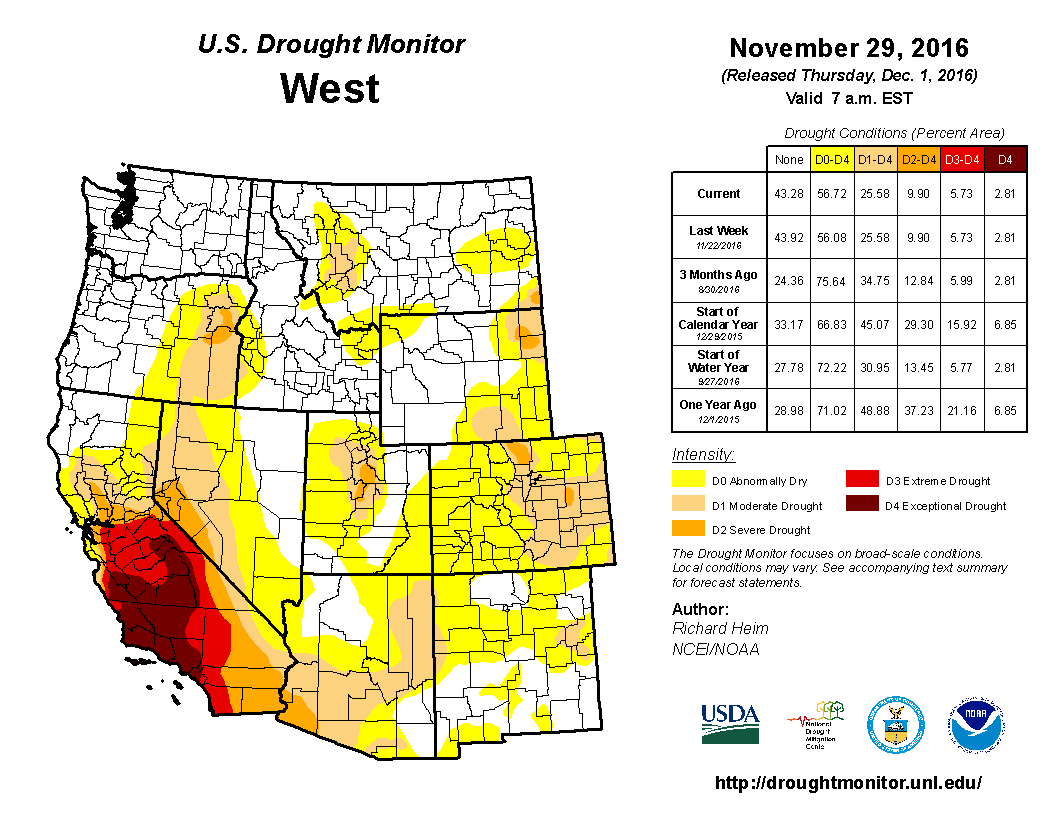
West Drought Monitor November 29, 2016.

From the Hutchins Water Center at Colorado Mesa University (Hannah Holm) via The Glenwood Springs Post Independent:

It’s been very dry in Colorado’s mountains this fall. It’s still early, and the snowpack could catch up to “normal,” but when I flew over those mountains on Nov. 15, they were brown. Just the barest dusting of white covered the highest ridges and north-facing slopes.

This delayed onset of winter provided a sobering backdrop to ongoing discussions about what to do if the Colorado River Basin slips back into severe drought with Lakes Powell and Mead, the two largest reservoirs in the basin, already half-empty.

If Lake Mead drops too low, farms and cities in the lower basin that have become accustomed to steady water supplies will have to drastically cut back. If Powell drops too low, Glen Canyon Dam will be unable to keep generating power or maintain sufficient releases to honor the 1922 agreement between the states that share the river.

No one knows exactly how upstream water users would be affected in that scenario, but if it’s a crisis reaction, it’s unlikely to be pretty. The environment could take a hit as well because low lake levels would make it impossible to conduct periodic high releases designed to mimic historical floods in order to benefit habitat conditions in the Grand Canyon.

In the lower Colorado River Basin, discussions among Arizona, California and Nevada have centered on who will cut their water use, by how much, and at what “trigger” levels in Lake Mead. This is necessary even without an intensified drought, because lake levels keep falling even with normal water deliveries from Lake Powell. The degree of drought just ratchets the urgency up or down.

In the upper Colorado River Basin, which straddles Colorado, Utah, Wyoming and New Mexico, there is no single outlet at the top of the system that can be cranked up or down. Instead, there are thousands of drainages feeding into the Colorado River, with widely dispersed ranches, farms and communities taking sips and gulps along the way, including some sizeable straws pulling water across the Continental Divide to Colorado’s Front Range.

A recent modeling effort coordinated by the Colorado River District concluded that if we were to experience another drought like the one of the early 2000s, with the reservoirs levels as low as they are now and without any additional conservation, Lake Powell could essentially be drained in just a few years.

Efforts are underway to figure out how to craft a demand management system that can entice upper basin water users to voluntarily dial back their consumption and get paid for it, in order to keep Powell from falling to critically low levels.

That’s complicated. For an agricultural demand management system to work for farmers, it needs to provide adequate compensation, not impede long-term operations, have simple paperwork and not put water rights at risk. For irrigation providers, it needs to pay its own way, be easy to manage, and not put water rights at risk. And for such a system to work for communities, you can’t have large swaths of fields left brown and unkempt, supply dealers left without customers and farmworkers left jobless.

GRAND VALLEY ACTIVITIES

A pilot project in Western Colorado’s Grand Valley is testing an approach to cutting back agricultural water use that seeks to work for everyone.

The location, just east of the Utah state line, is significant. About half of the water that flows into Lake Powell flows through Colorado’s Grand Valley first, some of it flowing through the river, and some detouring through irrigation ditches and farm fields before returning. Much of the water diverted does not return, of course, instead getting transpired through leaves of alfalfa, corn or grass, or plumping up peaches and wine grapes.

The Grand Valley Water Users Association (GVWUA), the biggest irrigation provider in the valley, is managing the pilot project to reduce that water consumption. At an October meeting to explain the pilot program to other regional water managers and irrigators, GVWUA manager Mark Harris said that the potential for future water shortages is driving the organization’s participation in the pilot.

For the 2017 irrigation season, GVWUA will conduct the $1 million pilot with funding from the Colorado Water Conservation Board, the Nature Conservancy and the Water Bank Work Group.

In 2017, 10 farm operators dispersed across the valley, each with 120 or more acres under irrigated cultivation, will participate in the GVWUA program.

The total reduction in water consumption achieved by the GVWUA pilot is predicted to be 3,200 acre feet, only a drop, but an important first drop to test the system. So far, the project appears to be on course work well for the participating farmers and the GVWUA. There is adequate compensation, management isn’t too complicated and water rights are protected.

Making the program acceptable for the rest of the community isn’t too complicated at this small scale, although some eyebrows may be raised at the odd brown field in the spring. If brought to sufficient scale to meaningfully benefit Lake Powell, however, this would become a more significant consideration.

In the meeting about the GVWUA program, several people voiced concern that agriculture was being expected to shoulder the burden of bringing supply and demand back into balance in the Colorado River Basin. Some cities are, in fact, also participating in programs to cut diversions to protect the reservoirs, and most have made large strides in conservation in recent decades. However, there is still a feeling that they can do more, particularly in the area of integrating land use and water planning.

If snow piles up in the mountains at reasonable levels over the next few years, it will buy time to fine tune and gradually scale up programs like the one GVWUA is testing, as well as experiments underway in other settings and on other crops, like high mountain hay meadows. Bolstering administrative capacity to coordinate a broad suite of such programs and developing legal mechanisms to ensure that conserved water reaches Lake Powell without being intercepted by other users must occur before such programs can be effective at a large scale.

If a moderate amount of conserved water is sent to Lake Powell each year or retained in upstream reservoirs, it will reduce the chances that more drastic cuts will be needed in any one year – avoiding the deepest impacts to agriculture and communities.

If the mountains keep staying brown late into the fall, however, the upper basin’s demand management efforts will have to accelerate significantly. Under that scenario, it will be harder to keep everyone happy.

Hannah Holm is coordinator at the Hutchins Water Center at Colorado Mesa University.

Rifle: Near the end of a long road for Graham Mesa water treatment plant

The water treatment process

From The Rifle Citizen-Telegram (Ryan Hoffman):

After a decade of debate and two years of construction, the city is nearing the end of construction on the Rifle Regional Water Purification Facility.

The approximately $30 million water treatment plant, consisting of eight above-ground structures on an approximately 5 acre campus, will replace both the Graham Mesa plant and the Beaver Creek plant after it comes online.

As things stand, that will likely occur toward the end of the first quarter of 2017.

“All the support systems have to come on before water can begin to flow, so water will begin to flow, we hope, in January,” Jim Miller, Rifle’s utilities director, said after a tour of the grounds in mid-November. “It will still be several months after that before customers would notice anything.”

Ultimately what Rifle municipal water customers will notice starting this summer, according to Miller, is clearer water with significantly less iron and manganese, which will make it better tasting.

Aside from improved water, completion of the plant will largely close the door on Rifle’s largest capital project ever — a matter that garnered a great deal of attention, and at times scrutiny from community members, over the past 10 years and particularly in the past seven when initial plans were first hatched…

The city decided to switch from the “design-bid-build” approach, opting instead for a “construction manager-general contractor” method.

Later in 2014, the city selected Moltz Construction Inc. as its contractor — a decision that Miller says has been instrumental in progressing the project forward.

That change allowed for flexibility and cost saving measures that, excluding design and consultant fees for the redesigned project, are expected to total $30.5 million, according to Miller’s memo.

Walking through the facilities, Miller says there are a number of cost savings born out of the value engineering that was possible by switching to the construction manager-general contractor approach.

A tank, known as a clean-in-place tank, was initially going to be 6 feet taller, which would have raised the roof of the entire building it’s housed in another 6 feet. The team was able to get a shorter tank that was wider and had the same capacity — effectively keeping the building at the previous height and saving money.

Miller admits that the approach can be confusing at times for those not directly involved on the project, especially with all the numbers and variables involved.

“It may not be the most transparent thing, but it is efficient.”

Along the way, Miller has had to address arguments, such as those suggesting the Graham Mesa plant should have been upgraded, rather than building an entirely new facility from scratch.

The Graham Mesa plant is aging and incapable of meeting certain regulatory standards. Further, it simply does not have the space that would allow for upgrades while having a functional treatment plant — a major flaw in the Graham Mesa plant is the absence of redundancy in the systems.

“They don’t know what they’re talking about,” Miller said of those who argue that the city should have stuck with the Graham Mesa plant.

The new facility will fall just a little short of 8 MGD, much more than the 4 to 5 MGD at Graham Mesa and the ½ MGD at Beaver Creek. Ultimately the plant can be brought to 8 MGD, but some pieces were left out as a cost-saving measure.

Having that flexibility to keep up with population growth is another important feature of the new facility.