Intake structure during construction in 1961. Photo Credit Reclamation.
From the US Bureau of Reclamation (Lesley McWhirter, Justyn Liff):
The Bureau of Reclamation has released the final Finding of No Significant Impact and Environmental Assessment evaluating if Reclamation will provide partial funding to the North Fork Water Conservancy District to make repairs to the Paonia Dam intake structure and bulkhead, part of the Paonia Project located near Paonia, Colo. Repairs are expected to begin in September 2017.
During construction, work crews and an excavator will be operating at the dam. Crews will dismantle the damaged upper concrete bulkhead of the intake structure and replace it with a modified aluminum trash rack and support members. These repairs are necessary to help ensure continuation of normal dam operations and water delivery to downstream users.
Prior to repairing the intake structure, increased turbidity downstream of the dam will be noticeable due to normal reservoir operations and drawdown. Turbidity will temporarily increase in Muddy Creek and the North Fork of the Gunnison River downstream of Paonia Dam, and sediment deposition will occur primarily in Muddy Creek from the dam to the confluence of Anthracite Creek until high flows begin the following spring.
Temperatures may rise to as high as 55 F [31 C] above average on December 22nd over sections of the Arctic near the North Pole. Note that this dynamic will tend to drive colder air out over the Continents — especially, in this case, toward Siberia. Also note that global temperatures remain well above average even when compared to the warmer than normal 1979 to 2000 time-frame. Image source: Climate Reanalyzer.From RoberScribbler.com:
A storm in the Greenland Strait is predicted to strengthen to 940 mb intensity on the 20th and 21st. This system is expected to dredge warm air from the tropical North Atlantic and then fling it all the way to the Pole…
As a result, temperatures in the polar region are expected to rise to near or above freezing. According to GFS model runs, the thermometer at 90 North is expected to hit around -0.3 C (31.5 F) at 0400 UTC on December 22. Meanwhile temperatures on the Siberian side of the Pole at 88 North, 109 East are predicted to hit 0.6 C or 33 F during the same time period.
Interior Secretary Jewell and Deputy Secretary Connor announcing milestones for smart western water management December 15, 2016. Photo credit USBR.
Here’s the release from the US Bureau of Reclamation (Interior_press@ios.doi.gov):
U.S. Secretary of the Interior Sally Jewell and Deputy Secretary of the Interior Michael L. Connor today celebrated milestones for two collaborative efforts the Interior Department has spearheaded to help secure sustainable water supplies for future generations. They made the announcements at the Colorado River Water Users Association meeting in Las Vegas.
Glen Canyon Dam releases. Photo via Twitter and Reclamation
First, Secretary Jewell finalized the framework to adaptively manage the Glen Canyon Dam over the next 20 years, with the goal of creating certainty and predictability for water and power users while protecting environmental and cultural resources in Grand Canyon National Park and the Colorado River ecosystem.
“The Colorado River is foundational to the Western economy, and the issues facing it are complex,” said Secretary Jewell. “I applaud the diverse set of partners that came together to develop a plan that will deliver water and power from Glen Canyon Dam, while also protecting the incredible natural and cultural resources that call the Colorado River Basin home.”
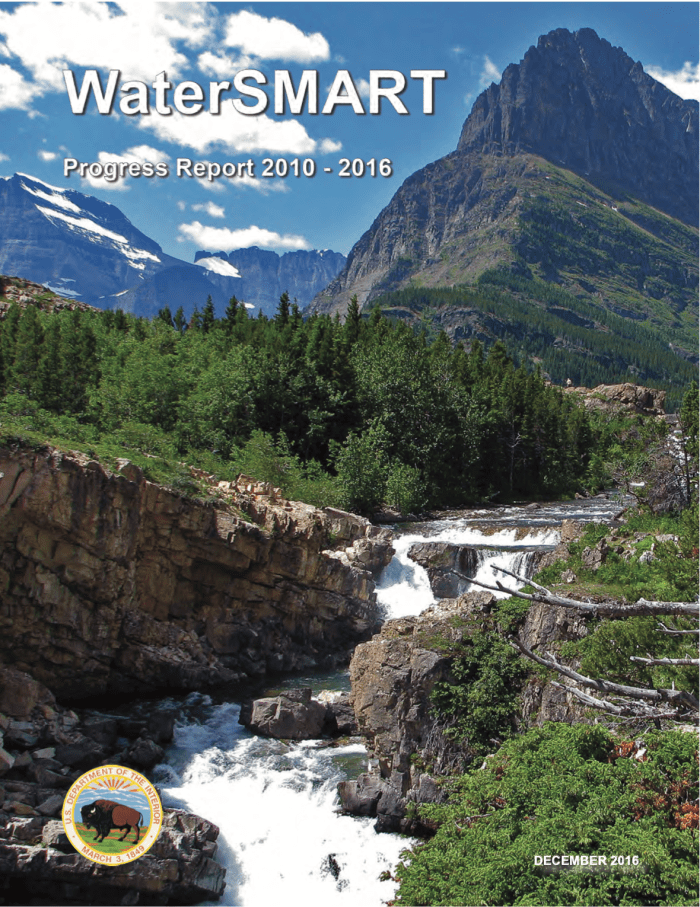
Second, the Interior Department released a report showing that projects initiated from 2010-2016 under the Department of the Interior’s WaterSMART program are expected to result in savings of 1.14 million acre-feet of water per year upon completion, the annual household usage of 4.6 million people.
“The WaterSMART program is about collaboration on new ideas and creative solutions to stretch finite water supplies, increase drought resilience, improve environmental conditions, and address the effects of climate change,” said Deputy Secretary Connor. “Through the water conservation and reuse projects funded by WaterSMART across the West, we expect to save enough water to meet the needs of Phoenix annually.”
To develop the Long-term Experimental and Management Plan (LTEMP) for Glen Canyon, the Interior Department conducted a comprehensive Environmental Impact Statement involving the Bureau of Reclamation and the National Park Service, along with 15 cooperating agencies, the Navajo Nation and all seven Colorado River Basin States. The Department carefully weighed economic, technical, social and environmental considerations among seven possible alternatives evaluated by the Final Environmental Impact Statement.
The final plan also includes a number of important improvements to enable successful dam operations in compliance with the Grand Canyon Protection Act and other federal statutes and regulations. The plan provides more even monthly volume releases and continues protocols for the High Flow Experiments. As was seen last month, these experimental releases are designed to restore sand features and associated backwater habitats to provide key fish and wildlife habitat, potentially reduce erosion of archaeological sites, restore and enhance riparian vegetation, increase beaches and enhance wilderness values along the Colorado River in Glen Canyon National Recreation Area and Grand Canyon National Park.
The LTEMP will not affect the amount of water available annually for communities and agriculture based on the annual water flow between Lake Powell and Lake Mead. Colorado River Basin water allocations are unchanged by the LTEMP Record of Decision. Those allocations and annual deliveries will continue consistent with the Colorado River Compact and other existing statutes, treaties, regulations and agreements governing Colorado River water allocation, appropriation, development and exportation.
The Colorado River Basin is just one area where the Department is working with its partners to address water conservation and other water-saving strategies. Today’s WaterSMART report and data visualization tool details progress made since 2010 to improve water conservation and help water-resource managers narrow the gap between water supply and demand. The WaterSMART Progress Report illustrates in detail how WaterSMART provides a framework through which water managers can develop and adopt innovative solutions that provide a more reliable water supply in a changing climate.
“Reclamation has more than 100 years of experience addressing the water supply and demand needs of the Western United States,” Reclamation Commissioner Estevan López said. “Through collaboration with our partners under WaterSMART, we hope to help ensure water sustainability for another 100 years and beyond.”
As part of WaterSMART, Reclamation provides funding for projects and studies that increase water and energy efficiency, plan for and mitigate drought, develop scientific information and tools to plan for future water needs, and facilitate the creation and advancement of watershed groups.
You can find a fact sheet with accomplishments under the WaterSMART program here.


![Temperatures may rise to as high as 55 F [31 C] above average on December 22nd over sections of the Arctic near the North Pole. Note that this dynamic will tend to drive colder air out over the Continents — especially, in this case, toward Siberia. Also note that global temperatures remain well above average even when compared to the warmer than normal 1979 to 2000 time-frame. Image source: Climate Reanalyzer.](https://coyotegulch.blog/wp-content/uploads/2016/12/gfstanomalycentigradeforecastfor12222016climatereanalyzerorg.png)