
#Drought news: #Colorado, 60% of topsoil and 59% of subsoil rated short to very short of moisture

Click here to go to the US Drought Monitor website. Here’s an excerpt:

Summary

This USDM week began with an upper-level ridge bringing above-normal temperatures to much of the central third of the CONUS. Short-wave troughs moving through the ridge brought surface lows and cold fronts as they moved across the country. By the end of the week, a large upper-level trough and its associated surface low and front were bringing cooler temperatures and much-needed precipitation to many drought areas. Drought contracted in parts of the Ohio to Lower Mississippi Valleys and Southern Plains. Drought expanded in parts of the Central to Southern Plains which missed out on the frontal precipitation. The early week fronts fell apart before reaching the Southeast drought area, and the late week front did not reach most of the Southeast before the cutoff date for this week’s USDM. As a result, drought expanded in southern Alabama to southeast Georgia, and in eastern Kentucky, and did not improve in the Southeast much from the frontal passages…

The Great Plains

Precipitation from the low pressure systems that moved across the middle of the country fell as snow in the northern Plains with rain in parts of the central and southern Plains. Precipitation amounts ranged from 0.5 to 1.5 inches from parts of Nebraska to North Dakota, as well as parts of Texas and southeast Oklahoma, while northeast Texas to the southeast tip of Oklahoma received over 2 inches and locally over 4 inches. But little to no precipitation fell from northwest Texas to much of Kansas. D0-D3 were pulled back in eastern and southern Texas, D2-D3 contracted in southeast Oklahoma, and the central Nebraska D1 blob was trimmed. But D0-D1 expanded in western Nebraska to central Oklahoma and the Texas panhandle, and an oval of D2 was added to southwest Kansas into the Oklahoma panhandle. As of November 27, the USDA reported that 41% of the topsoil was rated short to very short in Nebraska and Texas, and subsoil moisture was short to very short in 42% of Nebraska and 39% of Texas. Topsoil moisture short to very short increased in Kansas from 41% last week to 45% this week, while 35% of the subsoil moisture was rated short to very short. In Oklahoma, topsoil moisture short to very short increased from 50% last week to 55% this week, with 44% of the subsoil short to very short of moisture…

The Rockies and Far West

The upper-level troughs brought locally heavy precipitation to the coastal Northwest, with locally 10 inches or more measured in favored upslope areas of Washington and northwest Oregon. Two or more inches of precipitation fell from the northern California coast to the Cascades of Washington, and along upslope areas of the Sierra Nevada in California. Much of the Rockies and higher elevations elsewhere in the West received half an inch or more of precipitation, but parts of Montana and the Southwest had less than a tenth of an inch. The precipitation increased high elevation SNOTEL station snow depth almost everywhere across the West, but SWE (snow water content) values continued to be lower than average across the Pacific Northwest and most of the Rockies. The weekly precipitation totals were below normal for Montana, the interior Northwest, and parts of the Great Basin and Southwest. This was still early in the snow season, so no change to the USDM depiction was made across most of the West, except for a few locations. An oval of D0 was added in eastern Montana based on short-term drought indicators, and D0 expanded along the Rocky Front Range in the vicinity of Great Falls based on 30-day precipitation departures and low SNOTEL SWE values. In Montana, 34% of the subsoil moisture and 28% of the topsoil moisture were rated short or very short by the USDA. D0 was pulled back in north central New Mexico where short-term indicators showed wetness, especially NASA’s SPoRT LIS soil moisture tool and the USGS streamflow percentiles. Reservoirs in this area continued below 30+ year average levels, but this is due to long-term conditions mostly upstream in the basin out of state; in arid regions like New Mexico, it may take many years for some of these reservoirs to refill to these long-term average levels. November 27 USDA reports still indicated 67% of New Mexico’s topsoil, and 47% of the subsoil, were rated short to very short of moisture. As noted by the National Weather Service, November 28 SNOTEL data reflected a good start to the snow season for northern California mountain snowpack, with some basins 130-140% of median. But this is early in the snow season, so median values are easy to exceed. And basins to the south, including the San Joaquin, are still lagging, below 70% of median in more southerly locations. In California, 65% of the topsoil was rated short to very short, an increase of 5% from last week, and 65% of the subsoil was short to very short, according to the USDA. In Colorado, 60% of the topsoil and 59% of the subsoil were rated short to very short of moisture, while the statistics were 50%/60% in Nevada, 19%/32% in Oregon, 27%/30% in Utah, and 50%/50% in Wyoming…

Looking Ahead

In the day since the Tuesday morning cutoff time of this week’s USDM, the cold frontal passage dropped an inch to locally over 3 inches of rain from parts of Louisiana northeastward to western Virginia, and over parts of the Northeast. For November 30-December 5, a series of fronts and low pressure systems are forecast to drop an additional 1-2 inches of precipitation across the South from Texas to Virginia, and parts of the Northeast, with locally 3+ inches from Texas to Mississippi. One to 3 inches is progged for parts of the coastal Northwest and Northern Rockies. A tenth to half of an inch is expected across the Midwest, extreme northern Plains, and much of the central and northern portions of the West. No precipitation is forecast for southern California or much of the Southwest to central Plains. Temperatures should average warmer than normal in the East and cooler than normal in the West. For December 6-14, odds favor wetter-than-normal conditions for the northern tier States and drier than normal for the Southwest to southern Plains, with the Southeast transitioning from wet to dry. Temperatures are expected to be colder than normal in the West to Plains. The East Coast will transition from warmer than normal to cooler than normal as an upper-level trough migrates east through the period. Odds favor cooler- and drier-than-normal weather over Alaska.

@ColoradoStateU researcher studying use of ‘produced water’ on crops and livestock — Sterling Journal-Advocate

producedwaterllcgraphic

From The Sterling Journal Advocate (Jeff Rice):

Farmers and ranchers who work in close proximity to oil and gas production, especially if that extraction involves fracking, need to be aware of the effects of that process on their operations, according to a presentation made Tuesday morning during the Eastern Colorado Crop Production Conference in Fort Morgan.

While the boom in hydrologic fracturing, also known as “fracking,” began a decade ago, researchers are just now asking serious questions about the impact of fracking fluids on crops, livestock and people. Molly McLaughlin, a doctoral candidate at Colorado State University, told the 80-plus attendees at the Fort Morgan conference that she hopes her research will answer some of those questions.

The most surprising revelation from McLaughlin’s presentation is that some “produced water” from oil and gas wells is actually used to irrigate crops and water livestock.

The researcher explained that there are two kinds of fluids involved in fracking. The first is the fracturing fluid that is forced into the drilled well to widen fractures in the bore hole. The fluid consists mainly of water but also contains chemicals to reduce friction of fluids against the well casing, biocides to kill bacteria that may grow in the warm, wet environment, and “proppants” that hold the fractures open so oil and gas can flow into them to be extracted. McLoughlin said wells in eastern Colorado use an average of about 3 million gallons of water per well during the fracturing process, mixed with about 30,000 gallons of chemicals.

The other fluid is the produced water, or fluid that flows back out of the well during the extraction of oil and gas. McLoughlin said most of the fracturing fluids are expelled from the well in the first few years of production, but that water will flow out for the life of the well, or about 30 years in most cases. During later years, most of the water is what was already in the geologic formation that contains the oil or gas being pumped out. She pointed out that this is not water from aquifers that supply water for human consumption. As oil and gas production decreases, she said, water production increases.

Most of the exposure to fracking fluids and produced water happens during spills, McLoughlin said, and virtually all spills must be reported to state authorities. She said contamination can come from spilled chemicals getting into surface water, such as nearby lakes and streams, or by leaching through soil into shallow aquifers.

McLoughlin said most of the chemicals used in fracking will degrade fairly rapidly if they are spilled into soil, but that combinations of chemicals degrade at different rates. She said the presence of salts in the produced water can retard degradation by six months or more. Her research is aimed at determining the degradation rates of various chemical combinations, and the effects those combinations have on soil, crops, livestock, and people.

Wastewater from oil and gas wells is treated, McLoughlin said, by skimming pollutants off of the top of holding ponds, by heating the wastewater, or by adding neutralizing chemicals. She said increasingly, treated water is being used to irrigate some crops and water some livestock.

McLaughlin showed research being done at the University of California at Davis that uses produced water to irrigate switch grass for biofuels or cotton for textiles.

An online article from the California Environmental Protection Agency states that produced water from oil and gas wells there is treated and then blended with other water to irrigate crops in the arid inland areas of the state. The CEPA closely monitors that water, the article said, and the state’s Food Safety Expert Panel monitors the crops grown with that water.

McLoughlin concluded her presentation by saying that much more research needs to be done on potential impacts of oil and gas wastewater on food production.

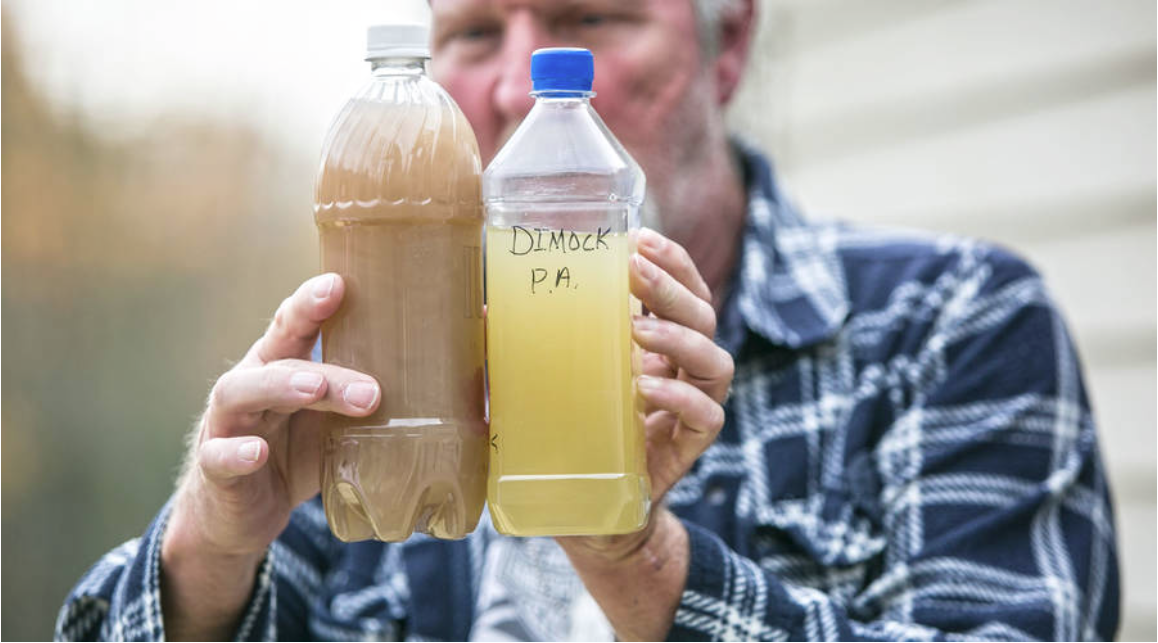
Ray Kemble holds two samples of well water from his neighborhood in Dimock, PA. He says the water was contaminated after fracking. - Amanda Hrycyna for APM Reports
Ray Kemble holds two samples of well water from his neighborhood in Dimock, PA. He says the water was contaminated after fracking. – Amanda Hrycyna for APM Reports

From MarketPlace.org (Scott Tong and Tom Scheck):

Top officials of the U.S. Environmental Protection Agency last year made critical changes at the eleventh hour to a highly anticipated, five-year scientific study of hydraulic fracturing’s effect on the nation’s drinking water. The changes, later criticized by scientists for lacking evidence, played down the risk of pollution that can result from the well-drilling technique known as fracking.

Documents obtained by APM Reports and Marketplace show that in the six weeks before the study’s public release, officials inserted a key phrase into the executive summary that said researchers did not find evidence of “widespread systemic impacts” of fracking by the oil and gas industry on the nation’s drinking water.

Earlier draft versions emphasized more directly that fracking has contaminated drinking water in some places.

The documents also show that the news release accompanying the scientific study was changed on June 3, 2015, the day before it was made public. A draft displayed a conclusion that the EPA had identified “potential vulnerabilities” to drinking water. But the final release dated June 4, concluded: “Assessment shows hydraulic fracturing activities have not led to widespread, systemic impacts to drinking water resources and identifies important vulnerabilities to drinking water resources.”

In a conference call with reporters about the study on the day it was released, the EPA’s deputy administrator, Tom Burke, highlighted the lack of “widespread, systemic impacts” as the agency’s top finding.

In fact, scientists had found evidence in some places that fracking activity had polluted drinking water supplies.

In all, the agency identified more than two dozen instances in which hydraulic fracturing had an impact on water resources. The agency also identified hundreds of other spills, many of which reached soil and water.

It’s not clear precisely who inserted or ordered the new phrasing. But emails acquired via the Freedom of Information Act show EPA officials, including press officers, met with key advisers to President Obama to discuss marketing strategy a month before the study’s release. The emails also show EPA public relations people exchanging a flurry of messages between 4 and 11 p.m. on the eve of the study’s release.

Fixes underway to remedy high lead levels in Denver, Jeffco and Cherry Creek school water — Chalkbeat

Roman lead pipe -- Photo via the Science Museum
Roman lead pipe — Photo via the Science Museum

From Chalkbeat (Ann Schimke):

A small proportion of sinks and water fountains in Denver, Jeffco and Cherry Creek schools have been taken out of service because of high lead levels found after school district testing in the summer and fall.

So far, results are back for one-third of Denver schools, mostly elementaries. They show that about 4 percent of samples came back high. Some schools have no sinks or fountains with elevated lead levels, while others — such as Cory and Greenlee elementaries, and Denver Montessori Junior/Senior High School — have four or five.

“We haven’t really found anything alarming,” said Joni Rix, environmental services manager for DPS. “Certainly we’ve found lead, but it’s not widespread.”

Fixes, which are expected to cost around $500,000, will happen at every school with elevated lead levels, she said.

That’s not the case in Jeffco, where testing revealed that about 80 percent of schools have at least one sink or water fountain with high lead levels.

While smaller fixes have been or will be made, district officials say voters’ rejection of the district’s $535 million bond issue earlier this month will make extensive plumbing repairs impossible.

“If it’s any kind of big fix it’s probably not going to happen,” said district spokeswoman Diana Wilson. “It’s probably going to be easier to shut some sinks down.”

In Cherry Creek, where testing was conducted this fall, some schools had elevated levels. In most cases, fixes have already been made, though more systemic problems surfaced at the 1980s-era Creekside Elementary. Water samples from 10 locations in the school had elevated lead levels and samples from most other locations also showed some lead, though not above the federal limit.

District spokeswoman Tustin Amole said via email that students there are drinking bottled water until repairs can be completed — probably over winter break.

The risk of lead poisoning from school water is relatively low, according to experts in Colorado. Still, they say school officials are right to be aware of it given that high lead levels can severely impair children’s physical and mental development.

School districts aren’t required to test their water for lead unless they’re considered public water systems. (That’s the case in some rural districts and on a limited basis in Jeffco, which provides water to six mountain schools.)

Still, in the wake of the lead-poisoning crisis in Flint, Mich., last year, Colorado’s five largest school districts all decided to test their water.

Douglas County School District launched its effort last spring at 19 older schools, and had no samples above the federal 15-parts-per-billion threshold, according to district records provided to Chalkbeat last summer.

Jeffco began districtwide lead-testing in June and Denver followed in August. In Jeffco, testing is now complete save for a small number of re-tests in locations where fixes have been made.

Aurora Public Schools began testing school water in October, and so far results are available for two early childhood centers, according to the district’s lead-testing web page. Neither have elevated lead levels.

Results for the remaining two-thirds of Denver’s schools will be back by the end of January. Rix said she expects a similar proportion of those samples — 4 to 5 percent — to have elevated levels. All told, district staff collected more than 4,000 water samples this fall.

Starting this Saturday, DPS will also test some schools’ service lines — the pipes that run from buildings to the city’s water mains under the street — to determine whether they are made of lead. That testing, which involves drilling into the ground to reach the service lines, will start at Newlon, Cowell, Goldrick, Schmitt and Knapp elementary schools.

The five, all built in the 1950s, are among 69 district schools that may have their service lines tested this year. The $572 million bond Denver voters passed earlier this month will provide $800,000 to replace lead service lines.

@ColoradoStateU: Winter watering, keep those hoses ready #drought

From Colorado State University (Jason Kosovski):

When Colorado weather is especially dry in the fall and early winter, watering season may not end just because your sprinklers are turned off. This year has seen relatively little moisture throughout the fall, and despite some snow in mid-November, the ground remains fairly dry.

Tips for fall and winter watering

As part of the Planttalk Colorado program offered through Colorado State University Extension, the Denver Botanic Gardens, and the Green Industries of Colorado, tips for fall and winter watering can be found online and through a short YouTube video. CSU Extension also offers a fact sheet on fall and winter watering.

Mike Landers, a certified arborist for Tagawa Gardens in Centennial, Colo., says that winter watering is “hand watering your trees throughout your landscapes starting around mid-October and could stretch into March, depending on how much moisture we get.”

Ensure optimal watering

Although most people have turned in-ground sprinkler systems off by this time, there are a number of tools that can be used to ensure optimal watering. One option is a frog type sprinkler which sits above ground and can be moved to different areas around and under trees to make sure that enough water gets to the roots, which are alive even during the winter. Deep root fork and needles are also options – these devices are inserted into the ground and inject water below the surface, getting closer to tree roots. Experts suggest watering about once a month during the fall and winter.

“Winter watering is especially critical for newly planted evergreen and deciduous woody plants, which are the most susceptible to winter drought injury,” said James Klett, a professor in the Department of Horticulture and Landscape Architecture and Extension landscape horticulturist. “You should water only when air and soil temperature are above 40 degrees with no snow cover.”

About Planttalk

Winter watering is just one of the more than 600 horticultural topics explained by the Planttalk Colorado program. Planttalk provides reliable information on a number of topics – from annual and perennials to vegetables and houseplants to insects and diseases. Much of the information comes in the form of research-based fact sheets, which provide gardeners with the basic details plus, in many instances, additional links for related information. Planttalk also has dedicated YouTube channel with instructional and demonstration videos and can be found on Pinterest.

For more information visit the website.