
Day: December 30, 2016
#AnimasRiver: Colorado lawmakers press EPA to repay mine spill costs — KOAA
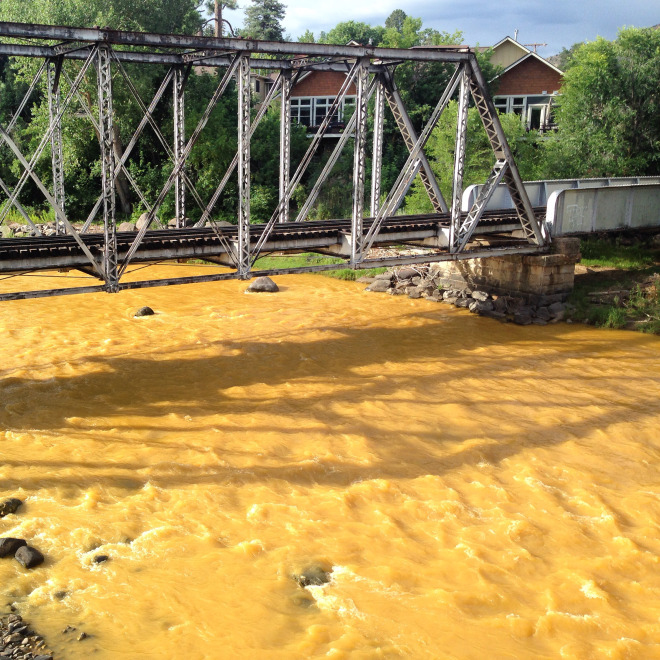
From the Associated Press via KOAA.com:
Two members of Colorado’s congressional delegation are pressing the Environmental Protection agency to fully reimburse state, local and tribal agencies for the cost of responding to a toxic mine waste spill triggered by the EPA.
Sen. Cory Gardner and Rep. Scott Tipton said Monday a law passed this month removed some of the obstacles the EPA cited in turning down $20.4 million in requests.
The EPA says it paid $4.5 million in claims but rejected the others, in some cases because the costs came after a cutoff date set by the agency. The EPA said it was following federal law.
An EPA-led crew inadvertently triggered the spill at the Gold King Mine in southwestern Colorado while doing preliminary cleanup work in August 2015.
Rivers in Colorado, New Mexico and Utah were polluted.
#Drought conditions improve for parts of Colorado — Kiowa County Press
From the Kiowa County Press (Chris Sorensen):
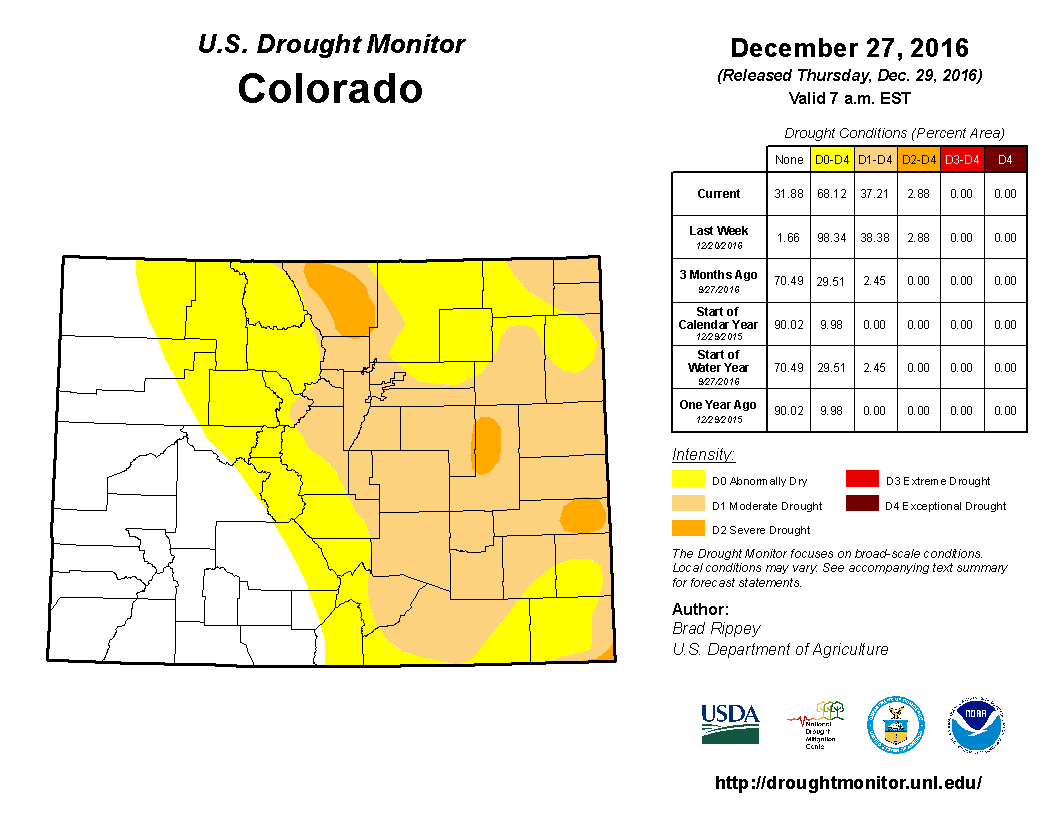
Nearly one-third of Colorado has seen drought conditions lifted over the past week.
Most of western Colorado has moved back into normal conditions as several storms brought heavy snow to the area recently. The northern mountains remain abnormally dry, however the snow water equivalent (SWE), as compared to the median for past years, is above 100 percent for the area. SWE is likely to vary substantially over the coming months.
For central and eastern Colorado, there was little change. Western Huerfano showed the most improvement, as moderate drought receded to abnormally dry conditions.
Conditions in southeast Colorado were otherwise unchanged, with the eastern half of Kiowa County and extreme southeast Baca County remaining in severe drought. The remainder of Kiowa County, along with all of Cheyenne, Otero, Crowley, and Pueblo Counties, and portions of Las Animas, Bent, Prowers, and Baca Counties were in moderate drought. The remainder of Baca, Prowers, Bent and Las Animas Counties are considered abnormally dry.
The SWE for the Arkansas drainage covering much of the southeast portion of the state currently stands at 98 percent of the median for this time of year. The statewide snow water equivalent stands at 106 percent as of December 21.
Colorado River Water Users Association Annual Conference recap
From HavasuNews.com (Sandra Dibble):
Water managers on both sides of the border say the accord [Minute 32x] will be crucial in spelling out how the U.S. and Mexico would take cuts when a shortage is declared on the river, a lifeline for some 40 million people in both countries.
The draft also contains provisions for continuing the restoration of wetlands in the Colorado River delta and extending agricultural water conservation programs in the Mexicali Valley, as well as allowing Mexico to continue storing water in Lake Mead.
The proposed agreement, known as a “minute,” is an extension of the 1944 U.S.-Mexico water treaty on the Colorado River that allots Mexico 1.5 million acre-feet annually — enough for up to 3 million households. The agreement would succeed an existing bilateral agreement, Minute 319, that is set to expire at the end of 2017.
“We’re trying to build on the trust that we had in Minute 319,” said Edward Drusina, who as head of the U.S. International Boundary and Water Commission (IBWC) is the chief U.S. negotiator. The proposed minute “is good for the United States and good for Mexico, and we will do what we can to move it forward,” Drusina said in remarks delivered in Las Vegas this month at a conference organized by the Colorado River Water Users Assn.
Because many of the key players at the federal level are expected to leave office in January, there is rising uncertainty over how much support for such an agreement can be expected under future Trump appointees. Beyond that, some are fearful that the collaboration between the United States and Mexico on the issue could be tainted by the politically heated rhetoric that the new administration has brought to other bilateral issues with Mexico such as trade and immigration.
“This great example of binational cooperation should not be derailed by unrelated political issues,” said Anne Castle, a former assistant secretary in the U.S. Department of the Interior and now a senior scholar at the Getches-Wilkinson Center for Natural Resources, Energy and the Environment at the University of Colorado.
“The collaboration between the U.S. and Mexico on binational management of this river that we share is extraordinary, and that is something to be celebrated and continued and supported,” Castle said.
Members of Trump’s transition team did not respond to requests for comment.
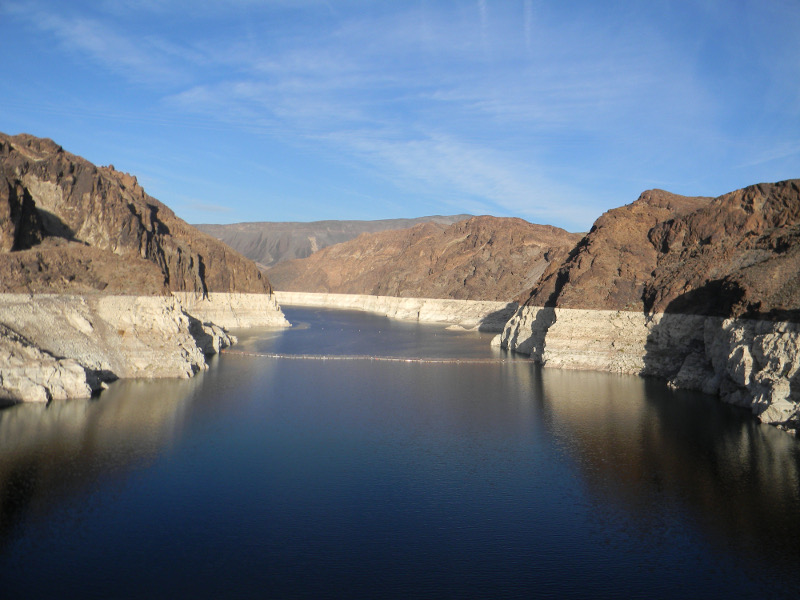
While a shortage has never been declared on the river, water managers say this could happen as early as 2018 if the levels in Lake Mead continue to drop. Earlier this year, the reservoir fell to its lowest level since the construction of the Hoover Dam in the 1930s.
“These are two countries that badly need each other at a time of water shortage on the Colorado,” said Stephen Mumme, a political science professor at Colorado State University and an expert on water and environmental issues on the U.S.-Mexico border. With treaty rights to its water, “Mexico has a pretty good hand to play, but it wants to cooperate with the United States, and it needs the storage upstream,” Mumme said.
The talks between the United States and Mexico, which have been taking place since 2015, are being led by the IBWC and its Mexican counterpart, Comision Internacional de Limites y Aguas. “The minute will have the same basic sections as Minute 319 but will be updated appropriately,” said Sally Spener, foreign affairs officer for the IBWC.
Signed in 2012 in Coronado, Minute 319 involved unprecedented binational cooperation on the Colorado River and for the first time in the treaty’s history recognition of the environment as a water user.
Its provisions included a “pulse flow” of a large volume of Colorado River water during an eight-week period in 2014 delivered to wetlands in Mexico that have been getting little water due to diversion upstream for urban and agricultural users.
Another component of Minute 319 involved a collaboration among three U.S. water agencies — the Metropolitan Water District of Southern California, the Central Arizona Project and the Southern Nevada Water Authority — and the U.S. Bureau of Reclamation to pay $18 million for water conservation projects in Mexico.
In exchange, they were to receive 124,000 acre-feet of Mexican water being stored at Lake Mead.
“The value of working with Mexico is key,” said Bill Hasencamp, Colorado River Resources manager for the Metropolitan Water District. “If we’re not done by January, that doesn’t mean we still don’t have an agreement with Mexico. We want to make sure it’s done right rather than done fast.”
Approving the agreement before the end of January “is going to be a challenge, because we’re running up against the clock,” said Tina Shields, water department manager of the Imperial Irrigation District. “Obviously people are moving very quickly now.”
The Lower Colorado Basin states of California, Arizona and Nevada are working on their own drought contingency plan which must be approved before the water scarcity provisions in the binational agreement can be made effective.
The states’ agreement would parallel the binational water scarcity provision with Mexico under the new accord, so that if the lower basin states take cuts under their contingency plan, so would Mexico, said Tanya Trujillo, who is representing California in the bilateral talks.
Trujillo, executive director of the Colorado River Board of California, was doubtful that the provisions would be worked out.