Editors note: This is the first of a three-part series examining the proposal to renew the county 1041 permit for Nestlé Waters North America.
For two days later this month, Oct. 20 and 22, Chaffee County Commissioners will hear from citizens and organizations in public hearings on the proposal to renew a 1041 permit granted to international conglomerate Nestlé Waters North America. If approved, the permit would allow Nestlé to continue to pump and truck local spring water it later sells as bottled water.
The original permit, granted by then-commissioners in 2009 was a controversial decision and the renewal has also generated opposition from activists who want the county to end the agreement.
Basically, the company pumps millions of gallons of water from the Ruby Mountain Spring in the north county annually, pipes it to a collection tank and pump station at Johnson Village, where it is loaded onto tankers, driven to a Denver bottling plant, and sold as Arrowhead Spring Water in plastic bottles.
The original (and current) agreement allows Nestlé to withdraw as much as 65 million gallons of water from the aquifer. However, company officials say Nestlé draws less than half that amount currently.
The original permit granted to Nestlé in 2009 was opposed by many residents, and an organized resistance to renewing the agreement has recently been mounted.
Larry Lawrence, Resource Manager for Nestlé Waters North America spoke with Ark Valley Voice recently about the agreement, what it provided both the company and community, and how the company has met the 1041 permit requirements, which some opponents of renewal dispute.
An engineer by profession, Lawrence has been with Nestlé Waters since 2003, and came to Colorado in 2019. He says he was already aware of the project through technical reviews with earlier resource managers prior to joining this assignment.
Lawrence said an earlier resource manager (Bruce Lauerman) was assigned to this area, and Lawrence took over in 2019. Looking for a water source closer to Denver, he said was a priority.
“The Arrowhead brand was marketed in New Mexico, Colorado, Idaho and a portion of Montana, all from California,” said Lawrence. “In reviews of not only our physical footprint but our carbon footprint and other aspects, where would we want to locate another factory? So Denver was chosen because of the reach we would have from this factory and to cover this market, which was a pretty good size bottled water market,” he added.
The factory was built in 2006, producing Nestlé Pure Life, a purified water from the municipal water system in Denver. Nestlé soon realized they wanted to produce the Arrowhead spring water brand. The prior Nestlé representative reviewed area springs and contacted various water agencies to see if they knew of any potential spring sources.
The Hagen Fish Hatchery on the Arkansas River, no longer in operation, was identified by the Colorado Division of Water Resources. Nestlé reached out to the Hagen family and reached a letter of intent for purchase at that time.
Lawrence said that at that time, they did several different studies. These included hydrological, environmental, and biological, to determine the impact of water collection there, water level withdrawal potential, and to determine the sustainability and volume of the site.
“A-number one for us is we never want to be in a position to where we recommend to the company to purchase a spring source that is non-sustainable,” said Lawrence. “…that would be a huge mistake for us, and it’s not a good business decision at all.”
The sites were studied to confirm a reasonable withdrawal rate to allow for replenishment at a sustainable rate. Another site, Bighorn Spring was reviewed, and because it did not meet replenishment rates, was not developed with Nestlé opting in favor of Ruby Mountain Springs.
Prior to that, Lawrence said other resource managers had looked at many other sites but they were ruled out for various reasons. In some cases it was because the water rights had been sold, even though there was a viable spring. According to Lawrence, springs in the eastern and southern U.S. are quite different than those generally found in the west.
It is an understatement to say that water issues are complex, especially in the west. Once the local site was selected, Nestlé reviewed what local and state government rules were for the permitting process.
The 1041 process in Colorado and in Chaffee County at the time was fairly new, and Nestlé, said Lawrence, was one of the first companies to enter that process.
“The spring here at Ruby Mountain Springs is similar to other mountain springs we see in the west. One of the differences here is we do have the Arkansas River running adjacent to the spring source,” he said.
The Nestlé operation includes the pumping stations at the spring site and long lengths of piping underground connecting to the Johnson Village property. That facility includes a large 30,000-gallon storage tank and pumps. Here, the water is loaded to tanker trucks that weigh about 87,000 pounds when full, which make the trips to the Denver bottling facility.
According to the permit, about 25 truckloads are allowed to run on U.S. 285 daily.
Next, we’ll review some of the issues and local opposition to the Nestlé 1041 renewal.
Eddie Van Halen, whose razzle-dazzle guitar-playing — combining complex harmonics, innovative fingerings and ingenious devices he patented for his instrument — made him the most influential guitarist of his generation and his band, Van Halen, one of the most popular rock acts of all time, died on Tuesday. He was 65.
Mr. Van Halen’s son, Wolfgang, said in a statement that his father had “lost his long and arduous battle with cancer.” The statement did not say where he died.
Mr. Van Halen structured his solos the way Macy’s choreographs its Independence Day fireworks shows: shooting off rockets of sound that seemed to explode in a shower of light and color. His outpouring of riffs, runs and solos was hyperactive and athletic, joyous and wry, making deeper or darker emotions feel irrelevant…
Mr. Van Halen was most widely revered by his peers for perfecting the technique of two-handed tapping on the guitar neck. That approach allowed him to add new textures, and percussive possibilities, to his instrument, while also making its six strings sound as expressive as a piano’s 88 keys or as changeable as a synthesizer. He received patents for three guitar devices he had created. In 2012, Guitar World Magazine ranked him No. 1 on its list of the “100 Greatest Guitarists of All Time.”
“I’m always pushing things past where they’re supposed to be,” Mr. Van Halen told the educational website Zocalo Public Square in 2015. “When ‘Spinal Tap’ was going to 11, I was going to 15,” he said — a reference to that film’s famous joke about a guitarist who dubiously claims that his amplifier can exceed its highest decibel level.
The zest in Mr. Van Halen’s playing paired perfectly with the hedonistic songs and persona of his hard-rocking band, Van Halen, whose original lineup featured his brother Alex on pummeling drums, Michael Anthony on thunderous bass and the singer David Lee Roth, who presented a scene-stealing mix of Lothario, peacock and clown…
Eleven of the band’s studio albums reached the Top Five, and four snagged the top spot on Billboard’s Top 200. Van Halen amassed eight Billboard Top 20 singles, including its cover of Roy Orbison’s “(Oh) Pretty Woman,” which reached No. 12 in 1982, and “Jump,” which seized the No. 1 spot in 1984 and held it for five weeks. In 2007, the band — including both Mr. Roth and Mr. Hagar — was inducted into the Rock & Roll Hall of Fame…
Edward Lodewijk Van Halen was born on Jan. 26, 1955, in Amsterdam to Jan and Eugenia (Beers) Van Halen. His father, a struggling Dutch classical musician who played clarinet, saxophone and piano, met his Indonesian-born wife while on tour in Indonesia.
In 1962, when Mr. Van Halen was 7, his family relocated to the United States, driven away by prejudice against his mother and unfavorable work opportunities in the Netherlands. They settled in Pasadena, Calif. His mother worked as a maid, his father as a janitor while seeking work as a musician.
In a new country, with a new language to learn, the Van Halen sons, Eddie and his older brother, Alex, turned to music as their lingua franca. Eddie first studied classical piano, which he excelled at despite a serious limitation.
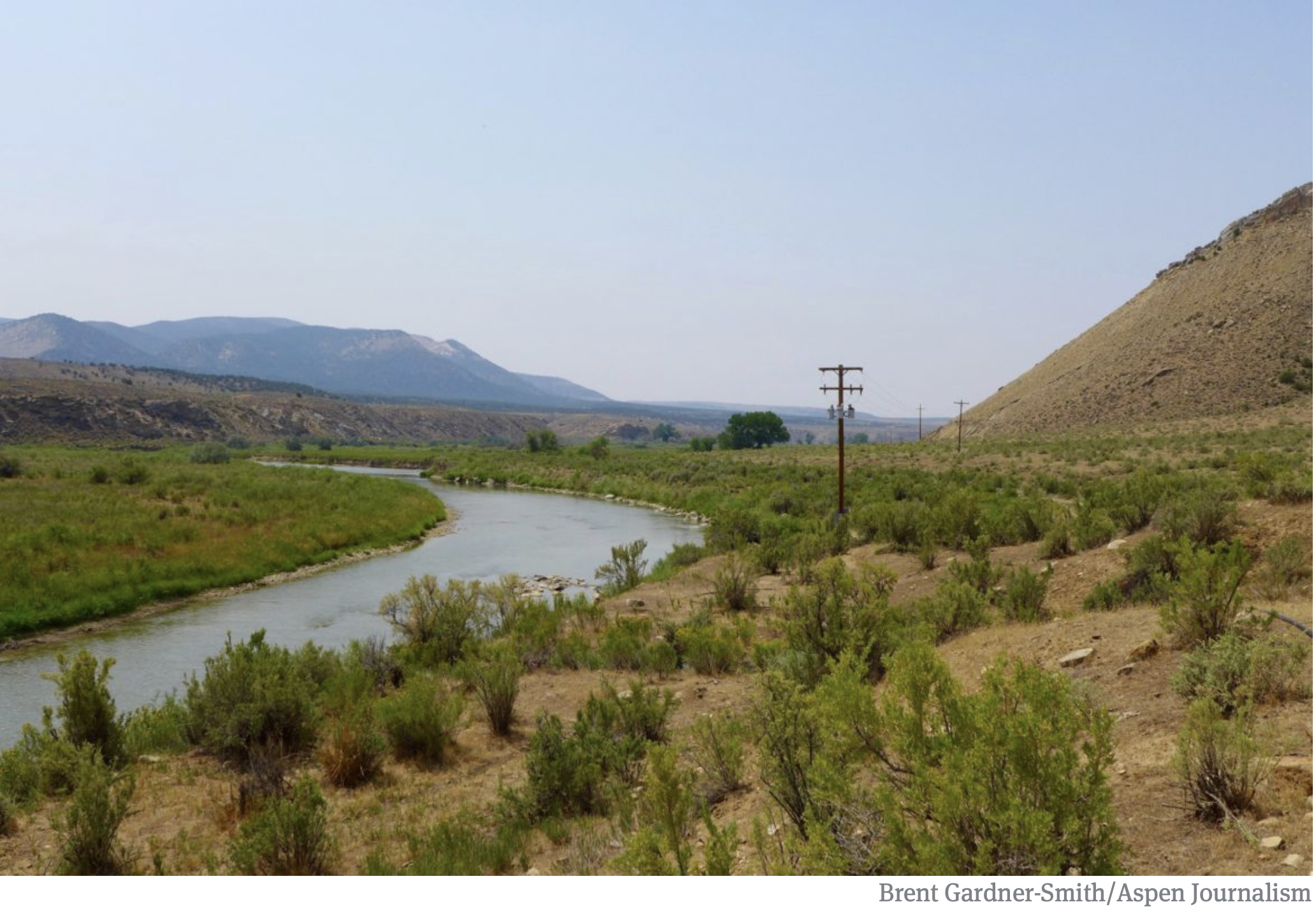
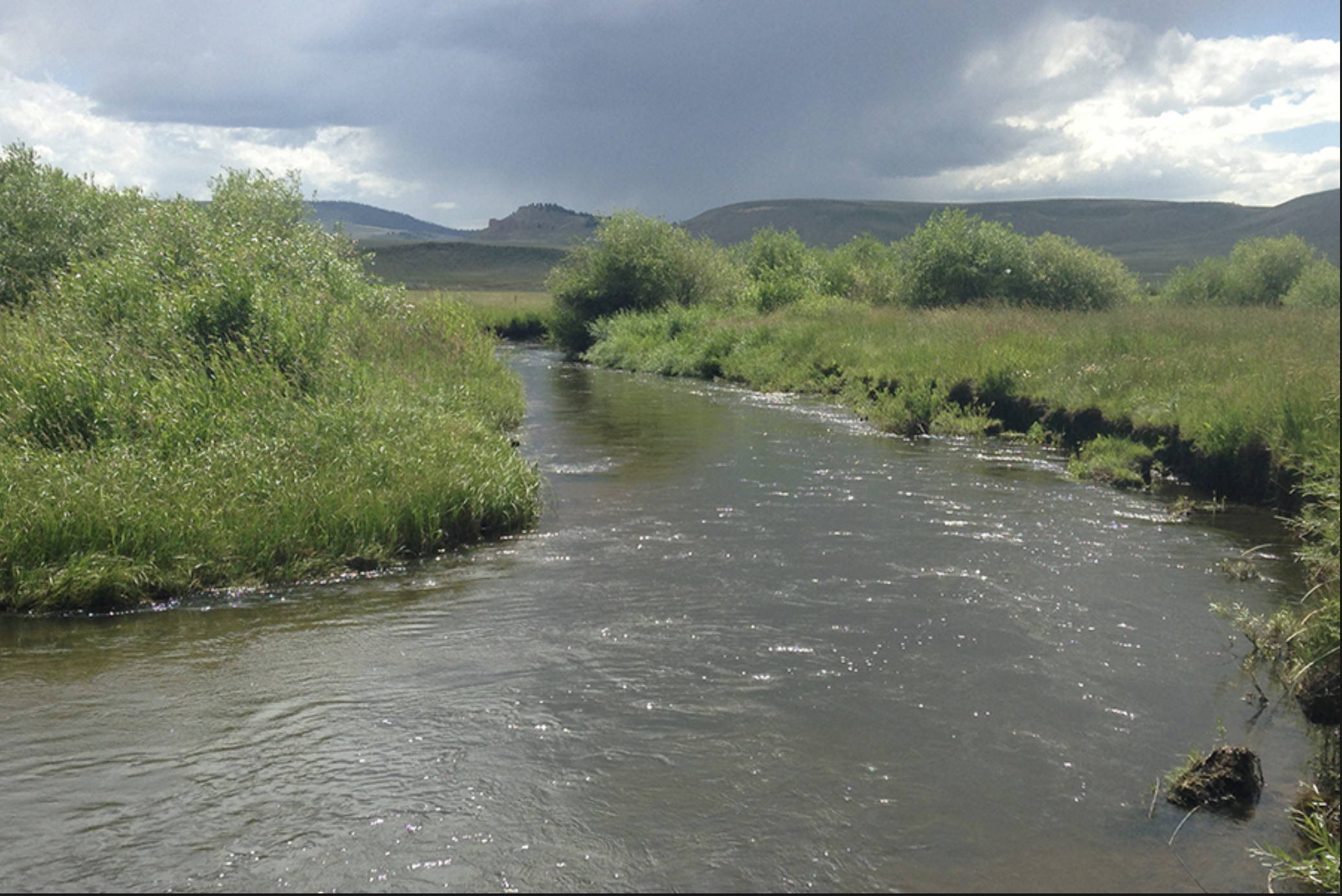
A view of the White River between Meeker and Rangely. The Rio Blanco Water Conservancy District and the State of Colorado are headed to a water court trial because they can’t agree on whether the district actually needs the water it claims it does for a reservoir and dam project. Photo credit: Brent Garndner-Smith/Aspen Journalism
A water court case is headed toward trial because the state of Colorado and a water conservancy district still cannot agree on whether the district actually needs the amount of water it claims it does for a large dam and reservoir project in the northwest corner of the state.
Expert reports from an engineering firm, an aquatic ecologist and an economics firm outline how they say the Rio Blanco Water Conservancy District can and will put its water storage rights to beneficial use. But even after Rio Blanco reduced the amount of water it’s asking for by more than 23,000 acre-feet, a report from Colorado’s top water engineers indicates the district still largely has a project in search of a need.
In their expert report submitted Aug. 31, Deputy State Engineer Tracy Kosloff and Division 6 Engineer Erin Light outline 11 instances where they say Rio Blanco has not met the requirements of state law by showing it has a specific plan and intent for the water it says it needs.
According to the report, Rio Blanco has not shown a need for water above its current supply in the categories of irrigation, municipal use, recreation, maintenance and recovery of endangered species or a back-up water supply to protect against a compact call. State engineers are asking that part or all of the water claimed for these uses be removed from the court’s final decree and deducted from the total water rights claim.
A pre-trial readiness conference is scheduled for Nov. 13. The case is scheduled to go to a 10-day trial starting Jan. 4 in Routt County District Court in Steamboat Springs, but the parties could still reach a settlement before then.
In 2014 Rio Blanco applied for a 90,000 acre-foot conditional water-storage right on the White River and proposed a dam and reservoir between Rangely and Meeker, known as the White River storage project or the Wolf Creek project. The district has now reduced that claim to either 66,720 acre-feet for an off-channel reservoir or 72,720 acre-feet for an on-channel reservoir.
There are two proposed versions of the project: one that would construct a dam and reservoir on the White River (the scale of this project is now rare in Colorado) or an off-channel reservoir at the bottom of Wolf Creek gulch, in the arid sagebrush hills just north of the river.
The conservancy district would prefer to build the off-channel option: a 66,720-acre-foot reservoir, with a dam that is 110 feet tall and 3,800 feet long. An off-channel reservoir would involve pumping water uphill from the river into the reservoir.
Rio Blanco is a taxpayer-supported special district that was formed in 1992 to operate and maintain Taylor Draw Dam, which creates Kenney Reservoir, just east of Rangely. The district extends roughly from the Yellow Creek confluence with the White River to the Utah state line.
A view looking downstream of the White River in the approximate location of the potential White River dam and reservoir. The right edge of the dam, looking downstream, would be against the brown hillside to the right of the photo. Photo credit: Aspen Journalism/Brent Gardner-Smith
Disputed amounts and uses
Rio Blanco says the project should store 7,000 acre-feet annually for irrigation. But Light and Kosloff’s report says according to the 2019 Technical Update to the Colorado Water Plan, the irrigated acres in the White River Basin are projected to decrease in the future, and that this storage project, because it is situated low in the basin, cannot serve the majority of the irrigated lands anyway, which are concentrated upstream along the mainstem of the White River near Meeker and along tributaries like Piceance Creek.
“Per the proposed decree, the applicant is once again requesting the court award irrigation use,” the engineer’s expert report reads. “The engineers continue to contend there is no evidence to suggest that there is a future water need for this purpose.”
Rio Blanco says some of the water would also be used in a future augmentation plan to replace depletions within the district that are out of priority due to a Colorado River Compact curtailment.
Rio Blanco is proposing that 11,887 acre-feet per year be stored as “augmentation,” or insurance in case of a compact call. According to the 1922 Colorado River Compact, the upper basin states (Colorado, Utah, New Mexico and Wyoming) must deliver 7.5 million acre-feet a year to Lake Powell for use by the lower basin states (Arizona, California and Nevada). If the upper basin doesn’t make this delivery, the lower basin can “call” for its water, triggering involuntary cutbacks in water use for the upper basin.
By releasing this replacement water stored in the proposed reservoir to meet these compact obligations, it would allow other water uses in the district to continue and avoid the mandatory cutbacks in the event of a compact call.
But state engineers say compact compliance is a problem to be tackled by the state and not individual water users. And since no one knows exactly how compact compliance would unfold (that’s still to be decided by the Upper Colorado River Commission and the state engineer) it’s not possible for Rio Blanco to have a plan in place for this augmentation water.
Light and Kosloff’s report says there is no recognized beneficial use that allows a water right “to provide water to users outside of Colorado for the purpose of allowing ongoing diversions of water rights within Colorado.”
Rio Blanco claims it needs three years-worth of drought contingency storage for uses within the basin. But state engineers say that there has never been a call on the White River below the town of Meeker, even in the driest years, and the likelihood of the reservoir being able to fill during the runoff season every year is extremely high. Light and Kosloff point out that not even Denver Water or Aurora Water have three times their annual demand in reserve.
The state also says Rio Blanco has overestimated the amount of water the town of Rangely will need, and that the need for the full amount claimed for recreation water is unsubstantiated, as is the need for water for the recovery of endangered fish species.
A view of the White River foreground, and the Wolf Creek gulch, across the river. The Rio Blanco Water Conservancy District and the State of Colorado are headed to a water court trial because they can’t agree on whether the district actually needs the water it claims it does for a reservoir and dam project at this site. Photo credit: Aspen Journalism/Brent Gardner-Smith
No comment from engineers, district officials
State engineers declined to talk to Aspen Journalism about their expert report.
Rio Blanco District Manager Alden Vanden Brink also declined to comment on the state’s opposition, citing concerns about litigation. Vanden Brink also is chair of the Yampa/White/Green River Basin Roundtable and sits on the board of the Colorado River Water Conservation District.
But another roundtable member says the project doesn’t hold water. Deirdre Macnab owns 4M Ranch, which is adjacent to the proposed project site, and was until recently the sole remaining opposer in the case. She recently pulled out of the formal water court process, citing mounting legal costs, but still opposes the project.
“Families living in western Rio Blanco County should be aware that a project that the professionals say doesn’t show any justification would put them in debt for years, and not just paying for the hundreds of millions in construction costs, but also almost a million dollars every year in electricity costs to pump the water up and over the dam,” Macnab said in a written statement. “Do Rio Blanco citizens really think this is in our economic best interests?”
Despite the state opposing the current project proposal, since 2013 it has also given roughly $850,000 to Rio Blanco in the form of Colorado Water Conservation Board grants to study the project. The Colorado River Water Conservation District has also given Rio Blanco $50,000 to investigate the feasibility of the project.
River District General Manager Andy Mueller said the multi-purpose water uses outlined in the project is the way water projects should be put together.
“Identifying the right-size project for the White River is still very important,” he said. “The specifics about the White River storage project as it’s currently proposed I think are things that still need to be worked out.”
Aspen Journalism is a local, nonprofit, investigative news organization covering water and rivers in collaboration with The Steamboat Pilot & Today and other Swift Communications newspapers. This story ran in the Oct. 6 edition of The Steamboat Pilot & Today.
Construction has begun for the Fraser River improvement project in Granby. The project will improve fish and sediment flows at the Granby Diversion Dam. Courtesy Trout Unlimited via The Sky-Hi Daily News
From Colorado Trout Unlimited via The Sky-Hi Daily News:
A project designed to improve the Fraser River in Granby began construction Thursday.
Construction is expected to be completed by the end of November and the bridge across the Fraser River at Kaibab Park will be closed during the work.
The Granby Diversion Dam, which helps divert the town’s water supply and agricultural irrigation water, is an 80 foot wide, 3.5 foot high boulder structure that spans the Fraser River. At low flows, the dam is a barrier that prevents fish movement critical for a healthy fishery and blocks the movement of small non-motorized crafts that currently portage around it, according to a release from Trout Unlimited.
The project is the result of a partnership between Granby, Trout Unlimited and Grand County. Funds were contributed by the US Fish and Wildlife Service, the Colorado Water Conservation Board, and the Open Lands, Rivers and Trails Fund, with the Northern Colorado Water Conservation Board contributing most of the materials for the project and Colorado Parks and Wildlife providing assistance.
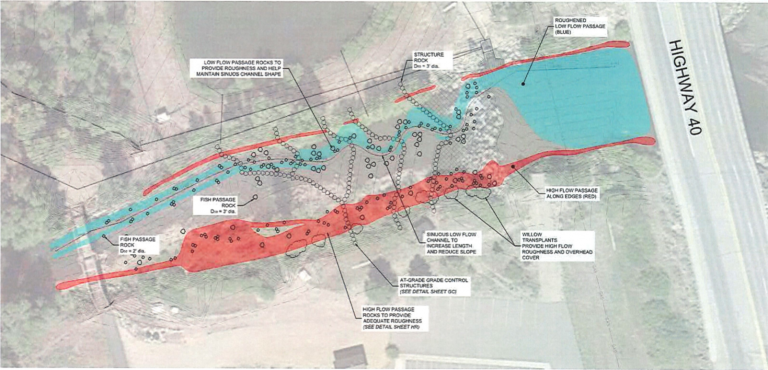
The goal of the project is to provide fish passage for trout and native species and for non-motorized boating recreation without interfering with water diversion for municipal and irrigation purposes. The project will also provide resilience for future flood events, facilitate natural stream processes like sediment transport and no rise in the 100 year floodplain.
This daagram shows fish passage from the proposed project on the Granby Diversion along Fraser River. Red represents fish passage during high flow and blue represents passage during low flow. Courtesy of Town of Granby via the Sky-Hi Daily News
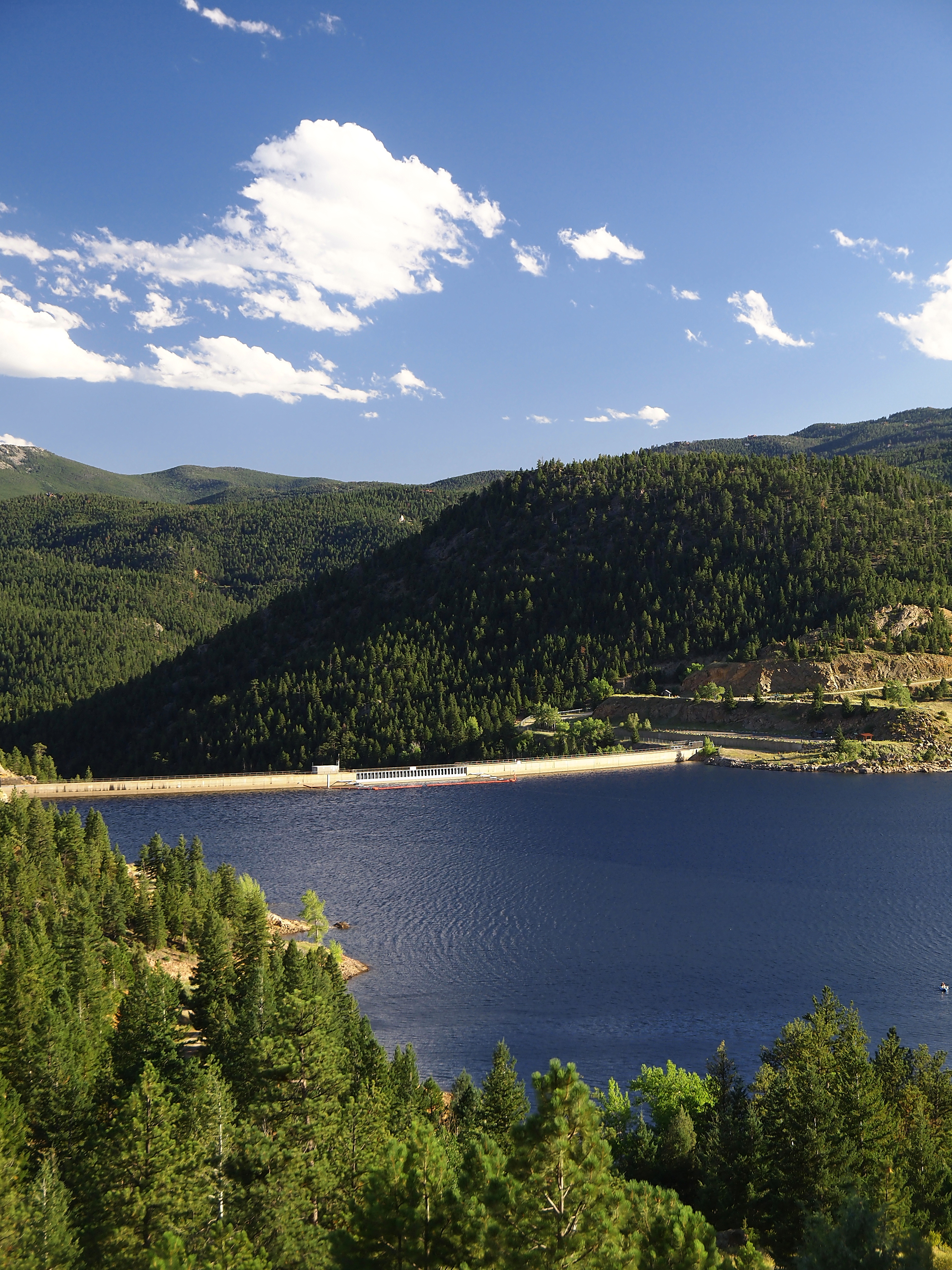
Gross Reservoir — The Gross Reservoir Expansion Project will raise the height of the existing dam by 131 feet, which will allow the capacity of the reservoir, pictured, to increase by 77,000 acre-feet. The additional water storage will help prevent future shortfalls during droughts and helps offset an imbalance in Denver Water’s collection system. With this project, Denver Water will provide water to current and future customers while providing environmental benefits to Colorado’s rivers and streams. Photo credit: Denver Water
The Boulder County Community Planning and Permitting Department’s review of a planned expansion of Gross Reservoir in western Boulder County is underway, officials announced Thursday.
This is the latest in a years-long dispute between Boulder County and Denver Water, who owns and operates the reservoir and dam. A Boulder District Court judge in December 2019 affirmed the county’s right to require that Denver Water go through its 1041 land use review process in order to expand the reservoir…
“Denver Water put in a request to determine if the expansion project would be exempt from our land use code,” Boulder County spokesperson Richard Hackett said.
However, the water utility company in July dismissed that appeal soon after the Federal Energy Regulatory Commission granted approval for Denver Water to continue with design and construction after the county told the company it would not conduct the review while the litigation was ongoing. The regulatory commission’s approval stipulates that project construction begin within two years. The project in 2017 received the other permit it needed from the U.S. Army Corps of Engineers…
No public meetings or hearings have been scheduled yet, but the county will announce them to its Gross Reservoir Expansion Project news list. People who want to receive emailed or text messaged notifications can sign up at here. Hackett said the agencies reviewing the application have until Oct. 14 to return initial comments, although the county has the right to extend that deadline due to extenuating circumstances caused by the coronavirus.
In the meantime, community members can submit questions or written comments to grossreservoir@bouldercounty.org. There is no deadline for doing so. Comments will be accepted until the Boulder County Board of Commissioners makes a decision.
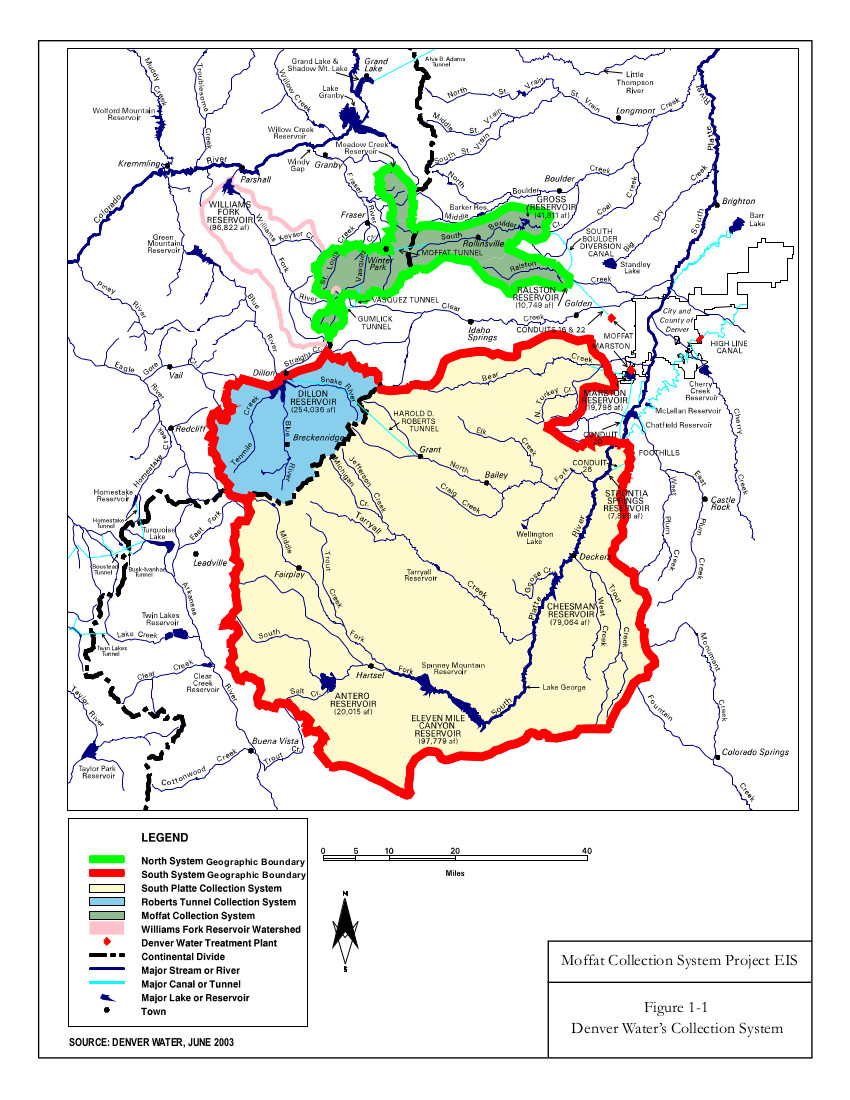
Denver Water’s collection system via the USACE EIS
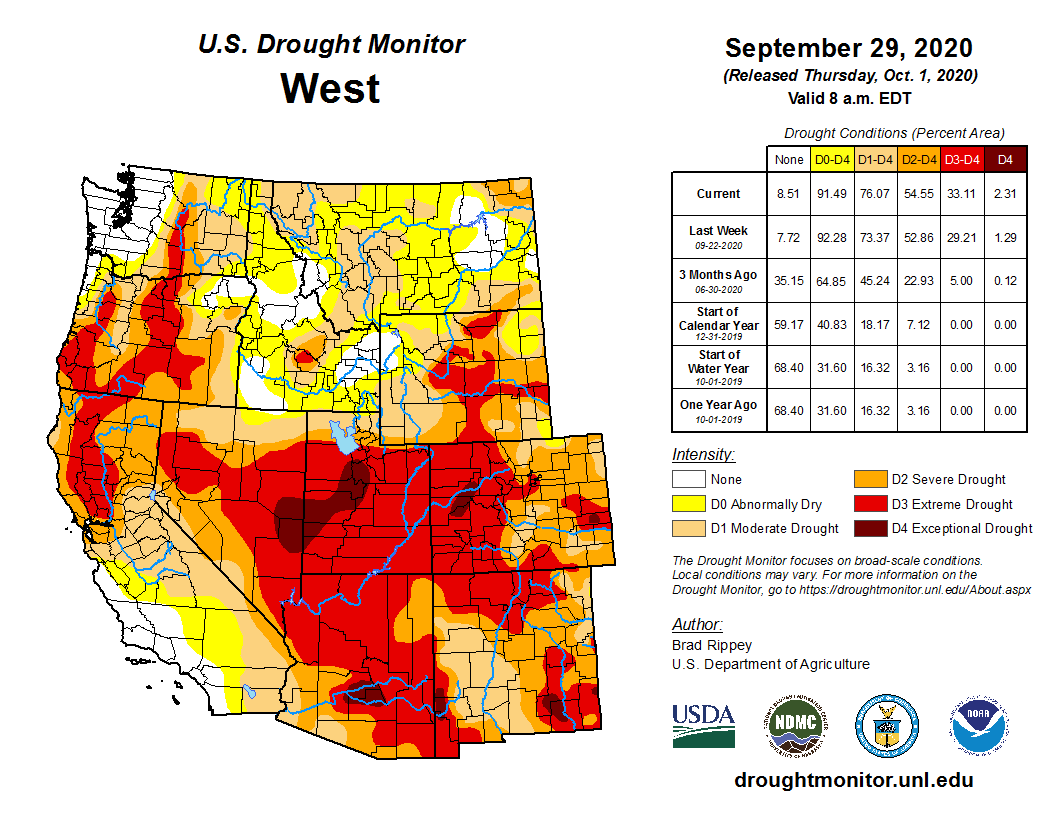
West Drought Monitor September 29, 2020. The most recent Colorado drought map shows a portion of Garfied, Mesa and Delta counties in “exceptional” drought, shown in the darkest shade. Eagle County, just east of the top portion of the darkest shade, is in “extreme” drought, along with the rest of the Western Slope.
FromThe Vail Daily (Scott N. Miller) via The Aspen Times:
Every square mile of Eagle County is in “extreme” drought. That’s the second-most severe classification. Portions of Garfield, Mesa and Delta counties are in the worst category, “exceptional” drought…
Erin Walter, a meteorologist at the Grand Junction office of the National Weather Service, said a high-pressure system will move out of the area toward the end of this week. That movement, along with a low-pressure system moving in off the Pacific coast, will create a chance of precipitation starting Saturday and lasting into Oct. 12.
That’s about it, though. Weather forecasters don’t predict the weather with confidence more than about seven days in advance. But the climate prediction arm of the National Oceanographic and Atmospheric Administration is calling for a chance of warmer and drier than average conditions for most of the contiguous portion of the U.S…
Holly Loff, the director of the Eagle River Watershed Council, said the Eagle River below Gypsum was recently running at 150 cubic feet per second. Normal flow this time of year is 229 cubic feet per second. The Eagle River at Avon has been running at 58.6 cubic feet per second, 51% of normal.
“It’s scary right now,” Loff said. Loff lives along the river in Gypsum, and said she can see rocks in the middle of the stream that have never before been above water.
Autumn is usually a dry period, although this fall is much drier than normal.
Diane Johnson, the communications and public affairs officer for the Eagle River Water & Sanitation District, said that the agency just after Labor Day put out the word to its customers to start winterizing their irrigation systems…
A La Nina develops with cooler-than-average temperatures in that part of the Pacific. That tends to bring storms through the Pacific Northwest, and that generally benefits the northern Colorado Rockies. The Vail Valley tends to benefit from La Nina patterns, although that isn’t a sure thing…
Johnson noted that this year’s drought is just a continuation of a pattern that’s persisted for this century so far.
“We have a changing climate, and we’ve got more folks living here,” Johnson said. “And the outlook for winter isn’t great.”
Eric Hjermstad, field operations director, Western Weather Consultants, lights a cloud seeding generator north of Silverthorne, Colorado. Photo credit: Denver Water
FromThe Grand Junction Daily Sentinel (Dennis Webb):
The entity that operates a long-running cloud-seeding program aimed at boosting snowfall on Grand Mesa is seeking to have its state permit for the program renewed for 10 years.
The effort by the Water Enhancement Authority is one of a couple of permit renewal applications now before the Colorado Water Conservation Board.
Durango-based Western Weather Consultants is seeking a renewal of a program for Vail Corp.’s ski areas at Vail and Beaver Creek, and another permit renewal is being pursued in southwest Colorado.
Water Enhancement Authority proposes to continue conducting the Grand Mesa operation on behalf of entities including the city of Grand Junction, Grand Mesa Water Conservancy District, Grand Mesa Water Users Association, Ute Water Conservancy District, Powderhorn Ski Co. and Collbran Water Conservancy District.
Altogether, 16 organizations are involved, said Mark Ritterbush, the authority’s secretary and treasurer, during a recent online public hearing on the permit renewal conducted by the conservation board. Ritterbush also is water services manager for the city of Grand Junction.
The Grand Mesa program dates back decades, and irrigation companies originally pooled money to create it. It now targets some 320 square miles roughly above 8,000 feet in elevation.
Any of 13 manually operated seeders and five remotely operated ones can be used to send silver iodide particles skyward into storm clouds when factors such as wind direction and temperature are right, in an attempt to enhance snowfall as supercooled water attaches to the particles.
The Grand Mesa program estimates it has boosted snowfall by an average of 4% since 1990, and by 7% to 8% percent each of the last three years as it has improved its operations through measures such as more targeted seeding and more use of remote seeders. The remote devices can be located at higher elevations closer to clouds, making it easier to get silver iodide into those clouds.
The program estimates the amount of snowfall enhancement by comparing snowfall averages at Grand Mesa and non-seeded locations in the region to historic averages before Grand Mesa seeding began.
Ritterbush estimates that an 8% increase in snowpack on the Grand Mesa translates to about 2,000 additional acre-feet of water. An acre-foot is about 326,000 gallons.
Based on the program budget, it’s costing about $7 an acre-foot for that additional water, which Ritterbush said doesn’t just help municipal water supplier and irrigators, but also helps the environment by boosting stream flows, and supports recreation activities such as skiing and rafting…
Altogether, there are eight cloud-seeding programs in Colorado. Funding comes from a variety of sources, including Front Range municipal water entities and from within states in the Colorado River’s Lower Basin.
Andrew Rickert with the Colorado Water Conservation Board said at the Grand Mesa program hearing that new funding is allowing for three new remote seeders to be installed in Colorado, including one on Grand Mesa if the permit there is renewed. Statewide, some 112 manual seeders and 13 remote stations are in use now.
Here’s a deep-dive into the proposed Whitney Reservoir Project from David O. Williams that’s running in The Rocky Mountain Post. Click through and read the whole article. Here’s an excerpt:
With Wednesday’s move by the Trump administration to weaken one of the nation’s bedrock conservation laws – the National Environmental Policy Act (NEPA) – all eyes will increasingly be on local opposition and regulation when it comes to major infrastructure on federal lands.
That’s pretty much what Eagle County Commissioner Kathy Chandler-Henry told me when I asked about the proposed Whitney Reservoir project currently being scoped out by the U.S. Forest Service along Homestake Creek in southeastern Eagle County. The reservoir is being proposed by Colorado Springs and Aurora to pump Western Slope water to the Front Range.
All that’s currently being considered by the Forest Service is a test-drilling project to detect fatal flaws and see if one of four possible dam configurations is feasible, at which point an actual proposal for Whitney Reservoir would be submitted and considered by the feds, including a possible request to shrink the Holy Cross Wilderness by up to 500 acres to realign the road.
The Forest Service was flooded with more than 500 online comments opposing the drilling and the reservoir, demanding higher levels of environmental scrutiny for a special use permit for the drilling project that could be issued under what’s known as a “categorical exclusion.” Opponents are demanding an Environmental Assessment (EA) or Environmental Impact Statement (EIS)…
What didn’t make it into my Vail Daily story due to space constraints was the Eagle County angle. It’s important because way back in the 1990s, when I first moved to the Vail area, there was a huge battle going on over what was then called Homestake II – a reservoir proposed for the same area by the same cities, which still hold 20,000 acre-feet of water rights here.
Eagle County used its 1041 permitting powers, which give counties some degree of local control over infrastructure projects with regional or statewide impacts, to deny Homestake II – a move that wound up in court and went all the way to the Colorado Supreme Court before Eagle County ultimately won. Those 1041 regulatory powers were granted by a state law in the 1970s.
All of that led to the Eagle River Memorandum of Understanding (MOU) that outlines how all the various stakeholders in the Eagle River Basin would work together going forward to resolve their issues. But one important thing remains true: Eagle County, not a signatory to the MOU, still has 1041 permitting authority.
So Chandler-Henry, the water leader on the board, had some important things to say last spring. First, on any proposal that would require redrawing the boundaries of the Holy Cross Wilderness Area: “I can tell you that’s not anything that we would ever be supportive of is moving wilderness boundaries.” Then, on the importance of local permitting power:
Chandler-Henry points out that federal protections have been stripped away by the current administration, with fens and ephemeral streams recently being removed from the definition of Waters of the United States by the U.S. Environmental Protection Agency. Those changes, she said, are making it much easier for water providers to get their federal permits in place.
“Which means 1041 is all the more important for local considerations,” Chandler-Henry said, adding she believes her constituents oppose a dam. “I think that that is going to be a huge public sentiment, that we don’t want anything there.”
That being said, the county has to be somewhat diplomatic on both the test drilling and a possible future reservoir. Eagle County officials said they are working with the Forest Service on the test drilling proposal and may comment later…
“Eagle County cannot take a position regarding, and will not be commenting on, any future reservoir project because of its permitting authority powers,” county officials said in an email. “Eagle County must avoid prejudging a file based upon this authority.
“Eagle County plans to meet with the USDA USFS to discuss procedural questions regarding the proposed Whitney Creek Geotechnical Investigation project. Depending upon the outcome of that conversation, Eagle County may or may not choose to provide comment [to the Forest Service],” officials added.
Chandler-Henry, who talked to me well before the formal test drilling application and the recent Trump move to gut NEPA, said the county is keeping an open mind on 1041 permitting for whatever proposal eventually comes before the board. However, she reiterated that shrinking the Holy Cross boundary – something Congress would have to approve – is a non-starter.
“Sen. [Michael] Bennett’s office says that whenever they’re approached by Aurora Water about moving those boundaries in Holy Cross, they say, ‘You need to go see what Eagle County thinks.’” Chandler-Henry added. “To date they have not done that because I think they know what we think about that.”
An official with Bennet’s office confirmed they are aware of the wilderness adjustment plan but are not supportive of pulling back boundaries to make room for a proposed reservoir because there is not broad local backing. Bennet has been a strong advocate of wilderness expansion, not shrinkage…
Conservation groups see this as a key issue, linking the test drilling to an eventual dam proposal that could lead to less wilderness. The original Homestake II proposal would have been in the Holy Cross Wilderness Area…
Chandler-Henry said Eagle County is firm on the wilderness issue but staying openminded on 1041 so any proposal can be weighed fairly on its merits.
“One of the things that we’re doing, which is going to be really useful, is trying to tie our 1041 permitting in with the community water plan that [Eagle River Watershed Council] is working on … because a 1041 allows us to look at environmental impact, economic impact, infrastructure,” Chandler-Henry said, adding the utility has been modeling for future growth.
“Those are always our concerns with any sort of 1041 permit,” Chandler-Henry added. “What happens if water is dammed up in a reservoir? Then what happens to the Eagle River, to the environment, to the subdivisions that are relying on that water, to the recreation economy?”
Chandler-Henry said Aurora Water has been a part of that planning process…
These wetlands, located on a 150-acre parcel in the Homestake Creek valley that Homestake Partners bought in 2018, would be inundated if Whitney Reservoir is constructed. The Forest Service received more than 500 comments, the majority in opposition to, test drilling associated with the project and the reservoir project itself. Photo credit: Heather Sackett/Aspen Journalism
The U.S. Forest Service has been inundated with more than 500 online comments in opposition to a geotechnical and drilling study by the cities of Aurora and Colorado Springs to determine the feasibility of a second reservoir in the Homestake Creek drainage six miles southwest of Red Cliff, including objections from nearby towns and a local state senator…
Operating together as Homestake Partners, Aurora and Colorado Springs own water rights dating back to the 1950s that, under the 1998 Eagle River Memorandum of Understanding (MOU), ensure them 20,000 more acre-feet of average annual water yield. They’ve been studying four potential dam sites in the Homestake Valley several miles below the cities’ existing Homestake Reservoir, which holds 43,600 acre-feet…
Western Slope signatories of the Eagle River MOU were tight-lipped on the geophysical study and drilling. Jim Pokrandt, director of community affairs for the Colorado River District, declined to comment on the investigatory test work, saying only, “Yes, we have signed the MOU. That said … we are not participating in the Whitney Creek effort.”
Diane Johnson,communications and public affairs manager for the Eagle River Water & Sanitation District, said: “The short answer is we – [ERWSD] and Upper Eagle Regional Water Authority — support [Homestake Partners’] right to pursue an application for their yield. We trust the permitting process to bring all impacts and benefits to light for the community to consider and weigh in total.” Neither organization submitted a comment to the Forest Service…
Two prominent local conservation groups – the Eagle Valley Land Trust and the Eagle River Watershed Council – both submitted comments to the Forest Service expressing serious reservations about both the drilling and the possibility of a dam…
The Eagle River MOU was drawn up after a lengthy court battle that ended in the 1990s when Eagle County rejected the cities’ Homestake II reservoir proposal using its 1041 powers under a state law passed in the 1970s that gives counties permit authority over certain outside infrastructure projects that could impact the local economy and environment.
Besides Homestake Partners (the two cities), the MOU was signed by the Colorado River District, Climax Molybdenum Company, and the Vail Consortium consisting of the Eagle River Water and Sanitation District, Upper Eagle Regional Water Authority and Vail Associates (now Vail Resorts).
The two private companies signed onto the MOU – Vail Resorts and Freeport-McMoRan (Climax) – declined to comment on either the drilling study or Whitney Reservoir.
Any proposed water storage project by any of the signatories has to meet the objectives of the MOU, which are, “Develop a joint use water project in Upper Eagle River basin that minimizes environmental impacts, is cost-effective, technically feasible, can be permitted by local, state and federal agencies, and provides sufficient yield to meet the water requirements of project participants as hereinafter defined.”
ERWSD’s Johnson said the water provider can’t comment on Whitney Reservoir because its environmental impacts have yet to be defined, but she did have overall praise for the MOU.
“To date, water users in the Eagle River basin have received great benefits from the MOU,” Johnson said. “It has been the basis to develop key elements of the local municipal and snowmaking water supplies that have been essential to the economic vitality of our community.”
The MOU provides 20,000 acre-feet for the cities, 10,000 acre-feet of firm water yield for the Vail Consortium (meaning if there’s a shortage, those needs are met first), and 3,000 acre-feet of water storage for Climax. About 2,000 acre-feet were already developed with Eagle Park Reservoir, but that leaves 28,000 acre-feet of yield and 3,000 of storage undeveloped.
It’s the rare point of bipartisan agreement in Colorado politics where public spending is concerned: Since the Taxpayer’s Bill of Rights took effect in 1992, state lawmakers have increasingly turned to fees to fund government operations.
But how you feel about that development, depends on your politics. To the left, it’s an unfortunate side effect of the state’s strict restrictions on taxation. To the right, it’s a sign that TABOR, the state’s landmark constitutional amendment governing public spending, didn’t go far enough to restrain government growth.
This November, that debate goes to voters, as it so often does in Colorado, in the form of a complicated ballot measure that demands an up-or-down vote on the future of the state’s fiscal policy.
Proposition 117, supported by conservative anti-tax groups, would require voter approval for the creation of certain fee-funded state government programs known as “enterprises.” Traditionally, these are public entities, like water utilities, parks or toll roads, that operate like a business because they are funded primarily by user fees rather than taxes.
Existing enterprise programs would be exempt from the new requirements, and the referendum would apply only to new fees that generate $100 million over their first five years, or an average of $20 million annually. And unlike the voter-consent requirements found in TABOR, local governments would be exempt from additional requirements.
Nonetheless, if the proposition passes, it would represent a major expansion of voter control over Colorado fiscal policy that would reshape future budget fights and further limit the ability of state lawmakers to create government programs.
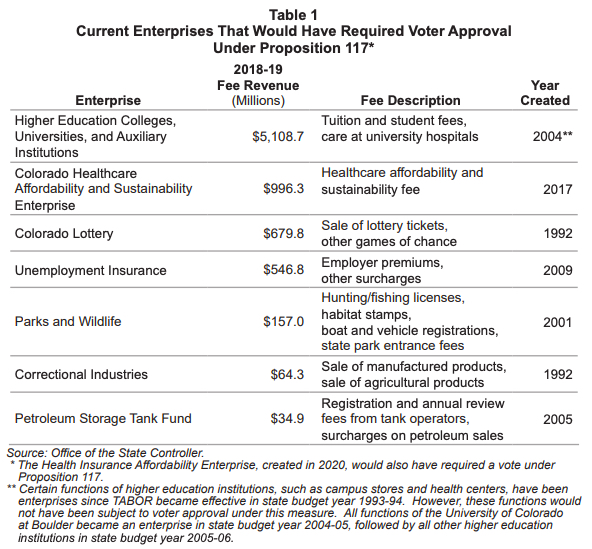
A nonpartisan legislative analysis found that had Proposition 117 been in effect previously, it would have triggered elections on seven of the 16 government-run state enterprises Colorado had in place in 2019, affecting as much as $7.6 billion in annual public spending by universities, state parks and prisons. It also would have required voter approval for a reinsurance program pushed by Gov. Jared Polis that imposed new fees on health insurance plans and hospitals.
Here’s an overview of what you should know about Proposition 117 and enterprise funds.
What are state enterprises, and why do they matter in Colorado?
State and local governments all over the country rely on so-called enterprise funds to pay for essential services. These are effectively government-run businesses that mostly operate with the fees they charge to users. In Colorado, state and local taxes can’t make up any more than 10% of an enterprise fund’s revenue.
Common examples include public water utilities, municipal airports and the entities that operate toll roads. But enterprises take on a special significance in Colorado because of the state’s unique restraints on taxation.
TABOR, added to the state constitution in 1992, does two key things that have contributed to the proliferation of enterprises.
One, TABOR requires voter approval for all new taxes — but not fees, which are legally distinct from taxes in that they can’t be used for general government services. Instead, courts have said they have to fund something that’s reasonably connected to the fee itself. For instance, toll fees can pay for road maintenance, and park fees can pay for parks upkeep, but neither could be used to pay for health care or courts. And because voters have rejected most new statewide taxes in the TABOR era, lawmakers tend to view fees as a more politically feasible way to boost spending on public services. Not all government fees are tied to enterprise funds, but that’s the purpose for many of them.
Two, TABOR prevents general government spending from increasing faster than a revenue cap, which limits the growth of the state budget to the rate of population growth plus inflation. Historically, this limit has not allowed the state to keep up with the growth in expenses such as Medicaid caseloads or schools. So to pay for new initiatives without cutting funding to other areas of the budget or asking for new taxes, lawmakers effectively have to set up programs as an enterprise, which TABOR explicitly exempts from its spending limit.
A legislative analysis published in the Blue Book ballot information guide shows examples of recent enterprise fees in Colorado that would need voter approval if Proposition 117 wins approval in November 2020. (Screenshot)
State lawmakers also have used this mechanism to prevent existing programs from crowding out other services. College tuition and student fees, for instance, were reclassified in 2004 and now make up the state’s largest enterprise, generating $5.1 billion in the 2019 fiscal year. More recently, lawmakers converted a hospital-bed fee that helps reimburse hospitals for uncompensated care to an enterprise fund; it now generates around $1 billion a year.
The case against Proposition 117
Opponents view Proposition 117 as an unnecessary restraint that will make it that much harder for lawmakers to fund public services. And they balk at the notion that lawmakers have turned to fees to circumvent TABOR. The constitutional provision explicitly allows lawmakers to create fee-funded enterprises without the same restraints it imposes on taxes.
Scott Wasserman, president of the Bell Policy Center, a progressive think tank, blames TABOR’s restrictions for the chronic underfunding of K-12 education, higher education and transportation — all in a state where, before the pandemic, the economy had consistently been rated among the nation’s strongest. He fears that placing new restrictions on enterprises will make matters worse.
And, he says, it’s simply not good government to continually put esoteric fiscal policy questions — like the $34 million petroleum storage tank enterprise, which charges fees to fund environmental clean-ups — on the ballot.
“Why do we want to make these very specific, technical, user-based issues politicized fights, where big money can come in and really distort the issue?” Wasserman said during the debate.
“This is why we send people to the state Capitol who are trying to operate government on our behalf,” he added.
State Sen. Dominick Moreno, the vice chairman of the Joint Budget Committee, also urged voters to reject it, saying that Proposition 117 would limit the state’s ability to respond to the ongoing financial crisis created by the coronavirus.
“Our teachers, doctors and nurses can’t afford more cuts and cannot be shut out of this recovery,” Moreno, a Commerce City Democrat, said in a statement. Proposition 117 and the Proposition 116 measure to cut income taxes “would stall our recovery and permanently harm our ability to provide critical state services.”
Notably, unlike TABOR and some of Colorado’s other constitutional fiscal constraints, Proposition 117 is a statutory change, meaning that lawmakers could override it by passing legislation. But there would be political risks in doing so if voters approved it on the ballot.
The case in favor of Proposition 117
To supporters, Proposition 117 is a natural extension of the voter protections provided by TABOR — protections that they argue lawmakers have undermined by leaning so heavily on enterprises.
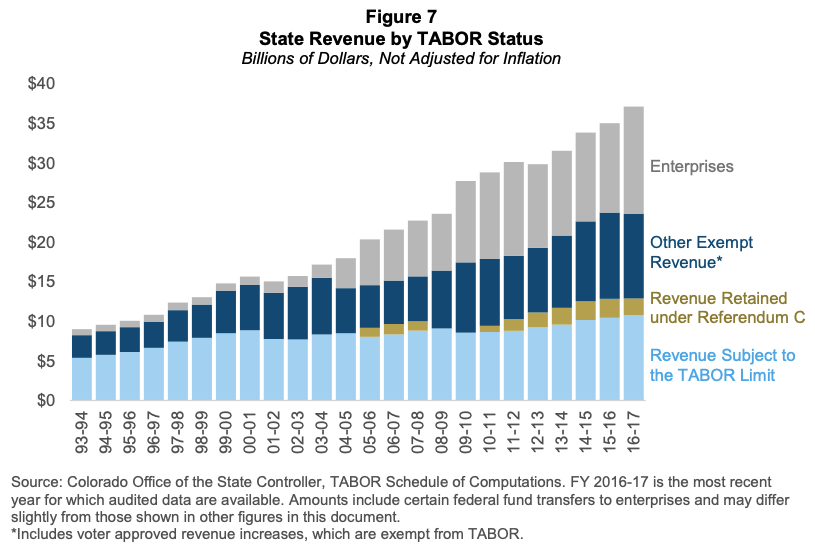
There’s no doubt that the growth of enterprising has been staggering. Just after TABOR took effect in the 1993-94 fiscal year, enterprise funds generated $742 million, which was just a fraction of the state’s total budget. In 2017-18, according to an analysis by Colorado Legislative Council, they generated nearly $18 billion. But not all of the total comes from fees. In the 2018-19 fiscal year, according to a separate legislative analysis, fee revenue collected by state enterprises only made up around 20% of the state’s roughly $29 billion budget.
A graphic from a December 2018 state report from the Joint Budget CommitteeColorado Legislative Council shows how state revenue has shifted to sources outside TABOR in recent years. (Screenshot)
Michael Fields, the executive director of Colorado Rising State Action, a conservative advocacy group, said during a recent debate that enterprise funds were “used for good things in the beginning,” such as college tuition, the state lottery and state parks.
“What we’re concerned about is the things that it’s moving towards,” he said in the forum moderated by PBS12 and The Colorado Sun. “If you’re going to create a new program, you need buy-in from the people.”
One enterprise that Fields suggests goes too far and should have received voter approval is the state’s new reinsurance program, which lawmakers decided to fund through health insurance fees after the coronavirus pummeled the state’s coffers. Legislative analysts expect it to generate $94 million in the 2021-22 fiscal year and more than $100 million annually after that.
Colorado is more reliant on government fees than the average state, according to an analysis by Pew Charitable Trusts, ranking 9th nationally in the percent of its budget that comes from service charges. Still, comparing fees and taxes across states is tricky. For one thing, Pew’s analysis excludes insurance funds, like Colorado’s unemployment trust fund, which is among the state’s largest enterprises. For another, Colorado’s “hospital provider fee” is considered a “bed tax” in many states, illustrating the degree to which TABOR has shaped even the words lawmakers use in creating policy.
“The legislature has been going around our Taxpayer’s Bill of Rights,” Fields said. “If they label something a fee, they don’t have to go to voters for approval.”
Dignitaries from throughout the nation, including U.S. Secretary of the Interior David Bernhardt and Bureau of Reclamation Commissioner Brenda Burman, gathered at Lake Pueblo for the groundbreaking of a pipeline that will deliver clear water to the Lower Arkansas River Valley…
As the conduit will bypass the Arkansas River, including the portion on Pueblo’s lower East Side where the heavily polluted Fountain Creek dumps into the river, it is seen as a regional solution to drinking water quality problems facing rural communities of Southeastern Colorado…
It may be a decade or more before the conduit will be built, but the project is well on its way now.
When completed, the conduit will serve an estimated 50,000 people in Southeastern Colorado via some 260 miles of pipeline.
Bill Long, president of the Southeastern Colorado Water Conservancy District and former Bent County commissioner, said: “It’s kind of an emotional event because generations have actually worked on this project and to finally see this kind of progress where we can deliver safe water to folks, which also provides a great opportunity for economic development is close to unbelievable. It truly is a great day.”
John Singletary, former chairman of the Lower Arkansas Valley Water Conservancy District, agreed:
“As a young boy in the Arkansas Basin, I sold gold frying pans to support the effort that eventually lead to President Kennedy coming to Pueblo to sign the Fryingpan-Arkansas Project into a law,” Singletary said. “This was the first step in seeing the Arkansas Valley Conduit built. In the decades since, people like Senator Michael Bennet have never lost sight that this project is more than politics. The Conduit is a vision turned reality to help reduce dry-up of farm ground and provide clean drinking water for 50,000 people in 40 communities east of Pueblo.”
The total project cost is estimated at somewhere between $564 and $610 million to complete over a 15-year period and about $30 million a year for the next 15 years will need to be appropriated to see it finished.
Sen. Michael Bennet, D-Colorado, who also has spent a lot of time and effort on the project throughout his career, echoed Long’s comments about ground finally being broken for the conduit.
“It is a testament to the commitment of generations of people in the Lower Arkansas Valley to bring clean drinking water to communities that were promised it in the early ’60s and never had that promise fulfilled,” Bennet said. “One of the first things I heard about when I became a senator was the Arkansas Valley Conduit because of Bill (Long) and because of Ray Kogovsek, who had been the congressman for that area, and made the case about how important it was.”
Bennet said the progress made on getting the conduit built has been a true bipartisan effort in which Democrats and Republicans have worked hand-in-hand…
The conduit, part of the original Fryingpan-Arkansas Project, would bring water from Pueblo Dam to Lamar and Eads, serving about 40 communities along the route. As it will bypass the Arkansas River, including the portion on Pueblo’s lower East Side where Fountain Creek dumps into the river, it is seen as a regional solution to drinking water quality problems facing rural communities of Southeastern Colorado.
Many of those water providers are facing enforcement action for high levels of naturally occurring radionuclides in well water. A new source of clean water through the Arkansas Valley Conduit is the least expensive alternative, according to a 2013 Environmental Impact Statement.
While the project is breaking ground, there is still a long way to go, Bennet cautioned.
The total project cost is estimated at somewhere between $564 and $610 million to complete over a 15-year period and about $30 million a year for the next 15 years will need to be appropriated to see it finished.
“It’s not going to be easy to do but we’re going to fight for it,” Bennet said.
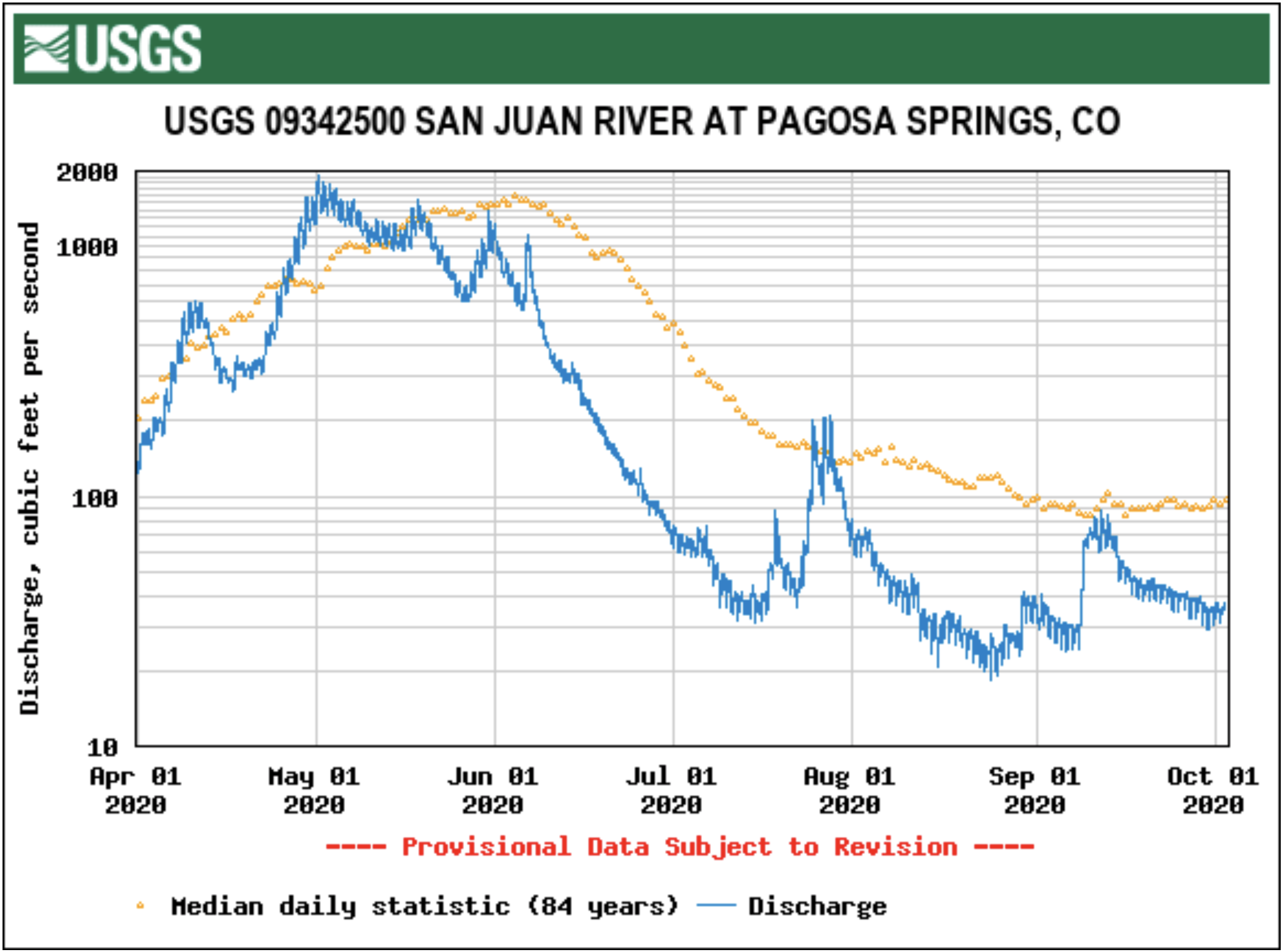
On the morning of Sept. 30, the flow rate of the San Juan River was listed at 30.3 cfs.
Based on 84 years of water records, the average flow rate for this date is 170 cfs. The highest recorded flow rate for this date was in 2014 at 902 cfs. The lowest rate was 12 cfs in 1953.
“The outcome will have profound consequences for the future of Earth’s climate.”
Whenever artist Michael Aschauer returns home after an extended stay in the United States, people here pepper him with questions about the direction America is heading.
With gallows humor typical of the city, they often ask, “Will it fall apart slowly, or very fast?” he said, adding that Vienna has plenty of experience with how rising and falling empires can destabilize global systems.
Aschauer is married to an American and keenly watches climate and energy politics on both sides of the Atlantic while trying to imagine a post-carbon future. In an informal social media art project, he documents gas stations that have been abandoned or converted to other uses.
He said it’s hard to imagine that Americans would re-elect the incumbent president, but that it can’t be ruled out, either, given the current volatility of U.S. politics. “The outcome will have profound consequences for the future of Earth’s climate,” he added.
Carbon budgets detailed in recent climate reports show that four more years of pro-fossil fuel policies in the U.S.would make it much harder for the world to reach the Paris climate agreement goal of preventing catastrophic global warming, he said. On the other hand, Biden’s decarbonization plan would accelerate demand for renewable energy in the world’s biggest consumer economy and speed the global shift to a zero-carbon economy.
He also said he’s noticed a brain drain away from the U.S. in fields like the arts and technology, and expects that to continue if Trump is reelected. Vienna, Berlin and other European cities are already full of American political refugees, he added.
In terms of climate policy, four more years of Trump would be damaging indeed, said Austrian-born Gernot Wagner, a climate economics professor at New York University. “We don’t have another presidential term to waste,” he said. “A Trump win would be devastating, especially since it’s not about emissions in any given year, but about the trajectory.”
And what happens in the U.S. affects China, Europe, India, Nigeria and elsewhere, he added. “A lot around climate policy is about momentum: ‘If you do something, then I will, too.’ A race to the top, rather than the bottom,” he said. “That’s what Paris was all about and still is. It’s also where a Biden victory can have the biggest impact.”
But China’s recently announced carbon neutrality goal could be a game-changer for global climate policy, he wrote in a recent commentary.
Political commentators in Europe say people care deeply about the American election because they understand it affects them, and not just because of climate policy. Some fear Trump, in a second term, could be prone to rogue actions that would trigger widespread economic and political instability.
There are also concerns about malignant U.S. influence in spheres like social media, trade and energy policy. Iran sanctions and differences over a gas pipeline from Russia to Germany are potential flashpoints. Recent polling shows America’s reputation has sagged under Trump.
Debate Debacle
But it’s not all fear and loathing—people here say they feel a cultural, social and economic affinity with the U.S. And the interest is even more intense this year, after extensive international media coverage of the escalating cycle of police violence and destructive protests, as well as wildfires, hurricanes, the botched pandemic response and potential election chaos all painted a picture of a country in turmoil.
Last week’s presidential debate reinforced global concerns about the direction of the U.S., said Reimund Schwarze, an environmental economist with the Helmholtz Centre for Environmental Research in Germany. Trump’s recent statements questioning the legitimacy of the election process raise the specter of widespread unrest, he said.
“It’s much deeper than environmental concerns. The motherland of democracy is stumbling, and this is a scary time,” said Schwarze, who has collaborated with the United States Environmental Protection Agency for 25 years, and whose daughter is currently a student at the University of Washington.
During the recent civil uprisings in Seattle, he said his daughter described scenes of arbitrary law enforcement actions that reminded him of the totalitarian regime in East Germany back in the 1980s. Through his contacts with the EPA he’s also seen how Trump is undermining government institutions at the deepest level, another warning sign of incipient authoritarianism, he said.
To explain why Germans perhaps are especially interested in the American election, he described the shared sense of elation in both countries at the fall of the Berlin Wall in 1989, as well as the intense alliance that formed in the preceding Cold War decades.
“We felt this would bring a period of prosperity, of freedom to the world, at least our part of the world,” he said, adding that the direction of the U.S. under Trump puts that security and stability at risk, just as his abandonment of international commitments, like withdrawal from the World Health Organization and the Paris climate agreement, threaten international order.
Global Governance
Those worries were underlined by United Nations Secretary General António Guterres in a Sept. 22 speech to the U.N. General Assembly, warning that the withdrawal of the U.S. and other countries into national shells does not bode well for pressing international policy questions.
Addressing climate and other environmental challenges requires more, not less, international cooperation, he said. The builders of the U.N. 75 years ago had lived through a global depression, a pandemic, genocide and world war, and “knew the cost of discord and the value of unity.”
In terms of climate, the future course of the U.S. is important because the country has emitted more total greenhouse gases than any other nation—29 percent, as much as the next four nations—China, Russia, Germany and the United Kingdom combined.
If the U.S. is not a big part of the push to limit the global temperature increase to less than 3.6 degrees Fahrenheit, that goal seems even farther away than it is already, regardless what the rest of the world does.
The world needs a U.S. president “who will value the lives of people across the world more than fossil fuels,” Ugandan youth climate activist Vanessa Nakate posted on Twitter recently.
Equally important, European analysts note that American technology and science are critical parts of the global push to limit global warming. But the past four years of anti-science rhetoric and efforts to suppress climate science by the Trump administration suggest that the U.S. at the national level has abandoned that goal, they say, making it easier for other countries to do the same.
Climate Finger-Pointing
“The number-one question I get asked is, why should we do something if the U.S. isn’t doing anything,” said climate scientist Cara Aisling-Augustenborg, a lecturer at University College Dublin who has also been a climate activist and climate adviser to the Irish government.
“Global climate policy is eking out an existence, barely, as it is,” she said. The lack of U.S. commitment and leadership may have encouraged other countries that already have motives to delay climate action. Australia wants to mine and export coal, and Brazil wants to slash forests so it can sell palm oil and cattle feed to Europe. “You can see why they would have an agenda,” she said.
The American withdrawal from the Paris agreement garnered a lot of media attention in Ireland and helped build climate consciousness in a way that may have been perversely beneficial. No politicians wanted to be associated with Trump’s outright climate denial, which led to more climate action from the Irish government, she said.
But if Trump is re-elected, the pendulum could swing further toward gloom, with an attitude of “we’re all going to hell anyway,” she said. “When you hear about how fast the ice is melting, and birds falling from the sky, it might be hard for me to continue advocating for climate action,” she said.
New Zealander Kevin Trenberth, a long-time climate scientist with the National Center for Atmospheric Research in Boulder, Colorado, is gloomy about U.S. prospects if Trump is re-elected. Climate policy is one thing, but he thinks survival of U.S. democracy is at stake in the election, he said.
“I don’t think the U.S. can survive four more years of Trump and there could be a civil war of sorts,” he said. “Democracy in the U.S. does not work, dark money dominates, the whole system is corrupt, and major changes are needed. Science priorities are wrong, and that is why I am in New Zealand.”
Global climate policy can’t take another four years of Trump, he added.
“No. After Paris in 2015, there was hope but it has been downhill ever since and no countries are meeting their goals,” he said. ” Real leadership is required from the U.S. and China. There are no penalties in the Paris agreement and so it is only peer pressure that matters.”
Trenberth said the “utter failure of the President and administration” in response to the pandemic was astounding, and a clear sign that the rest of the world can’t look to the U.S. for leadership as it once did.
American climate scientist Jason Box, a Greenland ice expert working for the Geological Survey of Denmark and Greenland, considers himself part of the brain drain from the U.S. He moved to Europe in 2013, partly spurred by a tax break that is part of Denmark’s “brain gain” policy, he said.
He wouldn’t move back to the U.S. if Trump is reelected, he said. “But that’s not the only reason. Others would include too many guns in the U.S.,” as well as general security and environmental concerns. “I mean, there was looting around where my folks live after the fire evacuations. I think too many folks are desperate,” he said.
Public interest in U.S. affairs is high, and the general reaction in the scientific community is a mixture of “shock and pity,” he said.
Cavalry No More?
The effect of the U.S. election on global climate policy can’t be separated from other policy areas, especially economic and energy policy, said Susanne Dröge, a senior fellow at the German Institute for International and Security Affairs in Berlin.
U.S. policies the past four years have rattled transatlantic relations more than any time since the post-World War II realignments, including the end of the Soviet Union, and interest in U.S. affairs in Germany remains high “due to the general interest in the little world order we still have,” Dröge said.
Even before Trump, the U.S. was signaling that Europe should take on more of a global leadership role, she added. “But even with that, there was a strong reliance that the U.S. will always be the cavalry that comes in when things go bad.”
Obama helped lead the charge for the Paris climate agreement, she said, in what turned out to be a “very short, exceptional period” for cooperative climate policy. She fears that with four more years of Trump, it could be very hard to find a way to return to a cooperative path forward.
In climate policy, Trump’s “u-turn in all dimensions” was not unexpected, but stunning nonetheless. And in spite of all that, to add complexity, U.S. emissions have generally declined the last few years, she added.
U.S. antipathy to global climate policy, in any event, is like an ill wind that spreads mistrust and triggers disengagement by other countries.
“Russia, China, Turkey, the Saudis are all saying, if the U.S. is not participating, why should we,” said Dröge, who closely monitors and analyzes global climate policy. “The bad example from the U.S. is more critical because it has such high leverage,” with the country still being a major economic power. If U.S. markets were to turn strongly to clean energy, it would help propel the rest of the world in the same direction.
Climate Blues
The U.S. has, for many years, determined war and peace at the global level. At the moment, the country’s policies are “moving the world towards climate disaster and possibly nuclear war,” said Helga Kromp-Kolb, director of the Global Center for Change and Sustainability at the University of Vienna.
“No wonder Europeans have a deep interest in the results of the U.S. elections, as do the people the world over. I believe a significant part of the scientific community sees the threats clearly and is deeply concerned, not only regarding what the U.S. does, but also who will take over if, or when, U.S. leadership is lost,” she said.
Trump’s emergence magnified an anti-science undercurrent that has always been part of U.S. culture, she said, adding that the real problem is that science has been misused, not only in the U.S., to support commercial products, like fossil fuels.
“Of course climate science is hit especially hard by the denialism of the present U.S. government at the time when the world needs all the data and the expertise it can get,” she said.
But a Biden win wouldn’t be a panacea for global climate policy, she cautioned.
“With the U.S. back as part of the effort, the world would no doubt be on a better path in the climate issue,” she said. “But to reach the climate goals takes more than Mr. Biden has so far committed to.”
Other Europeans also see a stormy political horizon for the U.S.
“The U.S. system is struggling right now, and it’s not too big a frame to ask if democracy itself is at stake,” said Austrian political scientist Paul Schuierer-Aigner, who became interested in U.S. politics when Barack Obama became president. Trump’s tilt toward authoritarianism is all the more frightening because the U.S., for whatever its other failings, used to be a bulwark against such political tendencies, at least in Europe, he said.
Now, just a few hundred miles east of Austria, Trump’s example has emboldened authoritarian leaders in Hungary and Poland, he said. “There are a lot of mini-Trumps in Europe, and we can learn a lot from those who are trying to defend democracy in the U.S. right now,” he added.
For Schuierer-Aigner, Trump is more a symptom of the root problem, which he says is growing existential stress caused by late-stage neoliberal capitalism, including wealth disparity and economic insecurity. He’s encouraged by strengthening backlash led by young people in the Sunrise Movement and the leadership and policy alternatives presented by U.S. Rep. Alexandria Ocasio-Cortez, the New York Democrat.
“From what I see in the Democratic Party, there is a lot of movement, a lot of mobilization from the other side.” Even with time running short for meaningful climate action, he said, there is a hopeful scenario that a generational shift in politics in the U.S. could upend the political landscape for many years to come, leading to fundamental changes in U.S. policy.
All over the world, people are waiting in suspense to see if Nov. 3 marks the start of that shift.
“I don’t want to put any pressure on anyone,” Austrian ecologist Sarah Höfler posted on Twitter recently, “but the American election will, in my opinion, decide whether humanity has still a chance in the #ClimateCrisis. It is as simple as that.”
Photo credit: Kim Bartlett via the Center for Biological Diversity
Here’s a guest column from Jennifer Molidor and Erik Molvar that’s running in The Vail Daily:
In the debate over grazing in the West, there’s a trend toward magical thinking. In “If you like fish and birds, hug a cow,” a Writers on the Range column from ranchers Pat and Sharon O’Toole, both indulge in unscientific flights of fantasy, claiming that irrigation and livestock are beneficial for native fish and wildlife.
Unlike cows, native wildlife in the West don’t need arid lands flooded with water to be productive. Prior to the agricultural colonization of the West (and its displacement of indigenous peoples and wildlife that made it possible), sage grouse flocked together by the thousands, and streams teemed with trout and salmon. America’s natural wealth of fish and wildlife hasn’t been sustained by the plague of cattle, sheep, and irrigated hayfields, it has been decimated by them.
Cattle are ecological misfits in the arid West, so dependent are they on water. Huddling along streams and riverbanks, trampling and gorging on streamside vegetation, cattle cause a massive influx of sediment into formerly crystalline waters.
In fact, livestock are a leading cause of stream degradation and trout population losses in the West. Trout reproduce by spawning in loose gravel and burying their eggs to protect them from scavengers. The eggs depend on a constant flow of oxygen-rich water to survive, and when livestock-related sedimentation smothers the nests with silt, the eggs die. This widespread problem is only made worse by cattle wallowing in shallow streams and rivers, crushing the eggs themselves.
The Colorado River system from which the O’Toole operation draws water has four species of endangered fishes: the Colorado pikeminnow, the razorback sucker, the bonytail, and the humpback chub. Their survival hangs by a thread because of the damaging water withdrawals of irrigators, and because overgrazing by cattle and sheep denudes the land, allowing salty sediment to wash into the water that remains.
Thanks largely to excessive irrigation withdrawals, the Colorado River doesn’t reach the sea anymore, leaving its once-biodiverse delta estuaries at the edge of the Sea of Cortez an arid wasteland. Yet the O’Tooles dismiss recent studies showing the devastating impact of irrigation on Western rivers like the Colorado without offering a scientifically valid rebuttal.
The O’Tooles’ Ladder Ranch runs domestic sheep in the Huston Park Wilderness, where their domestic sheep can transmit disease to the native bighorn sheep in the imperiled Encampment Herd. The O’Tooles also run cattle on BLM grazing leases along the Powder Rim, which has the worst cheatgrass infestations in the Red Desert.
And the damage goes beyond drought exacerbated by water withdrawals and streamside habitat destruction. The scientific community has called for a significant reduction in American livestock production to meet climate mitigation goals. In addition to methane emissions, grazing has a significant impact on the planet, causing desertification, spreading flammable invasive weeds, devastating rich streamside oases, polluting streams with fecal coliform, and wiping out native wildlife with deadly livestock diseases.
As professional wildlife conservationists, we are concerned.
We need to produce food in a genuinely sustainable way, not greenwash environmental degradation. Food production doesn’t have to rely on river-draining, habitat-destroying irrigation. Nor is food security enhanced by unsustainable production. We need better regulation over our public lands instead of allowing private industry to act with impunity by skirting ecological protections.
If it were up to the Western Watersheds Project and the Center for Biological Diversity, the O’Tooles write, these public lands would become urban sprawl. Presenting this tired claim — that vital wildlife habitat on public lands would become urban sprawl if it weren’t for livestock operators ignores the reality that much of the West is public land, not subject to urban development.
Let’s be clear that if it was up to Western Watersheds and the Center, western public lands would be conserved for wildlife and natural habitats as they are entitled to be under the law. Natural habitats would heal, native wildlife would repopulate, trout streams would recover with the heavy-handed impacts of livestock removed.
Only 1.9% of the U.S. beef supply comes from public lands cattle. Yet the damage cattle bring to these lands is catastrophic. The idea that invasive cattle hold Western landscapes together is a fairy tale. The real story is that western livestock producers need subsidies, handouts at taxpayer expense, and irrigated water to turn a profit — and wildlife and natural habitats pay the price.
It’s time to stop indulging in harmful livestock production and protect the wild spaces and native biodiversity of the West.
Erik Molvar is the executive director of Western Watersheds Project and is a wildlife biologist with 17 books on western public lands to his credit, as well as published scientific findings on the impacts of large herbivores on forage plants and ecosystem processes. He lives in Laramie, Wyoming. Jennifer Molidor is the senior food campaigner with the Center for Biological Diversity; she has a Ph.D from the University of Notre Dame and is a conservation writer in rural California.
Click here to view the story map that tells the story of the Upper Colorado River Endangered Fish Program. H/T to the Colorado Water Conservation Board.
Members of Learning By Doing tour the Fraser Flats on Sept. 27, 2016. Photo credit: Denver Water
Here’s a guest column from Stacy Chesney that’s running in The Sky-Hi Daily News:
When it comes to collaboratively managing water supplies on the West Slope, Denver Water understands that we must walk the talk.
When talking about our new era of doing business, Denver Water’s CEO/Manager Jim Lochhead regularly cites that “instead of platitudes, politics or parochialism, you need to sit down and work together.”
And that is exactly what has happened since the signatories of the Colorado River Cooperative Agreement sat down on Sept. 26, 2013, to put the new framework into action that ultimately benefits water supply, water quality, recreation and the environment on both sides of the Continental Divide.
From it came the Learning By Doing cooperative effort to maintain and enhance the aquatic environment in Grand County, which has already seen huge successes in the Fraser Flats River Habitat work, stream sampling programs and the removal of 2,500 tons of traction sand from Highway 40 before it could impact water quality and trout habitat downstream in the Fraser River.
We’re also aware that dry and hot summers, like we saw in 2018 and are experiencing again this year, bring added stress to the fisheries, environment and ultimately the entire communities of Grand and Summit counties.
When the rivers are low, talking the talk also becomes imperative.
Water efficiency is always top of mind for the Denver metro area, and during times like this, conservation dominates our communication channels. If you live on the West Slope, you may not see Denver Water’s communications about efficiency, but we are focusing on conservation measures and fostering appreciation for our source water where it matters: our customers.
We know that using less water means more water can be kept in the reservoirs, rivers and streams that fish live in and Coloradans enjoy. And ultimately, Denver Water’s customers are answering that call despite enduring what is turning out to be one of the hottest and driest years on record.
Overall, residents of the Denver metro area are using less water than they did in other summers when it was similarly hot and dry. We see them being cautious and judicious with their water use and adjusting based on the weather. In fact, Denver Water customers cut their water use in half in a matter of days when it snowed earlier in September.
This is nothing new though. After the 2002 drought, Denver Water’s conservation campaign led to our per-person reduction goal of 22% from pre-drought levels — one that we’ve continued to maintain since 2016. We’ve taken that momentum and are now working directly with our customers, sending water use reports along with rebates and tips to inefficient users on how to better use water wisely.
We also continue to evolve everything we do, from leading the way with new water reuse solutions, to upgrading our Water Shortage Plan – developed with feedback from our partners at Trout Unlimited, Grand County and other Learning By Doing stakeholders.
Denverites value where their water comes from. We live in this great state because of communities like Grand and Summit counties that provide resources precious to all of us. This benefit was made even more valuable because of the pandemic this year – a reality that we don’t take for granted and continually stress to the 1.5 million people we serve.
Stacy Chesney is Denver Water’s director of public affairs.
Denver Water’s collection system via the USACE EIS
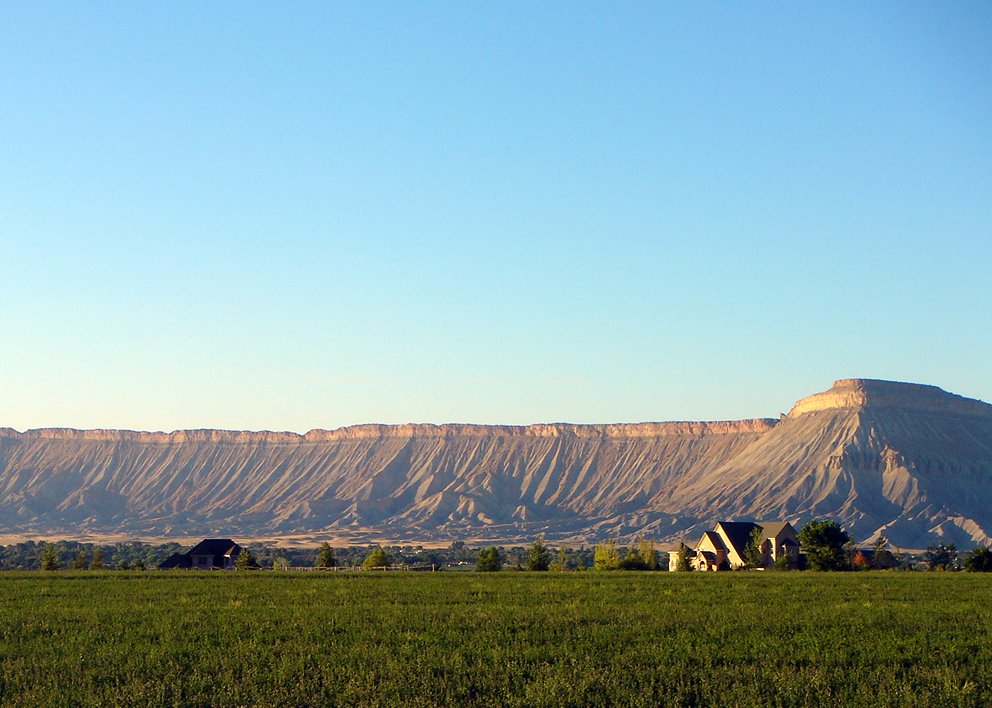
Book Cliffs and Mt. Garfield (on right, approximate altitude 6,600′) in Mesa County, Colorado. By User Skez on en.wikipedia – Originally from en.wikipedia; description page is (was) here03:31, 2 March 2006 Skez 992×708 (137,232 bytes) (Near Grand Junction, CO Taken by Sean Davis http://flickr.com/photos/skez/32161524/), CC BY-SA 2.0, https://commons.wikimedia.org/w/index.php?curid=835434
FromThe High Country News [This story was originally published at High Country News (hcn.org) October 1, 2020] (Paige Blankenbuehler):
In Grand Junction, Colorado, the presidential election is a choice between two distinct energy futures.
On July 13, in Grand Junction, Colorado, a day after the coronavirus pandemic hit a local three-month peak, 45 elderly women flouted the state’s “safer-at-home” directive and withstood temperatures that reached 105 degrees Fahrenheit to meet at the Grand Vista Hotel for the Mesa County Republican Women’s Luncheon.
Officially, the event was meant to spotlight an issue on this year’s ballot in Colorado, a contentious measure on wolf reintroduction in the state. But as the women milled about the hotel’s conference room, discarding their masks and embracing each other, the scene looked more like a reunion. Although the group, which was founded in 1944, typically gathers monthly in Grand Junction, Mesa County’s largest city, the meetings had been on forced hiatus since March, and the women were excited to be together, excited by their shared disobedience.
The featured speaker was Denny Behrens, co-chair of the Colorado Stop the Wolf Coalition, but the true star of the day was Lauren Boebert, a feisty MAGA Republican who had just beaten a longtime incumbent, Rep. Scott Tipton, in the Republican primary. Boebert moved from table to table for introductions, handshakes and hugs, a sidearm holstered at her hip. At 33, she was the youngest there by decades. In Rifle, Colorado, where she has lived since the early 2000s, Boebert owns the Shooters Grill, where waitresses in tight flannel shirts and denim serve burgers and steaks with loaded handguns strapped to their hips or thighs. The Grill was shut down in May for repeatedly violating public health orders restricting in-person dining, but the publicity Boebert received from the conflict — and a GoFundMe petition for the Grill that raised thousands of dollars — assisted her bid for Congress.
After a lunch of barbecued chicken, potato salad and corn muffins, the group’s president officially began the meeting. She recited a prayer, quoted Abraham Lincoln, and led the room in the Pledge of Allegiance. Then she introduced key people in the room: candidates for the county commission, a representative from President Donald Trump’s Mesa County campaign office, and Boebert.
Speaking to the room, Boebert described a conversation she had had with Trump, who called her after she won. “President Trump said that he was watching this from the very beginning,” Boebert said. “He said, ‘I knew that something big was going to happen with you, and now I get to call and congratulate you.’ He said, ‘Every day I’m fighting these maniacs, but now I have you to fight them with me.’”
Her audience laughed and applauded. Boebert smiled brightly. “We are going to win this fight against the liberal socialist agenda and restore the potential for our community to develop our rich natural resources right here in the ground in Mesa County,” she said.
Boebert is partly right; this election could mean a change in how much fossil fuels are extracted from public lands. Currently, a quarter of the crude oil produced in the United States comes from federal lands, and almost three-quarters of Mesa County is federally owned. Public land also accounts for 20% of the country’s total greenhouse gas emissions, making it key to any national energy (or climate) policy.
If he wins in November, Trump promises to further his agenda of “energy dominance,” which has already opened millions of acres of federal land across the Western U.S. to energy extraction. But if his opponent, Joseph Biden, wins the presidency, he’ll bring with him the most progressive environmental platform ever proposed by a major party candidate. And, as with so many issues in this election, the stakes are high for communities that rely on public lands — and nowhere are these themes more amplified than in Grand Junction, the home of the new Bureau of Land Management headquarters.
The Government Highline Canal, near Grand Junction, delivers water from the Colorado River, and is managed by the Grand Valley Water Users Association. Photo credit: Brent Gardner-Smith/Aspen Journalism
THERE ARE 1,260 OIL WELL SITES scattered throughout Mesa County. The scene is not apocalyptic; the sites don’t dominate the landscape, and the machinery is tucked away from highways and out of view from the city center. In the rural communities that orbit Grand Junction, pumpjacks, compressors and pipes sit amid a mosaic of farms and ranchland, orchards and winery towns, and numerous biking and hiking trails.
Some 63,000 people live in Grand Junction, more than 80% of them white, and around 15% Latino. The city is named for its location at the junction of the Gunnison and Colorado rivers, and has a long history of mining, including uranium. In the 1970s, thousands of homeowners were warned that their homes had been built on non-mediated radioactive sites, marked by gray, sand-like waste from a defunct uranium mill downtown.
Over the last decade, Grand Junction has developed a reputation for outdoor recreation and wineries. It is a city defined by two distinct identities: new liberal-leaning outdoor enthusiasts and a more rooted, conservative population. The different groups coexist amid the expansive public land with all its multiple uses: hunting, fishing, hiking, mountain biking, motorized off-roading and skiing, as well as ranching and the extraction of oil, gas and coal.
Downtown Grand Junction is home to more than 20 outdoor gear stores. Photo credit: AHolidayAway.com
There are nearly 20 outdoor gear stores in the downtown vicinity alone, reflecting the myriad approaches to life here. Brochures, maps and pamphlets at places like Hill People Gear — a family-run institution that sells hand-sewn goods and promotes gun rights on its website — and Loki Outdoor gear — where an 18-year-old sales associate told me she was “definitely” voting for Biden — tout the many nearby places where one might recreate. About 73% of Mesa County is public land, but only 18% of it is protected from natural resource development. So far, Grand Junction has had enough room for a variety of perspectives and competing interests. Since Trump took office, however, he has offered more land for oil and gas development in his first two years as president than Obama did in his entire second term, auctioning off more than 24 million acres of public lands. If Trump is re-elected and continues to lease land at the rate of the last few years, opponents fear that land that could be managed for recreation, wildlife or conservation will wind up under the control of energy companies. At best, it will remain idle, but be inaccessible to the public. At worst, it will be immediately developed and directly contribute to greenhouse emissions in a world that is already nearing the critical threshold for the climate crisis.
Even as Grand Junction has changed, the Trump years have widened the political and cultural divide between liberals and conservatives here. Multiple use and the concept of space for all have given way to sharpened political ideologies and divisiveness, and attitudes have hardened around the pandemic and its restrictions, while protests have arisen concerning police brutality.
The Lunch Loops Trail System on the outskirts of Grand Junction, Colorado, was developed on public land by the Bureau of Land Management and the local mountain bike trail association. About 73% of Mesa County is public land, and about 18% of it is protected from natural resource development. Photo credit: Andrew Miller/High Country News
AFTER I LEFT THE REPUBLICAN WOMEN’S Luncheon, I drove west to the trailhead of Lunch Loops, a popular mountain biking trail network just outside Colorado National Monument. I was there to meet Sarah Shrader and Scott Braden, two of the town’s most prominent conservationists.
Shrader and Braden represent an alternate vision for Grand Junction, a future in which a sustainable economy is built around abundant access to public lands. Both are relative newcomers to the area, but they’ve invested their personal and professional lives in the Colorado canyon country.
I waited for them by a picnic table in the sweltering heat. Behind me, a rocky mesa hulked over the system of singletrack trails, extending out from narrow ledges and scarcely visible breaks in the canyons — the kind of landscape whose scale outflanks the mind’s ability to absorb it.
The area is managed jointly by the Bureau of Land Management and the city of Grand Junction. The local BLM office, with the help of the city and a number of other land-use agencies, is extending a connector trail all the way to the monument. Once it’s finished, a person will be able to bike from the heart of downtown Junction all the way to the monument in about 25 minutes.
Soon, Braden arrived and shared some relief: iced black coffee sweetened with agave nectar, which he poured from a glass jar into a tin mug for me. Braden is 44, with a friendly smile and a dark goatee. He has worked for many conservation organizations and served a stint on a resource advisory council for the BLM. Now, he runs his own firm where he provides advocacy-for-hire for Western environmental and conservation groups.
“Grand Junction is really the perfect place to be for me,” he told me as we drank. “This is a place with an economic identity built around cattle and sheep, oil and gas, uranium mining. But you look out on places like this, and you see the ability of outdoor rec as an industry to transform it.”
Just then, Shrader drove up, parked, and walked towards us. Shrader is the head of the Outdoor Recreation Coalition, a local interest group she founded in 2015 to help outdoor recreation businesses work together to market the area as an international destination.
The three of us stood on the sandy pavement drinking our coffee, using the picnic table to reinforce social distancing. The trails were empty except for one mountain biker, who was climbing a steep ascent to the edge of the ridge; we watched, half in awe, half concerned that the rider might collapse from heat exhaustion. Shrader thought she recognized the cyclist as a pro she knew. “I was riding my bike up the monument the other day, and she lapped me going up,” Shrader said, “and she lapped me again going down.”
Shrader’s cheeks were moist with perspiration above a royal blue bandanna that she pulled down to drink her coffee. She moved from Prescott, Arizona, to Grand Junction in 2004 with her husband. In addition to running the coalition, Shrader owns a company called Bonsai Design, which builds adventure courses — hard-core mountain playgrounds with ziplines, obstacle courses, Indiana Jones-type bridges — for resorts, state parks and adventure-recreation companies. She started it in her basement in 2005, and her business grew quickly. She bought a building downtown, but outgrew that space, too. Just recently, she broke ground on a new location by the Colorado River — part of a revitalization project that features a water park designed to accommodate low-income families and encourage them to recreate on the river.
Shrader said the Outdoor Recreation Coalition was formed to grow adventure-based industries and the higher quality of life that goes with them. “I did that to really start talking publicly and visibly about the outdoor rec economy here and to shift focus on primarily getting our wealth from the surface of the land, instead of underneath it,” she said.
Recently, the president of Colorado Mesa University asked Shrader to develop and head a new outdoor rec industry program, which offers students experience and coursework on adventure programming, guide services and the fundamental accounting and finance classes needed to run an outdoor recreation business. This fall is its first semester. Shrader serves as the program’s director and also teaches a few classes. “It came from the demand of so many outdoor industry businesses here saying, ‘We need a talented and skilled workforce,’ ” she said. “I really created the program classes to be a reflection of what businesses need and what businesses want.”
She envisions training a new workforce for outdoor-recreation businesses in what has become an $887 billion industry — creating stable, green, good-paying jobs in fields tied to conservation and landscape preservation.
Shrader views the coming election as a crucial moment for Grand Junction. “When we’re talking about the economy, we’re talking about creating a quality of life that is bringing people here,” she told me. “Location-neutral workers, doctors, manufacturing companies — they don’t have to work in the outdoor rec industry, but they’re coming here and raising their families here, buying houses, buying commercial property here, paying their employees here because of this” — she motioned to the rocky mesas surrounding us.
Braden and Shrader worry that Trump’s desire to develop more natural resources here could significantly alter the local landscape. “This place — along with Book Cliffs, Dolores Basin, Grand Mesa, the national monument — is the critical infrastructure of our community, if you’re thinking about creating that quality of life,” Braden said. “If an oil well and a surface oil truck is one picture of an economy future, this place would be the picture of the other economy future. We have a choice as a community, which one we want to run towards.”
As Shrader drank her iced coffee, Braden continued. “Grand Junction is an avatar for this choice,” he said. “This is a place that, not too long ago, our picture of our economic future was an oil field. Now we have a choice.”
FOR DECADES, the Bureau of Land Management has struggled to disentangle the two contradictory directives that make up its mission: management of the landscape for conservation, and a quota for sustained yield of that landscape’s natural resources. Its direction sways back and forth, reflecting the interpretation of the administration currently in charge of the agency’s mandate for multiple uses. The idea is that the political appointees who run the agency have a responsibility to take a balanced approach that keeps in mind the public land’s many resources — timber, energy, habitat and more — and its various other uses, including recreation, mining and grazing. The BLM’s mission, in its own words, is to balance these at-odds uses “for the use and enjoyment of present and future generations.”
But ever since the BLM was formed in 1946 by President Harry Truman, to act as the guardian of the public lands, it has served as more of a purveyor than a preserver of land, water and minerals. It was established to administer grazing and mineral rights, and it largely benefited ranching interests, officially combining the General Land Office and the U.S. Grazing Service — both of which aided in the exploitative conquest of the Western United States in the late 19th and early 20th centuries.
The agency has never found its balance. In 1996, President Bill Clinton made history by designating the 1.7 million-acre Grand Staircase-Escalante National Monument in southern Utah, the first national monument to be overseen by the BLM. Then, under George W. Bush, millions of acres of public land were leased for oil and gas drilling and logging, and “Drill, baby, drill!” became a 2008 Republican campaign slogan. Barack Obama’s tenure over Western public lands was marked by the implementation of policies meant to rein in extraction and focus on preservation. The result was a record of compromise and small gains: He delisted 29 recovered species, but weakened the Endangered Species Act; he designated over two dozen national monuments, more than any other president, but left other important public lands unprotected; he promoted tribal sovereignty, but failed to address systemic inequalities in Indian Country. And even though Obama is considered the first leader to seriously address climate change, he also oversaw surges in oil and gas production.
Neil Kornze, who served as BLM director under Obama, told me that the agency acted as crucial connective tissue in addressing climate change. “As we think about climate solutions and the way that plants and animals are reacting to these really strong changes in our environment, the BLM becomes the bridge to other areas of refuge,” he said. “Questions about sustainable use and conservation are going to be really, really important for the next administration.”
But while the Obama administration’s policies were aimed at protecting more public lands from energy development, the rollout of those regulations was difficult for Bureau of Land Management field offices across the West. Jim Cagney, the BLM’s former Northwest district manager, based in Grand Junction, told me that the administration was too ambitious, and it overreached. Effective land management, he said, happens over decades, not over the course of a single administration.
“I don’t want to burst any environmentalist bubbles or anything, but those guys were really calling the shots from up above,” Cagney said. “My feeling at that time was that we can’t take on this many battles and win them. We’re going to get more pushback than we can handle. Can we slow down and bring this along at a sustainable pace? The Obama administration would have none of that.”
Cagney, who worked for the BLM for three decades, retired before Trump became president. “It’s plainly obvious that (the Trump administration’s) public-lands approach is rooted in the denial of any science that conflicts with their extractive agenda,” Cagney said. “I’ve spent my lifetime trying to maintain a balanced, unbiased approach to public lands. I think both parties overplay their hand, and the ever-increasing pendulum swings associated with administration changes are making management of the public lands unaffordable and impractical.”
SINCE HIS INAUGURATION IN 2017, Trump has worked hard to undo Obama’s legacy, especially when it comes to the environment. I interviewed more than a dozen former Interior Department employees, BLM directors and staff, conservationists, environmentalists and Washington insiders, and by most accounts, Trump has narrowed the vision of the beleaguered agency far more than any of his predecessors. “Energy dominance is not the same thing as multiple use,” Nada Culver, vice president of public lands and senior policy counsel for the National Audubon Society, told me. “It’s a very, very radical tug on the balancing act. There is a thumb on the scale.”
Back in October 2016, I attended a campaign rally for then-candidate Trump on the tarmac of the Grand Junction airport. Ten thousand people waited more than four hours outside the arena. The scene was rowdy, joyous, like an energized fan base at a music festival. Although public lands account for nearly three-quarters of the land inside Mesa County’s limits, a place known as the gateway to the canyonlands and the home of Colorado’s first national monument, Trump never mentioned them explicitly. But he knew that energy development would resonate with his constituency. “We’re going to unleash American energy, including shale, oil, natural gas, clean coal,” he told the crowd. “That means getting rid of job-killing regulations that are unnecessary. … We’re going to put the miners right here in Colorado back to work.
“We are going to dominate,” he said, as his audience whistled and whooped.
Trump won Mesa County by 64% — 28 points more than Clinton. And so began what critics call his “frontal assault” on regulation and public-lands protections, and a chaotic remaking of the Bureau of Land Management. Just one week into his presidency, in his second executive order, Trump took aim at the National Environmental Policy Act — the bedrock environmental legislation that safeguards public land and resources for future generations by requiring thorough environmental impact analyses — and ordered expedited environmental reviews for high-priority infrastructure projects. A few months later, Trump ordered public-land agencies to remove regulatory burdens that blocked projects to develop the “nation’s vast energy resources,” giving agencies 45 days to review ongoing projects.
According to an analysis by The New York Times, in the past few years, Trump has reversed 68 environmental rules; more than 30 similar rollbacks are currently in progress. Many of these moves impact the BLM. In April 2017, Trump signed an executive order to review all designations under the Antiquities Act; later that year, he shrank the boundaries of both Grand Staircase-Escalante and Bears Ears national monuments. In December 2017, he scrapped a rule that required mines to prove that they could reclaim their mines; a month later, he ordered Interior to expedite rural broadband projects on public lands. Trump has exempted pipelines that cross international borders, such as the Keystone XL project, from environmental review. In April 2019, he lifted an Obama-era moratorium on new coal leases on public lands; that summer, he nixed a ban on drilling in Alaska’s Arctic National Wildlife Refuge.
The new headquarters of the Bureau of Land Management in Grand Junction, Colorado. Photo credit: Bureau of Land Management
Trump has also refused to hire a BLM director. Instead, he selected William Perry Pendley, a controversial conservative with a history of lobbying to transfer public lands to local private interests, to serve as acting director in 2019. Trump sidestepped the nomination process altogether until this June, when he formally nominated Pendley to lead the agency in an official capacity. After months of outrage and opposition — notably from vulnerable Western politicians like Colorado’s Republican senator, Cory Gardner, who is up for re-election this year — Trump withdrew the nomination. Still, Pendley remained at the helm of BLM until a federal judge in Montana ordered Pendley to leave his post in late September. The judge concluded that Pendley served unlawfully as acting director for 424 days.
By most accounts, Trump has been successful in advancing his agenda of energy dominance. Though American energy production set records during Obama’s tenure, according to the Interior Department, the revenue from federal oil and gas output in 2019 was nearly $12 billion — double that produced during Obama’s last year in office. The courts — and the uncertain economic situation — have acted to temper abrupt change, but Trump has done everything in his power to clear the way for development.
“Four more years of Trump means a steady stream of oil and gas lease sales and locking in leases and fossil fuel emissions when we can’t afford it,” Kate Kelly, public-lands director for the Center for American Progress, an advocacy organization for progressive policies, told me. “We will continue to see every acre that could potentially be leased, leased, and the hollowing out of the agencies that are there to protect these landscapes.”
In late summer, Trump revealed one of his most extreme changes yet: Amid the widespread economic crisis due to the coronavirus pandemic, his administration finalized a “top-to-bottom overhaul” of NEPA. Trump’s change would fast-track infrastructure and result in shorter reviews and a narrower comment process, thereby limiting what the public is allowed to scrutinize. Already, 17 environmental groups have sued. “(NEPA) is a tool of democracy, a tool for the people,” Kym Hunter, a senior attorney with the Southern Environmental Law Center, the firm representing the groups, wrote in the suit. “We’re not going to stand idly by while the Trump administration eviscerates it.”
And Trump has promised to continue what he started if he’s re-elected in November. He remains skeptical of climate change, calling the crisis a “make-believe problem,” a “big scam” and a “Chinese hoax.” In countering Trump on the issue, Biden has been able to make his most compelling argument for the presidency yet: “There’s no more consequential challenge that we must meet in the next decade than the onrushing climate crisis,” he said at a virtual town hall in July. “Left unchecked, it is literally an existential threat to the planet and our very survival. That’s not up for dispute, Mr. President. When Mr. Trump thinks of climate change, the only word he can muster is ‘hoax.’ When I think about climate change, the word I think of is ‘jobs’ — green jobs and a green future.”
Right now, and for the foreseeable future, the public lands are the battleground for the climate crisis. The United States is the world’s largest emitter of fossil fuels after China, meaning that the country must play an outsized role to curb the climate crisis. In order to keep rising temperatures within the critical 2 degrees Celsius threshold that scientists deem necessary to prevent the worst environmental impacts, the U.S. must decrease its total emissions by 25% by 2025. We are not on track to meet this benchmark, but reducing the 20% of emissions that occur on public lands would significantly help the nation to limit catastrophic ripple effects from the worsening crisis. The fight between Biden and Trump is really a fight over keeping fossil fuels in the ground.
IN LATE OCTOBER 2019, Joe Biden traveled to Raleigh, North Carolina, for a campaign rally. There, he encountered Lily Levin, an 18-year-old climate activist with the Sunrise Movement, an international coalition of more than 10,000 young people fighting for immediate action on climate change and skyrocketing inequality. “I’m Lily from Sunrise,” she said as Biden turned around to face her. “I’m terrified for our future. Since you’ve reversed and are now taking super PAC money — ”
Biden held up a phone, pointed it toward himself and Levin, and took a selfie, as Levin continued: “How can we trust that you’re not fighting for the people profiting off climate change?”
“Look at my record, child,” Biden responded.
A few days earlier, Levin had learned that Biden was walking back an earlier promise that his campaign would not accept dark money from super PACS — interest groups that influence politics without regulations to require disclosures of the identities of their donors. “This lack of transparency is a problem, because young people simply cannot trust that politicians — who have kicked the can down the road for decades when it comes to climate change — will be on our side, unless we also know that they’re not taking a single dollar from the merchants of our planet’s destruction,” Levin wrote in an op-ed for BuzzFeed News a few days after the encounter.
Biden has struggled to capture the support of the progressive arm of the Democratic constituency, and his exchange with Levin deepened the doubts of the Sunrise Movement, which, since its creation in 2017, has become an influential force in Democratic politics. The group was an early champion of the Green New Deal, which was initially mocked by politicians, including Nancy Pelosi, as being overly ambitious and impractical. By 2019, however, 16 of the Democrats running for president had endorsed it. Biden was not among them.
A few days earlier, Levin had learned that Biden was walking back an earlier promise that his campaign would not accept dark money from super PACS — interest groups that influence politics without regulations to require disclosures of the identities of their donors. “This lack of transparency is a problem, because young people simply cannot trust that politicians — who have kicked the can down the road for decades when it comes to climate change — will be on our side, unless we also know that they’re not taking a single dollar from the merchants of our planet’s destruction,” Levin wrote in an op-ed for BuzzFeed News a few days after the encounter.
Biden has struggled to capture the support of the progressive arm of the Democratic constituency, and his exchange with Levin deepened the doubts of the Sunrise Movement, which, since its creation in 2017, has become an influential force in Democratic politics. The group was an early champion of the Green New Deal, which was initially mocked by politicians, including Nancy Pelosi, as being overly ambitious and impractical. By 2019, however, 16 of the Democrats running for president had endorsed it. Biden was not among them.
When Biden released his initial climate plan in June 2019, it fell far below what youth climate activists demanded, focusing more on market-driven changes rather than federal mandates to limit emissions. It shied away from a carbon tax, for example, instead favoring policies that finance emission-cutting efforts by the private sector. That December, the Sunrise Movement gave Biden an “F” rating, deriding his plan for its lack of specificity and saying it fell far short of promises made by other presidential candidates, such as Sens. Bernie Sanders and Elizabeth Warren. Polls from the time showed that Biden lost more than three-quarters of voters younger than 45. “We don’t have to beat around the bush,” one Sunrise member said. “Young people ain’t voting for Joe Biden.”
But in the months following the primaries, Biden abandoned his moderation in favor of a bolder, more progressive climate stance, largely as a result of pressure from the Sunrise Movement. In late July, Biden released a radically progressive, $2 trillion climate plan, the most ambitious blueprint ever released by a major party nominee and the culmination of months of collaborating with members of the Sunrise Movement.
Just days after releasing his plan, Biden held a virtual fundraiser. “I want young climate activists, young people everywhere, to know: I see you,” he said. “I hear you. I understand the urgency, and together we can get this done.”
In his plan, Biden calls for the complete elimination of carbon pollution by 2035. He also promises to rejoin the international Paris climate accord, which Trump withdrew the U.S. from in 2017. While Trump continues to dismiss the science behind climate change, Biden’s plan uses climate science and the projections of the Intergovernmental Panel on Climate Change as a foundation. Biden’s plan will focus on investing in renewable energy development and creating incentives for industry to invest in energy-efficient cars, homes and commercial buildings. Biden has pledged to end new oil, gas and coal leases on public land and has said he will emphasize more solar and wind energy projects on BLM land.
Despite their initial reservations, many environmental organizations and climate activists have been won over by Biden’s new approach. In August, the Sierra Club officially endorsed him. The Sunrise Movement, which agonized publicly over the choice, said that though it would not formally endorse Biden — the group has an endorsement process with specific benchmarks, including requiring candidates to sign a “no fossil-fuel money pledge,” in which lawmakers promise not to accept money from PACs or from donors in the extractive energy sector — it would campaign for him. “What I’ve seen in the last six to eight weeks is a pretty big transition in upping his ambition and centering environmental justice,” Varshini Prakash, co-founder and executive director of the group, told the Washington Post.
In August, Biden named Kamala Harris as his running mate — a signal to his constituency that she would bring accountability to the promises he has made regarding climate action. Harris, who has a strong record of environmental action, made it a centerpiece of her own failed run for the presidency. She and Alexandria Ocasio-Cortez, the progressive congresswoman from New York, introduced the Climate Equity Act, which would establish an executive team and an Office of Climate and Environmental Justice Accountability to police the impacts of environmental legislation on low-income and communities of color. Harris has also said that she wants to eliminate the filibuster — which is a tool most often used for hyper-partisan gridlock — in order to clear the way for the passage of the Green New Deal, a progressive package that aims to mitigate the worse impacts of climate change while transforming the U.S. economy toward equity, employment and justice in the country’s workforce.
If Biden is elected, his nomination to lead the Interior Department and the Bureau of Land Management will have great significance for his climate agenda. Potential nominees include Rep. Raúl Grijalva, a Democrat from Arizona and the chairman of the House Natural Resources Committee; Ken Salazar, Obama’s Interior secretary; and John Podesta, a lifelong Democratic operator and former chief of staff under Obama, who is credited with envisioning that era’s most memorable conservation and environmental achievements, such as the Climate Action Plan and an economic recovery bill that invested $90 billion in renewable energy and energy efficiency.
Biden has signaled that he’d name a preservation-minded Interior secretary. When Trump withdrew William Perry Pendley’s nomination, Biden responded on Twitter. “William Perry Pendley has no business working at BLM and I’m happy to see his nomination to lead it withdrawn,” Biden wrote. “In a Biden administration, folks who spend their careers selling off public lands won’t get anywhere near being tapped to protect them.”
FOLDED NEATLY ON THE COUNTERTOP that divides Tye Hess’s kitchen from his living room was a large navy flag decorated with stars and a bright red stripe and the declaration: TRUMP 2020, NO MORE BULLSHIT. It was a sunny afternoon in July in Redlands, a suburb of Grand Junction. The streets and culs-de-sac in Hess’ neighborhood are named after the local wine scene; Hess lives on Bordeaux Court.
“How many flags have you sold this week?” I asked. He exhaled loudly. “Quite a few, probably like 20,” he said.
Hess has short brown hair, bright blue eyes and a small gap between his teeth. He was wearing a Pink Floyd T-shirt and casually sipped a ruby grapefruit White Claw as we spoke.
“On Friday, I’m getting much more in, and I’m just going to start handing them out to people saying that if they want to donate to buy more, they can,” he told me. “I feel guilty, ya know?” He laughed. “It’s just something I believe in, so I don’t feel like charging for them. I’ve made plenty of money off these, and I can afford to give some away. But if somebody wants to donate money to buy another one, I’ll do that. Just keep it going.”
Hess typically sells the flags for $25. When I met him, he had already sold more than 200, hand-delivering each one, and setting up the deals through social media. Previously, he worked for a coal mine, overseeing methane flaring outside of Paonia, Colorado, and then working as an independent contractor, installing granite countertops, carpet and tile. He supplements his income by running his own e-commerce store. He views his flags project as a personal campaign trail. “We have to do everything we can to get him re-elected,” he said. Hess, who is 42, only registered to vote a few months before we met, and this election will be his first.
We were waiting for a customer named Eric Farr, who was picking up today’s flag. Hess threw away the White Claw, opened his refrigerator, and grabbed a Coors Light. The doorbell rang.
Farr seemed surprised to see me, even though Hess had told him a reporter would be at the handoff. “You’re not some super liberal lady who is going to spin everything I say, are you?” he asked. I promised him that I wouldn’t. “OK,” he said.
Farr was born in the mid-1980s at St. Mary’s Medical Center, in Grand Junction. He grew up riding a Yamaha YZ125 motorbike, honing a talent and a love for motocross on the dips and yaws of the town’s bluffs, managed for motorized use by the BLM. He had traveled widely, competing professionally on his Yamaha and sponsored by Jägermeister. “I have been all over the world, but never wanted to live anywhere else,” he told me. “I just want to keep the public lands open, like the BLM area. It’s just free and open space. I just want to keep a lot of it open for the motorcycles and side-by-sides.”
As we talked about the land, I asked Farr what he thought of Trump’s refusal to fill the position of director at the BLM. “With everything going on, I haven’t seen anything about (Trump’s) approach to public lands,” Farr replied, referring to the pandemic and the ongoing demonstrations for Black lives. “It seems like Trump is about letting the states do what they feel is best with their public lands. So I think he’s got enough on his plate that he doesn’t really have time. As important as public lands are, there are a million other things that are just as important that he’s focused on.”
I asked whether Farr was worried about future generations being able to mountain bike, e-bike and dirt-bike the rocky plateaus and canyons, the same lands that have been such a large part of his own life.
“I get real upset when people dump their trash out there, because that’s going to get them shut down quicker than anything probably,” he said. He thought Trump was the country’s best hope for a return to aspects of his childhood he values: “constitutional values,” he said, “what the founding fathers tried to instill into our country.” He told me that he wants his children — he has two children under 7 and a baby on the way — to experience the same freedom that he feels he grew up with. “I’m not a Democrat, I’m not a Republican,” Farr told me. “I’m a patriot. Trump is like our savior basically. He’s our only hope.”
“Yep, I just barely registered (to vote) because of Trump and seeing these idiots,” Hess said, referring to the social justice activists protesting in Grand Junction following the killing of George Floyd by police in Minneapolis. “I’ve had plenty of disagreements, and I never seen such rude comments (on social media). Then you fight back and they play the victim.”
Hess took another Coors out of the refrigerator and handed it to Farr. “It’s just ignorance and — like you said — victim mentality,” Farr said to Hess, taking the beer.
I tried to steer the conversation back to the Interior Department, but they wanted to focus on what they called the gall of the “radical socialist left.” Though both Hess and Farr’s lives have been intimately connected to the public lands in the Grand Junction area, the fate of those landscapes has not factored into their calculus for November’s election.
Firefighters on the march: The Pine Gulch Fire, smoke of which shown here, was started by alighting strike on July 31, 2020, approximately 18 miles north of Grand Junction, Colorado. According to InciWeb, as of August 27 2020, the Pine Gulch Fire became the largest wildfire in Colorado State history, surpassing Hayman Fire that burned near Colorado Springs in the summer of 2002. Photo credit: Bureau of Land Mangement-Colorado, via InciWeb and National Interagency Fire Center.
About a week later, a lightning bolt 18 miles north of Grand Junction ignited the Pine Gulch Fire, a blaze that became the largest wildfire in Colorado’s history. By early September, it had burned around 140,000 acres, mostly on BLM land. It pushed northwest, forcing evacuations for residents who live next to abandoned wells in the town of De Beque, down the road from Rifle, the home of Shooters Grill.
For weeks, Grand Junction was shrouded in wildfire smoke. Since we first talked, Hess and his fiancée had moved to the rural edges of the county. From Hess’ home, he could barely make out the rows of peach trees just beyond his property line under the dense sepia-toned sky. In a photo he sent me, the sun burned an electric scarlet; he told me he was worried for the wildlife.
I imagined what someone standing in the new headquarters of the BLM might be able to see. When I visited the office in July, the sky was bright blue and clear, with mere scraps of clouds offering a respite from the heat. From its north-facing windows, you could see the Grand Valley Off-Highway Vehicle Area, where Farr loves to ride. To the southeast was the place known as Lunch Loops, the mountain biking area that Shrader can pedal to in just minutes from her front door, and the entrance to Colorado National Monument.
Due to the pandemic, most employees were telecommuting, and very few people were there, save for a few construction workers fixing electrical issues on the third floor. They were from Shaw Construction, one of the BLM’s neighbors in the building. The BLM also shares the building with Chevron, the Colorado Oil and Gas Association, Laramie Energy and ProStar Geocorp, a mapping company. In the middle of a move, the BLM headquarters was a scene in flux, a place still trying to realize itself.
Along the halls of the BLM’s office, large murals of iconic scenery — Colorado National Monument, Black Canyon of the Gunnison — leaned against bare walls, waiting to be hung. I remembered talking to Hess about his city as a new nexus for public-lands management, and asking him what he thought about moving the BLM headquarters from Washington, D.C., to Grand Junction. Hess just laughed: “The BLM headquarters is here?”
Click on a thumbnail graphic below to view a gallery of drought data from the US Drought Monitor.
US Drought Monitor September 29, 2020.
West Drought Monitor September 29, 2020. The most recent Colorado drought map shows a portion of Garfied, Mesa and Delta counties in “exceptional” drought, shown in the darkest shade. Eagle County, just east of the top portion of the darkest shade, is in “extreme” drought, along with the rest of the Western Slope.
Colorado Drought Monitor September 29, 2020.
Click here to go to the US Drought Monitor website. Here’s an excerpt:
This Week’s Drought Summary
Tropical Storm Beta made landfall on September 21 about 10 pm CDT near Port O’Connor, TX, with sustained winds near 45 mph. Once inland, slow-moving Beta weakened and turned northeastward, crossing the Mississippi Delta before dissipating on September 25 over the Southeast. Nevertheless, heavy rainfall associated with Beta caused local flooding, especially along and near the middle and upper Texas coast. Beta’s heavy rain tracked across an area (centered on Mississippi) experiencing abnormal dryness (D0) and moderate drought (D1), leading to a significant boost in soil moisture. Mostly dry weather covered the remainder of the country, aside from a few showers in the upper Great Lakes region and some beneficial precipitation in the Northwest. Across much of the Plains and Midwest, open weather favored agricultural fieldwork but further reduced topsoil moisture in drought-affected areas. In fact, worsening drought remained a major concern across much of the western half of the country, with adverse impacts on rangeland and pastures. In addition, the return of hot, windy weather fanned several new Western wildfires. Near- or above-normal temperatures prevailed in the West, with the hottest weather occurring in the Four Corners States. As the drought-monitoring period ended on September 29, approaching heavy rain brought the promise of relief to the Northeast, enduring its second major drought in 5 years…
Dry, occasionally breezy weather led to a “flash-drought” situation, with rapid development or expansion of dryness and drought. Several days of summer-like warmth contributed to the drying; in Nebraska, daily-record highs rose to 95°F in Valentine (on September 22) and North Platte (on September 23). On September 24, East Rapid City, South Dakota, noted a daily-record high of 93°F. By September 27, topsoil moisture across the region rated very short to short ranged from 49% in Kansas to 77% in Colorado. Wyoming led the region with rangeland and pastures rated 64% very poor to poor. Colorado producers had planted 66% of their intended winter wheat acreage by September 27, leading the nation (and 9 percentage points ahead of the 5-year average), but only 19% of the crop had emerged (8 points behind average). These statistics—rapid planting but slow emergence—were indicative of dry conditions…
Precipitation in the Pacific Northwest aided wildfire containment efforts and brought slight improvement in the drought situation, mainly west of the northern Cascades. However, the remainder of the West remained warm and dry, with gusty winds and low humidity levels contributing to another round of dangerous wildfire activity in northern California. The much-needed Northwestern precipitation delivered daily-record amounts on September 23 in western Washington locations such as Hoquiam (1.32 inches); Olympia (1.23 inches); and Seattle (1.08 inches). Troutdale, Oregon, reported more than an inch of rain on September 18, 23, and 25—with totals of 1.13, 1.18, and 1.02 inches, respectively. Precipitation spread as far inland as the northern Rockies; in Idaho, daily-record totals included 0.55 inch (on September 25) in Stanley and 0.54 inch (on September 26) in McCall. Farther south, several new patches of exceptional drought (D4) were introduced or expanded in Colorado, New Mexico, Arizona, and Utah. As the water year (October 1, 2019 – September 30, 2020) came to an end, extreme drought (D3) was expanded in northern California and portions of neighboring states. California’s two most dangerous new wildfires were the Glass and Zogg Fires, both of which started on September 27. The Glass Fire, in Napa and Sonoma Counties, and the Zogg Fire, in Shasta County, both scorched about 50,000 acres of vegetation a couple of days, with little containment. Meanwhile, very poor to poor ratings were indicated by USDA on September 27 on at least 50% of rangeland and pastures in all Western States except Idaho, Nevada, and Utah, led by Oregon (82% very poor to poor). On the same date, topsoil moisture was at least 60% very short to short in every Western State except Arizona, led by New Mexico (86% very short to short)…
The remnant circulation of Tropical Storm Beta tracked across the area of abnormal dryness (D0) and moderate drought (D1) centered on Mississippi. September 21-24 rainfall topped 4 inches in locations such as Natchez, Mississippi (5.35 inches); Monroe, Louisiana (4.83 inches); and Texarkana, Arkansas (4.13 inches). Following Beta’s passage, D1 was eliminated from Mississippi. However, southeast of Beta’s area of influence, parts of eastern Mississippi saw mounting short-term precipitation deficits and a corresponding increase in D0 coverage. Farther west, parts of central Texas continued to benefit from recent heavy rainfall, while conditions rapidly worsened across the High Plains of Texas and Oklahoma. In fact, two new areas of exceptional drought (D4) were introduced in western Texas. Through September 29, year-to-date precipitation in Midland, Texas, totaled just 6.84 inches (59% of normal). In Texas’ northern panhandle, year-to-date precipitation had not yet reached the 9-inch mark in Borger and Dalhart. Borger’s 8.87-inch total was 48% of normal. On September 27, Texas led the country—among major production states—in cotton rated very poor to poor (35%). Oklahoma led the nation with 47% of its sorghum rated very poor to poor, according to USDA…
Looking Ahead
Unusually cold air will surge across the Midwest, eventually reaching much of the eastern half of the United States. By October 2-3, widespread freezes should occur from Nebraska and the Dakotas into the Great Lakes region. A secondary push of cold air will subsequently deliver additional freezes across the northern Plains and upper Midwest. In contrast, significantly above-normal temperatures west of the Rockies during the next 5 days will accompany completely dry weather. Elsewhere, periods of light precipitation may occur across much of the eastern half of the country, while locally heavy showers will linger for several days across Florida’s peninsula. A tropical wave over the western Caribbean Sea will continue to move generally westward with some potential for development during the weekend and beyond.
The NWS 6- to 10-day outlook for October 6 – 10 calls for the likelihood of near- or below-normal temperatures in the eastern United States, except across Florida’s peninsula, while warmer-than-normal weather will prevail from the Pacific Coast to the Plains and upper Midwest. Meanwhile, near- or below-normal precipitation across most of the country should contrast with wetter-than-normal weather in northern Maine, much of Florida, and the Pacific Northwest.
US Drought Monitor one week change map ending September 29, 2020.
Just for grins here’s a gallery of early October US Drought Monitor maps for several recent years.
Click here for all the inside skinny, and to register:
Meeting the Financial Challenges of Improved Water Management in the West: A GWC Webinar Series
Session Three
A Role for the Business Community
Wednesday, October 14th
12:00-1:00 p.m. Mountain Time
Zoom Webinar
Many members of the business community are increasingly concerned that western water scarcity is a threat to producing and selling their products, and more generally, to maintaining the healthy social and economic conditions that are needed to sustain strong economies. A variety of initiatives are now underway to address this concern, and to address water management issues both within and outside of their sphere of operations.
Registration (Webinar access will be sent to the email address provided)
View the full suite of sessions here: GWC Water Webinar Series
All session are free and open to the public.
The Tomichi Water Conservation Program involves regional coordination between six water users on lower Tomichi Creek to reduce consumptive use on irrigated meadows as a watershed drought management tool. The project will use water supply as a trigger for water conservation measures during one year in the three-year period. During implementation, participating water users would cease irrigation during dry months. Water not diverted will improve environmental and recreational flows through the Tomichi State Wildlife Area and be available to water users below the project area. Photo credit: Business for Water.
As Colorado is experiencing extreme drought conditions, and farmers and ranchers are facing significant challenges as a result, Gov. Polis is taking action by expanding Phase 2 activation of the Colorado Drought Mitigation and Response Plan for the state’s remaining 24 counties and is calling on the USDA to expedite disaster aid payments to support Colorado producers.
In June, Governor Polis activated Phase 2 of the Drought Mitigation and Response Plan for 40 of Colorado’s 64 counties. Due to increased drought conditions, he decided to expand this to the remaining 24, which includes Adams, Arapahoe, Boulder, Broomfield, Clear Creek, Denver, Douglas, Gilpin, Grand, Jackson, Jefferson, Lake, Larimer, Logan, Moffat, Morgan, Park, Phillips, Rio Blanco, Routt, Sedgwick, Summit, Teller, and Weld.
Colorado Drought Monitor September 22, 2020.
“Exceptional (D4) drought conditions returned to Colorado and continue to hold in Kiowa county; 50% of Colorado is currently experiencing extreme (D3) drought conditions; and 39% of the state is under severe (D2) drought (according to the Sept. 17th US Drought Monitor). As of the September 4th record, USDA drought disaster designations are active for 59 of 64 Colorado counties. Record breaking temperatures statewide are projected to persist over the next three months, meaning imminent relief is unlikely,” the Phase 2 activation Phase 2 activation letter reads.
The Governor also sent a letter to Secretary Perdue, encouraging the USDA to provide emergency relief for Colorado producers as a result of persistent drought conditions. “Colorado producers, in all four corners, continue to experience dire ecosystem conditions with depleted soil health, pest pressures, rangeland damage, and a heavy reliance on declining groundwater reserves,” the letter reads.
This field near Carbondale is irrigated with water that eventually flows into the Colorado River. The state has wrapped up the first year of an investigation into a program that could pay irrigators to reduce their consumptive use in order to send water downstream to a savings account in Lake Powell. Photo credit: Heather Sackett/Aspen Journalism
With another drought year draining the Colorado River system, a new economic study suggests that a wide-scale water conservation program in Colorado to reduce stress on the river could cost more than $120 million, depending on the amount of water saved for use in the program.
The study examined how much money it would take to adequately compensate ranchers and farmers who agree to temporarily remove water from Colorado’s West Slope hay meadows and corn fields using a practice known as fallowing. It also looked at how such a conservation program would affect the farm economy and the communities and workers who rely on it for jobs.
“Potentially the program could be beneficial to the participants,” said BBC Managing Director Douglas Jeavens, a principal with BBC Consulting, which conducted the work. “The payments have to be large enough to offset any losses,” he said.
The water saved would go into a special drought pool in Lake Powell. The pool is envisioned as a way for Colorado and other states in the Colorado River Basin’s Upper Basin—Wyoming, Utah and New Mexico—to further protect their ability to use the river’s water even as Lake Powell continues to shrink.
Kathleen Curry, a former lawmaker and rancher in the Gunnison River Basin, said the analysis covered all the variables at play.
“I thought they did a good job,” she said. “The numbers they came up with are reasonable.”
The study looked at two different scenarios. Under a moderate scenario it examined the impact of fallowing 25,000 acres of West Slope land annually over five years, and an aggressive scenario under which 100,000 acres of land would be fallowed for the same period of time.
The study, released Sept. 25, was sponsored by the Glenwood Springs-based Colorado River District, the Durango-based Southwestern Water Conservation District, and Tri-State Generation and Transmission. It adds important new detail to a statewide discussion about whether Colorado should participate in the drought pool.
Since the state began studying the pool’s feasibility in 2019, West Slope ranchers have said repeatedly that they can’t make a decision about whether to participate if they don’t know how much money they would be paid and how such a program would affect the local economy.
The study provides some preliminary answers.
Across the Yampa, Colorado, Gunnison and Dolores river basins, under the moderate scenario, ranchers would see a net benefit of nearly $9 million, while under the aggressive scenario, the net benefit would rise to $36 million over a five-year period. The water in the study was priced in a range starting at $194 an acre-foot and rising to $263 an acre-foot.
The Colorado, Yampa/White, Gunnison and Southwest basins were evaluated for secondary impacts of a demand management program that eventually could include the entire state. From the report: “Upper Basin Demand Management Economic Study in Western Colorado”. Source: Colorado River District
Individual ranchers who agree to fallow 100 acres of land could see an annual benefit, after expenses, of more than $50,000 under at least two scenarios, according to BBC’s analysis.
In modeling changes to the economy, the study found that 55 jobs would be lost under the moderate scenario, while 236 jobs would be lost under the aggressive scenario.
It also found that hay prices would rise 6 percent as supplies tighten and livestock populations would shrink by 2 percent.
Another key concern for ranchers and others is whether taking water off the fields could harm other water users on the river farther downstream.
“This is a critical issue,” said Jeavens. “But we think looking ahead we could design a program that either reduces or eliminates that risk.”
The pool would be filled with 500,000 acre-feet of water, roughly half of which would likely come from Colorado, should it, along with Wyoming, Utah and New Mexico, agree that filling the drought pool is doable.
Under a broader statewide study also underway, ranchers and cities would be asked to voluntarily set aside water for the drought pool and would be paid for whatever water they contributed to the program.
The Colorado Water Conservation Board, which is conducting the statewide feasibility analysis, declined to comment on the West Slope economic study.
Whether Colorado’s Front Range will embark on a similar study focusing on its contributions to the conservation program isn’t clear yet.
Previously Front Range cities have said they would be willing to contribute whatever water and/or cash is necessary to fill the drought pool in a way that is fair to cities and agricultural producers, as well as to different regions of the state.
Colorado River “Beginnings”. Photo: Brent Gardner-Smith/Aspen Journalism
The Colorado River, which starts high in Rocky Mountain National Park, supplies roughly half of the drinking water on the Front Range and is also used to irrigate millions of acres of hay meadows, corn fields and other crops on both the West Slope and Eastern Plains.
But if the drought-stressed river continues its decline, it could feasibly trigger involuntary cutbacks under the Colorado River Compact for the Upper Basin states, affecting both Colorado’s West Slope and Front Range.
Though such a scenario is still considered unlikely, policy makers and others want to see Colorado develop some kind of insurance against such a catastrophic event.
Who would pay for the conservation program remains to be decided. Some have suggested that thirsty state’s in the Colorado River’s Lower Basin—California, Nevada and Arizona—ante up any needed cash. Others believe that a new set of fees or taxes could fund the ambitious effort.
Don Schwindt, a rancher who sits on the board of the Southwestern Water Conservation District, said the study is a good step forward, but he wants more detailed analyses.
“These numbers are as good as any that have been generated. But the simple answer right now is that this is not enough money to generate the water. For my operation, I have to have a higher dollar than those averages or I am going to go broke.
“We’ve moved forward,” he said, “but we don’t have anything we can take to the bank yet.”
Jerd Smith is editor of Fresh Water News. She can be reached at 720-398-6474, via email at jerd@wateredco.org or @jerd_smith.
Brad Udall: Here’s the latest version of my 4-Panel plot thru Water Year (Oct-Sep) of 2019 of the #coriver big reservoirs, natural flows, precipitation, and temperature. Data goes back or 1906 (or 1935 for reservoirs.) This updates previous work with @GreatLakesPeck