
@GreatLakesPeck.
From KUNC (Alex Hager):
Drought has tightened its grip on the Western U.S., as dry conditions tick on into their second decade and strain a river that supplies 40 million people. Experts agree that things are bad and getting worse. But how exactly do you measure a drought, and how can you tell where it’s going?
Brad Udall is an expert on the subject, studying water and climate at Colorado State University’s Colorado Water Center. Lately, his forecasts for the basin haven’t been particularly uplifting.
“You cannot look at these and not be concerned,” Udall said. “The climate models tell us this is going to get worse. There’s every reason to believe it’s going to get worse. It’s gotten worse since 2000. The spooky thing is that it seems to be getting worse at a faster rate.”
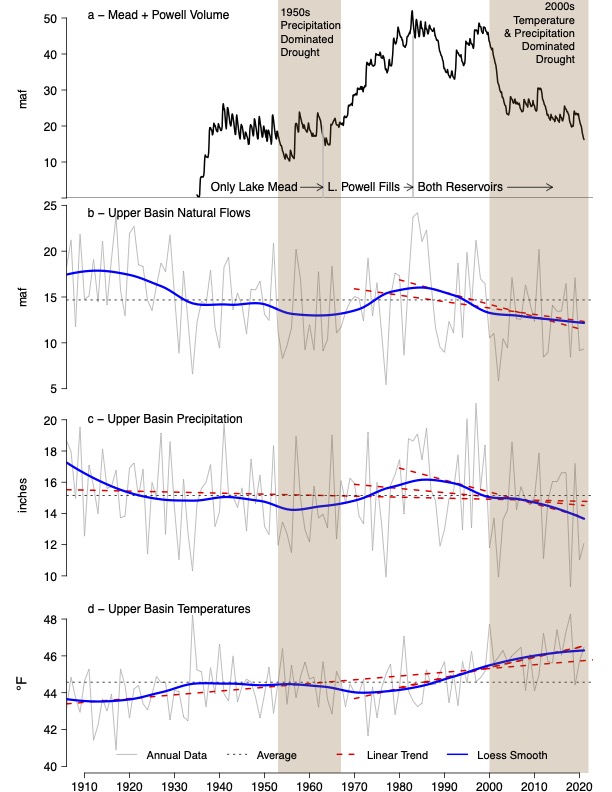
He cites four specific metrics that scientists use to quantify drought. They’re all connected, and they all paint a bleak picture of what the future might have in store.
It all starts with heat
All over the globe, temperatures are rising. In the Colorado River basin, hotter days are the first domino in a cascade of numbers that tell the story of drought. In the 21st century, average temperatures in the upper Colorado River basin are more than 2 degrees Fahrenheit warmer than in the previous century…
Dry soil keeps water out of rivers
You don’t have to be a scientist to notice changes in temperature and precipitation. But another metric that has an outsized influence on drought is harder to spot without specialized equipment. The amount of moisture in soil plays an important role in drought, and high temperatures are making conditions drier…
Precipitation is dropping, too
As much as high temperatures and dry soil are contributing to drought, recent years have also brought bad news for perhaps the most obvious metric: there’s less water falling from the sky…
Flows are low
Across the West, a sprawling web of streams and creeks carries water into the Colorado River. And across the West, they’re all carrying less…
So where do we go from here?CSU’s Brad Udall has some good news and some bad news. He thinks it’s within our technological capability to turn around some of the effects of climate change. But disagreements over policy and the very facts of climate change are standing in the way.