Biochar and compost both have the potential to increase crop productivity in the short term and improve resilience by retaining soil moisture and nutrients in the long-term. As an added benefit, biochar also sequesters carbon for long periods of time because biochar is primarily elemental carbon that is not easily converted to CO2 by soil microorganisms.
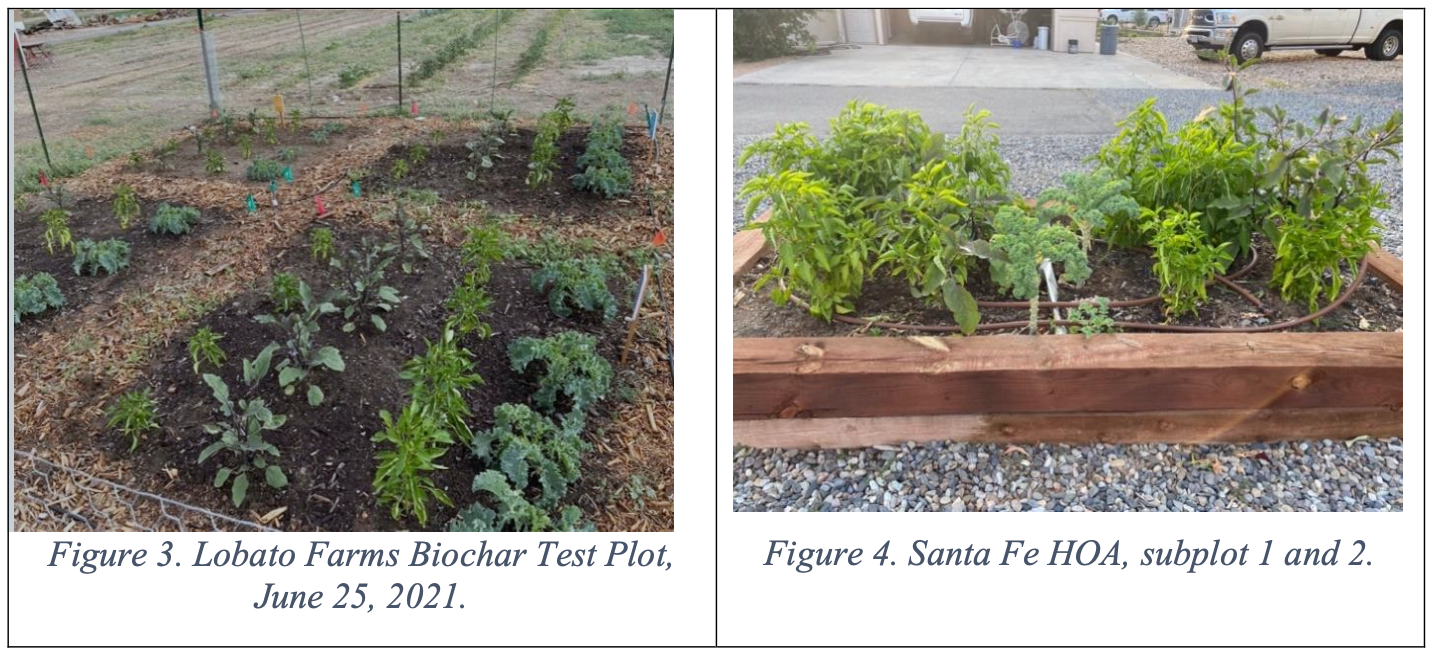
The first year’s experiment focuses on short term benefits. It took place at two locations, each with four subplots planted with the same vegetables – Ace Bell Peppers, Charger Peppers, Asian Eggplant and Curly-leafed Kale. The four subplots had different soil amendments – compost plus 20% biochar, compost plus 10% biochar, compost-only, and none.
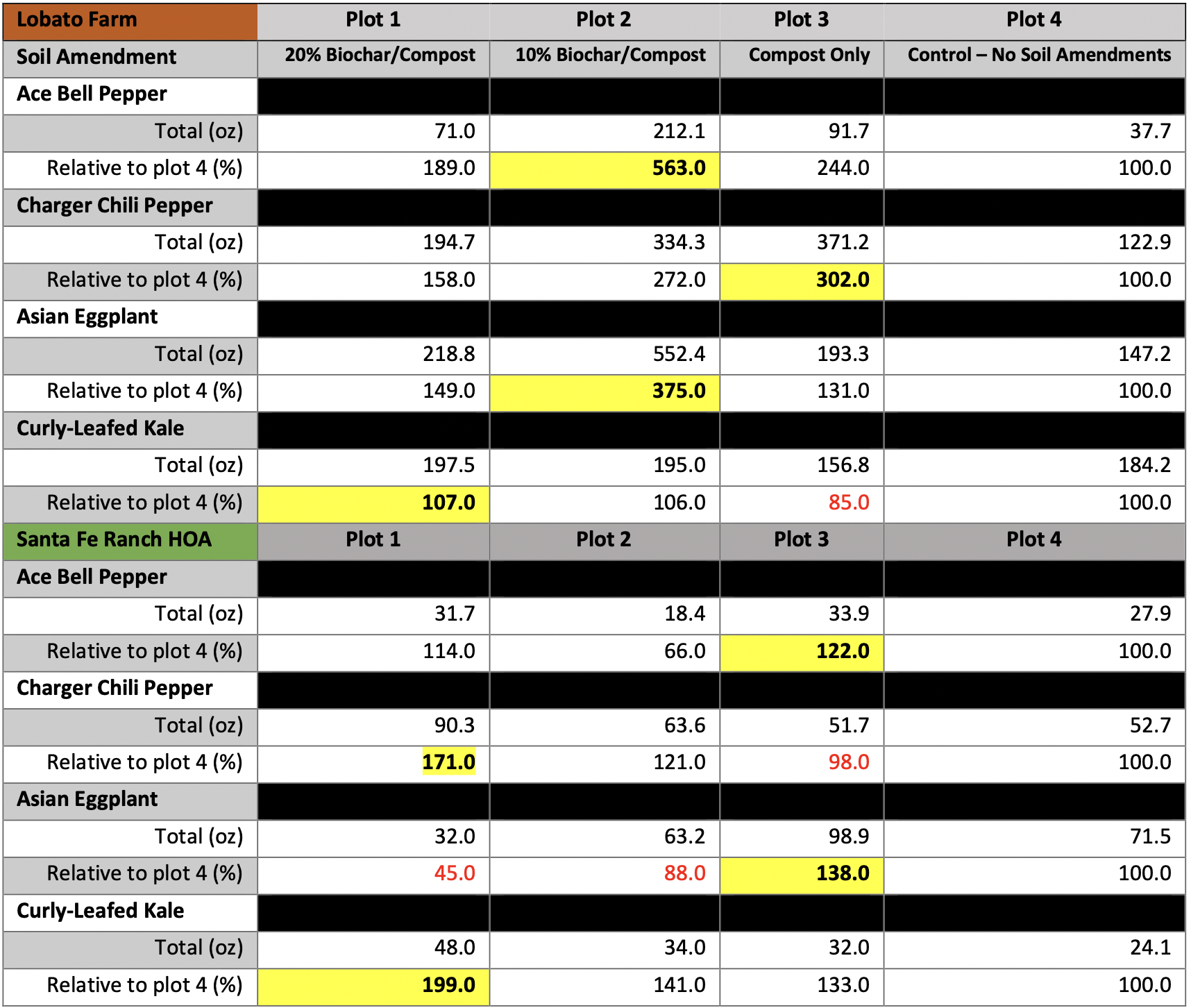
The table below presents summary statistics of the weight of each crop in each subplot and a comparison of the subplots to the control subplot 4. The subplot with the greatest harvest weight relative to subplot 4 is bolded; the amended subplots with values less than subplot 4 are red.
Summary Statistics- Production Quantity by crop and subplot. Notes: Plot 1 is compost + 20% biochar, Plot 2 is compost + 10% biochar, Plot 3 is compost only, Plot 4 is no amendment.
In all cases, the harvest weight from at least one of the amended plots, was greater than from subplot 4 (no amendment – the control). Subplot 2, which contained 10 percent biochar, yielded the largest produce weight for two of the four crops at Lobato Farms but none of the sub plots at the Santa Fe HOA. Subplot 1, which contained 20 percent biochar, yielded the greatest harvest weight for kale at Lobato Farms. The mixture of 20 percent biochar for both chili pepper and kale yielded the highest weight at the Santa Fe HOA.
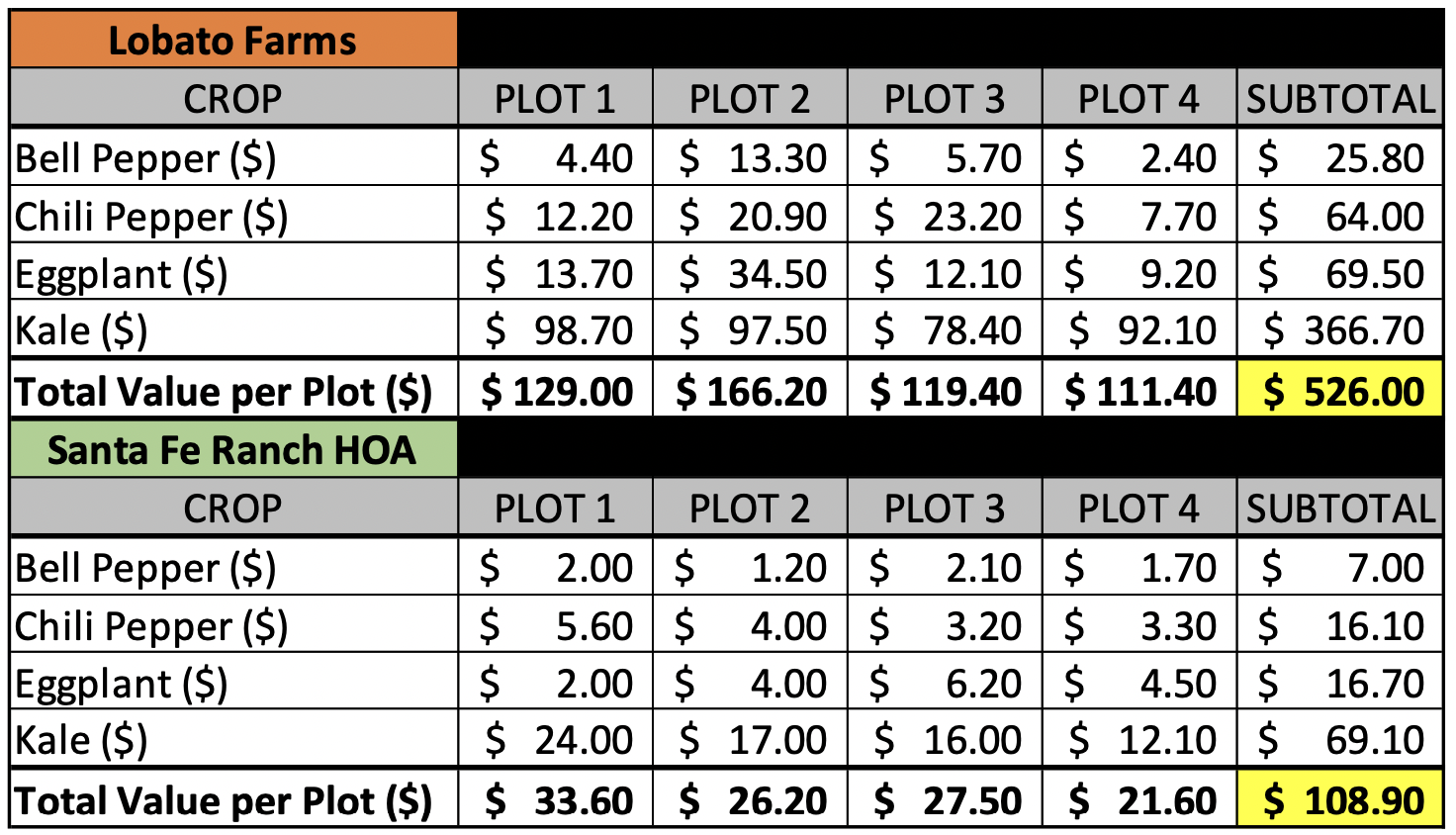
Using estimates of the market value of the crops, it is possible to assess the relative value of adding the different soil amendments (see table below). For both locations, using the amendments generated higher yields and the potential for more revenue. The sub plots containing biochar (1 and 2) also had higher value of output than the compost-only plot 3 at the Lobato Farm. Plot 3 did slightly better overall at Santa Fe than plot 2. The results for individual crops differ somewhat from the overall results. But only in one case (kale at Lobato’s) did plot 4 (no amendments) do better than an amended plot (plot 3). These results provide some initial confirmation of the value of using compost with biochar added.
Estimated value of production per crop and subplot USD ($). Note: Prices used for value calculation reflect wholesale value in September 2021. Kale, $8 per lb. Other crops, $1 per lb.
On Thursday, CCA issued a final report on its first-year study on the effects of implementing biochar into local agriculture at the Mesa County Public Library. The result: biochar-compost combinations have the potential to increase crop productivity in the short-term with the possibility of improving resilience by retaining soil moisture and nutrients in the long-term. Biochar also sequesters carbon for long periods of time because biochar is not easily biodegraded, reducing the carbon that’s released into the atmosphere. Biochar is a charcoal-like material made by heating plant matter to 600 to 800 degrees in a low-oxygen or oxygen-absent environment…
To the naked eye, biochar is simply shiny, black material, but under a microscopic view, the heating causes pores to develop, exhausting everything except remaining carbon from the material. Those pores can then be used to hold healthier elements for long periods of time. For instance, because those pores can store water, any farm that implements biochar can operate as normal without using as much water. If materials such as field stubble, tree trimmings and yard waste can be turned into biochar in a properly operated kiln, the waste can be used to help reduce smoke pollution in the valley instead of being burned in tall, smoky piles.
The study included growing four plots of bell peppers, chili peppers, eggplants and kale at Lobato Farms. The plots included 20% biochar and compost, 10% biochar and compost, compost only and a plot with no soil amendments. The 10% biochar-compost plot proved to produce the healthiest, most valuable crops, followed by the 20% biochar-compost plot.
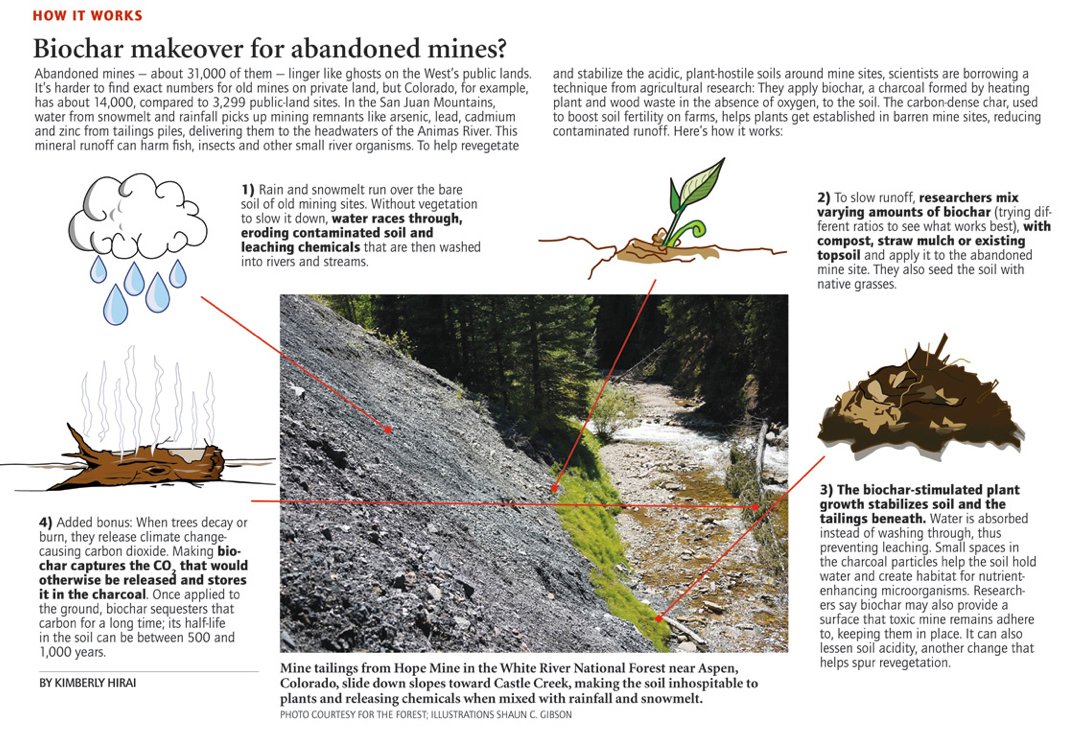
How biochar works. Graphic credit: The High Country News