The health of our waters is the principal measure of how we live on the land — Luna Leopold
Data Dump: Glen Canyon dips into hydropower buffer zone; #LakePowell hits 3,525 feet — @Land_Desk #ColoradoRiver #COriver #aridification
Lake Powell just north of Glen Canyon Dam. January 2022. Jonathan P. Thompson photo.
Click the link to read the article on the Land Desk website (Jonathan Thompson):
Lake Powell surface level dropped below the critical 3,525-foot mark sometime on the Ides of March. You’ve probably already read that somewhere, since the national media can’t seem to get enough of the slow motion desiccation of one of the nation’s largest reservoirs. And what’s so critical about 3,525 feet?
Nothing, really.
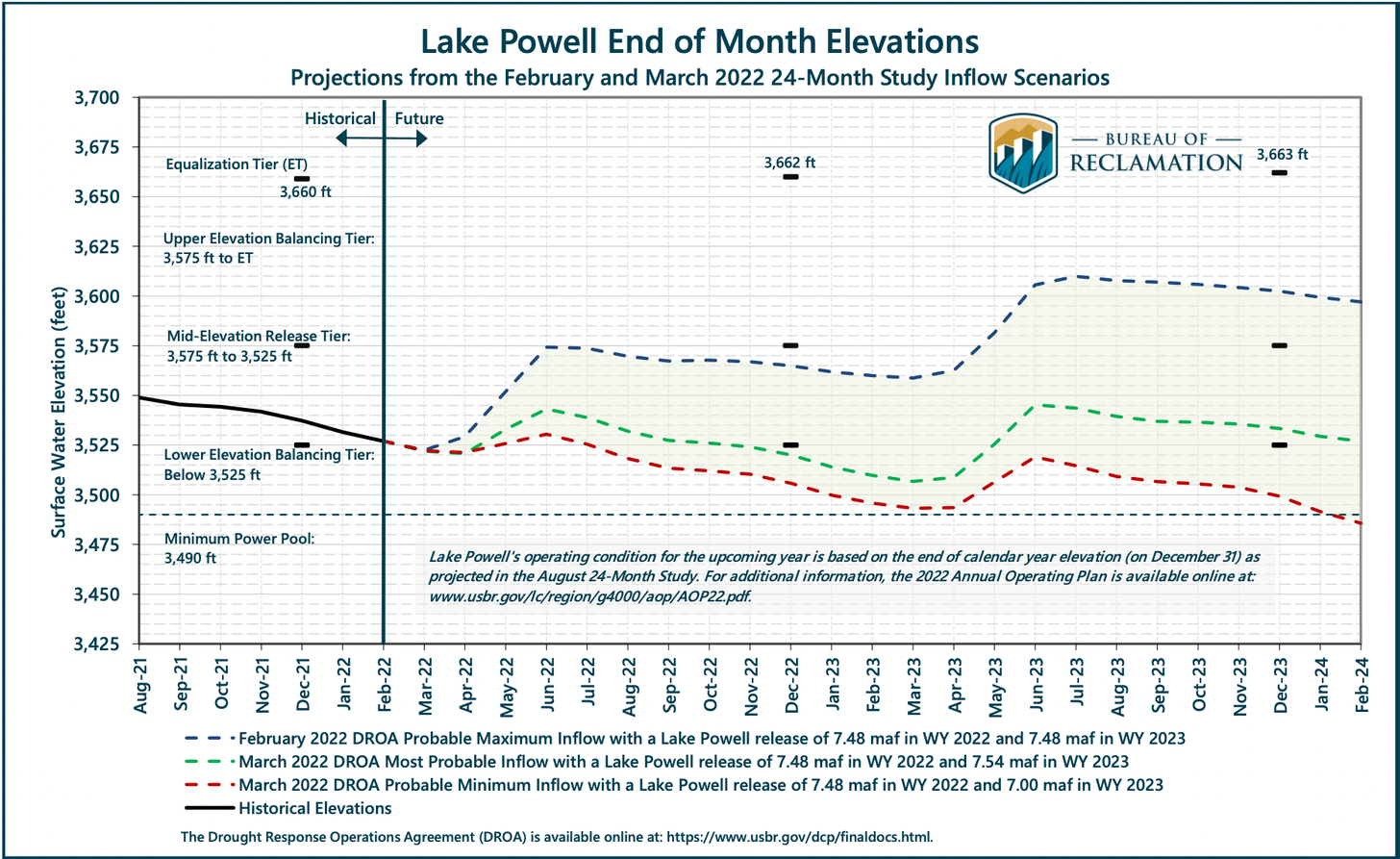
The real critical number is 3,490 feet, otherwise known as the “minimum power pool.” When Lake Powell sinks below that elevation, Glen Canyon Dam can no longer produce hydropower. That’s a big deal because Lake Powell really only serves two purposes these days: recreation and hydropower generation (the water storage component becomes somewhat irrelevant when Lake Mead is as low as it is now). Not only are the dam’s turbines a significant source of power for the Western Grid, but they also provide resilience for the grid in a way that other generators cannot.
Lake Powell has officially dipped just below 3,525 feet in elevation, reflecting the Colorado River Basin’s dry winter season. The elevation is expected to climb back above 3,525 feet over the course of spring runoff. More info: https://t.co/IobOBURhqH#drought#coloradoriver
Water managers had hoped to keep the level at least 35 feet above minimum power pool, i.e. above 3,525 feet, so they’d have a bit of a buffer to work with. Now the level is inside the buffer zone, which is reason for concern but not immediate alarm. While the rate of decline has prompted officials to issue a more pessimistic outlook for the reservoir, they don’t expect a loss of hydropower anytime soon. Snowpack levels in the watersheds that feed Lake Powell are slightly below average for this time of year, but are tracking about 7 percent ahead of last year’s levels. Spring runoff will soon begin, inflows will increase, and the lake should begin rising again, staving off the turbine shutdown—for now.
Let’s get to the data:
3,569 feet above sea level: Lake Powell’s surface level on March 9, 2021.
3,524.9 feet: Level on March 15, 2021.
-44 feet: Twelve-month change.
3,490 feet: Level at which Glen Canyon Dam stops producing hydropower.
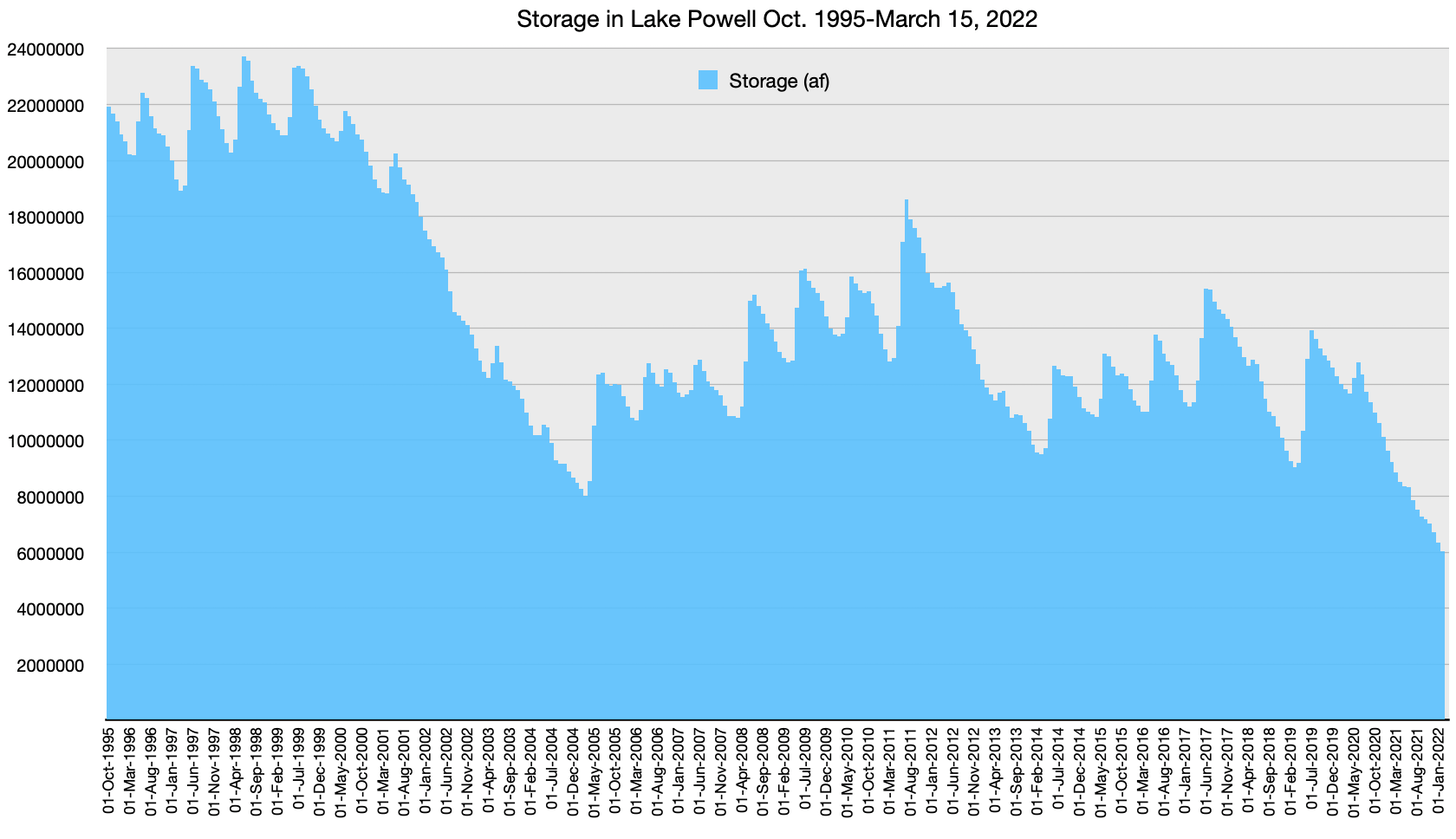
384 billion gallons: Amount by which Lake Powell’s storage has declined since November 2021.
855,656 megawatt hours: August 2021 output of Four Corners Power Plant.
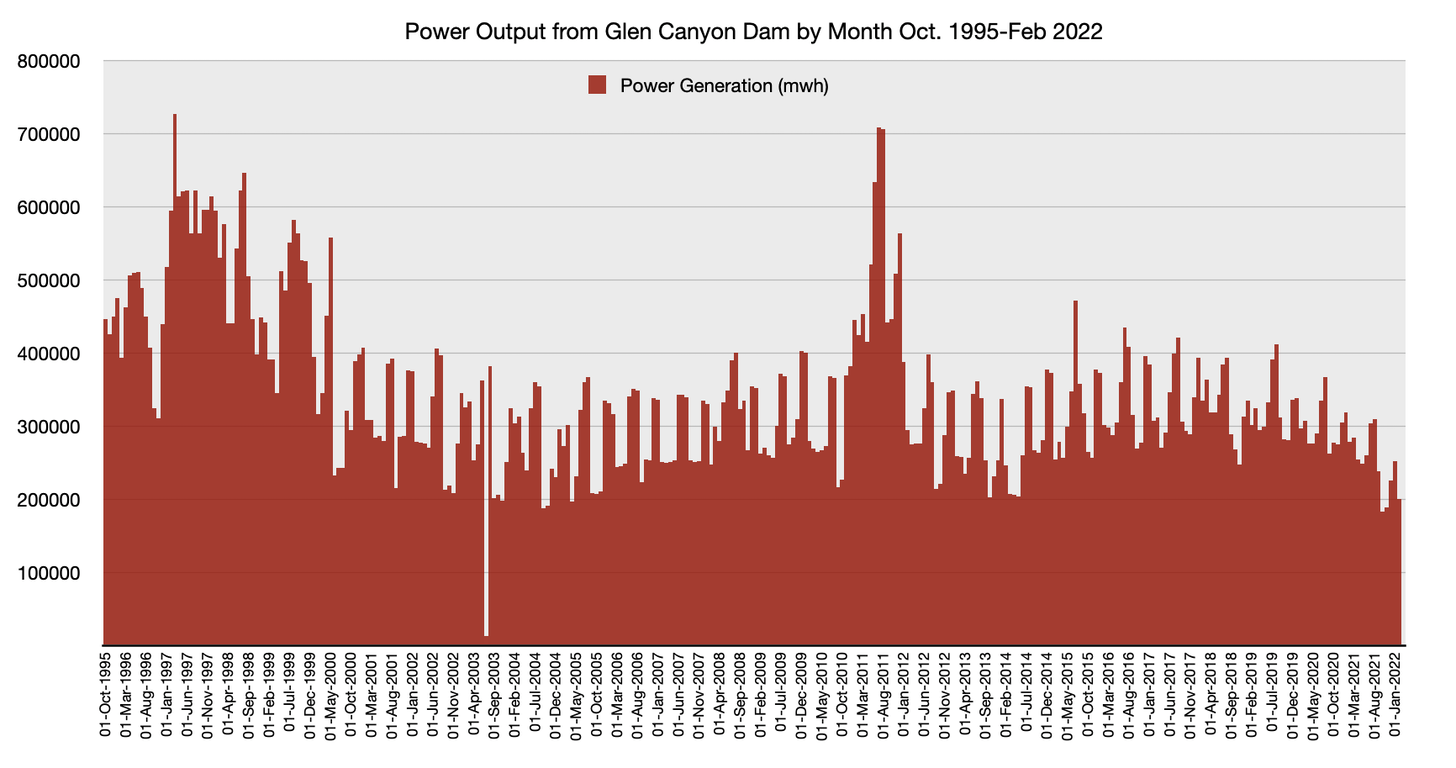
309,640 megawatt hours: August 2021 output of Glen Canyon Dam
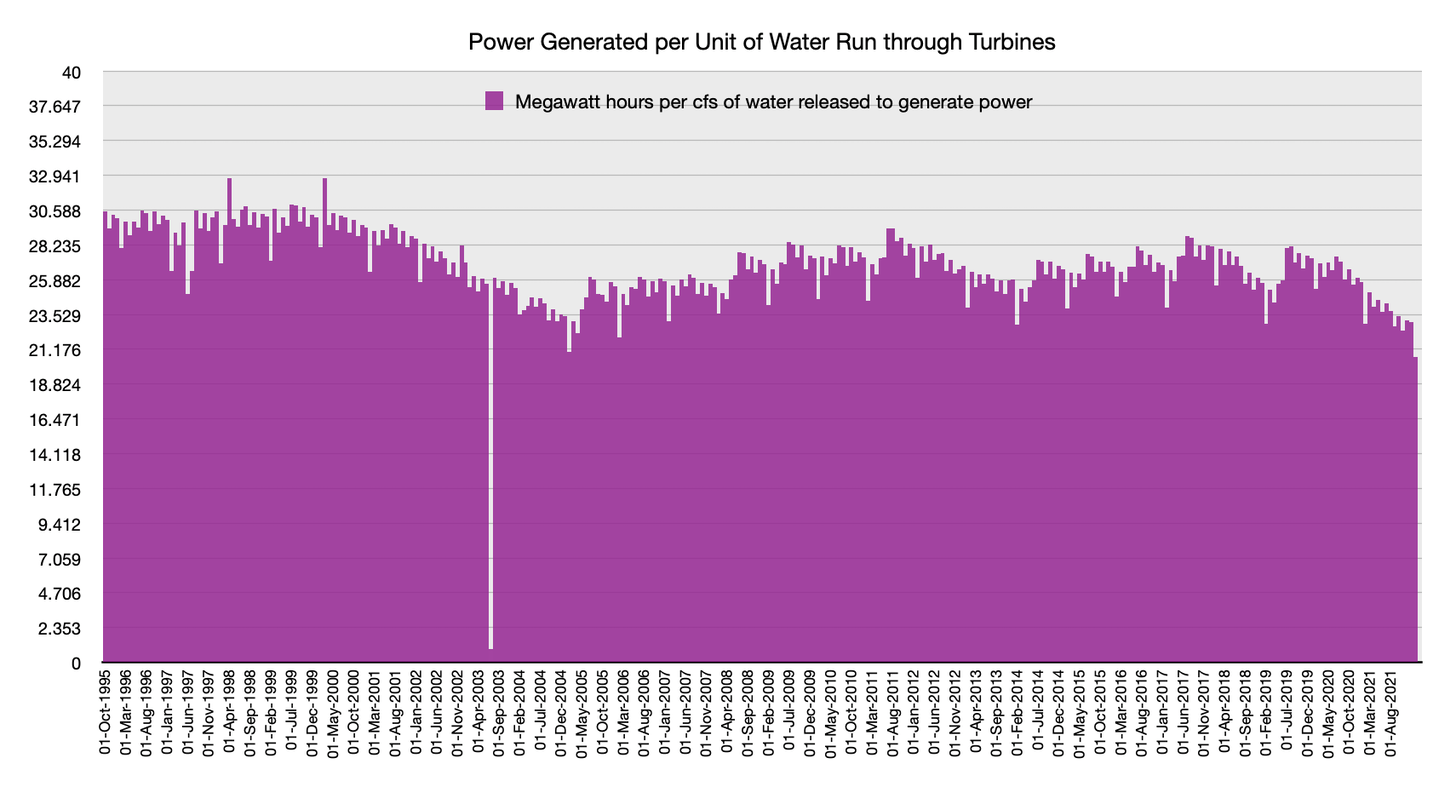
Lake Powell storage in acre-feet. 1 acre-foot = 325,851 gallons. USBR.Glen Canyon Dam’s power output roughly correlates with storage levels, but also varies month to month according to demand. USBR.As water levels drop there is less pressure to turn the dam’s turbines, so less power is generated per unit of water released.
Glen Canyon Dam, January 2022. Jonathan P. Thompson photo.
Click the link to read the article “Lake Powell hits historic low, raising hydropower concerns” on the Associated Press website (Sam Metz and Felicia Fonseca). Here’s an excerpt:
Lake Powell’s fall to below 3,525 feet (1,075 meters) puts it at its lowest level since the lake filled after the federal government dammed the Colorado River at Glen Canyon more than a half century ago — a record marking yet another sobering realization of the impacts of climate change and megadrought. It comes as hotter temperatures and less precipitation leave a smaller amount flowing through the over-tapped Colorado River. Though water scarcity is hardly new in the region, hydropower concerns at Glen Canyon Dam in Arizona reflect that a future western states assumed was years away is approaching — and fast.
“We clearly weren’t sufficiently prepared for the need to move this quickly,” said John Fleck, director of the University of New Mexico’s Water Resources Program.
Federal officials are confident water levels will rise in the coming months once snow melts in the Rockies. But they warn that more may need to be done to ensure Glen Canyon Dam can keep producing hydropower in the years ahead…About 5 million customers in seven states — Arizona, Colorado, Nebraska, Nevada, New Mexico, Utah and Wyoming — buy power generated at Glen Canyon Dam. The government provides it at a cheaper rate than energy sold on the wholesale market, which can be wind, solar, coal or natural gas. For the cities, rural electric cooperatives and tribes that rely on its hydropower, less water flowing through Glen Canyon Dam can therefore increase total energy costs. Customers bear the brunt…
Nick Williams, the bureau’s Upper Colorado Basin power manager, said many variables, including precipitation and heat, will determine the extent to which Lake Powell rebounds in the coming months. Regardless, hydrology modeling suggests there’s roughly a 1 in 4 chance it won’t be able to produce power by 2024.
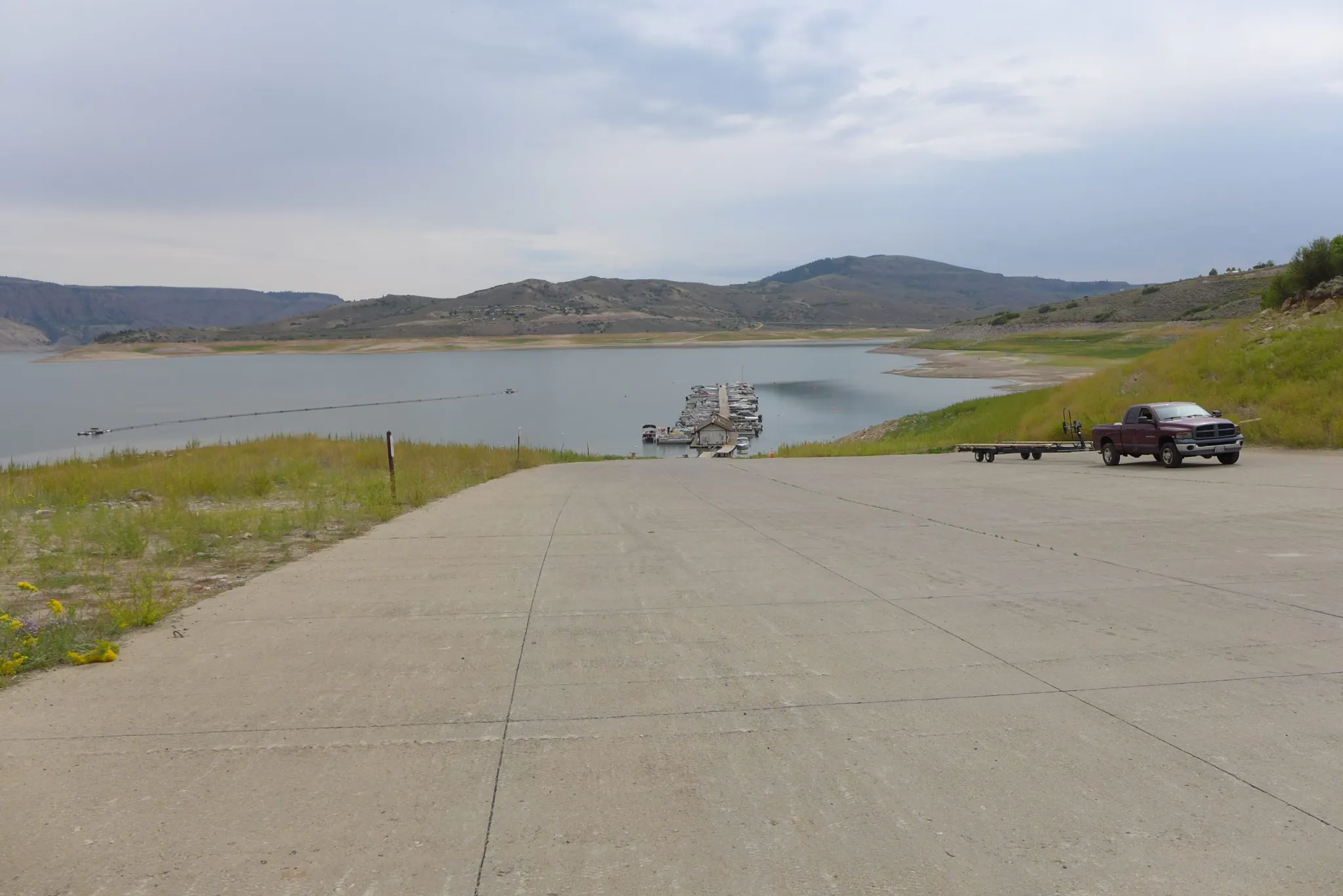
The boat ramp at the Lake Fork Marina closed for the season on Sept. 2 due to declining reservoir levels. The Bureau of Reclamation is making emergency releases out of Blue Mesa Reservoir to prop up levels in Lake Powell and preserve the ability to make hydropower. CREDIT: HEATHER SACKETT/ASPEN JOURNALISM
Click the link to read “Lake Powell drops below critical threshold for the first time despite attempts to avoid it” on the Colorado Public Radio website (Michael Elizabeth Sakas). Here’s an excerpt:
The reservoir is the second-largest in the U.S., and it’s a key piece of the Colorado River storage and supply system. Powell is fed mostly by snowmelt that collects in Colorado’s Rocky Mountains. A 20-year megadrought and a hotter climate, fueled primarily by greenhouse gas emissions from fossil fuels, has contributed to Powell’s levels dropping to all-time lows…
Colorado and the other states that share the Colorado River agreed to work together to keep Powell above this critical threshold with the Congressionally approved 2019 Drought Contingency Plan. That agreement creates a 35-foot buffer of water before the reservoir hits “dead pool,” when reservoir levels are so low, the hydroelectric generators can no longer produce energy. Water levels in Powell quickly started to drop after years of back-to-back drought. In response, the federal government in 2021 took emergency action and sent water from reservoirs in Colorado and other states to prop up supplies in Powell. Blue Mesa Reservoir outside of Gunnison lost eight feet of water as a result. Ultimately, those releases did not prevent water levels from dropping below the critical threshold. But U.S. Bureau of Reclamation hydraulic engineer Heather Patno said the additional release did add about six feet of water to Powell, and any extra buffer helps protect Powell’s ability to produce energy. Patno said the drop should be temporary as the snow in the mountains starts to melt and recharge the river and reservoirs. She said 2021 was the second-driest year on record for the Colorado River basin, and a very dry first few months of 2022 eroded the snowpack collecting in the mountains…
New research suggests there might be even less Colorado River water in the future than what’s forecasted.
A recent report from the Center for Colorado River Studies found that the U.S. Bureau of Reclamation’s projections can be too optimistic, partly because it’s based on the average water inflow into Powell from 1991-2020, a period that includes an abnormal decade in the 90s that was much wetter than the last 20 years. Patno said those findings are important, and it and other studies should be considered when federal and state governments decide how to adapt their water operations to drought. She said Powell projections did improve when the bureau recently switched to using the last 30-year average, but that Powell forecasts rely on models that have a level of risk and uncertainty.
Powell’s worst-case projections show its level could drop below 3,525 feet again as early as August of this year. Patno said emergency water releases from Blue Mesa and other reservoirs might be needed again as one of the tools to keep Powell propped up, especially as the current snowpack continues to decline. Inflow forecasts into Powell expect about 69 percent of average. The ongoing drought also means dry soil will soak up a lot of that water before it reaches rivers and lakes, Patno said.
Commissioner Mitchell (CWCB) Statement on Lake Powell Elevation 3525′:
As of March 15, Lake Powell, a major reservoir that feeds water to the Lower Colorado River Basin, fell below elevation 3525 feet. This is the target elevation identified within the Drought Contingency Plan that provides a buffer to hydropower.
The decline in Lake Powell was caused by over 20 years of low inflows in the Colorado River System, coupled with depletions that exceeded supplies. The imbalance between depletions and available River flows has historically been compensated by taking water from storage in Lake Powell and Lake Mead to provide for downstream depletions, thus causing declines in reservoir elevations.
Below is a statement from Colorado River Commissioner Becky Mitchell:
“Lake Powell hit elevation 3525 feet this week, which is a direct result of depletions from our major reservoirs over the last 20 years coupled with low flows into Lake Powell. As Lake Powell and Lake Mead have declined, water users in the Upper Colorado River Basin have been living on the front lines of climate change. The Upper Basin states of Colorado, New Mexico, Utah, and Wyoming have been taking water cuts for 20 years due to prolonged drought, while continuing to meet our Compact obligations. On top of this, water has been provided from Flaming Gorge and Blue Mesa Reservoirs in an effort to protect Lake Powell. Going forward, all who rely on the Colorado River System must learn to live with what the River provides and adapt to variability of water supply.”
For more information and updates, visit the Commissioner’s Corner on the Colorado Water Conservation Board website.