

Click the link to read the article on the Salt Lake Tribune website (Zak Podmore). Here’s an excerpt:
The reservoir could drop below the level needed to generate power at the Glen Canyon Dam this year if other ways of increasing the elevation of the lake aren’t used
…water managers in Colorado announced last week that they will stop exploring one proposal to prop up the rapidly depleting levels in Lake Powell. The plan — known as demand management — would compensate farmers and ranchers for voluntarily stopping irrigation on a temporary basis, sending water that would have been used for agriculture to the reservoir. A drought contingency plan developed in 2019 by Utah, Colorado, New Mexico and Wyoming identified demand management as one method that could be used to keep the water level in Lake Powell above 3,525 feet in elevation, around a quarter of its capacity, in order to protect electricity generation. The four-state demand management proposal was met with suspicion by agricultural interests, according to Anne Castle, a senior fellow at the University of Colorado Law School who previously worked on Colorado River issues under the Obama administration. Skeptics of the plan feared it could “wipe out irrigated agriculture” in parts of the river basin and fundamentally alter rural economies, Castle said at a recent University of Utah symposium hosted by the Wallace Stegner Center. She said those fears were “not unfounded” and “they would have to be dealt with in an equitable demand management program.”
[…]
Utah still supports a four-state demand management program, said Amy Haas, executive director of the Colorado River Authority of Utah, but it is also prepared to move forward with water conservation pilot projects and potentially pursue a smaller-scale demand management program on its own. She pointed to Utah’s investments in water measuring infrastructure, studies looking at switching to crops that require less water and other programs…
The Bureau of Reclamation recently announced that it is studying modifications to the Glen Canyon Dam that would allow for power generation at lower water levels. That could include installing turbines on bypass tubes that are located below the current hydropower intakes…
But Brad Udall said finding the political will and leadership at federal and state levels to permanently reduce demand is difficult.
“My biggest fear,” Udall said, “is that it’s easier to let the system crash than it is to find the painful solutions that are needed.”
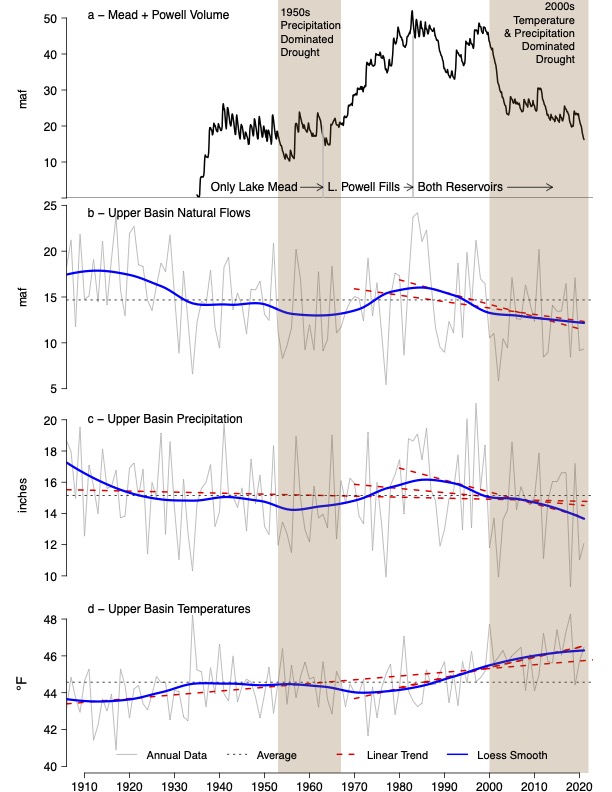
He defined a system crash as letting the two largest reservoirs in the U.S. — Lake Mead and Lake Powell — empty because of an inability to respond to declining flows. Udall added there have been incremental, positive solutions implemented in the basin over the last two decades, but he said future solutions have to be “more than incremental” to deal with the crisis.
@GreatLakesPeck.