
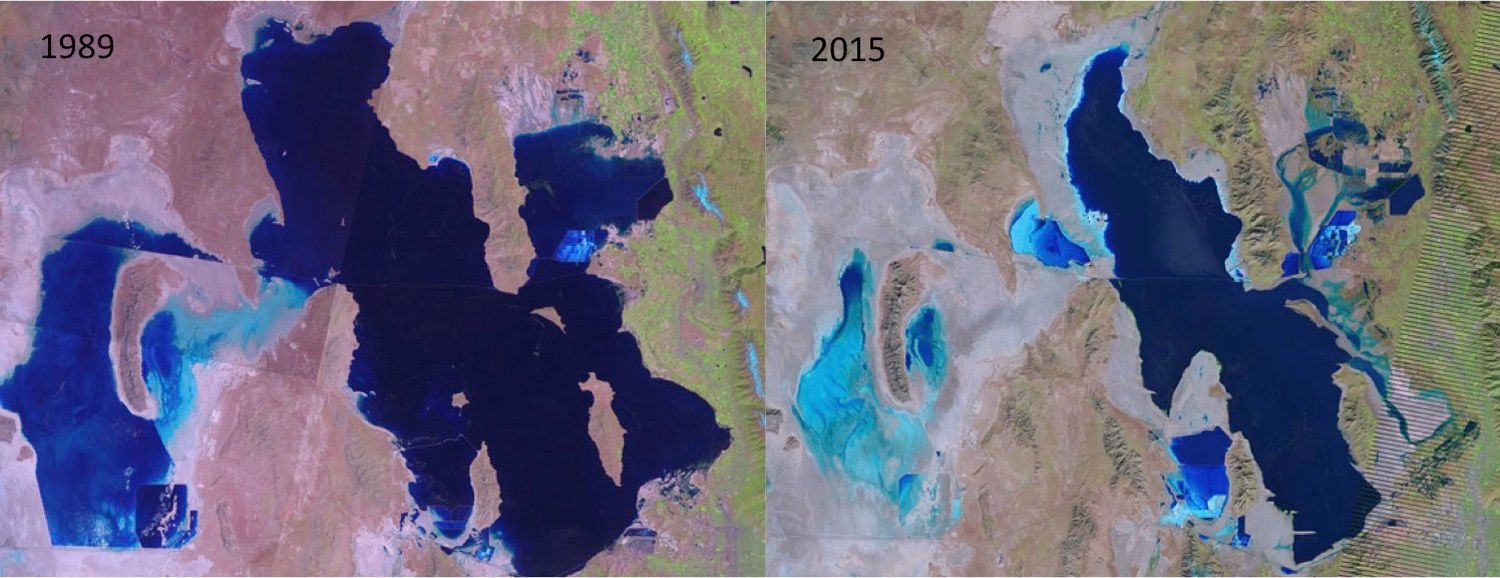
Click the link to read the article on The Guardian website (Maanvi Singh). Here’s an excerpt:
Emergency measures are required to avert a catastrophe in Utah’s Great Salt Lake, which has been drying up due to excessive water use, a new report warns. Within years, the lake’s ecosystems could collapse and millions will be exposed to toxic dust contained within the drying lakebed, unless drastic steps are taken to cut water use. A team of 32 scientists and conservationists caution that the lake could decline beyond recognition in just five years. Their warning is especially urgent amid a historic western megadrought fueled by global heating. To save the lake, the report suggests 30-50% reductions in water use may be required, to allow 2.5m acre-feet of water to flow from streams and rivers directly into the lake over the next two years.
“We really need to increase the speed of our response, and also increase our ambition for how much water we restore to the lake,” said Ben Abbott, an ecologist at Brigham Young University and one of the report’s lead authors…
Despite growing political momentum, Abbott said that existing policies and action plans will not be enough to save the lake from collapse. Already, the lake has lost 73% of its water and 60% of its surface area, as trillions of litres of water are diverted away from it to supply farms and homes. As a result, the lake is becoming saltier and uninhabitable to native flies and brine shrimp. Eventually, the lake will be unable to sustain the more than 10 million migratory birds and wildlife that frequent it. Declining lake levels could also make magnesium, lithium and other critical minerals extraction infeasible within the next two years. Dust from the exposed lakebed could further damage crops, degrade soil and cause snow to melt more quickly – triggering widespread economic losses for Utah’s agriculture and tourism industries. Toxic sediment, laced with arsenic, from the lakebed can exacerbate respiratory conditions and heart and lung disease, and could increase residents’ risk for cancer…
The climate crisis, which has increased average temperatures in northern Utah by 4F since the early 1900s, is further imperilling the lake, fuelling more severe droughts and heatwaves. But studies suggest that only about 9% of the lake’s decline due to evaporation and reduced runoff can be blamed on climate change. A legacy of water overuse is the main threat to the largest saltwater lake in the western hemisphere, and huge water diversions to irrigate vast operations to grow alfalfa and hay are no longer sustainable in Utah, Abbott said, nor are lush lawns in cities and suburbs.