
Daniel Craig McCool, University of Utah
As Western states haggle over reducing water use because of declining flows in the Colorado River Basin, a more hopeful drama is playing out in Glen Canyon.
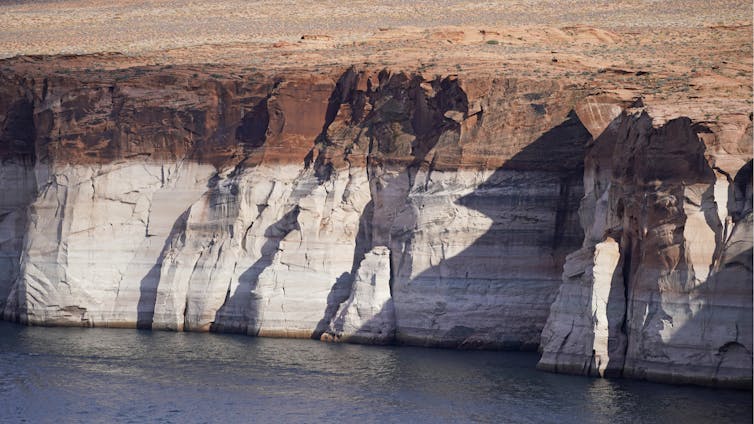
Lake Powell, the second-largest U.S. reservoir, extends from northern Arizona into southern Utah. A critical water source for seven Colorado River Basin states, it has shrunk dramatically over the past 40 years.
An ongoing 22-year megadrought has lowered the water level to just 22.6% of “full pool,” and that trend is expected to continue. Federal officials assert that there are no plans to drain Lake Powell, but overuse and climate change are draining it anyway.
As the water drops, Glen Canyon – one of the most scenic areas in the U.S. West – is reappearing.
This landscape, which includes the Colorado River’s main channel and about 100 side canyons, was flooded starting in the mid-1960s with the completion of Glen Canyon Dam in northern Arizona. The area’s stunning beauty and unique features have led observers to call it “America’s lost national park.”
Lake Powell’s decline offers an unprecedented opportunity to recover the unique landscape at Glen Canyon. But managing this emergent landscape also presents serious political and environmental challenges. In my view, government agencies should start planning for them now.
A tarnished jewel
Glen Canyon Dam, which towers 710 feet high, was designed to create a water “bank account” for the Colorado River Basin. The U.S. Bureau of Reclamation touted Lake Powell as the “Jewel of the Colorado” and promised that it would be a motorboater’s paradise and an endless source of water and hydropower.
Lake Powell was so big that it took 17 years to fill to capacity. At full pool, it contained 27 million acre-feet of water – enough to cover 27 million acres of land to a depth of one foot – and Glen Canyon Dam’s turbines could generate 1,300 megawatts of power when the reservoir was high.
Soon the reservoir was drawing millions of boaters and water skiers every year. But starting in the late 1980s, its volume declined sharply as states drew more water from the Colorado River while climate change-induced drought reduced the river’s flow. Today the reservoir’s average volume is less than 6 million acre-feet.
Nearly every boat ramp is closed, and many of them sit far from the retreating reservoir. Hydropower production may cease as early as 2024 if the lake falls to “minimum power pool,” the lowest point at which the turbines can draw water. And water supplies to 40 million people are gravely endangered under current management scenarios.
These water supply issues have created a serious crisis in the basin, but there is also an opportunity to recover an amazing landscape. Over 100,000 acres of formerly flooded land have emerged, including world-class scenery that rivals some of the crown jewels of the U.S. national park system. https://www.youtube.com/embed/y7jm08U38c0?wmode=transparent&start=0 As Lake Powell recedes, it is uncovering formerly flooded land and things that past visitors left behind.
Bargained away
Glen Canyon made a deep impression on explorer John Wesley Powell when he surveyed the Colorado River starting in 1867. When Powell’s expedition floated through Glen Canyon in 1869, he wrote:
“On the walls, and back many miles into the country, numbers of monument-shaped buttes are observed. So we have a curious ensemble of wonderful features – carved walls, royal arches, glens, alcove gulches, mounds, and monuments … past these towering monuments, past these oak-set glens, past these fern-decked alcoves, past these mural curves, we glide hour after hour.”
Glen Canyon remained relatively unknown until the late 1940s, when the Bureau of Reclamation proposed several large dams on the upper Colorado River for irrigation and hydropower. Environmentalists fiercely objected to one at Echo Park in Dinosaur National Monument on the Colorado-Utah border, alarmed by the prospect of building a dam in a national monument. Their campaign to block it succeeded – but in return they accepted a dam in Glen Canyon, a decision that former Sierra Club President David Brower later called his greatest regret.
New challenges
The first goal of managing the emergent landscape in Glen Canyon should be the inclusion of tribes in a co-management role. The Colorado River and its tributaries are managed through a complex maze of laws, court cases and regulations known as the “Law of the River.” In an act of stupendous injustice, the Law of the River ignored the water rights of Native Americans until courts stepped in and required western water users to consider their rights.
Tribes received no water allocation in the 1922 Colorado River Compact and were ignored or trivialized in subsequent legislation. Even though modern concepts of water management emphasize including all major stakeholders, tribes were excluded from the policymaking process.
There are 30 tribes in the Colorado River Basin, at least 19 of which have an association with Glen Canyon. They have rights to a substantial portion of the river’s flow, and there are thousands of Indigenous cultural sites in the canyon.
Another management challenge is the massive amounts of sediment that have accumulated in the canyon. “Colorado” means “colored red” in Spanish, a recognition of the silt-laden water. This silt used to build beaches in the Grand Canyon, just downstream, and created the Colorado River delta in Mexico.
But for the past 63 years, it has been accumulating in Lake Powell, where it now clogs some sections of the main channel and will eventually accumulate below the dam. Some of it is laced with toxic materials from mining decades ago. As more of the canyon is exposed, it may become necessary to create an active sediment management plan, including possible mechanical removal of some materials to protect public health.
The creation of Lake Powell also resulted in biological invasives, including nonnative fish and quagga mussels. Some of these problems will abate as the reservoir declines and a free-flowing river replaces stagnant still water.
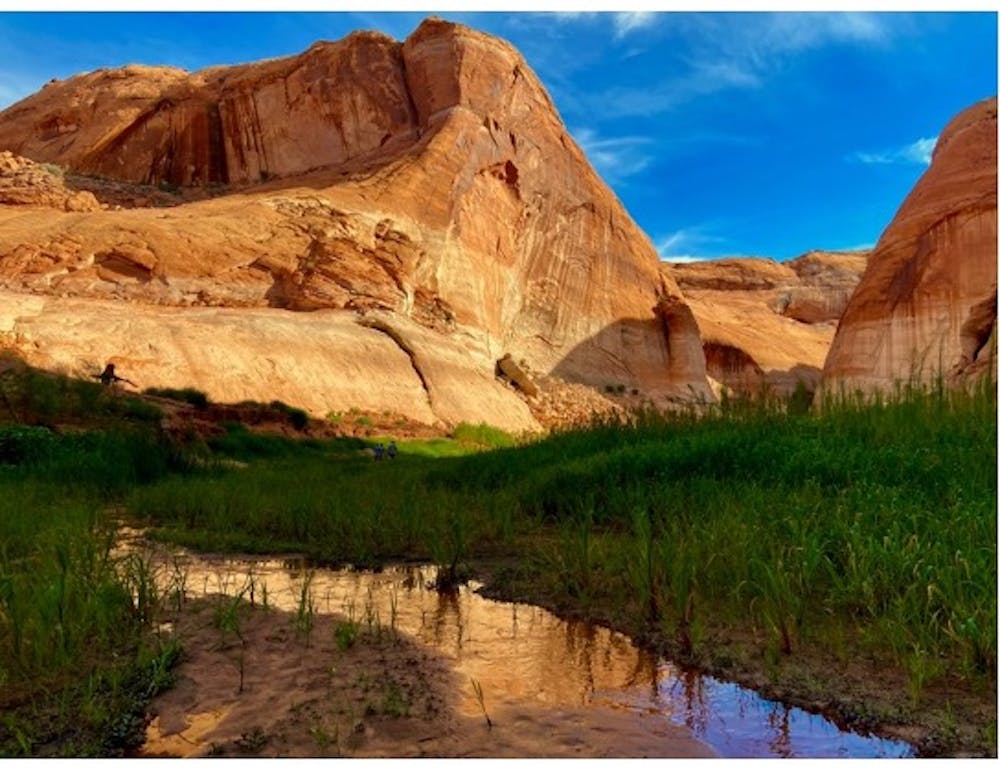
On a more positive note, native plants are recolonizing side canyons as they become exposed, creating verdant canyon bottoms. Restoring natural ecosystems in the canyon will require innovative biological management strategies as the habitat changes back to a more natural landscape.
Finally, as the emergent landscape expands and side canyons recover their natural scenery, Glen Canyon will become a unique tourist magnet. As the main channel reverts to a flowing river, users will no longer need an expensive boat; anyone with a kayak, canoe or raft will be able to enjoy the beauty of the canyons.
Glen Canyon National Recreation Area, which includes over 1.25 million acres around Lake Powell, was created to cater to people in motorized boats on a flat-water surface. Its staff will need to develop new capabilities and an active visitor management plan to protect the canyon and prevent the kind of crowding that is overrunning other popular national parks.
Other landscapes are likely to emerge across the West as climate change reshapes the region and numerous reservoirs decline. With proper planning, Glen Canyon can provide a lesson in how to manage them.
Daniel Craig McCool, Professor Emeritus of Political Science, University of Utah
This article is republished from The Conversation under a Creative Commons license. Read the original article.

Such a shame that Glen Canyon could once again become the boring inhospitable no mans land it once was after being such a treasured beautiful national oasis for so long. Hopefully water conservation, and mother nature will align to save Lake Powell, and allow it to continue to be one of the most amazing places on earth for all to enjoy!