
Click the link to read the guest column on the New York Times website (Chukwumerije Okereke). Here’s an excerpt:
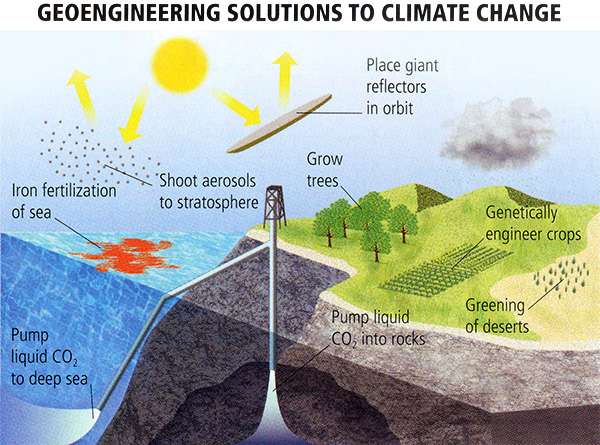
Several environmentalists last year presented Africa’s leading climate negotiators with a bold idea: A technology called solar geoengineering could protect their countries from the worst effects of climate change, they said. While insisting they were impartial, representatives from the Carnegie Climate Governance Initiative said that these technologies, which claim to be able to re-engineer the climate itself, either by dimming the sun’s rays or reflecting sunlight away from the earth, could quickly and cheaply turn the tide of dangerously rising temperatures — and that poor countries might have the most to gain.
It wasn’t the first time Westerners have tried to persuade Africans that solar engineering projects may be in our best interest. And it won’t be the last. In May, another international nonprofit, the Climate Overshoot Commission, headquartered in Paris, is hosting an event in Nairobi to help drum up support for research on solar geoengineering and other related technologies it says could be helpful in reducing risks when the world exceeds its global warming targets.
As a climate expert, I consider these environmental manipulation techniques extremely risky. And as an African climate expert, I strongly object to the idea that Africa should be turned into a testing ground for their use. Even if solar geoengineering can help deflect heat and improve weather conditions on the ground — a prospect that is unproven on any relevant scale — it’s not a long-term solution to climate change. It sends a message to the world that we can carry on over-consuming and polluting because we will be able to engineer our way out of the problem.
The solar engineering technology attracting the most attention would use balloons or aircraft to spray large quantities of aerosols — tiny particles of, for example, sulfur dioxide or engineered nanoparticles — into the stratosphere to dim the sunlight. It’s called solar radiation management and it’s highly speculative.Without using the whole earth as a laboratory, it’s impossible to know whether it would dim anything, let alone how it would affect ecosystems, people and the global climate.
These technologies would also theoretically need to be deployed essentially forever to keep warming at bay. Stopping would unleash the suppressed warming of the carbon dioxide still accumulating in the atmosphere in a temperature spike known as “termination shock.” One study found that the temperature change after ending solar radiation management could be up to four times as large as what’s being caused by climate change itself.
The other risk is that geoengineering will divert attention and investments from building renewable energy and other climate solutions in Africa. The continent has received only 2 percent of global investments in renewable energy in the last two decades, and the lack of access to capital is perhaps the biggest obstacle for countries that would like to cut down on fossil fuels.