
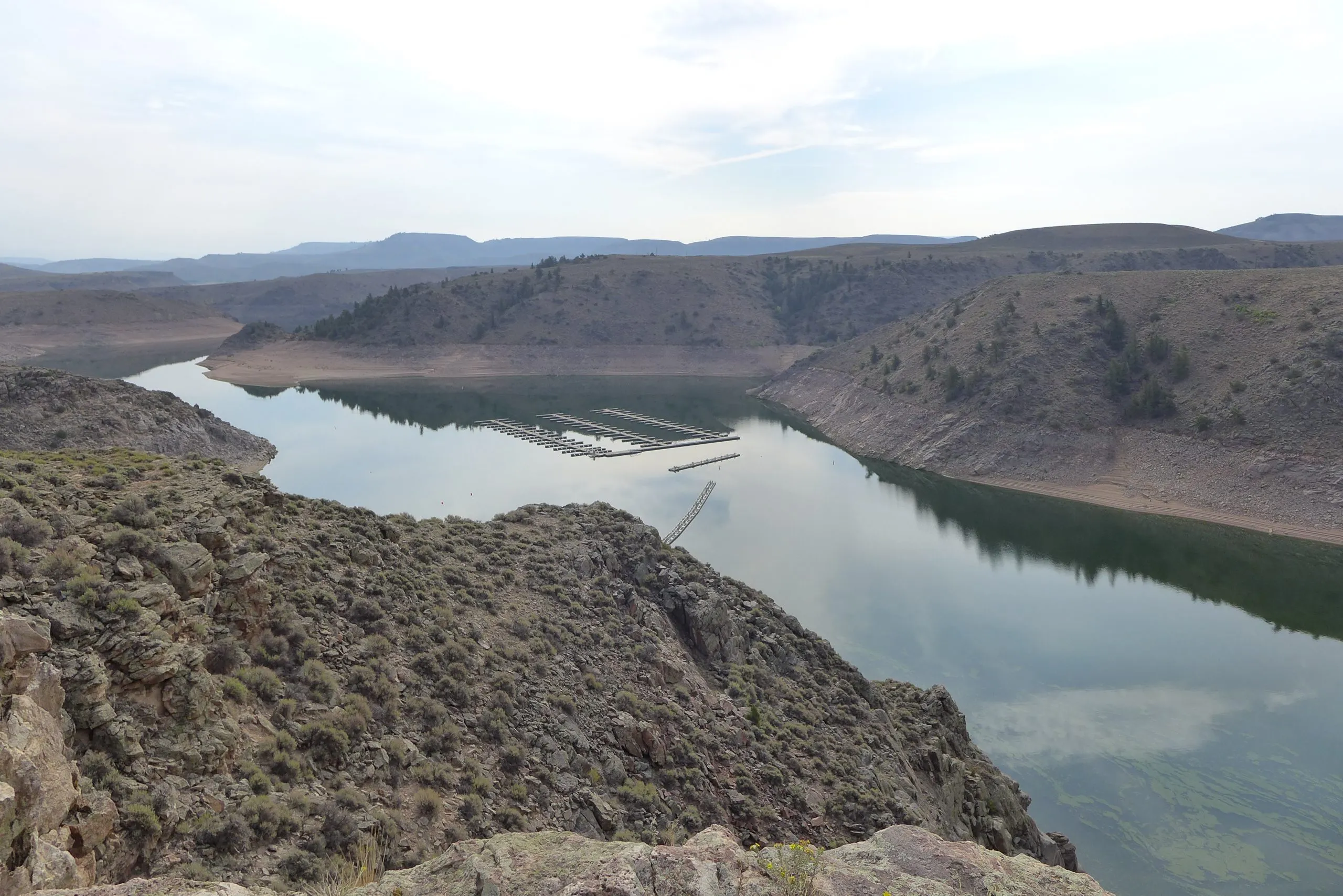
Click the link to read the article on the Aspen Journalism website (Heather Sackett):
Programs that would pay water users to conserve and send that water downstream for the benefit of the Colorado River system remain too controversial for Colorado water managers to agree on.
A statewide task force has failed to make recommendations to lawmakers about the primary issue they were supposed to tackle: how to address drought in the Colorado River basin and respond to a downstream call through water conservation programs.
Senate Bill 295 created the 17-member Colorado River Drought Task Force this year, with representatives from Western Slope water users, Front Range water providers, local governments, the state Department of Natural Resources, environmental groups and tribal leaders. The group met 10 times between July and December at locations across the state and remotely.
According to SB 295, the purpose of the task force was to provide recommendations for state legislation “to develop programs that address drought in the Colorado River basin and interstate commitments related to the Colorado River and its tributaries through the implementation of demand reduction projects and the voluntary and compensated conservation of the waters of the Colorado River and its tributaries.”
But a draft recommendation about what a conservation program should look like lost on a 9-7 vote, meaning task force members did not advance it as a recommendation to legislators. A narrative about the issue was still included in the report.
“I was personally disappointed that some of the larger topics that are out there in the water world or brought up at the task force did not get support from the task force,” said state Sen. Dylan Roberts, a Democrat who represents District 8 and was a sponsor of SB 295. “They either didn’t have time or shied away from those conversations about longer-term solutions.”
The losing recommendation contained many of the state’s same long-discussed themes surrounding demand management: Any potential program should be temporary, voluntary and compensated, should avoid disproportionate impacts to any one region, and must not injure other nonparticipating water rights holders; and Western Slope conservation districts should be involved with projects within their boundaries.
Task force members could not agree on whether the timing was right for such a program, with some saying it’s “premature.” The “no” votes came from those representing Front Range water providers, the Department of Natural Resources, the Department of Agriculture, the Southwestern Water Conservation District and Colorado’s two tribes, the Ute Mountain Ute Tribe and Southern Ute Indian Tribe.
“I think there is a lot of institutional pressure that keeps us tethered to the status quo in water policy in Colorado,” said Roberts, who represents Clear Creek, Eagle, Garfield, Gilpin, Grand, Jackson, Moffat, Rio Blanco, Routt and Summit counties. “We owe it to Coloradans and the people in the West to grapple with the reality of what faces us in the decades ahead. … There’s no time like the present to prepare for a bad situation.”
The lack of recommendations about conservation programs highlights the complicated nature of water in Colorado and the difficulty of achieving consensus among competing interests. A 2021 work group that had been created to tackle speculation also failed to make recommendations to lawmakers.

Conservation controversy continues
Demand management, water banking, system conservation, a strategic water reserve — the names and details are different, but the basic concept is the same: paying water users to use less on a temporary and voluntary basis. They have been controversial in Colorado, with skeptics saying these types of programs could strip rural agricultural communities of their water.
The Colorado Water Conservation Board undertook its own demand management feasibility investigation in 2019 with eight work groups devoted to exploring different aspects of a potential program. The CWCB shelved the investigation last year without implementing a program.
Some have argued that implementing a state conservation program now would weaken or constrain Colorado’s negotiating position among the six other Colorado River basin states as they hammer out new reservoir operating guidelines. The concern is that implementing a program now would remove the focus from where some say it belongs — that the crisis is driven by overuse in the lower basin. Some task force members said they simply didn’t have enough time to thoroughly discuss conserved consumptive use (CCU) programs.
“Unfortunately, the task force spent very little time discussing this recommendation,” Southwestern Water Conservation District General Manager Steve Wolff wrote in the report. “If we had, we may have been able to develop language that we all could have agreed to and moved a recommendation forward. As written, there are aspects that could not be supported by Southwestern.”
Alexandra Davis, Aurora Water’s deputy director of water resources, served on the task force and voted “no” on the recommendation on conservation programs.
“It’s been contentious,” Davis said. “The CWCB has had a difficult time coming to some sort of idea of what kind of program would benefit the state as a whole and to create sideboards for something that we haven’t been able to agree on yet just seemed premature.”
The Glenwood Springs-based Colorado River Water Conservation District, which recognizes that any CCU program is likely to heavily involve water users within its 15-county Western Slope area, has taken the lead on demand management and system conservation discussions and has commissioned its own studies on the topic in recent years. River District General Manager Andy Mueller wrote the minority report on the task force’s failed recommendation.
“Unfortunately, the task force was unable to provide clear guidance to the members of the General Assembly with respect to how our state should be prepared to move forward should the pressure to participate in an interstate conserved consumptive use program increase in the future,” Mueller wrote. “We respectfully disagree that the CCU proposal is premature, and that this conversation should wait until a specific program is implemented.”
Although the River District does not necessarily endorse a CCU program, officials have repeatedly said they should be prepared with guidelines that protect water users if the state decides to go forward with one and that the River District should be involved to ensure a measure of local control.
“If there are programs that are designed incorrectly, …you will destroy the future of our communities,” Mueller said at the Dec. 7 task force meeting in Denver. “We have seen an interstate water conservation program roll out without any approval by our state legislature or our government and we could see another one come out. … The West Slope will be the target of that produced water.”
Mueller was referring to the Upper Colorado River Commission’s System Conservation Program, which pays water users in the upper basin states — Colorado, New Mexico, Wyoming, Utah — to conserve. The program was rolled out in 2022 without evaluation or approval by the River District.
12 recommendations
The task force still came up with eight recommendations to legislators, most of which are expansions of or increased funding for existing programs: Continue funding of a technical assistance grant program; increase funding for aging water-related infrastructure; prioritize forest health and wildfire-ready watersheds; expand a temporary loan program to include storage rights; expand agricultural water rights protections beyond divisions 1 and 2 (the South Platte and Arkansas river basins); continue state funding of measurement tools; remove invasive species; and increase funding for municipal turf removal.
A sub-task force on tribal matters made four recommendations: fund a study of a potential pilot program to compensate tribes to not develop their water; have state officials write a letter requesting the U.S. Congress fully fund the Indian Irrigation Fund; waive a requirement for matching funds for state grant programs; and provide cultural protection of instream flows.
Task force Chair Kathy Chandler-Henry — a nonvoting member of the group, the president of the River District board and an Eagle County commissioner — said the time constraints were challenging. Coming up with recommendations in just five months for a field that normally moves at a snail’s pace was hard.
“I think the work that was done in that concentrated period of time is going to bear fruit in ways we don’t know about yet,” she said. “I think that, in itself, is the real value of the task force.”