Romancing the River: What Am I Talking About? — George Sibley (Sibley’s Rivers) #ColoradoRiver #COriver #aridification

Colorado River “Beginnings”. Photo: Brent Gardner-Smith/Aspen Journalism

Click the link to read the article the Sibley’s Rivers website (George Sibley):

Romancing the River – I am aware, as you are probably aware, that when I title these posts ā€˜Romancing the River,’ I am talking about the life work of the kinds of people who do not usually think of themselves as ā€˜romantics,’ or of their water-related work as ā€˜romancing the river.’

Engineers, lawyers, politicians, managers, career bureaucrats, scientists – they all see themselves as rational beings just doing what must be done to rationalize a random force of nature, to put the river to beneficial use feeding, watering, powering and even entertaining us. That’sĀ ā€˜romancing the river’? It’s almost an insult to call these serious public servantsromantics,Ā a term which resonates with most people today as not really very serious, just ā€˜love stories’ – so unserious it’s hardly worth them answering me when I call them romantics (which they don’t); easier for them to just dismiss me as some kind of nut (which they might).

“New plot using the nClimGrid data, which is a better source than PRISM for long-term trends. Of course, the combined reservoir contents increase from last year, but the increase is less than 2011 and looks puny compared to the ā€˜hole’ in the reservoirs. The blue Loess lines subtly change. Last year those lines ended pointing downwards. This year they end flat-ish. 2023 temps were still above the 20th century average, although close. Another interesting aspect is that the 20C Mean and 21C Mean lines on the individual plots really don’t change much. Finally, the 2023 Natural Flows are almost exactly equal to 2019. (17.678 maf vs 17.672 maf). For all the hoopla about how this was record-setting year, the fact is that this year was significantly less than 2011 (20.159 maf) and no different than 2019” — Brad Udall

So let me try again to explain myself – and why I believe it is neither criticism nor praise to suggest that the army of engineers, lawyers, politicians, career bureaucrats, scientists who have remade the Colorado River have been ā€˜romancing the river.’ It is a perspective to get up on the table and think about, as we find ourselves at a kind of still point: trying to figure out how to go forward from a century of river development that has ended uncomfortably close to a systemic collapse. It is hard to see 2022-23 as anything other than that, and we’ve only been temporarily reprieved with a wet winter and Biden’s infrastructure bucks giving us time to figure out how to do better for the future.
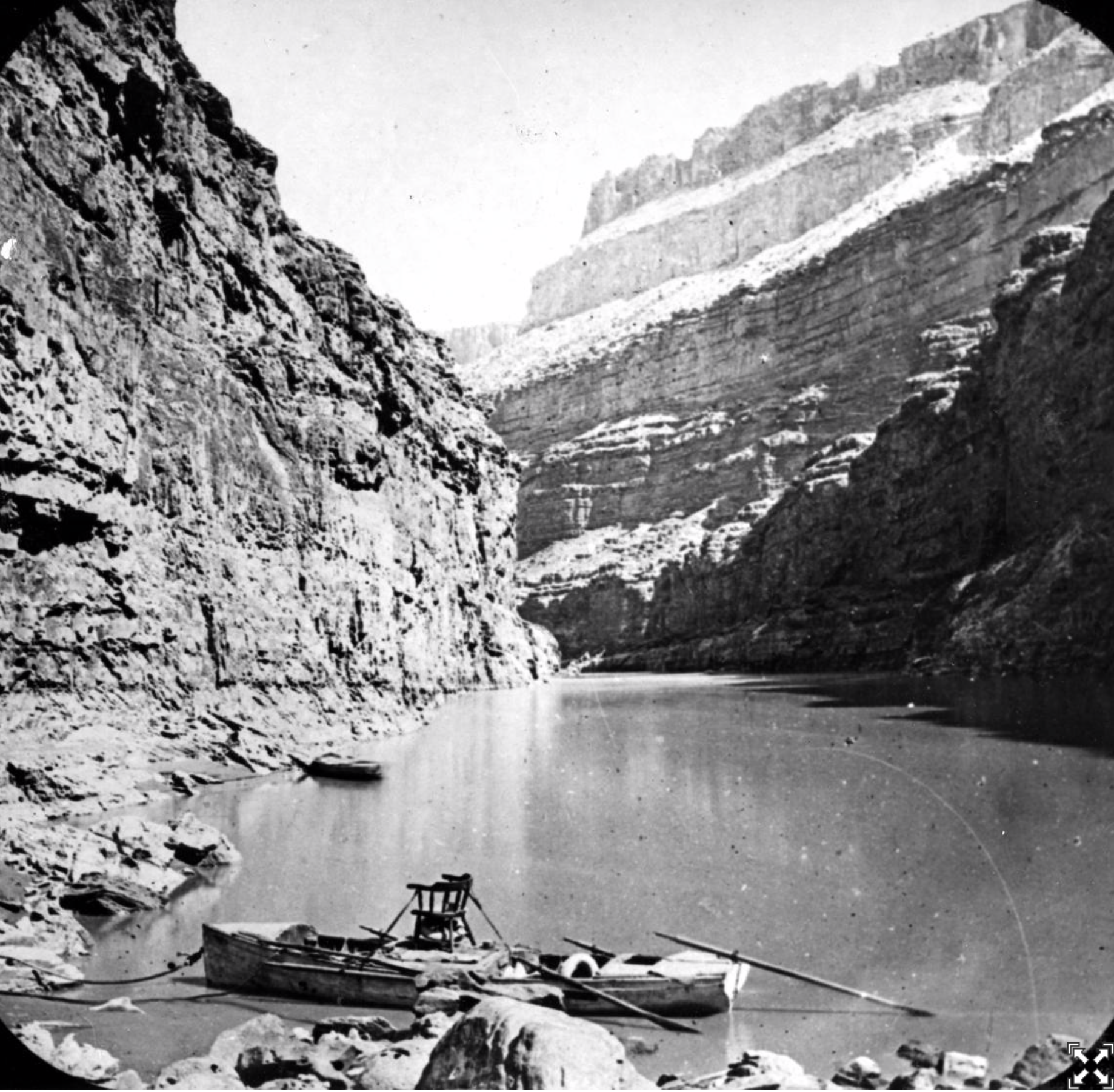
A stopover during Powell’s second expedition down the Colorado River. Note Powell’s chair at top center boat. Image: USGS

My thinking on this started with the book, mentioned here in posts more than a year ago, by Frederick Dellenbaugh, who came right out and said it in his title: The Romance of the Colorado River. Dellenbaugh, remember, first encountered the Colorado River as seventeen-year-old, in a boat with Major John Wesley Powell, on the scientist’s second trip down the canyons of the river in 1871-2.

Major Powell was better prepared and more experienced on that second trip, and actually able to accomplish some scientific work rather than just trying to survive. But for young Dellenbaugh, it was a big eye-opening experience – life-shaping, really: he spent the rest of his life exploring other unknown parts of the still-wild West, and collecting the stories of other adventurers.

He published The Romance of the Colorado River in 1902, thirty years after his formative trip with Powell – and the year the federal Reclamation Service was created as a branch of the U.S. Geological Survey, within 20 years the organization orchestrating the river’s development.

Dellenbaugh pulled no punches in describing his sense of the river and the challenge it represented. After noting in his introduction that ā€˜in every country, the great rivers have presented attractive pathways for interior exploration—gateways for settlement,’ serving as ā€˜friends and allies’ – he launches into his impression of the Colorado River:
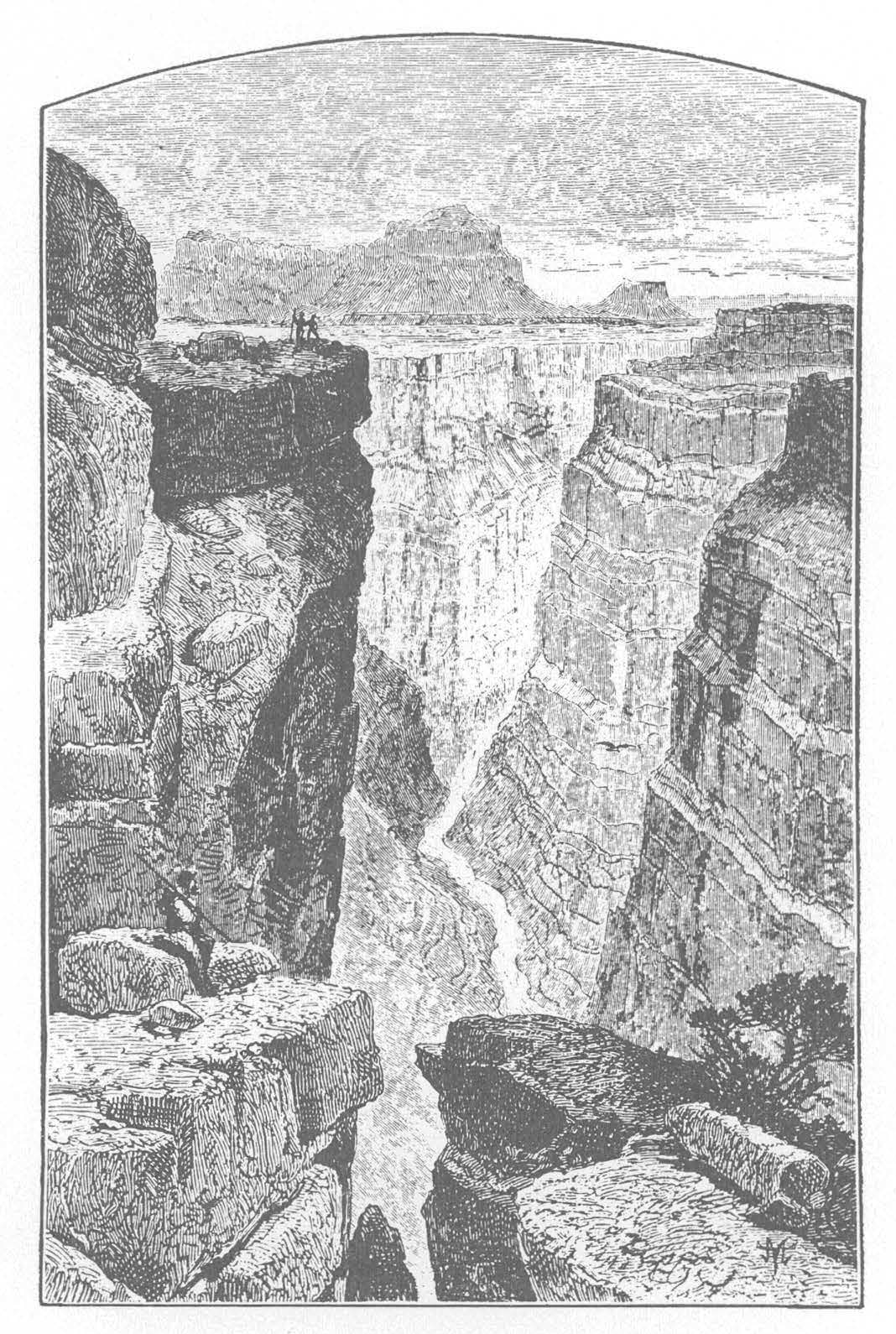
THE GRAND CANON, ​​​​​​​LOOKING EAST FROM TO-RO-WEAP From “Exploration of the Colorado River of the West and Its Tributaries” By J. W . Powell, 1875

ā€˜By contrast, it is all the more remarkable to meet with one great river which is none of these helpful things, but which, on the contrary, is a veritable dragon, loud in its dangerous lair, defiant, fierce, opposing utility everywhere, refusing absolutely to be bridled by Commerce, perpetuating a wilderness, prohibiting mankind’s encroachments, and in its immediate tide presenting a formidable host of snarling waters whose angry roar, reverberating wildly league after league between giant rock-walls carved through the bowels of the earth, heralds the impossibility of human conquest and smothers hope.’

There’s Dellenbaugh’s ā€˜romance of the river’ – an adventure story of rising to meet a challenge, a call to action to overcome obstacles. A veritable dragon refusing to be bridled? Impossible? Prohibiting encroachment? Smothering hope? We would see about that!

And while it’s not a conventional love story, passion is involved, the kind that can turn on a dime between love and hate. We loved the presence of water in a dry land – but the water was fickle at best, destructive at worst. Every farmer trying to irrigate from its two-month flood that turned into a trickle when they most needed it knew that love-hate relationship; it became the century-long (thus far) story of a strong and ornery people testing some new-found technological strength through picking a fight with a strong and ornery protagonist: we would teach the river to stand in and push rather than cutting and running.

Dellenbaugh was not the only one turning it into a romantic adventure. When the Colorado River Compact had been hammered out in 1922, the Commission Chair and Commerce Secretary Herbert Hoover announced that ā€˜the foundation has been laid for a great American conquest.’  In a 1946 report cataloging all the possible developments for the Colorado river’s upper tributaries, the Bureau of Reclamation carried forward Dellenbaugh’s assessment in its subtitle: ā€˜A Natural Menace Becomes a National Resource.’ These were the official public perceptions guiding our relationship with the Colorado River.

For three-quarters of the century that followed publication of Dellenbaugh’sĀ Romance, America embraced that romantic challenge, answering the call to conquest, taking on those obstacles, not just individually but as a national project, a big last step in the ā€˜Winning of the West.’ And fueled by the power unleashed by buried carbon fuels, we were ready for the fight; it was the Early Anthropocene, and it was our planet to reform.

Graphic via Holly McClelland/High Country News.

Remarkable things were done to the river as a result. The ā€˜veritable dragon’ has been broken and bridled for commerce and ā€˜utility everywhere.’ Its breaking and taming for commerce and utility is so massive that it practically requires the satellite view to take it in – the vast new ā€˜desert delta’ where the waters of the former desert river are spread from Phoenix and Tucson on the east, around through large squared-off green agricultural developments spotted with towns and cities, through the Imperial and Coachella valleys to Los Angeles and San Diego on the west…. And that’s just downriver; upriver are the tunnels through the mountains, taking water from the headwaters into the Platte, Arkansas, Rio Grande Basins, and into the Great Basin itself – how long will it be before Anthropocene math calculates that there might be enough water left in the Green River to move some through the Central Utah Project workings to help recharge the Not-So-Great Salt Lake?

For me, the ā€˜utility’ that cements the idea that this has been a big romantic adventure is the way we have kept significant reaches of river ā€˜wild’ enough for industries replicating Dellenbaugh’s formative adventure. Slipping onto the tongue and into the thrashing maw of Lava Falls, it is still easy to imagine a ā€˜veritable dragon,’ and millions of people from all over the planet come out of the Grand Canyon having relived Dellenbaugh’s romantic adventure.

But at the same time…. We also have to face some things that are less to be celebrated. Which brings me to Mary Austin again, another writer of the southwestern deserts mentioned here before, and her skeptical observation on Arizona’s ā€˜fabled Hassayampa,’ an intermittent tributary of the Gila River west of Phoenix, ā€˜of whose waters, if any drink, they can no more see fact as naked fact, but all radiant with the color of romance.’ Phoenicians have been drinking from the Hassayampa for a century now, wrapped up in the romance of the happy golden years in green and sunny places – and the underlying standard American romance of great wealth to be harvested fulfilling such romantic dreams.

But the ā€˜naked facts’ don’t go away just because we don’t want to see them, and there’s a kind of cosmic irony in the fact that, right where the Hassayampa flows into the Gila (when it’s actually flowing), two big developments, Buckeye and Teravalis, have been shut down at least temporarily on further development because they can’t present evidence of a hundred-year water supply. (See this post last spring.) 

The mayor of Buckeye, Eric Orsborn, who also owns a construction business, is not discouraged by this. ā€˜My view is that we’re still full steam ahead,’ he said in an article inĀ The Guardian.Ā ā€˜We don’t have to have all that water solved today…. What we need to figure out is what’s that next crazy idea out there’ for bringing in a new water supply. An idea under consideration currently is a desalinization plant down in Mexico on the Gulf of California, and a pipeline to bring the desalted water a couple hundred miles uphill to central Arizona. Crazy, and very expensive – but we’ve been saying in Colorado for decades now, as though it were a mother truth, ā€˜Water flows uphill toward money.’

But other naked facts have also been dimming the radiance of the Anthropocene conquest of the Colorado River. Water users have been coping for half a century with water quality issues stemming from using water over and over to irrigate alkaline soils. We also didn’t really know – and some states continue to refuse to acknowledge – how much water would be lost to evaporation from big reservoirs, hundreds of miles of open and unlined canals, and flood or furrow irrigation on subtropical desert lands. About a sixth of the river is vaporized annually.

The basic explanation for why CO2 and other greenhouse gases warm the planet is so simple and has been known science for more than a century. Our atmosphere is transparent to visible light — the rainbow of colors from red to violet that make up natural sunlight. When the sun shines, its light passes right through the atmosphere to warm the Earth. The warm Earth then radiates some of its energy back upward in the form of infrared radiation — the ā€œcolorā€ of light that lies just beyond red that our eyes can’t see (unless we’re wearing infrared-sensitive night-vision goggles). If all of that infrared radiation escaped back into space, the Earth would be frozen solid. However, naturally occurring greenhouse gas molecules, including not just CO2 but also methane and water vapor, intercept some of it — re-emitting the infrared radiation in all directions, including back to Earth. That keeps us warm. When we add extra greenhouse gases to the atmosphere, though, we increase the atmosphere’s heat-trapping capacity. Less heat escapes to space, more returns to Earth, and the planet warms.

But the biggest, most unforeseen collateral fact diminishing our conquest of the river is the turbulence we’ve wrought in the climate – increasingly an unignorable ā€˜naked fact.’ All the heavy technology and concrete we’ve invested in controlling the river, as well as all the technology of daily living that depends on burning carbon fuels, not to mention the methane from livestock and human waste – all our gaseous carbon emissions have increased the heat-holding capacity of the atmosphere, which in turn increases the heat energy driving our weather systems. We’ve seen this just this past year: how that changing balance can result in ā€˜atmospheric rivers’ of vapor forming over the ocean and dumping huge snowpacks when it condenses over the mountains – but then being back on the ā€˜abnormally dry’ edge of drought within a few months of the day-to-day water-sucking aridification that is the shape of the future.

So we Anthropocenes have conquered the river, bridled the dragon – but as we saw in the previous post here, we lost a full third of the river as the collateral consequences, unforeseen or just ignored, of the conquest. And all responsible prognosticators project that we will lose maybe another sixth of the river by mid-century to our drying out of the planet.

There are a number of ways to look at this. One would be to say, like Eric Orsborn, okay, there have been setbacks, but we can’t stop now; we need to finish the job. And he is far from the only Phoenician saying that. The state has a governor now and a Water Resources Department who know when it’s time to call a halt, but the state also has a Water Infrastructure Finance Authority charged with creating new water supplies for the state. The Mexican desal plant and megamile pipeline is just one idea in WIFA’s portfolio of possibilities; the old unkillable idea of bringing water over from the Missouri or Mississippi Rivers is still on their list.

ā€˜Those are big, audacious ideas, but I don’t think any are off the table,’ WIFA director Chuck Podolak toldĀ The Guardian. ā€˜We’re going to seek the wild ideas and fund the good ones.’ The romance of conquest throbs on; Hoover Dam was a wild idea a century ago, so why stop now?

A water policy analyst at Arizona State University, Kathryn Sorensen, toldThe Guardian that ā€˜the degree of [Buckeye’s] success will depend on the degree to which people are willing to pay for those more expensive solutions. But it’s absolutely feasible. We pave over rivers, we build sea walls, we drain swamps, we destroy wetlands, we import water supplies where they never would have otherwise gone. Humans always do outlandish things, it’s what we do.ā€

There is diminishing enthusiasm today, however, for the romance of conquest; dwellers in the megacities are increasingly reluctant to embrace higher water bills in order to finance more growth, more people, more traffic, longer lines everywhere – San DiegoĀ is an example today. The same is true for urban/suburban water conservation; there is a romantic appeal to helping one’s city by conserving in an emergency situation, a drought period or a maintenance shutdown; but conservation-in-perpetuity just to make more water available for growth lacks that romantic appeal.

For many of us, the ā€˜romance of the river’ has probably shifted 180 degrees over the past half century to a belated appreciation for the ā€˜natural river’: the Colorado River that once flowed to the ocean in a two-month flood and watered a beautiful wild delta, the river that would flow through a resurrected Glen Canyon if the dam were taken down, et cetera. This eco-rec perspective nurtures the belief that the world would be a better place if we would ā€˜just stop digging’ and leave it to nature to heal itself from our efforts. This idea has the ā€˜radiant color of romance’ for many of us, but it also has its underlying naked facts – not least of which are nature’s extreme remedies for a swarming species overpopulating its resource base.

I tend to think, myself, that, yes, we can’t stop now with our tinkering and meddling; we are all too deeply into this love-hate relationship with nature. Just as we will continue to thwart nature with vaccines against its leveling pandemics, we will continue to try to keep passable water in the pipes and faucets, on the fields, and in the recreational reaches for an ever-growing population because that is who we are; it’s what we do.

For many of us, the ā€˜romance of the river’ has probably shifted 180 degrees over the past half century to a belated appreciation for the ā€˜natural river’: the Colorado River that once flowed to the ocean in a two-month flood and watered a beautiful wild delta, the river that would flow through a resurrected Glen Canyon if the dam were taken down, et cetera. This eco-rec perspective nurtures the belief that the world would be a better place if we would ā€˜just stop digging’ and leave it to nature to heal itself from our efforts. This idea has the ā€˜radiant color of romance’ for many of us, but it also has its underlying naked facts – not least of which are nature’s extreme remedies for a swarming species overpopulating its resource base.

I tend to think, myself, that, yes, we can’t stop now with our tinkering and meddling; we are all too deeply into this love-hate relationship with nature. Just as we will continue to thwart nature with vaccines against its leveling pandemics, we will continue to try to keep passable water in the pipes and faucets, on the fields, and in the recreational reaches for an ever-growing population because that is who we are; it’s what we do.
Map credit: AGU

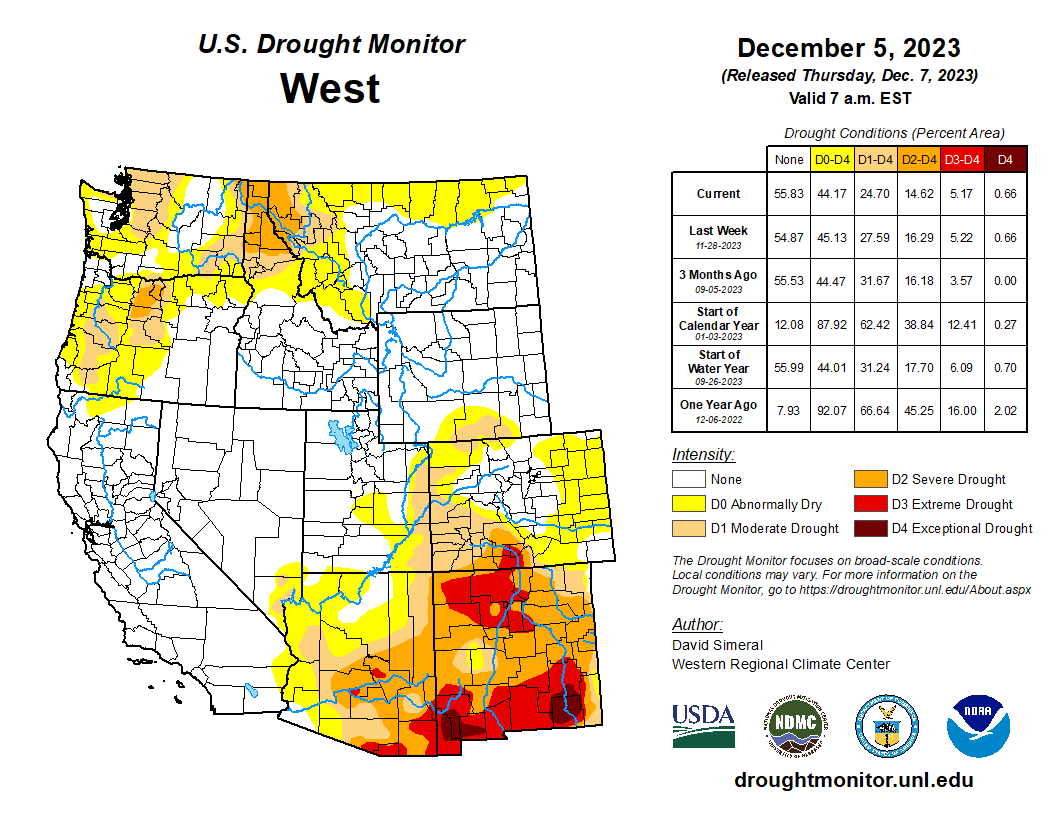
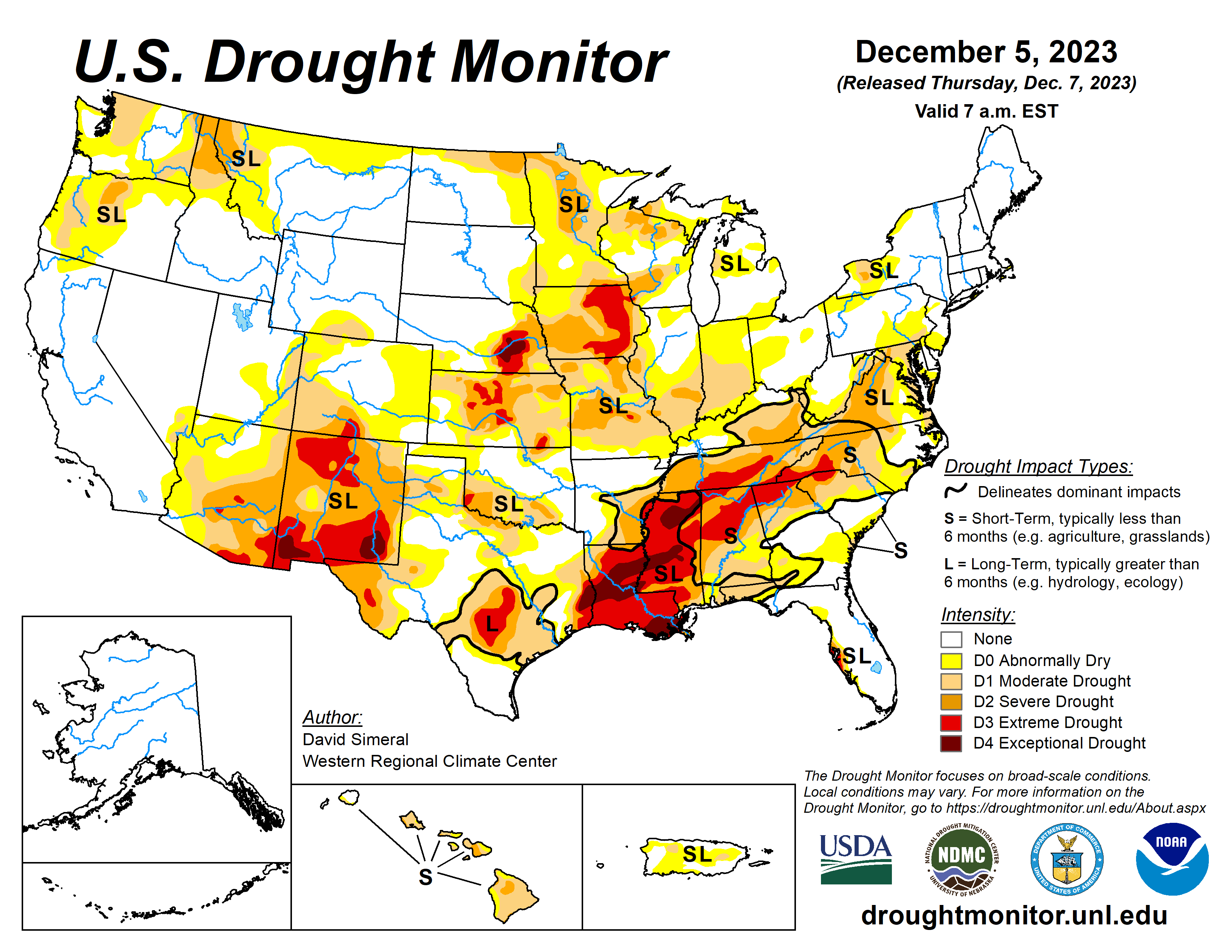
#Drought news December 7, 2023: Higher elevations in the Tetons and Wind River ranges in N.W. #Wyoming, the Wasatch Range in N. #Utah, and the #Colorado Rockies all received significant snowfall accumulations that helped to boost #snowpack levels

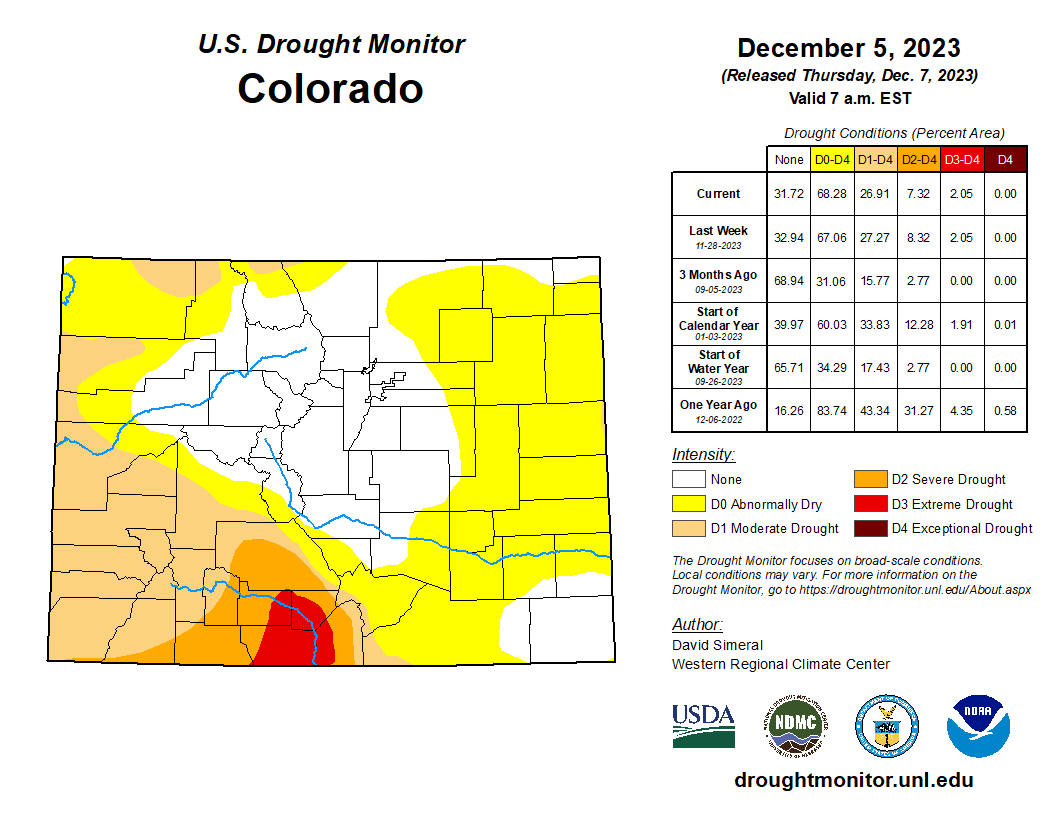
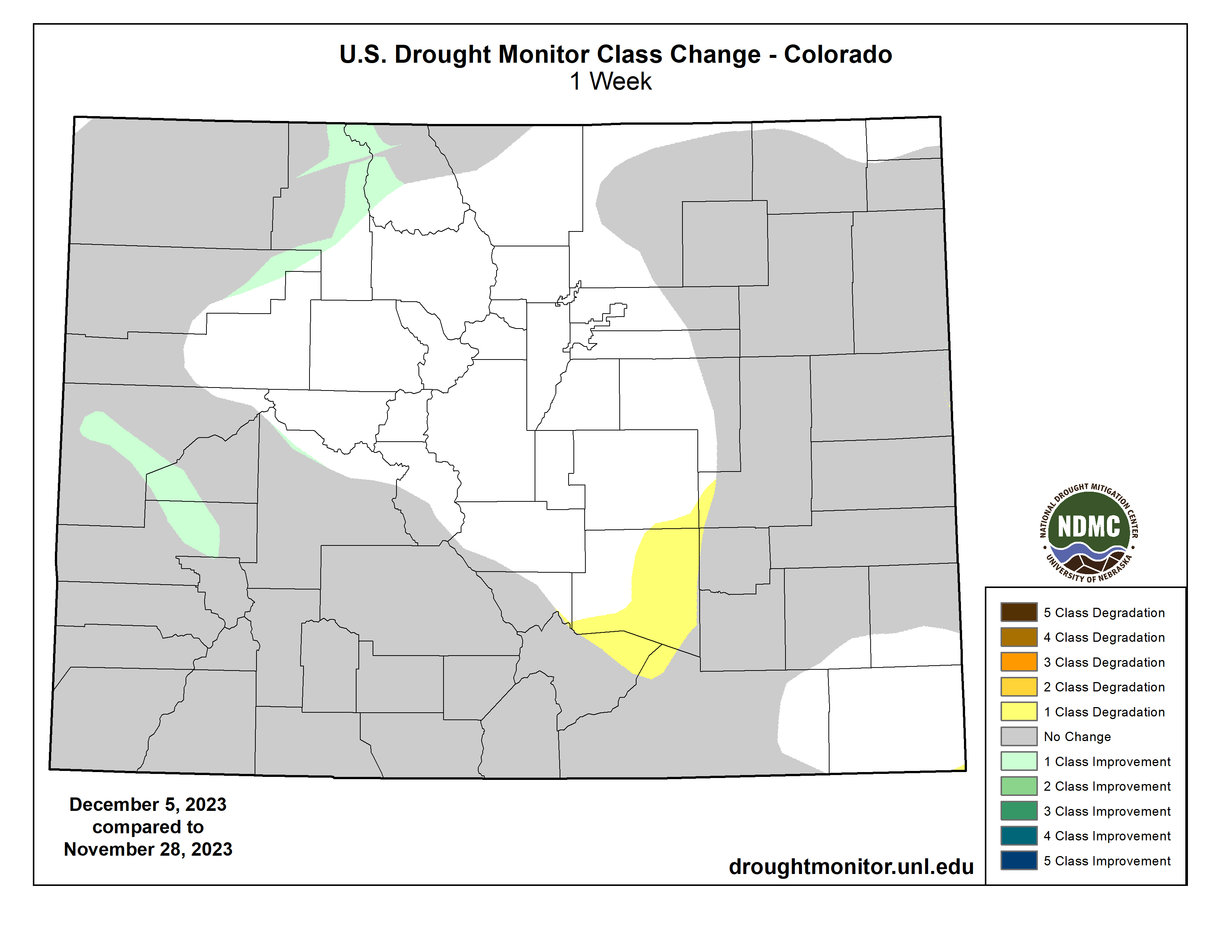
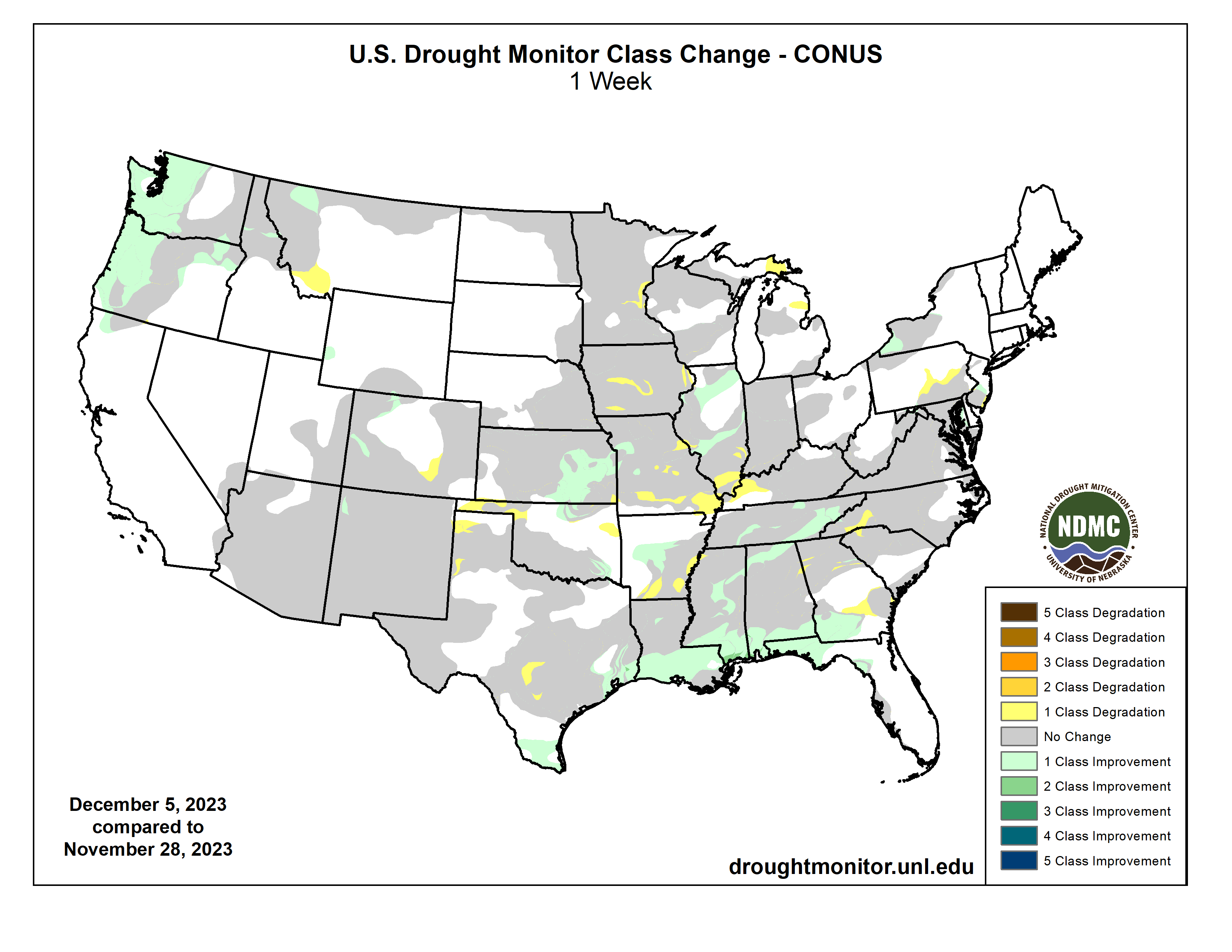
Click on a thumbnail graphic to view a gallery of drought data from the US Drought Monitor website.

Click the link to go to the US Drought Monitor website. Here’s an excerpt:

This Week’s Drought Summary

This U.S. Drought Monitor (USDM) week saw continued improvements on the map in drought-affected areas of the South, Southeast, and Pacific Northwest. In the South and Southeast, heavy rains over the weekend impacted areas of the Mid-South, and Gulf Coast states with isolated locations in southern Louisiana and the Florida Panhandle receiving up to 7-inch accumulations. In the Pacific Northwest, a series of atmospheric rivers delivered heavy rainfall to western Oregon and Washington as well as significant mountain snow to the higher elevations of the Olympic Peninsula, Cascade Range, and the Blue Mountains of northeastern Oregon. Some of the highest precipitation accumulations (8-15+ inches liquid) were observed in the Olympic Mountains, Cascades of southwestern Washington, and in the coastal ranges of west-central Oregon. Further inland, higher elevations in central Idaho and northwestern Montana ranges, Northern Great Basin ranges, the Tetons and Wind River ranges in northwestern Wyoming, the Wasatch Range in northern Utah, and the Colorado Rockies all received significant snowfall accumulations that helped to boost snowpack levels closer to normal to above normal levels. Likewise, high-elevation snows were observed in the mountains of the Southwest including along the Mogollon Rim and Chuska Mountains of Arizona as well as in the Nacimiento and Sangre de Cristo ranges of New Mexico. In California, snowpack conditions continue to lag normal levels with the statewide snow water equivalent (SWE) at 29% of normal (12/5). According to the Natural Resources Conservation Service (NRCS) SNOTEL network (12/5), region-wide (2-digit HUCs) percent of median snow water equivalent (SWE) levels were as follows: Pacific Northwest 73%, Souris-Red-Rainy 70%, Missouri 73%, California 73%, Great Basin 102%, Upper Colorado 86%, Lower Colorado 78%, Rio Grande 65%, and Arkansas-White-Red 64%. In areas of the Midwest, Great Lakes, and northern New England, light-to-moderate snowfall accumulations (ranging from 1 to 12+ inches) were observed during the past week with the highest totals (12+ inches) reported in areas of Vermont, New Hampshire, and Maine. In areas of the Hawaiian Islands, locally heavy showers and flash flooding were observed last week in association with a Kona Low system that helped to ease drought conditions across the island chain…

High Plains

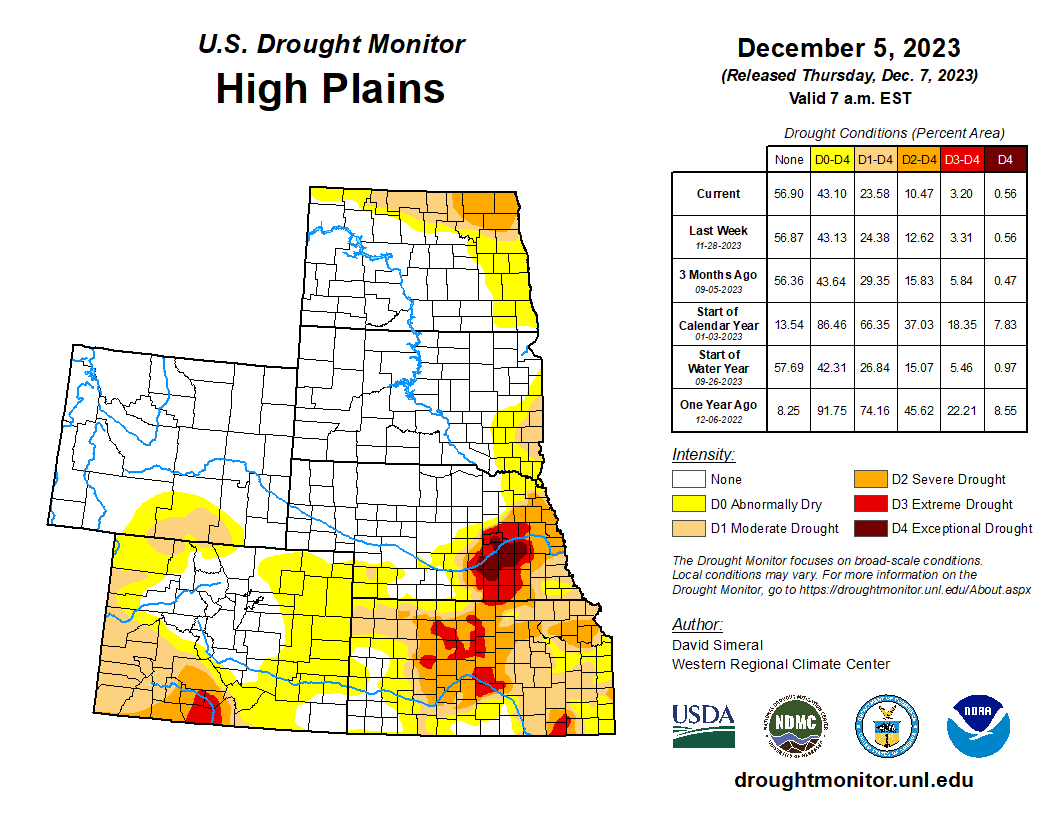
On this week’s map, some widespread one-category improvements were made across southeastern Kansas in response to precipitation during the past 30-60 days. According to the USGS, streamflow levels in the southeastern and east-central part of the state are normal to above normal. Conversely, numerous stream gauges are reporting much below-normal flows (< 10th percentile) in the central part of the state. In the Dakotas, conditions on the map remained status quo. In terms of snowpack conditions, the NWS NOHRSC reports the Upper Midwest Region (which includes the Dakotas, eastern Montana, and northeastern Wyoming) is currently 4.8% covered by snow with a maximum depth of 10 inches. Average temperatures for the week were generally above normal (2 to 10+ degrees F) with the greatest departures observed in the Dakotas. Today (12/5), high temperatures in North Dakota are expected to reach near 60 degrees F…

Colorado Drought Monitor one week change map ending December 5, 2023.

West

On the map, improvements were made across areas of the Southwest and Pacific Northwest including New Mexico, Oregon, and Montana. In northern New Mexico, areas of Extreme Drought (D3) were reduced in response to recent precipitation (past 14-day period) including high-elevation snowfall in the Nacimiento and Sangre de Cristo ranges. According to the NRCS SNOTEL network (12/5), sub-basin (8-digit HUCs) percent of median SWE levels were above normal in several New Mexico sub-basins including: Rio Grande-Santa Fe 116%, Jemez 170%, Chaco 161%, Rio Puerco 212%, and Upper Gila 192%. In the Pacific Northwest, an extended atmospheric river event delivered much-needed precipitation to the region including heavy rains and high elevation snowfall in western portions of Oregon and Washington as well as in the far northwestern corner of California, leading to one-category improvements on the map. According to the USGS, streamflow levels across western Washington and Oregon are ranging from normal (southern Oregon) to well above normal (northwestern Oregon and western Washington). The highest flows, including areas with severe flooding (i.e., Skagit and Snohomish rivers), were observed in western Washington. For the week, average temperatures across the region were generally above normal (2 to 8 degrees C) with the greatest positive departures observed in central portions of Oregon and Idaho and across the eastern two-thirds of Montana…

South

In the South, locally very heavy rainfall (up to 9 inches) was observed along the Gulf Coast regions of Texas, Louisiana, and Mississippi leading to one-category improvements in areas experiencing severe drought conditions. In Texas, areas of Extreme Drought (D3) expanded on the Edwards Plateau and South Central due to a combination of factors including long-term precipitation deficits and poor hydrologic conditions (streamflows, groundwater, and reservoir storage). Statewide reservoir conditions in Texas were at 68% full (12/6), with some poor conditions being reported including in the San Angelo area reservoirs which were at 22.9% full, according to Water Data for Texas. In northeastern Oklahoma, recent precipitation events led to some minor improvements in areas of Moderate Drought (D1) and Severe Drought (D2) while areas of Abnormally Dry (D0) were added in the Panhandle region. According to the Oklahoma Mesonet (12/5), the Panhandle region has gone 64 consecutive days with less than 0.25 inches of rainfall. In Tennessee, reductions in areas of Severe Drought (D2) and Extreme Drought (D3) were made on the map in response to precipitation during the past 14-day period. However, 4-to-8-inch precipitation deficits (60-day period) remain across the state as well as areas with poor surface water conditions…

Looking Ahead

The NWS Weather Prediction Center (WPC) 7-Day Quantitative Precipitation Forecast (QPF) calls for moderate-to-heavy precipitation accumulations ranging from 2 to 5+ inches (liquid) across western portions of Washington and Oregon as well as northwestern California, while 1 to 2+ inch accumulations (liquid) are expected in areas of eastern Washington and Oregon, Idaho Panhandle, and northwestern Montana. In the Intermountain West, accumulations around an inch are expected in areas of the northern Great Basin, and the Rockies (central and northern). In the eastern tier of the conterminous U.S., accumulations of 1 to 4 inches are expected with the heaviest totals anticipated in western North Carolina. The NWS Climate Prediction Center (CPC) 6-10 Day Outlooks call for a moderate-to-high probability of above-normal temperatures across California, Arizona, Nevada, southern Oregon as well as in the northern Plains, New England, and south Florida. Conversely, temperatures are expected to be below normal across most of the Gulf Coast region, Texas, and eastern New Mexico. In terms of precipitation, below-normal precipitation is expected across most of the conterminous U.S. except for areas of Texas, Florida, and upper New England.

US Drought Monitor one week change map ending December 5, 2023.

Tri-State Generation &Transmission’s plans for its #coal plants — Allen Best (@BigPivots) #ActOnClimate #KeepItInTheGround

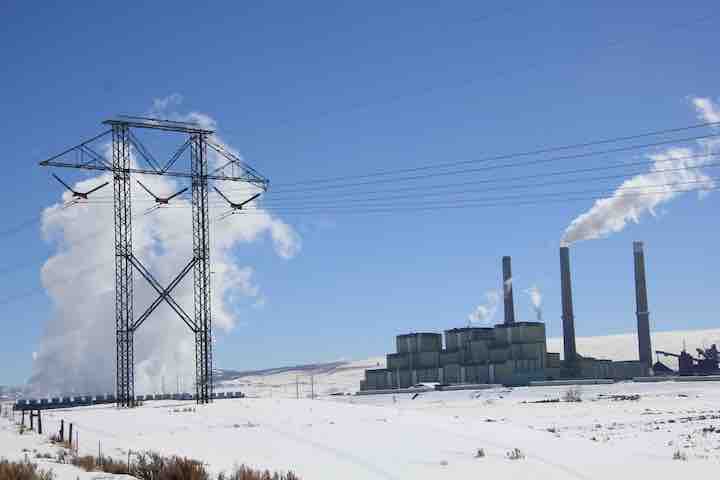
Craig Station. Photo credit: Allen Best/Big Pivots

Click the link to read the article on the Big Pivots website (Allen Best):

December 1, 2023

Wholesale power provider for 42 electrical cooperatives hopes for federal help as it pivots from coal-heavy portfolio during the next few years.

In planning for the years 2026-2031, Tri-State Generation and Transmission wants to hasten its exits from two coal plants and add a ton of new wind and solar generation plus battery storage. This is to supplemented by new electrical production from natural gas.

The electric resource plan is to be filed with the Colorado Public Utilities by 5 p.m. [December 1, 2023]. However, these details were obtained by Big Pivots from a memorandum sent to members of the Colorado Solar and Storage Association. Important details were confirmed by other stakeholders.

Two accelerated coal plant retirements will be identified in the PUC filing. At Craig, in northwest Colorado, the utility proposes to advance the retirement of its last coal-burning unit to no later or earlier than Jan. 1, 2028, two years earlier than is currently the plan.

The proposal also calls for retirement of Springerville Unit 3, a 400-megawatt coal-burning unit in Arizona. Tri-State had not previously announced plans for retiring the plant, in which it holds a 51% interest, according to a September 2023 Securities and Administration filing. The proposal calls for a retirement no later than Sept. 15, 2031, but leaves the door open for a sooner date.

Tri-State does not see getting out of fossil fuels. It will retain an interest in a coal plant near Wheatland, Wyo., called Laramie River Station.

It also proposes to augment its existing natural-gas-burning fleet with a combined-cycle gas plant. That plant could also be coupled with carbon capture and sequestration technology. Tri-State has 8 member cooperatives in Wyoming in addition to 18 in Colorado, with others in New Mexico and Nebraska. Tri-State has significant transmission across the four-state region.

Not least, Tri-State proposes to add 1,240 megawatts of new renewable generation plus 210 megawatts of energy storage in four installations.

Many of these ambitions depend almost entirely upon federal funding to buy down debt on assets stranded as the United States tries to dampen its greenhouse gas emissions. The Inflation Reduction Act of 2022 allocated $9.7 billion for a national program called New ERA (Empowering Rural Communities).

In September, Jeff Wadsworth, chief executive of Poudre Valley Electric, one of the largest of Tri-State’s 42 member cooperatives, told Big Pivots that the New ERA was the ā€œsingle biggest investment for electric cooperatives since the New Deal.ā€ The law creating the Rural Electrification Administration was passed by Congress in 1936, providing federal aid for extension of electrical lines to rural areas.

As the IRA was being crafted in 2022, Tri-State representatives lobbied Congress and the Biden administration hard to carve out funds for the energy transition in rural communities.

Tri-State has filed a letter of interest in applying for $970 million in federal funds. Whether it will get full funding is uncertain. In its SEC filing Tri-State reported overall long-term debt of $2.9 billion.

The National Rural Electric Cooperative Association, or NRECA, in September pointed out that the U.S. Department of Agriculture, the federal agency responsible for administering the program, had received 157 letters of interest from electric co-ops for 750 projects. The money is to be divided between small- and medium-sized cooperatives as well as Tri-State and other large cooperatives.

The federal agency has not set a timeline for a decision on federal funding, but stakeholders in the Tri-State process at the PUC expect a decision from commissioners by early summer. This presumed a decision by federal funding by mid-spring.

In a memo sent to some members of the Colorado Solar and Storage Association on Tuesday, the organization’s president, Mike Kruger, and general counsel, Ellen Howard Kutzer, said they believe it is best to support Tri-State in its quest for federal aid.

ā€œWe continue to believe it is better for the Colorado energy market to have a solvent and functioning Tri-State making an energy transition,ā€ they said.

COSSA and several other key groups involved in the proceeding at the PUC agree to a stipulation that expresses their broad support while reserving the right to push back on elements that aren’t part of the plan that presumes federal money through the New ERA program. Other signatories include Western Resource Advocates, the Sierra Club, and the Colorado Energy Office as well as two of Tri-State member cooperatives. At least two other groups declined.

The Office of the Utility Consumer Advocate, the state agency with the mission of speaking on behalf of consumers, also supported the narrow agreement.

ā€œWe are supportive of the broad concept that Tri-State has laid out in their electric resource plan, although we think there is a lot of work to do,ā€ said Joseph Pereria, deputy director of the agency. ā€œThere are a lot of unknowns, but a good process has been started.ā€

Tri-State’s insistence that it needs more natural gas backup for its major expansion into renewables is likely to be a major source of disagreement going forward. Xcel Energy and Platte River Power Authority are making the same argument as they prepare for a life of making electricity without coal.

Another major discussion will likely be about what constitutes just transition for Craig as it closes its coal-burning units. In adopting its goals for dramatic decarbonization in 2019, Colorado legislators also created an Office of Just Transition. The mission as summarized by the agency is to help ā€œworkers transition to new, high-quality jobs, to help communities continue to thrive by expanding and attracting diverse businesses, and to replace lost revenues.ā€

What this means in practice, though, is unclear. In the case of Pueblo, Xcel Energy has agreed to pay property taxes for 10 years after the last of the three coal-burning units at the Comanche Generating Station closes by 2031. As part of that process, Xcel will be conducting what is called a just transition electric resource plan. Xcel will see what kind of assets needed for its business can be located in Pueblo to replace the lost tax base and jobs.

Northwest Colorado communities need the same level of consideration and assistance, said Pereira.

Pueblo has started the conversation. ā€œCraig and Moffat County are in a different part of the state, with different needs and concerns,ā€ he said. ā€œSo it’s important that we listen to those communities and that we think big about how we can help them plan for a future without coal.ā€

Wade Buchanan, director of the Office of Just Transition, said only that it’s useful to have certainty when planning for retirements of coal plants and mines.

Panel recommends #Wyoming spend $37.5M on six energy projects — @WyoFile #ActOnClimate

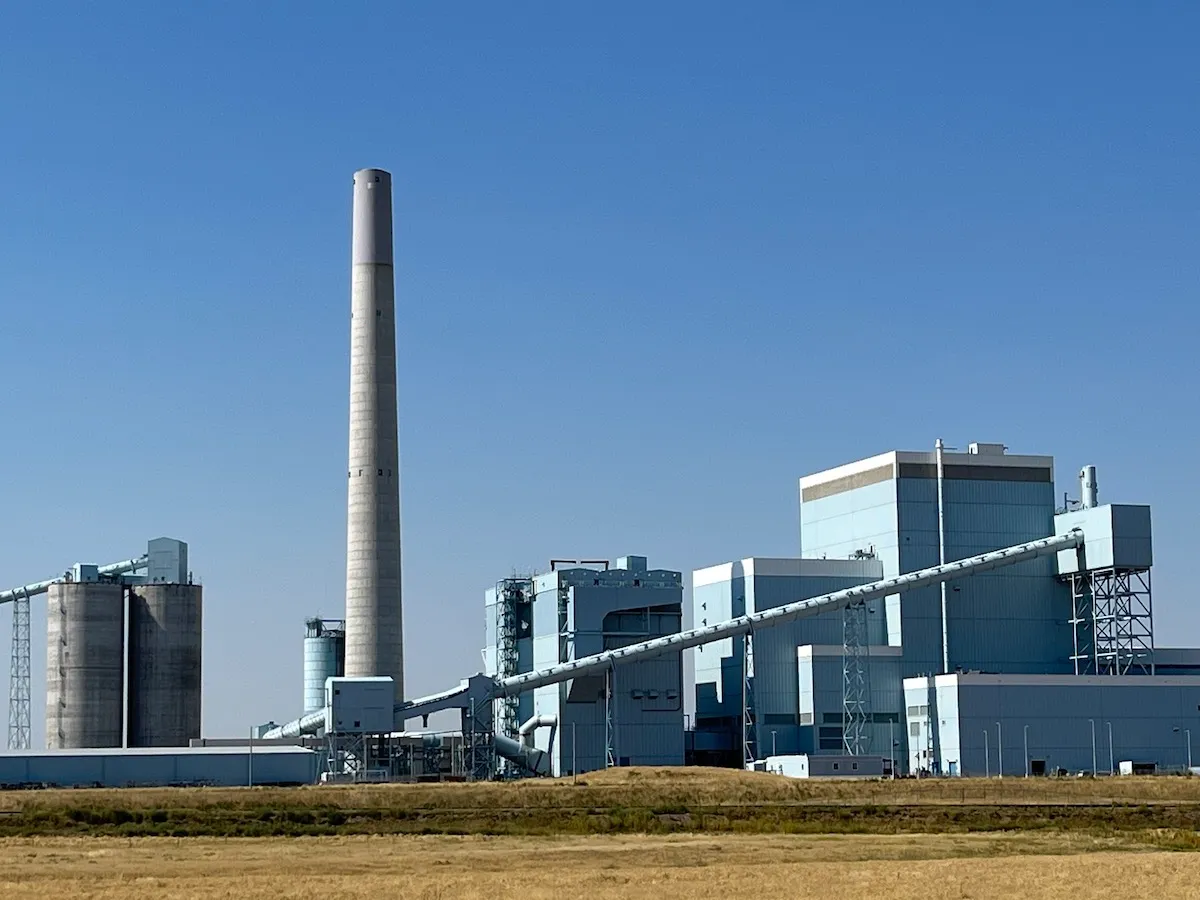
The University of Wyoming’s School of Energy Resources, and its partners, are advancing multiple CO2 capture and sequestration demonstration projects at Basin Electric’s Dry Fork Station north of Gillette, seen here on Sept. 2, 2022. (Dustin Bleizeffer/WyoFile)

Click the link to read the article on the WyoFile website (Dustin Bleizeffer):

State seeks public comment on proposals submitted by Black Hills Energy, natural gas pipeline giant Williams Companies and others.

The Wyoming Energy Authority has recommended Gov. Mark Gordon award a combined $37.5 million to support six energy projects, including coal-to-hydrogen and carbon capture proposals.

To pay for the initiatives, Gordon would tap a $150 million pot of Wyoming taxpayer money that the Legislature established in 2022 and set aside for the governor to spend at his discretion. The Wyoming Energy Authority, which screens proposals for the Energy Matching Funds program, is accepting public comment on the projects through Sunday. 

The agency is looking for both technical input and comments regarding the merits of each project, according to spokesperson Honora Kerr. None of the six recommended applications include renewable energy proposals that don’t involve fossil fuels. 

Summaries of the six projects can be viewed at the Wyoming Energy Authority’s website, and comments can be submitted to wea@wyo.gov.

Wyoming utility Black Hills Energy and natural gas pipeline giant Williams Companies are among the six private firms to potentially receive state matching funds. The state’s $37.5 million investment would leverage a total $120 million in federal and private funding, according to the Wyoming Energy Authority.

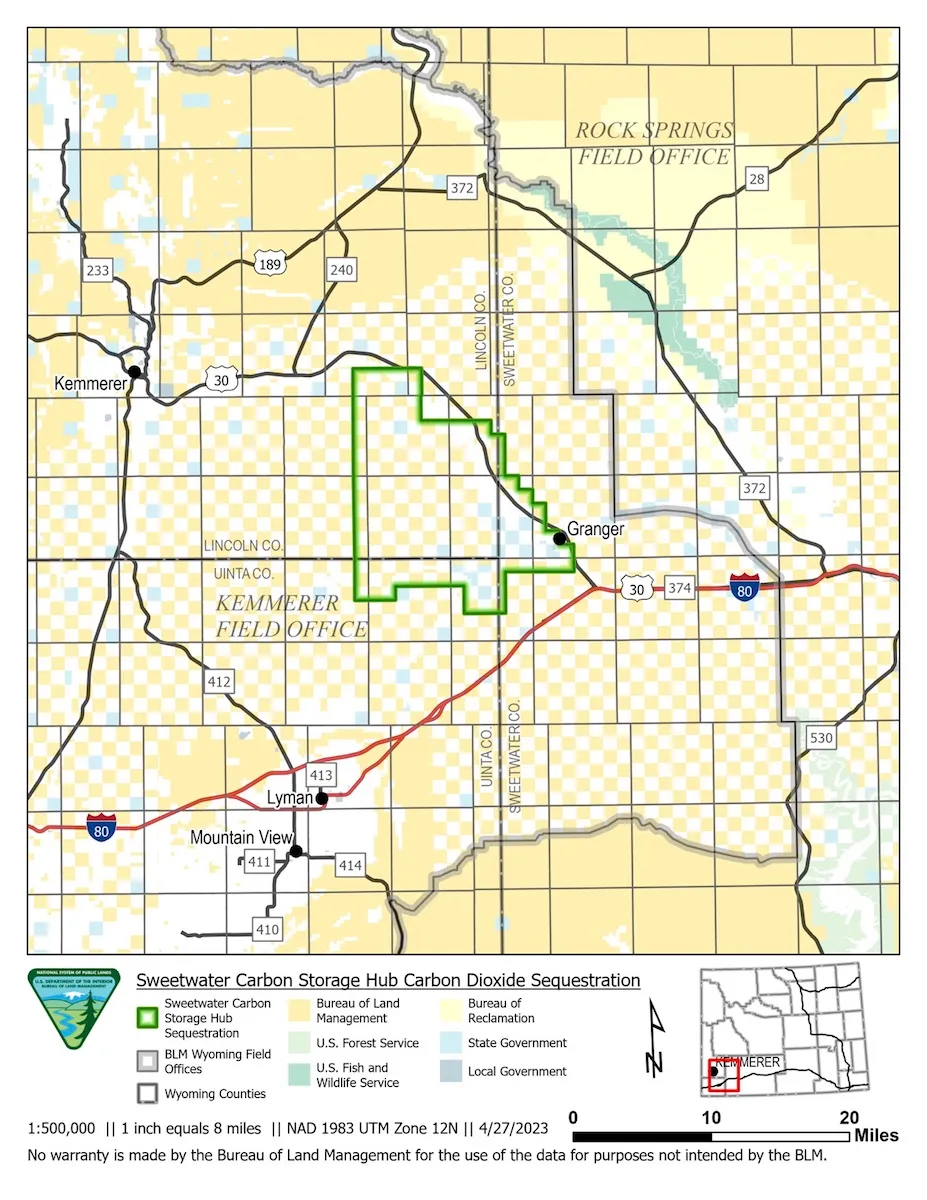
This map depicts the location of the proposed Sweetwater Carbon Storage Hub. (Bureau of Land Management)

Gordon approved Energy Matching Funds appropriations for two other energy projectsearlier this year: $9.1 million for the Sweetwater Carbon Storage Hub in southwest Wyoming, and $10 million for a ā€œnuclear microreactorā€ effort to assess the manufacture and deployment of small-scale nuclear reactors in the state and beyond.

The aim of the Energy Matching Funds program is to give Wyoming-based clean- and low-carbon energy projects a competitive edge by providing matching funds needed to land federal dollars available via the Inflation Reduction Act and Infrastructure, Investment and Jobs Act, according to the energy authority.

Recommended projects

The Wyoming Energy Authority compiles and updates questions and answers about project proposals to this spreadsheet. Here’s a brief description of each of the six energy projects.

° Black Hills Energy and Wyodak Resources Development Corporation’s ā€œBrightLoop – CCS Demonstration Plant: Converting Wyoming PRB Coal to Hydrogenā€œ; $15,995,451 in two phases of funding.

° Cowboy Clean Fuels, LLC’s ā€œTriangle Unit Carbon Capture and Storage Projectā€œ: $7,792,653. 

° Flowstate Solutions’ ā€œCO2 and Hydrogen Pipeline Safety: AI-Driven Leak Detectionā€œ: $2,000,000.Ā 

° Membrane Technology and Research, Inc.’s partnership with the Department of Energy for carbon capture and storage efforts at Basin Electric’s Dry Fork Station: $8,000,000. 

° The University of Wyoming School of Energy Resources ā€œIntegration of Produced Water Thermal Desalination and Steam Methane Reforming for Efficient Hydrogen Productionā€œ: $2,750,000.Ā 

° Williams Companies, Inc.’s ā€œEcho Springs CarbonSAFE Storage Complex Feasibility Studyā€œ: $975,000.