A man fishes along Blue River. The federal government Dec. 19, 2023, announced a $1.8 million grant for a habitat restoration on a section of the Blue River. Blue River Watershed Group/Courtesy photo
Click the link to read the article on the Summit Daily website (Ryan Spencer). Here’s an excerpt:
December 25, 2023
A tributary of the Colorado River, Summit County’s Blue River has seen fisheries decline due to unnatural conditions associated with the Dillon Reservoir, which provides water to Denver
The federal government earlier this month announced $1.8 million in grant funding for habitat restoration along a stretch of the Blue River downstream from the Dillon Reservoir in Summit County. The funding will support a local environmental group’s efforts to restore Gold Medal fishing on the Blue River, a status the river lost in 2016, according to Blue River Watershed Group advancement director Vanessa Logsdon.
“We’re incredibly excited,” Logsdon said. “This is one of the largest grants we’ve received, and this project is going to be an expensive project. It’s a large area of the river, and it’s basically bank-to-bank restoration.”
Blue River Watershed Group has partnered with Trout Unlimited to create an Integrated Water Management Plan for the Blue River watershed, Logsdon said. A tributary of the Colorado River, “the Blue River faces quite a few threats and issues because of the dam,” she said. On Dec. 19, the Biden Administration’s Department of the Interior announced $1,857,570 in funding to complete the engineering and design for a habitat restoration project laid out in the management plan. The stretch of river where the work will focus is impacted by its proximity to the outflow from the Dillon Reservoir, according to the Interior Department news release announcing the Bureau of Reclamation WaterSMART grant awards. In the Blue River, the dam has contributed to an unnatural flow regime, below-average water temperatures due to cold-water releases from the bottom of the reservoir, and a lack of natural sediment and nutrient transport, the release states. The Integrated Water Management Plan is the culmination of years of scientific studies and research that aims to provide a roadmap for solving environmental issues on the Blue River, Logsdon said. The plan focuses on the stretch of river from its release at the Dillon Reservoir to Columbine Campground north of Silverthorne, she said.
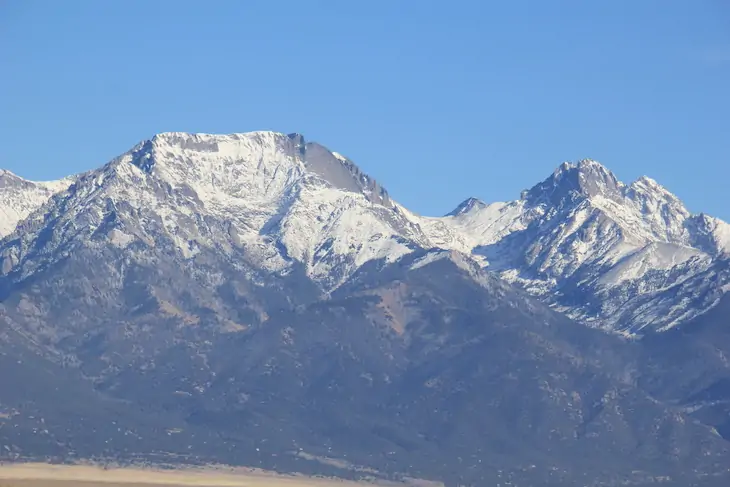
Kit Carson Peak, right, and Challenger, also a 14,000-foot peak, as seen from the area near Moffat, in the San Luis Valley. Photo/Allen Best
Click the link to read the article on the Big Pivots website (Allen Best):
December 24, 2023
It’s called Kit Carson, but a state advisory board in January will review alternatives more acceptable to the Diné and others
My hike up Kit Carson Peak in June 2000 began with great ambition and ended with confusion. Confusion remains now, almost 24 years later, if in a different way. We’re not sure what to call the 14,167-foot summit in the Sangre de Cristo Range.
My 12 hours above treeline that day left me hypoxic, my brain suffering from too little oxygen. I insisted that the route down took us the west side of Willow Lake, but my companions knew better.
Now I contemplate what to call Kit Carson from the floor of the San Luis Valley. A proposal before the Colorado Geographic Naming Advisory Board would have us call it Frustum Peak. A frustum is a flat-topped cone or pyramid.
Still others prefer Crestone, as was considered — but rejected — by a federal board in 2011. Two other 14,000-foot peaks, Crestone Peak and Crestone Needle, lie a short distance away. Three 14ers named Crestone? One stone too many. Other names may yet be considered.
Colorado also has a town and a county named Kit Carson, but neither is up for change as they are not on federal land.
The state advisory board members will resume their discussion on Jan. 24. They will also review alternatives to Garfield County’s Dead Mexican Gulch, Jefferson County’s Redskin Creek and Redskin Mountain, and Montezuma County’s Negro Draw.
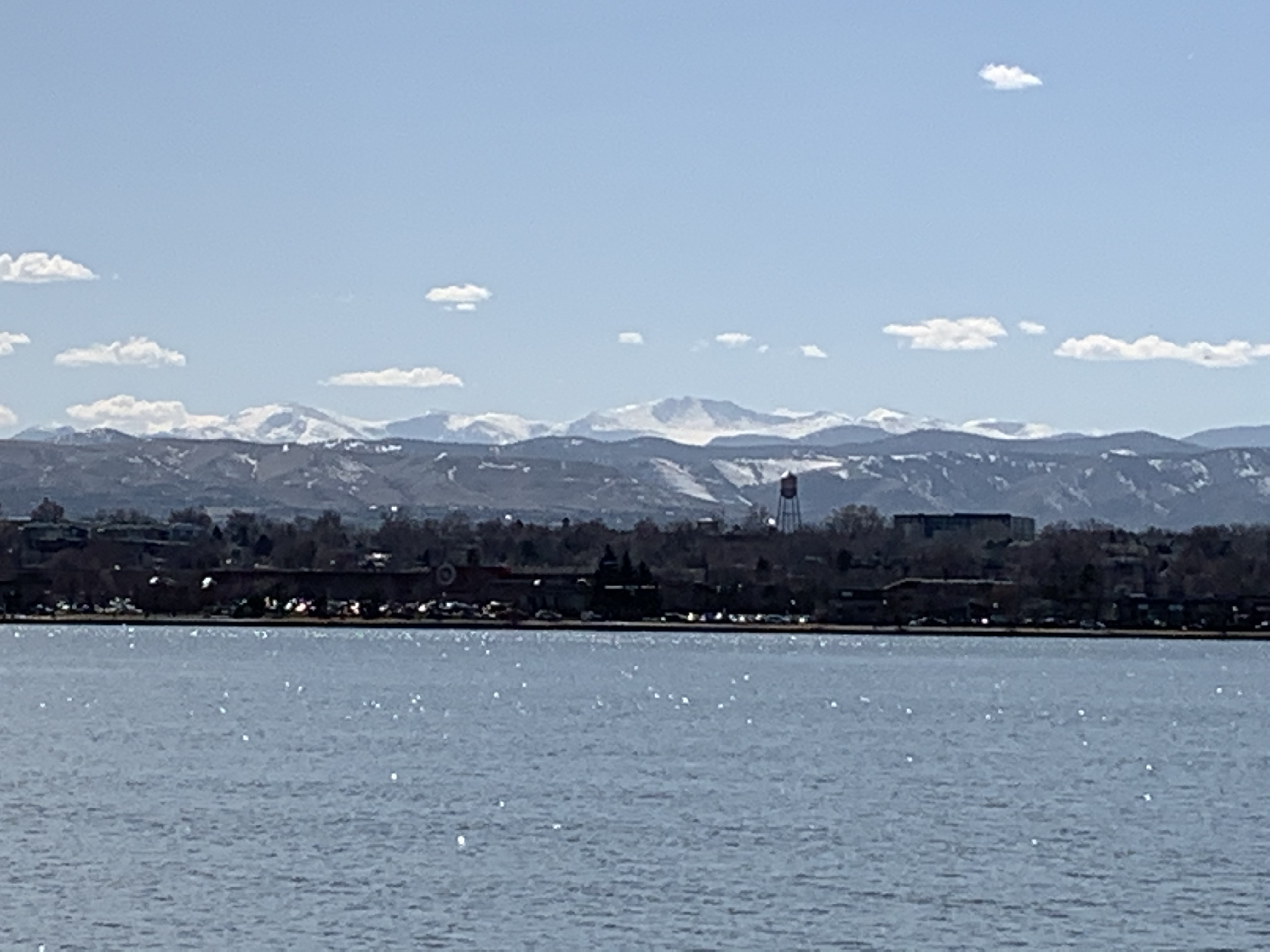
Sloans Lake with Mount Blue Sky in the background April 2, 2021.
Whatever they recommend will be just that. The U.S. Board of Geographic Names has final authority for names on federal lands as Colorado seeks to cleanse its geographic drawers of names with tawdry historical footnotes. Earlier this year, the 14er west of Denver gained a new name, Blue Sky. It had been called Evans, after the territorial governor in 1864 who seemingly turned a blind eye to the Sand Creek Massacre.
Christopher Houston “Kit” Carson has a more confused and interesting story. Born in Kentucky, reared in Missouri, he fled an apprenticeship in leathermaking for western adventures. As a fur trapper, he was quite successful. He survived.
Like other trappers, he found friends – and foes – among the native Americans, taking two of them as spouses. One called it quits, putting his belongings outside their teepee, as was the custom.
Taos was his favored home. His remains are buried there along with those of Josefa, his final wife. They both died in southeastern Colorado, at Boggsville, near today’s Las Animas. By then, he was General Carson in the U.S. Army.
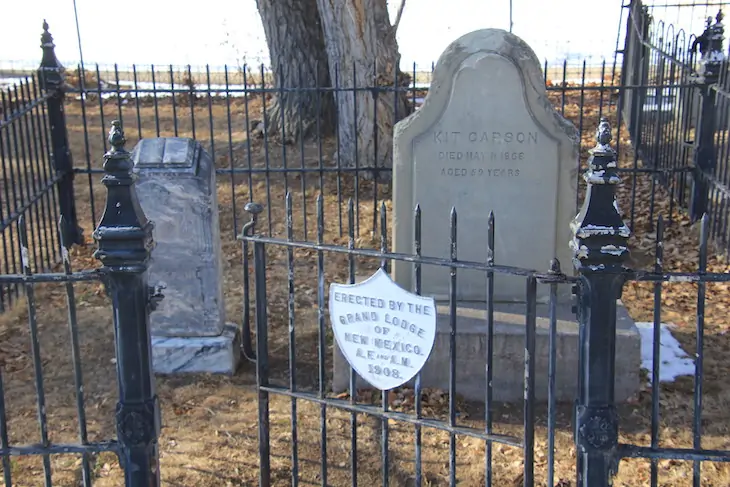
Kit Carson and his third wife, Josefa, both died in southeastern Colorado but are buried in Taos, which he considered home. Photo credit: Allen Best/Big Pivots
Consult “Blood and Thunder,” by Hampton Sides, for an immensely rewarding read about Carson. Sides acknowledges the complexities of Carson and other frontiersmen. “The mountain men lived with Indians, fought alongside and against them, loved them, married them, buried them, gambled and smoked with them,” he writes.
Trappers unwittingly left a more damning legacy.
“As the forerunners of Western civilization, creeping up the river valleys and across the mountain passes, the trappers brought small pox and typhoid, they brought guns and whiskey and venereal disease, they brought the puzzlement of money and the gleam of steel. And on their liquored breath they whispered the coming of an unimaginable force, of a gathering shadow on the eastern horizon, gorging itself on the continent as it pressed steadily this way.”
That is the conundrum of Carson. It‘s also the question many of us ask ourselves. Will we leave the world a better place – or worse? Or both?
While in the U.S. Army, Carson was responsible for corralling the recalcitrant Navajo, who had long been feared by Spanish, Hispanic and Anglo settlers because of their persistent raiding and sometimes killing. He complained to superiors about the lack of provisions for the Navajo as he marched them to an encampment in eastern New Mexico. Once there, a third died.
Afterward, although gravely ill, Carson accompanied Ute leaders to Washington D.C. at their request to represent them in meetings with President Ulysses Grant and others.
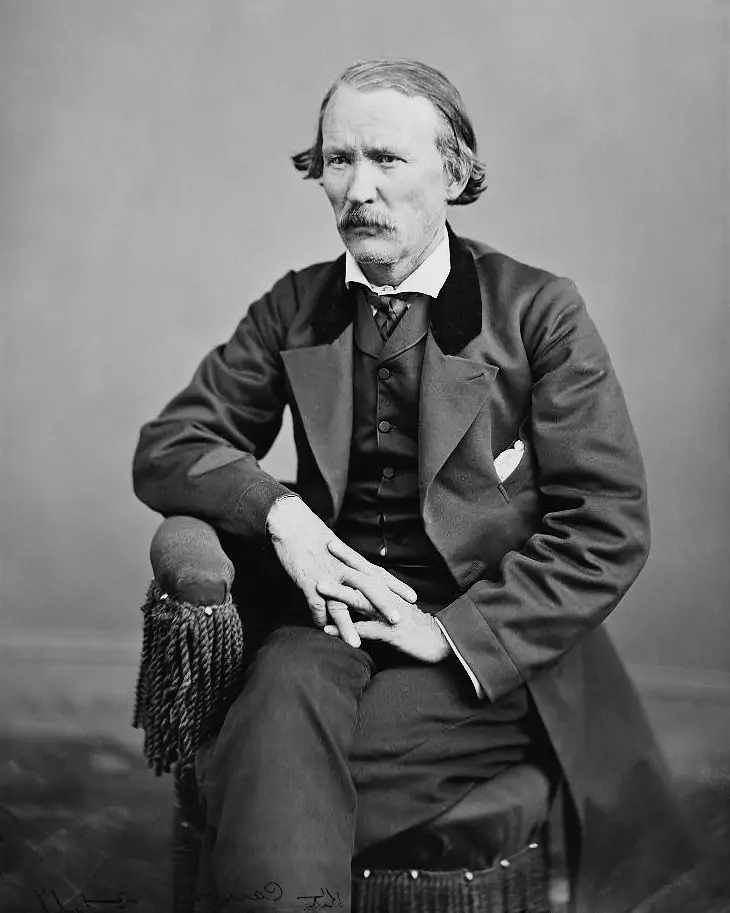
Kit Carson was photographed in 1868 in Washington D.C., shortly before his death in southeastern Colorado at the age of 59. Photo/Wikipedia
His story was complicated.
Carson was mythologized in his own time. Today, we tend to idealize Native Americans even while we fail, in some important ways, to pay them their due, such as their water rights in the Colorado River Basin.
A former newspaper columnist in Colorado Springs responded to my ruminations on Facebook with this: “In our re-naming craze, we should not name anything after humans any more. It turns out that all humans put their pants on one leg at a time.”
Conquerors generally name things in their own honor. Sometimes, we do honor the vanquished. To honor Utes, among Colorado’s 14ers we also have Antero, Shavano, and Tabeguache. We have none to honor Navajos, who call themselves Diné. If they emphatically dislike Kit Carson, so far they have not proposed an replacement.