Some days I want to fill my pockets with everything I’m afraid of losing. How much milkweed to save the monarch? How many foil blankets to keep an ancient redwood alive?
I worry about finches. Smaller than a fist, wingspan no bigger than an open hand. I keep thinking of what it took for them to get here, flying all those miles up to Oregon. I keep thinking of heat. Cities hitting triple digits. London for god sake. Italy on fire.
There’s smoke again in Ashland, like the time Kay and I went for a getaway. All we had were bandanas, useless against that stench and ash. We walked the streets like grandmotherly bandits, drank gin with the Airbnb windows shut. By then I knew she was terminal. Still, it felt impossible she could die.
I worry about beetle kill and rivers missing their fish, the dry tinder of California as creeks in Kentucky rage. I read that finches can live on thistles, as if to say, There’s hope. The ancients thought finches carried souls to the afterlife, and the sound of one finch singing meant an end to grief.
Last week a brush fire ignited within sight of my porch — just like that — flames leapt from slash and grass to standing firs. Two thousand acres burned. Where did the birds go then?
I miss my friend. I want to know those finches are somewhere. Safe and singing. From meadow rush and ditch shrubs, calling to their kind.
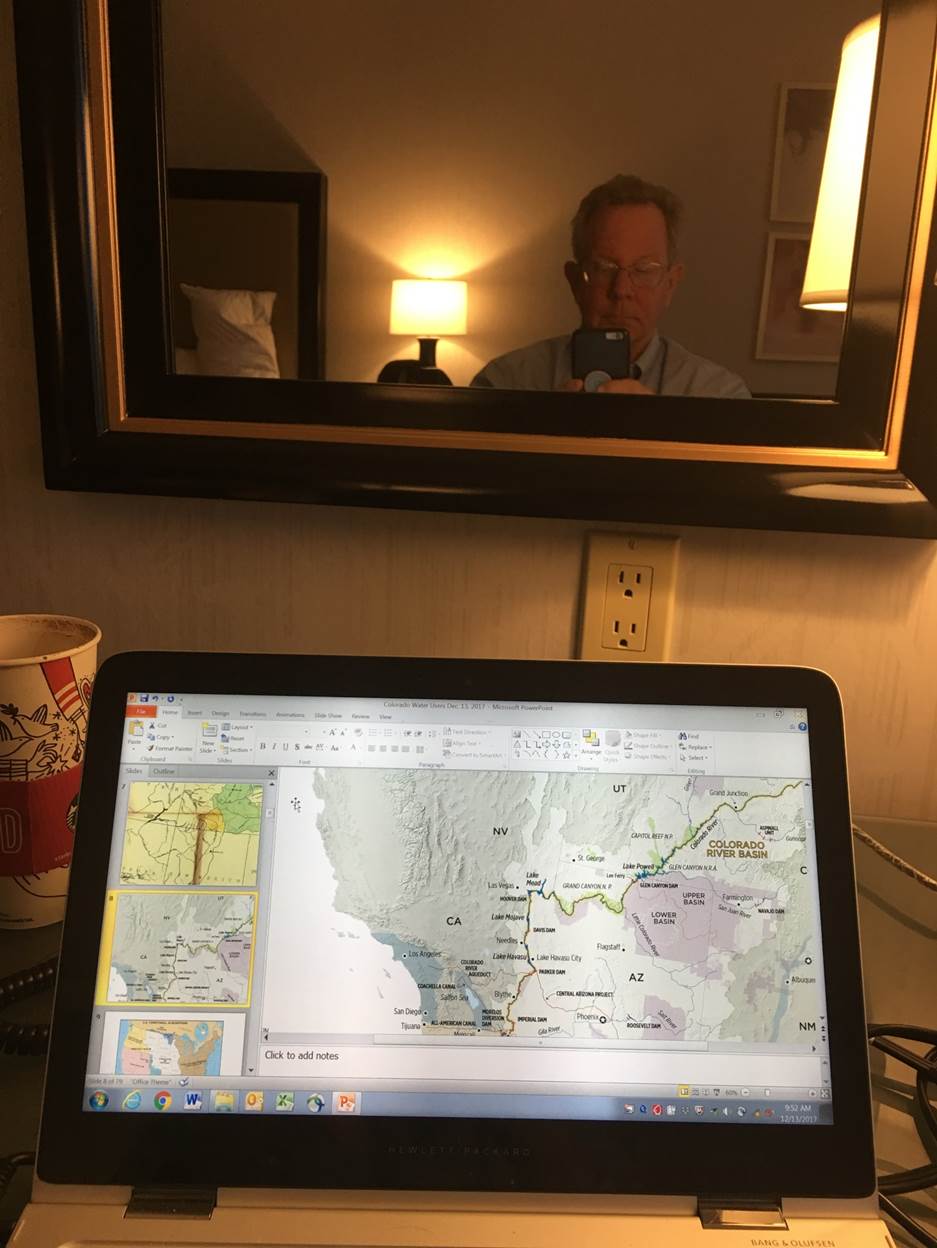
Greg Hobbs rehearsing his presentation for the 2017 CRWUA Annual Conference.
Click the link to read the article on the KUNC website (Alex Hager). Here’s an excerpt:
The biggest water policymakers in the arid West (and Coyote Gulch) will soon convene at the Colorado River’s marquee annual event – the Colorado River Water Users Association meeting in Las Vegas. Ahead of this year’s conference, leaders say they have more bandwidth to find a solution to the growing supply-demand imbalance that is straining the river. The event brings together hundreds of scientists, politicians, tribal members, farmers and others with a stake in the future of the water supply for roughly 40 million people across the Southwest. While they’re still facing the daunting challenge of agreeing on cutbacks to water use by farms, ranches and cities from Wyoming to Mexico, many say last year’s wet winter helped clear the way for more productive talks…
Since the earliest days of Colorado River management, Indigenous people have been on the fringes of talks about how to share its water. Some of the 30 federally-recognized tribes which use water from the Colorado River say they’re still being kept out of the rooms where important decisions are made about water policy. Calls for greater inclusion of tribes have been a staple of recent annual meetings in Las Vegas, but tribal water advocates say there’s still a need for more.
“We want our participation to be institutionalized,” said Lorelei Cloud, acting chairman of the Southern Ute Indian Tribe. “That is going to be key.”
Cloud, whose tribe sits in the southwest corner of Colorado, said she and other Indigenous water leaders are pushing for legally-protected seats at the table in post-2026 water management. Those seats, she said, should be designed to withstand changes in tribal, state or federal administrations. Tribal leaders say some progress has been made to give them a larger role in water talks. Cloud, who recently became the first Native American person to serve on the Colorado Water Conservation Board, praised the efforts of her state and the Upper Colorado River Commission. That body helps give Colorado, Utah, Wyoming and New Mexico a unified voice in region-wide water talks.
“We’ve had to hash out a lot of historical traumas and things that have happened to us, preventing us from being a part of those conversations,” she said. “In the Upper Basin, I think we’re blazing that trail right now. We’re ahead of the game.”
[…]
“As we listen to the agreements, you would think that our rate of consumption was significantly less than it had ever been after any other wet year, and that is not the case,” said Jack Schmidt, who directs the Center for Colorado River Studies at Utah State University. “We are sort of using water at a similar rate as in other years.”
Schmidt wrote about the current status of reservoir storage around the Colorado River basin in a blog post showing that the boost from last winter has been relatively modest and is being depleted in a way that could quickly erase any temporary gains. He said the region is currently using water at a rate that is “unexceptional,” comparing the current situation to 2011, 2017 and 2019, when big winter gains were consumed or lost to evaporation within two years.
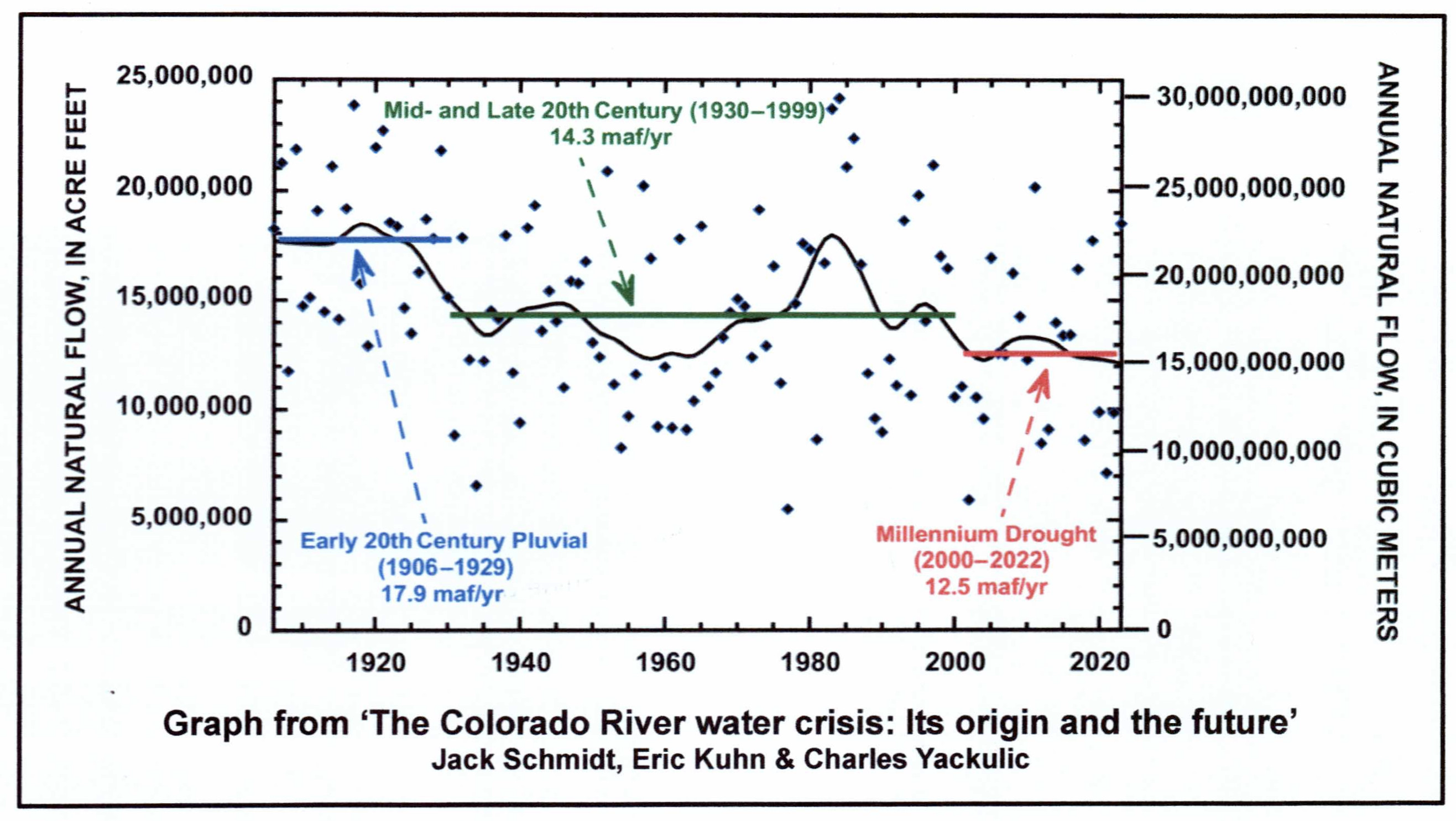
“New plot using the nClimGrid data, which is a better source than PRISM for long-term trends. Of course, the combined reservoir contents increase from last year, but the increase is less than 2011 and looks puny compared to the ‘hole’ in the reservoirs. The blue Loess lines subtly change. Last year those lines ended pointing downwards. This year they end flat-ish. 2023 temps were still above the 20th century average, although close. Another interesting aspect is that the 20C Mean and 21C Mean lines on the individual plots really don’t change much. Finally, the 2023 Natural Flows are almost exactly equal to 2019. (17.678 maf vs 17.672 maf). For all the hoopla about how this was record-setting year, the fact is that this year was significantly less than 2011 (20.159 maf) and no different than 2019” — Brad Udall
“New plot using the nClimGrid data, which is a better source than PRISM for long-term trends. Of course, the combined reservoir contents increase from last year, but the increase is less than 2011 and looks puny compared to the ‘hole’ in the reservoirs. The blue Loess lines subtly change. Last year those lines ended pointing downwards. This year they end flat-ish. 2023 temps were still above the 20th century average, although close. Another interesting aspect is that the 20C Mean and 21C Mean lines on the individual plots really don’t change much. Finally, the 2023 Natural Flows are almost exactly equal to 2019. (17.678 maf vs 17.672 maf). For all the hoopla about how this was record-setting year, the fact is that this year was significantly less than 2011 (20.159 maf) and no different than 2019” — Brad Udall