Messing with Maps: #ColoradoRiver edition — Jonathan P. Thompson (@LandDesk) #COriver #aridification

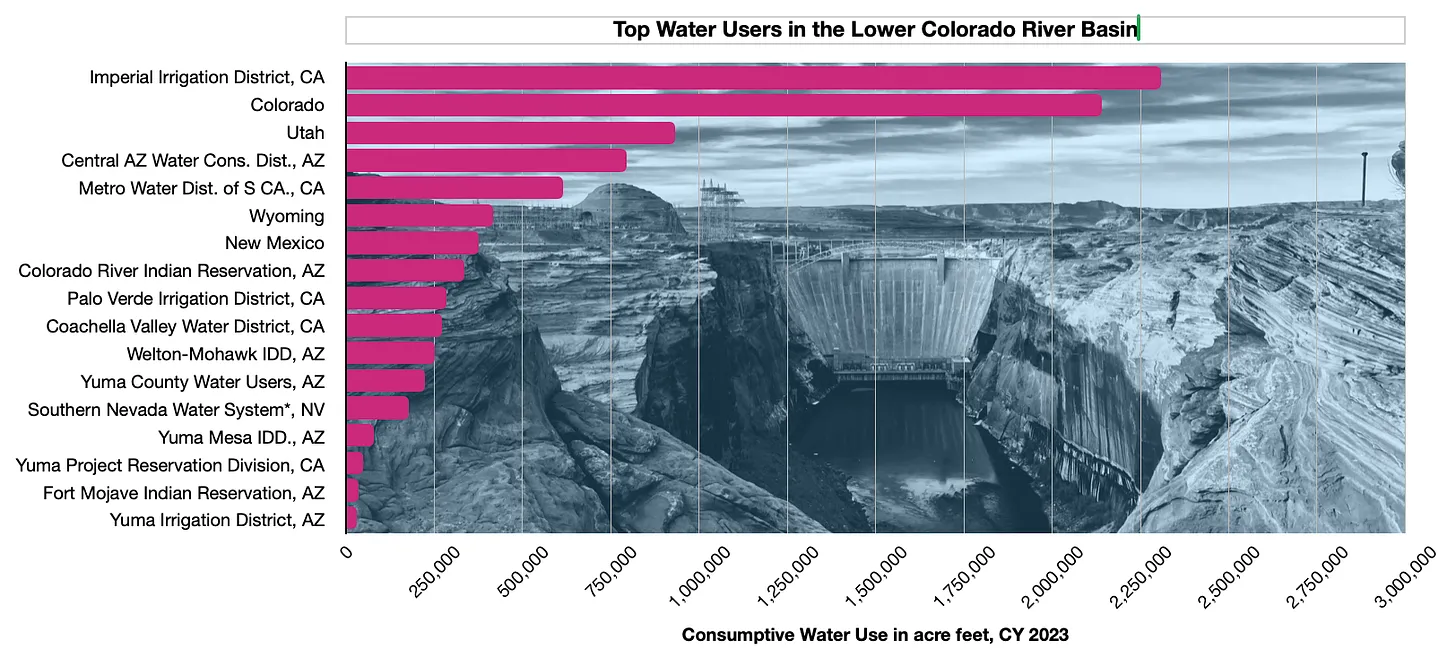
The Imperial Irrigation District in southern California uses more Colorado River water than the entire state of Colorado. The Southern Nevada Water system’s consumptive use (shown here) is the difference between total withdrawals from Lake Mead (404,065 af) and Las Vegas Wash return flows (227,809 af). Source: USBR. Credit: Jonathan P. Thompson/The Land Desk

Click the link to read the article on The Land Desk website (Jonathan P. Thompson):

December 12, 2023

The lopsided ways of Western water law

Back in 1996, the town of Silverton, Colorado had a rude water awakening. It had been a sparse winter and spring, snow-wise, in the San Juan Mountains, though nothing compared to what would come over the next couple of decades. By mid-summer the streams were running fairly low, and downstream irrigators began to worry that they might not be able to divert enough water for their uses. That prompted rumblings of a possible “call” on the river, in which senior water rights holders force junior rights holders — including Silverton — to shut off their spigots.

Silverton, Colo., lies an at elevation of 9,300 feet in San Juan County, and the Gold King Mine is more than 1,000 feet higher in the valley at the left side of the photo. Photo/Allen Best

Silverton, which sits near the headwaters of the Animas River, gets its municipal water from Boulder and Bear Creeks, two small streams that have remained mostly unsullied by acid mine drainage and heavy metal loading, natural or otherwise. The creeks weren’t in danger of running dry that year, and continued to carry plenty of water to supply the town and then some. But a call could very well force the town to shut off its pumps and to watch all of that water flow by. Why? Because under Colorado water law, usually summed up as “first in time, first in right,” Silverton’s right to pull water from the streams are inferior — or junior — to many downstream users.

Silverton was founded in 1874 and settler-colonial miners had been diverting water for a few years by then. That, theoretically, would have put them near the top of the “first in time” list for beneficial users of Animas River water (behind the Ute, Navajo, and Pueblo people who preceded them by centuries, of course). The earliest appropriation dates on the Animas River (and southwestern Colorado, in general) are in 1868, which is probably tied to the Ute Treaty of that same year. The Animas Ditch, diverted from the river south of Durango, has an 1868 date, while the Animas Consolidated, Reid, and Wallace Ditches north of Durango have mid-1870s dates. 

But Silverton’s founders — perhaps believing their proximity to so many streams’ headwaters would guarantee unfettered access to all the water they’d need in perpetuity — failed to secure their water rights. As a result, their earliest appropriation date, for the Boulder Creek diversion, is 1883, and the Bear Creek diversion is in 1904. That puts both of Silverton’s main water sources way down the priority line (number 123, in fact), meaning if downstream senior rights holders were not getting their allocated water, they could put Silverton into a pickle.
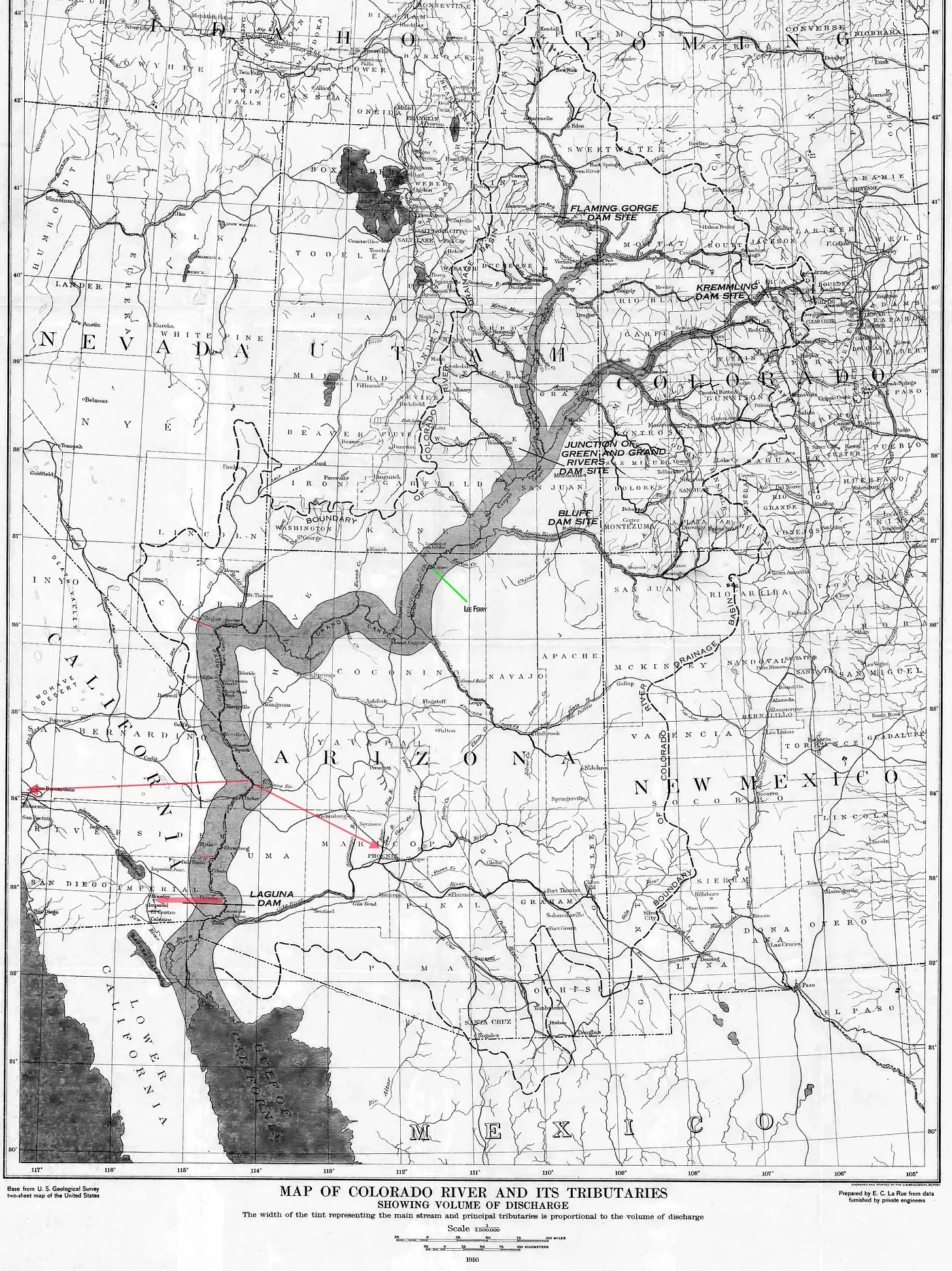
This 1916 map shows how the Upper Basin provides all of the water. I added a few red arrows showing the river’s largest users, all in the Lower Basin. The arrows in southern Nevada show the 404,065 acre-feet withdrawn from Lake Mead along with the 227,809 acre-feet of return flows via Las Vegas Wash (which is credited against their total withdrawals). So they end up with a consumptive use of 177,276 acre-feet. If the map is blurry, go to LandDesk.org and click on this post to see the larger photo. Source: USGS.

This small town’s woes came to mind recently when I stumbled upon this 1916 map of the Colorado River, which shows the approximate amount of water each tributary contributes to its total flow. The takeaway? Nearly every drop of water in the river originates in the Upper Basin States, or Wyoming, Utah, Colorado, and New Mexico. (This isn’t a surprise, but seeing it laid out so simply on a map really drives the point home.) And yet the river’s largest users and most senior water rights holders are in the Lower Basin States, namely California. So basically it’s a macro version of the Silverton situation: The Upper Basin produces the water, and the Lower Basin uses it and controls it. 

Okay, that’s a rather crude way of explaining a rather complicated situation, but it’s really not that far off. For example, in 2023, the Imperial Irrigation District in Southern California consumed 2.3 million acre-feet of Colorado River water; the entire state of Colorado used just 2.1 million acre-feet (MAF).2

And what about the downstreamers controlling the water?
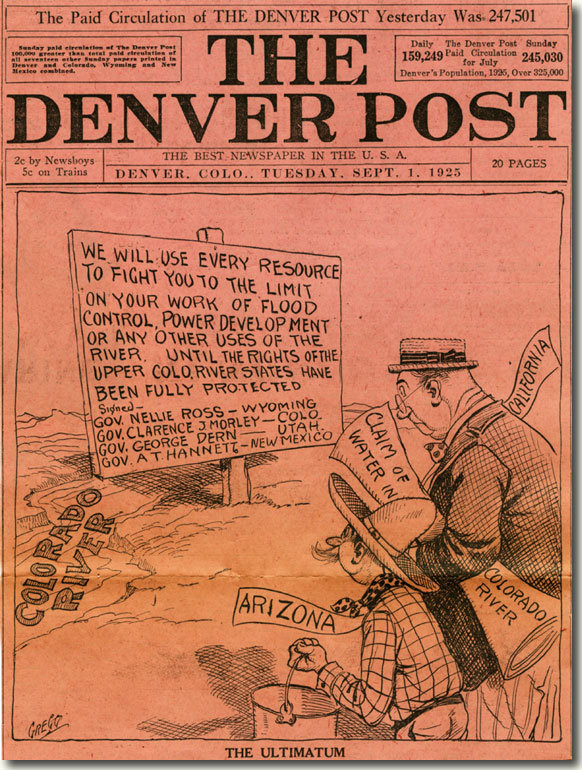
Upper Basin States vs. Lower Basin circa 1925 via CSU Water Resources Archives

The Colorado River Compact divided the presumed 15 MAF in the river equally, with 7.5 MAF going to the Lower Basin and 7.5 MAF going to the Upper Basin. That sounds fair, right? Thing is, the Compact doesn’t just cut the total annual flow of the river in half, which would be fair. Nor does it allow the Upper Basin to withdraw its 7.5 MAF, leaving the remainder to flow downstream. Nope. It requires that the Upper Basin leave enough water in the river to ensure that 7.5 MAF flows past the Lee (or Lee’s or Lees) Ferry gage into the Lower Basin each year.3 That mandate holds regardless of how much water is actually in the river, meaning that if there is anything less than 16.5 MAF, the Upper Basin’s gotta eat it (and it also forces the Upper Basin to include evaporative losses into its total water use, since it leaves that much less water to send downstream). That potentially puts the entire Upper Basin into the same boat as Silverton, just on a much larger level. 

That’s where reservoirs, especially Lake Powell, come in. The Upper Basin can save surplus water during wet years and release it during dry years to comply with the Compact’s downstream delivery mandate. And it also explains why Lake Powell is in danger of hitting dead pool: The Upper Basin has been burning up its savings to make its annual payment to the Lower Basin.

And that brings us to today’s second map: a profile of the entire Colorado River Basin with existing and proposed dams, circa 1946. I’m including this here for a couple of reasons. First off, I think it’s a really cool way to map a river system in quasi-3D without a bunch of technology. Second, the number of dams that might have been built if the mid-century water buffaloes had their way is mind-blowing.
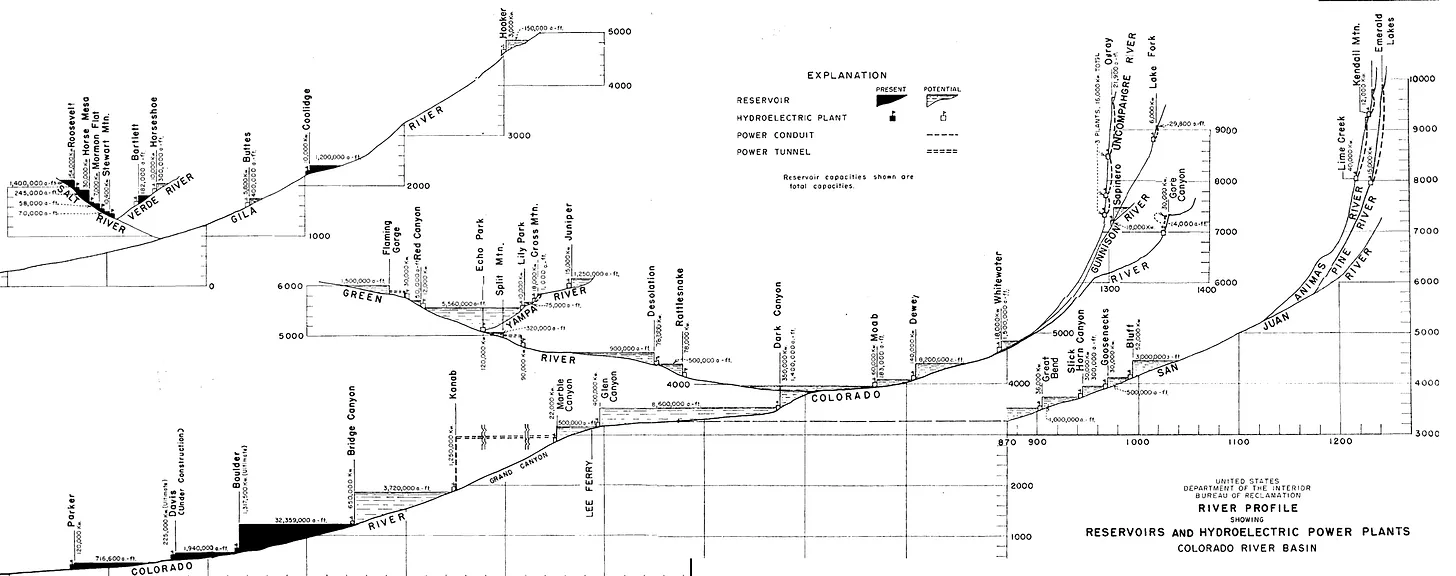
This is from 1946, more than a decade after Hoover Dam had been completed but before construction had begun on Glen Canyon Dam. It may have been the peak for potential dam Viewing the picture works best on the website at LandDesk.org. Source: USBR

Zoom in on the profile and you’ll see that Glen Canyon Dam was still only an itch in Floyd Dominy’s proverbial pants. It got built not long afterward, though. Also proposed: The Marble Canyon and Bridge Canyon Dams in the upper and lower Grand Canyon, respectively; a whole series of dams on the lower San Juan River; the Echo Park Dam on the Green and Yampa; the Dark Canyon, Moab, Dewey, and Whitewater Dams on the Colorado River between Grand Junction and Glen Canyon; and the Desolation and Rattlesnake Dams on the Green River. 

Had all those structures been built, there’d only be a handful of stretches of actual river remaining. Yikes! 

General view of the Sunnyside Mine and Lake Emma, southwestern Colorado photo via the Denver Public Library

Silverton’s 1996 water scare died down after the rains came that year. Had the call actually gone through, though, the town would have had an interesting way of keeping its water taps from going dry. The Sunnyside Mine would open up the valve on its American Tunnel bulkhead and release the required volume of water from the mine pool — a 1,200-foot-deep underground reservoir of water backed up inside the byzantine workings of the Sunnyside Mine. 

It just goes to show you that water in the West is important and that Western water law is weird.
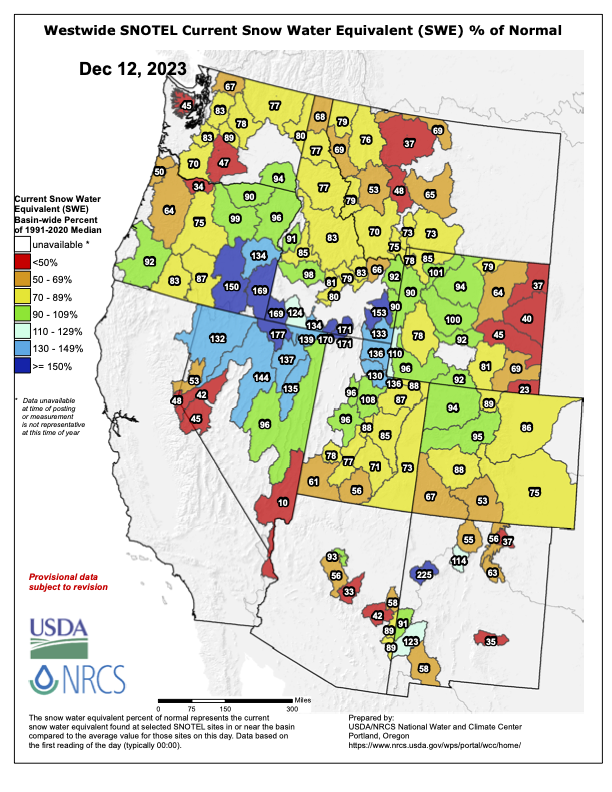
“Snow Drought” Threatening Western U.S. — WeatherNation #snowpack

Westwide SNOTEL basin-filled map December 12, 2023.

Click the link to read the article on the WeatherNation website (Lucy Bergemann). Here’s an excerpt:

After a record setting 2022-23 winter season for the Southwest U.S. including 12 atmospheric rivers that brought heavy rain and snow to California, Nevada and the 4 Corners region, the 2023-34 Winter season is getting off to a slower start. In fact, 73% of western U.S. snow reporting stations are seeing Snow Water Equivalent [SWE] below normal and 42% of stations are below the 30th percentile for SWE. Some of the most drastic conditions are in the Sierra Nevada and northern Montana. NIDIS attributes the drought conditions due to the minimal precipitation or “snow drought” seen across the region. In Colorado and Utah, most reporting stations are seeing SWE right around average with the worst of the conditions in the Rio Grande Basin and the Sangre de Cristo mountains of southern Colorado and New Mexico. 

Of course snow drought isn’t the only reason why the intermountain west is experiencing drought conditions. A lackluster monsoon season in New Mexico can be blamed for setting up extreme (level 4 out of 5) drought conditions from summer into early fall. In the latest Drought update, the National Integrated Drought Information System with NOAA announced that the southern 4 Corners region of Arizona and New Mexico are experiencing high levels of drought with 96.8% of New Mexico in drought conditions…

The other factor has been warmer than average temperatures, due in part to a strong El Nino pattern which typically results in warmer temperatures for the western states and northern Rockies. That pattern is likely to continue into the winter months. The other factor with El Nino is the likelihood of drought conditions expanding across the Southwest U.S. which could be trouble for an area that is still recovering from decades-long drought. Despite the active 2022-23 winter and meaningful moisture contributing to low reservoirs across the mountain west, “Lakes Powell and Mead continue to run very low with respect to long-term averages, given the overall dryness and warmth of the last couple of decades” according to Curtis Riganti of the National Drought Mitigation Center in Nebraska.

Arctic Report Card 2023: From wildfires to melting sea ice, the warmest summer on record had cascading impacts across the Arctic — The Conversation #ActOnClimate

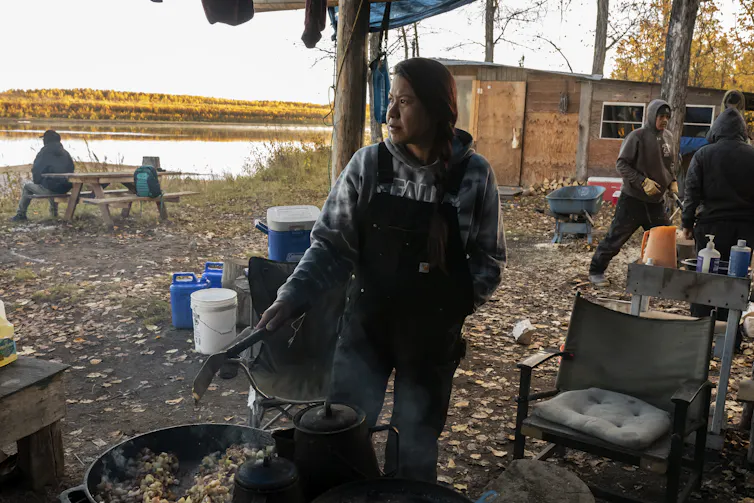
Giovanna Stevens grew up harvesting salmon at her family’s fish camp on Alaska’s Yukon River. Climate change is interrupting hunting and fishing traditions in many areas. AP Photo/Nathan Howard

Rick Thoman, University of Alaska Fairbanks; Matthew L. Druckenmiller, University of Colorado Boulder, and Twila A. Moon, University of Colorado Boulder

The year 2023 shattered the record for the warmest summer in the Arctic, and people and ecosystems across the region felt the impact.

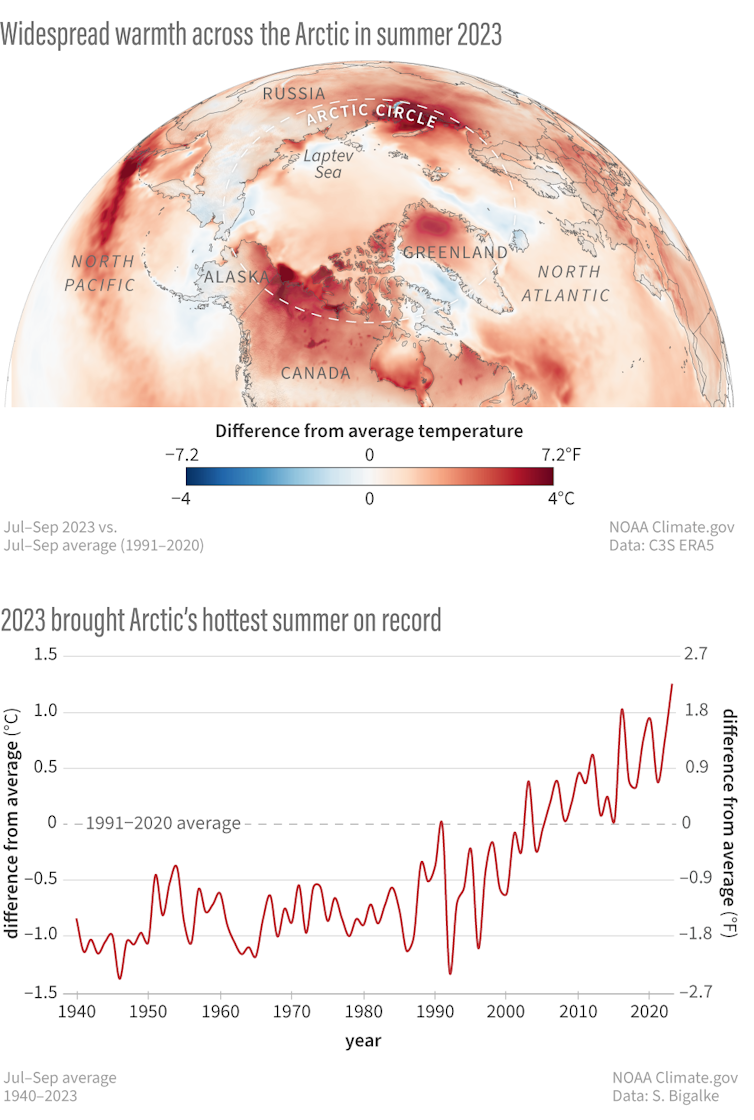
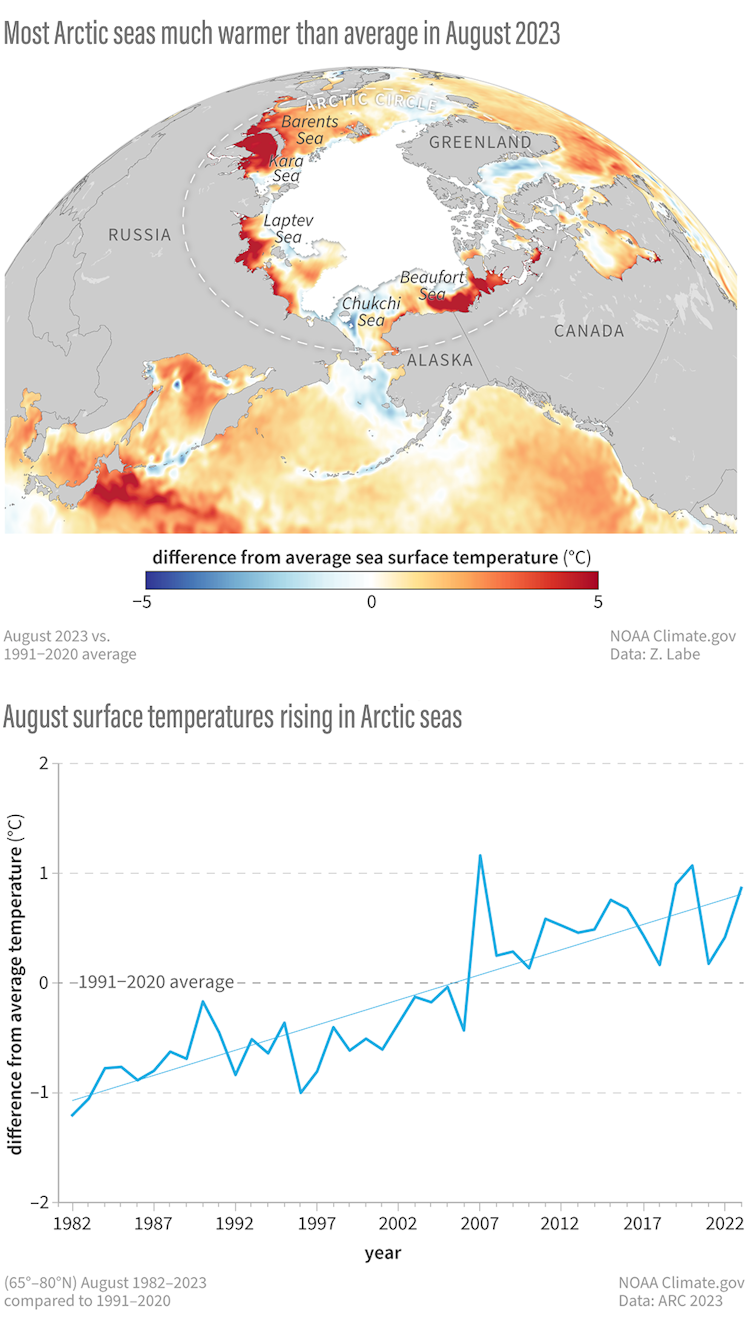
Wildfires forced evacuations across Canada. Greenland was so warm that a research station at the ice sheet summit recorded melting in late June, only its fifth melting event on record. Sea surface temperatures in the Barents, Kara, Laptev and Beaufort seas were 9 to 12 degrees Fahrenheit (5 to 7 degrees Celsius) above normal in August.

While reliable instrument measurements go back only to around 1900, it’s almost certain this was the Arctic’s hottest summer in centuries.

A map shows Arctic temperatures in 2023 and a chart shows changing heat over time.
Summer heat extremes in 2023 and over time. NOAA, Arctic Report Card 2023

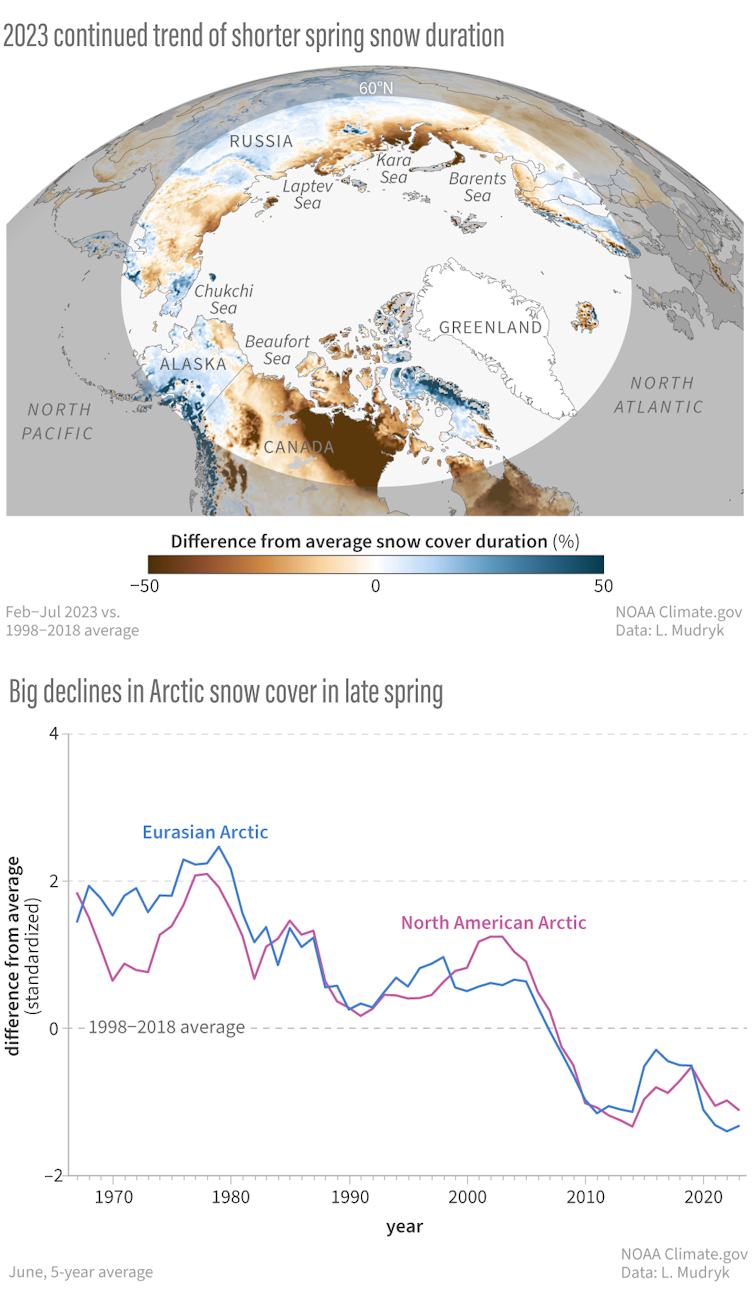
The year started out unusually wet, and snow accumulation during the winter of 2022-23 was above average across much the Arctic. But by May, high spring temperatures had left the North American snowpack at a record low, exposing ground that quickly warmed and dried, fueling lightning-sparked fires across Canada.

In the 2023 Arctic Report Card, released Dec. 12, we brought together 82 Arctic scientists from around the world to assess the Arctic’s vital signs, the changes underway and their effects on lives across the region and around the world.

Heat’s cascading effects throughout the Arctic

In an area as large as the Arctic, setting a new temperature record for a season by two-tenths of a degree Fahrenheit (0.1 degrees Celsius) of warming would be significant. Summer 2023 – July, August and September – shattered the previous record, set in 2016, by four times that. Temperatures almost everywhere in the Arctic were above normal.

A closer look at events in Canada’s Northwest Territories shows how rising air temperature, sea ice decline and warming water temperature feed off one another in a warming climate.

A map shows 2023 spring snow cover duration. A chart shows Arctic snow cover falling since the 1980s.
Arctic snow cover in 2023 and over time. NOAA, Arctic Report Card 2023

The winter snow cover melted early across large parts of northern Canada, providing an extra month for the Sun to heat up the exposed ground. The heat and lack of moisture dried out organic matter on and just below the surface; by November, 70,000 square miles (180,000 square kilometers) had burned across Canada, about a fifth of it in the Northwest Territories.

The very warm weather in May and June 2023 in the Northwest Territories also heated up the mighty Mackenzie River, which sent massive amounts of warm water into the Beaufort Sea to the north. The warm water melted the sea ice early, and currents also carried it west toward Alaska, where Mackenzie River water contributed to early sea ice loss along most of Northeast Alaska and to increased tundra vegetation growth.

A map shows Arctic sea surface temperatures in 2023 and a chart shows temperatures rising over time.
Sea surface temperatures have been rising. NOAA, Arctic Report Card 2023

Similar warmth in western Siberia also contributed to quickly melting sea ice and to high sea surface temperatures in the Kara and Laptev seas north of Russia.

The Arctic’s declining sea ice has been a big contributor to the tremendous increase in average fall temperatures across the region. Dark open water absorbs the Sun’s rays during the summer and, in the autumn, acts as a heating pad, releasing heat back into the atmosphere. Even thin sea ice can greatly limit this heat transfer and allow dramatic cooling of air just above the surface, but the past 17 years have seen the lowest sea ice extents on record.

Subsea permafrost: A wild card for climate

The report includes 12 essays exploring the effects of climate and ecosystem changes across the Arctic and how communities are adapting. One is a wake-up call about the risks in subsea permafrost, a potentially dangerous case of “out of sight, out of mind.”

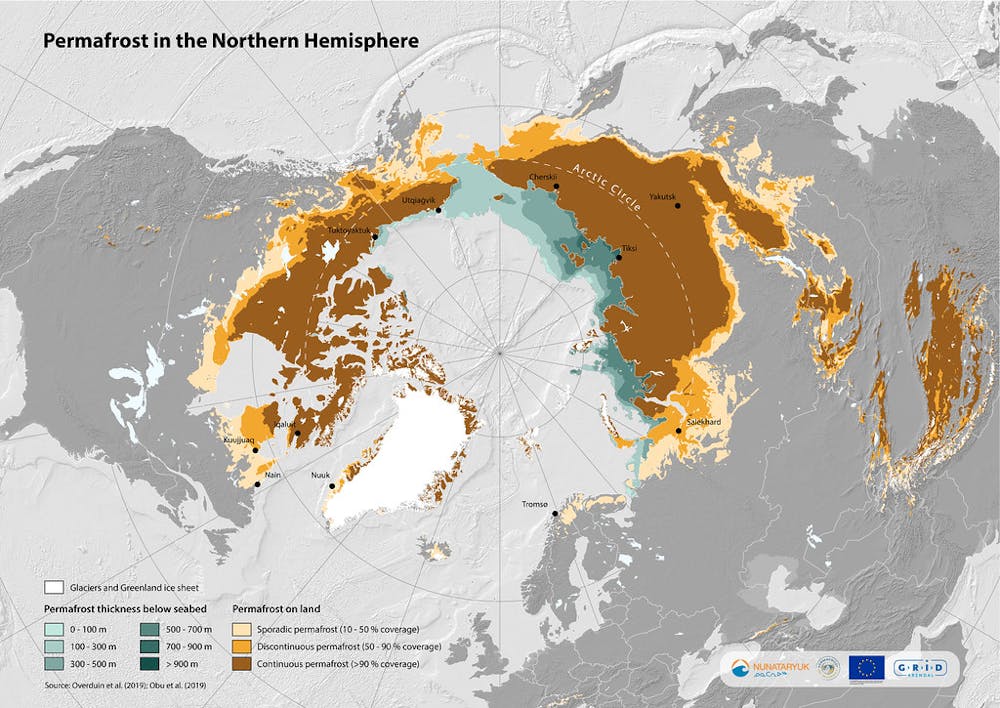
Subsea permafrost is frozen soil in the ocean floor that is rich in organic matter. It has been gradually thawing since it was submerged after Northern Hemisphere ice sheets retreated thousands of years ago. Today, warmer ocean temperatures are likely accelerating the thawing of this hidden permafrost.

Just as with permafrost on land, when subsea permafrost thaws, the organic matter it contains decays and releases methane and carbon dioxide – greenhouse gases that contribute to global warming and worsen ocean acidification.

A map shows most subsea permafrost off Siberia but also some off Alaska and Canada.
Known permafrost zones in the Northern Hemisphere. Greens are subsea permafrost. GRID-Arendal/Nunataryuk, CC BY-ND

Scientists estimate that nearly 1 million square miles (2.5 million square kilometers) of subsea permafrost remains, but with little research outside the Beaufort Sea and Kara Sea, no one knows how soon it may release its greenhouse gases or how intense the warming effects will be.

Salmon, reindeer and human lives

For many people living in the Arctic, climate change is already disrupting lives and livelihoods.

Indigenous observers describe changes in the sea ice that many people rely on for both subsistence hunting and coastal protection from storms. They have noted shifts in wind patterns and increasingly intense ocean storms. On land, rising temperatures are making river ice less reliable for travel, and thawing permafrost is sinking roads and destabilizing homes.

A map with disasters and indicators of trouble in a warming Arctic.
Highlights from the Arctic Report Card 2023. NOAA, Arctic Report Card 2023

Obvious and dramatic changes are happening within human lifetimes, and they cut to the core of Indigenous cultures to the point that people are having to change how they put food on the table.

Western Alaska communities that rely on Chinook salmon saw another year of extreme low numbers of returning adult salmon in 2023, scarcity that disrupts both cultural practices and food security. Yukon River Chinook have decreased in size by about 6% since the 1970s, and they’re producing fewer offspring. Then, in 2019, the year when many of this year’s returning Chinook salmon were born, exceptionally warm river water killed many of the young.

The returning Chinook salmon population has been so small during the past two years that fisheries have been closed even for subsistence harvest, which is the highest priority, in hopes that the salmon population recovers.

The inability to fish, or to hunt seals because the sea ice has thinned, is not just a food issue. Time spent at fish camps is critical for many Alaska Indigenous cultures and traditions, and kids are increasingly missing out on that experience.

As Indigenous communities adapt to ecosystem changes, people are also working to heal their landscapes.

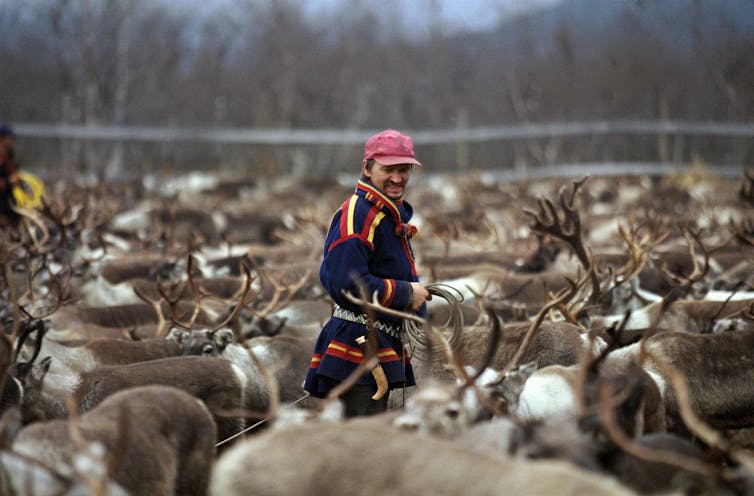
A man in colorful jacket and hat stands surrounded by dozens of reindeer.
A Sámi reindeer herder in traditional clothes counts new calves while preparing the herd for the arduous winter months. In Pictures Ltd./Corbis via Getty Images

In Finland, an effort to restore damaged reindeer habitat in collaboration with Sámi reindeer herders is helping to preserve their way of life. For many decades, commercial logging was allowed to tear up hundreds to thousands of square miles of reindeer peatland habitat.

The Sámi and their partners are working to replant turf and rewild 125,000 acres (52,000 hectares) of peatlands for reindeer grazing. Degraded peatlands also release greenhouse gases, contributing to climate change. Keeping them healthy helps capture and store carbon away from the atmosphere.

Temperatures in the Arctic have been rising more than three times faster than the global average, so it’s not surprising that the Arctic saw its warmest summer and sixth warmest year on record. The 2023 Arctic Report Card is a reminder of what’s a stake, both the risks as the planet warms and the lives and cultures already being disrupted by climate change.

Rick Thoman, Alaska Climate Specialist, University of Alaska Fairbanks; Matthew L. Druckenmiller, Research Scientist, National Snow and Ice Data Center (NSIDC), Cooperative Institute for Research in Environmental Sciences (CIRES), University of Colorado Boulder, and Twila A. Moon, Deputy Lead Scientist, National Snow and Ice Data Center (NSIDC), Cooperative Institute for Research in Environmental Sciences (CIRES), University of Colorado Boulder

This article is republished from The Conversation under a Creative Commons license. Read the original article.

President Biden’s Investing in America Agenda Provides $16.5 Million to Support Tribes Impacted by #Drought — U.S. Department of Interior

Photo credit: U.S. Department of Interior

Click the link to read the release on the Department of Interior website:

December 12, 2023

Funding will provide relief to Tribes confronted by drought conditions threatening homelands, food sources and cultural resources

The Department of the Interior today announced the availability of $16.5 million through the Bureau of Reclamation to expand access to clean, reliable water supplies for Tribes confronted by drought conditions that threaten Tribal homelands, food sources, and cultural resources. Two funding opportunities are now available through Reclamation’s Native American Affairs Program: a $12.5 million investment from President Biden’s Investing in America agenda — funded through the Inflation Reduction Act — and $4 million in annual funding for technical assistance and cooperative agreements.  

Funding from Reclamation’s Native American Affairs Program has previously supported projects including irrigation projects; municipal, industrial, and rural water systems; dam construction and dam safety; drought relief; emergency assistance; planning and engineering studies; and other activities that facilitate the negotiations and implementation of Indian water rights settlements. This round of funding is available without cost-share or matching requirements, making it easier for smaller and less-resourced Tribes to access this critical funding.  

“As Tribal communities across the West experience severe drought conditions, we are bringing every tool and every resource to bear, including historic investments through President Biden’s Investing in America agenda, to conserve and secure local water supplies, and ensure no community is left behind,” said Secretary Deb Haaland. “Today’s funding opportunity will allow us to partner with Tribes on projects that can have a real, tangible impact in Indian Country.”

“Reclamation is committed to working with sovereign nations to mitigate the devastating impacts of drought while securing ongoing investments in Tribal water projects,” said Reclamation Commissioner Camille Calimlim Touton. “This year’s additional emergency drought funding has no cost-share or matching requirements, helping get dollars to Indigenous communities swiftly and leveraging near-term efforts to build drought resilience in the face of a changing climate.”

Commissioner Touton announced the funding opportunity at the third Post-2026 Federal-Tribes-State partnership meeting — a new forum to enhance Tribal engagement and promote equitable information-sharing and discussion among the sovereign governments as the Department develops guidelines for the next several years of management of the Colorado River.

President Biden’s Investing in America agenda represents the largest investment in climate resilience in the nation’s history and is providing much-needed resources to enhance Western communities’ resilience to drought and climate change. Through the Inflation Reduction Act, Reclamation is investing nearly $4.6 billion to advance water system conservation and mitigate drought impacts, building on $8.3 billion provided through the Bipartisan Infrastructure Law to revitalize aging water infrastructure systems, advance water reuse methods and deliver water resources to rural and hard to reach communities.

Tribes and Tribal organizations in the 17 Western states in which Reclamation operates are encouraged to apply for both funding opportunities. Technical assistance grants and cooperative agreements are available up to $400,000. Grants for emergency drought relief must provide drought relief benefits within two years from the date of award and be completed within three years. The maximum award per project is limited to $500,000, and the maximum total awards per Tribe is limited to $1 million.

This funding opportunity advances the Biden-Harris Administration’s ambitious environmental justice agenda through the Justice40 Initiative, which set the goal that 40 percent of the overall benefits of certain covered Federal investments flow to disadvantaged or Justice40 communities, which include all Federally Recognized Tribes and Tribal entities.

More about these and other funding opportunities can be found at Reclamation’s website.

Civil engineer and horticulturist join forces for stormwater and green roof research at #Colorado State University Spur’s Hydro Backyard

Jen Bousselot and Amanda Salerno plant seedlings at CSU Spur alongside City of Denver employees Colin Bell and Austin Little.

Click the link to read the release on the Colorado State University website (Jana Crouch)

December 11, 2023

In the semi-arid Colorado climate, long periods of hot and dry conditions are often broken up by rapid torrential rains. Stormwater runoff can contribute to water pollution and cause flooding and erosion, creating a paradox of water being precious and scarce, yet hazardous and contaminated.

What if stormwater could instead be collected in biological green spaces to minimize runoff and filter the water for reuse as irrigation?

Two CSU researchers are collaborating with municipal officials in Denver to improve urban landscaping design for green stormwater management systems. Professors Sybil Sharvellecivil and environmental engineering, and Jennifer Bousselothorticulture and landscape architecture, have joined forces to integrate green infrastructure and stormwater reuse into the urban landscape.

The many dimensions of water and vegetation

The multi-faceted project will examine how different types of captured water (i.e., graywater, stormwater, etc.) affect various combinations of soil and vegetation. Additionally, the researchers will collect data on vegetation in street-level planters and green roof systems that will maximize the removal of toxins and pollutants from water.

Jen Bousselot, Assistant Professor in the Department of Horticulture and Landscape Architecture. Photo credit: Colorado State University

“Typically research focuses on one element. By approaching this work with equal weight given to the agriculture side and the engineering side, we have a robust project that is more valuable and useful to the end users,” said Bousselot, an expert in green roof development and urban horticulture.

By testing different sources of water, soil, and vegetation, their research will identify ideal combinations for urban landscaping that reduces pollution, minimizes damage from flooding and runoff, and sustainably treats and reuses stormwater. The four-year project will also capture how the vegetation responds in each weather season in Colorado.

CSU Spur serves as collaborative hub

At the Hydro Building of CSU Spur, the team has access to concrete test plots in Hydro’s Backyard to function as experimental bioretention cells mimicking streetside planters commonly found in urban landscapes. Spur’s Hydro Building also has a green roof space for testing the viability of vegetation irrigated with different non-potable water types.

Sybil Sharvelle, Associate Professor of Civil and Environmental Engineering. Photo credit: Colorado State University

“I love that Spur serves as a space to connect CSU’s agriculture and water engineering programs where we have enhanced collaboration opportunities. We can work on projects in the same location, and with the Terra Building right beside the Hydro Building, it is an area for elevated research where students get great experience,” said Sharvelle, an expert in urban stormwater management and head of the Water Technology Acceleration Platform Lab (Water TAP) at Spur.

“The outdoor lab at Hydro is a great place to interact with the public. I think school kids will love to visit, learn about how we are trying to protect our water resources, and hopefully be inspired to help too,” stated Colin Bell, Senior Engineer at the Division of Green Infrastructure within the Department of Transportation and Infrastructure for the City and County of Denver.

Sharvelle and Bousselot are co-advising civil engineering PhD student Amanda Guedes Salerno. Salerno will manage plant growth, measure water outflow from the bioretention cells and green roof, and other hands-on data collection at Spur. She earned her undergraduate degree in environmental engineering in her home country of Brazil, then came to CSU for a master’s degree in horticulture.

Her current PhD research is in many ways a continuation of her master’s research with green roof systems.

“The facility at Spur is amazing,” said Salerno. “As a master’s student, I studied green roof infrastructure but had to perform research in small simulation boxes. Now, we can access the fully functional green roof at Spur. The integration between the water science and horticulture science in one place is incredible.”

Partnering for the public good

The results of this research will provide guidance on stormwater treatment, water quality improvement, and the viability of vegetation in bioretention cells and green roof systems. The guidance will then inform future projects by the Division of Green Infrastructure and the Denver metro area’s Mile High Flood District(MHFD), who are jointly funding the project.

“This has been a really exciting collaboration with our local utilities and municipal partners. We are able to perform research and water quality testing at a level they may not have the resources for, and it has a direct impact on them,” said Sharvelle.

The Director of Research and Development at Mile High Flood District, Holly Piza, shared “The CSU and MHFD partnership at Spur allows us to connect academic research with practitioners in our region. This research is informing our regional criteria and advancing the practice of stormwater management.”

“It’s a great team. CSU brings the research expertise and an amazing facility, MHFD has a strong history of developing innovative stormwater criteria, and DGI will use the findings to build on an existing network of over 200 facilities in Denver,” said Bell.

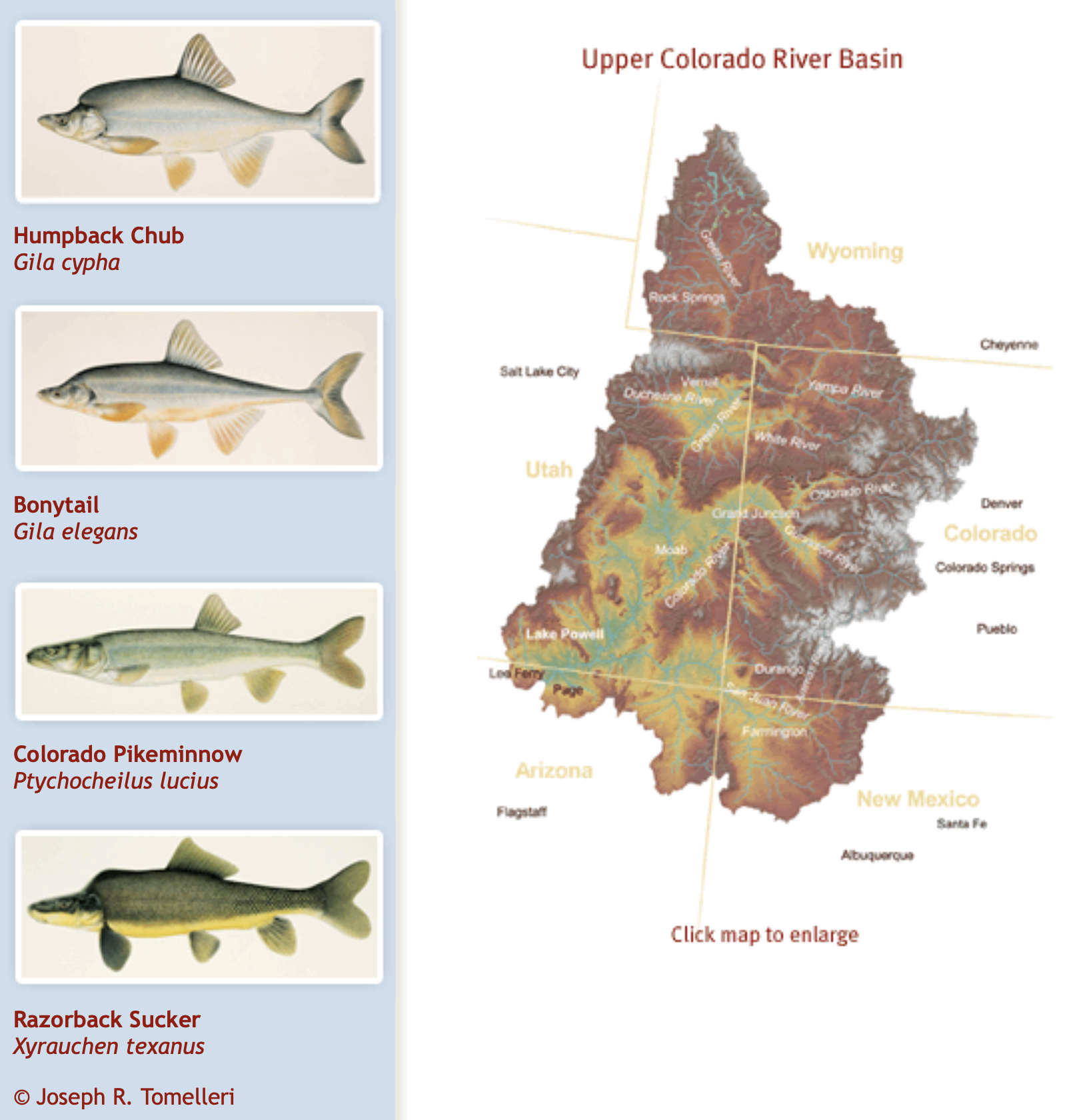
The Colorado Water Congress is hiring a #ColoradoRiver Project Coordinator to represent #CORiver water users in #CO, #WY, and #UT in the implementation of the Upper Colorado River Endangered Fish Recovery Program

Screen shot from the Upper Colorado River Endangered Fish Recovery Program website August 28, 2021:

Click the link to go to the Colorado Water Congress website to apply:

Contract Opportunity

The Colorado River Project Coordinator (Coordinator) represents Colorado River water users in Colorado, Wyoming, and Utah in the implementation of the Upper Colorado River Endangered Fish Recovery Program (Recovery Program) (https://coloradoriverrecovery.org/uc/). A broad coalition of twenty-three water users in Colorado and Utah provide funding for a Coordinator through the Colorado Water Congress Colorado River Project (Project). Each contributing water user is a member of the Project’s Executive Committee and provides guidance and direction to the Project Coordinator and is kept informed of Recovery Program activities through regular meetings with and correspondence from the Coordinator.

The successful candidate will collaborate with the current Coordinator for sufficient time to gain a complete understanding of the Program and the responsibilities of the position. The water users have benefitted from having the current Coordinator since the inception of the Recovery Program with one point of contact and consistent, successful representation in all of the Recovery Program facets. The water users realize how unique the arrangement has been with the longevity and the waters users will have an ongoing need for a Coordinator as long as the Recovery Program exists. The Recovery Program or its successor is expected to be permanent. A candidate that has a vision to provide a way for historic knowledge learning, retention and application, along with the ability to look toward the future, for a time period of 10-years or more is desired.

Coordinator will be an independent contractor and not an employee of the Colorado Water Congress (CWC). Coordinator could be an individual or a company. If a company wishes to apply, please identify and provide qualifications of the primary person responsible for the scope of work and any additional supporting staff. The company must provide a commitment that one person will serve as Coordinator and that any change in staff must be approved by the Executive Committee.  This does not preclude that person from other duties. The estimated time requirement averages 20 hours per week. The applicant must disclose any potential conflicts of interest.

Compensation range: $120 – $200 per hour, depending on knowledge, skills, and experience.

Minimum Qualifications: Bachelor’s Degree from an accredited college or university in Planning, Natural Resource Management, Environmental Science, Watershed Science, Engineering, or related field. Minimum 6 years of related work experience. Any equivalent combination of certifications, education, or experience that provides the required skills, knowledge, and abilities for the position.

Preferred Qualifications: A candidate with skills/experience in working with Congress on appropriations/authorizing legislation, a track record of successfully working with members of diverse groups to achieve consensus on difficult issues, ESA experience, and knowledge of the Recovery Program is preferred.

Here’s the detailed Scope of Services.

Applicant Submittal Information

Please submit your letter of interest and resume or documents using the portal on the Colorado Water Congress website HERE.

The position will be open until filled. Initial interviews are anticipated to be conducted the week of January 29thcoordinated with the Colorado Water Congress Annual Convention, January 31 to February 2, 2024, in Aurora, Colorado.

Please direct any questions to John McClow at jmcclow@ugrwcd.org

This is an equal employment opportunity.

Background

In mid-1983, the U.S. Fish and Wildlife Service released a draft proposal to restrict future water development in the Upper Colorado River Basin in order to protect native fish species listed as endangered under the federal Endangered Species Act.  The Colorado Water Congress (CWC) Colorado River Project was established on December 1, 1983 by a coalition of Colorado and Utah water users.  The objective of the Project was to develop an acceptable administrative solution to resolve conflicts between protection of federally listed endangered fish species and development and management of water in the Upper Colorado River Basin.  Negotiations among federal agencies, the states of Colorado, Utah and Wyoming, water interests, and environmental organizations between 1984 and 1987 resulted in establishment of the Upper Colorado River Endangered Fish Recovery Implementation Program (Recovery Program) on January 22, 1988 by agreement of the Secretary of the Interior, the Administrator Western Area Power Administration, and the governors of Colorado, Utah, and Wyoming.  The Recovery Program has the objective of recovering endangered fish while water development and management activities proceed in compliance with the ESA, Reclamation project authorizations, and state water and wildlife law.  This objective is being achieved.

Current participants in the Recovery Program include four federal agencies (U.S. Fish & Wildlife Service, Bureau of Reclamation, National Park Service, and Western Area Power Administration), the states of Colorado, Utah, and Wyoming, Upper Basin water users, Colorado River Storage Project power customers (Colorado River Energy Distributors Association), and environmental organizations (The Nature Conservancy, Western Resource Advocates).

Recovery Program actions taken to recover the species include construction of fish passages, fish screens, habitat improvements, non-native fish control, enhancing instream flows in accordance with state water law and interstate compacts, stocking, monitoring, and research.  These actions provide the ESA compliance for water depletions and water management in the Upper Colorado River Basin for federal, non-federal, and tribal water projects.  In entering the agreement to establish the Recovery Program, the United States agreed that any water needed for endangered fish would be acquired in accordance with state law and interstate compacts, and that there would be no taking of water or condemnation of water rights.  The states, water users and the Bureau of Reclamation committed to finding ways to provide water for endangered fish in accordance with state law, interstate compacts and Reclamation project authorizations.

As of December 31, 2022, the Recovery Program has provided ESA compliance for 2,203 water projects depleting approximately 2.8 million acre-feet/year in Colorado, Wyoming, and Utah.  This includes 1,262 projects in Colorado depleting 2.1 million acre-feet per year, 266 projects in Utah depleting 619,439 acre-feet per year, and 434 projects in Wyoming depleting 124,463 acre-feet per year.  No lawsuits have been filed on ESA compliance provided by the Recovery Program.

Role of the CWC Colorado River Project in the Upper Basin Recovery Program 

The CWC Colorado River Project (Project) plays a key role in Recovery Program implementation.  The Project supports participation by the water users’ representative in the Recovery Program’s governing and technical committees.  Participation ensures that the Recovery Program is implemented in accordance with existing agreements.  The Coordinator confers with and seeks input from the Executive Committee on key Recovery Program issues and provides assistance to water users throughout the Upper Colorado River Basin when needed to assure that ESA Section 7 consultations on water projects are carried out in accordance with Recovery Program agreements.

Because the Project is not part of a federal or state agency, it has considerable latitude in dealing directly with the United States Congress and presidential administrations with respect to Recovery Program matters.  Since its inception, the Project has been involved in successful efforts to secure federal funding for the Recovery Program.  In 2000, the Project garnered Congressional support for and coordinated passage of federal legislation (P.L. 106-392) that authorized federal cost sharing for the Recovery Program and use of Colorado River Storage Project hydropower revenues for Recovery Program activities, and recognizes non-federal cost sharing.  This legislation also authorized funding for the San Juan River Basin Recovery Implementation Program (https://coloradoriverrecovery.org/sj/). The Project has played a leading role in passage of subsequent amendments to expand federal cost-sharing as needed.  Each year the Project works with other non-federal participants in both recovery programs to secure annual appropriations by Congress for the Recovery Program and the San Juan Recovery Program in accordance with the authorizing legislation.  The annual appropriations are divided between the two programs pursuant to the authorizing legislation.  As of September 30, 2023, Congress has appropriated $173,552,000 in support of the Recovery Program and authorized $115,774,000 in Colorado River Storage Project Colorado River Project hydropower revenues to support the Recovery Program.  Total Recovery Program costs from FY 1989 through FY 2023 were $478,919,000, including non-federal contributions and credits to participants for various activities.

Study finds that livestock growers need more compensation for water #conservation: Costs of buying hay high in extreme drought year of 2020 — @AspenJournalism

Early morning fog hangs in the valleys above this irrigated field outside of Kremmling in July 2021. The pasture is part of a study that aims to learn about the impacts of using less water on high-elevation fields. CREDIT: HEATHER SACKETT/ASPEN JOURNALISM

Click the link to read the article on the Aspen Journalism website (Heather Sackett):

December 8, 2023

The results of a recent economic study of Grand County irrigators show that certain water conservation programs may be worth it for irrigators who grow hay but not for those who grow cows.

In 2020, a group of nine flood irrigators in the Kremmling area, scientists and conservation groups began a multiyear research project to find out what happens when irrigation water is withheld from high-elevation fields for a full season and a half-season. The project, officially called “Evaluating Conserved Consumptive Use in the Upper Colorado,” is ongoing through 2023, but preliminary results from 2020-22 show that the effects of taking water off a field linger beyond one season and that these types of programs may not make financial sense for irrigators who raise livestock. 

In 2020, control fields were irrigated normally; some fields received no irrigation water and some received irrigation water only through June 15. Normal irrigation practices were resumed in 2021, 2022 and 2023. But the fields with no or less water in 2020 did not fully bounce back and produce the same crop yield as the control fields in subsequent years. The amount of water used by the plants, known as consumptive use, as well as the amount of forage crop production, lagged behind the control fields even two years after resuming normal irrigation, something maybe partly due to the extreme drought in the summers of 2020 and 2021.

Perry Cabot, a researcher with Colorado State University, and Hannah Holm, associate director for policy with environmental group American Rivers, worked on the project and presented their findings to the Colorado Basin Roundtable last month.

“2020 was such an awful, horrible drought year, especially late in the season,” Holm said. “We are wondering if the fact that there was basically no precipitation falling from the sky, and that summer of 2021 [was also dry], might have knocked back the treatment fields that much harder. … We do see substantial recovery when returned to full irrigation, but it’s not uniform across the fields and it seems to not be 100% a couple of years later.” 

Where water was removed for half of the irrigation season, irrigators received $281 per acre, and those with full irrigation withdrawal received $621 per acre in 2020.

The study was funded by the Colorado Water Conservation Board, with support from the Colorado Basin Roundtable, The Nature Conservancy, Trout Unlimited and American Rivers.

The 2020 Economics and Enterprise Budgeting Report, released in August as part of the preliminary project report, found that these amounts need to be increased for irrigators who also raise livestock to make participation in the program worth it for them. The report, which is based on interviews, financial data and budgets from six of the participating irrigators, said agricultural producers who relied on their hayfields to feed cattle experience a net loss of profit, despite the payments. 

Producers with livestock would have needed an average payment of at least $971 per acre to fully compensate them for the additional costs of not irrigating their fields. This was mostly due to the high cost of having to buy hay in a drought year to replace the hay they didn’t grow.

Those just growing hay saw an average of a $197 increase in income per acre on the full-season treatment fields; those growing hay saw an average $46 loss per acre on the half-season treatment fields. Those who also had a herd of cows to manage in addition to growing hay lost an average of $350 of income per acre on the treatment fields.

Paul Bruchez, a Kremmling rancher and CWCB member, is one of the project’s leaders. 

“We were part of creating a deficit in our local hay market,” he said. “That was compounded by what was a natural drought. And then the end result was that hay was off-the-charts expensive.”

Many ranchers continue irrigating late into the season after their last cutting of hay so that they can grow back a little bit of grass, alfalfa or other forage crop on which their cattle can graze for several weeks in the fall before they start feeding them hay. Ranchers who participated in the project also lost this bit of fall grazing because they didn’t irrigate. 

“They had a loss of production initially for the harvesting of the hay to feed them through the winter, but then they also lost fall grazing,” said Jenny Beiermann, an agriculture and business management specialist with Colorado State University, who co-authored the economics study. “They incurred a lot of additional expenses compared to those who were just harvesting hay, and that’s why they needed a higher rate of payment for their fields.”

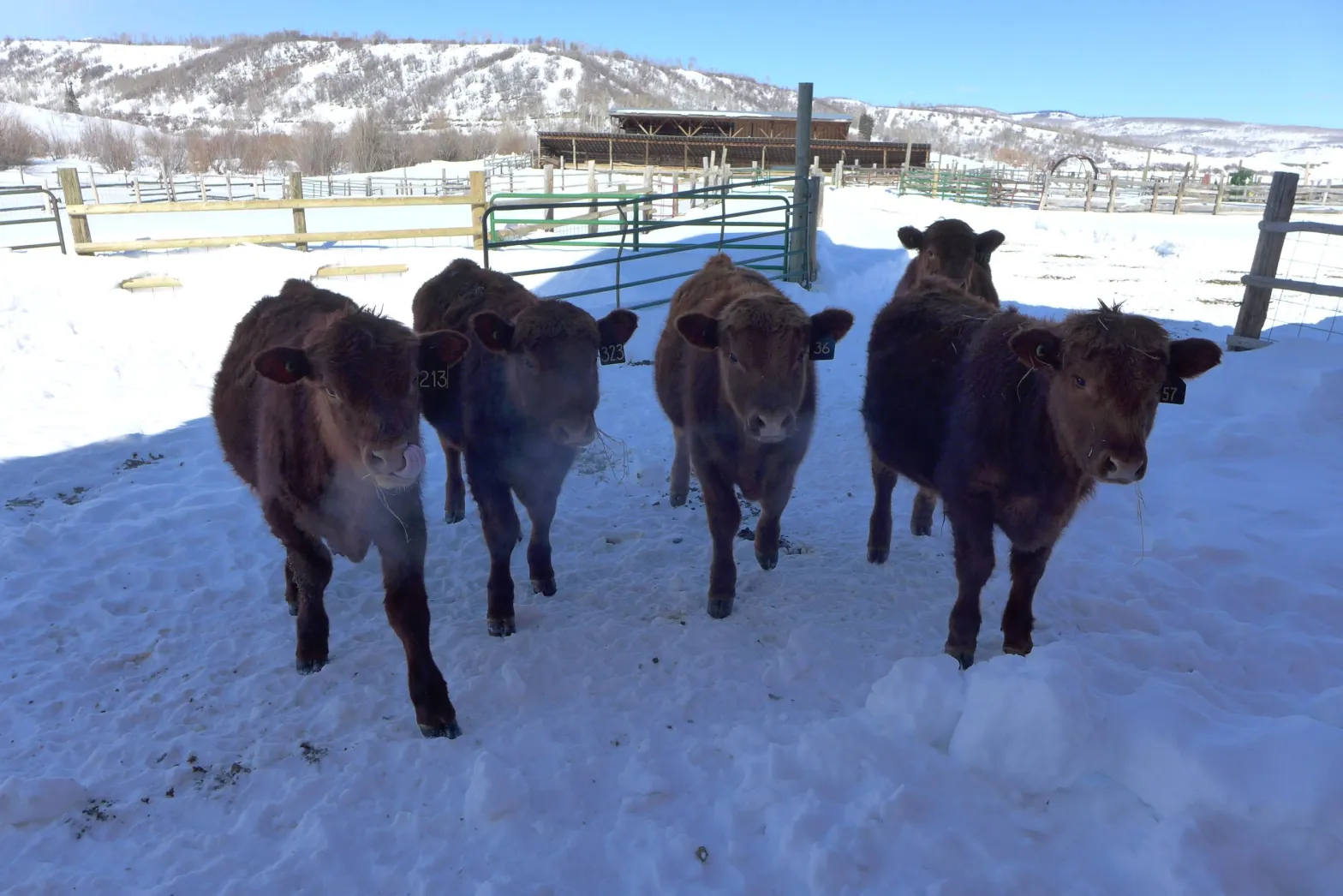
These cows live on the Fetcher ranch in Clark, north of Steamboat Springs. The results of a recent economics study found that certain types of water conservation programs may be worth it for irrigators who grow hay, but not for those who raise livestock. CREDIT: HEATHER SACKETT/ASPEN JOURNALISM

System conservation

These findings could have basinwide implications for the Upper Colorado River Commission’s System Conservation Program, which in September water managers voted to continue in 2024. The federally funded program pays irrigators to forgo watering their fields for a season with the goal of protecting critical elevations in the nation’s two largest reservoirs, Lake Powell and Lake Mead. The 2024 program will have a narrower scope that explores demand-management concepts and supports innovation and local drought resiliency on a longer-term basis. 

For the 2023 System Conservation Program, water managers set the opening payment to producers at $150 per acre-foot conserved, a number that some producers told Aspen Journalism was insultingly low. Producers could then negotiate up from there. SCP project participants in Colorado were paid an average of about $394 for every acre-foot conserved. The average price per acre-foot across the four upper basin states — Colorado, Utah, Wyoming and New Mexico — was $422. 

For 2024, the program will offer Colorado irrigators a fixed price of $509 per acre-foot conserved. 

UCRC Executive Director Chuck Cullom said the agency used projected commodity prices and crop budgets from CSU to arrive at the amount of compensation offered to producers for 2024 and did not take into account whether an irrigator had a cow/calf operation.

Another thing the project is studying is how birds use irrigated agricultural lands. But the results through 2022 of an avian monitoring project by Audubon Rockies were inconclusive. Researchers expected that when irrigation was resumed in the years after 2020, there would be more water-associated birds. The number of bird species counted did increase in 2021 — the first year irrigation water returned — but not in 2022. 

“In some regard, the results from 2022 were diminished from those in 2020 (treatment year), which further opposed our expectations,” the report reads. “Birds are highly diverse, mobile creatures that use a wide array of habitats for many different seasonal purposes, often making it challenging to interpret the outcomes of avian monitoring efforts.”

The thing to keep in mind about the economics study, Beiermann said, is that it was small and that conditions in high-elevation Grand County can be particularly brutal, with long winters. Drought and water availability can vary widely across the upper Colorado River basin and from year to year. Still, a key takeaway is that these types of water conservation programs may be better suited for irrigators who grow only hay.

“Agriculture is a really risky business and being profitable is really tough,” she said. “There are too many variables (for livestock producers). Generally speaking, they are going to have a lot higher costs.”

This story ran in the Dec. 9 edition of The Aspen Times.

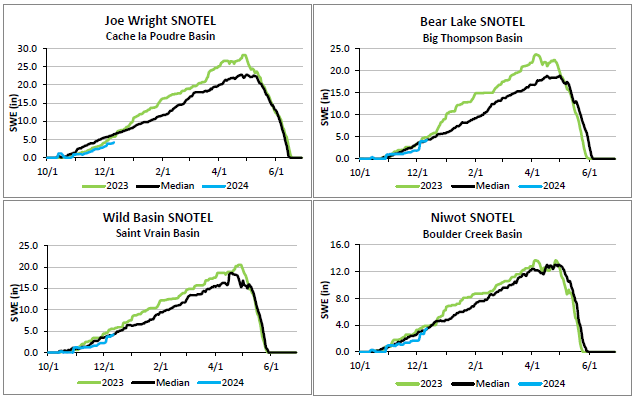
Mountain snow in the last week brought the total snow water equivalent at the Upper #ColoradoRiver and #SouthPlatteRiver SNOTEL sites to approximately 90% of median — @Northern_Water #snowpack #COriver

Last week, gains at the Upper Colorado sites were about 112% of normal and the South Platte sites had gains of 122%.