
Click the link to read the article on The Land Desk website (Jonathan P. Thompson):
December 12, 2023
The lopsided ways of Western water law
Back in 1996, the town of Silverton, Colorado had a rude water awakening. It had been a sparse winter and spring, snow-wise, in the San Juan Mountains, though nothing compared to what would come over the next couple of decades. By mid-summer the streams were running fairly low, and downstream irrigators began to worry that they might not be able to divert enough water for their uses. That prompted rumblings of a possible “call” on the river, in which senior water rights holders force junior rights holders — including Silverton — to shut off their spigots.

Silverton, which sits near the headwaters of the Animas River, gets its municipal water from Boulder and Bear Creeks, two small streams that have remained mostly unsullied by acid mine drainage and heavy metal loading, natural or otherwise. The creeks weren’t in danger of running dry that year, and continued to carry plenty of water to supply the town and then some. But a call could very well force the town to shut off its pumps and to watch all of that water flow by. Why? Because under Colorado water law, usually summed up as “first in time, first in right,” Silverton’s right to pull water from the streams are inferior — or junior — to many downstream users.
Silverton was founded in 1874 and settler-colonial miners had been diverting water for a few years by then. That, theoretically, would have put them near the top of the “first in time” list for beneficial users of Animas River water (behind the Ute, Navajo, and Pueblo people who preceded them by centuries, of course). The earliest appropriation dates on the Animas River (and southwestern Colorado, in general) are in 1868, which is probably tied to the Ute Treaty of that same year. The Animas Ditch, diverted from the river south of Durango, has an 1868 date, while the Animas Consolidated, Reid, and Wallace Ditches north of Durango have mid-1870s dates.
But Silverton’s founders — perhaps believing their proximity to so many streams’ headwaters would guarantee unfettered access to all the water they’d need in perpetuity — failed to secure their water rights. As a result, their earliest appropriation date, for the Boulder Creek diversion, is 1883, and the Bear Creek diversion is in 1904. That puts both of Silverton’s main water sources way down the priority line (number 123, in fact), meaning if downstream senior rights holders were not getting their allocated water, they could put Silverton into a pickle.
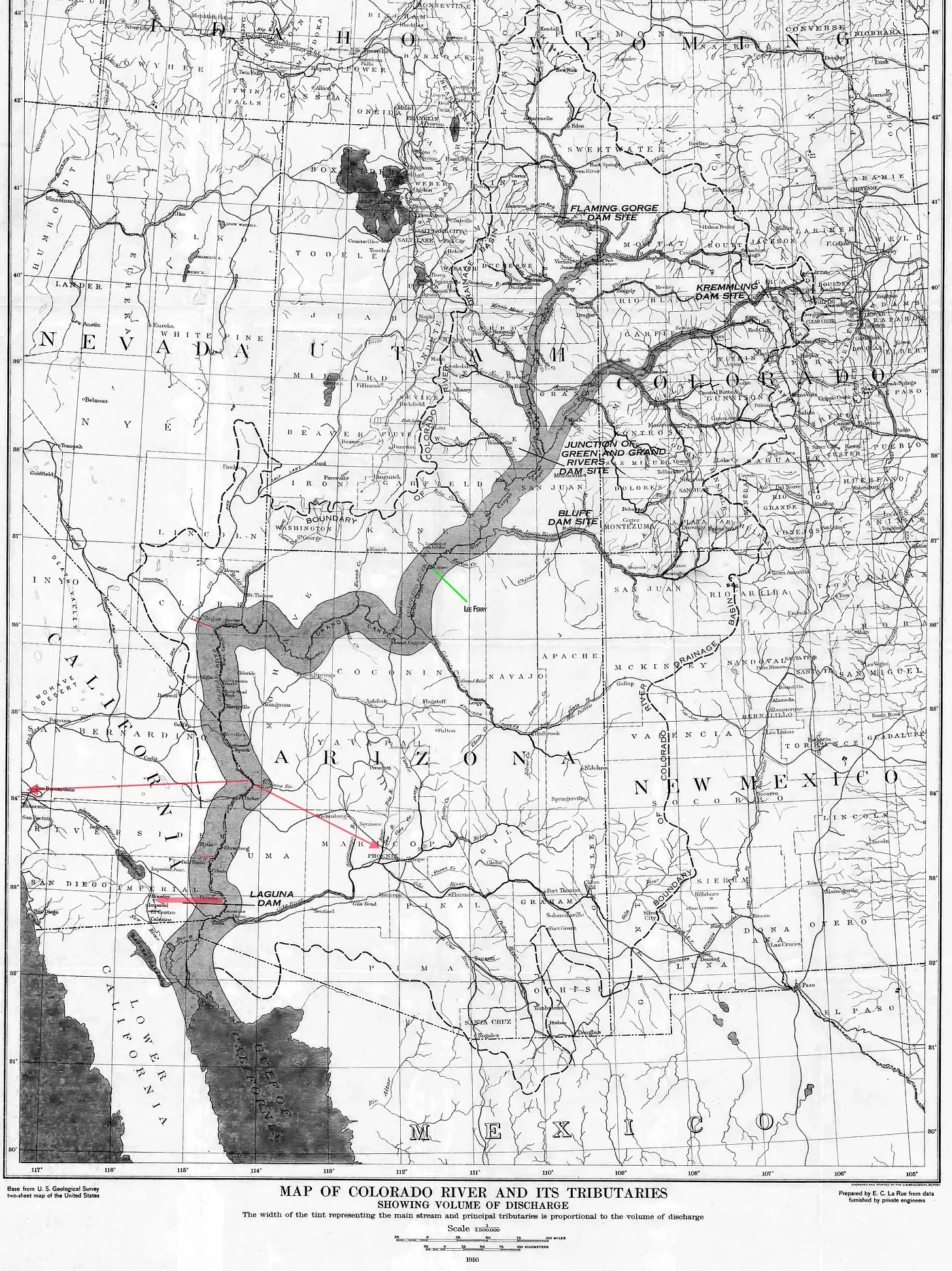
This small town’s woes came to mind recently when I stumbled upon this 1916 map of the Colorado River, which shows the approximate amount of water each tributary contributes to its total flow. The takeaway? Nearly every drop of water in the river originates in the Upper Basin States, or Wyoming, Utah, Colorado, and New Mexico. (This isn’t a surprise, but seeing it laid out so simply on a map really drives the point home.) And yet the river’s largest users and most senior water rights holders are in the Lower Basin States, namely California. So basically it’s a macro version of the Silverton situation: The Upper Basin produces the water, and the Lower Basin uses it and controls it.
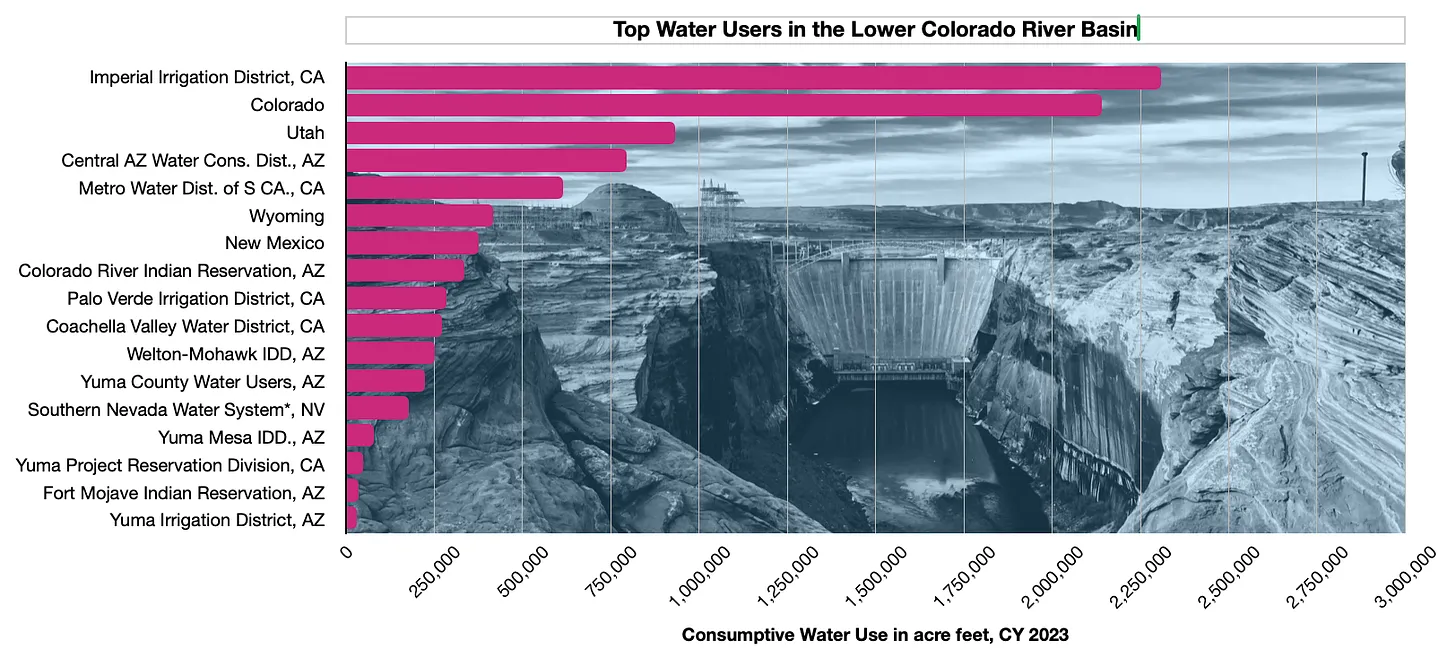
Okay, that’s a rather crude way of explaining a rather complicated situation, but it’s really not that far off. For example, in 2023, the Imperial Irrigation District in Southern California consumed 2.3 million acre-feet of Colorado River water; the entire state of Colorado used just 2.1 million acre-feet (MAF).2
And what about the downstreamers controlling the water?
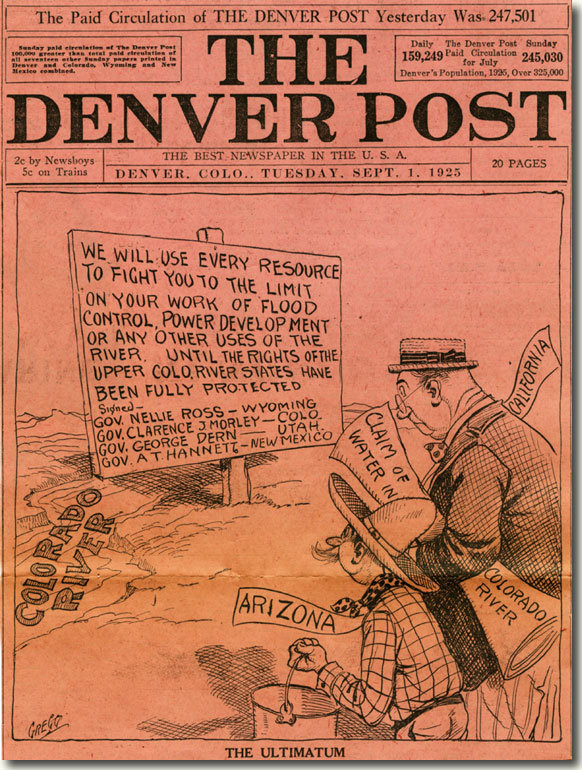
The Colorado River Compact divided the presumed 15 MAF in the river equally, with 7.5 MAF going to the Lower Basin and 7.5 MAF going to the Upper Basin. That sounds fair, right? Thing is, the Compact doesn’t just cut the total annual flow of the river in half, which would be fair. Nor does it allow the Upper Basin to withdraw its 7.5 MAF, leaving the remainder to flow downstream. Nope. It requires that the Upper Basin leave enough water in the river to ensure that 7.5 MAF flows past the Lee (or Lee’s or Lees) Ferry gage into the Lower Basin each year.3 That mandate holds regardless of how much water is actually in the river, meaning that if there is anything less than 16.5 MAF, the Upper Basin’s gotta eat it (and it also forces the Upper Basin to include evaporative losses into its total water use, since it leaves that much less water to send downstream). That potentially puts the entire Upper Basin into the same boat as Silverton, just on a much larger level.
That’s where reservoirs, especially Lake Powell, come in. The Upper Basin can save surplus water during wet years and release it during dry years to comply with the Compact’s downstream delivery mandate. And it also explains why Lake Powell is in danger of hitting dead pool: The Upper Basin has been burning up its savings to make its annual payment to the Lower Basin.
And that brings us to today’s second map: a profile of the entire Colorado River Basin with existing and proposed dams, circa 1946. I’m including this here for a couple of reasons. First off, I think it’s a really cool way to map a river system in quasi-3D without a bunch of technology. Second, the number of dams that might have been built if the mid-century water buffaloes had their way is mind-blowing.
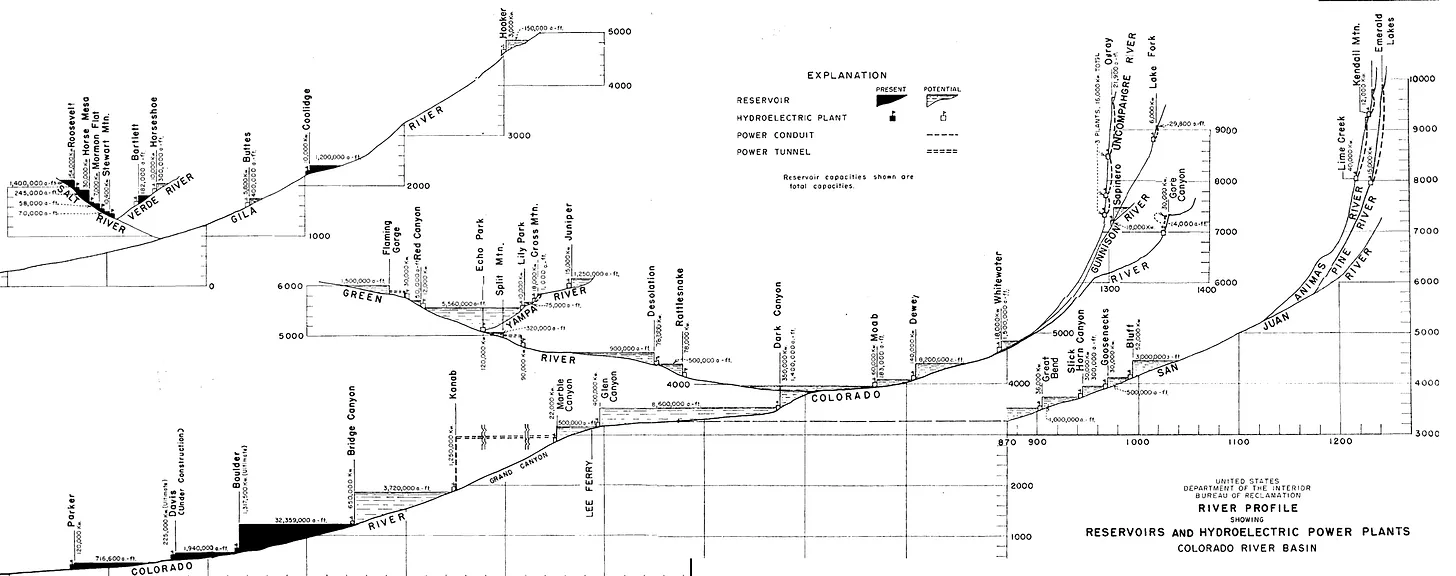
Zoom in on the profile and you’ll see that Glen Canyon Dam was still only an itch in Floyd Dominy’s proverbial pants. It got built not long afterward, though. Also proposed: The Marble Canyon and Bridge Canyon Dams in the upper and lower Grand Canyon, respectively; a whole series of dams on the lower San Juan River; the Echo Park Dam on the Green and Yampa; the Dark Canyon, Moab, Dewey, and Whitewater Dams on the Colorado River between Grand Junction and Glen Canyon; and the Desolation and Rattlesnake Dams on the Green River.
Had all those structures been built, there’d only be a handful of stretches of actual river remaining. Yikes!

Silverton’s 1996 water scare died down after the rains came that year. Had the call actually gone through, though, the town would have had an interesting way of keeping its water taps from going dry. The Sunnyside Mine would open up the valve on its American Tunnel bulkhead and release the required volume of water from the mine pool — a 1,200-foot-deep underground reservoir of water backed up inside the byzantine workings of the Sunnyside Mine.
It just goes to show you that water in the West is important and that Western water law is weird.