Water managers deadlocked on #ColoradoRiver: Both Upper and Lower basin reps say their alternative is best — Heather Sackett (@AspenJournalism) #CRWUA2024 #COriver #aridification

Attendees of the Colorado River Water Users Association watch negotiators Estevan Lopez of New Mexico and Becky Mitchell of Colorado speak on a panel Thursday at the Paris Hotel and Casino. The Upper and Lower basin states are at an impasse about how cuts will be shared and reservoirs operated after 2026. CREDIT: LUKE RUNYON/THE WATER DESK

Click the link to read the article on the Aspen Journalism website (Heather Sackett):

December 5, 2024

At the largest annual gathering of the basin’s water managers on Thursday, speakers invoked Dr. Strangelove, the Hunger Games and Alice in Wonderland to convey the dire, darkly dystopian and illusory state of the negotiations for how the Colorado River will be shared in the future.

The seven representatives from the Upper Basin states (Colorado, New Mexico, Utah and Wyoming) and the Lower Basin states (California, Arizona and Nevada) are deadlocked in disagreement and for the first time in recent years did not appear on stage together at the Colorado River Water Users Association Conference at the Paris Hotel and Casino in Las Vegas. This year, representatives from the two basins had their own separate panels, underscoring their failure thus far to reach a consensus on how to share shortages and operate the nation’s two largest reservoirs, Lake Powell and Lake Mead, after 2026.

Each took the opportunity to double down and reiterate their differing positions laid out in competing proposals submitted to the U.S. Bureau of Reclamation in March. Lower Basin water managers say all seven states that use the Colorado River must share cuts under the driest conditions, while Upper Basin officials maintain they already take cuts in dry years because they are squeezed by climate change and shouldn’t have to share additional cuts because their states have never used the entire 7.5-million-acre-foot apportionment given to them by the Colorado River Compact.

“In the Upper Basin, it’s the Hunger Games,” said Colorado’s top negotiator Becky Mitchell. “We are hungry all the time. There is never enough.”

The two basins have not moved any closer to a consensus during their nine-month-long standoff. Mitchell said she had expected the seven state representatives to have their customary meeting before the conference started.

“I’ve been here since Monday thinking that we would be meeting all day Tuesday and that did not occur,” Mitchell told the Colorado delegation at a breakfast Thursday morning. “I am hopeful that we can still come together again to talk and work towards a mutually agreeable solution.”

Credit: USBR

The current river management guidelines were developed in response to drought conditions in the first years of the 20th century and set shortage tiers based on reservoir levels that spell out which states in the Lower Basin will take cuts as levels fall. But these guidelines did not go far enough to protect reservoir levels from drought and climate change, and in 2022 Lake Powell flirted with falling below a critical elevation to make hydropower.
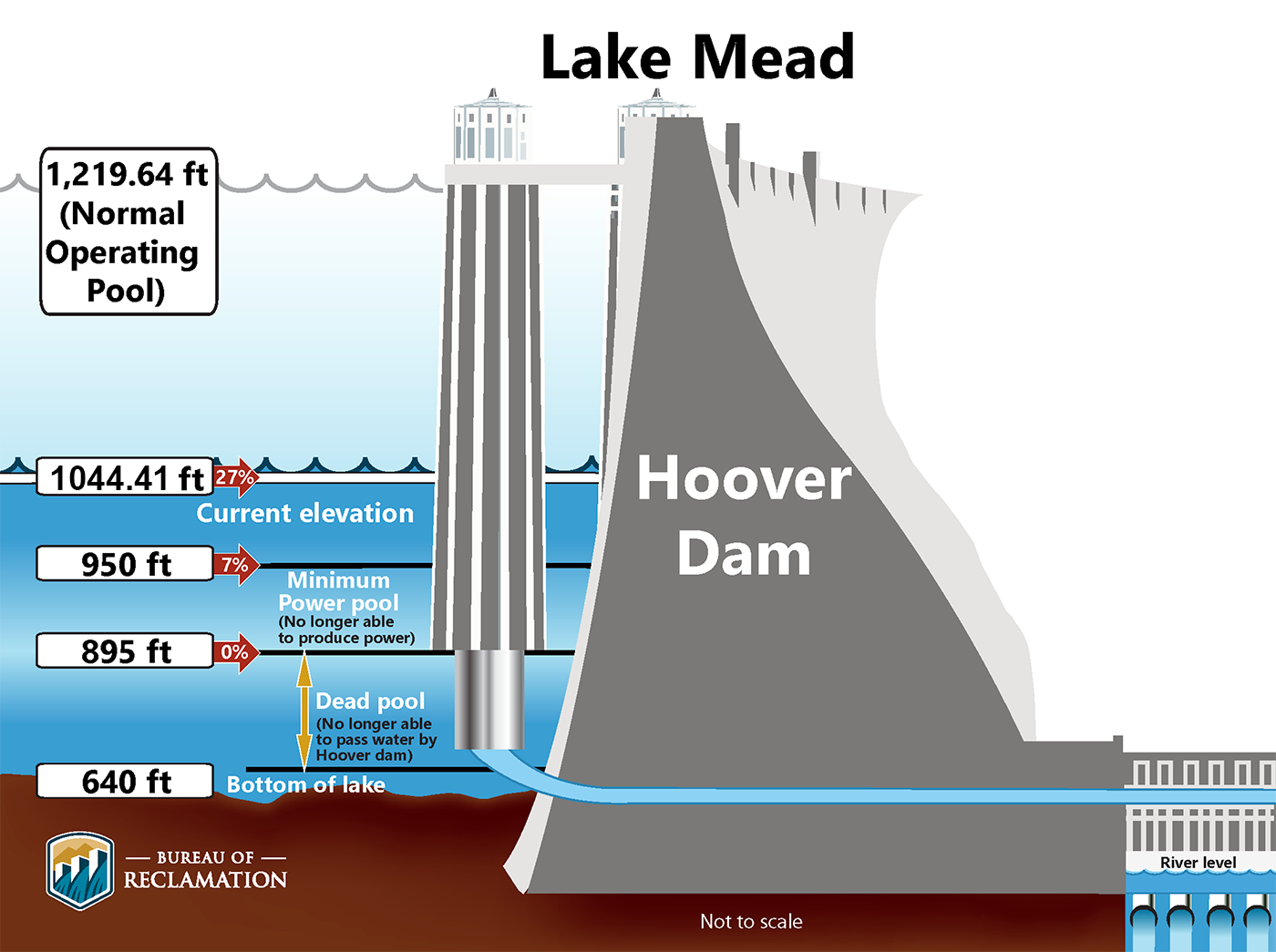
Lake Mead key elevations. Credit: USBR

Perhaps to spur the basin states toward a solution, in November, Reclamation released an outline of five potential paths forward, including a “No Action” alternative, which is unlikely to be chosen. None of the management options adopted either the Upper or Lower basin proposals, but instead include a “basin hybrid” that is a mash up of elements from both.

Proposed coordinated reservoir operations for Lake Powell and Lake Mead from Carly Jerla at the Colorado River Water Users Association Conference December 5, 2024.

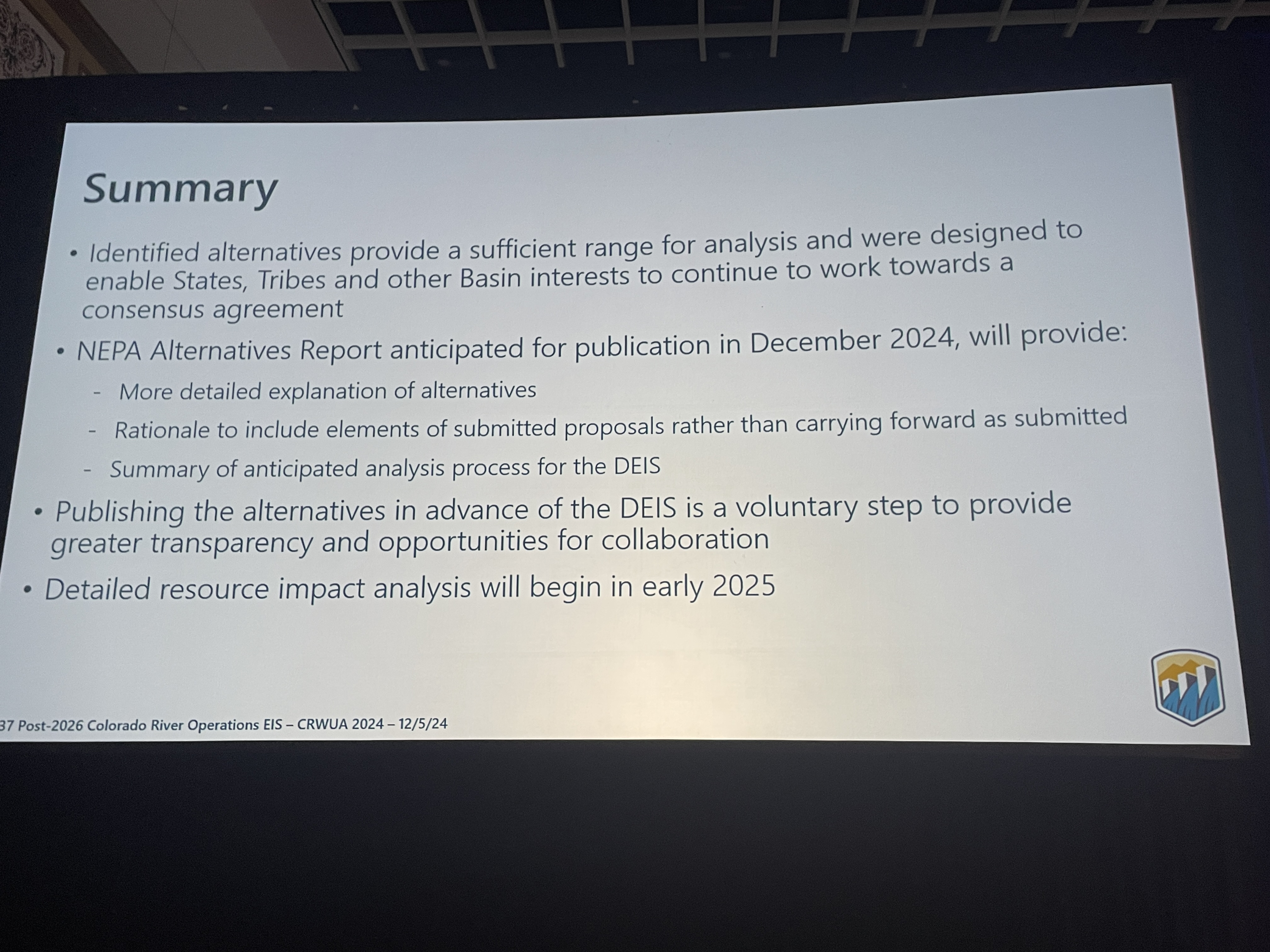
Carly Jerla, a senior program manager with Reclamation gave an overview of each of the options Thursday and said the agency intends to publish a report with more detail on the alternatives by the end of the year. Maximum cuts could range from 2.1 million acre-feet to 4 million acre-feet and could be shared based strictly on priority of who has the oldest rights or distributed proportionally across all seven states.

Upper Basin officials said in a prepared statement that they cannot speak directly to Reclamation’s potential alternatives and need more information before they can analyze them.

“The Upper Division States continue to stand firmly behind the concepts embodied in the Upper Division States’ Alternative, which performs best according to Reclamation’s own modeling and directly meets the purpose and need of the federal action,” the statement reads.
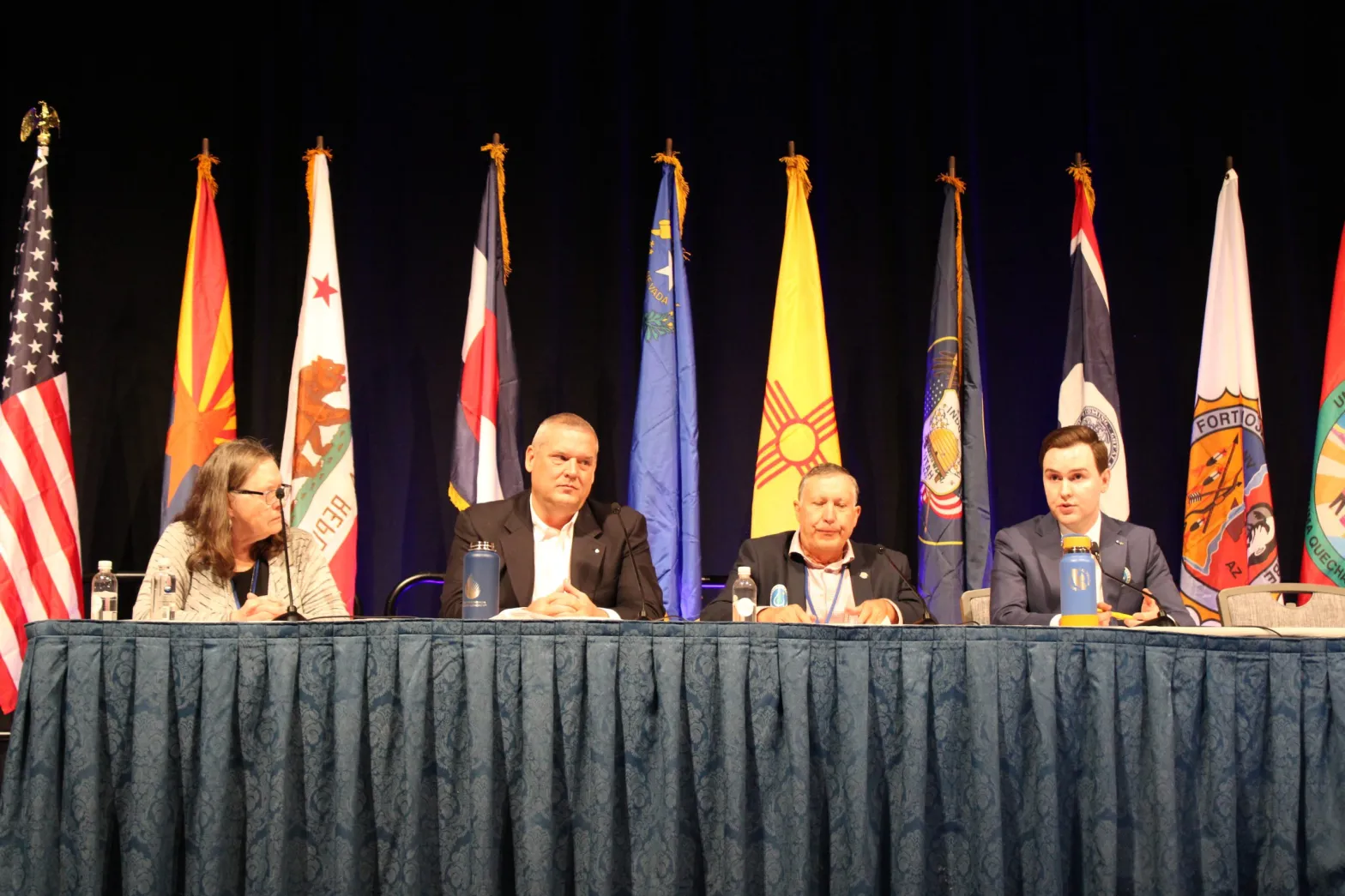
The negotiators from the Lower Colorado River Basin states speak on a panel Thursday at the Colorado River Water Users Association Conference in Las Vegas. From left, panel moderator Jennifer Gimbel, John Entsminger of Nevada, Tom Buschatzke of Arizona and JB Hamby of California. CREDIT: LUKE RUNYON/THE WATER DESK

Reclamation officially kicked off the post-2026 guidelines development process in June 2023 with a Notice of Intent. The current guidelines expire at the end of 2026 and new ones must be in place by August of that year, meaning water managers have just over a year and a half to complete the National Environmental Review Act process for implementing new management rules.

“We have a year and a half left to identify a preferred alternative, put out a draft EIS, put out a final EIS, develop the implementation and adopt a record of decision,” Jerla said. “So we need to be moving as a basin a lot faster in the second half than we did in our first half.”

On their panel, Lower Basin representatives gave an overview of their proposed alternative, plus their water conservation tallies over the past two decades, some of which was forced by the shortage agreements under the current guidelines.

“We’re asking the Upper Basin to come with us to help further protect the river, but only in those really hot, dry (years),” said Tom Buschatzke, Arizona’s top negotiator.

At this year’s conference, there was talk about the longtime elephant in the room, something Colorado River water managers have previously said they want to avoid at all costs: litigation over the Colorado River Compact. Upper Basin water managers believe that as long as they don’t use more than the 7.5 million acre-feet allocated to them, they will not be in violation of the compact. But Lower Basin officials believe that regardless of the Upper Basin’s use, the upstream states could be subject to a compact call if they don’t deliver 7.5 million acre-feet a year.

As river flows continue to decline due to climate change, the basin states could be inching closer to a compact call, which could force cuts on the Upper Basin.

Buschatzke addressed his September request of Arizona Gov. Katie Hobbs to set aside $1 million for litigation in case of a compact call.

“Compact compliance is out there, it is a potential issue,” Buschatzke said. “I have to do my due diligence for all potential outcomes.”

But the principals remained committed to finding agreement among the seven states. Top Nevada negotiator John Entsminger said he wants the Upper Basin states to know he’s not looking for a fight.

“I want everybody from the Upper Basin to hear from Nevada: We believe compromise is possible,” he said. “We think it’s the first, second and third best option. But we need a dance partner. So let’s get back to the table and make this happen.”

Map of the Colorado River drainage basin, created using USGS data. By Shannon1 Creative Commons Attribution-Share Alike 4.0

Water negotiators spar as time runs out to stabilize #ColoradoRiver — The Las Vegas Review-Journal #CRWUA2024 #COriver #aridification

Carly Jerla speaking at the Colorado River Water User’s Association Conference December 5, 2024. Photo credit: USBR

Click the link to read the article on the Las Vegas Review-Journal website (Alan Halaly). Here’s an excerpt:

December 5, 2024

At the second day of the Colorado River Water Users Association conference, the Bureau of Reclamation provided more details about its five proposed paths forward for post-2026 river operating guidelines. And both the Upper and Lower Basin states spoke openly about their frustrations in separate panels about talks that haven’t yielded compromises needed to sustain the system that provides water to more than 40 million people, including Las Vegas residents. Rather than considering the competing proposals set forth by the Lower and Upper basins this year, the bureau put together a “Basin Hybrid” plan that regulators feel is the beginning of a compromise. Some have suggested that the disagreement could result in a costly Supreme Court case against the federal government…

The fate of the Colorado River is something that would directly affect Southern Nevada, a region of the state that sources 90 percent of its water from Lake Mead. Scientists say the river has faced unprecedented shortages in the 2020s, with less water available for use than ever because of climate change and historic overuse. Thus, the need for sweeping changes to 2007 operating guidelines that will no longer apply in 2026.

The structural deficit refers to the consumption by Lower Basin states of more water than enters Lake Mead each year. The deficit, which includes losses from evaporation, is estimated at 1.2 million acre-feet a year. (Image: Central Arizona Project circa 2019)

Depending on how conversations proceed, the Lower Basin states of Nevada, California and Arizona could continue to bear the brunt of mandatory cuts to their allocations from the river. The Lower Basin has proposed basin-wide cuts should a shortage exceed 1.5 million acre-feet, the amount of water known as the “structural deficit” that the river loses to evaporation and transport…The Upper Basin states of Colorado, New Mexico, Utah and Wyoming have argued that declining snowpack and a lack of reservoir storage already set them back 1.2 million acre-feet. Northern states have floated putting more dams and reservoirs on the river that could, in total, store the equivalent of Nevada’s allotment from the river.

“We really need to understand that the enemy we’re battling right now is not the Upper Basin; it’s not the Lower Basin. It’s hydrology,” said Brandon Gebhart, Wyoming’s state engineer and Colorado River negotiator. “All of the rhetoric and other distractions going on right now are [bullshit]. It needs to stop.”

Carly Jerla’s summary slide at the Colorado Water User’s Association Conference December 5, 2024.

Experts urge caution in taking #ColoradoRiver negotiations to U.S. Supreme Court — The Las Vegas Review-Journal #COriver #aridification #CRWUA2024

Map credit: AGU

Click the link to read the article on the Las Vegas Review-Journal website (Alan Halaly). Here’s an excerpt:

December 5, 2024

Most who work on the Colorado River concur: A courtroom is the last place decisions about water should be made. But as total agreement between the Upper and Lower Basin seems more like a pipe dream with each passing month, a court battle has become a possibility while U.S. states, Native American tribes and Mexico chart a path forward as operating guidelines for the river expire in 2026. It would be an expensive, decadeslong legal fight against the Bureau of Reclamation’s decision that would likely make its way to the Supreme Court. At the annual Colorado River Water Users Association conference in Las Vegas on Wednesday, a panel of legal experts who have worked on interstate water cases spoke about the challenges such a case might bring. The bottom line: Engineers are far better equipped to solve water issues than judges, and all efforts should be made to keep post-2026 Colorado River negotiations out of the courtroom.

“The court has a limited understanding of technical water cases,” said Jeff Kightlinger, ex-general manager of the Metropolitan Water District of Southern California. “It has a very limited ability to draft nuanced, long-term solutions.”

[…]

“New plot using the nClimGrid data, which is a better source than PRISM for long-term trends. Of course, the combined reservoir contents increase from last year, but the increase is less than 2011 and looks puny compared to the ‘hole’ in the reservoirs. The blue Loess lines subtly change. Last year those lines ended pointing downwards. This year they end flat-ish. 2023 temps were still above the 20th century average, although close. Another interesting aspect is that the 20C Mean and 21C Mean lines on the individual plots really don’t change much. Finally, the 2023 Natural Flows are almost exactly equal to 2019. (17.678 maf vs 17.672 maf). For all the hoopla about how this was record-setting year, the fact is that this year was significantly less than 2011 (20.159 maf) and no different than 2019” — Brad Udall

The breakdown of talks between the Upper and Lower Basin states has centered on whether the Upper Basin states should be required to take cuts to their allocations from the river as climate change reduces water availability…Arizona’s [Tom Buschatzke], however, has publicly signaled that the state is eyeing $1 million in state funds to retain a lawyer if it becomes necessary. But that doesn’t mean leaders are satisfied with that option.

“I do not want litigation. There is uncertainty with litigation,” Arizona Department of Water Resources Director Tom Buschatzke said at a meeting earlier this year. “We see that in other basins, with judges running rivers. It’s not good for anybody.”